 Скачать презентацию IT Basics for Supply Networks 4 Dr Withalm IT
4541b7036e41eaff475180bb0e5b58b7.ppt
- Количество слайдов: 115



IT Basics for Supply Networks/4 Dr. Withalm IT Basics for Supply Networks
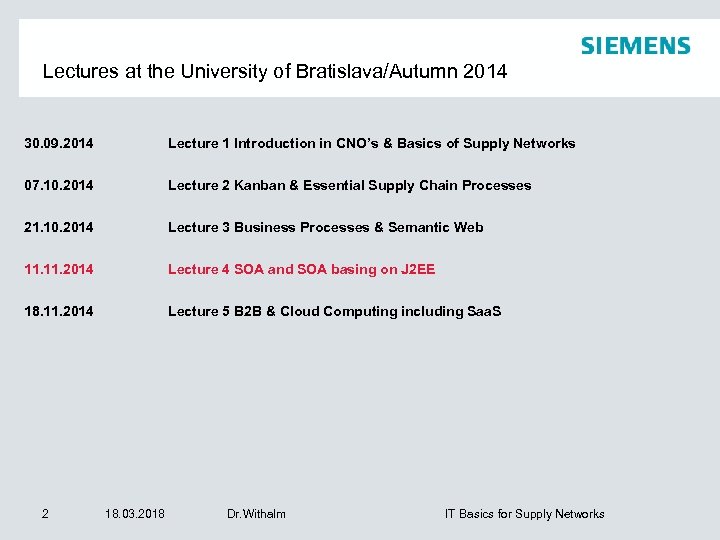
Lectures at the University of Bratislava/Autumn 2014 30. 09. 2014 Lecture 1 Introduction in CNO’s & Basics of Supply Networks 07. 10. 2014 Lecture 2 Kanban & Essential Supply Chain Processes 21. 10. 2014 Lecture 3 Business Processes & Semantic Web 11. 2014 Lecture 4 SOA and SOA basing on J 2 EE 18. 11. 2014 Lecture 5 B 2 B & Cloud Computing including Saa. S 2 18. 03. 2018 Dr. Withalm IT Basics for Supply Networks
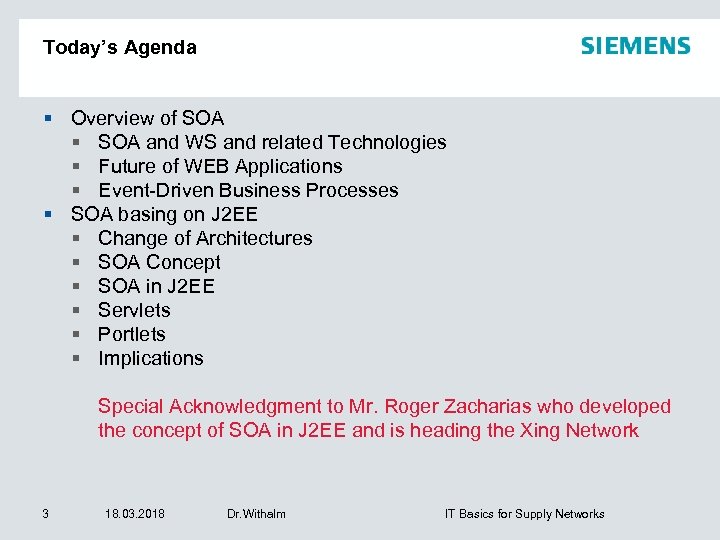
Today’s Agenda Overview of SOA and WS and related Technologies Future of WEB Applications Event-Driven Business Processes SOA basing on J 2 EE Change of Architectures SOA Concept SOA in J 2 EE Servlets Portlets Implications Special Acknowledgment to Mr. Roger Zacharias who developed the concept of SOA in J 2 EE and is heading the Xing Network 3 18. 03. 2018 Dr. Withalm IT Basics for Supply Networks
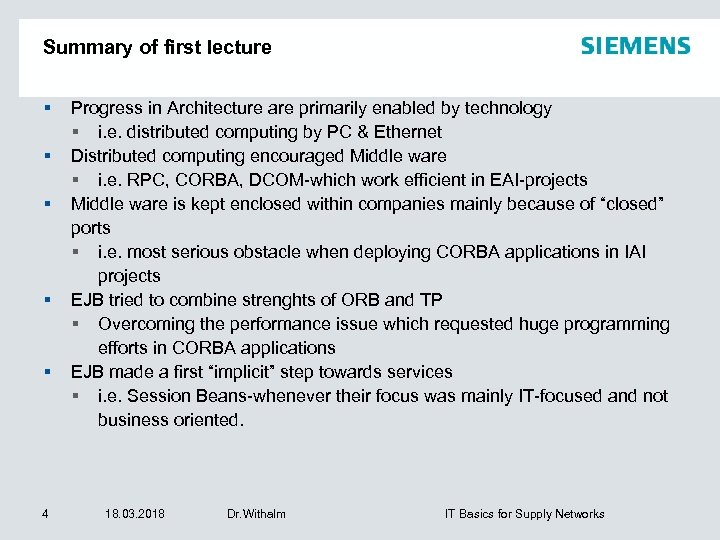
Summary of first lecture 4 Progress in Architecture are primarily enabled by technology i. e. distributed computing by PC & Ethernet Distributed computing encouraged Middle ware i. e. RPC, CORBA, DCOM-which work efficient in EAI-projects Middle ware is kept enclosed within companies mainly because of “closed” ports i. e. most serious obstacle when deploying CORBA applications in IAI projects EJB tried to combine strenghts of ORB and TP Overcoming the performance issue which requested huge programming efforts in CORBA applications EJB made a first “implicit” step towards services i. e. Session Beans-whenever their focus was mainly IT-focused and not business oriented. 18. 03. 2018 Dr. Withalm IT Basics for Supply Networks
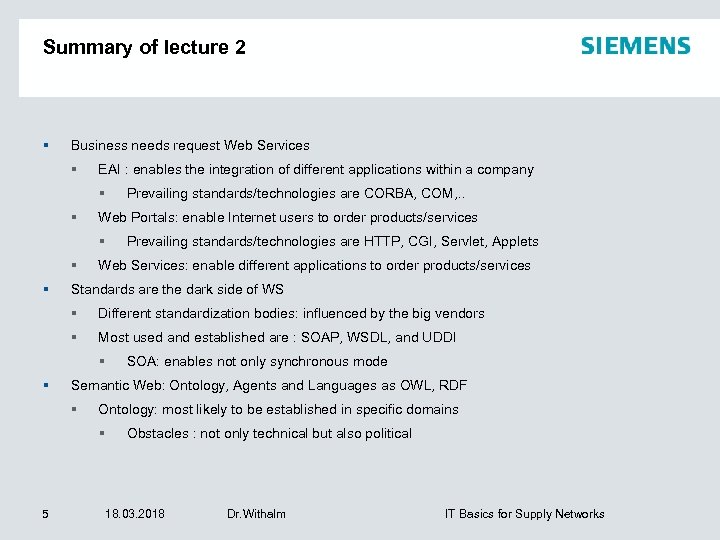
Summary of lecture 2 Business needs request Web Services EAI : enables the integration of different applications within a company Web Portals: enable Internet users to order products/services Prevailing standards/technologies are CORBA, COM, . . Prevailing standards/technologies are HTTP, CGI, Servlet, Applets Web Services: enable different applications to order products/services Standards are the dark side of WS Different standardization bodies: influenced by the big vendors Most used and established are : SOAP, WSDL, and UDDI Semantic Web: Ontology, Agents and Languages as OWL, RDF Ontology: most likely to be established in specific domains 5 SOA: enables not only synchronous mode Obstacles : not only technical but also political 18. 03. 2018 Dr. Withalm IT Basics for Supply Networks
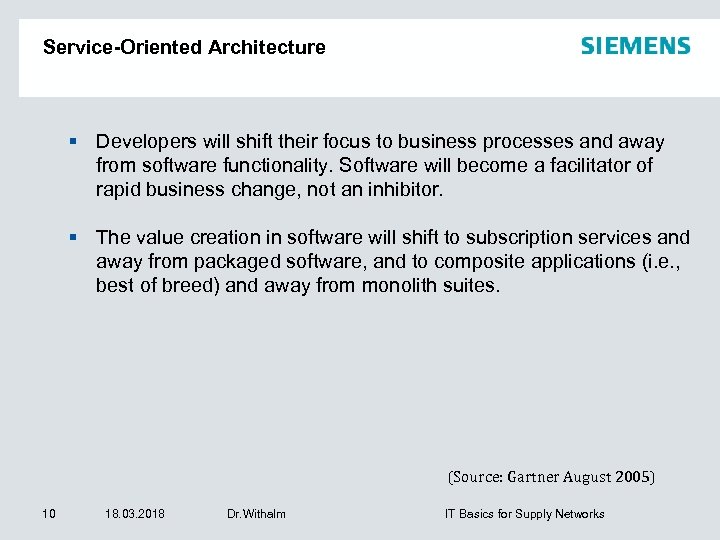
Service-Oriented Architecture Developers will shift their focus to business processes and away from software functionality. Software will become a facilitator of rapid business change, not an inhibitor. The value creation in software will shift to subscription services and away from packaged software, and to composite applications (i. e. , best of breed) and away from monolith suites. (Source: Gartner August 2005) 10 18. 03. 2018 Dr. Withalm IT Basics for Supply Networks
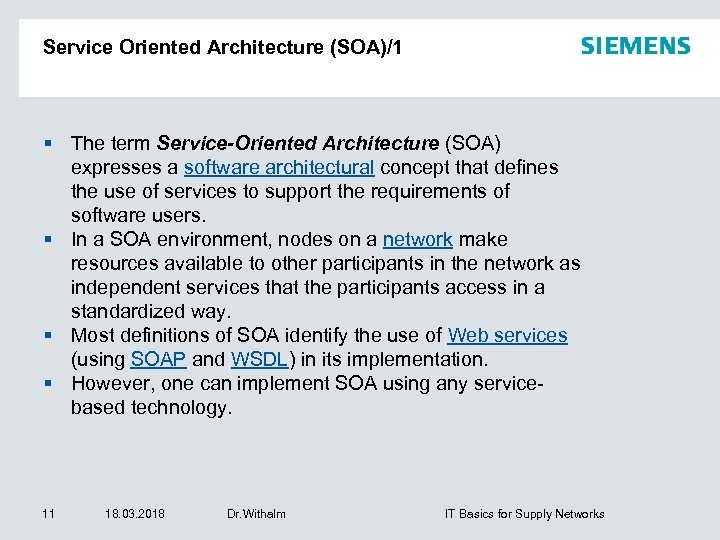
Service Oriented Architecture (SOA)/1 The term Service-Oriented Architecture (SOA) expresses a software architectural concept that defines the use of services to support the requirements of software users. In a SOA environment, nodes on a network make resources available to other participants in the network as independent services that the participants access in a standardized way. Most definitions of SOA identify the use of Web services (using SOAP and WSDL) in its implementation. However, one can implement SOA using any servicebased technology. 11 18. 03. 2018 Dr. Withalm IT Basics for Supply Networks
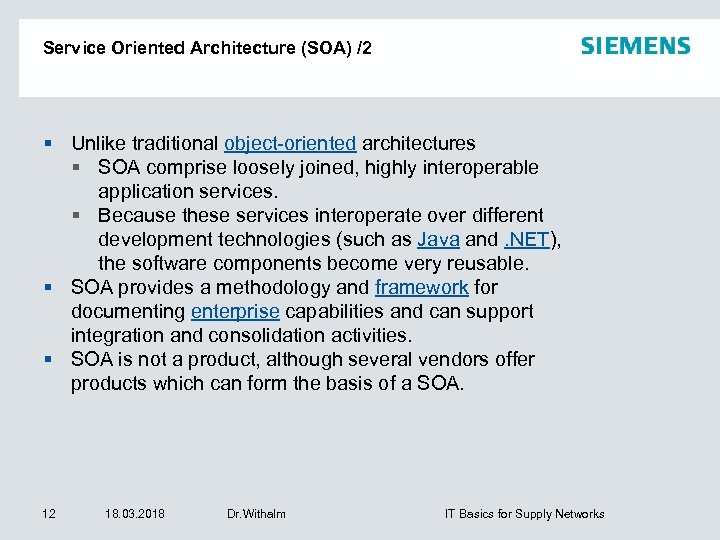
Service Oriented Architecture (SOA) /2 Unlike traditional object-oriented architectures SOA comprise loosely joined, highly interoperable application services. Because these services interoperate over different development technologies (such as Java and. NET), the software components become very reusable. SOA provides a methodology and framework for documenting enterprise capabilities and can support integration and consolidation activities. SOA is not a product, although several vendors offer products which can form the basis of a SOA. 12 18. 03. 2018 Dr. Withalm IT Basics for Supply Networks
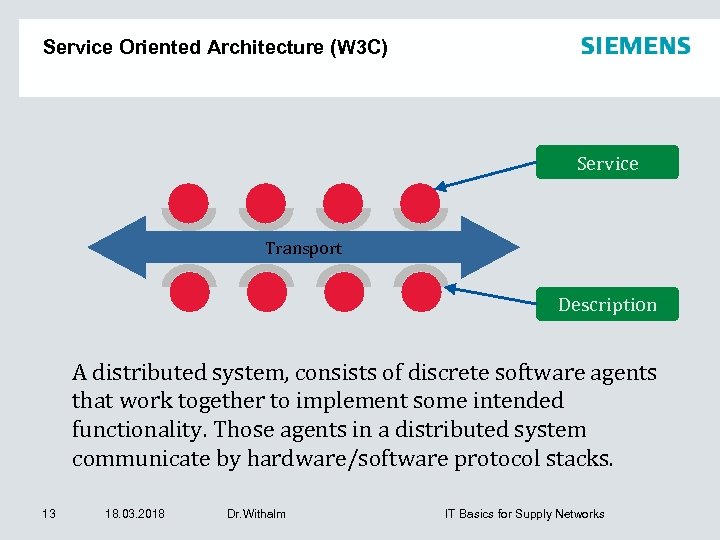
Service Oriented Architecture (W 3 C) Service Transport Description A distributed system, consists of discrete software agents that work together to implement some intended functionality. Those agents in a distributed system communicate by hardware/software protocol stacks. 13 18. 03. 2018 Dr. Withalm IT Basics for Supply Networks
SOA Core Principles Business Driven The business drives the services, and the services drive the technology. Bussiness Agility Business agility is a fundamental business requirement. Constant Change A successful SOA is always in flux. 14 18. 03. 2018 Dr. Withalm IT Basics for Supply Networks
Business Driven The business drives the services, and the services drive the technology. In essence, services act as a layer of abstraction between the business and the technology. The service-oriented architect must understand the dynamic relationships between the needs of the business and the available services on the one hand, as well as the technical underpinnings that offer the layer of abstraction required by the services. 15 18. 03. 2018 Dr. Withalm IT Basics for Supply Networks
Business Agility Business agility is a fundamental business requirement. Instead of dealing with concrete requirements from business, SOA considers the next level of abstraction: The ability to respond to changing requirements is the new ''meta-requirement. '' The entire architecture -- from the hardware on up -must reflect the business agility requirement. 16 18. 03. 2018 Dr. Withalm IT Basics for Supply Networks
Constant Change A successful SOA is always in flux. To visualize how a SOA is supposed to work, it is better to think of a living organism or an ecosystem rather than the traditional ''building a house'' metaphor that gave software architecture its name. IT environments are in a constant state of change, so the work of a service-oriented architect is never done. 17 18. 03. 2018 Dr. Withalm IT Basics for Supply Networks
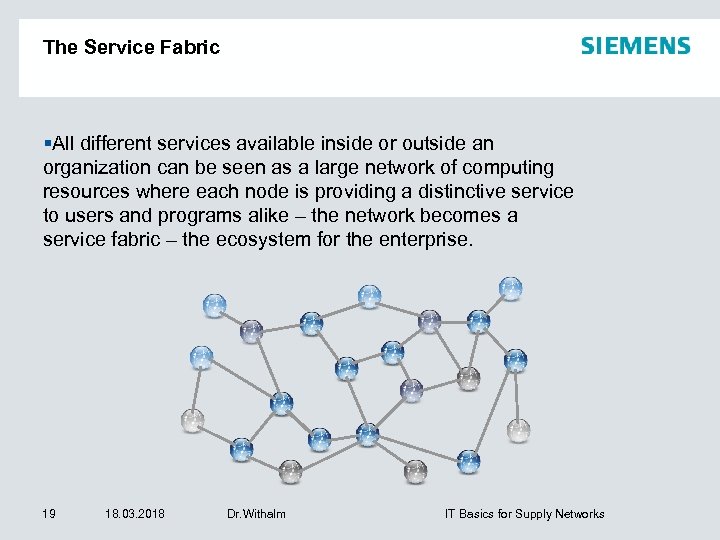
The Service Fabric All different services available inside or outside an organization can be seen as a large network of computing resources where each node is providing a distinctive service to users and programs alike – the network becomes a service fabric – the ecosystem for the enterprise. 19 18. 03. 2018 Dr. Withalm IT Basics for Supply Networks
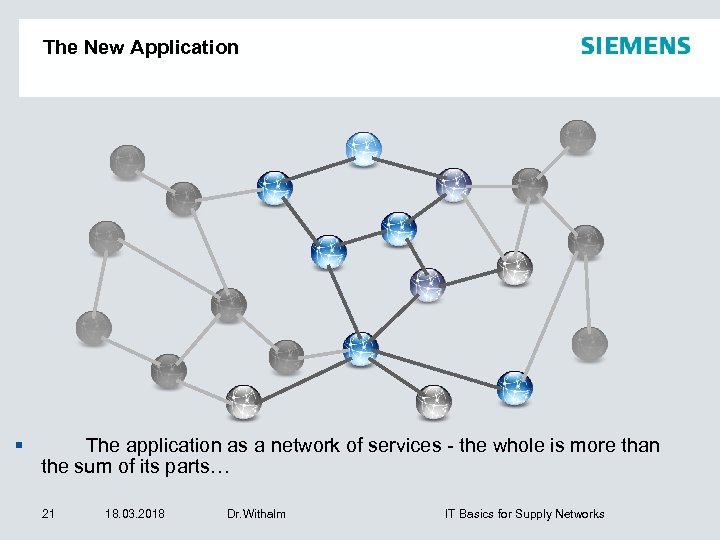
The New Application The application as a network of services - the whole is more than the sum of its parts… 21 18. 03. 2018 Dr. Withalm IT Basics for Supply Networks
Vision 22 The future of the application is the virtual collection of services based on the Service Oriented Architecture developed and enhanced on demand made available for service consumption in the service fabric of the Internet of tomorrow. 18. 03. 2018 Dr. Withalm IT Basics for Supply Networks
Service Categories User (Interface) Services Business (Logic) Services Data (Backend) Services 24 18. 03. 2018 Dr. Withalm IT Basics for Supply Networks
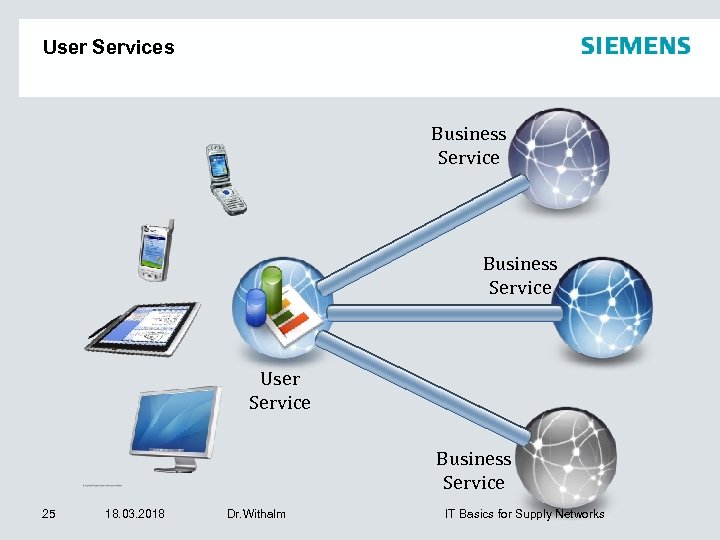
User Services Business Service User Service Business Service 25 18. 03. 2018 Dr. Withalm IT Basics for Supply Networks
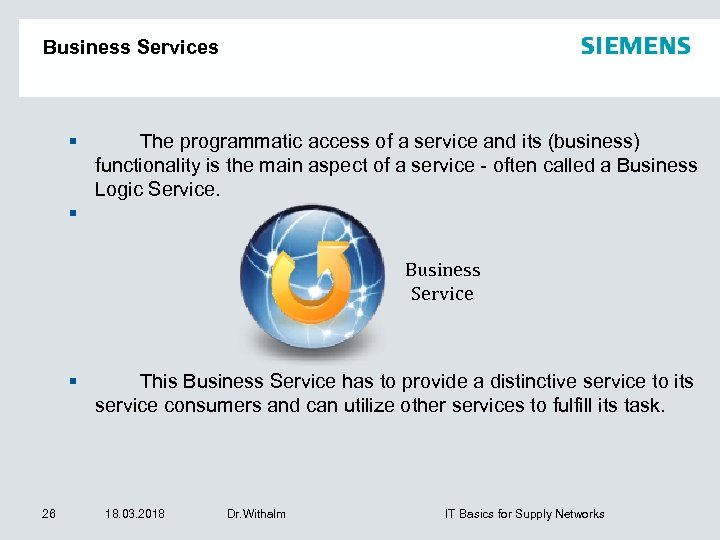
Business Services The programmatic access of a service and its (business) functionality is the main aspect of a service - often called a Business Logic Service. Business Service 26 This Business Service has to provide a distinctive service to its service consumers and can utilize other services to fulfill its task. 18. 03. 2018 Dr. Withalm IT Basics for Supply Networks
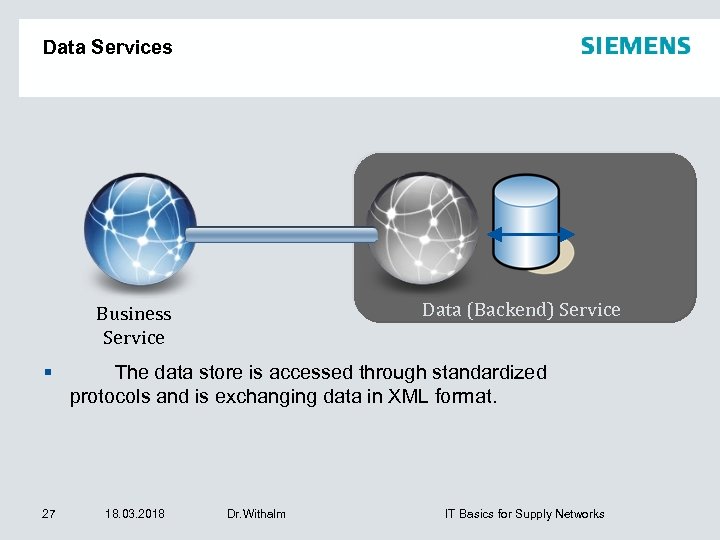
Data Services Data (Backend) Service Business Service 27 The data store is accessed through standardized protocols and is exchanging data in XML format. 18. 03. 2018 Dr. Withalm IT Basics for Supply Networks
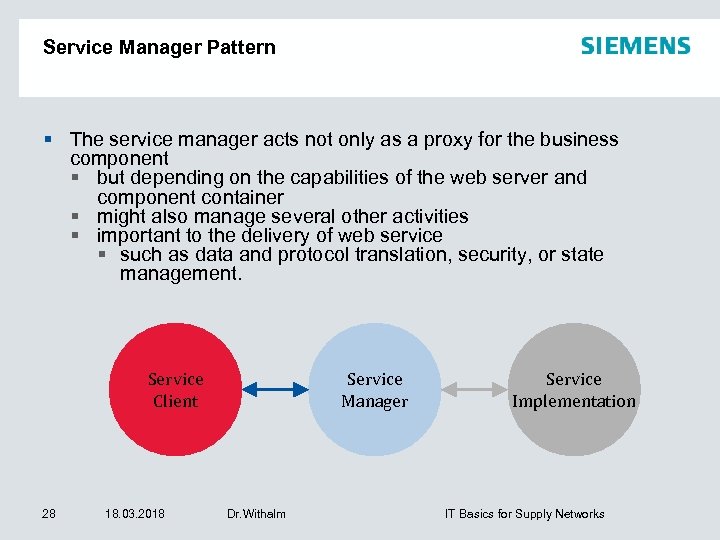
Service Manager Pattern The service manager acts not only as a proxy for the business component but depending on the capabilities of the web server and component container might also manage several other activities important to the delivery of web service such as data and protocol translation, security, or state management. Service Client 28 18. 03. 2018 Service Manager Dr. Withalm Service Implementation IT Basics for Supply Networks
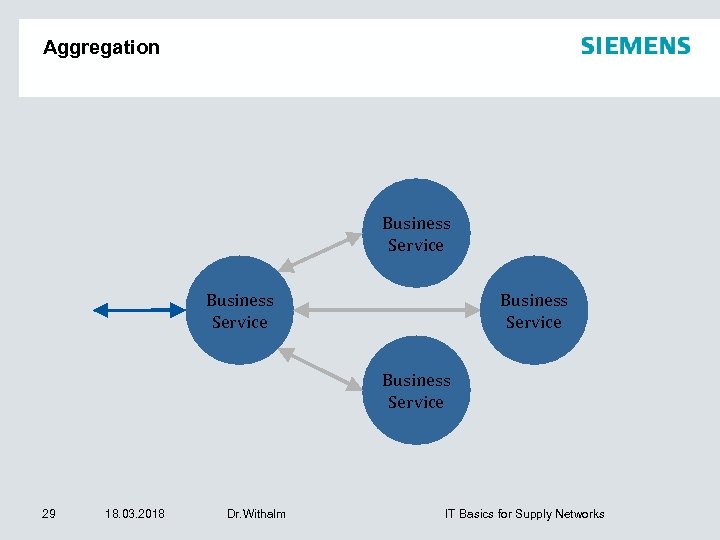
Aggregation Business Service 29 18. 03. 2018 Dr. Withalm IT Basics for Supply Networks
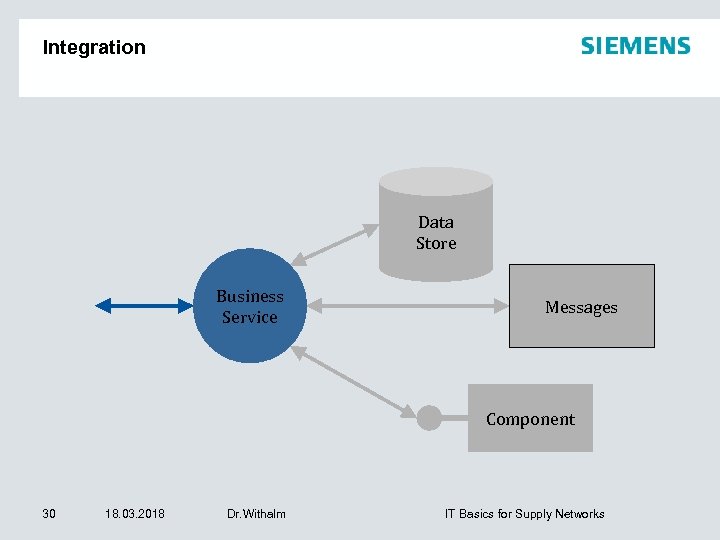
Integration Data Store Business Service Messages Component 30 18. 03. 2018 Dr. Withalm IT Basics for Supply Networks
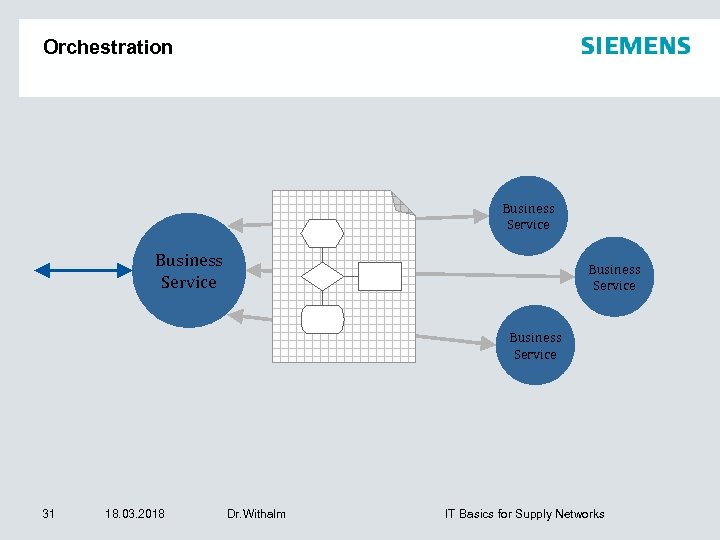
Orchestration Business Service 31 18. 03. 2018 Dr. Withalm IT Basics for Supply Networks
Services Orchestration and Choreography /1 No service is an island. The key point about service-oriented computing is that involves extended, loosely coupled activities among two or more autonomous business partners. Such activities can be thought of as (business) processes that engage several services in a manner that brings about the desired (business) outcome. 32 18. 03. 2018 Dr. Withalm IT Basics for Supply Networks
Services Orchestration and Choreography /2 Web services are rapidly emerging as the most practical approach for integrating a wide array of customer, vendor, and business-partner applications. While many companies have begun to deploy individual Web services, the real value will come when enterprises can connect services together, providing higher value to an organisation. 33 18. 03. 2018 Dr. Withalm IT Basics for Supply Networks
Services Orchestration and Choreography /3 In order to communicate and integrate services for achieving a collaboration between enterprises, it will be necessary to coordinate them, which involve the necessity of offering support to the services composition. Early experience shows that to make the most of new Web services investments there must be a standard approach to Web services composition. 34 18. 03. 2018 Dr. Withalm IT Basics for Supply Networks
Services Orchestration and Choreography /4 Orchestration/1 Refers to an executable business process that may interact with both internal and external Web services. Orchestration describes how Web services can interact at the message level, including the business logic and execution order of the interactions. 35 18. 03. 2018 Dr. Withalm IT Basics for Supply Networks
Services Orchestration and Choreography /5 Orchestration/2 These interactions organisations, may span applications and/or and result in a long-lived, transactional process. With orchestration, the process is always controlled from the perspective of one of the business parties. It takes the view of a process as a program or a partial order of operations that need to be executed. 36 18. 03. 2018 Dr. Withalm IT Basics for Supply Networks
Services Orchestration and Choreography/6 Choreography/1 More collaborative in nature, where each party involved in the process describes the part they play in the interaction. Choreography tracks the sequence of messages that may involve multiple parties and multiple sources. 37 18. 03. 2018 Dr. Withalm IT Basics for Supply Networks
Services Orchestration and Choreography/7 Choreography/2 It is associated with the public message exchanges that occur between multiple Web services. this takes the view of a process as being a set of message exchanges between participants. 38 18. 03. 2018 Dr. Withalm IT Basics for Supply Networks
Services Orchestration and Choreography/8 39 18. 03. 2018 Dr. Withalm IT Basics for Supply Networks
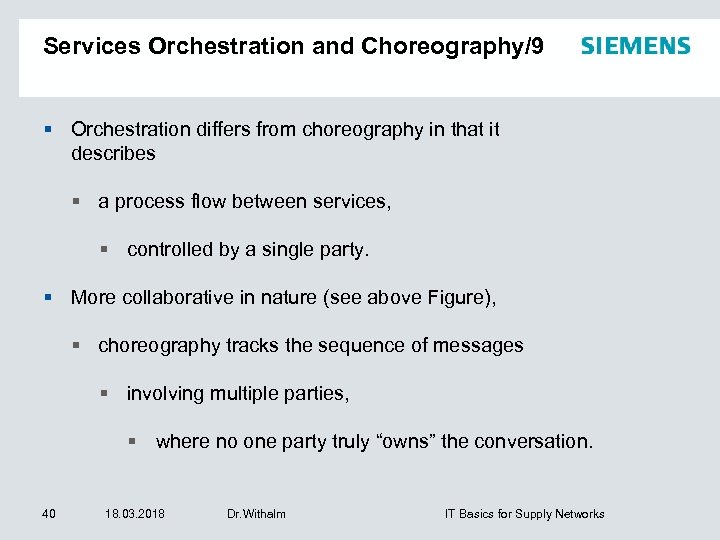
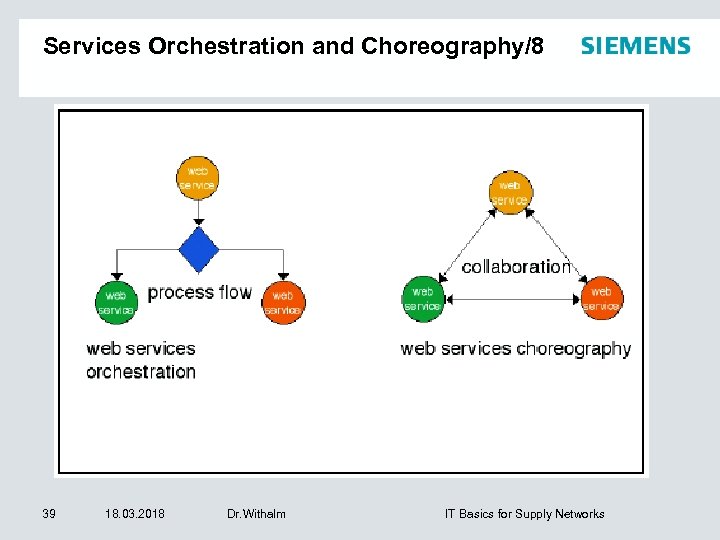
Services Orchestration and Choreography/9 Orchestration differs from choreography in that it describes a process flow between services, controlled by a single party. More collaborative in nature (see above Figure), choreography tracks the sequence of messages involving multiple parties, where no one party truly “owns” the conversation. 40 18. 03. 2018 Dr. Withalm IT Basics for Supply Networks
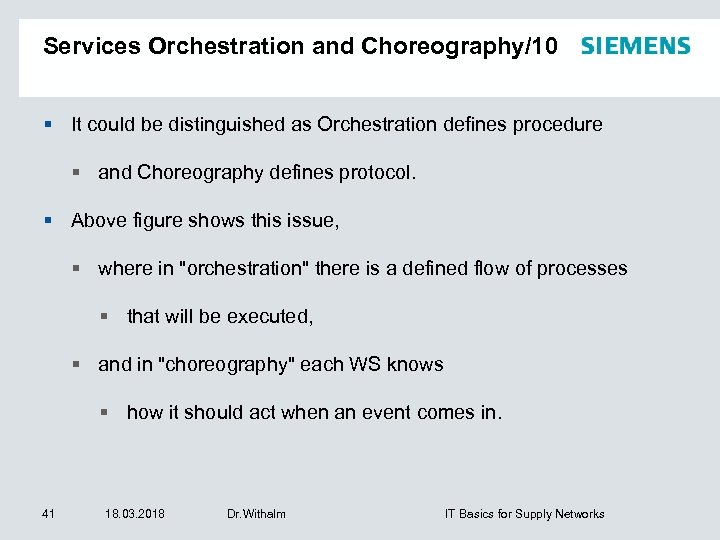
Services Orchestration and Choreography/10 It could be distinguished as Orchestration defines procedure and Choreography defines protocol. Above figure shows this issue, where in "orchestration" there is a defined flow of processes that will be executed, and in "choreography" each WS knows how it should act when an event comes in. 41 18. 03. 2018 Dr. Withalm IT Basics for Supply Networks
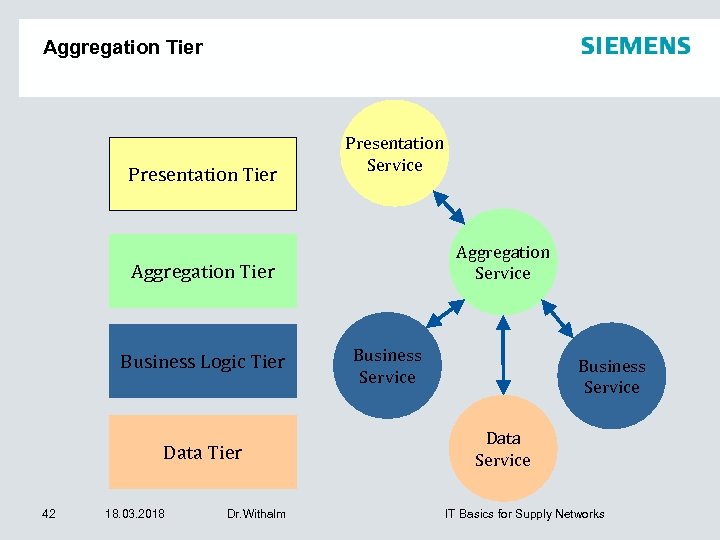
Aggregation Tier Presentation Service Aggregation Tier Business Logic Tier Data Tier 42 18. 03. 2018 Dr. Withalm Business Service Data Service IT Basics for Supply Networks
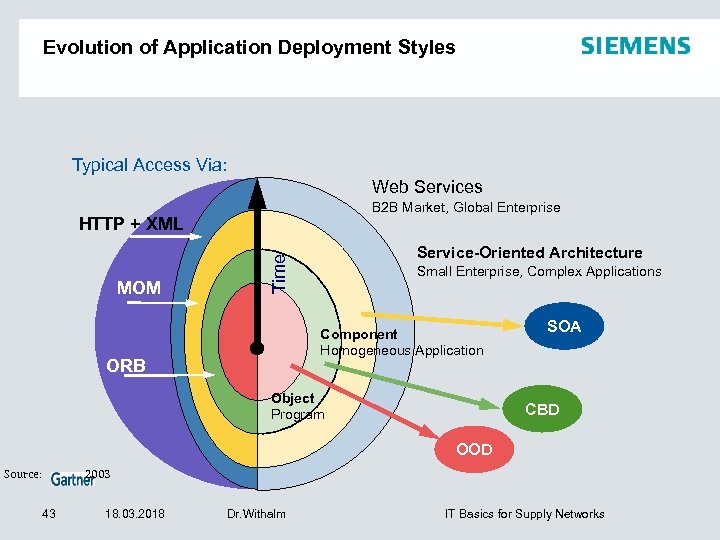
Evolution of Application Deployment Styles Typical Access Via: Web Services B 2 B Market, Global Enterprise HTTP + XML Time MOM Service-Oriented Architecture Small Enterprise, Complex Applications Component Homogeneous Application ORB Object Program SOA CBD OOD Source: 43 2003 18. 03. 2018 Dr. Withalm IT Basics for Supply Networks
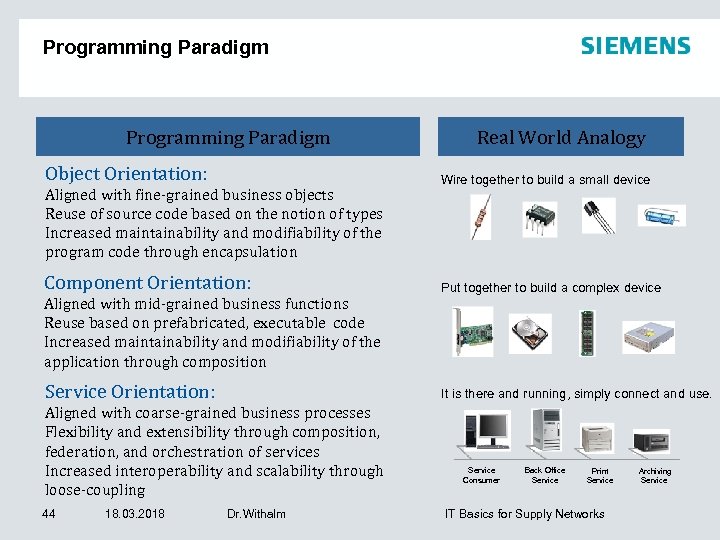
Programming Paradigm Object Orientation: Aligned with fine-grained business objects Reuse of source code based on the notion of types Increased maintainability and modifiability of the program code through encapsulation Component Orientation: Aligned with mid-grained business functions Reuse based on prefabricated, executable code Increased maintainability and modifiability of the application through composition Service Orientation: 18. 03. 2018 Wire together to build a small device Put together to build a complex device It is there and running, simply connect and use. Aligned with coarse-grained business processes Flexibility and extensibility through composition, federation, and orchestration of services Increased interoperability and scalability through loose-coupling 44 Real World Analogy Dr. Withalm Service Consumer Back Office Service Print Service IT Basics for Supply Networks Archiving Service
Programming Approaches/1 Declarative programming describes only the problem inference mechanism tries to solve the problem described provided by the respective program runtime environment e. g. Prolog 45 18. 03. 2018 Dr. Withalm IT Basics for Supply Networks
Programming Approaches/2 Event-driven programming reacts to outside events and takes corresponding action typical programs developed with this approach include 46 graphical user interfaces that react to user input control programs that react to external environmental conditions, e. g. to changes in temperature 18. 03. 2018 Dr. Withalm IT Basics for Supply Networks
Programming Approaches/3 Procedural programming Represents a sequential algorithm which is being executed step by step The execution of the algorithm is governed by data which can also be modified by the algorithm 47 18. 03. 2018 Dr. Withalm IT Basics for Supply Networks
Programming Approaches/4 Structured programming Extension of procedural programming The main problem is broken down into several sub problems each sub problem is solved Advantage: considerable simplification of individual algorithms functions, procedures or modules The overall program is also easier to maintain and service 48 18. 03. 2018 Dr. Withalm IT Basics for Supply Networks
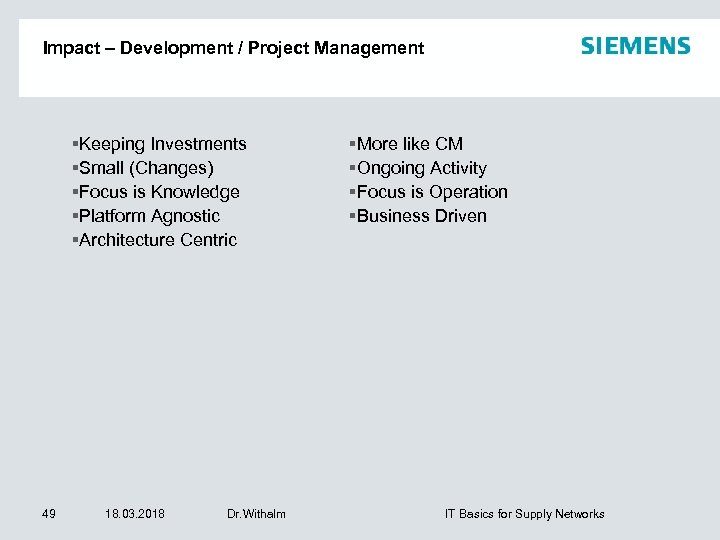
Impact – Development / Project Management Keeping Investments Small (Changes) Focus is Knowledge Platform Agnostic Architecture Centric 49 18. 03. 2018 Dr. Withalm More like CM Ongoing Activity Focus is Operation Business Driven IT Basics for Supply Networks
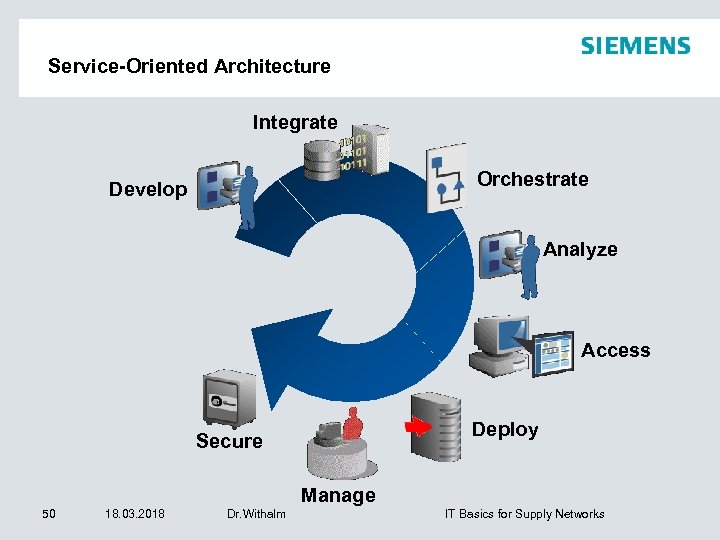
Service-Oriented Architecture Integrate Orchestrate Develop Analyze Access Deploy Secure Manage 50 18. 03. 2018 Dr. Withalm IT Basics for Supply Networks
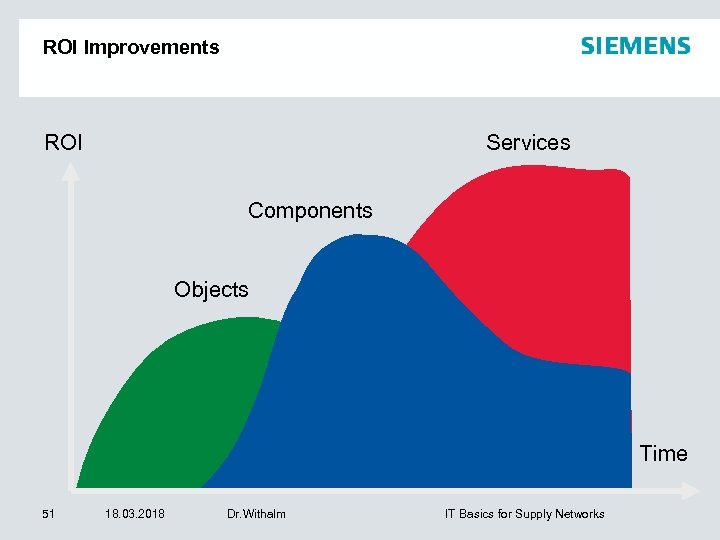
ROI Improvements ROI Services Components Objects Time 51 18. 03. 2018 Dr. Withalm IT Basics for Supply Networks
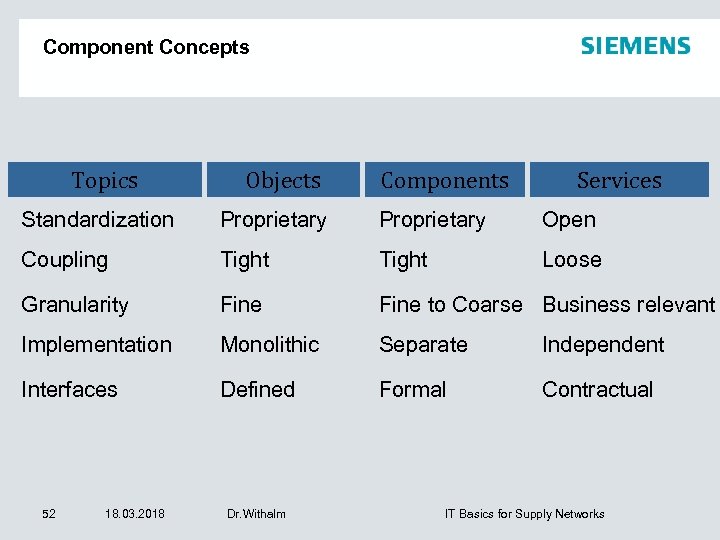
Component Concepts Topics Objects Components Services Standardization Proprietary Open Coupling Tight Loose Granularity Fine to Coarse Business relevant Implementation Monolithic Separate Independent Interfaces Defined Formal Contractual 52 18. 03. 2018 Dr. Withalm IT Basics for Supply Networks
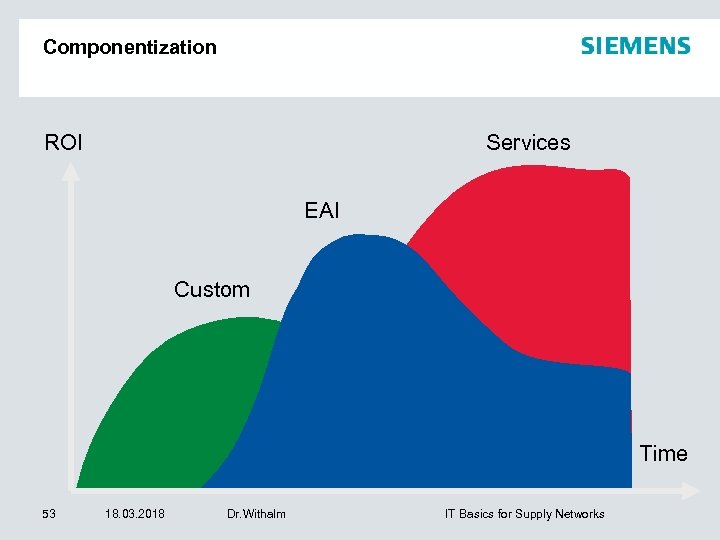
Componentization ROI Services EAI Custom Time 53 18. 03. 2018 Dr. Withalm IT Basics for Supply Networks
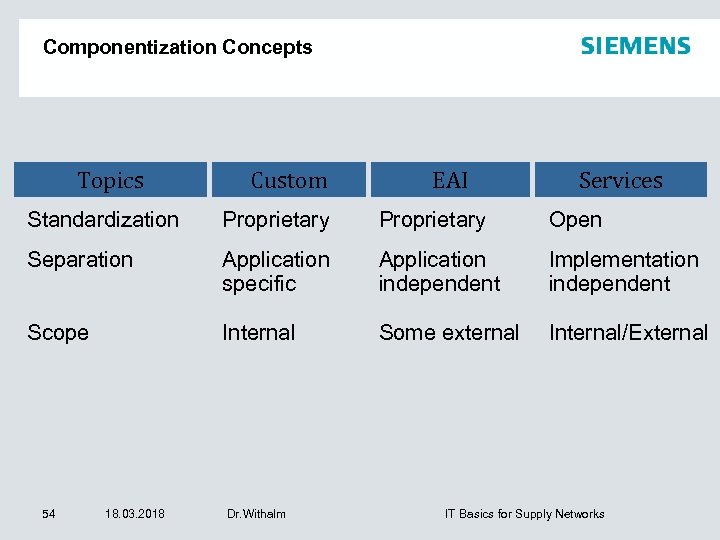
Componentization Concepts Topics Custom EAI Services Standardization Proprietary Open Separation Application specific Application independent Implementation independent Scope Internal Some external Internal/External 54 18. 03. 2018 Dr. Withalm IT Basics for Supply Networks
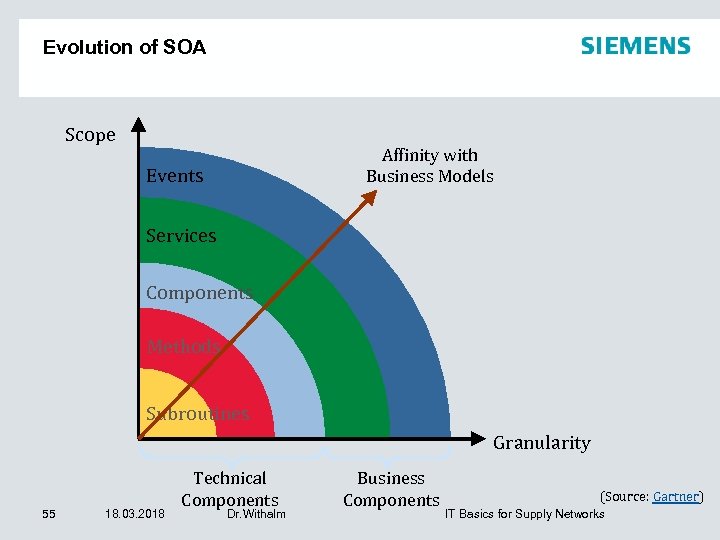
Evolution of SOA Scope Affinity with Business Models Events Services Components Methods Subroutines Granularity 55 18. 03. 2018 Technical Components Dr. Withalm Business Components (Source: Gartner) IT Basics for Supply Networks
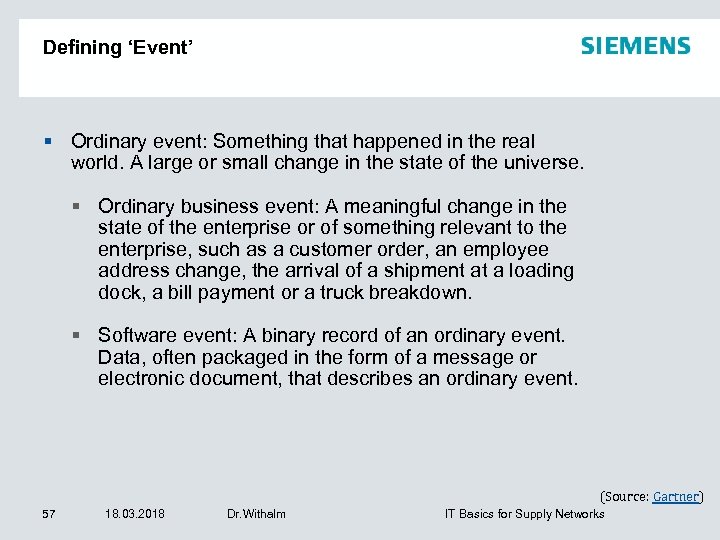
Defining ‘Event’ Ordinary event: Something that happened in the real world. A large or small change in the state of the universe. Ordinary business event: A meaningful change in the state of the enterprise or of something relevant to the enterprise, such as a customer order, an employee address change, the arrival of a shipment at a loading dock, a bill payment or a truck breakdown. Software event: A binary record of an ordinary event. Data, often packaged in the form of a message or electronic document, that describes an ordinary event. (Source: Gartner) 57 18. 03. 2018 Dr. Withalm IT Basics for Supply Networks
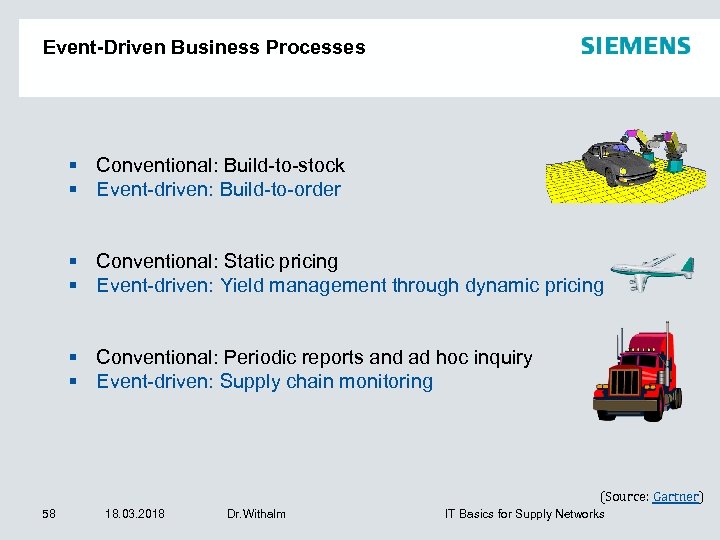
Event-Driven Business Processes Conventional: Build-to-stock Event-driven: Build-to-order Conventional: Static pricing Event-driven: Yield management through dynamic pricing Conventional: Periodic reports and ad hoc inquiry Event-driven: Supply chain monitoring (Source: Gartner) 58 18. 03. 2018 Dr. Withalm IT Basics for Supply Networks
Events Are Already Applied in Many Ways Event-Driven Business Processes (With or Without Computers) Work is triggered by a stimulus from outside. Event-Driven (or “Message-Driven”) Application Systems An application system organizes its flow around the sending and receiving of computer events. Event-Driven System Software Operating systems use event loops to schedule and dispatch internal services; management tools track the status of hardware and software components by listening to events. Event-Driven Function in an Application Program A particular section of a GUI application is triggered when a mouse is clicked on the associated screen icon. (Source: Gartner) 59 18. 03. 2018 Dr. Withalm IT Basics for Supply Networks
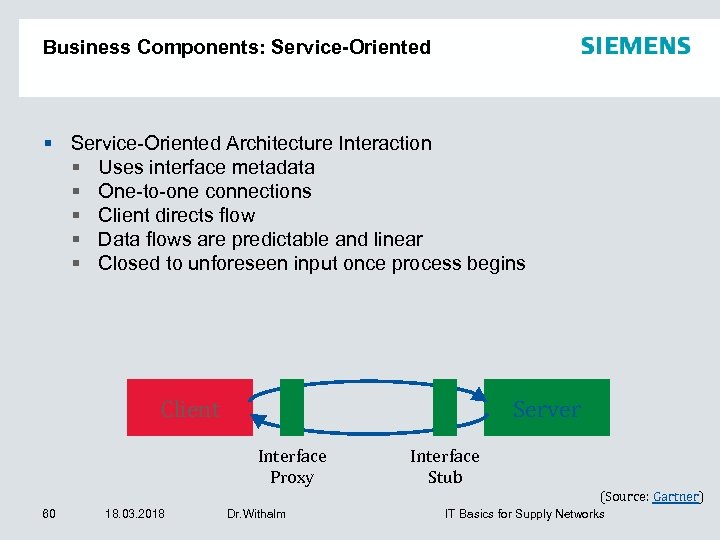
Business Components: Service-Oriented Architecture Interaction Uses interface metadata One-to-one connections Client directs flow Data flows are predictable and linear Closed to unforeseen input once process begins Client Server Interface Proxy Interface Stub (Source: Gartner) 60 18. 03. 2018 Dr. Withalm IT Basics for Supply Networks
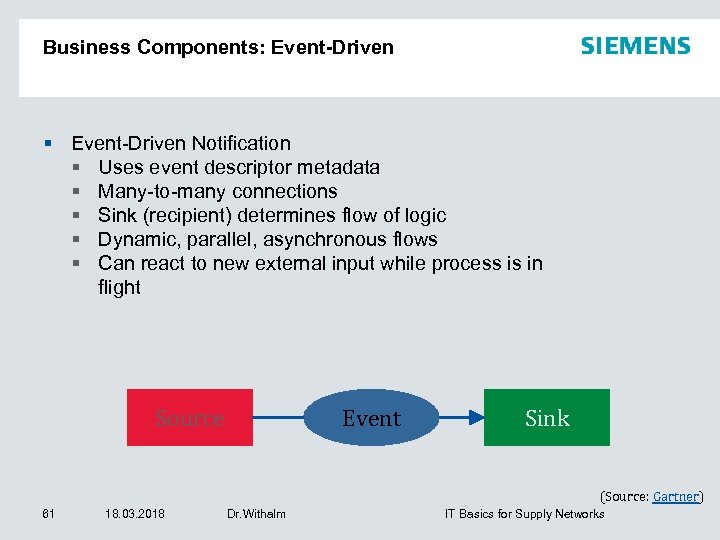
Business Components: Event-Driven Notification Uses event descriptor metadata Many-to-many connections Sink (recipient) determines flow of logic Dynamic, parallel, asynchronous flows Can react to new external input while process is in flight Source Event Sink (Source: Gartner) 61 18. 03. 2018 Dr. Withalm IT Basics for Supply Networks
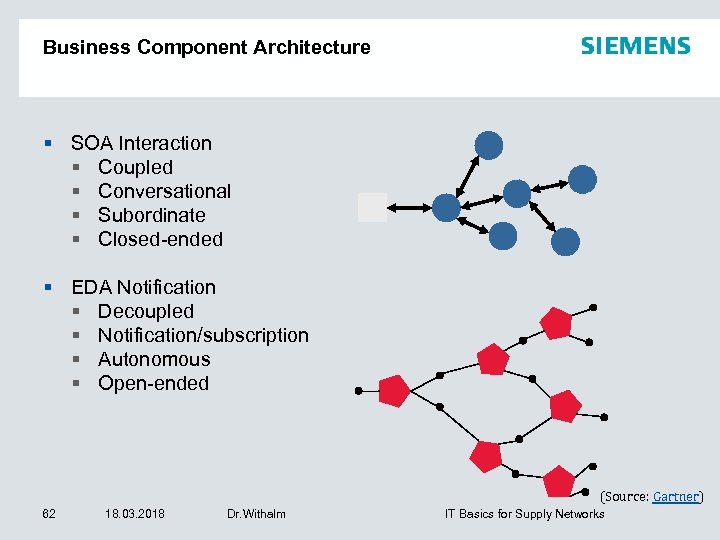
Business Component Architecture SOA Interaction Coupled Conversational Subordinate Closed-ended EDA Notification Decoupled Notification/subscription Autonomous Open-ended (Source: Gartner) 62 18. 03. 2018 Dr. Withalm IT Basics for Supply Networks
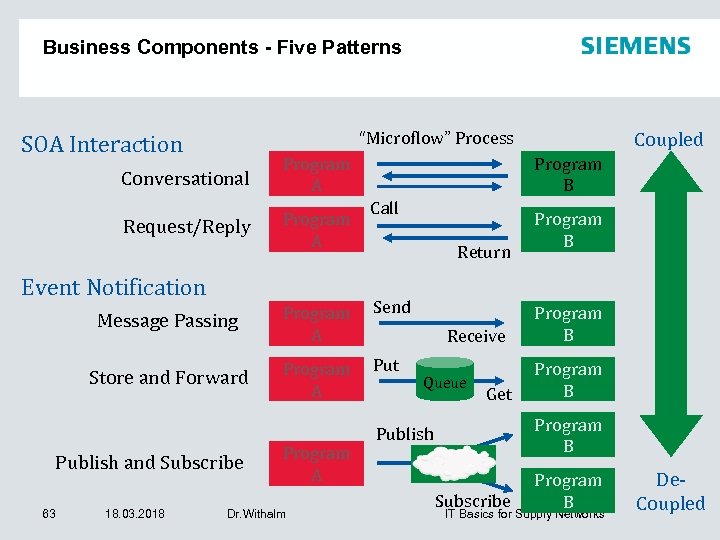
Business Components - Five Patterns “Microflow” Process SOA Interaction Conversational Program A Request/Reply Program A Event Notification Program B Call Return Message Passing Program A Send Store and Forward Program A Put Publish and Subscribe 63 18. 03. 2018 Program A Dr. Withalm Coupled Receive Queue Get Program B Publish Subscribe Program B IT Basics for Supply Networks De. Coupled
Enterprise Service Bus (ESB) An Enterprise Service Bus is an emerging standard for integrating enterprise applications in an implementation-independent fashion at a coarse-grained service level (leveraging the principles of service-oriented architecture) via an event-driven and XML-based¹ messaging engine (the bus). An enterprise service bus generally provides an abstraction layer on top of an Enterprise Messaging System which allows integration architects to exploit the value of messaging without writing code. 64 18. 03. 2018 Dr. Withalm IT Basics for Supply Networks
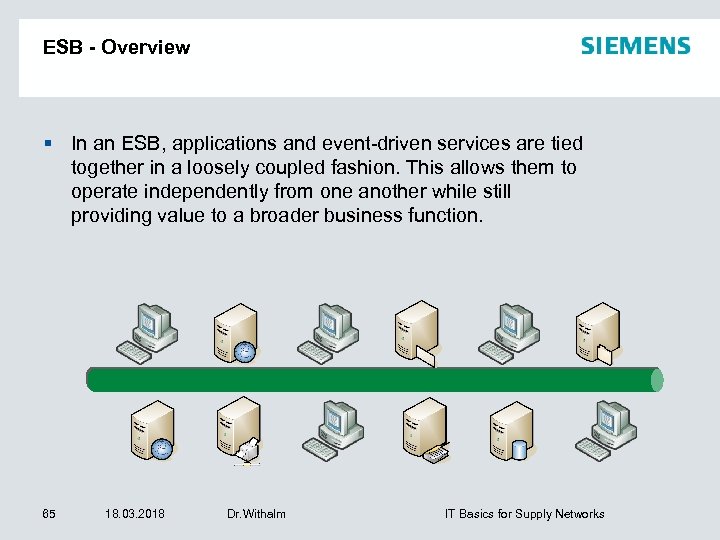
ESB - Overview In an ESB, applications and event-driven services are tied together in a loosely coupled fashion. This allows them to operate independently from one another while still providing value to a broader business function. 65 18. 03. 2018 Dr. Withalm IT Basics for Supply Networks
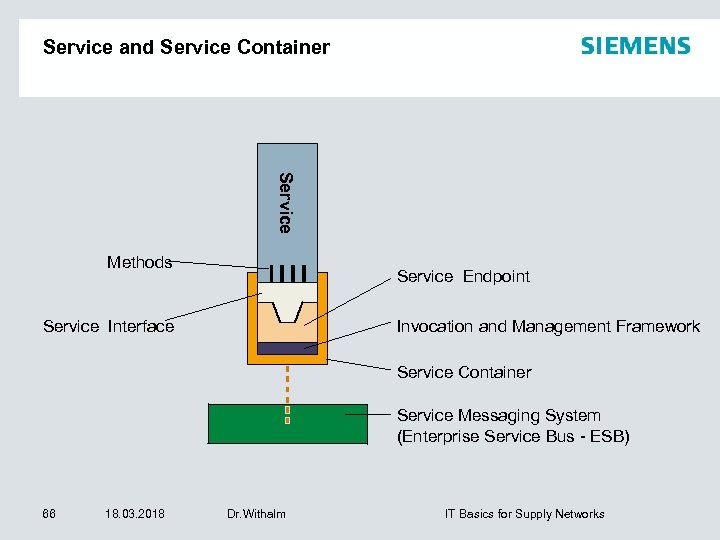
Service and Service Container Service Methods Service Endpoint Service Interface Invocation and Management Framework Service Container Service Messaging System (Enterprise Service Bus - ESB) 66 18. 03. 2018 Dr. Withalm IT Basics for Supply Networks
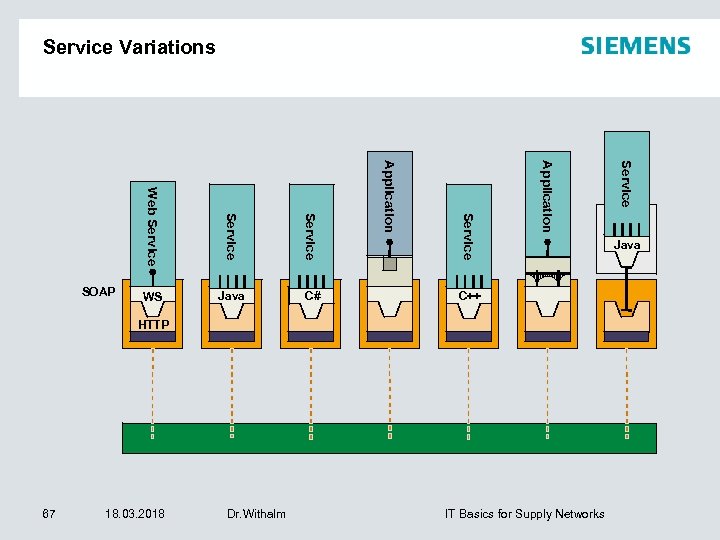
Service Variations C++ HTTP ESB 67 18. 03. 2018 Dr. Withalm IT Basics for Supply Networks Service Application C# Service Java Application Service WS Service Web Service SOAP Java
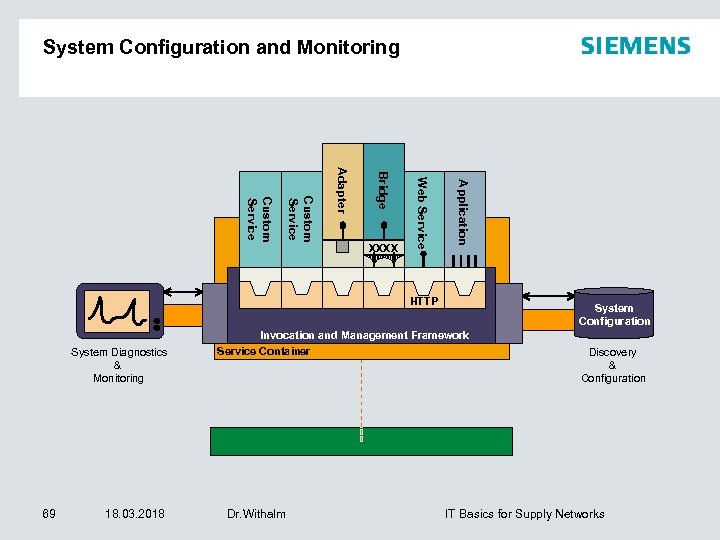
System Configuration and Monitoring Application Web Service Bridge XXXX Adapter Custom Service HTTP System Diagnostics & Monitoring System Configuration Invocation and Management Framework Service Container Discovery & Configuration ESB 69 18. 03. 2018 Dr. Withalm IT Basics for Supply Networks
Summary Service Oriented Architecture (SOA) is an important step towards flexible and scalable solutions. Especially when seen not just as another RPC mechanism but rather as a message based communication means between business components. The link with well-known Internet technologies is the foundation for the development of new applications and the backbone of integration with existing solutions. The use of SOA and the integration of rich internet applications (RIA) is the cornerstone of the next generation of Web Applications. 72 18. 03. 2018 Dr. Withalm IT Basics for Supply Networks
Summary of lecture 3/1 74 Business focus is the main intention of SOA Direct mapping of business processes onto SW artifacts Enabling very fast implementation of business processes Core principles of SOA Business driven, business agility, and constant change Vision: the network is the application Service categories User(interface) service, business(logic) service, and data(backend) service Aggregation of business services Orchestration and Choreography Programming paradigms Object orientation, component orientation, service orientation Programming approaches Declarative, event driven, procedural, structured 18. 03. 2018 Dr. Withalm IT Basics for Supply Networks
Summary of lecture 3/2 Component concepts Objects, components, services Componentization concepts Custom, EAI, services Diference between conventional business processes and event driven ones Different business component architecture SOA interaction and EDA notification Enterprise service bus Ties together application and event driven services Enabling them to operate independently and providing values to a broader business function Service container Are already available-see exercises But for large implementations some important artifacts as system diagnostics& monitoring are either missing or not higly reliable 75 18. 03. 2018 Dr. Withalm IT Basics for Supply Networks
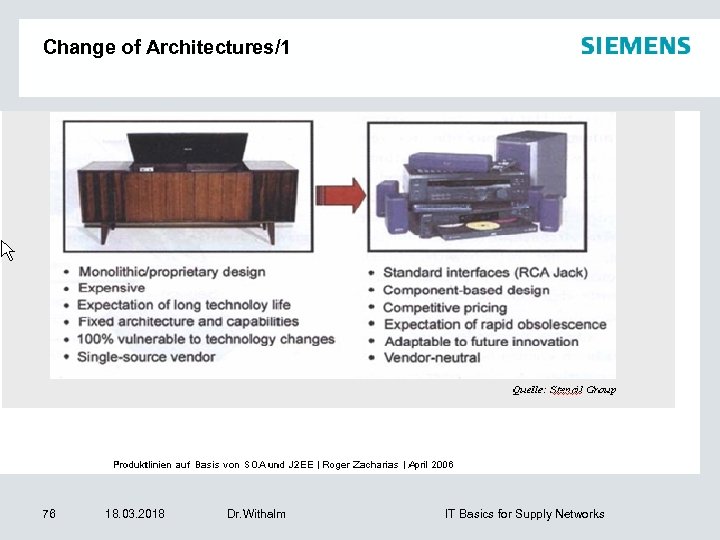
Change of Architectures/1 76 18. 03. 2018 Dr. Withalm IT Basics for Supply Networks
Change of Architectures/2 Drivers of this change are New technologies Java, J 2 EE, . NET, XML, and WS New Business Processes Merger of companies, Acquisition of Companies, Globalization, CNO’s (Collaborative Networked Organizations), VO (Virtual Organizations). If business and/or market react in 3 month cycles IT may not react in 18 month cycles Ideally IT should map a whole business process Which comprehend all departments Need to integrate systems and data within and between departments Serving different clients 77 18. 03. 2018 Dr. Withalm IT Basics for Supply Networks
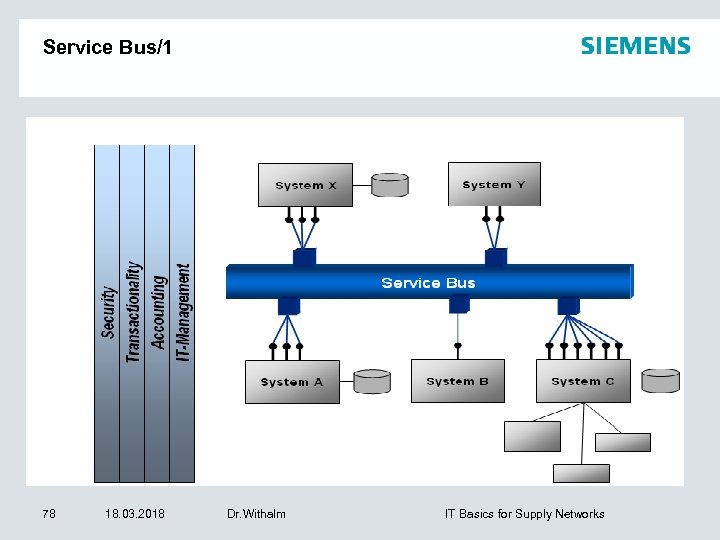
Service Bus/1 78 18. 03. 2018 Dr. Withalm IT Basics for Supply Networks
Service Bus/2 Nowadays many systems with different applications and data must co-operate To meet a business management goal Hence a service bus could be a most appropriate approach Enabling a maximum on flexibility In above figure department A offers a service to department B Which is described in a contract and is subject To specific conditions and constraints Merely the service providing is in the foreground And the service provider is replaceable 79 18. 03. 2018 Dr. Withalm IT Basics for Supply Networks
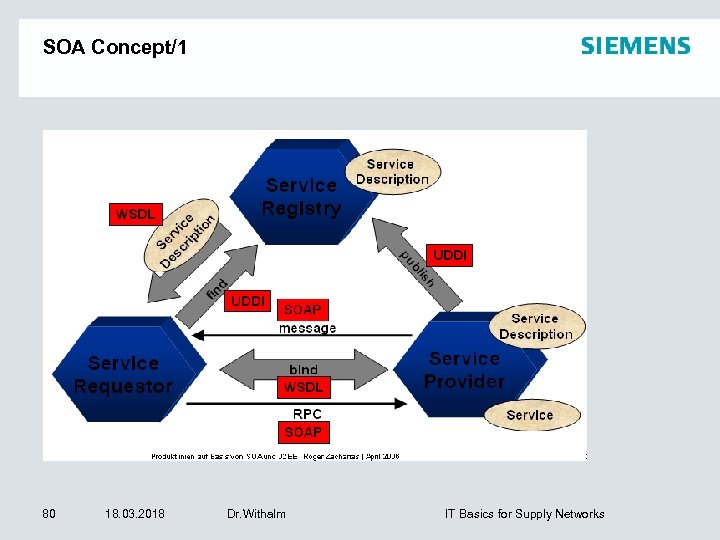
SOA Concept/1 80 18. 03. 2018 Dr. Withalm IT Basics for Supply Networks
SOA Concept/2 In SOA you are only concerned with three parties Service provider Provides services Registers them at the service registry of the service broker Publishes them at service broker Service Requester/Consumer Uses the available services Retrieves them at the service broker Service Broker Administrates references of services at the service registry Provides search functions to retrieve them 81 18. 03. 2018 Dr. Withalm IT Basics for Supply Networks
SOA /1 Concept/1 One of the biggest benefits of SOA is the possibility to reuse Already existing services in new services At any deepness of layering i. e. by aggregation of basic services value added services will be generated The so called service aggregation (orchestration/choreography) Which defines the order and conditions Under which complete independent from each other services interoperate In order to realize a new service 82 18. 03. 2018 Dr. Withalm IT Basics for Supply Networks
SOA /2 Concept/2 On this occasion new instruction standards are established As for instance the business process execution language (BPEL) Business Process Execution Language Modeling with (BPMN) Business Process Modeling Notation The long-term goal of these endeavors are Executable business process models Which may be modeled by business process analysts The most well-known example for collaboration is The combination of basic services as Flight reservation , reservation of accommodation and charging of credit cards To the higher value service “travel booking” A SOA service may be presented in different granularities From basic to complex work flow services-see next figure 83 18. 03. 2018 Dr. Withalm IT Basics for Supply Networks
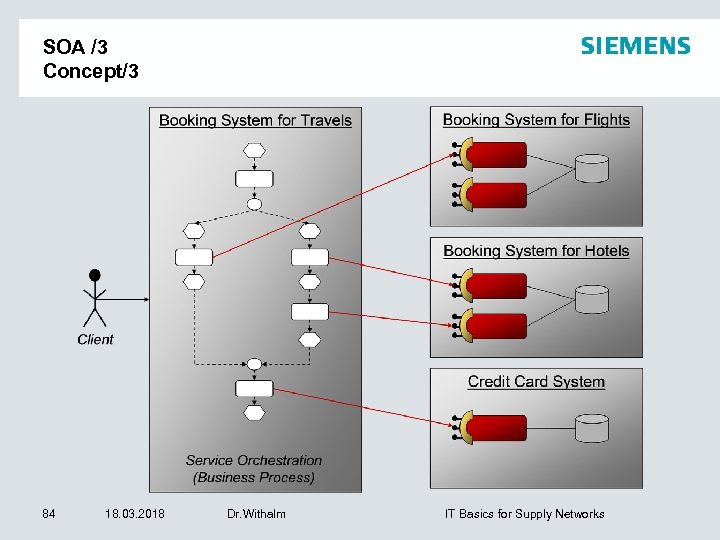
SOA /3 Concept/3 84 18. 03. 2018 Dr. Withalm IT Basics for Supply Networks
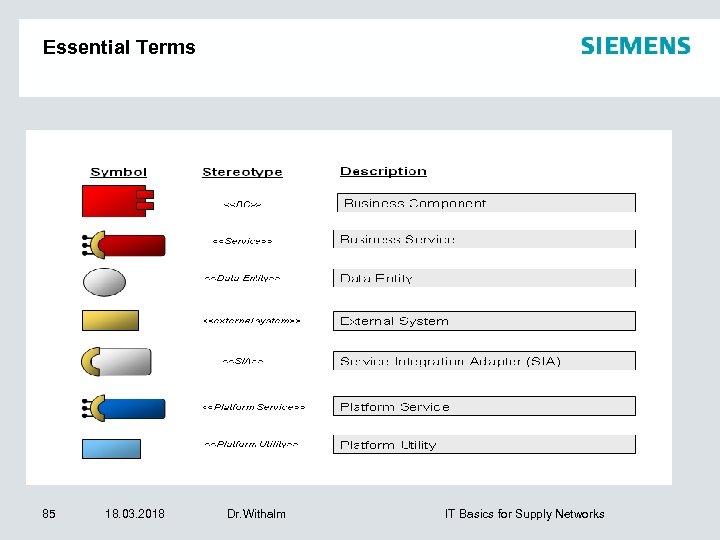
Essential Terms 85 18. 03. 2018 Dr. Withalm IT Basics for Supply Networks
SOA /33 SOA in J 2 EE/1 At present there are neither standards or blue prints in place How SOA could be implemented in J 2 EE Following a potential approach will be introduced First of all the domain architecture will be described And afterwards the mapping on a J 2 EE based architecture 86 18. 03. 2018 Dr. Withalm IT Basics for Supply Networks
SOA /34 SOA in J 2 EE/2 The fundamental approach is the structure of the business management system Into separate business components Which represent closed/isolated cohesive units These units may identified By decomposition of the whole system The term business component is more or less an artificial term in the context of J 2 EE 87 18. 03. 2018 Dr. Withalm IT Basics for Supply Networks
SOA /35 SOA in J 2 EE/3 For instance, a sale information system may be structured in the following business components Order processing, production planning, and sale planning Business components should be in any case disintegrated High cohesive Business force of attraction of the parts Minimal coupling To parts of other business components 88 18. 03. 2018 Dr. Withalm IT Basics for Supply Networks
SOA /36 SOA in J 2 EE/4 In that way it’s enabled to Develop, analyze, and market/merchandize The resulting IT-artifacts separately and in parallel If a system requires more of these business components It may be configured corresponding the specific customer requirements and domain 89 18. 03. 2018 Dr. Withalm IT Basics for Supply Networks
SOA /37 SOA in J 2 EE/5 Each business component specifies the accompanying business process and data For instance, a business component order processing contains the following business services Proposal processing, order processing, supply checking Invoice processing, and shipping processing And manages data as Customer, items, price, order, and invoice 90 18. 03. 2018 Dr. Withalm IT Basics for Supply Networks
SOA /38 SOA in J 2 EE/6 The description respectively the specification of such a business component Together with their tasks, terminologies, behavior, quality characteristics etc. May be very efficient described In respective part of this lectures Introducing ARIS in Lecture 5 91 18. 03. 2018 Dr. Withalm IT Basics for Supply Networks
SOA /39 SOA in J 2 EE/7 92 The business components have the following internal state Business services, which are aggregated to business processes Data entities, which are mapping business data Concretely a business component contains business services A business process is aggregated by business services-see orchestration and choreography A business process which is implemented as aggregation of business services is independent of business components Case A: can aggregate services of different systems Case B: can aggregate services of different department business applications (components) Case C: can aggregate services of one department business application (component) Each business service provides Operational SOA interfaces Which transform the system respectively the sub system from one consistent state into an other 18. 03. 2018 Dr. Withalm IT Basics for Supply Networks
SOA /40 SOA in J 2 EE/8 A business service will be realized by (at least) one technical service For instance, a business service check delivery could exist of two operations Check availability of product x Check delivering time of product y 93 18. 03. 2018 Dr. Withalm IT Basics for Supply Networks
SOA /41 SOA in J 2 EE/9 The external interface of a business component is the sum of the service interfaces Which will be applied by clients or other business components The business service itself contains the business logic And uses to fulfill its tasks for instance other business services Within the same or other business components or services of external systems 94 18. 03. 2018 Dr. Withalm IT Basics for Supply Networks
SOA /42 SOA in J 2 EE/10 The data entity of a business component will be invariably accessed Via the services of their business components For the data access of other business components The respective external service will be used The internal structure of a business component For fulfillment of a service is hidden from the service consumer i. e. the data flow and the interactions of the technical components 95 18. 03. 2018 Dr. Withalm IT Basics for Supply Networks
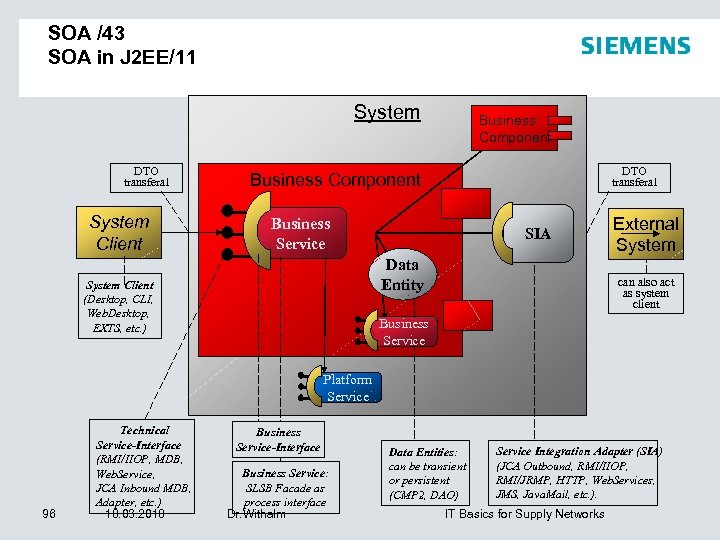
SOA /43 SOA in J 2 EE/11 System DTO transferal System Client Business Component DTO transferal Business Component Business Service SIA Data Entity System Client (Desktop, CLI, Web. Desktop, EXTS, etc. ) External System can also act as system client Business Service Platform Service 96 Technical Service-Interface (RMI/IIOP, MDB, Web. Service, JCA Inbound MDB, Adapter, etc. ) 18. 03. 2018 Business Service-Interface Business Service: SLSB Facade as process interface Dr. Withalm Data Entities: can be transient or persistent (CMP 2, DAO) Service Integration Adapter (SIA) (JCA Outbound, RMI/IIOP, RMI/JRMP, HTTP, Web. Services, JMS, Java. Mail, etc. ). IT Basics for Supply Networks
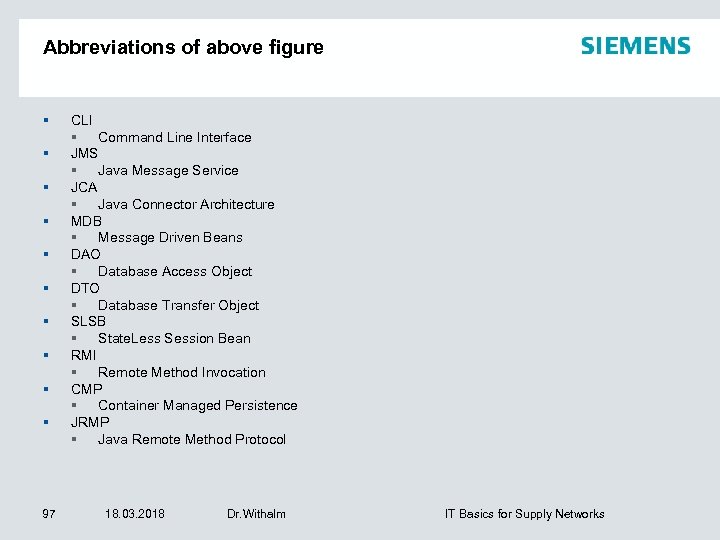
Abbreviations of above figure 97 CLI Command Line Interface JMS Java Message Service JCA Java Connector Architecture MDB Message Driven Beans DAO Database Access Object DTO Database Transfer Object SLSB State. Less Session Bean RMI Remote Method Invocation CMP Container Managed Persistence JRMP Java Remote Method Protocol 18. 03. 2018 Dr. Withalm IT Basics for Supply Networks
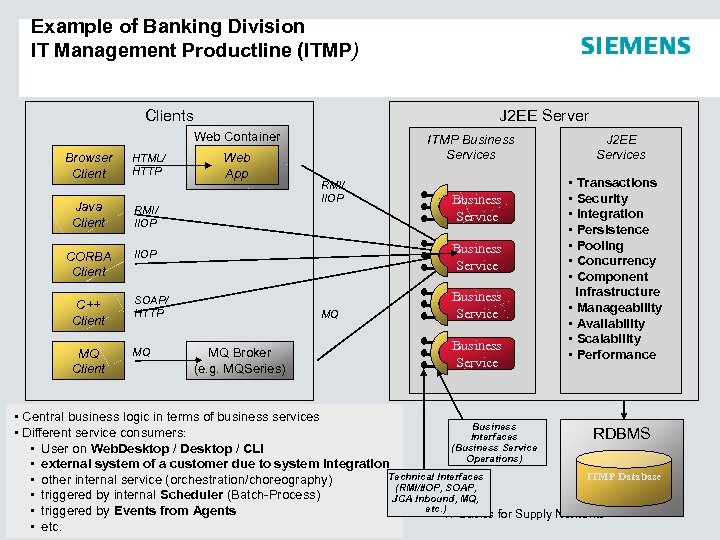
Example of Banking Division IT Management Productline (ITMP) Clients J 2 EE Server Web Container Web App ITMP Business Services Browser Client HTML/ HTTP Java Client RMI/ IIOP CORBA Client IIOP Business Service C++ Client SOAP/ HTTP Business Service MQ Client MQ RMI/ IIOP MQ MQ Broker (e. g. MQSeries) Business Service J 2 EE Services • Transactions • Security • Integration • Persistence • Pooling • Concurrency • Component Infrastructure • Manageability • Availability • Scalability • Performance • Central business logic in terms of business services Business • Different service consumers: RDBMS Interfaces (Business Service • User on Web. Desktop / CLI Operations) • external system of a customer due to system integration Technical Interfaces ITMP Database • other internal service (orchestration/choreography) (RMI/IIOP, SOAP, • triggered by internal Scheduler (Batch-Process) JCA Inbound, MQ, etc. ) • triggered by Events from Agents IT Basics for Supply Networks 98 18. 03. 2018 Dr. Withalm • etc.
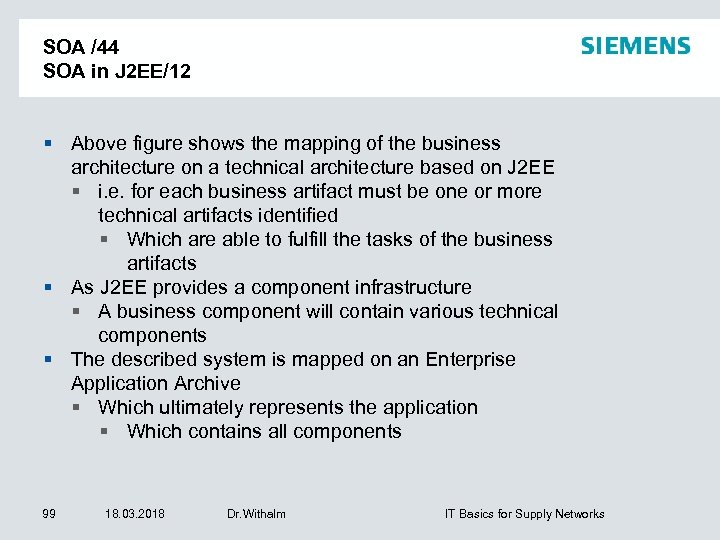
SOA /44 SOA in J 2 EE/12 Above figure shows the mapping of the business architecture on a technical architecture based on J 2 EE i. e. for each business artifact must be one or more technical artifacts identified Which are able to fulfill the tasks of the business artifacts As J 2 EE provides a component infrastructure A business component will contain various technical components The described system is mapped on an Enterprise Application Archive Which ultimately represents the application Which contains all components 99 18. 03. 2018 Dr. Withalm IT Basics for Supply Networks
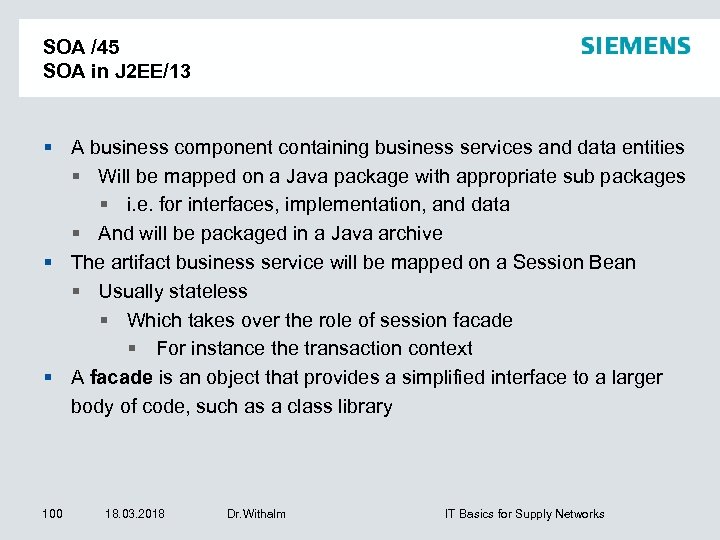
SOA /45 SOA in J 2 EE/13 A business component containing business services and data entities Will be mapped on a Java package with appropriate sub packages i. e. for interfaces, implementation, and data And will be packaged in a Java archive The artifact business service will be mapped on a Session Bean Usually stateless Which takes over the role of session facade For instance the transaction context A facade is an object that provides a simplified interface to a larger body of code, such as a class library 100 18. 03. 2018 Dr. Withalm IT Basics for Supply Networks
SOA /46 SOA in J 2 EE/14 Within the session bean exists-dependent of the complexity Various strategies for mapping the business logic of the business service The session façade may contain the business logic for the instance itself Or apply to downstream application services A data entity is mapped according to the application case Either on local CMP (Container Managed Persistence)-entity beans Or BMP (Bean Managed Persistence) entity beans together with data access objects 101 18. 03. 2018 Dr. Withalm IT Basics for Supply Networks
SOA /46 SOA in J 2 EE/15 The technical architecture must be completed by various artifacts In contrary to the business one The first additional artifact is a platform service The service approach within a system should also be applied To make use of the emphasized advantages For instance besides the existing caching, audit, and config services A logging service together with operation log. Message() should be provided Which are used by every system component Which should nevertheless be decoupled from them 102 18. 03. 2018 Dr. Withalm IT Basics for Supply Networks
SOA /48 SOA in J 2 EE/16 Primarily we are not interested in a maximal decoupling within a system In using XML But we are more interested in the service approach In which system internal communication artifacts should be applied And the interface must be published externally 103 18. 03. 2018 Dr. Withalm IT Basics for Supply Networks
SOA /49 SOA in J 2 EE/17 The second artifact is an adapter to the outer world Which will be denoted as service integration adapter This adapter publishes the services of the external system within the own system Must primarily provide a business interface The implementation of the interface is directly dependent From the external system which should be integrated And from the interfaces of this system which should be usable It encompasses generated WSDL stubs until the exploitation of screen scraping technique A computer program extracts data from the display output of another program 104 18. 03. 2018 Dr. Withalm IT Basics for Supply Networks
SOA /50 SOA in J 2 EE/18 The third additional artifact is the technical interface Which enables the technical accessibility of a service adorning the business interface A SOA service should be modeled independent As much as possible from the client type Reusing it in future contexts Decoupling of technical and business interface will accomplish it 105 18. 03. 2018 Dr. Withalm IT Basics for Supply Networks
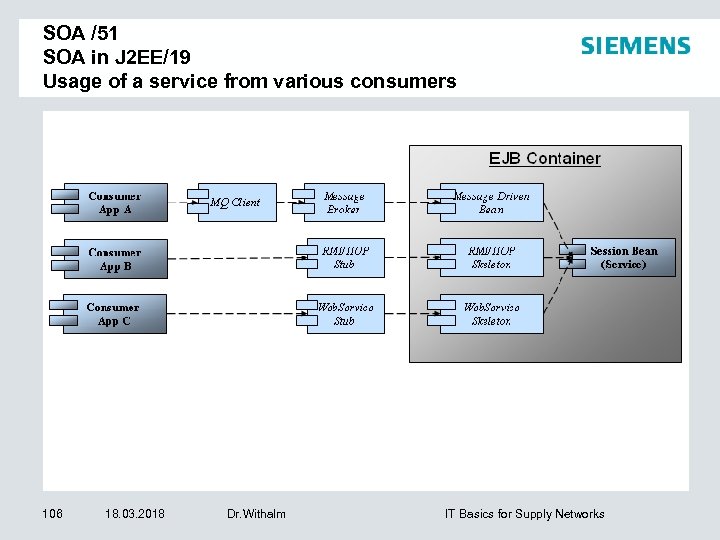
SOA /51 SOA in J 2 EE/19 Usage of a service from various consumers 106 18. 03. 2018 Dr. Withalm IT Basics for Supply Networks
SOA /52 SOA in J 2 EE/20 In above figure three different consumer applications are introduced Using the same service An asynchronous client (message queuing client) Calling the service by a message façade asynchronously Two synchronous clients accessing via RMI/IOP Web-Service 107 18. 03. 2018 Dr. Withalm IT Basics for Supply Networks
SOA /53 SOA in J 2 EE/21 The respective client should only know for using the service the corresponding naming service The business service ID The business interface Concerning the orchestration of the defined services Different possibilities are in place 108 18. 03. 2018 Dr. Withalm IT Basics for Supply Networks
SOA /54 SOA in J 2 EE/22 If a service should be used within compartment business process It is recommended to use A specialized business process engine Which is calling the interfaces of the defined systems On the respective positions within the process If services are used in a smaller environment (with a Web front end) The business delegate will be used as composite service respectively as service choreographer 109 18. 03. 2018 Dr. Withalm IT Basics for Supply Networks
SOA /55 SOA in J 2 EE/23 Each service oriented system can be described completely on a high level With help of these defined components Each of them are own stereotyped assigned The description is performed both static and dynamic (UML) Component, Deployment, and Interaction Diagrams 110 18. 03. 2018 Dr. Withalm IT Basics for Supply Networks
SOA /56 SOA in J 2 EE/24 The description can be applicable because of the high level of abstraction For the communication of all system stake holders i. e. customer, management, development Furthermore a traceability of the requirements is enabled From the business and technical architecture to the code As the described business artifacts are directly mapped on the technical ones 111 18. 03. 2018 Dr. Withalm IT Basics for Supply Networks
SOA /57 SOA in J 2 EE/25 Of course a unique naming for one and the same artifact is mandatory On all phases of the development process When Model Driven Architecture (MDA) is broadly applied This approach is clearly simplified 112 18. 03. 2018 Dr. Withalm IT Basics for Supply Networks
SOA /58 SOA in J 2 EE/26 The application of object-component-service concept Are shown by this approach A J 2 EE application can be taken to respective tiers Where each of these tiers corresponds to one of these concepts See the following figure So we can’t speak of replacing but of complementary approach The difference is merely the granularity Of the respective interfaces And in the level of abstraction 113 18. 03. 2018 Dr. Withalm IT Basics for Supply Networks
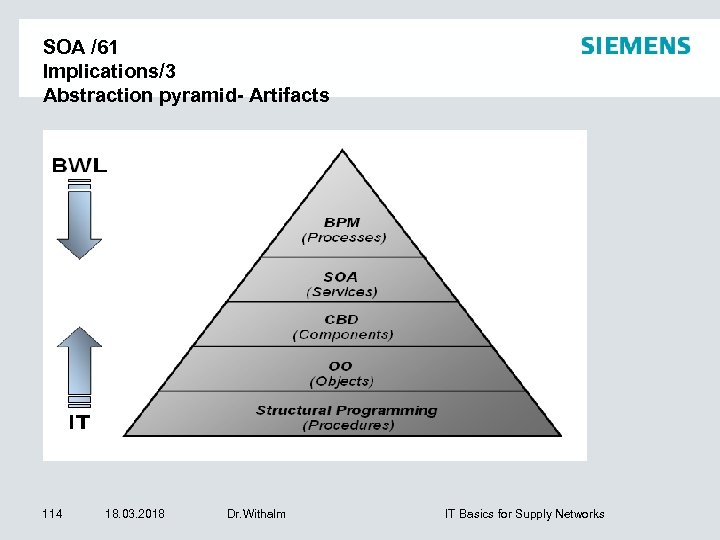
SOA /61 Implications/3 Abstraction pyramid- Artifacts 114 18. 03. 2018 Dr. Withalm IT Basics for Supply Networks
SOA /59 Implications/1 The evolution from the contemporary to SOA Will presumably have the following impacts The level of abstraction for developing application software will be increased Especially in combination with the MDA approach i. e. the development of business applications will require fewer detailed technical knowledge And becomes in that way more efficient 115 18. 03. 2018 Dr. Withalm IT Basics for Supply Networks
SOA /60 Implications/2 Of course these statement are more or less marketing As new approaches usually are more promising As finally will be reached But with each new approach target comes closer More efficient doesn’t mean that an application will be developed in half the time As experience have shown time for development stays constant As with a simplification of methods/tools the complexity of systems increases i. e. imagine the realization of an online booking system with Assembler instead of J 2 EE 116 18. 03. 2018 Dr. Withalm IT Basics for Supply Networks
SOA /63 Implications/5 SW-development in future will still take place on different levels (see following figure) With the most specialized tools, patterns, and ITspecialists Starting by development (firm ware) via Development of operating systems Development of middle ware Real application development 117 18. 03. 2018 Dr. Withalm IT Basics for Supply Networks
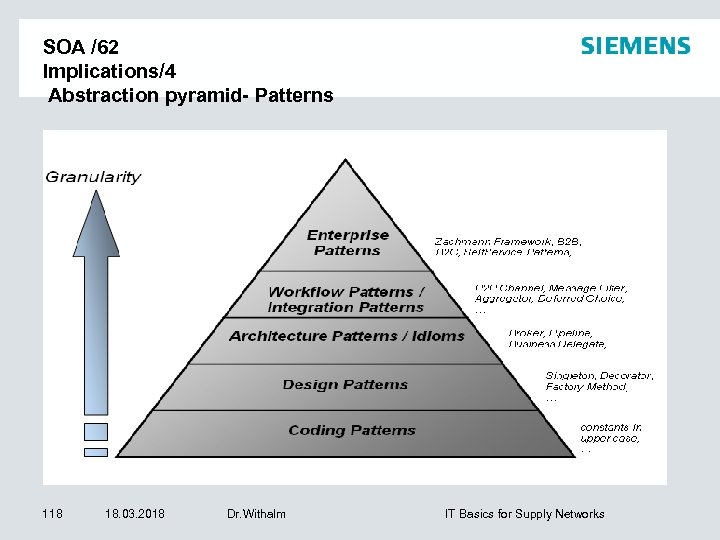
SOA /62 Implications/4 Abstraction pyramid- Patterns 118 18. 03. 2018 Dr. Withalm IT Basics for Supply Networks
SOA /64 Implications/6 Application development is also structured in three layers A layer of application framework with defined platform services Applications of pure business aspects Which uses the application framework Layer of choreography where orchestrating is predominating For mapping comprehensive business processes 119 18. 03. 2018 Dr. Withalm IT Basics for Supply Networks
SOA /65 Implications/7 It means that new business processes supporting ITsystems Must not be developed from scratch But may build up on already existing layers i. e. middle ware of application servers 120 18. 03. 2018 Dr. Withalm IT Basics for Supply Networks

SOA /66 Implications/8 As every other approach also SOA has some weaknesses Some are evident today Some become aware during development And some become aware years after employment The most severe problem is the wrong application of the SOA concepts And the resulting conclusion Also in the J 2 EE area some projects failed 121 18. 03. 2018 Dr. Withalm IT Basics for Supply Networks
SOA /67 Implications/9 If the realization of SOA is merely seen as Web-service technology And XML communication between services within a server is used Performance problems will arise Also the inter-system communication is backing at present merely on Web-Services As horizontal services are not comprehensive specified i. e. propagation of transaction context and cluster awareness And such services must be developed by oneself 122 18. 03. 2018 Dr. Withalm IT Basics for Supply Networks
SOA /68 Implications/10 Furthermore the added value will stay out If there is no direct mapping of business service on technical services But only a technical-oriented approach will be distinguished Disputes between enterprises are predictable If a service liable to pay costs is assembled of three services exempt from charges And afterwards is highly profitable 123 18. 03. 2018 Dr. Withalm IT Basics for Supply Networks
SOA /69 Implications/11 To solve this issue a respective accounting infrastructure for SOA must be established Presumably the IT-management of SOA systems is more challenging As for the coverage of a business process any systems must interact In contrary to a monolithic system there must be for instance 30 services exist i. e. 30 service level agreements must be concluded 124 18. 03. 2018 Dr. Withalm IT Basics for Supply Networks
SOA /70 Implications/12 In extreme case the danger of a system chaos exists With an exponential increasing of system complexity As millions of networked services are built And the control flow on the whole Is distributed over various instances And in that way hardly comprehensible 125 18. 03. 2018 Dr. Withalm IT Basics for Supply Networks
Thank you for your attention! IT Basics for Supply Networks
Farbpalette mit Farbcodes Primäre Flächenfarbe: Akzentfarben: R 255 G 210 B 078 R 255 G 255 B 255 Sekundäre Flächenfarben: R 245 G 128 B 039 R 229 G 025 B 055 R 000 G 133 B 062 R 000 G 084 B 159 R 000 G 000 B 000 R 255 G 221 B 122 R 248 G 160 B 093 R 236 G 083 B 105 R 064 G 164 B 110 R 064 G 127 B 183 R 064 G 064 B 064 R 215 G 225 B 225 R 130 G 160 B 165 R 255 G 232 B 166 R 250 G 191 B 147 R 242 G 140 B 155 R 127 G 194 B 158 R 127 G 169 B 207 R 127 G 127 B 127 R 220 G 225 B 230 R 185 G 195 B 205 R 145 G 155 B 165 R 255 G 244 B 211 R 252 G 223 B 201 R 248 G 197 B 205 R 191 G 224 B 207 R 191 G 212 B 231 R 191 G 191 B 191 R 255 G 250 B 237 127 R 170 G 190 B 195 R 254 G 242 B 233 R 252 G 232 B 235 R 229 G 243 B 235 R 229 G 238 B 245 R 229 G 229 B 229 18. 03. 2018 Dr. Withalm IT Basics for Supply Networks
Скачать презентацию IT Basics for Supply Networks 4 Dr Withalm IT
4541b7036e41eaff475180bb0e5b58b7.ppt