 Скачать презентацию IT Basics for Supply Networks 1 Dr Withalm IT
d5820dbb7699cab1d3d8269ca0b79188.ppt
- Количество слайдов: 68



IT Basics for Supply Networks/1 Dr. Withalm IT Basics for Supply Networks
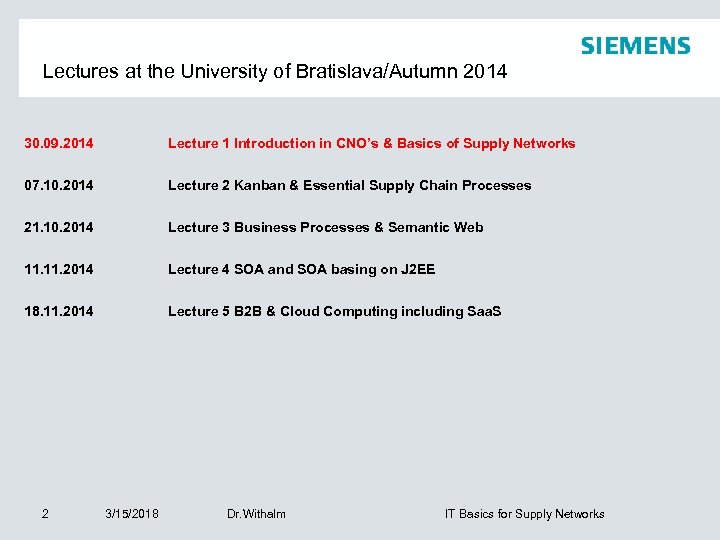
Lectures at the University of Bratislava/Autumn 2014 30. 09. 2014 Lecture 1 Introduction in CNO’s & Basics of Supply Networks 07. 10. 2014 Lecture 2 Kanban & Essential Supply Chain Processes 21. 10. 2014 Lecture 3 Business Processes & Semantic Web 11. 2014 Lecture 4 SOA and SOA basing on J 2 EE 18. 11. 2014 Lecture 5 B 2 B & Cloud Computing including Saa. S 2 3/15/2018 Dr. Withalm IT Basics for Supply Networks
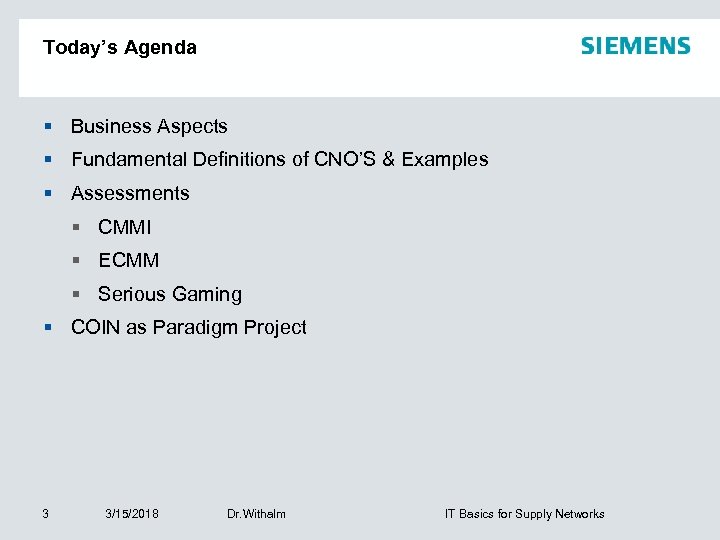
Today’s Agenda § Business Aspects § Fundamental Definitions of CNO’S & Examples § Assessments § CMMI § ECMM § Serious Gaming § COIN as Paradigm Project 3 3/15/2018 Dr. Withalm IT Basics for Supply Networks
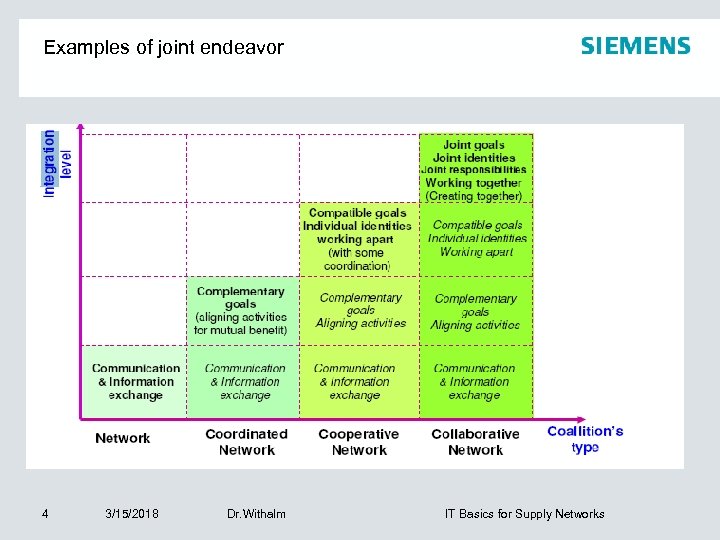
Examples of joint endeavor 4 3/15/2018 Dr. Withalm IT Basics for Supply Networks
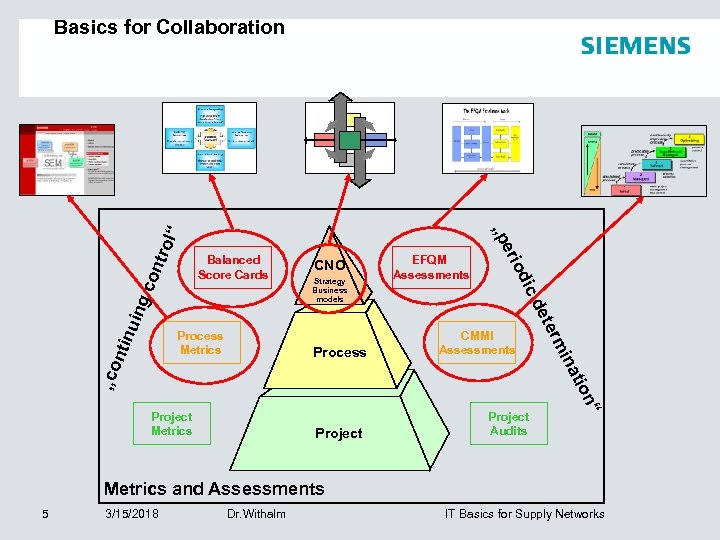
Basics for Collaboration con tro l“ Project Audits ing tinu „co n “ on ti na mi Project CMMI Assessments ter Project Metrics de Process ic Strategy Business models EFQM Assessments od Process Metrics CNO eri „p Balanced Score Cards Metrics and Assessments 5 3/15/2018 Dr. Withalm IT Basics for Supply Networks
Overview § Primarily the modern CNO‘s are basing on the WEB § Especially in the 90 -ties IT Systems were built by IT Providers (IBM, MS, HP, …. . ) § Sold to companies in order to start B 2 B § Both types of company lost: huge money § Spring 2000: Internet bubble burst § Example : Christmas 1999 § Afterwards the most severe challenges for CNO‘s were tackled in two steps § Enterprise Collaboration § Enterprise Interoperation 6 3/15/2018 Dr. Withalm IT Basics for Supply Networks
Enterprise Collaboration § Whenever IT Systems were well developed § Business success for all partner within a CNO was not guarantied § Therefore EC became a scientific discipline for tackling such issues: § Common Business Strategy both for the whole CNO and its respective members § Common Business Model both for the whole CNO and its respective members § Modeling of Cross Organizational Business Processes as well as the connections to the Private Business Processes of the respective members of a CNO 7 3/15/2018 Dr. Withalm IT Basics for Supply Networks
Enterprise Interoperation § Tackles the challenges of implementation of CBP as well as PCP § In the end of the lecture we will be ready § to implement both types of BP for Supply Networks 8 3/15/2018 Dr. Withalm IT Basics for Supply Networks
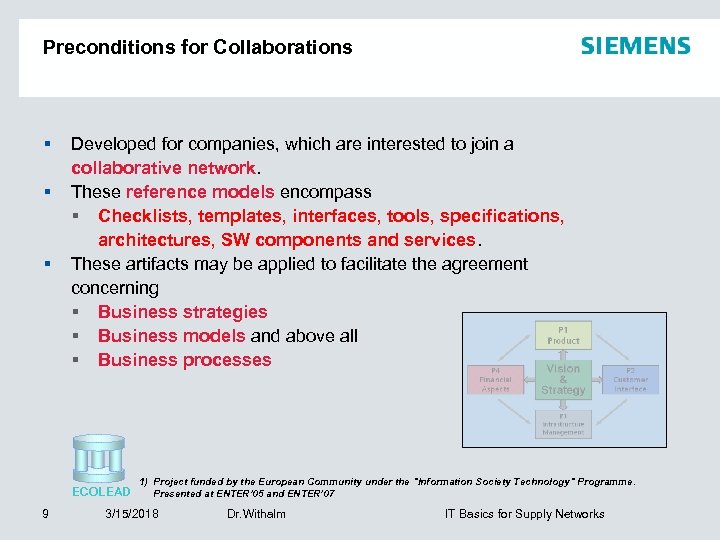
Preconditions for Collaborations § § § Developed for companies, which are interested to join a collaborative network. These reference models encompass § Checklists, templates, interfaces, tools, specifications, architectures, SW components and services. These artifacts may be applied to facilitate the agreement concerning § Business strategies § Business models and above all § Business processes ECOLEAD 9 1) Project funded by the European Community under the "Information Society Technology" Programme. Presented at ENTER’ 05 and ENTER’ 07 3/15/2018 Dr. Withalm IT Basics for Supply Networks
Why B 2 B ? § Organizations have need to collaborate § Resource Sharing § Example ELGA in Health Care § Competence Sharing § Example Airbus Suppliers § Capacity Sharing § Example in large companies i. e. SW Development 10 3/15/2018 Dr. Withalm IT Basics for Supply Networks
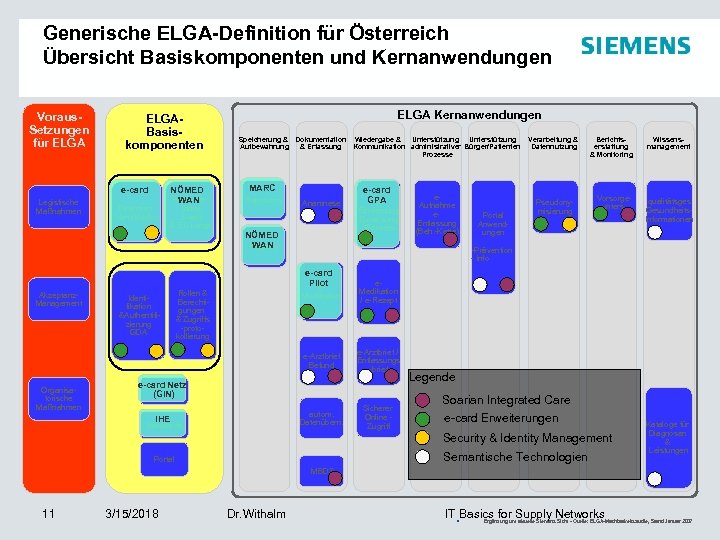
Generische ELGA-Definition für Österreich Übersicht Basiskomponenten und Kernanwendungen Voraus. Setzungen für ELGABasiskomponenten e-card Legistische Maßnahmen Akzeptanz. Management Patientenidentifikation NÖMED Patienten. WAN Index ö-weit & EU komp. Identifikation &Authentifizierung GDA ELGA Kernanwendungen Speicherung & Dokumentation Wiedergabe & Unterstützung & Erfassung Aufbewahrung Kommunikation administrativer Bürger/Patienten Prozesse MARC Repository Anamnese NÖMED WAN Registry Medikation e-Arztbrief Befund Organisatorische Maßnahmen Einweisung Zuweisung Überweis. autom. Datenübern. IHE Portal Anwendungen Pseudonymisierung Vorsorgeunters. Wissensmanagement qualitätsges Gesundheits. Informationen e. Medikation / e-Rezept e-Arztbrief / Entlassungs -brief e-card Netz Vernetzung (GIN) Standards e. Aufnahme e. Entlassung (Beh. -Kette) Berichtserstattung & Monitoring -Prävention - Info e-card Pilot e- Rollen & Berechtigungen & Zugriffs -protokollierung e-card GPA e- Verarbeitung & Datennutzung Sicherer Online Zugriff Legende Soarian Integrated Care e-card Erweiterungen Security & Identity Management Semantische Technologien Portal Kataloge für Diagnosen & Leistungen MBDS 11 3/15/2018 Dr. Withalm IT §Basics forum. Supply Networks Ergänzung aktuelle Siemens Sicht - Quelle: ELGA-Machbarkeitsstudie, Stand Januar 2007
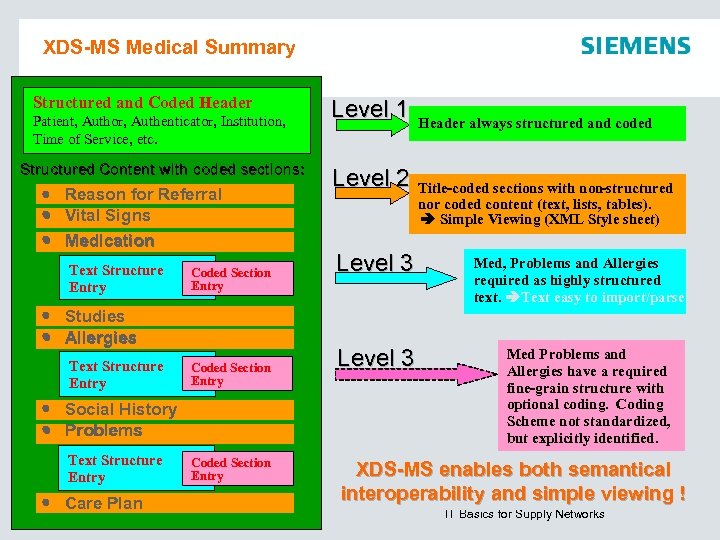
XDS-MS Medical Summary Structured and Coded Header Patient, Author, Authenticator, Institution, Time of Service, etc. St r u c t u r ed Co n t en t w i t h c o d ed s ec t i o n s : · Reason for Referral · Vital Signs · Medication Text Structure Entry Coded Section Entry · Studies · Allergies Text Structure Entry Coded Section Entry · Social History · Problem s Text Structure Entry · Care Plan 12 3/15/2018 Coded Section Entry Dr. Withalm Level 1 Level 2 Level 3 Header always structured and coded Title-coded sections with non-structured nor coded content (text, lists, tables). Simple Viewing (XML Style sheet) Med, Problems and Allergies required as highly structured text. Text easy to import/parse Med Problems and Allergies have a required fine-grain structure with optional coding. Coding Scheme not standardized, but explicitly identified. XDS-MS enables both semantical interoperability and simple viewing ! IT Basics for Supply Networks
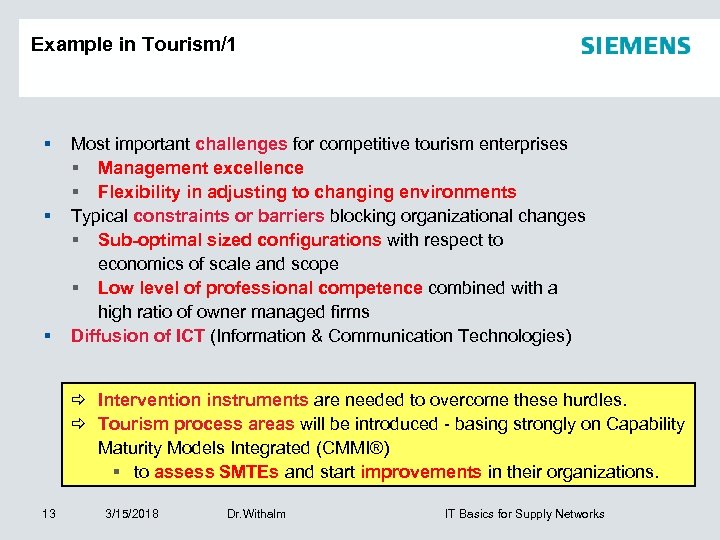
Example in Tourism/1 § § § Most important challenges for competitive tourism enterprises § Management excellence § Flexibility in adjusting to changing environments Typical constraints or barriers blocking organizational changes § Sub-optimal sized configurations with respect to economics of scale and scope § Low level of professional competence combined with a high ratio of owner managed firms Diffusion of ICT (Information & Communication Technologies) ð Intervention instruments are needed to overcome these hurdles. ð Tourism process areas will be introduced - basing strongly on Capability Maturity Models Integrated (CMMI®) § to assess SMTEs and start improvements in their organizations. 13 3/15/2018 Dr. Withalm IT Basics for Supply Networks
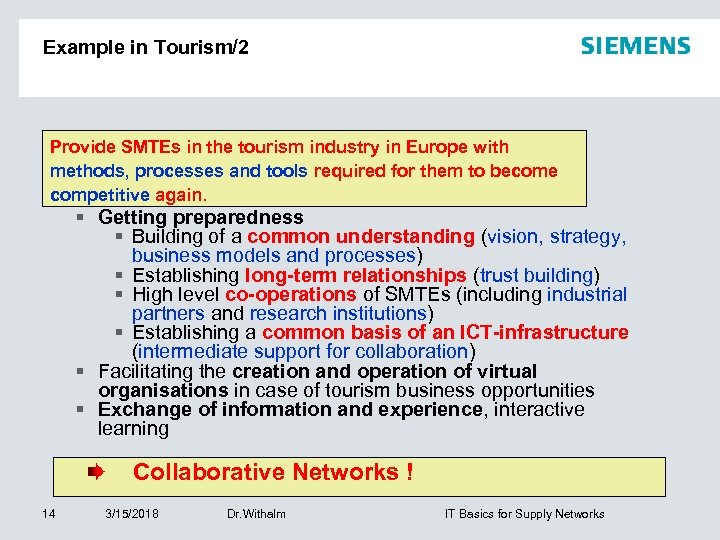
Example in Tourism/2 Provide SMTEs in the tourism industry in Europe with methods, processes and tools required for them to become competitive again. § Getting preparedness § Building of a common understanding (vision, strategy, business models and processes) § Establishing long-term relationships (trust building) § High level co-operations of SMTEs (including industrial partners and research institutions) § Establishing a common basis of an ICT-infrastructure (intermediate support for collaboration) § Facilitating the creation and operation of virtual organisations in case of tourism business opportunities § Exchange of information and experience, interactive learning Collaborative Networks ! 14 3/15/2018 Dr. Withalm IT Basics for Supply Networks
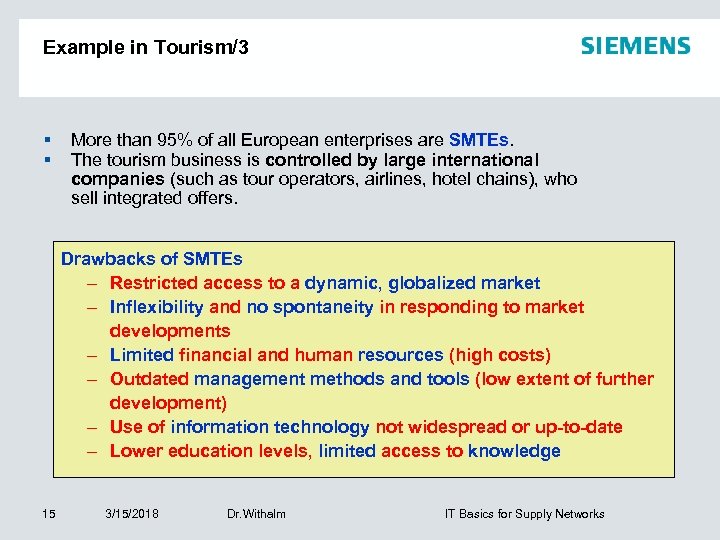
Example in Tourism/3 § § More than 95% of all European enterprises are SMTEs. The tourism business is controlled by large international companies (such as tour operators, airlines, hotel chains), who sell integrated offers. Drawbacks of SMTEs – Restricted access to a dynamic, globalized market – Inflexibility and no spontaneity in responding to market developments – Limited financial and human resources (high costs) – Outdated management methods and tools (low extent of further development) – Use of information technology not widespread or up-to-date – Lower education levels, limited access to knowledge 15 3/15/2018 Dr. Withalm IT Basics for Supply Networks
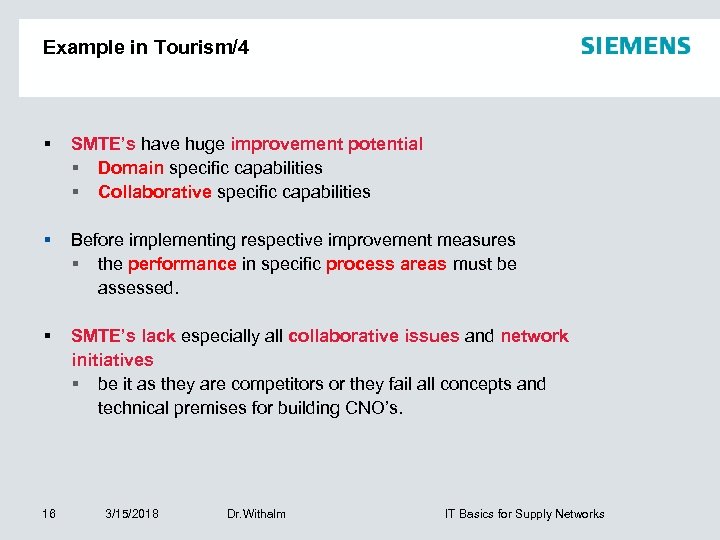
Example in Tourism/4 § SMTE’s have huge improvement potential § Domain specific capabilities § Collaborative specific capabilities § Before implementing respective improvement measures § the performance in specific process areas must be assessed. § SMTE’s lack especially all collaborative issues and network initiatives § be it as they are competitors or they fail all concepts and technical premises for building CNO’s. 16 3/15/2018 Dr. Withalm IT Basics for Supply Networks
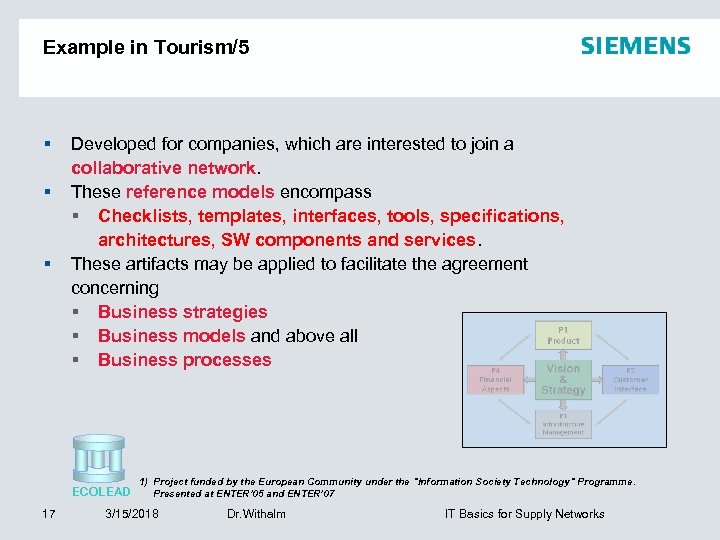
Example in Tourism/5 § § § Developed for companies, which are interested to join a collaborative network. These reference models encompass § Checklists, templates, interfaces, tools, specifications, architectures, SW components and services. These artifacts may be applied to facilitate the agreement concerning § Business strategies § Business models and above all § Business processes ECOLEAD 17 1) Project funded by the European Community under the "Information Society Technology" Programme. Presented at ENTER’ 05 and ENTER’ 07 3/15/2018 Dr. Withalm IT Basics for Supply Networks
Example in Tourism/6 § § § Most important challenges for competitive tourism enterprises § Management excellence § Flexibility in adjusting to changing environments Typical constraints or barriers blocking organizational changes § Sub-optimal sized configurations with respect to economics of scale and scope § Low level of professional competence combined with a high ratio of owner managed firms Diffusion of ICT (Information & Communication Technologies) ð Intervention instruments are needed to overcome these hurdles. ð Tourism process areas will be introduced - basing strongly on Capability Maturity Models Integrated (CMMI®) § to assess SMTEs and start improvements in their organizations. 18 3/15/2018 Dr. Withalm IT Basics for Supply Networks
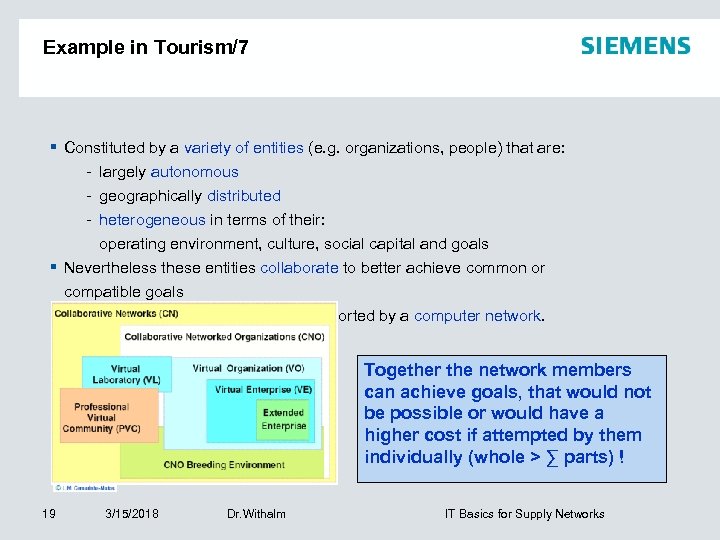
Example in Tourism/7 § Constituted by a variety of entities (e. g. organizations, people) that are: - largely autonomous - geographically distributed - heterogeneous in terms of their: operating environment, culture, social capital and goals § Nevertheless these entities collaborate to better achieve common or compatible goals § The collaborative interactions are supported by a computer network. Together the network members can achieve goals, that would not be possible or would have a higher cost if attempted by them individually (whole > ∑ parts) ! 19 3/15/2018 Dr. Withalm IT Basics for Supply Networks
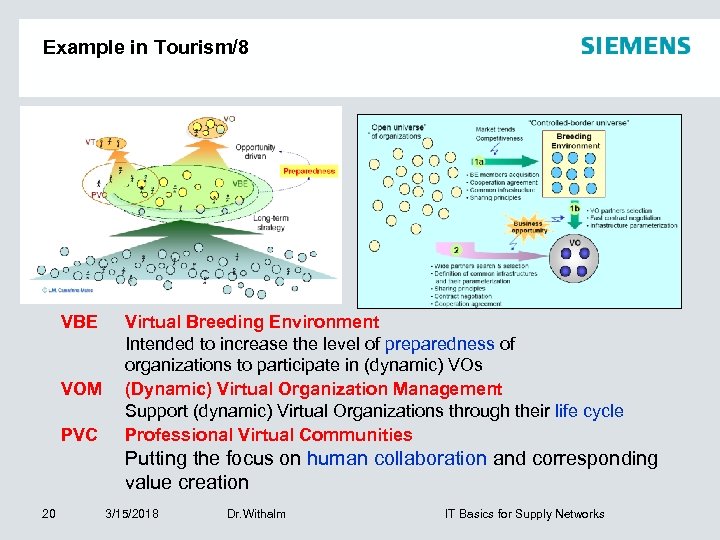
Example in Tourism/8 VBE VOM PVC Virtual Breeding Environment Intended to increase the level of preparedness of organizations to participate in (dynamic) VOs (Dynamic) Virtual Organization Management Support (dynamic) Virtual Organizations through their life cycle Professional Virtual Communities Putting the focus on human collaboration and corresponding value creation 20 3/15/2018 Dr. Withalm IT Basics for Supply Networks
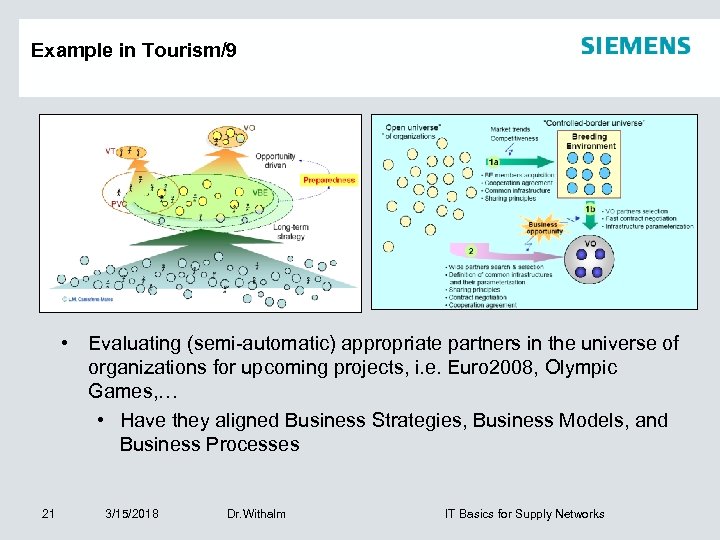
Example in Tourism/9 • Evaluating (semi-automatic) appropriate partners in the universe of organizations for upcoming projects, i. e. Euro 2008, Olympic Games, … • Have they aligned Business Strategies, Business Models, and Business Processes 21 3/15/2018 Dr. Withalm IT Basics for Supply Networks
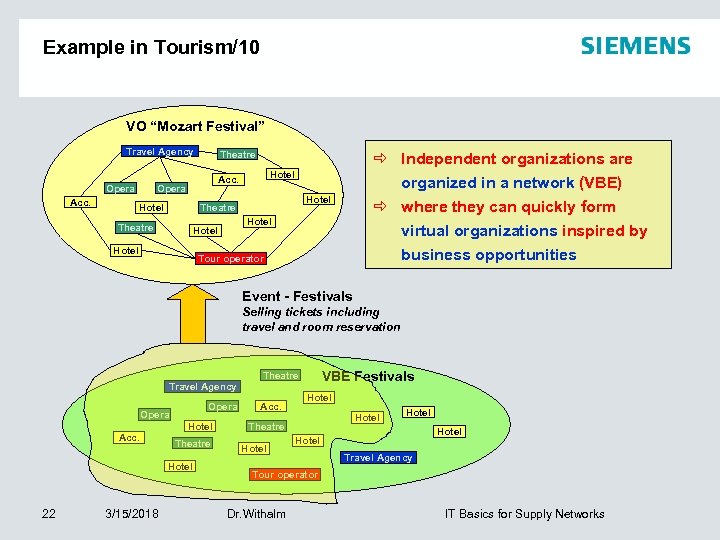
Example in Tourism/10 VO “Mozart Festival” Travel Agency Opera Acc. Theatre Hotel Acc. Opera Hotel Theatre Hotel ð Independent organizations are organized in a network (VBE) ð where they can quickly form virtual organizations inspired by business opportunities Tour operator Event - Festivals Selling tickets including travel and room reservation VBE Festivals Theatre Travel Agency Opera Acc. Opera Hotel Theatre Hotel 22 3/15/2018 Acc. Hotel Theatre Hotel Travel Agency Tour operator Dr. Withalm IT Basics for Supply Networks
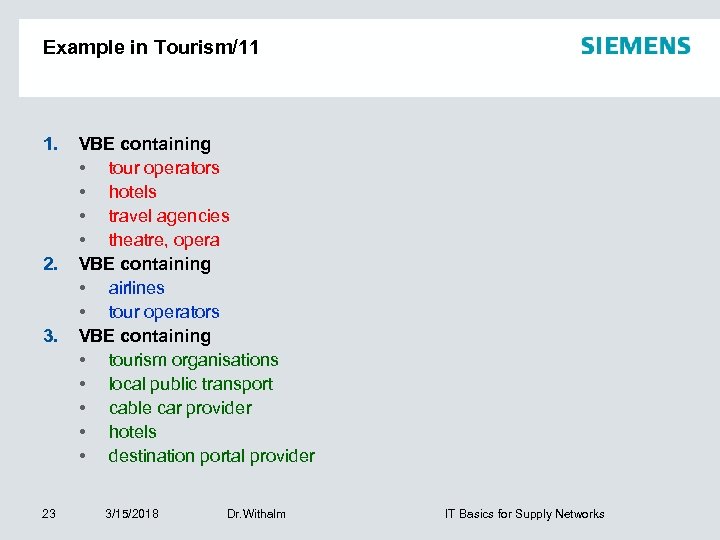
Example in Tourism/11 1. 2. 3. 23 VBE containing • tour operators SAPA • hotels ASA • travel agencies • theatre, opera VBE containing • airlines • tour operators VBE containing • tourism organisations • local public transport • cable car provider • hotels • destination portal provider 3/15/2018 Dr. Withalm IT Basics for Supply Networks
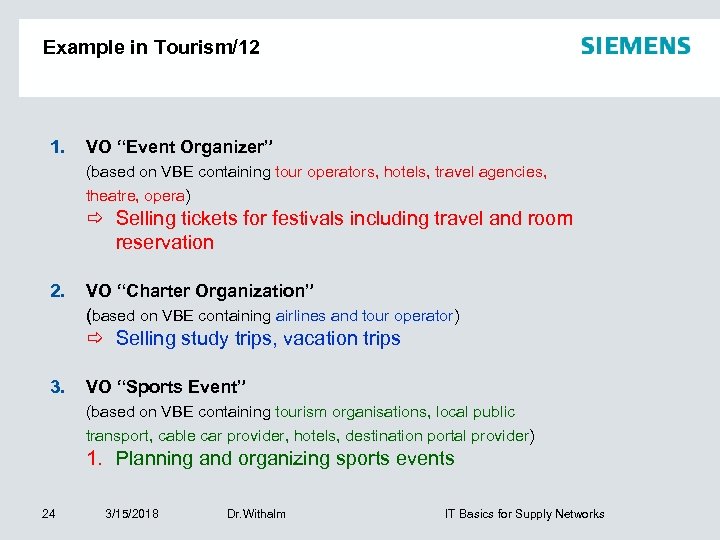
Example in Tourism/12 1. VO “Event Organizer” (based on VBE containing tour operators, hotels, travel agencies, theatre, opera) ð Selling tickets for festivals including travel and room reservation 2. VO “Charter Organization” (based on VBE containing airlines and tour operator) ð Selling study trips, vacation trips 3. VO “Sports Event” (based on VBE containing tourism organisations, local public transport, cable car provider, hotels, destination portal provider) 1. Planning and organizing sports events 24 3/15/2018 Dr. Withalm IT Basics for Supply Networks
Definitions/1 § SOA was the first paradigm in developing SW systems § which shifted away from technical to business concerns. § The conclusion of this matter § not start to implement business processes § but begin with considerations about Business Strategy (BS) and Business Models (BM). § The need to collaborate is very high in many domains § as for instance in automotive or transportation/travel § collaboration follows one of these forms § i. e. supply chain, collaborative networks, business ecosystems. 25 3/15/2018 Dr. Withalm IT Basics for Supply Networks
Definitions/2 Different Kinds of Services § § § 26 Primarily you must distinguish between Horizontal and Vertical Business Services. § Horizontal Services (as e. g. procurement) may be applied in many domains § Whereas Vertical Services are dedicated to a specific domain. A further dimension of Business Services focusing on Collaboration/Interoperability issues are § Enterprise Collaboration (EC) Services which are mainly interested in § establishing guidelines, rules and tools to settle issues § how to agree on common business strategies (BS), common business models (BM) and the primary modeling of common business processes (BP). § Enterprise Interoperability (EI) Services. which focus on issues as how to § implement common business processes (BP) and their integration / synchronization with existing business processes of the single members of a CNO. These kinds of services are the primary enabler of Collaborative Networked Organizations. Web services on the other hand are the implementation of business services § whereas Semantic Web Services describe the context of the web service semantically. § basing on an agreed/standardized ontology Note that the establishment and especially the agreement of ontology is a troublesome task. 3/15/2018 Dr. Withalm IT Basics for Supply Networks
Definition/3 Measuring the Success of Semantic Web Services § Process Areas must be defined wich are positively contributing to your business § § i. e. your BS, BM, and BP must ultimately drive to positive company results very postive results concerning process areas to meet common BS and BM were accomplished by ECOLEAD § § wheras both ATHENA and ECOLEAD added such results concerning BP Process Areas require specific attributes of Semantic Web Services § § § the better ontology meets the business requirements of specific domain the higher the maturity level of such an organization (organizations) will be. in the specific goals of the process areas such issues must be introduced § how many attempts you need to find the right web service § in the meaning of successful web service § 27 in the sense of success for your business. 3/15/2018 Dr. Withalm IT Basics for Supply Networks
Definition/4 Corresponding EU Projects with Siemens Participation § ECOLEAD § Focus on EC Issues § ATHENA § Focus on EI Issues § COIN § Synopsis of EC and EI § Semantic annotation of these services § which will enable- mid term- the semi automatic discovering and composition of services § Quality of semantic web services will be evaluated § a well proven and accepted approach will be pursued § the ECMM (Enterprise Collaboration Maturity Model) assessment adapted to EC/EI services 28 3/15/2018 Dr. Withalm IT Basics for Supply Networks
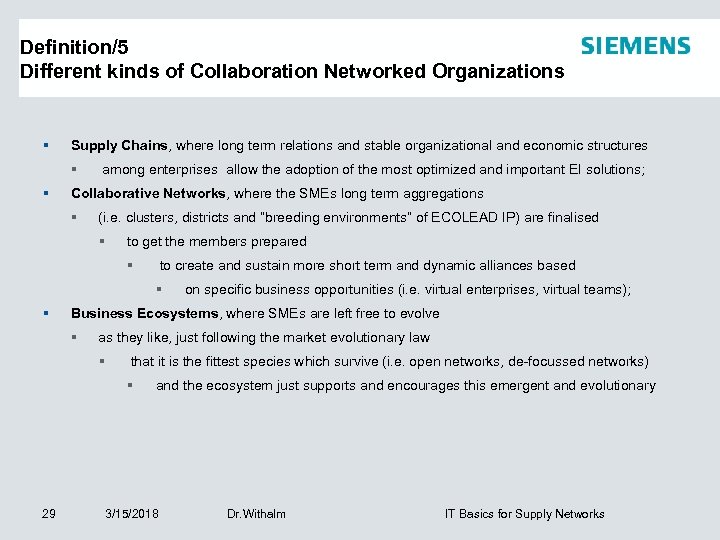
Definition/5 Different kinds of Collaboration Networked Organizations § Supply Chains, where long term relations and stable organizational and economic structures § § among enterprises allow the adoption of the most optimized and important EI solutions; Collaborative Networks, where the SMEs long term aggregations § (i. e. clusters, districts and “breeding environments” of ECOLEAD IP) are finalised § to get the members prepared § to create and sustain more short term and dynamic alliances based § § Business Ecosystems, where SMEs are left free to evolve § as they like, just following the market evolutionary law § that it is the fittest species which survive (i. e. open networks, de-focussed networks) § 29 on specific business opportunities (i. e. virtual enterprises, virtual teams); and the ecosystem just supports and encourages this emergent and evolutionary 3/15/2018 Dr. Withalm IT Basics for Supply Networks
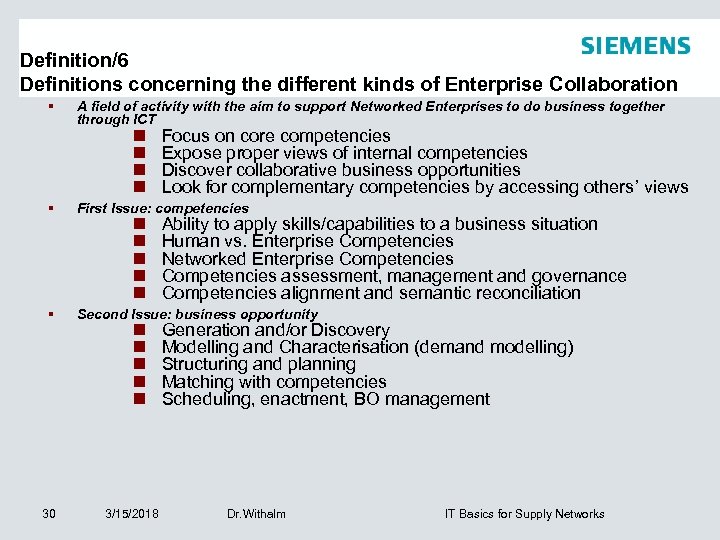
Definition/6 Definitions concerning the different kinds of Enterprise Collaboration § A field of activity with the aim to support Networked Enterprises to do business together through ICT n n Focus on core competencies Expose proper views of internal competencies Discover collaborative business opportunities Look for complementary competencies by accessing others’ views § First Issue: competencies § Second Issue: business opportunity 30 n n n n n 3/15/2018 Ability to apply skills/capabilities to a business situation Human vs. Enterprise Competencies Networked Enterprise Competencies assessment, management and governance Competencies alignment and semantic reconciliation Generation and/or Discovery Modelling and Characterisation (demand modelling) Structuring and planning Matching with competencies Scheduling, enactment, BO management Dr. Withalm IT Basics for Supply Networks
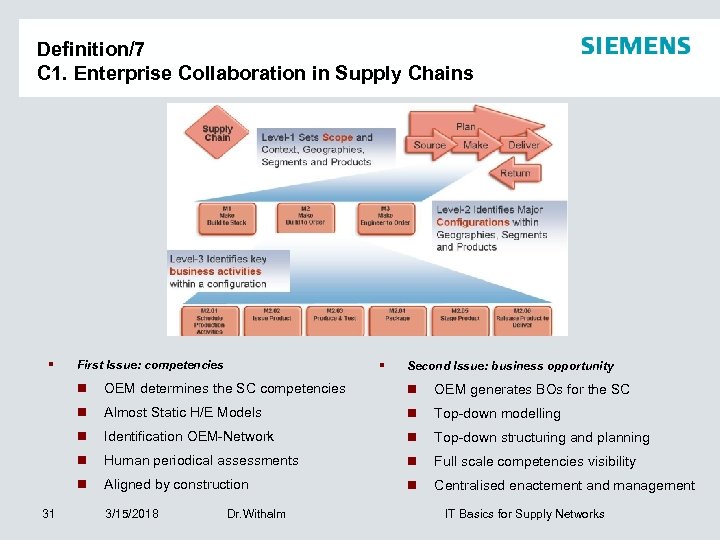
Definition/7 C 1. Enterprise Collaboration in Supply Chains § First Issue: competencies § Second Issue: business opportunity n n OEM generates BOs for the SC n Almost Static H/E Models n Top-down modelling n Identification OEM-Network n Top-down structuring and planning n Human periodical assessments n Full scale competencies visibility n 31 OEM determines the SC competencies Aligned by construction n Centralised enactement and management 3/15/2018 Dr. Withalm IT Basics for Supply Networks
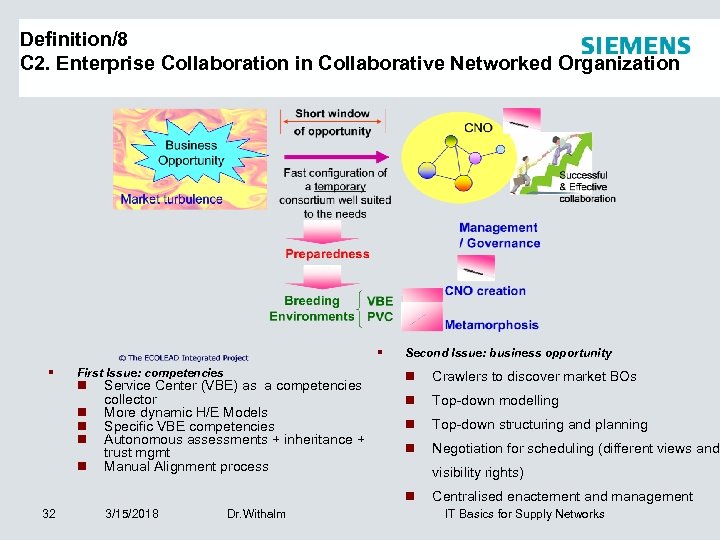
Definition/8 C 2. Enterprise Collaboration in Collaborative Networked Organization § § First Issue: competencies n n n Service Center (VBE) as a competencies collector More dynamic H/E Models Specific VBE competencies Autonomous assessments + inheritance + trust mgmt Manual Alignment process Second Issue: business opportunity n Crawlers to discover market BOs n Top-down modelling n Top-down structuring and planning n Negotiation for scheduling (different views and visibility rights) n 32 3/15/2018 Dr. Withalm Centralised enactement and management IT Basics for Supply Networks
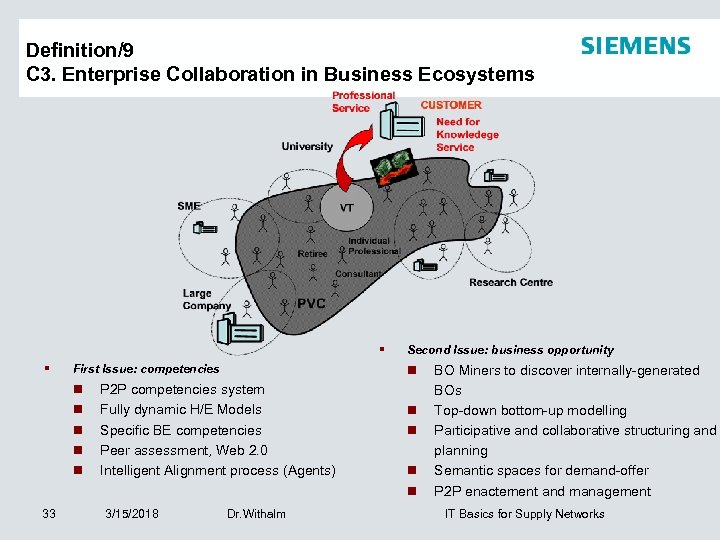
Definition/9 C 3. Enterprise Collaboration in Business Ecosystems § § 33 n First Issue: competencies n n n P 2 P competencies system Fully dynamic H/E Models Specific BE competencies Peer assessment, Web 2. 0 Intelligent Alignment process (Agents) 3/15/2018 Second Issue: business opportunity Dr. Withalm n n BO Miners to discover internally-generated BOs Top-down bottom-up modelling Participative and collaborative structuring and planning Semantic spaces for demand-offer P 2 P enactement and management IT Basics for Supply Networks
Introduction Assessments & Serious Gaming § One big hurdle in CNO‘s is the very different knowledge of their members especially concerning applying IT Systems § That‘s way experience has shown that assessments are essential before starting to build a CNO § Both the whole CNO as well as their members will be assessed § Assessment Method ECMM (Enterprise Collaboration Maturity Model) is derived from CMMI (Capability Maturity Model Integrated) § the prevailing Assessment Method for SW Organizations § Following the ECMM Assessment the respective CNO‘S and their members will be trained by Serious Gaming § In order to overcome the revealed weaknesses 34 3/15/2018 Dr. Withalm IT Basics for Supply Networks
CMMI - Capability Maturity Model Integration § Model for evaluating software/hardware/systems engineering organizations § Developed by the Software Engineering Institute (SEI) § Initiated by Do. D § Headed by Watts Humphrey § Reference model also for derived methods such as Bootstrap and Siemens Process Assessments 35 3/15/2018 Dr. Withalm IT Basics for Supply Networks
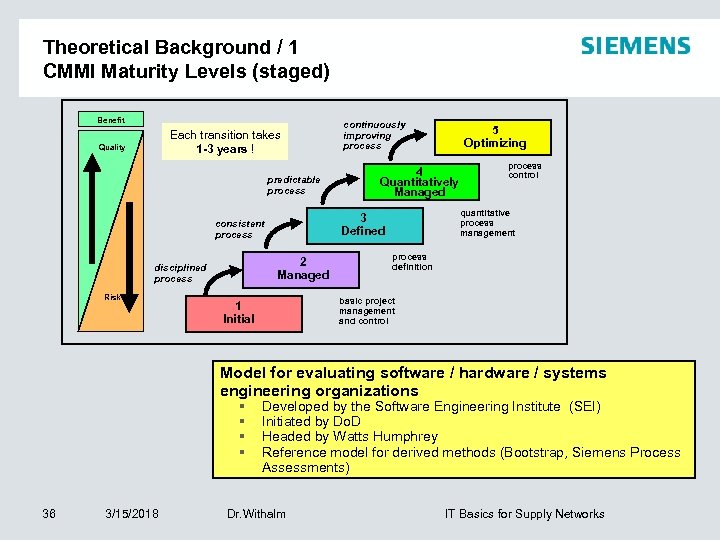
Theoretical Background / 1 CMMI Maturity Levels (staged) Benefit Each transition takes 1 -3 years ! Quality predictable process 2 Managed Risk 5 Optimizing 4 Quantitatively Managed process control quantitative process management 3 Defined consistent process disciplined process continuously improving process definition basic project management and control 1 Initial Model for evaluating software / hardware / systems engineering organizations § § 36 3/15/2018 Developed by the Software Engineering Institute (SEI) Initiated by Do. D Headed by Watts Humphrey Reference model for derived methods (Bootstrap, Siemens Process Assessments) Dr. Withalm IT Basics for Supply Networks
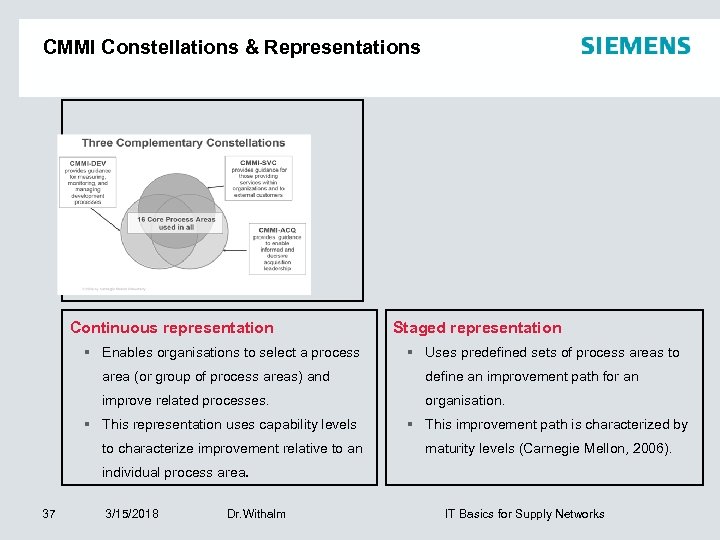
CMMI Constellations & Representations Continuous representation § Enables organisations to select a process Staged representation § Uses predefined sets of process areas to area (or group of process areas) and define an improvement path for an improve related processes. organisation. § This representation uses capability levels to characterize improvement relative to an § This improvement path is characterized by maturity levels (Carnegie Mellon, 2006). individual process area. 37 3/15/2018 Dr. Withalm IT Basics for Supply Networks
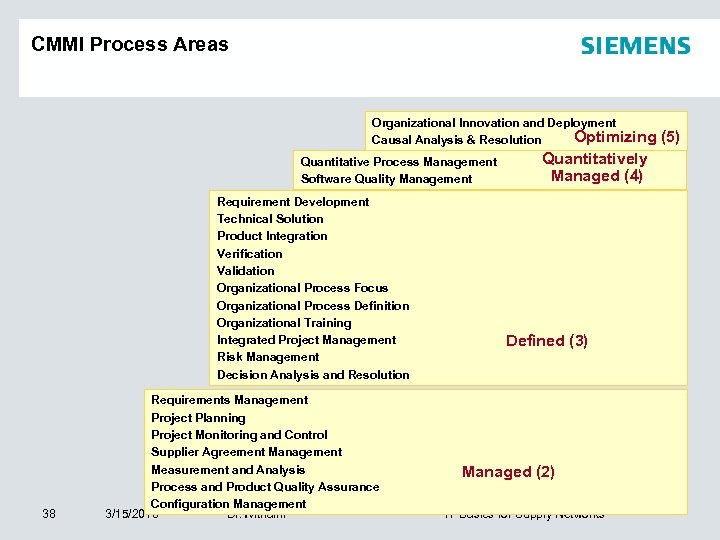
CMMI Process Areas Organizational Innovation and Deployment Optimizing Causal Analysis & Resolution Quantitative Process Management Software Quality Management Requirement Development Technical Solution Product Integration Verification Validation Organizational Process Focus Organizational Process Definition Organizational Training Integrated Project Management Risk Management Decision Analysis and Resolution 38 Requirements Management Project Planning Project Monitoring and Control Supplier Agreement Management Measurement and Analysis Process and Product Quality Assurance Configuration Management 3/15/2018 Dr. Withalm Quantitatively Managed (4) Defined (3) Managed (2) IT Basics for Supply Networks (5)
ECMM Overview/1 § The Enterprise Collaboration Maturity Model (ECMM) has as main objective § to analyze, measure, and propose improvement practices for increasing the capability of an organization to be able to collaborate and interoperate. § That is, both interoperability and collaboration aspects should be included to reach a model that takes into account Enterprise Interoperability and Enterprise Collaboration. § In order to reach this main objective, other secondary and more specific objectives have been identified: § § Set improvement objectives and priorities § Guide for improving projects and organizational processes § Help ensure stable, capable, and mature processes § 39 Diagnose the state of an organization’s current practices regarding collaboration and interoperability issues Proposition of EC and EI technologies and services that could be useful 3/15/2018 Dr. Withalm IT Basics for Supply Networks
ECMM Overview/2 § Regarding the special features for collaboration practices the ECMM should be useful to: § Support the collaboration during the whole life cycle of a Collaborative Networked Organisation (CNO): creation, operation, evolution, dissolution. § For an enterprise (that could be part of a CNO or not) in order to evaluate its preparedness for collaboration (in a specific collaboration or in general) and provide best practices to correctly position the enterprise inside its collaborative network. 40 3/15/2018 Dr. Withalm IT Basics for Supply Networks
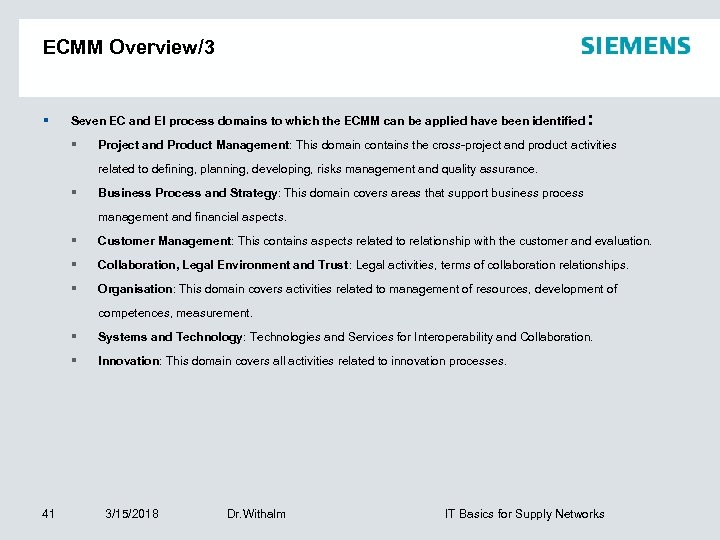
ECMM Overview/3 § Seven EC and EI process domains to which the ECMM can be applied have been identified § : Project and Product Management: This domain contains the cross-project and product activities related to defining, planning, developing, risks management and quality assurance. § Business Process and Strategy: This domain covers areas that support business process management and financial aspects. § Customer Management: This contains aspects related to relationship with the customer and evaluation. § Collaboration, Legal Environment and Trust: Legal activities, terms of collaboration relationships. § Organisation: This domain covers activities related to management of resources, development of competences, measurement. § § 41 Systems and Technology: Technologies and Services for Interoperability and Collaboration. Innovation: This domain covers all activities related to innovation processes. 3/15/2018 Dr. Withalm IT Basics for Supply Networks
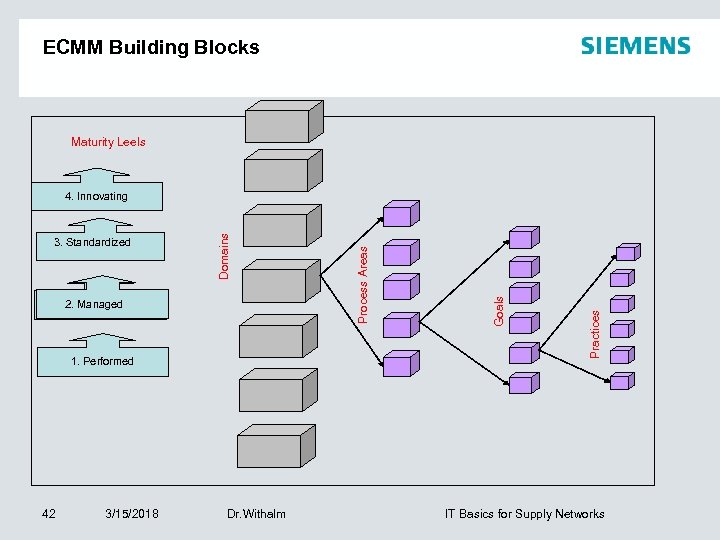
ECMM Building Blocks Maturity Leels 42 3/15/2018 Dr. Withalm Practices 1. Performed Goals 3. 2. Managed Standardized Process Areas 3. Standardized Domains 4. Innovating IT Basics for Supply Networks
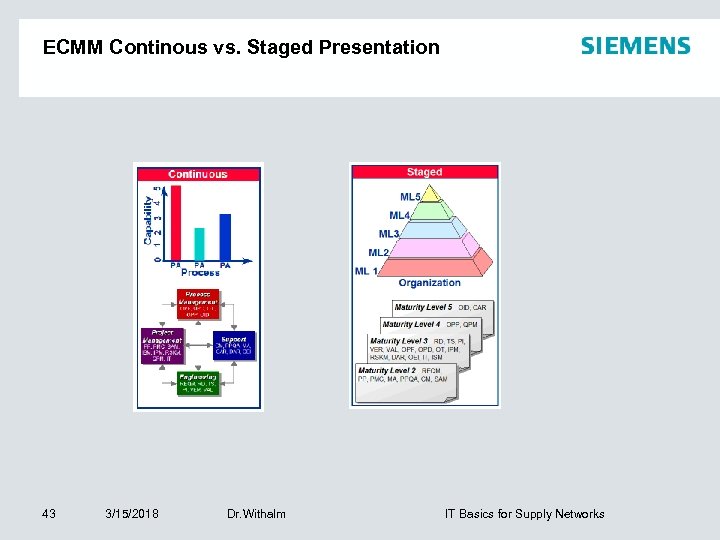
ECMM Continous vs. Staged Presentation 43 3/15/2018 Dr. Withalm IT Basics for Supply Networks
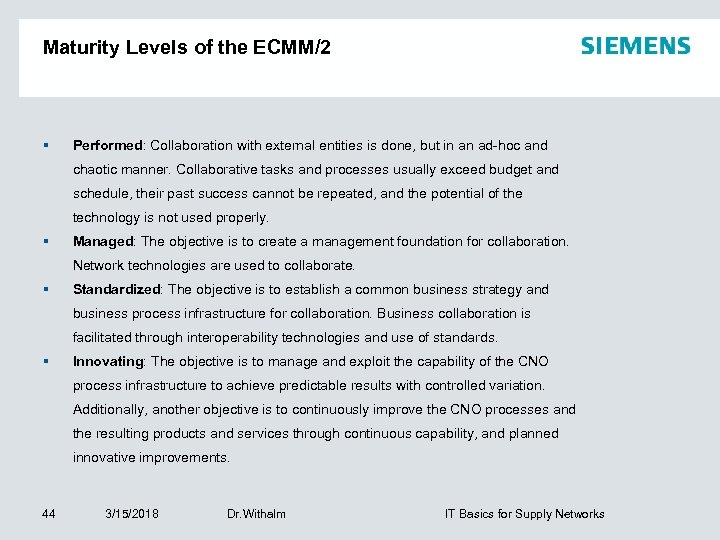
Maturity Levels of the ECMM/2 § Performed: Collaboration with external entities is done, but in an ad-hoc and chaotic manner. Collaborative tasks and processes usually exceed budget and schedule, their past success cannot be repeated, and the potential of the technology is not used properly. § Managed: The objective is to create a management foundation for collaboration. Network technologies are used to collaborate. § Standardized: The objective is to establish a common business strategy and business process infrastructure for collaboration. Business collaboration is facilitated through interoperability technologies and use of standards. § Innovating: The objective is to manage and exploit the capability of the CNO process infrastructure to achieve predictable results with controlled variation. Additionally, another objective is to continuously improve the CNO processes and the resulting products and services through continuous capability, and planned innovative improvements. 44 3/15/2018 Dr. Withalm IT Basics for Supply Networks
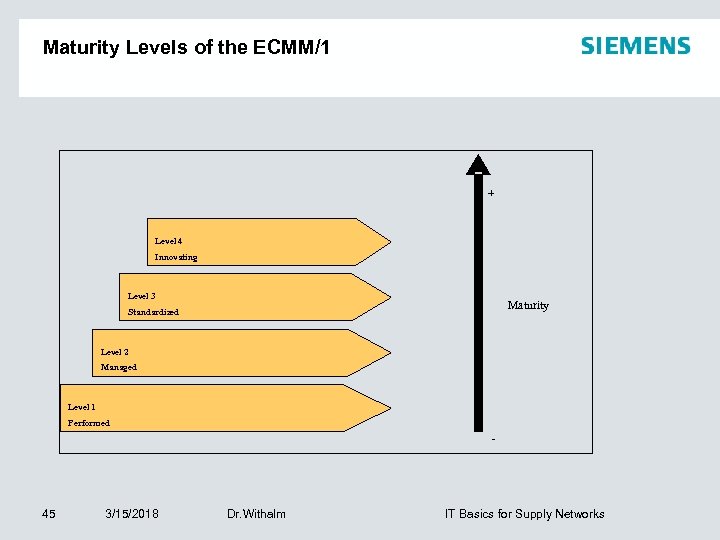
Maturity Levels of the ECMM/1 + Level 4 Innovating Level 3 Maturity Standardized Level 2 Managed Level 1 Performed - 45 3/15/2018 Dr. Withalm IT Basics for Supply Networks
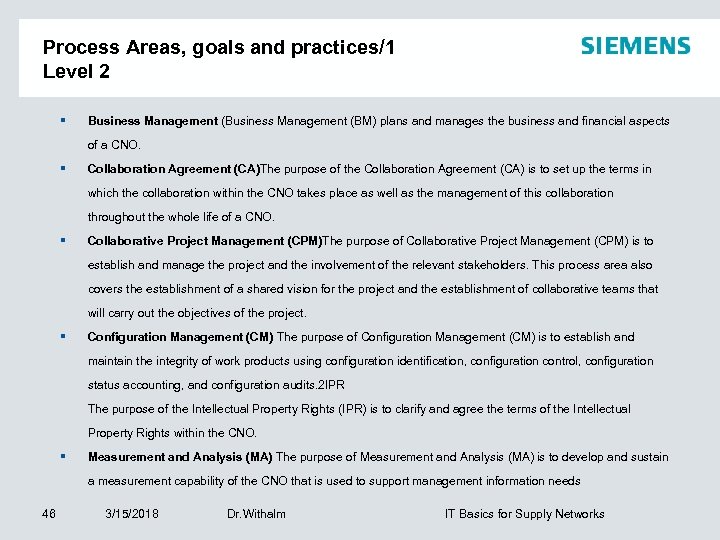
Process Areas, goals and practices/1 Level 2 § Business Management (BM) plans and manages the business and financial aspects of a CNO. § Collaboration Agreement (CA)The purpose of the Collaboration Agreement (CA) is to set up the terms in which the collaboration within the CNO takes place as well as the management of this collaboration throughout the whole life of a CNO. § Collaborative Project Management (CPM)The purpose of Collaborative Project Management (CPM) is to establish and manage the project and the involvement of the relevant stakeholders. This process area also covers the establishment of a shared vision for the project and the establishment of collaborative teams that will carry out the objectives of the project. § Configuration Management (CM) The purpose of Configuration Management (CM) is to establish and maintain the integrity of work products using configuration identification, configuration control, configuration status accounting, and configuration audits. 2 IPR The purpose of the Intellectual Property Rights (IPR) is to clarify and agree the terms of the Intellectual Property Rights within the CNO. § Measurement and Analysis (MA) The purpose of Measurement and Analysis (MA) is to develop and sustain a measurement capability of the CNO that is used to support management information needs 46 3/15/2018 Dr. Withalm IT Basics for Supply Networks
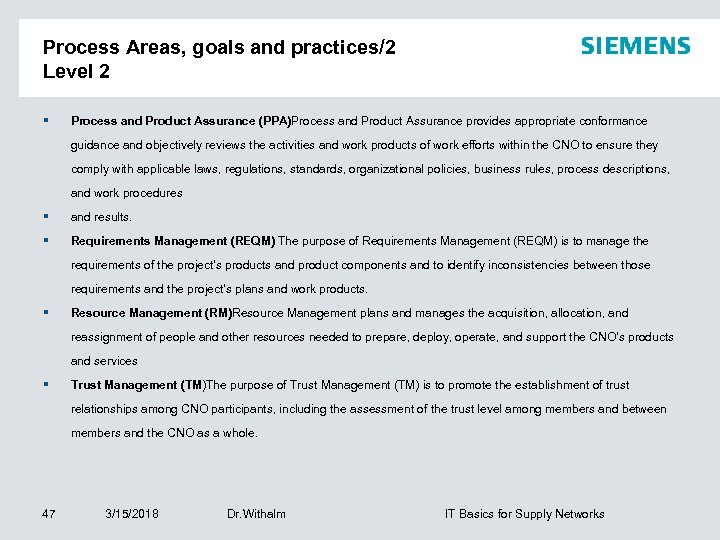
Process Areas, goals and practices/2 Level 2 § Process and Product Assurance (PPA)Process and Product Assurance provides appropriate conformance guidance and objectively reviews the activities and work products of work efforts within the CNO to ensure they comply with applicable laws, regulations, standards, organizational policies, business rules, process descriptions, and work procedures § and results. § Requirements Management (REQM) The purpose of Requirements Management (REQM) is to manage the requirements of the project’s products and product components and to identify inconsistencies between those requirements and the project’s plans and work products. § Resource Management (RM)Resource Management plans and manages the acquisition, allocation, and reassignment of people and other resources needed to prepare, deploy, operate, and support the CNO’s products and services § Trust Management (TM)The purpose of Trust Management (TM) is to promote the establishment of trust relationships among CNO participants, including the assessment of the trust level among members and between members and the CNO as a whole. 47 3/15/2018 Dr. Withalm IT Basics for Supply Networks
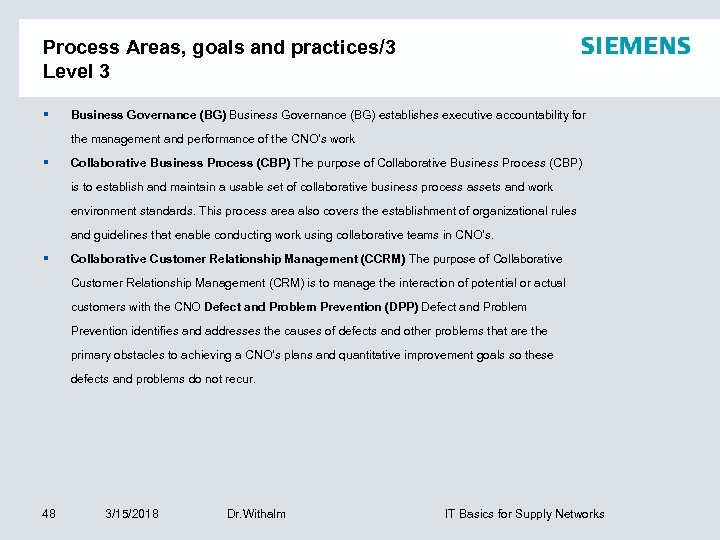
Process Areas, goals and practices/3 Level 3 § Business Governance (BG) establishes executive accountability for the management and performance of the CNO’s work § Collaborative Business Process (CBP) The purpose of Collaborative Business Process (CBP) is to establish and maintain a usable set of collaborative business process assets and work environment standards. This process area also covers the establishment of organizational rules and guidelines that enable conducting work using collaborative teams in CNO’s. § Collaborative Customer Relationship Management (CCRM) The purpose of Collaborative Customer Relationship Management (CRM) is to manage the interaction of potential or actual customers with the CNO Defect and Problem Prevention (DPP) Defect and Problem Prevention identifies and addresses the causes of defects and other problems that are the primary obstacles to achieving a CNO’s plans and quantitative improvement goals so these defects and problems do not recur. 48 3/15/2018 Dr. Withalm IT Basics for Supply Networks
Process Areas, goals and practices/4 Level 3 § Organizational Innovation (OI) The purpose of Organizational Innovation (OI) is to select and deploy incremental and innovative improvements that measurably improve the CNO’s processes and technologies. The improvements support the CNO’s quality and process-performance objectives as derived from the CNO’s . business objectives § Requirements development (RD) The purpose of Requirements Development (RD) is to produce and analyze customer, product and product component requirements. § Risk Management (RSKM) The purpose of Risk Management (RSKM) is to identify potential problems before they occur so that risk-handling activities can be planned and invoked as needed across the life of the CNO, product or project to mitigate adverse impacts on achieving objectives. § Interoperability and Collaboration Technologies (ICT) The purpose of Interoperability and Collaboration Technologies (ICT) is to standardize the usage of a set of baseline tools, techniques and methods for interoperability and collaboration § Technical Solution (TS)The purpose of Technical Solution (TS) is to design, develop, and implement solutions to the committed requirements. Solutions, designs, and implementations encompass products, product components, and product-related lifecycle processes either singly or in combination as appropriate. 49 3/15/2018 Dr. Withalm IT Basics for Supply Networks
Process Areas, goals and practices/5 Level 4 § Customer Evaluation (CE) The purpose of Customer Evaluation (CE) is to measure the customers’ satisfaction regarding the delivered products and services and to set up a set of indicators internal to the CNO w. r. t. the customers. § Open Innovation (OPI) Systematically explore a wide range of internal and external sources for innovation opportunities, integrate and exploit those opportunities through multiple channels. § Organizational Process Performance (OPP) The purpose of Organizational Process Performance (OPP) is to establish and maintain a quantitative understanding of the performance of the CNO’s set of standard processes in support of quality and process-performance objectives, and to provide the process-performance data, baselines, and models to quantitatively manage the CNO's projects. § Quantitative Project Management (QPM) The purpose of Quantitative Project Management (QPM) is to quantitatively manage the project’s defined process to achieve the project’s established quality and processperformance objectives. § Training and Competency Development (TCD) Competency Development develops the competencies within the CNO’s workforce that are needed to perform the organization’s work using the organization’s standard processes. The purpose of Training is to develop the skills and knowledge of people so they can perform their roles effectively and efficiently. 50 3/15/2018 Dr. Withalm IT Basics for Supply Networks
ECMM Assessments & Serious Gaming/1 • • • Serious Gaming easily supports the process area concept of ECMM In COIN, the concept of process areas was pursued • For each of them respective KPI’s were established KPI’s enable the measurement of goal fulfillment in ECMM Further issues as specific practices, sub practices, and typical work products • Become a matter of the game • i. e. gamers select them and may eventually meet their specific goals Assessment is very easy if learners/gamers have met the objectives In case of difficulties learner/gamer goes back to e-learning system • Issues are explained • Start with a new game 51 3/15/2018 Dr. Withalm IT Basics for Supply Networks
ECMM Assessments & Serious Gaming/2 • Serious Gaming is the backbone of the whole system • Via Web Services respective ECMM tools and the COIN learning engine will be connected • E-learning content will be structured in a ECMM compliant manner § Appropriate specific goals and practices need to be established for each of the EC/EI process areas including respective e-learning content. § An important component of the serious gaming approach is the collaboration between players/learners, which is especially important for domains like automotive. § The game needs to provide CSCW (Computer Supported Cooperative Work) features, where gamers are enabled to communicate, negotiate, setting up contracts together, etc. § Assessment is not limited to assess individuals only § Outcome of the team might be the right measure of success § Enabling the analysis of gamers' behavior as a team member 52 3/15/2018 Dr. Withalm IT Basics for Supply Networks
Serious Gaming/1 l All learning tools, methodologies, and content can be considered as e-learning l Mainly consisting of digital support l Serious Games are computer and/or video games l Used -beside entertaining goals for educational technology l Serious Games can be of any genre l Many of them can be considered a kind of edutainment. l Computer based serious games are an e-learning methodology 53 3/15/2018 Dr. Withalm IT Basics for Supply Networks
Serious Gaming/2 l Serious Games were already being developed for non entertainment purposes since the late 90’s l Including e. g. early work by Henry Jenkins at MIT. l Additionally, the ability of games to contribute to training expanded l With development of multi-player gaming l In 2002 games were developed that address policy and management issues l Since 2004 focus shifted to social issues and social change l Especially games for health which address healthcare applications 54 3/15/2018 Dr. Withalm IT Basics for Supply Networks
Serious Gaming/3 l Serious Games are considered as the next evolutionary generation of learning tools l Addressing some of the short comings of its predecessors l A serious game could be a simulation that has the look& feel of a game l But corresponding to non-game areas l Including e. g. business operations, military operations or medical applications. l The games are intended to provide an engaging, self-reinforcing context l In which to motivate and educate players l Through modifying existing game applications for educational purposes l There is a great potential for learning with games 55 3/15/2018 Dr. Withalm IT Basics for Supply Networks
Serious Gaming/4 l Combined approach of e-learning with specific method Serious Gaming and CMMI l Should have the following strengths l Motivation of learners l Directed improvement measures l Assessment of team collaboration l Nevertheless there is still development and adequate work to be done l Modification of the classical CMMI process areas including sub-structures like tasks and work results-one essential WP in COIN. l Development of supporting E-Learning materials reflecting the modified CMMI process areas including sub-structures. l Selection and adaptation of a serious gaming engine to make the modified CMMI approach playable. l The gaming engine should also provide a mechanism to integrate access to the E-Learning materials. 56 3/15/2018 Dr. Withalm IT Basics for Supply Networks
The COIN Vision COIN VISION: “By 2020 enterprise collaboration and interoperability services will become an invisible, pervasive and self-adaptive knowledge and business utility at disposal of the European networked enterprises from any industrial sector and domain in order to rapidly set-up, efficiently manage and effectively operate different forms of business collaborations, from the most traditional supply chains to the most advanced and dynamic business ecosystems. ” 59 3/15/2018 Dr. Withalm IT Basics for Supply Networks
Background and motivation Enterprise Collaboration (EC) and Enterprise Interoperability (EI) have been the two major research catalysts for DG INFSO D 4 "Networked Enterprise & Radio Frequency Identification (RFID)", and aggregated tens of projects and hundreds of researchers in their projects clusters initiatives. COIN is rooted in the previous initiatives. Enterprise Collaboration comes from a business perspective and identifies the process of enterprises - mainly SMEs - to set-up and manage cross-enterprise win-win business relations in response to business opportunities. Enterprise Interoperability originates by the ICT world and identifies a capability of enterprise software and applications to exchange information and to mutually understand the information exchanged at the level of data, applications, processes and enterprise models involved. 60 3/15/2018 Dr. Withalm IT Basics for Supply Networks
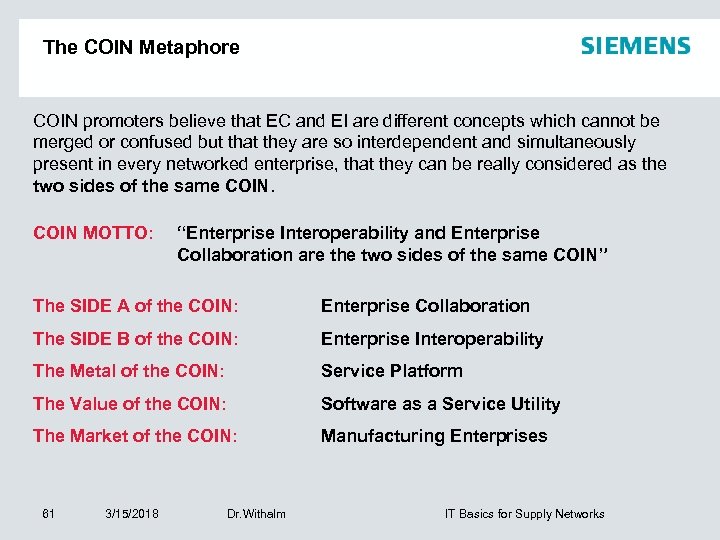
The COIN Metaphore COIN promoters believe that EC and EI are different concepts which cannot be merged or confused but that they are so interdependent and simultaneously present in every networked enterprise, that they can be really considered as the two sides of the same COIN MOTTO: “Enterprise Interoperability and Enterprise Collaboration are the two sides of the same COIN” The SIDE A of the COIN: Enterprise Collaboration The SIDE B of the COIN: Enterprise Interoperability The Metal of the COIN: Service Platform The Value of the COIN: Software as a Service Utility The Market of the COIN: Manufacturing Enterprises 61 3/15/2018 Dr. Withalm IT Basics for Supply Networks
COIN A Side: Enterprise Collaboration The COIN Project develops services for European SMEs enterprise aggregation, synchronization and co-operation in response to the more and more demanding and complex business opportunities coming from the global market. § Existing solutions from previous EU FP 6 project and other sources will be used as starting point (EC services baseline). § On top of a developed common baseline, the project will further develop EC innovative services for § Collaborative Product Development, § Collaborative Management, § Production Planning, § Collaborative Project Collaborative Human Interaction. § Such services will be easily configurable to meet different collaboration requirements, from the most static supply chains where optimization and efficiency are of key importance, till to the most dynamic business ecosystems where evolutionary behaviour of the business system, including sudden disappearing and re-appearing of business entities, has to be modelled and supported. 62 3/15/2018 Dr. Withalm IT Basics for Supply Networks
COIN B Side: Enterprise Interoperability is the ability of two or more systems or components to exchange information and to use the information that has been exchanged. § The COIN Project provides a foundation for Enterprise Interoperability Services based on the principles of existing interoperability frameworks (e. g. in the e-government, e-business and enterprise architectures domains) and results from previous projects to be integrated with the new COIN Service platform. § The work starts with the consolidation of the results from previous EU FP 6 Enterprise Interoperability projects and other sources like de-facto and de-jure standards. Existing services will be harmonised into a set of baseline Enterprise Interoperability-services. § On top of a developed common baseline, the project will further develop innovative services for § § Knowledge Interoperability Services, § 63 Information Interoperability Services, Business Interoperability Services 3/15/2018 Dr. Withalm IT Basics for Supply Networks
COIN Metal: a Generic Service Platform The COIN Project develops a pervasive, adaptive service platform to host Baseline and Innovative COIN services for Enterprise Collaboration and Enterprise Interoperability. The services will be available under innovative on-demand, utility-oriented Saa. S-U business model for European enterprise (mainly SMEs). § Based on several well proven results from semantic web, semantic web service, semantic-enabled service-oriented architecture, together with some trust, security dependability results and peer-to-peer evolutionary and intelligent systems, the project will further develop a powerful baseline service platform with many distinctive features and peculiar characteristics to make it suitable for collaboration and interoperability among European enterprises. 64 3/15/2018 Dr. Withalm IT Basics for Supply Networks
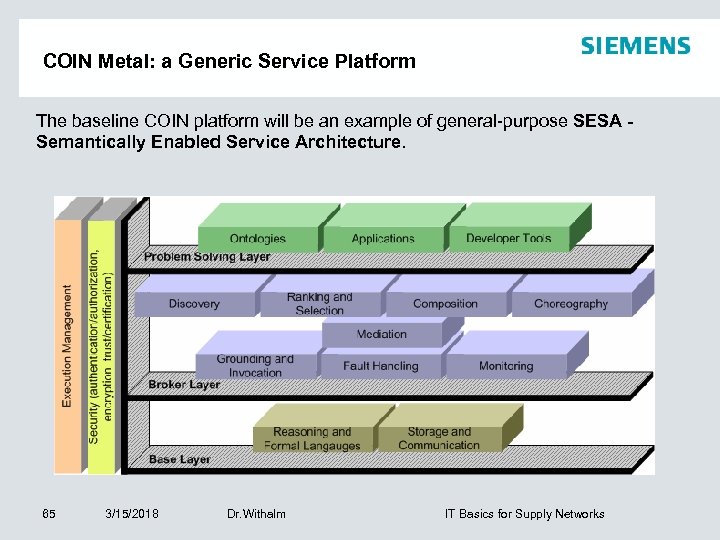
COIN Metal: a Generic Service Platform The baseline COIN platform will be an example of general-purpose SESA Semantically Enabled Service Architecture. 65 3/15/2018 Dr. Withalm IT Basics for Supply Networks
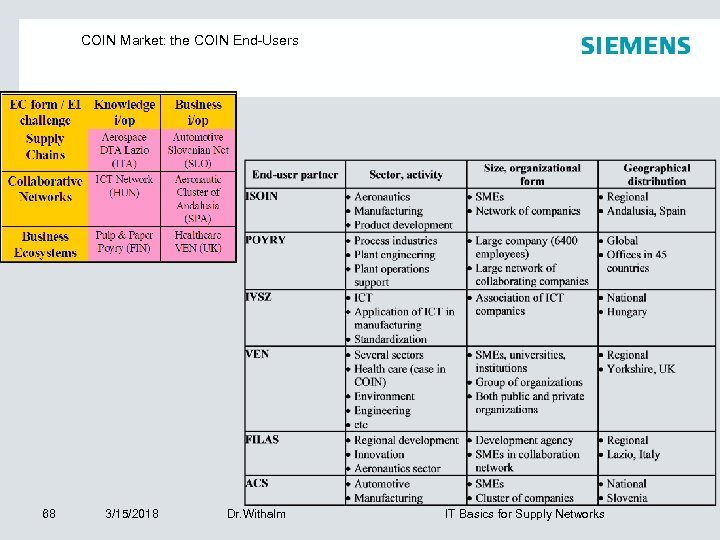
COIN Market: the COIN End-Users 68 3/15/2018 Dr. Withalm IT Basics for Supply Networks
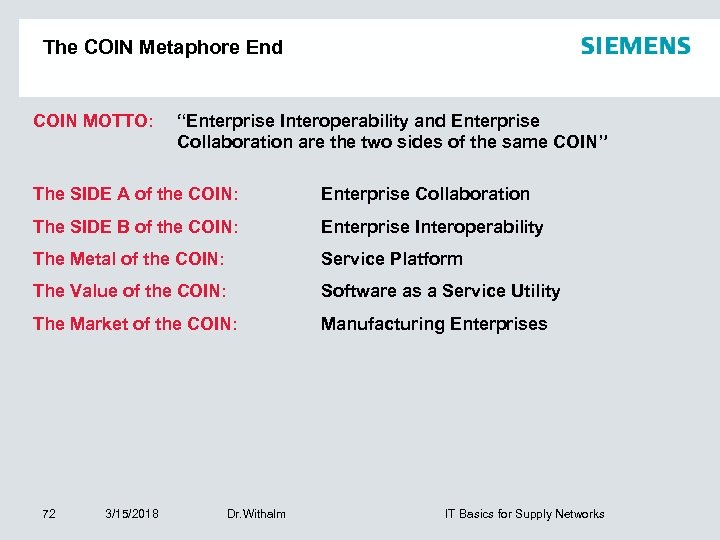
The COIN Metaphore End COIN MOTTO: “Enterprise Interoperability and Enterprise Collaboration are the two sides of the same COIN” The SIDE A of the COIN: Enterprise Collaboration The SIDE B of the COIN: Enterprise Interoperability The Metal of the COIN: Service Platform The Value of the COIN: Software as a Service Utility The Market of the COIN: Manufacturing Enterprises 72 3/15/2018 Dr. Withalm IT Basics for Supply Networks
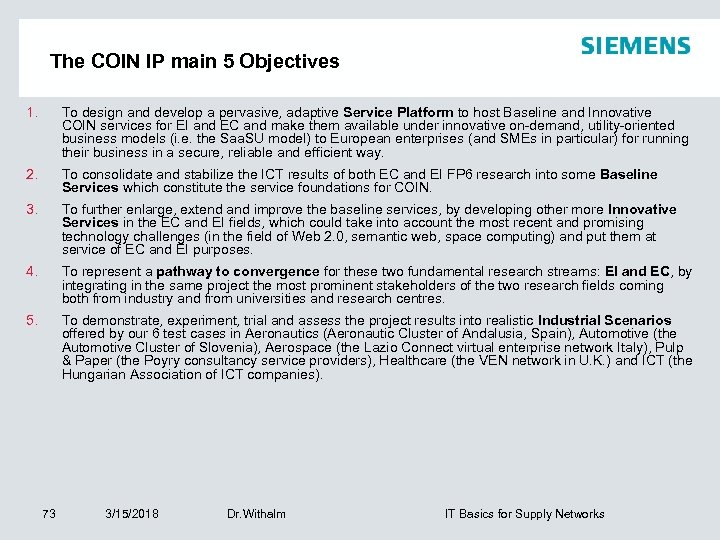
The COIN IP main 5 Objectives 1. To design and develop a pervasive, adaptive Service Platform to host Baseline and Innovative COIN services for EI and EC and make them available under innovative on-demand, utility-oriented business models (i. e. the Saa. SU model) to European enterprises (and SMEs in particular) for running their business in a secure, reliable and efficient way. 2. To consolidate and stabilize the ICT results of both EC and EI FP 6 research into some Baseline Services which constitute the service foundations for COIN. 3. To further enlarge, extend and improve the baseline services, by developing other more Innovative Services in the EC and EI fields, which could take into account the most recent and promising technology challenges (in the field of Web 2. 0, semantic web, space computing) and put them at service of EC and EI purposes. 4. To represent a pathway to convergence for these two fundamental research streams: EI and EC, by integrating in the same project the most prominent stakeholders of the two research fields coming both from industry and from universities and research centres. 5. To demonstrate, experiment, trial and assess the project results into realistic Industrial Scenarios offered by our 6 test cases in Aeronautics (Aeronautic Cluster of Andalusia, Spain), Automotive (the Automotive Cluster of Slovenia), Aerospace (the Lazio Connect virtual enterprise network Italy), Pulp & Paper (the Poyry consultancy service providers), Healthcare (the VEN network in U. K. ) and ICT (the Hungarian Association of ICT companies). 73 3/15/2018 Dr. Withalm IT Basics for Supply Networks
Thank you for your attention! IT Basics for Supply Networks
Farbpalette mit Farbcodes Primäre Flächenfarbe: Akzentfarben: R 255 G 210 B 078 R 255 G 255 B 255 Sekundäre Flächenfarben: R 245 G 128 B 039 R 229 G 025 B 055 R 000 G 133 B 062 R 000 G 084 B 159 R 000 G 000 B 000 R 255 G 221 B 122 R 248 G 160 B 093 R 236 G 083 B 105 R 064 G 164 B 110 R 064 G 127 B 183 R 064 G 064 B 064 R 215 G 225 B 225 R 130 G 160 B 165 R 255 G 232 B 166 R 250 G 191 B 147 R 242 G 140 B 155 R 127 G 194 B 158 R 127 G 169 B 207 R 127 G 127 B 127 R 220 G 225 B 230 R 185 G 195 B 205 R 145 G 155 B 165 R 255 G 244 B 211 R 252 G 223 B 201 R 248 G 197 B 205 R 191 G 224 B 207 R 191 G 212 B 231 R 191 G 191 B 191 R 255 G 250 B 237 79 R 170 G 190 B 195 R 254 G 242 B 233 R 252 G 232 B 235 R 229 G 243 B 235 R 229 G 238 B 245 R 229 G 229 B 229 3/15/2018 Dr. Withalm IT Basics for Supply Networks
Скачать презентацию IT Basics for Supply Networks 1 Dr Withalm IT
d5820dbb7699cab1d3d8269ca0b79188.ppt