


 Скачать презентацию IT as a Lever for Change in Teaching
138b66b12a5164235d8ba40ba6bee96a.ppt
- Количество слайдов: 51
 IT as a Lever for Change in Teaching and Learning Sue Trinidad sue@cite. hku. hk Nancy Law nancy@cite. hku. hk Centre for Information Technology in Education University of Hong Kong http: //www. cite. hku. hk
 • • • Overview This presentation will focus on the exciting use of e-learning and how it can become a lever for change in teaching and learning. What are the conditions necessary for the benefits of e-learning to be realized? What components are necessary to create a suitable e-learning environment? What skills do educators need to build suitable e-learning environments? These questions will be addressed through: 1. Examples of e-learning environments that Hong Kong teachers have created will be provided, as will innovations that can help lever change, especially as was noted during SARS. 2. Findings from an international comparative study of innovative pedagogical practices using ICT. Participants will be encouraged to share their own e-learning experiences and contribute to the discussion of e-learning as a lever for change
 Challenges ahead of Us
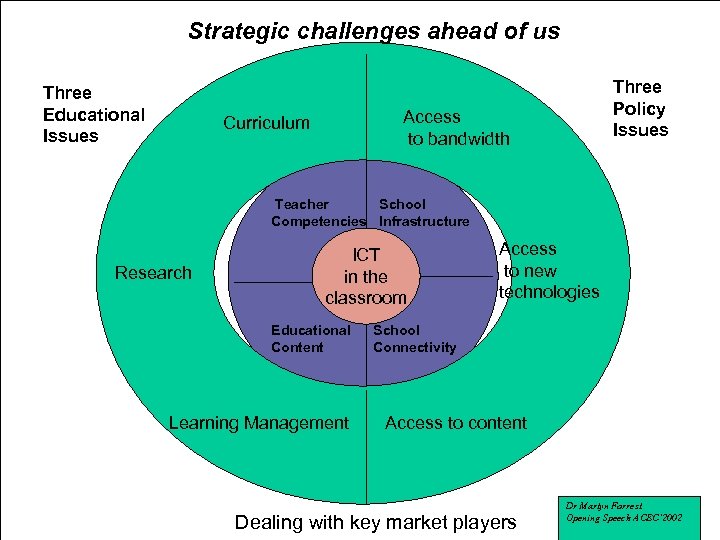 Strategic challenges ahead of us Three Educational Issues Three Policy Issues Access to bandwidth Curriculum Teacher School Competencies Infrastructure Research ICT in the classroom Educational Content Learning Management Access to new technologies School Connectivity Access to content Dealing with key market players Dr Martyn Forrest Opening Speech ACEC’ 2002
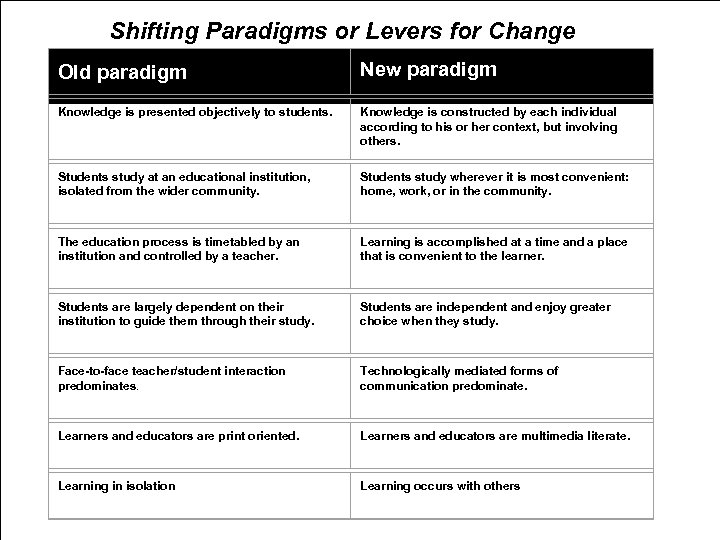 Shifting Paradigms or Levers for Change Old paradigm New paradigm Knowledge is presented objectively to students. Knowledge is constructed by each individual according to his or her context, but involving others. Students study at an educational institution, isolated from the wider community. Students study wherever it is most convenient: home, work, or in the community. The education process is timetabled by an institution and controlled by a teacher. Learning is accomplished at a time and a place that is convenient to the learner. Students are largely dependent on their institution to guide them through their study. Students are independent and enjoy greater choice when they study. Face-to-face teacher/student interaction predominates. Technologically mediated forms of communication predominate. Learners and educators are print oriented. Learners and educators are multimedia literate. Learning in isolation Learning occurs with others
 IT as a Lever for Change in Teaching and Learning : E-learning
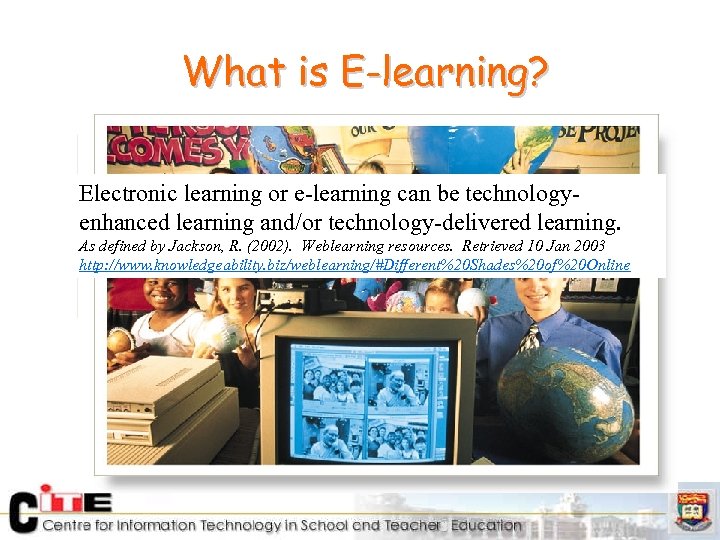 What is E-learning? Electronic learning or e-learning can be technologyenhanced learning and/or technology-delivered learning. As defined by Jackson, R. (2002). Weblearning resources. Retrieved 10 Jan 2003 http: //www. knowledgeability. biz/weblearning/#Different%20 Shades%20 of%20 Online
 What do you believe constitutes good e-learning? There are many factors that can influence the elearning experience: – – Infrastructure. Quality of content and assessment. Quality of learner support systems. Assumptions made by learners and facilitators about the learning experience itself. – Educational design. - Peer support networks for learners and facilitators. • Careful design of quality online learning materials along with learner support and learner activity will encourage deep and more meaningful e-learning.
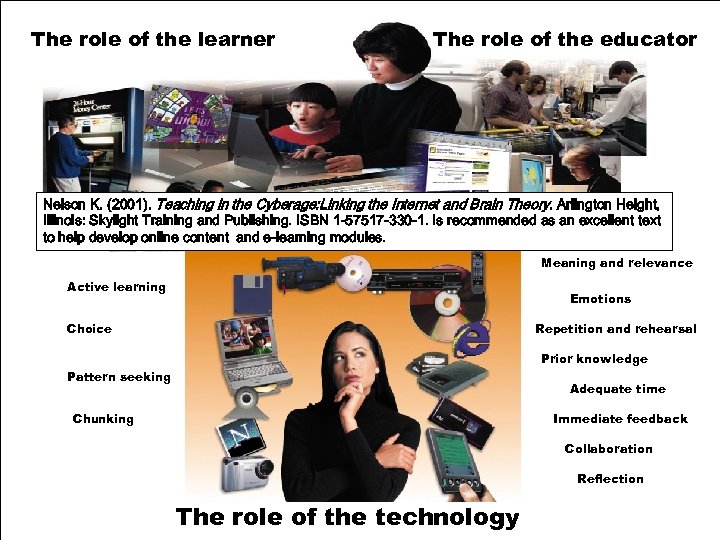 The role of the learner The role of the educator Nelson K. (2001). Teaching in the Cyberage: Linking the Internet and Brain Theory. Arlington Height, Illinois: Skylight Training and Publishing. ISBN 1 -57517 -330 -1. Is recommended as an excellent text to help develop online content and e-learning modules. Meaning and relevance Active learning Emotions Choice Repetition and rehearsal Prior knowledge Pattern seeking Adequate time Chunking Immediate feedback Collaboration Reflection The role of the technology
 IT as a Lever for Change in Teaching and Learning : Designing e-learning environments
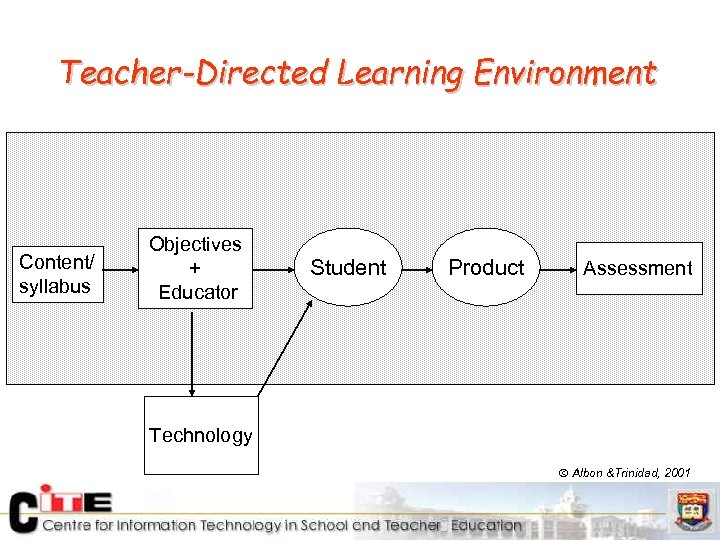 Teacher-Directed Learning Environment Content/ syllabus Objectives + Educator Student Product Assessment Technology Albon &Trinidad, 2001
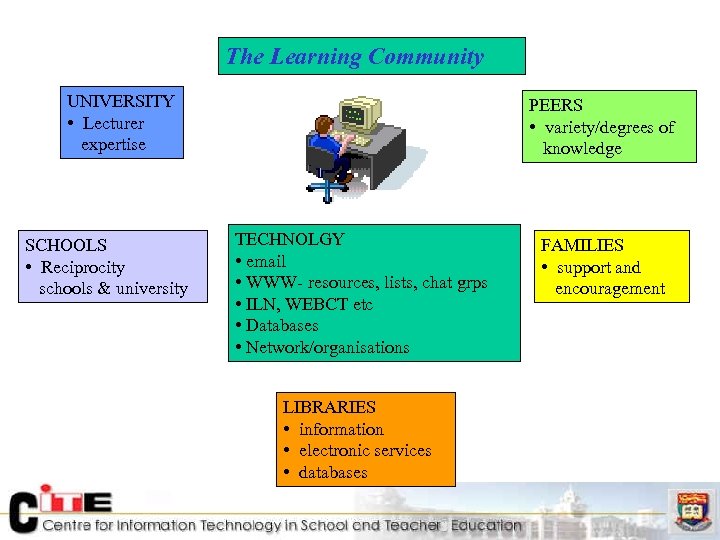 The Learning Community UNIVERSITY • Lecturer expertise SCHOOLS • Reciprocity schools & university PEERS • variety/degrees of knowledge TECHNOLGY • email • WWW- resources, lists, chat grps • ILN, WEBCT etc • Databases • Network/organisations LIBRARIES • information • electronic services • databases FAMILIES • support and encouragement
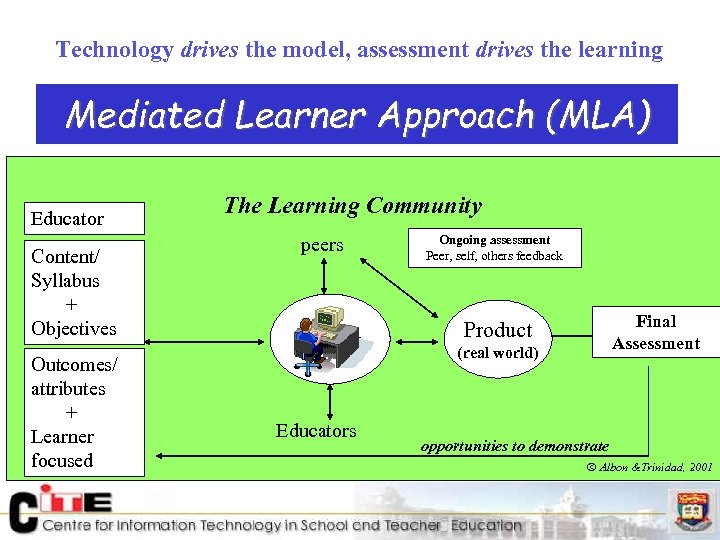 Technology drives the model, assessment drives the learning Mediated Learner Approach (MLA) Educator Content/ Syllabus + Objectives Outcomes/ attributes + Learner focused The Learning Community peers Student Educators Ongoing assessment Peer, self, others feedback Final Assessment Product (real world) opportunities to demonstrate Albon &Trinidad, 2001
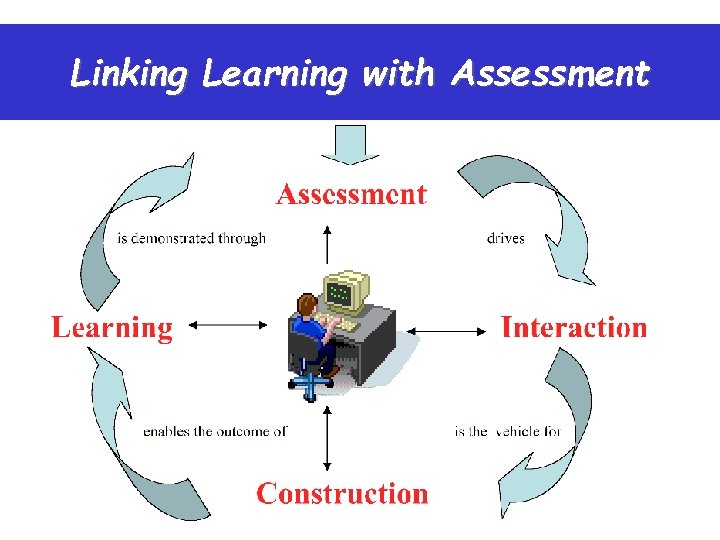 Linking Learning with Assessment
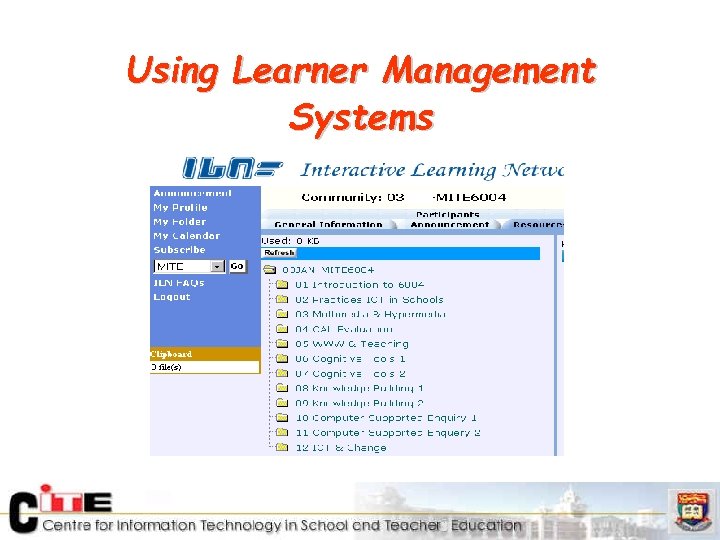 Using Learner Management Systems
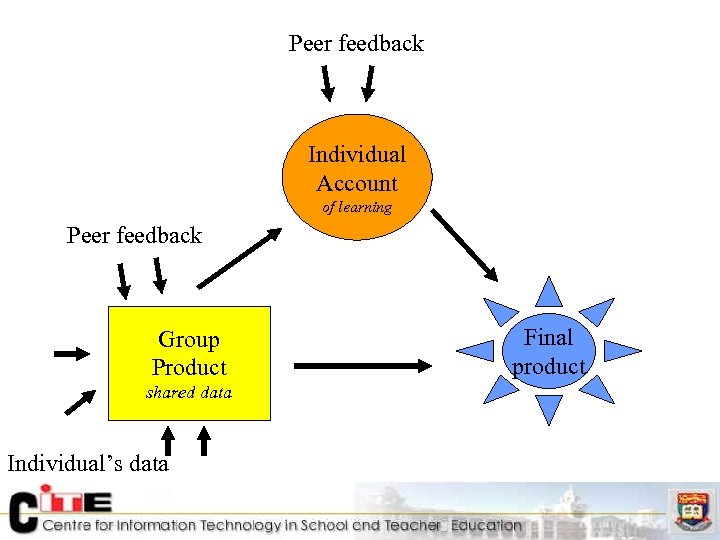 Peer feedback Individual Account of learning Peer feedback Group Product shared data Individual’s data Final product
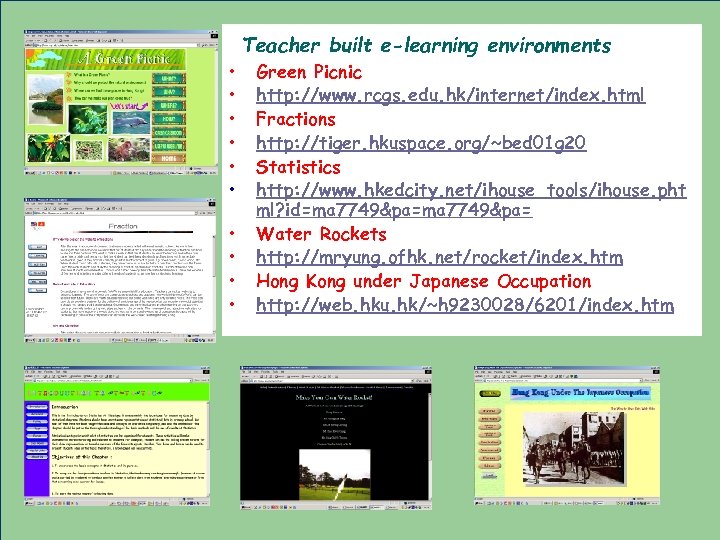 Teacher built e-learning environments Building e-learning sites • Green Picnic • • • http: //www. rcgs. edu. hk/internet/index. html Fractions http: //tiger. hkuspace. org/~bed 01 g 20 Statistics http: //www. hkedcity. net/ihouse_tools/ihouse. pht ml? id=ma 7749&pa= Water Rockets http: //mryung. ofhk. net/rocket/index. htm Hong Kong under Japanese Occupation http: //web. hku. hk/~h 9230028/6201/index. htm
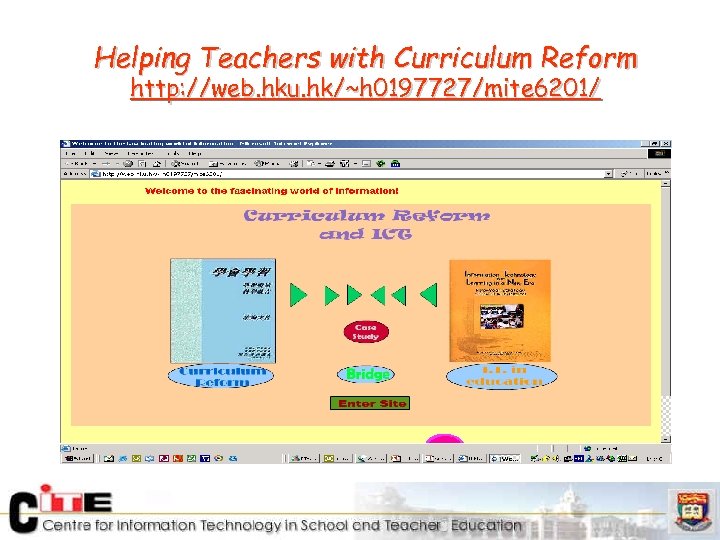 Helping Teachers with Curriculum Reform http: //web. hku. hk/~h 0197727/mite 6201/
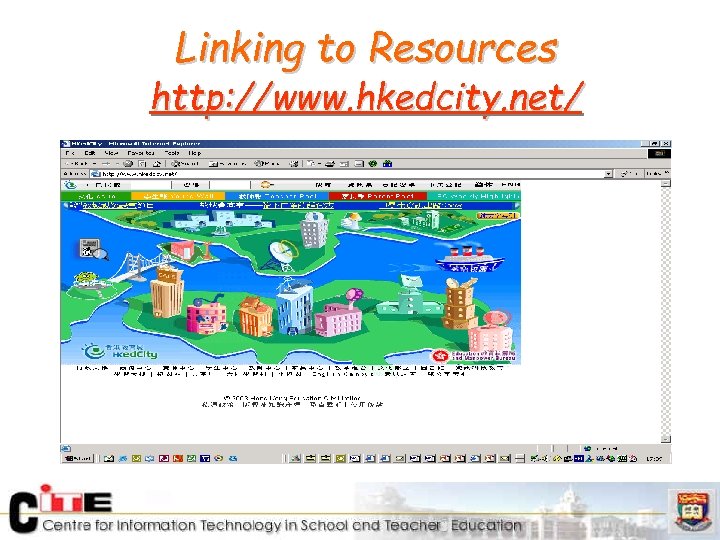 Linking to Resources http: //www. hkedcity. net/
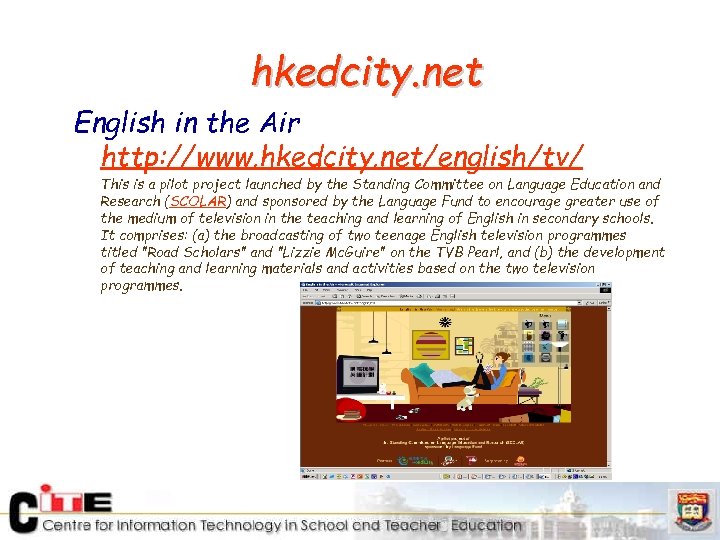 hkedcity. net English in the Air http: //www. hkedcity. net/english/tv/ This is a pilot project launched by the Standing Committee on Language Education and Research (SCOLAR) and sponsored by the Language Fund to encourage greater use of the medium of television in the teaching and learning of English in secondary schools. It comprises: (a) the broadcasting of two teenage English television programmes titled "Road Scholars" and "Lizzie Mc. Guire" on the TVB Pearl, and (b) the development of teaching and learning materials and activities based on the two television programmes.
 IT as a Lever for Change in Teaching and Learning : E-learning & SARS
 E-learning & SARS Three Observations: 1. Conditions necessary for taking advantage of IT: * readiness * conception of e-learning 2. A paradigm shift in e-learning is necessary 3. A need for technology-innovation: e-learning platforms that would support collaborative inquiry
 E-learning & SARS – what happened? Class suspension & IT Universities: HKU • http: //www. hku. hk/sars/index. shtml • http: //www. hku. hk/cgi-bin/sars/message_announcement. pl And similarly for other universities Schools: • http: //ihouse. hkedcity. net/~sp 1400/elearn. htm
 E-learning & SARS – what happened? Support from within the education community for the community • HKU: “Inter-disciplinary Self-Learning Platform” http: //www. hku. hk/gened/withu/ • CUHK: “Web-based Support for Primary and Secondary Students” http: //www. fed. cuhk. edu. hk/prisecstudent/html • Hong Kong Ed. City I-classroom “Learning and Teaching Strategies and Resources on ‘Atypical Pneumonia’” http: //www. hkedcity. net/project/cdi/index_eng. html
 E-learning & SARS learning & teaching – what kinds of took place? • Video conferencing? • Webcast/chat room? • Web forum/discussion? Most popular: • Repository of notes & ppt • Delivery of instructions on homework • Posting of assignments by students
 Using E-learning during SARS: Observation 1 IT readiness • Both teachers & students involvement must have used e-learning before • Communication platforms & mode of learning & teaching used must have been already set up and used before • SARS has promoted more extensive uses of IT where it has already taken root • IT can increase momentum, not create it!
 Using E-learning during SARS: Observation 2 Conception of e-learning • The usage is generally very traditional • IT platforms as communal space for disseminating what is most important in teaching and learning • Common use of IT tools: listen to teacher explanation, download course materials and submit assignment Do such uses of IT in learning Help to prepare students for lifelong learning?
 Conditions necessary to take advantage of IT during SARS: • Readiness • Conception of learning & teaching - & elearning IT can only be a lever for improvement and innovation, not a catalyst!
 A Paradigm shift in e-learning? • Some students’ general opinions on the replacement of face-to-face classroom interaction by learning through IT during the outbreak of SARS: “Too many assignments!” “I miss my fellow classmates!” Can technology contribute to learning differently?
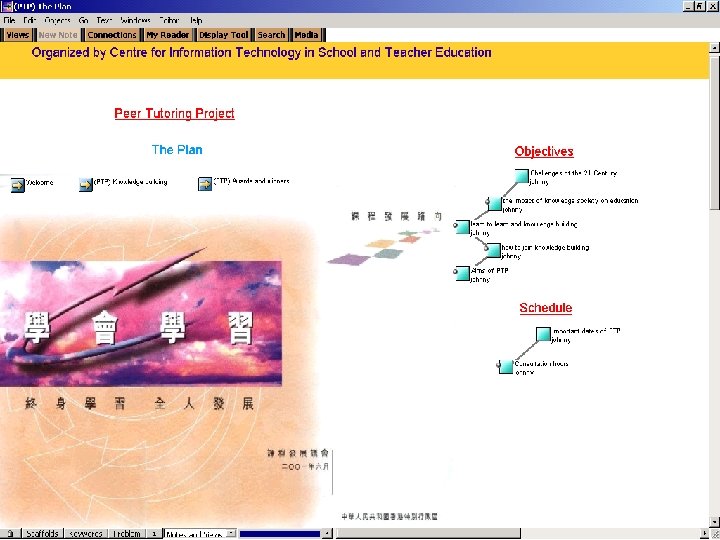
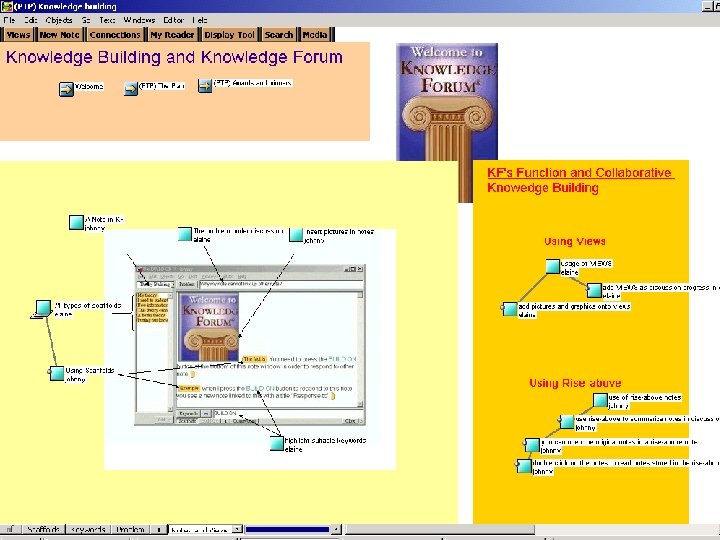
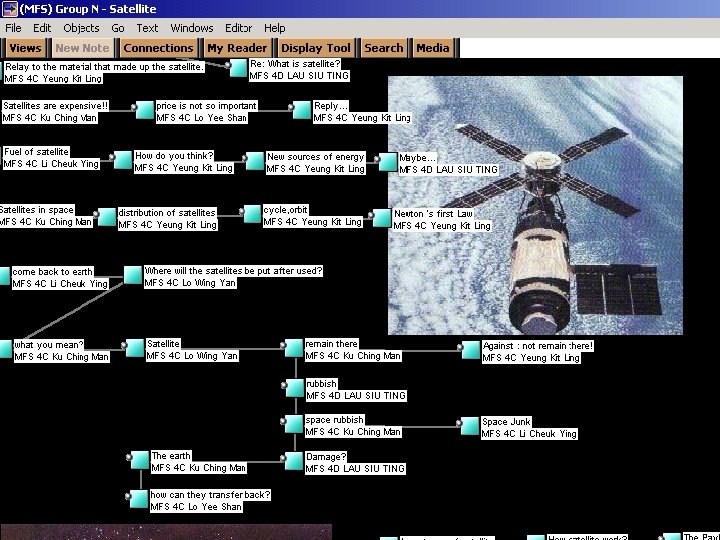
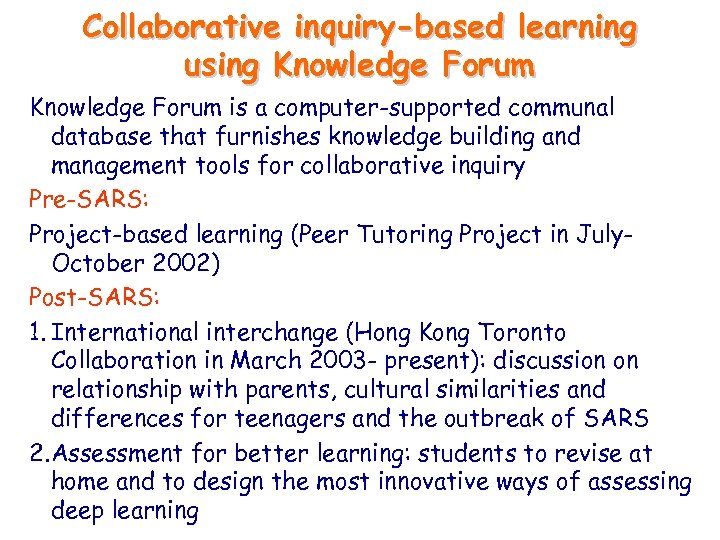 Collaborative inquiry-based learning using Knowledge Forum is a computer-supported communal database that furnishes knowledge building and management tools for collaborative inquiry Pre-SARS: Project-based learning (Peer Tutoring Project in July. October 2002) Post-SARS: 1. International interchange (Hong Kong Toronto Collaboration in March 2003 - present): discussion on relationship with parents, cultural similarities and differences for teenagers and the outbreak of SARS 2. Assessment for better learning: students to revise at home and to design the most innovative ways of assessing deep learning
 Much needed technology innovation: pedagogically sound e-Learning platforms • Existing e-learning platform mostly traditional: teachercentered and learning-resource centered, focusing on delivery, drill & assessment • Current e. Learning platforms are suited for instruction centered and knowledge centred education • Education Reform emphasizes on ‘Life-long Learning’ • Life-long learning requires collaborative learning skills, problem-solving techniques and inquiry skills • Current e-learning platforms cannot support this change effectively – we need innovation in e-learning platforms!
 E-learning – a lever for education innovations To summarize: 1. Conditions necessary for taking advantage of IT: * readiness * conception of e-learning 2. A paradigm shift in e-learning is necessary 3. A need for technology-innovation: e-learning platforms that would support collaborative inquiry
 IT as a Lever for Change in Teaching and Learning : SITES M 2: an international comparative case study of innovative pedagogical practices using technology
 Emerging pedagogical paradigm Second International Information Technology in Education Study conducted under the auspices of International Association for the Evaluation of Educational Achievement http: //sitesdatabase. cite. hku. hk/online/index. asp
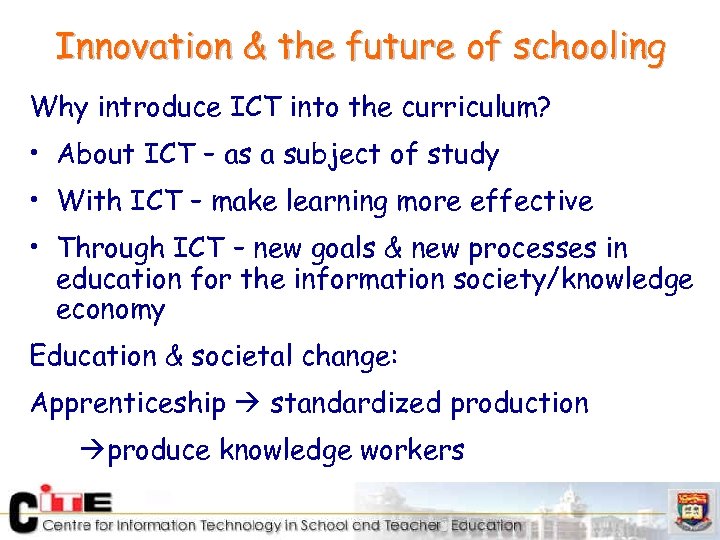 Innovation & the future of schooling Why introduce ICT into the curriculum? • About ICT – as a subject of study • With ICT – make learning more effective • Through ICT – new goals & new processes in education for the information society/knowledge economy Education & societal change: Apprenticeship standardized production produce knowledge workers
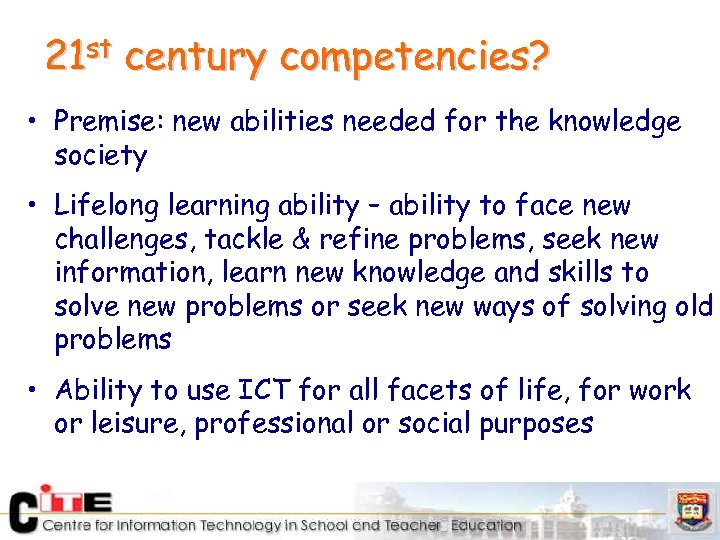 21 st century competencies? • Premise: new abilities needed for the knowledge society • Lifelong learning ability – ability to face new challenges, tackle & refine problems, seek new information, learn new knowledge and skills to solve new problems or seek new ways of solving old problems • Ability to use ICT for all facets of life, for work or leisure, professional or social purposes
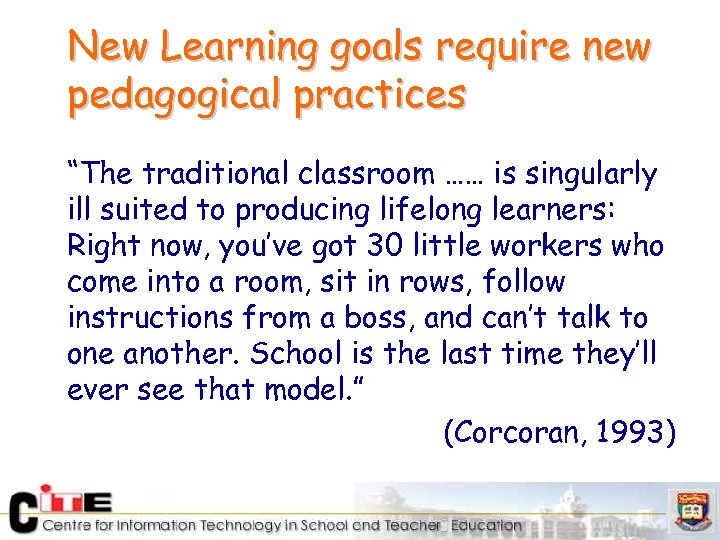 New Learning goals require new pedagogical practices “The traditional classroom …… is singularly ill suited to producing lifelong learners: Right now, you’ve got 30 little workers who come into a room, sit in rows, follow instructions from a boss, and can’t talk to one another. School is the last time they’ll ever see that model. ” (Corcoran, 1993)
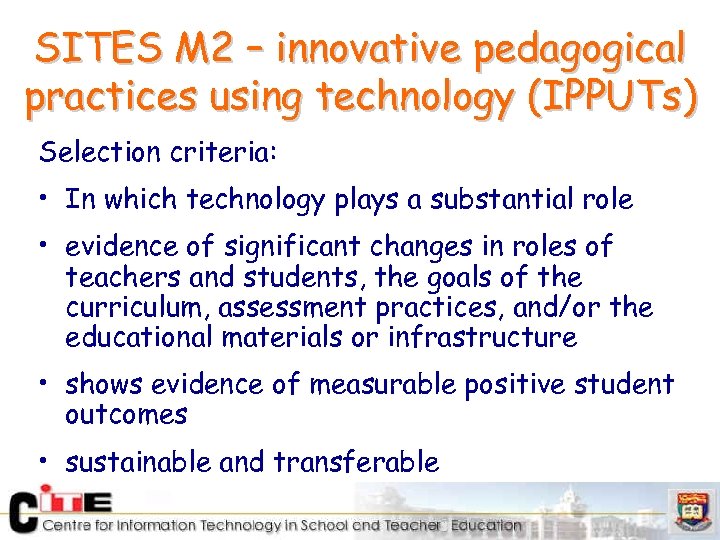 SITES M 2 – innovative pedagogical practices using technology (IPPUTs) Selection criteria: • In which technology plays a substantial role • evidence of significant changes in roles of teachers and students, the goals of the curriculum, assessment practices, and/or the educational materials or infrastructure • shows evidence of measurable positive student outcomes • sustainable and transferable
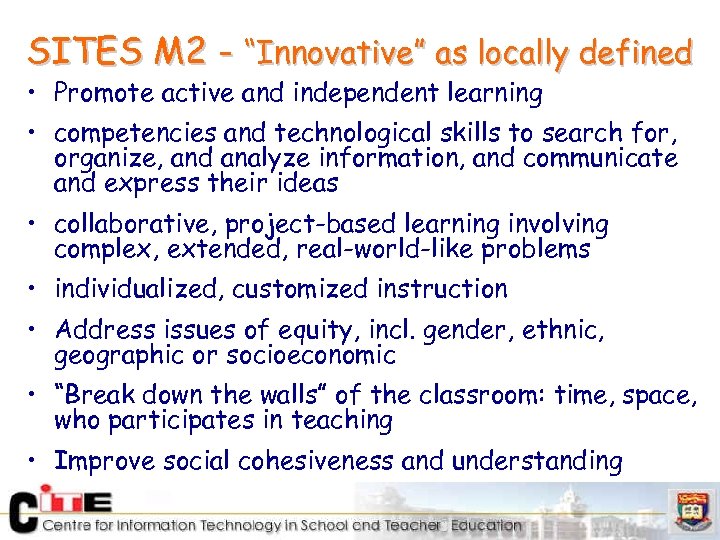 SITES M 2 - “Innovative” as locally defined • Promote active and independent learning • competencies and technological skills to search for, organize, and analyze information, and communicate and express their ideas • collaborative, project-based learning involving complex, extended, real-world-like problems • individualized, customized instruction • Address issues of equity, incl. gender, ethnic, geographic or socioeconomic • “Break down the walls” of the classroom: time, space, who participates in teaching • Improve social cohesiveness and understanding
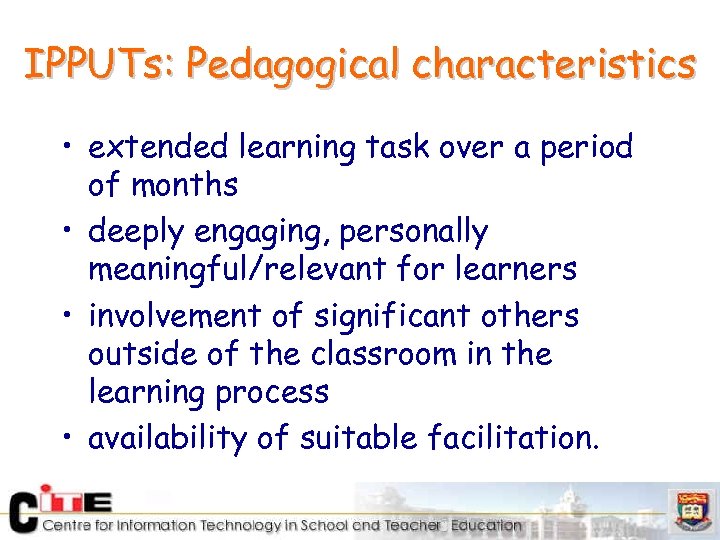 IPPUTs: Pedagogical characteristics • extended learning task over a period of months • deeply engaging, personally meaningful/relevant for learners • involvement of significant others outside of the classroom in the learning process • availability of suitable facilitation.
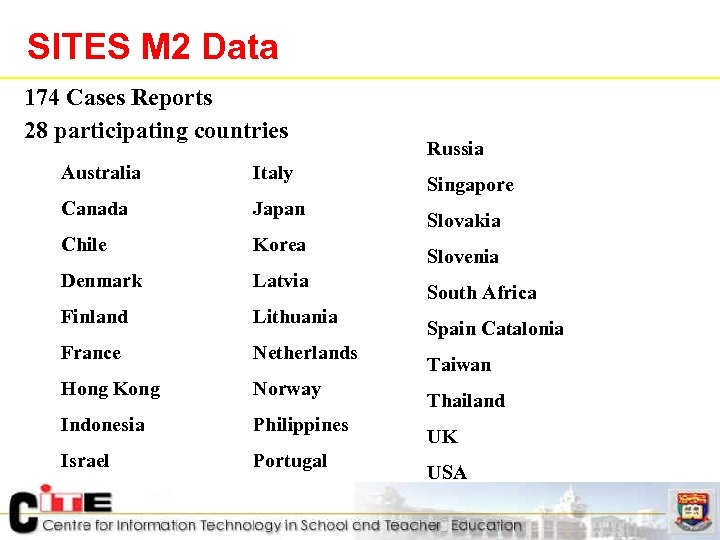 SITES M 2 Data 174 Cases Reports n 28 participating countries n Australia Italy Canada Japan Chile Korea Denmark Latvia Finland Lithuania France Netherlands Hong Kong Norway Indonesia Philippines Israel Portugal Russia Singapore Slovakia Slovenia South Africa Spain Catalonia Taiwan Thailand UK USA
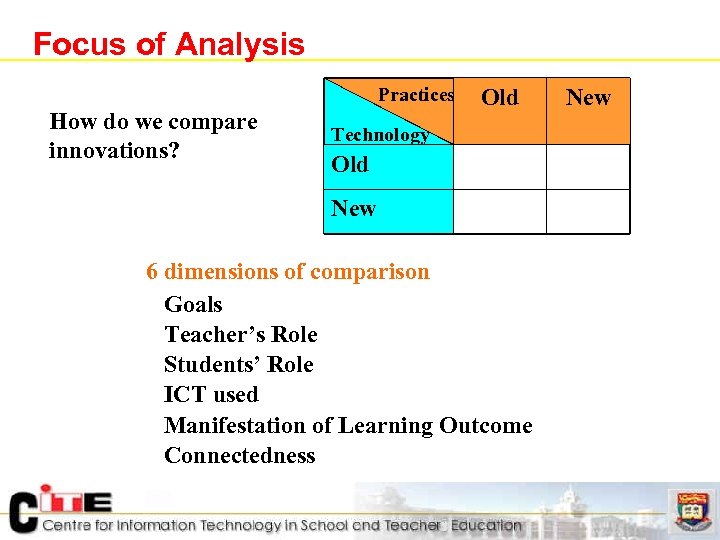 Focus of Analysis Practices How do we compare innovations? Old New Technology Old New 6 dimensions of comparison 6 to understand innovativeness (from old to new): n. Goals n. Teacher’s Role n. Students’ Role n. ICT used n. Manifestation of Learning Outcome n. Connectedness
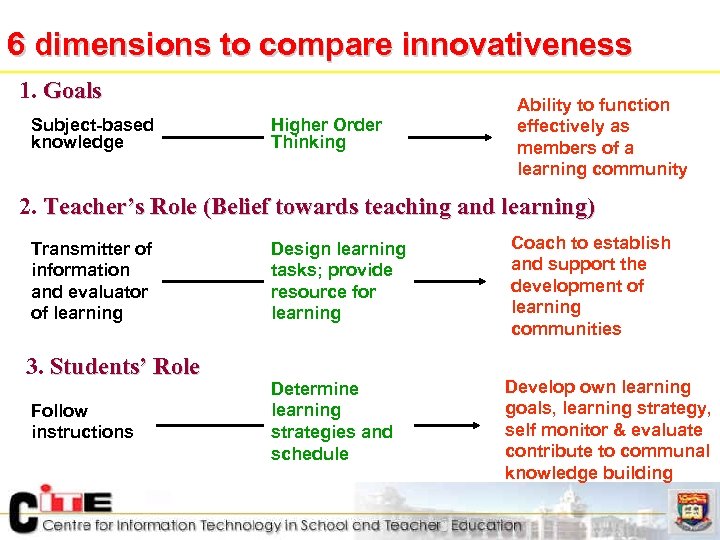 6 dimensions to compare innovativeness 1. Goals Subject-based knowledge Higher Order Thinking Ability to function effectively as members of a learning community 2. Teacher’s Role (Belief towards teaching and learning) Transmitter of information and evaluator of learning 3. Students’ Role Follow instructions Design learning tasks; provide resource for learning Determine learning strategies and schedule Coach to establish and support the development of learning communities Develop own learning goals, learning strategy, self monitor & evaluate contribute to communal knowledge building
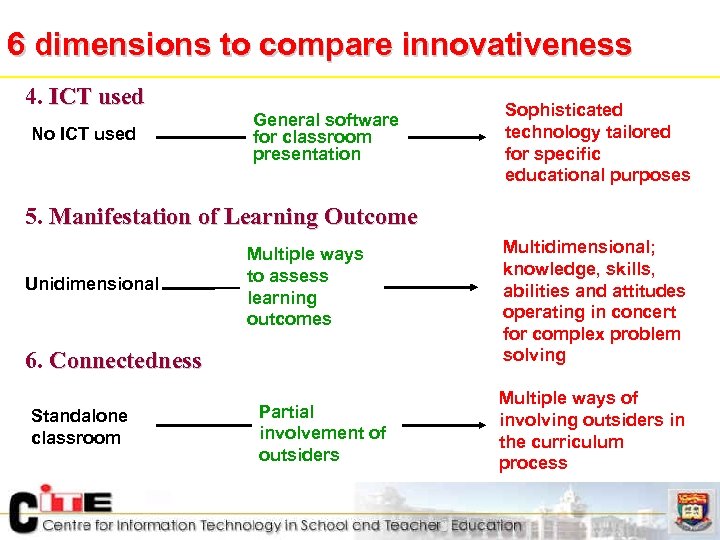 6 dimensions to compare innovativeness 4. ICT used No ICT used General software for classroom presentation Sophisticated technology tailored for specific educational purposes 5. Manifestation of Learning Outcome Unidimensional Multiple ways to assess learning outcomes 6. Connectedness Standalone classroom Partial involvement of outsiders Multidimensional; knowledge, skills, abilities and attitudes operating in concert for complex problem solving Multiple ways of involving outsiders in the curriculum process
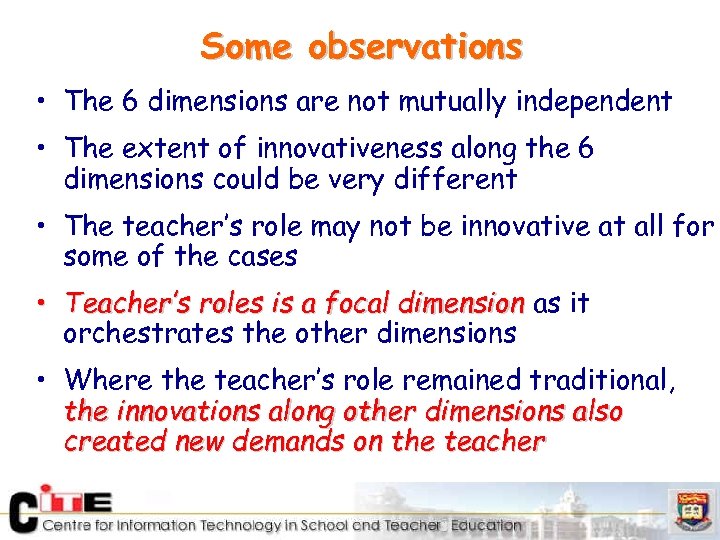 Some observations • The 6 dimensions are not mutually independent • The extent of innovativeness along the 6 dimensions could be very different • The teacher’s role may not be innovative at all for some of the cases • Teacher’s roles is a focal dimension as it orchestrates the other dimensions • Where the teacher’s role remained traditional, the innovations along other dimensions also created new demands on the teacher
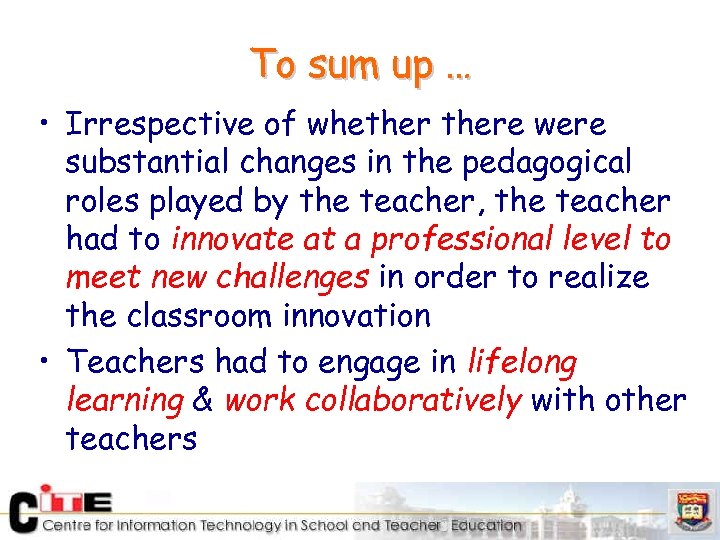 To sum up … • Irrespective of whethere were substantial changes in the pedagogical roles played by the teacher, the teacher had to innovate at a professional level to meet new challenges in order to realize the classroom innovation • Teachers had to engage in lifelong learning & work collaboratively with other teachers
 Innovative Classroom Practices and the Teacher of the Future It is through pedagogical innovations that the teaching profession renews and recreates itself into a variety of education professionals in the 21 st century.
 W O N And for those wishing to learn more please join us at the Information Session for MSc[ITE] & PCAdv. Ed. Stud - Responding to Change in Education: IT as a Lever for Innovation Date: 06 September 2003 Time: 2: 30 pm -4: 00 pm Venue: Rm 101, Runme Shaw Building, The University of Hong Kong Speaker: Dr. Bob Fox