


 Скачать презентацию IT Acquisition Advisory Council IT-AAC A non-partisan think
a8579a84b69297d3a815e8eb6957c81f.ppt
- Количество слайдов: 22
 IT Acquisition Advisory Council (IT-AAC) A non-partisan think tank, 501. C 3, representing; AFCEA Intl. , Uof. MD, Uof. TN, INSA, ICH, SSCI, ISSA, AIA, Center for American Progress, PRTM Blueprint for Sustainable IT Acquisition Reform Leveraging non-traditional expertise and benchmarked standards of practices outside the reach of the Defense Industrial Complex Chairman Mike Wynne, 21 st AF SEC, Mike. Wynne@IT-AAC. org Marv Langston, IT-AAC Vice Chair marv@langston. org Kevin Carroll, Vice Chair, Kevin. Carroll@ICHnet. org www. it-aac. org 703 768 0400 904 Clifton Drive * Alexandria * Virginia 22308 www. IT-AAC. org * (703) 768 -0400
 ™ Briefing Summary q Purpose q Today's Situation q Our Proposal to Assist q Way Forward Recommendation “Together, these steps will help to catalyze a fundamental reform of Federal IT, which is essential to improving the effectiveness and efficiency of the Federal Government” White House, OMB Director 501. C 6 Non-Profit Research Institute 703 -768 -0400 ICH Proprietary info@ICHnet. org www. ICHnet. org © 1999 - 2009 All Rights Reserved www. IT-AAC. org
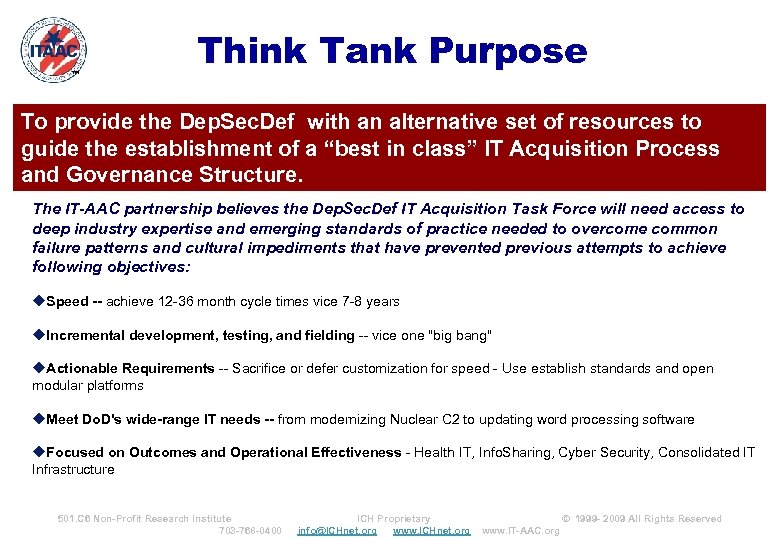 ™ Think Tank Purpose To provide the Dep. Sec. Def with an alternative set of resources to guide the establishment of a “best in class” IT Acquisition Process and Governance Structure. The IT-AAC partnership believes the Dep. Sec. Def IT Acquisition Task Force will need access to deep industry expertise and emerging standards of practice needed to overcome common failure patterns and cultural impediments that have prevented previous attempts to achieve following objectives: u. Speed -- achieve 12 -36 month cycle times vice 7 -8 years u. Incremental development, testing, and fielding -- vice one "big bang" u. Actionable Requirements -- Sacrifice or defer customization for speed - Use establish standards and open modular platforms u. Meet Do. D's wide-range IT needs -- from modernizing Nuclear C 2 to updating word processing software u. Focused on Outcomes and Operational Effectiveness - Health IT, Info. Sharing, Cyber Security, Consolidated IT Infrastructure 501. C 6 Non-Profit Research Institute 703 -768 -0400 ICH Proprietary info@ICHnet. org www. ICHnet. org © 1999 - 2009 All Rights Reserved www. IT-AAC. org
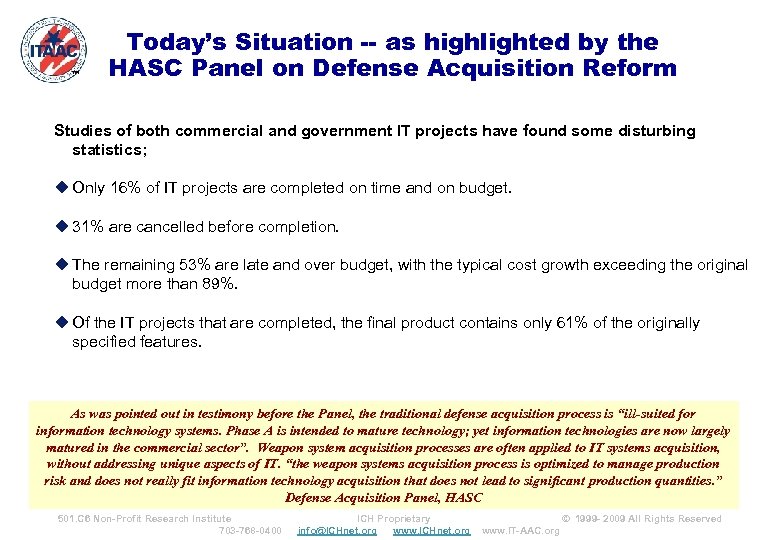 ™ Today’s Situation -- as highlighted by the HASC Panel on Defense Acquisition Reform Studies of both commercial and government IT projects have found some disturbing statistics; u Only 16% of IT projects are completed on time and on budget. u 31% are cancelled before completion. u The remaining 53% are late and over budget, with the typical cost growth exceeding the original budget more than 89%. u Of the IT projects that are completed, the final product contains only 61% of the originally specified features. As was pointed out in testimony before the Panel, the traditional defense acquisition process is “ill-suited for information technology systems. Phase A is intended to mature technology; yet information technologies are now largely matured in the commercial sector”. Weapon system acquisition processes are often applied to IT systems acquisition, without addressing unique aspects of IT. “the weapon systems acquisition process is optimized to manage production risk and does not really fit information technology acquisition that does not lead to significant production quantities. ” Defense Acquisition Panel, HASC 501. C 6 Non-Profit Research Institute 703 -768 -0400 ICH Proprietary info@ICHnet. org www. ICHnet. org © 1999 - 2009 All Rights Reserved www. IT-AAC. org
 The IT Acquisition Lifecycle is more than just contracting ™ Building blocks include: u Governance: how an enterprise supports, oversees and manages IT programs and on-going portfolio. SOA as defined in the commercial market is governance tool not technology. u Decision Analytics: enables effective Program Management and Value Stream Analysis execution. As most of these sub- processes are designed to improve decision making, a relative new discipline has evolved (since 86), that addresses the human and cultural challenges in decision making. Decision Analytics is the discipline of framing the essence and success criteria of each gate in the acquisition lifecycle. It brings focus to the high risk areas of a program, and reduces analysis/paralysis. u Requirements Development: Actionable requirements must be constrained by the realm of the possible. With pressures to do more with less, we must embrace mechanisms that force a relative valuation/impact of the gap/capability, with clearly defined outcomes u Solution Architecture: This is one of the most critical elements of the acquisition lifecycle, as it should represent all stake holder agreements. The market embrace of SOA is not about technology, but a refocusing of the EA on service level management and data. A good architecture is a lexicon that links requirements, technologies and acquisition strategy. u Technology Assessment: Understanding the limitation of technology early in the process is key. Without a clear view of the “realm of the possible” validated by real world results, we often find ourselves in high risk areas and over specification. Market research must be done early to help users constrain requirements and embrace the inherent business practices that codify. Recognizing that 70% make up of every IT application is vested in IT infrastructure (netcentric, cloud, SOA), it is critical to establish a common infrastructure/infrastructure standard by which all applications can share. The most prolific is ITIL to date. u Business Case Analysis: Demonstrating the business value of technology investments, based on evidenced based research and lifecycle cost. This is a core requirement of Clinger Cohen Act. u Procurement and Contracting: Software as a Service and SOA portent a new dynamic for acquisition of IT (health IT, cyber, business systems), that brings focus to Service Level Agreements (SLAs), Software as a Service (Saa. S) and SL Management. If the previous activities do not directly feed the acquisition strategy or provide mechanisms for contractor accountability, all is lost. “IT Reform is about Operational Efficiency” 501. C 6 Non-Profit Research Institute 703 -768 -0400 ICH Proprietary info@ICHnet. org www. ICHnet. org © 1999 - 2009 All Rights Reserved www. IT-AAC. org
 Do. D IT Acquisition Challenges ™ “We are buying yesterday’s technology tomorrow” u DSB IATF: “Do. D reliance on FFRDCs is isolating it from sources of new technologies, and will hinder the departments ability to get the best technical advise in the future” u AF Science Advisory Board 2000: PMs need greater access to real world lesson learned and innovations of the market to mitigate risk and cost overruns. PMs frequently enter high risk areas due to limited access to lessons learned from those who have already forged ahead. u CMU SEI Study 2004: The Do. DAF alone is not effective for IT architectures, lacks business view, performance metrics or means of avoiding over specification. Do. DAF (C 4 ISR) was developed by Mitre and IDA in 1986 to provide Do. D with a systems engineering documentation tool for existing system implementations. 2009 NDAA Sec 803 : Government needs a high integrity knowledge exchange by which innovations of the market can be objectively assessed. u DSB 2009: Weapons Systems Style Solution Architecture and Acquisition Processes take too long, cost too much, recommend establishing a separate IT Acquisition market that is tuned for the fast paced market. u IT-AAC 2009: Major IT Programs lack senior leadership support, and have few vested in the success. All participants, including oversight, must be incentivized in meeting program goals and outcomes. u BENS RPT on ACQUISITION 2009: Do. D needs independent architecture development that is not compromised by those with a vested interest in the outcome. FAR OCI rules must be better enforced. u NDAA Sec 804 2010: Do. D will establish a modular IT Acquisition process that is responsive to the fast paced IT market. "Weapons systems depend on stable requirements, but with IT, technology changes faster than the requirements process can keep up, " he said. "It changes faster than the budget process and it changes faster than the acquisition milestone process. For all these reasons, the normal acquisition process does not work for information technology. ” Dep. Sec Bill Lynn statement at the 2009 Defense IT Acquisition Summit hosted by IT-AAC 501. C 6 Non-Profit Research Institute 703 -768 -0400 ICH Proprietary info@ICHnet. org www. ICHnet. org © 1999 - 2009 All Rights Reserved www. IT-AAC. org
 Federal IT Acquisition Root Causes ™ compromising mission effectiveness and costing tax payer $40 B/year 1. IT Acquisition Ecosystem Ineffective: – Missing incentives & metrics, redundant oversight, vague accountability, ineffective governance (MOE, SLA) puts focus on compliance vs outcomes. – Programs spending up to 25% on compliance without any reduction in risk. 2. Good laws (CCA, OMB 119, FAR, Sec 804) lack enforcement. – Frequently compounded by Ad-hoc Implementations and Mil. Spec methods. – DODAF, JCIDS, NESI, LISI were designed for Weapons Systems, compete with standards and orthogonal to Industry Best Practices. 3. Conflict of Interest unenforced, optimal resources and expertise overlooked: – FAR prohibits Contractors with vested interests in implementation should not use “Chinese firewalls” to bypass rules or gain unfair advantage. – Optimal resources in IT Program planning, market research, and solution engineering overlooked, inhibiting access to real world best practices and innovations of the market. Standards bodies & non-profit research institutes under utilized. “You can’t solve today’s problems with the same thinking that got you there in the first place” Einstein 501. C 6 Non-Profit Research Institute 703 -768 -0400 ICH Proprietary info@ICHnet. org www. ICHnet. org © 1999 - 2009 All Rights Reserved www. IT-AAC. org 6
 Root Cause (cont. ) ™ 4. Innovation Stifled: – Traditional SIs and FFRDCs are insulated from commercial IT innovations and best practices. – Do. D lack organic mechanisms for tapping innovations of the market, commercial expertise, or real world lessons learned. Public Service organizations (. edu, . org, SDOs) often left out of the equation. 5. Current IT Processes in conflict with best practices and drive “design to spec” approach: – Mil. Spec Requirements (JCIDS), Architecture (Do. DAF), Tech Assessment (TRL/C&A), Business Case (BCA) and Procurement (Do. D 5000) and Enterprise Management (CMM) processes are disconnected and inconsistent with fast paced IT market (violating Paperwork Reduction Act, CCA, and OMB A 119) 6. Budgeting (POM) approaches drive stove pipe solutions: – Frequently undermining ability to establish common & interoperable infrastructure services which accounts for 70% of every IT program buy. Concepts like SOA, Cloud Computing and Service Level Management cannot be embraced without a change in the above. "It is not a great mystery what needs to change, what it takes is the political will and willingness, as Eisenhower possessed, to make hard choices -- choices that will displease powerful people both inside the Pentagon and out” Defense Secretary Robert Gates 501. C 6 Non-Profit Research Institute 703 -768 -0400 ICH Proprietary info@ICHnet. org www. ICHnet. org © 1999 - 2009 All Rights Reserved www. IT-AAC. org
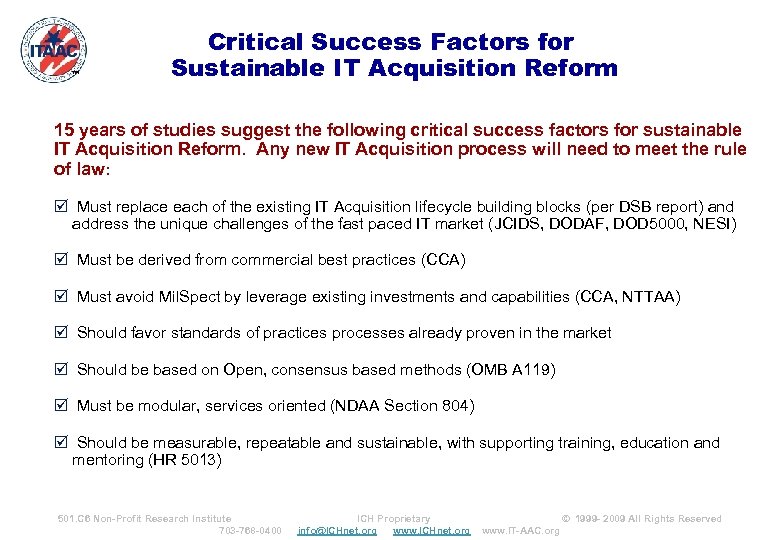 ™ Critical Success Factors for Sustainable IT Acquisition Reform 15 years of studies suggest the following critical success factors for sustainable IT Acquisition Reform. Any new IT Acquisition process will need to meet the rule of law: þ Must replace each of the existing IT Acquisition lifecycle building blocks (per DSB report) and address the unique challenges of the fast paced IT market (JCIDS, DODAF, DOD 5000, NESI) þ Must be derived from commercial best practices (CCA) þ Must avoid Mil. Spect by leverage existing investments and capabilities (CCA, NTTAA) þ Should favor standards of practices processes already proven in the market þ Should be based on Open, consensus based methods (OMB A 119) þ Must be modular, services oriented (NDAA Section 804) þ Should be measurable, repeatable and sustainable, with supporting training, education and mentoring (HR 5013) 501. C 6 Non-Profit Research Institute 703 -768 -0400 ICH Proprietary info@ICHnet. org www. ICHnet. org © 1999 - 2009 All Rights Reserved www. IT-AAC. org
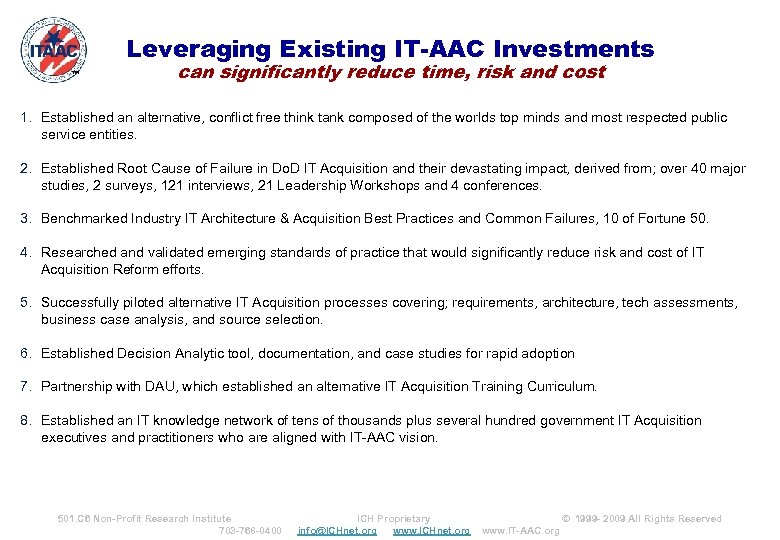 Leveraging Existing IT-AAC Investments ™ can significantly reduce time, risk and cost 1. Established an alternative, conflict free think tank composed of the worlds top minds and most respected public service entities. 2. Established Root Cause of Failure in Do. D IT Acquisition and their devastating impact, derived from; over 40 major studies, 2 surveys, 121 interviews, 21 Leadership Workshops and 4 conferences. 3. Benchmarked Industry IT Architecture & Acquisition Best Practices and Common Failures, 10 of Fortune 50. 4. Researched and validated emerging standards of practice that would significantly reduce risk and cost of IT Acquisition Reform efforts. 5. Successfully piloted alternative IT Acquisition processes covering; requirements, architecture, tech assessments, business case analysis, and source selection. 6. Established Decision Analytic tool, documentation, and case studies for rapid adoption 7. Partnership with DAU, which established an alternative IT Acquisition Training Curriculum. 8. Established an IT knowledge network of tens of thousands plus several hundred government IT Acquisition executives and practitioners who are aligned with IT-AAC vision. 501. C 6 Non-Profit Research Institute 703 -768 -0400 ICH Proprietary info@ICHnet. org www. ICHnet. org © 1999 - 2009 All Rights Reserved www. IT-AAC. org
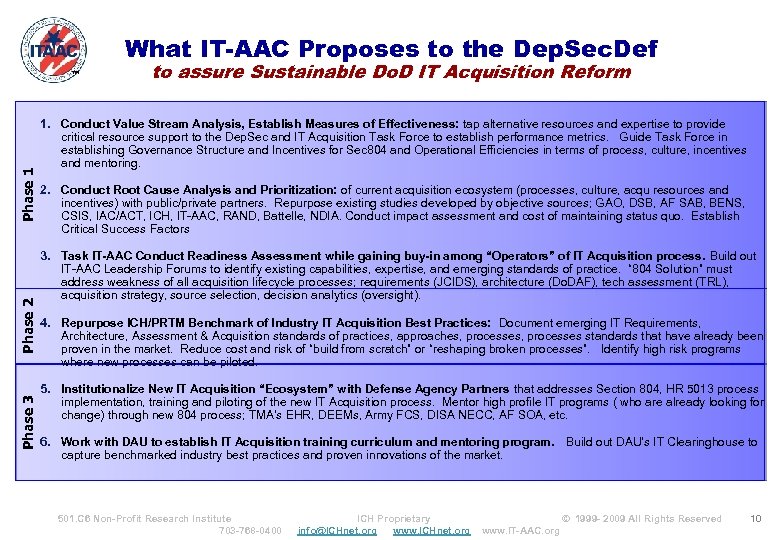 What IT-AAC Proposes to the Dep. Sec. Def Phase 3 Phase 2 Phase 1 ™ to assure Sustainable Do. D IT Acquisition Reform 1. Conduct Value Stream Analysis, Establish Measures of Effectiveness: tap alternative resources and expertise to provide critical resource support to the Dep. Sec and IT Acquisition Task Force to establish performance metrics. Guide Task Force in establishing Governance Structure and Incentives for Sec 804 and Operational Efficiencies in terms of process, culture, incentives and mentoring. 2. Conduct Root Cause Analysis and Prioritization: of current acquisition ecosystem (processes, culture, acqu resources and incentives) with public/private partners. Repurpose existing studies developed by objective sources; GAO, DSB, AF SAB, BENS, CSIS, IAC/ACT, ICH, IT-AAC, RAND, Battelle, NDIA. Conduct impact assessment and cost of maintaining status quo. Establish Critical Success Factors 3. Task IT-AAC Conduct Readiness Assessment while gaining buy-in among “Operators” of IT Acquisition process. Build out IT-AAC Leadership Forums to identify existing capabilities, expertise, and emerging standards of practice. “ 804 Solution” must address weakness of all acquisition lifecycle processes; requirements (JCIDS), architecture (Do. DAF), tech assessment (TRL), acquisition strategy, source selection, decision analytics (oversight). 4. Repurpose ICH/PRTM Benchmark of Industry IT Acquisition Best Practices: Document emerging IT Requirements, Architecture, Assessment & Acquisition standards of practices, approaches, processes standards that have already been proven in the market. Reduce cost and risk of “build from scratch” or “reshaping broken processes”. Identify high risk programs where new processes can be piloted. 5. Institutionalize New IT Acquisition “Ecosystem” with Defense Agency Partners that addresses Section 804, HR 5013 process implementation, training and piloting of the new IT Acquisition process. Mentor high profile IT programs ( who are already looking for change) through new 804 process; TMA’s EHR, DEEMs, Army FCS, DISA NECC, AF SOA, etc. 6. Work with DAU to establish IT Acquisition training curriculum and mentoring program. Build out DAU’s IT Clearinghouse to capture benchmarked industry best practices and proven innovations of the market. 501. C 6 Non-Profit Research Institute 703 -768 -0400 ICH Proprietary info@ICHnet. org www. ICHnet. org © 1999 - 2009 All Rights Reserved www. IT-AAC. org 10
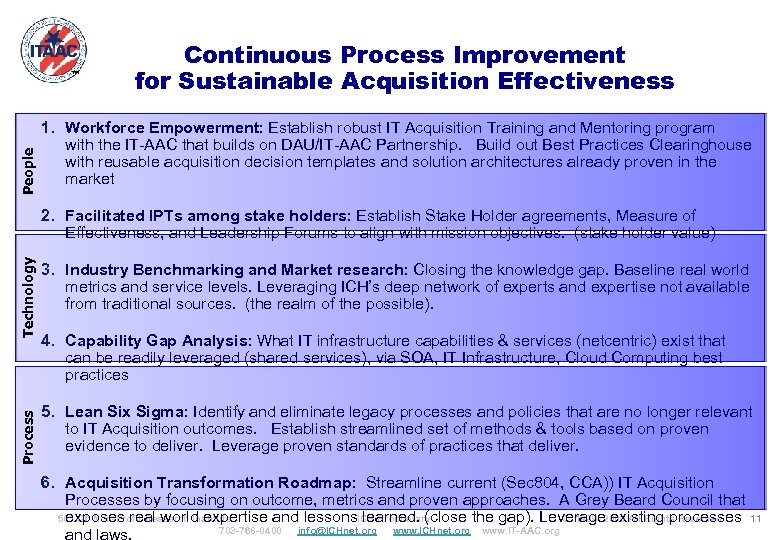 People ™ Continuous Process Improvement for Sustainable Acquisition Effectiveness 1. Workforce Empowerment: Establish robust IT Acquisition Training and Mentoring program with the IT-AAC that builds on DAU/IT-AAC Partnership. Build out Best Practices Clearinghouse with reusable acquisition decision templates and solution architectures already proven in the market Process Technology 2. Facilitated IPTs among stake holders: Establish Stake Holder agreements, Measure of Effectiveness, and Leadership Forums to align with mission objectives. (stake holder value) 3. Industry Benchmarking and Market research: Closing the knowledge gap. Baseline real world metrics and service levels. Leveraging ICH’s deep network of experts and expertise not available from traditional sources. (the realm of the possible). 4. Capability Gap Analysis: What IT infrastructure capabilities & services (netcentric) exist that can be readily leveraged (shared services), via SOA, IT Infrastructure, Cloud Computing best practices 5. Lean Six Sigma: Identify and eliminate legacy processes and policies that are no longer relevant to IT Acquisition outcomes. Establish streamlined set of methods & tools based on proven evidence to deliver. Leverage proven standards of practices that deliver. 6. Acquisition Transformation Roadmap: Streamline current (Sec 804, CCA)) IT Acquisition Processes by focusing on outcome, metrics and proven approaches. A Grey Beard Council that 501. C 6 Non-Profit Research Institute © 1999 - existing processes 11 exposes real world expertise and lessons. ICH Proprietary learned. (close the gap). Leverage 2009 All Rights Reserved 703 -768 -0400 info@ICHnet. org www. IT-AAC. org and laws.
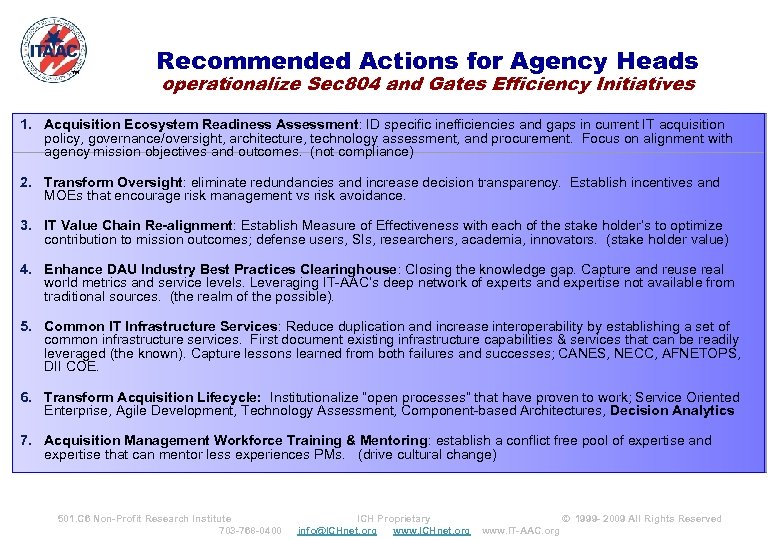 ™ Recommended Actions for Agency Heads operationalize Sec 804 and Gates Efficiency Initiatives 1. Acquisition Ecosystem Readiness Assessment: ID specific inefficiencies and gaps in current IT acquisition policy, governance/oversight, architecture, technology assessment, and procurement. Focus on alignment with agency mission objectives and outcomes. (not compliance) 2. Transform Oversight: eliminate redundancies and increase decision transparency. Establish incentives and MOEs that encourage risk management vs risk avoidance. 3. IT Value Chain Re-alignment: Establish Measure of Effectiveness with each of the stake holder’s to optimize contribution to mission outcomes; defense users, SIs, researchers, academia, innovators. (stake holder value) 4. Enhance DAU Industry Best Practices Clearinghouse: Closing the knowledge gap. Capture and reuse real world metrics and service levels. Leveraging IT-AAC’s deep network of experts and expertise not available from traditional sources. (the realm of the possible). 5. Common IT Infrastructure Services: Reduce duplication and increase interoperability by establishing a set of common infrastructure services. First document existing infrastructure capabilities & services that can be readily leveraged (the known). Capture lessons learned from both failures and successes; CANES, NECC, AFNETOPS, DII COE. 6. Transform Acquisition Lifecycle: Institutionalize “open processes” that have proven to work; Service Oriented Enterprise, Agile Development, Technology Assessment, Component-based Architectures, Decision Analytics 7. Acquisition Management Workforce Training & Mentoring: establish a conflict free pool of expertise and expertise that can mentor less experiences PMs. (drive cultural change) 501. C 6 Non-Profit Research Institute 703 -768 -0400 ICH Proprietary info@ICHnet. org www. ICHnet. org © 1999 - 2009 All Rights Reserved www. IT-AAC. org
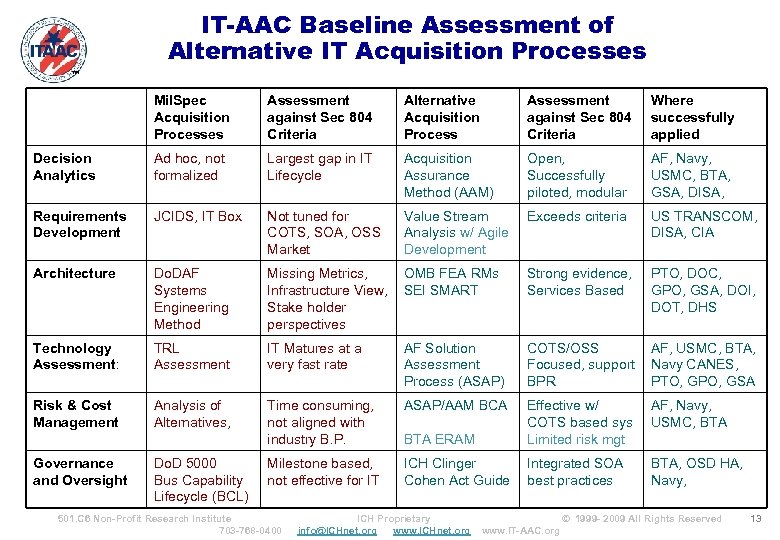 IT-AAC Baseline Assessment of Alternative IT Acquisition Processes ™ Mil. Spec Acquisition Processes Assessment against Sec 804 Criteria Alternative Acquisition Process Assessment against Sec 804 Criteria Where successfully applied Decision Analytics Ad hoc, not formalized Largest gap in IT Lifecycle Acquisition Assurance Method (AAM) Open, Successfully piloted, modular AF, Navy, USMC, BTA, GSA, DISA, Requirements Development JCIDS, IT Box Not tuned for COTS, SOA, OSS Market Value Stream Analysis w/ Agile Development Exceeds criteria US TRANSCOM, DISA, CIA Architecture Do. DAF Systems Engineering Method Missing Metrics, Infrastructure View, Stake holder perspectives OMB FEA RMs SEI SMART Strong evidence, Services Based PTO, DOC, GPO, GSA, DOI, DOT, DHS Technology Assessment: TRL Assessment IT Matures at a very fast rate AF Solution Assessment Process (ASAP) COTS/OSS Focused, support BPR AF, USMC, BTA, Navy CANES, PTO, GPO, GSA Risk & Cost Management Analysis of Alternatives, Time consuming, not aligned with industry B. P. ASAP/AAM BCA AF, Navy, USMC, BTA ERAM Effective w/ COTS based sys Limited risk mgt Milestone based, not effective for IT ICH Clinger Cohen Act Guide Integrated SOA best practices BTA, OSD HA, Navy, Governance and Oversight Do. D 5000 Bus Capability Lifecycle (BCL) 501. C 6 Non-Profit Research Institute 703 -768 -0400 ICH Proprietary info@ICHnet. org www. ICHnet. org © 1999 - 2009 All Rights Reserved www. IT-AAC. org 13
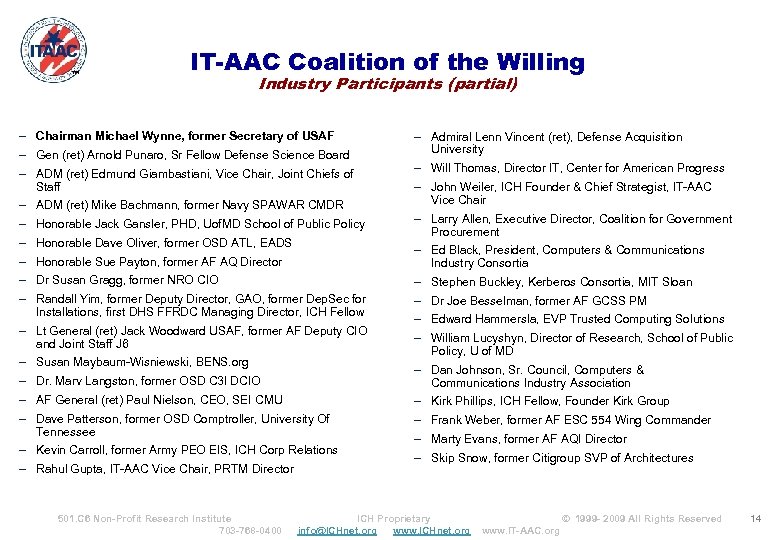 ™ IT-AAC Coalition of the Willing Industry Participants (partial) – Chairman Michael Wynne, former Secretary of USAF – Gen (ret) Arnold Punaro, Sr Fellow Defense Science Board – ADM (ret) Edmund Giambastiani, Vice Chair, Joint Chiefs of Staff – ADM (ret) Mike Bachmann, former Navy SPAWAR CMDR – Honorable Jack Gansler, PHD, Uof. MD School of Public Policy – Honorable Dave Oliver, former OSD ATL, EADS – Honorable Sue Payton, former AF AQ Director – Dr Susan Gragg, former NRO CIO – Randall Yim, former Deputy Director, GAO, former Dep. Sec for Installations, first DHS FFRDC Managing Director, ICH Fellow – Lt General (ret) Jack Woodward USAF, former AF Deputy CIO and Joint Staff J 6 – Susan Maybaum-Wisniewski, BENS. org – Dr. Marv Langston, former OSD C 3 I DCIO – AF General (ret) Paul Nielson, CEO, SEI CMU – Dave Patterson, former OSD Comptroller, University Of Tennessee – Kevin Carroll, former Army PEO EIS, ICH Corp Relations – Rahul Gupta, IT-AAC Vice Chair, PRTM Director 501. C 6 Non-Profit Research Institute 703 -768 -0400 – Admiral Lenn Vincent (ret), Defense Acquisition University – Will Thomas, Director IT, Center for American Progress – John Weiler, ICH Founder & Chief Strategist, IT-AAC Vice Chair – Larry Allen, Executive Director, Coalition for Government Procurement – Ed Black, President, Computers & Communications Industry Consortia – Stephen Buckley, Kerberos Consortia, MIT Sloan – Dr Joe Besselman, former AF GCSS PM – Edward Hammersla, EVP Trusted Computing Solutions – William Lucyshyn, Director of Research, School of Public Policy, U of MD – Dan Johnson, Sr. Council, Computers & Communications Industry Association – Kirk Phillips, ICH Fellow, Founder Kirk Group – Frank Weber, former AF ESC 554 Wing Commander – Marty Evans, former AF AQI Director – Skip Snow, former Citigroup SVP of Architectures ICH Proprietary info@ICHnet. org www. ICHnet. org © 1999 - 2009 All Rights Reserved www. IT-AAC. org 14
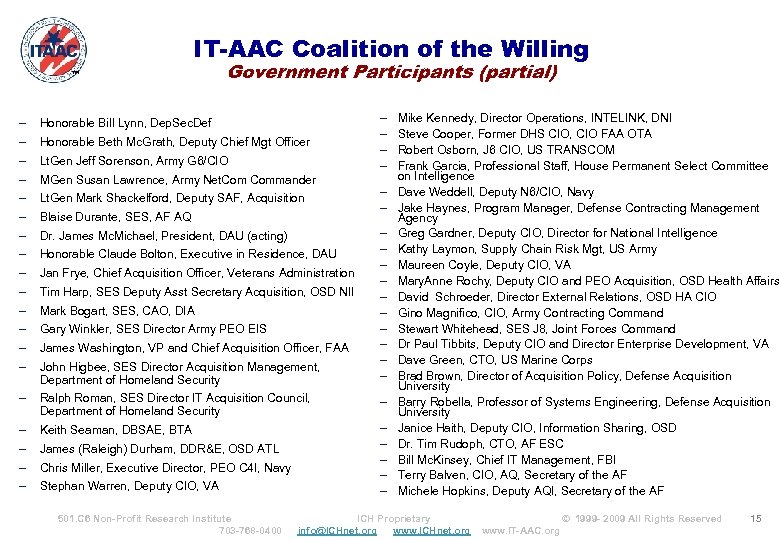 IT-AAC Coalition of the Willing ™ Government Participants (partial) – – – – – Honorable Bill Lynn, Dep. Sec. Def – Ralph Roman, SES Director IT Acquisition Council, Department of Homeland Security – – – Keith Seaman, DBSAE, BTA – – – Honorable Beth Mc. Grath, Deputy Chief Mgt Officer Lt. Gen Jeff Sorenson, Army G 6/CIO MGen Susan Lawrence, Army Net. Commander Lt. Gen Mark Shackelford, Deputy SAF, Acquisition Blaise Durante, SES, AF AQ Dr. James Mc. Michael, President, DAU (acting) Honorable Claude Bolton, Executive in Residence, DAU Jan Frye, Chief Acquisition Officer, Veterans Administration Tim Harp, SES Deputy Asst Secretary Acquisition, OSD NII Mark Bogart, SES, CAO, DIA Gary Winkler, SES Director Army PEO EIS James Washington, VP and Chief Acquisition Officer, FAA John Higbee, SES Director Acquisition Management, Department of Homeland Security James (Raleigh) Durham, DDR&E, OSD ATL Chris Miller, Executive Director, PEO C 4 I, Navy Stephan Warren, Deputy CIO, VA 501. C 6 Non-Profit Research Institute 703 -768 -0400 – – – Mike Kennedy, Director Operations, INTELINK, DNI Steve Cooper, Former DHS CIO, CIO FAA OTA Robert Osborn, J 6 CIO, US TRANSCOM Frank Garcia, Professional Staff, House Permanent Select Committee on Intelligence Dave Weddell, Deputy N 6/CIO, Navy Jake Haynes, Program Manager, Defense Contracting Management Agency Greg Gardner, Deputy CIO, Director for National Intelligence Kathy Laymon, Supply Chain Risk Mgt, US Army Maureen Coyle, Deputy CIO, VA Mary. Anne Rochy, Deputy CIO and PEO Acquisition, OSD Health Affairs David Schroeder, Director External Relations, OSD HA CIO Gino Magnifico, CIO, Army Contracting Command Stewart Whitehead, SES J 8, Joint Forces Command Dr Paul Tibbits, Deputy CIO and Director Enterprise Development, VA Dave Green, CTO, US Marine Corps Brad Brown, Director of Acquisition Policy, Defense Acquisition University Barry Robella, Professor of Systems Engineering, Defense Acquisition University Janice Haith, Deputy CIO, Information Sharing, OSD Dr. Tim Rudoph, CTO, AF ESC Bill Mc. Kinsey, Chief IT Management, FBI Terry Balven, CIO, AQ, Secretary of the AF Michele Hopkins, Deputy AQI, Secretary of the AF ICH Proprietary info@ICHnet. org www. ICHnet. org © 1999 - 2009 All Rights Reserved www. IT-AAC. org 15
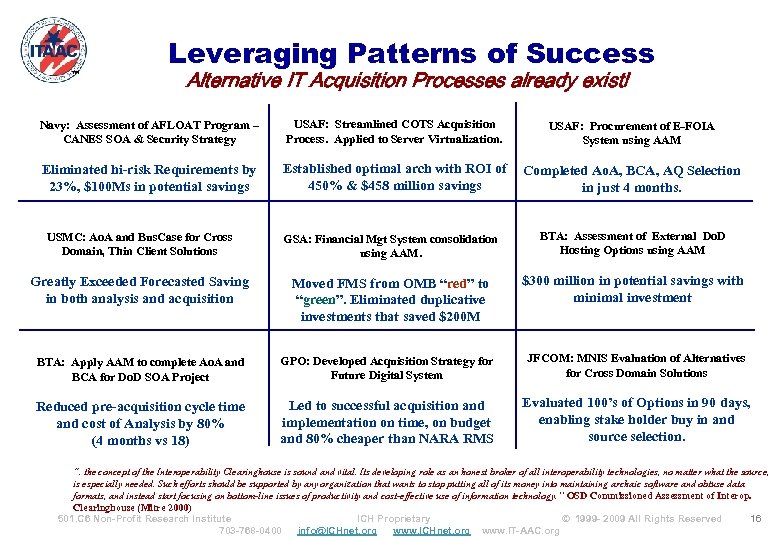 ™ Leveraging Patterns of Success Alternative IT Acquisition Processes already exist! Navy: Assessment of AFLOAT Program – CANES SOA & Security Strategy USAF: Streamlined COTS Acquisition Process. Applied to Server Virtualization. USAF: Procurement of E-FOIA System using AAM Eliminated hi-risk Requirements by 23%, $100 Ms in potential savings Established optimal arch with ROI of 450% & $458 million savings Completed Ao. A, BCA, AQ Selection in just 4 months. USMC: Ao. A and Bus. Case for Cross Domain, Thin Client Solutions GSA: Financial Mgt System consolidation using AAM. BTA: Assessment of External Do. D Hosting Options using AAM Greatly Exceeded Forecasted Saving in both analysis and acquisition Moved FMS from OMB “red” to “green”. Eliminated duplicative investments that saved $200 M $300 million in potential savings with minimal investment BTA: Apply AAM to complete Ao. A and BCA for Do. D SOA Project GPO: Developed Acquisition Strategy for Future Digital System JFCOM: MNIS Evaluation of Alternatives for Cross Domain Solutions Reduced pre-acquisition cycle time and cost of Analysis by 80% (4 months vs 18) Led to successful acquisition and implementation on time, on budget and 80% cheaper than NARA RMS Evaluated 100’s of Options in 90 days, enabling stake holder buy in and source selection. “. the concept of the Interoperability Clearinghouse is sound and vital. Its developing role as an honest broker of all interoperability technologies, no matter what the source, is especially needed. Such efforts should be supported by any organization that wants to stop putting all of its money into maintaining archaic software and obtuse data formats, and instead start focusing on bottom-line issues of productivity and cost-effective use of information technology. ” OSD Commissioned Assessment of Interop. Clearinghouse (Mitre 2000) 501. C 6 Non-Profit Research Institute ICH Proprietary © 1999 - 2009 All Rights Reserved 16 703 -768 -0400 info@ICHnet. org www. IT-AAC. org
 ™ Backup Slides in case you want to do something about IT 501. C 6 Non-Profit Research Institute 703 -768 -0400 ICH Proprietary info@ICHnet. org www. ICHnet. org © 1999 - 2009 All Rights Reserved www. IT-AAC. org 17
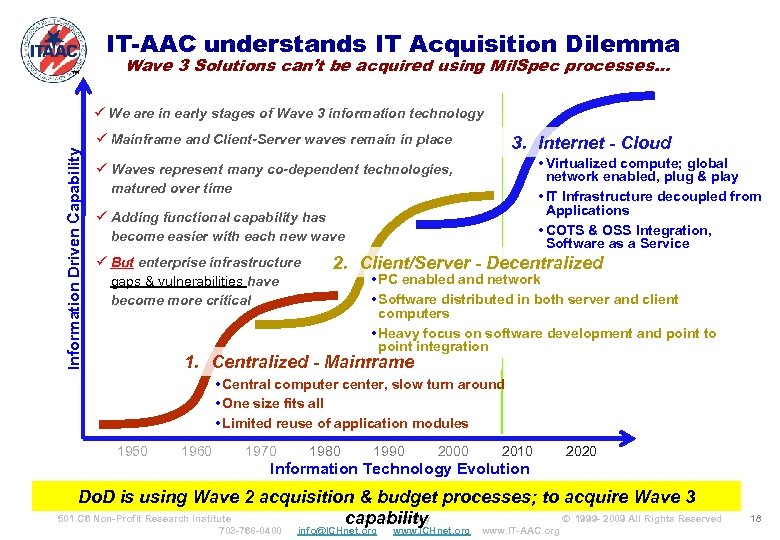 IT-AAC understands IT Acquisition Dilemma ™ Wave 3 Solutions can’t be acquired using Mil. Spec processes… Information Driven Capability ü We are in early stages of Wave 3 information technology ü Mainframe and Client-Server waves remain in place 3. Internet - Cloud • Virtualized compute; global network enabled, plug & play • IT Infrastructure decoupled from Applications • COTS & OSS Integration, Software as a Service ü Waves represent many co-dependent technologies, matured over time ü Adding functional capability has become easier with each new wave ü But enterprise infrastructure gaps & vulnerabilities have become more critical 2. Client/Server - Decentralized • PC enabled and network • Software distributed in both server and client computers • Heavy focus on software development and point to point integration 1. Centralized - Mainframe • Central computer center, slow turn around • One size fits all • Limited reuse of application modules 1950 1960 1970 1980 1990 2000 2010 2020 Information Technology Evolution Do. D is using Wave 2 acquisition & budget processes; to acquire Wave 3 501. C 6 Non-Profit Research Institute ICH Proprietary © 1999 - 2009 All Rights Reserved capability 703 -768 -0400 info@ICHnet. org www. IT-AAC. org 18
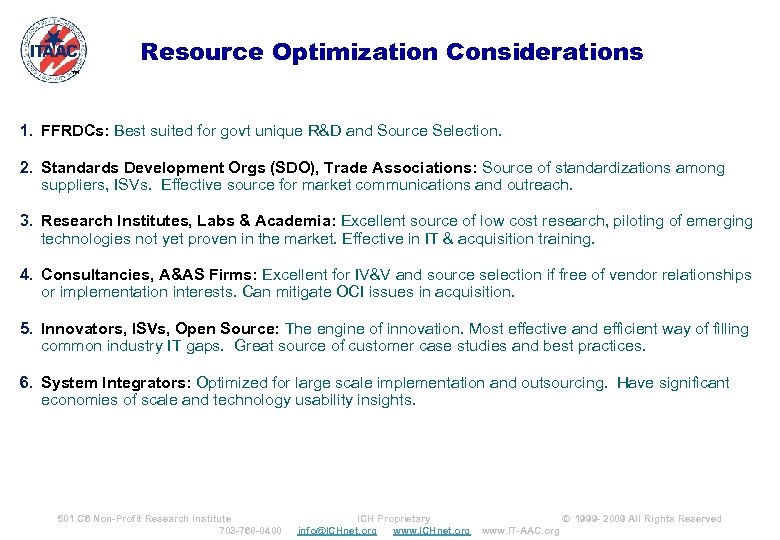 Resource Optimization Considerations ™ 1. FFRDCs: Best suited for govt unique R&D and Source Selection. 2. Standards Development Orgs (SDO), Trade Associations: Source of standardizations among suppliers, ISVs. Effective source for market communications and outreach. 3. Research Institutes, Labs & Academia: Excellent source of low cost research, piloting of emerging technologies not yet proven in the market. Effective in IT & acquisition training. 4. Consultancies, A&AS Firms: Excellent for IV&V and source selection if free of vendor relationships or implementation interests. Can mitigate OCI issues in acquisition. 5. Innovators, ISVs, Open Source: The engine of innovation. Most effective and efficient way of filling common industry IT gaps. Great source of customer case studies and best practices. 6. System Integrators: Optimized for large scale implementation and outsourcing. Have significant economies of scale and technology usability insights. 501. C 6 Non-Profit Research Institute 703 -768 -0400 ICH Proprietary info@ICHnet. org www. ICHnet. org © 1999 - 2009 All Rights Reserved www. IT-AAC. org
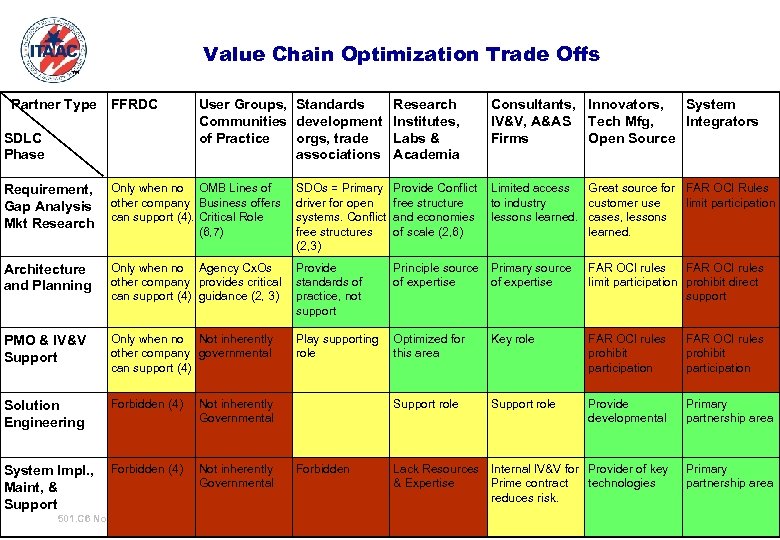 Value Chain Optimization Trade Offs ™ Partner Type FFRDC SDLC Phase User Groups, Standards Communities development of Practice orgs, trade associations Research Institutes, Labs & Academia Consultants, Innovators, System IV&V, A&AS Tech Mfg, Integrators Firms Open Source Requirement, Gap Analysis Mkt Research Only when no OMB Lines of other company Business offers can support (4). Critical Role (6, 7) SDOs = Primary driver for open systems. Conflict free structures (2, 3) Provide Conflict free structure and economies of scale (2, 6) Limited access Great source for FAR OCI Rules to industry customer use limit participation lessons learned. cases, lessons learned. Architecture and Planning Only when no Agency Cx. Os other company provides critical can support (4) guidance (2, 3) Provide standards of practice, not support Principle source of expertise Primary source of expertise FAR OCI rules limit participation prohibit direct support PMO & IV&V Support Only when no Not inherently other company governmental can support (4) Play supporting role Optimized for this area Key role FAR OCI rules prohibit participation Solution Engineering Forbidden (4) Not inherently Governmental Support role Provide developmental Primary partnership area System Impl. , Maint, & Support Forbidden (4) Not inherently Governmental Lack Resources Internal IV&V for Provider of key & Expertise Prime contract technologies reduces risk. Primary partnership area 501. C 6 Non-Profit Research Institute 703 -768 -0400 Forbidden ICH Proprietary info@ICHnet. org www. ICHnet. org © 1999 - 2009 All Rights Reserved www. IT-AAC. org 20
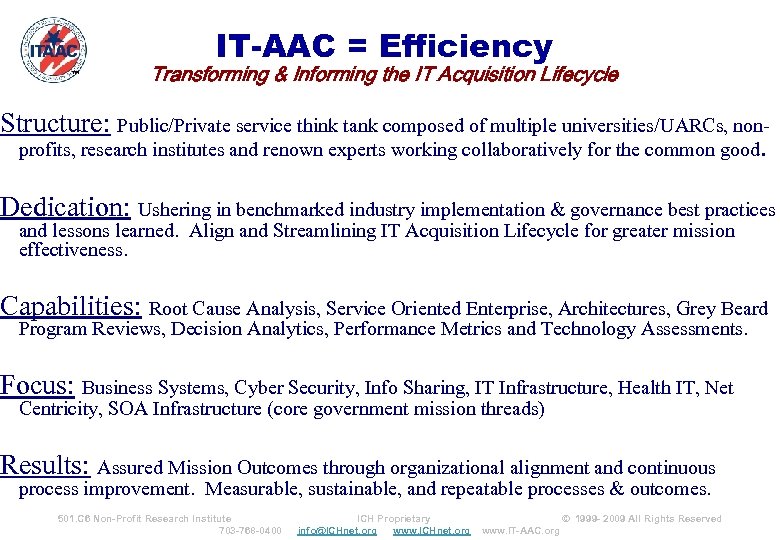 IT-AAC = Efficiency ™ Transforming & Informing the IT Acquisition Lifecycle Structure: Public/Private service think tank composed of multiple universities/UARCs, non. ICH Methods profits, research institutes and renown experts working collaboratively for the common good. Dedication: Ushering in benchmarked industry implementation & governance best practices and lessons learned. Align and Streamlining IT Acquisition Lifecycle for greater mission effectiveness. Capabilities: Root Cause Analysis, Service Oriented Enterprise, Architectures, Grey Beard Program Reviews, Decision Analytics, Performance Metrics and Technology Assessments. Focus: Business Systems, Cyber Security, Info Sharing, IT Infrastructure, Health IT, Net Centricity, SOA Infrastructure (core government mission threads) Results: Assured Mission Outcomes through organizational alignment and continuous process improvement. Measurable, sustainable, and repeatable processes & outcomes. 501. C 6 Non-Profit Research Institute 703 -768 -0400 ICH Proprietary info@ICHnet. org www. ICHnet. org © 1999 - 2009 All Rights Reserved www. IT-AAC. org