


 Скачать презентацию IT 803 Mixed-Initiative Intelligent Systems Professor Dr
92d829627f7af67c68ae236b19a45ed8.ppt
- Количество слайдов: 79
 IT 803 – Mixed-Initiative Intelligent Systems Professor: Dr Gheorghe Tecuci Mixed-Initiative Issues in MASMA - an Agent-Based Meeting Scheduler Research review by Cristina Boicu March 1 -8, 2004
 Brief Introduction l Consider several mixed-initiative issues in the context of a specific personal assistant, a meeting scheduler. l MASMA (Multi-Agent System for Meeting Automation) is used to study the interaction between agents and users l The authors claim that, in interactive applications, agents are more effective when associated with human users to form an integrated mixed initiative system ¡ the agent-user couple is a multi-agent system that should avoid conflicts in order to work effectively 2
 MASMA Mixed-Initiative System l MASMA = Multi-Agent System for Meeting Automation l MASMA - a personal assistant that supports users in managing their personal agenda and in organizing and scheduling appointments, meetings, conferences and seminars. l It has a multi-agent architecture 3
 Outline The meeting scheduling problem l Illustrative Example of the interaction in MASMA l Mixed-initiative definition and related aspects l Mixed-initiative issues in MASMA l ¡ architecture, task, control, awareness, communication, evaluation Summary l Lessons learned l References l 4
 The Meeting Scheduling Problem Question When organizing a meeting of several persons what problems may appear and what it requires? 5
 The Meeting Scheduling Problem When organizing a meeting of several persons what problems may appear and what it requires ? l Scheduling meetings for a set of users requires: ¡ ¡ complex negotiation strategies ¡ l a massive organizational effort a large number of communication acts (e-mail messages, phone calls, faxes) It generally requires a compromise among: ¡ the different users’ constraints ¡ the availability of the resources ¡ the need to satisfy the highest number of people 6
 The Meeting Scheduling Problem l Given: a set U of n users l Goal: organize a meeting M on a particular subject and with specific resource requirements (dimension of the room, equipment) l The meeting concerns a number of invited users I (subset-of U) subdivided among: ¡ ¡ necessary invitees N, such that the meeting cannot take place if one of them is not available optional invitees O whose participation is not strictly necessary 7
 The Meeting Scheduling Problem l One user U 0 acts as the organizer or host of the meeting. l The users’ availability over intervals of time is defined by using the set of preference values: {high; medium; low; null} l An interval of time has availability null when either a previous meeting exists in that interval or the user explicitly sets his unavailability. 8
 Outline The meeting scheduling problem l Illustrative Example of the interaction in MASMA l Mixed-initiative definition and related aspects l Mixed-initiative issues in MASMA l ¡ architecture, task, control, awareness, communication, evaluation Summary l Lessons learned l References l 9
 Illustrative Example l Three persons: Amedeo, Daniela and Marcello l Each is represented by a Meeting Agent, respectively labeled as MAA, MAD and MAM l The users are able to set the level of autonomy they allow to their personal agents l Amedeo has been using MAA for a long time so he delegates it a lot of decisions l Marcello is more careful in his use of MAM 10
 Illustrative Example (cont) l Marcello has been hired by the firm ‘XYX’ and his boss is Amedeo l He is involved in the project ‘Masma’ in which Daniela is also working as a project leader l Daniela wants to organize a meeting with Marcello about ‘Masma’ l Before filling in an announcement, she consults her agenda and notices that on November 16 th she has a short meeting at 11 o’clock 11
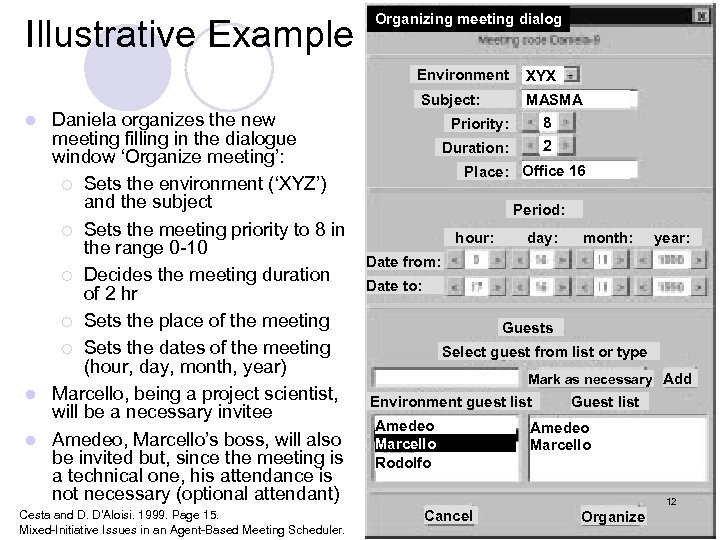 Organizing meeting dialog Illustrative Example (cont) Environment Subject: Daniela organizes the new meeting filling in the dialogue window ‘Organize meeting’: ¡ Sets the environment (‘XYZ’) and the subject ¡ Sets the meeting priority to 8 in the range 0 -10 ¡ Decides the meeting duration of 2 hr ¡ Sets the place of the meeting ¡ Sets the dates of the meeting (hour, day, month, year) l Marcello, being a project scientist, will be a necessary invitee l Amedeo, Marcello’s boss, will also be invited but, since the meeting is a technical one, his attendance is not necessary (optional attendant) XYX MASMA l Cesta and D. D'Aloisi. 1999. Page 15. Mixed-Initiative Issues in an Agent-Based Meeting Scheduler. Priority: 8 Duration: 2 Place: Office 16 Period: hour: day: month: year: Date from: Date to: Guests Select guest from list or type Mark as necessary Add Environment guest list Amedeo Marcello Rodolfo Cancel Guest list Amedeo Marcello 12 Organize
 Illustrative Example (cont) Daniela’s agent sends the meeting announcement to Amedeo’s and Marcello’s agents (MAA and MAM) l Amedeo’s agent evaluates the meeting relevance and decides that Amedeo is not interested in it ¡ The relevance is established based on a set of preference rules previously given by Amedeo. These rules may take into account: l the meeting subject (technical, managerial) l his attendance (optional, necessary) l his schedule (busy, free) l the meeting priority l MAA being set on autonomous decision for that step, sends MAD its rejection l MAD continues the scheduling of the meeting for the remaining participants (because Amedeo was marked as optional invitee) l 13
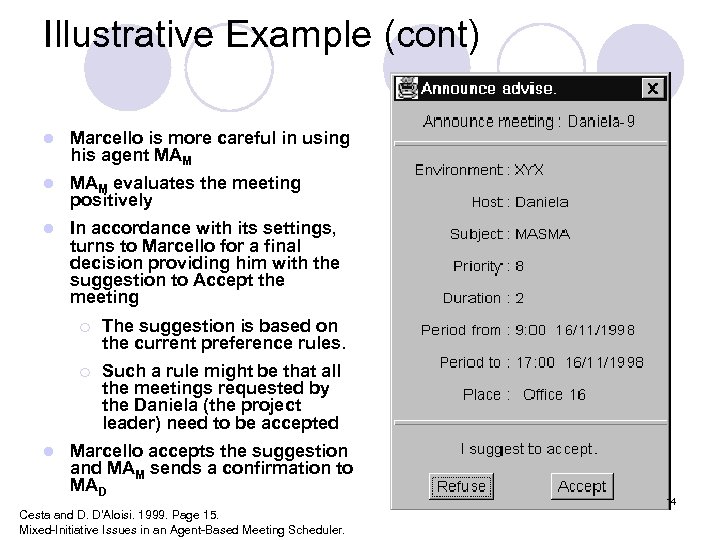 Illustrative Example (cont) l Marcello is more careful in using his agent MAM l MAM evaluates the meeting positively l In accordance with its settings, turns to Marcello for a final decision providing him with the suggestion to Accept the meeting ¡ ¡ l The suggestion is based on the current preference rules. Such a rule might be that all the meetings requested by the Daniela (the project leader) need to be accepted Marcello accepts the suggestion and MAM sends a confirmation to MAD Cesta and D. D'Aloisi. 1999. Page 15. Mixed-Initiative Issues in an Agent-Based Meeting Scheduler. 14
 Illustrative Example (cont) l At this point a negotiation begins between MAD and MAM to actually schedule the meeting. l MAD asks MAM for time intervals with high availability. l If no satisfactory interval is found, it will ask MAM for medium availability and afterwards for low. l In case no agreement is reached MAD asks for relaxation of constraints. l MAM cannot decide by itself since Marcello requires to be explicitly asked at critical points (a critical decision may cause the cancellation of a meeting previously fixed and a costly reorganization) 15
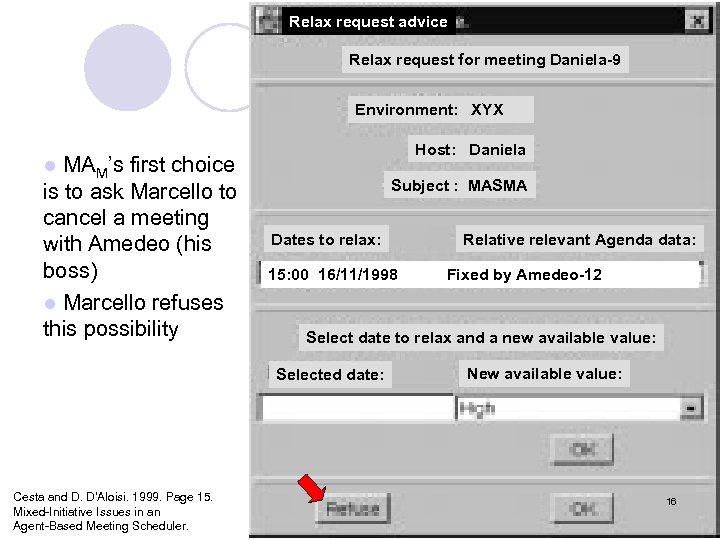 Relax request advice Relax request for meeting Daniela-9 Environment: XYX MAM’s first choice is to ask Marcello to cancel a meeting with Amedeo (his boss) l Marcello refuses this possibility Host: Daniela l Subject : MASMA Dates to relax: 15: 00 16/11/1998 Fixed by Amedeo-12 Select date to relax and a new available value: Selected date: Cesta and D. D'Aloisi. 1999. Page 15. Mixed-Initiative Issues in an Agent-Based Meeting Scheduler. Relative relevant Agenda data: New available value: 16
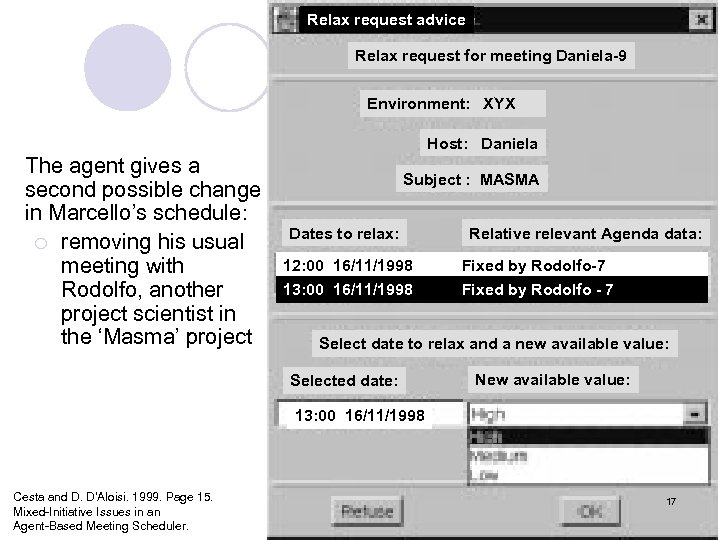 Relax request advice Relax request for meeting Daniela-9 Environment: XYX Host: Daniela The agent gives a second possible change in Marcello’s schedule: ¡ removing his usual meeting with Rodolfo, another project scientist in the ‘Masma’ project Subject : MASMA Dates to relax: Relative relevant Agenda data: 12: 00 16/11/1998 Fixed by Rodolfo-7 13: 00 16/11/1998 Fixed by Rodolfo - 7 Select date to relax and a new available value: Selected date: New available value: 13: 00 16/11/1998 Cesta and D. D'Aloisi. 1999. Page 15. Mixed-Initiative Issues in an Agent-Based Meeting Scheduler. 17
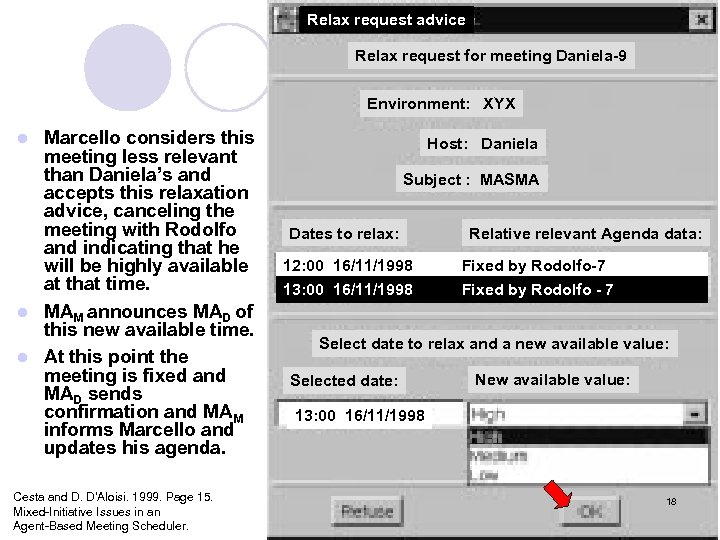 Relax request advice Relax request for meeting Daniela-9 Environment: XYX Marcello considers this meeting less relevant than Daniela’s and accepts this relaxation advice, canceling the meeting with Rodolfo and indicating that he will be highly available at that time. l MAM announces MAD of this new available time. l At this point the meeting is fixed and MAD sends confirmation and MAM informs Marcello and updates his agenda. l Cesta and D. D'Aloisi. 1999. Page 15. Mixed-Initiative Issues in an Agent-Based Meeting Scheduler. Host: Daniela Subject : MASMA Dates to relax: Relative relevant Agenda data: 12: 00 16/11/1998 Fixed by Rodolfo-7 13: 00 16/11/1998 Fixed by Rodolfo - 7 Select date to relax and a new available value: Selected date: New available value: 13: 00 16/11/1998 18
 Outline The meeting scheduling problem l Illustrative Example of the interaction in MASMA l Mixed-initiative definition and related aspects l Mixed-initiative issues in MASMA l ¡ architecture, task, control, awareness, communication, evaluation Summary l Lessons learned l References l 19
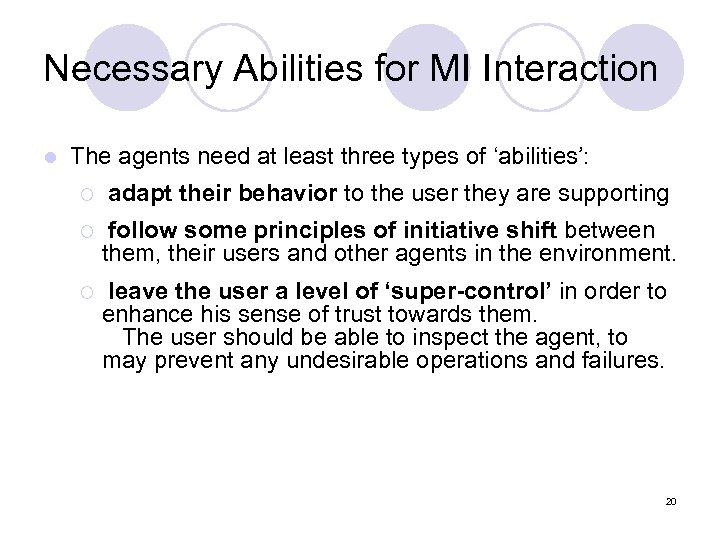 Necessary Abilities for MI Interaction l The agents need at least three types of ‘abilities’: ¡ adapt their behavior to the user they are supporting ¡ follow some principles of initiative shift between them, their users and other agents in the environment. ¡ leave the user a level of ‘super-control’ in order to enhance his sense of trust towards them. The user should be able to inspect the agent, to may prevent any undesirable operations and failures. 20
 Definition of Mixed-Initiative l DEFINITION: In an agent-based system, in which the actors are a user and his personal agent, the flow of initiative and the flow of decisions coincide. At any moment, the initiative is held by the actor able to decide the next step. A mixed-initiative agentbased system is a user-agent pair in which the decision making is shared between the user and the agent. The analysis of the initiative turns is related to who decides at a certain moment. l Although the definition of initiative means making a decision on what to do, it does not imply the decision will be acted upon. l The agent may also execute actions based on the user’s choices or decisions. l Question: Is always necessary for the flow of initiative and the flow of decision to coincide? 21
 Initiative and the Role of Control l Control = the possibility for one actor to supervise and influence an ongoing process l Initiative and control are different, since the user has the possibility to inspect and verify the agent behavior even when it is the agent who is to decide l COROLLARY: In an user-agent pair, the control and the initiative are separate. For instance, an actor may hold initiative but not control. Also the execution and the initiative are separate. For instance, an actor can decide but not necessarily implement the decision. 22
 Interaction Protocol l The interaction protocols drive the initiative flow according to: ¡ ¡ the user’s profile and preferences, a list of constraints on the degrees of freedom allowed to the agent, the criticality of a decision, an analysis of the current situation and the past history of the interaction 23
 Interaction Protocol (cont) l The analysis of a behavior protocol allows for establishing who takes the initiative (not necessarily who is performing the current actions). l The evaluation of how many times the agent takes the initiative gives a measure of the agent autonomy. l A completely autonomous agent will never relinquish the initiative, while a slave agent will only be able to execute the user’s directions. 24
 Outline The meeting scheduling problem l Illustrative Example of the interaction in MASMA l Mixed-initiative definition and related aspects l Mixed-initiative issues in MASMA l ¡ architecture, task, control, awareness, communication, evaluation Summary l Lessons learned l References l 25
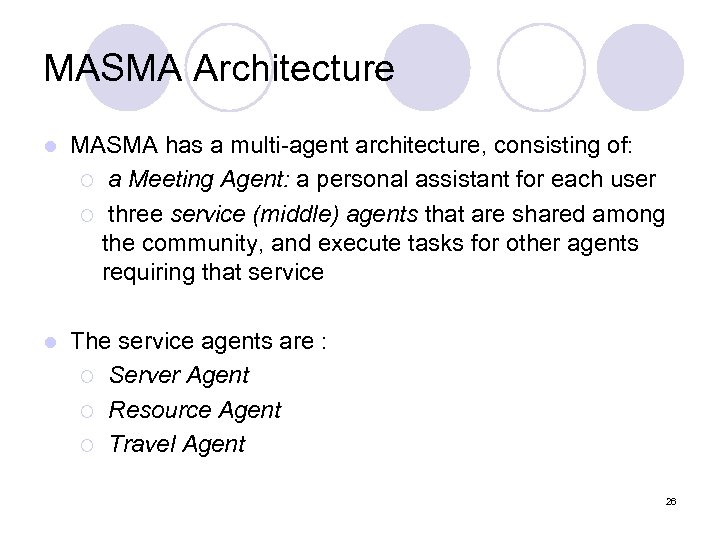 MASMA Architecture l MASMA has a multi-agent architecture, consisting of: ¡ a Meeting Agent: a personal assistant for each user ¡ three service (middle) agents that are shared among the community, and execute tasks for other agents requiring that service l The service agents are : ¡ Server Agent ¡ Resource Agent ¡ Travel Agent 26
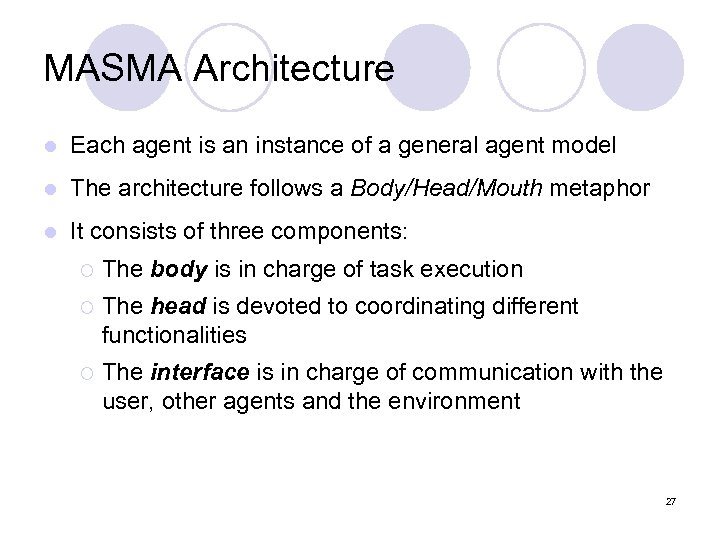 MASMA Architecture l Each agent is an instance of a general agent model l The architecture follows a Body/Head/Mouth metaphor l It consists of three components: ¡ The body is in charge of task execution ¡ The head is devoted to coordinating different functionalities ¡ The interface is in charge of communication with the user, other agents and the environment 27
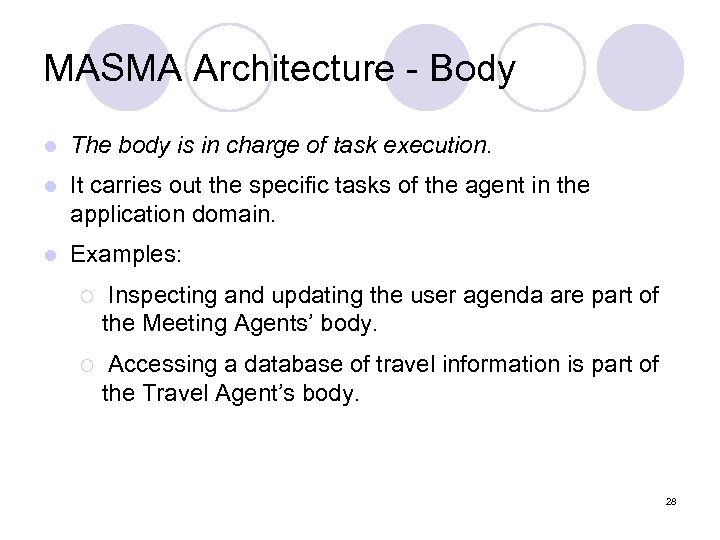 MASMA Architecture - Body l The body is in charge of task execution. l It carries out the specific tasks of the agent in the application domain. l Examples: ¡ Inspecting and updating the user agenda are part of the Meeting Agents’ body. ¡ Accessing a database of travel information is part of the Travel Agent’s body. 28
 MASMA Architecture - Head l The head is devoted to: ¡ coordinating the different functionalities; ¡ managing the representation of the external world, of the agent and of the current state of affairs; ¡ reasoning, solving problems and taking decisions; ¡ coordinating and negotiating with other agents 29
 MASMA Architecture – Head l l l The head consists of four components: ¡ controller ¡ reasoner ¡ knowledge base ¡ working memory The controller: ¡ guarantees the basic level of functionality ¡ continuously checks for new information ¡ activates a task for the body to execute When a conflict arises about the next step to be taken, the controller gives responsibility to the reasoner to perform higher level functionalities and to decide the more appropriate future plan. The reasoner puts the results of the reasoning process in the working memory. Then the controller searches the working memory for actions to be executed. The knowledge base is managed by a deductive information retriever where information is represented as assertions and rules. It contains the user's mental attitudes, plan libraries, beliefs on other agents, on the external environment and on the application domain. 30 The working memory is managed by a deductive information retriever.
 MASMA Architecture - Interface l The interface is in charge of the communication with the user, other agents and the environment. l It consists of: ¡ a Message Manager to support the interactions between agents ¡ a set of Sensors and Actuators to exchange data with the software environment. They generally consist of the instruction set of the operating system. The actuators can influence the status of the environment (can modify databases, activate printers, faxes, phones or other resources) ¡ a User Interface Manager to communicate with the users 31
 The Meeting Agent l A Meeting Agent is associated with each user and acts as a personal assistant specialized in meeting organization. l The Meeting Agent main tasks are: ¡ To manage the user’s agenda ¡ To maintain the user’s profile ¡ To negotiate with other agents to determine meetings schedules 32
 The Meeting Agent l Both the agent and the user can access the user’s electronic agenda. l The agenda is a separate software module l The user manipulates the agenda separately through his preferred interface. l Due to a mechanism for concurrency control, the common data structure allows both the user and the meeting agent to independently access and write information about appointments. 33
 The Meeting Agent l In the organizational process, the Meeting Agent represents the user according to his profile. l The user’s profile contains: ¡ the user’s preference values assigned to the different dates and times ¡ data about the user’s general interests The user profile will be presented in more details later. 34
 The Meeting Agent (cont) l The process of determining a meeting needs a negotiation phase to decide the date, place and duration of the event. l The Meeting Agent can play the role of organizer or attendee by applying a corresponding negotiation protocol. 35
 The Meeting Agent (cont) l A Meeting Agent can also interact with a service agent to obtain information. l In this case the control moves temporarily to such a service agent. l The three middle agents work as specialized knowledge servers to which some tasks have been delegated. 36
 The Server Agent l The Server Agent is in charge of: ¡ managing the network addresses ¡ maintaining a knowledge base with the users’ network addresses by respecting their privacy needs l In case of new users, it is able to get the addresses by querying an external server. 37
 The Server Agent (cont. ) l It also manages a service of free distribution of announcements about conferences, workshops and seminars. l The users can subscribe to the service by transmitting a list of keywords and topics they are interested in. l The keywords are inserted in a database managed by the Server Agent so that it can help the organizer’s agent to make announcements in a selective way without disturbing all the connected users. 38
 The Resource Agent l The Resource Agent adopts a centralized administration of the common resources. l Each site is characterized by
 The Travel Agent l The Travel Agent helps the user to mechanize the last step in organizing a meeting, the lodging and travel decisions. l The agent can connect the user to train and flight timetables, decide the best path between two places, inform him about prices, show a list of possible hotels. 40
 Outline The meeting scheduling problem l Illustrative Example of the interaction in MASMA l Mixed-initiative definition and related aspects l Mixed-initiative issues in MASMA l ¡ architecture, task, control, awareness, communication, evaluation Summary l Lessons learned l References l 41
 Task issue l It is not specifically discussed in the paper. l The following remarks are my own interpretation related to this issue. l However, the way in which the control is encoded in the system suggests how the division of tasks is made. 42
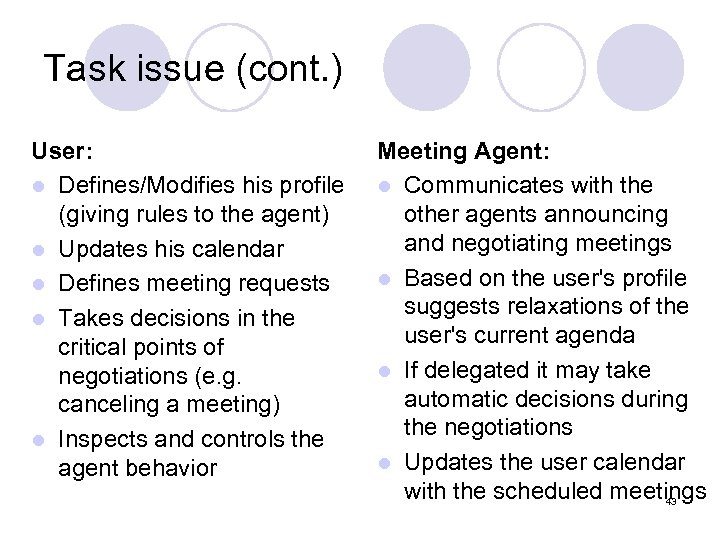 Task issue (cont. ) User: l Defines/Modifies his profile (giving rules to the agent) l Updates his calendar l Defines meeting requests l Takes decisions in the critical points of negotiations (e. g. canceling a meeting) l Inspects and controls the agent behavior Meeting Agent: l Communicates with the other agents announcing and negotiating meetings l Based on the user's profile suggests relaxations of the user's current agenda l If delegated it may take automatic decisions during the negotiations l Updates the user calendar with the scheduled meetings 43
 Outline The meeting scheduling problem l Illustrative Example of the interaction in MASMA l Mixed-initiative definition and related aspects l Mixed-initiative issues in MASMA l ¡ architecture, task, control, awareness, communication, evaluation Summary l Lessons learned l References l 44
 Types of Interaction l MASMA has three different types of interaction: ¡ human user vs (personal) meeting agent ¡ meeting agent vs service agent l The user can control the autonomy of its agent 45
 Control Mechanisms User centered control through personalization. The system contains mechanisms that allow the user to describe his way of solving the problem of meeting scheduling to his personal agent. l Task driven control of the initiative. This is the way to define the rules for relinquishing control during standard problem solving activity. This initiative flow can be modified by the information in the user’s profile and by the direct intervention of the user. l Mechanisms to allow control by the user. The user is allowed to observe the current negotiation going on and to influence the negotiation behavior of the agents. l 46
 User centered control through personalization l Modeling the agent on the user’s behavior makes a system able to decide and solve problems following the same rules and laws of the user. l MASMA allows the user to build a knowledge base concerning his preferences and his rules of behavior, that form the user’s profile. 47
 User Profile l In MASMA, the user directly and interactively defines and maintains his profile. l The profile contains a formal representation of the user’s standard behavior in meeting scheduling. l The profile is internally represented in: ¡ a database of rules, describing behaviors ¡ in a database of facts, representing preferences 48
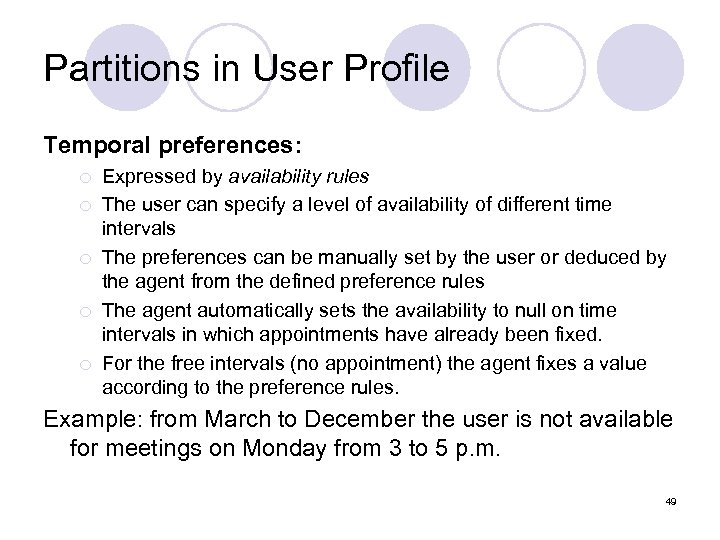 Partitions in User Profile Temporal preferences: ¡ ¡ ¡ Expressed by availability rules The user can specify a level of availability of different time intervals The preferences can be manually set by the user or deduced by the agent from the defined preference rules The agent automatically sets the availability to null on time intervals in which appointments have already been fixed. For the free intervals (no appointment) the agent fixes a value according to the preference rules. Example: from March to December the user is not available for meetings on Monday from 3 to 5 p. m. 49
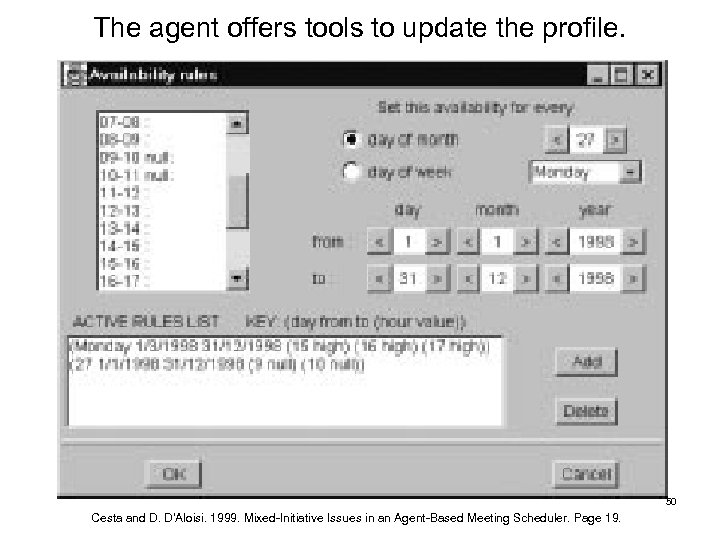 The agent offers tools to update the profile. 50 Cesta and D. D'Aloisi. 1999. Mixed-Initiative Issues in an Agent-Based Meeting Scheduler. Page 19.
 Question l What are the advantages/disadvantages to learn the user’s profile vs. letting the user to define and update the profile? 51
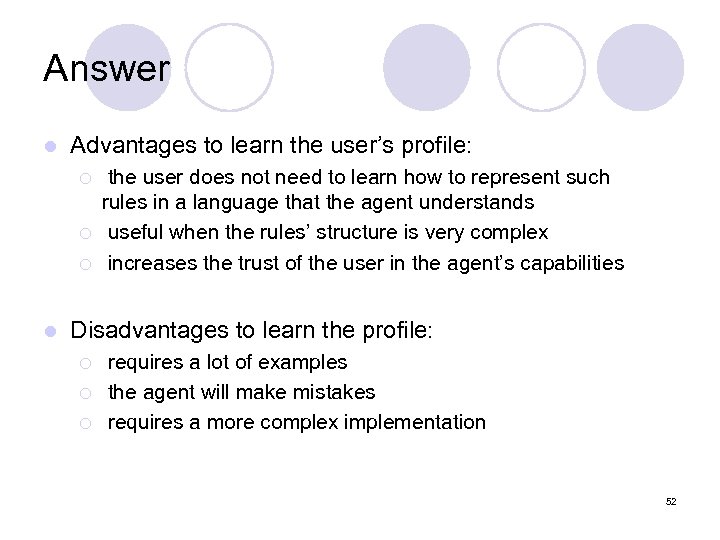 Answer l Advantages to learn the user’s profile: ¡ ¡ ¡ l the user does not need to learn how to represent such rules in a language that the agent understands useful when the rules’ structure is very complex increases the trust of the user in the agent’s capabilities Disadvantages to learn the profile: ¡ ¡ ¡ requires a lot of examples the agent will make mistakes requires a more complex implementation 52
 Partitions in User Profile Contextual preferences: ¡ Used to insert information about usual habits concerning the content of a meeting (e. g. , who is organizing the meeting, the place of the meeting, its subject). ¡ Used to force automated behavior according to this contextual information without entering into dialogue with the user. 53
 Partitions in User Profile Types of contextual preferences: l user’s bias towards personal appointments (colleagues, relatives) sets priority values on a person or classes of people who are potential organizers of meetings (e. g. for a meeting with user’s spouse set ‘never cancel unless it is my boss calling me’) l predisposition to different types of engagements (e. g. , working groups, project meetings, conferences) l options on traveling and accommodation (e. g. the user could be afraid of flying: consequently any invitation for conference 54 overseas should be automatically rejected)
 Partitions in User Profile Autonomy preferences: ¡ general preferences that influence the level of autonomy of the agent with respect to the user. Preferences: ¡ Type of information about the agenda to be passed to other agents (ex: the user could specify that only dates with ‘high’ or ‘medium’ availability can be passed to other Meeting Agents organizing a meeting) ¡ An autonomy flag (‘true’ gives the agent the authority to directly make appointments without asking confirmation to its user) 55
 Task driven control of the initiative l Use negotiation protocols to regulate the behavior of the actors during the decision making for each meeting. l When executed, such protocols follow a standard behavior which is personalized by the user profile l Since a Meeting Agent can play the role of organizer or attendee, two different basic protocol –one for each role– have been defined. l According to the steps in the protocol, the initiative shifts from one agent to another or from a personal agent to its user and back. 56
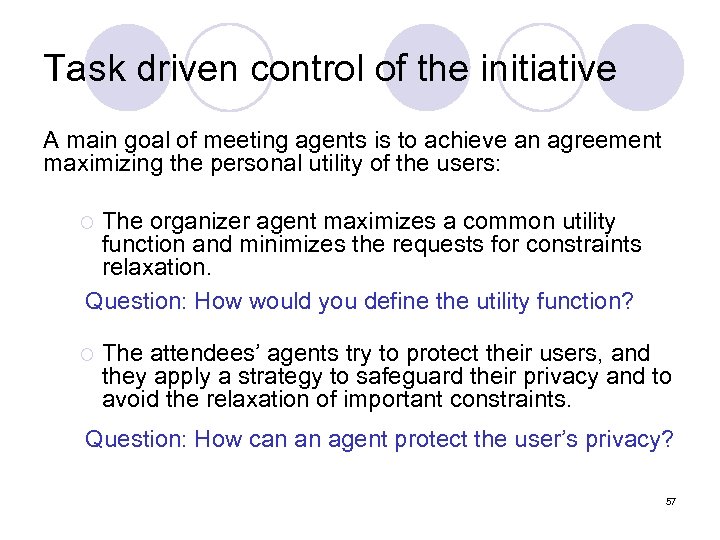 Task driven control of the initiative A main goal of meeting agents is to achieve an agreement maximizing the personal utility of the users: The organizer agent maximizes a common utility function and minimizes the requests for constraints relaxation. Question: How would you define the utility function? ¡ ¡ The attendees’ agents try to protect their users, and they apply a strategy to safeguard their privacy and to avoid the relaxation of important constraints. Question: How can an agent protect the user’s privacy? 57
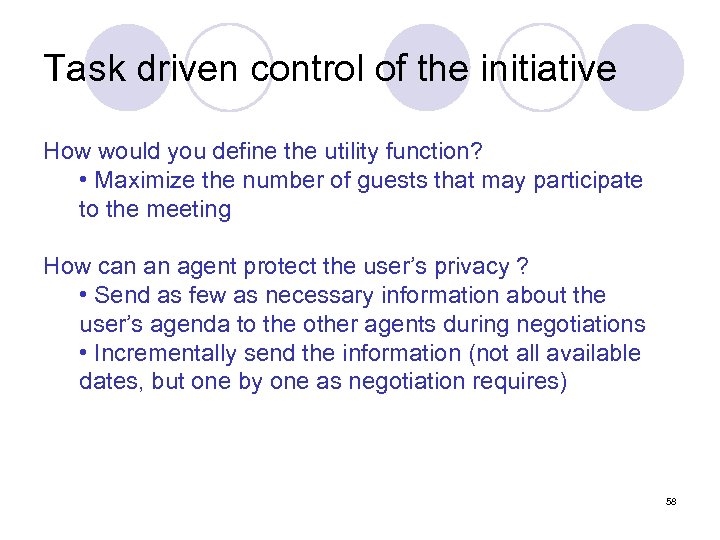 Task driven control of the initiative How would you define the utility function? • Maximize the number of guests that may participate to the meeting How can an agent protect the user’s privacy ? • Send as few as necessary information about the user’s agenda to the other agents during negotiations • Incrementally send the information (not all available dates, but one by one as negotiation requires) 58
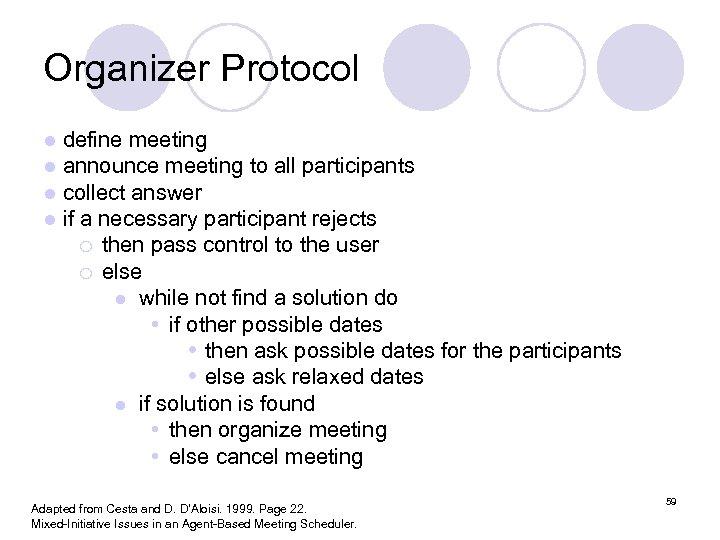 Organizer Protocol l l define meeting announce meeting to all participants collect answer if a necessary participant rejects ¡ then pass control to the user ¡ else l while not find a solution do • if other possible dates then ask possible dates for the participants else ask relaxed dates l if solution is found • then organize meeting • else cancel meeting Adapted from Cesta and D. D'Aloisi. 1999. Page 22. Mixed-Initiative Issues in an Agent-Based Meeting Scheduler. 59
 Mechanisms to allow control by the user l An agent should have the capability of acting and autonomously propose solutions according to the current problem l The user must have the possibility of controlling and inspecting the agent decisions. 60
 Mechanisms to allow control by the user The need for control emerges at different phases in an agent life-cycle: l Training phase: the user observes the agent behavior to decide about its reliability. The user sets his profile but he prefers to maintain the control and the initiative since he is likely not to trust the agent yet. l Working phase: after a while the user achieves a level of trust towards his agent and can leave decisions to it. 61
 Mechanisms to allow control by the user l The agents involves the user according to the relevance (in the user’s view) of decisions. l It is the user who decides when to relinquish the initiative to the agent, because the relevance of a decision is assessed by the user through his preferences. l The level of autonomy of the agent is not decided according to its knowledge of the current decision but on the criticality of the decision for the user. l Another feature to allow the user to increase his sense of control is the possibility of inspection of the agent behavior. l The agent is endowed with an inspection mode about its activities. 62
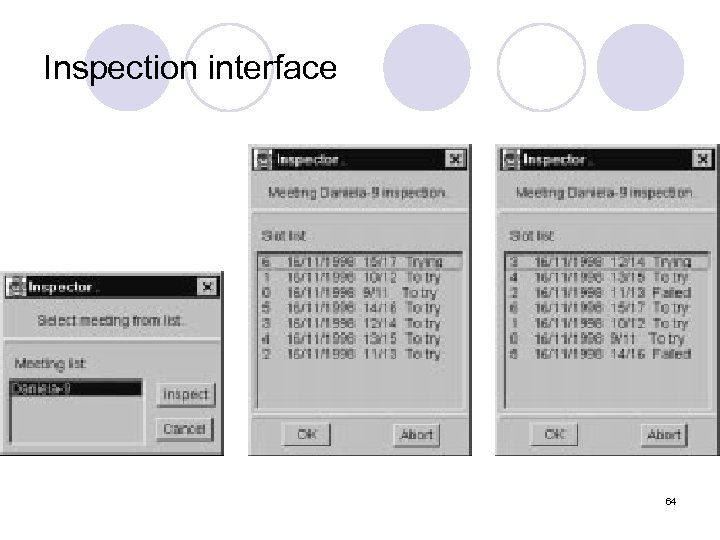
 Mechanisms to allow control by the user l MASMA has an inspection facility that allows the user to observe the agent behavior, to analyze the running processes, to verify the information and data at agent disposal or to interfere or take the agent over if necessary. l The user can influence the organization and negotiation processes by dynamically modifying the preferences and rules. l Example: ¡ ¡ The user may remember he is engaged on November 16 th: he accesses his calendar and turns the preference value to ‘null’. The agent records the change and modifies its negotiation parameters. 63
 Inspection interface 64
 Outline The meeting scheduling problem l Illustrative Example of the interaction in MASMA l Mixed-initiative definition and related aspects l Mixed-initiative issues in MASMA l ¡ architecture, task, control, awareness, communication, evaluation Summary l Lessons learned l References l 65
 Awareness in MASMA Variable levels of awareness: l The user may configure the level of autonomy assigned to his agent (e. g. may or may not delegate the agent for automatic scheduling); ¡ If the agent has a low degree of autonomy, the agent will ask the user for most of the decisions, therefore the user will permanently be aware of the agent's actions ¡ If the agent has a high degree of autonomy, most of the agent's decisions will not be directly communicated to the user 66
 Awareness in MASMA The shared awareness: l Is maintained through the system calendar, which both the user and his agent can access and modify independently; l When the user modifies the calendar his agent is immediately announced, and takes into consideration the modification; l The user is immediately announced when conflicts or schedule changes appear l The inspection facility can be used by the user to observe and be aware of the agent’s actions 67
 Outline The meeting scheduling problem l Illustrative Example of the interaction in MASMA l Mixed-initiative definition and related aspects l Mixed-initiative issues in MASMA l ¡ architecture, task, control, awareness, communication, evaluation Summary l Lessons learned l References l 68
 Communication in MASMA Human-agent communication: l Realized through a graphical user interface; l Fixed and predefined type of interaction allowed (i. e. descriptions of the commands are obtained by selecting values for predefined parameters) l The agent generates predefined structured information dialogs (e. g. suggestion advise to accept a meeting) Agent-agent communication: l The interface part of each agent has a message manager; l The agents communicate among them through these messages 69
 Outline The meeting scheduling problem l Illustrative Example of the interaction in MASMA l Mixed-initiative definition and related aspects l Mixed-initiative issues in MASMA l ¡ architecture, task, control, awareness, communication, evaluation Summary l Lessons learned l References l 70
 Evaluation of MASMA No evaluation was presented in any of the papers that I found about this system. 71
 Outline The meeting scheduling problem l Illustrative Example of the interaction in MASMA l Mixed-initiative definition and related aspects l Mixed-initiative issues in MASMA l ¡ architecture, task, control, awareness, communication, evaluation Summary l Lessons learned l References l 72
 Summary l In contexts where agents manage personal data and take decisions that might be critical for the user (his personal agenda), the user probably prefers to maintain continuous control over the process since he is not likely to immediately trust how his agent could act on his behalf. l MASMA: ¡ Is a multi-agent system addressing the meeting scheduling problem ¡ Incorporates mechanisms to constrain the agent autonomy while preserving the user’s own autonomy 73
 Summary l The delegation of tasks between the user and the agent is controlled via a negotiation protocol l It is possible to select what decisions (or classes of decisions) can be relinquished to the agent and decide when the initiative can be relinquished to the agent. In both cases the choice is made according to the criticality of decisions l The user can always maintain the control on his agent and interfere and influence its actions. l The user can dynamically influence the negotiation process by changing the constraints on line. l After a testing phase, the user can decide to leave more decision steps to his agent although the possibility remains of inspecting and interfering in its behavior. 74
 Outline The meeting scheduling problem l Illustrative Example of the interaction in MASMA l Mixed-initiative definition and related aspects l Mixed-initiative issues in MASMA l ¡ architecture, task, control, awareness, communication, evaluation Summary l Lessons learned l References l 75
 Lessons Learned l The user must maintain the control of the decisions which are considered critical l The shared awareness may be implemented through a tool that is currently used by the user (e. g. the system calendar) l It is important for the user to be able to vary the level of the agent’s autonomy 76
 Outline The meeting scheduling problem l Illustrative Example of the interaction in MASMA l Mixed-initiative definition and related aspects l Mixed-initiative issues in MASMA l ¡ architecture, task, control, awareness, communication, evaluation Summary l Lessons learned l References l 77
 Papers Used for Presentation A. Cesta and D. D'Aloisi. Mixed-Initiative Issues in an Agent. Based Meeting Scheduler. International Journal on User Modeling and User-Adapted Interaction, 9(1/2): 45 -78, April 1999. l A. Cesta, D. D' Aloisi and R. Brancaleoni. Considering the User in Mixed-Initiative Meeting Management. In the Second ERCIM Workshop on "User Interfaces for All“. 1996 l Cesta, A. , Collia, M. and D’Aloisi, D. 1998. Tailorable interactive agents for scheduling meetings. In: F. Giunchiglia (ed. ): Intelligence: Methodology, Systems and Applications. Lecture Notes in Artificial Intelligence, Berlin: Springer, 153– 166. l Daniela D’Aloisi, Amedeo Cesta and Rodolfo Brancaleoni. Mixed-Initiative Aspects in an Agent-Based System. Computational Models for Mixed Initiative Interactions. AAAI 78 1997 Spring Symposia Series. Stanford University. l
 Other Interesting Papers Computational Models for Mixed Initiative Interactions. AAAI 1997 Spring Symposia Series. Stanford University. March 2426, 1997 http: //www. aaai. org/Press/Reports/Symposia/Spring/ss-9704. html l A. Cesta and D. D'Aloisi. Active Interfaces as Personal Assistants: a Case Study. SIGCHI Bulletin, 28(3): 108 -113, July 1996. l A. Cesta and D. D’Ailoisi. Building Interfaces as Personal Agents: A Case Study. 1996. l Cesta, A. , D’Aloisi, D. and Giannini, V. : 1995, Active interfaces for useful software tools. In: Y. Anzai, K. Ogawa, and H. Mori (eds. ): Symbiosis of Human and Artifacts. New York: Elsevier Science, 225– 230. l 79