 Скачать презентацию isvr The Benefit of using an FM Radio
5be35c971e24e4d891b165c26174c7e6.ppt
- Количество слайдов: 1



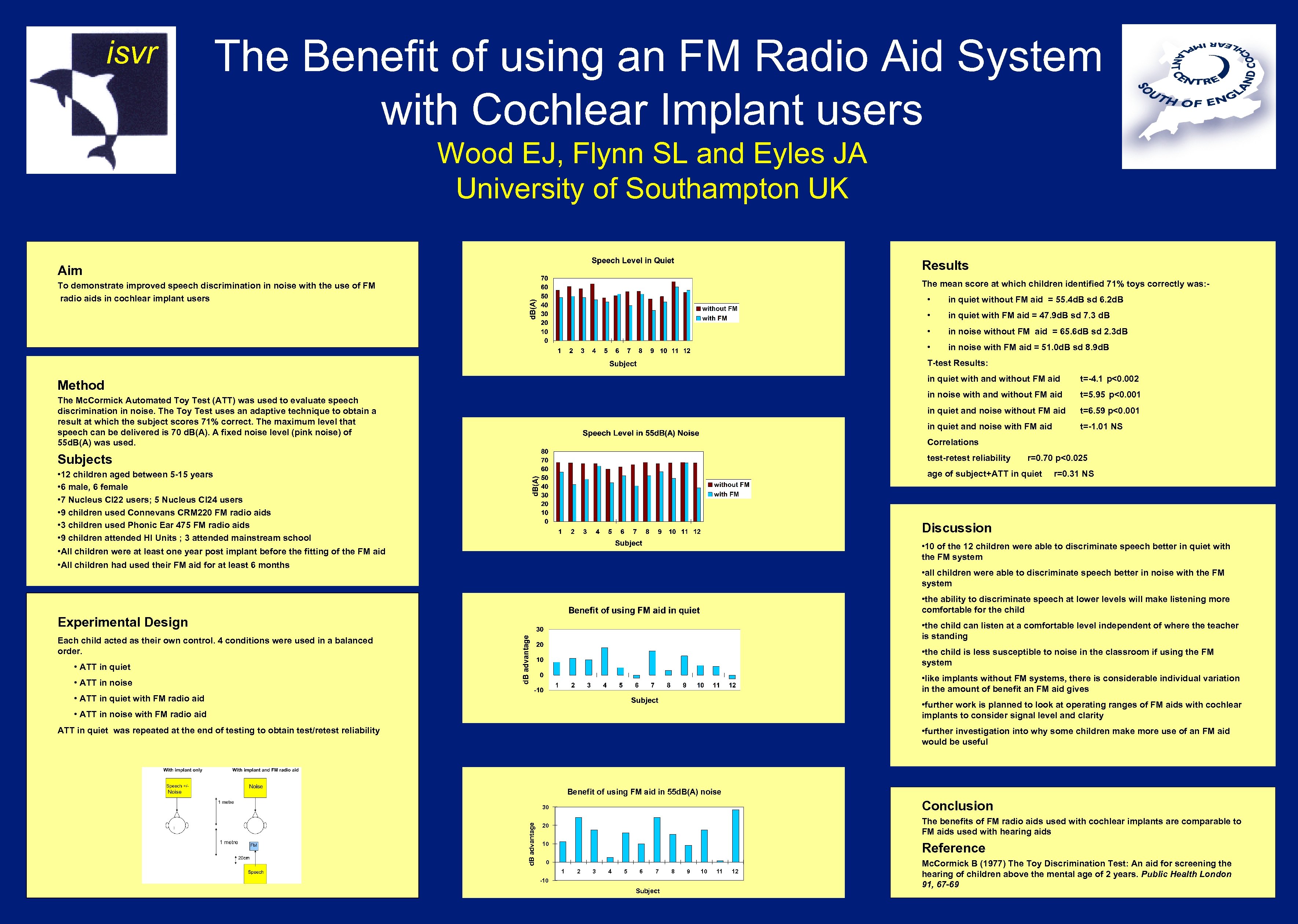
isvr The Benefit of using an FM Radio Aid System with Cochlear Implant users Wood EJ, Flynn SL and Eyles JA University of Southampton UK Results Aim The mean score at which children identified 71% toys correctly was: - To demonstrate improved speech discrimination in noise with the use of FM radio aids in cochlear implant users • in quiet without FM aid = 55. 4 d. B sd 6. 2 d. B • in quiet with FM aid = 47. 9 d. B sd 7. 3 d. B • in noise without FM aid = 65. 6 d. B sd 2. 3 d. B • in noise with FM aid = 51. 0 d. B sd 8. 9 d. B T-test Results: in quiet with and without FM aid in noise with and without FM aid t=6. 59 p<0. 001 in quiet and noise with FM aid The Mc. Cormick Automated Toy Test (ATT) was used to evaluate speech discrimination in noise. The Toy Test uses an adaptive technique to obtain a result at which the subject scores 71% correct. The maximum level that speech can be delivered is 70 d. B(A). A fixed noise level (pink noise) of 55 d. B(A) was used. t=5. 95 p<0. 001 in quiet and noise without FM aid Method t=-4. 1 p<0. 002 t=-1. 01 NS Correlations Subjects test-retest reliability • 12 children aged between 5 -15 years • 6 male, 6 female • 7 Nucleus CI 22 users; 5 Nucleus CI 24 users • 9 children used Connevans CRM 220 FM radio aids • 3 children used Phonic Ear 475 FM radio aids • 9 children attended HI Units ; 3 attended mainstream school age of subject+ATT in quiet r=0. 70 p<0. 025 r=0. 31 NS Discussion • 10 of the 12 children were able to discriminate speech better in quiet with the FM system • All children were at least one year post implant before the fitting of the FM aid • All children had used their FM aid for at least 6 months • all children were able to discriminate speech better in noise with the FM system • the ability to discriminate speech at lower levels will make listening more comfortable for the child Experimental Design • the child can listen at a comfortable level independent of where the teacher is standing Each child acted as their own control. 4 conditions were used in a balanced order. • the child is less susceptible to noise in the classroom if using the FM system • ATT in quiet • like implants without FM systems, there is considerable individual variation in the amount of benefit an FM aid gives • ATT in noise • ATT in quiet with FM radio aid • further work is planned to look at operating ranges of FM aids with cochlear implants to consider signal level and clarity • ATT in noise with FM radio aid ATT in quiet was repeated at the end of testing to obtain test/retest reliability • further investigation into why some children make more use of an FM aid would be useful Benefit of using FM aid in 55 d. B(A) noise d. B advantage 30 Conclusion 20 The benefits of FM radio aids used with cochlear implants are comparable to FM aids used with hearing aids Reference 10 0 1 2 3 4 5 6 7 -10 Subject 8 9 10 11 12 Mc. Cormick B (1977) The Toy Discrimination Test: An aid for screening the hearing of children above the mental age of 2 years. Public Health London 91, 67 -69
Скачать презентацию isvr The Benefit of using an FM Radio
5be35c971e24e4d891b165c26174c7e6.ppt