 Скачать презентацию Istituto Superiore Mario Boella Slotted VANET One
3101ed01c56733e60001659165f79de5.ppt
- Количество слайдов: 21



Istituto Superiore Mario Boella Slotted VANET – One Year After R. Scopigno, BWA Lab – scopigno@ismb. it 1
Agenda Survey on solutions by international literature The need for a comparative analysis The state-of-art of MS-Aloha Upcoming activities by ISMB 2
Agenda Survey on solutions by international literature The need for a comparative analysis The state-of-art of MS-Aloha Upcoming activities by ISMB 3
Slotted MAC VANETs Synchronous protocols are supposed to improve VANET performances… in theory Coordination over time-space: Higher PDR Fixed Latency and determinism These features cannot be taken for granted Slotted protocols can worsen performances E. g. Hidden Terminal (HT): A, B can select the same slot x and continuously transmit on the same, mutually interfering to C In CSMA/CA the effect in not so disruptive: even without RTS/CTS interference is not deterministic and PDR keeps high Studies need to consider all possible causes of HT from real world (urban obstructions by corners, fading, mobility), otherwise purely ideal results E. g. Blocking Protocol by scarse slot reuse 4
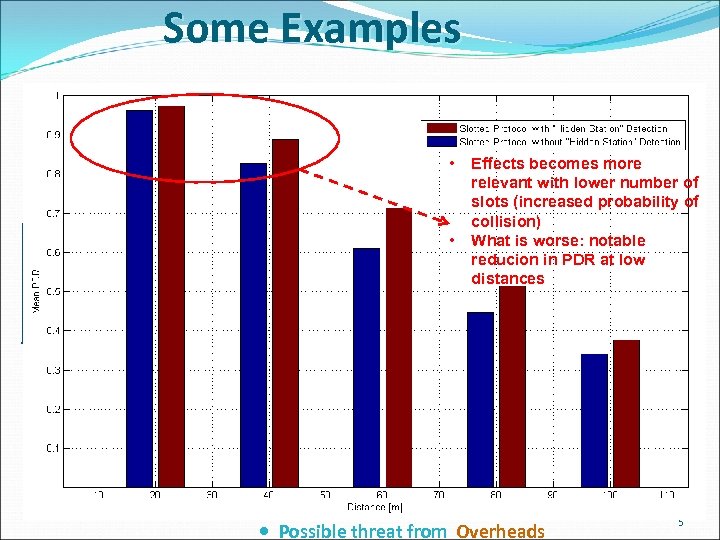
Some Examples Several cases of HT A B C A, C in LOS simultaneously select the same (without ack) • Effects becomes more B can hear either one (A? ) or none lower number of relevant with slots (increased sensing No one will ever discover it HT only by probability of collision) . . OR. . A↔B; C↔B but NOT A↔Cworse: notable • What is reducion in PDR at the A, C cannot hear each other; C may selectlow slot distances already used by A and collide B can hear either one (A? ) or none No one will ever discover it HT only by sensing . . OR. . It may happen also if an ack-ed setup is involved A, C may get close due to mobility All these cases have a huge impact A continuous ACK is required, by all the nodes (a priori unknown set), two hop-far Possible threat from Overheads 5
International Solutions must be carefully evaluated Some of them could worsen rather than improve performance Literature includes 3 main approaches which have never been quantitavely compared S-TDMA (Self-Configuring TDMA) from Halmstadt Univ Solution developed for ship survelliance in open spaces (originally no HT solution) Fully specified for ships; missing details about VANET adaptation (exact message formats - especially for signalling, management of HT, …) MS-Aloha (Mobile Slotted Aloha) from ISMB developed specifically for VANETs against HT and to solve scalability DTDMA (Decentralized TDMA) from Toyota MS-Aloha and DTDMA share a common rationale against HT 6
Agenda Survey on solutions by international literature The need for a comparative analysis The state-of-art of MS-Aloha Upcoming activities by ISMB 7
Comparative Analysis Solutions must be carefully evaluated A possible standard should inherit the points of strenght of each technology S-TDMA, MS-Aloha, DTDMA have never been compared Common initial rationale (slots, absolute synchronization) Different approaches What requirements? What target figures? What their weights? A proposal of requirements - based on literature - follows Metrics, additional requirements and scenarios can be suggested Suggestions please: scopigno@ismb. it 8
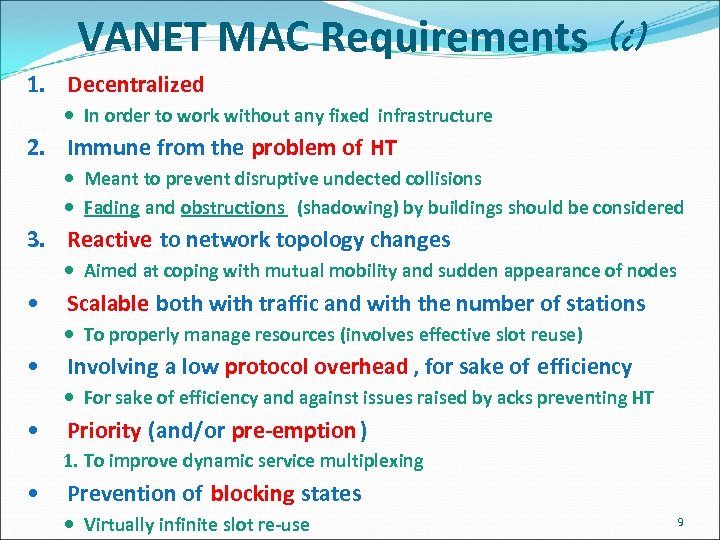
VANET MAC Requirements (i) 1. Decentralized In order to work without any fixed infrastructure 2. Immune from the problem of HT Meant to prevent disruptive undected collisions Fading and obstructions (shadowing) by buildings should be considered 3. Reactive to network topology changes Aimed at coping with mutual mobility and sudden appearance of nodes • Scalable both with traffic and with the number of stations To properly manage resources (involves effective slot reuse) • Involving a low protocol overhead , for sake of efficiency For sake of efficiency and against issues raised by acks preventing HT • Priority (and/or pre-emption ) 1. To improve dynamic service multiplexing • Prevention of blocking states Virtually infinite slot re-use 9
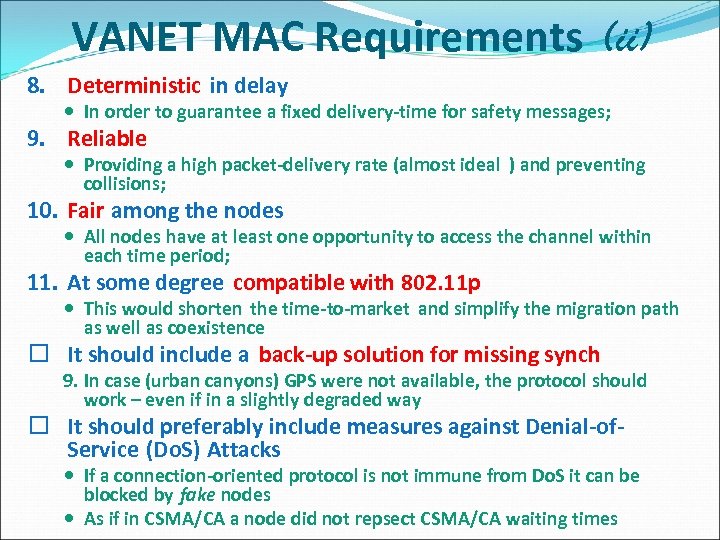
VANET MAC Requirements (ii) 8. Deterministic in delay In order to guarantee a fixed delivery-time for safety messages; 9. Reliable Providing a high packet-delivery rate (almost ideal ) and preventing collisions; 10. Fair among the nodes All nodes have at least one opportunity to access the channel within each time period; 11. At some degree compatible with 802. 11 p This would shorten the time-to-market and simplify the migration path as well as coexistence It should include a back-up solution for missing synch 9. In case (urban canyons) GPS were not available, the protocol should work – even if in a slightly degraded way It should preferably include measures against Denial-of. Service (Do. S) Attacks If a connection-oriented protocol is not immune from Do. S it can be blocked by fake nodes As if in CSMA/CA a node did not repsect CSMA/CA waiting times
Agenda Survey on solutions by international literature The need for a comparative analysis The state-of-art of MS-Aloha Upcoming activities by ISMB 11
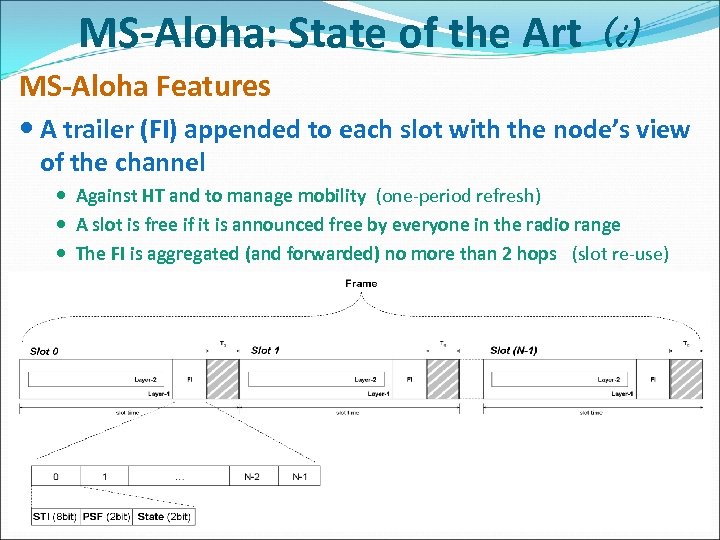
MS-Aloha: State of the Art (i) MS-Aloha Features A trailer (FI) appended to each slot with the node’s view of the channel Against HT and to manage mobility (one-period refresh) A slot is free if it is announced free by everyone in the radio range The FI is aggregated (and forwarded) no more than 2 hops (slot re-use) As tiny as possible to avoid heavy overheads (short-identification) Preemption (high priority connection can reject a lower priority one) Slot Re-Use and infinite re-use by dynamic thresholds A cross-layer threshold can be set-up If a FI is received in a frame with [Power < Thr] the information is processed (but not forwarded) Thr is dynimically raised and lowered by each node based on the number of free slots which it considers free Infinite slot reuse
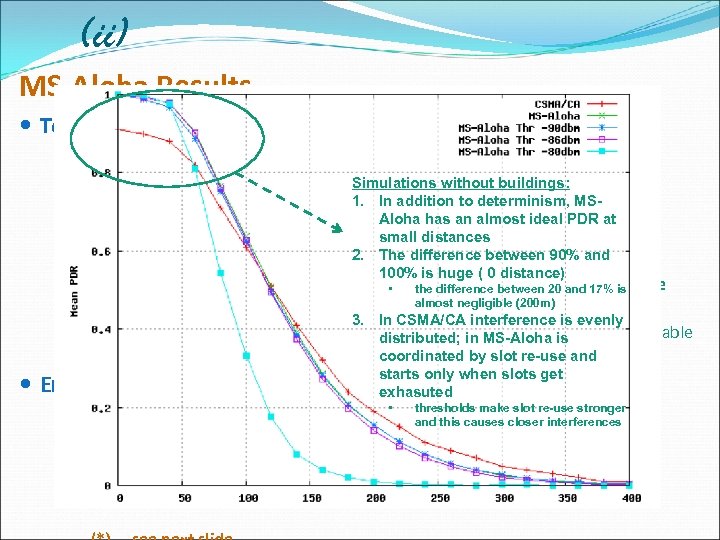
(ii) MS-Aloha Results Tested by simulations (NS-2) involving Nakagami fading Cumulative Signal-to-Noise and Interference (SNIR) Model (by Mercedes) Simulations without buildings: Obstruction by buildings (by ISMB) 1. In addition to determinism, MSAloha has an almost ideal PDR at Large number of nodes small distances 2. The difference (*), 12 Mbps and Settings: 224 slots (446 us), 0. 1 s frame, guardtime 1µs between 90%linerate 100% is huge ( 0 distance) In each slot: 200 B + 802. 11 p frame + 802. 11 pthe difference between 20 and 17% is PLCP (PLCP used to detect frame • almost negligible (200 m) start) 3. In CSMA/CA interference is evenly Java visualization-tool to study NS-2 outputs (of MS-Aloha, CSMA/CA and adptable distributed; in MS-Aloha is to any protocol) – by ISMB coordinated by slot re-use and starts only when slots get exhasuted Encouraging comparative results to CSMA/CA • slot re-use stronger Higher PDR, fixed latency, effective slot reusethresholds makecloser interferences and this causes Lower overhead ( η=0. 3) than CSMA/CA (η=0. 13 -0. 03) no statistical waiting time 13 Both in case of unicast and broadcast, despite 336 Byte overhead in FI
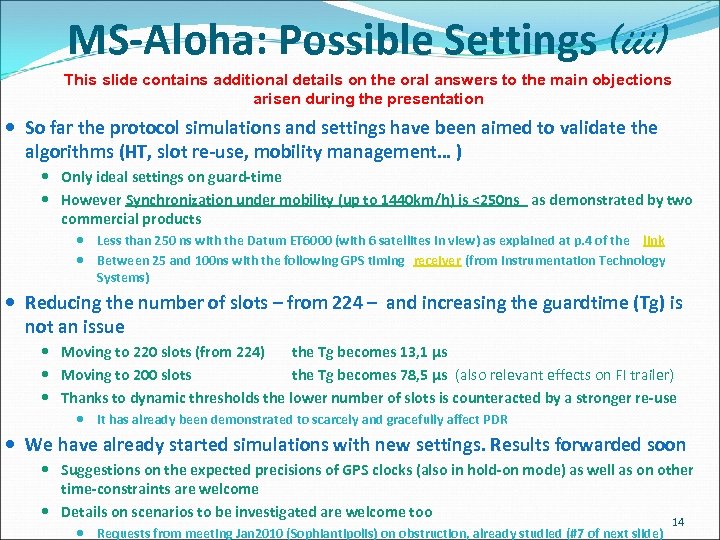
MS-Aloha: Possible Settings (iii) This slide contains additional details on the oral answers to the main objections arisen during the presentation So far the protocol simulations and settings have been aimed to validate the algorithms (HT, slot re-use, mobility management… ) Only ideal settings on guard-time However Synchronization under mobility (up to 1440 km/h) is <250 ns as demonstrated by two commercial products Less than 250 ns with the Datum ET 6000 (with 6 satellites in view) as explained at p. 4 of the link Between 25 and 100 ns with the following GPS timing receiver (from Instrumentation Technology Systems) Reducing the number of slots – from 224 – and increasing the guardtime (Tg) is not an issue Moving to 220 slots (from 224) the Tg becomes 13, 1 µs Moving to 200 slots the Tg becomes 78, 5 µs (also relevant effects on FI trailer) Thanks to dynamic thresholds the lower number of slots is counteracted by a stronger re-use It has already been demonstrated to scarcely and gracefully affect PDR We have already started simulations with new settings. Results forwarded soon Suggestions on the expected precisions of GPS clocks (also in hold-on mode) as well as on other time-constraints are welcome Details on scenarios to be investigated are welcome too Requests from meeting Jan 2010 (Sophiantipolis) on obstruction, already studied (#7 of next slide) 14
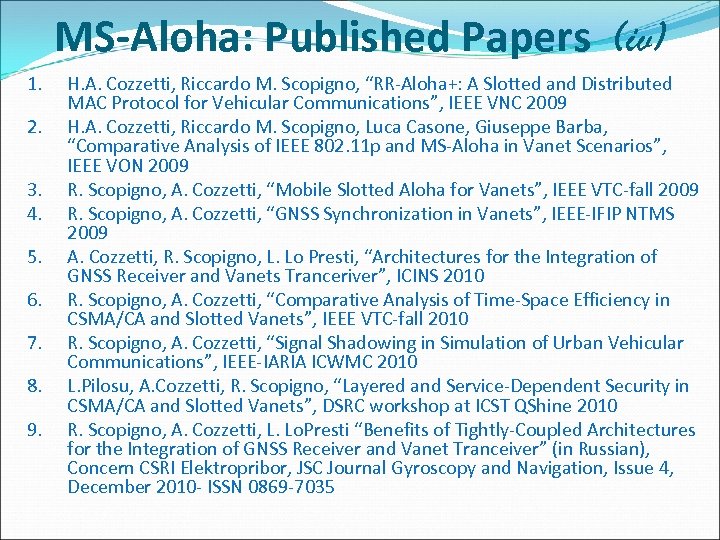
MS-Aloha: Published Papers (iv) 1. 2. 3. 4. 5. 6. 7. 8. 9. H. A. Cozzetti, Riccardo M. Scopigno, “RR-Aloha+: A Slotted and Distributed MAC Protocol for Vehicular Communications”, IEEE VNC 2009 H. A. Cozzetti, Riccardo M. Scopigno, Luca Casone, Giuseppe Barba, “Comparative Analysis of IEEE 802. 11 p and MS-Aloha in Vanet Scenarios”, IEEE VON 2009 R. Scopigno, A. Cozzetti, “Mobile Slotted Aloha for Vanets”, IEEE VTC-fall 2009 R. Scopigno, A. Cozzetti, “GNSS Synchronization in Vanets”, IEEE-IFIP NTMS 2009 A. Cozzetti, R. Scopigno, L. Lo Presti, “Architectures for the Integration of GNSS Receiver and Vanets Tranceriver”, ICINS 2010 R. Scopigno, A. Cozzetti, “Comparative Analysis of Time-Space Efficiency in CSMA/CA and Slotted Vanets”, IEEE VTC-fall 2010 R. Scopigno, A. Cozzetti, “Signal Shadowing in Simulation of Urban Vehicular Communications”, IEEE-IARIA ICWMC 2010 L. Pilosu, A. Cozzetti, R. Scopigno, “Layered and Service-Dependent Security in CSMA/CA and Slotted Vanets”, DSRC workshop at ICST QShine 2010 R. Scopigno, A. Cozzetti, L. Lo. Presti “Benefits of Tightly-Coupled Architectures for the Integration of GNSS Receiver and Vanet Tranceiver” (in Russian), Concern CSRI Elektropribor, JSC Journal Gyroscopy and Navigation, Issue 4, December 2010 - ISSN 0869 -7035
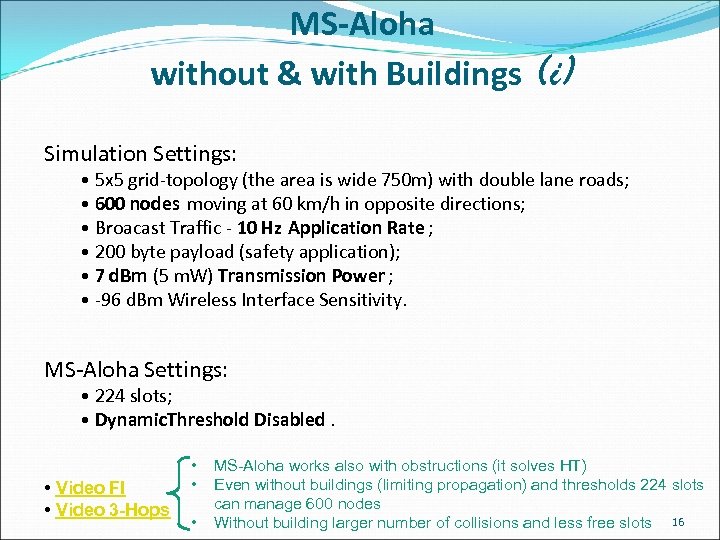
MS-Aloha without & with Buildings (i) Simulation Settings: • 5 x 5 grid-topology (the area is wide 750 m) with double lane roads; • 600 nodes moving at 60 km/h in opposite directions; • Broacast Traffic - 10 Hz Application Rate ; • 200 byte payload (safety application); • 7 d. Bm (5 m. W) Transmission Power ; • -96 d. Bm Wireless Interface Sensitivity. MS-Aloha Settings: • 224 slots; • Dynamic. Threshold Disabled. • Video FI • Video 3 -Hops • • • MS-Aloha works also with obstructions (it solves HT) Even without buildings (limiting propagation) and thresholds 224 slots can manage 600 nodes Without building larger number of collisions and less free slots 16
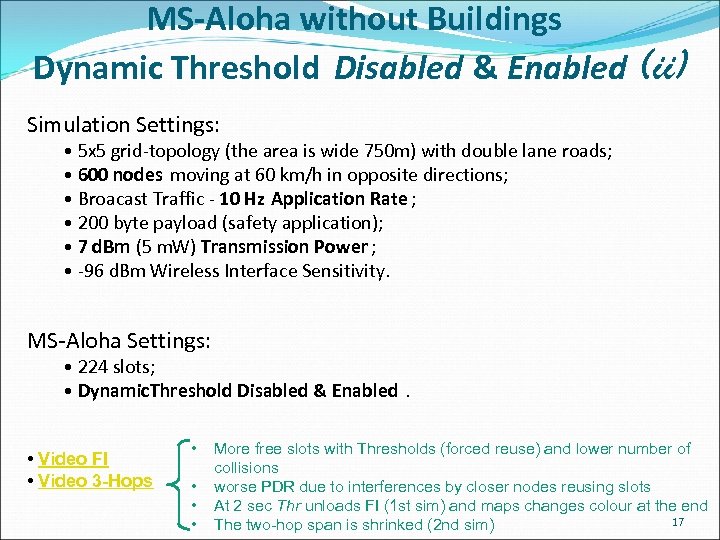
MS-Aloha without Buildings Dynamic Threshold Disabled & Enabled (ii) Simulation Settings: • 5 x 5 grid-topology (the area is wide 750 m) with double lane roads; • 600 nodes moving at 60 km/h in opposite directions; • Broacast Traffic - 10 Hz Application Rate ; • 200 byte payload (safety application); • 7 d. Bm (5 m. W) Transmission Power ; • -96 d. Bm Wireless Interface Sensitivity. MS-Aloha Settings: • 224 slots; • Dynamic. Threshold Disabled & Enabled. • Video FI • Video 3 -Hops • • More free slots with Thresholds (forced reuse) and lower number of collisions worse PDR due to interferences by closer nodes reusing slots At 2 sec Thr unloads FI (1 st sim) and maps changes colour at the end 17 The two-hop span is shrinked (2 nd sim)
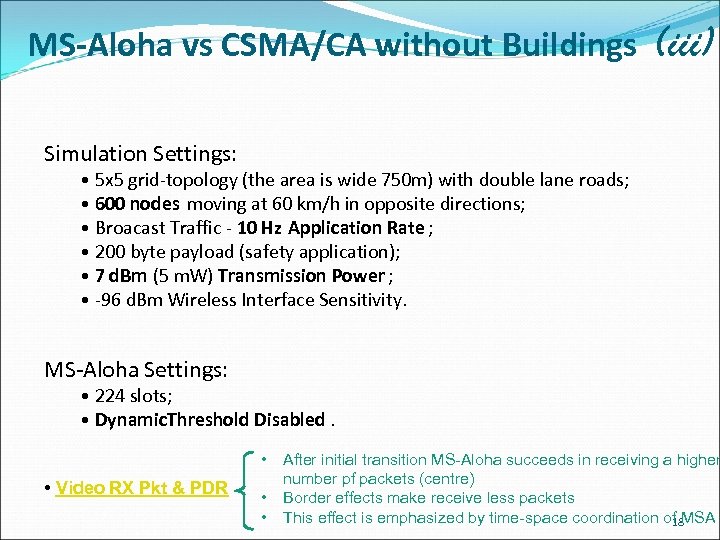
MS-Aloha vs CSMA/CA without Buildings (iii) Simulation Settings: • 5 x 5 grid-topology (the area is wide 750 m) with double lane roads; • 600 nodes moving at 60 km/h in opposite directions; • Broacast Traffic - 10 Hz Application Rate ; • 200 byte payload (safety application); • 7 d. Bm (5 m. W) Transmission Power ; • -96 d. Bm Wireless Interface Sensitivity. MS-Aloha Settings: • 224 slots; • Dynamic. Threshold Disabled. • • Video RX Pkt & PDR • • After initial transition MS-Aloha succeeds in receiving a higher number pf packets (centre) Border effects make receive less packets This effect is emphasized by time-space coordination of MSA 18
Agenda Survey on solutions by international literature The need for a comparative analysis The state-of-art of MS-Aloha Upcoming activities by ISMB 19
ISMB: Upcoming Activities in the Field New simulations Improved realism in channel/mobility modelling Comparative analysis to other protocols Analysis of degradation depending on clock delivery Additional open issues Stronger compatibility with CSMA/CA Workaround for missing synchronization Pre-emption and service multiplexing Nesting of upper-layer protocols (geo-routing) Visualization Tool and extended comparative analyses Extension of V_Super. Car to support outputs of other protocols Possibly with other slotted protocols (S-TDMA, DTDMA) Possible implementation Possible framework research project (Italian Ministry of Research), currently supporting the 20 proposal (submitted to FP 7 call on Transport) and other pending regional

Thank you for your kind attention
Скачать презентацию Istituto Superiore Mario Boella Slotted VANET One
3101ed01c56733e60001659165f79de5.ppt