 Скачать презентацию Istanbul Bilgi University e-MBA Program Metehan Sekban Ph
7551fa555b8e816b662323cdc4837c09.ppt
- Количество слайдов: 21



Istanbul Bilgi University e-MBA Program Metehan Sekban, Ph. D. Director- MBA Programs Metehan Sekban World Education Market May 2003

TURKEY – Selected Statistics Population 65, 700, 000 Rural population 1999 (% of total pop. ) 25. 92 % GDP per capita (PPP) US$6, 870 GNP per capita US$2, 900 Global Competitiveness 2001– 02 54 Main telephone lines per 100 inhabitants 27. 99 Internet hosts per 10, 000 inhabitants 10. 64 Personal computers per 100 inhabitants 3. 81 Percent of PCs connected to Internet 2. 80 % Internet users per 100 inhabitants 3. 04 Cell phone subscribers per 100 inhabitants 24. 55 Av. monthly cost – a 20 hrs. Internet access US$11. 20 Metehan Sekban World Education Market May 2003
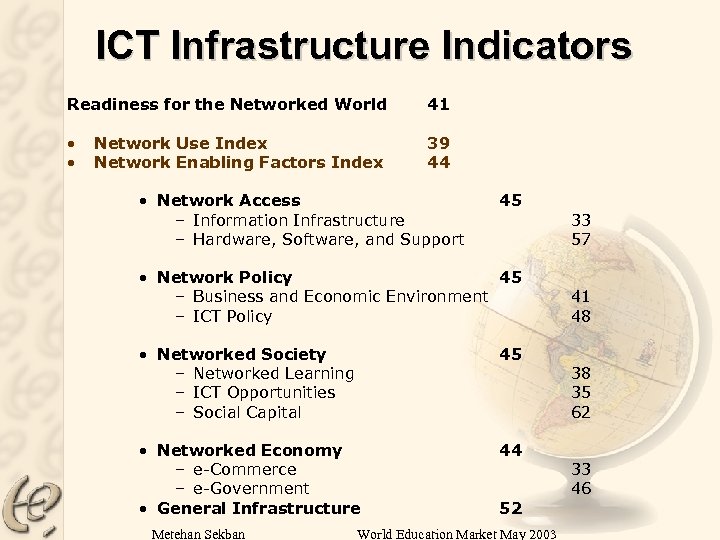
ICT Infrastructure Indicators Readiness for the Networked World 41 • • 39 44 Network Use Index Network Enabling Factors Index • Network Access – Information Infrastructure – Hardware, Software, and Support 45 33 57 • Network Policy 45 – Business and Economic Environment – ICT Policy 41 48 • Networked Society – Networked Learning – ICT Opportunities – Social Capital 45 38 35 62 • Networked Economy – e-Commerce – e-Government • General Infrastructure 44 Metehan Sekban 52 World Education Market May 2003 33 46

Istanbul Bilgi University Established in 1996 Private non-profit institution In 2002 -2003 Academic Year 4 Faculties 13 Departments 25 Programs 6722 students 12 Grad Programs 958 students 4 MBA Programs – Total 688 students Executive MBA ($14500) 24 students 61 grads Bilgi MBA ($9200) 244 students 143 grads e-MBA (English $6800) 124 students 30 grads e-MBA (Turkish $5300) 256 students Metehan Sekban World Education Market May 2003
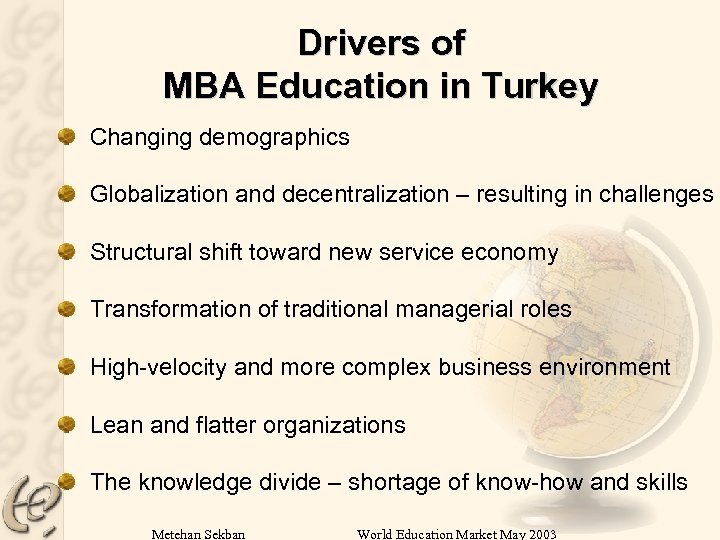
Drivers of MBA Education in Turkey Changing demographics Globalization and decentralization – resulting in challenges Structural shift toward new service economy Transformation of traditional managerial roles High-velocity and more complex business environment Lean and flatter organizations The knowledge divide – shortage of know-how and skills Metehan Sekban World Education Market May 2003

Bilgi e-MBA Increasing demand for MBA degree Competitive edge – skills, knowledge and continuous learning Time and place constraints Changing work demand - need for retraining Geographical dispersion Internet penetration increasing Need for integration of work and learning Metehan Sekban World Education Market May 2003

e-MBA Technical Specification Technology Platform Technical Support Maintenance On-going development of e-MBA technological infrastructure Metehan Sekban World Education Market May 2003
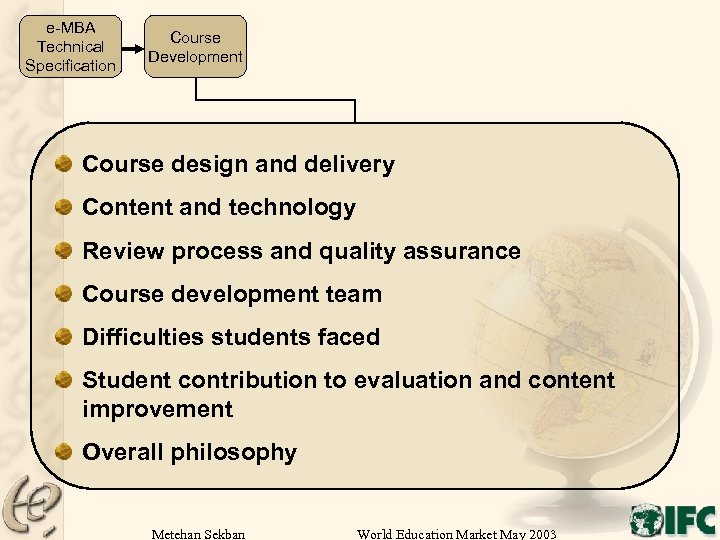
e-MBA Technical Specification Course Development Course design and delivery Content and technology Review process and quality assurance Course development team Difficulties students faced Student contribution to evaluation and content improvement Overall philosophy Metehan Sekban World Education Market May 2003
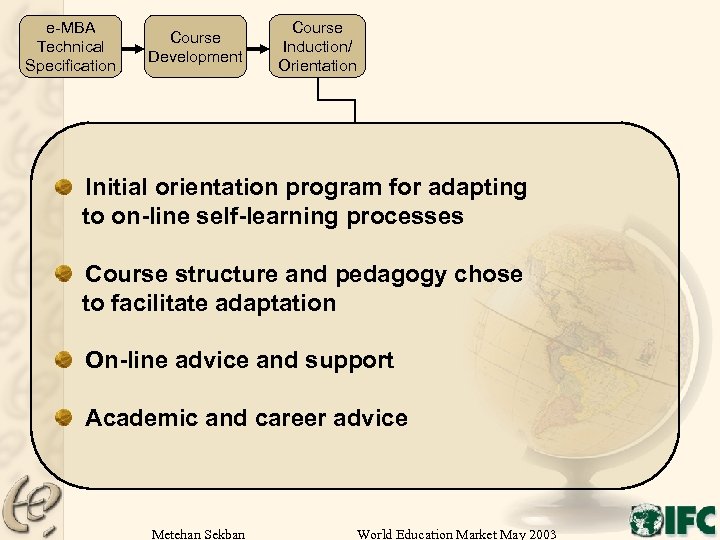
e-MBA Technical Specification Course Development Course Induction/ Orientation Initial orientation program for adapting to on-line self-learning processes Course structure and pedagogy chose to facilitate adaptation On-line advice and support Academic and career advice Metehan Sekban World Education Market May 2003
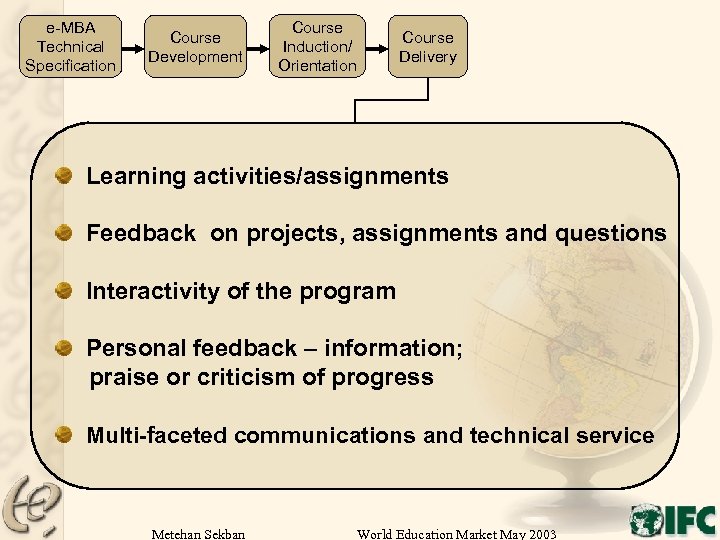
e-MBA Technical Specification Course Development Course Induction/ Orientation Course Delivery Learning activities/assignments Feedback on projects, assignments and questions Interactivity of the program Personal feedback – information; praise or criticism of progress Multi-faceted communications and technical service Metehan Sekban World Education Market May 2003
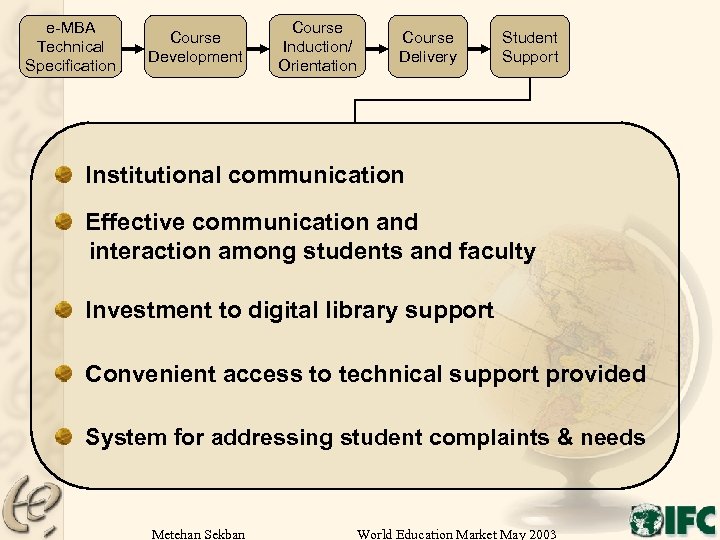
e-MBA Technical Specification Course Development Course Induction/ Orientation Course Delivery Student Support Institutional communication Effective communication and interaction among students and faculty Investment to digital library support Convenient access to technical support provided System for addressing student complaints & needs Metehan Sekban World Education Market May 2003
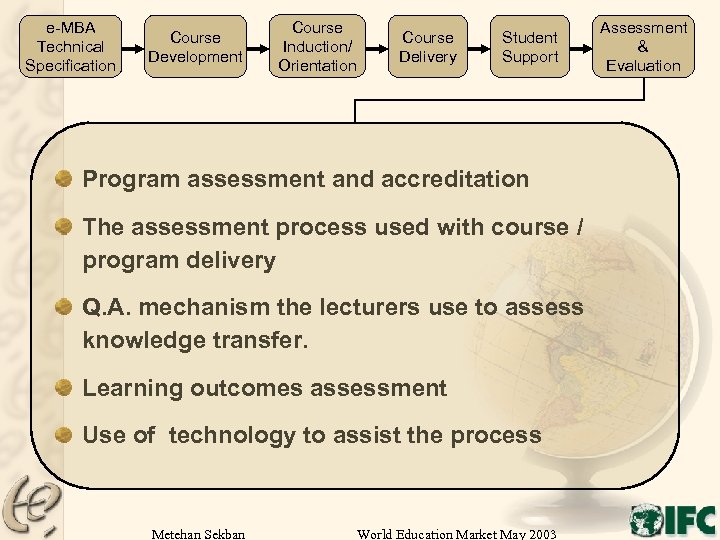
e-MBA Technical Specification Course Development Course Induction/ Orientation Course Delivery Student Support Program assessment and accreditation The assessment process used with course / program delivery Q. A. mechanism the lecturers use to assess knowledge transfer. Learning outcomes assessment Use of technology to assist the process Metehan Sekban World Education Market May 2003 Assessment & Evaluation
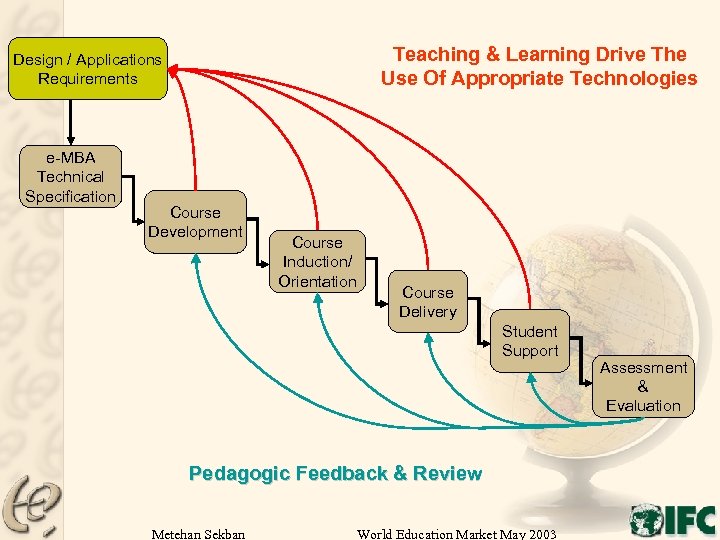
Teaching & Learning Drive The Use Of Appropriate Technologies Design / Applications Requirements e-MBA Technical Specification Course Development Course Induction/ Orientation Course Delivery Student Support Pedagogic Feedback & Review Metehan Sekban World Education Market May 2003 Assessment & Evaluation
e-MBA quality assurance process Faculty collaboration with content team critical – development of content, guides, templates. . Approval by curriculum committee Informatics and Accreditation committee approval Continuous peer review Students provide feedback Revision for updates Supervision of Higher Education Council Metehan Sekban World Education Market May 2003

Some statistics e-MBA students – from 32 different cities Istanbul has 67% of students Average of MBA students approx 26 yrs – e-MBA students’ average approx 30 yrs LES (graduate admission test scores ) no significant difference Metehan Sekban World Education Market May 2003
IT Infrastructure at Bilgi Networked campus with access to Internet 22 Mbs. – 2 Mbs. allocated to e-MBA program Totally automated LMS - no campus delivery except for orientation and final exams 8500 journals in 15 databases, 20000 e-books available for remote access Well-equipped teaching labs and student workrooms – extended hours Software library for teaching and developer staff Metehan Sekban World Education Market May 2003
Financial Picture Well ahead of expected enrollment with 390 students Expect to reach annualized b/even in 2003 Initial software, hardware, content, IT investments completed Second-cycle capital requirement provisions Profits returned to be reinvested in new programs, course development and connectivity Metehan Sekban World Education Market May 2003
What have we learned? A planned orientation program is a must E-learning is a holistic project – content and technology teams have to collaborate Technology is not an end in itself, should be developed/modified to suit the needs Content development is a major challenge Synchronic elements do not contribute as much as interactivity in a graduate program Metehan Sekban World Education Market May 2003
What have we learned? Course development for e-learning requires a “new way of thinking” CRM is beneficial, building personalized communication channels enhances the program Connectivity is still a problem Student progress should be tracked and frequent feedback should be provided Metehan Sekban World Education Market May 2003
Future Outlook & Commitments Develop new graduate and certificate programs – improve future program structure Reinvest profits/surpluses in program development Increase quantity and quality of communication Research on how better content design and delivery can enhance learning (reflective learning; formative assessment; student support) Develop animations, simulations and a more collaborative development and learning environment When connectivity problems are solved – then consider integrating synchronic elements Cooperation with other institutions for joint programs Metehan Sekban World Education Market May 2003

Metehan Sekban World Education Market May 2003
Скачать презентацию Istanbul Bilgi University e-MBA Program Metehan Sekban Ph
7551fa555b8e816b662323cdc4837c09.ppt