


 Скачать презентацию IST-Africa Initiative Regional Impact of Information Society Technologies
9a7e4b86489bc734e4969d89623dd288.ppt
- Количество слайдов: 34
 IST-Africa Initiative Regional Impact of Information Society Technologies in Africa Sustainable Living Labs & Living Labs Networks in Africa Paul Cunningham, Miriam Cunningham, IIMC / IST-Africa Initiative IST-Africa Living Labs Workshop Hosted by National Computer Board Mauritius, 16 November 2012 www. IST-Africa. org IST-Africa Living Lab Workshop, 16 November ’ 12 Mauritius Copyright 2002 - 2012 IST-Africa Initiative
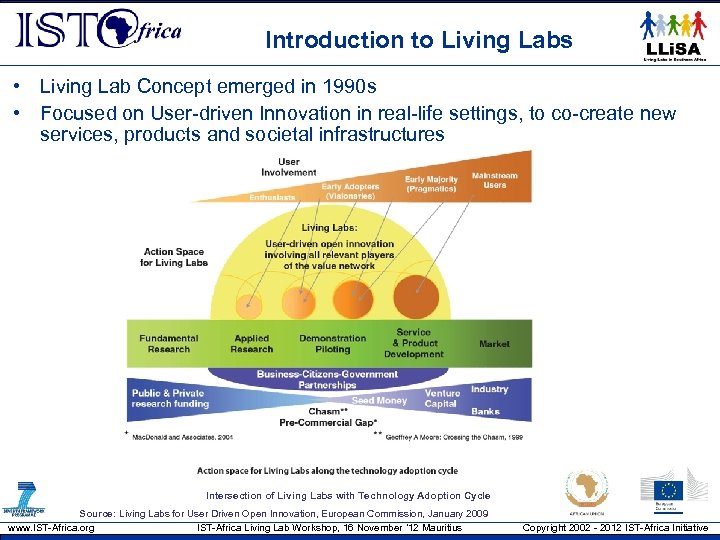 Introduction to Living Labs • Living Lab Concept emerged in 1990 s • Focused on User-driven Innovation in real-life settings, to co-create new services, products and societal infrastructures Intersection of Living Labs with Technology Adoption Cycle Source: Living Labs for User Driven Open Innovation, European Commission, January 2009 www. IST-Africa. org IST-Africa Living Lab Workshop, 16 November ’ 12 Mauritius Copyright 2002 - 2012 IST-Africa Initiative
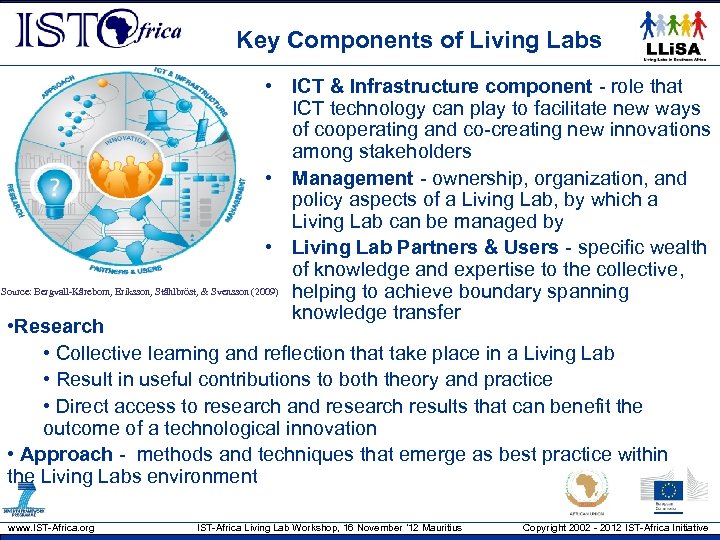 Key Components of Living Labs • ICT & Infrastructure component - role that ICT technology can play to facilitate new ways of cooperating and co-creating new innovations among stakeholders • Management - ownership, organization, and policy aspects of a Living Lab, by which a Living Lab can be managed by • Living Lab Partners & Users - specific wealth of knowledge and expertise to the collective, Source: Bergvall-Kåreborn, Eriksson, Ståhlbröst, & Svensson (2009) helping to achieve boundary spanning knowledge transfer • Research • Collective learning and reflection that take place in a Living Lab • Result in useful contributions to both theory and practice • Direct access to research and research results that can benefit the outcome of a technological innovation • Approach - methods and techniques that emerge as best practice within the Living Labs environment www. IST-Africa. org IST-Africa Living Lab Workshop, 16 November ’ 12 Mauritius Copyright 2002 - 2012 IST-Africa Initiative
 Living Labs in an African context • Based on an integrated Developed and Developing Country perspective, Herselman and Cunningham [2011] propose this definition: • “Living Labs are environments, a methodology or an approach which caters for user-driven open innovation within real-life rural and urban settings/communities, where users can collaborate with multiple committed stakeholders (whether NGOs, SMMEs, industrial, academic/research, government institutions or donors) in one or more locations, to become co-creators or co-designers of innovative ideas, processes or products within multidisciplinary environments. Successful deployments can result in improved processes or service delivery, new business models, products or services, and can be replicated (with necessary socio-cultural adaption) to improve overall quality of life and wider socio-economic impact (including entrepreneurship) in participating and other communities”. • Leveraging Living Labs methodologies and Living Labs Networks in Africa provide an important opportunity to collaborate, co-create, prototype and test new products and services, technologies, processes, business models or ideas customised for developing markets www. IST-Africa. org IST-Africa Living Lab Workshop, 16 November ’ 12 Mauritius Copyright 2002 - 2012 IST-Africa Initiative
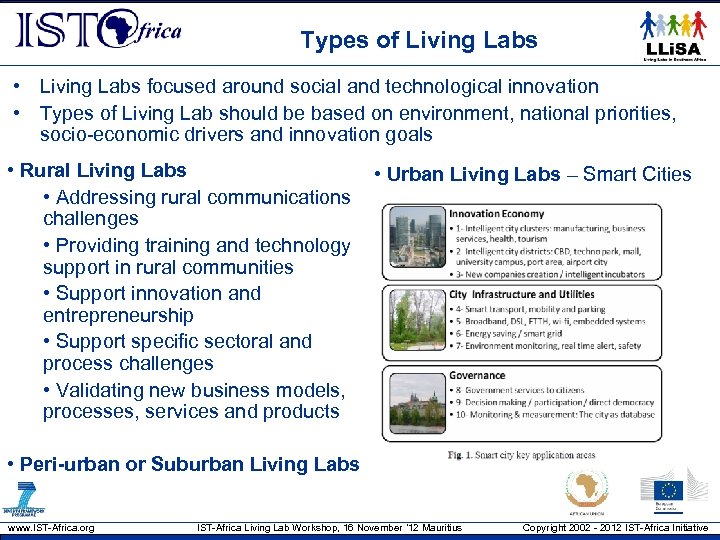 Types of Living Labs • Living Labs focused around social and technological innovation • Types of Living Lab should be based on environment, national priorities, socio-economic drivers and innovation goals • Rural Living Labs • Urban Living Labs – Smart Cities • Addressing rural communications challenges • Providing training and technology support in rural communities • Support innovation and entrepreneurship • Support specific sectoral and process challenges • Validating new business models, processes, services and products • Peri-urban or Suburban Living Labs www. IST-Africa. org IST-Africa Living Lab Workshop, 16 November ’ 12 Mauritius Copyright 2002 - 2012 IST-Africa Initiative
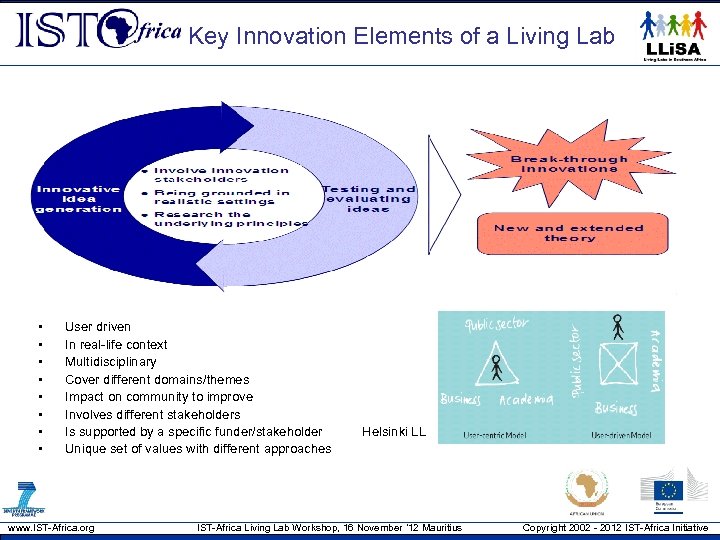 Key Innovation Elements of a Living Lab • • User driven In real-life context Multidisciplinary Cover different domains/themes Impact on community to improve Involves different stakeholders Is supported by a specific funder/stakeholder Helsinki LL Unique set of values with different approaches www. IST-Africa. org IST-Africa Living Lab Workshop, 16 November ’ 12 Mauritius Copyright 2002 - 2012 IST-Africa Initiative
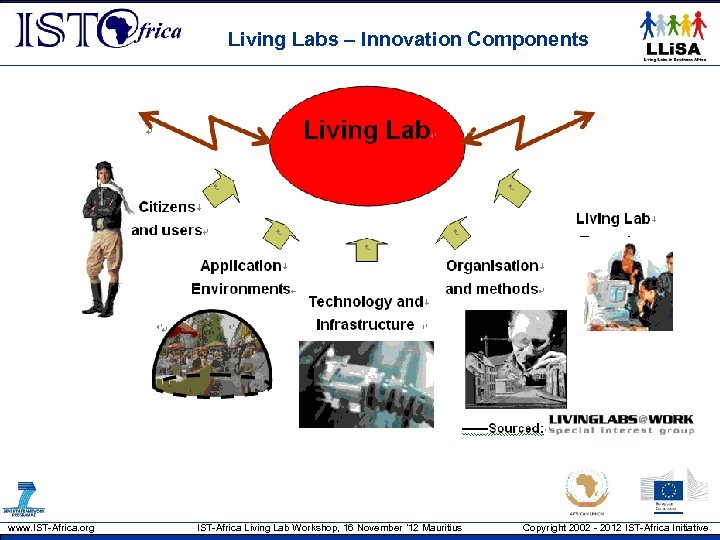 Living Labs – Innovation Components www. IST-Africa. org IST-Africa Living Lab Workshop, 16 November ’ 12 Mauritius Copyright 2002 - 2012 IST-Africa Initiative
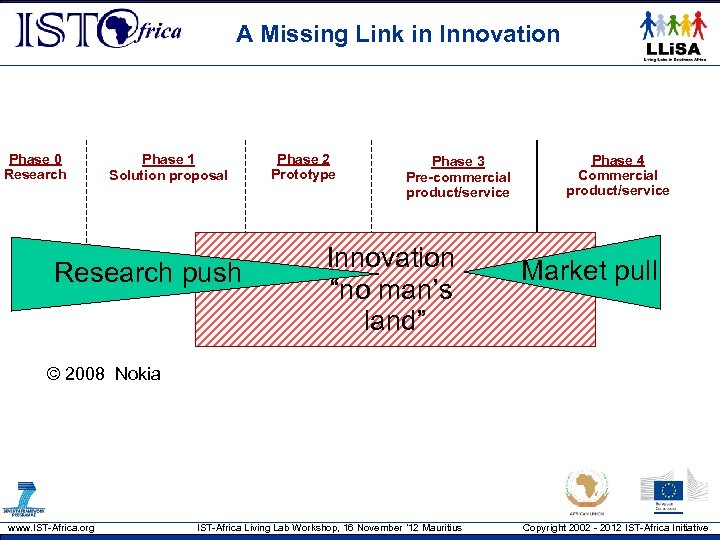 A Missing Link in Innovation Phase 0 Research Phase 1 Solution proposal Research push Phase 2 Prototype Phase 3 Pre-commercial product/service Innovation “no man’s land” Phase 4 Commercial product/service Market pull © 2008 Nokia www. IST-Africa. org IST-Africa Living Lab Workshop, 16 November ’ 12 Mauritius Copyright 2002 - 2012 IST-Africa Initiative
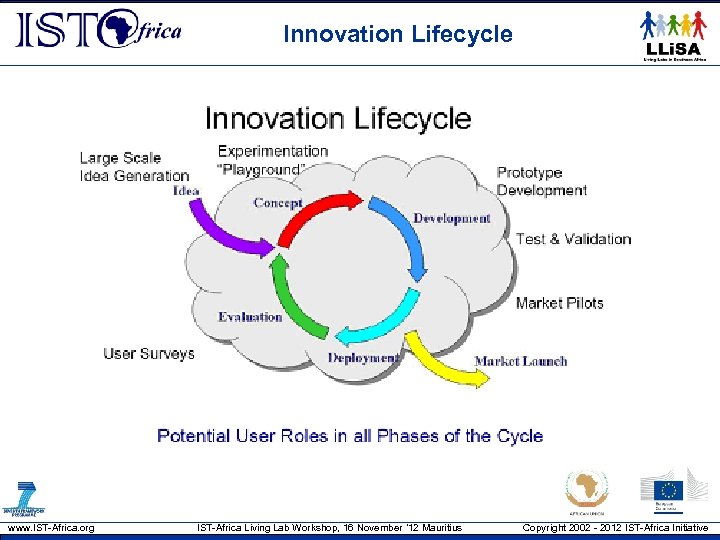 Innovation Lifecycle www. IST-Africa. org IST-Africa Living Lab Workshop, 16 November ’ 12 Mauritius Copyright 2002 - 2012 IST-Africa Initiative
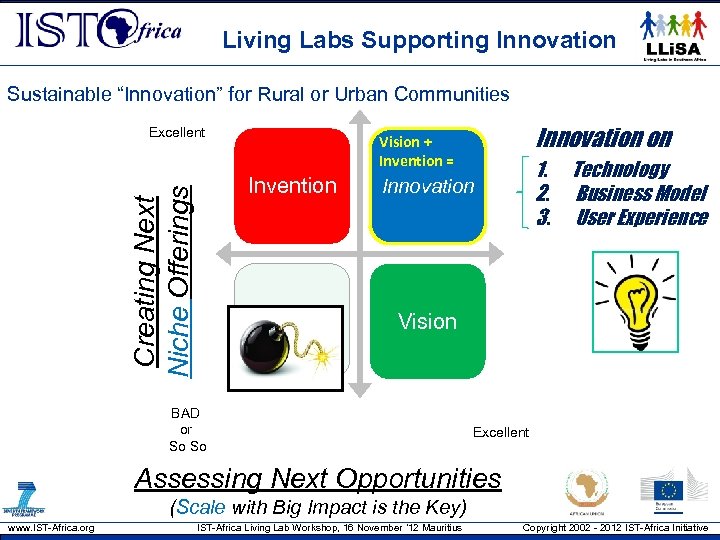 Living Labs Supporting Innovation Sustainable “Innovation” for Rural or Urban Communities Creating Next Niche Offerings Excellent Innovation on Vision + Invention = Invention Innovation 1. Technology 2. Business Model 3. User Experience Vision BAD or So So Excellent Assessing Next Opportunities (Scale with Big Impact is the Key) www. IST-Africa. org IST-Africa Living Lab Workshop, 16 November ’ 12 Mauritius Copyright 2002 - 2012 IST-Africa Initiative
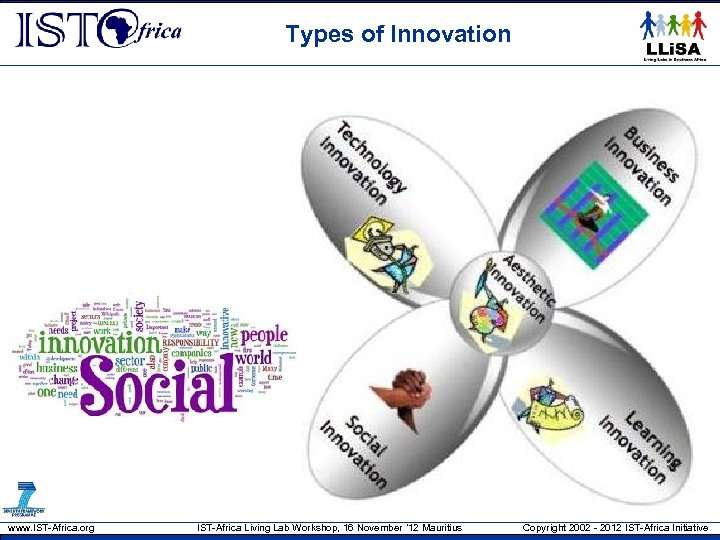 Types of Innovation www. IST-Africa. org IST-Africa Living Lab Workshop, 16 November ’ 12 Mauritius Copyright 2002 - 2012 IST-Africa Initiative
 Key Innovation Elements in Living Labs innovation system components Key Elements Strategy Structure Leadership Systems Processes Values and Culture HR/Rewards Enabling Technology Physical Environment Talent Community Knowledge Creation/Learning Innovation Studios www. IST-Africa. org IST-Africa Living Lab Workshop, 16 November ’ 12 Mauritius Copyright 2002 - 2012 IST-Africa Initiative
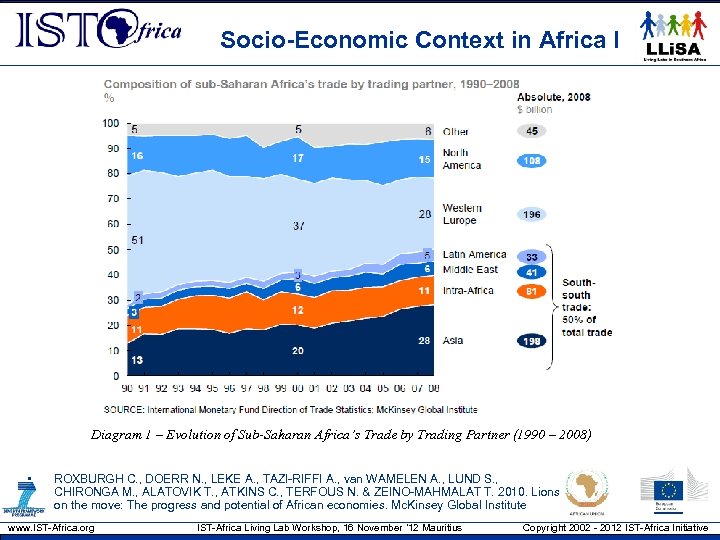 Socio-Economic Context in Africa I Diagram 7 – Evolution of Sub-Saharan Africa’s Trade by Trading Partner (1990 – 2008) Diagram 1 – Evolution of Sub-Saharan Africa’s Trade by Trading Partner (1990 – 2008) • ROXBURGH C. , DOERR N. , LEKE A. , TAZI-RIFFI A. , van WAMELEN A. , LUND S. , CHIRONGA M. , ALATOVIK T. , ATKINS C. , TERFOUS N. & ZEINO-MAHMALAT T. 2010. Lions on the move: The progress and potential of African economies. Mc. Kinsey Global Institute www. IST-Africa. org IST-Africa Living Lab Workshop, 16 November ’ 12 Mauritius Copyright 2002 - 2012 IST-Africa Initiative
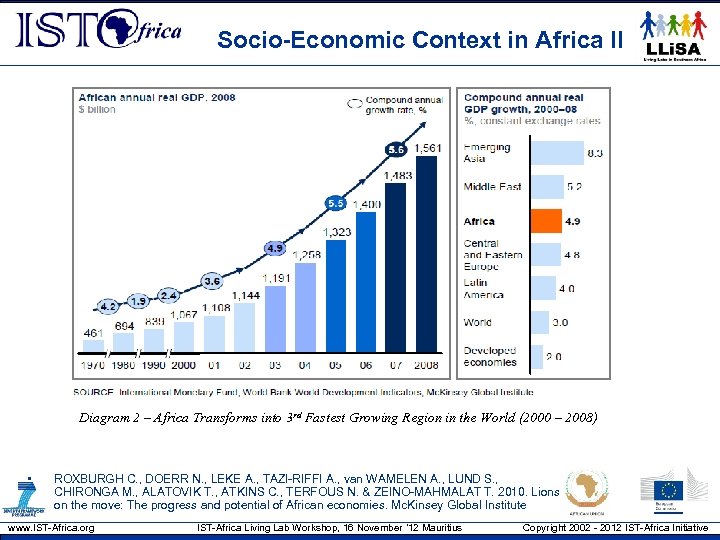 Socio-Economic Context in Africa II Diagram 2 – Africa Transforms into 3 rd Fastest Growing Region in the World (2000 – 2008) • ROXBURGH C. , DOERR N. , LEKE A. , TAZI-RIFFI A. , van WAMELEN A. , LUND S. , CHIRONGA M. , ALATOVIK T. , ATKINS C. , TERFOUS N. & ZEINO-MAHMALAT T. 2010. Lions on the move: The progress and potential of African economies. Mc. Kinsey Global Institute www. IST-Africa. org IST-Africa Living Lab Workshop, 16 November ’ 12 Mauritius Copyright 2002 - 2012 IST-Africa Initiative
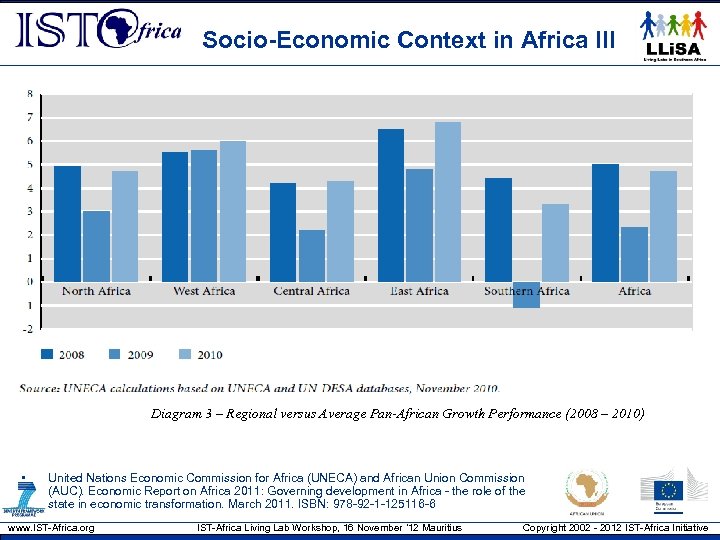 Socio-Economic Context in Africa III Diagram 3 – Regional versus Average Pan-African Growth Performance (2008 – 2010) • United Nations Economic Commission for Africa (UNECA) and African Union Commission (AUC). Economic Report on Africa 2011: Governing development in Africa - the role of the state in economic transformation. March 2011. ISBN: 978 -92 -1 -125116 -6 www. IST-Africa. org IST-Africa Living Lab Workshop, 16 November ’ 12 Mauritius Copyright 2002 - 2012 IST-Africa Initiative
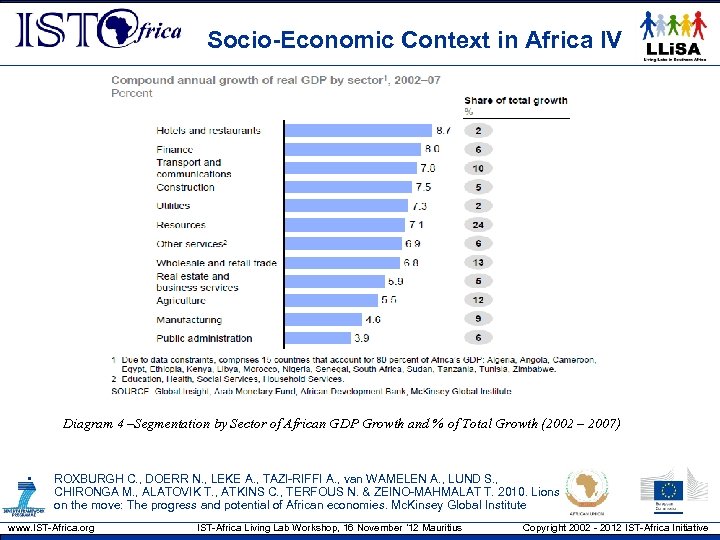 Socio-Economic Context in Africa IV Diagram 4 –Segmentation by Sector of African GDP Growth and % of Total Growth (2002 – 2007) • ROXBURGH C. , DOERR N. , LEKE A. , TAZI-RIFFI A. , van WAMELEN A. , LUND S. , CHIRONGA M. , ALATOVIK T. , ATKINS C. , TERFOUS N. & ZEINO-MAHMALAT T. 2010. Lions on the move: The progress and potential of African economies. Mc. Kinsey Global Institute www. IST-Africa. org IST-Africa Living Lab Workshop, 16 November ’ 12 Mauritius Copyright 2002 - 2012 IST-Africa Initiative
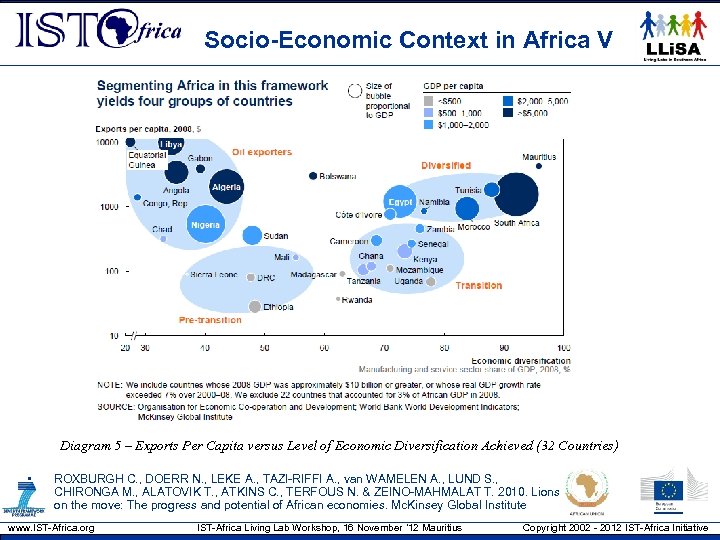 Socio-Economic Context in Africa V Diagram 5 – Exports Per Capita versus Level of Economic Diversification Achieved (32 Countries) • ROXBURGH C. , DOERR N. , LEKE A. , TAZI-RIFFI A. , van WAMELEN A. , LUND S. , CHIRONGA M. , ALATOVIK T. , ATKINS C. , TERFOUS N. & ZEINO-MAHMALAT T. 2010. Lions on the move: The progress and potential of African economies. Mc. Kinsey Global Institute www. IST-Africa. org IST-Africa Living Lab Workshop, 16 November ’ 12 Mauritius Copyright 2002 - 2012 IST-Africa Initiative
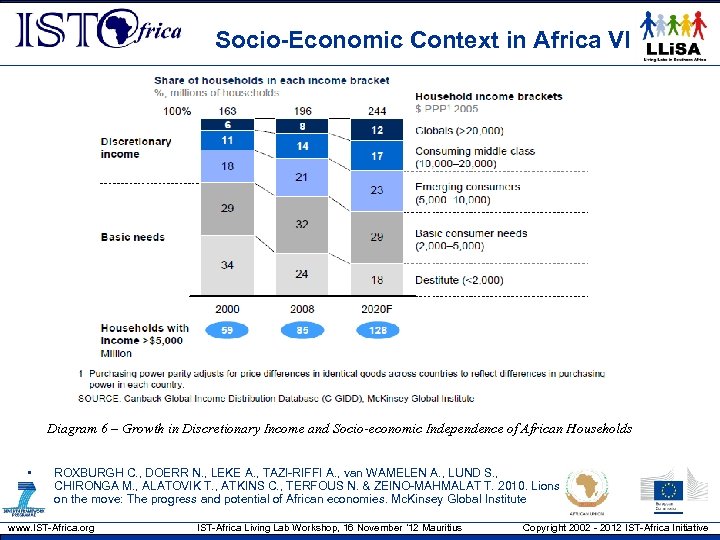 Socio-Economic Context in Africa VI Diagram 6 – Growth in Discretionary Income and Socio-economic Independence of African Households • ROXBURGH C. , DOERR N. , LEKE A. , TAZI-RIFFI A. , van WAMELEN A. , LUND S. , CHIRONGA M. , ALATOVIK T. , ATKINS C. , TERFOUS N. & ZEINO-MAHMALAT T. 2010. Lions on the move: The progress and potential of African economies. Mc. Kinsey Global Institute www. IST-Africa. org IST-Africa Living Lab Workshop, 16 November ’ 12 Mauritius Copyright 2002 - 2012 IST-Africa Initiative
 Market Opportunity in Africa • • • By 2040, Africa will have the world’s largest Economically Active Population (15 – 64), growing from c. 413 million in 2010 to over 1. 1. billion • Africa will become the most important market in the world as proportion of households with discretionary income continues to grow • By 2020, c. 128 million African households (52%) will have discretionary income Literacy levels for African Youth (15 - 24 year olds) is high, Average (74. 9% ) and Median (79. 3%) [2006 – 2008 Statistics] Only 25% of growth in African GDP per capita was as a result of productivity gains • With skills transfer and investment in education and e. Skills to leverage youth literacy, Africa’s future workforce could become a significant engine of global production as well as consumption Targeting countries and RECs where ICT adoption and skills development are priorities will facilitate faster adoption of Living Labs and establishing Networks Member States should align Living Labs with national policies to invest in e. Skills to actively target opportunities in Sectors including Services, ICT, Business Process Outsourcing (BPO) and Knowledge Economy Opportunity to target Foreign Direct Investment and to Co-Create new products, services and business models designed for African needs www. IST-Africa. org IST-Africa Living Lab Workshop, 16 November ’ 12 Mauritius Copyright 2002 - 2012 IST-Africa Initiative
 Emergence of Living Labs • • • Living Labs have evolved over the past seven years • Based on National and Regional Policies and Innovation Initiatives • Prioritised placing the user at the centre of the Innovation Lifecycle within reallife settings Living Labs launched as test beds/pilots to measure the impact and effectiveness of research being undertaken in the areas of Collaborative Working Environments, Ambient Intelligence and e. Inclusion. • Broad thematic focus - Well. Being (e. Health, e. Inclusion, Ambient Assisted Living), e-Services in Rural areas, e-Participation (providing active input to local and municipal decision making), ICT for Energy Efficiency and Community development. • Provide a mechanism to bridge the gap between technological development and market implementation by linking end users, industry and SMEs, government and research/academia within local experimentation environments Different Approaches • Open ended engagement with one or more communities (physical or virtual) • Project oriented approach with a specific focus and target end date www. IST-Africa. org IST-Africa Living Lab Workshop, 16 November ’ 12 Mauritius Copyright 2002 - 2012 IST-Africa Initiative
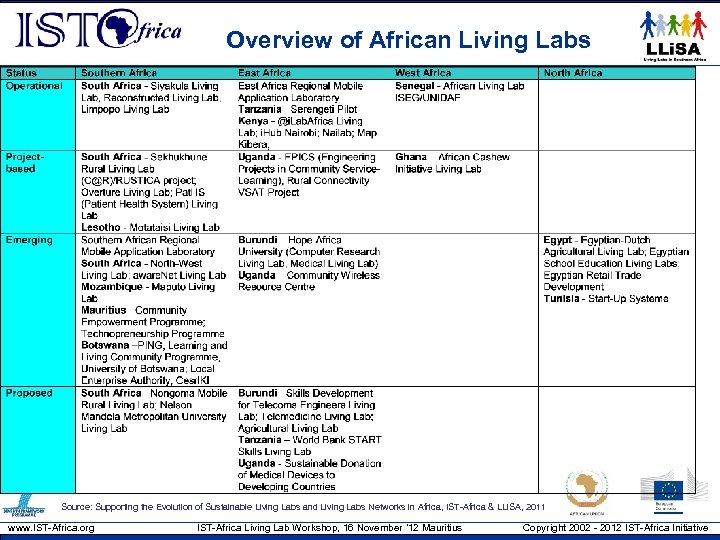 Overview of African Living Labs Source: Supporting the Evolution of Sustainable Living Labs and Living Labs Networks in Africa, IST-Africa & LLi. SA, 2011 www. IST-Africa. org IST-Africa Living Lab Workshop, 16 November ’ 12 Mauritius Copyright 2002 - 2012 IST-Africa Initiative
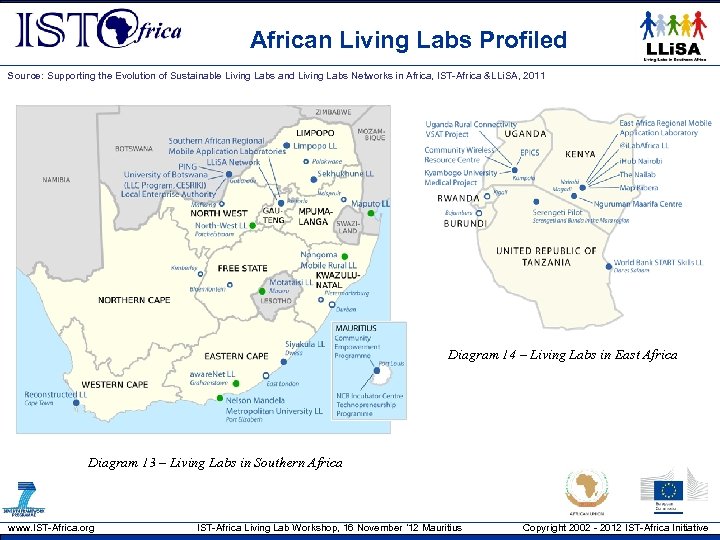 African Living Labs Profiled Source: Supporting the Evolution of Sustainable Living Labs and Living Labs Networks in Africa, IST-Africa & LLi. SA, 2011 Diagram 14 – Living Labs in East Africa Diagram 13 – Living Labs in Southern Africa www. IST-Africa. org IST-Africa Living Lab Workshop, 16 November ’ 12 Mauritius Copyright 2002 - 2012 IST-Africa Initiative
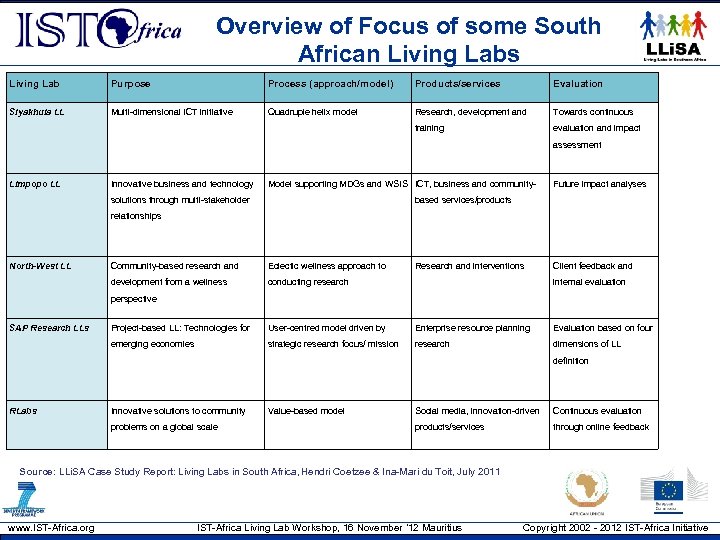 Overview of Focus of some South African Living Labs Living Lab Purpose Process (approach/model) Products/services Evaluation Siyakhula LL Multi-dimensional ICT initiative Quadruple helix model Research, development and Towards continuous training evaluation and impact assessment Limpopo LL Innovative business and technology Model supporting MDGs and WSIS ICT, business and community- solutions through multi-stakeholder North-West LL based services/products relationships Future impact analyses Community-based research and Eclectic wellness approach to development from a wellness Research and interventions conducting research Client feedback and internal evaluation perspective SAP Research LLs Project-based LL: Technologies for User-centred model driven by Enterprise resource planning Evaluation based on four emerging economies strategic research focus/ mission research dimensions of LL definition RLabs Innovative solutions to community Value-based model Social media, innovation-driven Continuous evaluation problems on a global scale products/services through online feedback Source: LLi. SA Case Study Report: Living Labs in South Africa, Hendri Coetzee & Ina-Mari du Toit, July 2011 www. IST-Africa. org IST-Africa Living Lab Workshop, 16 November ’ 12 Mauritius Copyright 2002 - 2012 IST-Africa Initiative
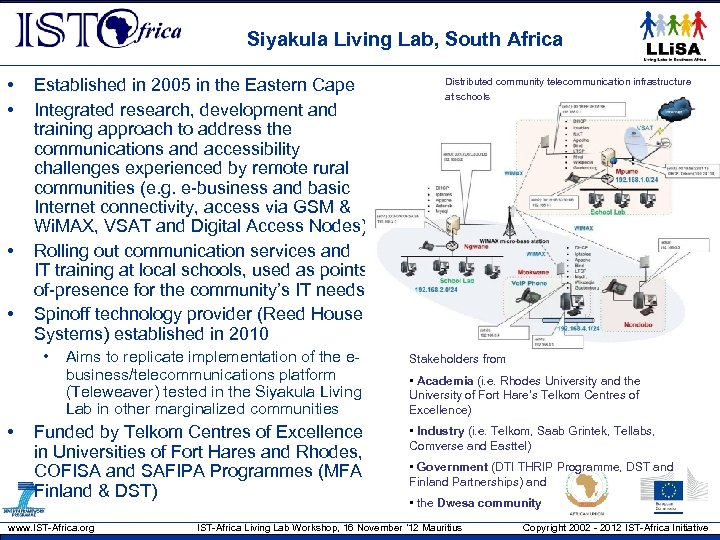 Siyakula Living Lab, South Africa • • Established in 2005 in the Eastern Cape Integrated research, development and training approach to address the communications and accessibility challenges experienced by remote rural communities (e. g. e-business and basic Internet connectivity, access via GSM & Wi. MAX, VSAT and Digital Access Nodes) Rolling out communication services and IT training at local schools, used as pointsof-presence for the community’s IT needs Spinoff technology provider (Reed House Systems) established in 2010 • • Aims to replicate implementation of the ebusiness/telecommunications platform (Teleweaver) tested in the Siyakula Living Lab in other marginalized communities Funded by Telkom Centres of Excellence in Universities of Fort Hares and Rhodes, COFISA and SAFIPA Programmes (MFA Finland & DST) Distributed community telecommunication infrastructure at schools Stakeholders from • Academia (i. e. Rhodes University and the University of Fort Hare’s Telkom Centres of Excellence) • Industry (i. e. Telkom, Saab Grintek, Tellabs, Comverse and Easttel) • Government (DTI THRIP Programme, DST and Finland Partnerships) and • the Dwesa community www. IST-Africa. org IST-Africa Living Lab Workshop, 16 November ’ 12 Mauritius Copyright 2002 - 2012 IST-Africa Initiative
 Reconstructed Living Lab, South Africa • • • Established in 2007 in disadvantaged part of Cape Town Focused on Social Innovation supported by Technology • Community Transformation, Up-Skilling & Empowerment • Value-based Model to develop and train people in use of ICT and Social Media to address social problems in communities Activities include • RLabs Academy – Web Literacy Training Programme • Active involvement of community in training users • • Innovation Incubator • RLabs Research Institute – access to grass roots communities to carry out research and development for government, industry, academia, foundations • RLabs Products and Services – licensing social media consulting and online services (Jamii. X Platform) Stakeholders • Government - Ministry of Foreign Affairs, Finland Department of Science and Technology, South Africa • Industry – Voda. Com • Research – Cape Pensinula University of Technology • Civil Society – Communities, Cell-Life (NGO) www. IST-Africa. org IST-Africa Living Lab Workshop, 16 November ’ 12 Mauritius Copyright 2002 - 2012 IST-Africa Initiative
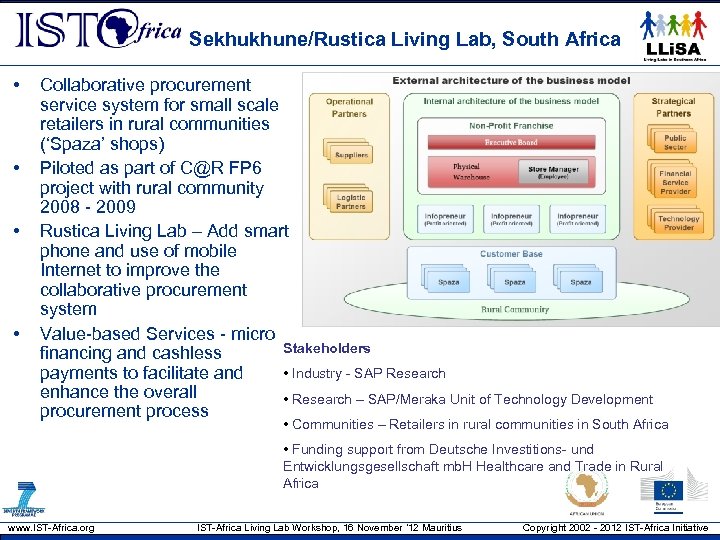 Sekhukhune/Rustica Living Lab, South Africa • • Collaborative procurement service system for small scale retailers in rural communities (‘Spaza’ shops) Piloted as part of C@R FP 6 project with rural community 2008 - 2009 Rustica Living Lab – Add smart phone and use of mobile Internet to improve the collaborative procurement system Value-based Services - micro Stakeholders financing and cashless • Industry - SAP Research payments to facilitate and enhance the overall • Research – SAP/Meraka Unit of Technology Development procurement process • Communities – Retailers in rural communities in South Africa • Funding support from Deutsche Investitions- und Entwicklungsgesellschaft mb. H Healthcare and Trade in Rural Africa www. IST-Africa. org IST-Africa Living Lab Workshop, 16 November ’ 12 Mauritius Copyright 2002 - 2012 IST-Africa Initiative
 Serengeti Pilot, Tanzania • Established in 2005 as part of ICT for Rural Development project to build and sustain broadband communication in rural areas • Funding from Swedish International Development Agency (SIDA) • • Focused on leveraging ICT through infrastructure sharing to build municipal broadband communication networks to improve public service delivery focusing on health, education and local government Initial Services – email and Voice over IP (Vo. IP) to enhance communication channels Additional Services • • • Implemented by the Tanzania Commission of Science and Technology (COSTECH); Dar es Salaam Institute of Technology (DIT) and Royal Institute of Technology (KTH), Sweden e. Governance (district website to inform public) e. Health (linking district hospitals to primary health centres for consultations via video-conferencing and Vo. IP) e. Learning (learning resources for students and teachers) Applications developed or customised by students from research partners in collaboration with local community Created network connecting Serengeti and Bunda in Northern Tanzania Used Public Private Partnership model – government private sector and community Trained local entrapeneurs to maintain Wi-Fi Network Established ICT Board to take responsibility for Living Lab Introduced ICT Services & encouraged organisations to identify the most relevant components www. IST-Africa. org IST-Africa Living Lab Workshop, 16 November ’ 12 Mauritius Copyright 2002 - 2012 IST-Africa Initiative
 Living Labs in Southern Africa Network • • Living Labs in Southern Africa Network (LLi. SA) emerged from 2006 until its formal launch in 2009 was funded by Department of Science and Technology (DST) and the Ministry of Foreign Affairs, Finland under the COFISA and SAFIPA Programmes, hosted by the Meraka Institute, CSIR Primarily focused on building capacity, facilitating collaboration, establishing and developing Living Lab activities and supporting existing and emerging Living Labs in Southern Africa • Opportunities for co-creation of innovation and collaboration to offer/develop new ideas of innovation • Multistakeholder • Government (Department of Science and Technology, Telkom Centers of Excellence, COFISA, SAFIPA, Limpopo Provincial government); • Research (CSIR, Rhodes University, Fort Hare University, Cape Peninsula University of Technology, Venda University, University of Free State, North West University, UKZN, NMMU); • Industry (Nokia/Siemens, Intel, SAP, Motorola, First National Bank, Vodacom, SAINe, Telkom) and • Civil Society • • • Established a commonly owned vision for the goals and objectives of the Network through engagement and a co-creation process with all key stakeholders Provide support in relation to monitoring and evaluation Successful model and experience which can be transferred to other regions www. IST-Africa. org IST-Africa Living Lab Workshop, 16 November ’ 12 Mauritius Copyright 2002 - 2012 IST-Africa Initiative
 Action Plan – Living Lab Themes for Mauritius I • Potential Thematic areas where Living Labs concepts are relevant in Mauritius • x www. IST-Africa. org IST-Africa Living Lab Workshop, 16 November ’ 12 Mauritius Copyright 2002 - 2012 IST-Africa Initiative
 Action Plan for Mauritius Action Plan • Create National Task Force to identify living lab opportunities Tasks agreed • Engage with Living Labs in Southern Africa (LLi. SA) www. IST-Africa. org IST-Africa Living Lab Workshop, 16 November ’ 12 Mauritius Copyright 2002 - 2012 IST-Africa Initiative
 Action Plan for Mauritius Action Plan • Create National Task Force to identify living lab opportunities Tasks agreed • Engage with Living Labs in Southern Africa (LLi. SA) www. IST-Africa. org IST-Africa Living Lab Workshop, 16 November ’ 12 Mauritius Copyright 2002 - 2012 IST-Africa Initiative
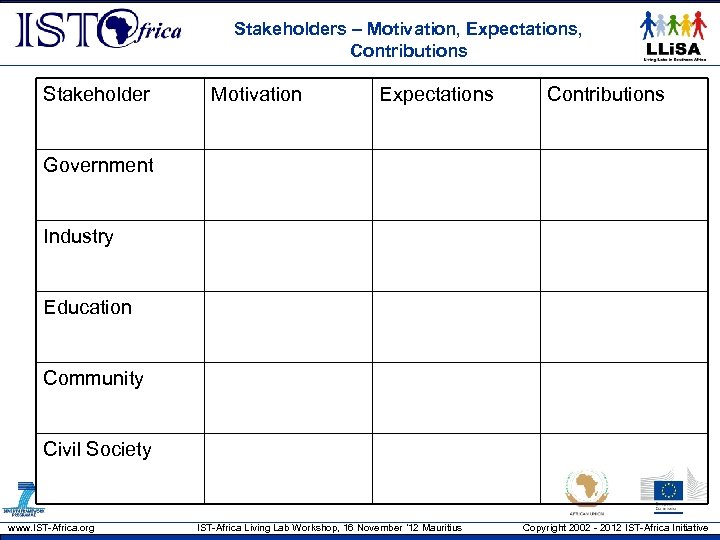 Stakeholders – Motivation, Expectations, Contributions Stakeholder Motivation Expectations Contributions Government Industry Education Community Civil Society www. IST-Africa. org IST-Africa Living Lab Workshop, 16 November ’ 12 Mauritius Copyright 2002 - 2012 IST-Africa Initiative
 5 Thinking Hats White Hat – Facts • What do I know? What do I need to find out? How will I get the information I need? Red Hat – Feelings • What do I feel about Living Labs? Black Hat – Risks • What are the potential risks? Yellow Hat – Benefits • What are the potential benefits of using Living Labs? Green Hat Creativity • What are possible ideas for Living Labs? Blue Hat – Big Picture – Next steps and actions to be take www. IST-Africa. org IST-Africa Living Lab Workshop, 16 November ’ 12 Mauritius Copyright 2002 - 2012 IST-Africa Initiative
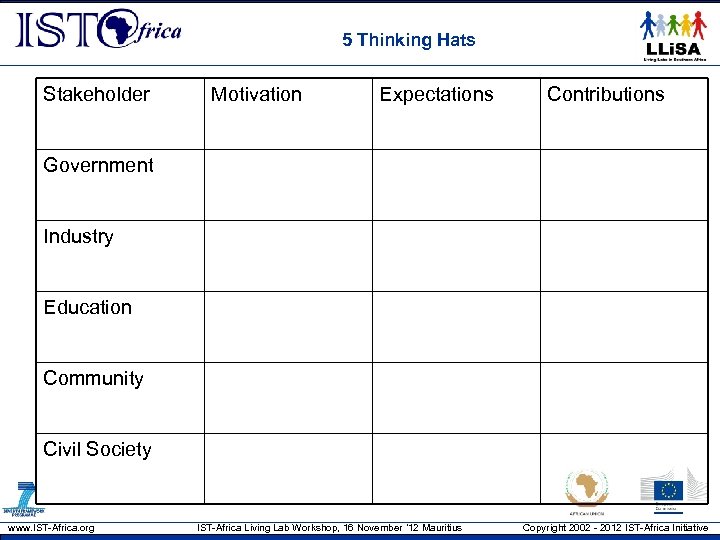 5 Thinking Hats Stakeholder Motivation Expectations Contributions Government Industry Education Community Civil Society www. IST-Africa. org IST-Africa Living Lab Workshop, 16 November ’ 12 Mauritius Copyright 2002 - 2012 IST-Africa Initiative