


 Скачать презентацию IST 511 Information Management Information and Technology Introduction
485361b7afbafef4f067706f7d495b8c.ppt
- Количество слайдов: 70
 IST 511 Information Management: Information and Technology Introduction to IST 511 Dr. C. Lee Giles David Reese Professor, College of Information Sciences and Technology Professor of Computer Science and Engineering Professor of Supply Chain and Information Systems The Pennsylvania State University, University Park, PA, USA giles@ist. psu. edu http: //clgiles. ist. psu. edu
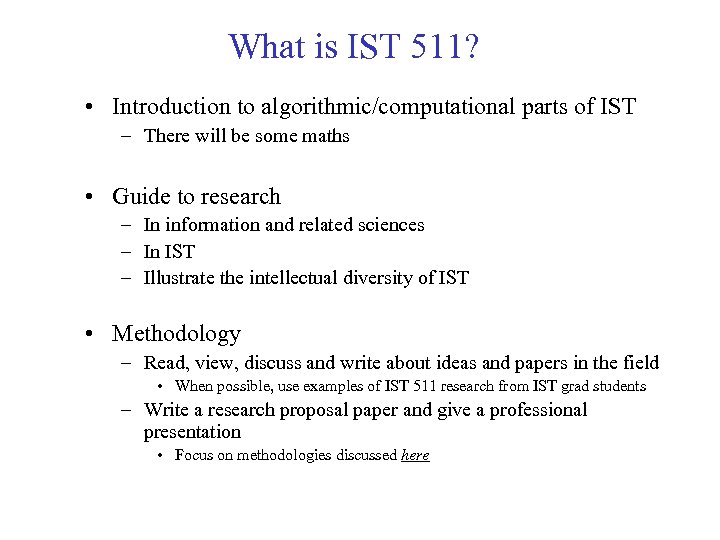 What is IST 511? • Introduction to algorithmic/computational parts of IST – There will be some maths • Guide to research – In information and related sciences – In IST – Illustrate the intellectual diversity of IST • Methodology – Read, view, discuss and write about ideas and papers in the field • When possible, use examples of IST 511 research from IST grad students – Write a research proposal paper and give a professional presentation • Focus on methodologies discussed here
 IST 511 • Nearly all course material is at: http: //clgiles. ist. psu. edu/IST 511 Lose this address, put IST 511 into Google or Bing Read this page and links very carefully at least once a week • Angel is used so far only for student submissions. • Important notices will be sent by email with the subject: IST 511
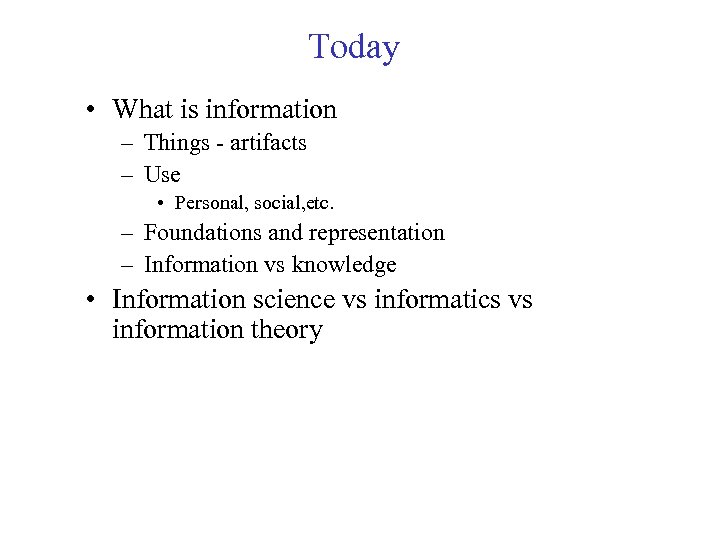 Today • What is information – Things - artifacts – Use • Personal, social, etc. – Foundations and representation – Information vs knowledge • Information science vs informatics vs information theory
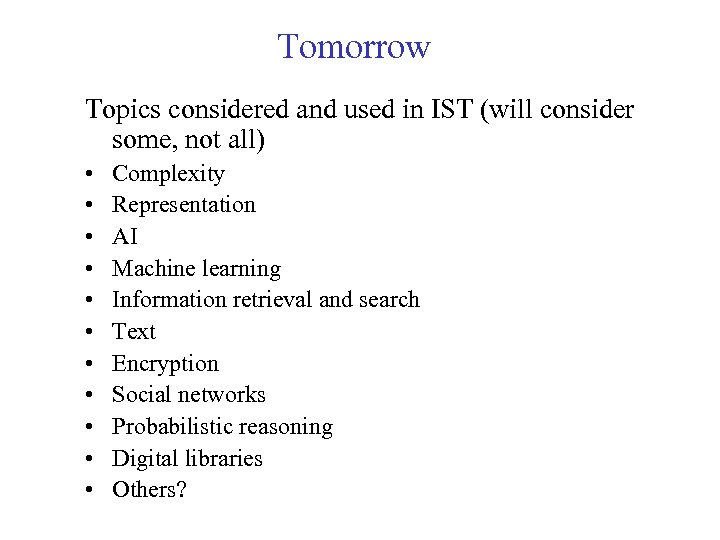 Tomorrow Topics considered and used in IST (will consider some, not all) • • • Complexity Representation AI Machine learning Information retrieval and search Text Encryption Social networks Probabilistic reasoning Digital libraries Others?
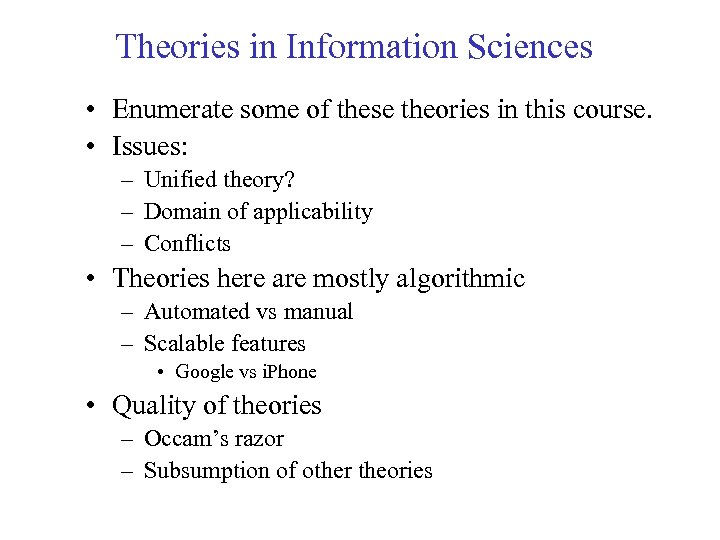 Theories in Information Sciences • Enumerate some of these theories in this course. • Issues: – Unified theory? – Domain of applicability – Conflicts • Theories here are mostly algorithmic – Automated vs manual – Scalable features • Google vs i. Phone • Quality of theories – Occam’s razor – Subsumption of other theories
 Past & Recent Headlines • A Minnesota hacker was sentenced to 18 years in prison on Tuesday for using his neighbors’ wireless network without permission and then framing them for child pornography distribution and email threats against Vice President Joe Biden and other officials. • “Latest Genealogy Tools Create a Need to Know” • “Bots Hammer Estonia In Cyber Vendetta” • “UPS slashed the time it takes to determine the least-expensive route from months and wants to make that information available in real time” • “Sophisticated internet users continue to fall for spam” • “Google makes us stupid” • “Google makes us smarter” • “IT doesn’t matter” • “Microsoft and Yahoo unite against Google Book Search”
 What is Information? • There are several ways to define “information” – Subjective: People develop models of their environment. Information created by people makes those models more accurate. – Thing/artifact: Information is what’s captured in a book, web page, or other resource. • More information is digital
 Information - wikipedia • Information as a concept has a diversity of meanings, from everyday usage to technical settings. Generally speaking, the concept of information is closely related to notions of constraint, communication, control, data, form, instruction, knowledge, meaning, mental stimulus, pattern, perception, and representation. • Many people speak about the Information Age as the advent of the Knowledge Age or knowledge society, the information society, the Information revolution, and information technologies, and even though informatics, information science and computer science are often in the spotlight, the word "information" is often used without careful consideration of the various meanings it has acquired.
 How much information is there in the world Informetrics - the measurement of information • Stored – – – What can we store What do we intend to store. What is stored. • How do we use it – Decision making
 Information Age • We have entered the information age – What is the information age? • When do we leave it and where do we go next? – – David Weinberger’s Too Big to Know What information was
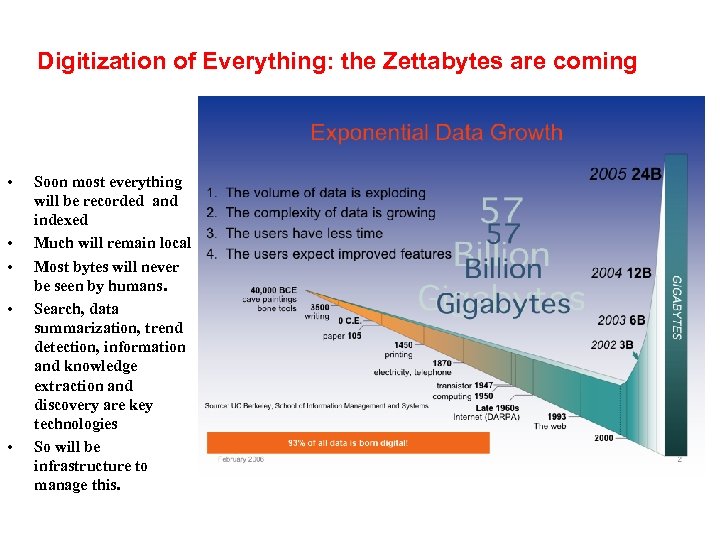 Digitization of Everything: the Zettabytes are coming • • • Soon most everything will be recorded and indexed Much will remain local Most bytes will never be seen by humans. Search, data summarization, trend detection, information and knowledge extraction and discovery are key technologies So will be infrastructure to manage this.
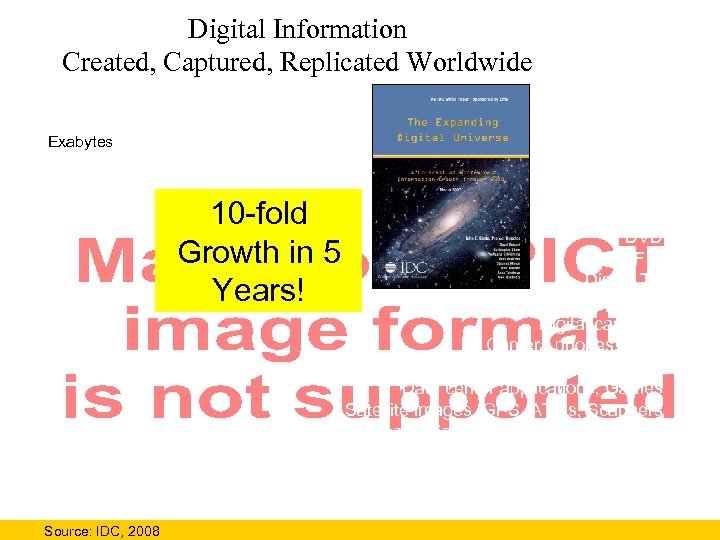 Digital Information Created, Captured, Replicated Worldwide Exabytes 10 -fold Growth in 5 Years! DVD RFID Digital TV MP 3 players Digital cameras Camera phones, Vo. IP Medical imaging, Laptops, Data center applications, Games Satellite images, GPS, ATMs, Scanners Sensors, Digital radio, DLP theaters, Telematics Peer-to-peer, Email, Instant messaging, Videoconferencing, CAD/CAM, Toys, Industrial machines, Security systems, Appliances Source: IDC, 2008
 Scale of things to come • Information growth: – In 2002, recorded media and electronic information flows generated about 22 exabytes EB (1018) of information – In 2006, the amount of digital information created, captured, and replicated was 161 EB – In 2010, the amount of information added annually to the digital universe was about 988 EB (almost 1 ZB) • How much of this is information, data or knowledge?
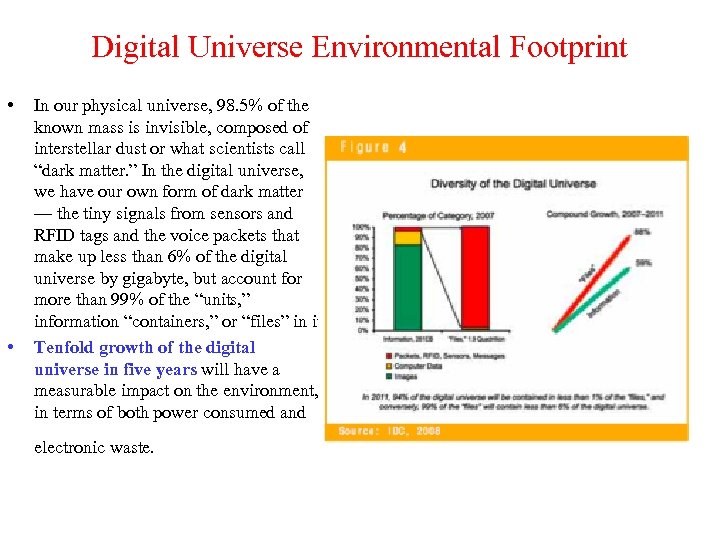 Digital Universe Environmental Footprint • • In our physical universe, 98. 5% of the known mass is invisible, composed of interstellar dust or what scientists call “dark matter. ” In the digital universe, we have our own form of dark matter — the tiny signals from sensors and RFID tags and the voice packets that make up less than 6% of the digital universe by gigabyte, but account for more than 99% of the “units, ” information “containers, ” or “files” in it. Tenfold growth of the digital universe in five years will have a measurable impact on the environment, in terms of both power consumed and electronic waste.
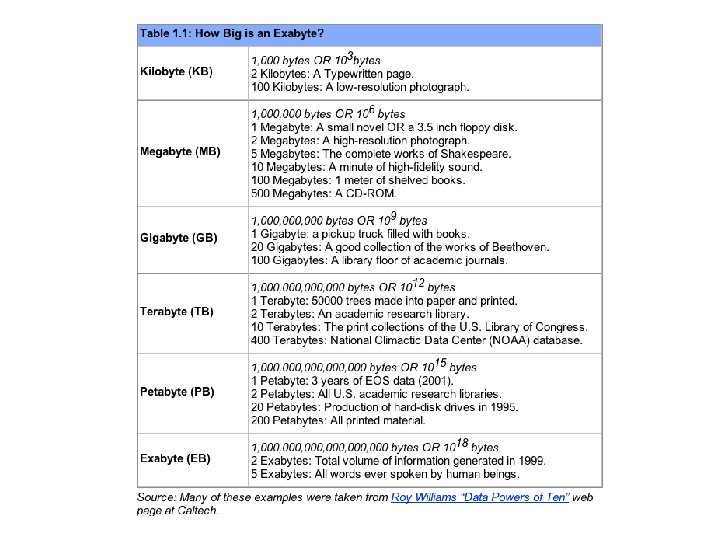
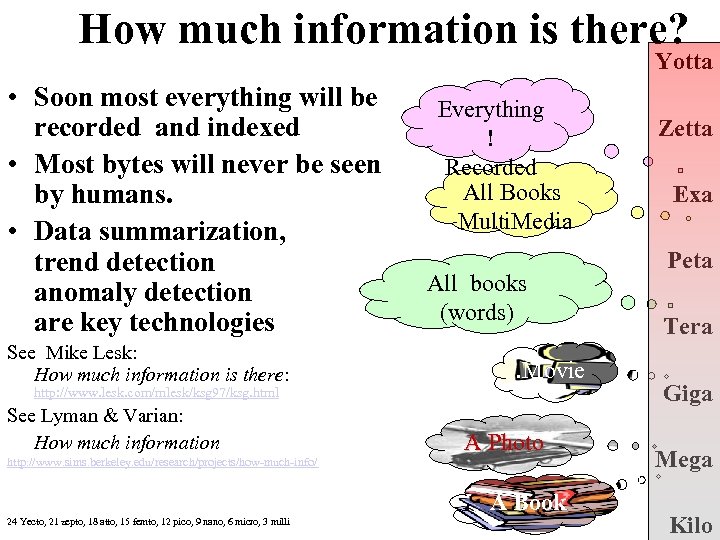 How much information is there? Yotta • Soon most everything will be recorded and indexed • Most bytes will never be seen by humans. • Data summarization, trend detection anomaly detection are key technologies See Mike Lesk: How much information is there: Everything ! Recorded All Books Multi. Media All books (words). Movie http: //www. lesk. com/mlesk/ksg 97/ksg. html See Lyman & Varian: How much information http: //www. sims. berkeley. edu/research/projects/how-much-info/ 24 Yecto, 21 zepto, 18 atto, 15 femto, 12 pico, 9 nano, 6 micro, 3 milli A Photo A Book Zetta Exa Peta Tera Giga Mega Kilo
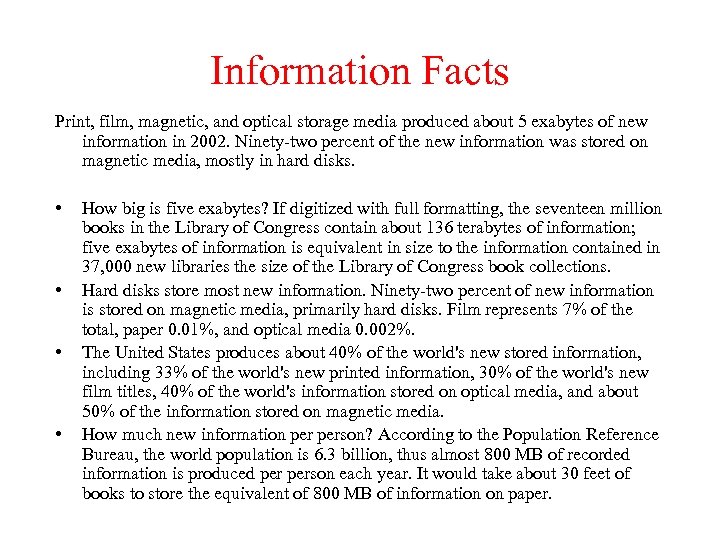 Information Facts Print, film, magnetic, and optical storage media produced about 5 exabytes of new information in 2002. Ninety-two percent of the new information was stored on magnetic media, mostly in hard disks. • • How big is five exabytes? If digitized with full formatting, the seventeen million books in the Library of Congress contain about 136 terabytes of information; five exabytes of information is equivalent in size to the information contained in 37, 000 new libraries the size of the Library of Congress book collections. Hard disks store most new information. Ninety-two percent of new information is stored on magnetic media, primarily hard disks. Film represents 7% of the total, paper 0. 01%, and optical media 0. 002%. The United States produces about 40% of the world's new stored information, including 33% of the world's new printed information, 30% of the world's new film titles, 40% of the world's information stored on optical media, and about 50% of the information stored on magnetic media. How much new information person? According to the Population Reference Bureau, the world population is 6. 3 billion, thus almost 800 MB of recorded information is produced person each year. It would take about 30 feet of books to store the equivalent of 800 MB of information on paper.
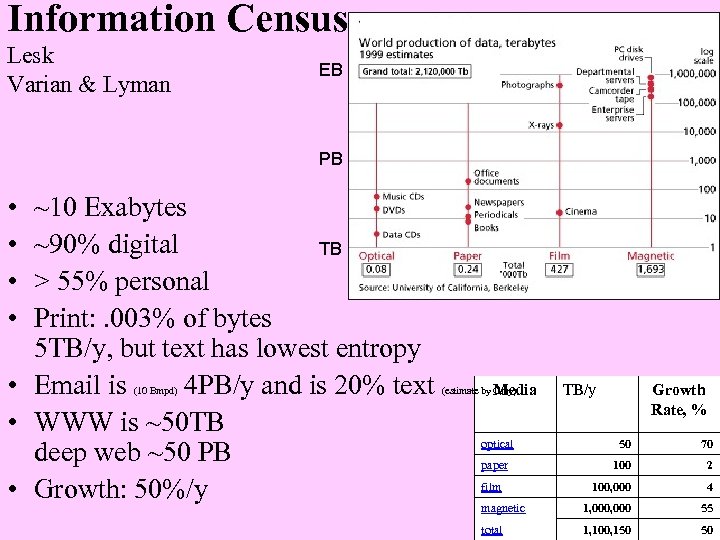 Information Census Lesk Varian & Lyman EB PB • • ~10 Exabytes ~90% digital TB > 55% personal Print: . 003% of bytes 5 TB/y, but text has lowest entropy • Email is 4 PB/y and is 20% text • WWW is ~50 TB deep web ~50 PB • Growth: 50%/y (10 Bmpd) Media (estimate by Gray) TB/y Growth Rate, % optical 50 70 paper 100 2 100, 000 4 magnetic 1, 000 55 total 1, 100, 150 50 film
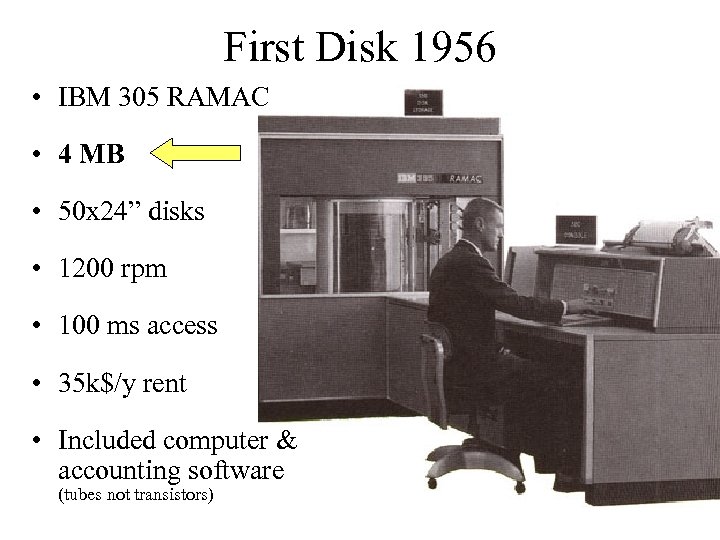 First Disk 1956 • IBM 305 RAMAC • 4 MB • 50 x 24” disks • 1200 rpm • 100 ms access • 35 k$/y rent • Included computer & accounting software (tubes not transistors)
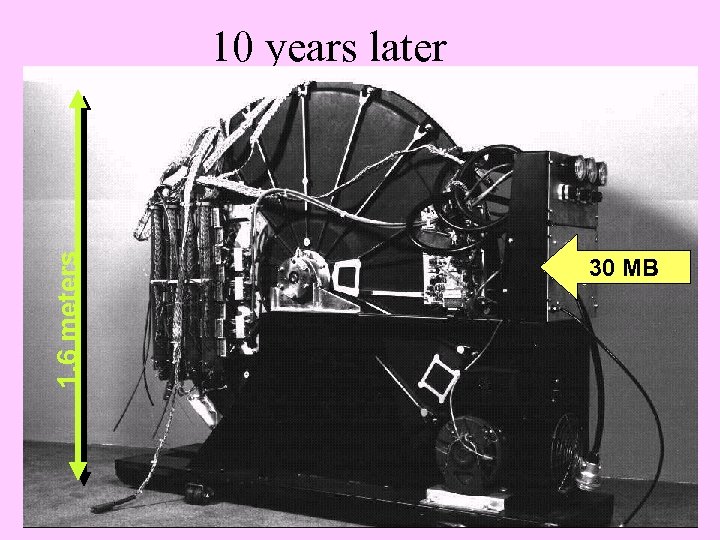 1. 6 meters 10 years later 30 MB
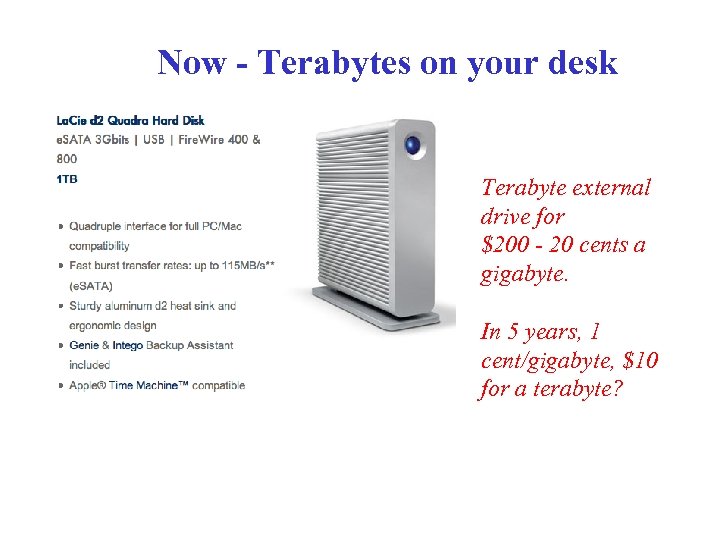 Now - Terabytes on your desk Terabyte external drive for $200 - 20 cents a gigabyte. In 5 years, 1 cent/gigabyte, $10 for a terabyte?
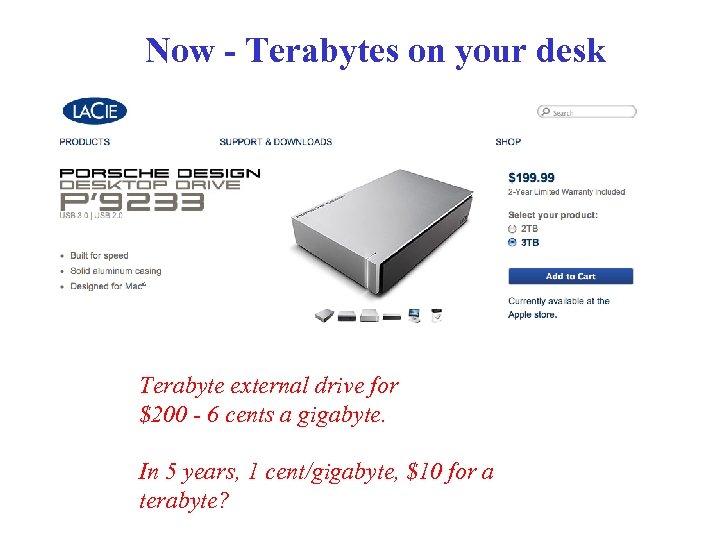 Now - Terabytes on your desk Terabyte external drive for $200 - 6 cents a gigabyte. In 5 years, 1 cent/gigabyte, $10 for a terabyte?
 Moore's Law • Defined by Dr. Gordon Moore during the sixties. • Predicts an exponential increase in component density over time, with a doubling time of 18 months. • Applicable to microprocessors, DRAMs , DSPs and other microelectronics. • Monotonic increase in density observed since the 1960 s.
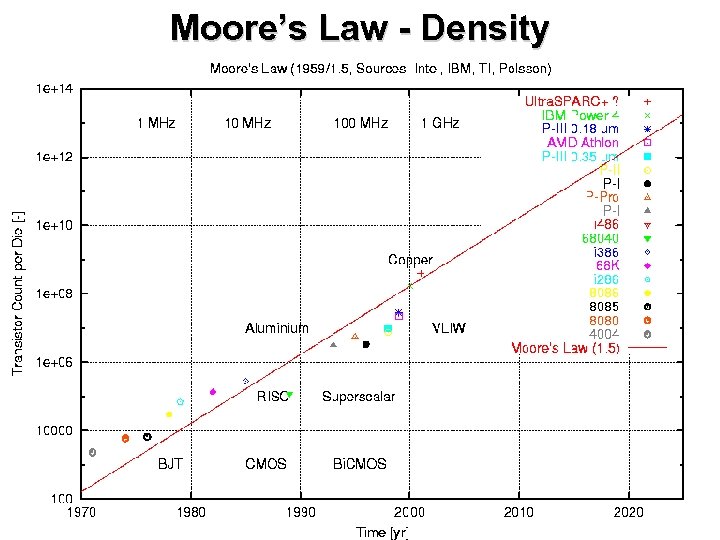 Moore’s Law - Density
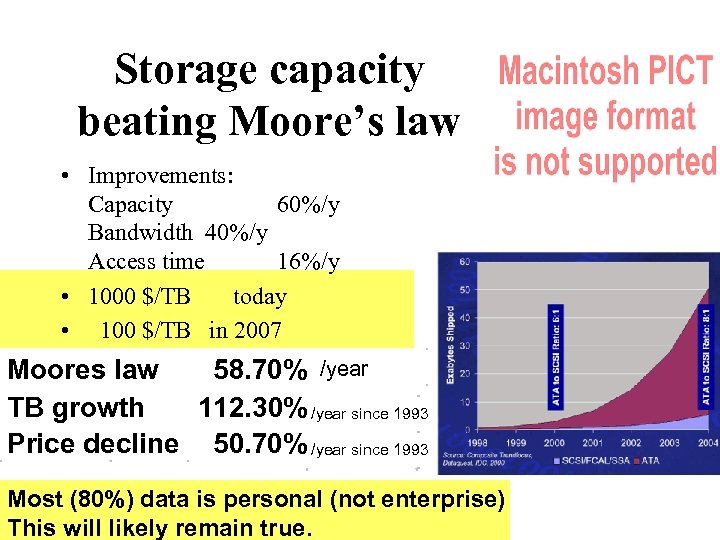 Storage capacity beating Moore’s law • Improvements: Capacity 60%/y Bandwidth 40%/y Access time 16%/y • 1000 $/TB today • 100 $/TB in 2007 Moores law 58. 70% /year TB growth 112. 30% /year since 1993 Price decline 50. 70% /year since 1993 Most (80%) data is personal (not enterprise) This will likely remain true.
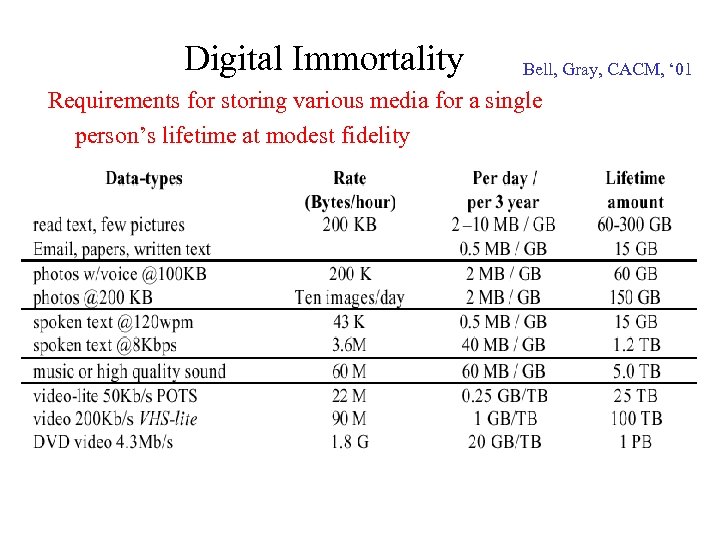 Digital Immortality Bell, Gray, CACM, ‘ 01 Requirements for storing various media for a single person’s lifetime at modest fidelity
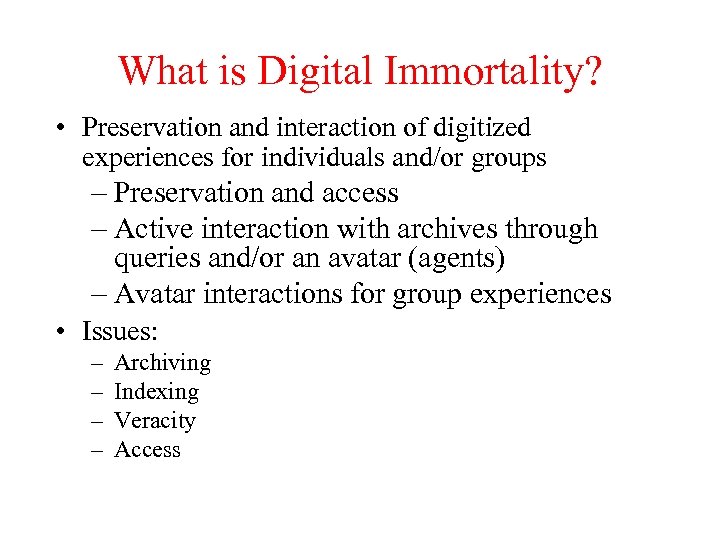 What is Digital Immortality? • Preservation and interaction of digitized experiences for individuals and/or groups – Preservation and access – Active interaction with archives through queries and/or an avatar (agents) – Avatar interactions for group experiences • Issues: – – Archiving Indexing Veracity Access
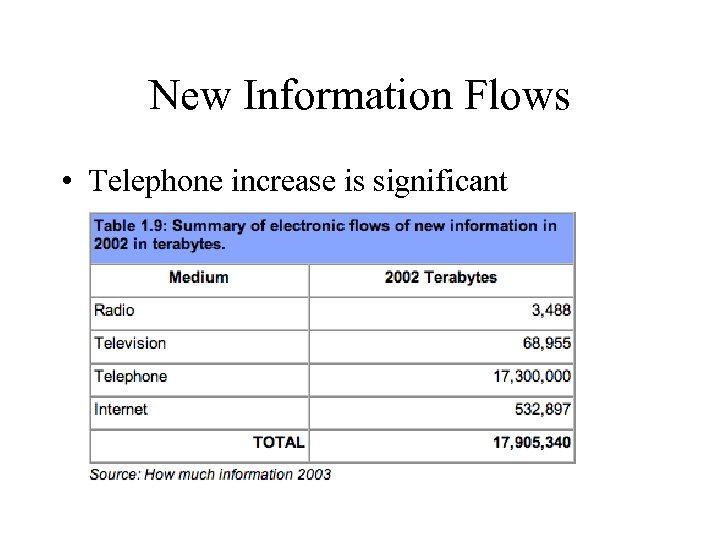 New Information Flows • Telephone increase is significant
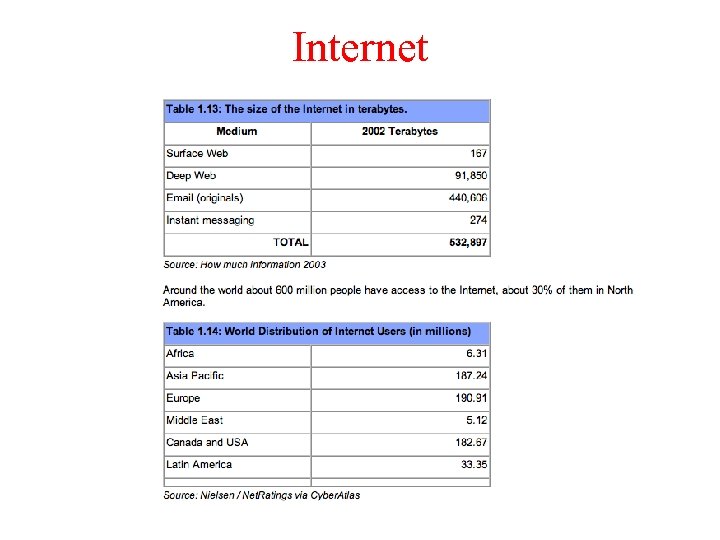 Internet
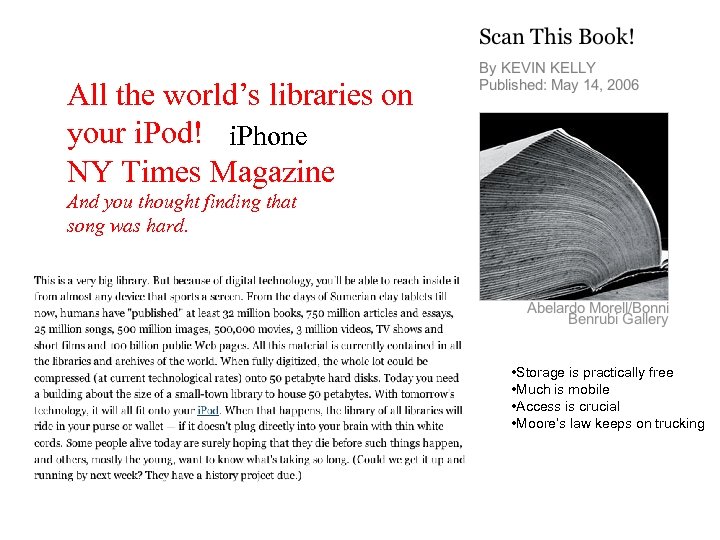 All the world’s libraries on your i. Pod! i. Phone NY Times Magazine And you thought finding that song was hard. • Storage is practically free • Much is mobile • Access is crucial • Moore’s law keeps on trucking
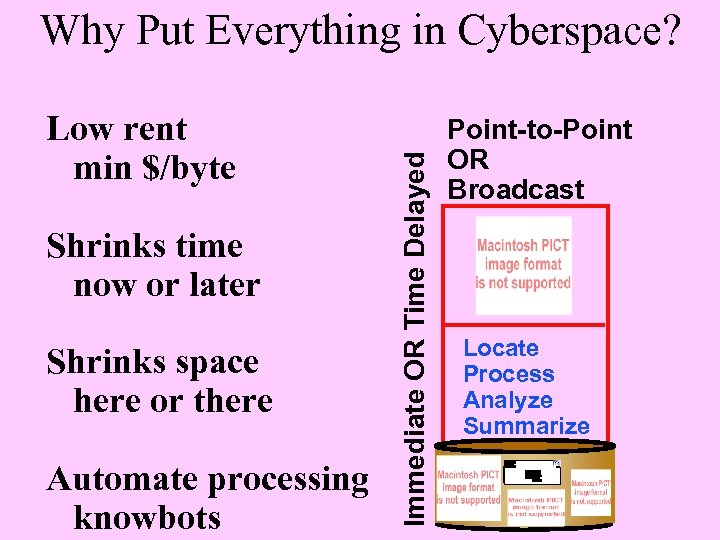 Low rent min $/byte Shrinks time now or later Shrinks space here or there Automate processing knowbots Immediate OR Time Delayed Why Put Everything in Cyberspace? Point-to-Point OR Broadcast Locate Process Analyze Summarize
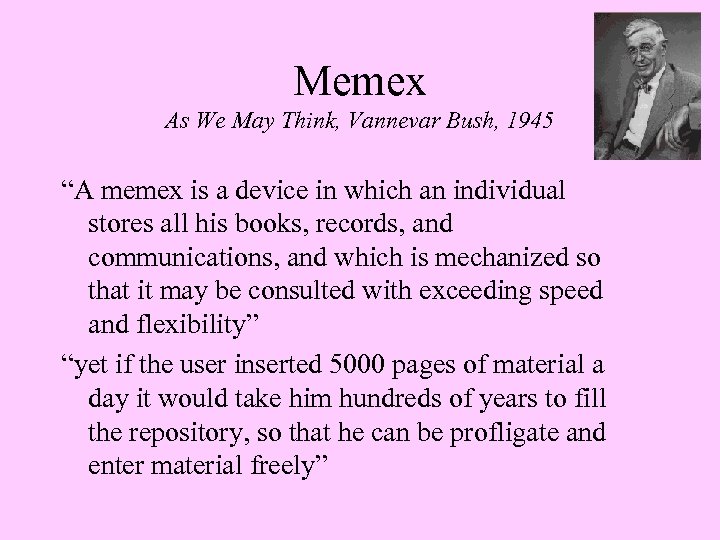 Memex As We May Think, Vannevar Bush, 1945 “A memex is a device in which an individual stores all his books, records, and communications, and which is mechanized so that it may be consulted with exceeding speed and flexibility” “yet if the user inserted 5000 pages of material a day it would take him hundreds of years to fill the repository, so that he can be profligate and enter material freely”
 Trying to fill a terabyte in a year Items/TB Items/day 300 KB JPEG 3 M 9, 800 1 MB Doc 1 M 2, 900 1 hour 256 kb/s MP 3 audio 1 hour 1. 5 Mbp/s MPEG video 9 K 26 290 0. 8
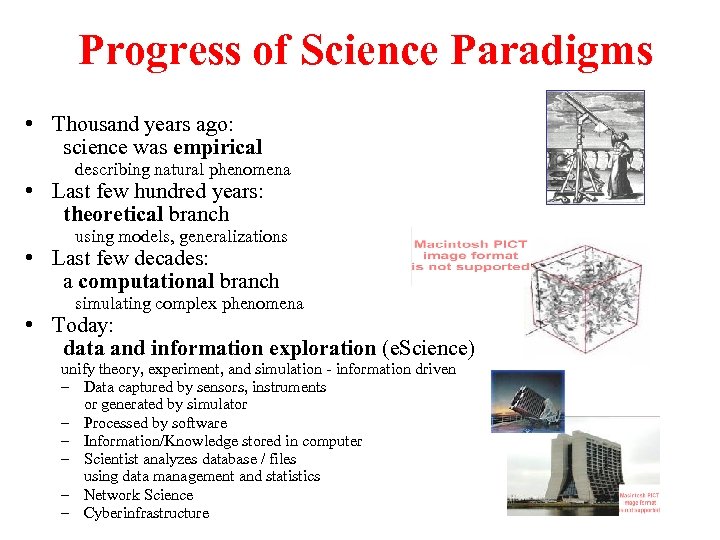 Progress of Science Paradigms • Thousand years ago: science was empirical describing natural phenomena • Last few hundred years: theoretical branch using models, generalizations • Last few decades: a computational branch simulating complex phenomena • Today: data and information exploration (e. Science) unify theory, experiment, and simulation - information driven – Data captured by sensors, instruments or generated by simulator – Processed by software – Information/Knowledge stored in computer – Scientist analyzes database / files using data management and statistics – Network Science – Cyberinfrastructure
 Information Systems • An Information System is the system of persons, data records and activities that process the data and information in a given organization, including manual processes or automated processes. – – • Usually the term is used erroneously as a synonymous for computerbased information systems, which is only the Information technologies component of an Information System. The computer-based information systems are the field of study for Information technologies (IT); however these should hardly be treated apart from the bigger Information System that is always involved in. The actual system such as a search engine, etc.
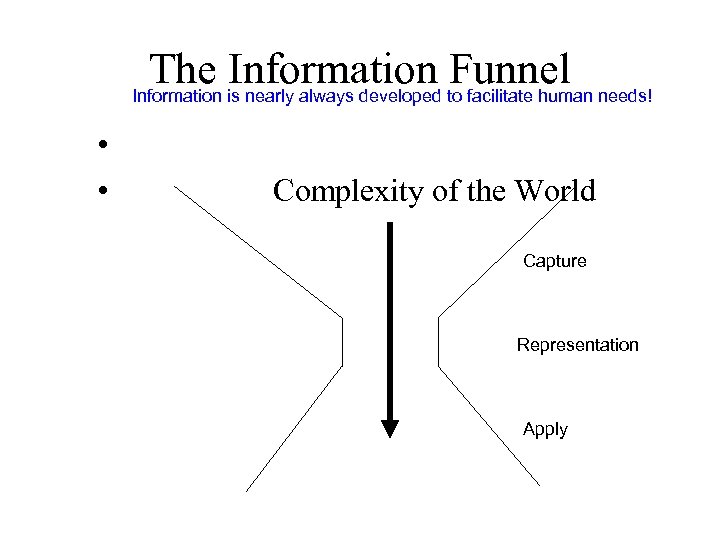 The Information Funnel needs! Information is nearly always developed to facilitate human • Complexity of the World Capture Representation Apply
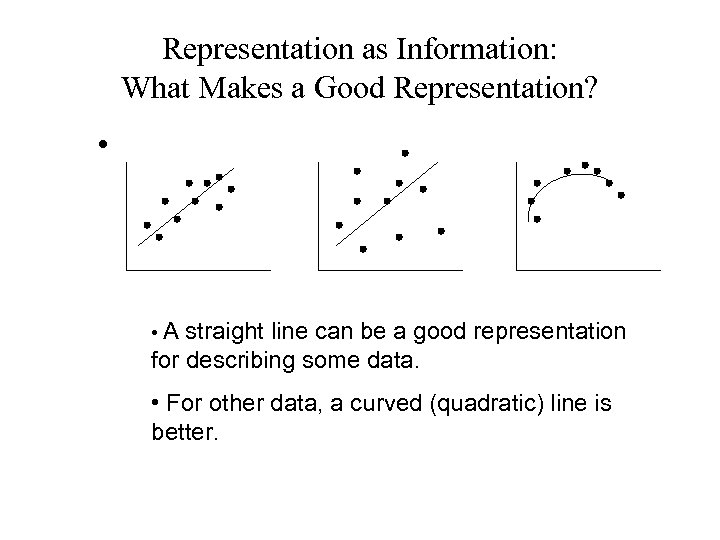 Representation as Information: What Makes a Good Representation? • • A straight line can be a good representation for describing some data. • For other data, a curved (quadratic) line is better.
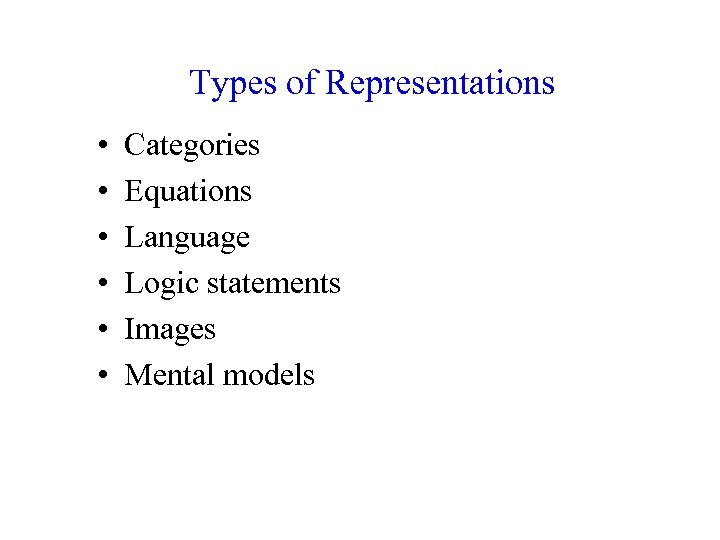 Types of Representations • • • Categories Equations Language Logic statements Images Mental models
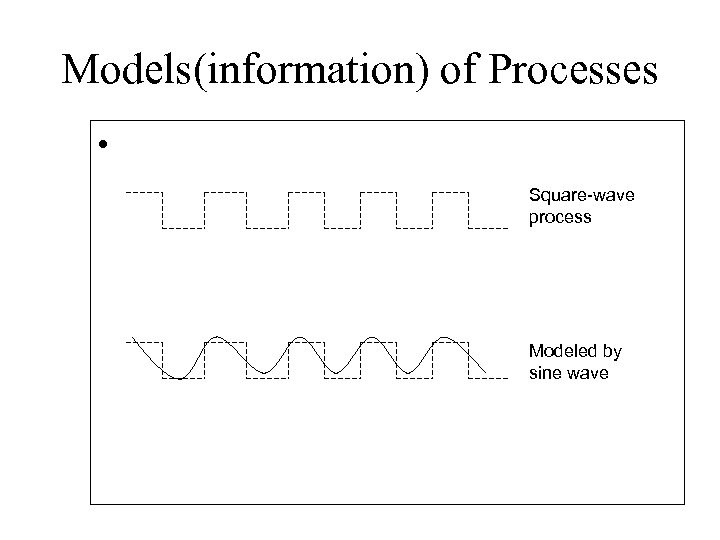 Models(information) of Processes • Square-wave process Modeled by sine wave
 Information Processing • There are many ways to apply the information stored in representations. • Retrieval – Finding useful information • Recognition – Identifying an instance • Inference – Extend stored information to a new situation
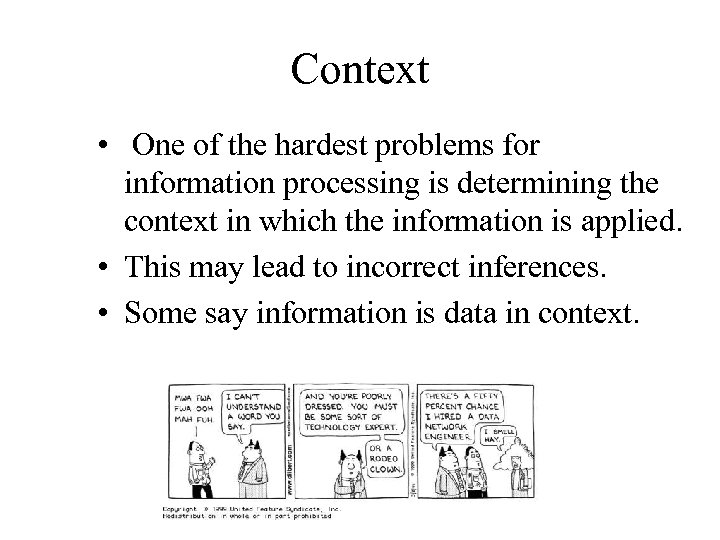 Context • One of the hardest problems for information processing is determining the context in which the information is applied. • This may lead to incorrect inferences. • Some say information is data in context.
 People and Information • People process information based on their experience and context. • Human information processing is affected by emotions and needs. • Your data may be my information
 What is an information system? • Processes information • Requires knowledge of what information is • How much information is available – Static vs dynamic – Explict vs implicit • How it is used and structured – information management • How it’s managed • Incorporated into personal or social use.
 Information Characteristics • Structural / Ontological / context – State based • • • Representations / rules Functional / active Language / communication Personal Social
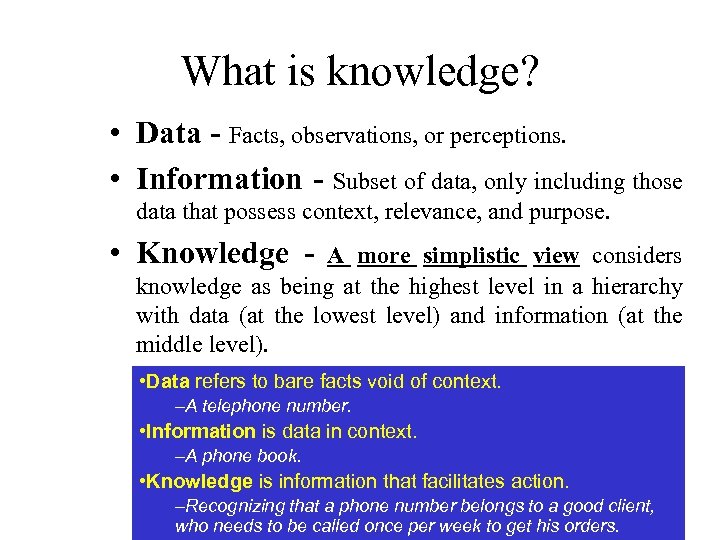 What is knowledge? • Data - Facts, observations, or perceptions. • Information - Subset of data, only including those data that possess context, relevance, and purpose. • Knowledge - A more simplistic view considers knowledge as being at the highest level in a hierarchy with data (at the lowest level) and information (at the middle level). • Data refers to bare facts void of context. –A telephone number. • Information is data in context. –A phone book. • Knowledge is information that facilitates action. –Recognizing that a phone number belongs to a good client, who needs to be called once per week to get his orders.
 From Facts to Wisdom (Haeckel & Nolan, 1993) one example of the hierarchy
 What is knowledge? • Knowledge - A more complex view considers knowledge as intrinsically different from information. Instead of considering knowledge as richer or more detailed set of facts, we define knowledge in an area as justified beliefs about relationships among concepts relevant to that particular area.
 Is Information • An aspect of intelligence? – Derivative to its use • An aspect of life? • Innate to physical reality? – Innate code, ex DNA, etc.
 Characteristics of Information – Invariant – Dynamic – Personal – Situational – Cultural – An act versus a fact – Additive – Symbolic – Others?
 Information Theory • Information theory is a discipline in applied mathematics involving the quantification of data with the goal of enabling as much data as possible to be reliably stored on a medium or communicated over a channel. • The measure of information, known as information entropy, is usually expressed by the average number of bits needed for storage or communication. – The more common the event, the higher the entropy http: //en. wikipedia. org/wiki/Information_theory
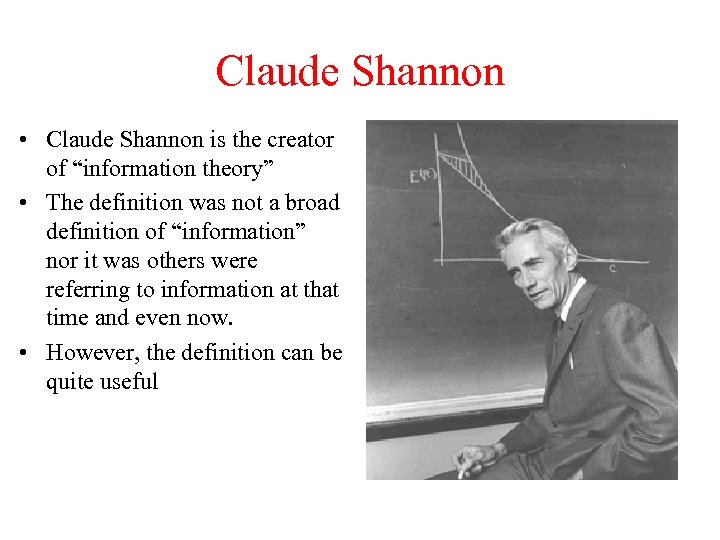 Claude Shannon • Claude Shannon is the creator of “information theory” • The definition was not a broad definition of “information” nor it was others were referring to information at that time and even now. • However, the definition can be quite useful
 Models of Information • Common model: a representation of data – When possible formalize the information process – Interoperability – Standards • What is formalization? – Logical or mathematical representation • Natural language definitions are becoming formal – Why formal definitions of information? – Examples?
 Formalization/automation/digitization of Information Advantages: • Costs • Reproducibility • Scalability • Automation • Interpretation • Others?
 Consequences of Information • Information can lead to – Decisions – Actions – Contemplation – Laws – More information
 Models of Information Use • Personal models – Cognitive • Social models – – – Institutions Groups Nations Commerce Etc.
 What is Information? • There is no standard definition • Context is important; maybe vital – "Information is produced when data are processed so that they are placed within some context in order to convey meaning to a recipient. " • Information causes things to happen – Permits decisions, actions, predictions, etc. • An innate aspect of intelligence/universe?
 The Philosophy of Information: A Definition What is the Philosophy of Information? a new philosophical discipline, concerned with a) the critical investigation of the conceptual nature and basic principles of information, including its dynamics (especially computation and flow), utilisation and sciences; and b) the elaboration and application of information-theoretic and computational methodologies to philosophical problems. L. Floridi What is the Philosophy of Information? (2002) Open Problems in the Philosophy of Information © L. Floridi
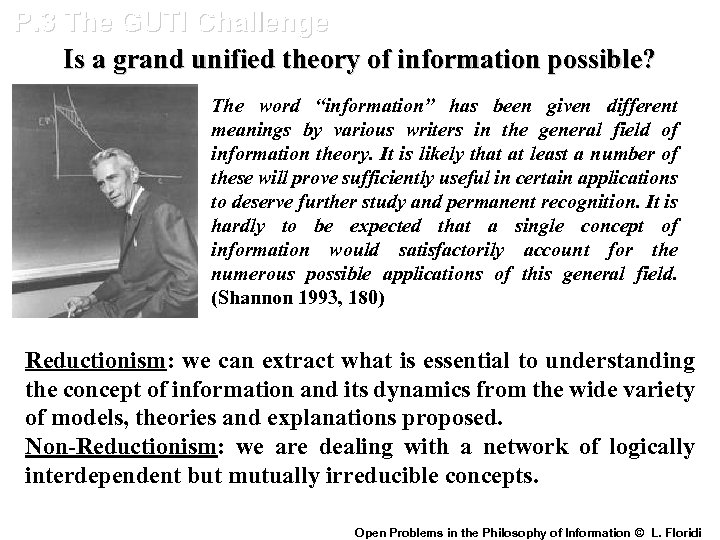 P. 3 The GUTI Challenge Is a grand unified theory of information possible? The word “information” has been given different meanings by various writers in the general field of information theory. It is likely that at least a number of these will prove sufficiently useful in certain applications to deserve further study and permanent recognition. It is hardly to be expected that a single concept of information would satisfactorily account for the numerous possible applications of this general field. (Shannon 1993, 180) Reductionism: we can extract what is essential to understanding the concept of information and its dynamics from the wide variety of models, theories and explanations proposed. Non-Reductionism: we are dealing with a network of logically interdependent but mutually irreducible concepts. Open Problems in the Philosophy of Information © L. Floridi
 What is information science? wikipedia Not to be confused with informatics or information theory • Information science is an interdisciplinary science primarily concerned with the collection, classification, manipulation, storage, retrieval and dissemination of information. Practitioners within the field study the application and usage of knowledge in organizations, along with the interaction between people, organizations and any existing information systems, with the aim of creating, replacing or improving information systems. Information science is often (mistakenly) considered a branch of computer science. However, it is actually a broad, interdisciplinary field, incorporating not only aspects of computer science, but often diverse fields such as mathematics, business, library science, cognitive science, and the social sciences.
 information science vs informatics wikipedia • Informatics is the science of information, the practice of information processing, and the engineering of information systems. Informatics studies the structure, algorithms, behavior, and interactions of natural and artificial systems that store, process, access and communicate information. • It also develops its own conceptual and theoretical foundations and utilizes foundations developed in other fields. Since the advent of computers, individuals and organizations increasingly process information digitally. • This has led to the study of informatics that has computational, cognitive and social aspects, including study of the social impact of information technologies. • Many subfields: X-informatics
 Great Predictions • • • "Computers in the future may weigh no more than 1. 5 tons. ” Popular Mechanics, forecasting the relentless march of science, 1949 "I think there is a world market for maybe five computers. ” Thomas Watson, chairman of IBM, 1943 "Heavier-than-air flying machines are impossible. ” Lord Kelvin, president, Royal Society, 1895. "Man will never reach the moon regardless of all future scientific advances. "Dr. Lee De Forest, inventor of the vacuum tube and father of television. "Everything that can be invented has been invented. ” Charles H. Duell, Commissioner, U. S. Office of Patents, 1899. “Nobody would ever need more than 640 kilobytes of memory on their personal computer, ” 1981, Bill Gates. – Other predictions of Bill Gates?
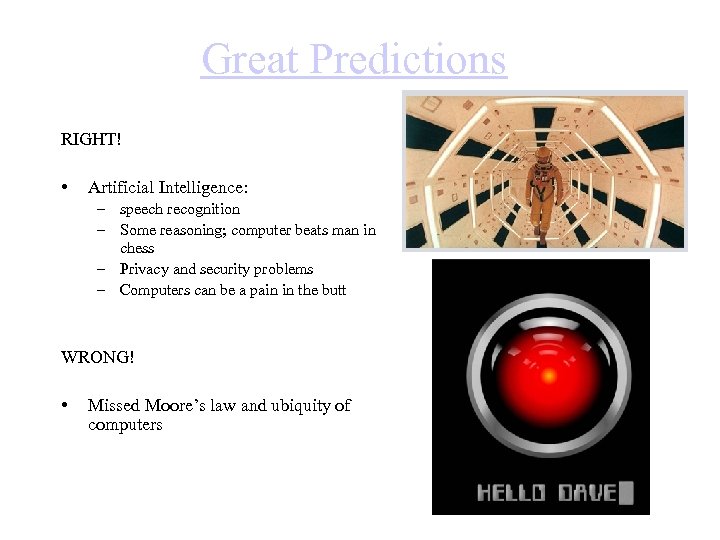 Great Predictions RIGHT! • Artificial Intelligence: – speech recognition – Some reasoning; computer beats man in chess – Privacy and security problems – Computers can be a pain in the butt WRONG! • Missed Moore’s law and ubiquity of computers
 Predicting the future – “The future ain’t what it used to be” Yogi Berra • Can we really predict the future? • Who predicted the implications of the web and search engines? • Social networking? • Can we understand power laws and their implications? – We have no examples of exponential growth in our evolution except plagues. • Can we understand the pervasiveness of computers?
 Everything Gets Bigger “Screens” are larger • Flat screen television • Wall televisions “Screens” are everywhere • Every room of the house • Waiting rooms • Stores • Cars • Phones “ The return of large data centers”
 Everything Gets Smaller • Phones • Watches / instruments • Computers – embedded • Glasses • Projectors
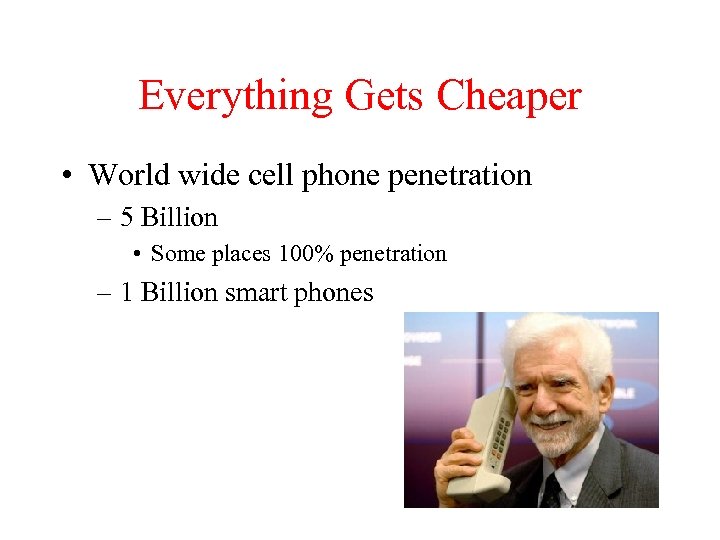 Everything Gets Cheaper • World wide cell phone penetration – 5 Billion • Some places 100% penetration – 1 Billion smart phones
 Everything gets smarter • Mobile phones - the new computer • The PDA that is really an assistant • Digital immortality
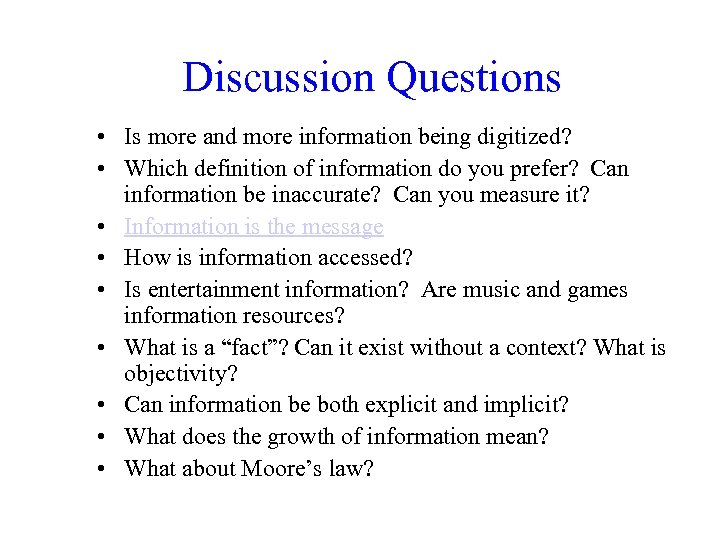 Discussion Questions • Is more and more information being digitized? • Which definition of information do you prefer? Can information be inaccurate? Can you measure it? • Information is the message • How is information accessed? • Is entertainment information? Are music and games information resources? • What is a “fact”? Can it exist without a context? What is objectivity? • Can information be both explicit and implicit? • What does the growth of information mean? • What about Moore’s law?
 Thanks to: • Jim Gray, Microsoft • L. Floridi, Hertfordshire • Robert Allen, Drexel • Wikipedia