


 Скачать презентацию Issues of the Gilded Age and the Progressive
028904efc62cbd66cfe771eb451f2fee.ppt
- Количество слайдов: 53
 Issues of the Gilded Age and the Progressive Era US History Unit #10 – Chapters 16 & 17
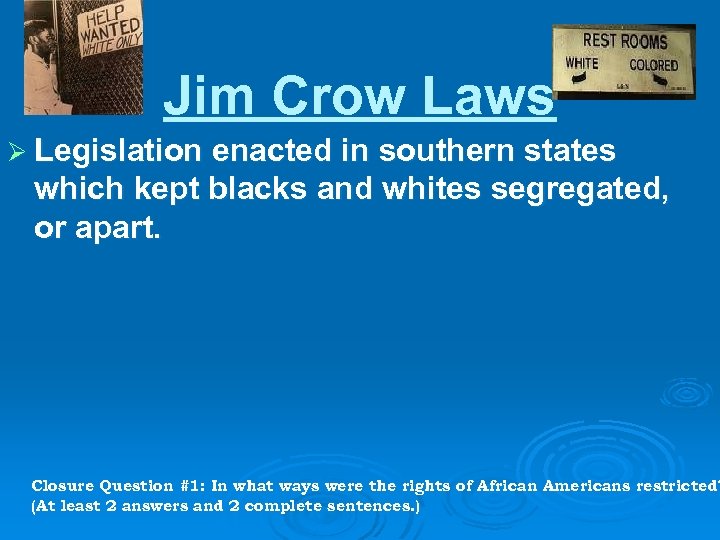 Jim Crow Laws Ø Legislation enacted in southern states which kept blacks and whites segregated, or apart. Closure Question #1: In what ways were the rights of African Americans restricted? (At least 2 answers and 2 complete sentences. )
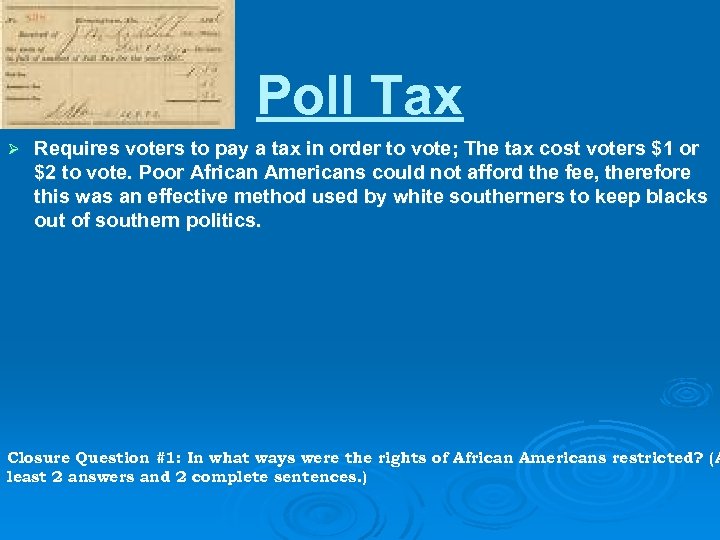 Poll Tax Ø Requires voters to pay a tax in order to vote; The tax cost voters $1 or $2 to vote. Poor African Americans could not afford the fee, therefore this was an effective method used by white southerners to keep blacks out of southern politics. Closure Question #1: In what ways were the rights of African Americans restricted? (A least 2 answers and 2 complete sentences. )
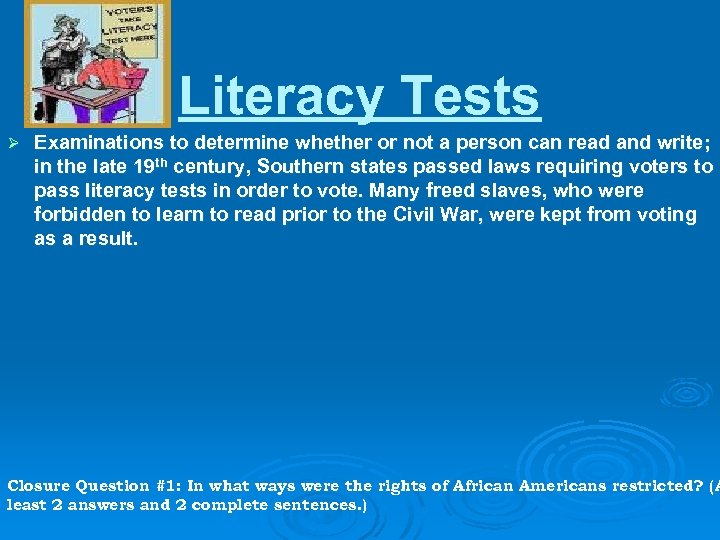 Literacy Tests Ø Examinations to determine whether or not a person can read and write; in the late 19 th century, Southern states passed laws requiring voters to pass literacy tests in order to vote. Many freed slaves, who were forbidden to learn to read prior to the Civil War, were kept from voting as a result. Closure Question #1: In what ways were the rights of African Americans restricted? (A least 2 answers and 2 complete sentences. )
 Grandfather Clauses Ø Voting laws enacted in southern states which allowed a person to vote as long as his ancestors had voted prior to 1866. Of course, the ancestors of the black freedmen did not vote prior to 1866. Closure Question #1: In what ways were the rights of African Americans restricted? (A least 2 answers and 2 complete sentences. )
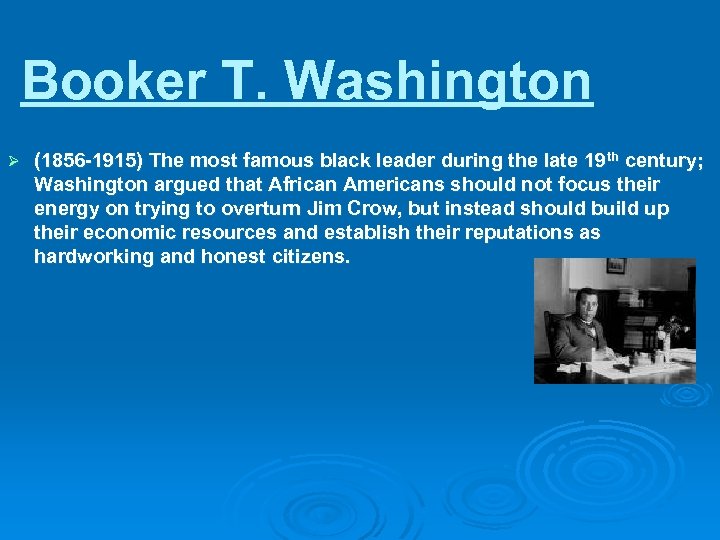 Booker T. Washington Ø (1856 -1915) The most famous black leader during the late 19 th century; Washington argued that African Americans should not focus their energy on trying to overturn Jim Crow, but instead should build up their economic resources and establish their reputations as hardworking and honest citizens.
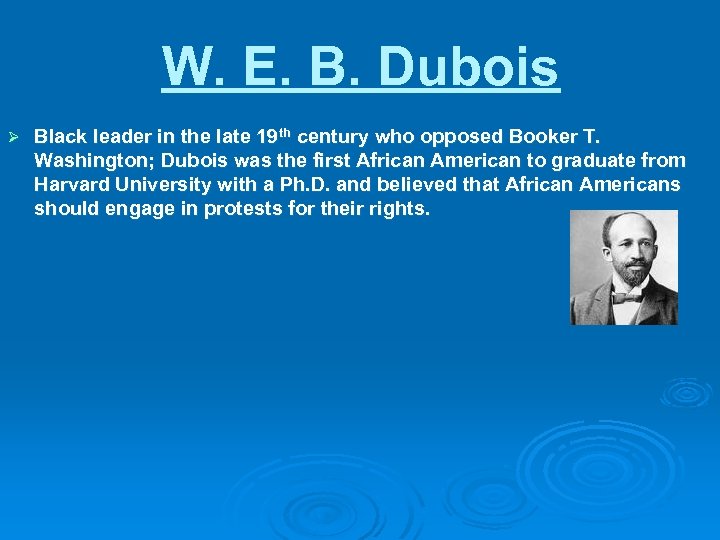 W. E. B. Dubois Ø Black leader in the late 19 th century who opposed Booker T. Washington; Dubois was the first African American to graduate from Harvard University with a Ph. D. and believed that African Americans should engage in protests for their rights.
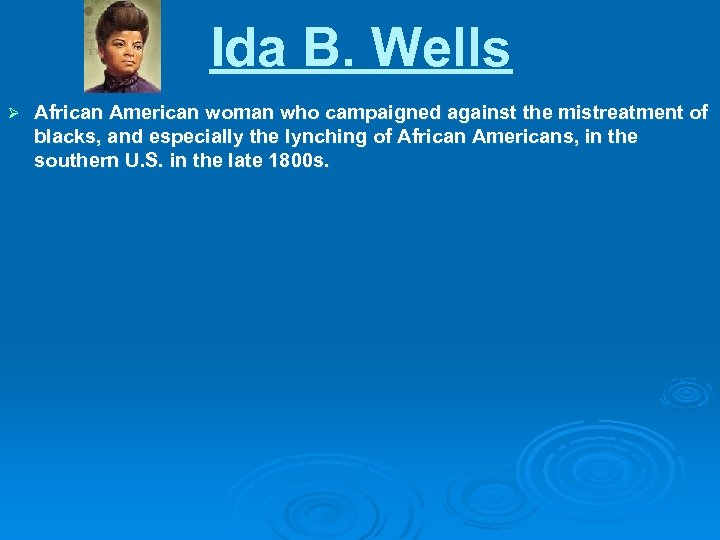 Ida B. Wells Ø African American woman who campaigned against the mistreatment of blacks, and especially the lynching of African Americans, in the southern U. S. in the late 1800 s.
 Closure Question #2: How did Chinese Americans and Mexican Americans respond to mistreatment in the Gilded Age? (At least 2 answers and 2 complete sentences. ) Like African Americans, brave Chinese immigrants challenged discrimination. Saum Song Bo questioned why he should support a fund-raising drive to build the Statue of Liberty. “That statue represents Liberty holding a torch which lights the passage of those of all nations who come into this country, ” Bo wrote in a letter published in American Missionary in 1898. “But are the Chinese allowed to come? As for the Chinese who are here, are they allowed to enjoy liberty as men of all other nationalities enjoy it? ” Ø Chinese immigrants also turned to the federal courts to protect their rights but with mixed results. In 1886, in the case of Yick Wo v. Hopkins, the U. S. Supreme court sided with a Chinese immigrant who challenged a California law that banned him and other Chinese from operating a laundry. In 1898, the Court ruled that individuals of Chinese descent, born in the United States, could not be stripped of their citizenship. Yet the Court upheld the Chinese Exclusion Act and several other discriminatory measures. Ø
 Las Gorras Blancas Ø Group of Mexican Americans in the southwest U. S. who, near the turn of the 20 th century, protested the loss of their land to large ranch owners, often destroying the property of white farmers. Supported by a national labor organization, the Knights of Labor, the group also had its own newspaper. Closure Question #2: How did Chinese Americans and Mexican Americans respond to mistreatment in the Gilded Age? (At least 2 answers and 2 complete sentences. )
 National Woman Suffrage Association Ø Established in 1869 by Susan B. Anthony and Elizabeth Cady Stanton; the NWSA fought for a constitutional amendment that would grant women the right to vote. Closure Question #3: Do you think women activists during the late 1800 s had any effe on the political or social life of the country? (Explain in at least 1 complete sentence.
 Women’s Christian Temperance Union Ø Led by Frances Willard, the WCTU’s primary goal was to ban the sale, production, and consumption of liquor in the United States. Closure Question #3: Do you think women activists during the late 1800 s had any effe on the political or social life of the country? (Explain in at least 1 complete sentence.
 Closure Assignment #1 Use your notes from Chapter 16, Section 1 to answer the following questions: 1. In what ways were the rights of African Americans restricted? (At least 2 answers and 2 complete sentences. ) 2. How did Chinese Americans and Mexican Americans respond to mistreatment in the Gilded Age? (At least 2 answers and 2 complete sentences. ) 3. Do you think women activists during the late 1800 s had any effect on the political or social life of the country? (Explain in at least 1 complete sentence. ) Ø
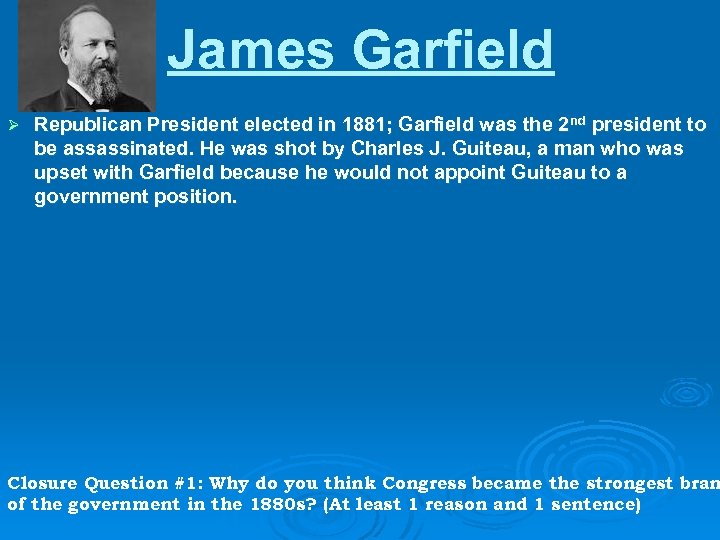 James Garfield Ø Republican President elected in 1881; Garfield was the 2 nd president to be assassinated. He was shot by Charles J. Guiteau, a man who was upset with Garfield because he would not appoint Guiteau to a government position. Closure Question #1: Why do you think Congress became the strongest bran of the government in the 1880 s? (At least 1 reason and 1 sentence)
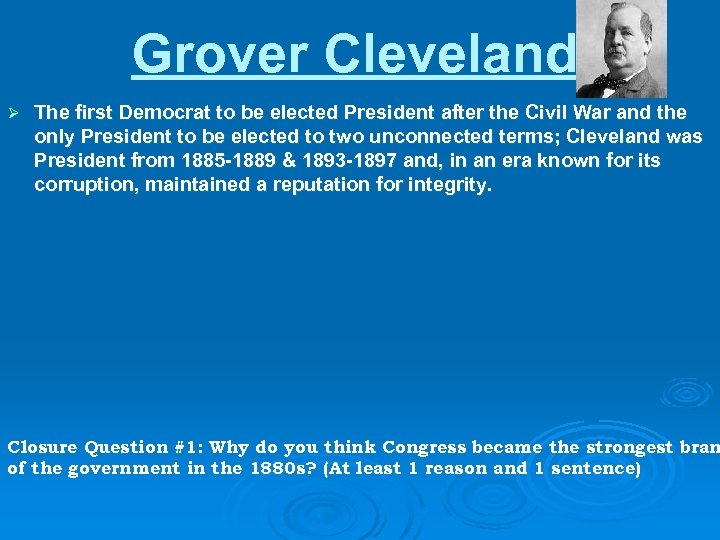 Grover Cleveland Ø The first Democrat to be elected President after the Civil War and the only President to be elected to two unconnected terms; Cleveland was President from 1885 -1889 & 1893 -1897 and, in an era known for its corruption, maintained a reputation for integrity. Closure Question #1: Why do you think Congress became the strongest bran of the government in the 1880 s? (At least 1 reason and 1 sentence)
 Spoils System Ø Political system in which politicians awarded government jobs to loyal party workers, with little regard for their qualifications. During the Gilded Age the U. S. Government was dominated by the spoils system, further breeding corruption in politics. Closure Question #1: Why do you think Congress became the strongest bran of the government in the 1880 s? (At least 1 reason and 1 sentence)
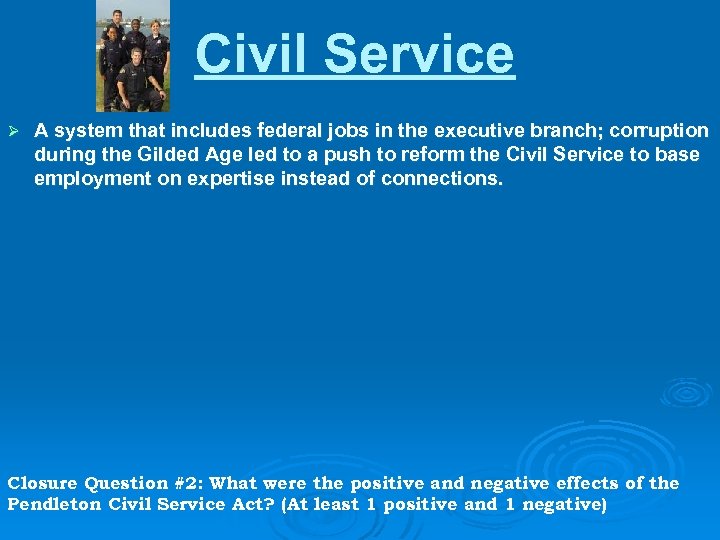 Civil Service Ø A system that includes federal jobs in the executive branch; corruption during the Gilded Age led to a push to reform the Civil Service to base employment on expertise instead of connections. Closure Question #2: What were the positive and negative effects of the Pendleton Civil Service Act? (At least 1 positive and 1 negative)
 Pendleton Civil Service Act Ø Passed in 1883, the act established a Civil Service Commission, which wrote a civil service exam. Individuals who wanted to work for the government had to take the exam, and getting a job depended on doing well on the exam. Closure Question #2: What were the positive and negative effects of the Pendleton Civil Service Act? (At least 1 positive and 1 negative)
 Gold Standard Ø Monetary policy adopted during the Gilded Age which meant that the government would use gold as the basis for national currency. Ø The Republicans favored a high tariff, arguing that it would allow American Industries to grow and promote jobs in manufacturing. Democrats countered that high tariffs increased the costs of goods to consumers and made it harder for American farmers to sell their goods abroad. Closure Question #3: President Cleveland called the high tariff “unjust taxation. ” Why do you think President Cleveland made this statement? (At l 1 sentence)
 Closure Assignment #2 Use your notes from Chapter 16, Section 2 to answer the following questions: 1. Why do you think Congress became the strongest branch of the government in the 1880 s? (At least 1 reason and 1 sentence) 2. What were the positive and negative effects of the Pendleton Civil Service Act? (At least 1 positive and 1 negative) 3. President Cleveland called the high tariff “unjust taxation. ” Why do you think President Cleveland made this statement? Explain his point of view. (At least 2 sentences) Ø
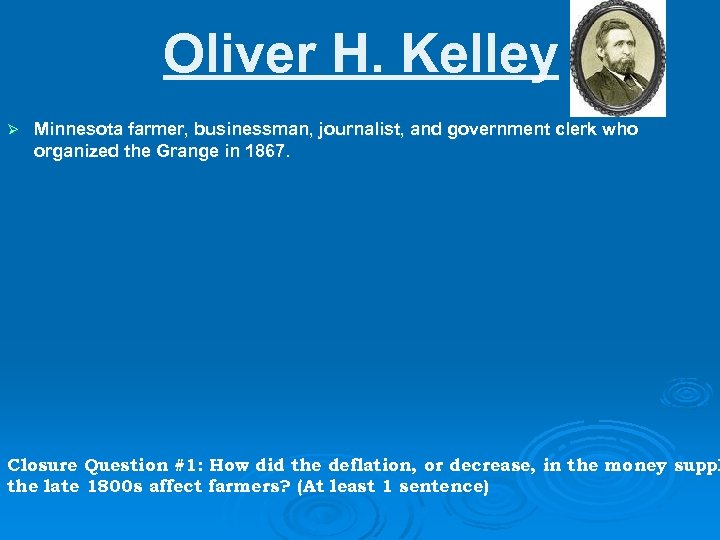 Oliver H. Kelley Ø Minnesota farmer, businessman, journalist, and government clerk who organized the Grange in 1867. Closure Question #1: How did the deflation, or decrease, in the money suppl the late 1800 s affect farmers? (At least 1 sentence)
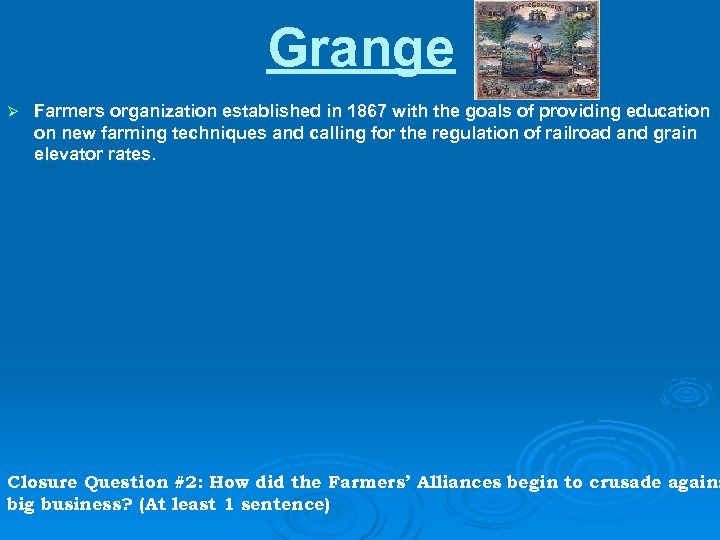 Grange Ø Farmers organization established in 1867 with the goals of providing education on new farming techniques and calling for the regulation of railroad and grain elevator rates. Closure Question #2: How did the Farmers’ Alliances begin to crusade agains big business? (At least 1 sentence)
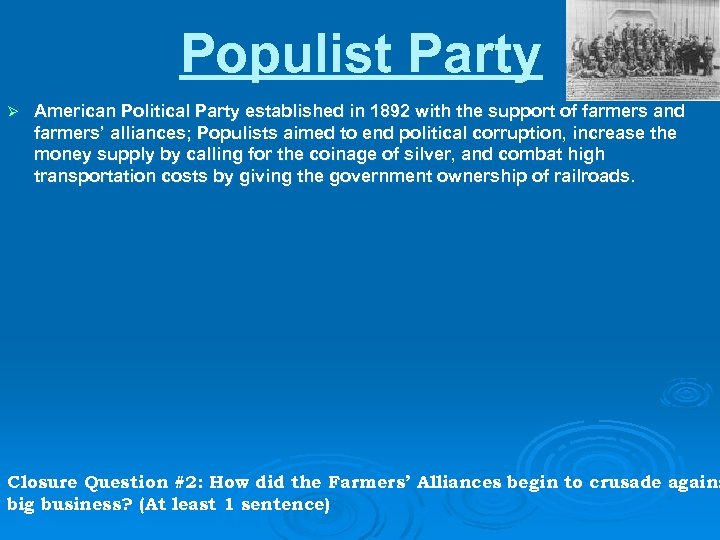 Populist Party Ø American Political Party established in 1892 with the support of farmers and farmers’ alliances; Populists aimed to end political corruption, increase the money supply by calling for the coinage of silver, and combat high transportation costs by giving the government ownership of railroads. Closure Question #2: How did the Farmers’ Alliances begin to crusade agains big business? (At least 1 sentence)
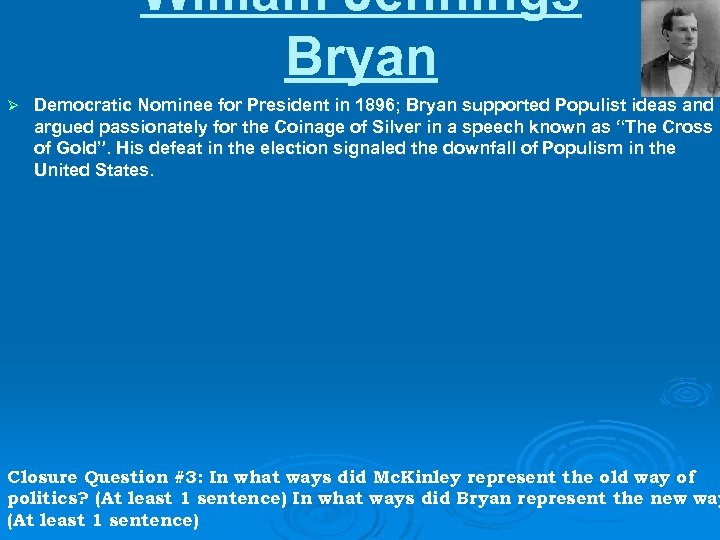 William Jennings Bryan Ø Democratic Nominee for President in 1896; Bryan supported Populist ideas and argued passionately for the Coinage of Silver in a speech known as “The Cross of Gold”. His defeat in the election signaled the downfall of Populism in the United States. Closure Question #3: In what ways did Mc. Kinley represent the old way of politics? (At least 1 sentence) In what ways did Bryan represent the new way (At least 1 sentence)
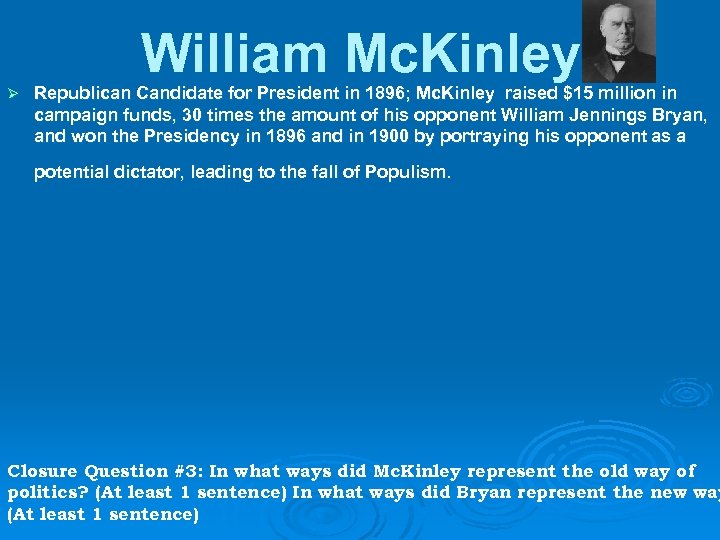 William Mc. Kinley Ø Republican Candidate for President in 1896; Mc. Kinley raised $15 million in campaign funds, 30 times the amount of his opponent William Jennings Bryan, and won the Presidency in 1896 and in 1900 by portraying his opponent as a potential dictator, leading to the fall of Populism. Closure Question #3: In what ways did Mc. Kinley represent the old way of politics? (At least 1 sentence) In what ways did Bryan represent the new way (At least 1 sentence)
 Closure Assignment #3 Ø 1. 2. 3. Working in groups of 4, use your notes from Chapter 16, Section 3 to answer the following questions: How did the deflation, or decrease, in the money supply in the late 1800 s affect farmers? (At least 1 sentence) How did the Farmers’ Alliances begin to crusade against big business? (At least 1 sentence) In what ways did Mc. Kinley represent the old way of politics? (At least 1 sentence) In what ways did Bryan represent the new way? (At least 1 sentence)
 Muckrakers / Lincoln Steffens Muckrakers - Socially conscious journalists and other writers who uncovered a wide-range of problems in American society. Their articles, appearing in newspapers and magazines nationwide, shocked angered mainstream Americans, creating the social environment conducive to the Progressive movement. Ø Lincoln Steffens – Editor of Mc. Clure’s Magazine and leading muckraker; Steffens published The Shame of the Cities, exposing political corruption. Ø Closure Question #1: What problems did muckrakers expose and what effects did their work have on Progressive reform? (At least 2 problems and 1 sentence)
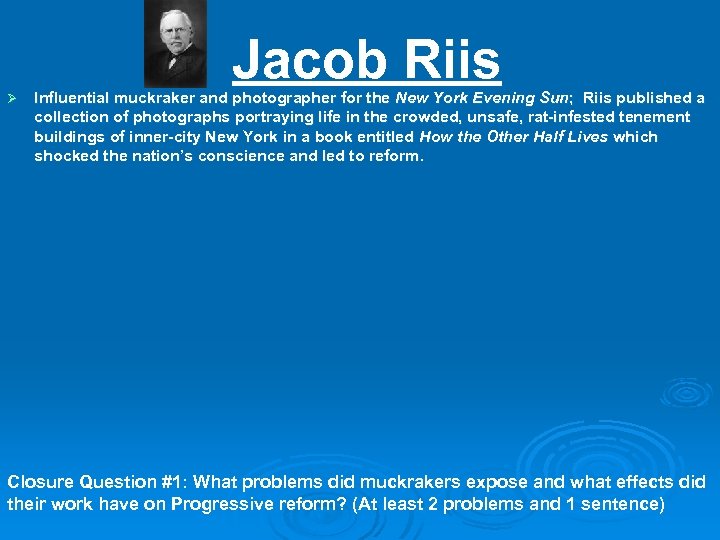 Jacob Riis Ø Influential muckraker and photographer for the New York Evening Sun; Riis published a collection of photographs portraying life in the crowded, unsafe, rat-infested tenement buildings of inner-city New York in a book entitled How the Other Half Lives which shocked the nation’s conscience and led to reform. Closure Question #1: What problems did muckrakers expose and what effects did their work have on Progressive reform? (At least 2 problems and 1 sentence)
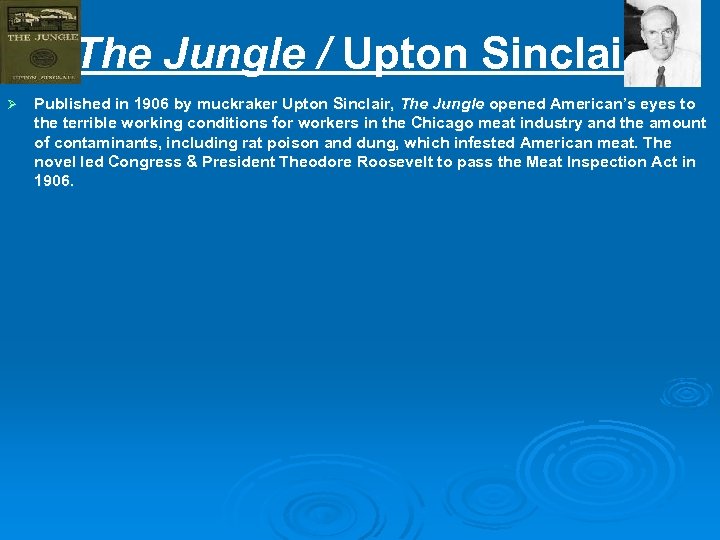 The Jungle / Upton Sinclair Ø Published in 1906 by muckraker Upton Sinclair, The Jungle opened American’s eyes to the terrible working conditions for workers in the Chicago meat industry and the amount of contaminants, including rat poison and dung, which infested American meat. The novel led Congress & President Theodore Roosevelt to pass the Meat Inspection Act in 1906.
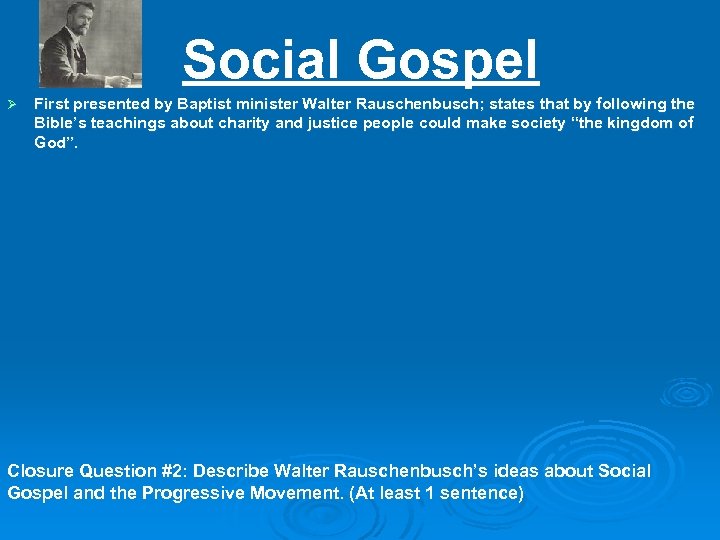 Social Gospel Ø First presented by Baptist minister Walter Rauschenbusch; states that by following the Bible’s teachings about charity and justice people could make society “the kingdom of God”. Closure Question #2: Describe Walter Rauschenbusch’s ideas about Social Gospel and the Progressive Movement. (At least 1 sentence)
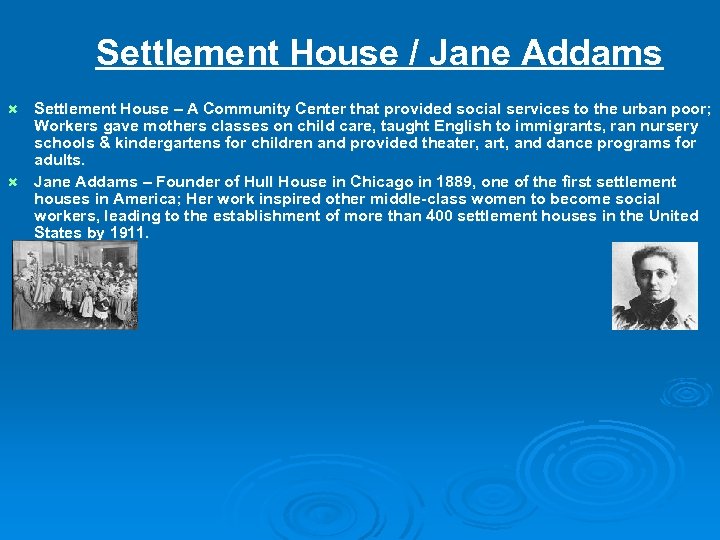 Settlement House / Jane Addams Settlement House – A Community Center that provided social services to the urban poor; Workers gave mothers classes on child care, taught English to immigrants, ran nursery schools & kindergartens for children and provided theater, art, and dance programs for adults. Jane Addams – Founder of Hull House in Chicago in 1889, one of the first settlement houses in America; Her work inspired other middle-class women to become social workers, leading to the establishment of more than 400 settlement houses in the United States by 1911.
 Initiative Direct Primary – An election in which citizens vote to select nominees for upcoming elections; thanks to the work of Progressives by 1916, all but 4 states had direct primaries. Ø Initiative – Progressive political reform which gives citizens the power to put a proposed new law directly on the ballot in the next election by collecting citizens’ signatures on a petition. Ø Closure Question #3: Which groups in American society might have opposed Progressive reform? Explain. (At least 1 sentence)
 Referendum / Recall Referendum – Progressive political reform which allows citizens to approve or reject laws passed by a legislature. Ø Recall – Gives voters the power to remove public servants from office before their term has ended. Ø Closure Question #3: Which groups in American society might have opposed Progressive reform? Explain. (At least 1 sentence)
 Closure Assignment #4 Based on the material covered from Chapter 17, Section 1, answer the following questions: 1. What problems did muckrakers expose and what effects did their work have on Progressive reform? (At least 2 problems and 1 sentence) 2. Describe Walter Rauschenbusch’s ideas about Social Gospel and the Progressive Movement. (At least 1 sentence) 3. Which groups in American society might have opposed Progressive reform? Explain. (At least 1 sentence) Ø
 Florence Kelley / Margaret Sanger Florence Kelley – Founder of the National Consumers League (NCL) in 1889; Kelley established the NCL to urge women to buy products that were produced under fair and safe working conditions at a fair price and avoid buying products that were produced using unsafe or unsanitary methods. Ø Margaret Sanger – Believing that family life and women’s healthy would improve if mothers had fewer children, Sanger opened America’s first birthcontrol clinic in 1916 and, in 1921, founded the American Birth Control League to make birth control information available to women across the country. Ø Closure Question #1: Why would education have led middle-class women to address societal problems? (At least 1 sentence)
 Carrie Chapman Catt / Alice Paul Carrie Chapman Catt –President of the NAWSA (National American Woman Suffrage Association) beginning in 1900; Catt’s political efforts, including the referendum process, & social efforts, recruiting wealthy & well-educated women to the cause, were keys in winning the right to vote for women in 1919. Ø Alice Paul – Social Activist in the women’s rights movement in the early 1900 s; Paul formed the National Woman’s Party (NWP) in 1917 to organize protest marches for suffrage. The NWP was the 1 st group to march with picket signs outside the White House, and hundreds of women were arrested in protests. Ø Closure Question #2: Choose one specific social problem and explain how Progressive women reformers proposed to solve that problem. (1 sentence)
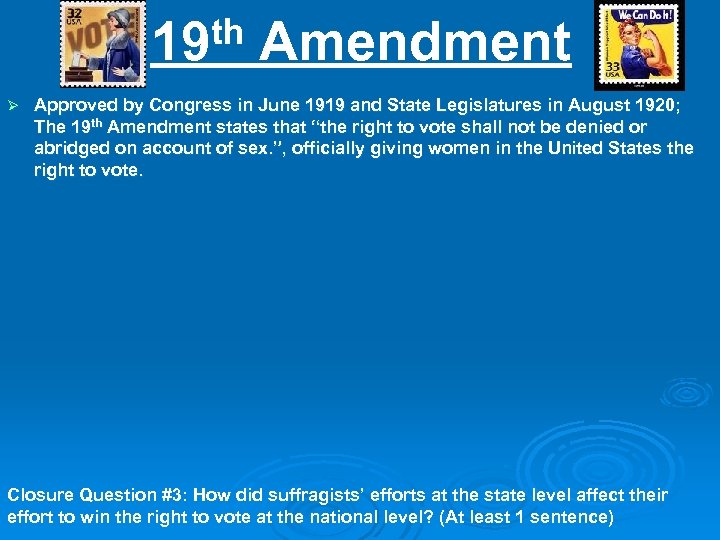 th 19 Ø Amendment Approved by Congress in June 1919 and State Legislatures in August 1920; The 19 th Amendment states that “the right to vote shall not be denied or abridged on account of sex. ”, officially giving women in the United States the right to vote. Closure Question #3: How did suffragists’ efforts at the state level affect their effort to win the right to vote at the national level? (At least 1 sentence)
 Closure Assignment #5 Based on the material covered from Chapter 17, Section 2, answer the following questions: 1. Why would education have led middle-class women to address societal problems? (At least 1 sentence) 2. Choose one specific social problem and explain how Progressive women reformers proposed to solve that problem. (At least 1 sentence) 3. How did suffragists’ efforts at the state level affect their effort to win the right to vote at the national level? (At least 1 sentence) Ø
 Niagara Movement / NAACP Niagara Movement – Group of African Americans opposed to discrimination established by W. E. B. Dubois and William Monroe Trotter in 1905; the group attacked Booker T. Washington’s willingness to compromise the rights of African Americans. The movement had a great influence on the formation of the NAACP. Ø NAACP (National Association for the Advancement of Colored People) – Est. in 1909 & led by white & black progressives, including Addams, Kelley, & Dubois; The NAACP aimed to help African Americans “be physically free from low-paid labor, mentally free from ignorance, politically free from disfranchisement, & socially free from insult. ” Ø
 Closure Question #1: How did Progressives’ views about race and values foster prejudice? (At least 1 sentence) Many Progressives shared the same prejudice against nonwhites held by other white Americans of the time. They believed that some people were more fit that others to play a leading role in society. They agreed with socalled scientific theories that said that dark skinned peoples had less intelligence than whites. In the late 1800 s, southern Progressives used these misguided theories to justify the passage of laws that kept African Americans from voting. Some southern Progressives urged an end to the violence and terrorism waged against African Americans. Ø Edgar Gardner Murphy, an Episcopal minister and a leading Alabama Progressive, advised that African Americans “will accept in the white man’s country the place assigned him by the white man… not by stress of rivalry, but by genial cooperation with the white man’s interests. After the Supreme Court issued its Plessy v. Ferguson decision, states across the North and the South had passed segregation laws. By 1910, segregation was the norm across the nation. After 1914, even the offices of the federal government in Washington D. C. were segregated as a result of policies approved by President Woodrow Wilson, a Progressive. Ø
 Urban League Ø Established in 1911 as an association of clubs and churches that helped African Americans settle and find work in America’s cities; the Urban League helped families buy clothes and books and send children to school while helping factory workers and maids find jobs. Closure Question #2: What do the differing approaches of Booker T. Washington and W. E. B. Du Bois suggest about their views of American society? (At least 2 sentences)
 Ø Anti-Defamation League – Established in 1913 by Jews in New York in response to growing anti-Semitism. Its goal was and is to defend Jews and others against physical and verbal attacks, false statements, and “to secure justice and fair treatment to all citizens alike…” Closure Question #3: Were the goals and actions of the mutualistas more similar to the of the Urban League or to those of the Anti-Defamation League? Explain. (At least 1 sentence)
 Mutualistas Ø Groups of Mexican Americans formed in several states which made loans, provided legal assistance and provided health insurance to needy families. Closure Question #3: Were the goals and actions of the mutualistas more similar to the of the Urban League or to those of the Anti-Defamation League? Explain. (At least 1 sentence)
 Closure Assignment #6 Based on the material covered from Chapter 17, Section 3, answer the following questions: 1. How did Progressives’ views about race and values foster prejudice? (At least 1 sentence) 2. What do the differing approaches of Booker T. Washington and W. E. B. Du Bois suggest about their views of American society? (At least 2 sentences) 3. Were the goals and actions of the mutualistas more similar to the of the Urban League or to those of the Anti-Defamation League? Explain. (At least 1 sentence) Ø
 Theodore Roosevelt / Square Deal Theodore Roosevelt – Republican President from 1901 to 1909; Roosevelt was Vice-President to William Mc. Kinley in the election of 1901 and became President as a result of Mc. Kinley’s assassination. Previously he had served as Governor of New York & led American forces in Cuba during the Spanish. American War. He was only 43 years old when he became President and was the first Progressive President. Ø Square Deal – Phrase coined by Roosevelt to describe his political policy; Roosevelts goals were to keep the wealthy and powerful from taking advantage of small businesses owners and the poor. Ø Closure Question #1: What impact did Roosevelt’s actions have on the government’s role in the economy? (At least 1 sentence)
 Hepburn Act Ø Reform act supported by Roosevelt and passed by Congress in 1906; the Hepburn Act gave the ICC the authority to set and limit shipping costs and set maximum prices for ferries, bridge tolls, and oil pipelines. Closure Question #1: What impact did Roosevelt’s actions have on the government’s role in the economy? (At least 1 sentence)
 Meat Inspection Act / Pure Food & Drug Act Meat Inspection Act – Reform passed in 1906 following the publication of The Jungle by Upton Sinclair; The act provided federal agents to inspect any meat sold across state lines and required federal inspection of meat-processing plants. Ø Pure Food & Drug Act – Reform passed in 1906 which provided federal agents to inspect foods and medicines sold across state lines and banned the interstate shipment of impure food & the mislabeling of food and drugs. Ø Closure Question #1: What impact did Roosevelt’s actions have on the government’s role in the economy? (At least 1 sentence)
 Gifford Pinchot / National Reclamation Act Gifford Pinchot – Leader of the Division of Forestry in the U. S. Department of Agriculture during Roosevelt’s presidency; Pinchot believed that forests should be preserved for public use, meaning that forests should be protected so that trees would have time to mature into good lumber. Ø National Reclamation Act – Reform passed in 1902 which gave the federal government the power to decide where and how water would be distributed. Ø Closure Question #2: How did Theodore Roosevelt’s national forest policy reflect his ideas about conservation and preservation? (At least 1 sentence)
 New Nationalism / Progressive Party New Nationalism – Roosevelt’s program to restore the government’s trustbusting power in 1911; Roosevelt began the program after a disagreement with his successor as President, William H. Taft. Ø Progressive Party – Political party established in 1912 branching off from the Republican Party; Progressives left the Republican Party as a result of the disagreement between President Taft and Roosevelt and nominated Theodore Roosevelt as their candidate for President. Ø Closure Question #3: How were the goals and actions of Wilson’s New Freedom similar to Roosevelt’s New Nationalism? How were they different? (At least 2 sentences)
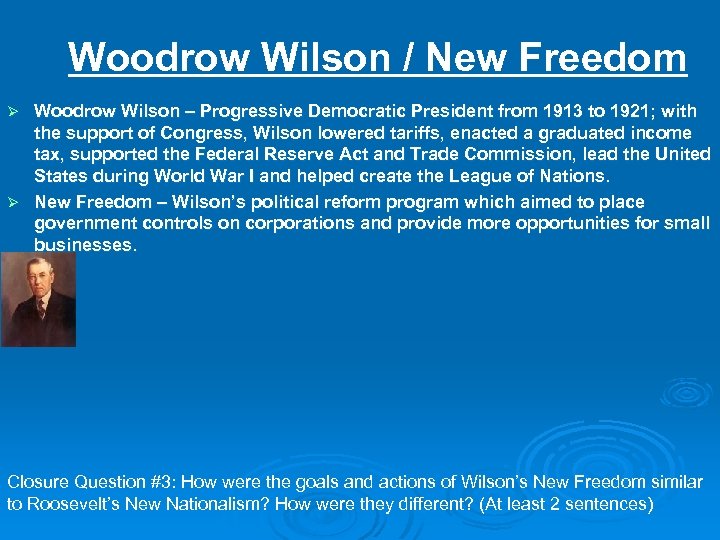 Woodrow Wilson / New Freedom Woodrow Wilson – Progressive Democratic President from 1913 to 1921; with the support of Congress, Wilson lowered tariffs, enacted a graduated income tax, supported the Federal Reserve Act and Trade Commission, lead the United States during World War I and helped create the League of Nations. Ø New Freedom – Wilson’s political reform program which aimed to place government controls on corporations and provide more opportunities for small businesses. Ø Closure Question #3: How were the goals and actions of Wilson’s New Freedom similar to Roosevelt’s New Nationalism? How were they different? (At least 2 sentences)
 16 th Amendment / Federal Reserve Act 16 th Amendment – Passed in 1913, the amendment gave Congress the power to establish a graduated income tax, which is a tax in which the wealthy pay a higher percentage of their income than do poor people. Ø Federal Reserve Act – Passed in 1913, this law placed national banks under the control of a Federal Reserve Board, which a) set up regional banks to hold reserve funds for commercial banks, b) sets the interest rate that banks pay to borrow money from other banks and c) supervises banks to make sure they are well run. Ø
 Federal Trade Commission / Clayton Antitrust Act Federal Trade Commission – Created by Congress in 1914, members of this group monitor business practices that might lead to monopoly and watches out for false advertising or dishonest labeling on products sold in the United States. Ø Clayton Antitrust Act – Passed in 1914; strengthened earlier antitrust laws by spelling out specific actions businesses could not do. Ø
 Closure Assignment #7 Based on the material covered from Chapter 17, Sections 4 & 5, answer the following three questions in Box #4 of your closure sheet: 1. What impact did Roosevelt’s actions have on the government’s role in the economy? (At least 1 sentence) 2. How did Theodore Roosevelt’s national forest policy reflect his ideas about conservation and preservation? (At least 1 sentence) 3. How were the goals and actions of Wilson’s New Freedom similar to Roosevelt’s New Nationalism? How were they different? (At least 2 sentences) Ø