


 Скачать презентацию Issues in Enhancing Model Reuse C Michael Overstreet
43311ae73d238cc13c912424d9eeb4d5.ppt
- Количество слайдов: 18
 Issues in Enhancing Model Reuse C. Michael Overstreet cmo@cs. odu. edu Richard E. Nance nance@vt. edu Osman Balci balci@vt. edu Jan. 29, 2002 Grand Challenges in Simulation
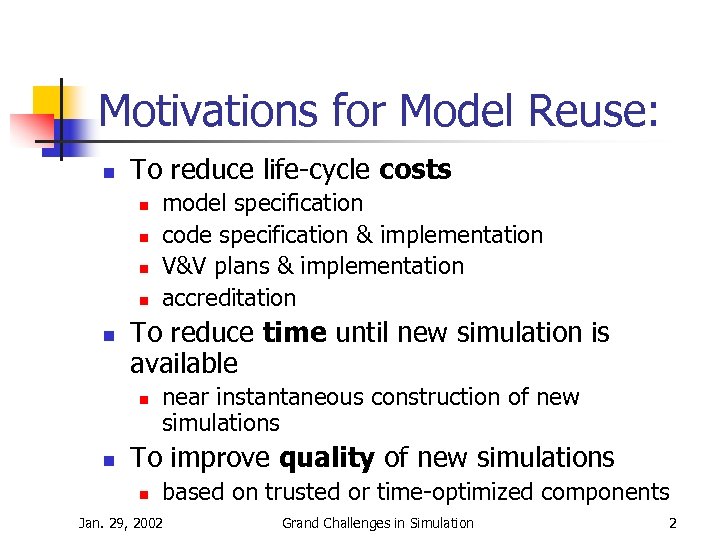 Motivations for Model Reuse: n To reduce life-cycle costs n n n To reduce time until new simulation is available n n model specification code specification & implementation V&V plans & implementation accreditation near instantaneous construction of new simulations To improve quality of new simulations n based on trusted or time-optimized components Jan. 29, 2002 Grand Challenges in Simulation 2
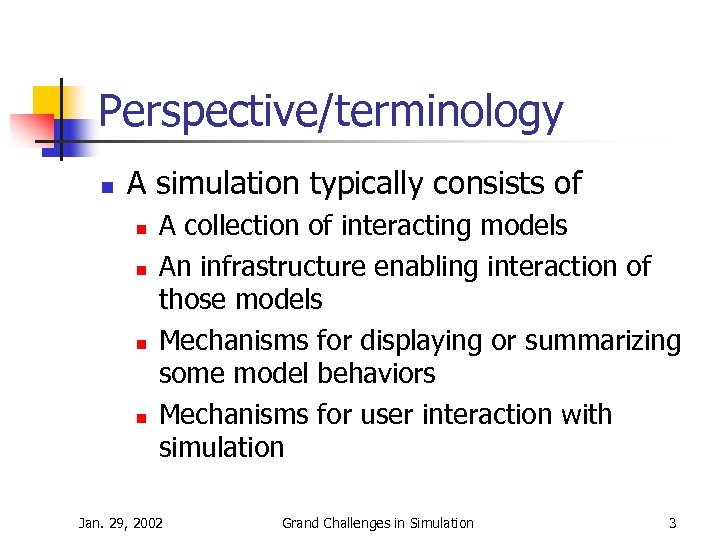 Perspective/terminology n A simulation typically consists of n n A collection of interacting models An infrastructure enabling interaction of those models Mechanisms for displaying or summarizing some model behaviors Mechanisms for user interaction with simulation Jan. 29, 2002 Grand Challenges in Simulation 3
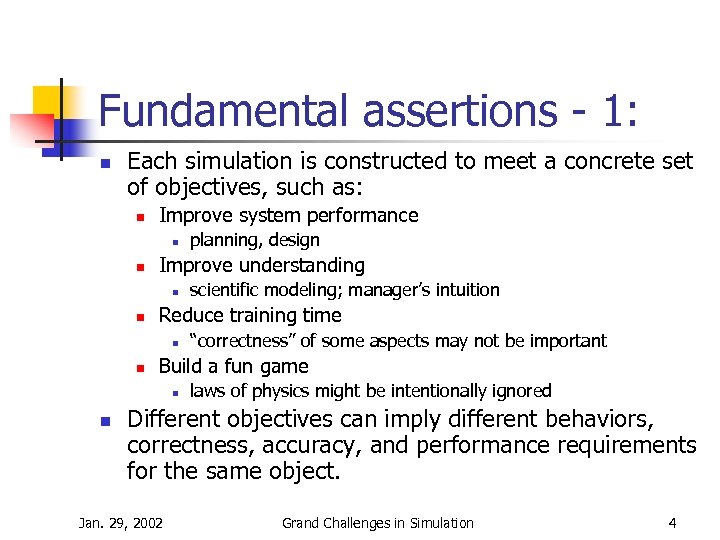 Fundamental assertions - 1: n Each simulation is constructed to meet a concrete set of objectives, such as: n Improve system performance n n Improve understanding n n “correctness” of some aspects may not be important Build a fun game n n scientific modeling; manager’s intuition Reduce training time n n planning, design laws of physics might be intentionally ignored Different objectives can imply different behaviors, correctness, accuracy, and performance requirements for the same object. Jan. 29, 2002 Grand Challenges in Simulation 4
 Fundamental assertions - 2: n n n Objectives determine desired behaviors of models. Desired behaviors determine model content. Models are based on abstractions and assumptions. Appropriateness of abstractions depends on desired behaviors. The models used in simulations reflect sometimes subtle tradeoffs of speed, accuracy, included features, costs. Jan. 29, 2002 Grand Challenges in Simulation 5
 Thus: Model reuse must take both original and new objectives into consideration; valid reuse requires consistency between the two sets of objectives. n Similarly for model assumptions and constraints n Jan. 29, 2002 Grand Challenges in Simulation 6
 Occam’s view of simulation: n The simplest, minimal model is best: n n n Ease of understanding Quicker implementation Reduced debugging effort Likely most run-time efficient Improve reuse potential n n n easier modification, if needed Bias towards elegance Thus models should be just barely good enough to meet objectives. Jan. 29, 2002 Grand Challenges in Simulation 7
 Economic facts of simulation: n n Costs are in development & CPU cycles are free. Tyranny of better software and cheaper hardware: n n n User “needs” are often quite elastic; if it’s not too expensive, it’s a requirement. Faster, cheap hardware results in unanticipated new uses of simulations (e. g. , real-time decision support) Many of today’s simulations will be perceived as inadequate tomorrow. Jan. 29, 2002 Grand Challenges in Simulation 8
 Conflicting user needs n n n Create “total immersion” interactive environment Create believable environment Create new simulations on demand Create simulations cheaply Incorrect behavior unacceptable Some incorrectness required n n n Games Tutorials Execution efficiency vital Jan. 29, 2002 Grand Challenges in Simulation 9
 Example levels of reuse n Plug ‘n play: no changes necessary n n Existing model “easily” altered to provide new or modified behaviors n n Mod. SAF a successful example Can result in significant cost benefit Modeling approach useful in new domain n Reuse concepts, architecture, designs, etc. Jan. 29, 2002 Grand Challenges in Simulation 10
 Impossible goal: automated reuse of arbitrary models? n n Page & Opper showed that deciding if a collection of models meets a set of objectives is NP-complete. Overstreet & Nance showed that deciding if two models are equivalent is unsolvable. Jan. 29, 2002 Grand Challenges in Simulation 11
 Feasible goal: automated reuse of specially constructed models n n Mod. SAF (One. SAF): can build “new” simulation by combining existing library of models as needed. Each model is built from consistent set of objectives so that it will interact with other models correctly. Adding a new model to library requires that it be built in conformance to these objectives. A slight change in objectives could mean that reuse of these models is undesirable. Jan. 29, 2002 Grand Challenges in Simulation 12
 Key reuse issues: research needed - 1 n n Determining how to locate potentially reusable models. Detecting incompatible objectives among selected models. Detecting incompatible assumptions among selected models. Building models in such a way that reuse potential is enhanced. Jan. 29, 2002 Grand Challenges in Simulation 13
 Key reuse issues: research needed - 2 n n Determining the level of granularity that best enhances reuse potential. Capturing and representing the objectives, constraints and assumptions of each model. Determining if constraints (such as speed, memory) will be met with selected collection of models. If individual models are valid, what does this imply about a new combination? Jan. 29, 2002 Grand Challenges in Simulation 14
 Comments on issues n Many of these issues are well know to designers of Simulation Programming Languages, for example, granularity: n GPSS (and many current simulation programming languages) consists of a collection of reusable models, each easily parameterized. n n But building a new simulation is like writing a new program from scratch. Use of high level components results in faster development but loss of flexibility Jan. 29, 2002 Grand Challenges in Simulation 15
 No single solution n Execution overhead: n n n Some models are run once and thrown away Some model executions must meet real-time deadlines Some are execution intensive but not real-time Some models need only be suggestive (wake of a ship at sea); others must be highly precise (fluid flow about a supersonic wing). A solution should be less expensive than the problem it solves n we need both quick & dirty simulations and welldocumented, highly reusable simulations Jan. 29, 2002 Grand Challenges in Simulation 16
 Summary - 1 n n n Reuse is, in large part, motivated by economics. The changing economics of computing changes the models we choose to build. The changing economics of computing changes the economics of reuse. Jan. 29, 2002 Grand Challenges in Simulation 17
 Summary - 2 n n Key to reuse is the capturing of objectives, assumptions and constraints. Models can be designed for reuse, but it appears feasible only when original objectives are compatible. Completely automated reuse appears economically infeasible Automated support is more likely economical. Jan. 29, 2002 Grand Challenges in Simulation 18