


 Скачать презентацию Issues in Data Mining Infrastructure Authors Nemanja Jovanovic
2e63dacc0314da192346d77dcbc53981.ppt
- Количество слайдов: 57
 Issues in Data Mining Infrastructure Authors: Nemanja Jovanovic, nemko@acm. org Valentina Milenkovic, tina@eunet. yu Prof. Dr. Veljko Milutinovic, vm@etf. bg. ac. yu http: //galeb. etf. bg. ac. yu/~vm 1
 Data Mining in the Nutshell § Uncovering the hidden knowledge § Huge n-p complete search space § Multidimensional interface 2
 A Problem … You are a marketing manager for a cellular phone company § Problem: Churn is too high § Turnover (after contract expires) is 40% § Customers receive free phone (cost 125$) with contract § You pay a sales commission of 250$ per contract § Giving a new telephone to everyone whose contract is expiring is very expensive (as well as wasteful) § Bringing back a customer after quitting is both difficult and expensive 3
 … A Solution § Three months before a contract expires, predict which customers will leave § If you want to keep a customer that is predicted to churn, offer them a new phone § The ones that are not predicted to churn need no attention § If you don’t want to keep the customer, do nothing § How can you predict future behavior? § Tarot Cards? § Magic Ball? § Data Mining? 4
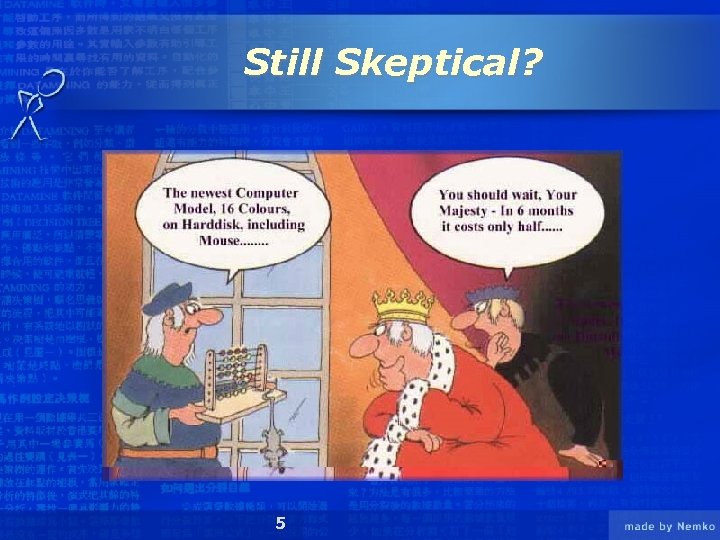 Still Skeptical? 5
 The Definition The automated extraction of predictive information from (large) databases § Automated § Extraction § Predictive § Databases 6
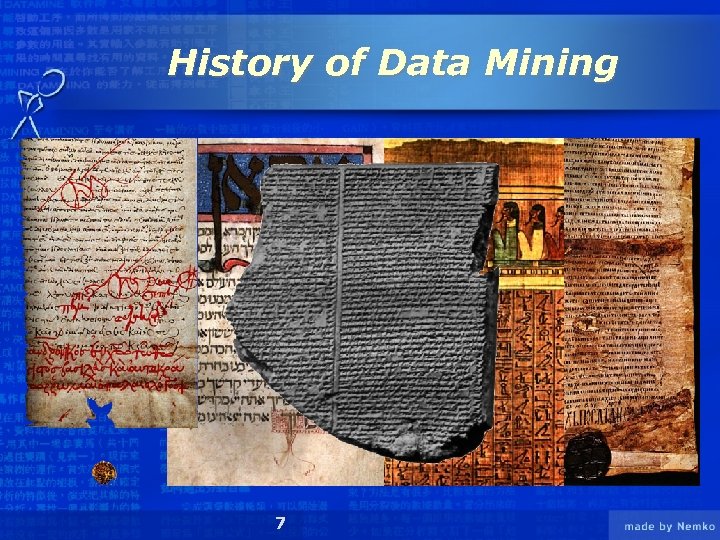 History of Data Mining 7
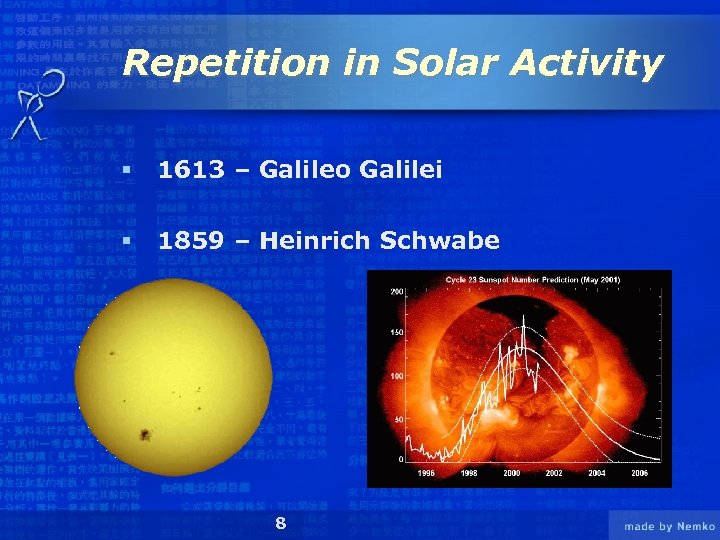 Repetition in Solar Activity § 1613 – Galileo Galilei § 1859 – Heinrich Schwabe 8
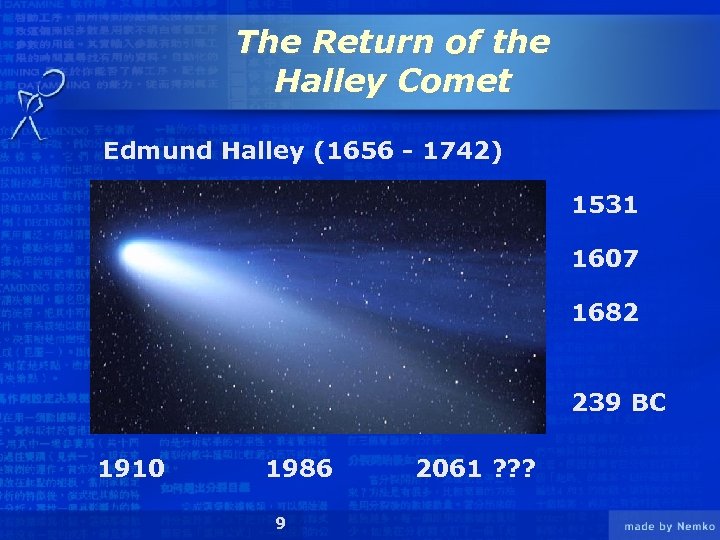 The Return of the Halley Comet Edmund Halley (1656 - 1742) 1531 1607 1682 239 BC 1910 1986 9 2061 ? ? ?
 Data Mining is Not § Data warehousing § Ad-hoc query/reporting § Online Analytical Processing (OLAP) § Data visualization 10
 Data Mining is § Automated extraction of predictive information from various data sources § Powerful technology with great potential to help users focus on the most important information stored in data warehouses or streamed through communication lines 11
 Data Mining can § Answer question that were too time consuming to resolve in the past § Predict future trends and behaviors, allowing us to make proactive, knowledge driven decision 12
 Focus of this Presentation § Data Mining problem types § Data Mining models and algorithms § Efficient Data Mining § Available software 13
 Data Mining Problem Types 14
 Data Mining Problem Types § 6 types § Often a combination solves the problem 15
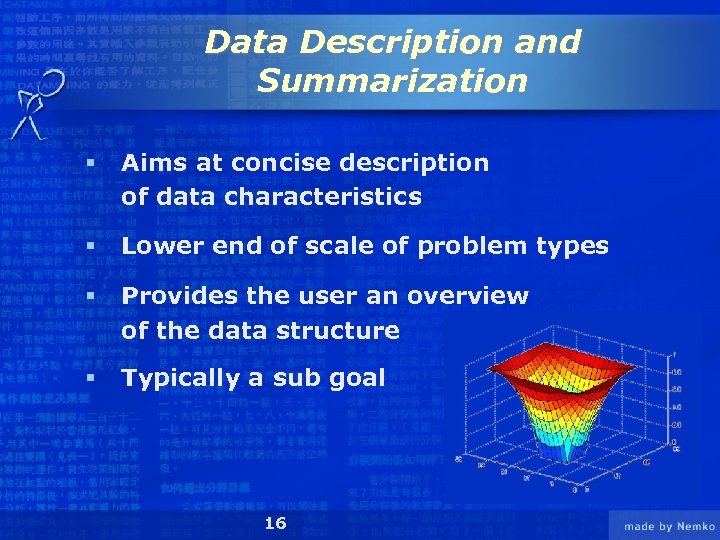 Data Description and Summarization § Aims at concise description of data characteristics § Lower end of scale of problem types § Provides the user an overview of the data structure § Typically a sub goal 16
 Segmentation § Separates the data into interesting and meaningful subgroups or classes § Manual or (semi)automatic § A problem for itself or just a step in solving a problem 17
 Classification § Assumption: existence of objects with characteristics that belong to different classes § Building classification models which assign correct labels in advance § Exists in wide range of various application § Segmentation can provide labels or restrict data sets 18
 Concept Description § Understandable description of concepts or classes § Close connection to both segmentation and classification § Similarity and differences to classification 19
 Prediction (Regression) § Finds the numerical value of the target attribute for unseen objects § Similar to classification - difference: discrete becomes continuous 20
 Dependency Analysis § Finding the model that describes significant dependences between data items or events § Prediction of value of a data item § Special case: associations 21
 Data Mining Models 22
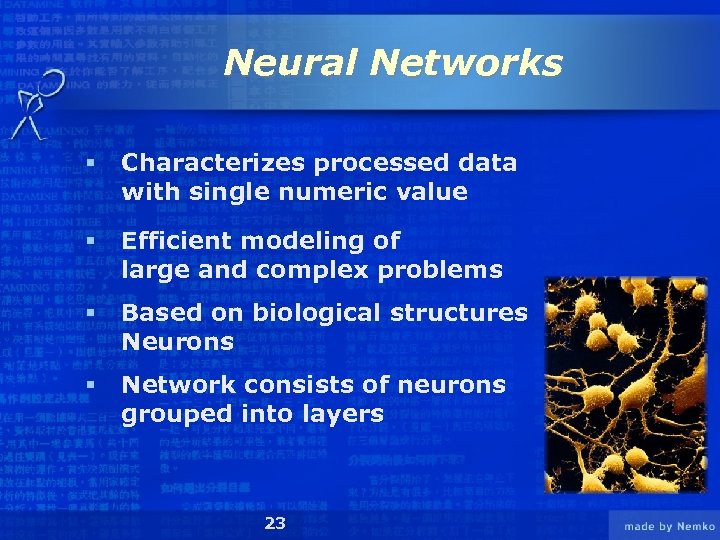 Neural Networks § Characterizes processed data with single numeric value § Efficient modeling of large and complex problems § Based on biological structures Neurons § Network consists of neurons grouped into layers 23
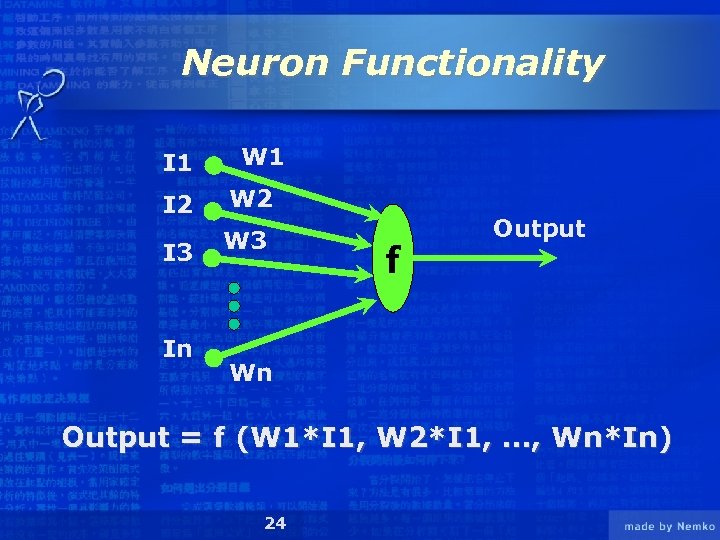 Neuron Functionality I 1 W 1 I 2 W 2 I 3 W 3 In f Output Wn Output = f (W 1*I 1, W 2*I 1, …, Wn*In) 24
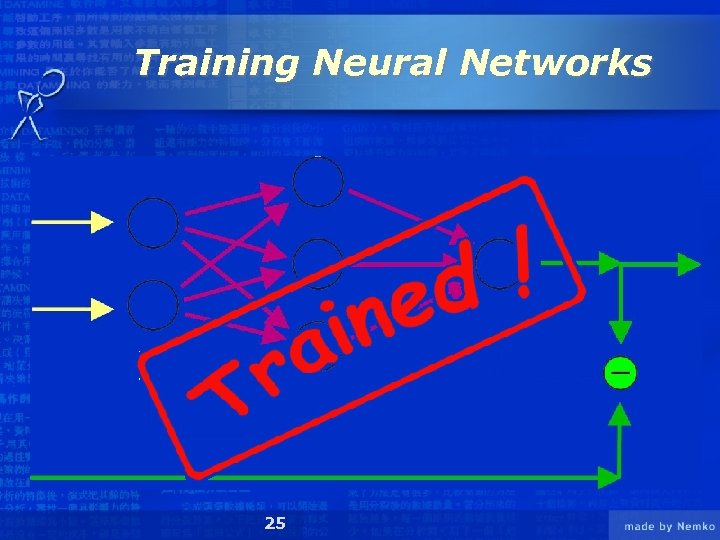 Training Neural Networks 25
 Neural Networks - Conclusion § Once trained, Neural Networks can efficiently estimate value of output variable for given input § Neurons and network topology are essentials § Usually used for prediction or regression problem types § Difficult to understand § Data pre-processing often required 26
 Decision Trees § A way of representing a series of rules that lead to a class or value § Iterative splitting of data into discrete groups maximizing distance between them at each split § Classification trees and regression trees § Univariate splits and multivariate splits § Unlimited growth and stopping rules § CHAID, CHART, Quest, C 5. 0 27
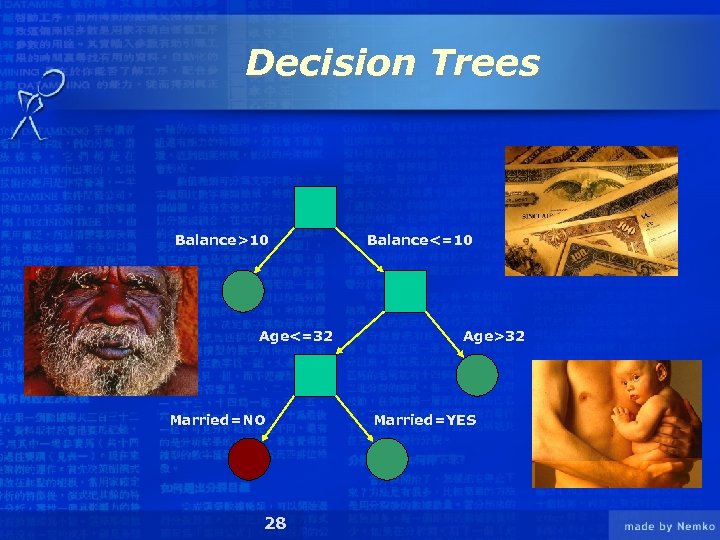 Decision Trees Balance>10 Age<=32 Married=NO 28 Balance<=10 Age>32 Married=YES
 Decision Trees 29
 Rule Induction § Method of deriving a set of rules to classify cases § Creates independent rules that are unlikely to form a tree § Rules may not cover all possible situations § Rules may sometimes conflict in a prediction 30
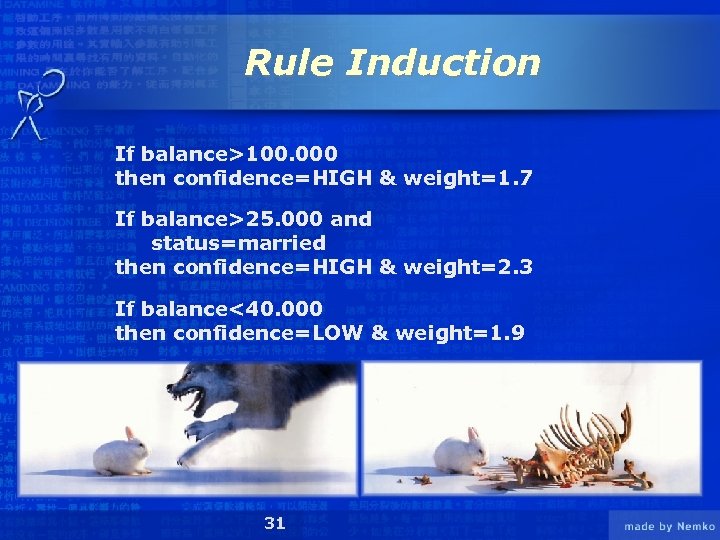 Rule Induction If balance>100. 000 then confidence=HIGH & weight=1. 7 If balance>25. 000 and status=married then confidence=HIGH & weight=2. 3 If balance<40. 000 then confidence=LOW & weight=1. 9 31
 K-nearest Neighbor and Memory-Based Reasoning (MBR) § Usage of knowledge of previously solved similar problems in solving the new problem § Assigning the class to the group where most of the k-”neighbors” belong § First step – finding the suitable measure for distance between attributes in the data § How far is black from green? § + Easy handling of non-standard data types § - Huge models 32
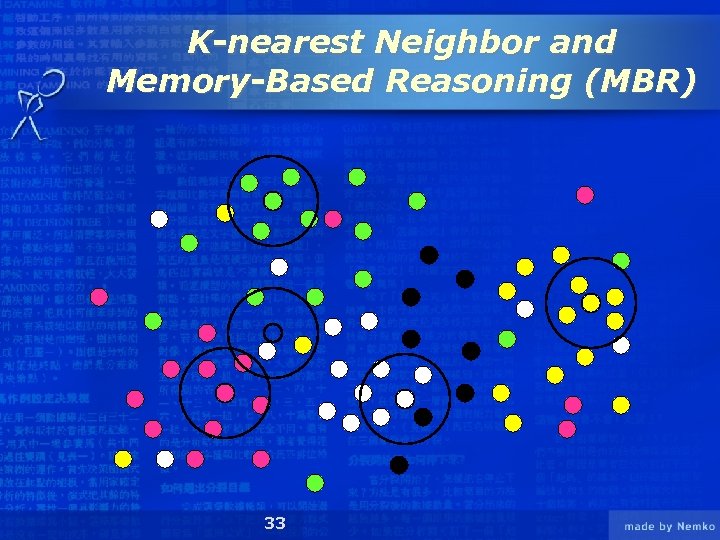 K-nearest Neighbor and Memory-Based Reasoning (MBR) 33
 Data Mining Models and Algorithms § Many other available models and algorithms § Logistic regression § Discriminant analysis § Generalized Adaptive Models (GAM) § Genetic algorithms § Etc… § Many application specific variations of known models § Final implementation usually involves several techniques § Selection of solution that match best results 34
 Efficient Data Mining 35
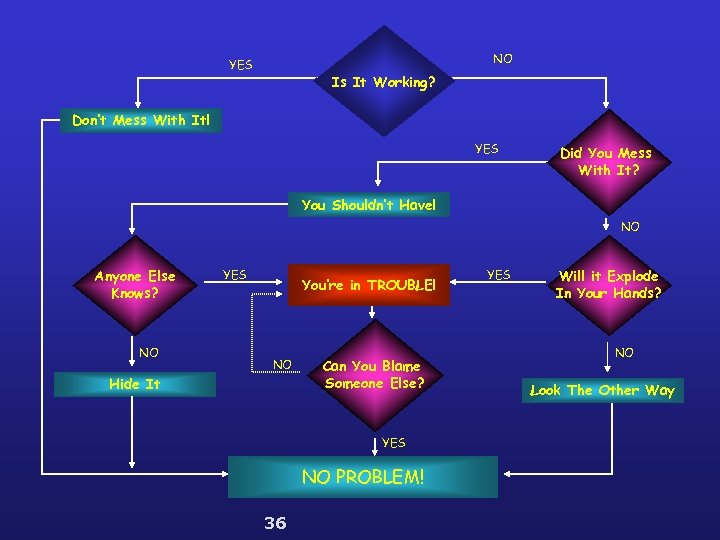 NO YES Is It Working? Don’t Mess With It! YES Did You Mess With It? You Shouldn’t Have! NO Anyone Else Knows? NO YES You’re in TROUBLE! NO Hide It Can You Blame Someone Else? YES NO PROBLEM! 36 YES Will it Explode In Your Hands? NO Look The Other Way
 DM Process Model § 5 A – used by SPSS Clementine (Assess, Access, Analyze, Act and Automate) § SEMMA – used by SAS Enterprise Miner (Sample, Explore, Modify, Model and Assess) § CRISP–DM – tends to become a standard 37
 CRISP - DM § CRoss-Industry Standard for DM § Conceived in 1996 by three companies: 38
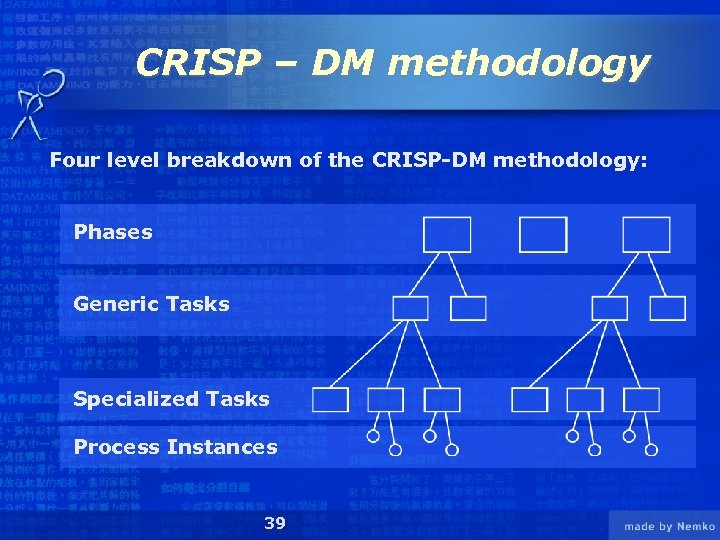 CRISP – DM methodology Four level breakdown of the CRISP-DM methodology: Phases Generic Tasks Specialized Tasks Process Instances 39
 Mapping generic models to specialized models § Analyze the specific context § Remove any details not applicable to the context § Add any details specific to the context § Specialize generic context according to concrete characteristic of the context § Possibly rename generic contents to provide more explicit meanings 40
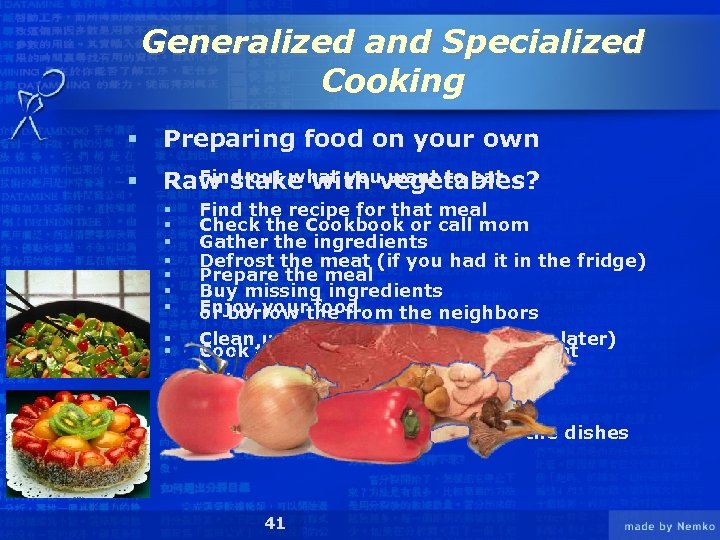 Generalized and Specialized Cooking § Preparing food on your own § § Find out what youvegetables? Raw stake with want to eat § § Find the recipe for that meal Check the Cookbook or call mom Gather the ingredients Defrost the meat (if you had it in the fridge) Prepare the meal Buy missing ingredients Enjoy yourthe from the neighbors or borrow food Clean up everything (or leave it for later) Cook the vegetables and fry the meat § Enjoy your food or even more § You were cooking so convince someone else to do the dishes § § § § 41
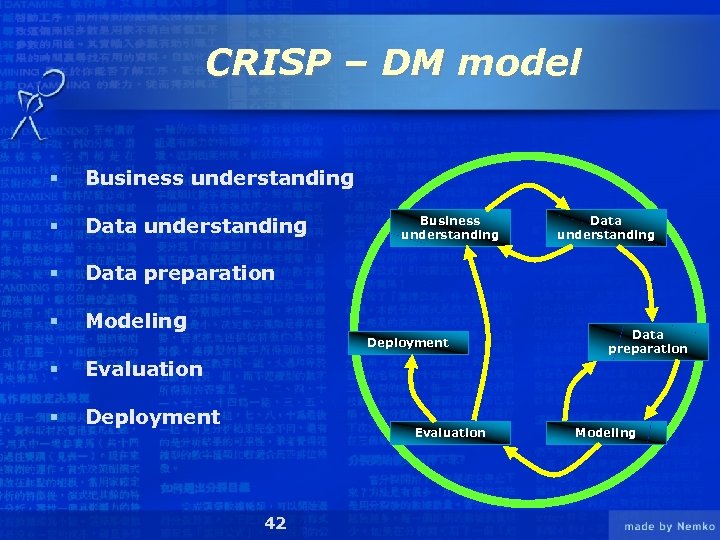 CRISP – DM model § Business understanding § Data preparation § Modeling Business understanding Deployment § Deployment Data preparation Evaluation § Data understanding Evaluation 42 Modeling
 Business Understanding § Determine business objectives § Assess situation § Determine data mining goals § Produce project plan 43
 Data Understanding § Collect initial data § Describe data § Explore data § Verify data quality 44
 Data Preparation § Select data § Clean data § Construct data § Integrate data § Format data 45
 Modeling § Select modeling technique § Generate test design § Build model § Assess model 46
 Evaluation results = models + findings § Evaluate results § Review process § Determine next steps 47
 Deployment § Plan deployment § Plan monitoring and maintenance § Produce final report § Review project 48
 At Last… 49
 Available Software 14 50
 Conclusions 51
 WWW. NBA. COM 52
 Se 7 en 53
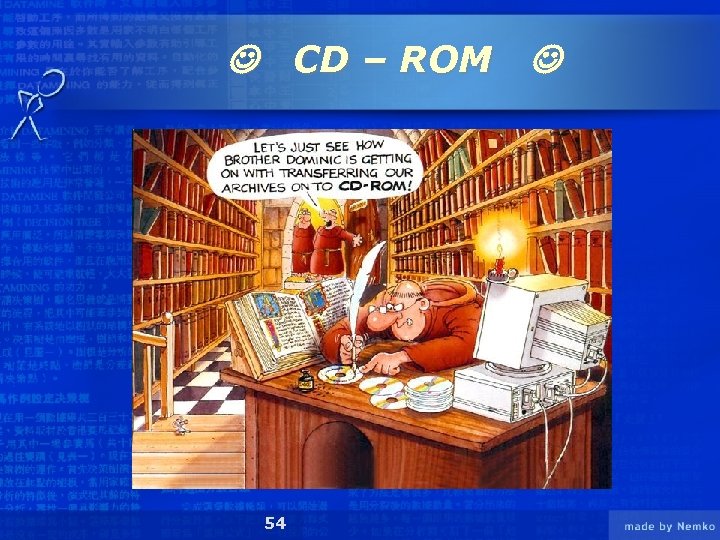 CD – ROM 54
 Credits Anne Stern, SPSS, Inc. Djuro Gluvajic, ITE, Denmark Obrad Milivojevic, PC PRO, Yugoslavia 55
 References § Bruha, I. , ‘Data Mining, KDD and Knowledge Integration: Methodology and A case Study”, SSGRR 2000 § Fayyad, U. , Shapiro, P. , Smyth, P. , Uthurusamy, R. , “Advances in Knowledge Discovery and Data Mining”, MIT Press, 1996 § Glumour, C. , Maddigan, D. , Pregibon, D. , Smyth, P. , “Statistical Themes nad Lessons for Data Mining”, Data Mining And Knowledge Discovery 1, 11 -28, 1997 § Hecht-Nilsen, R. , “Neurocomputing”, Addison-Wesley, 1990 § Pyle, D. , “Data Preparation for Data Mining”, Morgan Kaufman, 1999 § galeb. etf. bg. ac. yu/~vm § www. thearling. com § www. crisp-dm. com § www. twocrows. com § www. sas. com/products/miner § www. spss. com/clementine 56
 The END 57