


 Скачать презентацию Issues and trends in science teacher education in
9ca4be00cb37d28455cd74badb31d253.ppt
- Количество слайдов: 16
 Issues and trends in science teacher education in Taiwan Huann-shyang Lin National Sun Yat-sen University, Taiwan
 Topics to be addressed • Brief introduction of Taiwan’s educational system. • Critical changes in the past two decades. • Challenges and critical issues.
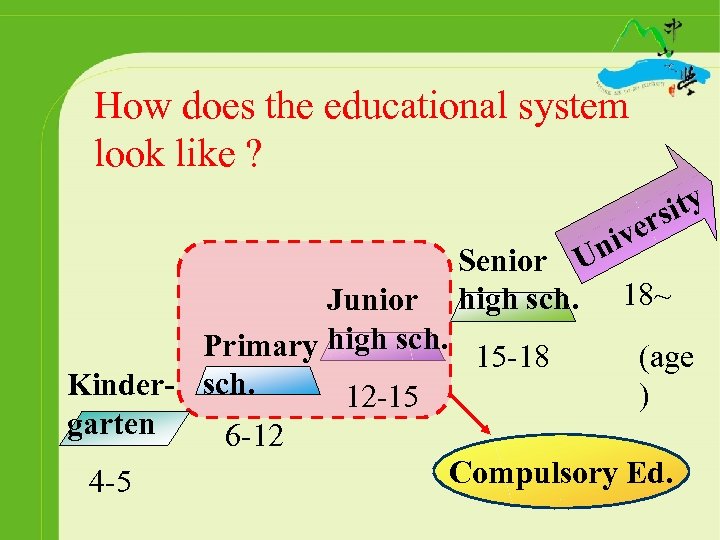 How does the educational system look like ? ity ers iv Senior Un high sch. 18~ Junior Primary high sch. 15 -18 Kinder- sch. 12 -15 garten 6 -12 4 -5 (age ) Compulsory Ed.
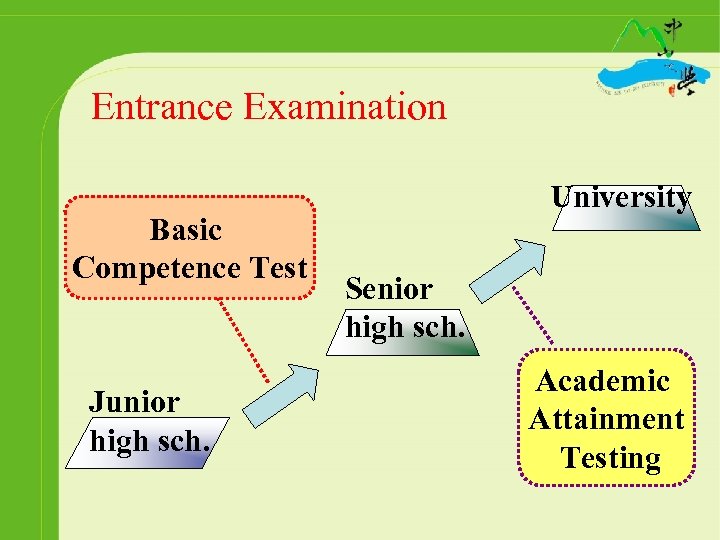 Entrance Examination Basic Competence Test Junior high sch. University Senior high sch. Academic Attainment Testing
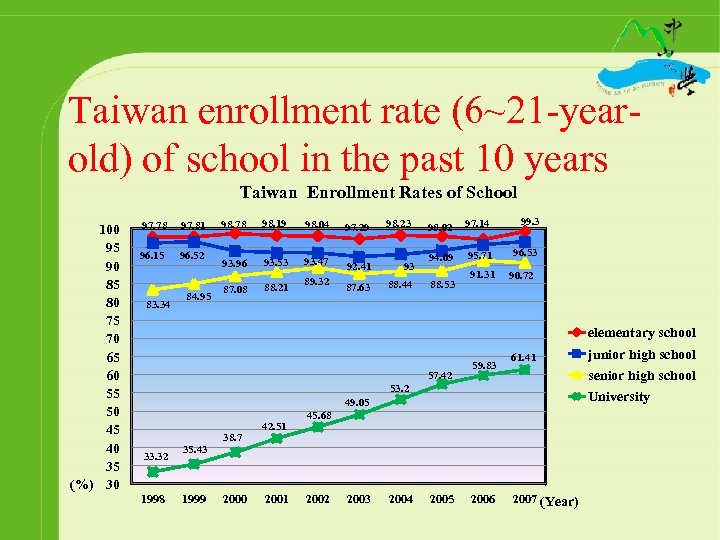 Taiwan enrollment rate (6~21 -yearold) of school in the past 10 years Taiwan Enrollment Rates of School 100 95 90 85 80 75 70 65 60 55 50 45 40 35 (%) 30 97. 78 97. 81 96. 15 96. 52 83. 34 84. 95 98. 78 98. 19 98. 04 93. 96 93. 53 93. 47 87. 08 88. 21 89. 32 97. 29 98. 23 92. 41 93 87. 63 88. 44 98. 02 97. 14 99. 3 94. 09 95. 71 96. 53 88. 53 91. 31 90. 72 elementary school 57. 42 59. 83 61. 41 senior high school 53. 2 University 49. 05 33. 32 1998 35. 43 1999 38. 7 2000 42. 51 2001 45. 68 2002 2003 2004 junior high school 2005 2006 2007 (Year)
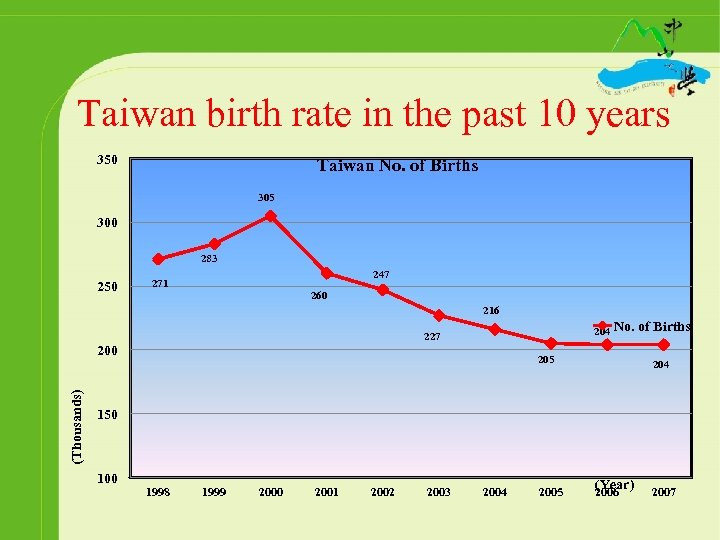 Taiwan birth rate in the past 10 years 350 Taiwan No. of Births 305 300 283 250 247 271 260 216 204 227 (Thousands) 200 No. of Births 205 204 150 100 1998 1999 2000 2001 2002 2003 2004 2005 (Year) 2006 2007
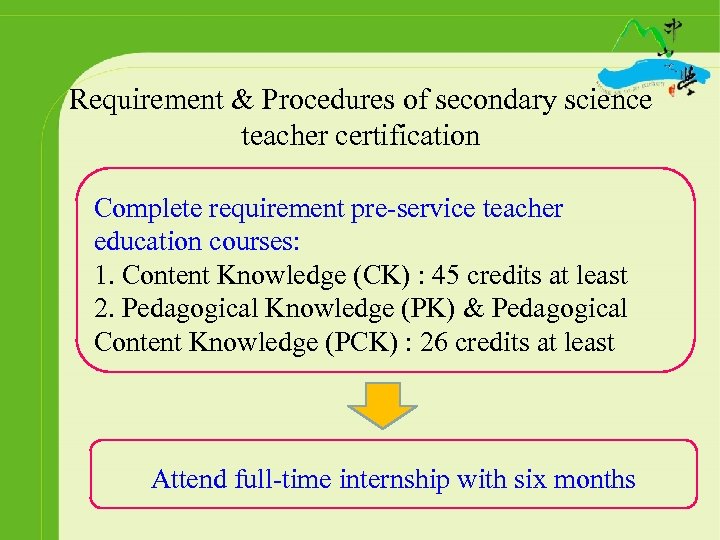 Requirement & Procedures of secondary science teacher certification Complete requirement pre-service teacher education courses: 1. Content Knowledge (CK) : 45 credits at least 2. Pedagogical Knowledge (PK) & Pedagogical Content Knowledge (PCK) : 26 credits at least Attend full-time internship with six months
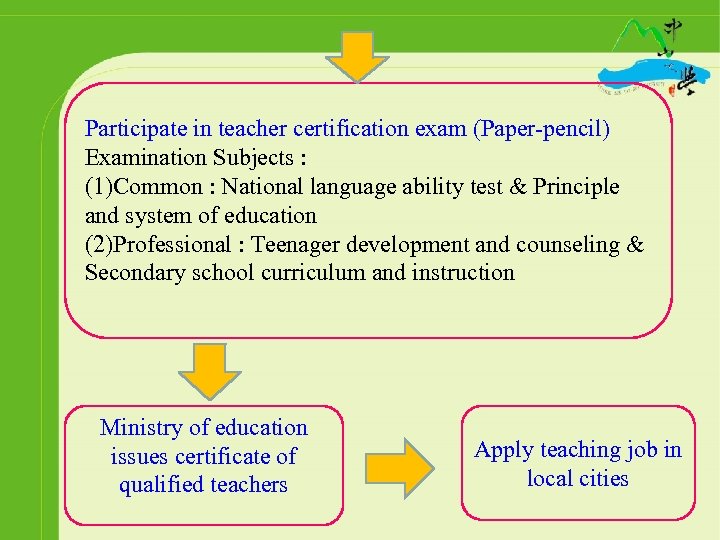 Participate in teacher certification exam (Paper-pencil) Examination Subjects : (1)Common : National language ability test & Principle and system of education (2)Professional : Teenager development and counseling & Secondary school curriculum and instruction Ministry of education issues certificate of qualified teachers Apply teaching job in local cities
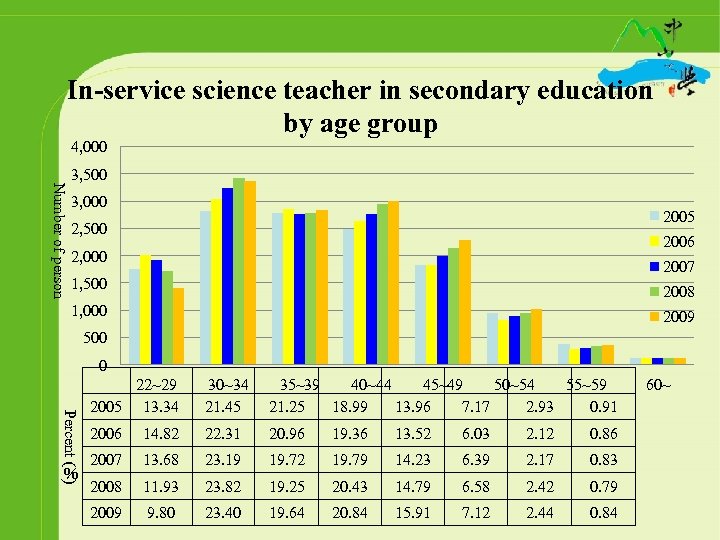 In-service science teacher in secondary education by age group 4, 000 Number of person 3, 500 3, 000 2005 2, 500 2006 2, 000 2007 1, 500 2008 1, 000 2009 500 0 Percent ( ) % 22~29 2005 13. 34 30~34 21. 45 35~39 40~44 45~49 50~54 55~59 21. 25 18. 99 13. 96 7. 17 2. 93 0. 91 2006 14. 82 22. 31 20. 96 19. 36 13. 52 6. 03 2. 12 0. 86 2007 13. 68 23. 19 19. 72 19. 79 14. 23 6. 39 2. 17 0. 83 2008 11. 93 23. 82 19. 25 20. 43 14. 79 6. 58 2. 42 0. 79 2009 9. 80 23. 40 19. 64 20. 84 15. 91 7. 12 2. 44 0. 84 60~
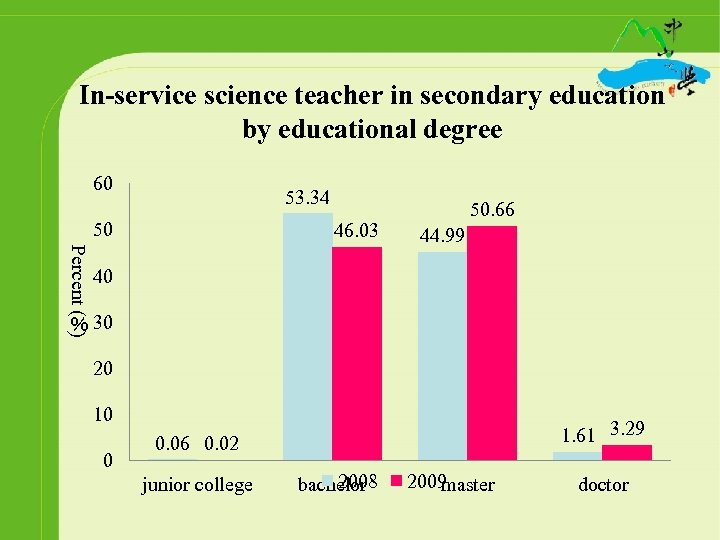 In-service science teacher in secondary education by educational degree 60 53. 34 50 46. 03 50. 66 Percent ( ) 44. 99 40 % 30 20 10 0 1. 61 3. 29 0. 06 0. 02 junior college 2008 bachelor 2009 master doctor
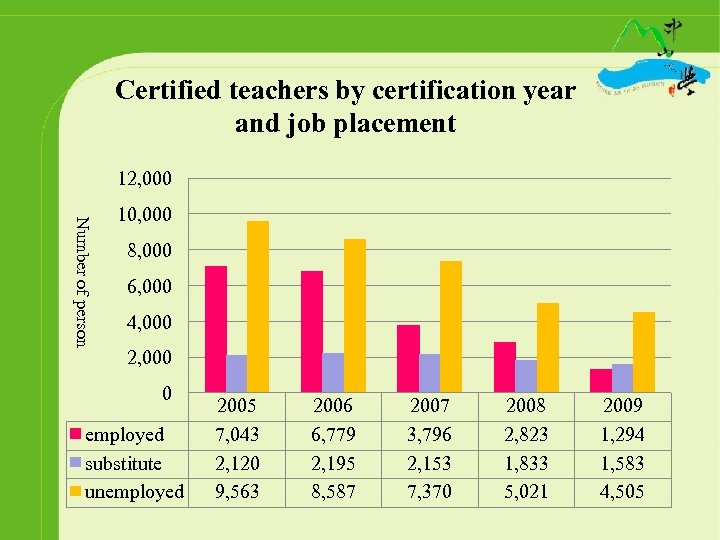 Certified teachers by certification year and job placement 12, 000 Number of person 10, 000 8, 000 6, 000 4, 000 2, 000 0 employed substitute unemployed 2005 7, 043 2, 120 9, 563 2006 6, 779 2, 195 8, 587 2007 3, 796 2, 153 7, 370 2008 2, 823 1, 833 5, 021 2009 1, 294 1, 583 4, 505
 Critical changes- teacher education • In 1994, the Law of Teacher Education was substantially revised. • Before 1994, all k-12 teachers were educated through national teachers colleges and normal universities. The tuition fees of pre-service teachers were supported by the government. Their teaching jobs were securely guaranteed. Only the top 5% of examinees can get into the teacher education colleges or universities.
 Critical changes- Teacher education • After 1994, the teacher education programs are open to all universities. All university students can apply for the pre-service program on their own expense for the tuition fee. Upon completing the credit requirement and passing the certification exam, certified teachers have to compete for job opportunities.
 Critical changes- Curricular reform • In 2003, the innovation of national curriculum for compulsory education (grades 1 -9) switched from Subject Matter-based (SM) curriculum to Integrated and Coordinated (IC) curriculum. • The innovation attracted a lot of continuing concerns, debates, and even criticisms.
 Challenges- Professional development How can in-service science teachers be attracted for life-long learning of developing their own professional ability? (Current status: Low interest for in-service training; passive for change)
 Thank you for your attention!