 Скачать презентацию ISSTA 09 Identifying Bug Signatures Using Discriminative Graph
d5a18cd6e10128601f7c9a37e81e1221.ppt
- Количество слайдов: 33



ISSTA’ 09 Identifying Bug Signatures Using Discriminative Graph Mining Hong Cheng 1, David Lo 2, Yang Zhou 1, Xiaoyin Wang 3, and Xifeng Yan 4 1 Chinese University of Hong Kong 2 Singapore Management University 3 Peking University 4 University of California at Santa Barbara 1

Automated Debugging o Bugs part of day-to-day software development o Bugs caused the loss of much resources – NIST report 2002 – 59. 5 billion dollars/annum o Much time is spent on debugging – Need support for debugging activities – Automate debugging process o Problem description – Given labeled correct and faulty execution traces – Make debugging an easier task to do 2
Bug Localization and Signature Identification o Bug localization – Pinpointing a single statement or location which is likely to contain bugs – Does not produce the bug context o Bug signature mining [Hsu et al. , ASE’ 08] – – Provides the context where a bug occurs Does not assume “perfect bug understanding” In the form of sequences of program elements Occur when the bug is manifested 3
Outline o Motivation: Bug Localization and Bug Signature o Pioneer Work on Bug Signature Mining o Identifying Bug Signatures Using Discriminative Graph Mining o Experimental Study o Related Work o Conclusions and Future Work 4
![Pioneer Work on Bug Signature Identification o RAPID [Hsu et al. , ASE’ 08]](https://present5.com/presentation/d5a18cd6e10128601f7c9a37e81e1221/image-5.jpg "Pioneer Work on Bug Signature Identification o RAPID [Hsu et al. , ASE’ 08]")
Pioneer Work on Bug Signature Identification o RAPID [Hsu et al. , ASE’ 08] –Identify relevant suspicious program elements via Tarantula –Compute the longest common subsequences that appear in all faulty executions with a sequence mining tool BIDE [Wang and Han, ICDE’ 04] –Sort returned signatures by length –Able to identify a bug involving path-dependent fault 5
Software Behavior Graphs o Model software executions as behavior graphs –Node: method or basic block –Edge: call or transition (basic block/method) or return –Two levels of granularities: method and basic block o Represent signatures as discriminating subgraphs o Advantages of graph over sequence representation –Compactness: loops mining scalability –Expressiveness: partial order and total order 6
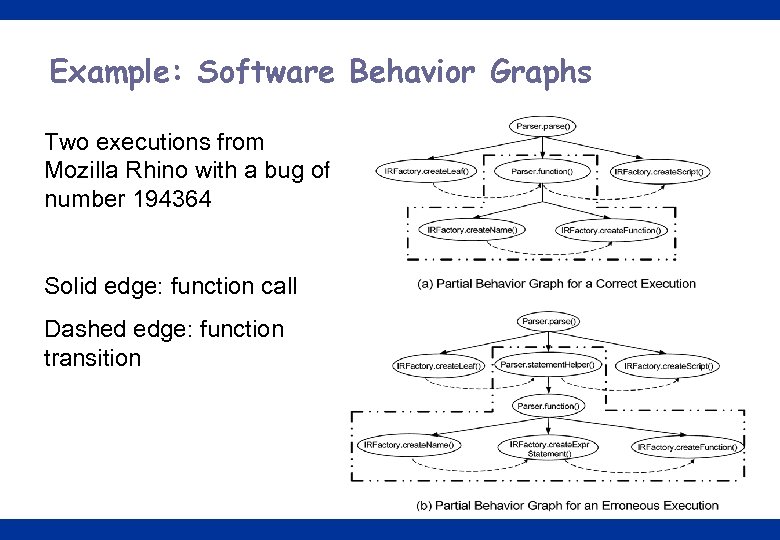
Example: Software Behavior Graphs Two executions from Mozilla Rhino with a bug of number 194364 Solid edge: function call Dashed edge: function transition 7
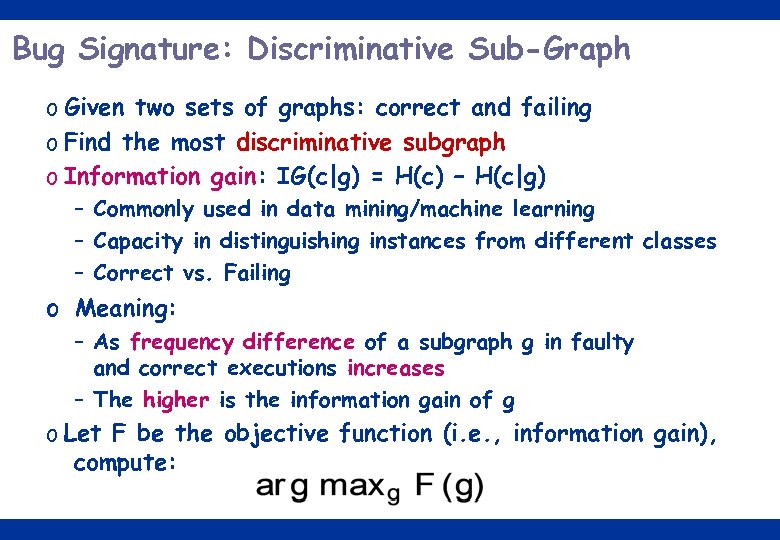
Bug Signature: Discriminative Sub-Graph o Given two sets of graphs: correct and failing o Find the most discriminative subgraph o Information gain: IG(c|g) = H(c) – H(c|g) – Commonly used in data mining/machine learning – Capacity in distinguishing instances from different classes – Correct vs. Failing o Meaning: – As frequency difference of a subgraph g in faulty and correct executions increases – The higher is the information gain of g o Let F be the objective function (i. e. , information gain), compute: 8

Bug Signature: Discriminative Sub-Graph o The discriminative subgraph mined from behavior graphs contrasts the program flow of correct and failing executions and provides context for understanding the bug o Differences with RAPID: –Not only element-level suspiciousness, signature-level suspiciousness/discriminative-ness –Does not restrict that the signature must hold across all failing executions –Sort by level of suspiciousness 10
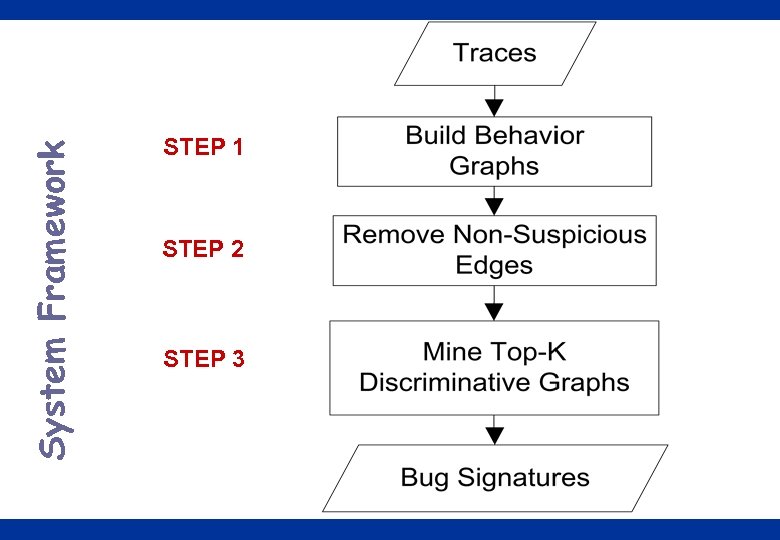
System Framework STEP 1 STEP 2 STEP 3 11
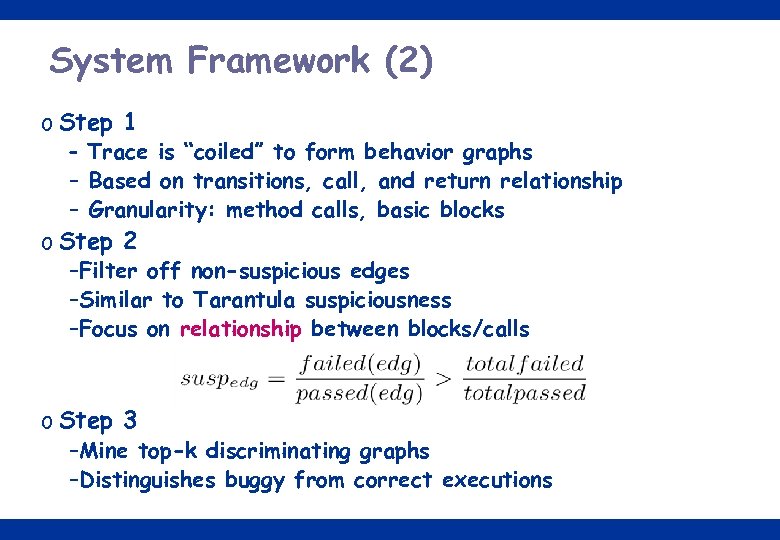
System Framework (2) o Step 1 – Trace is “coiled” to form behavior graphs – Based on transitions, call, and return relationship – Granularity: method calls, basic blocks o Step 2 –Filter off non-suspicious edges –Similar to Tarantula suspiciousness –Focus on relationship between blocks/calls o Step 3 –Mine top-k discriminating graphs –Distinguishes buggy from correct executions 12
![An Example 1: void replace. First. Occurrence (char arr [], int len, char cx,](https://present5.com/presentation/d5a18cd6e10128601f7c9a37e81e1221/image-12.jpg "An Example 1: void replace. First. Occurrence (char arr [], int len, char cx,")
An Example 1: void replace. First. Occurrence (char arr [], int len, char cx, char cy, char cz) { int i; 2: for (i=0; i<len; i++) { 3: if (arr[i]==cx){ 4: arr[i] = cz; 5: // a bug, should be a break; 6: } 7: if (arr[i]==cy)){ 8: arr[i] = cz; 9: // a bug, should be a break; 10: } 11: }} Four test cases Generated traces 13
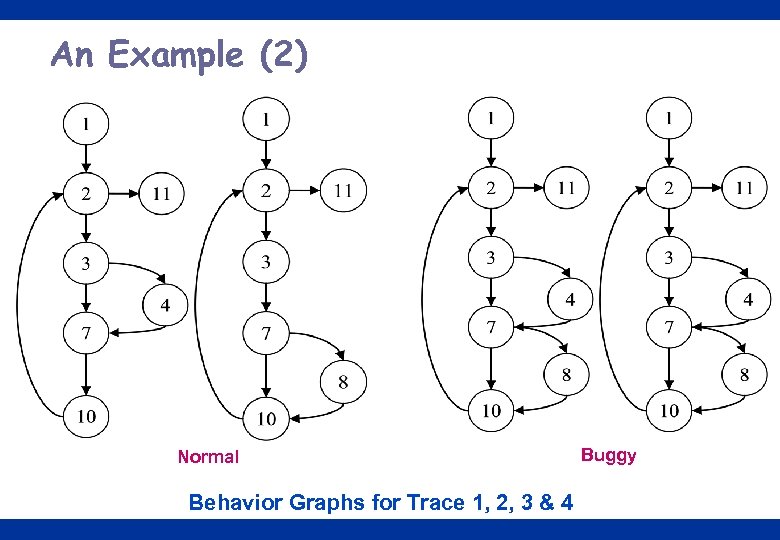
An Example (2) Normal Buggy Behavior Graphs for Trace 1, 2, 3 & 4 14
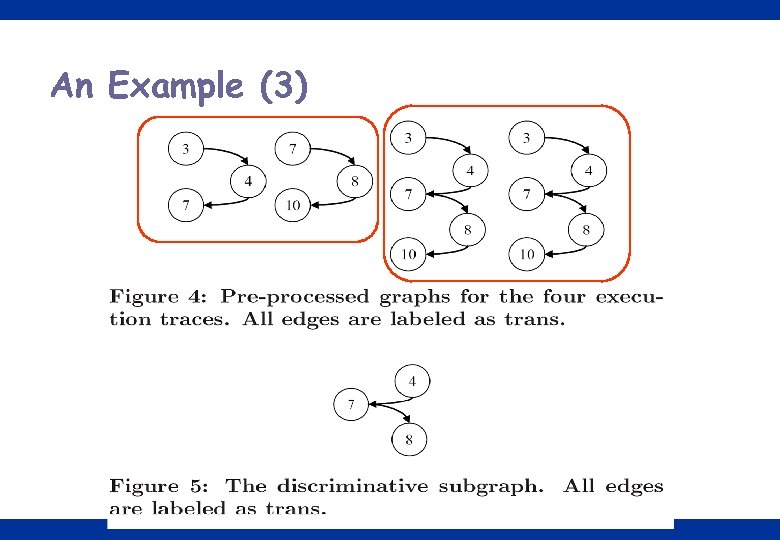
An Example (3) 15
Challenges in Graph Mining: Search Space Explosion o If a graph is frequent, all its subgraphs are frequent – the Apriori property o An n-edge frequent graph may have up to 2 n subgraphs which are also frequent o Among 423 chemical compounds which are confirmed to be active in an AIDS antiviral screen dataset, there around 1, 000 frequent subgraphs if the minimum support is 5% 16
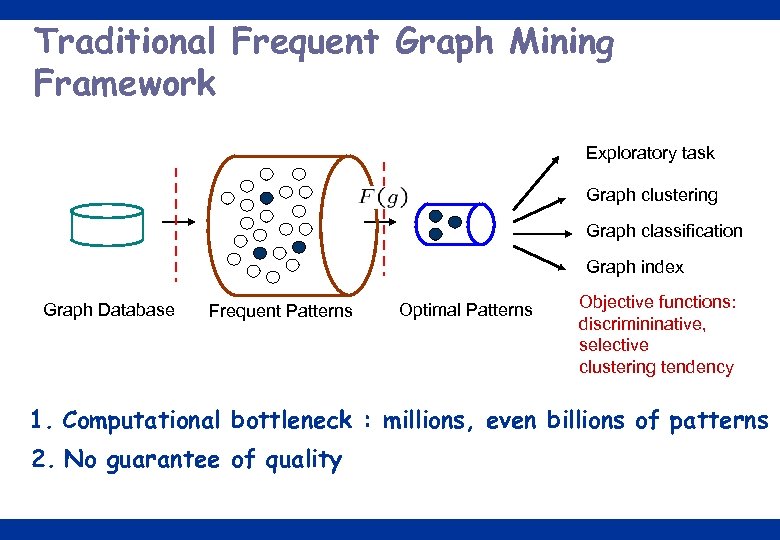
Traditional Frequent Graph Mining Framework Exploratory task Graph clustering Graph classification Graph index Graph Database Frequent Patterns Optimal Patterns Objective functions: discrimininative, selective clustering tendency 1. Computational bottleneck : millions, even billions of patterns 2. No guarantee of quality 17
Leap Search for Discriminative Graph Mining o Yan et al. proposed a new leap search mining paradigm in SIGMOD’ 08 –Core idea: structural proximity for search space pruning o Directly outputs the most discriminative subgraph, highly efficient! 18
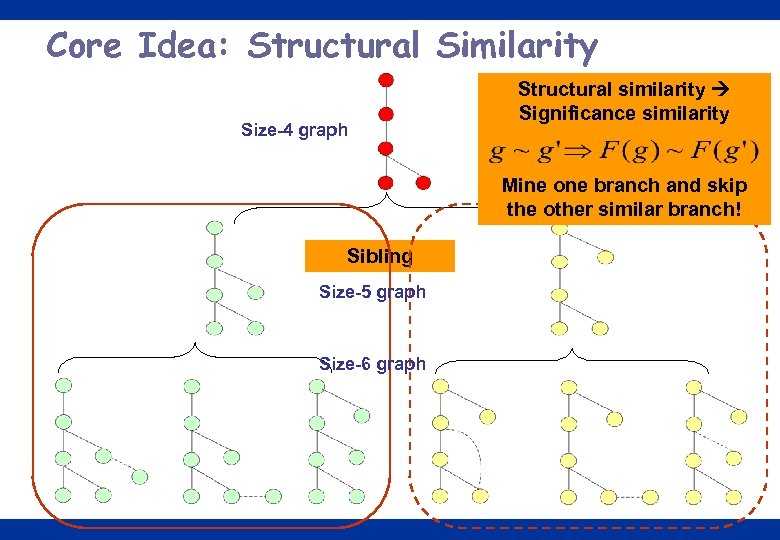
Core Idea: Structural Similarity Size-4 graph Structural similarity Significance similarity Mine one branch and skip the other similar branch! Sibling Size-5 graph Size-6 graph 19
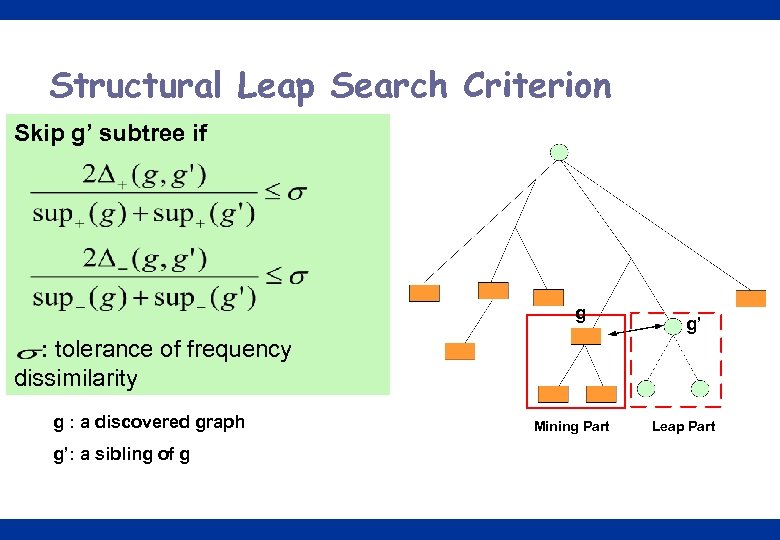
Structural Leap Search Criterion Skip g’ subtree if g g’ : tolerance of frequency dissimilarity g : a discovered graph Mining Part Leap Part g’: a sibling of g 20
Extending LEAP to Top-K LEAP o LEAP returns the single most discriminative subgraph from the dataset o A ranked list of k most discriminative subgraphs is more informative than the single best one o Top-K LEAP idea –The LEAP procedure is called for k times –Checking partial result in the process –Producing k most discriminative subgraphs 21
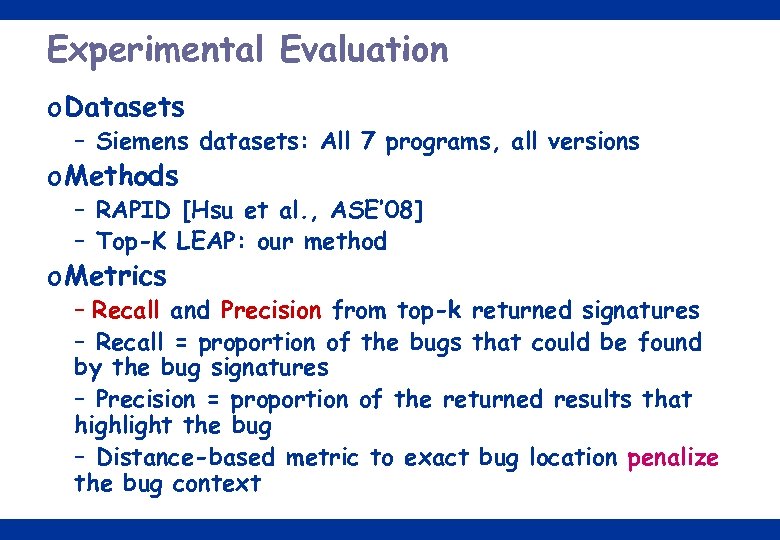
Experimental Evaluation o Datasets – Siemens datasets: All 7 programs, all versions o Methods – RAPID [Hsu et al. , ASE’ 08] – Top-K LEAP: our method o Metrics – Recall and Precision from top-k returned signatures – Recall = proportion of the bugs that could be found by the bug signatures – Precision = proportion of the returned results that highlight the bug – Distance-based metric to exact bug location penalize the bug context 22
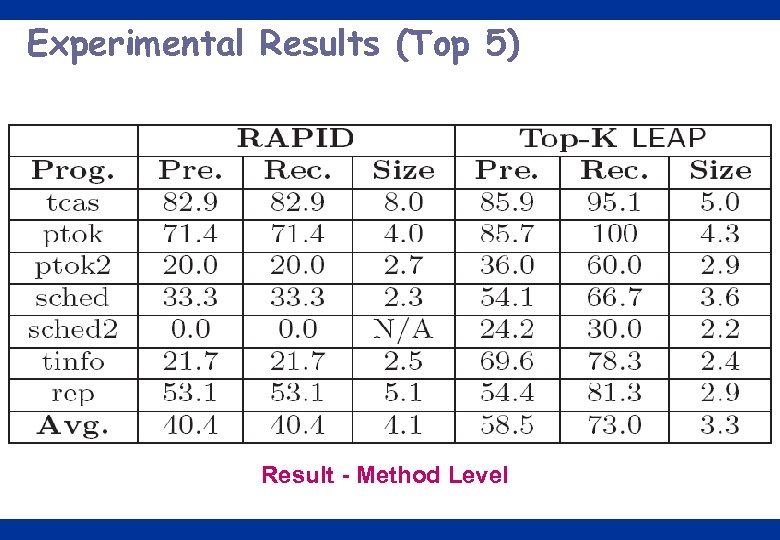
Experimental Results (Top 5) Result - Method Level 23
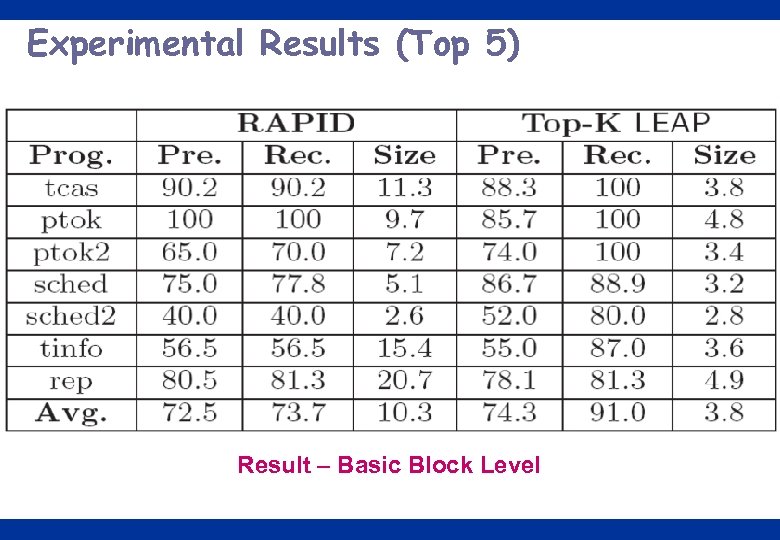
Experimental Results (Top 5) Result – Basic Block Level 24
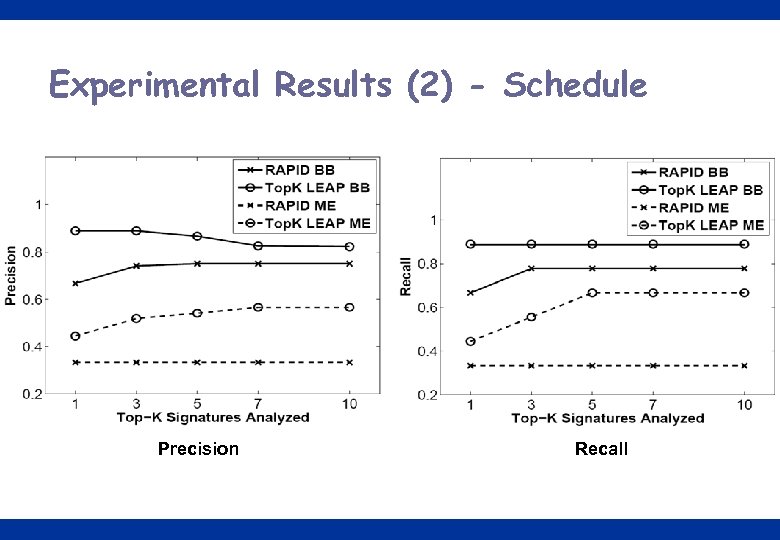
Experimental Results (2) - Schedule Precision Recall 25
Efficiency Test o Top-K LEAP finishes mining on every dataset between 1 and 258 seconds o RAPID cannot finish running on several datasets in hours –Version 6 of replace dataset, basic block level –Version 10 of print_tokens 2, basic block level 26
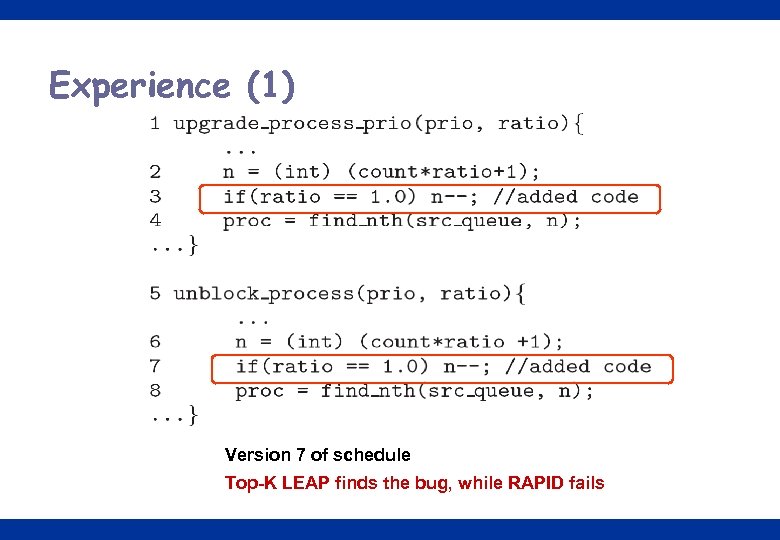
Experience (1) Version 7 of schedule Top-K LEAP finds the bug, while RAPID fails 27
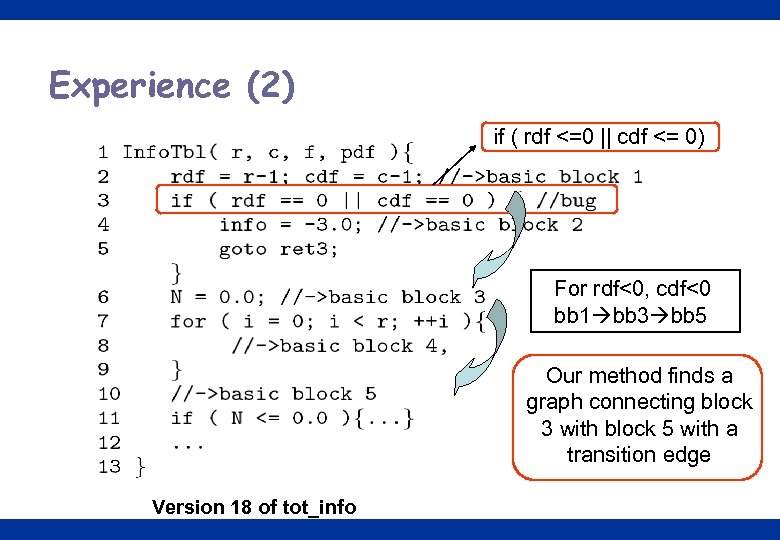
Experience (2) if ( rdf <=0 || cdf <= 0) For rdf<0, cdf<0 bb 1 bb 3 bb 5 Our method finds a graph connecting block 3 with block 5 with a transition edge Version 18 of tot_info 28
Threat to Validity o Human error during the labeling process – Human is the best judge to decide whether a signature is relevant or not. o Only small programs – Scalability on larger programs o Only c programs – Concept of control flow is universal 29
![Related Work o Bug Signature Mining: RAPID [Hsu et al. , ASE’ 08] o](https://present5.com/presentation/d5a18cd6e10128601f7c9a37e81e1221/image-29.jpg "Related Work o Bug Signature Mining: RAPID [Hsu et al. , ASE’ 08] o")
Related Work o Bug Signature Mining: RAPID [Hsu et al. , ASE’ 08] o Bug Predictors to Faulty CF Path [Jiang et al. , ASE’ 07] – Clustering similar bug predictors and inferring approximate path connecting similar predictors in CFG. – Our work: finding combination of bug predictors that are discriminative. Result guaranteed to be feasible paths. o Bug Localization Methods –Tarantula [Jones and Harrold, ASE’ 05], WHITHER [Renieris and Reiss, ASE’ 03], Delta Debugging [Zeller and Hildebrandt, TSE’ 02], Ask. Igor [Cleve and Zeller, ICSE’ 05], Predicate evaluation [Liblit et al. , PLDI’ 03, PLDI’ 05], Sober [Liu et al. , FSE’ 05], etc. 30
Related Work on Graph Mining o Early work –SUBDUE [Holder et al. , KDD’ 94], WARMR [Dehaspe et al. , KDD’ 98] o Apriori-based approach • AGM [Inokuchi et al. , PKDD’ 00] • FSG [Kuramochi and Karypis, ICDM’ 01] o Pattern-growth approach– state-of-the-art • g. Span [Yan and Han, ICDM’ 02] • Mo. Fa [Borgelt and Berthold, ICDM’ 02] • FFSM [Huan et al. , ICDM’ 03] • Gaston [Nijssen and Kok, KDD’ 04] 31

Conclusions o A discriminative graph mining approach to identify bug signatures –Compactness, Expressiveness, Efficiency o Experimental results on Siemens datasets –On average, 18. 1% higher precision, 32. 6% higher recall (method level) –On average, 1. 8% higher precision, 17. 3% higher recall (basic block level) –Average signature size of 3. 3 nodes (vs. 4. 1) (method level) or 3. 8 nodes (vs 10. 3) (basic block level) –Mining at basic block level is more accurate than method level - (74. 3%, 91%) vs (58. 5%, 73%) 32
Future Extensions o Mine minimal subgraph patterns – Current patterns may contain irrelevant nodes and edges for the bug o Enrich software behavior graph representation – Currently only captures program flow semantics – May attach additional information to nodes and edges such as program parameters and return values 33

Thank You Questions, Comments, Advice ? 34
Скачать презентацию ISSTA 09 Identifying Bug Signatures Using Discriminative Graph
d5a18cd6e10128601f7c9a37e81e1221.ppt