 Скачать презентацию ISROMAC-12 February 2008 The Twelfth International Symposium on
f601f6e0de5fcbbe75f2610b9ad13ed5.ppt
- Количество слайдов: 55



ISROMAC-12 February 2008 The Twelfth International Symposium on Transport Phenomena and Dynamics of Rotating Machinery Issues on Stability, Forced Nonlinear Response and Control in Gas Bearing Supported Rotors for Oil. Free Microturbomachinery Luis San Andres Mast-Childs Professor Turbomachinery Laboratory, Mechanical Engineering Department Texas A&M University (http: //phn. tamu. edu/TRIBGroup)
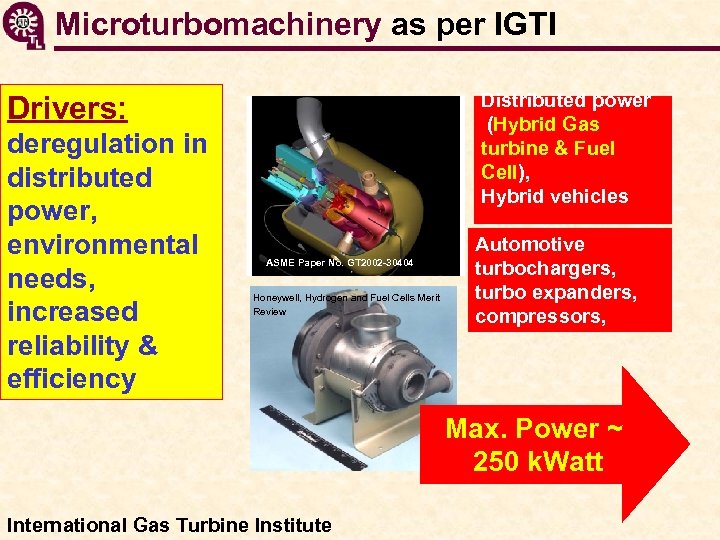
Microturbomachinery as per IGTI Distributed power (Hybrid Gas turbine & Fuel Cell), Hybrid vehicles Drivers: deregulation in distributed power, environmental needs, increased reliability & efficiency ASME Paper No. GT 2002 -30404 Honeywell, Hydrogen and Fuel Cells Merit Review Automotive turbochargers, turbo expanders, compressors, Max. Power ~ 250 k. Watt International Gas Turbine Institute
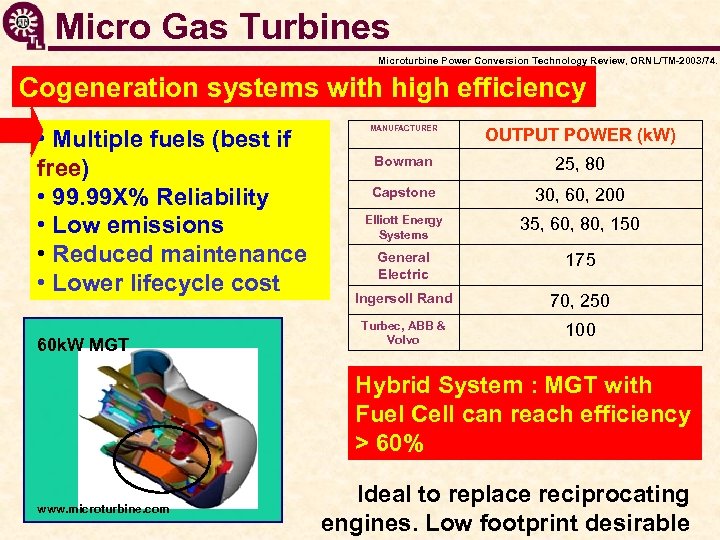
Micro Gas Turbines Microturbine Power Conversion Technology Review, ORNL/TM-2003/74. Cogeneration systems with high efficiency • Multiple fuels (best if free) • 99. 99 X% Reliability • Low emissions • Reduced maintenance • Lower lifecycle cost 60 k. W MGT MANUFACTURER OUTPUT POWER (k. W) Bowman 25, 80 Capstone 30, 60, 200 Elliott Energy Systems 35, 60, 80, 150 General Electric 175 Ingersoll Rand 70, 250 Turbec, ABB & Volvo 100 Hybrid System : MGT with Fuel Cell can reach efficiency > 60% www. microturbine. com Ideal to replace reciprocating engines. Low footprint desirable
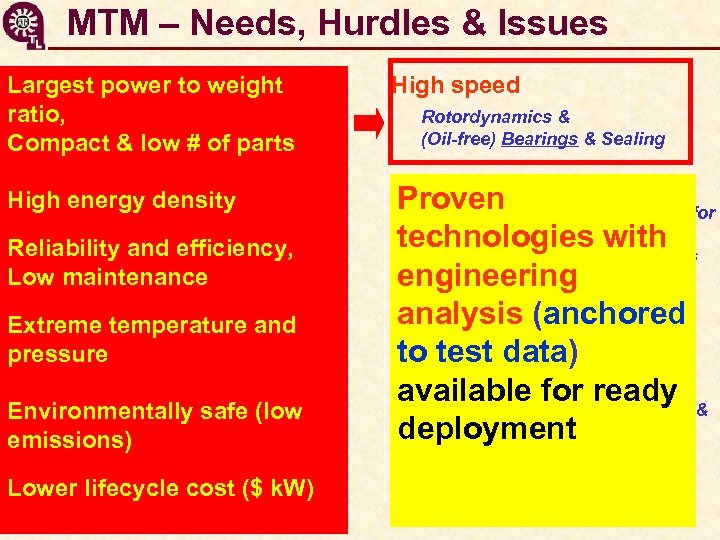
MTM – Needs, Hurdles & Issues Largest power to weight ratio, Compact & low # of parts High energy density High speed Rotordynamics & (Oil-free) Bearings & Sealing Materials Environmentally safe (low emissions) Proven surface conditioning for Coatings: low friction and wear technologies with Ceramic rotors and components engineering Manufacturing analysis (anchored Automated agile processes Cost & number to test data) Processes & Cycles available for ready & Low-NOx combustors for liquid gas fuels deployment Lower lifecycle cost ($ k. W) Fuels Reliability and efficiency, Low maintenance Extreme temperature and pressure TH scaling (low Reynolds #) Best if free (bio-fuels)
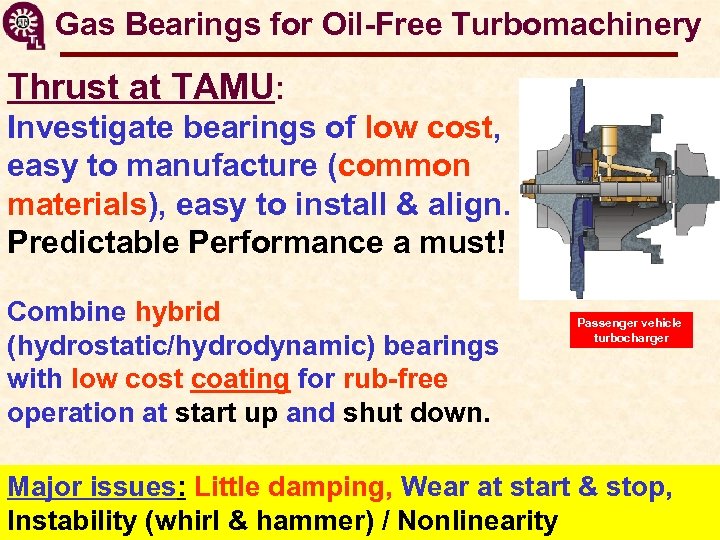
Gas Bearings for Oil-Free Turbomachinery Thrust at TAMU: Investigate bearings of low cost, easy to manufacture (common materials), easy to install & align. Predictable Performance a must! Combine hybrid (hydrostatic/hydrodynamic) bearings with low cost coating for rub-free operation at start up and shut down. Passenger vehicle turbocharger Major issues: Little damping, Wear at start & stop, Instability (whirl & hammer) / Nonlinearity
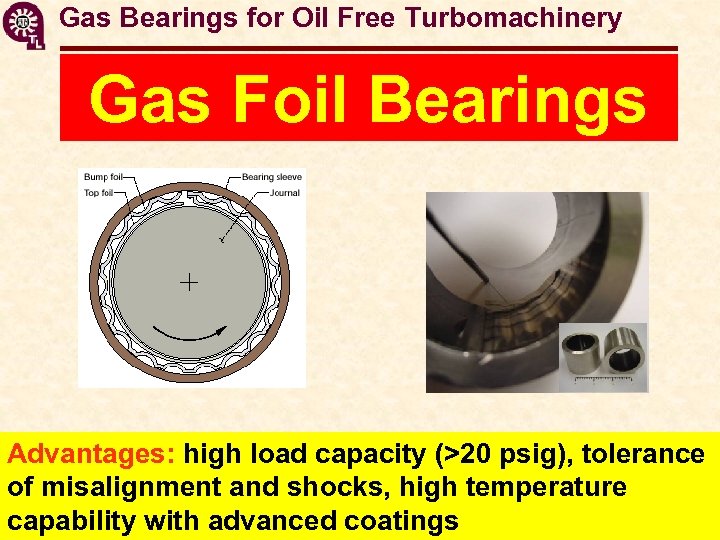
Gas Bearings for Oil Free Turbomachinery Gas Foil Bearings Advantages: high load capacity (>20 psig), tolerance of misalignment and shocks, high temperature capability with advanced coatings
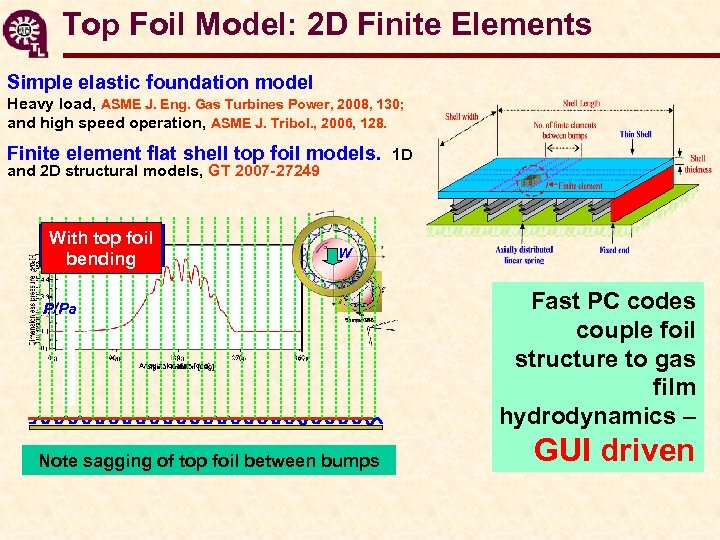
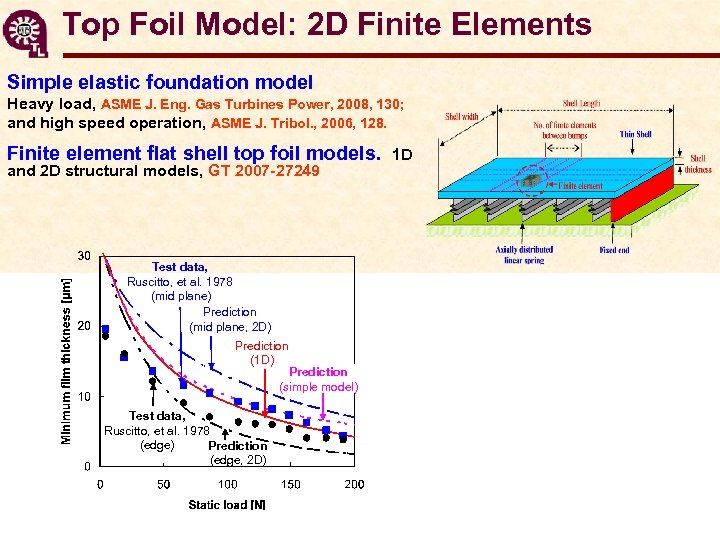
Top Foil Model: 2 D Finite Elements Simple elastic foundation model Heavy load, ASME J. Eng. Gas Turbines Power, 2008, 130; and high speed operation, ASME J. Tribol. , 2006, 128. Finite element flat shell top foil models. 1 D and 2 D structural models, GT 2007 -27249 Uniform elastic With top foil foundation bending W P/Pa Note sagging of top foil between bumps Fast PC codes couple foil structure to gas film hydrodynamics – GUI driven
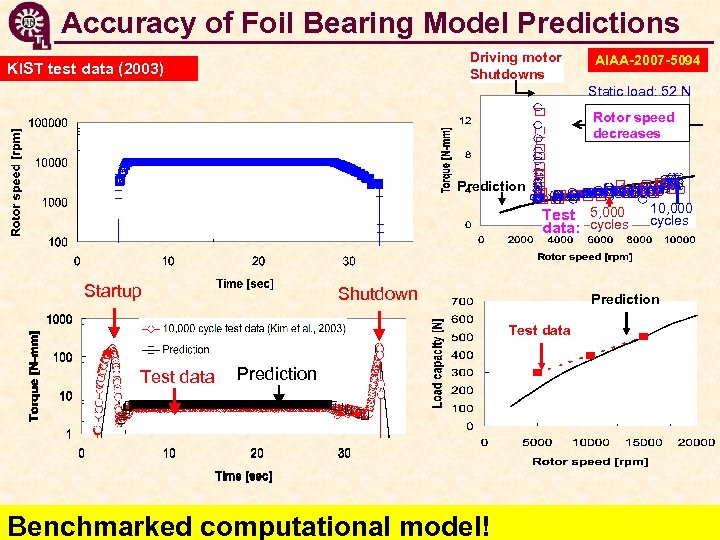
Accuracy of Foil Bearing Model Predictions Driving motor Shutdowns KIST test data (2003) AIAA-2007 -5094 Static load: 52 N Rotor speed decreases Prediction Test 5, 000 data: cycles Startup Shutdown Prediction Test data Prediction Benchmarked computational model! 10, 000 cycles
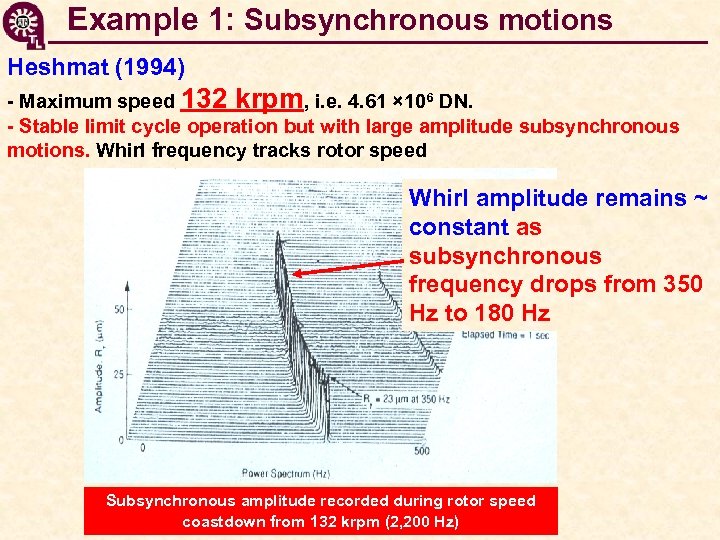
Example 1: Subsynchronous motions Heshmat (1994) - Maximum speed 132 krpm, i. e. 4. 61 × 106 DN. - Stable limit cycle operation but with large amplitude subsynchronous motions. Whirl frequency tracks rotor speed Whirl amplitude remains ~ constant as subsynchronous frequency drops from 350 Hz to 180 Hz Subsynchronous amplitude recorded during rotor speed coastdown from 132 krpm (2, 200 Hz)
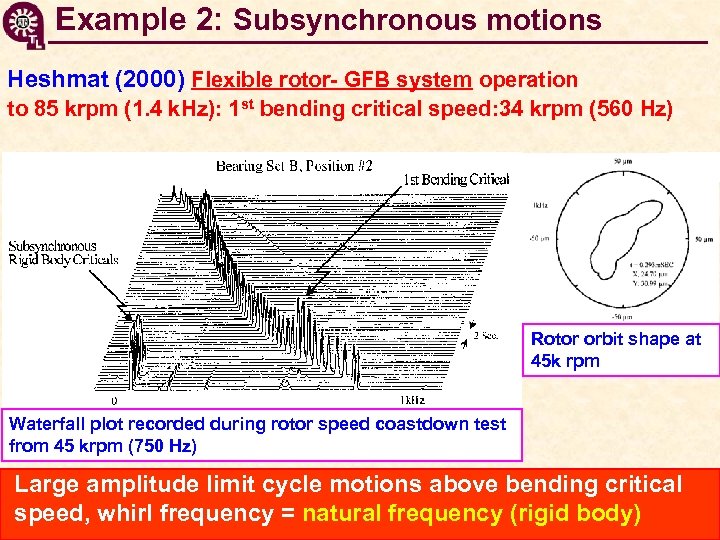
Example 2: Subsynchronous motions Heshmat (2000) Flexible rotor- GFB system operation to 85 krpm (1. 4 k. Hz): 1 st bending critical speed: 34 krpm (560 Hz) Rotor orbit shape at 45 k rpm Waterfall plot recorded during rotor speed coastdown test from 45 krpm (750 Hz) Large amplitude limit cycle motions above bending critical speed, whirl frequency = natural frequency (rigid body)
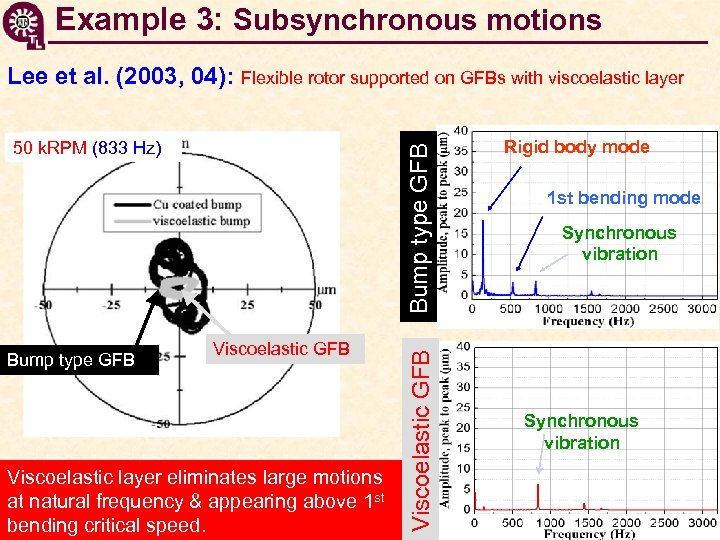
Example 3: Subsynchronous motions Lee et al. (2003, 04): Flexible rotor supported on GFBs with viscoelastic layer Viscoelastic GFB Viscoelastic layer eliminates large motions at natural frequency & appearing above 1 st bending critical speed. Viscoelastic GFB Bump type GFB 50 k. RPM (833 Hz) Rigid body mode 1 st bending mode Synchronous vibration
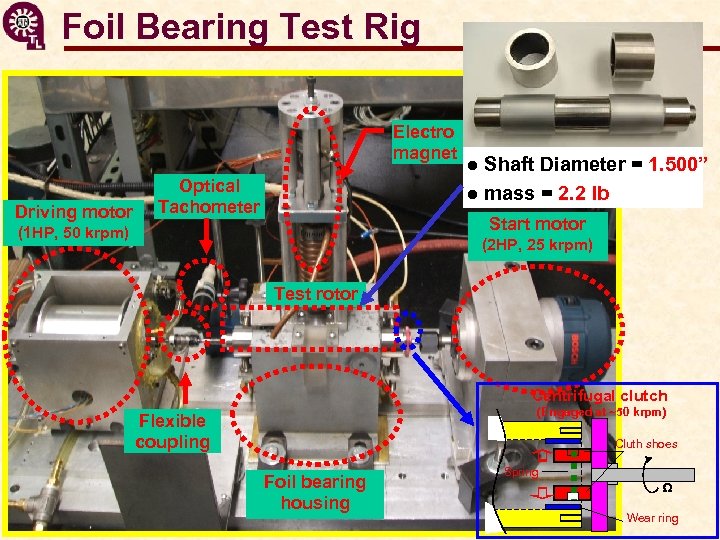
Foil Bearing Test Rig Electro magnet loader Shaft Diameter = 1. 500” l mass = 2. 2 lb l Driving motor Optical Tachometer Start motor (1 HP, 50 krpm) (2 HP, 25 krpm) Test rotor Centrifugal clutch (Engaged at ~50 krpm) Flexible coupling Cluth shoes Foil bearing housing Spring Ω Wear ring
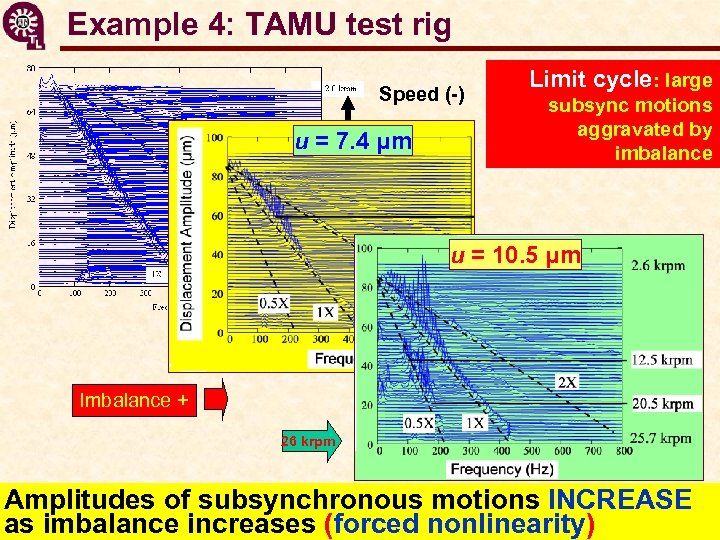
Example 4: TAMU test rig Speed (-) u = 7. 4 μm Limit cycle: large subsync motions aggravated by imbalance u = 10. 5 μm Imbalance + 26 krpm Amplitudes of subsynchronous motions INCREASE as imbalance increases (forced nonlinearity)
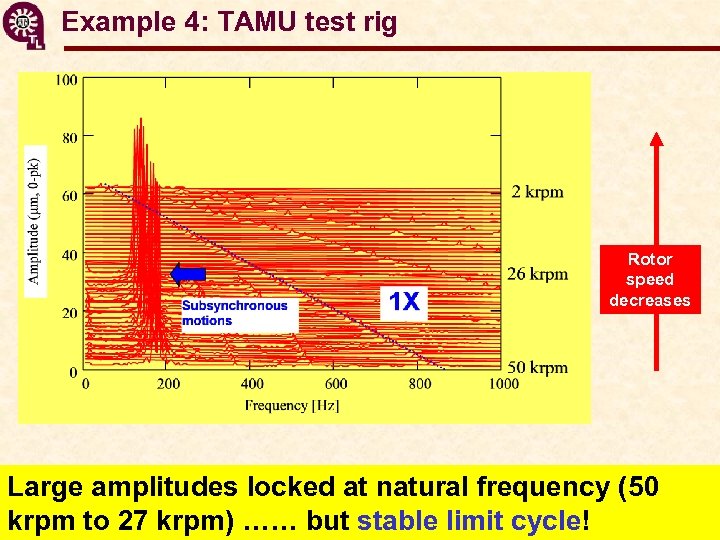
Example 4: TAMU test rig Rotor speed decreases Large amplitudes locked at natural frequency (50 krpm to 27 krpm) …… but stable limit cycle!
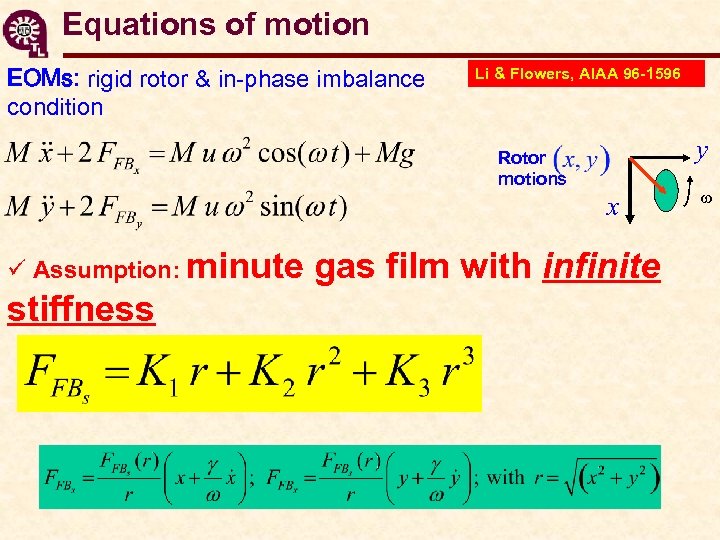
Overview – GFB computational models What causes the subsynchronous motions? What causes the excitation of natural frequency? All GFB models predict (linearized) rotordynamic force coefficients. No model readily available to predict nonlinear rotordynamic forced response
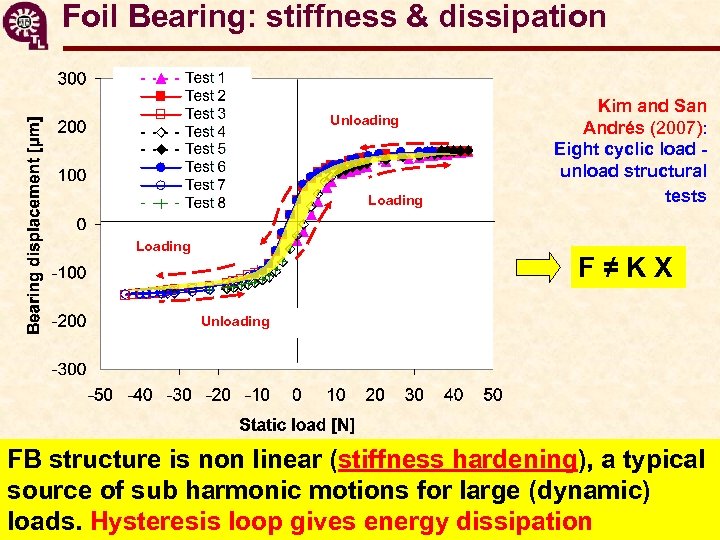
Foil Bearing: stiffness & dissipation Unloading Loading Kim and San Andrés (2007): Eight cyclic load - unload structural tests F ≠ K X Unloading FB structure is non linear (stiffness hardening), a typical source of sub harmonic motions for large (dynamic) loads. Hysteresis loop gives energy dissipation
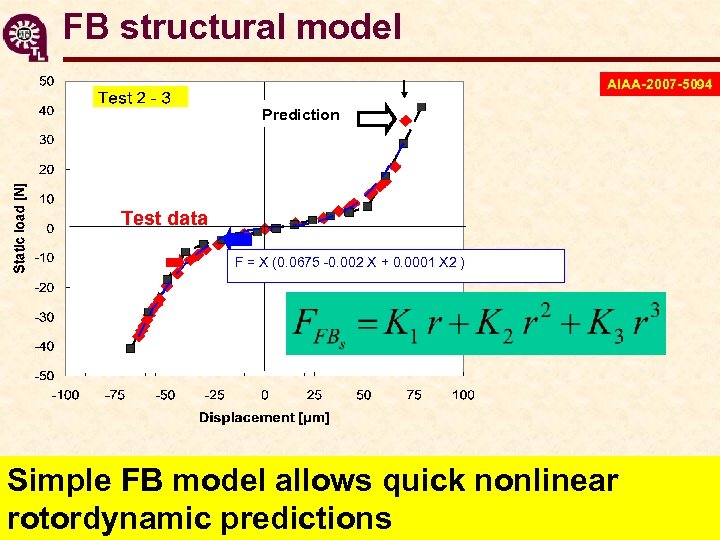
FB structural model AIAA-2007 -5094 Prediction Test data F = X (0. 0675 -0. 002 X + 0. 0001 X 2 ) Simple FB model allows quick nonlinear rotordynamic predictions
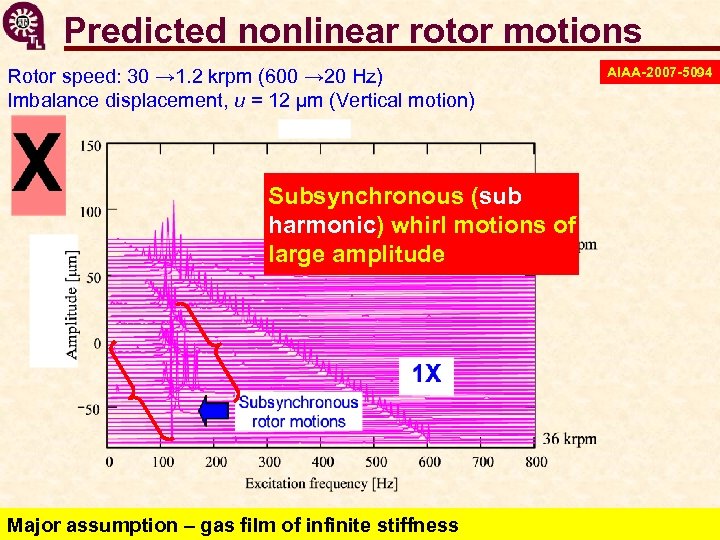
Predicted nonlinear rotor motions Rotor speed: 30 → 1. 2 krpm (600 → 20 Hz) Imbalance displacement, u = 12 μm (Vertical motion) Subsynchronous (sub harmonic) whirl motions of large amplitude Major assumption – gas film of infinite stiffness AIAA-2007 -5094
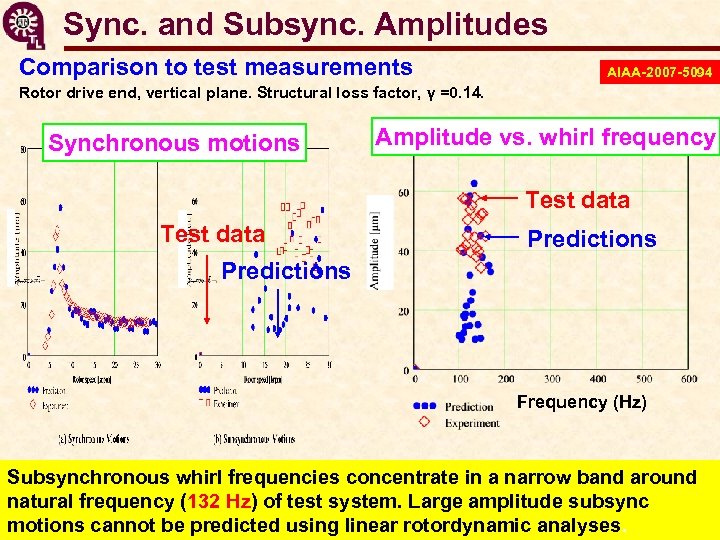
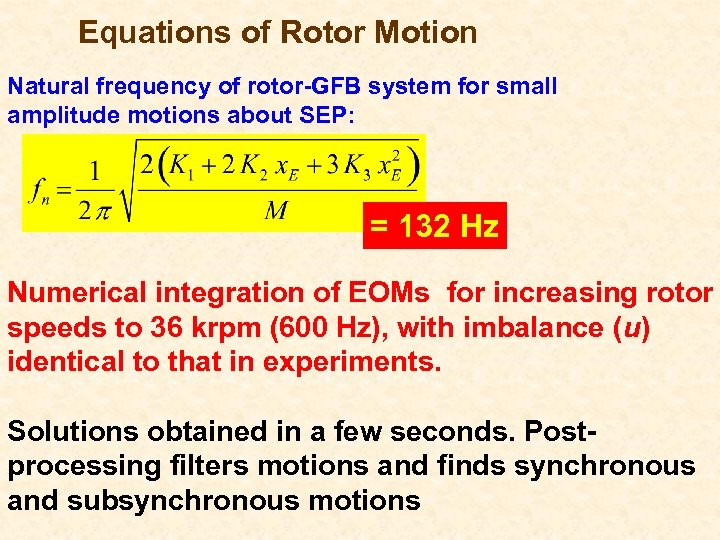
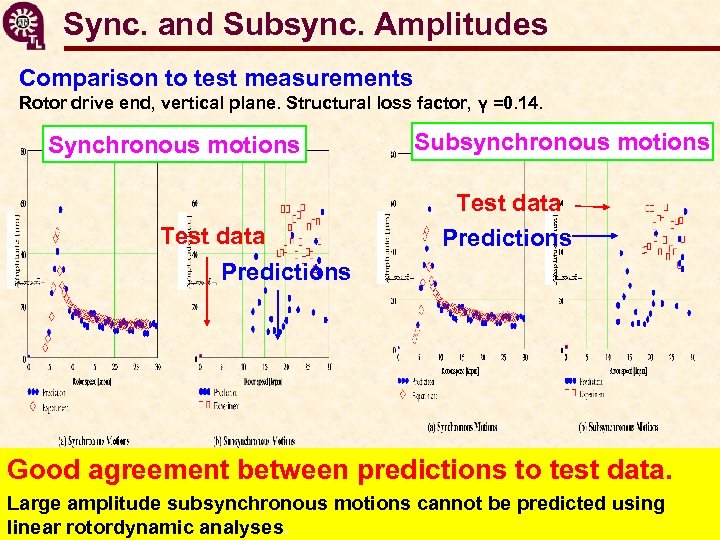
Sync. and Subsync. Amplitudes Comparison to test measurements AIAA-2007 -5094 Rotor drive end, vertical plane. Structural loss factor, γ =0. 14. Synchronous motions Amplitude vs. whirl frequency Test data Predictions Frequency (Hz) Subsynchronous whirl frequencies concentrate in a narrow band around natural frequency (132 Hz) of test system. Large amplitude subsync motions cannot be predicted using linear rotordynamic analyses.
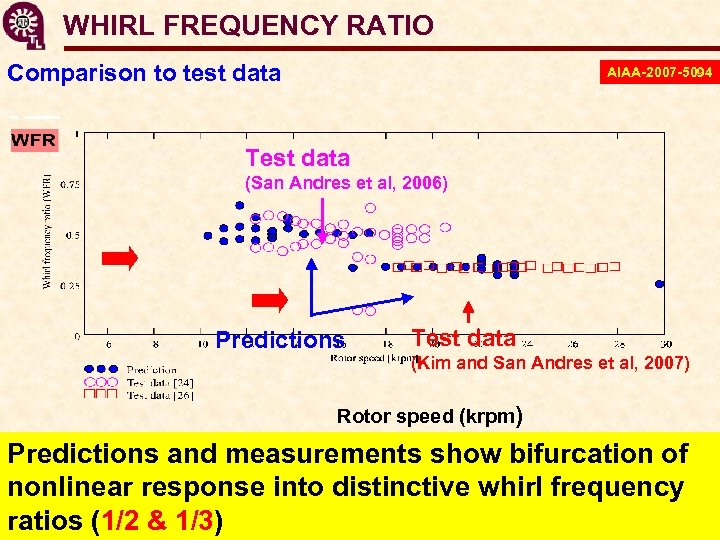
WHIRL FREQUENCY RATIO Comparison to test data AIAA-2007 -5094 Test data (San Andres et al, 2006) Predictions Test data (Kim and San Andres et al, 2007) Rotor speed (krpm) Predictions and measurements show bifurcation of nonlinear response into distinctive whirl frequency ratios (1/2 & 1/3)
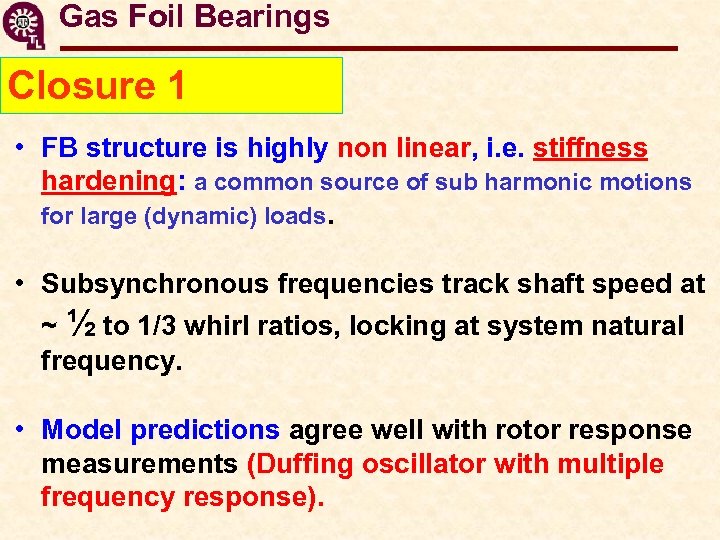
Gas Foil Bearings Closure 1 • FB structure is highly non linear, i. e. stiffness hardening: a common source of sub harmonic motions for large (dynamic) loads. • Subsynchronous frequencies track shaft speed at ~ ½ to 1/3 whirl ratios, locking at system natural frequency. • Model predictions agree well with rotor response measurements (Duffing oscillator with multiple frequency response).
![Rotordynamic tests with bearing side pressurization -FEED AIR PRESSURE: 40 k. Pa [6 psig]](https://present5.com/presentation/f601f6e0de5fcbbe75f2610b9ad13ed5/image-22.jpg "Rotordynamic tests with bearing side pressurization -FEED AIR PRESSURE: 40 k. Pa [6 psig]")
Rotordynamic tests with bearing side pressurization -FEED AIR PRESSURE: 40 k. Pa [6 psig] - 340 k. Pa [50 psig] IJTC 2007 -44047 Typically foil bearings DO not require pressurization. Cooling flow needed for thermal management to remove heat from drag or to reduce thermal gradients in hot/cold engine sections AIR SUPPLY Axial flow retards evolution of mean circumferential flow velocity within GFB, as in an annular seal
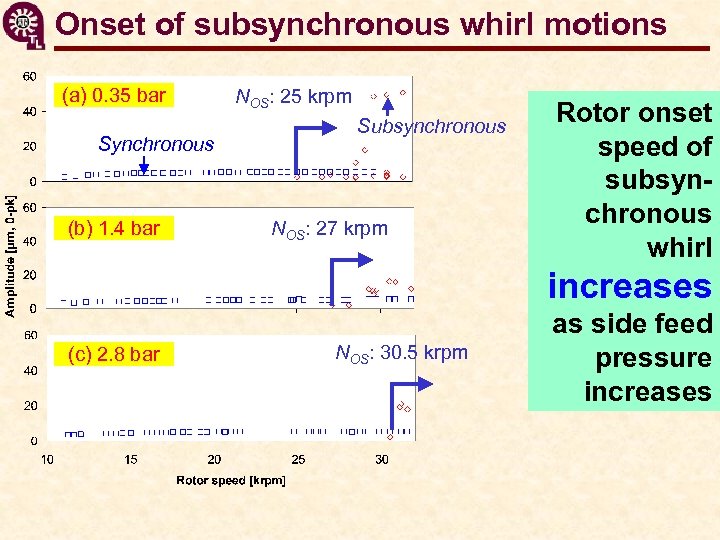
Onset of subsynchronous whirl motions (a) 0. 35 bar Synchronous (b) 1. 4 bar NOS: 25 krpm Subsynchronous NOS: 27 krpm Rotor onset speed of subsynchronous whirl increases (c) 2. 8 bar NOS: 30. 5 krpm as side feed pressure increases
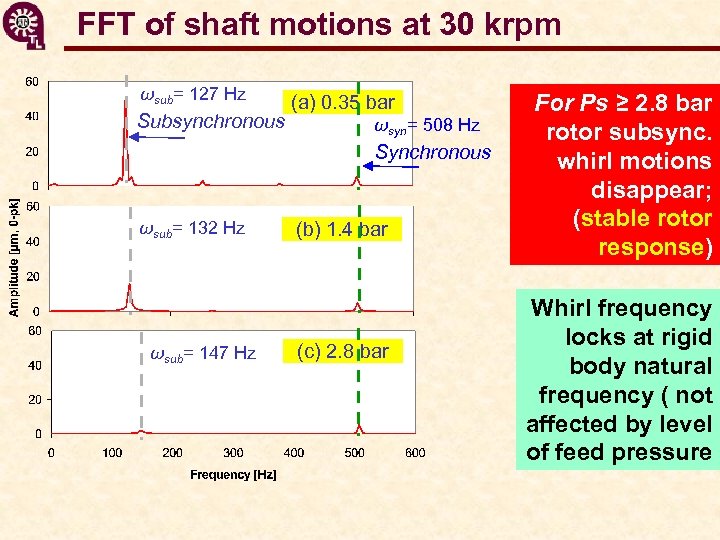
FFT of shaft motions at 30 krpm ωsub= 127 Hz Subsynchronous (a) 0. 35 bar ωsyn= 508 Hz Synchronous ωsub= 132 Hz ωsub= 147 Hz (b) 1. 4 bar (c) 2. 8 bar For Ps ≥ 2. 8 bar rotor subsync. whirl motions disappear; (stable rotor response) Whirl frequency locks at rigid body natural frequency ( not affected by level of feed pressure
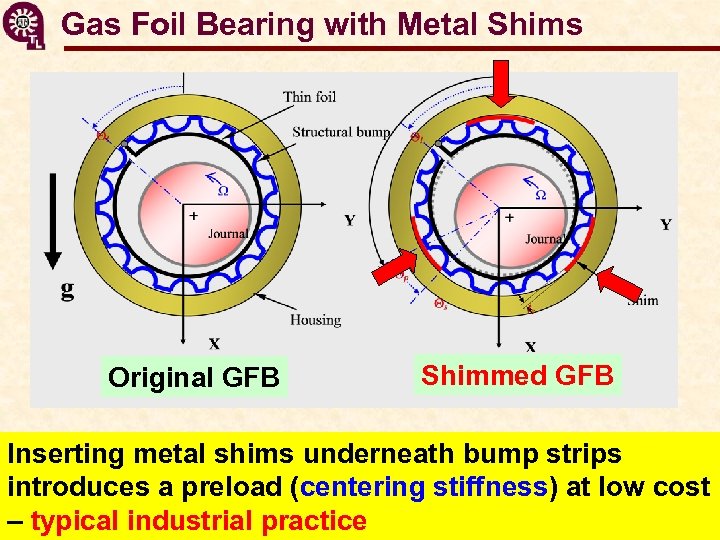
Gas Foil Bearing with Metal Shims Original GFB Shimmed GFB Inserting metal shims underneath bump strips introduces a preload (centering stiffness) at low cost – typical industrial practice
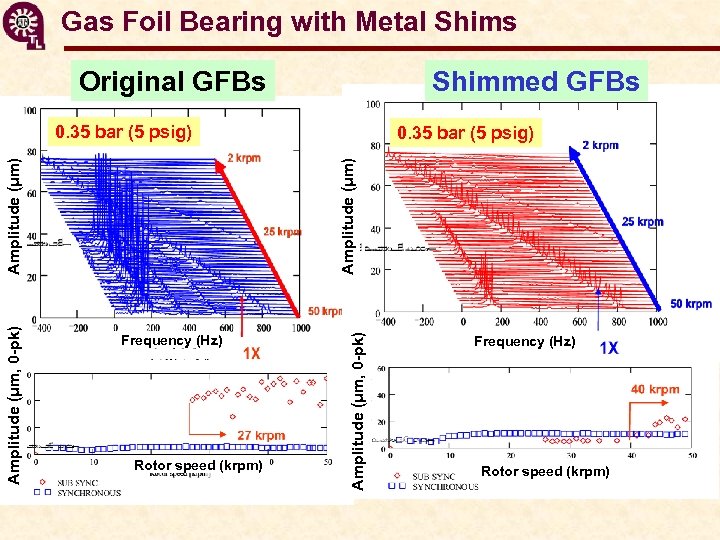
Gas Foil Bearing with Metal Shims Shimmed GFBs Original GFBs 0. 35 bar (5 psig) Amplitude (μm) Frequency (Hz) Rotor speed (krpm) Amplitude (μm, 0 -pk) 0. 35 bar (5 psig) Frequency (Hz) Rotor speed (krpm)
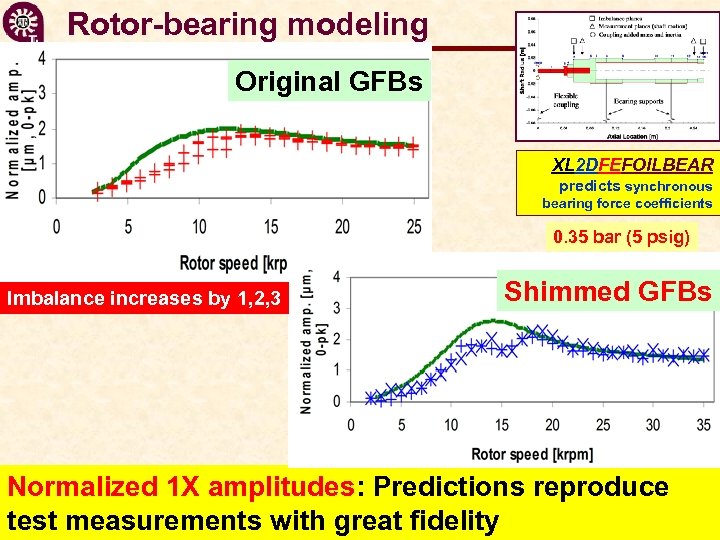
Rotor-bearing modeling Original GFBs XL 2 DFEFOILBEAR predicts synchronous bearing force coefficients 0. 35 bar (5 psig) Imbalance increases by 1, 2, 3 Shimmed GFBs Normalized 1 X amplitudes: Predictions reproduce test measurements with great fidelity
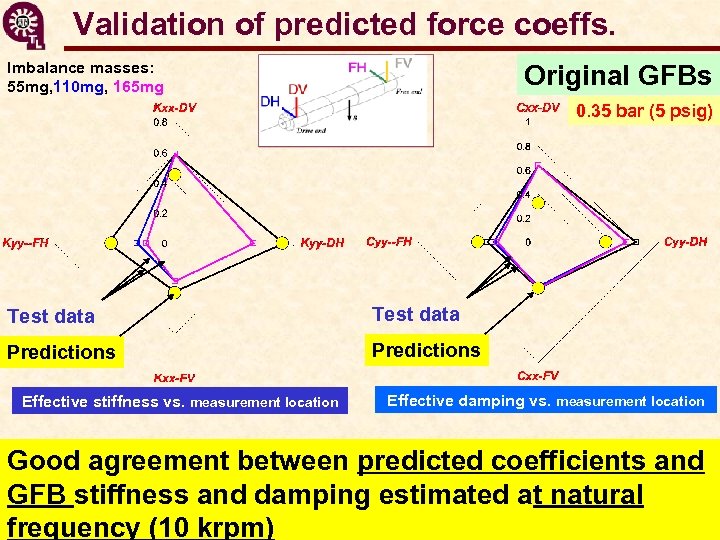
Validation of predicted force coeffs. Imbalance masses: 55 mg, 110 mg, 165 mg Original GFBs 0. 35 bar (5 psig) Test data Predictions Effective stiffness vs. measurement location Effective damping vs. measurement location Good agreement between predicted coefficients and GFB stiffness and damping estimated at natural frequency (10 krpm)
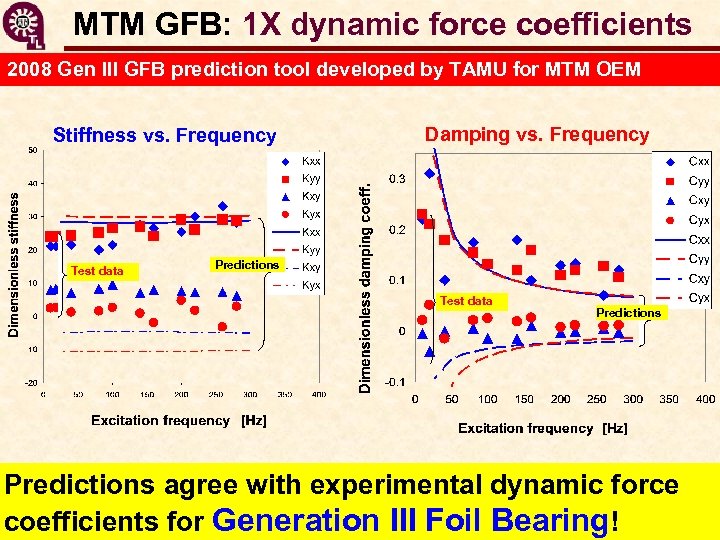
MTM GFB: 1 X dynamic force coefficients 2008 Gen III GFB prediction tool developed by TAMU for MTM OEM Stiffness vs. Frequency Test data Damping vs. Frequency Predictions Test data Predictions agree with experimental dynamic force coefficients for Generation III Foil Bearing!
Gas Foil Bearings Closure 2 • Predictive foil bearing FE model (structure + gas film) benchmarked by test data. • (Cooling) end side pressure reduces amplitude of whirl motions (+ stable) • Preloads (shims) increase bearing stiffness and raise onset speed of subsync. whirl. • Predicted rotor 1 X response and GFB force coefficients agree well with measurements.

Gas Bearings for Oil Free Turbomachinery Flexure Pivot Bearings Advantages: Promote stability, eliminate pivot wear, engineered product with many commercial appls.
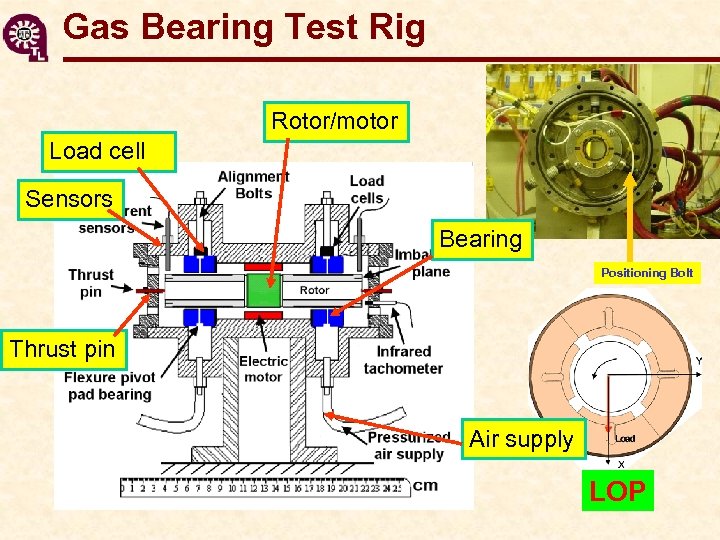
Gas Bearing Test Rig Rotor/motor Load cell Sensors Bearing Positioning Bolt Thrust pin Air supply LOP
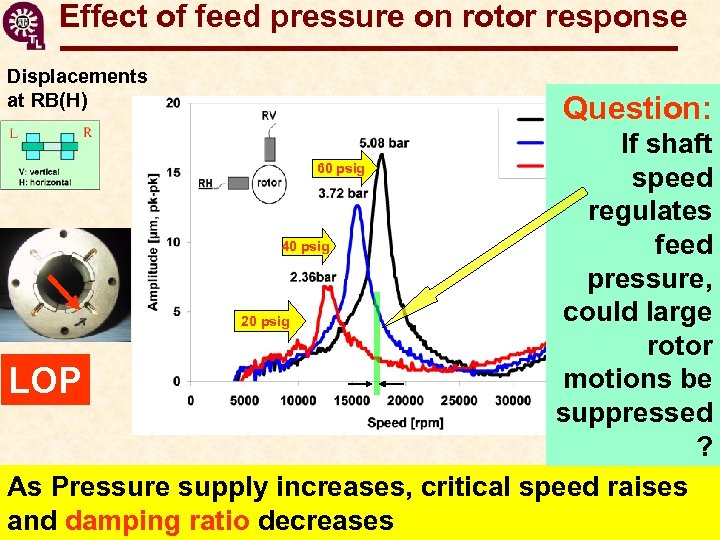
Effect of feed pressure on rotor response Displacements at RB(H) Question: If shaft 60 psig speed regulates 40 psig feed pressure, could large 20 psig rotor motions be LOP suppressed ? As Pressure supply increases, critical speed raises and damping ratio decreases
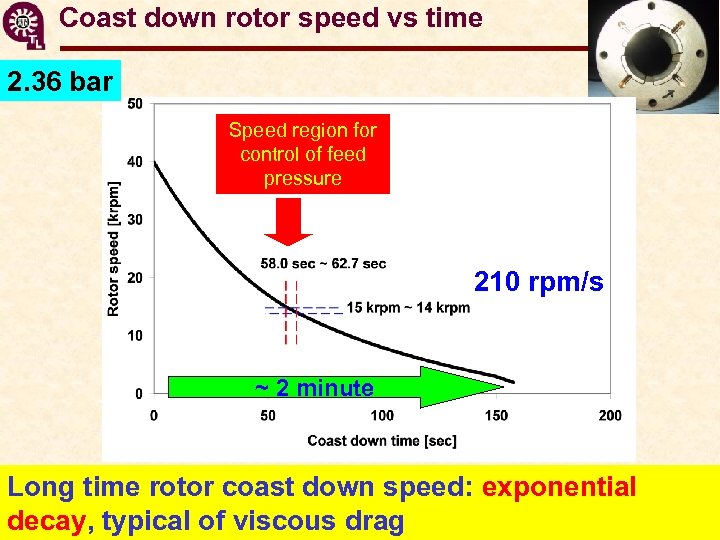
Coast down rotor speed vs time 2. 36 bar Speed region for control of feed pressure 210 rpm/s ~ 2 minute Long time rotor coast down speed: exponential decay, typical of viscous drag
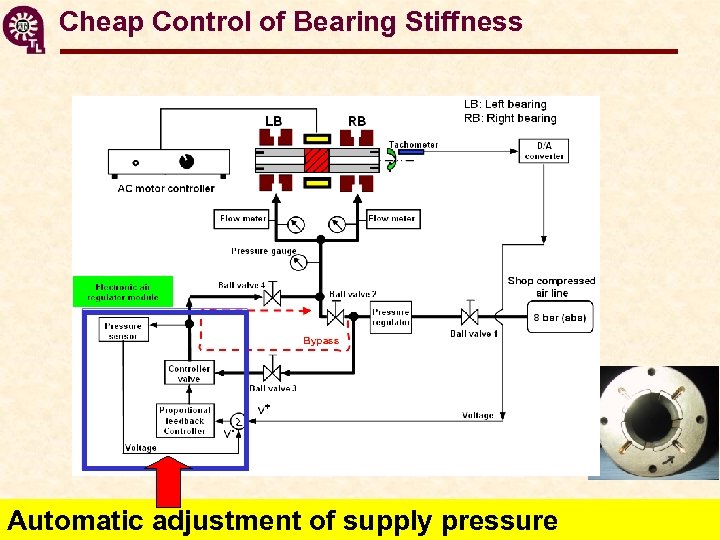
Cheap Control of Bearing Stiffness Automatic adjustment of supply pressure
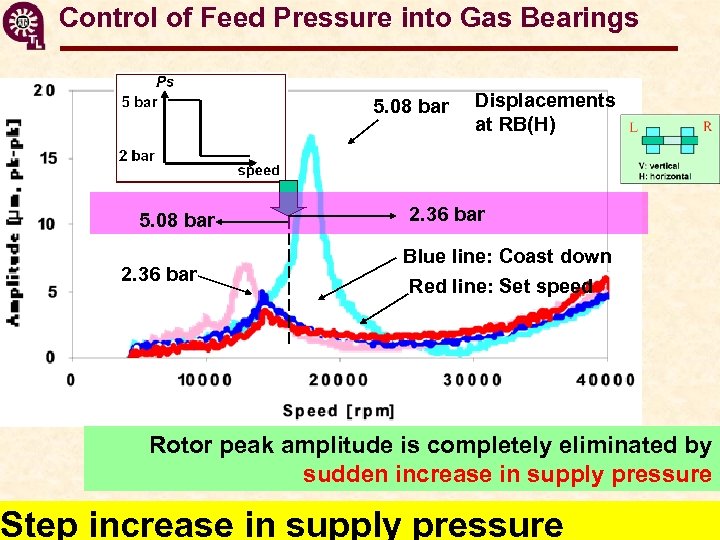
Control of Feed Pressure into Gas Bearings 5. 08 bar 2. 36 bar Displacements at RB(H) 2. 36 bar Blue line: Coast down Red line: Set speed Rotor peak amplitude is completely eliminated by sudden increase in supply pressure Step increase in supply pressure
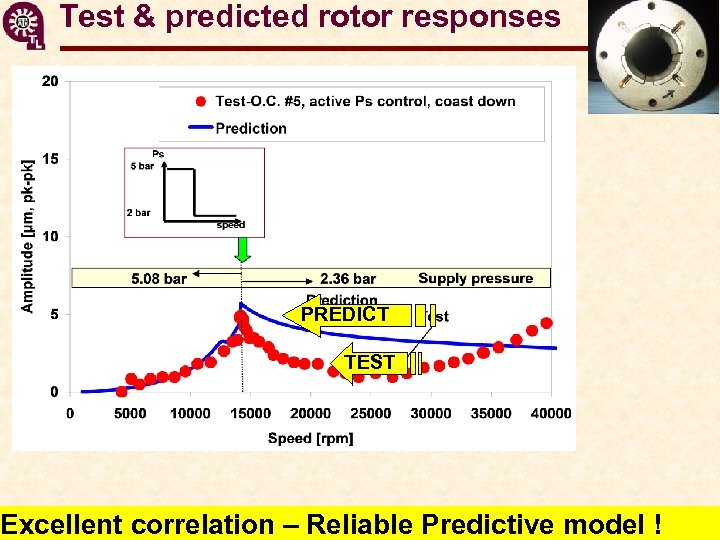
Test & predicted rotor responses PREDICT TEST Excellent correlation – Reliable Predictive model !
Flexure Pivot Hydrostatic Gas Bearings Closure: Stable to 99 krpm! • Supply pressure stiffens gas bearings and raises rotor critical speeds, though also reducing system modal damping. • CHEAP Feed pressure control of bearing stiffness eliminates critical speeds (reduce amplitude motions)! • Models predict well rotor response; even for large amplitude motions and with controlled supply pressure!
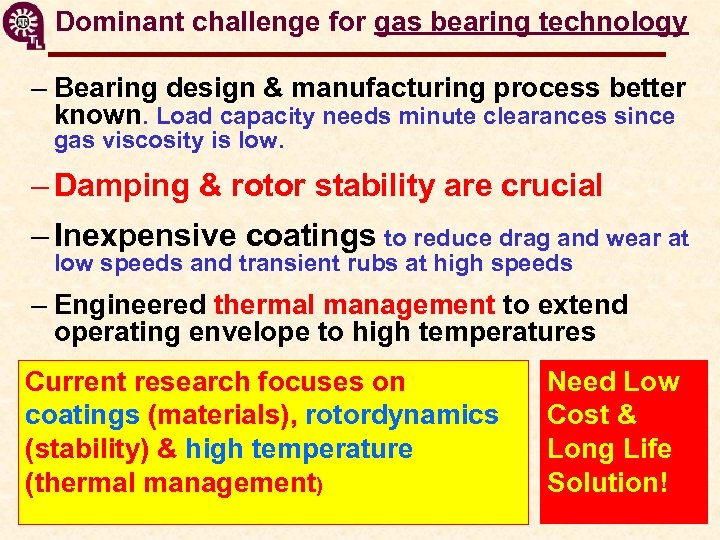
Dominant challenge for gas bearing technology – Bearing design & manufacturing process better known. Load capacity needs minute clearances since gas viscosity is low. – Damping & rotor stability are crucial – Inexpensive coatings to reduce drag and wear at low speeds and transient rubs at high speeds – Engineered thermal management to extend operating envelope to high temperatures Current research focuses on coatings (materials), rotordynamics (stability) & high temperature (thermal management) Need Low Cost & Long Life Solution!
Acknowledgments Thanks to Students Tae-Ho Kim. Dario Rubio, Anthony Breedlove, Keun Ryu, Chad Jarrett NSF (Grant # 0322925) NASA GRC (Program NNH 06 ZEA 001 N-SSRW 2), Capstone Turbines, Inc. , Honeywell Turbocharging Systems, Foster-Miller, & TAMU Turbomachinery Research Consortium (TRC) To learn more visit: http: //phn. tamu. edu/TRIBGroup

BACK UP SLIDES
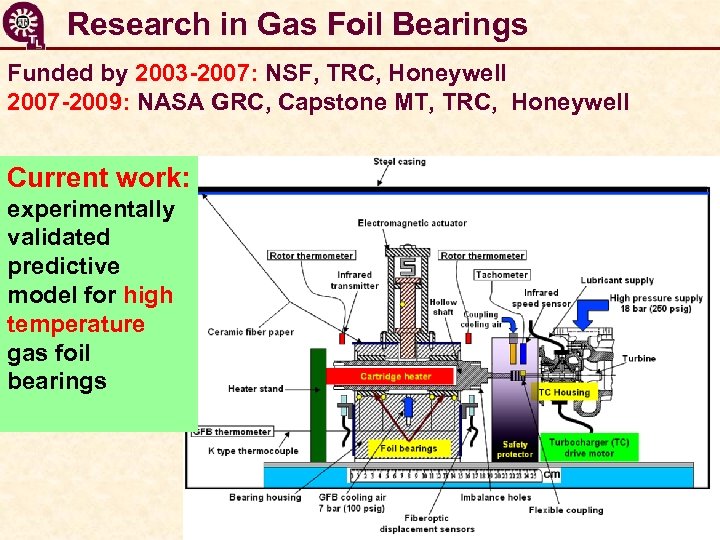
Research in Gas Foil Bearings Funded by 2003 -2007: NSF, TRC, Honeywell 2007 -2009: NASA GRC, Capstone MT, TRC, Honeywell Current work: experimentally validated predictive model for high temperature gas foil bearings
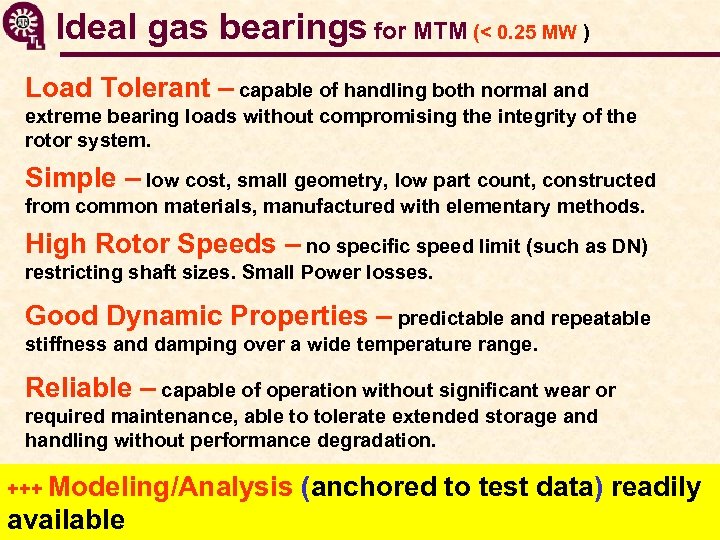
Ideal gas bearings for MTM (< 0. 25 MW ) Load Tolerant – capable of handling both normal and extreme bearing loads without compromising the integrity of the rotor system. Simple – low cost, small geometry, low part count, constructed from common materials, manufactured with elementary methods. High Rotor Speeds – no specific speed limit (such as DN) restricting shaft sizes. Small Power losses. Good Dynamic Properties – predictable and repeatable stiffness and damping over a wide temperature range. Reliable – capable of operation without significant wear or required maintenance, able to tolerate extended storage and handling without performance degradation. +++ Modeling/Analysis (anchored to test data) readily available
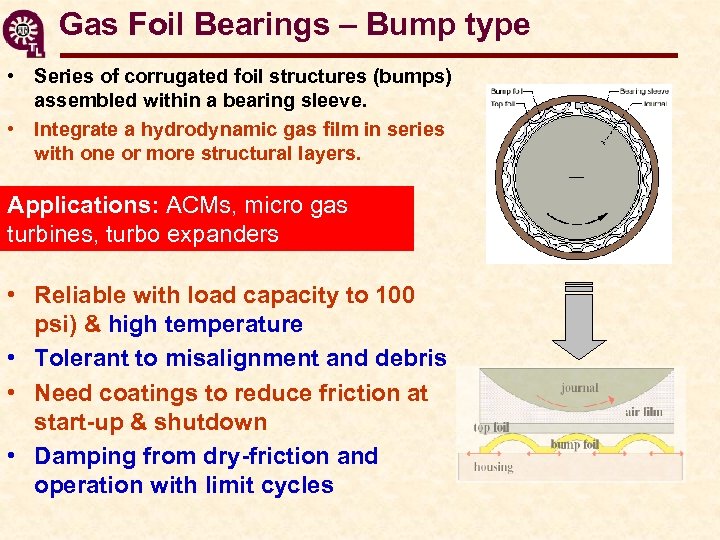
Gas Foil Bearings – Bump type • Series of corrugated foil structures (bumps) assembled within a bearing sleeve. • Integrate a hydrodynamic gas film in series with one or more structural layers. Applications: ACMs, micro gas turbines, turbo expanders • Reliable with load capacity to 100 psi) & high temperature • Tolerant to misalignment and debris • Need coatings to reduce friction at start-up & shutdown • Damping from dry-friction and operation with limit cycles
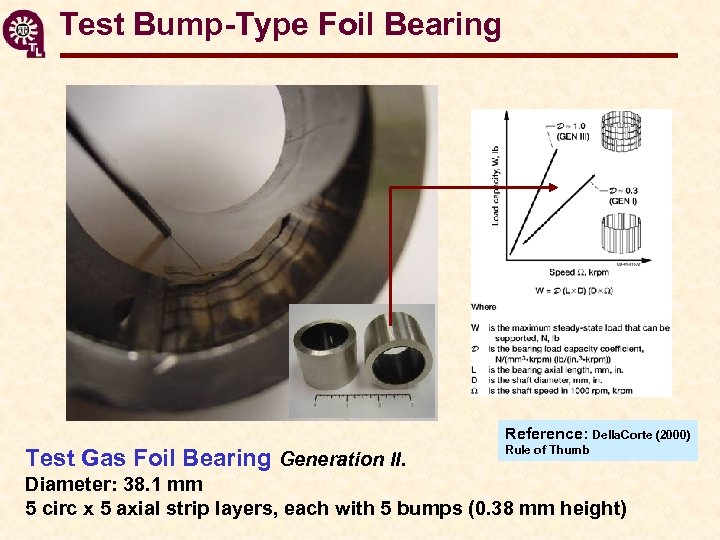
Test Bump-Type Foil Bearing Reference: Della. Corte (2000) Test Gas Foil Bearing Generation II. Rule of Thumb Diameter: 38. 1 mm 5 circ x 5 axial strip layers, each with 5 bumps (0. 38 mm height)
Oil-Free Bearings for Turbomachinery Justification Current advancements in automotive turbochargers and midsize gas turbines need of proven gas bearing technology to procure compact units with improved efficiency in an oil-free environment. DOE, DARPA, NASA interests range from applications as portable fuel cells (< 60 k. W) in microengines to midsize gas turbines (< 250 k. W) for distributed power and hybrid vehicles. Gas Bearings allow • weight reduction, energy and complexity savings • higher cavity temperatures, without needs for cooling air • improved overall engine efficiency
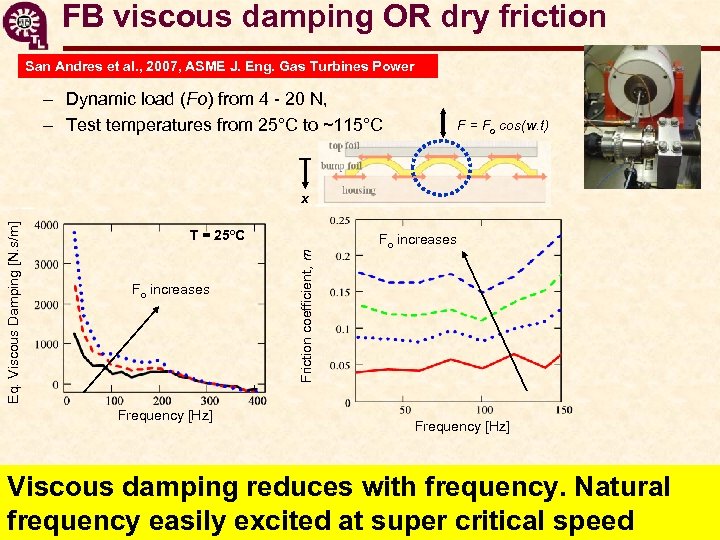
FB viscous damping OR dry friction San Andres et al. , 2007, ASME J. Eng. Gas Turbines Power – Dynamic load (Fo) from 4 - 20 N, – Test temperatures from 25°C to ~115°C F = Fo cos(w. t) T = 25ºC Fo increases Frequency [Hz] Fo increases Friction coefficient, m Eq. Viscous Damping [N. s/m] x Frequency [Hz] Viscous damping reduces with frequency. Natural frequency easily excited at super critical speed
Top Foil Model: 2 D Finite Elements Simple elastic foundation model Heavy load, ASME J. Eng. Gas Turbines Power, 2008, 130; and high speed operation, ASME J. Tribol. , 2006, 128. Finite element flat shell top foil models. 1 D and 2 D structural models, GT 2007 -27249 Test data, Ruscitto, et al. 1978 (mid plane) Prediction (mid plane, 2 D) Prediction (1 D) Prediction (simple model) Test data, Ruscitto, et al. 1978 (edge) Prediction (edge, 2 D)
Equations of motion EOMs: rigid rotor & in-phase imbalance condition Li & Flowers, AIAA 96 -1596 y Rotor motions x ü Assumption: minute gas film with infinite stiffness w
Equations of Rotor Motion Natural frequency of rotor-GFB system for small amplitude motions about SEP: = 132 Hz Numerical integration of EOMs for increasing rotor speeds to 36 krpm (600 Hz), with imbalance (u) identical to that in experiments. Solutions obtained in a few seconds. Postprocessing filters motions and finds synchronous and subsynchronous motions
Sync. and Subsync. Amplitudes Comparison to test measurements Rotor drive end, vertical plane. Structural loss factor, γ =0. 14. Synchronous motions Test data Subsynchronous motions Test data Predictions Good agreement between predictions to test data. Large amplitude subsynchronous motions cannot be predicted using linear rotordynamic analyses.
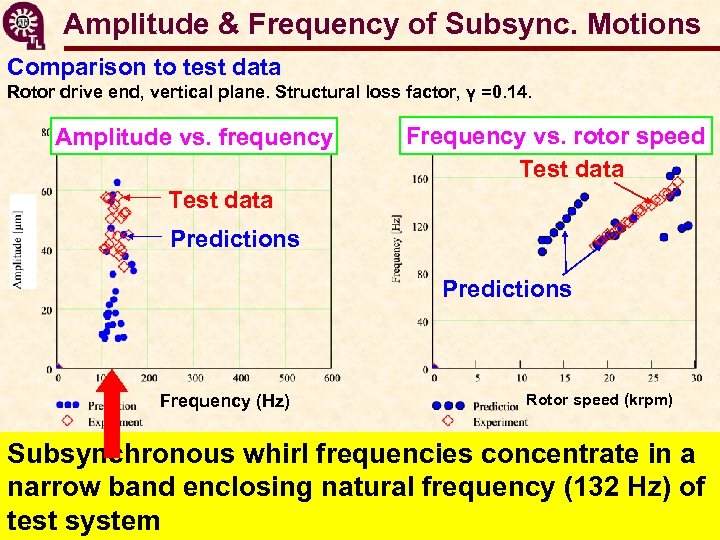
Amplitude & Frequency of Subsync. Motions Comparison to test data Rotor drive end, vertical plane. Structural loss factor, γ =0. 14. Amplitude vs. frequency Frequency vs. rotor speed Test data Predictions Frequency (Hz) Rotor speed (krpm) Subsynchronous whirl frequencies concentrate in a narrow band enclosing natural frequency (132 Hz) of test system
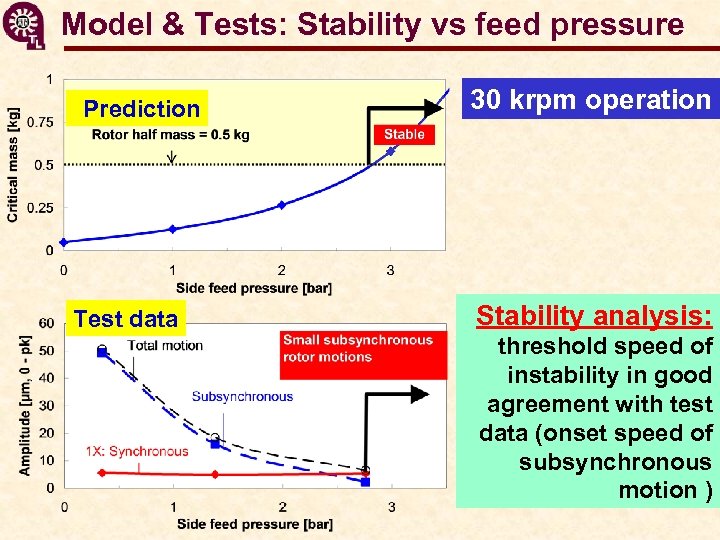
Model & Tests: Stability vs feed pressure Prediction Test data 30 krpm operation Stability analysis: threshold speed of instability in good agreement with test data (onset speed of subsynchronous motion )
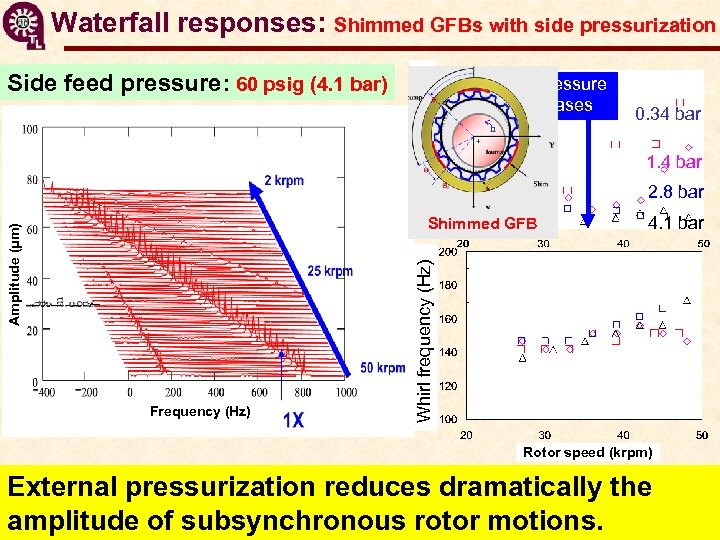
Side feed pressure: 60 psig (4. 1 bar) Amplitude (μm, 0 -pk) Waterfall responses: Shimmed GFBs with side pressurization Side pressure increases 1. 4 bar 2. 8 bar 4. 1 bar Whirl frequency (Hz) Amplitude (μm) Shimmed GFB Frequency (Hz) 0. 34 bar Rotor speed (krpm) External pressurization reduces dramatically the amplitude of subsynchronous rotor motions.
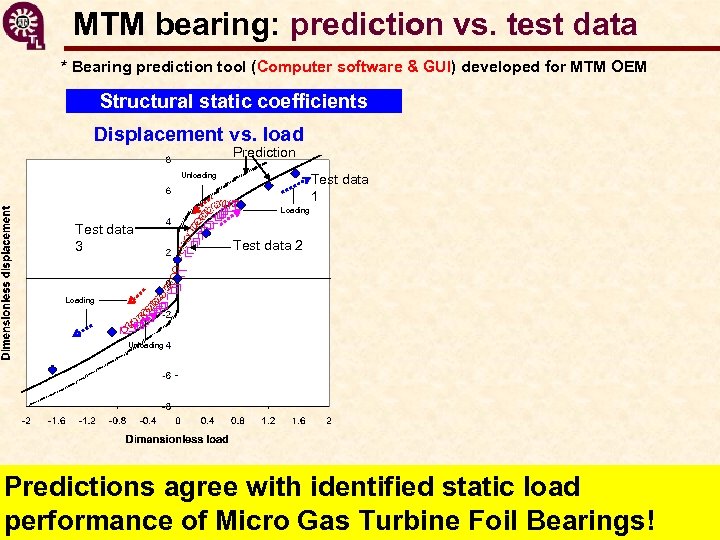
MTM bearing: prediction vs. test data * Bearing prediction tool (Computer software & GUI) developed for MTM OEM Structural static coefficients Displacement vs. load Prediction Unloading Test data 1 Loading Test data 3 Test data 2 Loading Unloading Predictions agree with identified static load performance of Micro Gas Turbine Foil Bearings!
Скачать презентацию ISROMAC-12 February 2008 The Twelfth International Symposium on
f601f6e0de5fcbbe75f2610b9ad13ed5.ppt