 Скачать презентацию Israel s Future The Greatest Prophecy in the Bible
dcd954f4d9114fe3e136ee3e1ffe598b.ppt
- Количество слайдов: 37




Israel’s Future: The Greatest Prophecy in the Bible
Part One - Daniel 9: 20 - 24 • A. The Amazing Prophesy • Daniel 9: 20 – 27
B. The Historical Setting: • After the reign of Solomon the kingdom of Israel was divided into two parts: the northern kingdom of Israel and the southern kingdom of Judah. • In approximately 722 B. C. the Assyrians took away most of the inhabitants of the northern kingdom. They were dispersed in the Assyrian Empire and few returned.
• The inhabitants of southern kingdom of Judah were later • • • taken captive by the Babylonians--the first of four great Gentile world empires: Babylon, Medo-Persia, Greece, and Rome (cf. Dan. 7: 1 -8). That captivity began about 605 B. C. when King Nebuchadnezzar started what became a series of three significant deportations from Judah. In the first deportation Nebuchadnezzer carried away the young men from among the nobles and princes of Judah. Among them were four young men named Daniel, Mishael, Hananiah, and Azariah. The Babylonians renamed them Belteshazzar, Shadrach, Meshach, and Abednego (Dan. 1: 6 -7). Although a captive, Daniel remained fully committed to the God of Israel. As a result of his commitment and the quality of his character he eventually became the prime minister of Babylon.
• At the time the prophecy recorded in Daniel 9 • • was given, the Babylonian Empire had fallen to the Medo-Persian Empire. A king named Cyrus (also titled Darius) was in power. Although the Jewish exiles were now the captives of the Medo-Persians, Daniel retained his position as prime minister because of his integrity. Some scholars believe Daniel received his revelation in the year 537 B. C. , which was just about seventy years after Daniel had been taken captive.
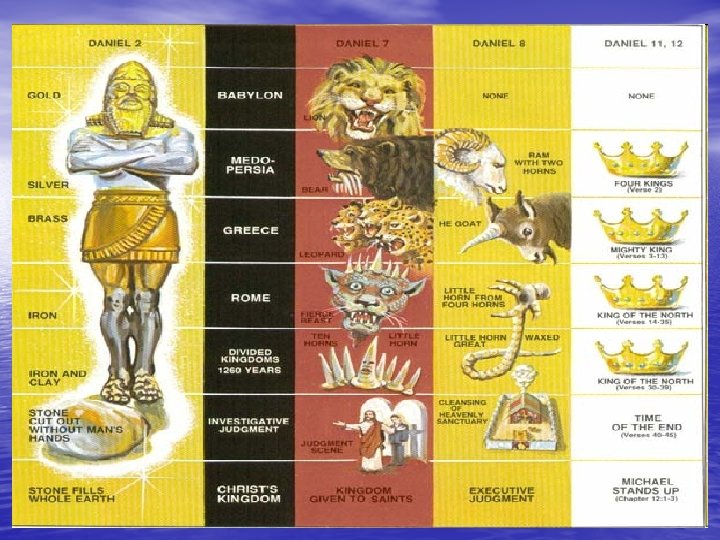
Previously in Daniel! • Daniel 2: Nebuchadnezzar’s Dream • a prophecy of four great Gentile empires • • succeeded by the kingdom of God Daniel 7: Vision of the Beasts the same vision in a different format that includes the reign of the Antichrist over the final form of the last Gentile world power Daniel 8: Second Vision of Beasts Focuses on the future of Israel
Daniel’s Prayer (9: 3 – 19) • There a number of characteristics that made Daniel's prayer answerable by God. • 1. It was in response to God's Word • 2. It was according to God's will • 3. It was fervent • 4. It included self-denial (an attitude of humility) • 5. It focused on others
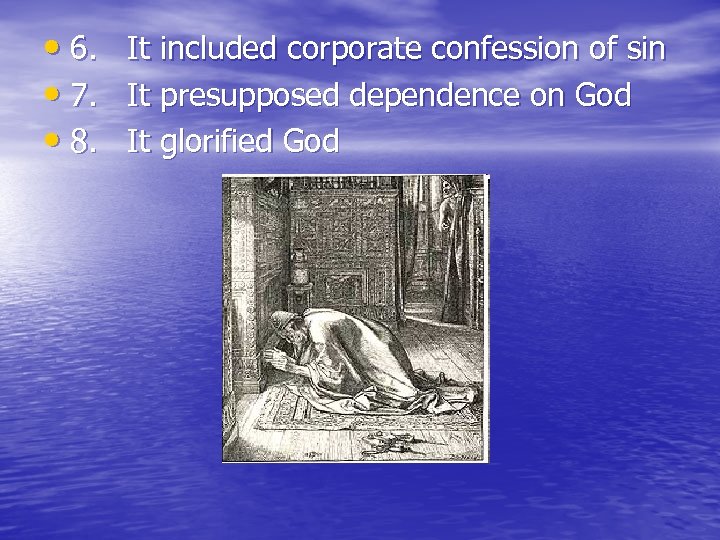
• 6. It included corporate confession of sin • 7. It presupposed dependence on God • 8. It glorified God
THE MESSENGER OF THE REVELATION (vv. 21 -23) • Gabriel: The last two letters of Gabriel's name signify one of the names of God (Heb. , el, "the strong one"). • The first part of Gabriel's name is derived from the Hebrew word gabor, which also means "the strong one, " but in reference to man. • Thus the compound meaning of Gabriel's name is "man, the strong one; God, the strong one" or "the strong man of God. "
THE CONTENT OF THE REVELATION (vv. 24 -27) • The prophecy deals with the nation of Israel and • • • the city of Jerusalem. There are two princes mentioned: the Messiah (who is Christ, v. 25) and another who will come (the Antichrist, v. 26). The time period covered by the prophecy is seventy weeks, divided into three periods: seven weeks, sixty-two weeks, and one week. The time period began "from the going forth of the commandment to restore and build Jerusalem" (v. 25) and will end when Messiah the Prince comes to establish His eternal kingdom.
1) God's Purpose in History (v. 24) • Verse 24 outlines six purposes that God will • • accomplish for Israel and Jerusalem. Three are negative and three are positive: NEGATIVE … a) "To finish the transgression" That literally means "to restrain firmly the transgression. " Today sin expresses itself freely, but a day will come when that will not be true. Jesus will rule with a rod of iron (Ps. 2: 6 -9) and every expression of evil--"transgression"--will be immediately restrained by His divine power.
• b) "To make an end of sins" • That means sin will be done away with in general and individually (the plural denotes that individual sins will be dealt with). • Some think the Hebrew verb translated "to make an end" might be better translated "to seal up. " It's a word always associated with divine judgment. The idea is that at the end of the seventy weeks God will wipe out sin.
• c) "To make reconciliation for iniquity" • "To make reconciliation" translates the Hebrew • • verb kaphar, which means "to cover. " It speaks of expiation and atonement. This speaks of how God will put an end to transgression and sin: by atoning for sin. That was surely a welcome word to Daniel because it was sin that caused Israel to be taken into captivity. What Daniel may not have understood was that was speaking of the coming of Christ and His work on the cross. That's where sin was dealt with, though the full effect of that work will be fully realized only when Christ comes again. Thus the first three negative purposes spoken of in verses 24 -27 pertain to the cross and its provision for sin.
Positive things… • a) "To bring in everlasting righteousness" • "Righteousness" is stated as a plural in the Hebrew text • • and refers to an everlasting era of righteousness. The Jewish people didn't use a distinction in the Old Testament between the Messiah's first and second coming, nor did they understand the gap that exists between them--the church age, which is called a "mystery" in the New Testament (cf. Eph. 3: 2 -6). We see a hint of that time in the transition between this fourth purpose of God and the three that precede it: the first three deal with the work of Christ on the cross (at the end of Daniel's sixty-ninth week) , while this and the following two represent Christ establishing His eternal kingdom of righteousness (at the end of the seventieth week).
• b) "To seal up the vision and prophecy" • When the eternal kingdom of Christ is established • • there will be no need for vision or prophecy. Some think "to seal up the vision and prophecy" speaks of the completion of the New Testament. But that can't be true because Joel 2: 28 -29 indicates that prophecy and visions will occur at the initiation of the kingdom, which is yet future. Therefore, though an exact chronology for it is not specified, what is spoken of here is the end of prophecies and visions at the inauguration of Christ's kingdom.
• c) "To anoint the Most Holy" • The phrase "the Most Holy" occurs thirty- nine times in the Old Testament and always has some reference to the Holy of Holies in the Tabernacle and Temple. • It always refers to a place, indicating that when Christ's kingdom is inaugurated, there will be a Temple: the restored Temple of the millennial kingdom (cf. Ezek. 40 -48).
B. God's Timing in History (vv. 24 -25) • 1. Defining the terms • a) "Weeks" • "Weeks" translates the Hebrew word shabuwa, • which literally means "sevens. " The word doesn't by itself indicate whether it is speaking of days, weeks, months, or years, so it must be interpreted in its context. Many evangelical Bible scholars think it refers to weeks of years. There a number of reasons for interpreting shabuwa that way.
• Daniel knew one of the reasons the Jewish people were • • • taken into captivity was their constant violation of the seven-year Sabbath. Instead of allowing the land a year of rest their greed and materialism caused them to plow and plant the seventh year. This violation was repeated over an extended period of time and God determined that the land belonging to Him would have its rest. The Jewish people were taken captive "to fulfill the word of the Lord by the mouth of Jeremiah, until the land had enjoyed her sabbaths; for as long as she lay desolate she kept sabbath, to fulfill threescore and ten years" (2 Chron. 36: 21). They had violated seventy sabbath years, which means they had disobeyed the sabbath commandment for 490 of their 800 -year history as a nation. God exacted one year of captivity for each sabbath year violated. In Daniel 9: 24 Daniel is being told that 490 years beyond that would fulfill the history of his people.
• b) "Year" • In Daniel's day some used 365 -day years and others 360 -day years. Those who used 360 -day years would occasionally add an extra month to catch up. • There are two compelling reasons to believe the years of Daniel 9 are 360 -day years.
2. Determining the Messiah's arrival • a) The first seven weeks • (1) When did they commence? • Verse 25 indicates that they begin with "the commandment to restore and build Jerusalem"--but history records several such commands given on different dates. • It's important to know which one is right since a different starting date would result in a different ending date.
At the second degree of Artaxerxes • • • This is the best candidate for the decree spoken of in Daniel 9: 25. Two scholars have convincingly researched this view: Sir Robert Anderson of Scotland Yard, who over hundred years ago wrote the classic book The Coming Prince (Grand Rapids: Kregel, 1954) , and Dr. Harold Hoehner of Dallas Theological Seminary, who wrote Chronological Aspects of the Life of Christ (Grand Rapids: Zondervan, 1977). Dr. Hoehner confirmed Anderson's precise computations, differing with him only concerning the proper year of the accession of Artaxerxes to his throne. Ezra 4 records that the restoration of the Temple was temporarily suspended because the builders were accused of also rebuilding the city without authorization. Permission for rebuilding the city came only with the second decree of Artaxerxes "in the month Nisan, in the twentieth year of Artaxerxes" (Neh. 2: 1). Artaxerxes's reign started in 465 B. C. , so the date referred to in Nehemiah 2: 1 was the month of Nisan in the year 445 B. C. Because a king's reign was dated from the first of the month of his reign, Sir Robert Anderson thought that since no other date was mentioned in Nehemiah 2, the date Nehemiah spoke of was probably the first of Nisan, 445 B. C. --or March 14, 445 B. C. according to our calendar.
When did they conclude? • The seven weeks of years concluded in 396 B. C. , forty-nine years after the second decree of Artaxerxes in 445 B. C.
• b) The sixty-two weeks • (1) When did they commence? • In 396 B. C. , following the forty-nine years of rebuilding Jerusalem, a period of sixtytwo weeks of years (434 years) commenced. • Simple addition shows that the total number of years between the second decree of Artaxerxes and the coming of the Messiah is 483 years. • Each of those years consisted of 360 days. Thus the total number of days involved is 173, 880 days.
When did they conclude ? • The phrase "the Messiah, the Prince" (Heb. , • mashiach nagid) is formal terminology that means "the Anointed One, the Ruler. " The Hebrew word translated "prince" (nagid) was first used of King Saul and then of other kings. It is a title associated with kingly authority and is applied here to the appearing of the Lord Jesus Christ as a prince and ruler.
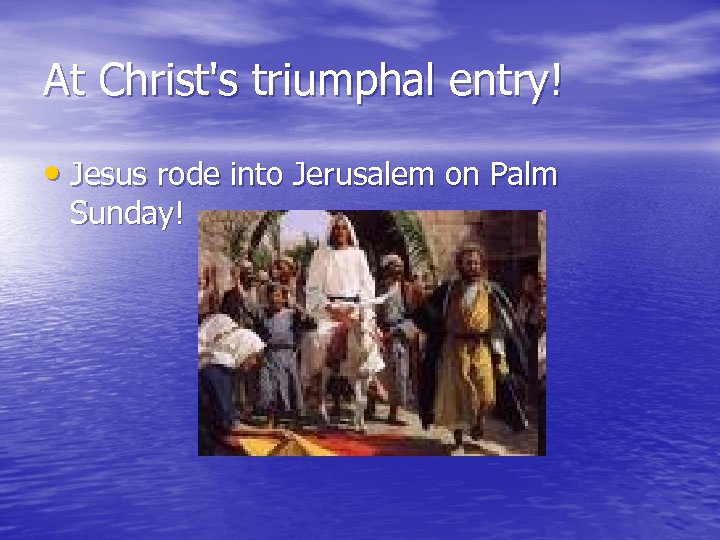
At Christ's triumphal entry! • Jesus rode into Jerusalem on Palm Sunday!
• The interpretation that makes the most sense is • • • the triumphal entry of Jesus into Jerusalem since that was when He was presented to the Jewish people as the Messianic Prince. The test of this theory is whether the triumphal entry occurred 173, 880 days after the second decree of Artaxerxes. Working from March 14, 445 B. C. (the date of Artaxerxes' second decree according to our calendar) , Sir Robert Anderson calculated by the use of astronomical calendars and charts that the day of the coming of the Messiah was April 6, A. D. 32. Such calendars and charts helped him determine the timing of the Jewish new moons by which the Passovers were determined.
• When Jesus entered Jerusalem in triumph it wasn't on a whim. When He said, "Mine hour is not yet come, " He knew what He was talking about: God has declared "the end from the beginning, and from ancient times the things that are not yet done" (Isa. 46: 10). • God told Daniel precisely when the Messiah would enter Jerusalem and be acknowledged as King with shouts of "Hosanna to the Son of David!" (Matt. 21: 9).
C. God's Future for Israel (vv. 26 -27) • 1. Their treatment of Christ (v. 26 a) • a) When it occurred • That verse is saying the Messiah would be cut • • off after sixty-two "weeks. " Since that period immediately follows the seven weeks mentioned in Daniel 9: 25, this is talking about something that happens after a sixty-nine week period. Christ was crucified shortly after that period of time ended at His triumphal entry into Jerusalem.
• Since Christ was crucified after the end of the • • sixty-ninth week, but not during the seventieth week, there must be one week left of the seventy determined for Israel (Dan. 9: 24). Verse 27 indicates that is when a coming prince known as the Antichrist "shall confirm the covenant with many. " Since that covenant has not yet been declared and nothing occurred in the seven years following Christ's triumphal entry that explains Daniel 9: 26 -27, there must be a gap between the sixty-ninth and seventieth weeks--they do not occur as a continuous unit of time. Such gaps are common in biblical prophecy.
• (1) They rejected His Person • The Hebrew verb translated "cut off" (karath) also means "to kill" or "destroy" (cf. Gen. 9: 11; Deut. 20: 20; Jer. 11: 19). • Daniel 9: 26 is saying that the Messiah would be killed. • The Jewish people who knew their Bibles should • never have concluded that "the preaching of the cross is. . . foolishness" (1 Cor. 1: 18). But most of them at the time of Christ didn't understand their Messiah was to be executed, so the cross became "a stumbling block" (v. 23). Jesus had to reprimand His own disciples for their ignorance and explain what Scripture said on the matter (Luke 24: 13 -27).
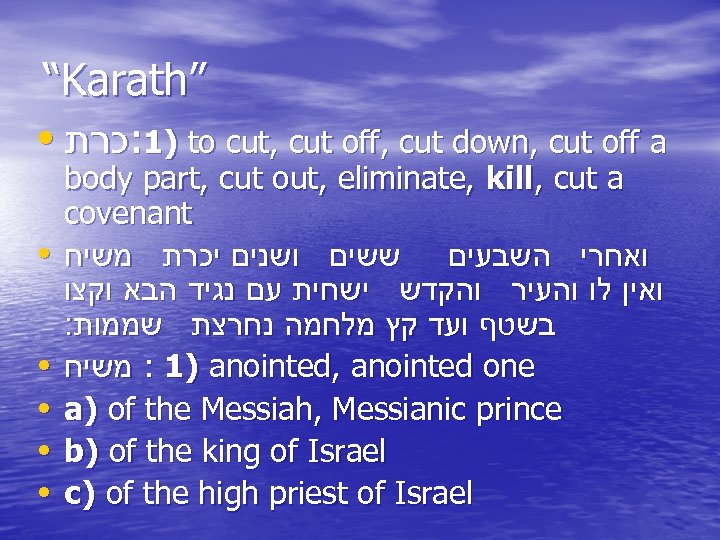
“Karath” ● )1: כרת to cut, cut off, cut down, cut off a ● ● ● body part, cut out, eliminate, kill, cut a covenant ואחרי השבעים ששים ושנים יכרת משיח ואין לו והעיר והקדש ישחית עם נגיד הבא וקצו בשטף ועד קץ מלחמה נחרצת שממות׃ )1 : משיח anointed, anointed one a) of the Messiah, Messianic prince b) of the king of Israel c) of the high priest of Israel
• Karath is used a number of times in the Old Testament • • to describe the execution of a criminal (Lev. 7: 20; Ps. 37: 9; Prov. 2: 22). Daniel's usage of the term implies the Messiah would die a criminal's death--a prophecy so specific, it seems incomprehensible that when Jesus was presented in triumph in precise accord with Daniel's timetable but then crucified, the Jewish people would not immediately recognize who He was. They waited for centuries for their Messiah to come and then missed Him through hate and despite. And if it is argued that Daniel 9 is somewhat obscure and easily misunderstood, one need only turn to Psalm 22 (which describes the crucifixion in detail) or Isaiah 53 (which describes the suffering and death of the Messiah) to understand that the Old Testament clearly declares the Messiah would die.
• The Messiah was to die, "but not for himself" • • (Dan. 9: 26). That's a hard phrase to interpret, but it apparently means He would die with nothing for Himself. When Jesus died on the cross He received nothing that was due Him: no honor, respect, love, or acceptance. "He was in the world, and the world was made by him, and the world knew him not. He came unto his own, and his own received him not" (John 1: 10 -11). Instead He received what He didn't deserve: the sins of the world.
2. Their treatment by the people of the Antichrist (v. 26 b) • a) The Antichrist identified • "The prince that shall come" is opposite the one • • identified in Daniel 9: 25 as the "Messiah, the Prince. " b) The people identified The Roman Empire will be revived again as a ten-nation confederacy during the last days. Thus the people of the prince to come will have some connection with the Romans and a revived Roman Empire.
• c) The persecution inflicted • In A. D. 70 --less than forty years after our Lord • • • was crucified--that prophecy was fulfilled when Jerusalem was destroyed by the Romans. The Antichrist will reign over a revived Roman Empire that will trouble Israel in a way similar to the first Roman Empire. Until its final persecution by the Antichrist Israel has experienced a steady stream of desolations that began with the destruction of Jerusalem in A. D. 70, while the rise of the Antichrist will commence a holocaust beyond any it has previously experienced. It will be like a flood (cf. Rev. 12: 15). That final desolation is vividly prefigured by the first Roman holocaust.
3. Their treatment by the Antichrist (v. 27) • The history of the Jewish people is a chronicle of • persecution and desolation. Yet it has not ended-in the midst of persecution ninety thousand Jewish people reentered Palestine in 1914. By 1948 Israel was again chartered among the community of nations. This regathering of Israel is in preparation for the final week of Israel's history as declared in Daniel 9, when the Antichrist will come and make a covenant with the nation of Israel.
Скачать презентацию Israel s Future The Greatest Prophecy in the Bible
dcd954f4d9114fe3e136ee3e1ffe598b.ppt