 Скачать презентацию ISQS 3358 Business Intelligence Anatomy of Business Intelligence
fdf8cd39ff58a6dd19d118b53a574ff3.ppt
- Количество слайдов: 52




ISQS 3358, Business Intelligence Anatomy of Business Intelligence Zhangxi Lin Texas Tech University 1
Learning Objectives n n n Understand today’s turbulent business environment and describe how organizations survive and even excel in such an environment (solving problems and exploiting opportunities) Understand the need for computerized support of managerial decision making Describe the business intelligence (BI) methodology and concepts and relate them to DSS Understand the major issues in implementing business intelligence \cimarroncobadisqs 3358
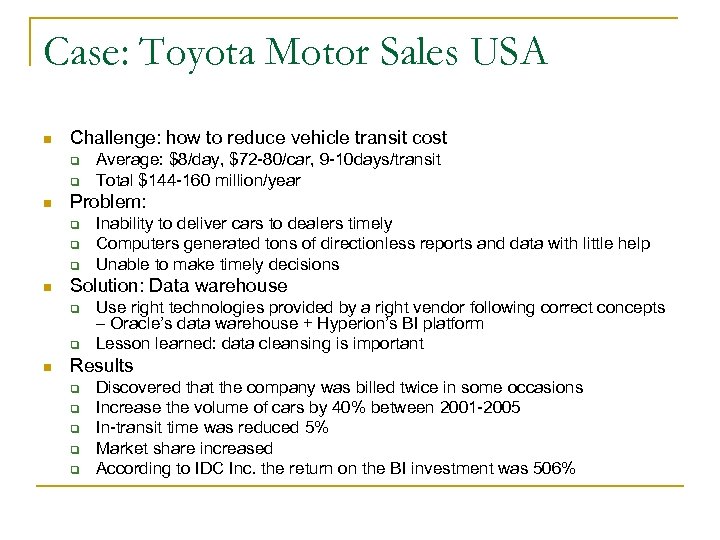
Case: Toyota Motor Sales USA n Challenge: how to reduce vehicle transit cost q q n Problem: q q q n Inability to deliver cars to dealers timely Computers generated tons of directionless reports and data with little help Unable to make timely decisions Solution: Data warehouse q q n Average: $8/day, $72 -80/car, 9 -10 days/transit Total $144 -160 million/year Use right technologies provided by a right vendor following correct concepts – Oracle’s data warehouse + Hyperion’s BI platform Lesson learned: data cleansing is important Results q q q Discovered that the company was billed twice in some occasions Increase the volume of cars by 40% between 2001 -2005 In-transit time was reduced 5% Market share increased According to IDC Inc. the return on the BI investment was 506%
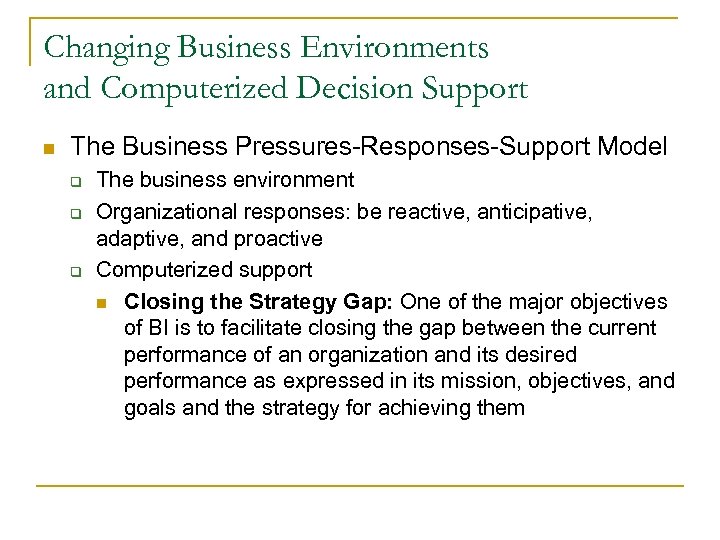
Changing Business Environments and Computerized Decision Support n The Business Pressures-Responses-Support Model q q q The business environment Organizational responses: be reactive, anticipative, adaptive, and proactive Computerized support n Closing the Strategy Gap: One of the major objectives of BI is to facilitate closing the gap between the current performance of an organization and its desired performance as expressed in its mission, objectives, and goals and the strategy for achieving them
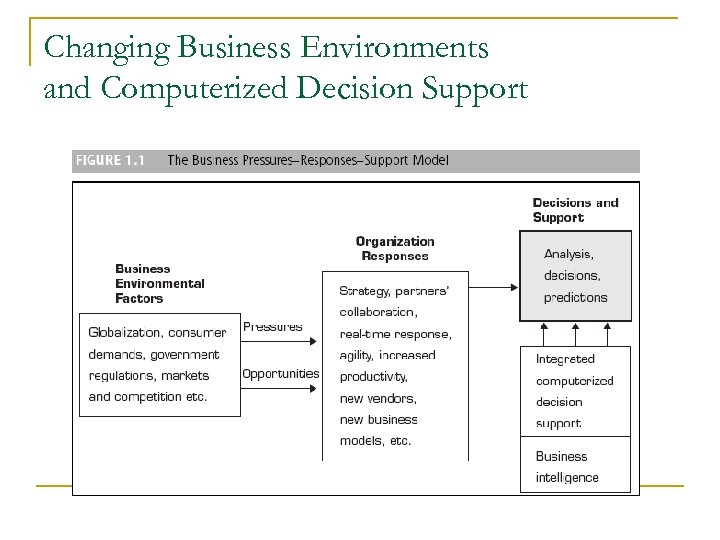
Changing Business Environments and Computerized Decision Support
A Framework for Business Intelligence (BI) n Business intelligence (BI) A conceptual framework for decision support. It combines architecture, databases (or data warehouse), analytical tools and applications
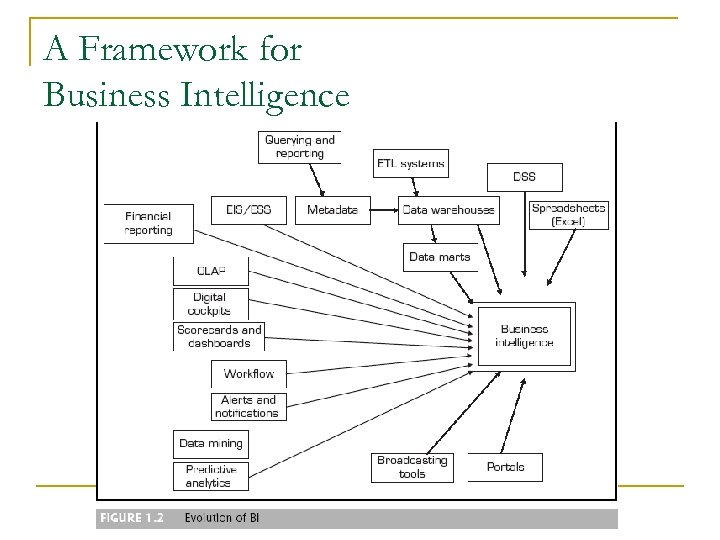
A Framework for Business Intelligence
A Framework for Business Intelligence (BI) n The Origins and Drivers of Business Intelligence q q Organizations are being compelled to capture, understand, and harness their data to support decision making in order to improve business operations Managers need the right information at the right time and in the right place
A Framework for Business Intelligence (BI) n BI’s Architecture and Components q q Data Warehouse Business Analytics n q Automated decision systems Performance and Strategy
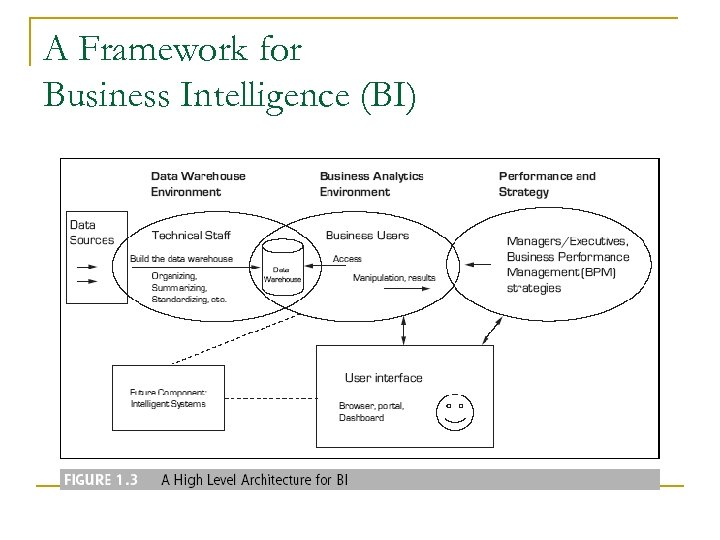
A Framework for Business Intelligence (BI)
A Framework for Business Intelligence (BI) n BI’s Architecture and Components q Data Mining A class of information analysis based on databases that looks for hidden patterns in a collection of data which can be used to predict future behavior
A Framework for Business Intelligence (BI) n BI’s Architecture and Components q business (or corporate) performance management (BPM) A component of BI based on the balanced scorecard methodology, which is a framework for defining, implementing, and managing an enterprise’s business strategy by linking objectives with factual measures
A Framework for Business Intelligence (BI) n BI’s Architecture and Components q User Interface: Dashboards and Other Information Broadcasting Tools n Dashboards A visual presentation of critical data for executives to view. It allows executives to see hot spots in seconds and explore the situation
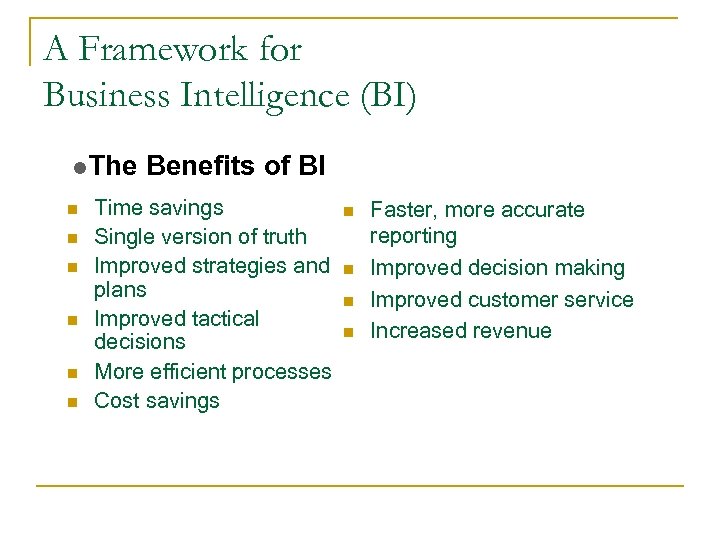
A Framework for Business Intelligence (BI) l. The n n n Benefits of BI Time savings Single version of truth Improved strategies and plans Improved tactical decisions More efficient processes Cost savings n n Faster, more accurate reporting Improved decision making Improved customer service Increased revenue
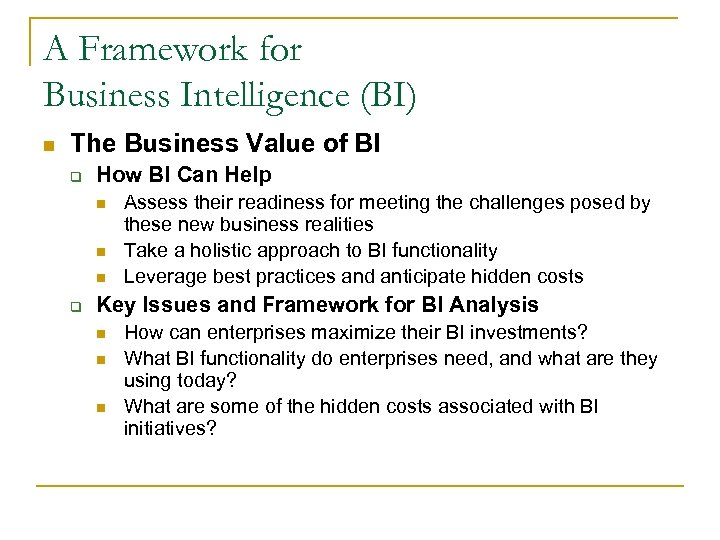
A Framework for Business Intelligence (BI) n The Business Value of BI q How BI Can Help n n n q Assess their readiness for meeting the challenges posed by these new business realities Take a holistic approach to BI functionality Leverage best practices and anticipate hidden costs Key Issues and Framework for BI Analysis n n n How can enterprises maximize their BI investments? What BI functionality do enterprises need, and what are they using today? What are some of the hidden costs associated with BI initiatives?
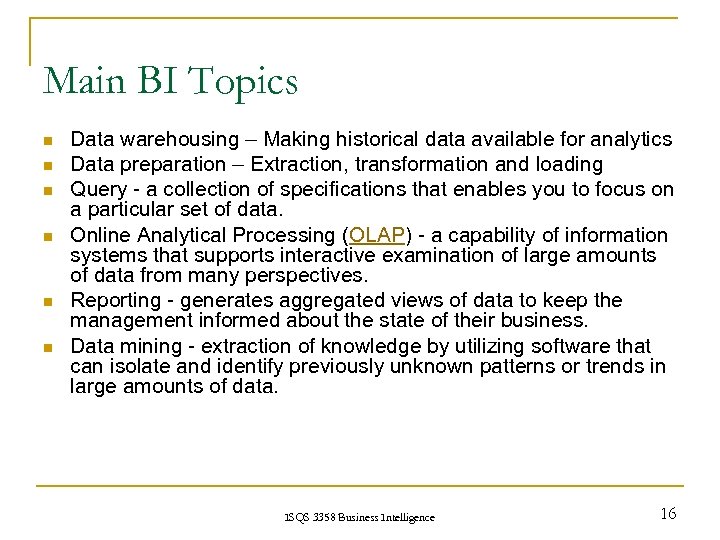
Main BI Topics n n n 16 Data warehousing – Making historical data available for analytics Data preparation – Extraction, transformation and loading Query - a collection of specifications that enables you to focus on a particular set of data. Online Analytical Processing (OLAP) - a capability of information systems that supports interactive examination of large amounts of data from many perspectives. Reporting - generates aggregated views of data to keep the management informed about the state of their business. Data mining - extraction of knowledge by utilizing software that can isolate and identify previously unknown patterns or trends in large amounts of data. ISQS 3358 Business Intelligence 16
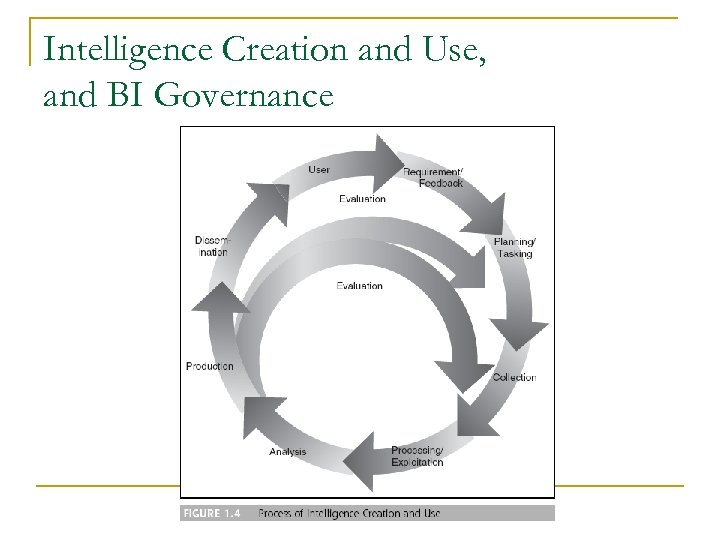
Intelligence Creation and Use, and BI Governance
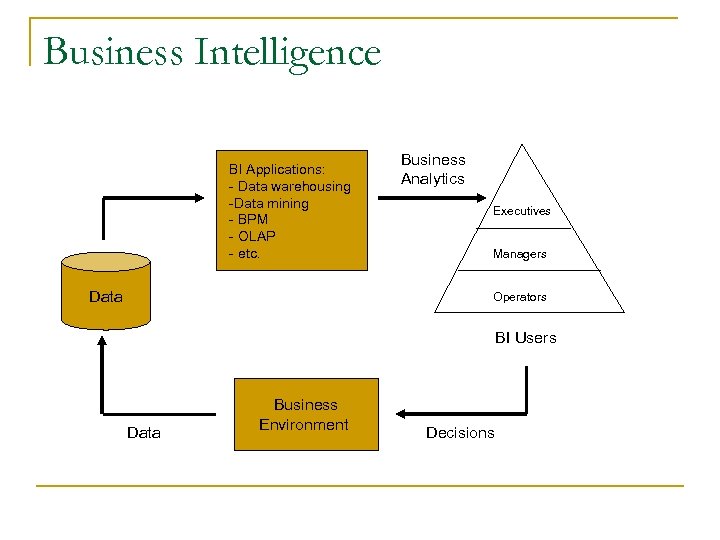
Business Intelligence BI Applications: - Data warehousing -Data mining - BPM - OLAP - etc. Data Business Analytics Executives Managers Operators BI Users Data Business Environment Decisions
Intelligence Creation and Use and BI Governance n BI Governance The project prioritization process within organizations
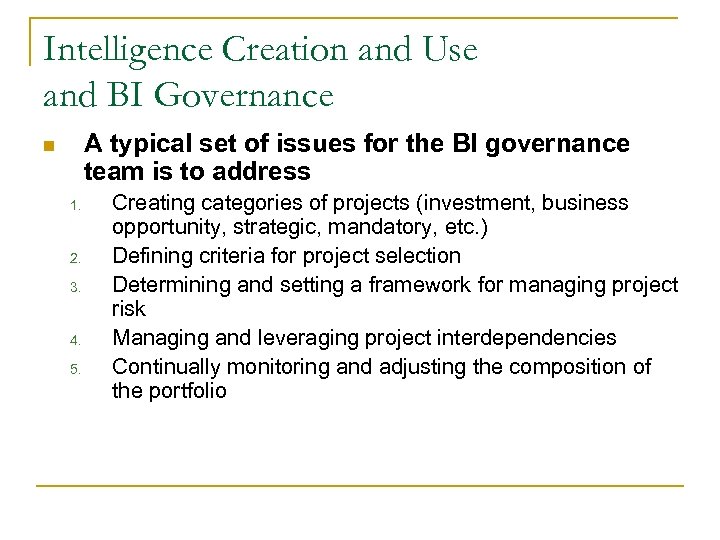
Intelligence Creation and Use and BI Governance A typical set of issues for the BI governance team is to address n 1. 2. 3. 4. 5. Creating categories of projects (investment, business opportunity, strategic, mandatory, etc. ) Defining criteria for project selection Determining and setting a framework for managing project risk Managing and leveraging project interdependencies Continually monitoring and adjusting the composition of the portfolio
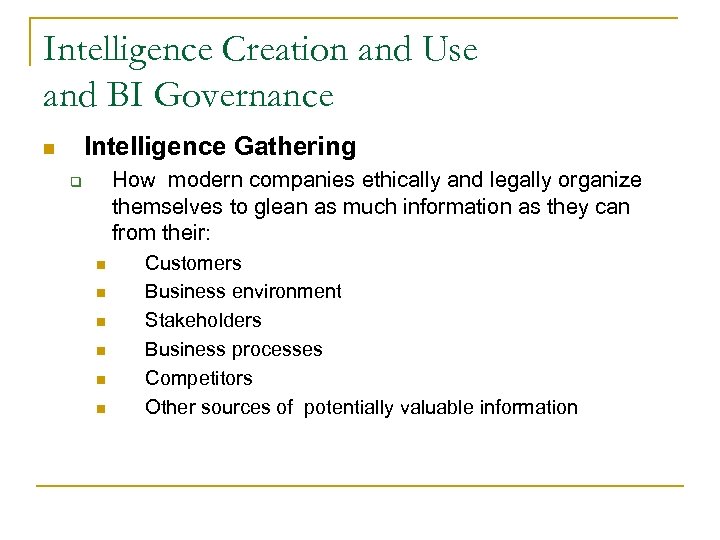
Intelligence Creation and Use and BI Governance Intelligence Gathering n How modern companies ethically and legally organize themselves to glean as much information as they can from their: q n n n Customers Business environment Stakeholders Business processes Competitors Other sources of potentially valuable information
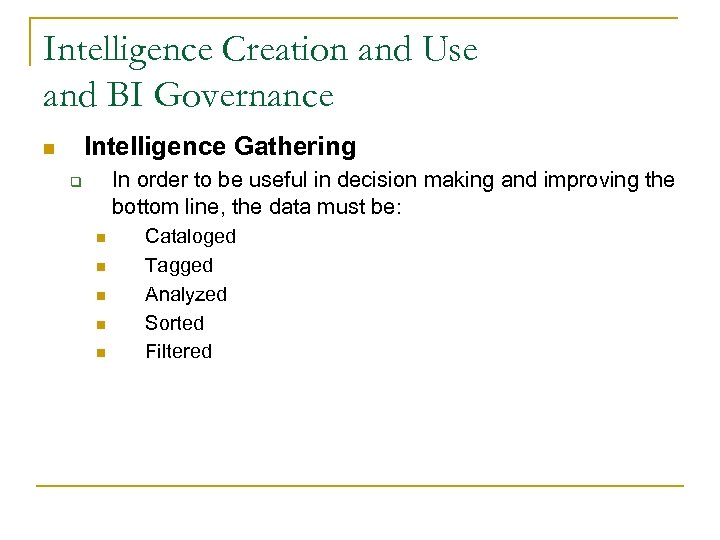
Intelligence Creation and Use and BI Governance Intelligence Gathering n In order to be useful in decision making and improving the bottom line, the data must be: q n n n Cataloged Tagged Analyzed Sorted Filtered
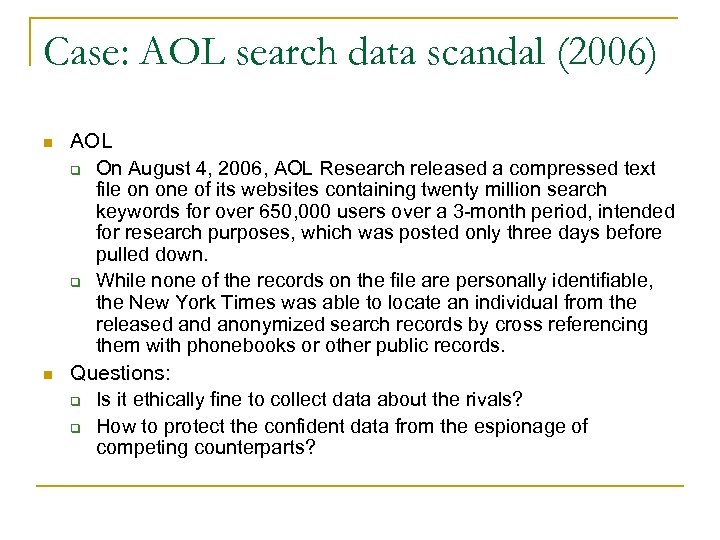
Case: AOL search data scandal (2006) n n AOL q On August 4, 2006, AOL Research released a compressed text file on one of its websites containing twenty million search keywords for over 650, 000 users over a 3 -month period, intended for research purposes, which was posted only three days before pulled down. q While none of the records on the file are personally identifiable, the New York Times was able to locate an individual from the released anonymized search records by cross referencing them with phonebooks or other public records. Questions: q Is it ethically fine to collect data about the rivals? q How to protect the confident data from the espionage of competing counterparts?
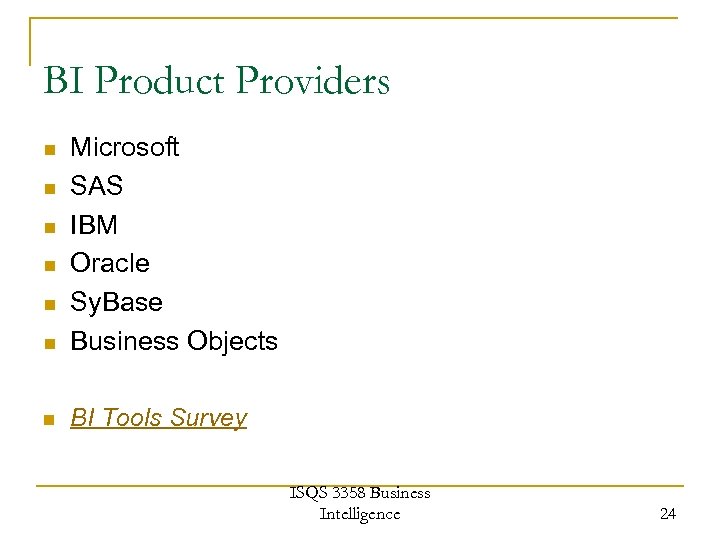
BI Product Providers n Microsoft SAS IBM Oracle Sy. Base Business Objects n BI Tools Survey n n n 24 ISQS 3358 Business Intelligence 24
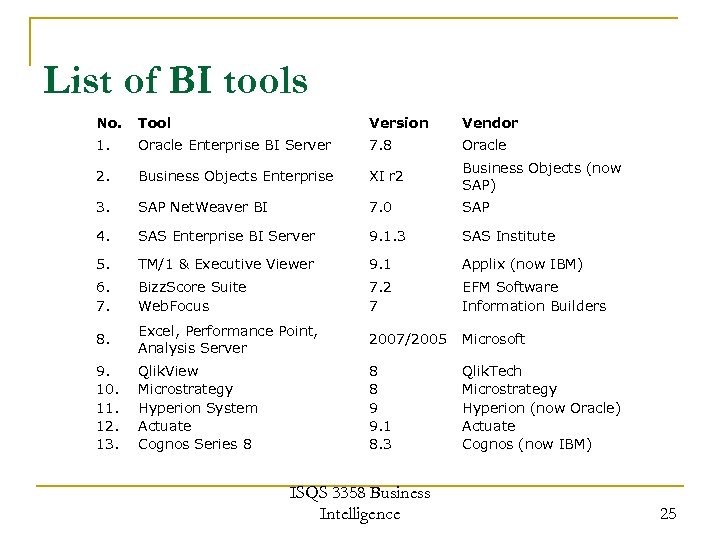
List of BI tools No. Version Vendor 1. Oracle Enterprise BI Server 7. 8 Oracle 2. Business Objects Enterprise XI r 2 Business Objects (now SAP) 3. SAP Net. Weaver BI 7. 0 SAP 4. SAS Enterprise BI Server 9. 1. 3 SAS Institute 5. TM/1 & Executive Viewer 9. 1 Applix (now IBM) 6. 7. Bizz. Score Suite Web. Focus 7. 2 7 EFM Software Information Builders 8. Excel, Performance Point, Analysis Server 2007/2005 Microsoft 9. 10. 11. 12. 13. 25 Tool Qlik. View Microstrategy Hyperion System Actuate Cognos Series 8 8 8 9 9. 1 8. 3 Qlik. Tech Microstrategy Hyperion (now Oracle) Actuate Cognos (now IBM) ISQS 3358 Business Intelligence 25
Microsoft SQL Server n n n SQL Server is a client-server based, relational database engine. That puts it head-to-head with the likes of IBM’s DB 2 and Oracle’s Oracle… or so Microsoft dearly wants us to believe. The problem is that, while DB 2 and Oracle are unquestionably enterprise-level products, SQL Server has for years been dogged by the suspicion that it can’t really cut the mustard. SQL Server Products q q q n SQL Server 2005 Editions q 26 Microsoft SQL Server 2000 Microsoft SQL Server 2005 Microsoft SQL Server 2008 SQL Server Express SQL Server Workgroup SQL Server Developer SQL Server Standard SQL Server Enterprise SQL Server Compact ISQS 3358 Business Intelligence 26
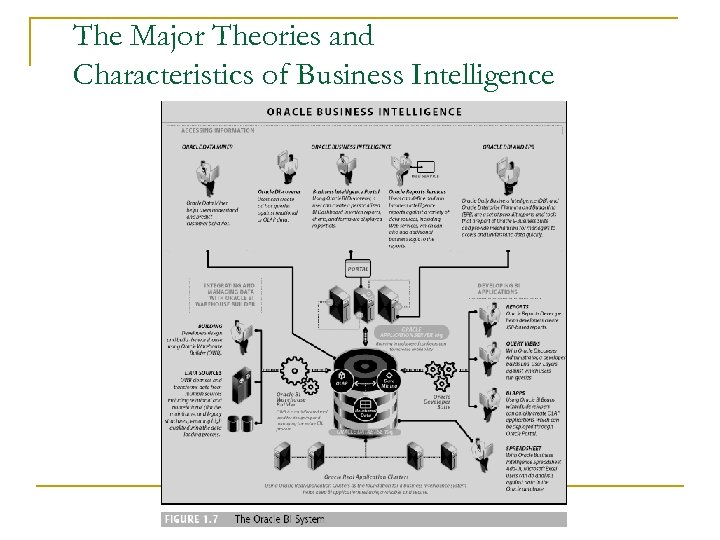
The Major Theories and Characteristics of Business Intelligence n Some Theories of BI q q q A factory and warehouse The information factory Data warehousing and business intelligence Teradata advanced analytics methodology Oracle BI system
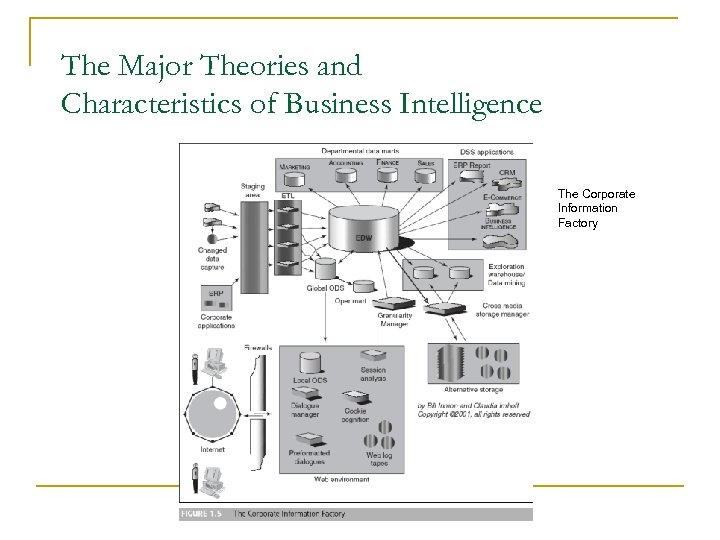
The Major Theories and Characteristics of Business Intelligence The Corporate Information Factory
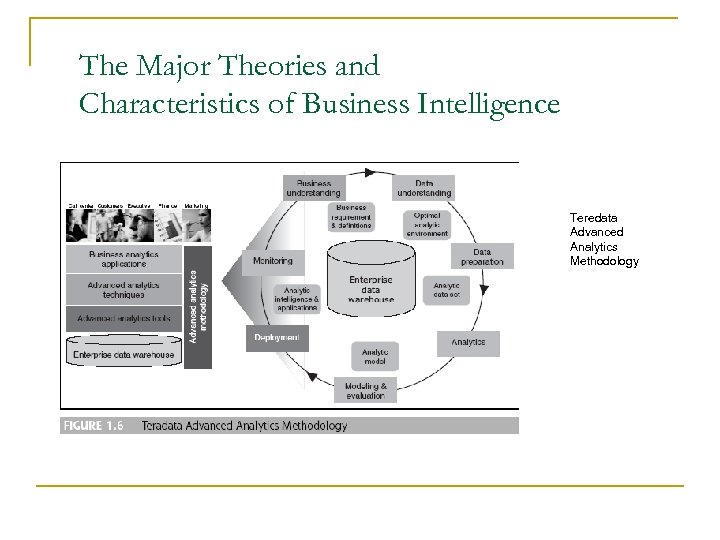
The Major Theories and Characteristics of Business Intelligence Teredata Advanced Analytics Methodology
The Major Theories and Characteristics of Business Intelligence
Toward Competitive Intelligence and Advantage n Competitive Intelligence (CI) q q CI implies tracking what competitors are doing by gathering material on their recent and in-process activities Competitive strategy in an industry n n q q low-cost leader market niche Sustaining competitive advantage through building brand customer loyalty using BI applications Case: MSI’s Netbook (http: //en. wikipedia. org/wiki/Netbook)
Toward Competitive Intelligence and Advantage n The Strategic Imperative of BI q q Barriers to entry of a new competitor are being significantly diminished Because of the Web revolution and increasing globalization, companies throughout the world are challenging major players in industries The ability to deliver goods worldwide is making it easier for potential competitors to get products and services to more customers almost anywhere Companies are finding better or less expensive suppliers all over the globe
The Different Users of Business Intelligence n 33 There are many different users who can benefit from business intelligence q Executives – Those who focus on the overall business q Business Decision Makers – Usually focused on single areas of the business (finance, HR, manufacturing, and so forth) q Information Workers – Typically managers or staff working in the back office q Line Workers – Employees who might use BI without knowing it q Analysts – Employees who will perform extensive data analysis
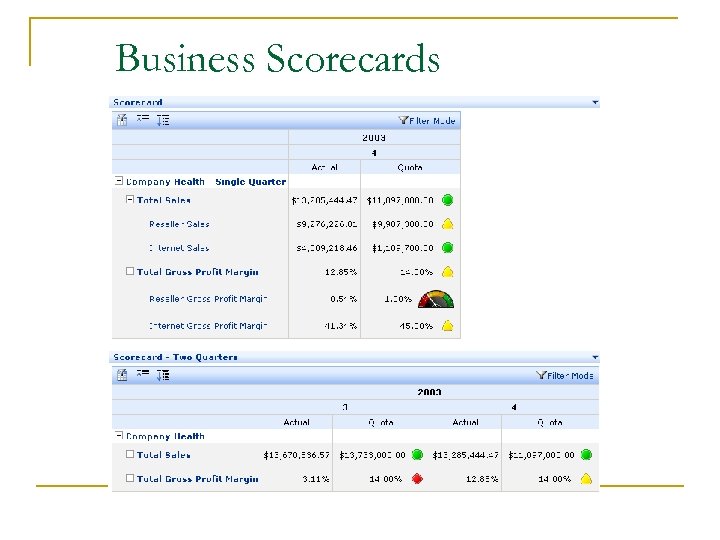
Business Scorecards 34
The Purpose of a Scorecard n n n 35 A scorecard should give an executive a visual representation of the health of an organization in a single glance The scorecard is of sufficiently high level to represent major business operations and their goals The data in a scorecard should be as recent as possible to make them more actionable
Benefits to the Executive n n n 36 In a single glance, the executive can see a wide swath of the business (finance, manufacturing, sales, marketing, and more) Immediate value is gained without the need for the executive to perform analysis Executives see not just actual values, but comparisons to plans or prior results
The Contents of a Scorecard n 37 Scorecards usually contain some or all of the following elements: q Key Performance Indicators (KPIs) q KPI actual values compared to historical values (for trend analysis) q KPI actual values compared to a forecast or budget amount q Rankings of different departments, locations, products, and so forth
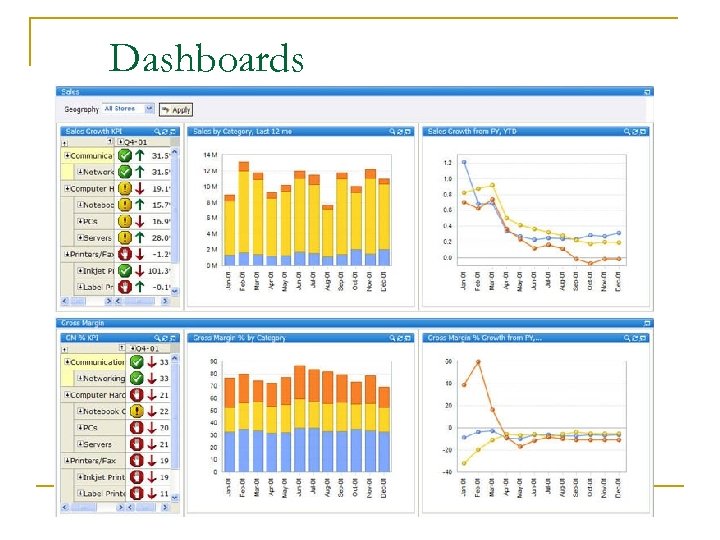
Dashboards 38
The Purpose of a Dashboard n n 39 A dashboard is designed to allow decision makers to see a variety of data that affects their divisions or departments This data may be in the form of scorecards, charts, tables, and so forth The dashboard is generally customized for each user More targeted and detailed than a scorecard
Benefits to Decision Makers n n n 40 Decision makers see a variety of information targeted to their department q This allows decision makers to focus only on the items over which they have control Information is more detailed than that of a scorecard The tools in the dashboard often have better analytic capabilities than a scorecard
The Contents of a Dashboard n n n 41 A Dashboard generally contains a variety of different views of data The data is generally KPIs and shows trends, breakdowns, and comparisons against a forecast or historical data The dashboard often consists of charts and tables, and may include scorecard elements as well
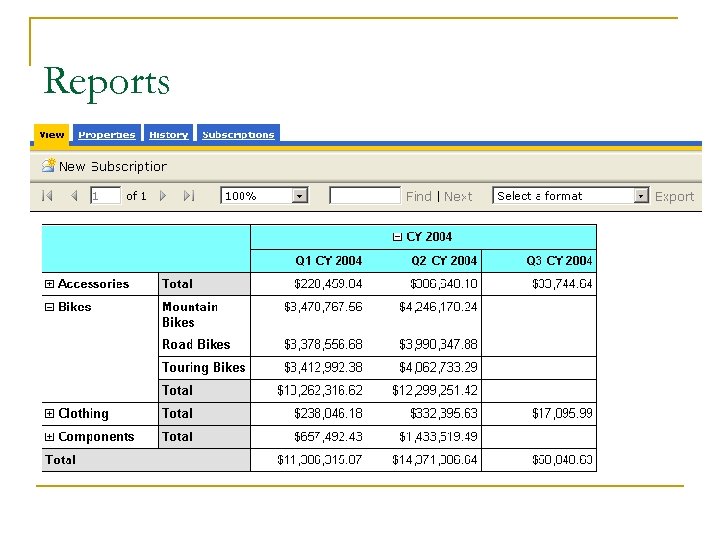
Reports 42
The Purpose of Reports n n n 43 Reports allow a much broader audience to benefit from the data in a BI solution Reports may be static, requiring no training q Reports may also allow a limited amount of interactivity Reports can be presented in a variety of formats, allowing for easier distribution
The Purpose of Custom Application Integration n 44 An application used by line workers may include business intelligence without the worker realizing what is happening q A sales clerk may get a list of targeted recommendations to make based on what the customer is buying q A loan officer may be presented with the level of risk associated with granting a loan to a particular customer
The Contents of Custom Application Integration n 45 Custom applications may include predictive output from data mining models Custom applications can show history and trends for the current customer, supplier, and so forth Custom applications may allow easy ways for users to explore the data for relationships
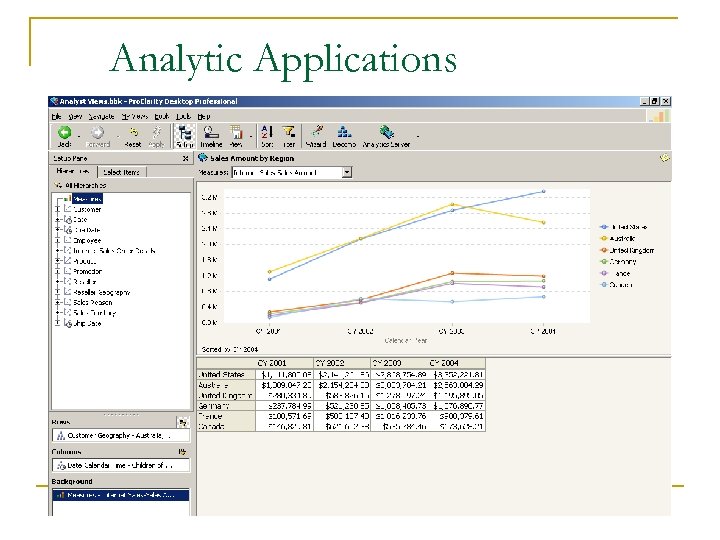
Analytic Applications 46
The Purpose of Analytic Applications n n n 47 Analytic applications free analysts from building complex models and writing complex queries Analysts are free to focus on the data and discover relationships and drivers behind numbers Rich visualizations allow much easier understanding of trends and relationships
The Contents of Analytic Applications n n n 48 Analytic applications typically have no limits; analysts can see everything Analytic applications can view and analyze all of an organization’s data in a number of ways Analytic applications are powerful, but not as easy to use as other mechanisms
OLTP vs. OLAP n n Online transaction processing systems (OLTP) Systems that handle a company’s routine ongoing business Online analytic processing (OLAP) An information system that enables the user, while at a PC, to query the system, conduct an analysis, and so on. The result is generated in seconds ISQS 3358 Business Intelligence 49
Successful Business Intelligence Implementation n n n Appropriate Planning and Alignment with the Business Strategy Establish a BI Competency Center (BICC) within the Company Real-time, On-Demand BI Is Attainable Developing or Acquiring BI Systems Justification and Cost/Benefit Analysis Security and Protection of Privacy Integration of Systems and Applications
Conclusion: Business Intelligence Today and Tomorrow n n Today’s organizations are deriving more value from BI by extending actionable information to many types of employees, maximizing the use of existing data assets Visualization tools including dashboards are used by producers, retailers, governments, and special agencies More and more industry-specific analytical tools will flood the market to perform almost any kind of analysis and to facilitate informed decision making from the top level to the user level A potential trend involving BI is its possible merger with artificial intelligence (AI)
Application Cases in the Book n Case 1. 1 – Intelligence Price Setting Using Automated Decision Support q q n Case 1. 2 - Predictive Analytics Helps Texas Collect Taxes q n http: //www. longs. com Using Price-optimization programs by SAS Using data mining software from SPSS Case 1. 3 - France Telecom Business Intelligence q q q “Business Intelligence Competence Center” http: //www. intelligentsolutions. com http: //www. dmreview. com
Скачать презентацию ISQS 3358 Business Intelligence Anatomy of Business Intelligence
fdf8cd39ff58a6dd19d118b53a574ff3.ppt