


 Скачать презентацию ISO Layer and TCP Fundamentals Rich Carlson Internet
ed8a16a17ad61c09d8b00bba28676631.ppt
- Количество слайдов: 51
 ISO Layer and TCP Fundamentals Rich Carlson Internet 2 e. VLBI workshop – TCP Fundamentals September 17, 2006
 Outline • A Brief history of networking • The OSI reference model • The TCP/IP architecture • TCP Fundamentals 2
 Arpanet • 1962 - ARPA pursues new Interactive Computing paradigm • Focus is on computers as a communications device • Industry focused on computers as arithmetic calculators 3
 IMPs & TIPs • 1969 – A 4 node network is built using Interface Message Processors (IMPs) • UCLA, SRI, UCSB, Univ of Utah • 1971 – BBN develops a Terminal IPM (TIP) supports up to 64 terminals 4
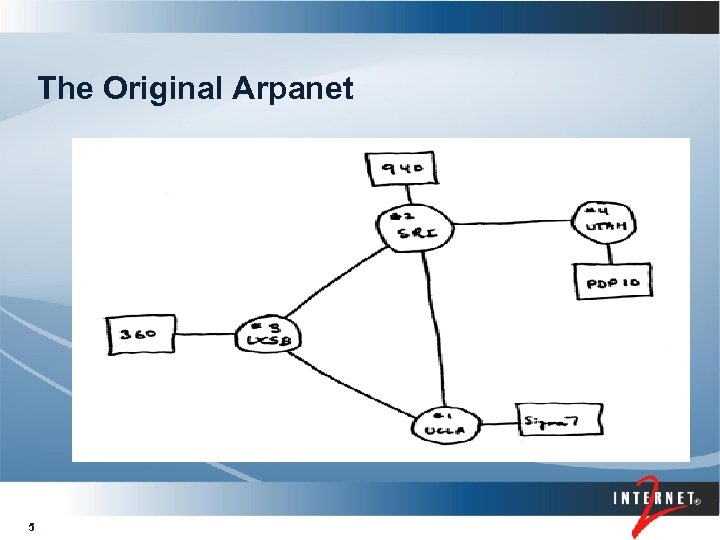 The Original Arpanet 5
 Networks Proliferate • 1974 – BBN opens Telenet • 1975 – DEC develops DECnet • 1976 – UUCP (Unix-to-Unix Co. Py) • 1977 – Tymshare opens Tymnet • 1981 – CUNY develops BITnet 6
 Federal Agencies get in the Act • ARPA - ARPAnet • DOE – MFENet and HEPNet created • NASA – SPAN created • NSF – CSNet created 7
 ISO OSI networks International Organization for Standardization (ISO) • Open Systems Interconnection (OSI) • 1979 - 7 layer reference model defined • 1982 – ISO begins deliberations on specific protocols for each layer • 1990 – U. S. mandates all gov. purchased computers must be GOSIP compliant • 1995 – GOSIP requirement rescinded 8
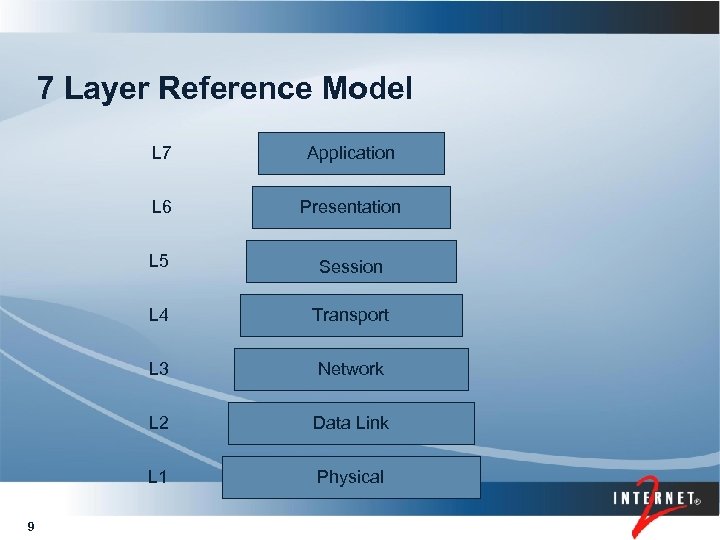 7 Layer Reference Model L 7 L 6 Presentation L 5 Session L 4 Transport L 3 Network L 2 Data Link L 1 9 Application Physical
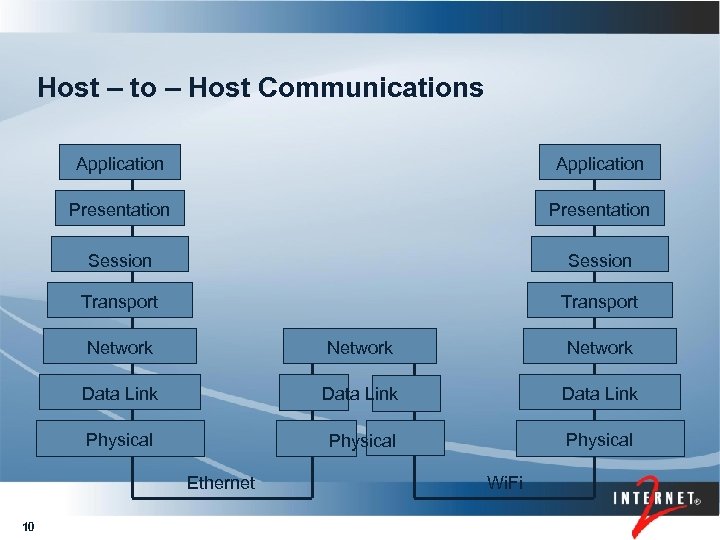 Host – to – Host Communications Application Presentation Session Transport Network Data Link Physical Ethernet 10 Wi. Fi
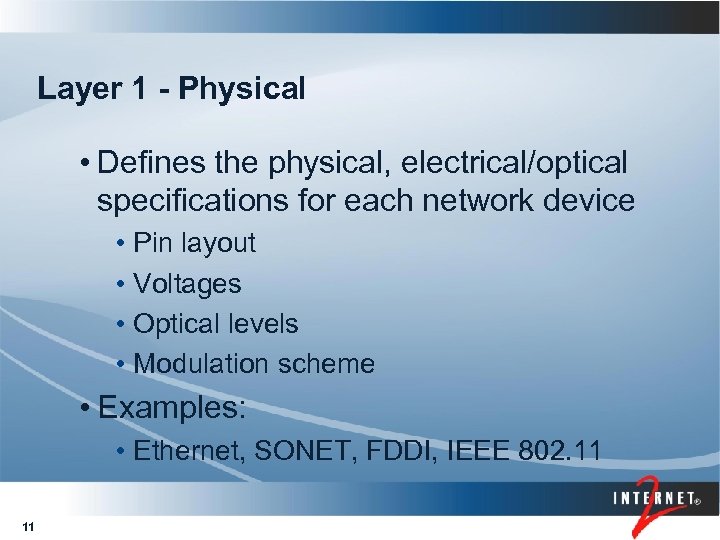 Layer 1 - Physical • Defines the physical, electrical/optical specifications for each network device • Pin layout • Voltages • Optical levels • Modulation scheme • Examples: • Ethernet, SONET, FDDI, IEEE 802. 11 11
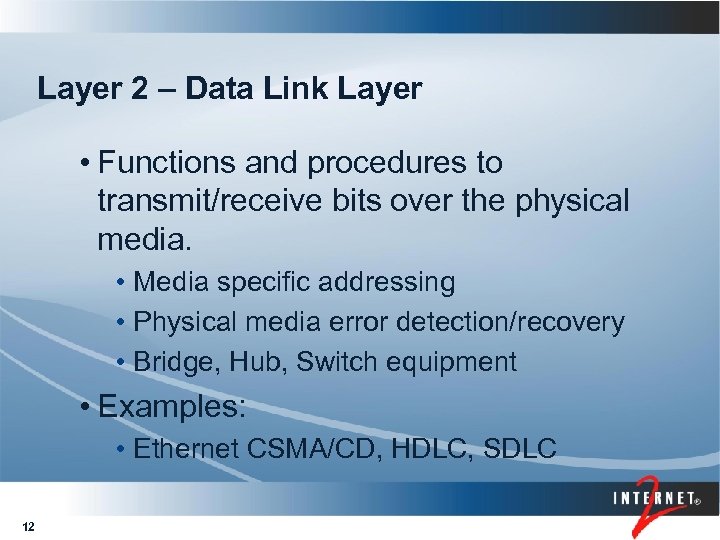 Layer 2 – Data Link Layer • Functions and procedures to transmit/receive bits over the physical media. • Media specific addressing • Physical media error detection/recovery • Bridge, Hub, Switch equipment • Examples: • Ethernet CSMA/CD, HDLC, SDLC 12
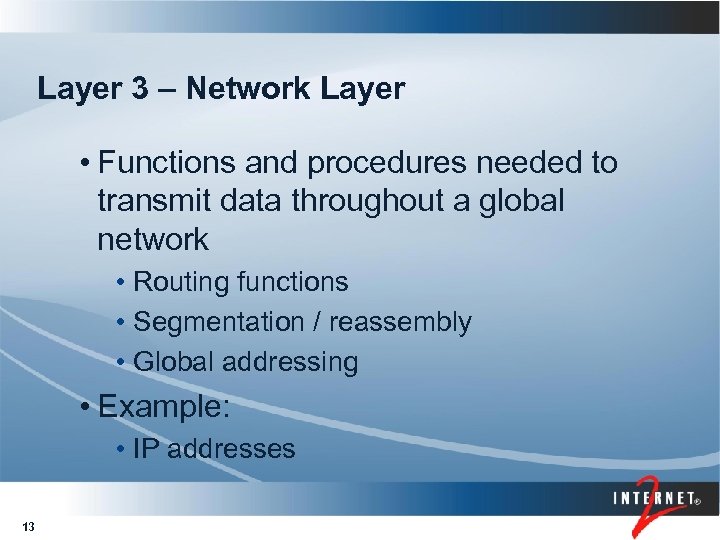 Layer 3 – Network Layer • Functions and procedures needed to transmit data throughout a global network • Routing functions • Segmentation / reassembly • Global addressing • Example: • IP addresses 13
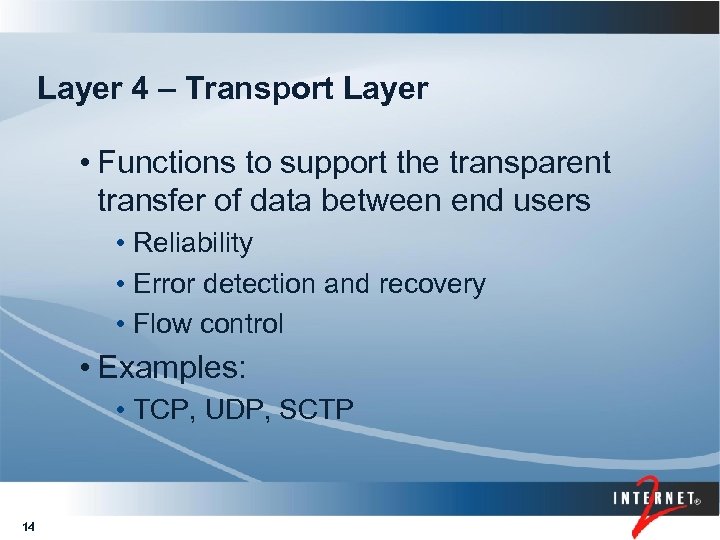 Layer 4 – Transport Layer • Functions to support the transparent transfer of data between end users • Reliability • Error detection and recovery • Flow control • Examples: • TCP, UDP, SCTP 14
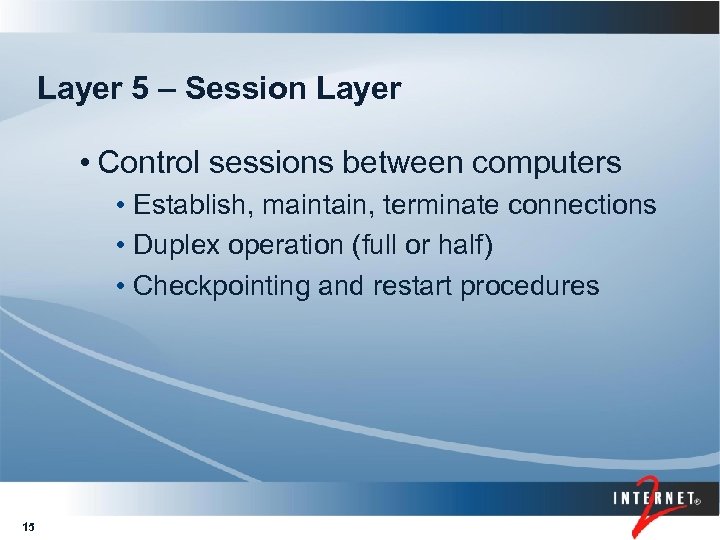 Layer 5 – Session Layer • Control sessions between computers • Establish, maintain, terminate connections • Duplex operation (full or half) • Checkpointing and restart procedures 15
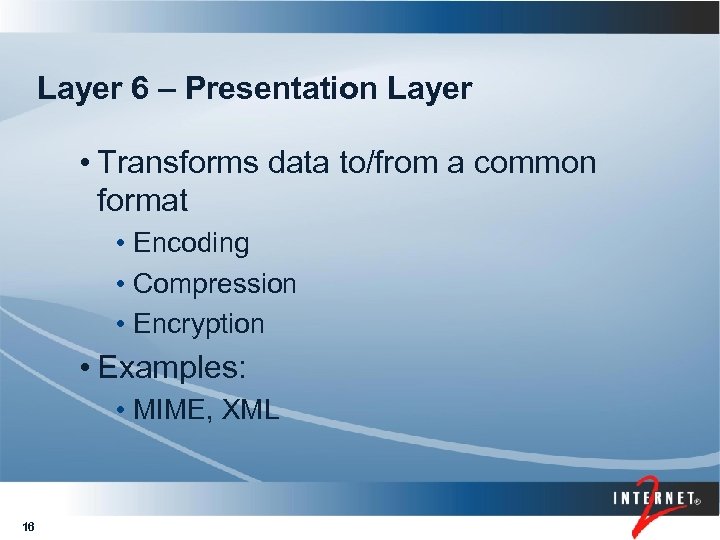 Layer 6 – Presentation Layer • Transforms data to/from a common format • Encoding • Compression • Encryption • Examples: • MIME, XML 16
 Layer 7 – Application Layer • Program used to interact with computer and data • Specific application for each task • GUI or command line interface • Examples: • SSH, SCP, HTTP, email 17
 OSI Quick Summary • OSI reference model defines modular ‘stack’ that allows multi-vendor interoperations. • Input/output details specified • Internal details left up to individual vendors • Usually implemented by a series of function calls 18
 TCP/P Internet • Direct descendant of ARPAnet • Provides Global packet switched network services • ‘Standard’ protocol shipped by most vendors • Still under active development • IPv 6 • TCP modifications 19
 NCP to TCP transition • NCP (Network Control Protocol) a host-to -host protocol for the Arpanet • Handled multiple functions • Separate network and transmission functions into 2 distinct protocols • IP handles addressing and routing functions • TCP handles reliability functions • 1 year transition period • Flag day specified as 1 -Jan-1983 20
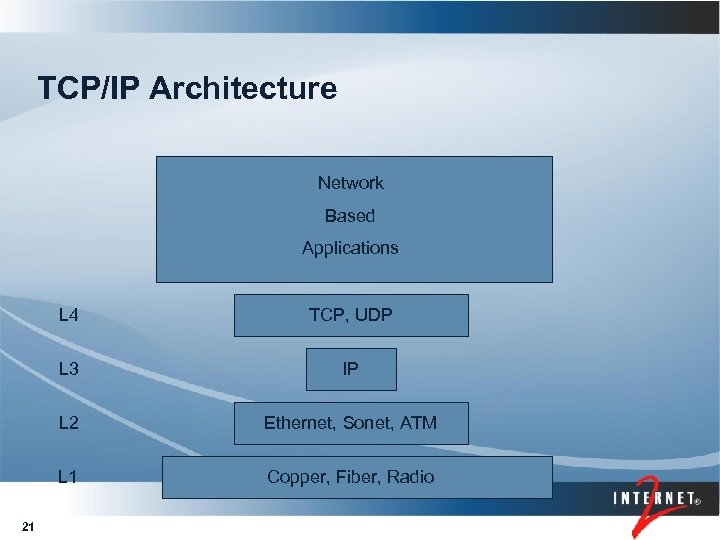 TCP/IP Architecture Network Based Applications L 4 L 3 IP L 2 Ethernet, Sonet, ATM L 1 21 TCP, UDP Copper, Fiber, Radio
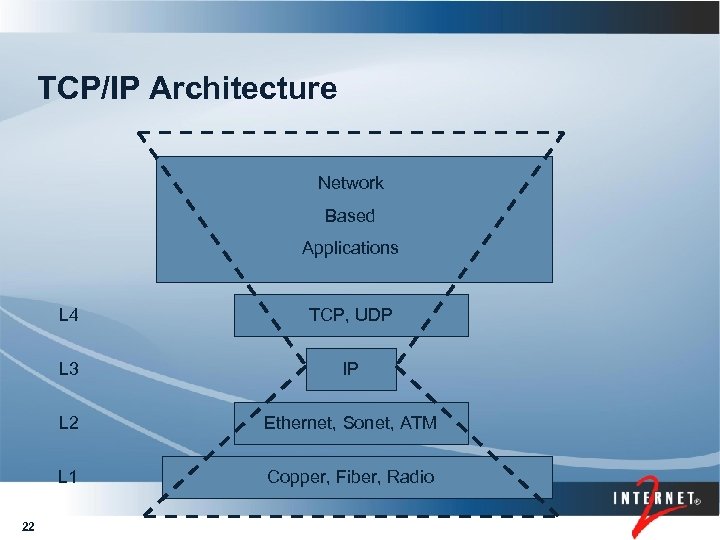 TCP/IP Architecture Network Based Applications L 4 L 3 IP L 2 Ethernet, Sonet, ATM L 1 22 TCP, UDP Copper, Fiber, Radio
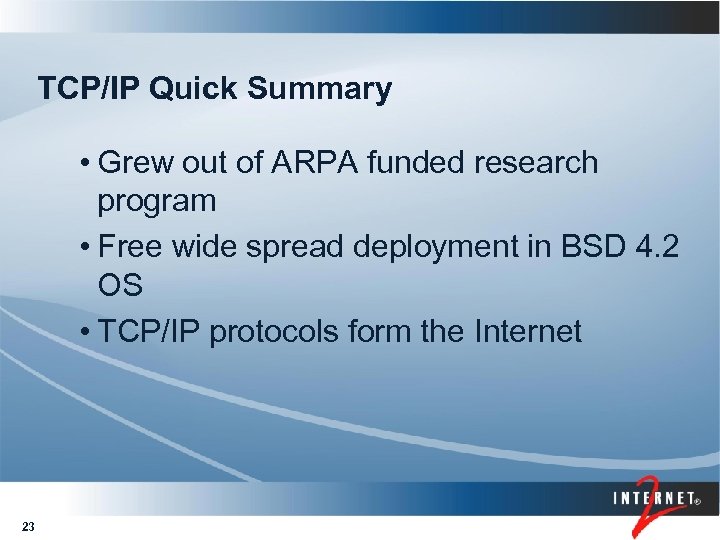 TCP/IP Quick Summary • Grew out of ARPA funded research program • Free wide spread deployment in BSD 4. 2 OS • TCP/IP protocols form the Internet 23
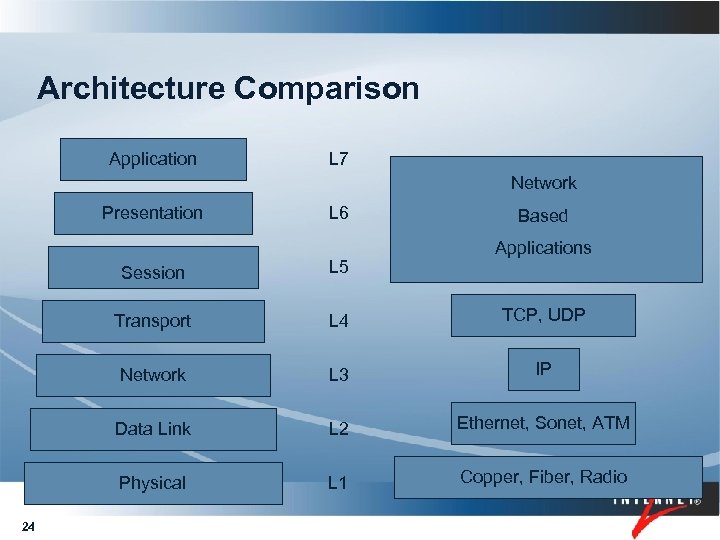 Architecture Comparison Application L 7 Network Presentation L 6 Based Applications Session Transport L 4 TCP, UDP Network L 3 IP Data Link L 2 Ethernet, Sonet, ATM Physical 24 L 5 L 1 Copper, Fiber, Radio
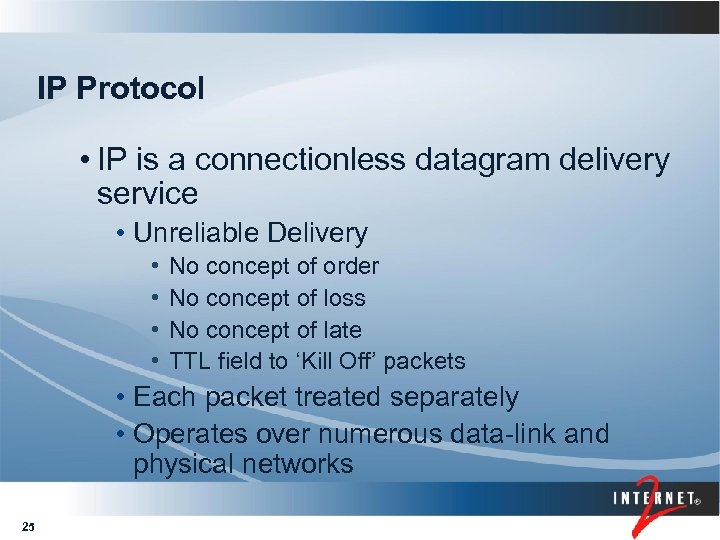 IP Protocol • IP is a connectionless datagram delivery service • Unreliable Delivery • • No concept of order No concept of loss No concept of late TTL field to ‘Kill Off’ packets • Each packet treated separately • Operates over numerous data-link and physical networks 25
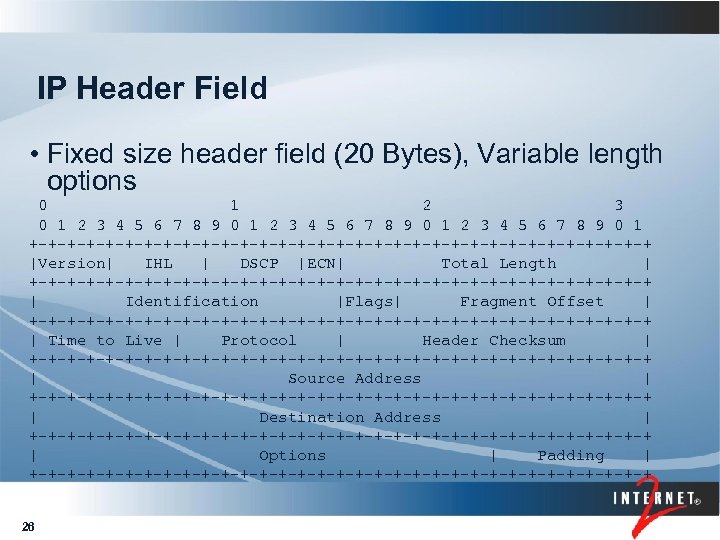 IP Header Field • Fixed size header field (20 Bytes), Variable length options 0 1 2 3 4 5 6 7 8 9 0 1 +-+-+-+-+-+-+-+-+-+-+-+-+-+-+-+-+ |Version| IHL | DSCP |ECN| Total Length | +-+-+-+-+-+-+-+-+-+-+-+-+-+-+-+-+ | Identification |Flags| Fragment Offset | +-+-+-+-+-+-+-+-+-+-+-+-+-+-+-+-+ | Time to Live | Protocol | Header Checksum | +-+-+-+-+-+-+-+-+-+-+-+-+-+-+-+-+ | Source Address | +-+-+-+-+-+-+-+-+-+-+-+-+-+-+-+-+ | Destination Address | +-+-+-+-+-+-+-+-+-+-+-+-+-+-+-+-+ | Options | Padding | +-+-+-+-+-+-+-+-+-+-+-+-+-+-+-+-+ 26
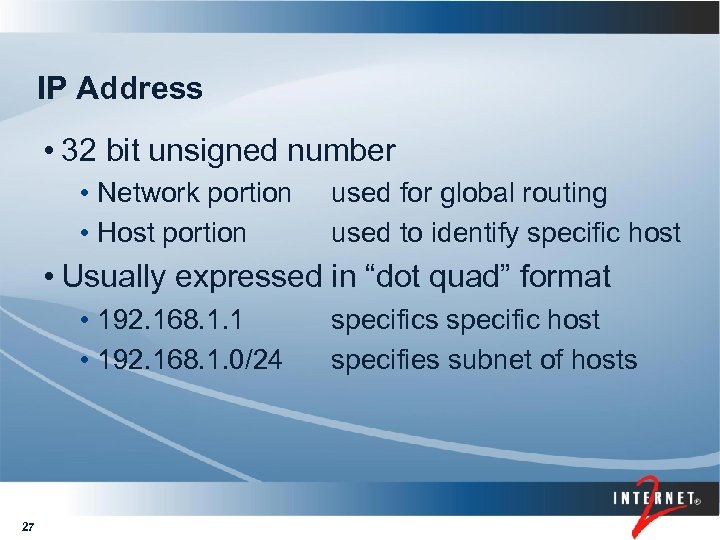 IP Address • 32 bit unsigned number • Network portion • Host portion used for global routing used to identify specific host • Usually expressed in “dot quad” format • 192. 168. 1. 1 • 192. 168. 1. 0/24 27 specifics specific host specifies subnet of hosts
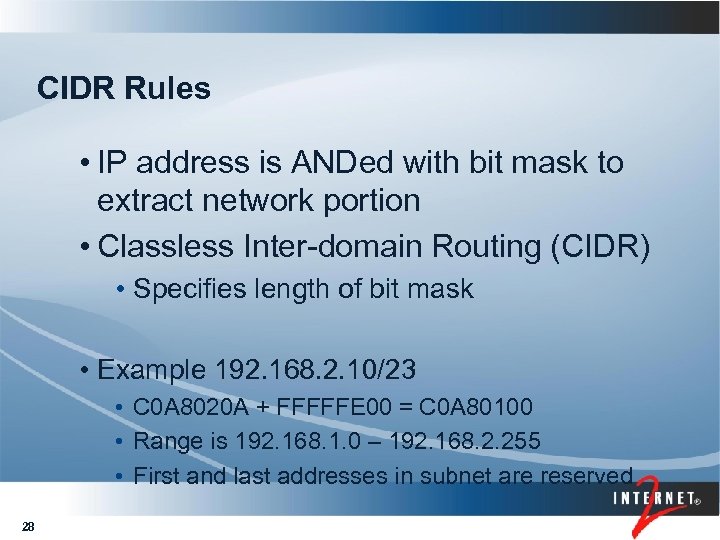 CIDR Rules • IP address is ANDed with bit mask to extract network portion • Classless Inter-domain Routing (CIDR) • Specifies length of bit mask • Example 192. 168. 2. 10/23 • C 0 A 8020 A + FFFFFE 00 = C 0 A 80100 • Range is 192. 168. 1. 0 – 192. 168. 2. 255 • First and last addresses in subnet are reserved 28
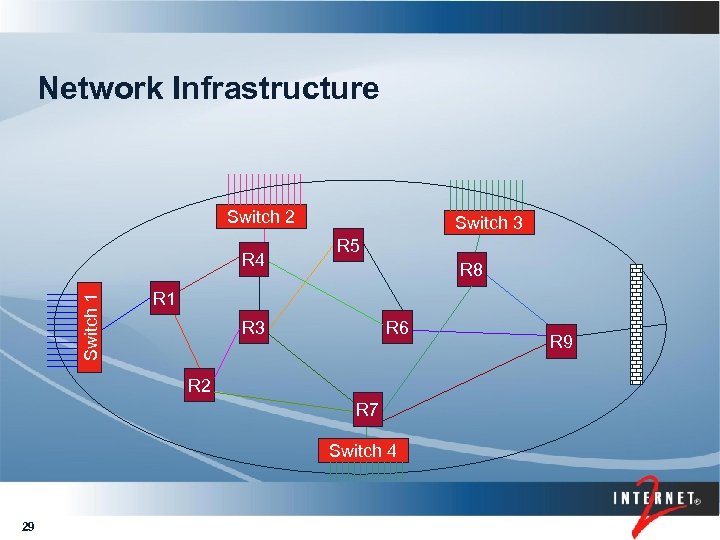 Network Infrastructure Switch 2 Switch 1 R 4 Switch 3 R 5 R 8 R 1 R 3 R 6 R 2 R 7 Switch 4 29 R 9
 IP Fragmentation • Routers may break packets into smaller chunks (fragmentation) • Destination host is responsible for reassembling all fragments into original packet • Performance impact on modern (ASIC based) routers 30
 IP Don’t Fragment • Flag in header to indicate that packet should be discarded instead of fragmented • Basis for Path MTU Discovery protocol • Find the largest packet that can transit the entire end-to-end path • Router may return an ICMP error message when it discards the packet • PMTU black holes can occur 31
 TCP Protocol • TCP provides connection orientated delivery service • Reliable Delivery • • In-order guarantee Loss detection and recovery Flow control Error detection • Hides network details from applications 32
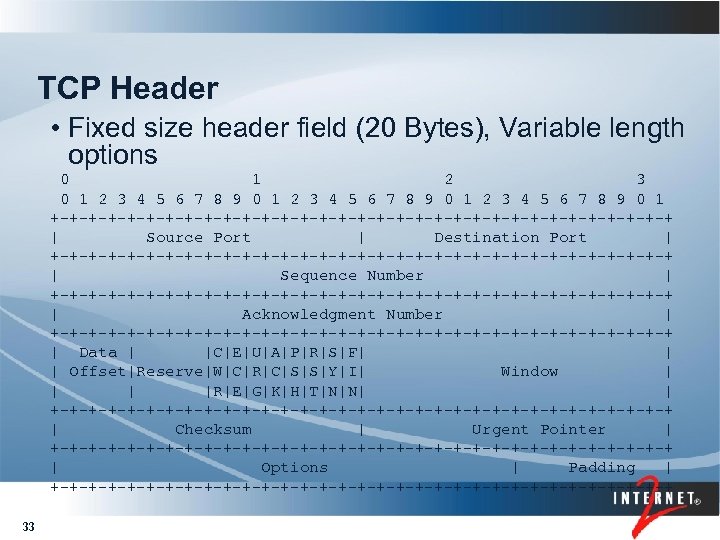 TCP Header • Fixed size header field (20 Bytes), Variable length options 0 1 2 3 4 5 6 7 8 9 0 1 +-+-+-+-+-+-+-+-+-+-+-+-+-+-+-+-+ | Source Port | Destination Port | +-+-+-+-+-+-+-+-+-+-+-+-+-+-+-+-+ | Sequence Number | +-+-+-+-+-+-+-+-+-+-+-+-+-+-+-+-+ | Acknowledgment Number | +-+-+-+-+-+-+-+-+-+-+-+-+-+-+-+-+ | Data | |C|E|U|A|P|R|S|F| | | Offset|Reserve|W|C|R|C|S|S|Y|I| Window | |R|E|G|K|H|T|N|N| | +-+-+-+-+-+-+-+-+-+-+-+-+-+-+-+-+ | Checksum | Urgent Pointer | +-+-+-+-+-+-+-+-+-+-+-+-+-+-+-+-+ | Options | Padding | +-+-+-+-+-+-+-+-+-+-+-+-+-+-+-+-+ 33
 TCP Connection Setup • Host in “Listen” state does passive open • Host in “Connect” state does active open • Hosts complete a 3 -way handshake to complete open (move to “Established” state • Full Duplex connection established, hosts can transfer data in either direction 34
 TCP Flow Control • Original design relied on TCP Window size to control number of packets entering the network • Real world experience showed that network could experience congestion collapse and new mechanisms were needed • Slow Start after connection is opened • Exponential Growth algorithm • Congestion Avoidance once loss is detected • Linear Growth algorithm 35
 TCP Reno • Most common version of TCP today • Loss based detection to switch from Slow Start to Congestion Avoidance flow control • Transmit and Receive windows to guarantee reliability 36
![TCP and RTT / Loss Speed = [C * Pkt Size]/[RTT * Sqrt(loss)] Distance](https://present5.com/presentation/ed8a16a17ad61c09d8b00bba28676631/image-37.jpg "TCP and RTT / Loss Speed = [C * Pkt Size]/[RTT * Sqrt(loss)] Distance") TCP and RTT / Loss Speed = [C * Pkt Size]/[RTT * Sqrt(loss)] Distance RTT Loss Speed (msec) LAN Metro Transcontinental Global 1 8 70 70 500 (Mbps) 1 E-8 1 E-3 1 E-6 Uses standard Ethernet Size TCP segment (1480 bytes) Formula from Mathis et. al. 37 82, 880. 0 10, 360. 0 1, 184. 0 3. 7 16. 6
TCP and RTT / Loss Speed = [C * Pkt Size]/[RTT * Sqrt(loss)] Distance RTT Loss Speed (msec) LAN Metro Transcontinental Global 1 8 70 70 500 (Mbps) 1 E-8 1 E-3 1 E-6 Uses standard Ethernet Size TCP segment (1480 bytes) Formula from Mathis et. al. 37 82, 880. 0 10, 360. 0 1, 184. 0 3. 7 16. 6
![TCP and Jumbo Frames • Speed = [C * Pkt Size]/[RTT * Sqrt(loss)] •](https://present5.com/presentation/ed8a16a17ad61c09d8b00bba28676631/image-38.jpg "TCP and Jumbo Frames • Speed = [C * Pkt Size]/[RTT * Sqrt(loss)] •") TCP and Jumbo Frames • Speed = [C * Pkt Size]/[RTT * Sqrt(loss)] • Jumbo Frames are a non-standard Ethernet feature Distance Use 1 E-6 loss rate Formula from Mathis et. al. 38 Pkt Size Speed (msec) Transcontinental RTT (Bytes) (Mbps) 70 70 1500 9000 120. 0 720. 0
TCP and Jumbo Frames • Speed = [C * Pkt Size]/[RTT * Sqrt(loss)] • Jumbo Frames are a non-standard Ethernet feature Distance Use 1 E-6 loss rate Formula from Mathis et. al. 38 Pkt Size Speed (msec) Transcontinental RTT (Bytes) (Mbps) 70 70 1500 9000 120. 0 720. 0
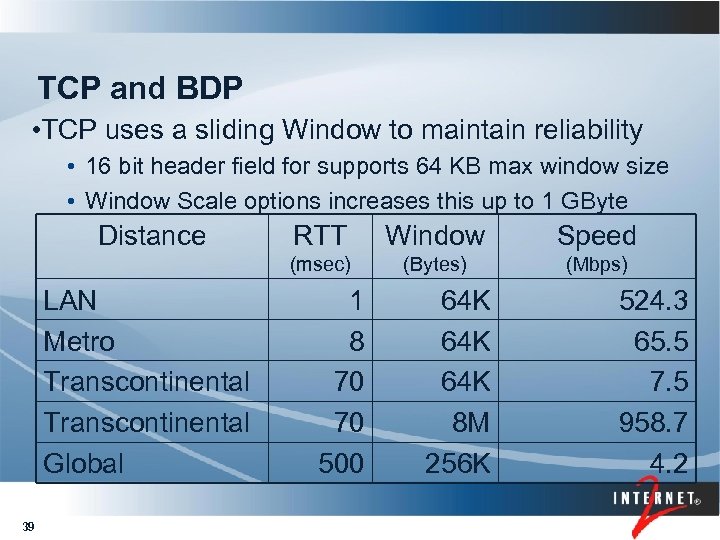 TCP and BDP • TCP uses a sliding Window to maintain reliability • 16 bit header field for supports 64 KB max window size • Window Scale options increases this up to 1 GByte Distance 39 Window Speed (msec) LAN Metro Transcontinental Global RTT (Bytes) (Mbps) 1 8 70 70 500 64 K 64 K 8 M 256 K 524. 3 65. 5 7. 5 958. 7 4. 2
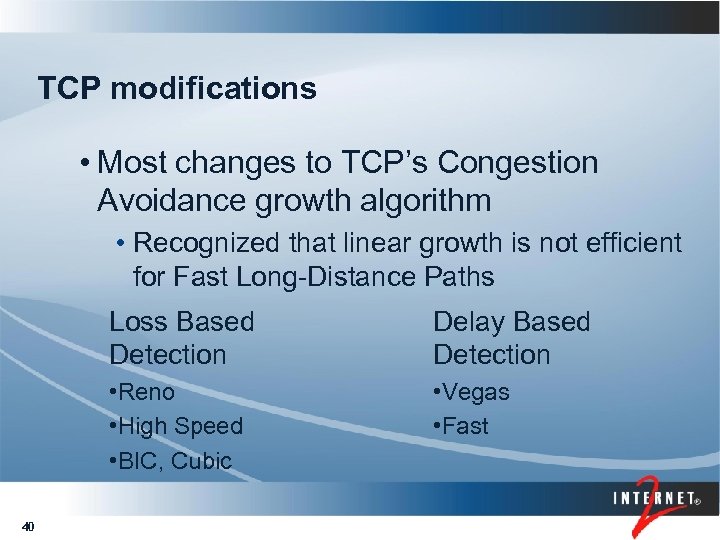 TCP modifications • Most changes to TCP’s Congestion Avoidance growth algorithm • Recognized that linear growth is not efficient for Fast Long-Distance Paths Loss Based Detection • Reno • High Speed • BIC, Cubic 40 Delay Based Detection • Vegas • Fast
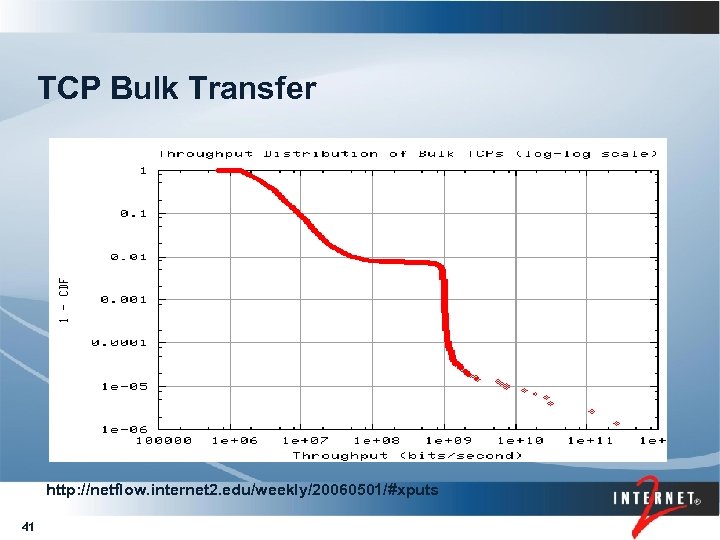 TCP Bulk Transfer http: //netflow. internet 2. edu/weekly/20060501/#xputs 41
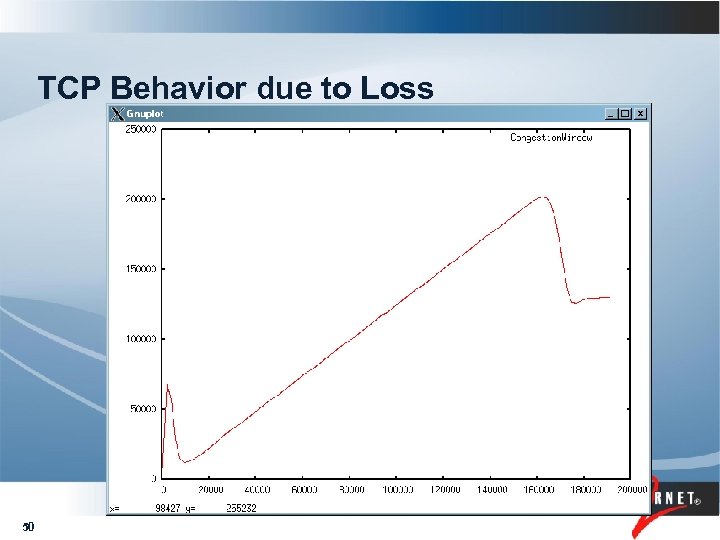
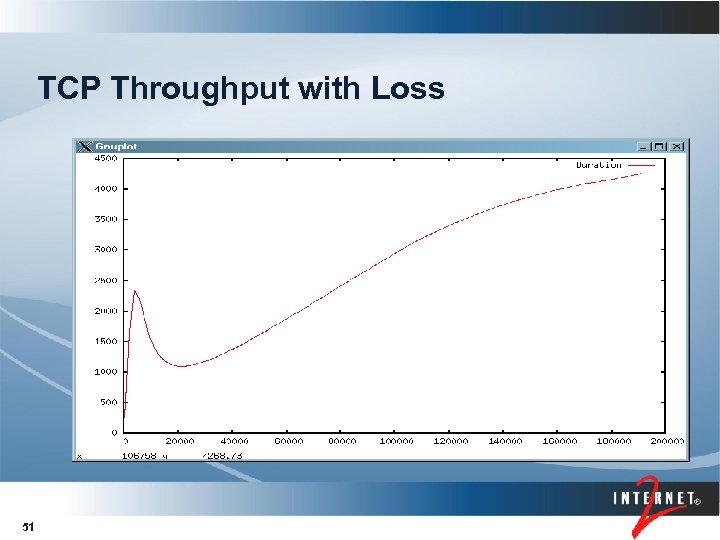
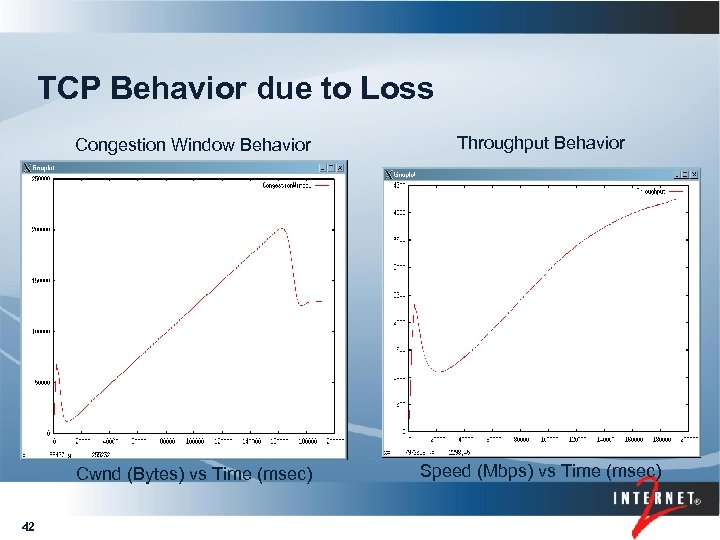 TCP Behavior due to Loss Congestion Window Behavior Cwnd (Bytes) vs Time (msec) 42 Throughput Behavior Speed (Mbps) vs Time (msec)
 UDP Protocol • UDP – User Datagram Protocol • Application must provide • Reliability • Flow Control • Useful for short messages • DNS • Real Time audio/video 43
 Domain Name System • DNS – Domain Name System • Translates Fully Qualified Domain Name (FQDN) into IP address • A Globally distributed database • Hierarchical naming structure • Supports both Authoritative and Caching servers • Requires a minimum of 2 packets and 1 RTT for each resolution 44
 Real-time Transport Protocol • RTP – Real-time Transport Protocol • Carries data with real-time properties • Used for Audio and Video streams • Header contains sequence number and timestamp to provide receiver with pkt info • RTCP – RTP Control Protocol • Carries control information about the stream from receiver back to sender 45
 Unicast vs Multicast • Unicast packets - 1 source & 1 destination • Multicast packets • • IP addresses (224. 0. 0. 0 – 239. 255) Single source, multiple receivers Multiple sources, multiple receivers Routers and Switches must support multicast to prevent unwanted packets from flooding the network • Multiple unicast streams can be used to emulate a multicast session 46
 Multicast Traffic • Source starts sending packets using a multicast IP address • Local router/switch uses control messages to advertise traffics availability • Receivers send request-to-join messages • New path from receiver to “merge point” is created and traffic flow begins 47
 Conclusions • Global packet switching began with the ARPAnet • TCP/IP packet switching is the defacto standard for today’s networks • Smart hosts, dumb infrastructure • New and existing applications support end-to-end communications between people 48
 49
49
 TCP Behavior due to Loss 50
 TCP Throughput with Loss 51