


 Скачать презентацию ISO 9000 -3 The ISO 9000 standards
7c08637d76c6b7456ca6e169e4cee613.ppt
- Количество слайдов: 11
 ISO 9000 -3
 The ISO 9000 standards as applied to the design and development of software. In such instances, these standards have to be appropriately interpreted because of the more complex nature of the software design, development, distribution and installation process. In 1987, the ISO 9000 -3 guidelines were published by the ISO Technical Committee 17 (TC 176) to address these needs of the IT community.
 Introduction of ISO 9000 -3 ISO 9001 is generic and many IT people find it difficult to interpret and apply ISO 9000 -3 is a set of guidelines that helps interpret and apply ISO 9001 for software development Since it is NOT a standard, companies are still assessed against ISO 9001 3
 Assumptions of ISO 9000 -3 • Each development project is associated with a life cycle with phases • The software product produced is the result of a contractual agreement between a purchaser and a supplier 4
 Overview of ISO 9000 -3 • It consists of 22 clauses that do not correspond directly with the 20 clauses of ISO 9001 • These 22 clauses are grouped into three major sections: • Section 4: Quality system – Framework • Section 5: Quality system – Life cycle activities • Section 6: Quality system – Supporting activities 5
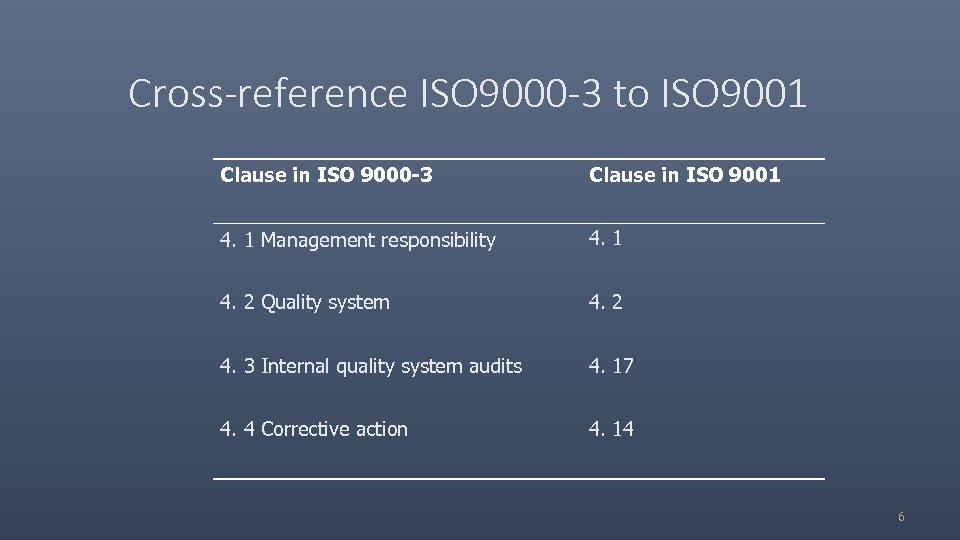 Cross-reference ISO 9000 -3 to ISO 9001 Clause in ISO 9000 -3 Clause in ISO 9001 4. 1 Management responsibility 4. 1 4. 2 Quality system 4. 2 4. 3 Internal quality system audits 4. 17 4. 4 Corrective action 4. 14 6
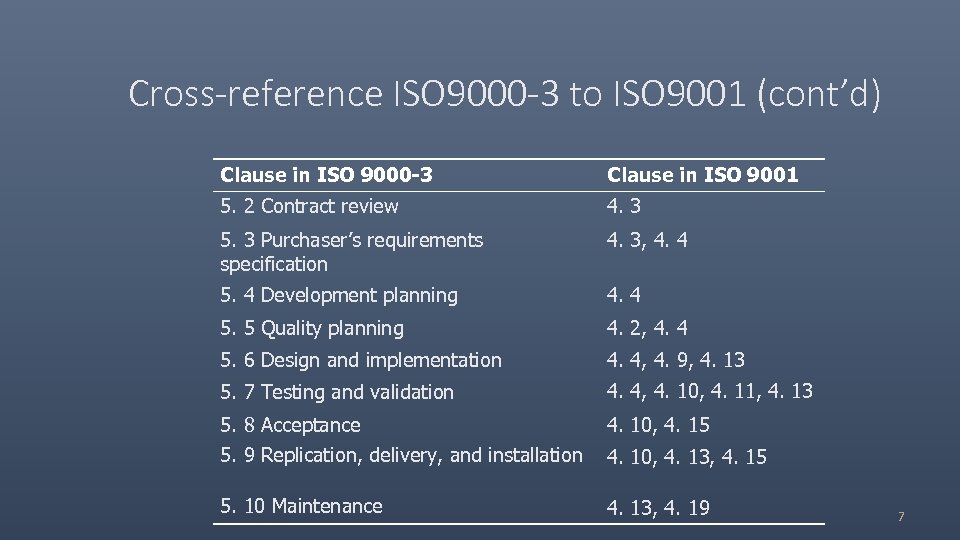 Cross-reference ISO 9000 -3 to ISO 9001 (cont’d) Clause in ISO 9000 -3 Clause in ISO 9001 5. 2 Contract review 4. 3 5. 3 Purchaser’s requirements specification 4. 3, 4. 4 5. 4 Development planning 4. 4 5. 5 Quality planning 4. 2, 4. 4 5. 6 Design and implementation 4. 4, 4. 9, 4. 13 5. 7 Testing and validation 4. 4, 4. 10, 4. 11, 4. 13 5. 8 Acceptance 4. 10, 4. 15 5. 9 Replication, delivery, and installation 4. 10, 4. 13, 4. 15 5. 10 Maintenance 4. 13, 4. 19 7
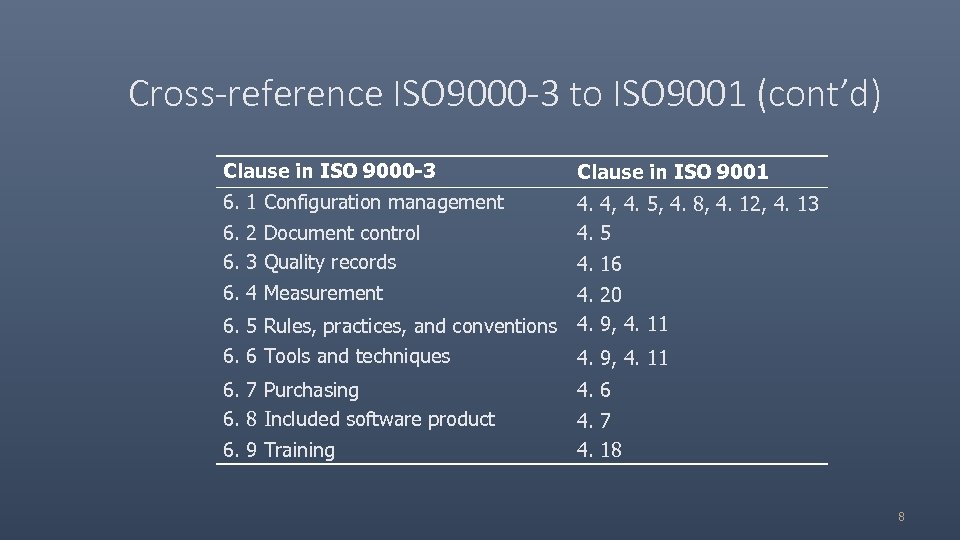 Cross-reference ISO 9000 -3 to ISO 9001 (cont’d) Clause in ISO 9000 -3 Clause in ISO 9001 6. 1 Configuration management 4. 4, 4. 5, 4. 8, 4. 12, 4. 13 4. 5 6. 2 Document control 6. 3 Quality records 4. 16 6. 4 Measurement 4. 20 6. 5 Rules, practices, and conventions 4. 9, 4. 11 6. 6 Tools and techniques 4. 9, 4. 11 6. 7 Purchasing 6. 8 Included software product 4. 6 6. 9 Training 4. 7 4. 18 8
 Why Comply with ISO 9001? Provide a foundation for a quality system which is needed for quality software Increase productivity and reduce costs because development is done right the first time under control Ensure consistency of software quality Stay competitive by keeping up with market standards Fulfil software contractual requirements Improve corporate image 9
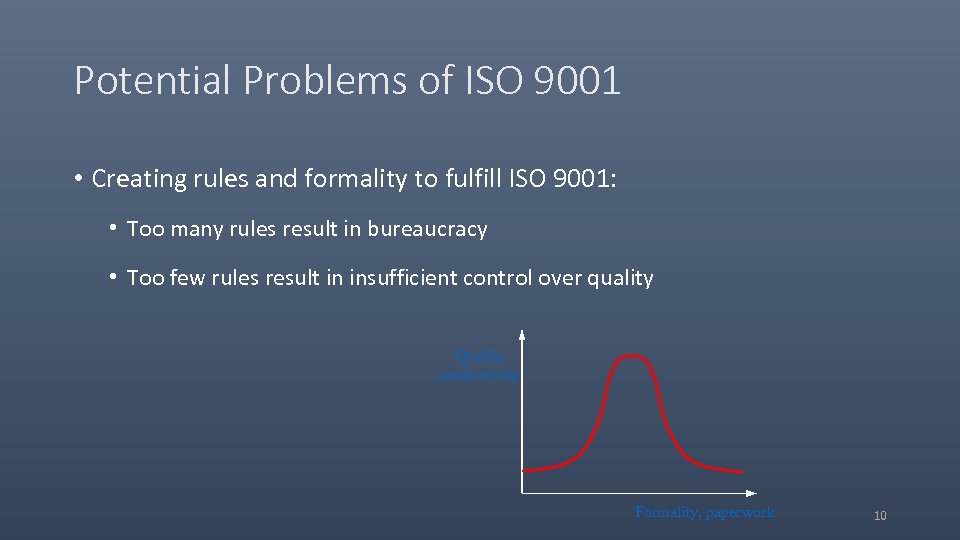 Potential Problems of ISO 9001 • Creating rules and formality to fulfill ISO 9001: • Too many rules result in bureaucracy • Too few rules result in insufficient control over quality Quality productivity Formality, paperwork 10
 Thanks