


 Скачать презентацию ISM 270 Service Engineering and Management Lecture 8
8316f7bb99c29d8b0ac66de1411d8654.ppt
- Количество слайдов: 56
 ISM 270 Service Engineering and Management Lecture 8: Service Supply Chains
 Announcements Ø Homework 5 due next week l Should help for Littlefield! Ø Littlefield Lab Next week Ø Projects due following week
 Project Presentation 20 minutes – 15 min presentation, 5 min questions Ø Clear presentation of service idea Ø l l l Prototype demonstration/screenshot/outline Differentiate from competition Give market estimation • How many potential customers? • How will you make money? • What are the risks? l Argue why this will lead to successful service business
 Some key concepts for capacity management Ø Economic Order Quantity Ø Queueing Dynamics
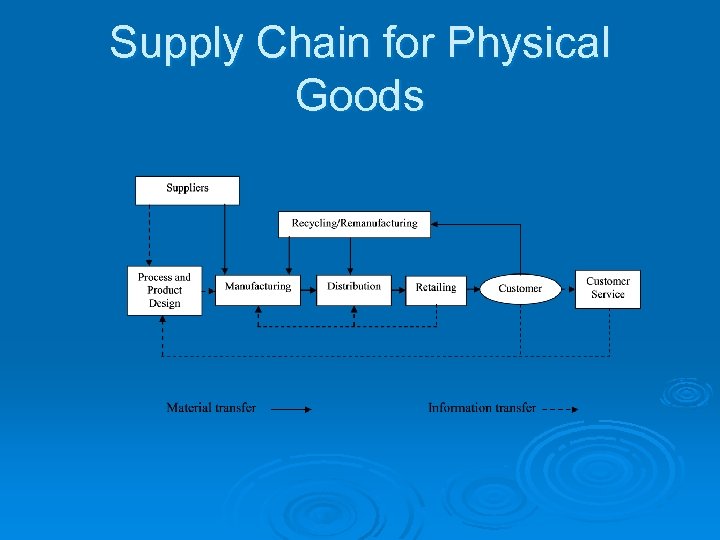 Supply Chain for Physical Goods
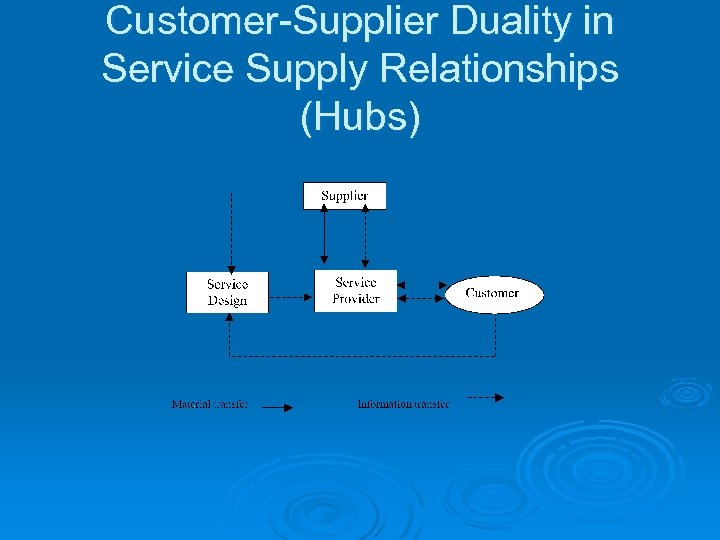 Customer-Supplier Duality in Service Supply Relationships (Hubs)
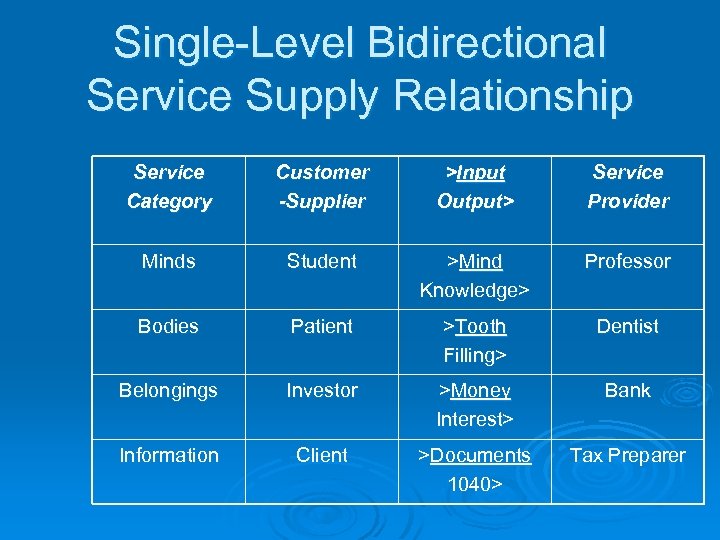 Single-Level Bidirectional Service Supply Relationship Service Category Customer -Supplier >Input Output> Service Provider Minds Student >Mind Knowledge> Professor Bodies Patient >Tooth Filling> Dentist Belongings Investor >Money Interest> Bank Information Client >Documents 1040> Tax Preparer
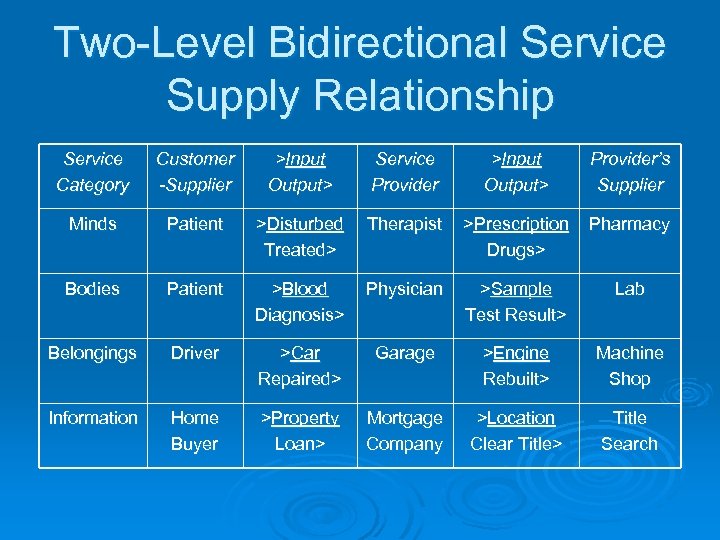 Two-Level Bidirectional Service Supply Relationship Service Category Customer -Supplier >Input Output> Service Provider >Input Output> Provider’s Supplier Minds Patient >Disturbed Treated> Therapist >Prescription Drugs> Pharmacy Bodies Patient >Blood Diagnosis> Physician >Sample Test Result> Lab Belongings Driver >Car Repaired> Garage >Engine Rebuilt> Machine Shop Information Home Buyer >Property Loan> Mortgage Company >Location Clear Title> Title Search
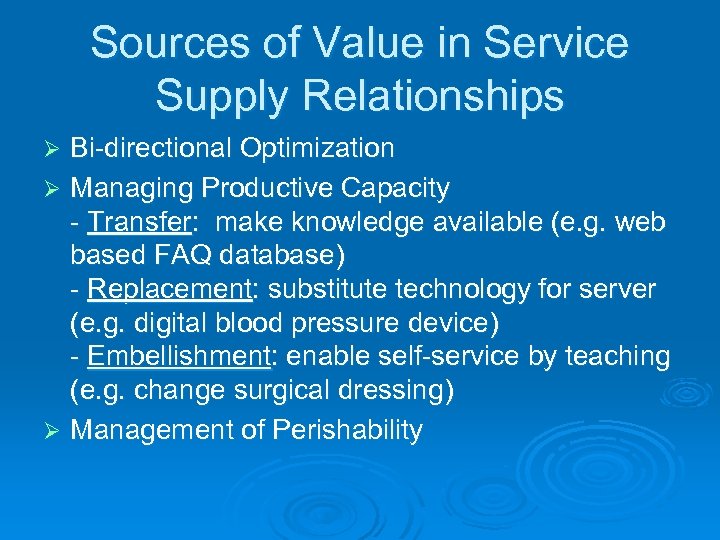 Sources of Value in Service Supply Relationships Bi-directional Optimization Ø Managing Productive Capacity - Transfer: make knowledge available (e. g. web based FAQ database) - Replacement: substitute technology for server (e. g. digital blood pressure device) - Embellishment: enable self-service by teaching (e. g. change surgical dressing) Ø Management of Perishability Ø
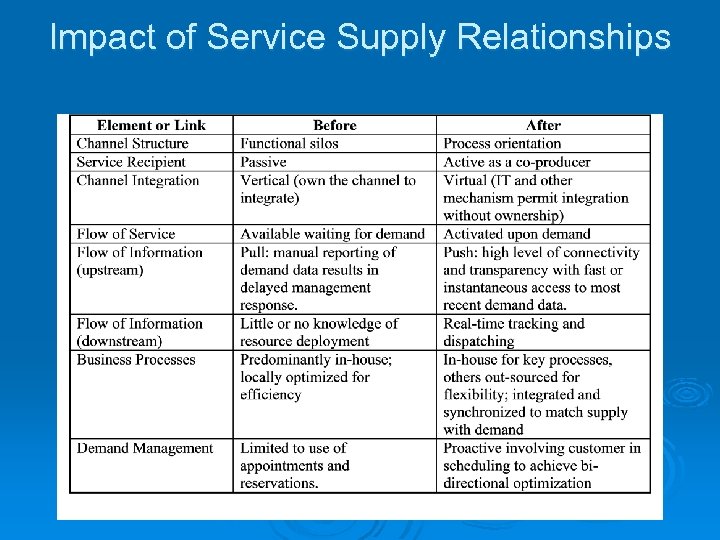 Impact of Service Supply Relationships
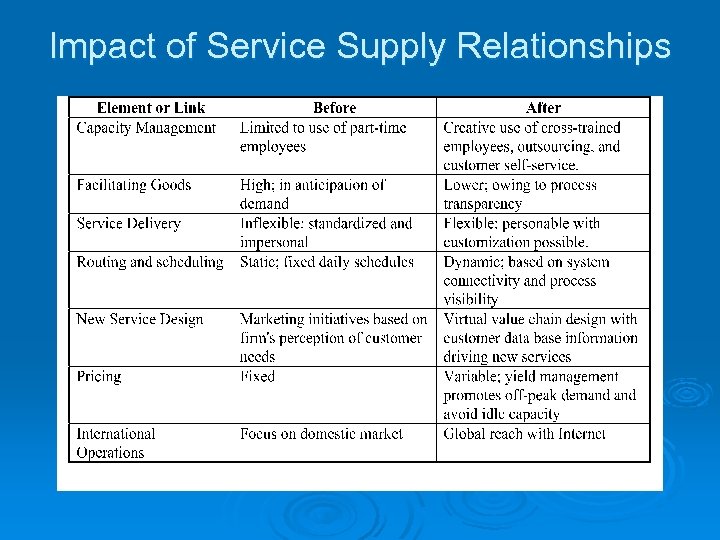 Impact of Service Supply Relationships
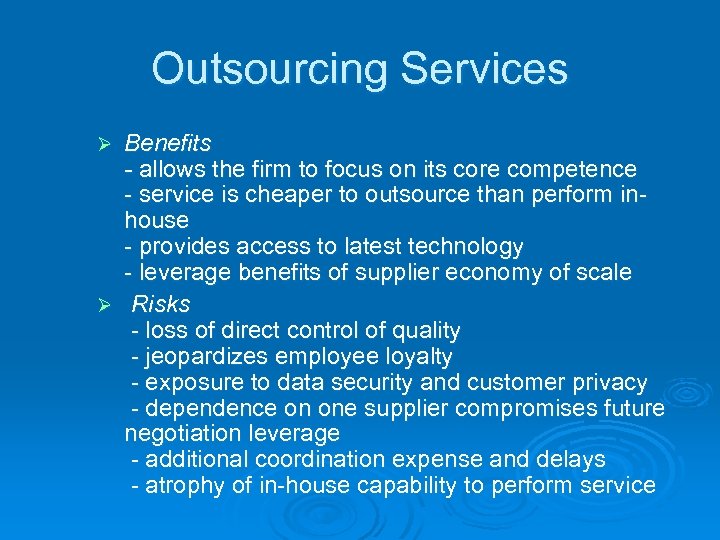 Outsourcing Services Benefits - allows the firm to focus on its core competence - service is cheaper to outsource than perform inhouse - provides access to latest technology - leverage benefits of supplier economy of scale Ø Risks - loss of direct control of quality - jeopardizes employee loyalty - exposure to data security and customer privacy - dependence on one supplier compromises future negotiation leverage - additional coordination expense and delays - atrophy of in-house capability to perform service Ø
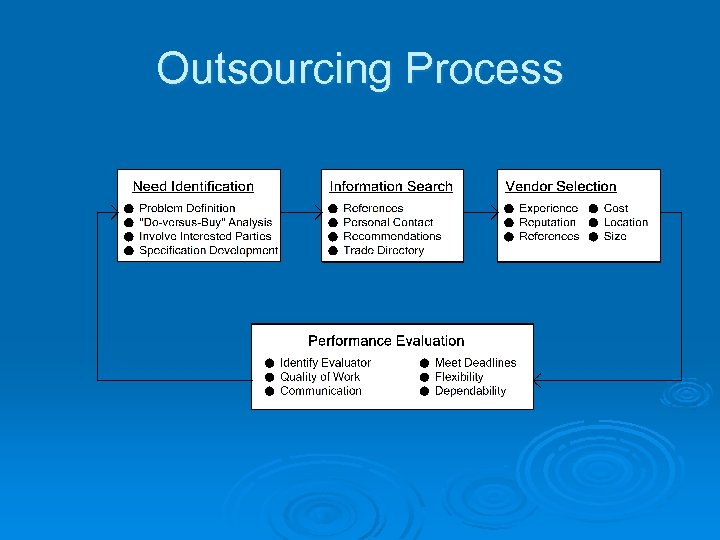 Outsourcing Process
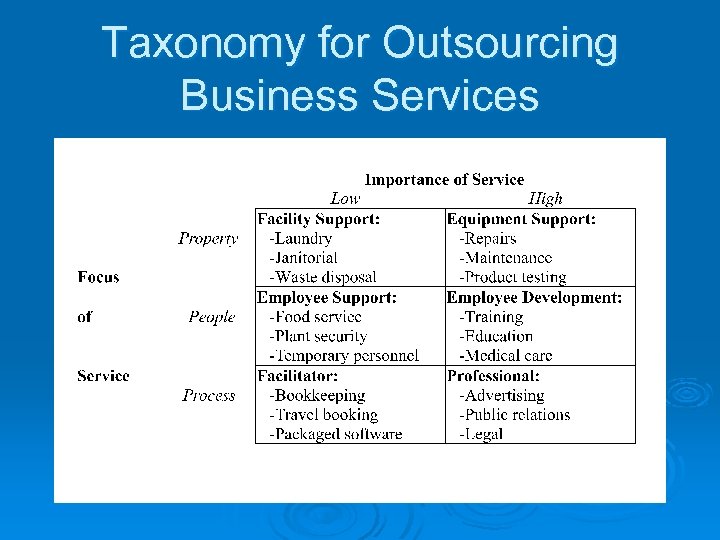 Taxonomy for Outsourcing Business Services
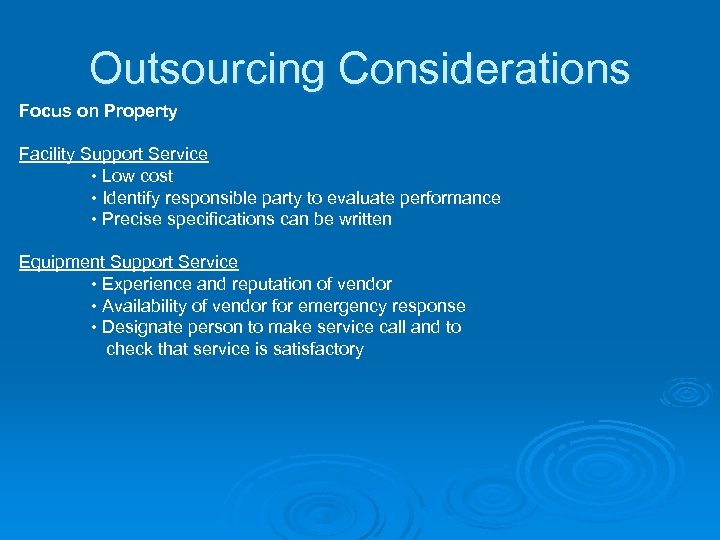 Outsourcing Considerations Focus on Property Facility Support Service • Low cost • Identify responsible party to evaluate performance • Precise specifications can be written Equipment Support Service • Experience and reputation of vendor • Availability of vendor for emergency response • Designate person to make service call and to check that service is satisfactory
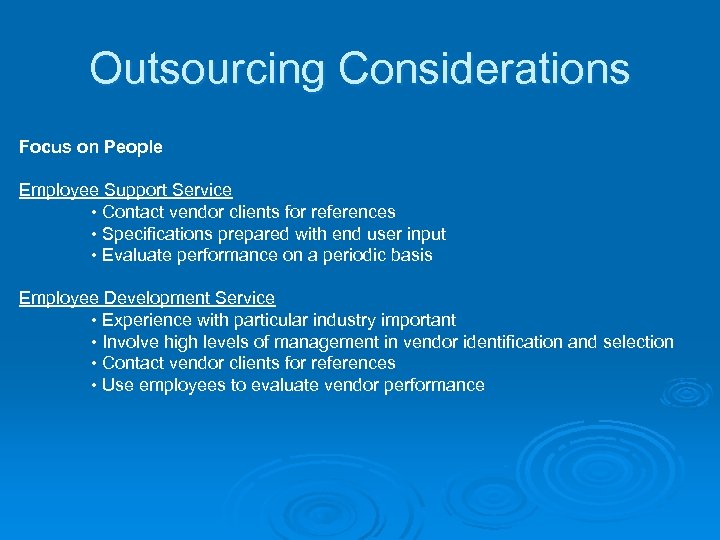 Outsourcing Considerations Focus on People Employee Support Service • Contact vendor clients for references • Specifications prepared with end user input • Evaluate performance on a periodic basis Employee Development Service • Experience with particular industry important • Involve high levels of management in vendor identification and selection • Contact vendor clients for references • Use employees to evaluate vendor performance
 Outsourcing Considerations Focus on Process Facilitator Service • Knowledge of alternate vendors important • Involve end user in vendor identification • References or third party evaluations useful • Have user write detailed specifications Professional Service • Involve high level management in vendor identification and selection • Reputation and experience very important • Performance evaluation by top management
 The bull-whip effect Ø Variations in demand are amplified as one moves upstream in the supply chain (further from the customer) Ø Small uncertainty at one end can lead to large uncertainty at the other end of a supply chain Ø Good method to nullify is based on demand-driven forecasting where all information is shared through supply chain
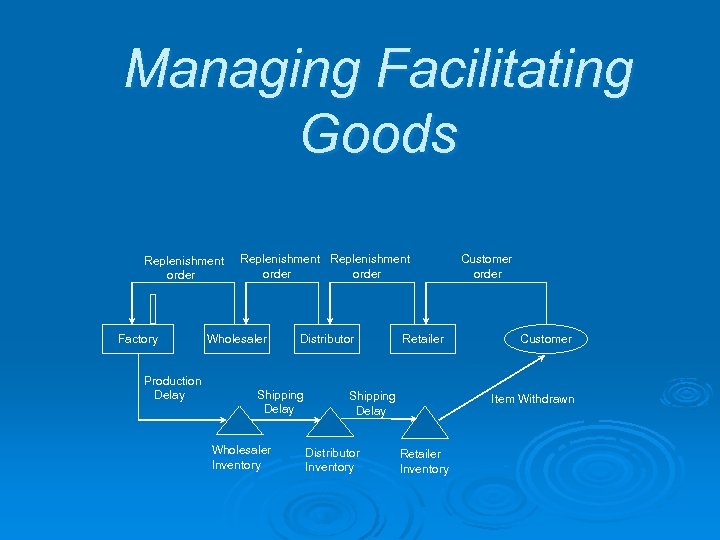 Managing Facilitating Goods Replenishment order Factory Production Delay Replenishment order Wholesaler Distributor Shipping Delay Wholesaler Inventory Retailer Shipping Delay Distributor Inventory Customer order Customer Item Withdrawn Retailer Inventory
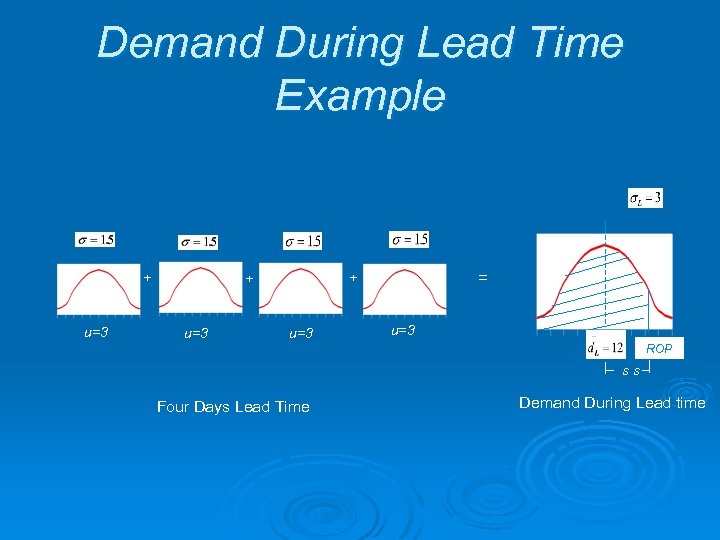
 Role of Inventory in Services Ø Decoupling inventories Ø Seasonal inventories Ø Speculative inventories Ø Cyclical inventories Ø In-transit inventories Ø Safety stocks
 Considerations in Inventory Systems Ø Type of customer demand Ø Planning time horizon Ø Replenishment lead time Ø Constraints and relevant costs
 Relevant Inventory Costs Ø Ordering costs Ø Receiving and inspections costs Ø Holding or carrying costs Ø Shortage costs
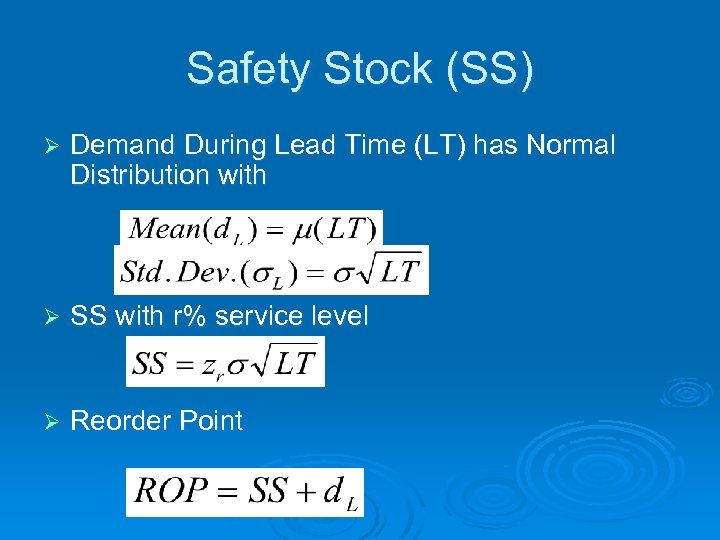
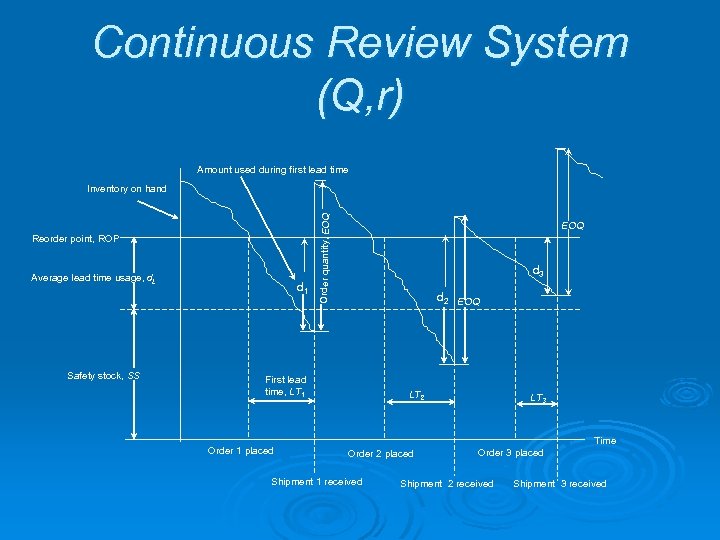
 Inventory Management Questions Ø What should be the order quantity (Q)? Ø When should an order be placed, called a reorder point (ROP)? Ø How much safety stock (SS) should be maintained?
 Inventory Models Economic Order Quantity (EOQ) Ø Special Inventory Models With Quantity Discounts Planned Shortages Ø Demand Uncertainty - Safety Stocks Ø Inventory Control Systems Continuous-Review (Q, r) Periodic-Review (order-up-to) Ø Single Period Inventory Model Ø
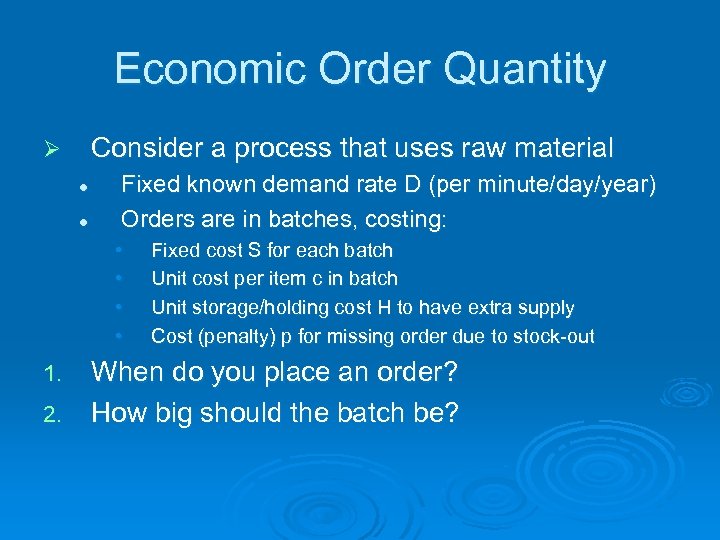 Economic Order Quantity Consider a process that uses raw material Ø l l Fixed known demand rate D (per minute/day/year) Orders are in batches, costing: • • Fixed cost S for each batch Unit cost per item c in batch Unit storage/holding cost H to have extra supply Cost (penalty) p for missing order due to stock-out When do you place an order? 2. How big should the batch be? 1.
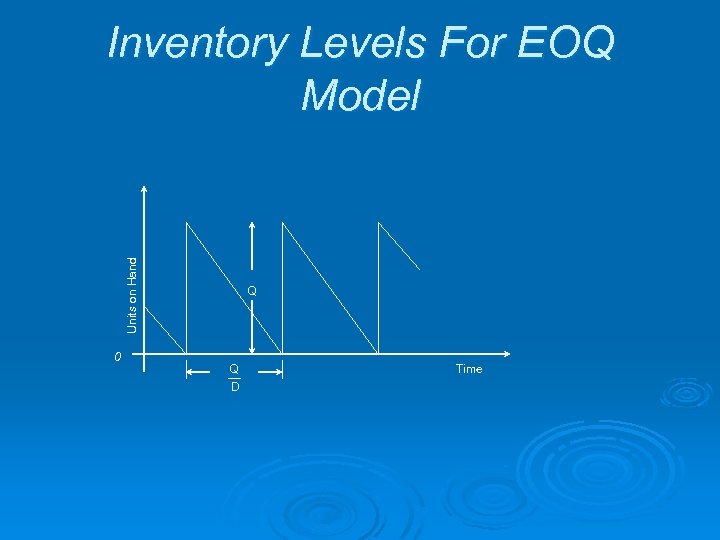 Units on Hand Inventory Levels For EOQ Model 0 Q Q D Time
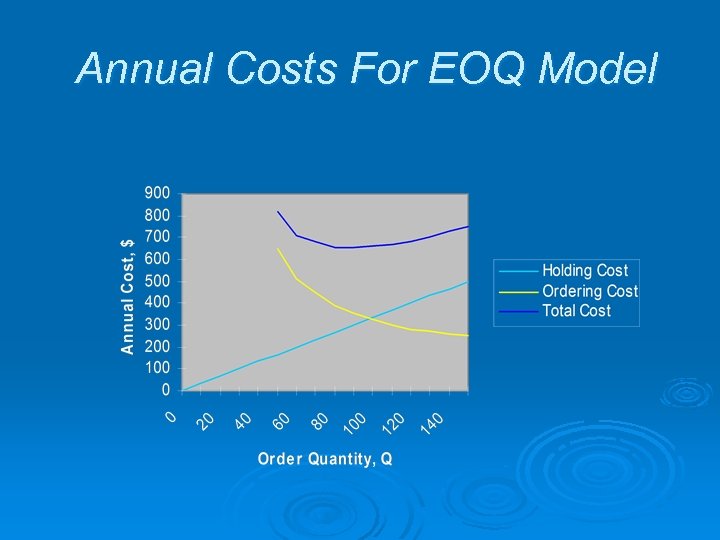 Annual Costs For EOQ Model
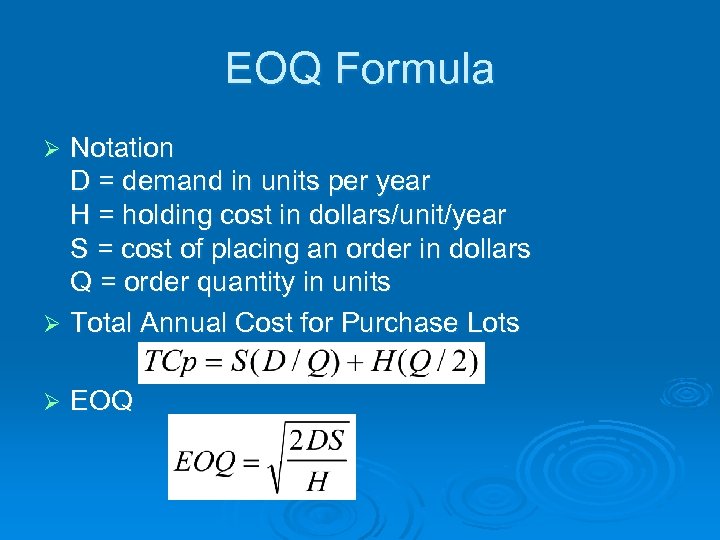 EOQ Formula Notation D = demand in units per year H = holding cost in dollars/unit/year S = cost of placing an order in dollars Q = order quantity in units Ø Total Annual Cost for Purchase Lots Ø Ø EOQ
 Economic Order Quantity Ø Variations: l l l Lead-time from order to arrival of batch Uncertain/varying demand Option to back-order
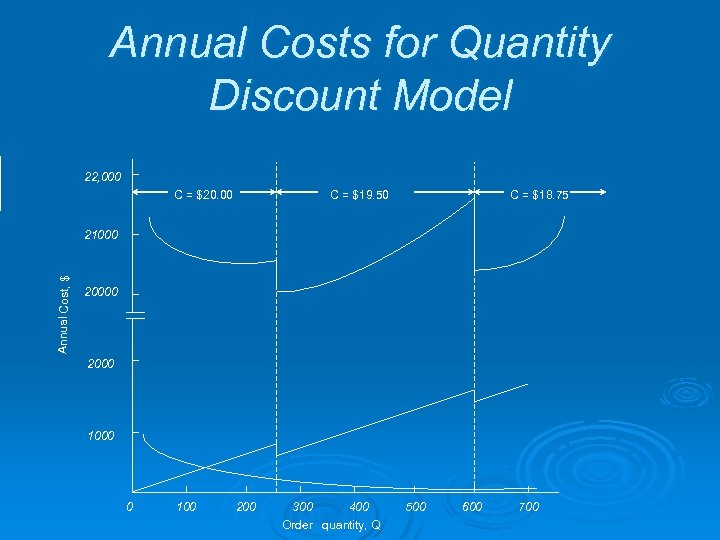 Annual Costs for Quantity Discount Model 22, 000 C = $20. 00 C = $19. 50 C = $18. 75 Annual Cost, $ 21000 2000 1000 0 100 200 300 400 Order quantity, Q 500 600 700
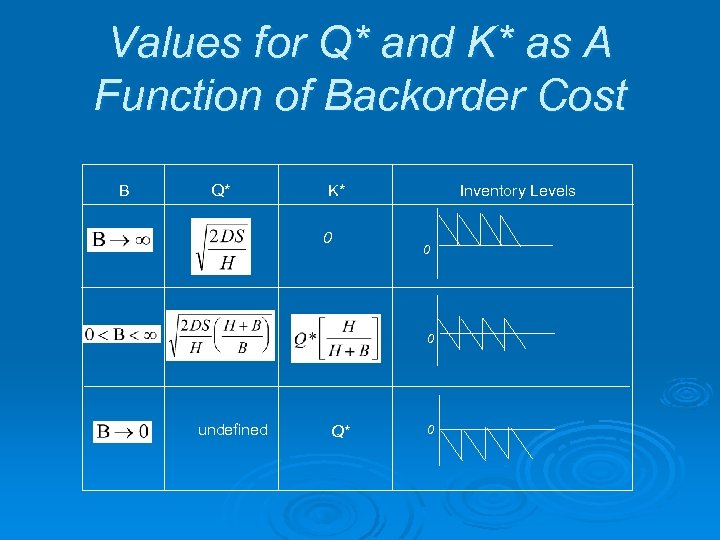
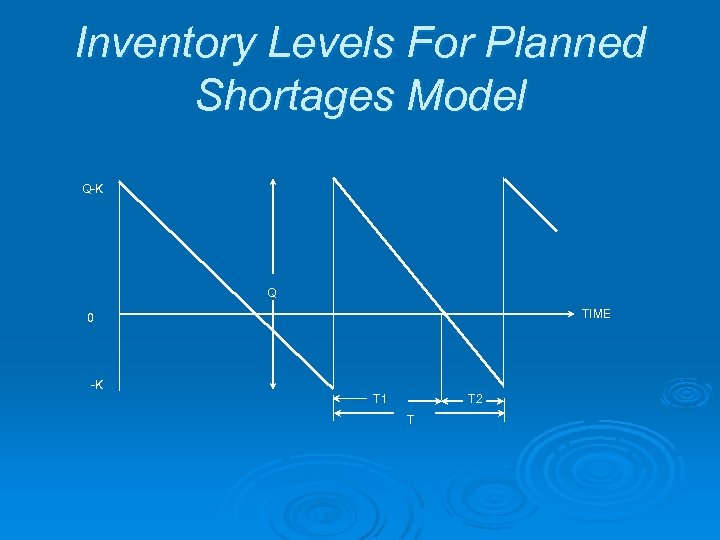 Inventory Levels For Planned Shortages Model Q-K Q TIME 0 -K T 1 T 2 T
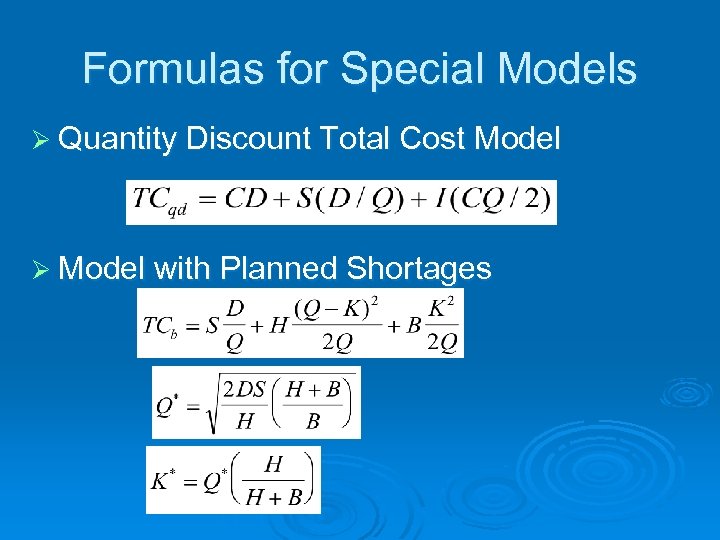 Formulas for Special Models Ø Quantity Discount Total Cost Model Ø Model with Planned Shortages
 Values for Q* and K* as A Function of Backorder Cost B Q* K* Inventory Levels 0 0 0 undefined Q* 0
 Demand During Lead Time Example + u=3 = + + u=3 ROP ss Four Days Lead Time Demand During Lead time
 Safety Stock (SS) Ø Demand During Lead Time (LT) has Normal Distribution with Ø SS with r% service level Ø Reorder Point
 Continuous Review System (Q, r) Amount used during first lead time Reorder point, ROP Average lead time usage, d. L Safety stock, SS d 1 Order quantity, EOQ Inventory on hand EOQ d 3 d 2 EOQ First lead time, LT 1 Order 1 placed LT 2 LT 3 Time Order 2 placed Shipment 1 received Order 3 placed Shipment 2 received Shipment 3 received
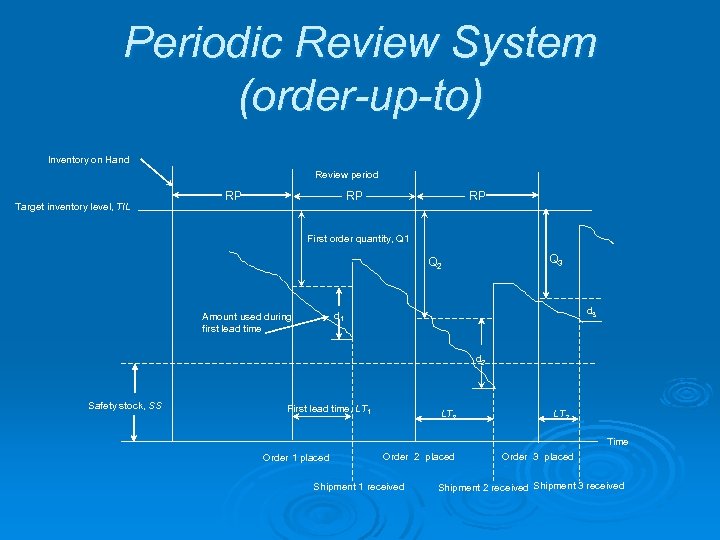 Periodic Review System (order-up-to) Inventory on Hand Review period Target inventory level, TIL RP RP RP First order quantity, Q 1 Q 3 Q 2 d 3 d 1 Amount used during first lead time d 2 Safety stock, SS First lead time, LT 1 LT 2 LT 3 Time Order 1 placed Order 2 placed Shipment 1 received Order 3 placed Shipment 2 received Shipment 3 received
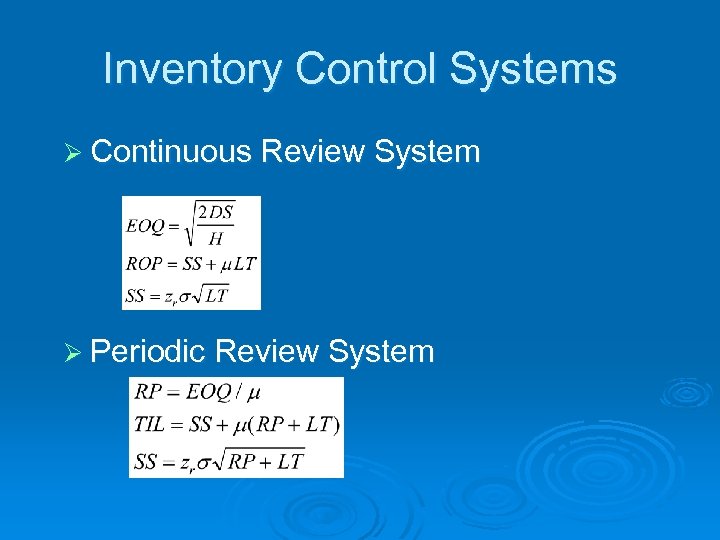 Inventory Control Systems Ø Continuous Review System Ø Periodic Review System
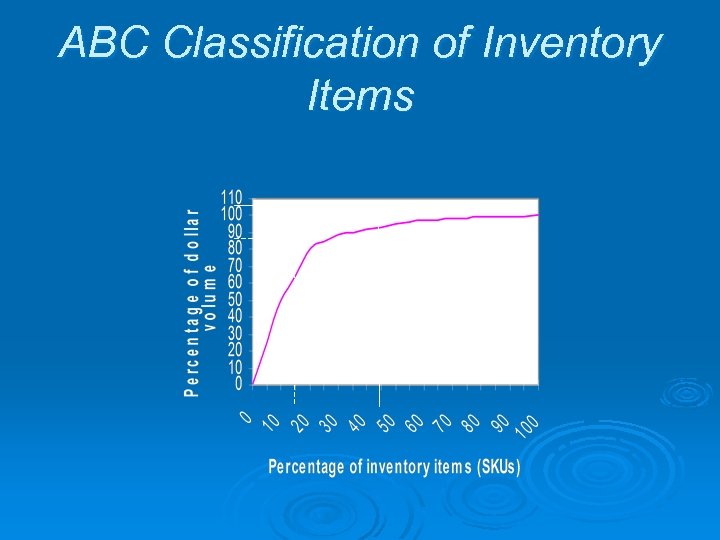 ABC Classification of Inventory Items A B C
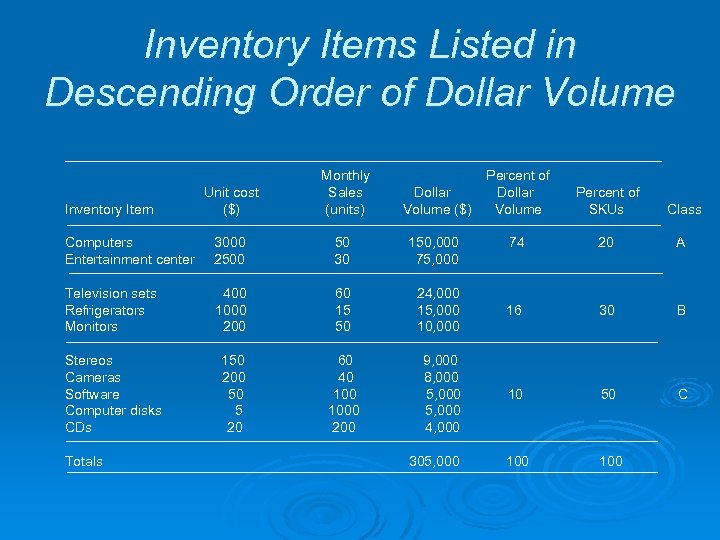 Inventory Items Listed in Descending Order of Dollar Volume Monthly Percent of Unit cost Sales Dollar Percent of Inventory Item ($) (units) Volume ($) Volume SKUs Class Computers 3000 50 150, 000 74 20 A Entertainment center 2500 30 75, 000 Television sets 400 60 24, 000 Refrigerators 1000 15, 000 16 30 B Monitors 200 50 10, 000 Stereos 150 60 9, 000 Cameras 200 40 8, 000 Software 50 100 5, 000 10 50 C Computer disks 5 1000 5, 000 CDs 200 4, 000 Totals 305, 000 100
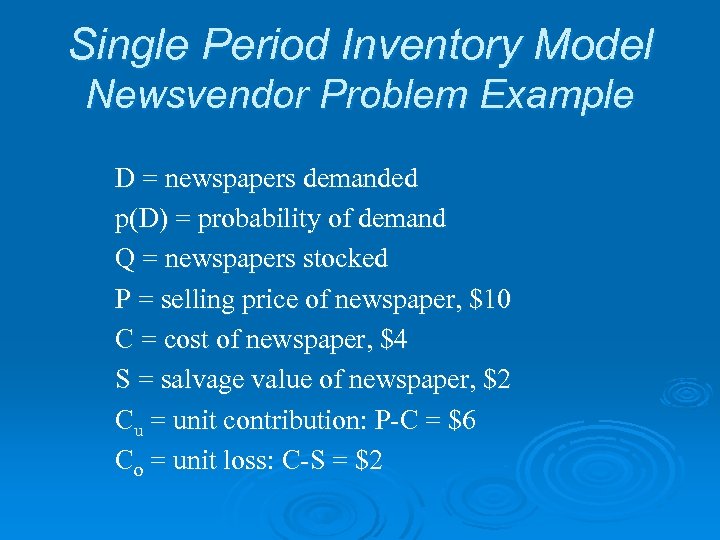 Single Period Inventory Model Newsvendor Problem Example D = newspapers demanded p(D) = probability of demand Q = newspapers stocked P = selling price of newspaper, $10 C = cost of newspaper, $4 S = salvage value of newspaper, $2 Cu = unit contribution: P-C = $6 Co = unit loss: C-S = $2
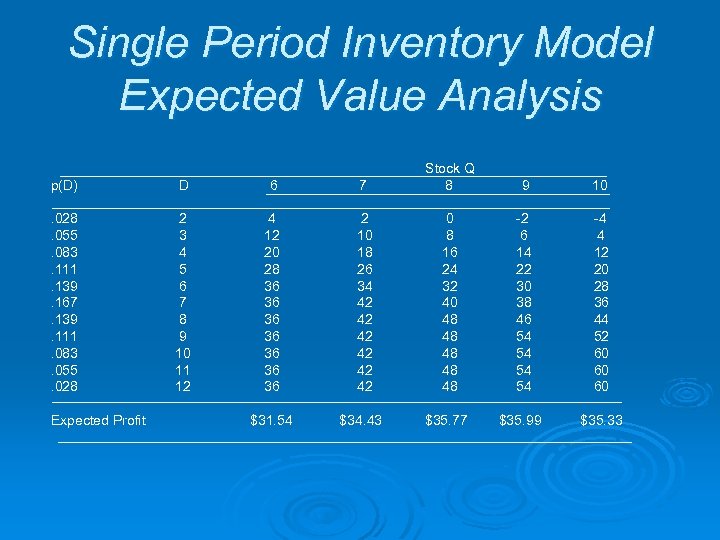 Single Period Inventory Model Expected Value Analysis Stock Q p(D) D 6 7 8 9 10 . 028 2 4 2 0 -2 -4. 055 3 12 10 8 6 4. 083 4 20 18 16 14 12. 111 5 28 26 24 22 20. 139 6 34 32 30 28. 167 36 42 40 38 36. 139 8 36 42 48 46 44. 111 9 36 42 48 54 52. 083 10 36 42 48 54 60. 055 11 36 42 48 54 60. 028 12 36 42 48 54 60 Expected Profit $31. 54 $34. 43 $35. 77 $35. 99 $35. 33
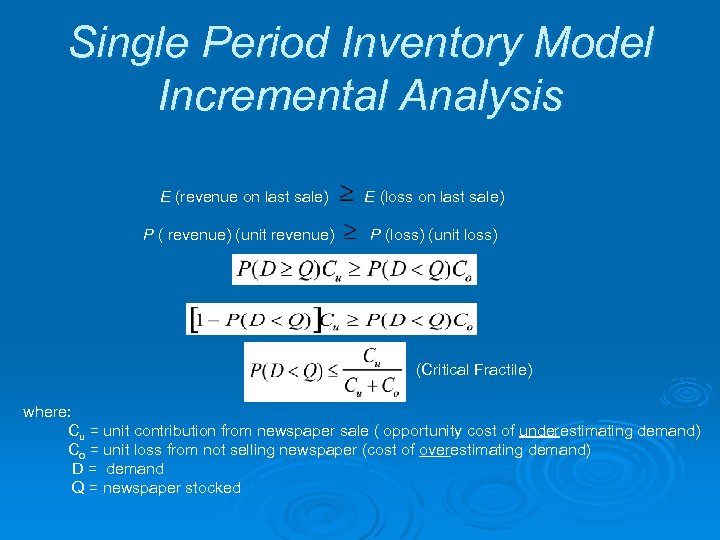 Single Period Inventory Model Incremental Analysis E (revenue on last sale) E (loss on last sale) P ( revenue) (unit revenue) P (loss) (unit loss) (Critical Fractile) where: Cu = unit contribution from newspaper sale ( opportunity cost of underestimating demand) Co = unit loss from not selling newspaper (cost of overestimating demand) D = demand Q = newspaper stocked
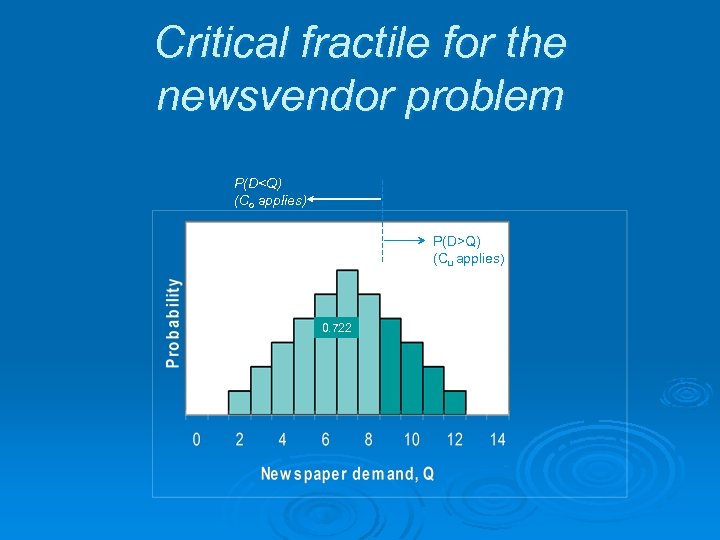 Critical fractile for the newsvendor problem P(D
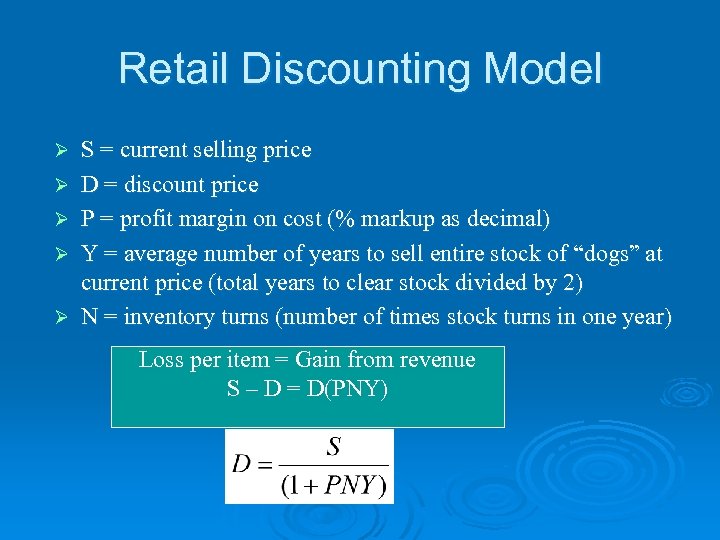 Retail Discounting Model Ø Ø Ø S = current selling price D = discount price P = profit margin on cost (% markup as decimal) Y = average number of years to sell entire stock of “dogs” at current price (total years to clear stock divided by 2) N = inventory turns (number of times stock turns in one year) Loss per item = Gain from revenue S – D = D(PNY)
 Growth and Global Expansion
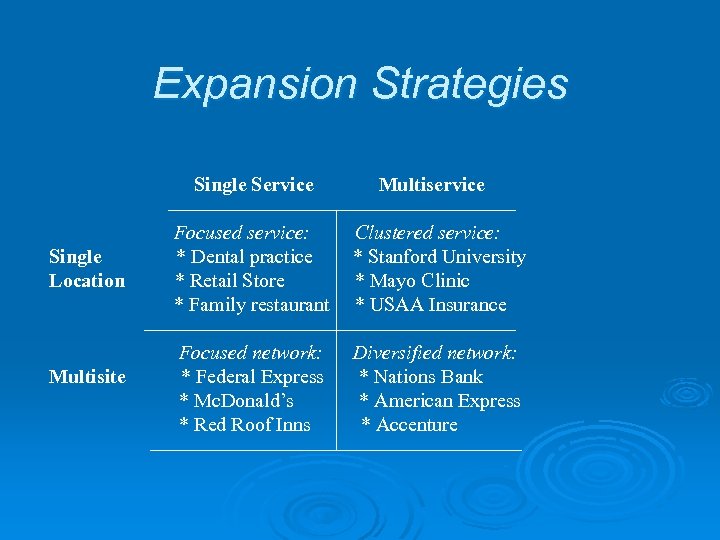 Expansion Strategies Single Service Multiservice Focused service: Clustered service: Single * Dental practice * Stanford University Location * Retail Store * Mayo Clinic * Family restaurant * USAA Insurance Focused network: Diversified network: Multisite * Federal Express * Nations Bank * Mc. Donald’s * American Express * Red Roof Inns * Accenture
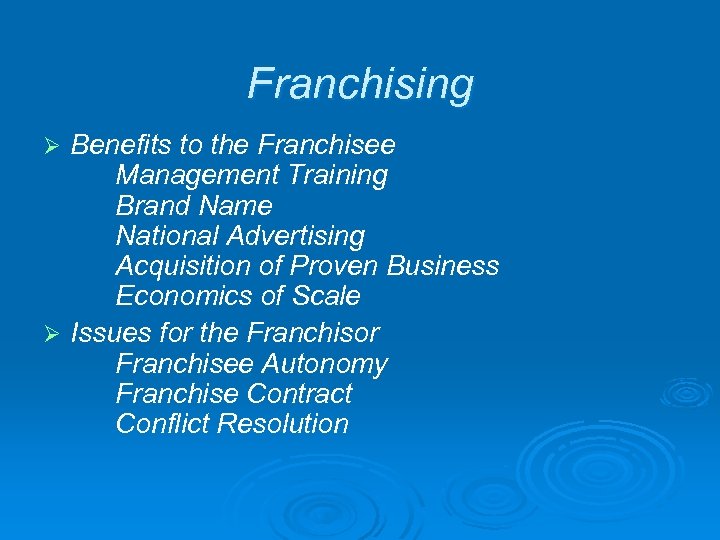 Franchising Benefits to the Franchisee Management Training Brand Name National Advertising Acquisition of Proven Business Economics of Scale Ø Issues for the Franchisor Franchisee Autonomy Franchise Contract Conflict Resolution Ø
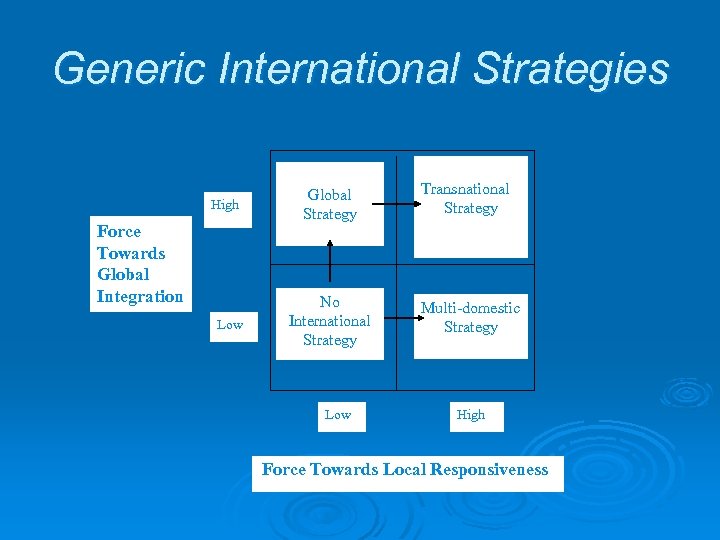 Generic International Strategies High Force Towards Global Integration Low Global Strategy No International Strategy Transnational Strategy Multi-domestic Strategy Low High Force Towards Local Responsiveness
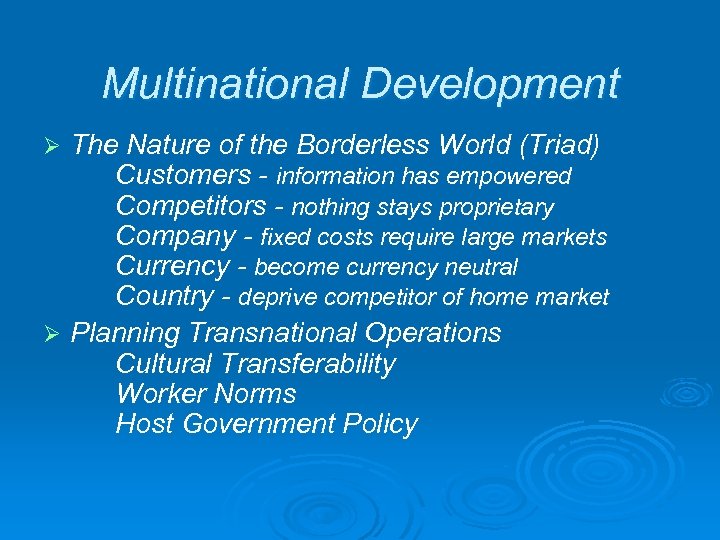 Multinational Development The Nature of the Borderless World (Triad) Customers - information has empowered Competitors - nothing stays proprietary Company - fixed costs require large markets Currency - become currency neutral Country - deprive competitor of home market Ø Planning Transnational Operations Cultural Transferability Worker Norms Host Government Policy Ø
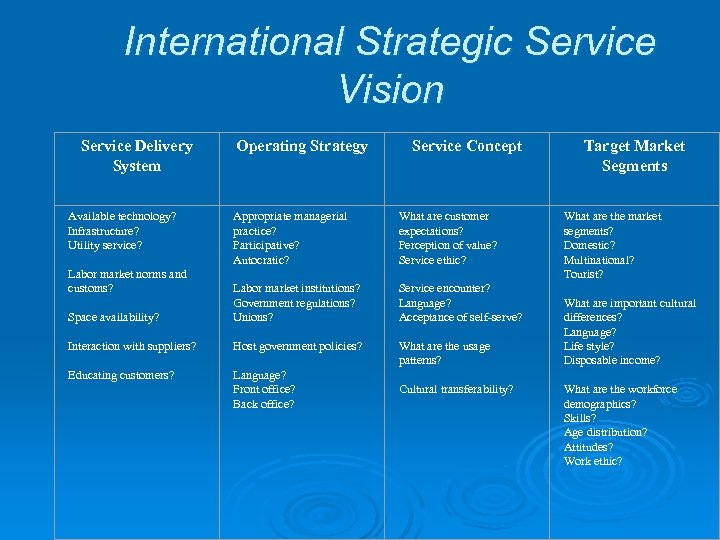 International Strategic Service Vision Service Delivery System Available technology? Infrastructure? Utility service? Labor market norms and customs? Space availability? Interaction with suppliers? Educating customers? Operating Strategy Service Concept Appropriate managerial practice? Participative? Autocratic? Labor market institutions? Government regulations? Unions? Host government policies? Language? Front office? Back office? What are customer expectations? Perception of value? Service ethic? Service encounter? Language? Acceptance of self-serve? What are the usage patterns? Cultural transferability? Target Market Segments What are the market segments? Domestic? Multinational? Tourist? What are important cultural differences? Language? Life style? Disposable income? What are the workforce demographics? Skills? Age distribution? Attitudes? Work ethic?
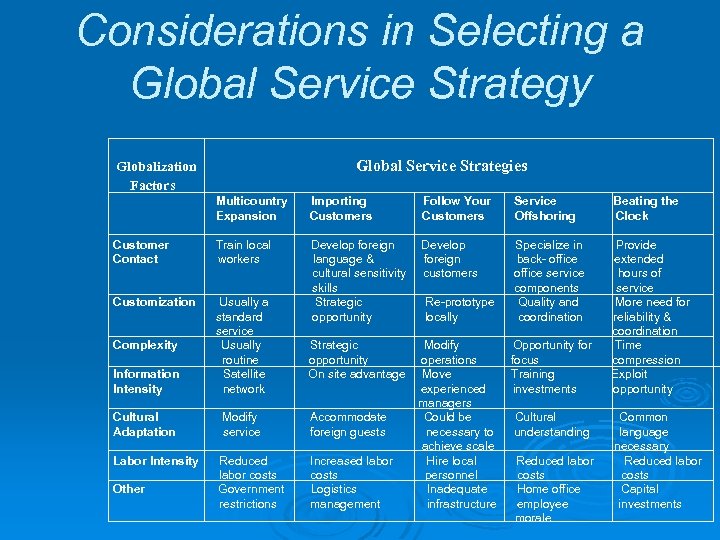 Considerations in Selecting a Global Service Strategy Global Service Strategies Globalization Factors Multicountry Expansion Importing Customers Follow Your Customers Service Offshoring Beating the Clock Customer Train local Develop foreign Develop Specialize in Provide Contact workers language & foreign back- office extended cultural sensitivity customers office service hours of skills components service Customization Usually a Strategic Re-prototype Quality and More need for standard opportunity locally coordination reliability & service coordination Complexity Usually Strategic Modify Opportunity for Time routine opportunity operations focus compression Information Satellite On site advantage Move Training Exploit Intensity network experienced investments opportunity managers Cultural Modify Accommodate Could be Cultural Common Adaptation service foreign guests necessary to understanding language achieve scale necessary Labor Intensity Reduced Increased labor Hire local Reduced labor labor costs personnel costs Other Government Logistics Inadequate Home office Capital restrictions management infrastructure employee investments morale
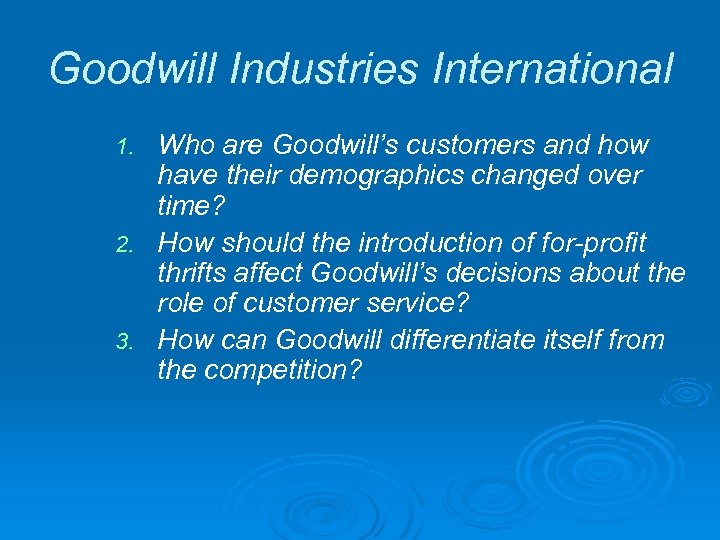 Goodwill Industries International Who are Goodwill’s customers and how have their demographics changed over time? 2. How should the introduction of for-profit thrifts affect Goodwill’s decisions about the role of customer service? 3. How can Goodwill differentiate itself from the competition? 1.
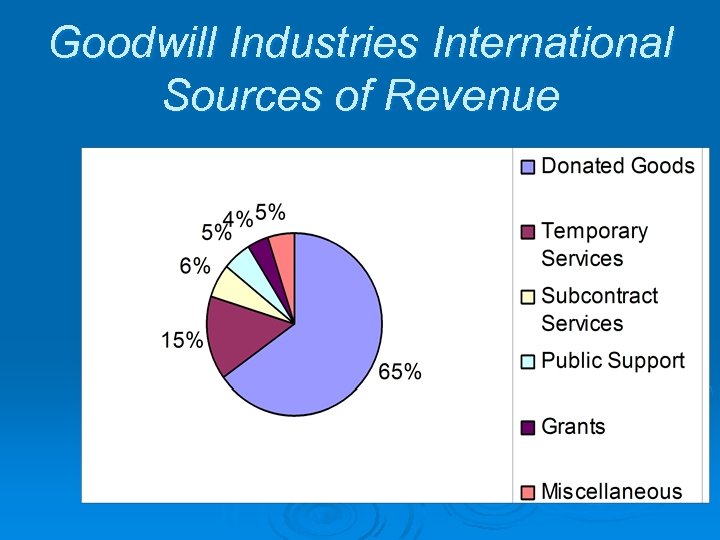 Goodwill Industries International Sources of Revenue
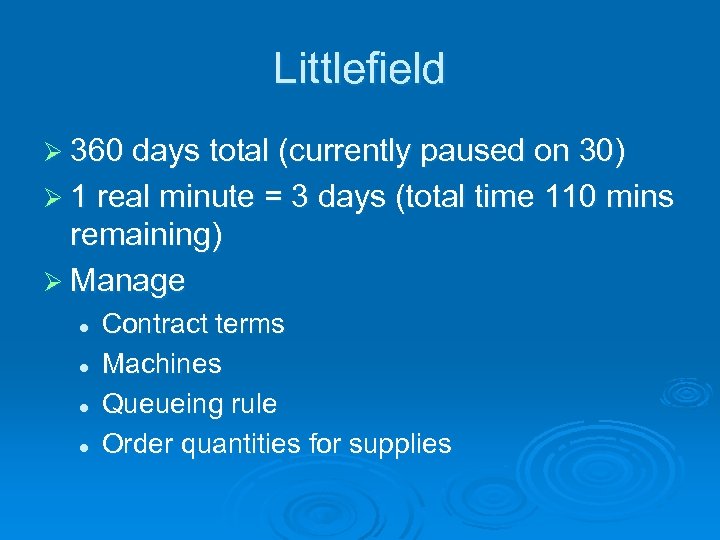 Littlefield Ø 360 days total (currently paused on 30) Ø 1 real minute = 3 days (total time 110 mins remaining) Ø Manage l l Contract terms Machines Queueing rule Order quantities for supplies
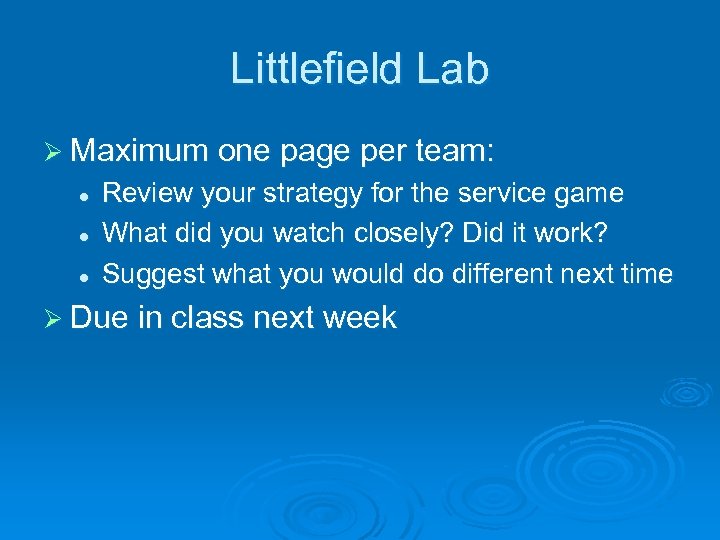 Littlefield Lab Ø Maximum one page per team: l l l Review your strategy for the service game What did you watch closely? Did it work? Suggest what you would do different next time Ø Due in class next week