


 Скачать презентацию ISM 270 Service Engineering and Management Lecture 2
ffe877c57c16af6d42cd86f9a950a10c.ppt
- Количество слайдов: 48
 ISM 270 Service Engineering and Management Lecture 2
 Notes Ø Video of class available from website l l Username: Password: Homework 1 due next week Ø Homework 2 due 2 weeks Ø Office hours 5 pm room 2085 Ø Computer access to SOE account available Ø Library challenges Ø
 Homework: Week 1 Ø Link
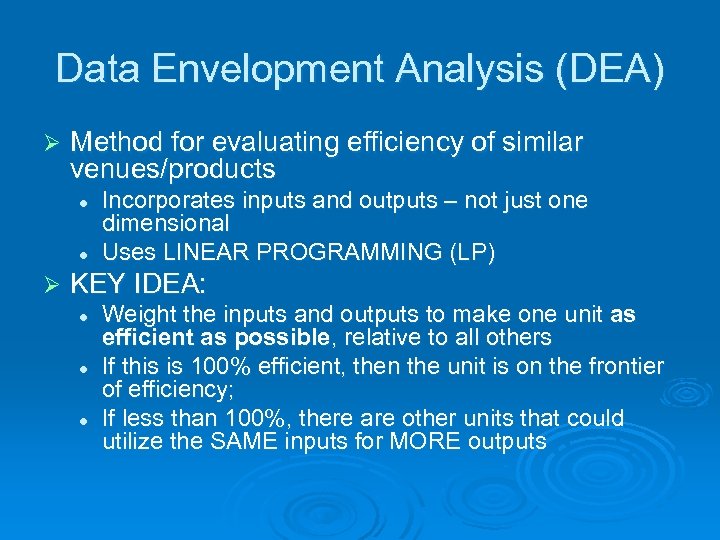 Data Envelopment Analysis (DEA) Ø Method for evaluating efficiency of similar venues/products l l Ø Incorporates inputs and outputs – not just one dimensional Uses LINEAR PROGRAMMING (LP) KEY IDEA: l l l Weight the inputs and outputs to make one unit as efficient as possible, relative to all others If this is 100% efficient, then the unit is on the frontier of efficiency; If less than 100%, there are other units that could utilize the SAME inputs for MORE outputs
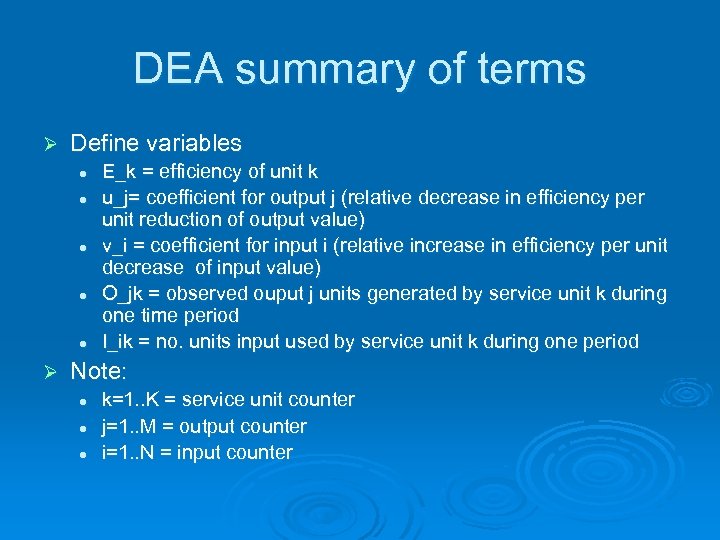 DEA summary of terms Ø Define variables l l l Ø E_k = efficiency of unit k u_j= coefficient for output j (relative decrease in efficiency per unit reduction of output value) v_i = coefficient for input i (relative increase in efficiency per unit decrease of input value) O_jk = observed ouput j units generated by service unit k during one time period I_ik = no. units input used by service unit k during one period Note: l l l k=1. . K = service unit counter j=1. . M = output counter i=1. . N = input counter
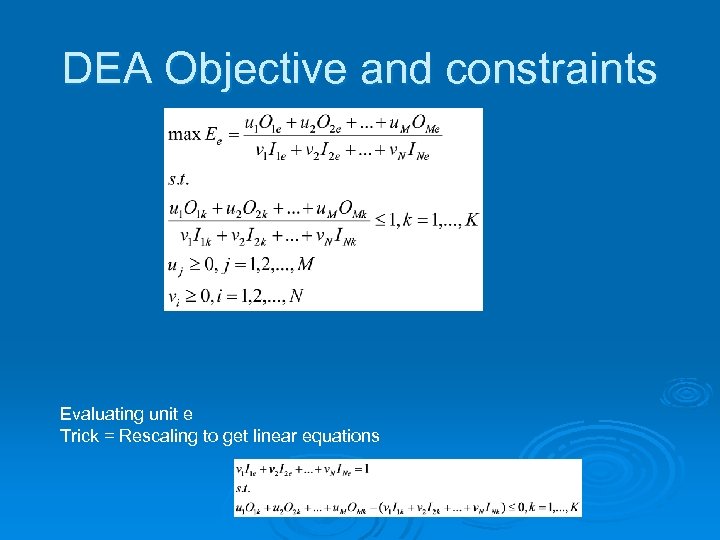 DEA Objective and constraints Evaluating unit e Trick = Rescaling to get linear equations
 Example from Text: Burger Palace Ø Small, artificial example for illustration! Ø Page 68 Ø Excel formulation
 The Nature of Services
 Learning Objectives Ø Ø Ø Classify a service into one of four categories using the service process matrix. Describe a service using the four dimensions of the service package. Discuss the managerial implications of the distinctive characteristics of a service operation. Discuss the insights obtained from a strategic classification of services. Discuss the role of a service manager from an open-systems view of service.
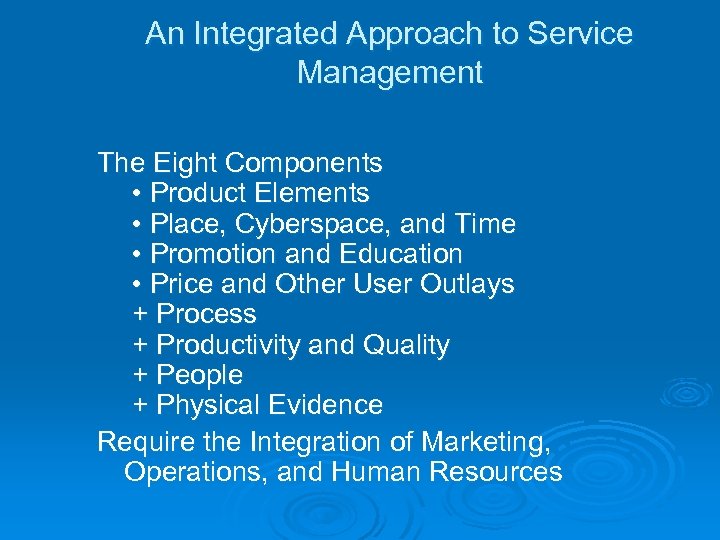 An Integrated Approach to Service Management The Eight Components • Product Elements • Place, Cyberspace, and Time • Promotion and Education • Price and Other User Outlays + Process + Productivity and Quality + People + Physical Evidence Require the Integration of Marketing, Operations, and Human Resources
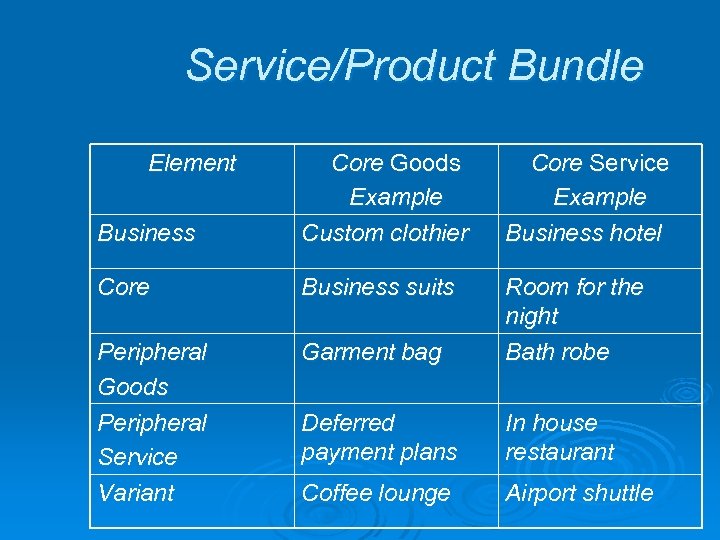 Service/Product Bundle Element Business Core Goods Example Custom clothier Core Service Example Business hotel Core Business suits Peripheral Goods Peripheral Service Variant Garment bag Room for the night Bath robe Deferred payment plans In house restaurant Coffee lounge Airport shuttle
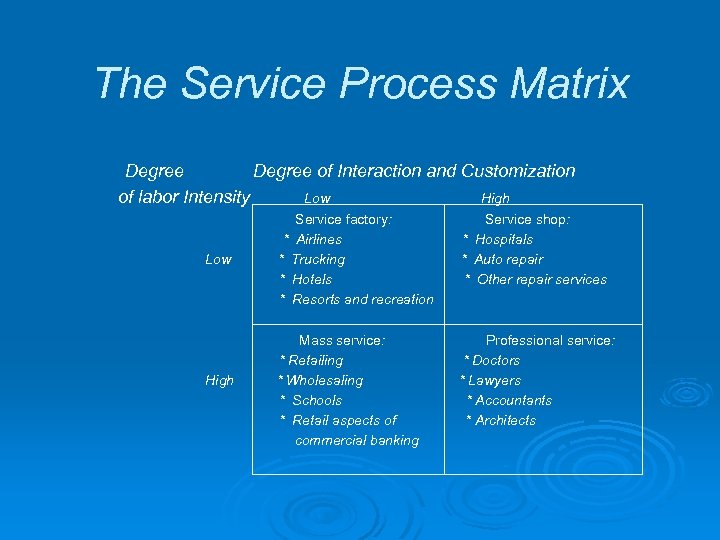 The Service Process Matrix Degree of Interaction and Customization of labor Intensity Low High Service factory: * Airlines * Trucking * Hotels * Resorts and recreation Service shop: * Hospitals * Auto repair * Other repair services Mass service: * Retailing * Wholesaling * Schools * Retail aspects of commercial banking Professional service: * Doctors * Lawyers * Accountants * Architects
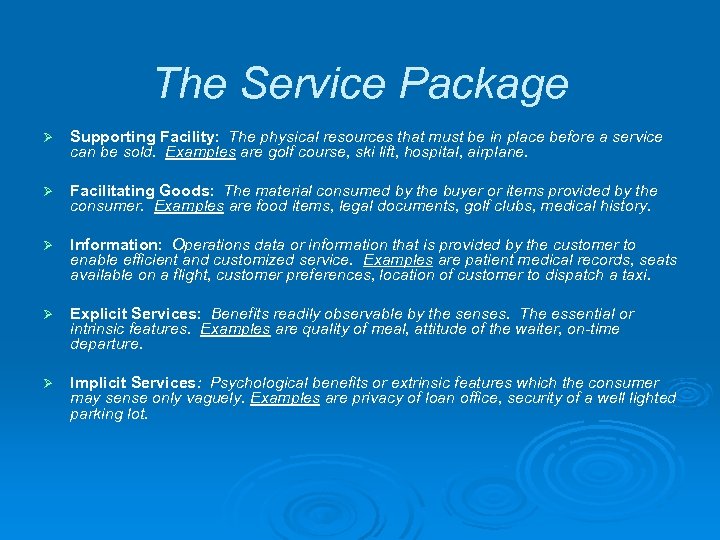 The Service Package Ø Supporting Facility: The physical resources that must be in place before a service can be sold. Examples are golf course, ski lift, hospital, airplane. Ø Facilitating Goods: The material consumed by the buyer or items provided by the consumer. Examples are food items, legal documents, golf clubs, medical history. Ø Information: Operations data or information that is provided by the customer to enable efficient and customized service. Examples are patient medical records, seats available on a flight, customer preferences, location of customer to dispatch a taxi. Ø Explicit Services: Benefits readily observable by the senses. The essential or intrinsic features. Examples are quality of meal, attitude of the waiter, on-time departure. Ø Implicit Services: Psychological benefits or extrinsic features which the consumer may sense only vaguely. Examples are privacy of loan office, security of a well lighted parking lot.
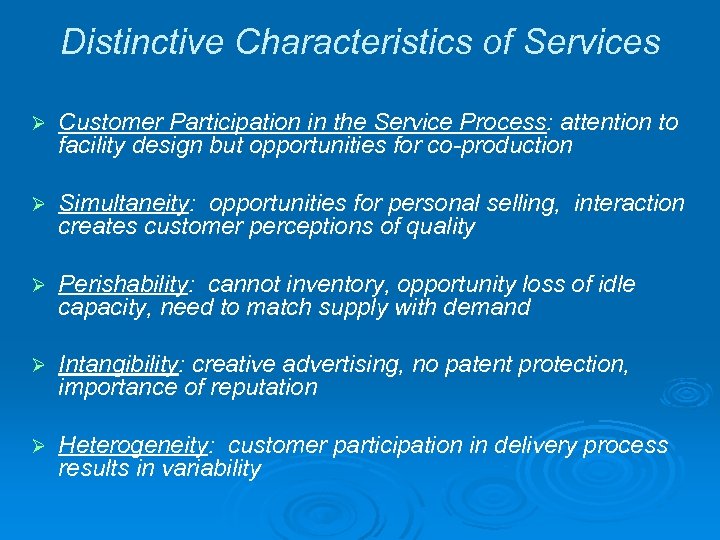 Distinctive Characteristics of Services Ø Customer Participation in the Service Process: attention to facility design but opportunities for co-production Ø Simultaneity: opportunities for personal selling, interaction creates customer perceptions of quality Ø Perishability: cannot inventory, opportunity loss of idle capacity, need to match supply with demand Ø Intangibility: creative advertising, no patent protection, importance of reputation Ø Heterogeneity: customer participation in delivery process results in variability
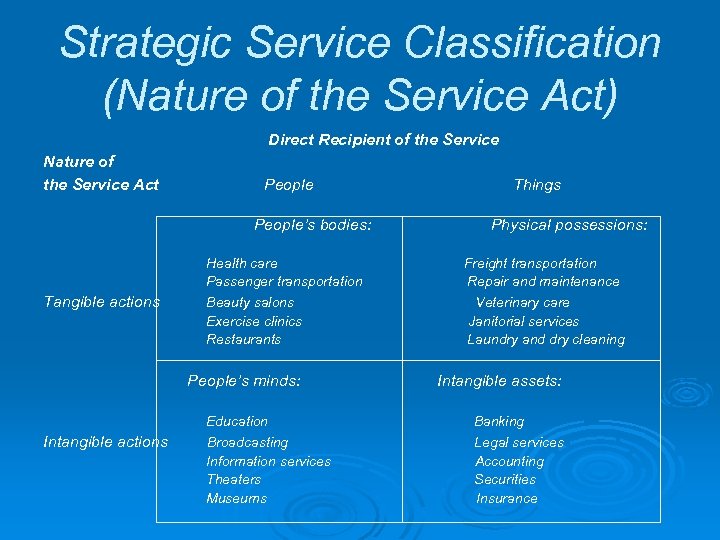 Strategic Service Classification (Nature of the Service Act) Direct Recipient of the Service Nature of the Service Act People’s bodies: Tangible actions Health care Passenger transportation Beauty salons Exercise clinics Restaurants People’s minds: Intangible actions Education Broadcasting Information services Theaters Museums Things Physical possessions: Freight transportation Repair and maintenance Veterinary care Janitorial services Laundry and dry cleaning Intangible assets: Banking Legal services Accounting Securities Insurance
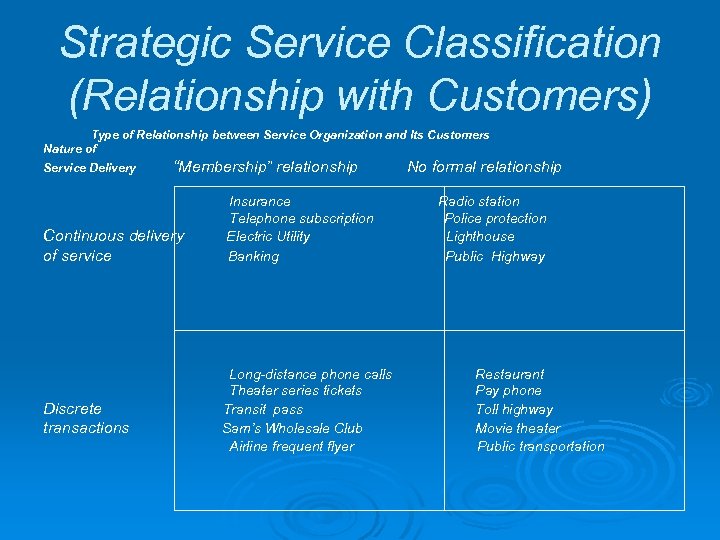 Strategic Service Classification (Relationship with Customers) Type of Relationship between Service Organization and Its Customers Nature of Service Delivery “Membership” relationship Continuous delivery of service Discrete transactions Insurance Telephone subscription Electric Utility Banking Long-distance phone calls Theater series tickets Transit pass Sam’s Wholesale Club Airline frequent flyer No formal relationship Radio station Police protection Lighthouse Public Highway Restaurant Pay phone Toll highway Movie theater Public transportation
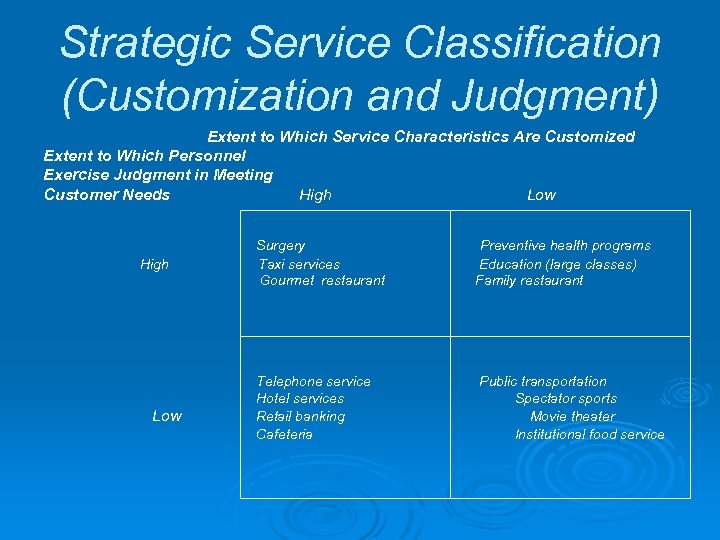 Strategic Service Classification (Customization and Judgment) Extent to Which Service Characteristics Are Customized Extent to Which Personnel Exercise Judgment in Meeting Customer Needs High Low Surgery Taxi services Gourmet restaurant Telephone service Hotel services Retail banking Cafeteria Preventive health programs Education (large classes) Family restaurant Public transportation Spectator sports Movie theater Institutional food service
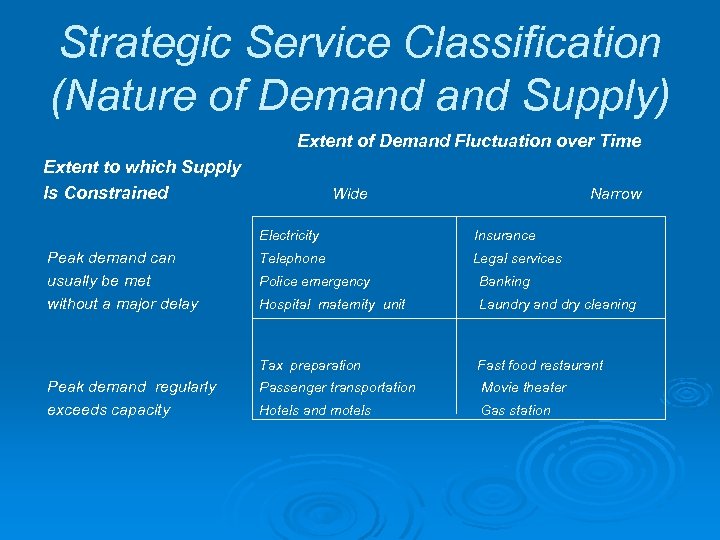 Strategic Service Classification (Nature of Demand Supply) Extent of Demand Fluctuation over Time Extent to which Supply Is Constrained Wide Narrow Electricity Peak demand can usually be met without a major delay Insurance Telephone Legal services Banking Hospital maternity unit Laundry and dry cleaning Tax preparation Peak demand regularly exceeds capacity Police emergency Fast food restaurant Passenger transportation Movie theater Hotels and motels Gas station
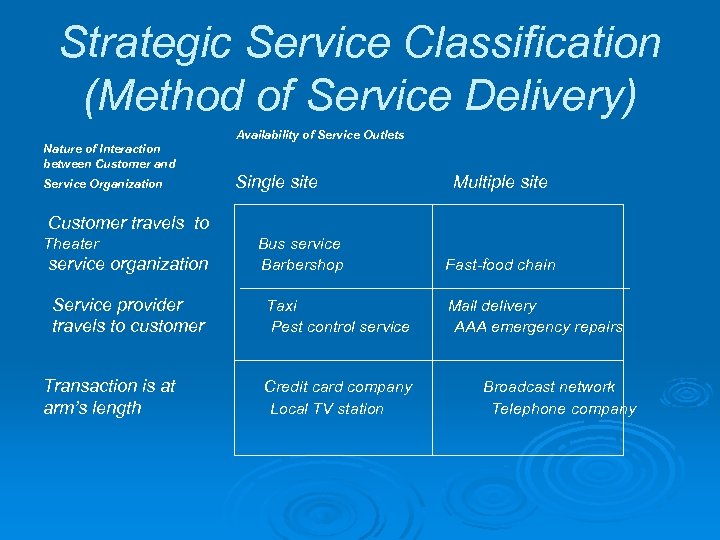 Strategic Service Classification (Method of Service Delivery) Availability of Service Outlets Nature of Interaction between Customer and Service Organization Single site Multiple site Customer travels to Theater service organization Service provider travels to customer Transaction is at arm’s length Bus service Barbershop Taxi Pest control service Credit card company Local TV station Fast-food chain Mail delivery AAA emergency repairs Broadcast network Telephone company
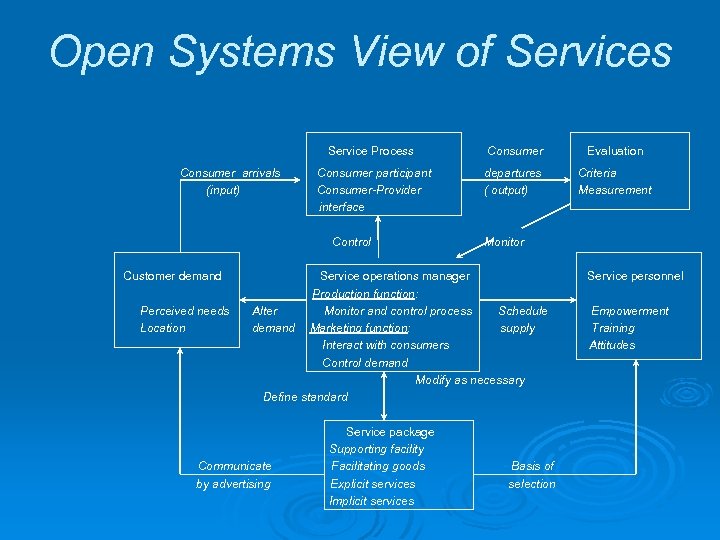 Open Systems View of Services Service Process Consumer arrivals (input) Consumer Evaluation Consumer participant Consumer-Provider interface departures ( output) Criteria Measurement Control Customer demand Perceived needs Location Monitor Service operations manager Production function: Alter Monitor and control process Schedule demand Marketing function: supply Interact with consumers Control demand Modify as necessary Define standard Communicate by advertising Service package Supporting facility Facilitating goods Explicit services Implicit services Basis of selection Service personnel Empowerment Training Attitudes
 Topics for Discussion Ø When does collecting information through service membership become an invasion of privacy? Ø What are some management problems associated with allowing service employees to exercise judgement in meeting customer needs? Ø What factors are important for a manager to consider when attempting to enhance a service firm’s image?
 Sample Quiz Ø Link
 Service Strategy
 Learning Objectives Ø Ø Ø Ø Ø Formulate a strategic service vision. Discuss the competitive environment of services. Describe how a service competes using the three generic service strategies. Discuss the service purchase decision. Discuss the competitive role of information in services. Explain the role of the virtual value chain in service innovation. Discuss the limits in the use of information. Categorize a service firm according to its stage of competitiveness. Conduct a data envelopment analysis (DEA).
 Strategic Service Vision Target Market Segments Ø Ø Ø What are common characteristics of important market segments? What dimensions can be used to segment the market, demographic, psychographic? How important are various segments? What needs does each have? How well are these needs being served, in what manner, by whom?
 Strategic Service Vision Service Concept Ø Ø What are important elements of the service to be provided, stated in terms of results produced for customers? How are these elements supposed to be perceived by the target market segment, by the market in general, by employees, by others? How do customers perceive the service concept? What efforts does this suggest in terms of the manner in which the service is designed, delivered, marketed?
 Strategic Service Vision Operating Strategy What are important elements of the strategy: operations, financing, marketing, organization, human resources, control? Ø On which will the most effort be concentrated? Ø Where will investments be made? Ø How will quality and cost be controlled: measures, incentives, rewards? Ø What results will be expected versus competition in terms of, quality of service, cost profile, productivity, morale/loyalty of servers? Ø
 Strategic Service Vision Service Delivery System What are important features of the service delivery system including: role of people, technology, equipment, layout, procedures? Ø What capacity does it provide, normally, at peak levels? Ø To what extent does it, help insure quality standards, differentiate the service from competition, provide barriers to entry by competitors? Ø
 Competitive Environment of Services Ø Relatively Low Overall Entry Barriers Ø Economies of Scale Limited Ø High Transportation Costs Ø Erratic Sales Fluctuations Ø No Power Dealing with Buyers or Suppliers Ø Product Substitutions for Service Ø High Customer Loyalty Ø Exit Barriers
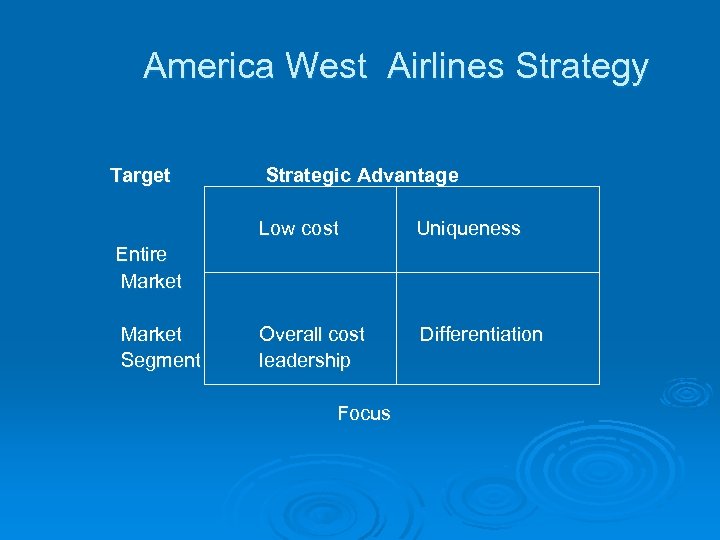
 Competitive Service Strategies (Overall Cost Leadership) Ø Seeking Out Low-cost Customers Ø Standardizing a Custom Service Ø Reducing the Personal Element in Service Delivery (promote self-service) Ø Reducing Network Costs (hub and spoke) Ø Taking Service Operations Off-line
 Competitive Service Strategies (Differentiation) Making the Intangible Tangible (memorable) Ø Customizing the Standard Product Ø Reducing Perceived Risk Ø Giving Attention to Personnel Training Ø Controlling Quality Ø Note: Differentiation in service means being unique in brand image, technology use, features, or reputation for customer service.
 Competitive Service Strategies (Focus) Ø Buyer Group: (e. g. USAA insurance and military officers) Ø Service Offered: (e. g. Shouldice Hospital and hernia patients) Ø Geographic Region: (e. g. Austin Cable Vision and TV watchers)
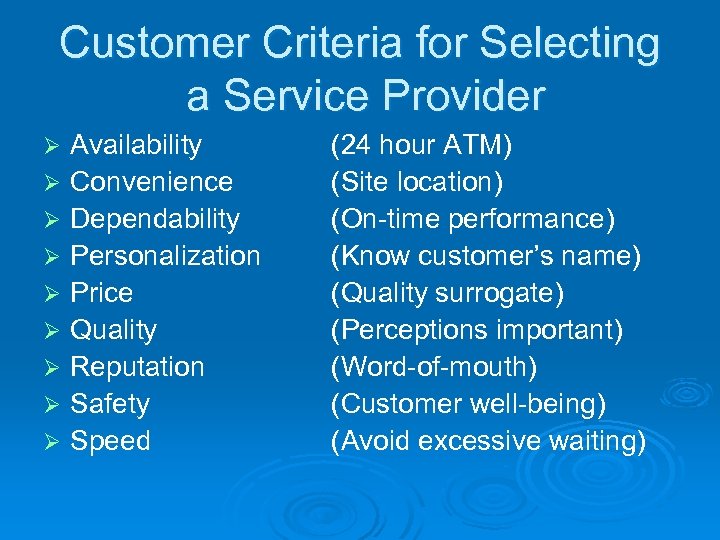 Customer Criteria for Selecting a Service Provider Ø Ø Ø Ø Ø Availability Convenience Dependability Personalization Price Quality Reputation Safety Speed (24 hour ATM) (Site location) (On-time performance) (Know customer’s name) (Quality surrogate) (Perceptions important) (Word-of-mouth) (Customer well-being) (Avoid excessive waiting)
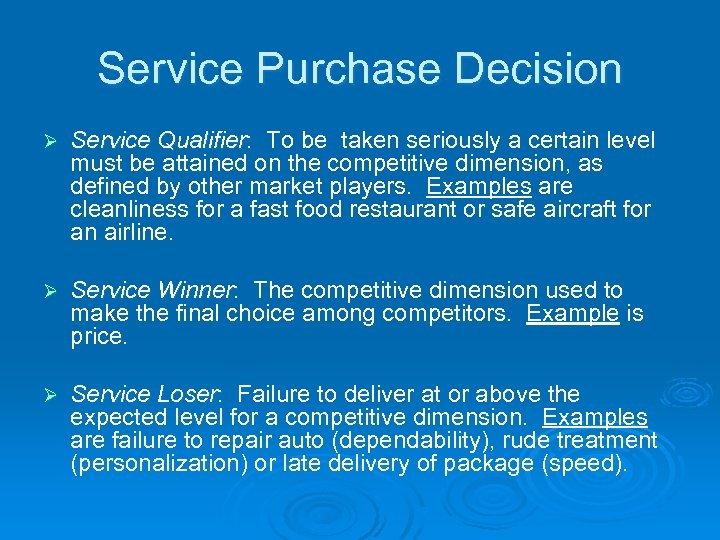 Service Purchase Decision Ø Service Qualifier: To be taken seriously a certain level must be attained on the competitive dimension, as defined by other market players. Examples are cleanliness for a fast food restaurant or safe aircraft for an airline. Ø Service Winner: The competitive dimension used to make the final choice among competitors. Example is price. Ø Service Loser: Failure to deliver at or above the expected level for a competitive dimension. Examples are failure to repair auto (dependability), rude treatment (personalization) or late delivery of package (speed).
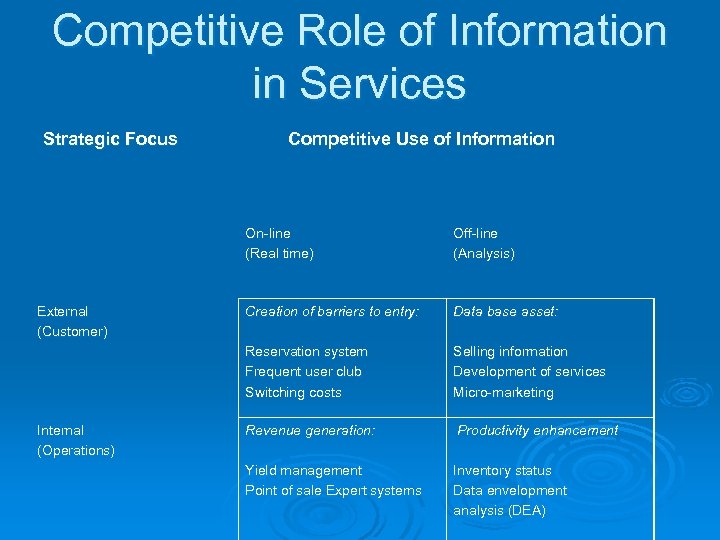 Competitive Role of Information in Services Strategic Focus Competitive Use of Information On-line (Real time) Internal (Operations) Creation of barriers to entry: Data base asset: Reservation system Frequent user club Switching costs External (Customer) Off-line (Analysis) Selling information Development of services Micro-marketing Revenue generation: Productivity enhancement Yield management Point of sale Expert systems Inventory status Data envelopment analysis (DEA)
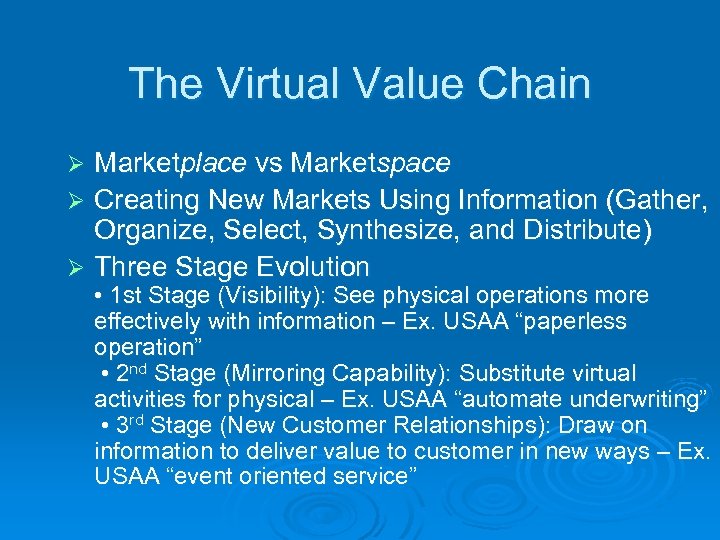 The Virtual Value Chain Marketplace vs Marketspace Ø Creating New Markets Using Information (Gather, Organize, Select, Synthesize, and Distribute) Ø Three Stage Evolution Ø • 1 st Stage (Visibility): See physical operations more effectively with information – Ex. USAA “paperless operation” • 2 nd Stage (Mirroring Capability): Substitute virtual activities for physical – Ex. USAA “automate underwriting” • 3 rd Stage (New Customer Relationships): Draw on information to deliver value to customer in new ways – Ex. USAA “event oriented service”
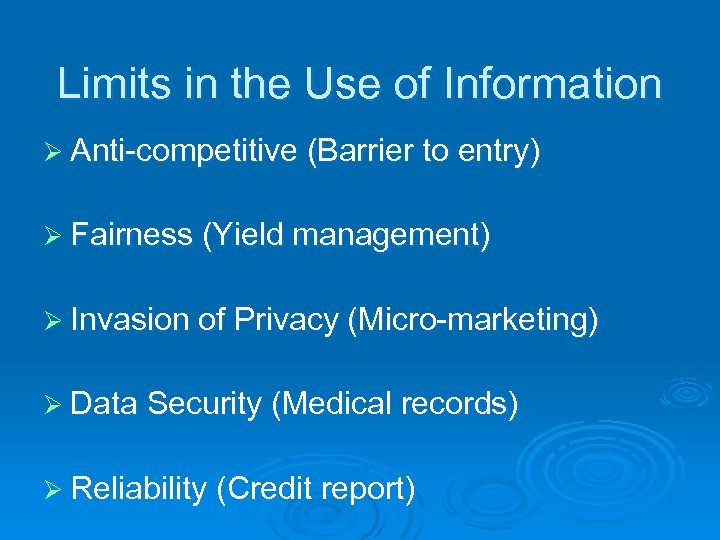 Limits in the Use of Information Ø Anti-competitive (Barrier to entry) Ø Fairness (Yield management) Ø Invasion of Privacy (Micro-marketing) Ø Data Security (Medical records) Ø Reliability (Credit report)
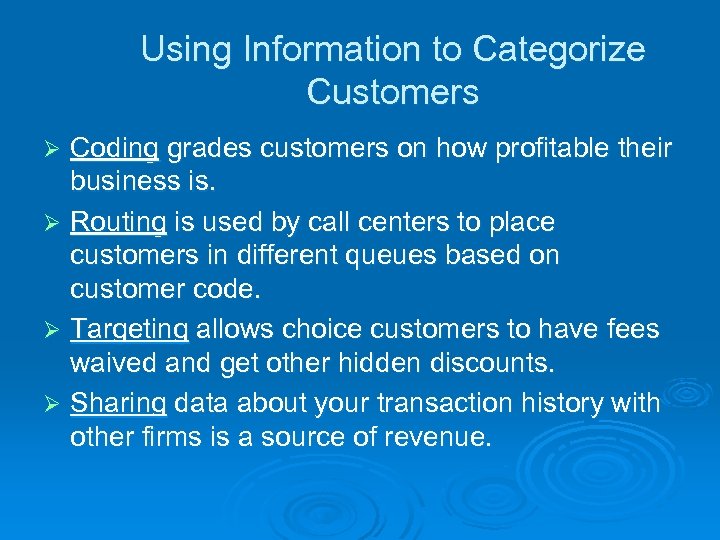 Using Information to Categorize Customers Coding grades customers on how profitable their business is. Ø Routing is used by call centers to place customers in different queues based on customer code. Ø Targeting allows choice customers to have fees waived and get other hidden discounts. Ø Sharing data about your transaction history with other firms is a source of revenue. Ø
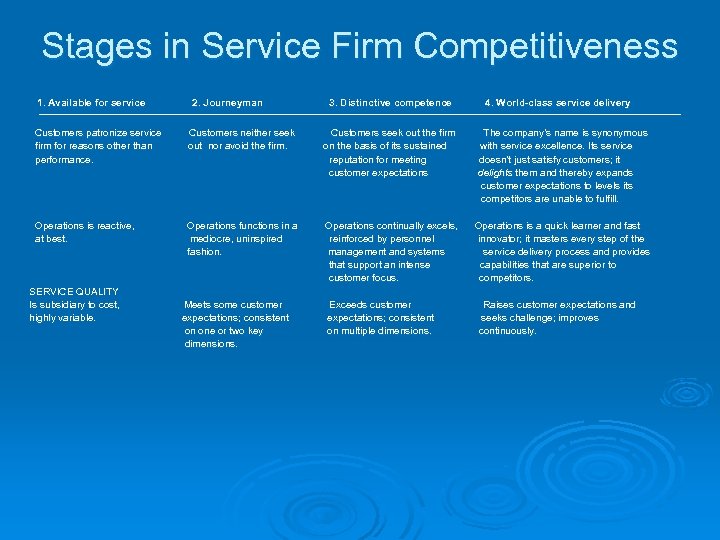 Stages in Service Firm Competitiveness 1. Available for service 2. Journeyman 3. Distinctive competence 4. World-class service delivery Customers patronize service firm for reasons other than performance. Customers neither seek out nor avoid the firm. Customers seek out the firm on the basis of its sustained reputation for meeting customer expectations The company’s name is synonymous with service excellence. Its service doesn’t just satisfy customers; it delights them and thereby expands customer expectations to levels its competitors are unable to fulfill. Operations is reactive, at best. Operations functions in a mediocre, uninspired fashion. Operations continually excels, reinforced by personnel management and systems that support an intense customer focus. Operations is a quick learner and fast innovator; it masters every step of the service delivery process and provides capabilities that are superior to competitors. SERVICE QUALITY Is subsidiary to cost, highly variable. Meets some customer expectations; consistent on one or two key dimensions. Exceeds customer expectations; consistent on multiple dimensions. Raises customer expectations and seeks challenge; improves continuously.
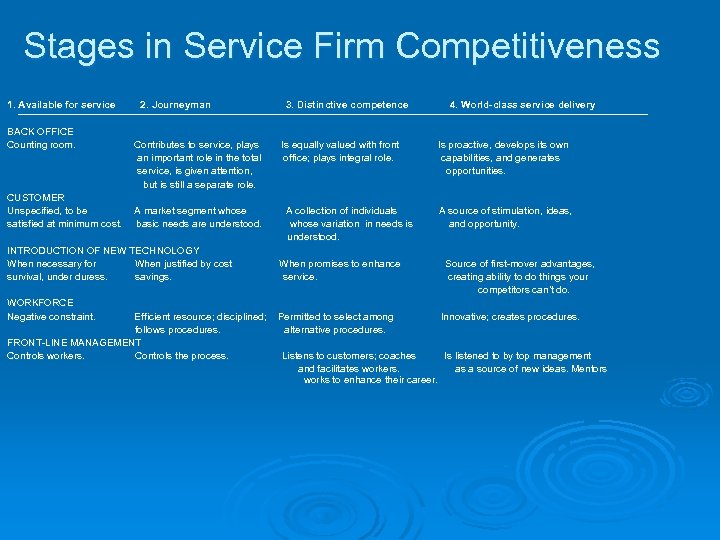 Stages in Service Firm Competitiveness 1. Available for service BACK OFFICE Counting room. CUSTOMER Unspecified, to be satisfied at minimum cost. 2. Journeyman Contributes to service, plays an important role in the total service, is given attention, but is still a separate role. A market segment whose basic needs are understood. INTRODUCTION OF NEW TECHNOLOGY When necessary for When justified by cost survival, under duress. savings. WORKFORCE Negative constraint. Efficient resource; disciplined; follows procedures. FRONT-LINE MANAGEMENT Controls workers. Controls the process. 3. Distinctive competence Is equally valued with front office; plays integral role. A collection of individuals whose variation in needs is understood. When promises to enhance service. Permitted to select among alternative procedures. 4. World-class service delivery Is proactive, develops its own capabilities, and generates opportunities. A source of stimulation, ideas, and opportunity. Source of first-mover advantages, creating ability to do things your competitors can’t do. Innovative; creates procedures. Listens to customers; coaches Is listened to by top management and facilitates workers. as a source of new ideas. Mentors works to enhance their career.
 Mini case: America West Ø Read
 America West Airlines Strategy Target Strategic Advantage Low cost Uniqueness Overall cost leadership Differentiation Entire Market Segment Focus
 America West Winning Customers Ø Service Qualifiers: Ø Service Winners: Ø Service Losers:
 America West Strategic Service Vision Ø Target market segments Ø Service concept Ø Operating strategy Ø Service delivery system
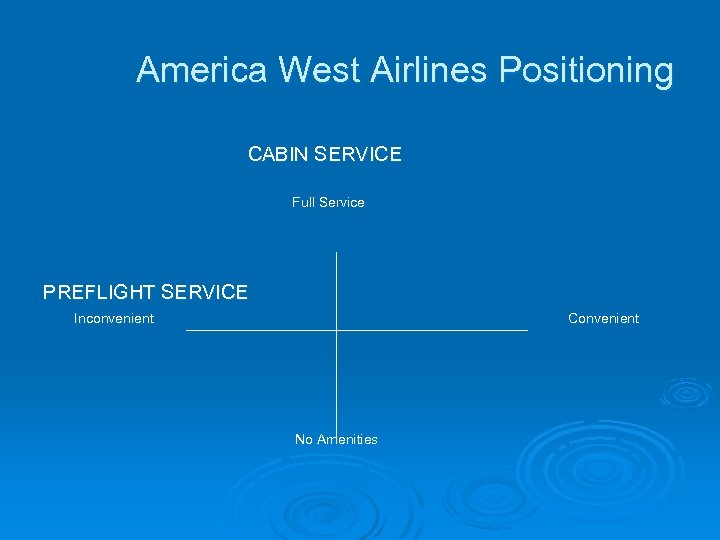 America West Airlines Positioning CABIN SERVICE Full Service PREFLIGHT SERVICE Inconvenient Convenient No Amenities
 Homework 2
 Paul Maglio
 Next week: Ø Alan Karp, HP Labs Ø Technology in Services Ø Project 1 given Ø Homework 1 due