


 Скачать презентацию Islamic Wealth Management Zurich 12 th January 2010
318446ed24baa01676e92d3e3b33a476.ppt
- Количество слайдов: 25
 Islamic Wealth Management Zurich, 12 th January 2010 Michael Gassner, Islamic Financial Engineer Sustainable Swiss Private Banking since 1841.
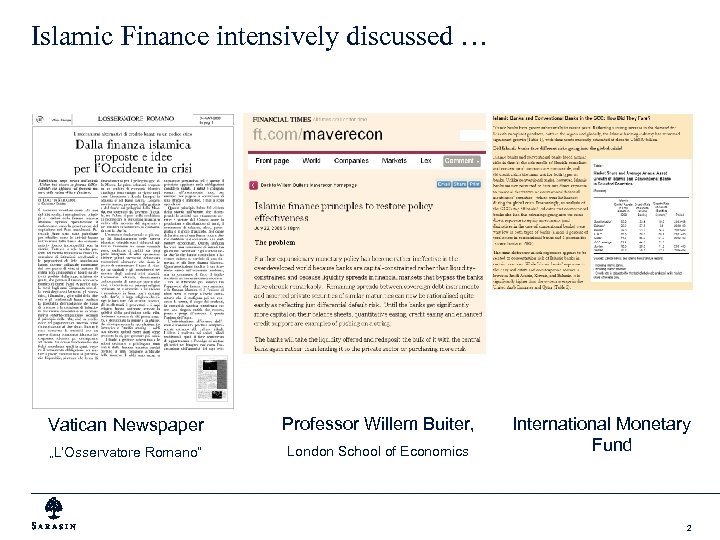 Islamic Finance intensively discussed … Vatican Newspaper Professor Willem Buiter, „L‘Osservatore Romano“ London School of Economics International Monetary Fund 2
 Introduction n Islam is the youngest among the three Abrahamic religions and shares many religious, social and ethical values with Judaism and Christianity. n Islam recognises all the prophets n The Messenger Muhammad is regarded by Muslims as the seal of the prophets. n To understand the implications for the financial sector the basic religious contents should be briefly outlined. 3
 Pillars of Islam 1. Al Shahadah, is the first of five pillars of Islam and the only formal requirement to become Muslim 2. As Salat, a Muslim is obliged to perform five prayers to certain periods of time in a special ritual manner 3. Zakat, an obligatory social tax on Muslims owning wealth. 4. Saum, fasting in the month of Ramadan for those capable of it 5. Hajj, the pilgrimage to Mecca for those who could afford it 4
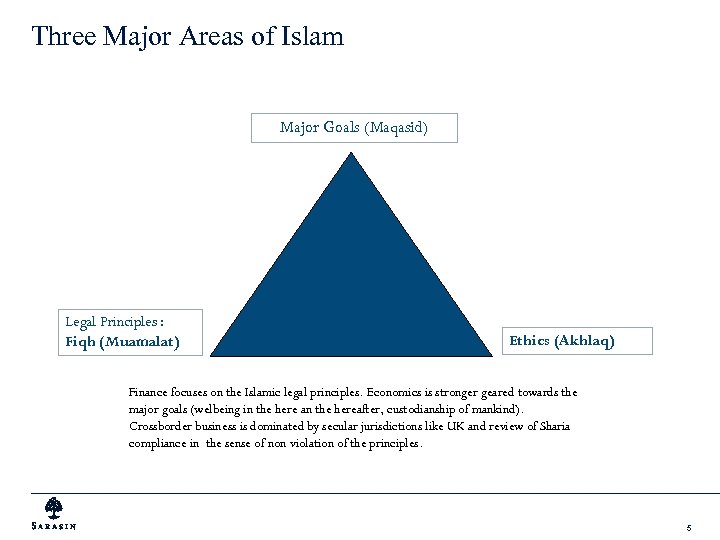 Three Major Areas of Islam Major Goals (Maqasid) Legal Principles : Fiqh (Muamalat) Ethics (Akhlaq) Finance focuses on the Islamic legal principles. Economics is stronger geared towards the major goals (welbeing in the here an the hereafter, custodianship of mankind). Crossborder business is dominated by secular jurisdictions like UK and review of Sharia compliance in the sense of non violation of the principles. 5
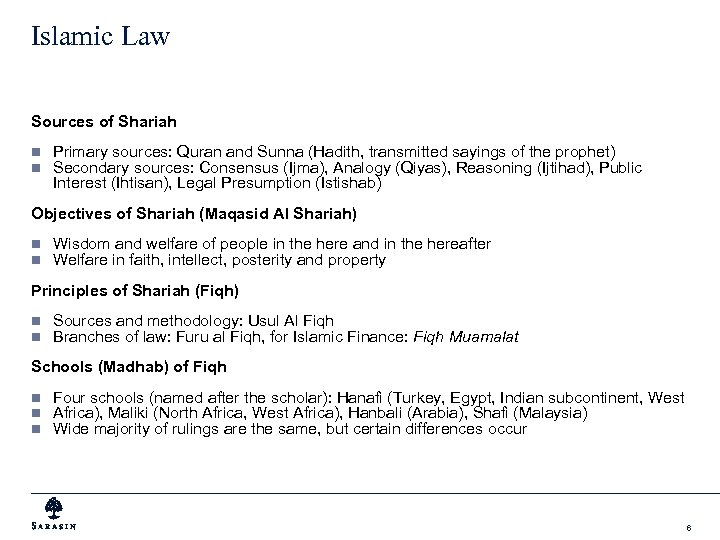 Islamic Law Sources of Shariah n n Primary sources: Quran and Sunna (Hadith, transmitted sayings of the prophet) Secondary sources: Consensus (Ijma), Analogy (Qiyas), Reasoning (Ijtihad), Public Interest (Ihtisan), Legal Presumption (Istishab) Objectives of Shariah (Maqasid Al Shariah) n n Wisdom and welfare of people in the here and in the hereafter Welfare in faith, intellect, posterity and property Principles of Shariah (Fiqh) n n Sources and methodology: Usul Al Fiqh Branches of law: Furu al Fiqh, for Islamic Finance: Fiqh Muamalat Schools (Madhab) of Fiqh n n n Four schools (named after the scholar): Hanafi (Turkey, Egypt, Indian subcontinent, West Africa), Maliki (North Africa, West Africa), Hanbali (Arabia), Shafi (Malaysia) Wide majority of rulings are the same, but certain differences occur 6
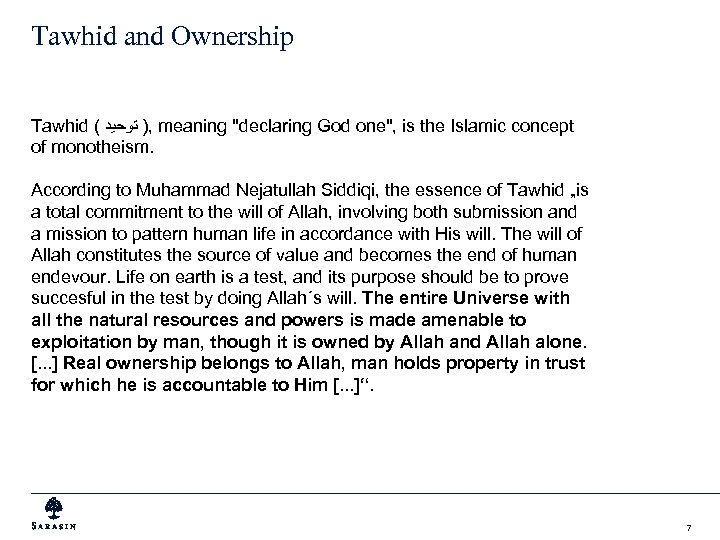 Tawhid and Ownership Tawhid ( , ) ﺗﻮﺣﻴﺪ meaning "declaring God one", is the Islamic concept of monotheism. According to Muhammad Nejatullah Siddiqi, the essence of Tawhid „is a total commitment to the will of Allah, involving both submission and a mission to pattern human life in accordance with His will. The will of Allah constitutes the source of value and becomes the end of human endevour. Life on earth is a test, and its purpose should be to prove succesful in the test by doing Allah´s will. The entire Universe with all the natural resources and powers is made amenable to exploitation by man, though it is owned by Allah and Allah alone. [. . . ] Real ownership belongs to Allah, man holds property in trust for which he is accountable to Him [. . . ]“. 7
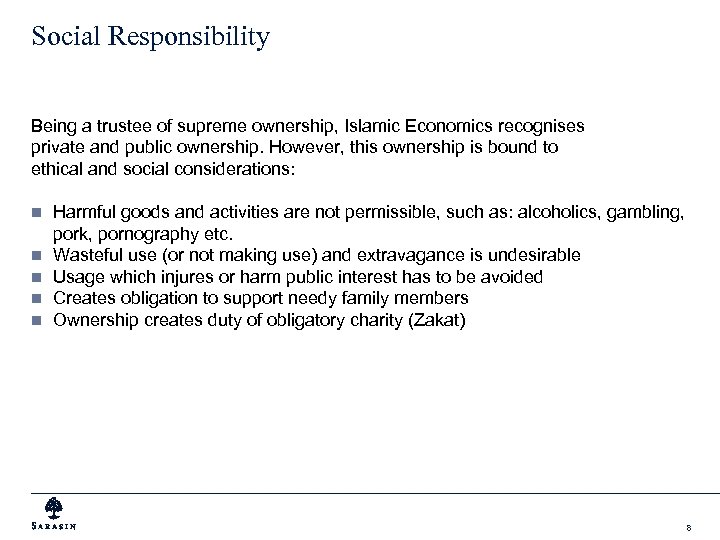 Social Responsibility Being a trustee of supreme ownership, Islamic Economics recognises private and public ownership. However, this ownership is bound to ethical and social considerations: n n n Harmful goods and activities are not permissible, such as: alcoholics, gambling, pork, pornography etc. Wasteful use (or not making use) and extravagance is undesirable Usage which injures or harm public interest has to be avoided Creates obligation to support needy family members Ownership creates duty of obligatory charity (Zakat) 8
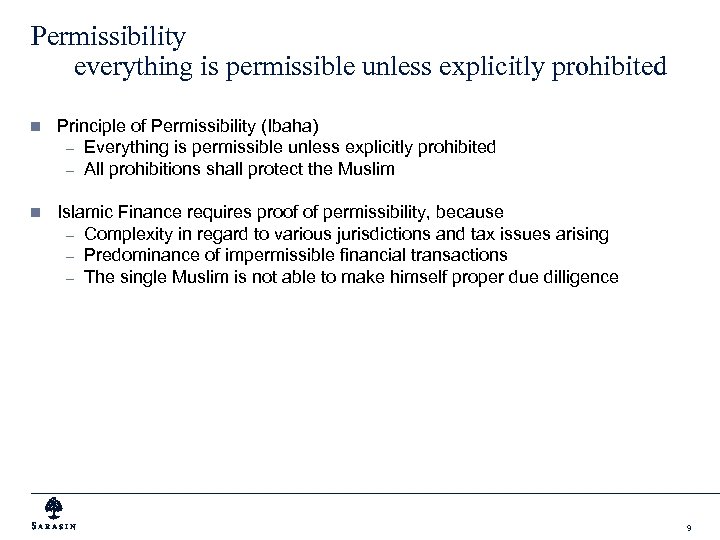 Permissibility everything is permissible unless explicitly prohibited n Principle of Permissibility (Ibaha) – Everything is permissible unless explicitly prohibited – All prohibitions shall protect the Muslim n Islamic Finance requires proof of permissibility, because – Complexity in regard to various jurisdictions and tax issues arising – Predominance of impermissible financial transactions – The single Muslim is not able to make himself proper due dilligence 9
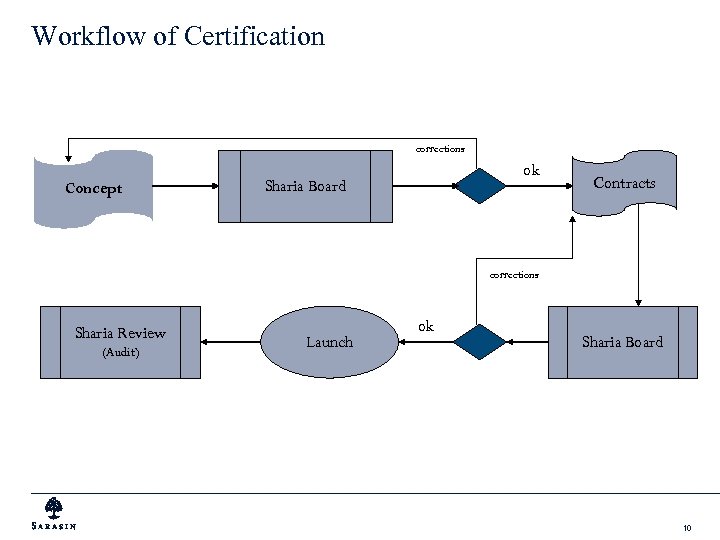 Workflow of Certification corrections Concept ok Sharia Board Contracts corrections Sharia Review (Audit) Launch ok Sharia Board 10
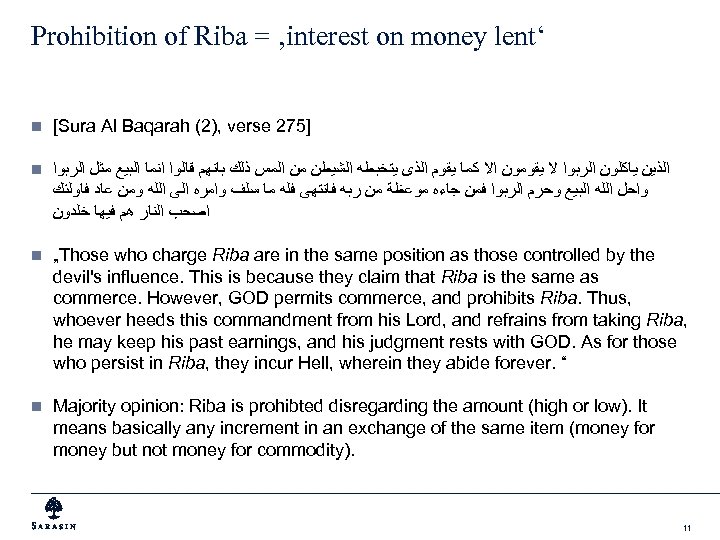 Prohibition of Riba = ‚interest on money lent‘ n [Sura Al Baqarah (2), verse 275] n ﺍﻟﺬﻳﻦ ﻳﺎﻛﻠﻮﻥ ﺍﻟﺮﺑﻮﺍ ﻻ ﻳﻘﻮﻣﻮﻥ ﺍﻻ ﻛﻤﺎ ﻳﻘﻮﻡ ﺍﻟﺬﻯ ﻳﺘﺨﺒﻄﻪ ﺍﻟﺸﻴﻄﻦ ﻣﻦ ﺍﻟﻤﺲ ﺫﻟﻚ ﺑﺎﻧﻬﻢ ﻗﺎﻟﻮﺍ ﺍﻧﻤﺎ ﺍﻟﺒﻴﻊ ﻣﺜﻞ ﺍﻟﺮﺑﻮﺍ ﻭﺍﺣﻞ ﺍﻟﻠﻪ ﺍﻟﺒﻴﻊ ﻭﺣﺮﻡ ﺍﻟﺮﺑﻮﺍ ﻓﻤﻦ ﺟﺎﺀﻩ ﻣﻮﻋﻈﺔ ﻣﻦ ﺭﺑﻪ ﻓﺎﻧﺘﻬﻰ ﻓﻠﻪ ﻣﺎ ﺳﻠﻒ ﻭﺍﻣﺮﻩ ﺍﻟﻰ ﺍﻟﻠﻪ ﻭﻣﻦ ﻋﺎﺩ ﻓﺎﻭﻟﺌﻚ ﺍﺻﺤﺐ ﺍﻟﻨﺎﺭ ﻫﻢ ﻓﻴﻬﺎ ﺧﻠﺪﻭﻥ n „Those who charge Riba are in the same position as those controlled by the devil's influence. This is because they claim that Riba is the same as commerce. However, GOD permits commerce, and prohibits Riba. Thus, whoever heeds this commandment from his Lord, and refrains from taking Riba, he may keep his past earnings, and his judgment rests with GOD. As for those who persist in Riba, they incur Hell, wherein they abide forever. “ n Majority opinion: Riba is prohibted disregarding the amount (high or low). It means basically any increment in an exchange of the same item (money for money but not money for commodity). 11
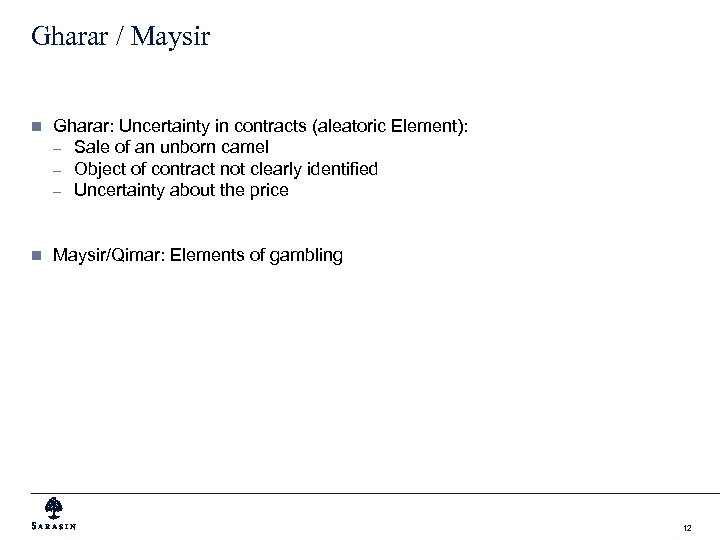 Gharar / Maysir n Gharar: Uncertainty in contracts (aleatoric Element): – Sale of an unborn camel – Object of contract not clearly identified – Uncertainty about the price n Maysir/Qimar: Elements of gambling 12
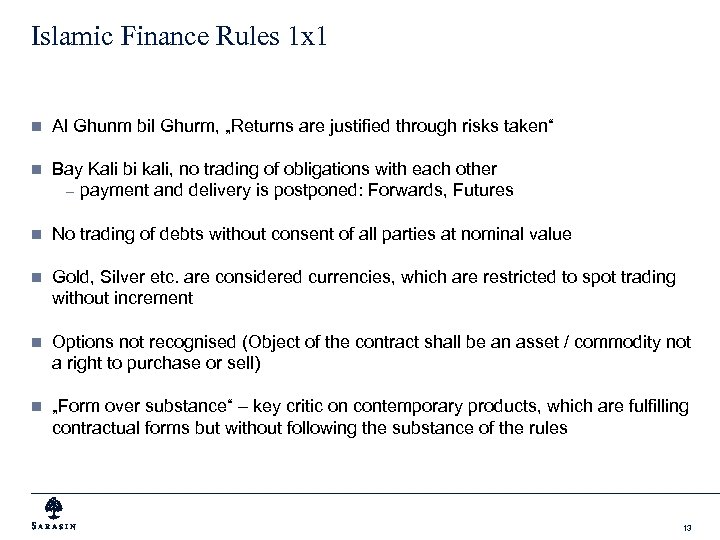 Islamic Finance Rules 1 x 1 n Al Ghunm bil Ghurm, „Returns are justified through risks taken“ n Bay Kali bi kali, no trading of obligations with each other – payment and delivery is postponed: Forwards, Futures n No trading of debts without consent of all parties at nominal value n Gold, Silver etc. are considered currencies, which are restricted to spot trading without increment n Options not recognised (Object of the contract shall be an asset / commodity not a right to purchase or sell) n „Form over substance“ – key critic on contemporary products, which are fulfilling contractual forms but without following the substance of the rules 13
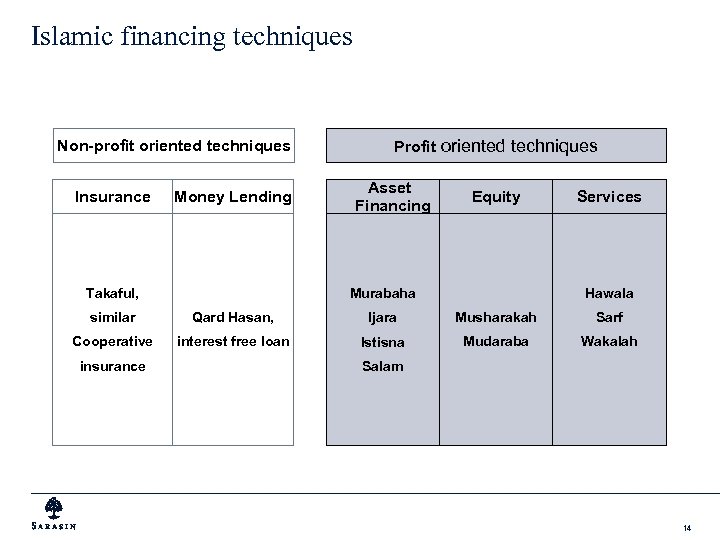 Islamic financing techniques Non-profit oriented techniques Insurance Money Lending Takaful, Profit oriented techniques Asset Financing Equity Services Hawala Murabaha similar Qard Hasan, Ijara Musharakah Sarf Cooperative interest free loan Istisna Mudaraba Wakalah insurance Salam 14
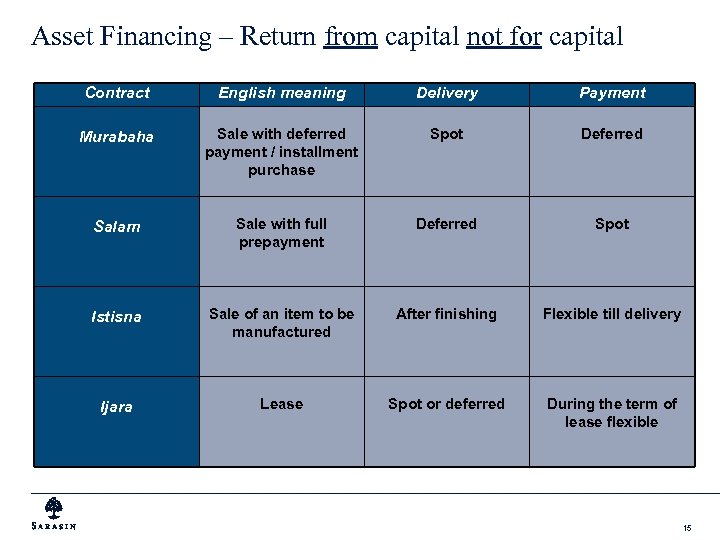 Asset Financing – Return from capital not for capital Contract English meaning Delivery Payment Murabaha Sale with deferred payment / installment purchase Spot Deferred Salam Sale with full prepayment Deferred Spot Istisna Sale of an item to be manufactured After finishing Flexible till delivery Ijara Lease Spot or deferred During the term of lease flexible 15
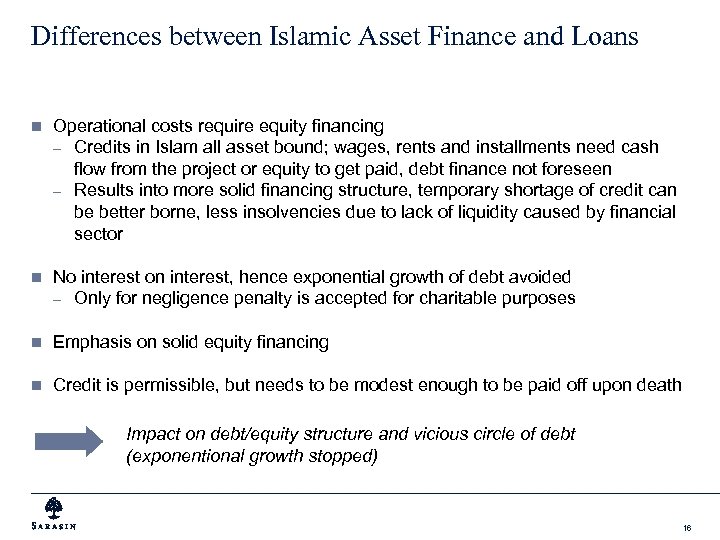 Differences between Islamic Asset Finance and Loans n Operational costs require equity financing – Credits in Islam all asset bound; wages, rents and installments need cash flow from the project or equity to get paid, debt finance not foreseen – Results into more solid financing structure, temporary shortage of credit can be better borne, less insolvencies due to lack of liquidity caused by financial sector n No interest on interest, hence exponential growth of debt avoided – Only for negligence penalty is accepted for charitable purposes n Emphasis on solid equity financing n Credit is permissible, but needs to be modest enough to be paid off upon death Impact on debt/equity structure and vicious circle of debt (exponentional growth stopped) 16
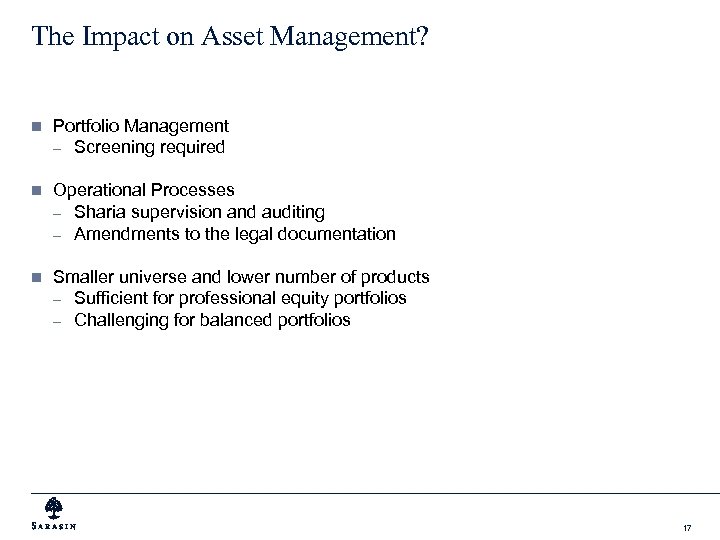 The Impact on Asset Management? n Portfolio Management – Screening required n Operational Processes – Sharia supervision and auditing – Amendments to the legal documentation n Smaller universe and lower number of products – Sufficient for professional equity portfolios – Challenging for balanced portfolios 17
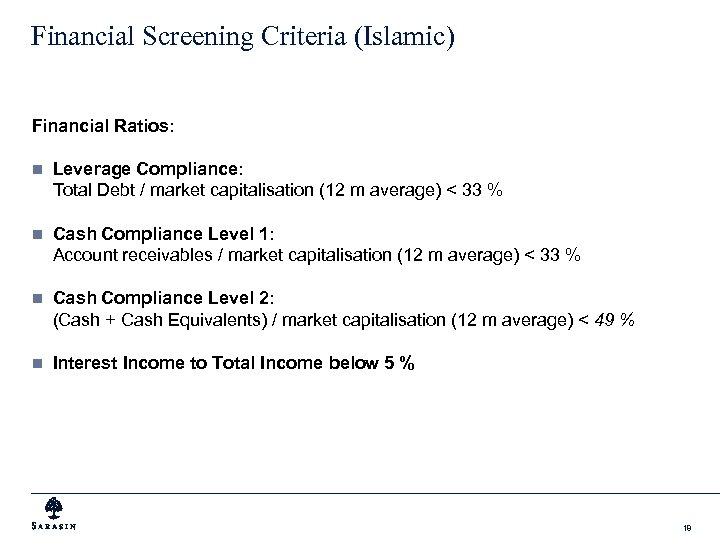 Financial Screening Criteria (Islamic) Financial Ratios: n Leverage Compliance: Total Debt / market capitalisation (12 m average) < 33 % n Cash Compliance Level 1: Account receivables / market capitalisation (12 m average) < 33 % n Cash Compliance Level 2: (Cash + Cash Equivalents) / market capitalisation (12 m average) < 49 % n Interest Income to Total Income below 5 % 18
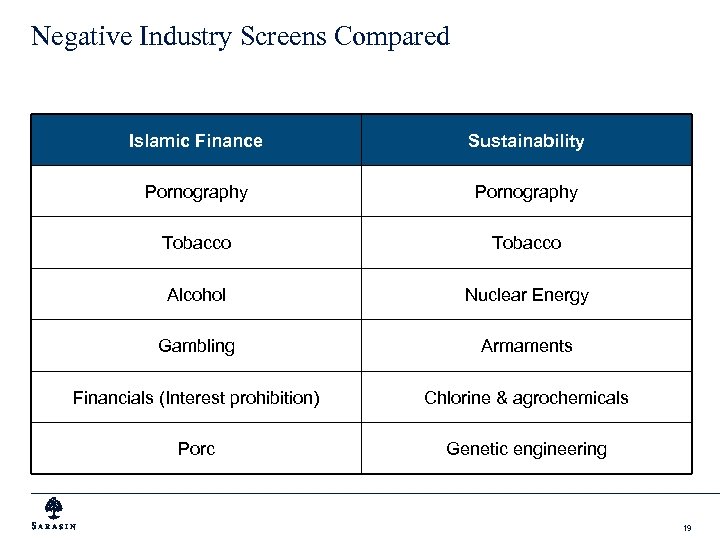 Negative Industry Screens Compared Islamic Finance Sustainability Pornography Tobacco Alcohol Nuclear Energy Gambling Armaments Financials (Interest prohibition) Chlorine & agrochemicals Porc Genetic engineering 19
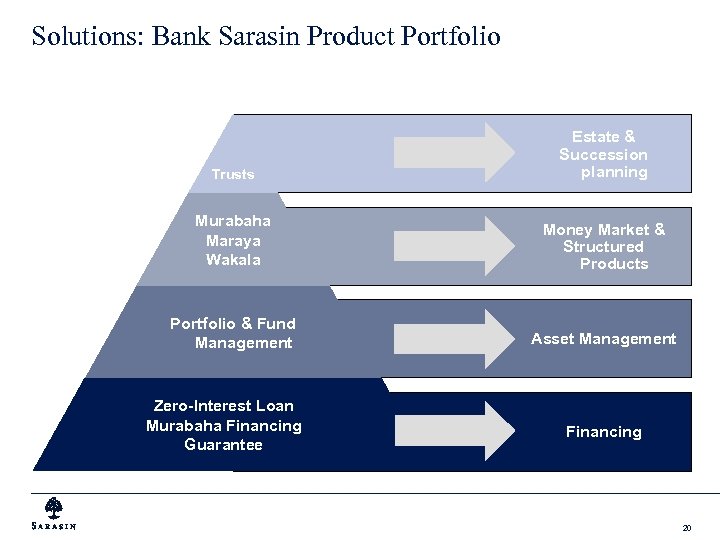 Solutions: Bank Sarasin Product Portfolio Trusts Estate & Succession planning Murabaha Maraya Wakala Money Market & Structured Products Portfolio & Fund Management Asset Management Zero-Interest Loan Murabaha Financing Guarantee Financing 20
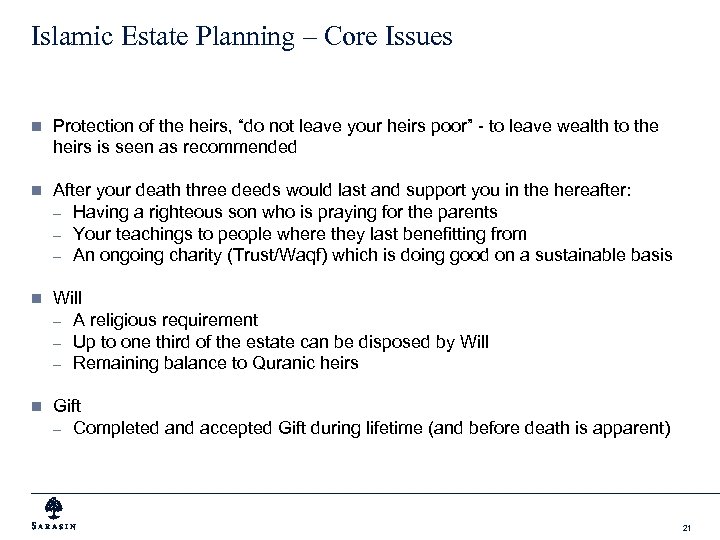 Islamic Estate Planning – Core Issues n Protection of the heirs, “do not leave your heirs poor” - to leave wealth to the heirs is seen as recommended n After your death three deeds would last and support you in the hereafter: – Having a righteous son who is praying for the parents – Your teachings to people where they last benefitting from – An ongoing charity (Trust/Waqf) which is doing good on a sustainable basis n Will – A religious requirement – Up to one third of the estate can be disposed by Will – Remaining balance to Quranic heirs n Gift – Completed and accepted Gift during lifetime (and before death is apparent) 21
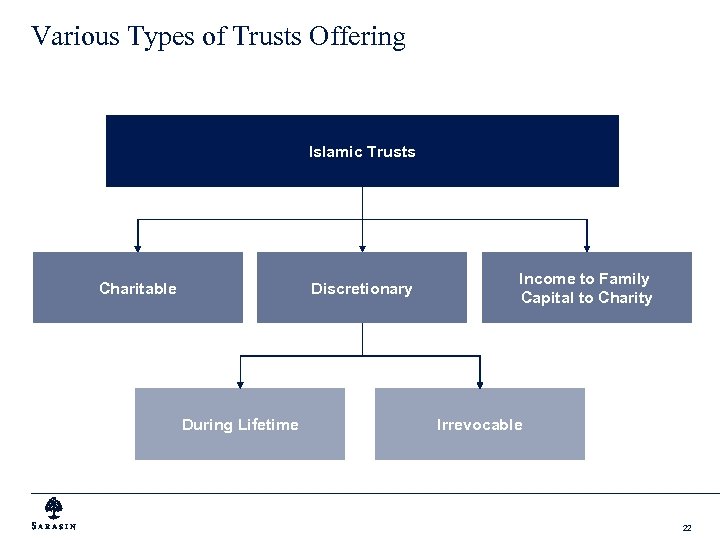 Various Types of Trusts Offering Islamic Trusts Charitable Discretionary During Lifetime Income to Family Capital to Charity Irrevocable 22
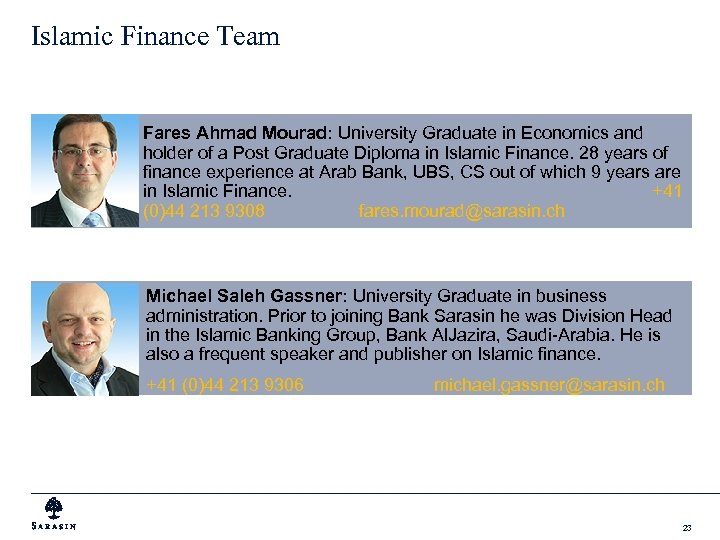 Islamic Finance Team Fares Ahmad Mourad: University Graduate in Economics and holder of a Post Graduate Diploma in Islamic Finance. 28 years of finance experience at Arab Bank, UBS, CS out of which 9 years are in Islamic Finance. +41 (0)44 213 9308 fares. mourad@sarasin. ch Michael Saleh Gassner: University Graduate in business administration. Prior to joining Bank Sarasin he was Division Head in the Islamic Banking Group, Bank Al. Jazira, Saudi-Arabia. He is also a frequent speaker and publisher on Islamic finance. +41 (0)44 213 9306 michael. gassner@sarasin. ch 23
 Important Information This publication has been prepared by Bank Sarasin & Co. Ltd, Switzerland, (hereafter “BSC”) for information purposes only. It contains selected information and does not purport to be complete. This document is based on publicly available information and data (“the Information”) believed to be correct, accurate and complete. BSC has not verified and is unable to guarantee the accuracy and completeness of the Information contained herein. Possible errors or incompleteness of the Information do not constitute legal grounds (contractual or tacit) for liability, either with regard to direct, indirect or consequential damages. In particular, neither BSC nor its shareholders and employees shall be liable for the opinions, estimations and strategies contained in this document. The opinions expressed in this document, along with the quoted figures, data and forecasts, are subject to change without notice. A positive historical performance or simulation does not constitute any guarantee for a positive performance in the future. Discrepancies may emerge in respect of our own financial research or other publications of the Sarasin Group relating to the same financial instruments or issuers. It is impossible to rule out the possibility that a business connection may exist between a company which is the subject of research and a company within the Sarasin Group, from which a potential conflict of interest could result. This document does not constitute either a request or offer, solicitation or recommendation to buy or sell investments or other specific financial instruments, products or services. It should not be considered as a substitute for individual advice and risk disclosure by a qualified financial, legal or tax advisor. This document is intended for persons working in countries where the Sarasin Group has a business presence. BSC does not accept any liability whatsoever for losses arising from the use of the Information (or parts thereof) contained in this document. © 2009 Copyright Bank Sarasin & Co. Ltd. All rights reserved. . 24
 For further information please contact us Sustainable Swiss Private Banking since 1841.