 Скачать презентацию Islamic Republic of IRAN Workshop in Tehran
e3444a276daa111e4c433f8dca5b031e.ppt
- Количество слайдов: 41



Islamic Republic of IRAN Workshop in Tehran – March 2015 U. N. e-Government Survey Findings and Methodology Jonas Rabinovitch, Senior e-Government Advisor E-Government Branch – DPADM Department of Economic and Social Affairs United Nations
Contents 1. UNDESA’s Work on E- government 2. Overview of the 2014 UN E-government Survey 3. Key Findings 4. E-government Development Index 5. 2014 Global and Regional E-Gov. Trends http: //www. UNPAN. org/DPADM/ 2
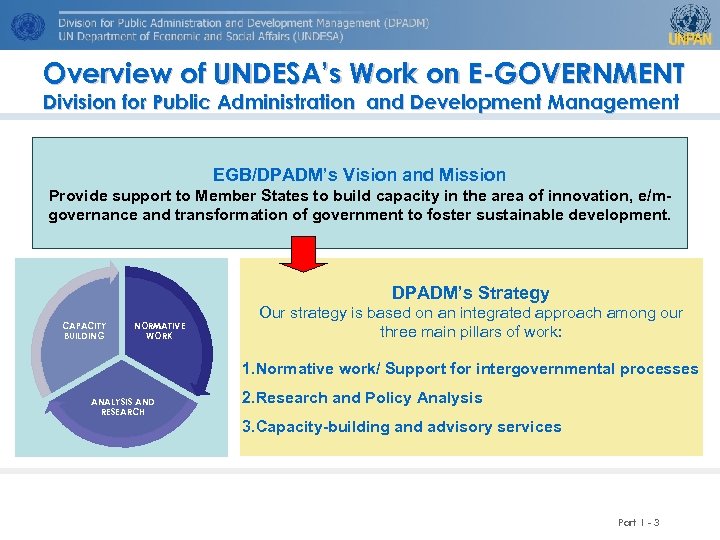
Overview of UNDESA’s Work on E-GOVERNMENT Division for Public Administration and Development Management EGB/DPADM’s Vision and Mission Provide support to Member States to build capacity in the area of innovation, e/mgovernance and transformation of government to foster sustainable development. DPADM’s Strategy CAPACITY BUILDING NORMATIVE WORK Our strategy is based on an integrated approach among our three main pillars of work: 1. Normative work/ Support for intergovernmental processes ANALYSIS AND RESEARCH 2. Research and Policy Analysis 3. Capacity-building and advisory services Part 1 - 3
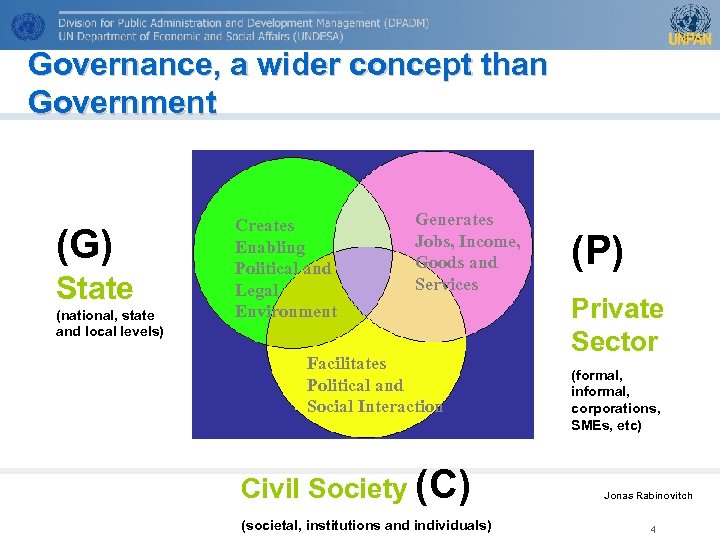
Governance, a wider concept than Government (G) State (national, state and local levels) Creates Enabling Political and Legal Environment Generates Jobs, Income, Goods and Services Facilitates Political and Social Interaction Civil Society (C) (societal, institutions and individuals) (P) Private Sector (formal, informal, corporations, SMEs, etc) Jonas Rabinovitch 4
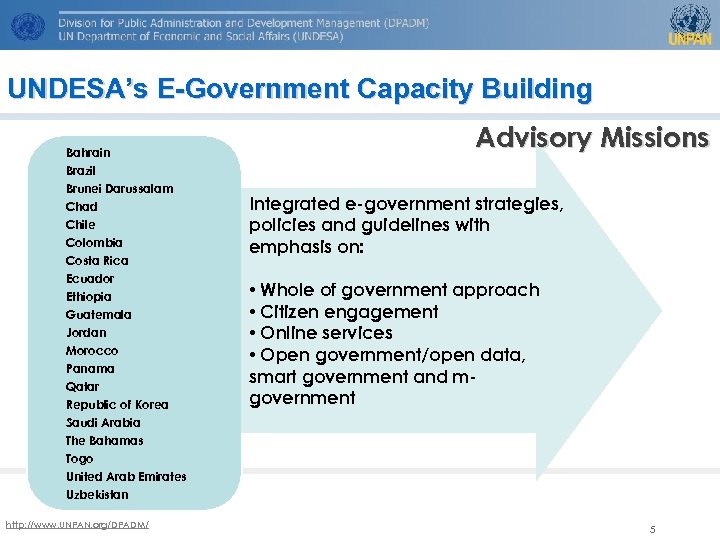
UNDESA’s E-Government Capacity Building Bahrain Brazil Brunei Darussalam Chad Chile Colombia Costa Rica Ecuador Ethiopia Guatemala Jordan Morocco Panama Qatar Republic of Korea Advisory Missions Integrated e-government strategies, policies and guidelines with emphasis on: • Whole of government approach • Citizen engagement • Online services • Open government/open data, smart government and mgovernment Saudi Arabia The Bahamas Togo United Arab Emirates Uzbekistan http: //www. UNPAN. org/DPADM/ 5
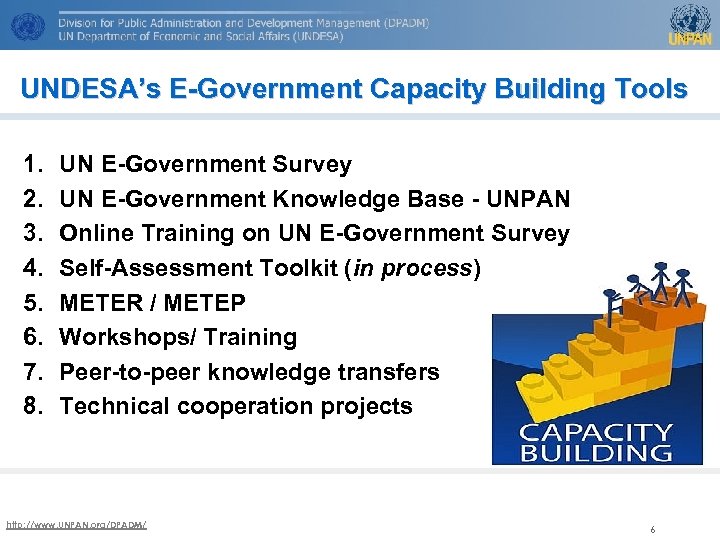
UNDESA’s E-Government Capacity Building Tools 1. 2. 3. 4. 5. 6. 7. 8. UN E-Government Survey UN E-Government Knowledge Base - UNPAN Online Training on UN E-Government Survey Self-Assessment Toolkit (in process) METER / METEP Workshops/ Training Peer-to-peer knowledge transfers Technical cooperation projects http: //www. UNPAN. org/DPADM/ 6
Self-Assessment E-Government Tool-Kit From “What” to “How” § A tool for decision-makers to identify: o Areas of strength and challenges; o Steps needed to enhance their e. Government services; o Develop and implement e. Government strategies to promote sustainable development. § Practice oriented, hands-on and comprehensible tool; § Member States will perform a self-assessment based on UN framework and methodology; § Help UNDESA collect, analyze data and prepare reports. http: //www. UNPAN. org/DPADM/ 7
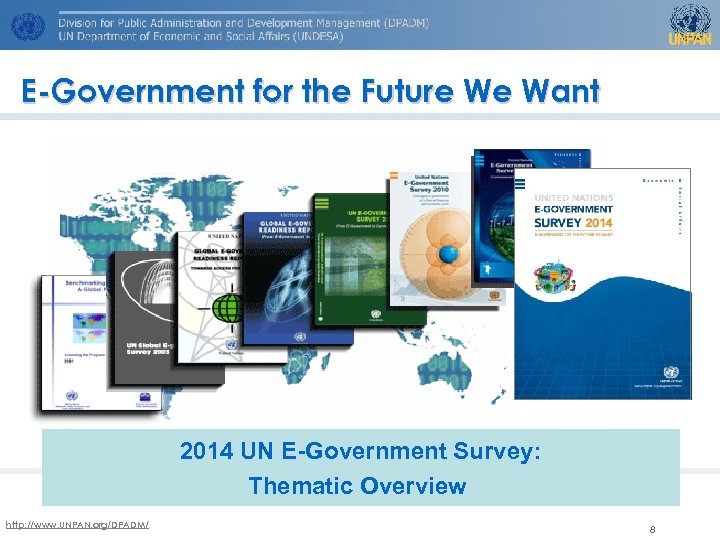
E-Government for the Future We Want 2014 UN E-Government Survey: Thematic Overview http: //www. UNPAN. org/DPADM/ 8
UN E-Government Survey The E-Gov Survey presents a systematic assessment of the use of ICT to transform and reform the public sector by enhancing efficiency, effectiveness, transparency, accountability, access to public services and citizen participation in 193 Countries. Ø UN E-Gov Survey adopted by Member States and Economists as a useful tool to benchmark e-Government Development Ø UN Survey as a tool to guide policies and strategies on how Member States can overall improve public service delivery and bridge the digital divide. http: //www. UNPAN. org/DPADM/ http: //www. unpan. org/dpadm/ 9
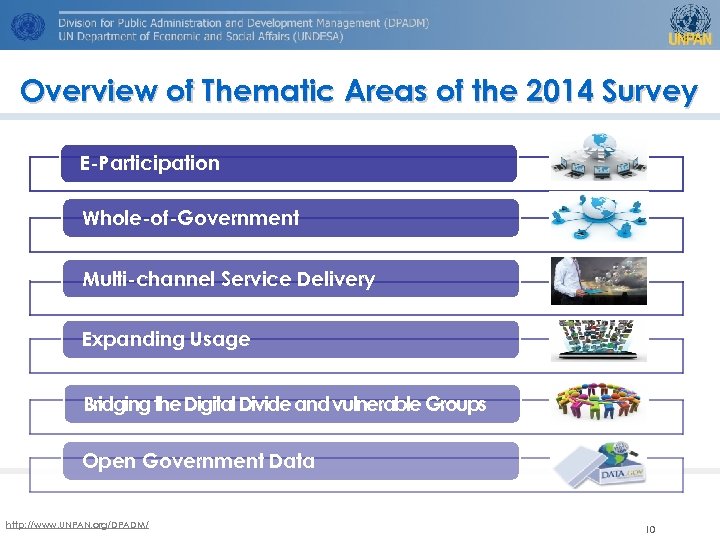
Overview of Thematic Areas of the 2014 Survey E-Participation Whole-of-Government Multi-channel Service Delivery Expanding Usage Bridging the Digital Divide and vulnerable Groups Open Government Data http: //www. UNPAN. org/DPADM/ 10
Key Findings • Governments across the globe are undertaking a process of transformative change. E-Government is becoming a holistic process to transform government towards sustainable development. • The transformative changes entail not only the design and implementation of innovative practices, but more fundamentally a transformation of government’s role, functions, institutional frameworks and processes. • E-Government development can contribute towards the post-2015 development agenda: strengthening national capabilities, regional and national networks. http: //www. UNPAN. org/DPADM/ 11
Key Findings • In 2014, for the first time, all 193 UN Member States had national websites. • At the regional level, Europe continued to lead followed by the Americas, Asia, Oceania and Africa. • Effective regional cooperation will help support change programs and advance e-government development. (Examples: European Union, African Union’s Programme for Infrastructure Development. . ) http: //www. UNPAN. org/DPADM/ 12
Key Findings • e-Consultation: 49% of countries provide a facility for feedback regarding the improvement of their online services. • e-Decision Making: 75 Member States place their eparticipation policy online. • Almost 43% of United Nations Member States today provide information about their CIO for e-government. • 73 Countries offered a “One-Stop-Shop” portal in 2014. http: //www. UNPAN. org/DPADM/ 13
Overview of Thematic Areas of the 2014 Survey • Between 2012 and 2014, the number of countries offering mobile apps and mobile portals doubled to nearly 50 countries. • In 2014, 40% of national portals allow for flexible font size. • Digital Gap: an estimated 1. 1 billion households worldwide are still not yet connected to the Internet. http: //www. UNPAN. org/DPADM/ 14
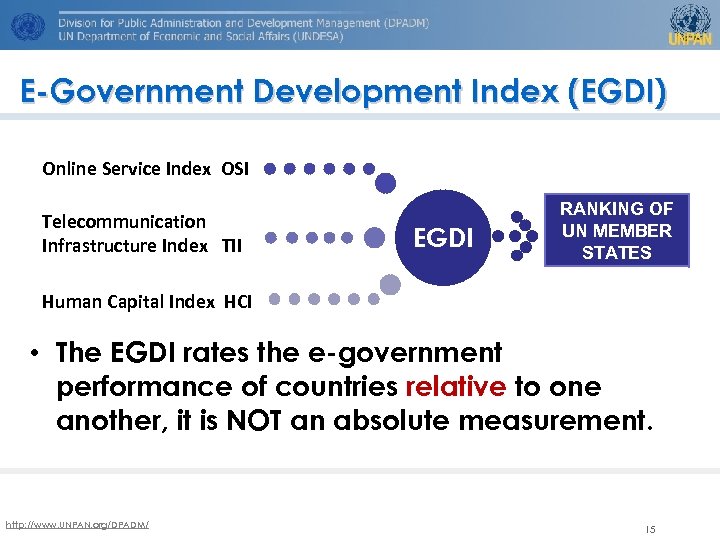
E-Government Development Index (EGDI) Online Service Index OSI Telecommunication Infrastructure Index TII EGDI RANKING OF UN MEMBER STATES Human Capital Index HCI • The EGDI rates the e-government performance of countries relative to one another, it is NOT an absolute measurement. http: //www. UNPAN. org/DPADM/ 15
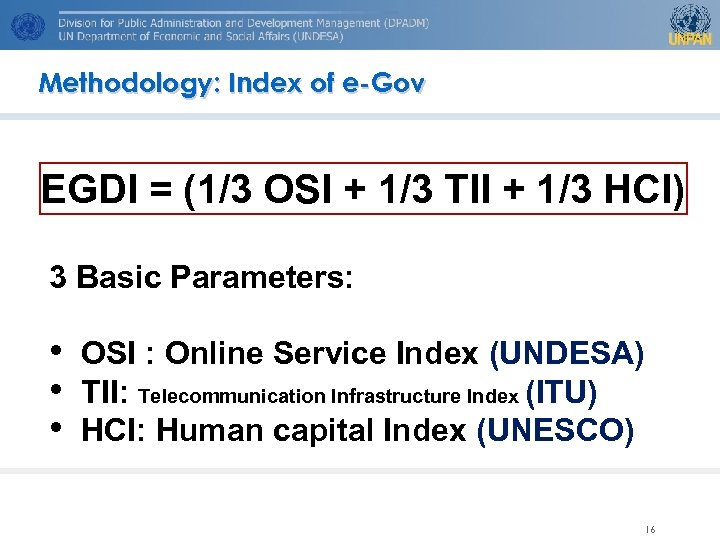
Methodology: Index of e-Gov EGDI = (1/3 OSI + 1/3 TII + 1/3 HCI) 3 Basic Parameters: • OSI : Online Service Index (UNDESA) • TII: Telecommunication Infrastructure Index (ITU) • HCI: Human capital Index (UNESCO) 16
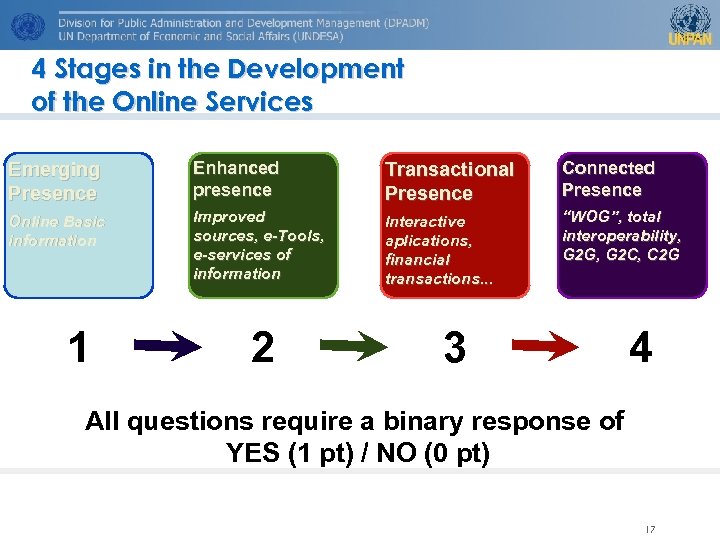
4 Stages in the Development of the Online Services Emerging Presence Enhanced presence Transactional Presence Connected Presence Online Basic information Improved sources, e-Tools, e-services of information Interactive aplications, financial transactions. . . “WOG”, total interoperability, G 2 G, G 2 C, C 2 G 1 2 3 4 All questions require a binary response of YES (1 pt) / NO (0 pt) 17
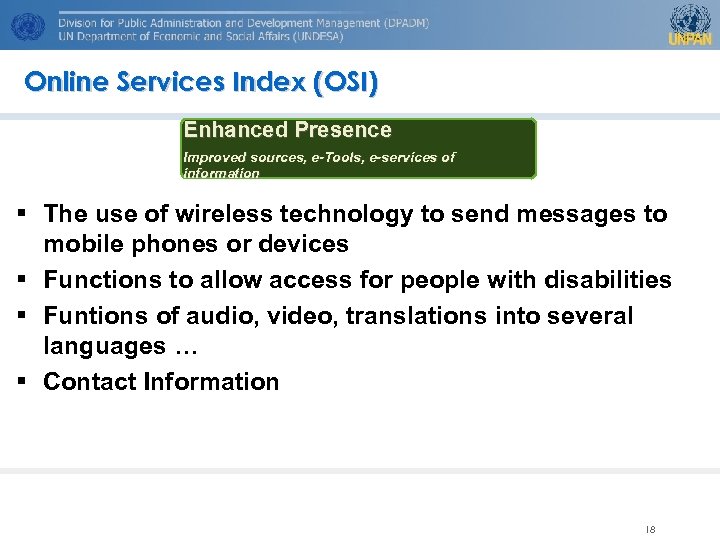
Online Services Index (OSI) Enhanced Presence Improved sources, e-Tools, e-services of information § The use of wireless technology to send messages to mobile phones or devices § Functions to allow access for people with disabilities § Funtions of audio, video, translations into several languages … § Contact Information 18
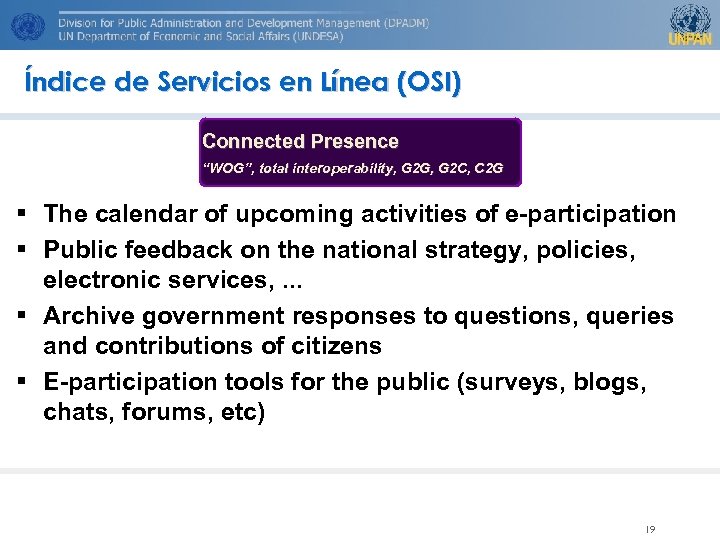
Índice de Servicios en Línea (OSI) Connected Presence “WOG”, total interoperability, G 2 G, G 2 C, C 2 G § The calendar of upcoming activities of e-participation § Public feedback on the national strategy, policies, electronic services, . . . § Archive government responses to questions, queries and contributions of citizens § E-participation tools for the public (surveys, blogs, chats, forums, etc) 19
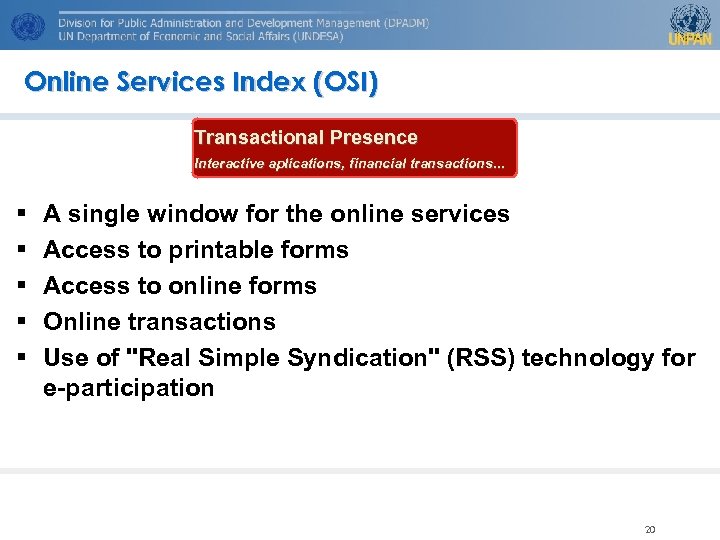
Online Services Index (OSI) Transactional Presence Interactive aplications, financial transactions. . . § § § A single window for the online services Access to printable forms Access to online forms Online transactions Use of "Real Simple Syndication" (RSS) technology for e-participation 20
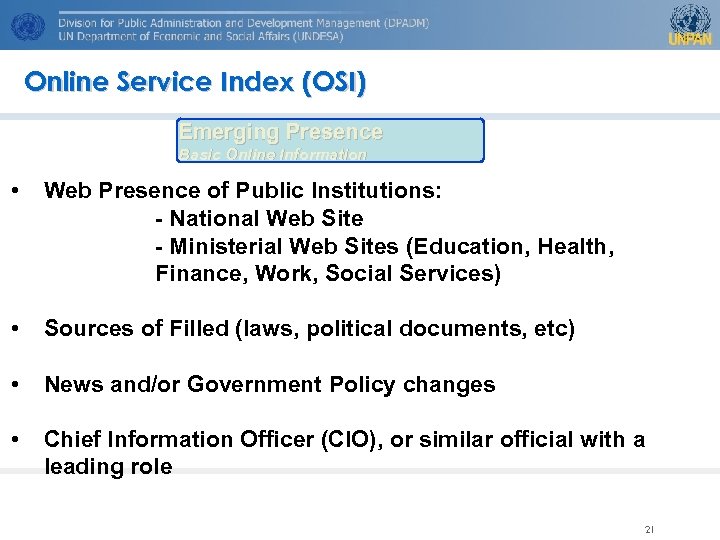
Online Service Index (OSI) Emerging Presence Basic Online Information • Web Presence of Public Institutions: - National Web Site - Ministerial Web Sites (Education, Health, Finance, Work, Social Services) • Sources of Filled (laws, political documents, etc) • News and/or Government Policy changes • Chief Information Officer (CIO), or similar official with a leading role 21
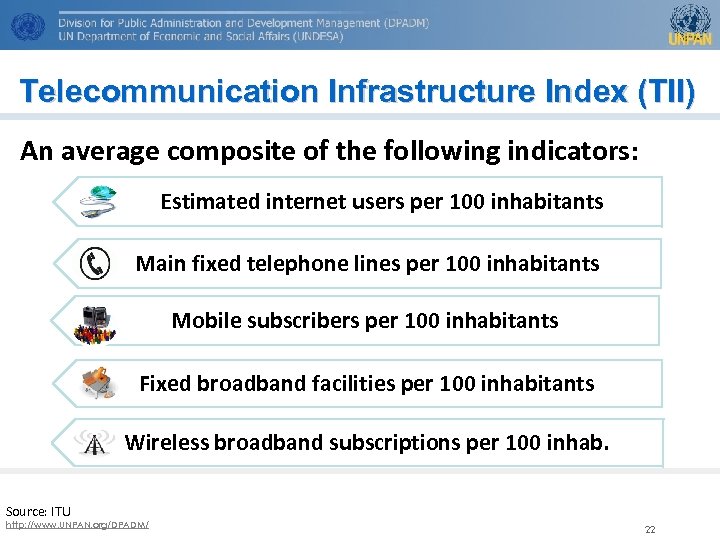
Telecommunication Infrastructure Index (TII) An average composite of the following indicators: Estimated internet users per 100 inhabitants Main fixed telephone lines per 100 inhabitants Mobile subscribers per 100 inhabitants Fixed broadband facilities per 100 inhabitants Wireless broadband subscriptions per 100 inhab. Source: ITU http: //www. UNPAN. org/DPADM/ 22
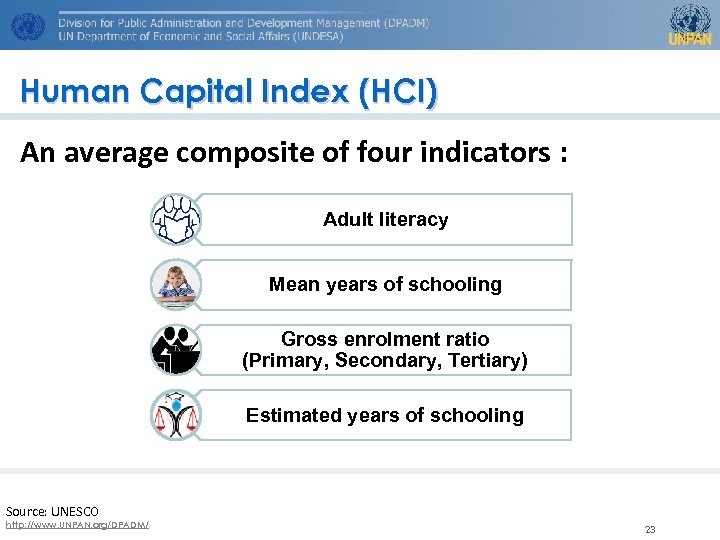
Human Capital Index (HCI) An average composite of four indicators : Adult literacy Mean years of schooling Gross enrolment ratio (Primary, Secondary, Tertiary) Estimated years of schooling Source: UNESCO http: //www. UNPAN. org/DPADM/ 23
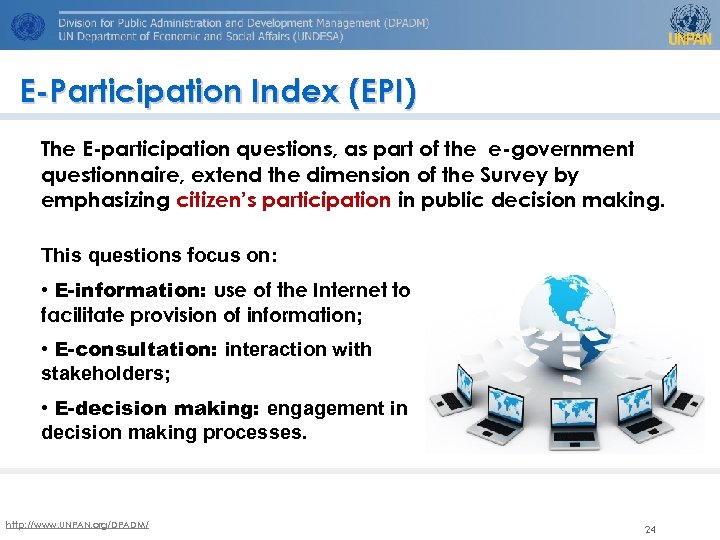
E-Participation Index (EPI) The E-participation questions, as part of the e-government questionnaire, extend the dimension of the Survey by emphasizing citizen’s participation in public decision making. This questions focus on: • E-information: use of the Internet to facilitate provision of information; • E-consultation: interaction with stakeholders; • E-decision making: engagement in decision making processes. http: //www. UNPAN. org/DPADM/ 24
E-Government Development at a Glance Global Trends http: //www. UNPAN. org/DPADM/ 25
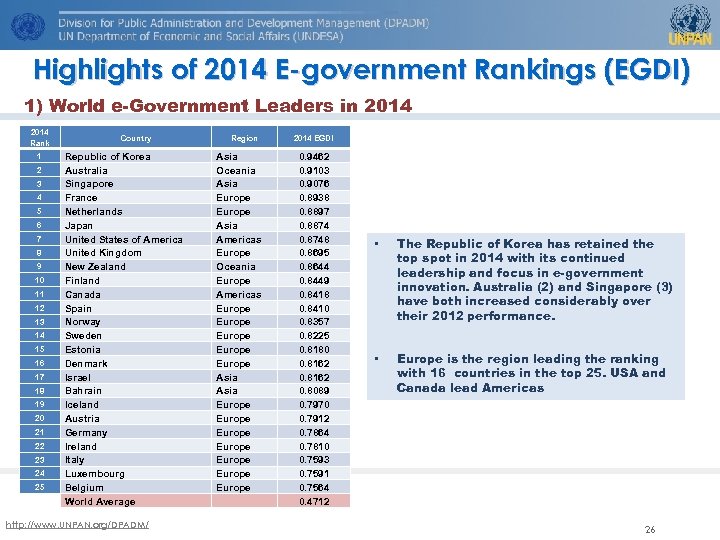
Highlights of 2014 E-government Rankings (EGDI) 1) World e-Government Leaders in 2014 Rank 1 2 3 4 5 6 7 8 9 10 11 12 13 14 15 16 17 18 19 20 21 22 23 24 25 Country Republic of Korea Australia Singapore France Netherlands Japan United States of America United Kingdom New Zealand Finland Canada Spain Norway Sweden Estonia Denmark Israel Bahrain Iceland Austria Germany Ireland Italy Luxembourg Belgium World Average http: //www. UNPAN. org/DPADM/ Region Asia Oceania Asia Europe Asia Americas Europe Oceania Europe Americas Europe Europe Asia Europe Europe 2014 EGDI 0. 9462 0. 9103 0. 9076 0. 8938 0. 8897 0. 8874 0. 8748 0. 8695 0. 8644 0. 8449 0. 8418 0. 8410 0. 8357 0. 8225 0. 8180 0. 8162 0. 8089 0. 7970 0. 7912 0. 7864 0. 7810 0. 7593 0. 7591 0. 7564 0. 4712 • The Republic of Korea has retained the top spot in 2014 with its continued leadership and focus in e-government innovation. Australia (2) and Singapore (3) have both increased considerably over their 2012 performance. • Europe is the region leading the ranking with 16 countries in the top 25. USA and Canada lead Americas 26
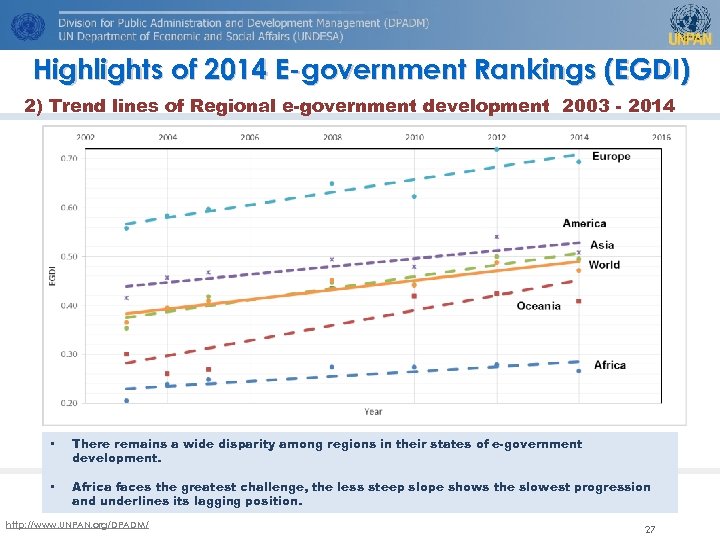
Highlights of 2014 E-government Rankings (EGDI) 2) Trend lines of Regional e-government development 2003 - 2014 • There remains a wide disparity among regions in their states of e-government development. • Africa faces the greatest challenge, the less steep slope shows the slowest progression and underlines its lagging position. http: //www. UNPAN. org/DPADM/ 27
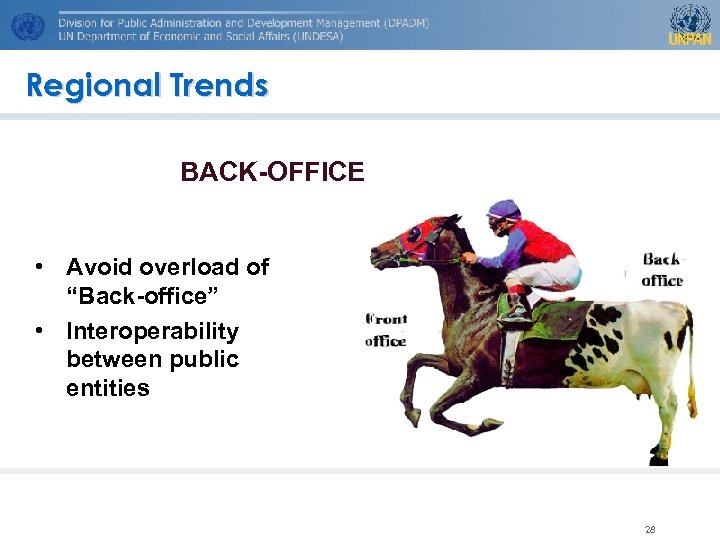
Regional Trends BACK-OFFICE • Avoid overload of “Back-office” • Interoperability between public entities 28
Regional Trends Incorporate the e-Government Office in the institutional framework of the state 29
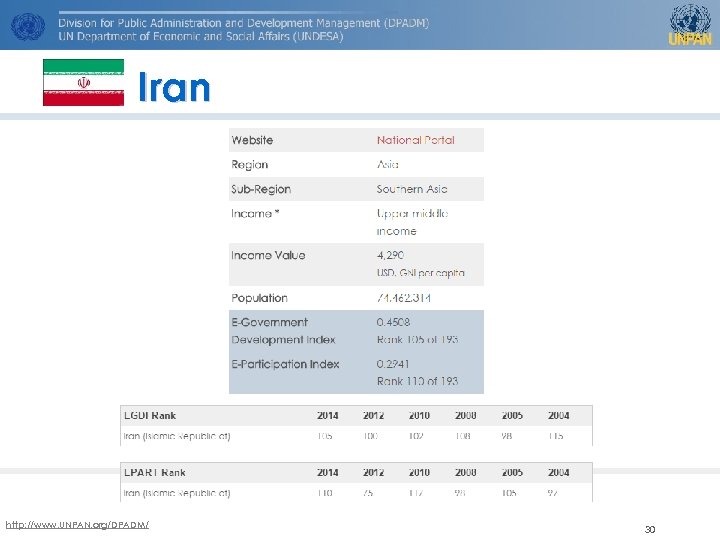
Iran http: //www. UNPAN. org/DPADM/ 30
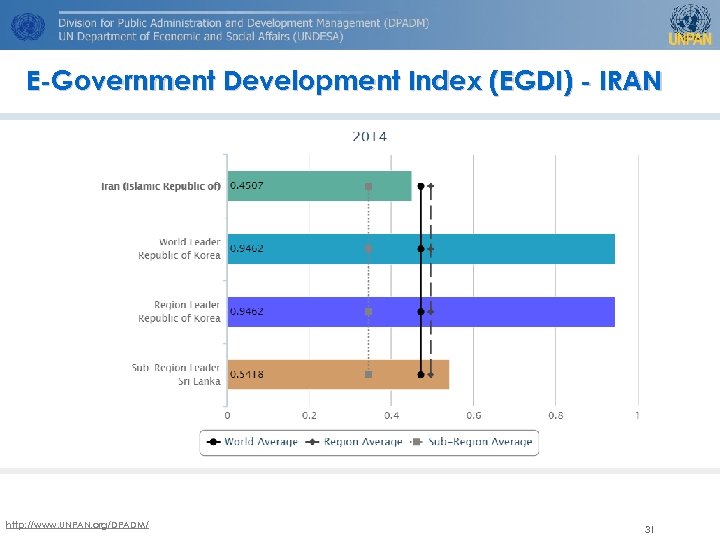
E-Government Development Index (EGDI) - IRAN http: //www. UNPAN. org/DPADM/ 31
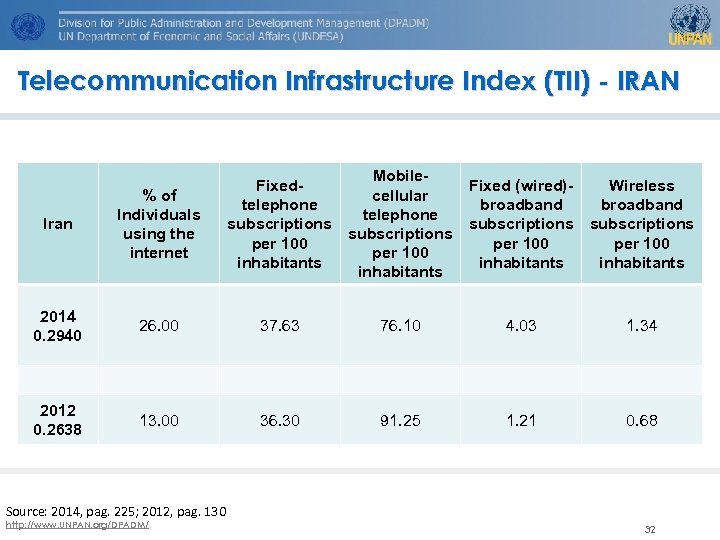
Telecommunication Infrastructure Index (TII) - IRAN Mobile. Fixed (wired)Wireless cellular telephone broadband telephone subscriptions per 100 inhabitants Iran % of Individuals using the internet 2014 0. 2940 26. 00 37. 63 76. 10 4. 03 1. 34 2012 0. 2638 13. 00 36. 30 91. 25 1. 21 0. 68 Source: 2014, pag. 225; 2012, pag. 130 http: //www. UNPAN. org/DPADM/ 32
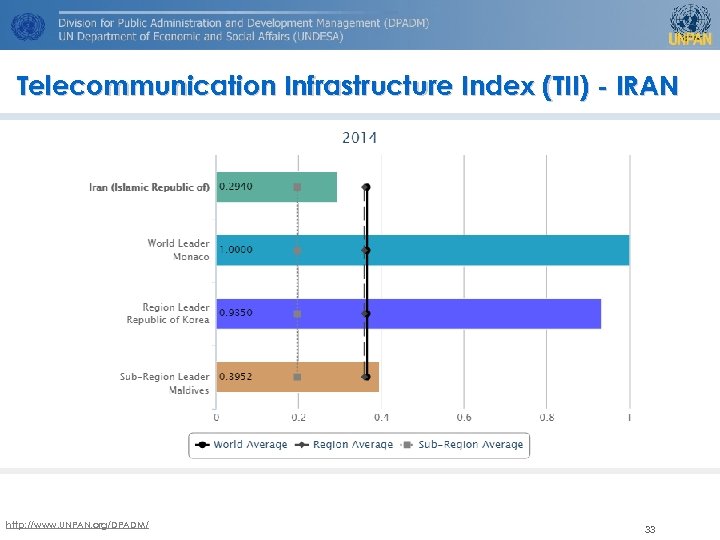
Telecommunication Infrastructure Index (TII) - IRAN http: //www. UNPAN. org/DPADM/ 33
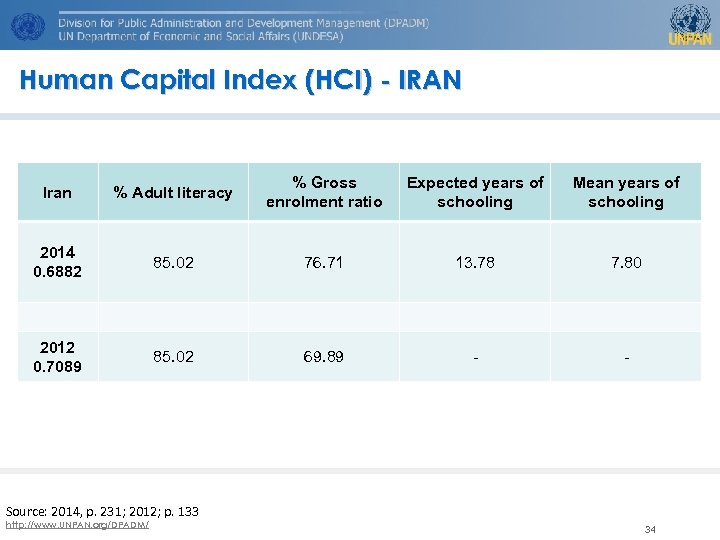
Human Capital Index (HCI) - IRAN Iran % Adult literacy % Gross enrolment ratio Expected years of schooling Mean years of schooling 2014 0. 6882 85. 02 76. 71 13. 78 7. 80 2012 0. 7089 85. 02 69. 89 - - Source: 2014, p. 231; 2012; p. 133 http: //www. UNPAN. org/DPADM/ 34
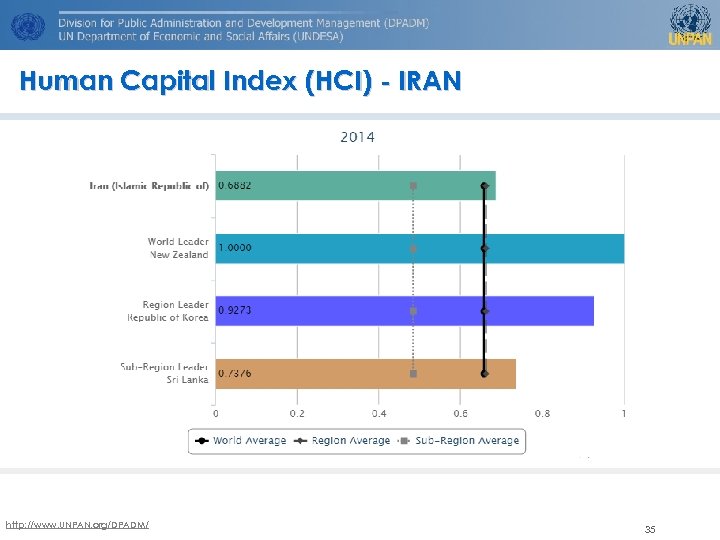
Human Capital Index (HCI) - IRAN http: //www. UNPAN. org/DPADM/ 35
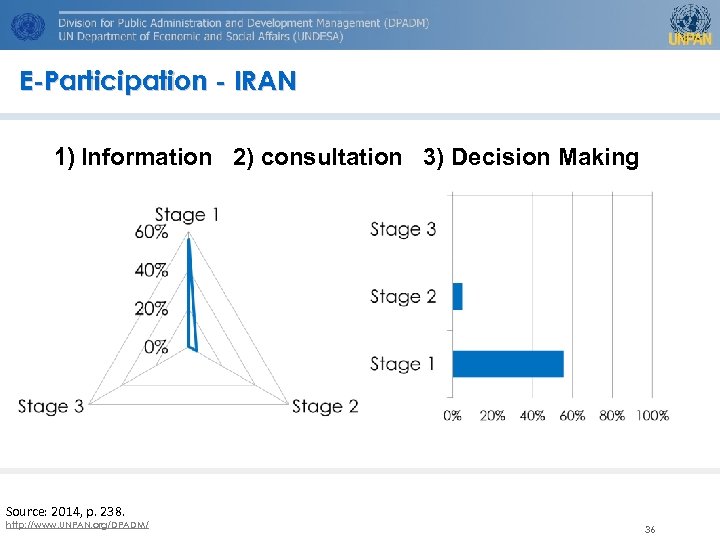
E-Participation - IRAN 1) Information 2) consultation 3) Decision Making Source: 2014, p. 238. http: //www. UNPAN. org/DPADM/ 36
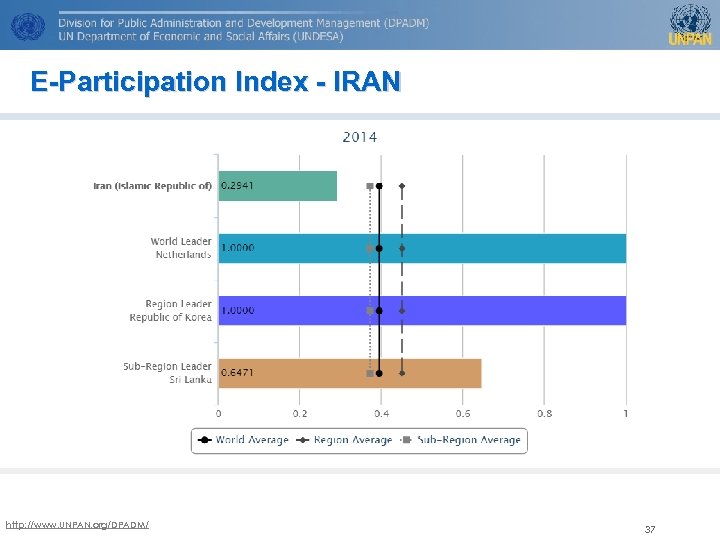
E-Participation Index - IRAN http: //www. UNPAN. org/DPADM/ 37
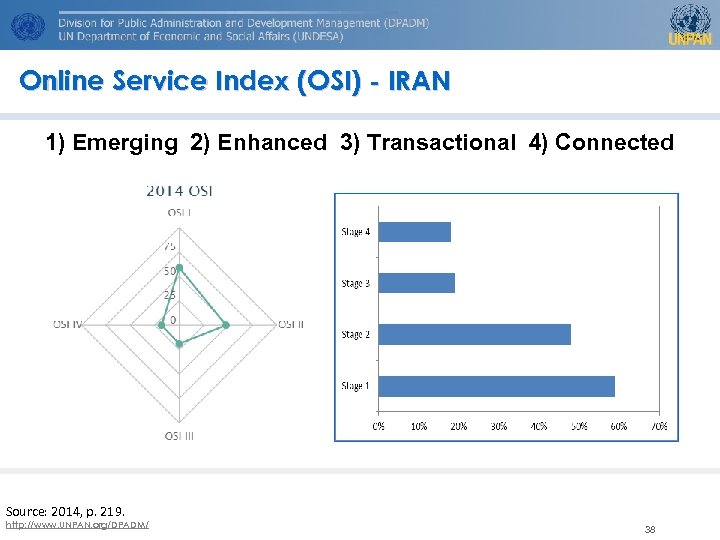
Online Service Index (OSI) - IRAN 1) Emerging 2) Enhanced 3) Transactional 4) Connected Source: 2014, p. 219. http: //www. UNPAN. org/DPADM/ 38
Conclusion Building national and local capacity in a holistic and integrated manner is central to addressing the multifacted, highly complex and interdependent challenges our societies face today. To improve e-government, the survey suggests countries establish a clear national vision, supported by committed leadership, appropriate policies and collaborative governance frameworks, and greater investment in telecommunication infrastructure, human capital and provision of online services. http: //www. UNPAN. org/DPADM/ 39
Conclusion UNDESA will capture the main findings of this workshop by developing an online training for the benefit of Member States who could not attend this event. In addition, UNDESA stands ready to provide capacitybuilding support, upon request from Member States, either by facilitating further knowledge exchanges, trainings, study tours, or advisory services. http: //www. UNPAN. org/DPADM/ 40
THANK YOU rabinovitch@un. org http: //www. UNPAN. org/DPADM/ 41
Скачать презентацию Islamic Republic of IRAN Workshop in Tehran
e3444a276daa111e4c433f8dca5b031e.ppt