


 Скачать презентацию ISLAMIC GUNPOWDER EMPIRES DO NOW RISE AND
04b42a8bb60d5966849b128d84d8021d.ppt
- Количество слайдов: 29
 ISLAMIC GUNPOWDER EMPIRES
 DO NOW: RISE AND FALL OF EMPIRES Reasons for Rise Reasons for fall
 AGE OF GUNPOWDER EMPIRES 1450 – 1800 CHANGED THE BALANCE OF POWER This term applies to a number of states, all of which rapidly expanded during the late 15 th and over the entire 16 th century. Most significant were Portugal, Spain, the Ottoman Empire, the Safavid Empire, and the Mughal Empire but also included England, France, Tokugawa (Japan), Romanov Russia, and Ming/Manchu (Qing) China
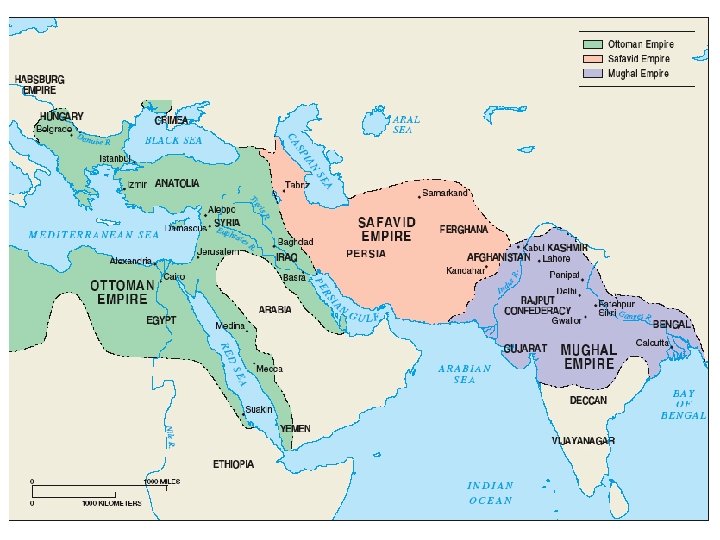
 THE ISLAMIC EMPIRES 15001800 Three Islamic Empires dominate from southern Europe to Northern India from 1500 -1800 Ottoman Empire (Balkans, Middle East, North Africa, & Eastern Europe) Safavid Empire (Persia); Shia Islam Mughal Empire (Northern India)-had lasting Islamic cultural impact
 COMMON CHARACTERISTICS Religion (of the rulers at least…) All three Islamic empires were military creations Governing § Autocratic: emperors imposed their will on the state § Ongoing problems with royal succession § Ottoman rulers legally killed brothers after taking the throne Influence of Royal and Upper-Class Women § Harem politics: women often influenced policies, selections
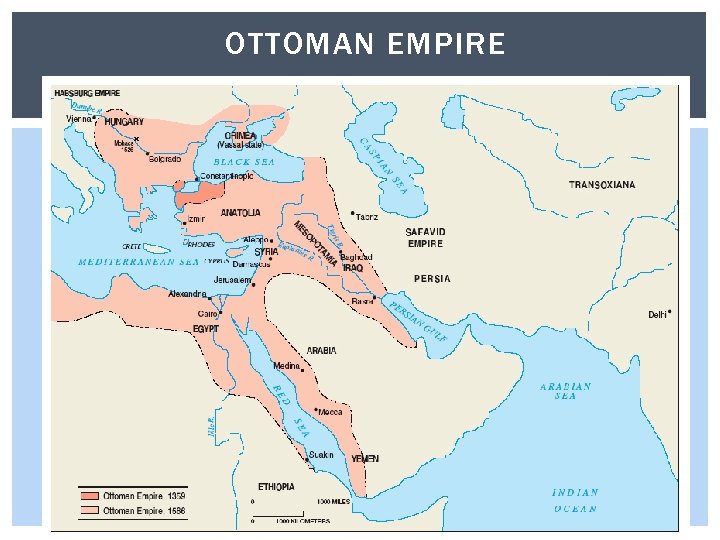 OTTOMAN EMPIRE
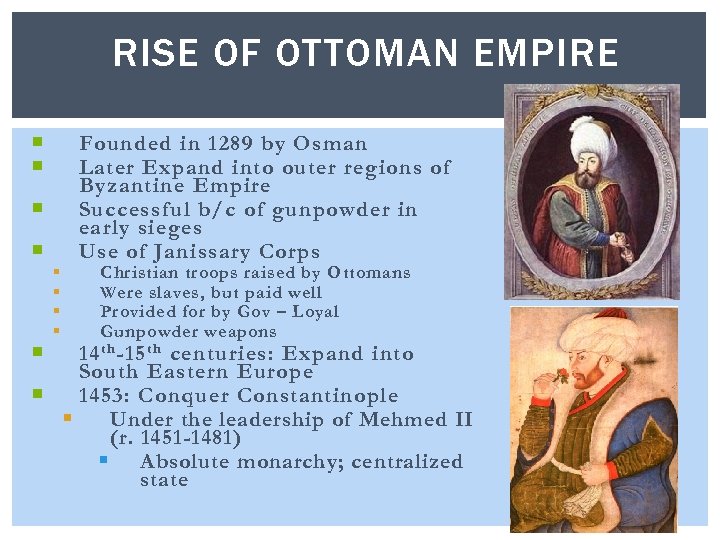 RISE OF OTTOMAN EMPIRE § § Founded in 1289 by Osman Later Expand into outer regions of Byzantine Empire Successful b/c of gunpowder in early sieges Use of Janissary Corps Christian troops raised by Ottomans Were slaves, but paid well Provided for by Gov – Loyal Gunpowder weapons 14 t h -15 t h centuries: Expand into South Eastern Europe 1453: Conquer Constantinople § Under the leadership of Mehmed II (r. 1451 -1481) § Absolute monarchy; centralized state
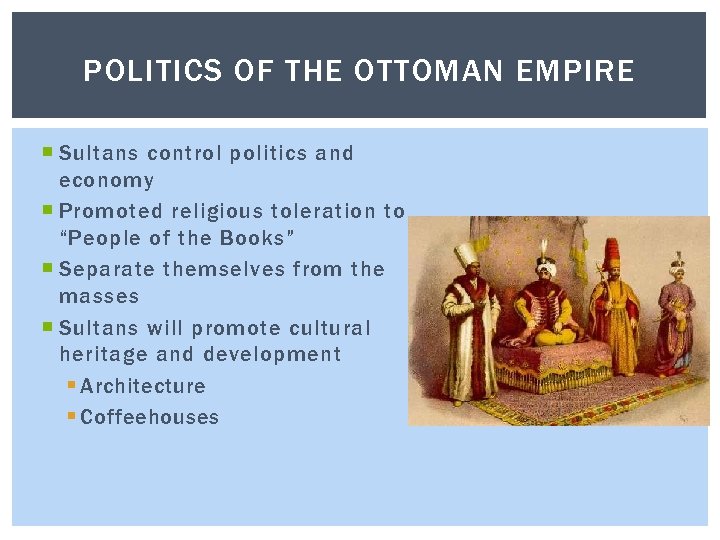 POLITICS OF THE OTTOMAN EMPIRE Sultans control politics and economy Promoted religious toleration to “People of the Books” Separate themselves from the masses Sultans will promote cultural heritage and development § Architecture § Coffeehouses
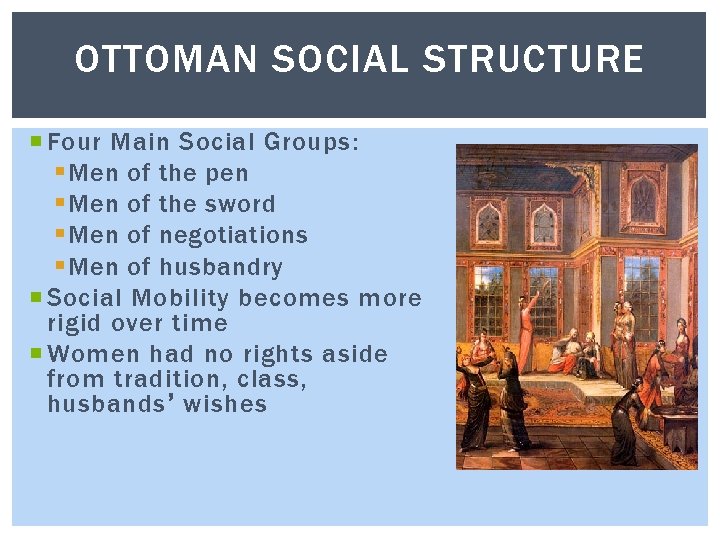 OTTOMAN SOCIAL STRUCTURE Four Main Social Groups: § Men of the pen § Men of the sword § Men of negotiations § Men of husbandry Social Mobility becomes more rigid over time Women had no rights aside from tradition, class, husbands’ wishes
 THE OTTOMAN MILLET SYSTEM Millet System: Different communities based on religion throughout the empire Each millet was headed by its own religious dignitary § Advised sultan on affairs in the community § Was punished by sultan for problems of the community In the millet system each community was responsible for § Taxes § Education § Legal Matters: Marriage, Divorce, Inheritance
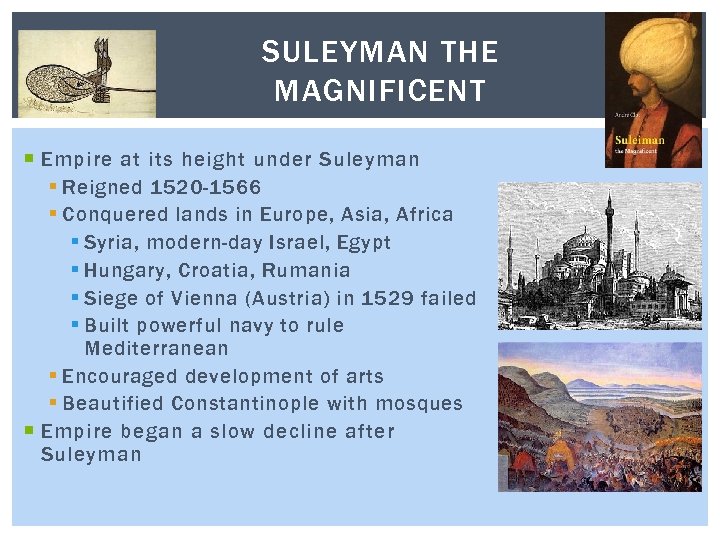 SULEYMAN THE MAGNIFICENT Empire at its height under Suleyman § Reigned 1520 -1566 § Conquered lands in Europe, Asia, Africa § Syria, modern-day Israel, Egypt § Hungary, Croatia, Rumania § Siege of Vienna (Austria) in 1529 failed § Built powerful navy to rule Mediterranean § Encouraged development of arts § Beautified Constantinople with mosques Empire began a slow decline after Suleyman
 WHAT WERE THE CAUSES OF OTTOMAN DECLINE IN THE 17 TH CENTURY? Reached limits of expansive power early on Too large to be maintained High taxes on peasants corruption of govt. officials & weak rulers Rebellions Declining position of women
 ACHIEVEMENTS OF MUSLIM EMPIRES Math and Astronomy Biology and Medicine § Indian System (0 -9) § Algebra § Maps § Sunrise/sunset times § Opened body for study § Hospitals (Free) Physics in Chemistry § Optics § Alchemy Medicine § Kept records § Trained physicians § Medical Encyclopedias § TOOK GREEK KNOWLEDGE FORWARD – RENAISSACNE
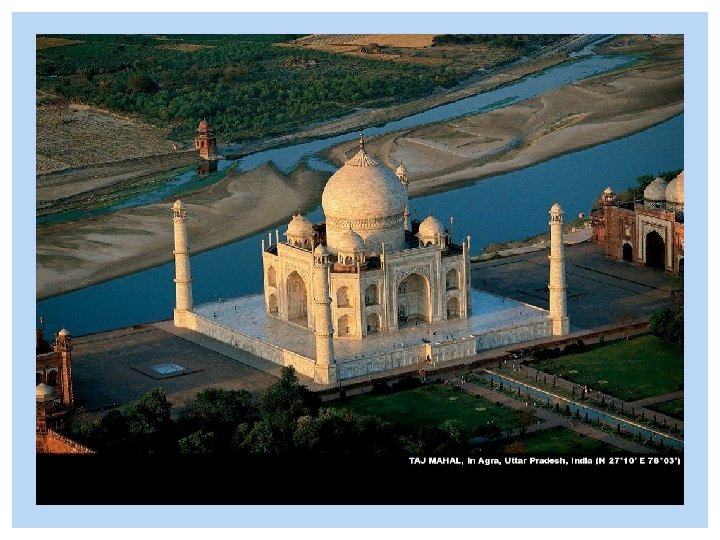
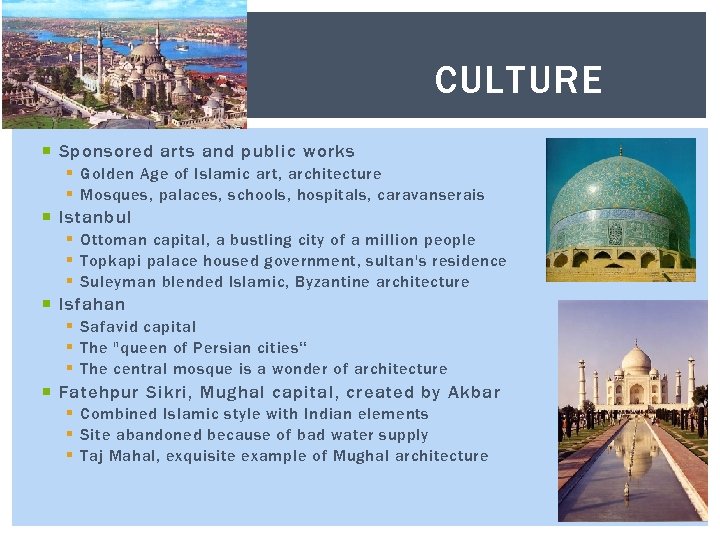 CULTURE Sponsored arts and public works § Golden Age of Islamic art, architecture § Mosques, palaces, schools, hospitals, caravanserais Istanbul § Ottoman capital, a bustling city of a million people § Topkapi palace housed government, sultan's residence § Suleyman blended Islamic, Byzantine architecture Isfahan § Safavid capital § The "queen of Persian cities“ § The central mosque is a wonder of architecture Fatehpur Sikri, Mughal capital, created by Akbar § Combined Islamic style with Indian elements § Site abandoned because of bad water supply § Taj Mahal, exquisite example of Mughal architecture
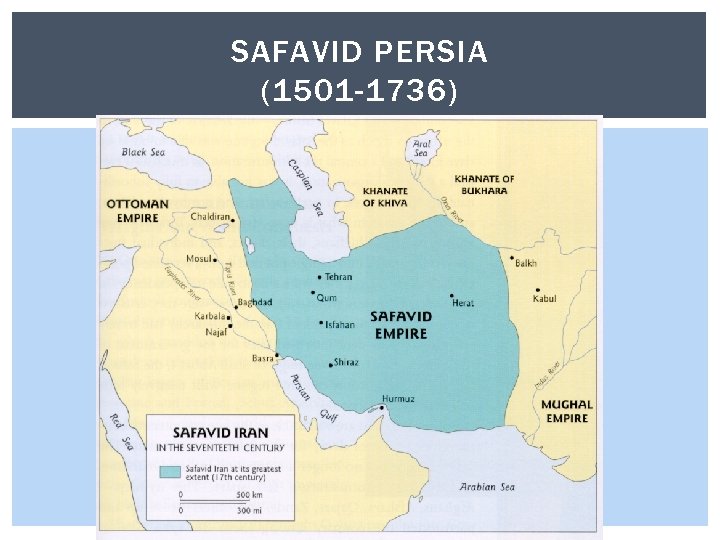 SAFAVID PERSIA (1501 -1736)
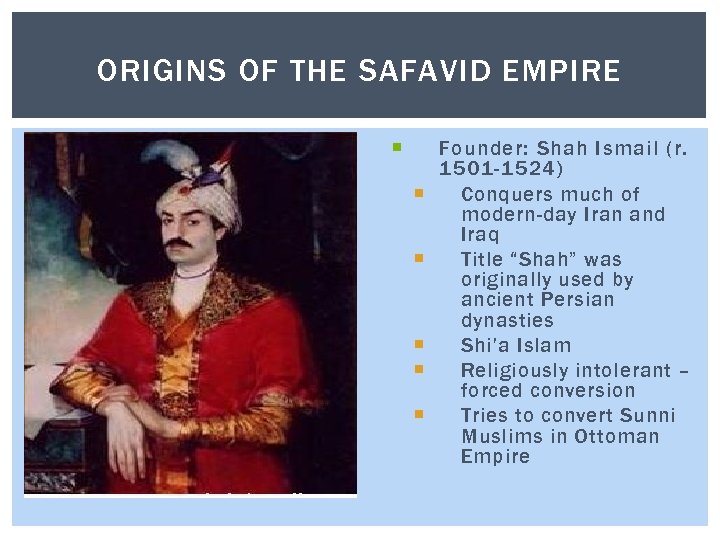 ORIGINS OF THE SAFAVID EMPIRE Founder: Shah Ismail (r. 1501 -1524) Conquers much of modern-day Iran and Iraq Title “Shah” was originally used by ancient Persian dynasties Shi’a Islam Religiously intolerant – forced conversion Tries to convert Sunni Muslims in Ottoman Empire
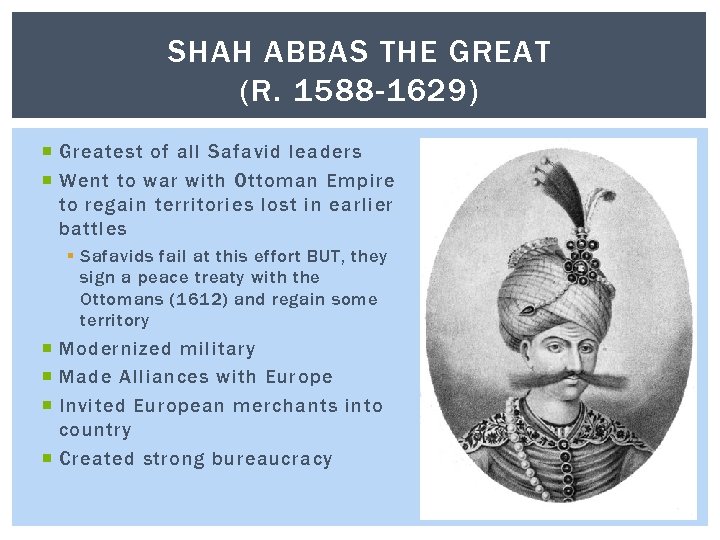 SHAH ABBAS THE GREAT (R. 1588 -1629) Greatest of all Safavid leaders Went to war with Ottoman Empire to regain territories lost in earlier battles § Safavids fail at this effort BUT, they sign a peace treaty with the Ottomans (1612) and regain some territory Modernized military Made Alliances with Europe Invited European merchants into country Created strong bureaucracy
 SAFAVID SOCIETY AND ECONOMY/CULTURE SOCIETY Traditional Social Structure Women are forced to wear the veil and live in seclusion Young boys kidnapped and enslaved (like Janissaries) Strong emphasis on artisans, engineers and merchants ECONOMY/CULTURE Main Exports: Silk items and Persian rugs Government invests money in cultural achievements § Isfahan (capital) § Architecture (City planning; mosques) § Literature, poetry and music
 DECLINE OF THE SAFAVID EMPIRE Leaders kept in seclusion from the people Inept leadership Invaded by nomadic tribes in 1722 Gets caught in the middle of many territorial and political battles
 THE MUGHAL EMPIRE Zahir al-Din Muhammad (Babur) invaded northern India in 1523 Descendant of Chinggis Khan Conquered Delhi in 1526 Controlled empire extending from Afghanistan to most of India
 THE MUGHAL EMPIRE Mughal Empire expanded under Akbar the Great (r. 1556 -1605) Established Mughal (“Mongol”) Dynasty Ruled with absolute power Established a centralized government Took personal power Expanded empire into southern India Tolerant of many religions Tried to reduce tensions between Hindus and Muslims Encouraged “Divine Faith” which focused on the emperor
 THE MUGHAL EMPIRE Empire reached peak under Aurangzeb (r. 16591707) Expanded Mughal Empire to its greatest extent Almost all of India except southern tip Did not follow Akbar’s policy of toleration Imposed Islam on empire Destroyed Hindu temples Taxed Hindus Caused further resentment among Hindus
 MUGHAL CULTURE Akbar’s tolerant policies helped unify the empire. A conflict of cultures led to the end of this empire, but resulted in a culture unique to the Mughal Empire. Cultures that blended in the empire included Muslims Hindus Persians Indians
 FAILURE OF MUGHAL DYNASTY After Akbar needed reforms ignored Government bureaucracy corrupt Army behind in weaponry & tactics technology too many building projects Less religious tolerance Empire becomes too large internal rebellions Rulers extravagant & pleasure seeking
 SIMILARITIES AND DIFFERENCES BETWEEN ISLAMIC GUNPOWDER EMPIRES
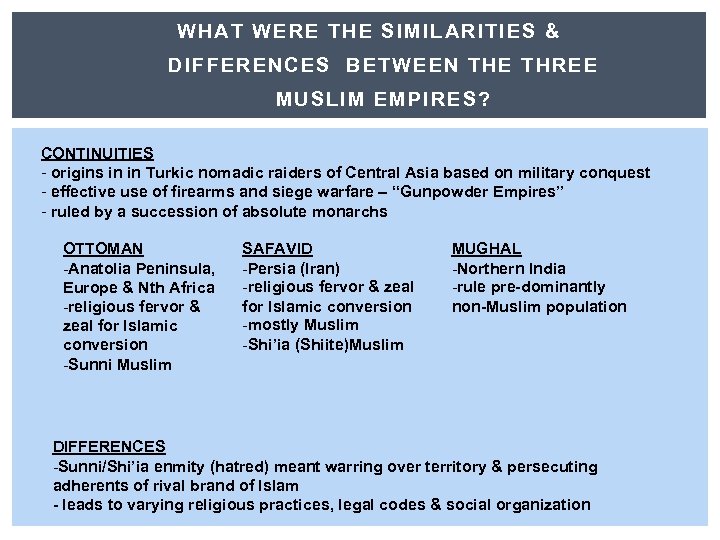 W HAT WERE T HE SIMILARITIES & DIF FERENCES BETWEEN THE THREE MUSLIM E MPIRES? CONTINUITIES - origins in in Turkic nomadic raiders of Central Asia based on military conquest - effective use of firearms and siege warfare – “Gunpowder Empires” - ruled by a succession of absolute monarchs OTTOMAN -Anatolia Peninsula, Europe & Nth Africa -religious fervor & zeal for Islamic conversion -Sunni Muslim SAFAVID -Persia (Iran) -religious fervor & zeal for Islamic conversion -mostly Muslim -Shi’ia (Shiite)Muslim MUGHAL -Northern India -rule pre-dominantly non-Muslim population DIFFERENCES -Sunni/Shi’ia enmity (hatred) meant warring over territory & persecuting adherents of rival brand of Islam - leads to varying religious practices, legal codes & social organization
 COMMON WEAKNESSES succession problems imperial central power weakens failure to adapt Western military & scientific advances rulers better at conquests than administration rulers too interested in pleasure seeking too much building peasants not taken care of-taxes