


 Скачать презентацию ISIC Rev 4 Main concepts and application rules
077a48e2004c68b4019faf1dff60a89e.ppt
- Количество слайдов: 42
 ISIC Rev. 4 Main concepts and application rules United Nations Statistics Division
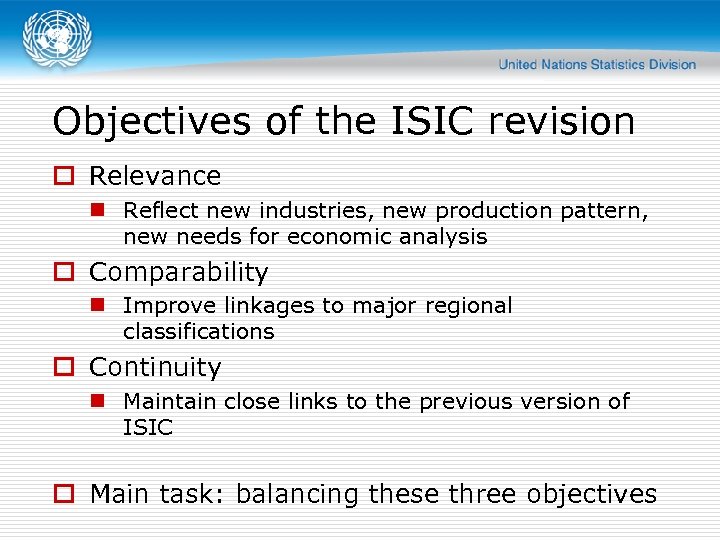 Objectives of the ISIC revision o Relevance n Reflect new industries, new production pattern, new needs for economic analysis o Comparability n Improve linkages to major regional classifications o Continuity n Maintain close links to the previous version of ISIC o Main task: balancing these three objectives
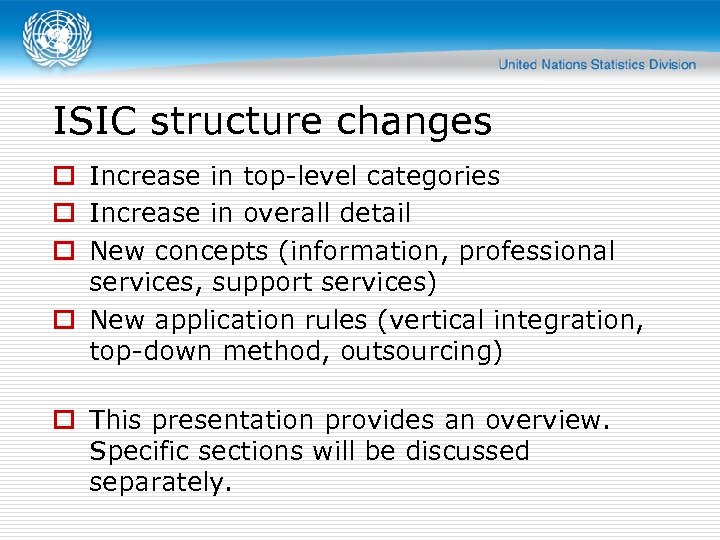 ISIC structure changes o Increase in top-level categories o Increase in overall detail o New concepts (information, professional services, support services) o New application rules (vertical integration, top-down method, outsourcing) o This presentation provides an overview. Specific sections will be discussed separately.
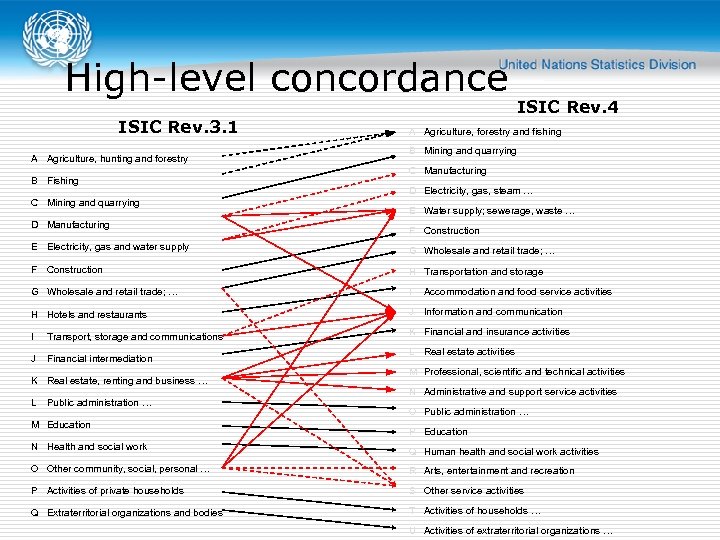 High-level concordance ISIC Rev. 3. 1 A Agriculture, hunting and forestry B Fishing C Mining and quarrying D Manufacturing ISIC Rev. 4 A Agriculture, forestry and fishing B Mining and quarrying C Manufacturing D Electricity, gas, steam … E Water supply; sewerage, waste … F Construction E Electricity, gas and water supply G Wholesale and retail trade; … F Construction H Transportation and storage G Wholesale and retail trade; … I H Hotels and restaurants J Information and communication I Transport, storage and communications K Financial and insurance activities J Financial intermediation K Real estate, renting and business … L Public administration … M Education Accommodation and food service activities L Real estate activities M Professional, scientific and technical activities N Administrative and support service activities O Public administration … P Education N Health and social work Q Human health and social work activities O Other community, social, personal … R Arts, entertainment and recreation P Activities of private households S Other service activities Q Extraterritorial organizations and bodies T Activities of households … U Activities of extraterritorial organizations …
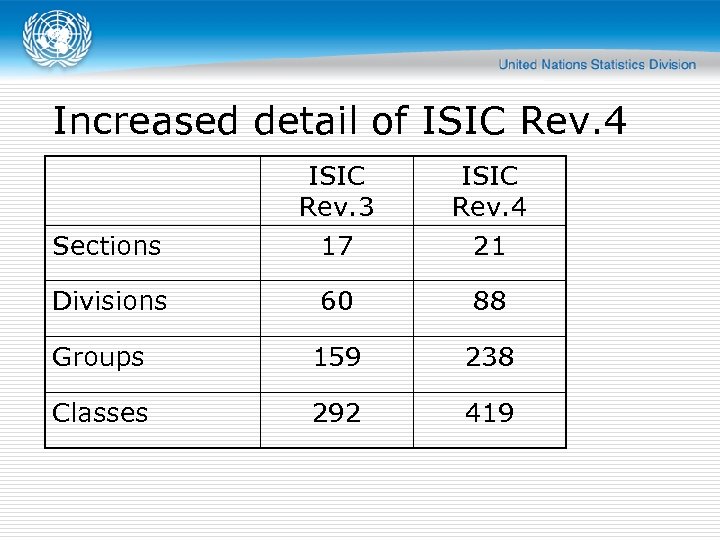 Increased detail of ISIC Rev. 4 Sections ISIC Rev. 3 17 ISIC Rev. 4 21 Divisions 60 88 Groups 159 238 Classes 292 419
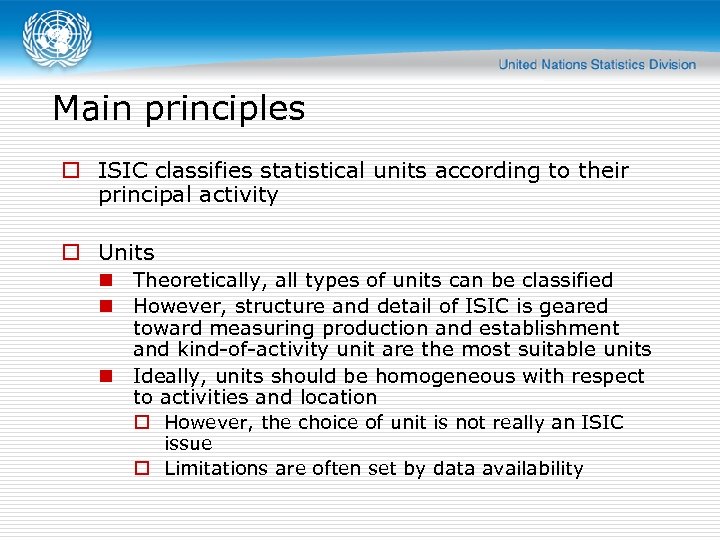 Main principles o ISIC classifies statistical units according to their principal activity o Units n Theoretically, all types of units can be classified n However, structure and detail of ISIC is geared toward measuring production and establishment and kind-of-activity unit are the most suitable units n Ideally, units should be homogeneous with respect to activities and location o However, the choice of unit is not really an ISIC issue o Limitations are often set by data availability
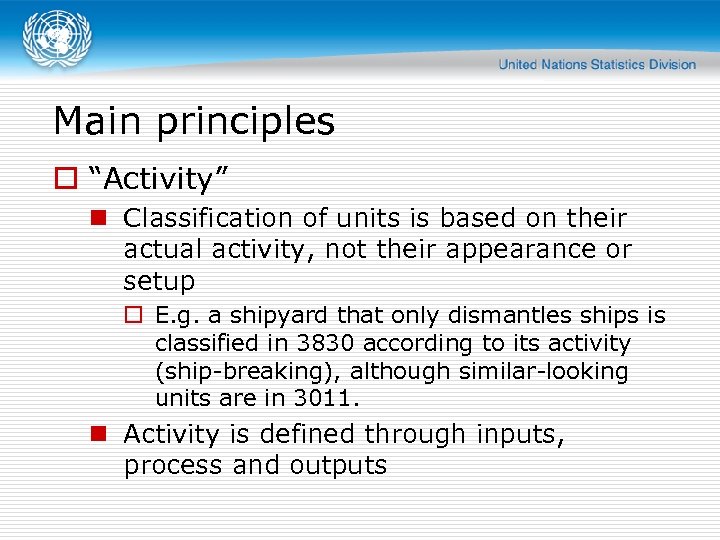 Main principles o “Activity” n Classification of units is based on their actual activity, not their appearance or setup o E. g. a shipyard that only dismantles ships is classified in 3830 according to its activity (ship-breaking), although similar-looking units are in 3011. n Activity is defined through inputs, process and outputs
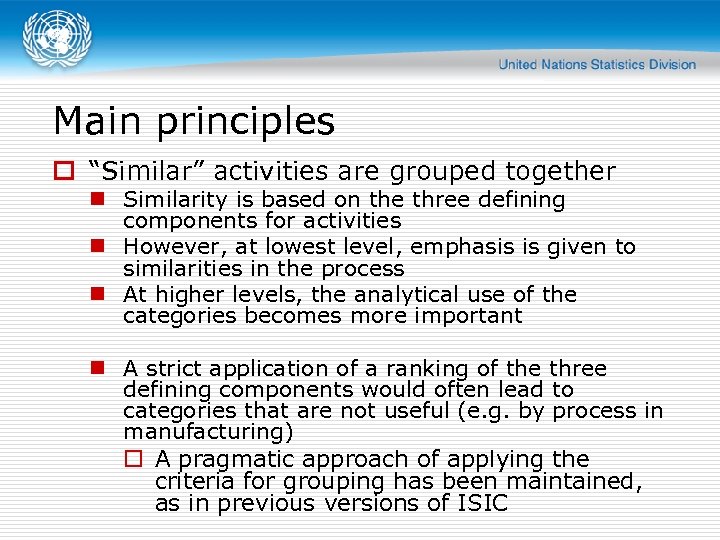 Main principles o “Similar” activities are grouped together n Similarity is based on the three defining components for activities n However, at lowest level, emphasis is given to similarities in the process n At higher levels, the analytical use of the categories becomes more important n A strict application of a ranking of the three defining components would often lead to categories that are not useful (e. g. by process in manufacturing) o A pragmatic approach of applying the criteria for grouping has been maintained, as in previous versions of ISIC
 Main principles o Although output (products) is related to the activity, it can not always be used to determine the activity of a unit n Will be discussed separately in ISIC-CPC link topic o However, with some caveats, it provides a good tool n Classes of ISIC are defined so that as far as possible the following two conditions are fulfilled: (a) The production of the category of goods and services that characterizes a given class accounts for the bulk of the output of the units classified to that class; (b) The class contains the units that produce most of the category of goods and services that characterize it.
 Main principles o Since a unit can carry out several activities, rules are necessary to identify the primary activity of a given unit n This still requires knowledge about the individual activities (elementary activities) of a unit
 ISIC – application rules o Reviewed concepts in this version of ISIC: n Top-down method n Vertical integration n Outsourcing o Application and impact depends strongly on the selection of units n ISIC does not define units, but provides information and definitions n Int. Recommendations for Industrial Statistics (IRIS 2008) gives guidance n Choice of unit depends on statistics collected and on organizational settings n ISIC can theoretically be applied to all units
 Top-down method
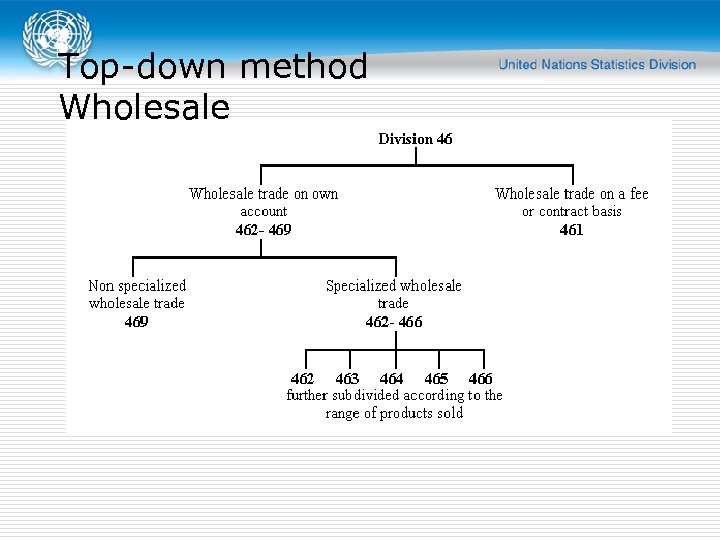
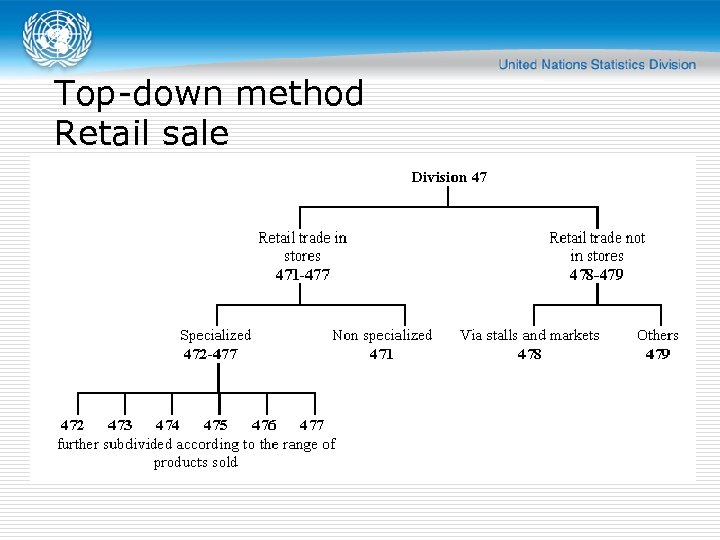
 Top-down method o. Method has not changed from previous versions of ISIC n Exception for trade activities has been made explicit o. Applies to units carrying out multiple activities -> selection of unit is important ! (but this is not an ISIC issue)
 Top-down method o The top-down method follows a hierarchical principle: n the classification of a unit at the lowest level of the classification must be consistent with the classification of the unit at the higher levels of the structure. o To satisfy this condition the process starts with the identification of the relevant position at the highest level and progresses down through the levels of the classification in the following way:
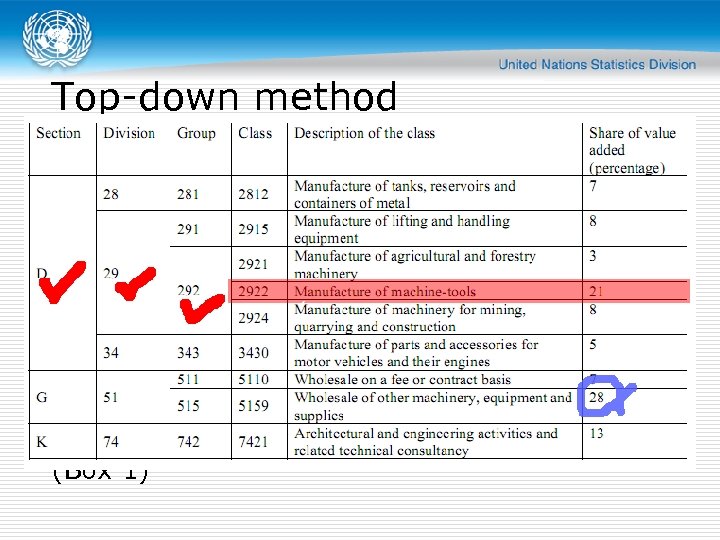 Top-down method 1. Identify the section which has the highest share of the value added. 2. Within this section identify the division which has the highest share of the value added within this section. 3. Within this division identify the group which has the highest share of the valued added within this division. 4. Within this group identify the class which has the highest share of value added within this group. (Box 1)
 Top-down method o. For wholesale and retail trade, step 3 has to be refined o. Why? n Additional levels exist that are not part of the ISIC structure itself, e. g. o. Own-account vs. fee-based o. Specialized vs. non-specialized o. In-store vs. not-in-store n Similar distinctions do not exist for other activities, such as manufacturing.
 Top-down method Wholesale
 Top-down method Retail sale
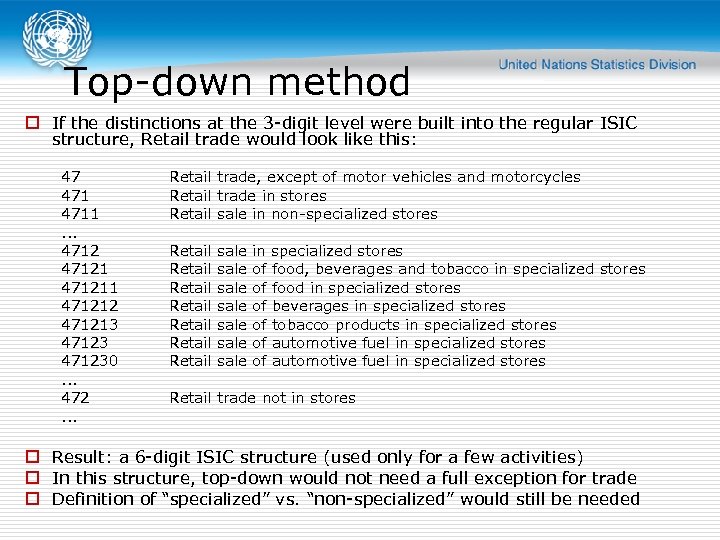 Top-down method o If the distinctions at the 3 -digit level were built into the regular ISIC structure, Retail trade would look like this: 47 4711. . . 471212 471213 471230. . . 472. . . Retail trade, except of motor vehicles and motorcycles Retail trade in stores Retail sale in non-specialized stores Retail Retail sale sale in of of of specialized stores food, beverages and tobacco in specialized stores food in specialized stores beverages in specialized stores tobacco products in specialized stores automotive fuel in specialized stores Retail trade not in stores o Result: a 6 -digit ISIC structure (used only for a few activities) o In this structure, top-down would not need a full exception for trade o Definition of “specialized” vs. “non-specialized” would still be needed
 Top-down method The rules may sound complicated, but: o. Reflect more complex composition of trade activities in ISIC n Driven by the desire for more detail in this area o. Provide necessary definitions for specialized vs. non-specialized trade activities
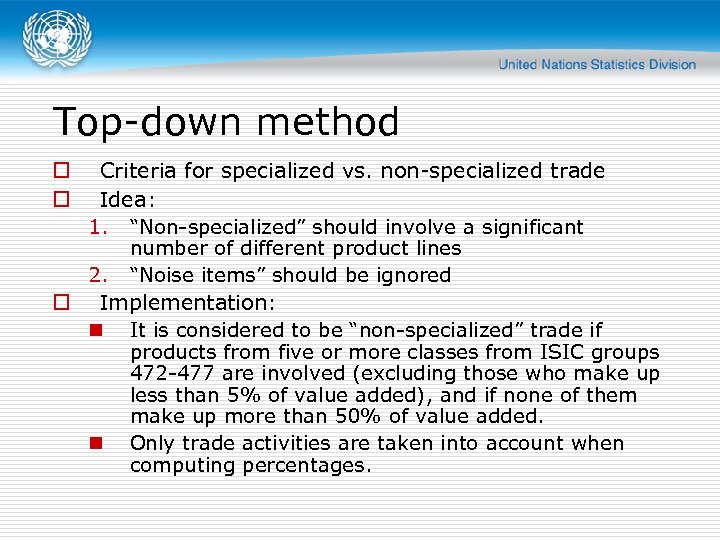 Top-down method Criteria for specialized vs. non-specialized trade Idea: 1. “Non-specialized” should involve a significant number of different product lines 2. “Noise items” should be ignored o Implementation: n It is considered to be “non-specialized” trade if products from five or more classes from ISIC groups 472 -477 are involved (excluding those who make up less than 5% of value added), and if none of them make up more than 50% of value added. n Only trade activities are taken into account when computing percentages. o o
 Vertical integration
 Treatment of vertically integrated activities o Vertical integration of activities occurs where the different stages of production are carried out in succession by the same unit and where the output of one process serves as input to the next. o Examples of common vertical integration: n tree felling and subsequent sawmilling n production of wearing apparel in a textile mill
 Treatment of vertically integrated activities o Vertical integration should be treated like any other form of multiple activities, i. e. the principal activity of the unit is the activity accounting for the largest share of value added, as determined by the top-down method. o This treatment has changed from previous versions of ISIC. o If value added or substitutes cannot be determined for the individual steps in a vertically integrated process directly from accounts compiled by the unit itself, comparisons with similar units could be used. Alternatively, valuation of intermediate or final products could be based on market prices.
 Treatment of vertically integrated activities o Impact of the changed rule should be minimal, since in many cases units will be broken up statistically if portions are substantial
 Outsourcing
 Outsourcing Can take many forms: o Outsourcing of labour o Outsourcing of support functions o Outsourcing of parts of a production process o Outsourcing of the complete production process
 Outsourcing - Terminology n n n Principal = unit that enters in a contractual relationship with another unit (here called contractor) to carry out some part of the whole production process. Sometimes, the terms "converter" or "contractor" had also been used. Contractor = unit that carries out a specific production process based on a contractual relationship with a Principal. The term "subcontractor" had been used too. The activities performed by the contractor are denominated "on a fee or contract basis". Outsourcing = contractual agreement according to which the principal requires the contractor to carry out a specific production process. Sometimes, the term "subcontracting" is used as well.
 Outsourcing - Terminology o Other terminology is sometimes used (e. g. in recent OECD documents), where in this context: n “insourcing” and “outsourcing” refers to relationship between units involved n “offshoring” refers to transactions between economic territories o This terminology is not used here.
 Outsourcing o The principal and the contractor may be located in the same economic territory or in different economic territories: the actual location does not affect the classification of either one of these units.
 Outsourcing o Contractors, i. e. units carrying out an activity on a fee or contract basis, are usually classified with units producing the same goods or services for their own account
 Outsourcing - manufacturing o In manufacturing, the principal provides the contractor the technical specifications of the manufacturing activity to be carried out on the input material. o The input material (raw or intermediate good) can either be provided (owned) by the principal or not.
 Outsourcing - manufacturing o A principal who outsources only part of the transformation process is to be classified into manufacturing. o The activity of a principal who completely outsources the transformation process should be classified into manufacturing only if he owns the raw material used as input to the production process (and therefore owns the final output).
 Outsourcing - manufacturing o In all other cases, the activity of the principal should be classified in Section G "Wholesale and retail trade" (according to the type of operation and the specific good sold). n In this case the principal buys the good from the contractor and re-sells it without transformation
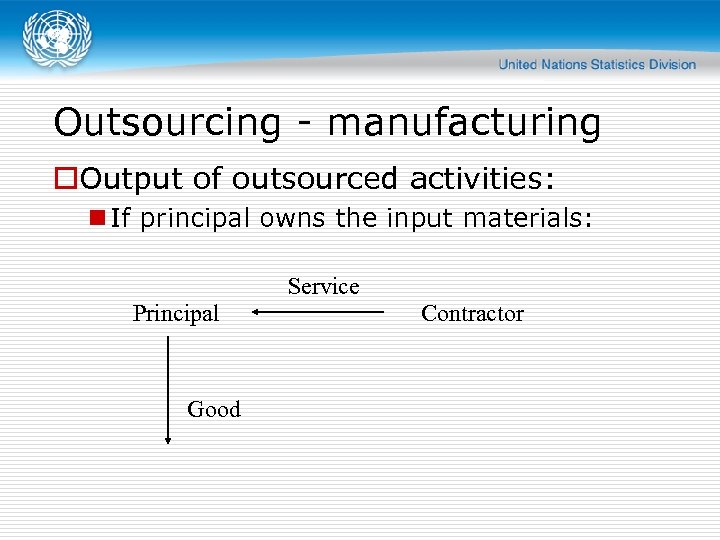 Outsourcing - manufacturing o. Output of outsourced activities: n If principal owns the input materials: Service Principal Good Contractor
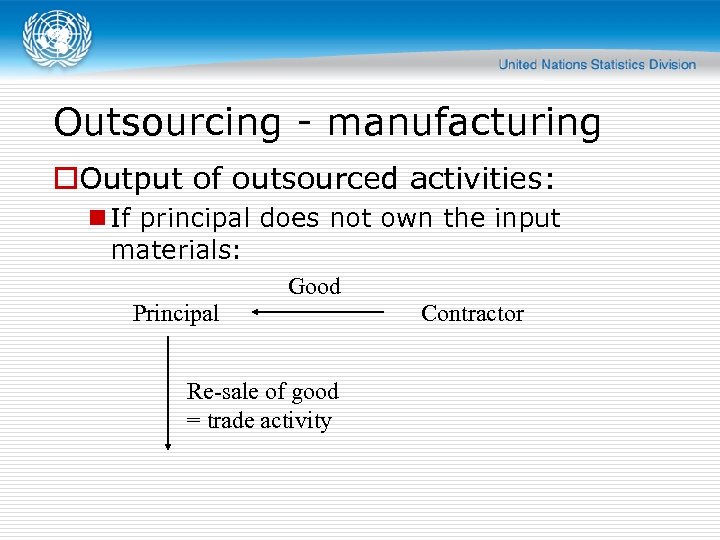 Outsourcing - manufacturing o. Output of outsourced activities: n If principal does not own the input materials: Good Principal Re-sale of good = trade activity Contractor
 Outsourcing – manufacturing o Some remarks: n A unit classified in Manufacturing can have two types of outputs: o a manufactured good o a manufacturing service n Both are identified in the product classification n Manufacturing is defined as a (mechanical or chemical) transformation process o This implies that the “manufacturer” has to have ownership of the good before and after the transformation process
 Outsourcing – manufacturing o Some remarks: n Proposals for classification (in this case) are often driven by a reference to “risk” o To take the risk of manufacturing, you need to have a liability in this process o Owning the concept is not sufficient o Owning the concept does not imply ownership of the produced good n Sale of goods o Wholesale/retail sale is defined as “buying and reselling without transformation” o Simply selling the goods that you produce does not make you a wholesaler/retailer
 Outsourcing – services o For services, the concept of a “service retailer” does not exist o If the whole process (service provision) is outsourced, both the principal and the contractor are classified to the same ISIC class o If only a portion of the process is outsourced, the principal remains classified as if it were carrying out the complete process o If a separate class exists for the outsourced portion, the contractor is classified to that portion, otherwise to the same class as the principal
 Outsourcing – support functions o This applies to the outsourcing of functions like accounting, computer services etc. o In this case, the principal is classified as if it were carrying out the complete core process. (In other words, support functions do not influence the classification of a unit. ) o The contractor is classified to the specific support function it is carrying out.
 Outsourcing – employment o Increasingly, companies emerge that provide only the labour force to their clients. o In turn, producers (e. g. manufacturers) may have little or no employment o In this case the principal is classified as if it were operating with own employees. o The contractor is classified to ISIC 7820 or 7830, depending on the type of contract. o Important: Define the line between off-site employees and independent providers
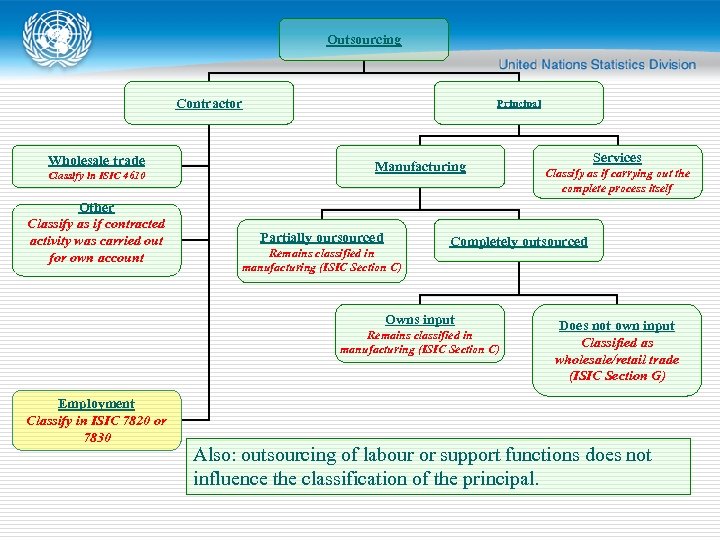 Outsourcing Contractor Wholesale trade Classify in ISIC 4610 Other Classify as if contracted activity was carried out for own account Principal Manufacturing Partially oursourced Remains classified in manufacturing (ISIC Section C) Classify as if carrying out the complete process itself Completely outsourced Owns input Remains classified in manufacturing (ISIC Section C) Employment Classify in ISIC 7820 or 7830 Services Does not own input Classified as wholesale/retail trade (ISIC Section G) Also: outsourcing of labour or support functions does not influence the classification of the principal.