


 Скачать презентацию IS THERE FUTURE FOR MODERN MUSICAL GENRES Done
Salta project.pptx
- Количество слайдов: 15
 IS THERE FUTURE FOR MODERN MUSICAL GENRES? Done by: Azhikova S. Checked by: Tasyrova B
 PLAN: I. III. Introduction. Main part. Conclusion.
 Music is such a big part of our lives, and we react to it in many ways without even realizing. Music is an art form whose medium is sound. Its common elements are pitch (which governs melody and harmony), rhythm (and its associated concepts tempo, meter, and articulation), dynamics, and the sonic qualities of timbre and texture. The word derives from Greek μουσική (mousike; "art of the Muses)
 WHAT IS THE MUSIC GENRE? Douglass M. Green “Beethoven's Op. 61 and Mendelssohn's Op. 64 are identical in genre – both are violin concertos – but different in form” v Peter van der Merwe "basic musical language. “ v Allan F. Moore, state that genre and style are two separate terms, and that secondary characteristics such as subject matter can also differentiate between genres. v
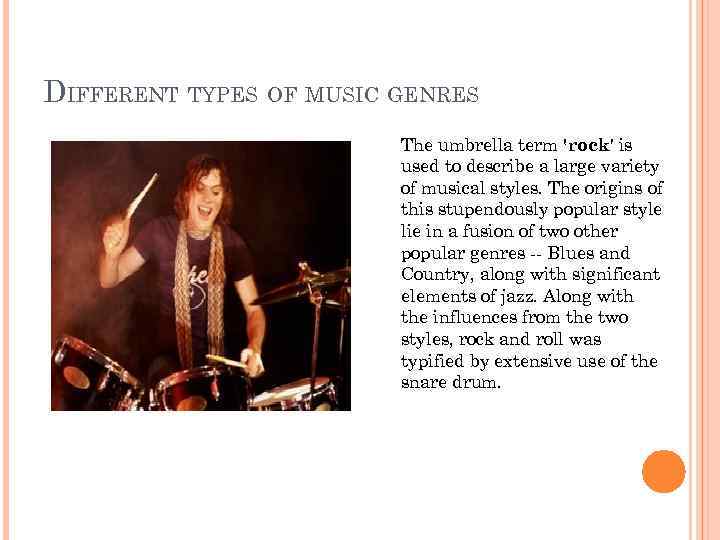 DIFFERENT TYPES OF MUSIC GENRES The umbrella term 'rock' is used to describe a large variety of musical styles. The origins of this stupendously popular style lie in a fusion of two other popular genres -- Blues and Country, along with significant elements of jazz. Along with the influences from the two styles, rock and roll was typified by extensive use of the snare drum.
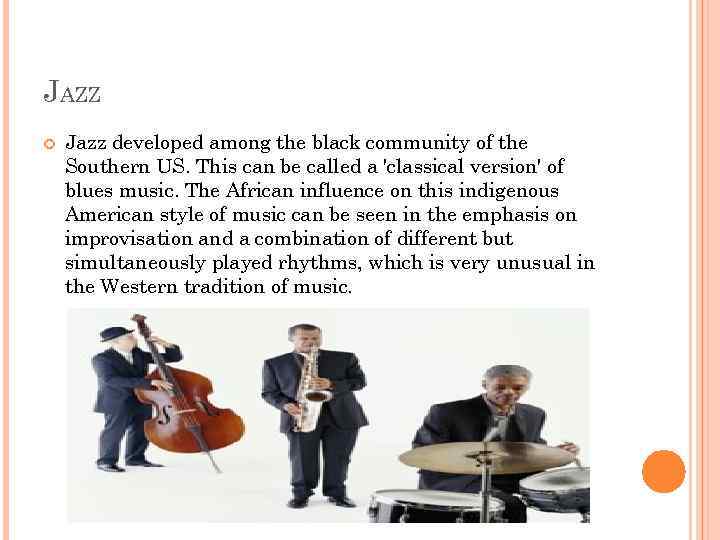 JAZZ Jazz developed among the black community of the Southern US. This can be called a 'classical version' of blues music. The African influence on this indigenous American style of music can be seen in the emphasis on improvisation and a combination of different but simultaneously played rhythms, which is very unusual in the Western tradition of music.
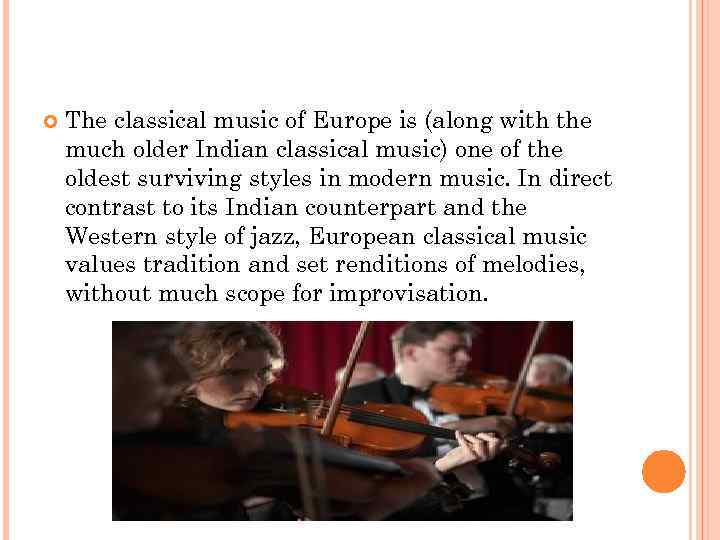 The classical music of Europe is (along with the much older Indian classical music) one of the oldest surviving styles in modern music. In direct contrast to its Indian counterpart and the Western style of jazz, European classical music values tradition and set renditions of melodies, without much scope for improvisation.
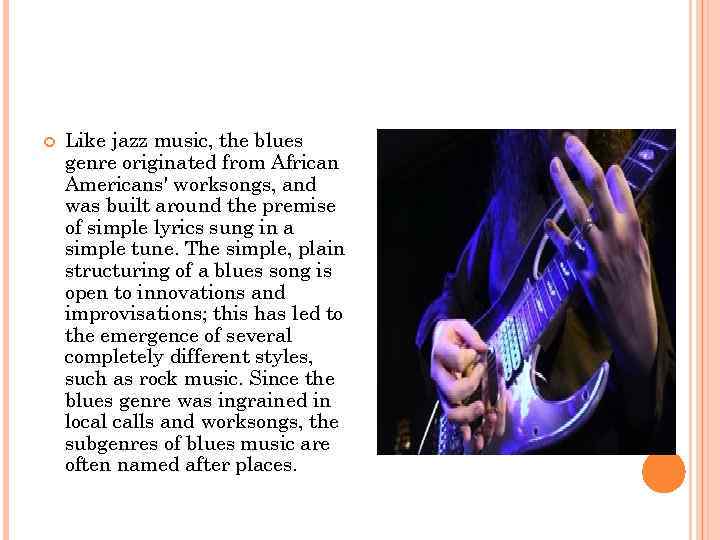 Like jazz music, the blues genre originated from African Americans' worksongs, and was built around the premise of simple lyrics sung in a simple tune. The simple, plain structuring of a blues song is open to innovations and improvisations; this has led to the emergence of several completely different styles, such as rock music. Since the blues genre was ingrained in local calls and worksongs, the subgenres of blues music are often named after places.
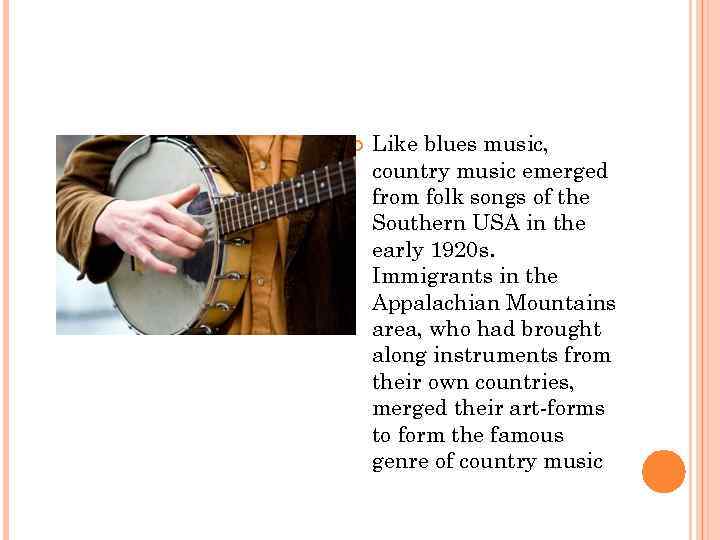 Like blues music, country music emerged from folk songs of the Southern USA in the early 1920 s. Immigrants in the Appalachian Mountains area, who had brought along instruments from their own countries, merged their art-forms to form the famous genre of country music
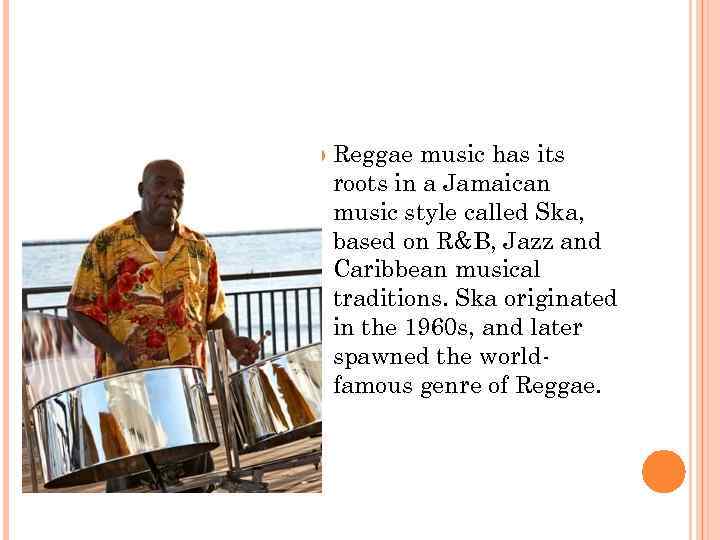 Reggae music has its roots in a Jamaican music style called Ska, based on R&B, Jazz and Caribbean musical traditions. Ska originated in the 1960 s, and later spawned the worldfamous genre of Reggae.
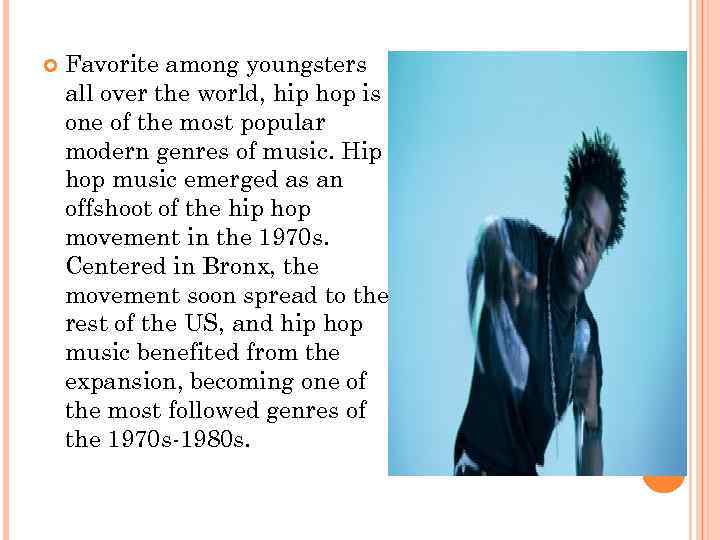 Favorite among youngsters all over the world, hip hop is one of the most popular modern genres of music. Hip hop music emerged as an offshoot of the hip hop movement in the 1970 s. Centered in Bronx, the movement soon spread to the rest of the US, and hip hop music benefited from the expansion, becoming one of the most followed genres of the 1970 s-1980 s.
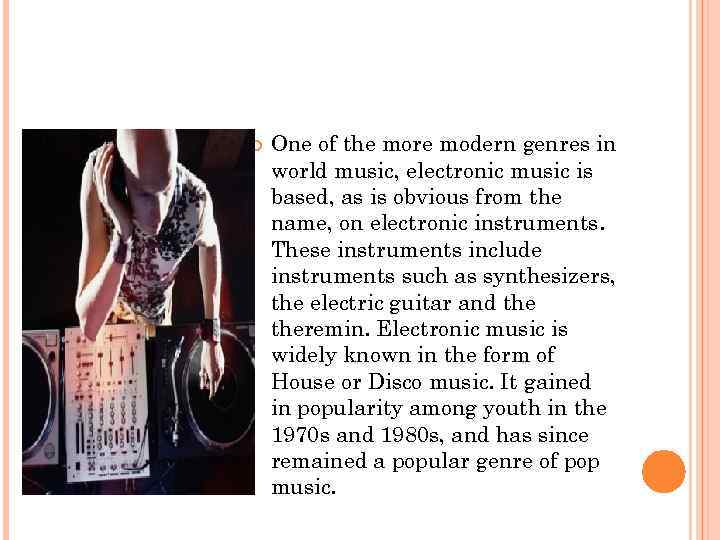 One of the more modern genres in world music, electronic music is based, as is obvious from the name, on electronic instruments. These instruments include instruments such as synthesizers, the electric guitar and theremin. Electronic music is widely known in the form of House or Disco music. It gained in popularity among youth in the 1970 s and 1980 s, and has since remained a popular genre of pop music.
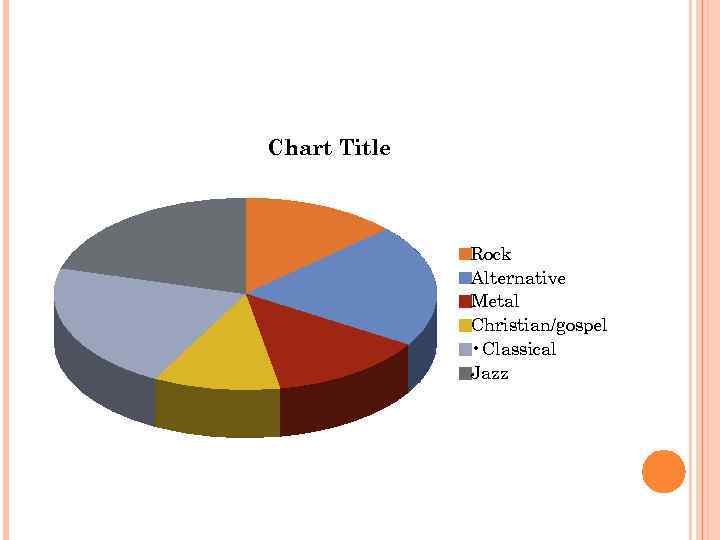 Chart Title Rock Alternative Metal Christian/gospel • Classical Jazz
 CONCLUSION The fans of popular music will continue to be more accepting of whatever is presented to them as popular. They will continue to be more apt to steal their music rather than pay for it, though they will be even more willing to pay increasing prices to see the performers in a live setting. They will continue to be more obsessed with image, show decreasing loyalty towards acts, and be more susceptible to short-lived trends.
 REFERENCES: http: //www. buzzle. com/articles/different-types-ofmusic-genres. html v Samson, Jim. "Genre". In Grove Music Online. Oxford Music Online. Accessed March 4, 2012. v Jump up^ Green, Douglass M. (1965). Form in Tonal Music. Holt, Rinehart, and Winston, Inc. p. 1. ISBN 0 -03 -020286 -8. v Jump up^ van der Merwe, Peter (1989). Origins of the Popular Style: The Antecedents of Twentieth-Century Popular Music. Oxford: Clarendon Press. p. 3. ISBN 0 -19 -316121 -4. v