Скачать презентацию IS THERE A FUTURE FOR SOFT SOCIAL SENSITIVE
ebd6f63207481a130aaf0e11cfba466a.ppt
- Количество слайдов: 30
![IS THERE A FUTURE FOR „SOFT” [SOCIAL SENSITIVE] CAPITALISM IN THE POST-SOCIALIST EUROPE? by](https://present5.com/presentation/ebd6f63207481a130aaf0e11cfba466a/image-1.jpg "IS THERE A FUTURE FOR „SOFT” [SOCIAL SENSITIVE] CAPITALISM IN THE POST-SOCIALIST EUROPE? by") IS THERE A FUTURE FOR „SOFT” [SOCIAL SENSITIVE] CAPITALISM IN THE POST-SOCIALIST EUROPE? by Pál TAMÁS [Hungarian Academy of Sciences, Budapest]
IS THERE A FUTURE FOR „SOFT” [SOCIAL SENSITIVE] CAPITALISM IN THE POST-SOCIALIST EUROPE? by Pál TAMÁS [Hungarian Academy of Sciences, Budapest]
![THE TAXONOMICAL QUESTION Is there an East European [post]socialist welfare state model beyond the](https://present5.com/presentation/ebd6f63207481a130aaf0e11cfba466a/image-2.jpg "THE TAXONOMICAL QUESTION Is there an East European [post]socialist welfare state model beyond the") THE TAXONOMICAL QUESTION Is there an East European [post]socialist welfare state model beyond the European „classical 4” welfare regimes? Yes, the „early-born welfare state” [Janos Kornai] of EE as a fundamental concept for legitimation of the social order. a. Survival ratio of that E-B welfare state? The strategic debate. b. How to reduce the social expenditure? Tactics and time -horizons c. What does happen with the European social model in that context? 2 Europes- with an internal periphery?
THE TAXONOMICAL QUESTION Is there an East European [post]socialist welfare state model beyond the European „classical 4” welfare regimes? Yes, the „early-born welfare state” [Janos Kornai] of EE as a fundamental concept for legitimation of the social order. a. Survival ratio of that E-B welfare state? The strategic debate. b. How to reduce the social expenditure? Tactics and time -horizons c. What does happen with the European social model in that context? 2 Europes- with an internal periphery?
![EVOLUTION OF THE SOVIET WELFARE REGIME [as a concept] 20 -30 ies –patchwork of](https://present5.com/presentation/ebd6f63207481a130aaf0e11cfba466a/image-3.jpg "EVOLUTION OF THE SOVIET WELFARE REGIME [as a concept] 20 -30 ies –patchwork of") EVOLUTION OF THE SOVIET WELFARE REGIME [as a concept] 20 -30 ies –patchwork of differently modernized social segments, islands, pockets. Differentiated social services in different segments. Close to the „classical” Chinese communist system of social insurance of the 50 -70 ies From the late 50 ies-early 60 ies de facto universal: Bismarcian instruments, but universal in its system via obligatory and permanent full employment. The system collapsed in the early 90 ies.
EVOLUTION OF THE SOVIET WELFARE REGIME [as a concept] 20 -30 ies –patchwork of differently modernized social segments, islands, pockets. Differentiated social services in different segments. Close to the „classical” Chinese communist system of social insurance of the 50 -70 ies From the late 50 ies-early 60 ies de facto universal: Bismarcian instruments, but universal in its system via obligatory and permanent full employment. The system collapsed in the early 90 ies.
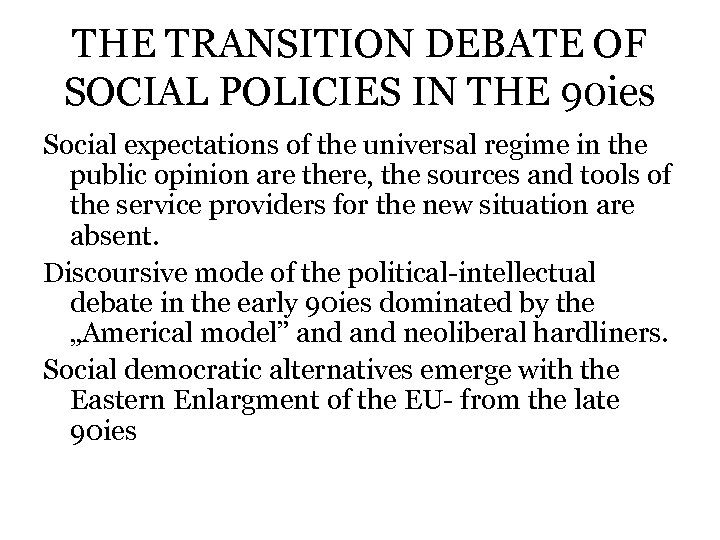 THE TRANSITION DEBATE OF SOCIAL POLICIES IN THE 90 ies Social expectations of the universal regime in the public opinion are there, the sources and tools of the service providers for the new situation are absent. Discoursive mode of the political-intellectual debate in the early 90 ies dominated by the „Americal model” and neoliberal hardliners. Social democratic alternatives emerge with the Eastern Enlargment of the EU- from the late 90 ies
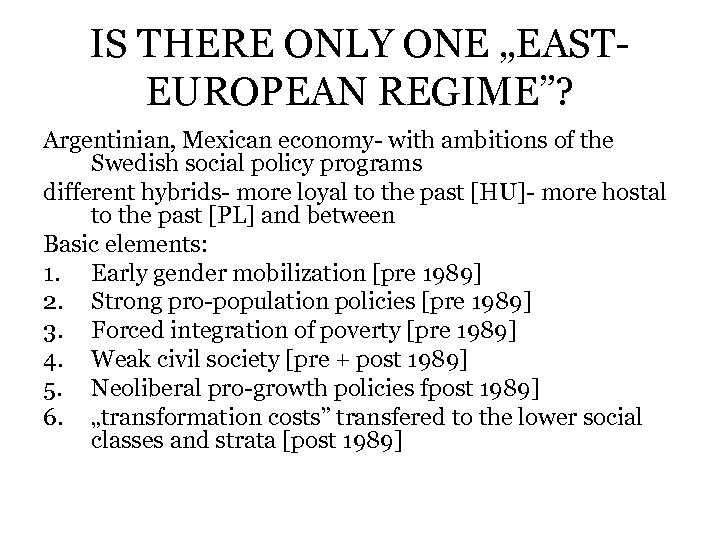 IS THERE ONLY ONE „EASTEUROPEAN REGIME”? Argentinian, Mexican economy- with ambitions of the Swedish social policy programs different hybrids- more loyal to the past [HU]- more hostal to the past [PL] and between Basic elements: 1. Early gender mobilization [pre 1989] 2. Strong pro-population policies [pre 1989] 3. Forced integration of poverty [pre 1989] 4. Weak civil society [pre + post 1989] 5. Neoliberal pro-growth policies fpost 1989] 6. „transformation costs” transfered to the lower social classes and strata [post 1989]
 THE „SCANDINAVIAN DREAM” „Scandinavia” as an ideal case [like the romantic concept of the „pure love”] is there at least from 1968 [the Prague Spring], but after 1989 -90 everybody is realistic, and tries to „marry the first potential reach partner; wife, husband”] Special cases : a. the Finnish model” in Hungary b. The ambivalence of the Baltics- Scandinavian modernization but without scandinavian social policies [Estonia, Latvia- brutal neoliberal growth regimes with Scandinavian foreign policy umbrella and economic domination]
 STRATEGIC DILEMMAS A. „optimal” and „acceptable” social inequalities [the „Atlantic” and the East Asian developmental states]. B. The post-communist underclass and the social reproduction C. Changing social justice concepts as tools for legitimation of transition D. Limits for a new social contract [political assets of transformation] E. Re-integration of alienated generations after the transition
 BIFURCATION OF THE EUROPEAN SOCIAL MODEL „Eastern options”- short- and medium-term: there isn’t free choice there Obligations of the eurozone, minization of budget deficits +flat-tax competition in the region [ECE] Actual ECE social expenditures: 19 -21% of the GDP [Scandinavia- 29 -30%, DE, AU -26 -27%] The new „Eastern model” [overgeneralization!] 1618% of the GDP- strong public education + growing share of private investment in health +minimalistic social assistance [deep poverty + some population policies]
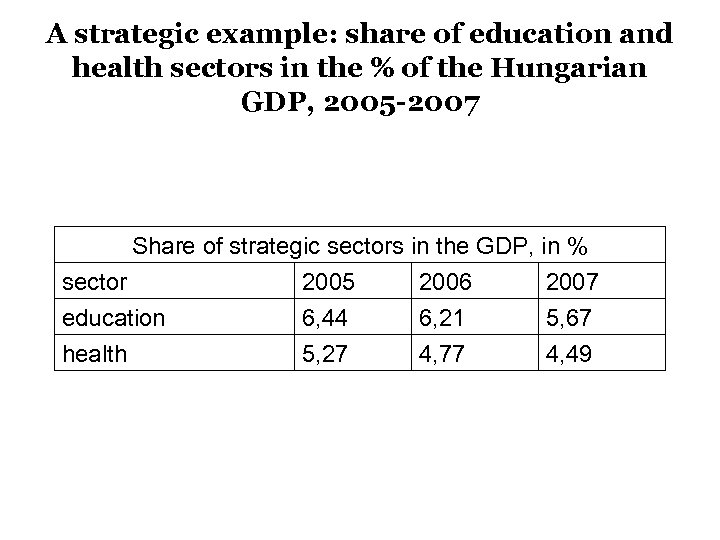 A strategic example: share of education and health sectors in the % of the Hungarian GDP, 2005 -2007 Share of strategic sectors in the GDP, in % sector 2005 2006 2007 education 6, 44 6, 21 5, 67 health 5, 27 4, 77 4, 49
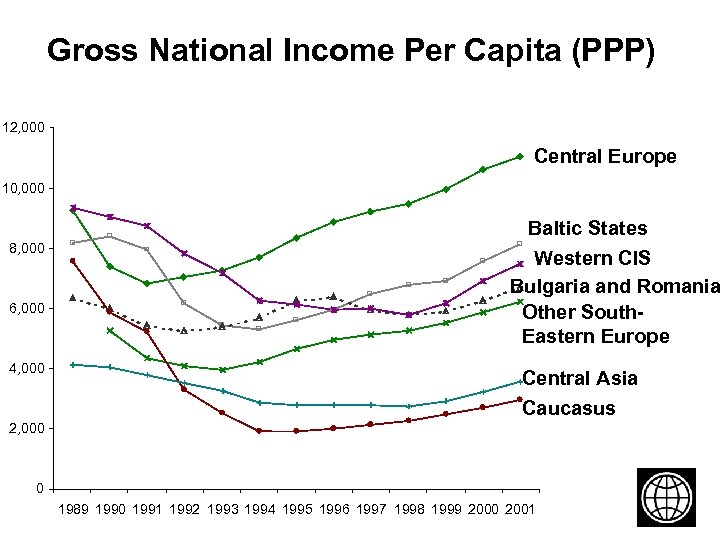 Gross National Income Per Capita (PPP) 12, 000 Central Europe 10, 000 8, 000 6, 000 4, 000 Baltic States Western CIS Bulgaria and Romania Other South. Eastern Europe Central Asia Caucasus 2, 000 0 1989 1990 1991 1992 1993 1994 1995 1996 1997 1998 1999 2000 2001
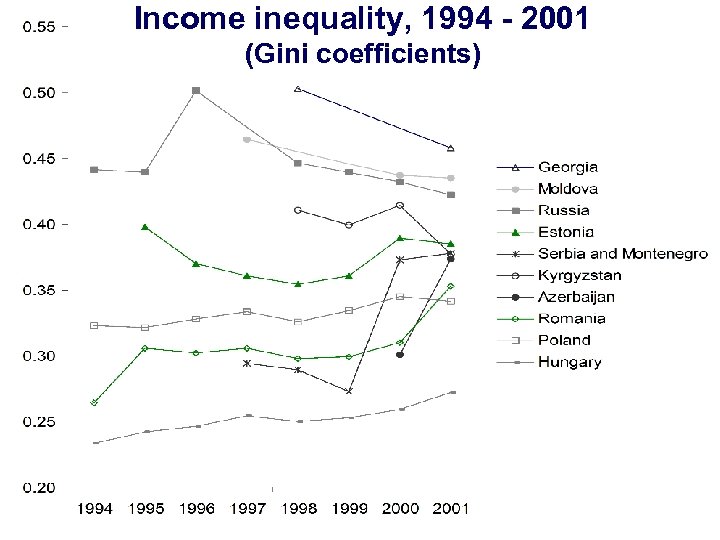 Income inequality, 1994 - 2001 (Gini coefficients)
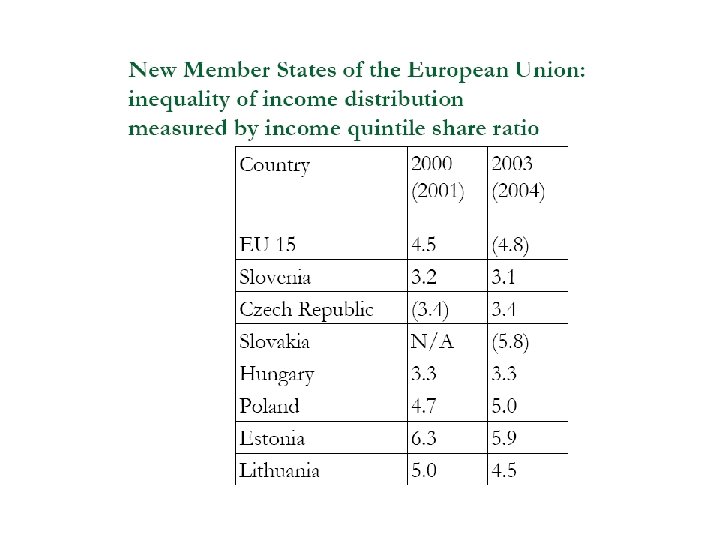
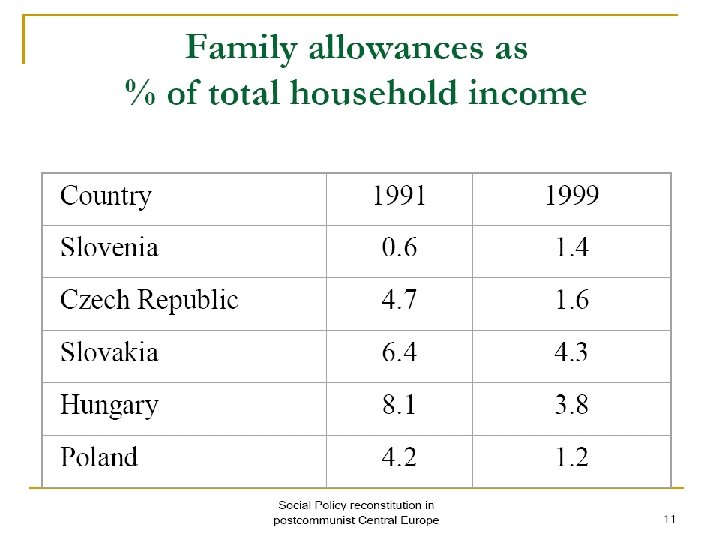
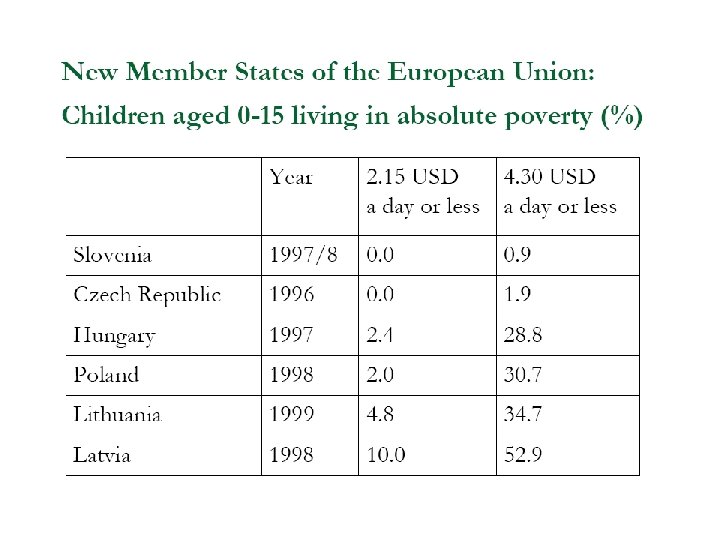
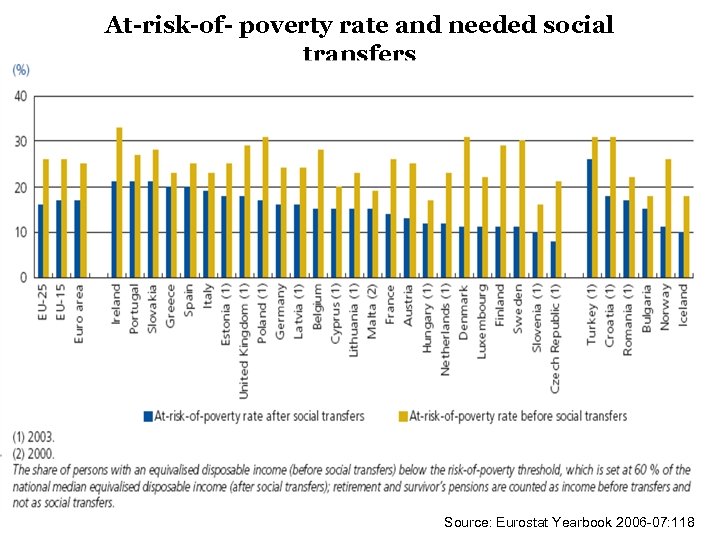 At-risk-of- poverty rate and needed social transfers Source: Eurostat Yearbook 2006 -07: 118
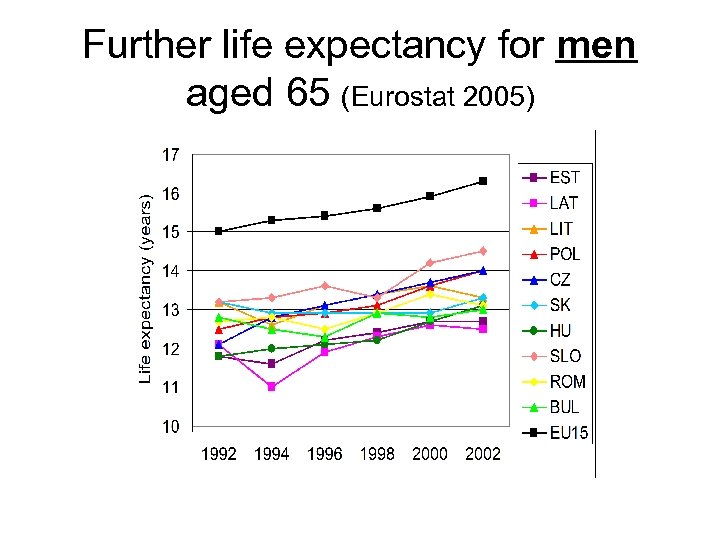 Further life expectancy for men aged 65 (Eurostat 2005)
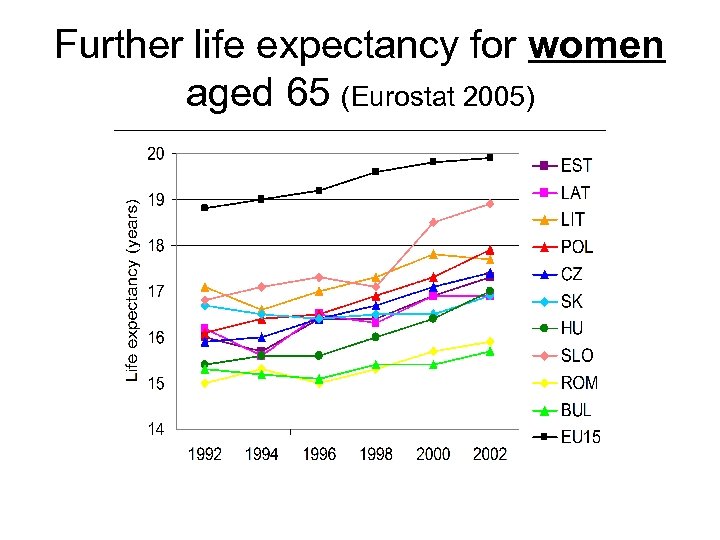 Further life expectancy for women aged 65 (Eurostat 2005)
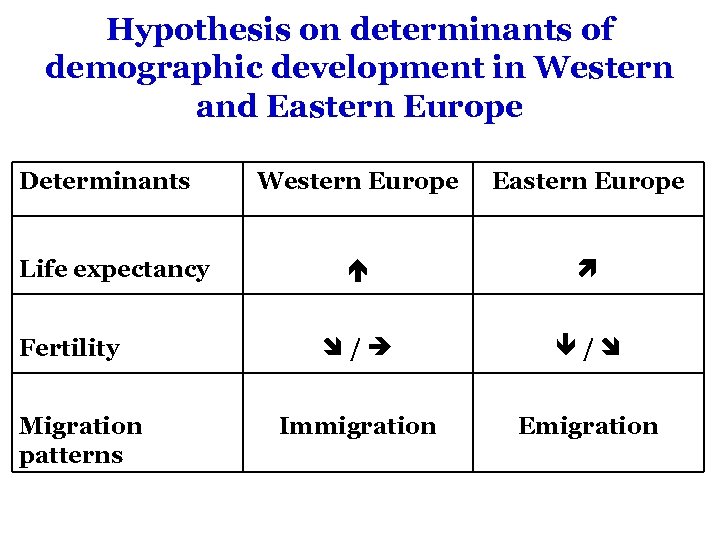 Hypothesis on determinants of demographic development in Western and Eastern Europe Determinants Life expectancy Fertility Migration patterns Western Europe Eastern Europe / / Immigration Emigration
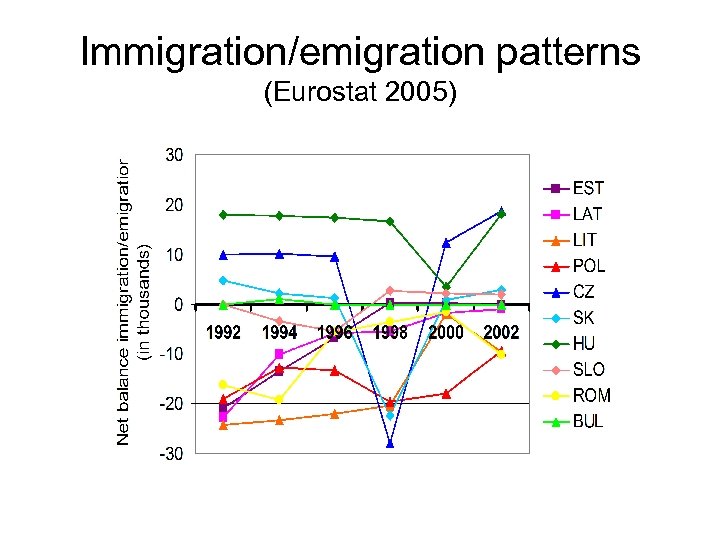 Immigration/emigration patterns (Eurostat 2005)
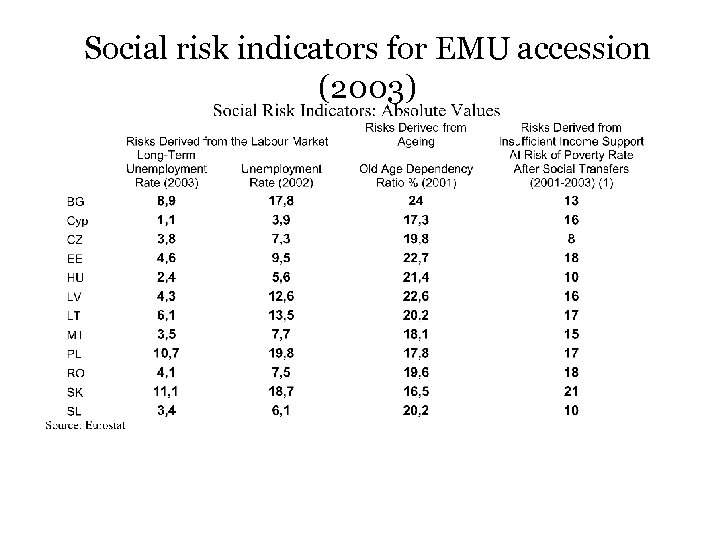 Social risk indicators for EMU accession (2003)
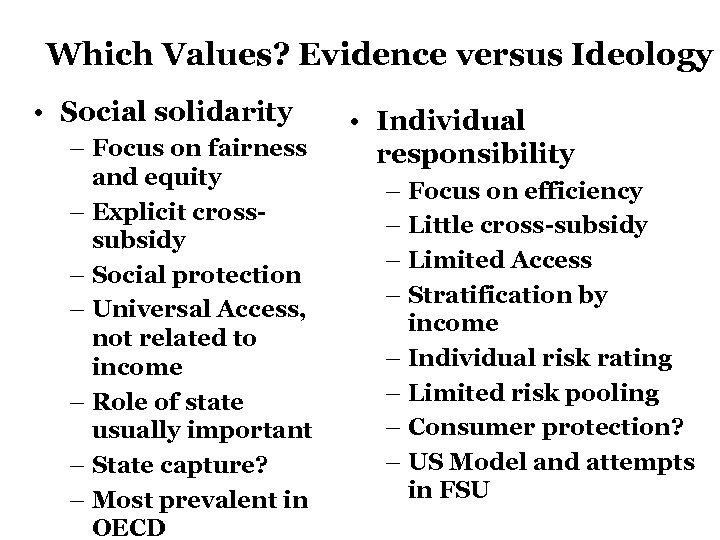 Which Values? Evidence versus Ideology • Social solidarity – Focus on fairness and equity – Explicit crosssubsidy – Social protection – Universal Access, not related to income – Role of state usually important – State capture? – Most prevalent in OECD • Individual responsibility – Focus on efficiency – Little cross-subsidy – Limited Access – Stratification by income – Individual risk rating – Limited risk pooling – Consumer protection? – US Model and attempts in FSU
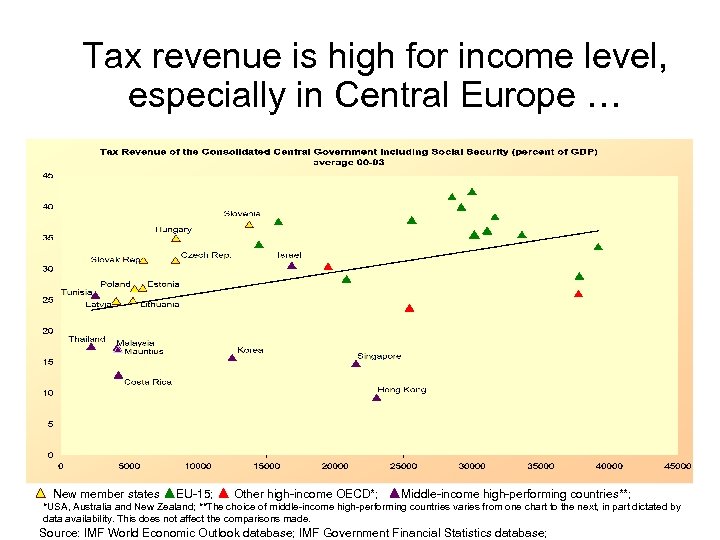 Tax revenue is high for income level, especially in Central Europe … New member states EU-15; Other high-income OECD*; Middle-income high-performing countries**; *USA, Australia and New Zealand; **The choice of middle-income high-performing countries varies from one chart to the next, in part dictated by data availability. This does not affect the comparisons made. Source: IMF World Economic Outlook database; IMF Government Financial Statistics database;
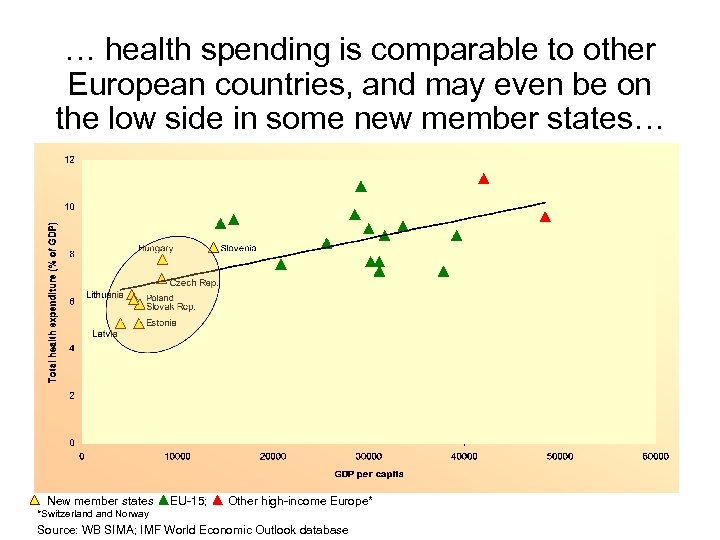 … health spending is comparable to other European countries, and may even be on the low side in some new member states… New member states EU-15; Other high-income Europe* *Switzerland Norway Source: WB SIMA; IMF World Economic Outlook database
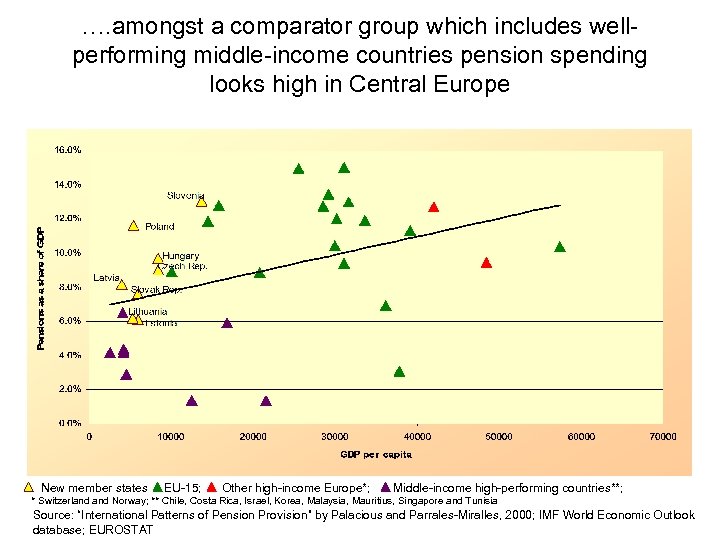 …. amongst a comparator group which includes wellperforming middle-income countries pension spending looks high in Central Europe New member states EU-15; Other high-income Europe*; Middle-income high-performing countries**; * Switzerland Norway; ** Chile, Costa Rica, Israel, Korea, Malaysia, Mauritius, Singapore and Tunisia Source: “International Patterns of Pension Provision” by Palacious and Parrales-Miralles, 2000; IMF World Economic Outlook database; EUROSTAT
 …. amongst a comparator group which includes wellperforming middle-income countries pension spending looks high in Central Europe New member states EU-15; Other high-income Europe*; Middle-income high-performing countries**; * Switzerland Norway; ** Chile, Costa Rica, Israel, Korea, Malaysia, Mauritius, Singapore and Tunisia Source: “International Patterns of Pension Provision” by Palacious and Parrales-Miralles, 2000; IMF World Economic Outlook database; EUROSTAT
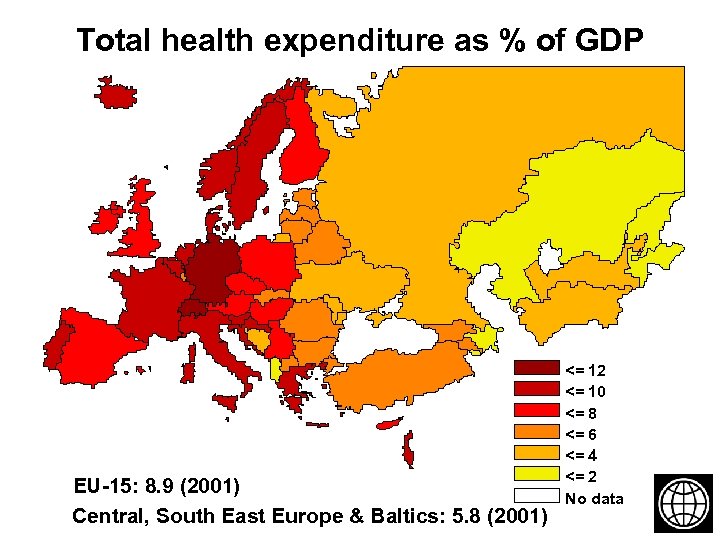 Total health expenditure as % of GDP EU-15: 8. 9 (2001) Central, South East Europe & Baltics: 5. 8 (2001) <= 12 <= 10 <= 8 <= 6 <= 4 <= 2 No data
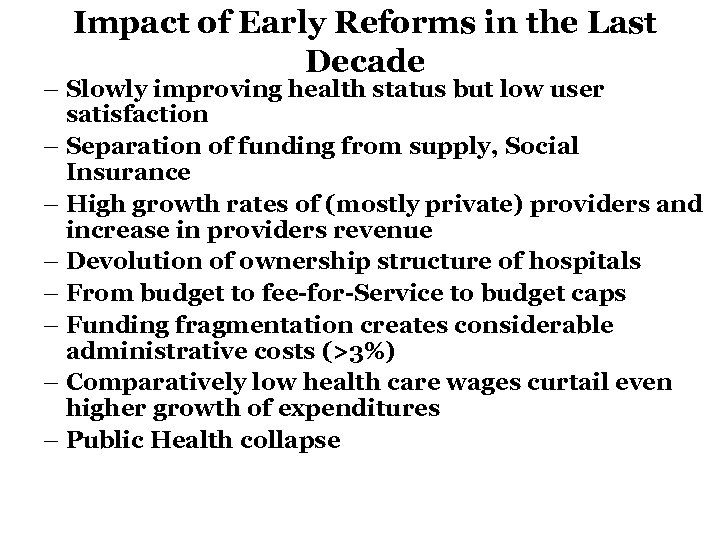 Impact of Early Reforms in the Last Decade – Slowly improving health status but low user satisfaction – Separation of funding from supply, Social Insurance – High growth rates of (mostly private) providers and increase in providers revenue – Devolution of ownership structure of hospitals – From budget to fee-for-Service to budget caps – Funding fragmentation creates considerable administrative costs (>3%) – Comparatively low health care wages curtail even higher growth of expenditures – Public Health collapse
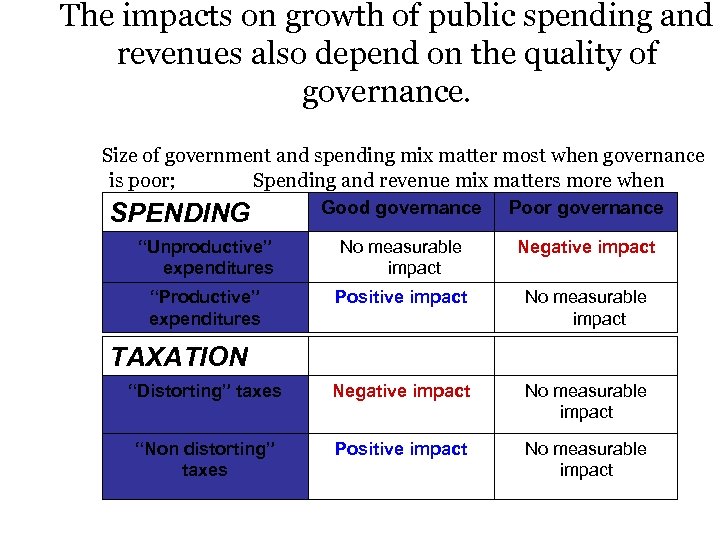 The impacts on growth of public spending and revenues also depend on the quality of governance. Size of government and spending mix matter most when governance is poor; Spending and revenue mix matters more when governance is good. Good governance Poor governance SPENDING “Unproductive” expenditures No measurable impact Negative impact “Productive” expenditures Positive impact No measurable impact “Distorting” taxes Negative impact No measurable impact “Non distorting” taxes Positive impact No measurable impact TAXATION