 Скачать презентацию Is the Semantic Web a Database Laks V
504d1f61c0b7ef15afc55f1304ea43d9.ppt
- Количество слайдов: 68



Is the (Semantic) Web a Database? Laks V. S. Lakshmanan University of British Columbia http: //www. cs. ubc. ca/~laks Joint work: Igor Naverniouk (UBC) Fereidoon Sadri Univ. of North Carolina @ Greensboro July 18, 2003 Thanks to: Wendy Wang Zhimin Chen 1
Debunking the hype in the title n Asilomar 98 Report: the web is a huge DB!… But the web ain’t a DB: Mendelzon, Nov. 98! n Our punchline: n Adding semantics doesn’t make it a DB! n BUT, a huge embedded collection of repositories of info. (and services) which could greatly benefit from a databasey abstraction n n Disclaimer: nnot a talk about SW. n. Work in progress. July 18, 2003 SW=DB? , Keynote, IDEAS 2003 2
Overview n n n What is the Semantic Web and why bother with it? The Web and Databases SW – technologies & tools The X-DARES-U project @ UBC Summary, Related Work, & Future Challenges July 18, 2003 SW=DB? , Keynote, IDEAS 2003 3
Overview n n n What is the Semantic Web and why bother with it? The Web and Databases SW – technologies & tools The X-DARES-U project @ UBC Summary, Related Work, & Future Challenges July 18, 2003 SW=DB? , Keynote, IDEAS 2003 4
Semantic Web – what and why n SW = Web + a host of technologies. n n XML and XML schema Resource Description Framework (RDF) and RDF schema Ontologies (domain specific) Ontology languages (DAML+OIL, OWL, …) n n n Description logics Key idea: semantically mark up your data (and functionality) So, SW = semantic view of the world (web) July 18, 2003 SW=DB? , Keynote, IDEAS 2003 5
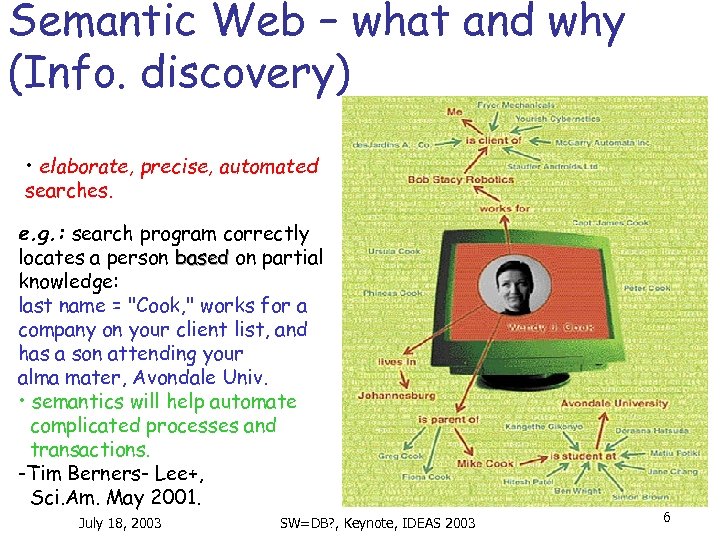
Semantic Web – what and why (Info. discovery) • elaborate, precise, automated searches. e. g. : search program correctly locates a person based on partial knowledge: last name = "Cook, " works for a company on your client list, and has a son attending your alma mater, Avondale Univ. • semantics will help automate complicated processes and transactions. -Tim Berners- Lee+, Sci. Am. May 2001. July 18, 2003 SW=DB? , Keynote, IDEAS 2003 6
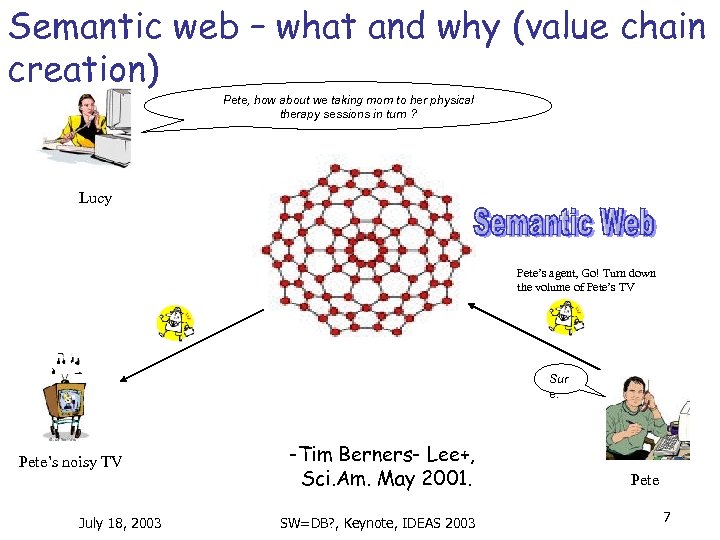
Semantic web – what and why (value chain creation) Pete, how about we taking mom to her physical therapy sessions in turn ? Lucy Pete’s agent, Go! Turn down the volume of Pete’s TV Sur e. Pete’s noisy TV July 18, 2003 -Tim Berners- Lee+, Sci. Am. May 2001. SW=DB? , Keynote, IDEAS 2003 Pete 7
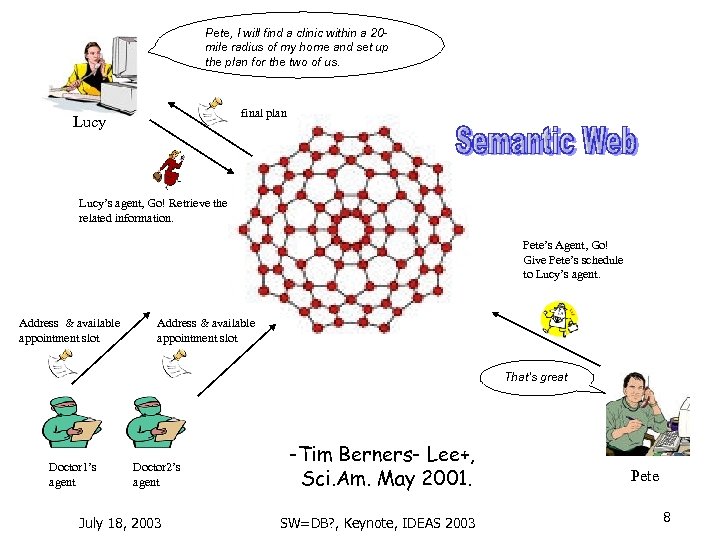
Pete, I will find a clinic within a 20 mile radius of my home and set up the plan for the two of us. final plan Lucy’s agent, Go! Retrieve the related information. Pete’s Agent, Go! Give Pete’s schedule to Lucy’s agent. Address & available appointment slot That’s great Doctor 1’s agent Doctor 2’s agent July 18, 2003 -Tim Berners- Lee+, Sci. Am. May 2001. SW=DB? , Keynote, IDEAS 2003 Pete 8
Semantic Web – what and why “Is this rocket science? Well, not really. The Semantic Web, like the World Wide Web, is just taking well established ideas, and making them work interoperability over the Internet. This is done with standards, which is what the World Wide Web Consortium is all about. We are not inventing relational models for data, or query systems or rule-based systems. We are just webizing them. We are just allowing them to work together in a decentralized system - without a human having to custom handcraft every connection. ” -- Tim Berners-Lee, Business Case for the Semantic Web, http: //www. w 3. org/Design. Issues/Business July 18, 2003 SW=DB? , Keynote, IDEAS 2003 9
Overview n n n What is the Semantic Web and why bother with it? The Web and Databases SW – technologies & tools The X-DARES-U project @ UBC Summary, Related Work, & Future Challenges July 18, 2003 SW=DB? , Keynote, IDEAS 2003 10
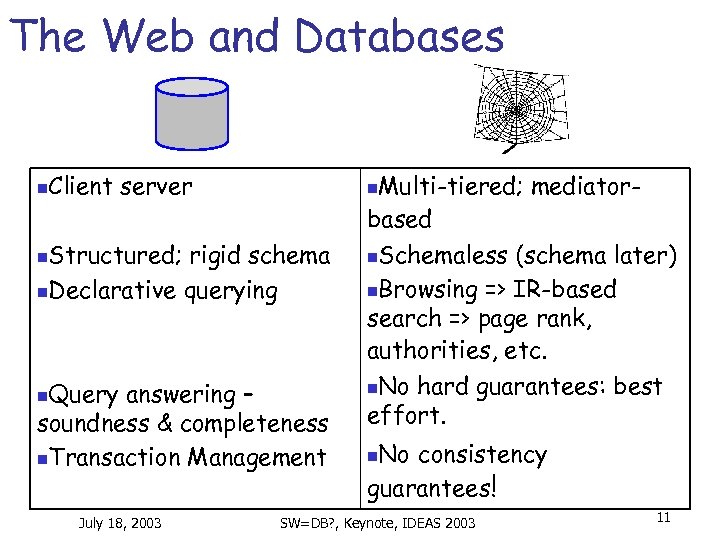
The Web and Databases n Client server Structured; rigid schema n. Declarative querying n Query answering – soundness & completeness n. Transaction Management n July 18, 2003 Multi-tiered; mediatorbased n. Schemaless (schema later) n. Browsing => IR-based search => page rank, authorities, etc. n. No hard guarantees: best effort. n No consistency guarantees! n SW=DB? , Keynote, IDEAS 2003 11
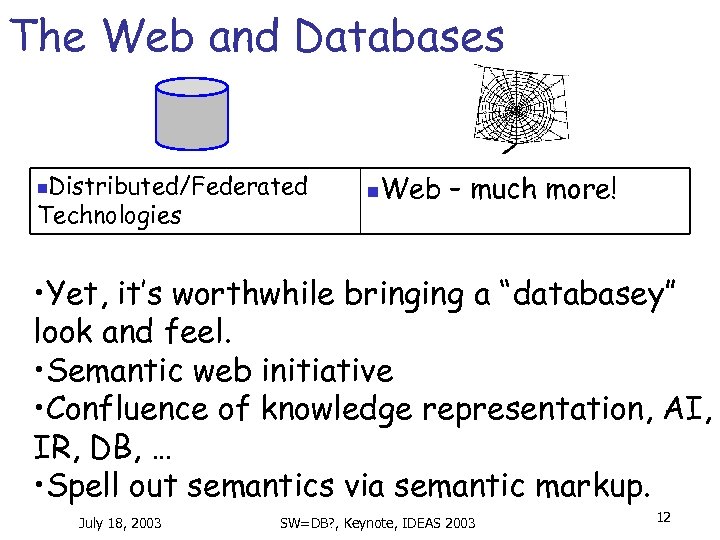
The Web and Databases Distributed/Federated Technologies n n Web – much more! • Yet, it’s worthwhile bringing a “databasey” look and feel. • Semantic web initiative • Confluence of knowledge representation, AI, IR, DB, … • Spell out semantics via semantic markup. July 18, 2003 SW=DB? , Keynote, IDEAS 2003 12
Overview n n n What is the Semantic Web and why bother with it? The Web and Databases SW – technologies & tools The X-DARES-U project @ UBC Summary, Related Work, & Future Challenges July 18, 2003 SW=DB? , Keynote, IDEAS 2003 13
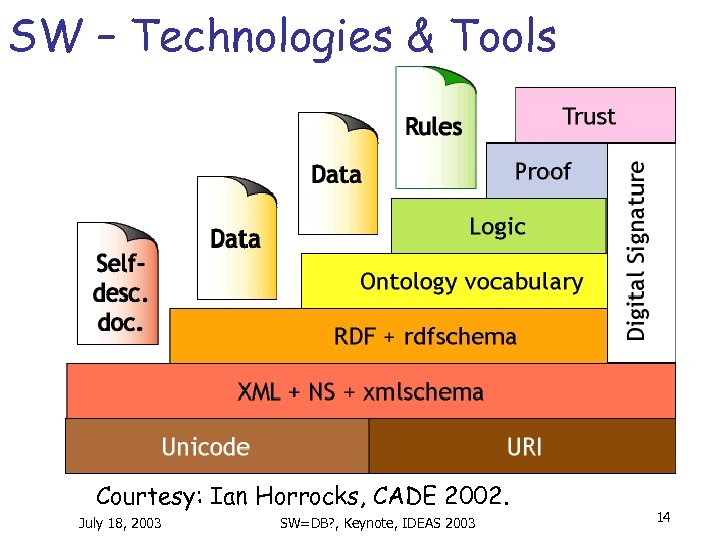
SW – Technologies & Tools Courtesy: Ian Horrocks, CADE 2002. July 18, 2003 SW=DB? , Keynote, IDEAS 2003 14
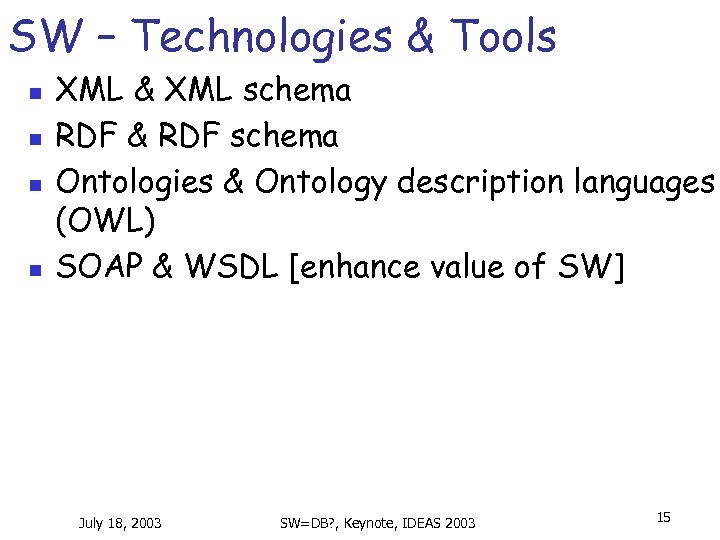
SW – Technologies & Tools n n XML & XML schema RDF & RDF schema Ontologies & Ontology description languages (OWL) SOAP & WSDL [enhance value of SW] July 18, 2003 SW=DB? , Keynote, IDEAS 2003 15
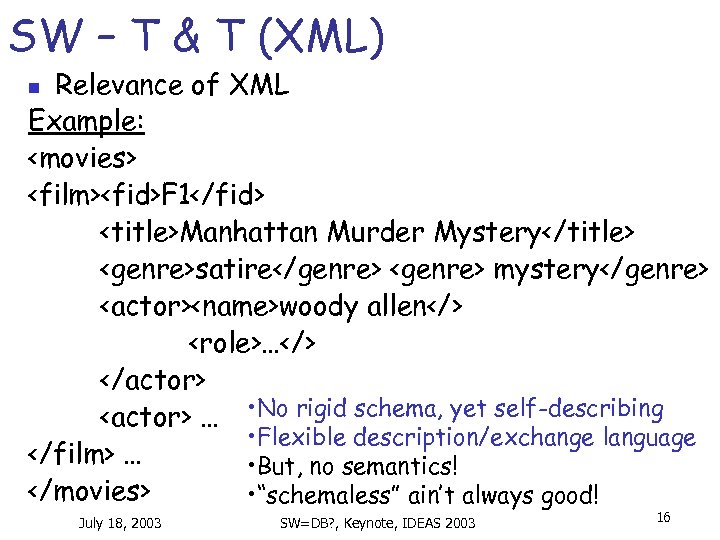
SW – T & T (XML) Relevance of XML Example: <movies> <film><fid>F 1</fid> <title>Manhattan Murder Mystery</title> <genre>satire</genre> <genre> mystery</genre> <actor><name>woody allen</> <role>…</> </actor> <actor> … • No rigid schema, yet self-describing • Flexible description/exchange language </film> … • But, no semantics! </movies> • “schemaless” ain’t always good! n July 18, 2003 SW=DB? , Keynote, IDEAS 2003 16
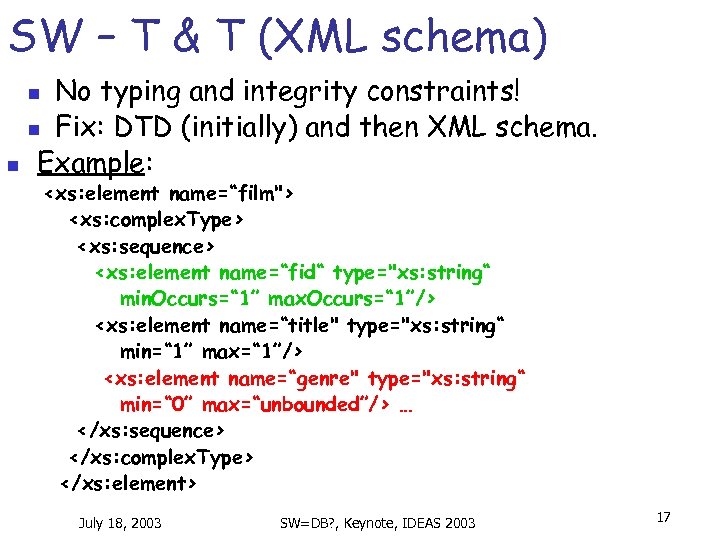
SW – T & T (XML schema) No typing and integrity constraints! n Fix: DTD (initially) and then XML schema. n Example: n <xs: element name=“film"> <xs: complex. Type> <xs: sequence> <xs: element name=“fid“ type="xs: string“ min. Occurs=“ 1” max. Occurs=“ 1”/> <xs: element name=“title" type="xs: string“ min=“ 1” max=“ 1”/> <xs: element name=“genre" type="xs: string“ min=“ 0” max=“unbounded”/> … </xs: sequence> </xs: complex. Type> </xs: element> July 18, 2003 SW=DB? , Keynote, IDEAS 2003 17
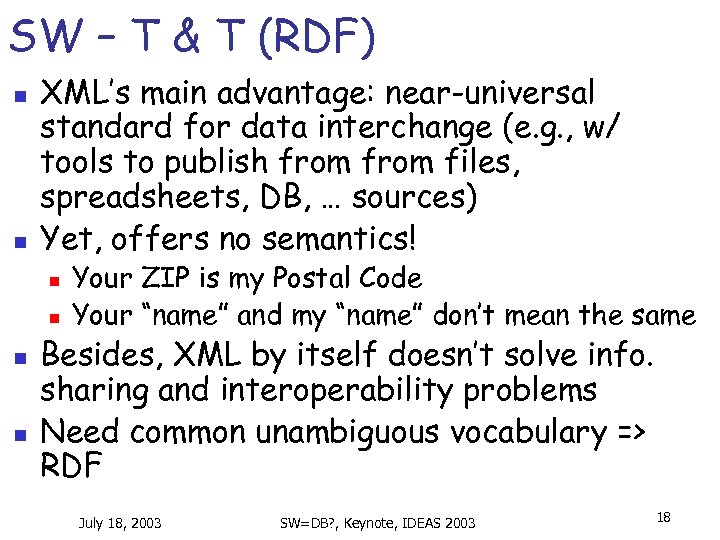
SW – T & T (RDF) n n XML’s main advantage: near-universal standard for data interchange (e. g. , w/ tools to publish from files, spreadsheets, DB, … sources) Yet, offers no semantics! n n Your ZIP is my Postal Code Your “name” and my “name” don’t mean the same Besides, XML by itself doesn’t solve info. sharing and interoperability problems Need common unambiguous vocabulary => RDF July 18, 2003 SW=DB? , Keynote, IDEAS 2003 18
SW – T & T (RDF) n Syntax for describing data/resources on the web & relationships in terms of classes and properties July 18, 2003 SW=DB? , Keynote, IDEAS 2003 19
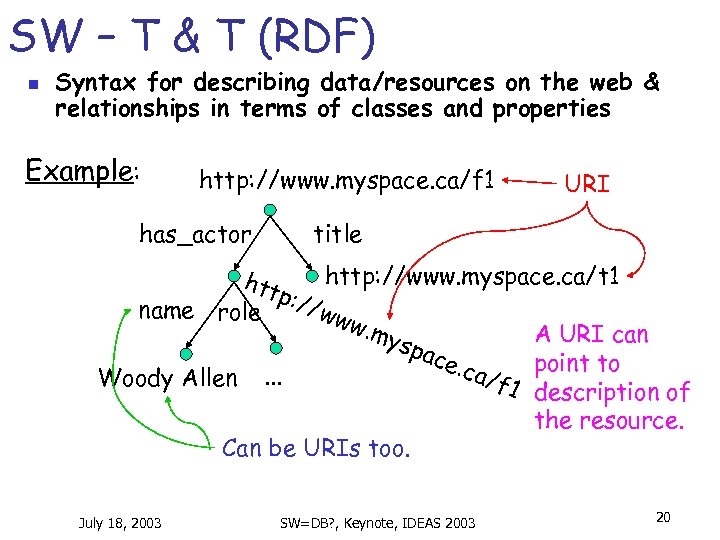
SW – T & T (RDF) n Syntax for describing data/resources on the web & relationships in terms of classes and properties Example: http: //www. myspace. ca/f 1 has_actor URI title http: //www. myspace. ca/t 1 htt p: / /ww name role w. m A URI can ysp ace point to. ca/ Woody Allen. . . f 1 description of Can be URIs too. July 18, 2003 SW=DB? , Keynote, IDEAS 2003 the resource. 20
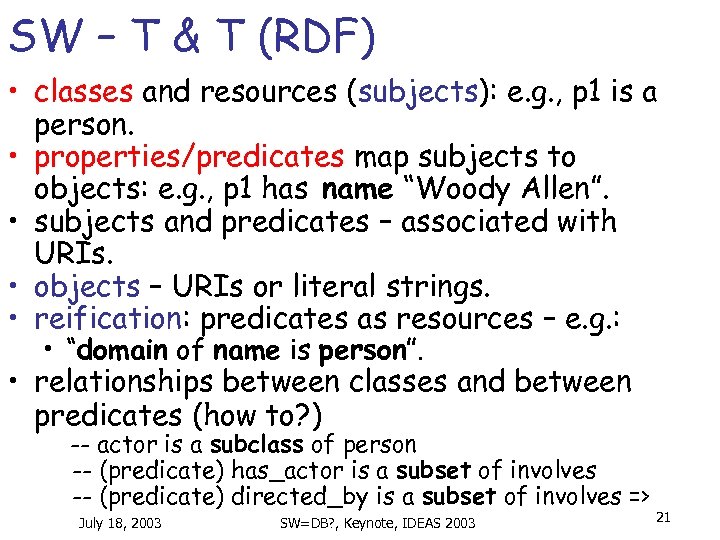
SW – T & T (RDF) • classes and resources (subjects): e. g. , p 1 is a person. • properties/predicates map subjects to objects: e. g. , p 1 has name “Woody Allen”. • subjects and predicates – associated with URIs. • objects – URIs or literal strings. • reification: predicates as resources – e. g. : • “domain of name is person”. • relationships between classes and between predicates (how to? ) -- actor is a subclass of person -- (predicate) has_actor is a subset of involves -- (predicate) directed_by is a subset of involves => July 18, 2003 SW=DB? , Keynote, IDEAS 2003 21
SW – T & T (RDF schema) n n RDFS – provides RDF vocabulary description and type system. similar to but different from OO languages’ type systems: property-centric vs. classcentric. ontology description languages such as OWL build on it. Example => July 18, 2003 SW=DB? , Keynote, IDEAS 2003 22
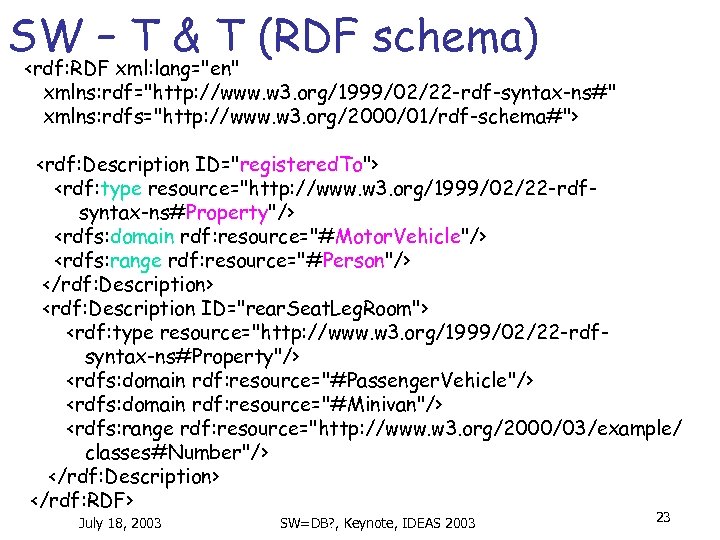
SW – T & T (RDF schema) <rdf: RDF xml: lang="en" xmlns: rdf="http: //www. w 3. org/1999/02/22 -rdf-syntax-ns#" xmlns: rdfs="http: //www. w 3. org/2000/01/rdf-schema#"> <rdf: Description ID="registered. To"> <rdf: type resource="http: //www. w 3. org/1999/02/22 -rdfsyntax-ns#Property"/> <rdfs: domain rdf: resource="#Motor. Vehicle"/> <rdfs: range rdf: resource="#Person"/> </rdf: Description> <rdf: Description ID="rear. Seat. Leg. Room"> <rdf: type resource="http: //www. w 3. org/1999/02/22 -rdfsyntax-ns#Property"/> <rdfs: domain rdf: resource="#Passenger. Vehicle"/> <rdfs: domain rdf: resource="#Minivan"/> <rdfs: range rdf: resource="http: //www. w 3. org/2000/03/example/ classes#Number"/> </rdf: Description> </rdf: RDF> July 18, 2003 SW=DB? , Keynote, IDEAS 2003 23
SW – T & T (OWL) n n n RDF/RDF schema – too weak to completely describe semantics of application/data. Role filled by languages like DAML+OIL, OWL. E. g. , how does an application know watch in one source, wristwatch in another, and clock in a third are closely related? How does it know that curb and kerb are essentially the same thing? More generally, need for relating various terms used in an app. domain and their boolean combos. => ontology. July 18, 2003 SW=DB? , Keynote, IDEAS 2003 24
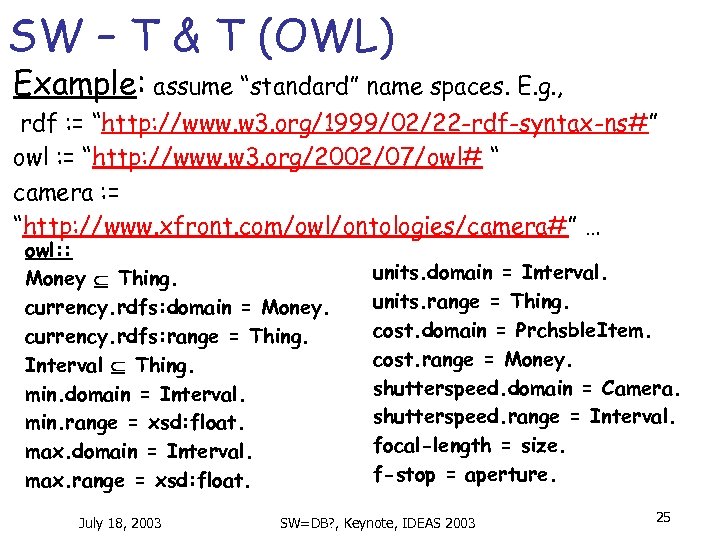
SW – T & T (OWL) Example: assume “standard” name spaces. E. g. , rdf : = “http: //www. w 3. org/1999/02/22 -rdf-syntax-ns#” owl : = “http: //www. w 3. org/2002/07/owl# “ camera : = “http: //www. xfront. com/owl/ontologies/camera#” … owl: : Money Thing. currency. rdfs: domain = Money. currency. rdfs: range = Thing. Interval Thing. min. domain = Interval. min. range = xsd: float. max. domain = Interval. max. range = xsd: float. July 18, 2003 units. domain = Interval. units. range = Thing. cost. domain = Prchsble. Item. cost. range = Money. shutterspeed. domain = Camera. shutterspeed. range = Interval. focal-length = size. f-stop = aperture. SW=DB? , Keynote, IDEAS 2003 25
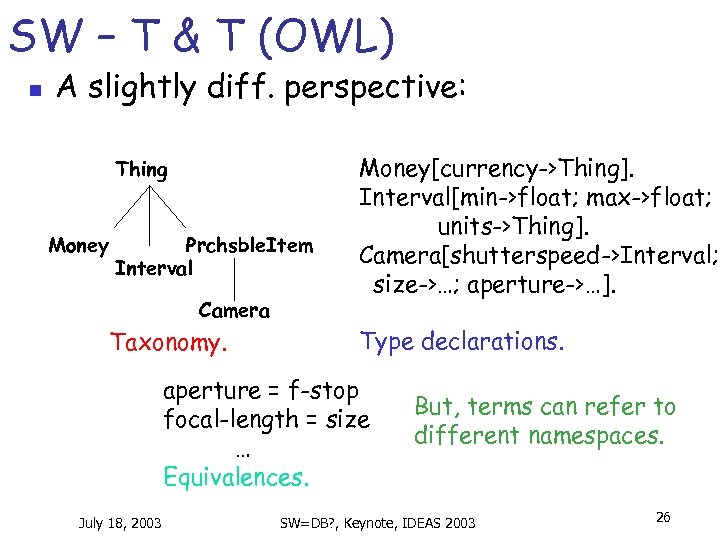
SW – T & T (OWL) n A slightly diff. perspective: Thing Money Prchsble. Item Interval Camera Taxonomy. Money[currency->Thing]. Interval[min->float; max->float; units->Thing]. Camera[shutterspeed->Interval; size->…; aperture->…]. Type declarations. aperture = f-stop focal-length = size … Equivalences. July 18, 2003 But, terms can refer to different namespaces. SW=DB? , Keynote, IDEAS 2003 26
SW – T & T (SOAP) n n Protocol for exchanging info. over http. Platform & language independent. XML-based. Based on request and response. n n E. g. , get. Stock. Price: specify stock. Name and obtain stock. Price. Mandatory & optional functions. Many hops possible between sender and ultimate receiver w/ obligations for intermediate nodes. RPC for web apps. Flexible. July 18, 2003 SW=DB? , Keynote, IDEAS 2003 27
SW – T & T (WSDL) n n n n Distributed computing on the web. Invoke remote method on your data. Invoke remote method on data from some place else. Obtain/provide data (XML). WSDL spec. – XML doc describing service location and operations supported (and types). Used in tandem with SOAP (or other protocols). UDDI – web services registry. July 18, 2003 SW=DB? , Keynote, IDEAS 2003 28
Overview n n n What is the Semantic Web and why bother with it? The Web and Databases SW – technologies & tools The X-DARES-U project @ UBC Summary, Related Work, & Future Challenges July 18, 2003 SW=DB? , Keynote, IDEAS 2003 29
The X-DARES-U Project at UBC n n n Vision and Goals Architecture XML interoperability Current status Based on [Lakshmanan & Sadri ICSW ’ 03]. July 18, 2003 SW=DB? , Keynote, IDEAS 2003 30
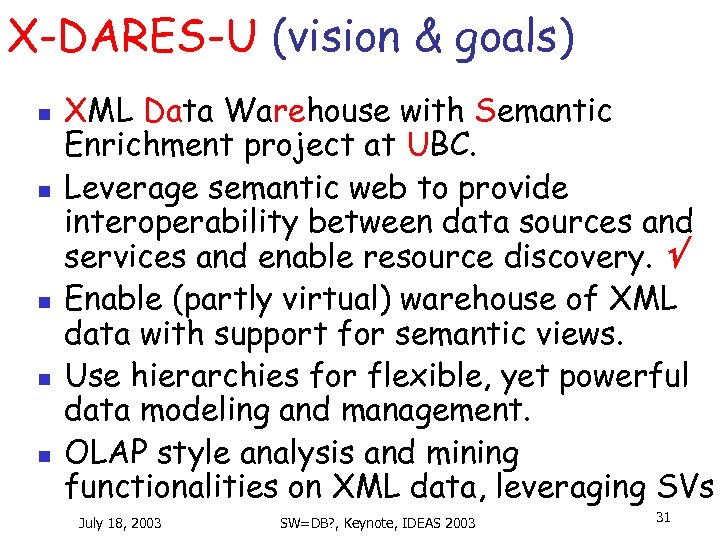
X-DARES-U (vision & goals) n n n XML Data Warehouse with Semantic Enrichment project at UBC. Leverage semantic web to provide interoperability between data sources and services and enable resource discovery. Enable (partly virtual) warehouse of XML data with support for semantic views. Use hierarchies for flexible, yet powerful data modeling and management. OLAP style analysis and mining functionalities on XML data, leveraging SVs July 18, 2003 SW=DB? , Keynote, IDEAS 2003 31
X-DARES-U (architecture) July 18, 2003 SW=DB? , Keynote, IDEAS 2003 32
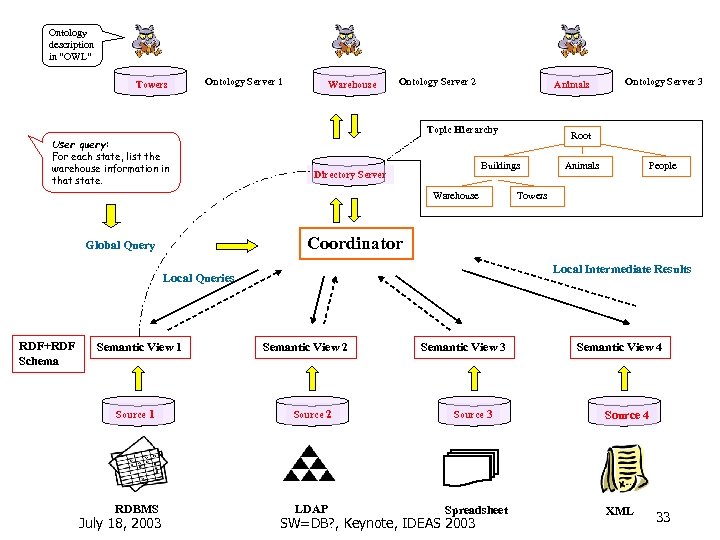
Ontology description in “OWL” Towers Ontology Server 1 Warehouse Ontology Server 2 Animals Topic Hierarchy User query: For each state, list the warehouse information in that state. Warehouse Semantic View 1 1 RDBMS July 18, 2003 People Towers Local Intermediate Results Local Queries Source Animals Coordinator Global Query RDF+RDF Schema Root Buildings Directory Server Ontology Server 3 Semantic View 2 Source 2 LDAP Semantic View 3 Source 3 Spreadsheet SW=DB? , Keynote, IDEAS 2003 Semantic View 4 Source 4 XML 33
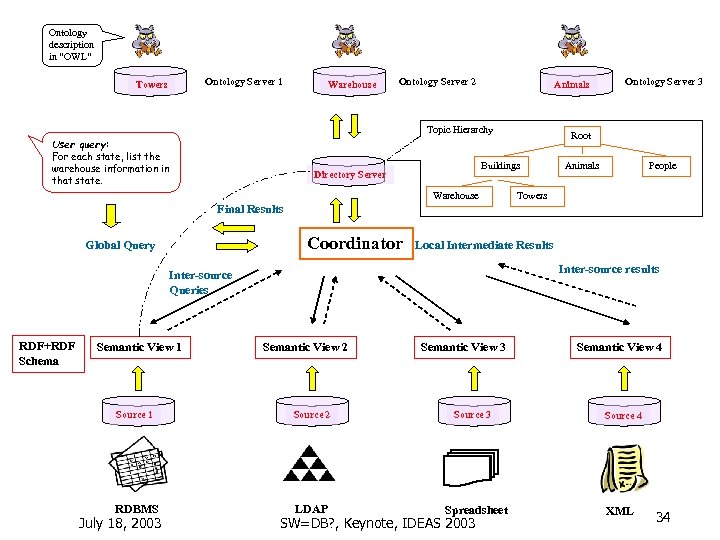
Ontology description in “OWL” Ontology Server 1 Towers Warehouse Ontology Server 2 Animals Topic Hierarchy User query: For each state, list the warehouse information in that state. Root Buildings Directory Server Warehouse Ontology Server 3 Animals People Towers Final Results Coordinator Global Query Local Intermediate Results Inter-source results Inter-source Queries RDF+RDF Schema Semantic View 1 Source 1 RDBMS July 18, 2003 Semantic View 2 Source 2 LDAP Semantic View 3 Source 3 Spreadsheet SW=DB? , Keynote, IDEAS 2003 Semantic View 4 Source 4 XML 34
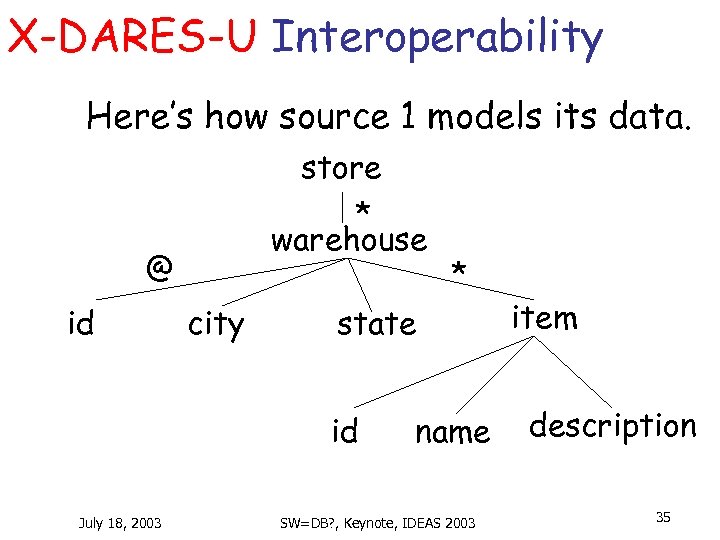
X-DARES-U Interoperability Here’s how source 1 models its data. store * warehouse @ id city state id July 18, 2003 * name SW=DB? , Keynote, IDEAS 2003 item description 35
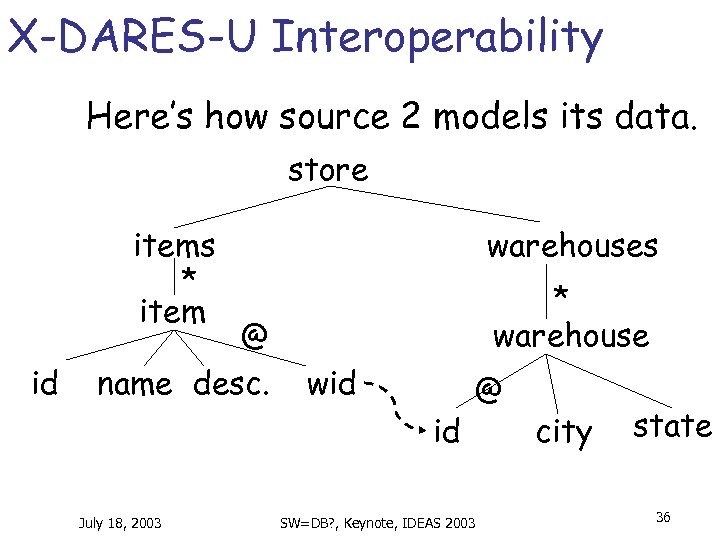
X-DARES-U Interoperability Here’s how source 2 models its data. store items * item id @ name desc. warehouses * warehouse wid id July 18, 2003 @ SW=DB? , Keynote, IDEAS 2003 city state 36
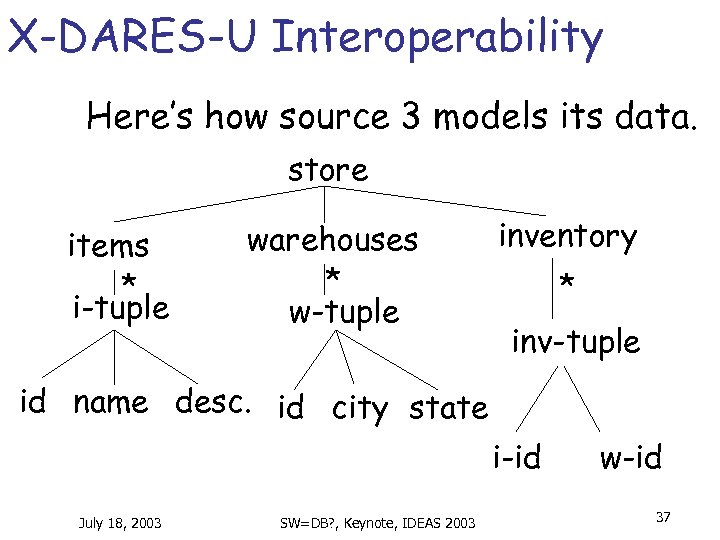
X-DARES-U Interoperability Here’s how source 3 models its data. store items * i-tuple warehouses * w-tuple inventory * inv-tuple id name desc. id city state i-id July 18, 2003 SW=DB? , Keynote, IDEAS 2003 w-id 37
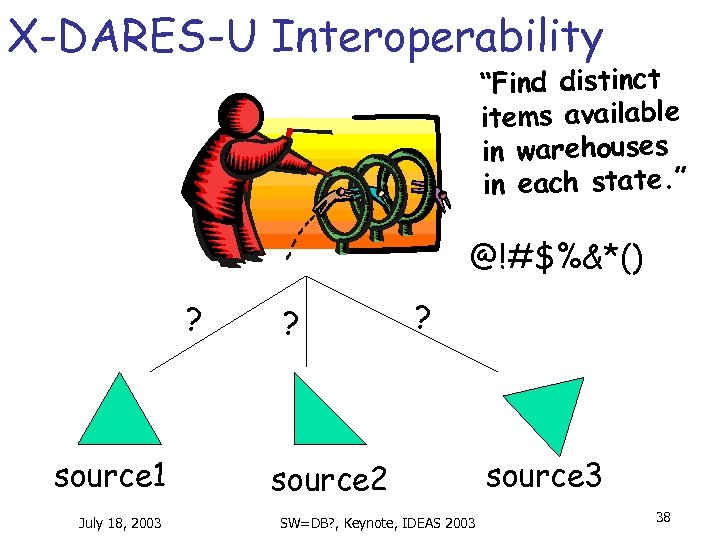
X-DARES-U Interoperability “Find distinct items available in warehouses in each state. ” @!#$%&*() ? source 1 July 18, 2003 ? ? source 2 SW=DB? , Keynote, IDEAS 2003 source 3 38
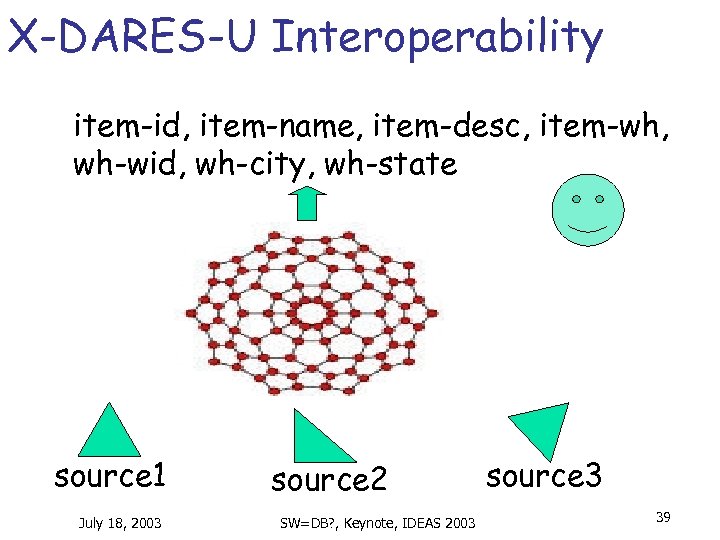
X-DARES-U Interoperability item-id, item-name, item-desc, item-wh, wh-wid, wh-city, wh-state source 1 July 18, 2003 source 2 SW=DB? , Keynote, IDEAS 2003 source 3 39
![X-DARES-U Interoperability FOR $S IN distinct(doc(…)/wh-state/tuple/state) RETURN <state> {$S} FOR $X IN doc(…)/wh-state/tuple[state=$S], $Y](https://present5.com/presentation/504d1f61c0b7ef15afc55f1304ea43d9/image-40.jpg "X-DARES-U Interoperability FOR $S IN distinct(doc(…)/wh-state/tuple/state) RETURN <state> {$S} FOR $X IN doc(…)/wh-state/tuple[state=$S], $Y")
X-DARES-U Interoperability FOR $S IN distinct(doc(…)/wh-state/tuple/state) RETURN <state> {$S} FOR $X IN doc(…)/wh-state/tuple[state=$S], $Y IN doc(…)/i-wh/tuple[wh = $X/wh], $Z IN doc(…)/i-id/tuple[item = $Y/item] RETURN <item><id> distinct($Z/item. Id)}</></></> coordinator source 1 July 18, 2003 source 2 SW=DB? , Keynote, IDEAS 2003 wh-state Join item-wh Join item-id source 3 40
X-DARES-U Interoperability n n But who creates these semantic views and how? Who: Local data source administrators. n n n How: we envisage SV authoring tools. Additionally, queries and applications can leverage domain specific ontologies. Several in existence or offing already: n n n camera. owl (www. xfront. com) Dublin core (generic ontology for docs) GPS coordinate, security, space shuttle, … (orlando. drc. com/Semantic. Web/Topics/Ontology/Ontol ogies. htm) July 18, 2003 SW=DB? , Keynote, IDEAS 2003 41
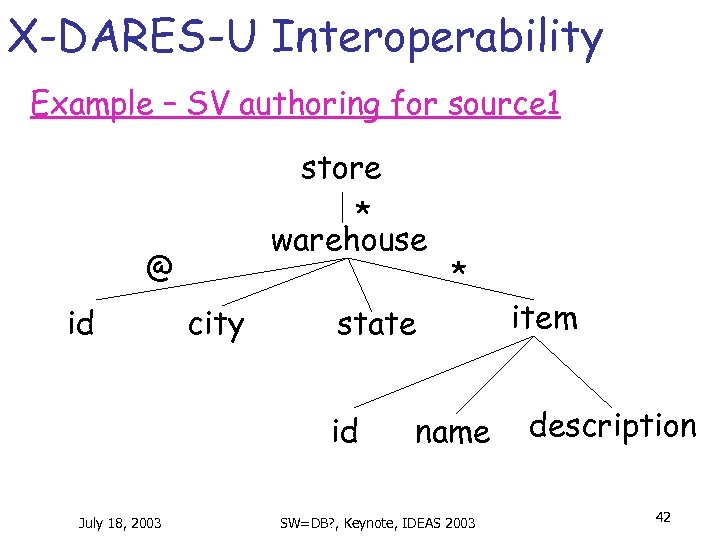
X-DARES-U Interoperability Example – SV authoring for source 1 store * warehouse @ id city state id July 18, 2003 * name SW=DB? , Keynote, IDEAS 2003 item description 42
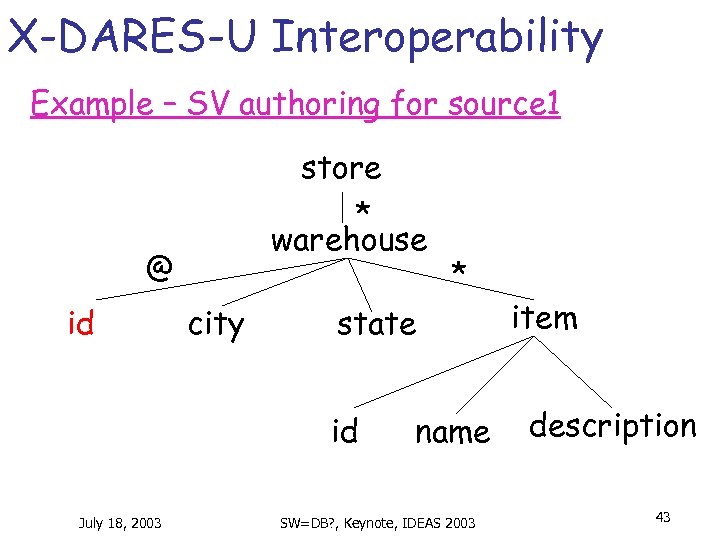
X-DARES-U Interoperability Example – SV authoring for source 1 store * warehouse @ id city state id July 18, 2003 * name SW=DB? , Keynote, IDEAS 2003 item description 43
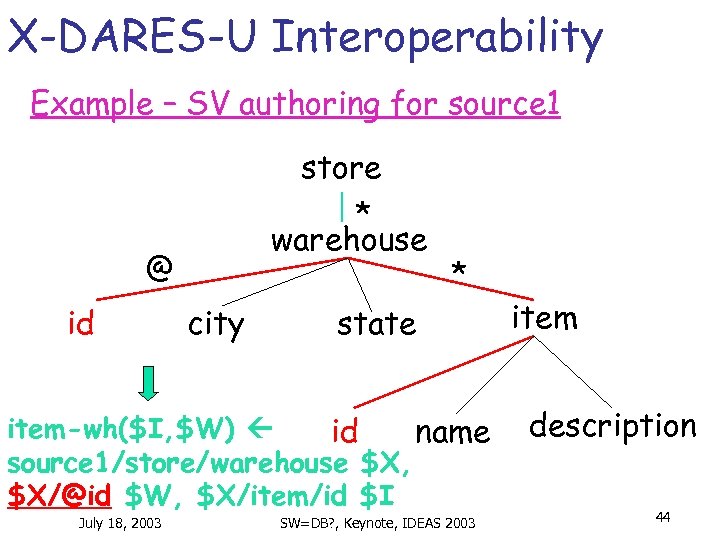
X-DARES-U Interoperability Example – SV authoring for source 1 store * warehouse @ id city * state item-wh($I, $W) id name source 1/store/warehouse $X, $X/@id $W, $X/item/id $I July 18, 2003 SW=DB? , Keynote, IDEAS 2003 item description 44
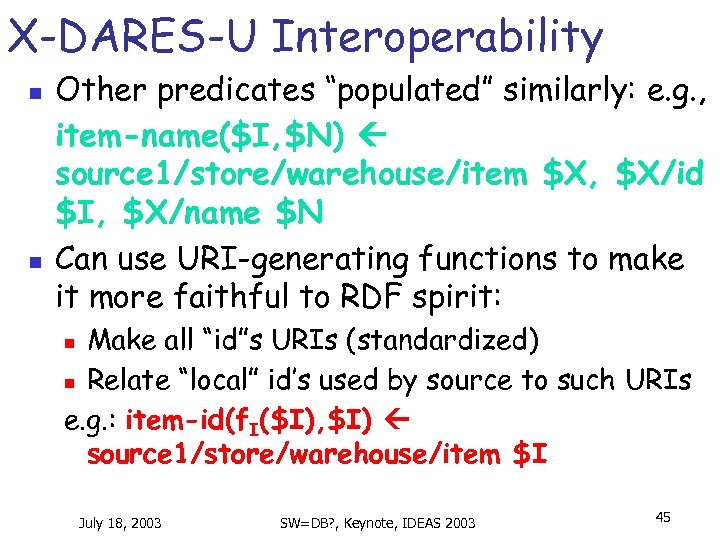
X-DARES-U Interoperability n n Other predicates “populated” similarly: e. g. , item-name($I, $N) source 1/store/warehouse/item $X, $X/id $I, $X/name $N Can use URI-generating functions to make it more faithful to RDF spirit: Make all “id”s URIs (standardized) n Relate “local” id’s used by source to such URIs e. g. : item-id(f. I($I), $I) source 1/store/warehouse/item $I n July 18, 2003 SW=DB? , Keynote, IDEAS 2003 45
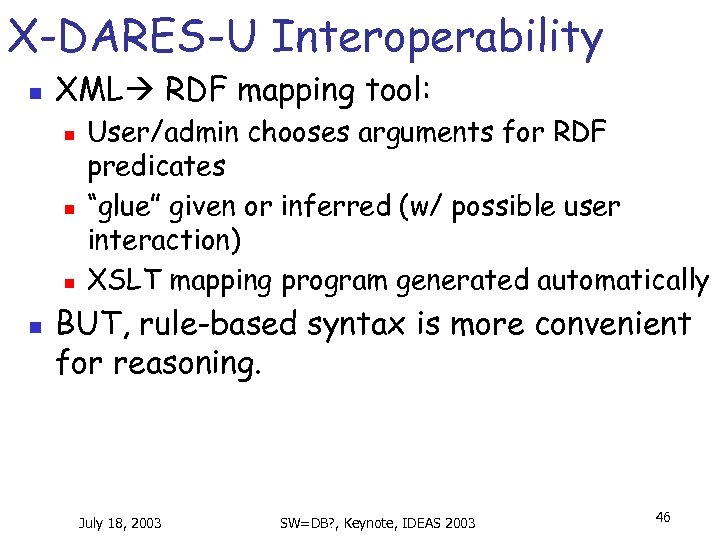
X-DARES-U Interoperability n XML RDF mapping tool: n n User/admin chooses arguments for RDF predicates “glue” given or inferred (w/ possible user interaction) XSLT mapping program generated automatically BUT, rule-based syntax is more convenient for reasoning. July 18, 2003 SW=DB? , Keynote, IDEAS 2003 46
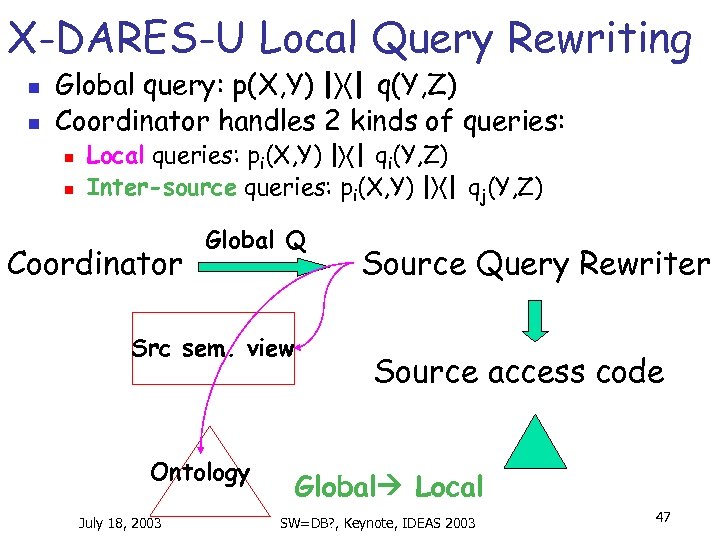
X-DARES-U Local Query Rewriting n n Global query: p(X, Y) | | q(Y, Z) Coordinator handles 2 kinds of queries: n n Local queries: pi(X, Y) | | qi(Y, Z) Inter-source queries: pi(X, Y) | | qj(Y, Z) Coordinator Global Q Src sem. view Ontology July 18, 2003 Source Query Rewriter Source access code Global Local SW=DB? , Keynote, IDEAS 2003 47
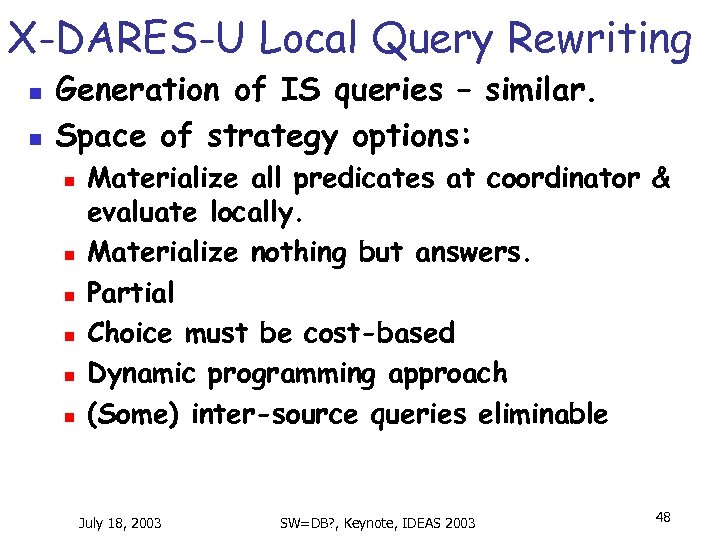
X-DARES-U Local Query Rewriting n n Generation of IS queries – similar. Space of strategy options: n n n Materialize all predicates at coordinator & evaluate locally. Materialize nothing but answers. Partial Choice must be cost-based Dynamic programming approach (Some) inter-source queries eliminable July 18, 2003 SW=DB? , Keynote, IDEAS 2003 48
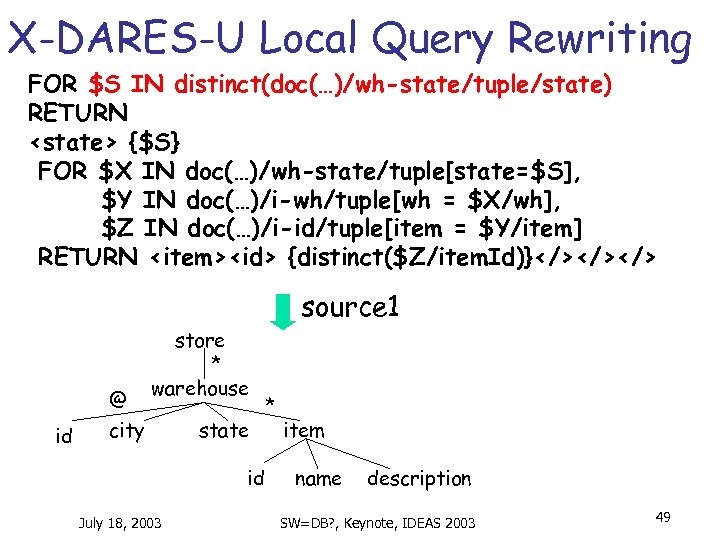
X-DARES-U Local Query Rewriting FOR $S IN distinct(doc(…)/wh-state/tuple/state) RETURN <state> {$S} FOR $X IN doc(…)/wh-state/tuple[state=$S], $Y IN doc(…)/i-wh/tuple[wh = $X/wh], $Z IN doc(…)/i-id/tuple[item = $Y/item] RETURN <item><id> {distinct($Z/item. Id)}</></></> source 1 id @ city store * warehouse state id July 18, 2003 * item name description SW=DB? , Keynote, IDEAS 2003 49
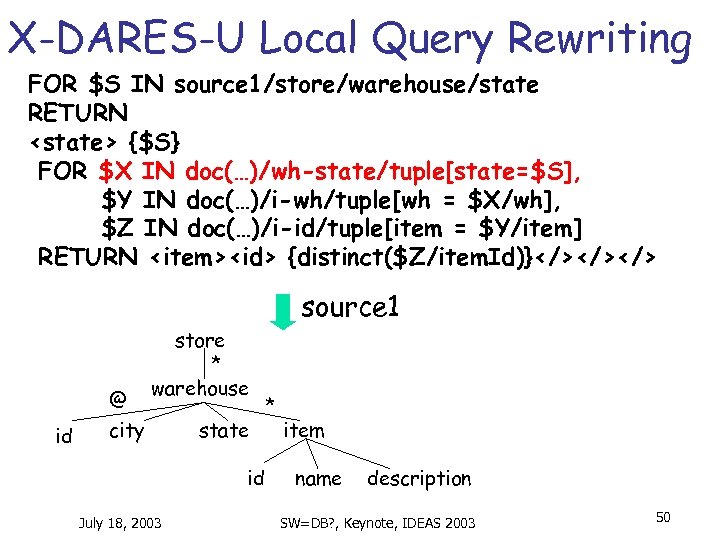
X-DARES-U Local Query Rewriting FOR $S IN source 1/store/warehouse/state RETURN <state> {$S} FOR $X IN doc(…)/wh-state/tuple[state=$S], $Y IN doc(…)/i-wh/tuple[wh = $X/wh], $Z IN doc(…)/i-id/tuple[item = $Y/item] RETURN <item><id> {distinct($Z/item. Id)}</></></> source 1 id @ city store * warehouse state id July 18, 2003 * item name description SW=DB? , Keynote, IDEAS 2003 50
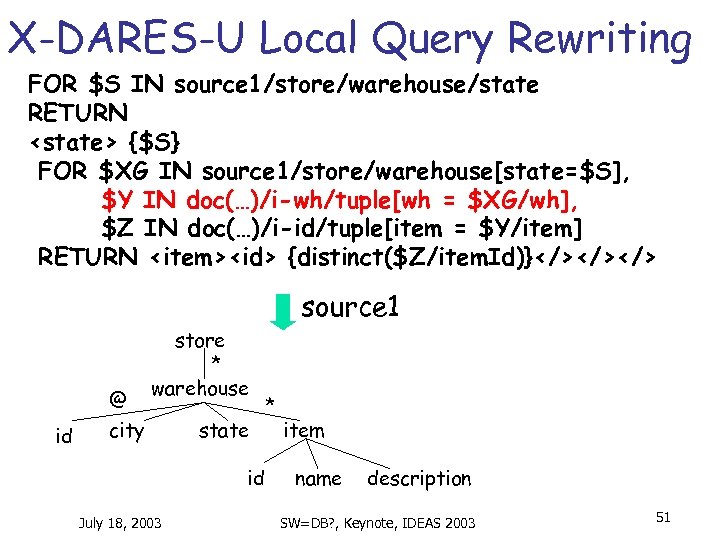
X-DARES-U Local Query Rewriting FOR $S IN source 1/store/warehouse/state RETURN <state> {$S} FOR $XG IN source 1/store/warehouse[state=$S], $Y IN doc(…)/i-wh/tuple[wh = $XG/wh], $Z IN doc(…)/i-id/tuple[item = $Y/item] RETURN <item><id> {distinct($Z/item. Id)}</></></> source 1 id @ city store * warehouse state id July 18, 2003 * item name description SW=DB? , Keynote, IDEAS 2003 51
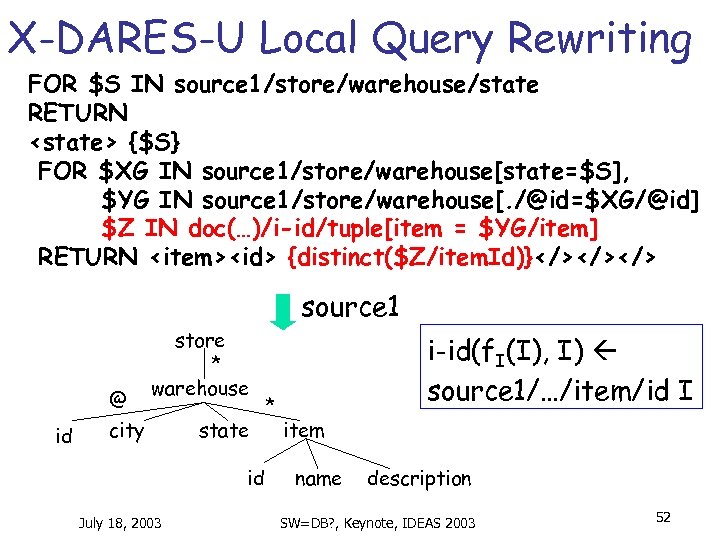
X-DARES-U Local Query Rewriting FOR $S IN source 1/store/warehouse/state RETURN <state> {$S} FOR $XG IN source 1/store/warehouse[state=$S], $YG IN source 1/store/warehouse[. /@id=$XG/@id] $Z IN doc(…)/i-id/tuple[item = $YG/item] RETURN <item><id> {distinct($Z/item. Id)}</></></> source 1 id @ city store * warehouse state id July 18, 2003 * i-id(f. I(I), I) source 1/…/item/id I item name description SW=DB? , Keynote, IDEAS 2003 52
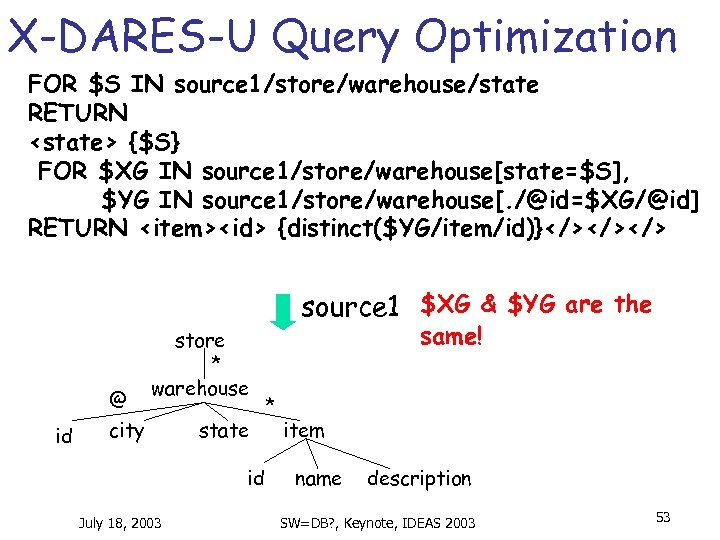
X-DARES-U Query Optimization FOR $S IN source 1/store/warehouse/state RETURN <state> {$S} FOR $XG IN source 1/store/warehouse[state=$S], $YG IN source 1/store/warehouse[. /@id=$XG/@id] RETURN <item><id> {distinct($YG/item/id)}</></></> source 1 $XG & $YG are the id @ city store * warehouse state id July 18, 2003 same! * item name description SW=DB? , Keynote, IDEAS 2003 53
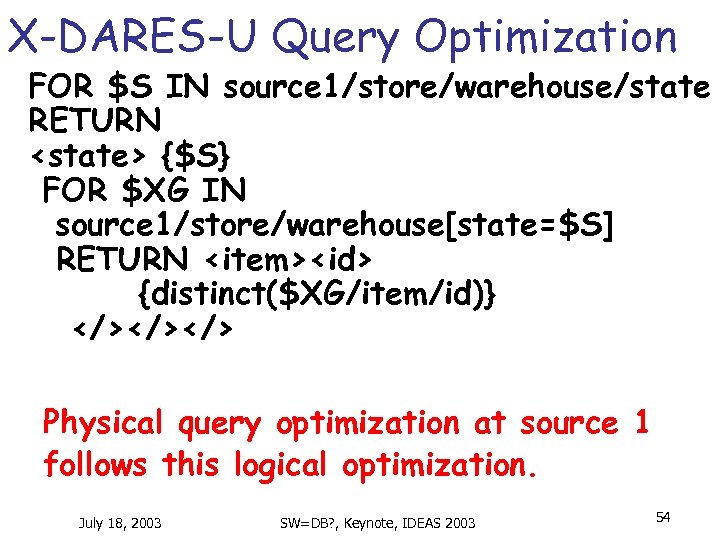
X-DARES-U Query Optimization FOR $S IN source 1/store/warehouse/state RETURN <state> {$S} FOR $XG IN source 1/store/warehouse[state=$S] RETURN <item><id> {distinct($XG/item/id)} </></></> Physical query optimization at source 1 follows this logical optimization. July 18, 2003 SW=DB? , Keynote, IDEAS 2003 54
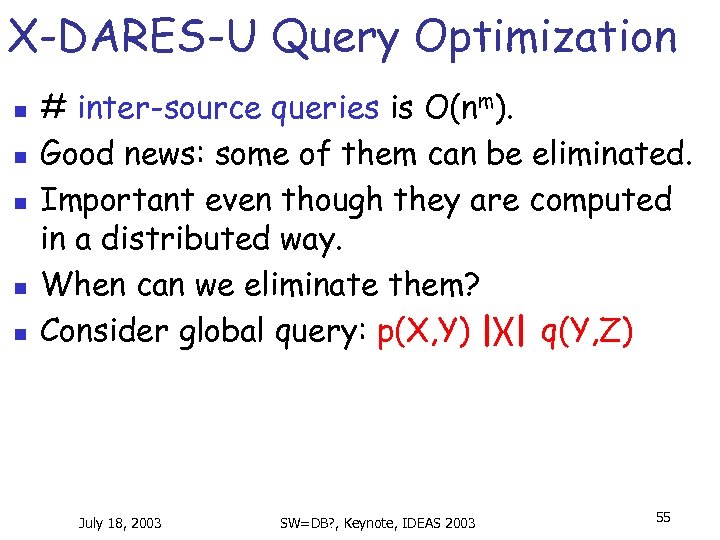
X-DARES-U Query Optimization n n # inter-source queries is O(nm). Good news: some of them can be eliminated. Important even though they are computed in a distributed way. When can we eliminate them? Consider global query: p(X, Y) | | q(Y, Z) July 18, 2003 SW=DB? , Keynote, IDEAS 2003 55
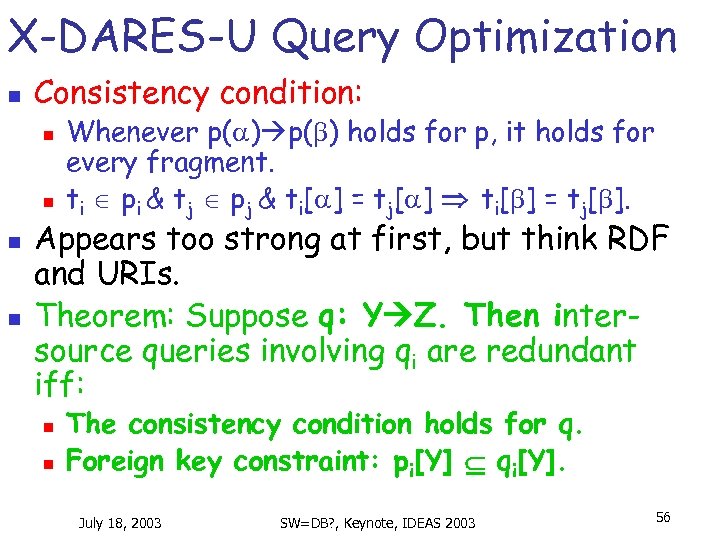
X-DARES-U Query Optimization n Consistency condition: n n Whenever p( ) holds for p, it holds for every fragment. ti pi & tj pj & ti[ ] = tj[ ]. Appears too strong at first, but think RDF and URIs. Theorem: Suppose q: Y Z. Then intersource queries involving qi are redundant iff: n n The consistency condition holds for q. Foreign key constraint: pi[Y] qi[Y]. July 18, 2003 SW=DB? , Keynote, IDEAS 2003 56
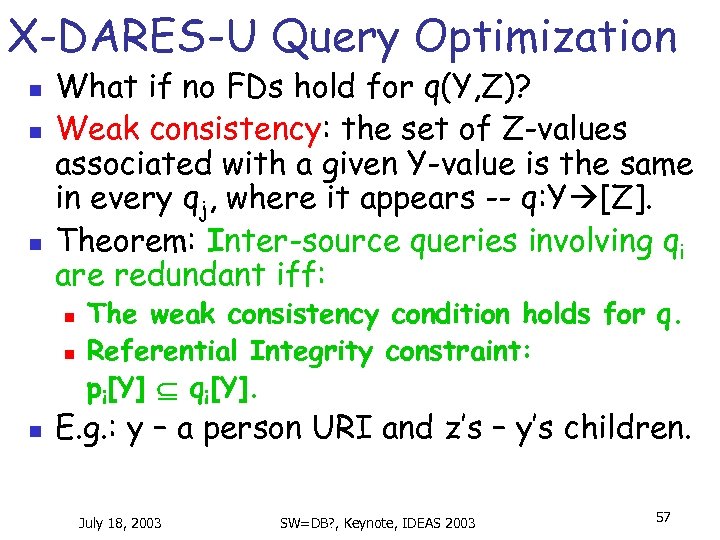
X-DARES-U Query Optimization n What if no FDs hold for q(Y, Z)? Weak consistency: the set of Z-values associated with a given Y-value is the same in every qj, where it appears -- q: Y [Z]. Theorem: Inter-source queries involving qi are redundant iff: n n n The weak consistency condition holds for q. Referential Integrity constraint: pi[Y] qi[Y]. E. g. : y – a person URI and z’s – y’s children. July 18, 2003 SW=DB? , Keynote, IDEAS 2003 57
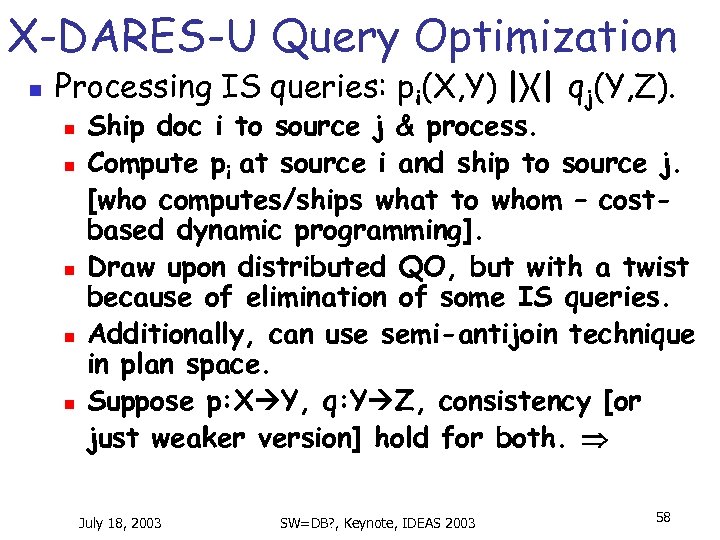
X-DARES-U Query Optimization n Processing IS queries: pi(X, Y) | | qj(Y, Z). n n n Ship doc i to source j & process. Compute pi at source i and ship to source j. [who computes/ships what to whom – costbased dynamic programming]. Draw upon distributed QO, but with a twist because of elimination of some IS queries. Additionally, can use semi-antijoin technique in plan space. Suppose p: X Y, q: Y Z, consistency [or just weaker version] hold for both. July 18, 2003 SW=DB? , Keynote, IDEAS 2003 58
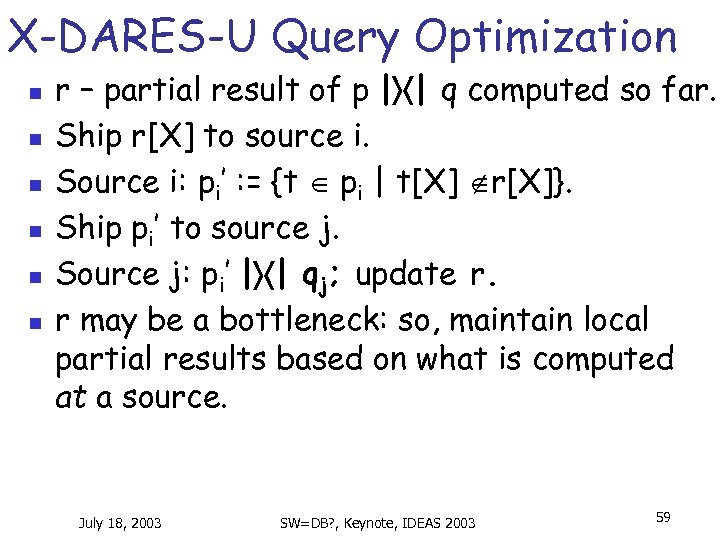
X-DARES-U Query Optimization n n n r – partial result of p | | q computed so far. Ship r[X] to source i. Source i: pi’ : = {t pi | t[X] r[X]}. Ship pi’ to source j. Source j: pi’ | | qj; update r. r may be a bottleneck: so, maintain local partial results based on what is computed at a source. July 18, 2003 SW=DB? , Keynote, IDEAS 2003 59
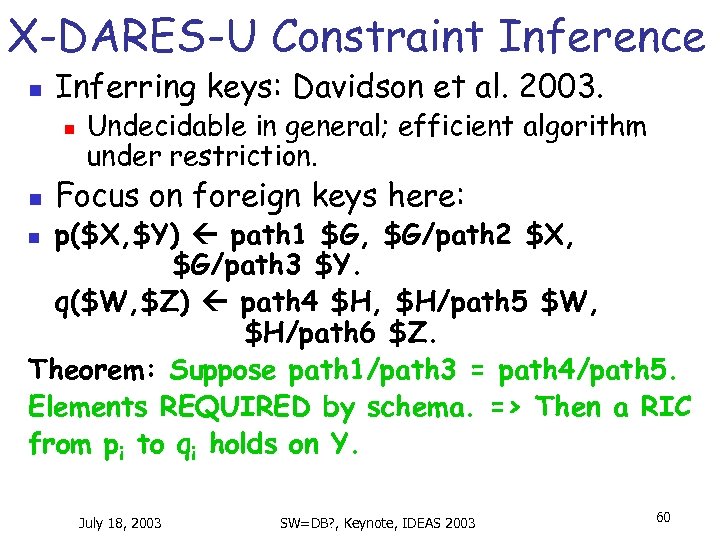
X-DARES-U Constraint Inference n Inferring keys: Davidson et al. 2003. n n Undecidable in general; efficient algorithm under restriction. Focus on foreign keys here: p($X, $Y) path 1 $G, $G/path 2 $X, $G/path 3 $Y. q($W, $Z) path 4 $H, $H/path 5 $W, $H/path 6 $Z. Theorem: Suppose path 1/path 3 = path 4/path 5. Elements REQUIRED by schema. => Then a RIC from pi to qi holds on Y. n July 18, 2003 SW=DB? , Keynote, IDEAS 2003 60
X-DARES-U Constraint Inference n Remarks: undecidability in the general case should not hamper inference in our setting. n n Mappings highly restrictive. Even hardness of arbitrary XPath query equivalence should not limit us much. n Mapping rules generated by tools based on “glue” variables typically “//”-free and/or “*”-free. July 18, 2003 SW=DB? , Keynote, IDEAS 2003 61
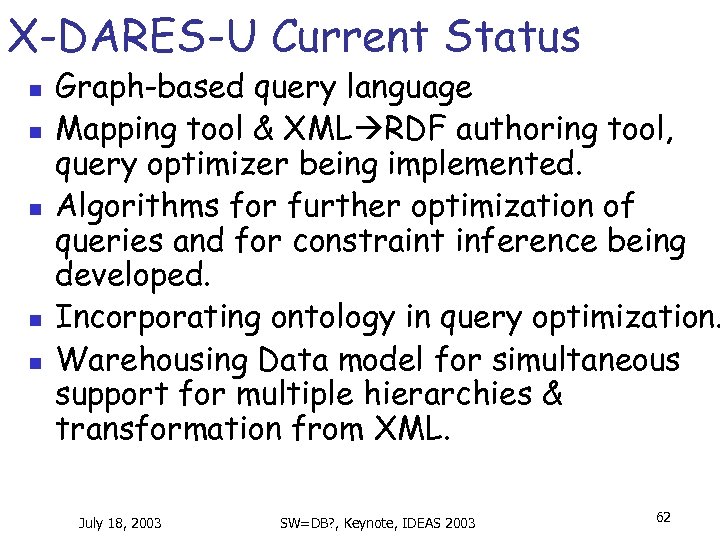
X-DARES-U Current Status n n n Graph-based query language Mapping tool & XML RDF authoring tool, query optimizer being implemented. Algorithms for further optimization of queries and for constraint inference being developed. Incorporating ontology in query optimization. Warehousing Data model for simultaneous support for multiple hierarchies & transformation from XML. July 18, 2003 SW=DB? , Keynote, IDEAS 2003 62
Overview n n n What is the Semantic Web and why bother with it? The Web and Databases SW – technologies & tools The X-DARES-U project @ UBC Summary, Related Work, & Future Challenges July 18, 2003 SW=DB? , Keynote, IDEAS 2003 63
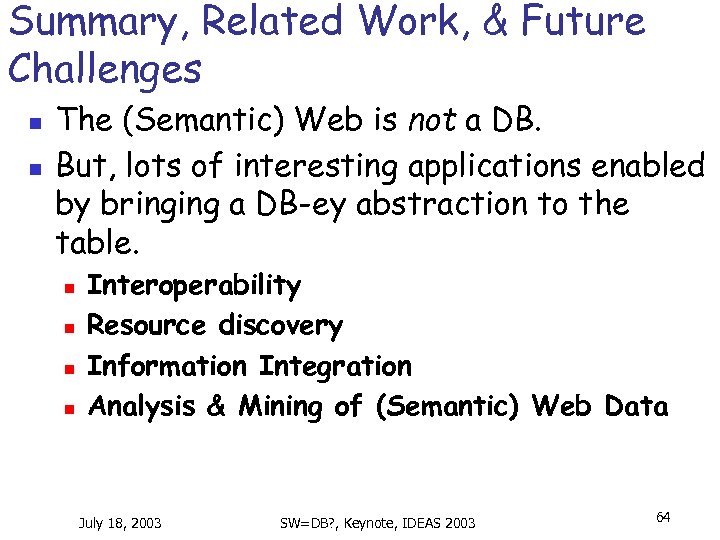
Summary, Related Work, & Future Challenges n n The (Semantic) Web is not a DB. But, lots of interesting applications enabled by bringing a DB-ey abstraction to the table. n n Interoperability Resource discovery Information Integration Analysis & Mining of (Semantic) Web Data July 18, 2003 SW=DB? , Keynote, IDEAS 2003 64
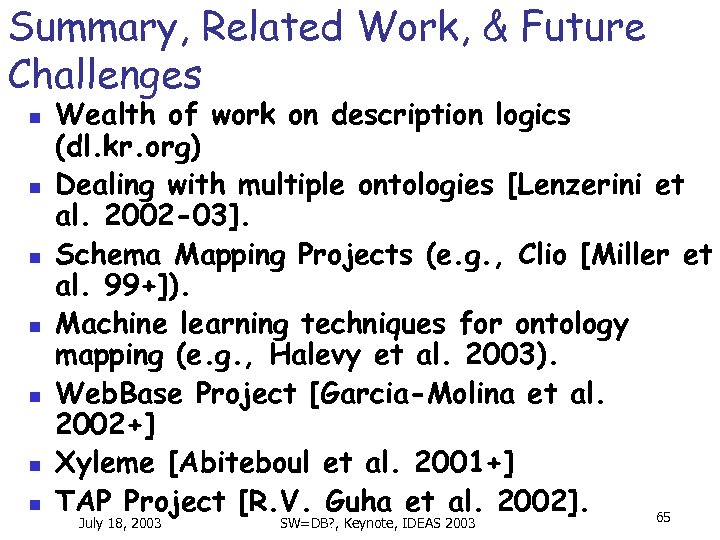
Summary, Related Work, & Future Challenges n n n n Wealth of work on description logics (dl. kr. org) Dealing with multiple ontologies [Lenzerini et al. 2002 -03]. Schema Mapping Projects (e. g. , Clio [Miller et al. 99+]). Machine learning techniques for ontology mapping (e. g. , Halevy et al. 2003). Web. Base Project [Garcia-Molina et al. 2002+] Xyleme [Abiteboul et al. 2001+] TAP Project [R. V. Guha et al. 2002]. 65 July 18, 2003 SW=DB? , Keynote, IDEAS 2003
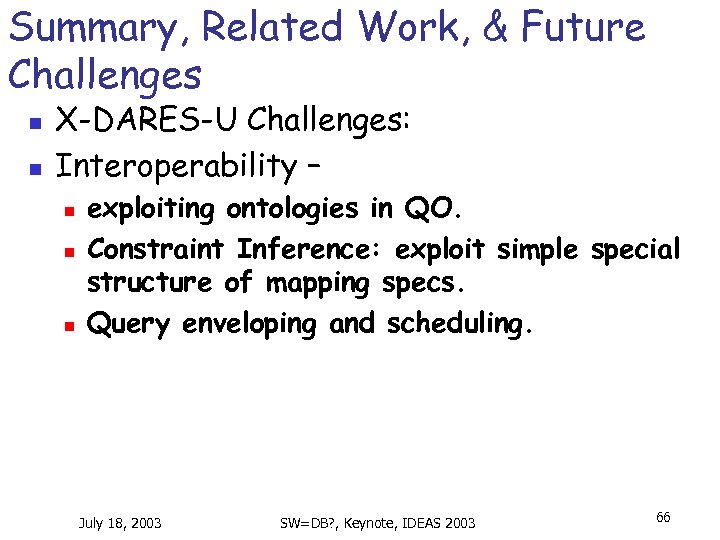
Summary, Related Work, & Future Challenges n n X-DARES-U Challenges: Interoperability – n n n exploiting ontologies in QO. Constraint Inference: exploit simple special structure of mapping specs. Query enveloping and scheduling. July 18, 2003 SW=DB? , Keynote, IDEAS 2003 66
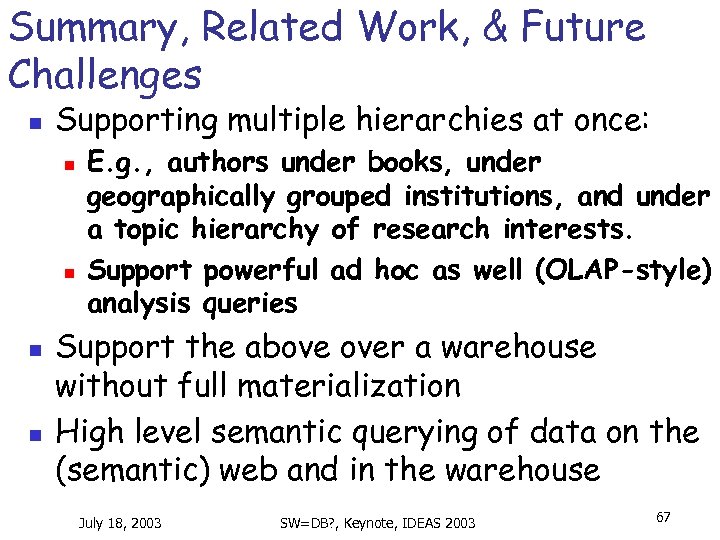
Summary, Related Work, & Future Challenges n Supporting multiple hierarchies at once: n n E. g. , authors under books, under geographically grouped institutions, and under a topic hierarchy of research interests. Support powerful ad hoc as well (OLAP-style) analysis queries Support the above over a warehouse without full materialization High level semantic querying of data on the (semantic) web and in the warehouse July 18, 2003 SW=DB? , Keynote, IDEAS 2003 67
Summary, Related Work, & Future Challenges n X-DARES-U to meet these challenges! n Pun is intended! Thanks! http: //www. cs. ubc. ca/~laks. July 18, 2003 SW=DB? , Keynote, IDEAS 2003 68
Скачать презентацию Is the Semantic Web a Database Laks V
504d1f61c0b7ef15afc55f1304ea43d9.ppt