


 Скачать презентацию Is the Playing Field Leveling in Peru The
f1967b62c1a151c40f532831ea8f6149.ppt
- Количество слайдов: 27
 Is the Playing Field Leveling in Peru? The Evolution of Children’s Opportunities Javier Escobal, GRADE & Young Lives –Peru (and LCSPP/PREMPR – World Bank) Human Rights, Development and Economic Growth - Metrics, New Ways of Thinking, and New Strategies April 7 -8, 2011, Elliott School, Washington, DC
 Outline o Motivation: Recent trends in Poverty and Inequality o The Human Opportunity Index o Results based on Repeated Cross-Sections LSMS o Some additional Results from a Longitudinal Sample • Young Lives (Niños del Milenio) • Access versus quality • Multiple deprived children
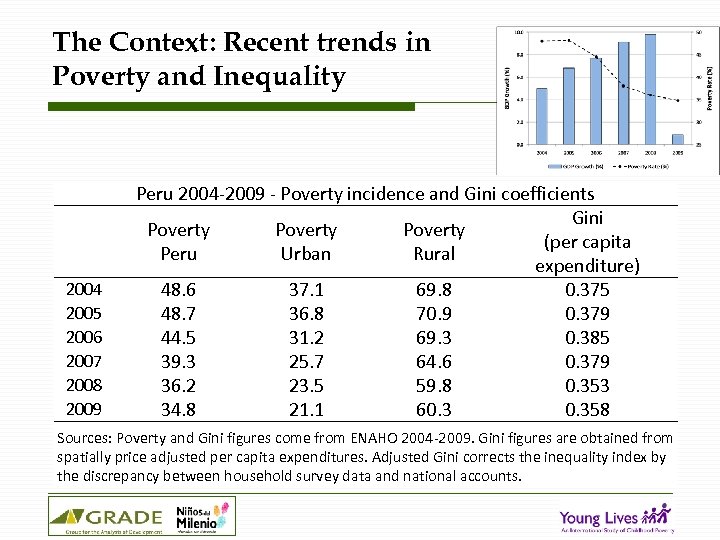 The Context: Recent trends in Poverty and Inequality 2004 2005 2006 2007 2008 2009 Peru 2004 -2009 - Poverty incidence and Gini coefficients Gini Poverty (per capita Peru Urban Rural expenditure) 48. 6 37. 1 69. 8 0. 375 48. 7 36. 8 70. 9 0. 379 44. 5 31. 2 69. 3 0. 385 39. 3 25. 7 64. 6 0. 379 36. 2 23. 5 59. 8 0. 353 34. 8 21. 1 60. 358 Sources: Poverty and Gini figures come from ENAHO 2004 -2009. Gini figures are obtained from spatially price adjusted per capita expenditures. Adjusted Gini corrects the inequality index by the discrepancy between household survey data and national accounts.
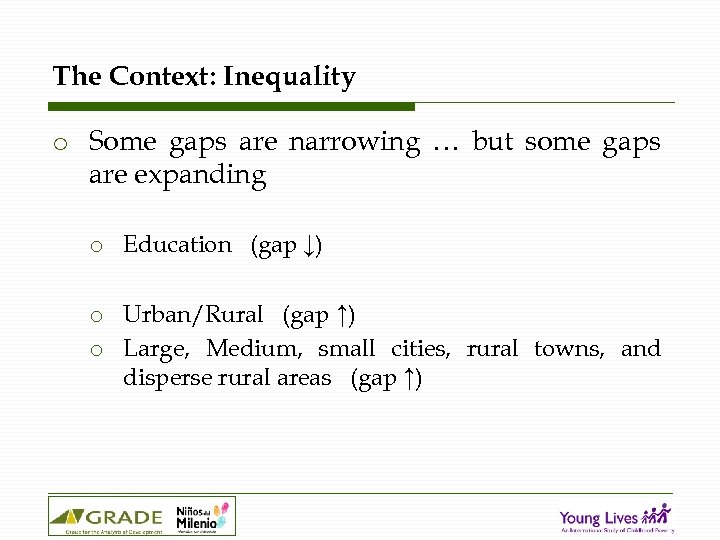 The Context: Inequality o Some gaps are narrowing … but some gaps are expanding o Education (gap ↓) o Urban/Rural (gap ↑) o Large, Medium, small cities, rural towns, and disperse rural areas (gap ↑)
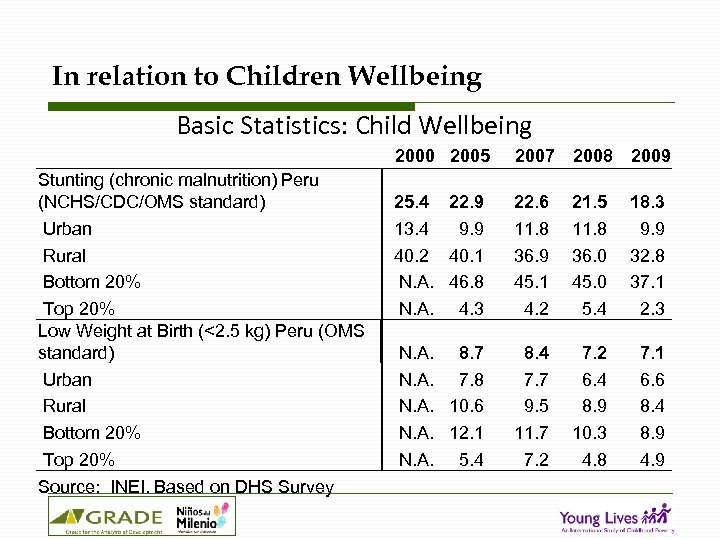 In relation to Children Wellbeing Basic Statistics: Child Wellbeing Stunting (chronic malnutrition) Peru (NCHS/CDC/OMS standard) Urban Rural Bottom 20% Top 20% Low Weight at Birth (<2. 5 kg) Peru (OMS standard) Urban Rural Bottom 20% Top 20% Source: INEI. Based on DHS Survey 2000 2005 2007 2008 2009 25. 4 22. 9 13. 4 9. 9 40. 2 40. 1 N. A. 46. 8 N. A. 4. 3 22. 6 11. 8 36. 9 45. 1 4. 2 21. 5 11. 8 36. 0 45. 0 5. 4 18. 3 9. 9 32. 8 37. 1 2. 3 N. A. 8. 7 N. A. 7. 8 N. A. 10. 6 N. A. 12. 1 N. A. 5. 4 8. 4 7. 7 9. 5 11. 7 7. 2 6. 4 8. 9 10. 3 4. 8 7. 1 6. 6 8. 4 8. 9 4. 9
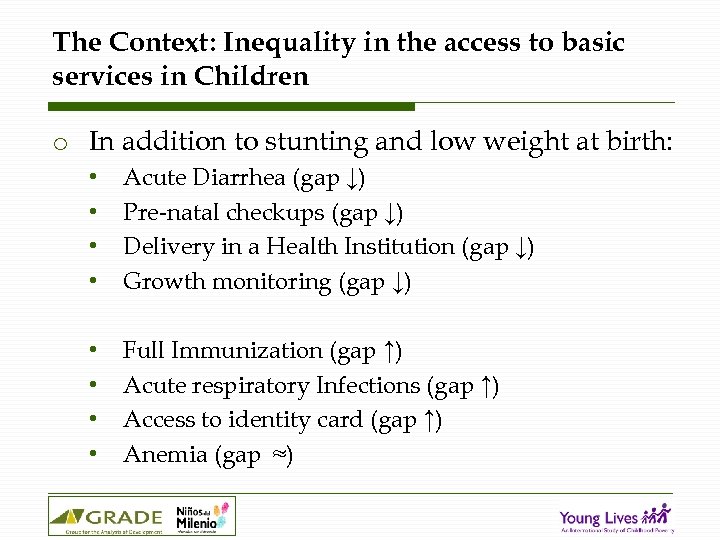 The Context: Inequality in the access to basic services in Children o In addition to stunting and low weight at birth: • • Acute Diarrhea (gap ↓) Pre-natal checkups (gap ↓) Delivery in a Health Institution (gap ↓) Growth monitoring (gap ↓) • • Full Immunization (gap ↑) Acute respiratory Infections (gap ↑) Access to identity card (gap ↑) Anemia (gap ≈)
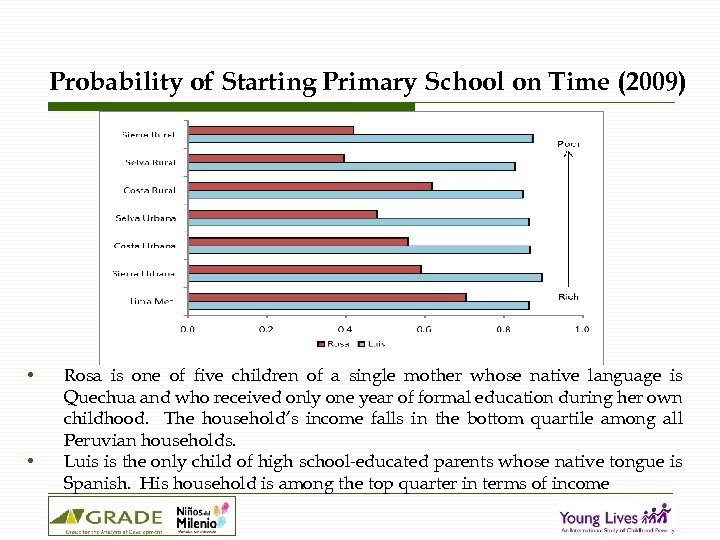 Probability of Starting Primary School on Time (2009) • • Rosa is one of five children of a single mother whose native language is Quechua and who received only one year of formal education during her own childhood. The household’s income falls in the bottom quartile among all Peruvian households. Luis is the only child of high school-educated parents whose native tongue is Spanish. His household is among the top quarter in terms of income
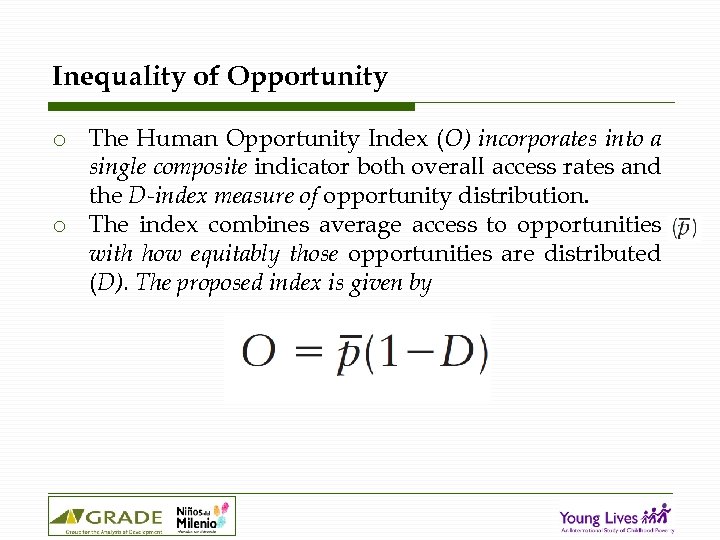 Inequality of Opportunity o The Human Opportunity Index (O) incorporates into a single composite indicator both overall access rates and the D-index measure of opportunity distribution. o The index combines average access to opportunities with how equitably those opportunities are distributed (D). The proposed index is given by
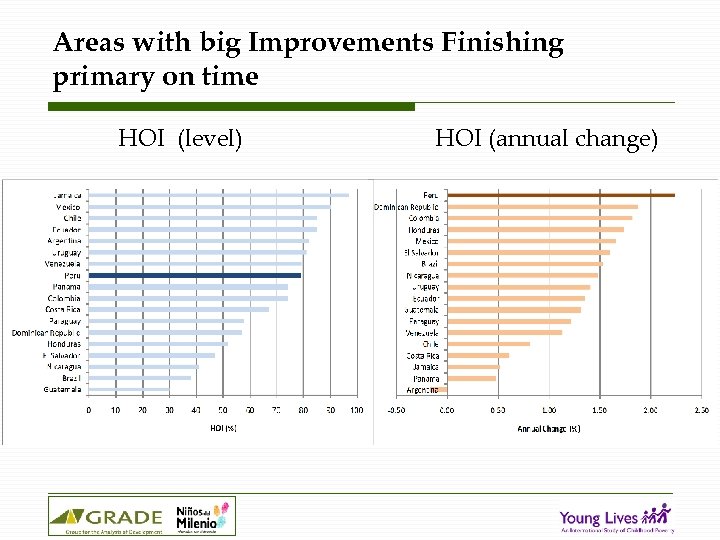 Areas with big Improvements Finishing primary on time HOI (level) HOI (annual change)
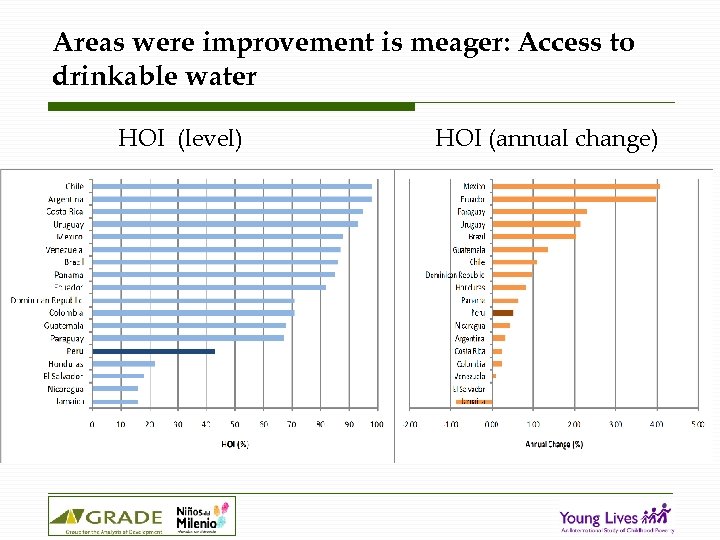 Areas were improvement is meager: Access to drinkable water HOI (level) HOI (annual change)
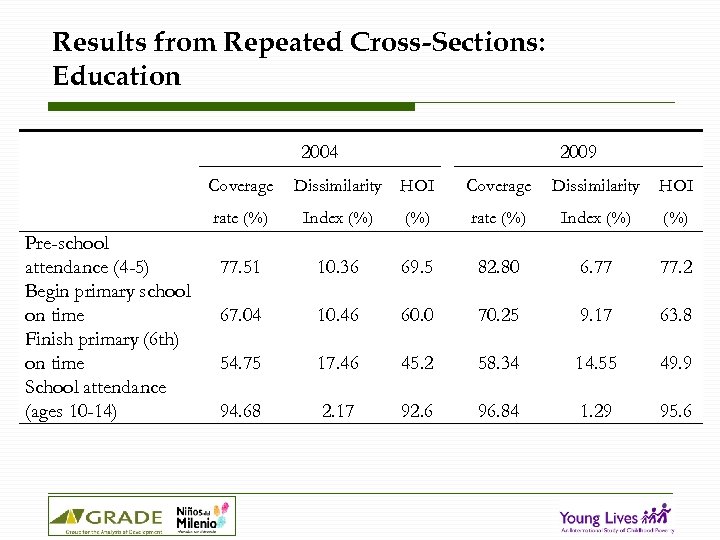 Results from Repeated Cross-Sections: Education 2004 Coverage Pre-school attendance (4 -5) Begin primary school on time Finish primary (6 th) on time School attendance (ages 10 -14) Dissimilarity rate (%) 2009 HOI Coverage Dissimilarity HOI Index (%) rate (%) Index (%) 77. 51 10. 36 69. 5 82. 80 6. 77 77. 2 67. 04 10. 46 60. 0 70. 25 9. 17 63. 8 54. 75 17. 46 45. 2 58. 34 14. 55 49. 9 94. 68 2. 17 92. 6 96. 84 1. 29 95. 6
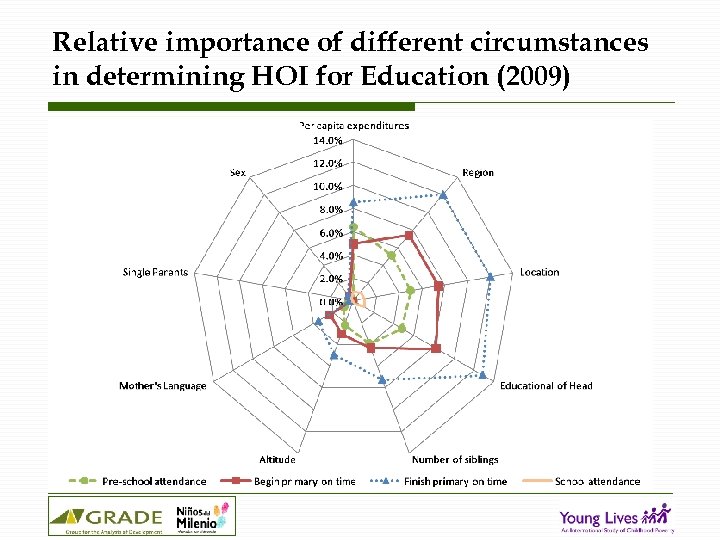 Relative importance of different circumstances in determining HOI for Education (2009)
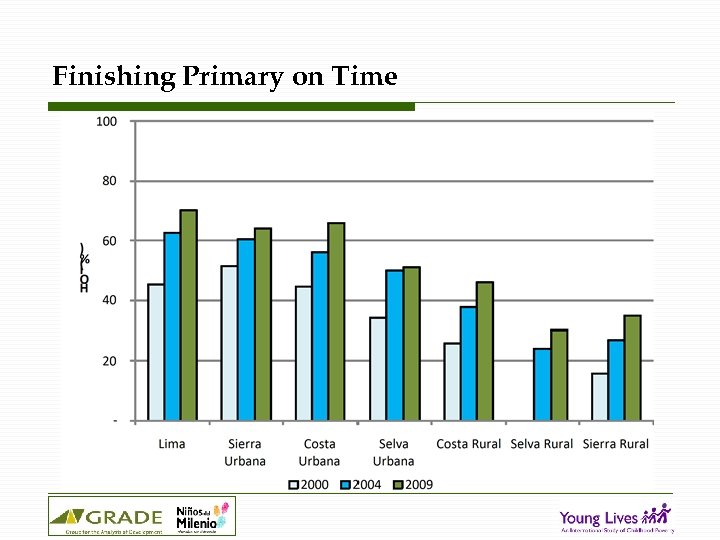 Finishing Primary on Time
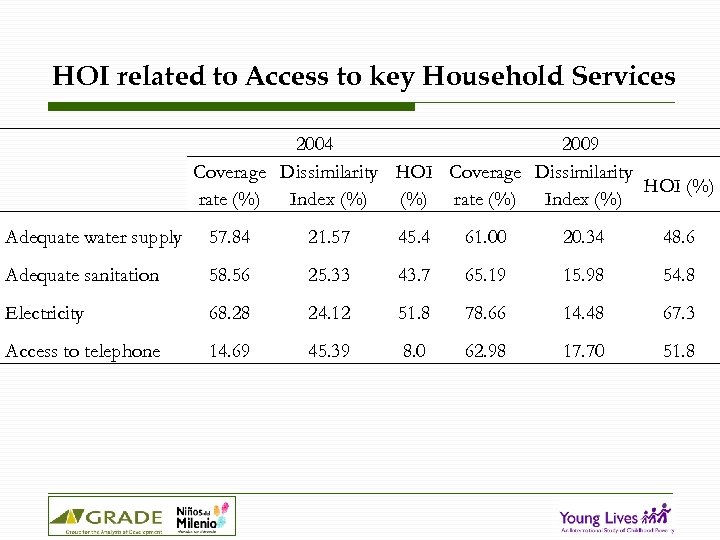 HOI related to Access to key Household Services 2004 2009 Coverage Dissimilarity HOI (%) rate (%) Index (%) Adequate water supply 57. 84 21. 57 45. 4 61. 00 20. 34 48. 6 Adequate sanitation 58. 56 25. 33 43. 7 65. 19 15. 98 54. 8 Electricity 68. 28 24. 12 51. 8 78. 66 14. 48 67. 3 Access to telephone 14. 69 45. 39 8. 0 62. 98 17. 70 51. 8
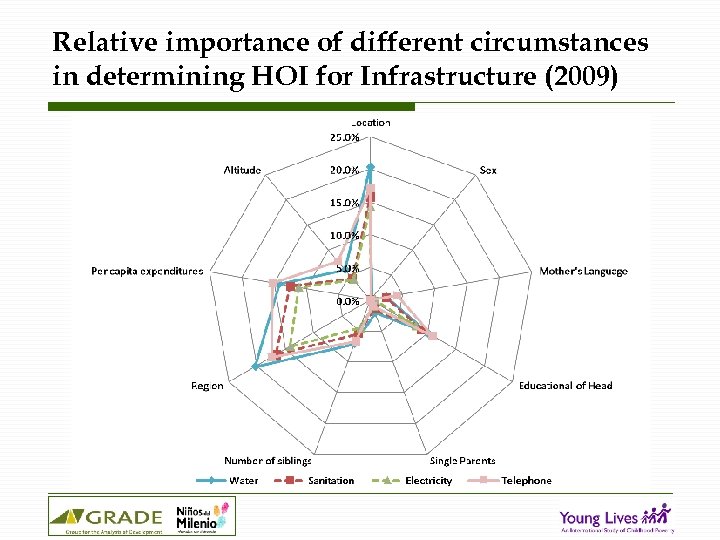 Relative importance of different circumstances in determining HOI for Infrastructure (2009)
 Evidence from Longitudinal Data: Young Lives o o Young Lives: An international study of childhood poverty 12, 000 children in 4 countries over 15 years) Longitudinal project gathering comparable information in Ethiopia, India (Andhra Pradesh), Peru and Vietnam In Peru YL is tracking a representative sample of Peruvian children from two cohorts: a younger cohort who were aged between 6 months and 18 months in 2002 (born 2000) and an older cohort of children aged between 7. 5 years old and 8. 5 years old in 2002 (born 1994) Advantages from the point of view of studying Inequality of opportunities o A larger set of circumstances o A larger array of Child wellbeing indicators (opportunities) o Following the children through their life cycle. Data in the Public Domain
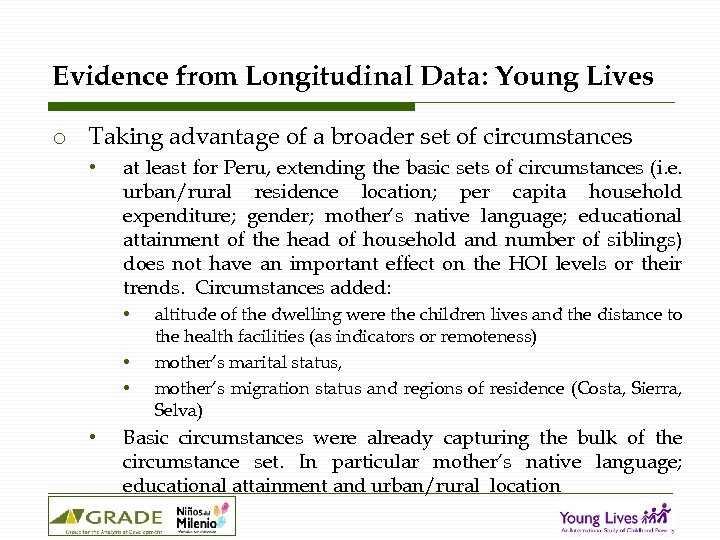 Evidence from Longitudinal Data: Young Lives o Taking advantage of a broader set of circumstances • at least for Peru, extending the basic sets of circumstances (i. e. urban/rural residence location; per capita household expenditure; gender; mother’s native language; educational attainment of the head of household and number of siblings) does not have an important effect on the HOI levels or their trends. Circumstances added: • • altitude of the dwelling were the children lives and the distance to the health facilities (as indicators or remoteness) mother’s marital status, mother’s migration status and regions of residence (Costa, Sierra, Selva) Basic circumstances were already capturing the bulk of the circumstance set. In particular mother’s native language; educational attainment and urban/rural location
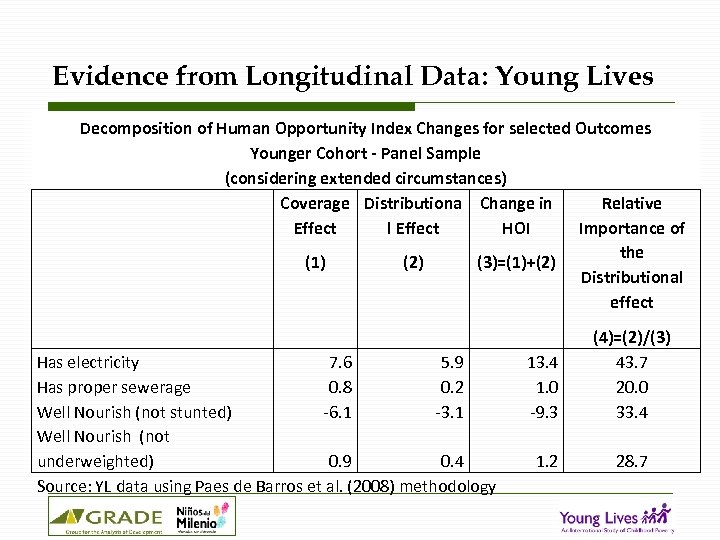 Evidence from Longitudinal Data: Young Lives Decomposition of Human Opportunity Index Changes for selected Outcomes Younger Cohort - Panel Sample (considering extended circumstances) Coverage Distributiona Change in Relative Effect l Effect HOI Importance of the (1) (2) (3)=(1)+(2) Distributional effect Has electricity 7. 6 5. 9 Has proper sewerage 0. 8 0. 2 Well Nourish (not stunted) -6. 1 -3. 1 Well Nourish (not underweighted) 0. 9 0. 4 Source: YL data using Paes de Barros et al. (2008) methodology 13. 4 1. 0 -9. 3 (4)=(2)/(3) 43. 7 20. 0 33. 4 1. 2 28. 7
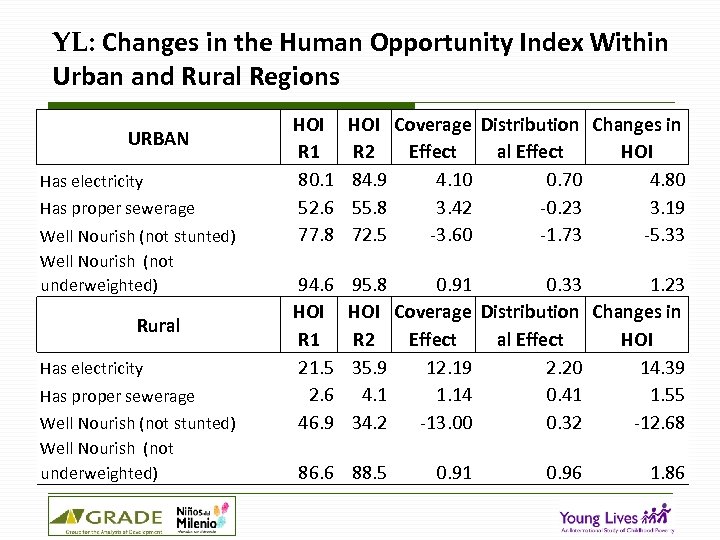 YL: Changes in the Human Opportunity Index Within Urban and Rural Regions URBAN Has electricity Has proper sewerage Well Nourish (not stunted) Well Nourish (not underweighted) Rural Has electricity Has proper sewerage Well Nourish (not stunted) Well Nourish (not underweighted) HOI R 1 80. 1 52. 6 77. 8 HOI Coverage Distribution Changes in R 2 Effect al Effect HOI 84. 9 4. 10 0. 70 4. 80 55. 8 3. 42 -0. 23 3. 19 72. 5 -3. 60 -1. 73 -5. 33 94. 6 HOI R 1 21. 5 2. 6 46. 9 95. 8 0. 91 0. 33 1. 23 HOI Coverage Distribution Changes in R 2 Effect al Effect HOI 35. 9 12. 19 2. 20 14. 39 4. 1 1. 14 0. 41 1. 55 34. 2 -13. 00 0. 32 -12. 68 86. 6 88. 5 0. 91 0. 96 1. 86
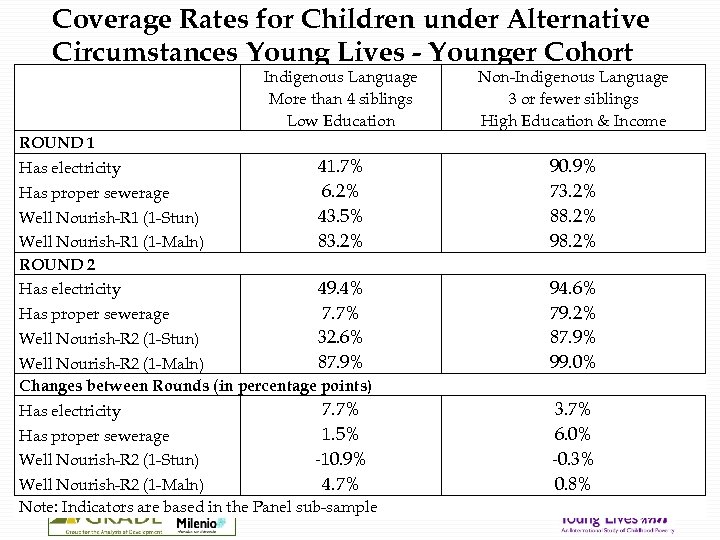 Coverage Rates for Children under Alternative Circumstances Young Lives - Younger Cohort ROUND 1 Has electricity Has proper sewerage Well Nourish-R 1 (1 -Stun) Well Nourish-R 1 (1 -Maln) ROUND 2 Has electricity Has proper sewerage Well Nourish-R 2 (1 -Stun) Indigenous Language More than 4 siblings Low Education Non-Indigenous Language 3 or fewer siblings High Education & Income 41. 7% 6. 2% 43. 5% 83. 2% 90. 9% 73. 2% 88. 2% 98. 2% 49. 4% 7. 7% 32. 6% 87. 9% 94. 6% 79. 2% 87. 9% 99. 0% 7. 7% 1. 5% -10. 9% 4. 7% 3. 7% 6. 0% -0. 3% 0. 8% Well Nourish-R 2 (1 -Maln) Changes between Rounds (in percentage points) Has electricity Has proper sewerage Well Nourish-R 2 (1 -Stun) Well Nourish-R 2 (1 -Maln) Note: Indicators are based in the Panel sub-sample
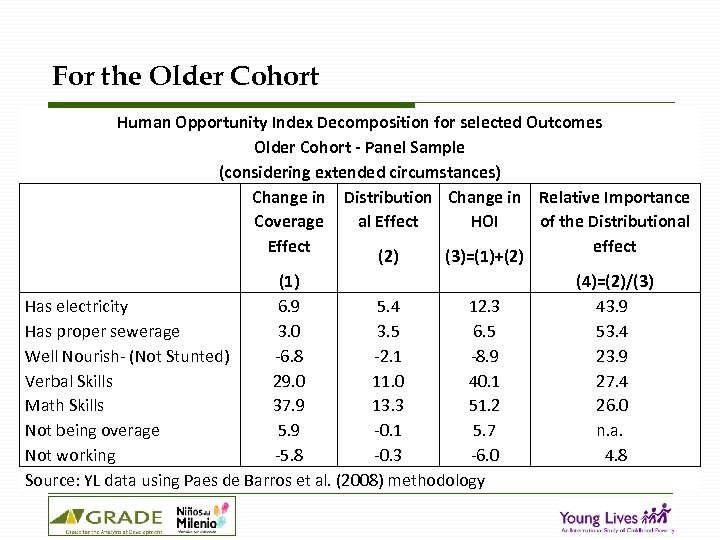 For the Older Cohort Human Opportunity Index Decomposition for selected Outcomes Older Cohort - Panel Sample (considering extended circumstances) Change in Distribution Change in Relative Importance Coverage al Effect HOI of the Distributional Effect effect (2) (3)=(1)+(2) (1) (4)=(2)/(3) Has electricity 6. 9 5. 4 12. 3 43. 9 Has proper sewerage 3. 0 3. 5 6. 5 53. 4 Well Nourish- (Not Stunted) -6. 8 -2. 1 -8. 9 23. 9 Verbal Skills 29. 0 11. 0 40. 1 27. 4 Math Skills 37. 9 13. 3 51. 2 26. 0 Not being overage 5. 9 -0. 1 5. 7 n. a. Not working -5. 8 -0. 3 -6. 0 4. 8 Source: YL data using Paes de Barros et al. (2008) methodology
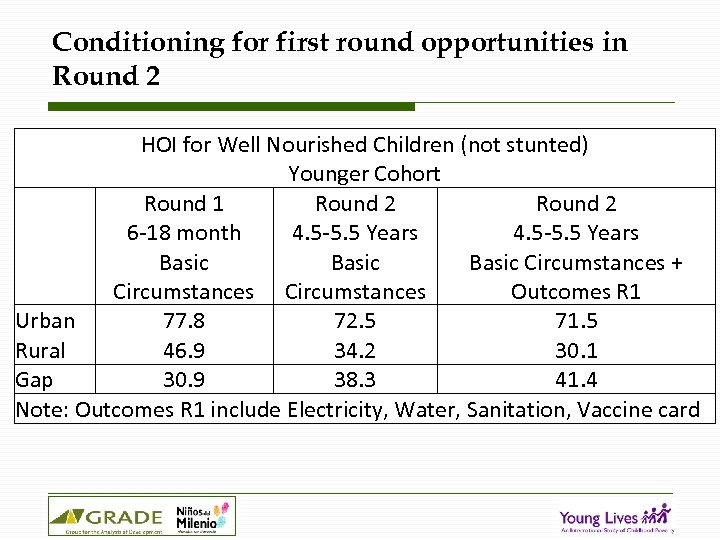 Conditioning for first round opportunities in Round 2 HOI for Well Nourished Children (not stunted) Younger Cohort Round 1 Round 2 6 -18 month 4. 5 -5. 5 Years Basic Circumstances + Circumstances Outcomes R 1 Urban 77. 8 72. 5 71. 5 Rural 46. 9 34. 2 30. 1 Gap 30. 9 38. 3 41. 4 Note: Outcomes R 1 include Electricity, Water, Sanitation, Vaccine card
 What happens when we look at individual trajectories?
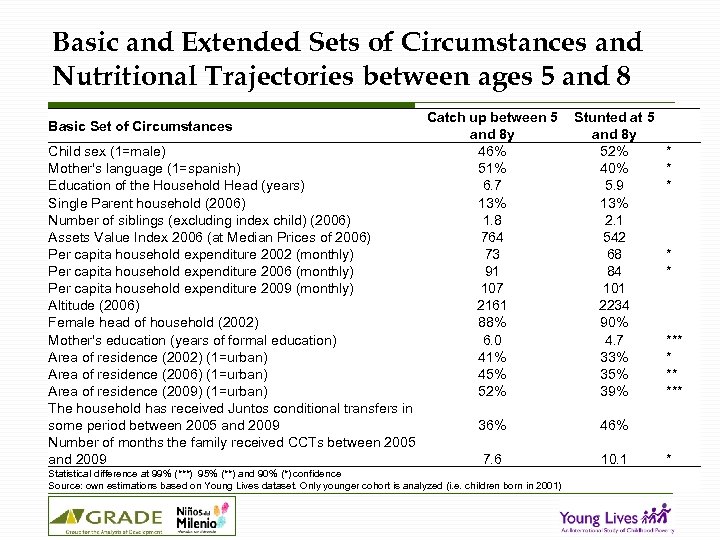 Basic and Extended Sets of Circumstances and Nutritional Trajectories between ages 5 and 8 Basic Set of Circumstances Child sex (1=male) Mother's language (1=spanish) Education of the Household Head (years) Single Parent household (2006) Number of siblings (excluding index child) (2006) Assets Value Index 2006 (at Median Prices of 2006) Per capita household expenditure 2002 (monthly) Per capita household expenditure 2006 (monthly) Per capita household expenditure 2009 (monthly) Altitude (2006) Female head of household (2002) Mother's education (years of formal education) Area of residence (2002) (1=urban) Area of residence (2006) (1=urban) Area of residence (2009) (1=urban) The household has received Juntos conditional transfers in some period between 2005 and 2009 Number of months the family received CCTs between 2005 and 2009 Catch up between 5 Stunted at 5 and 8 y 46% 52% * 51% 40% * 6. 7 5. 9 * 13% 1. 8 2. 1 764 542 73 68 * 91 84 * 107 101 2161 2234 88% 90% 6. 0 4. 7 *** 41% 33% * 45% 35% ** 52% 39% *** 36% 46% 7. 6 10. 1 * Statistical difference at 99% (***) 95% (**) and 90% (*) confidence Source: own estimations based on Young Lives dataset. Only younger cohort is analyzed (i. e. children born in 2001)
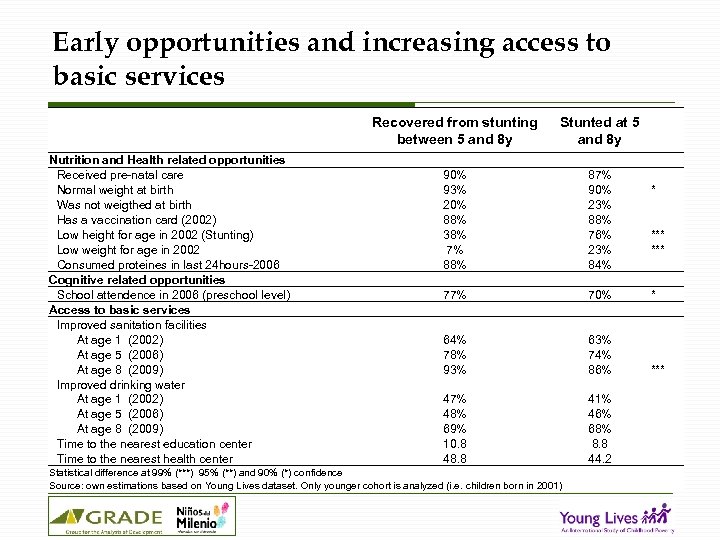 Early opportunities and increasing access to basic services Nutrition and Health related opportunities Received pre-natal care Normal weight at birth Was not weigthed at birth Has a vaccination card (2002) Low height for age in 2002 (Stunting) Low weight for age in 2002 Consumed proteines in last 24 hours-2006 Cognitive related opportunities School attendence in 2006 (preschool level) Access to basic services Improved sanitation facilities At age 1 (2002) At age 5 (2006) At age 8 (2009) Improved drinking water At age 1 (2002) At age 5 (2006) At age 8 (2009) Time to the nearest education center Time to the nearest health center Recovered from stunting between 5 and 8 y Stunted at 5 and 8 y 90% 93% 20% 88% 38% 7% 88% 77% 64% 78% 93% 47% 48% 69% 10. 8 48. 8 87% 90% 23% 88% 76% 23% 84% 70% 63% 74% 86% 41% 46% 68% 8. 8 44. 2 Statistical difference at 99% (***) 95% (**) and 90% (*) confidence Source: own estimations based on Young Lives dataset. Only younger cohort is analyzed (i. e. children born in 2001) * *** * ***
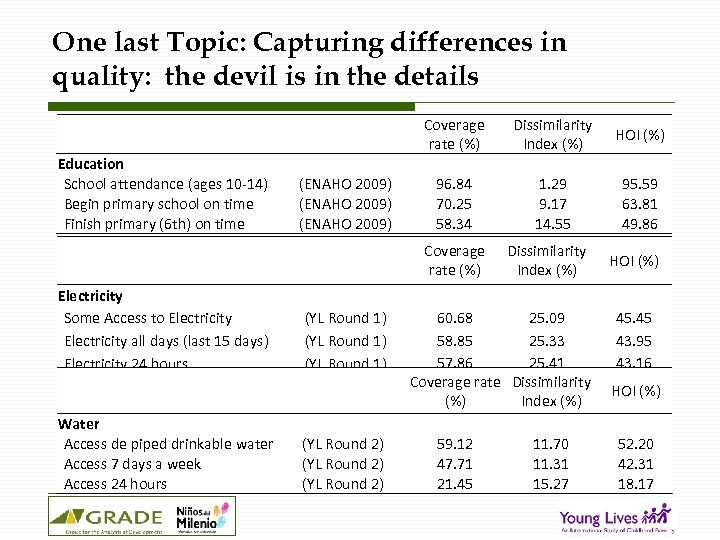 One last Topic: Capturing differences in quality: the devil is in the details Education School attendance (ages 10 -14) Begin primary school on time Finish primary (6 th) on time Coverage rate (%) (ENAHO 2009) Electricity Some Access to Electricity all days (last 15 days) Electricity 24 hours Water Access de piped drinkable water Access 7 days a week Access 24 hours (YL Round 1) (YL Round 2) HOI (%) 96. 84 70. 25 58. 34 1. 29 9. 17 14. 55 95. 59 63. 81 49. 86 Coverage rate (%) Dissimilarity Index (%) 60. 68 25. 09 58. 85 25. 33 57. 86 25. 41 Coverage rate Dissimilarity (%) Index (%) 59. 12 11. 70 47. 71 11. 31 21. 45 15. 27 HOI (%) 45. 45 43. 95 43. 16 HOI (%) 52. 20 42. 31 18. 17
 Thanks! YL data available at ESDS - UK http: //www. ninosdelmilenio. org http: //www. younglives. org. uk