


 Скачать презентацию Is It Time for a Legal Technology Curriculum
aef8191f0dda413a58a5569e0fced6ef.ppt
- Количество слайдов: 34
 Is It Time for a Legal Technology Curriculum? Kenneth J. Hirsh Wayne Miller Director of Computing Services Senior Lecturing Fellow Duke University School of Law Director of Educational Technologies Duke University School of Law Brian Donnelly Bob Seibel Director of Educational Technology and Lecturer in Law Columbia Law School Professor of Law CUNY School of Law `
 A law school technologist’s view of a few key dates in American legal education. • 1779 Wythe teaches at College of William and Mary • 1870 Langdell introduces case method at Harvard • 1961 Clinic movement begins • 1969 Internet created, though known only to a few
 A law school technologist’s view of a few key dates in American legal education. • 1980 IBM PC introduced • 1982 Center for Computer-Assisted Legal Education (CALI) founded • 1993 World Wide Web goes public
 In a world dependent on information technology… • Law firms build extranets. • Courts require electronic filing. • Knowledge management organizes institutional memory • Online legal research is efficient and relatively economical. • Evidence is presented digitally
 In a world where law schools depend on information technology… • Prospective students fill out applications online. • More than 95% of students bring a notebook computer. • E-mail is the predominant means of one-to-one and web sites are the means of mass communication. • Ethernet and wireless networks become pervasive. • Schools purchase and require expensive exam administration software.
 Yet…. • Most law schools give little thought to the integrated use of information technology in their graduates’ practices. • Many faculty resist the use of technology in the classroom. • And this is despite the recommendations of the ABA “Mc. Crate Committee Report” in 1992, which listed among fundamental lawyer skills:
 Skill § 9: In order to practice effectively, a lawyer should be familiar with the skills and concepts required for efficient management, including: 9. 1 Formulating Goals and Principles for Effective Practice Management; 9. 2 Developing Systems and Procedures to Ensure that Time, Effort, and Resources Are Allocated Efficiently; 9. 3 Developing Systems and Procedures to Ensure that Work is Performed and Completed at the Appropriate Time; 9. 4 Developing Systems and Procedures for Effectively Working with Other People; 9. 5 Developing Systems and Procedures for Efficiently Administering a Law Office
 In response: • Some schools have developed or expanded skills courses and clinics. • Some schools have added courses which look at part of the role of technology.
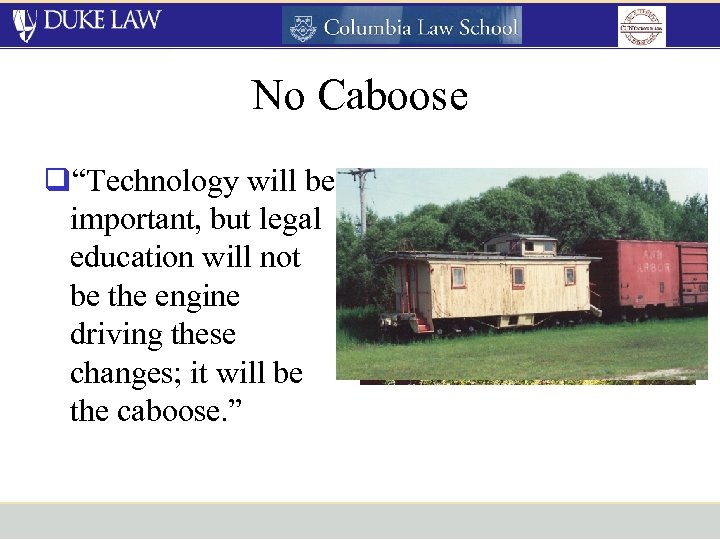 No Caboose q“Technology will be important, but legal education will not be the engine driving these changes; it will be the caboose. ”
 Why not emphasize technology? q. Not “thinking like a lawyer” q. Just a skill q. Non-lawyers can take care of it q. Can’t know which technologies will be important in someone’s career q. Isn’t technology just a tool?
 IT is a meta-tool q Information technology is a fundamentally different way to do the same old thing - overcoming time, space and other historical limitations – perhaps most accessible analogy is how the apparent motion of static images (showing a series over time) created a whole new category of cultural production – the “movie”, television, video, animation, virtual reality “movie” q It is a tool whose conventions you have to “get” – that takes exposure q There are implications to using technology that require a basic understanding of how technology works
 State of Technology Instruction q. Respondent (E-mailed) Survey q. Website Survey q. Results – – More courses involve technology, broadly defined, than subjectively anticipated – Very few examples of widespread institutional commitment – Little sense of a coherent standard practice
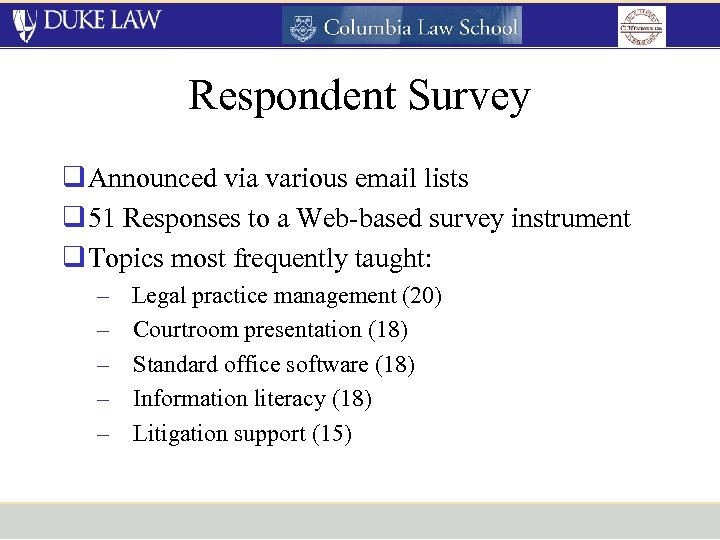 Respondent Survey q Announced via various email lists q 51 Responses to a Web-based survey instrument q Topics most frequently taught: – – – Legal practice management (20) Courtroom presentation (18) Standard office software (18) Information literacy (18) Litigation support (15)
 Website Survey q. How do law schools represent their curricula to the world (wide web)? q. What kinds of courses are most likely to represent themselves as integrating instruction about information technology? q. A survey of 187 websites showed a wide variety of detail and orientation, but patterns emerged.
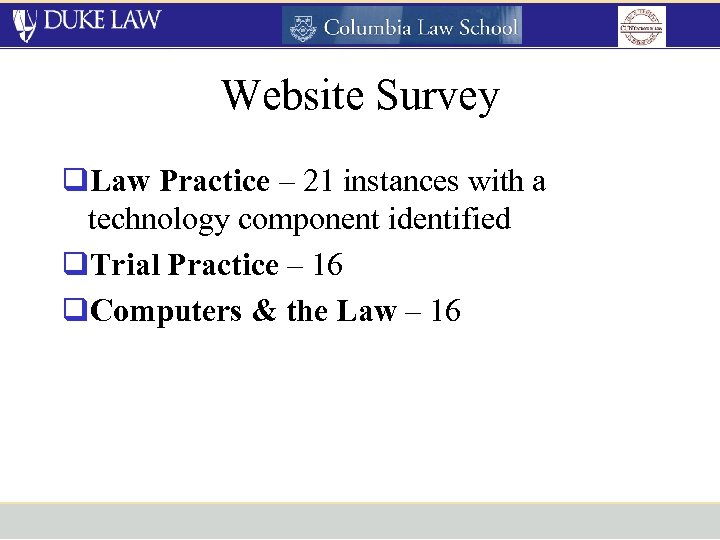 Website Survey q. Law Practice – 21 instances with a technology component identified q. Trial Practice – 16 q. Computers & the Law – 16
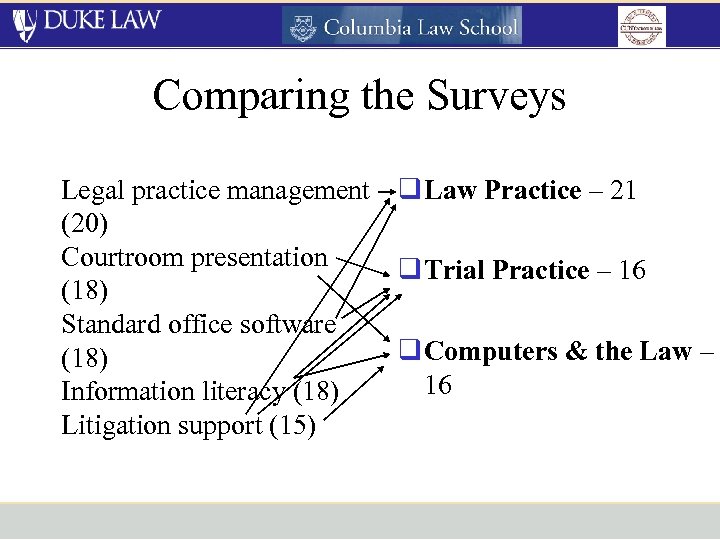 Comparing the Surveys Legal practice management q Law Practice – 21 (20) Courtroom presentation q Trial Practice – 16 (18) Standard office software q Computers & the Law – (18) 16 Information literacy (18) Litigation support (15)
 Web Survey q Law Practice – University of Colorado Law Practice Management. LAWS 7609 -1. Studies the Topics include the business structure establishment of a solo or small-firm legal practice. Topics include the business structure (PC, LLC, etc. ) office systems, marketing and development, staffing, liability marketing and development, staffing, insurance, managing time, technology, and billing. (This is technology a practice course that counts toward the 14 credit liability insurance, managing time, maximum of practice hours. ) Course supported by the Section of Law Practice Management of the ABA in technology, and billing. technology memory of Harold A. Feder, CU Law ’ 59.
 Web Survey q Trial Practice – U of Maryland Advanced Trial Advocacy: Litigating with Technology (3) Technologies presenting interesting and new legal Technologies This course teaches practical aspects of litigation strategy, emphasizing pretrial and courtroom-related technologies. Students will learn to apply questions are imaging and database software, web concepts and skills in civil procedure, legal research, evidence and sources for specialized litigation research, case advocacy in a course focused on the ethical, procedural, evidentiary and systemic effects of technological legal innovations. Technologies mapping, electronic filing, electronic discovery, presenting interesting and new legal questions are imaging and database remote witness testimony, electronic trial software, web sources for specialized litigation research, case mapping, presentation tools (including computer-based electronic filing, electronic discovery, remote witness testimony, electronic trial presentation tools (including computer-based evidence display, re-creation, and simulation) and multimedia court records.
 Web Survey q Trial Practice – William and Mary q LAW 720 04 Trial Advocacy - Technology Augmented 3 credits An advanced litigation course intended for those second- or third-year students who have a substantial interest in litigation. The course is designed to develop the student¹s skill as a trial lawyer for both civil and criminal cases. Trial Advocacy will deal with trial strategy, jury selection, opening statements, presentation of evidence, including the examination of witnesses, closing arguments, and preparation of jury instructions. Evidence presentation and related technologies will be technologies fully integrated into all aspects of the course. A trial will be required. This is a pass/fail course. Prerequisite: satisfactory completion of Legal Skills I, II and Evidence presentation and related technologies will be technologies fully integrated into all aspects of the course.
 Web Survey q Computers and the Law – U of Conn. q LAW 981 Computers and the Law 3 units Deals with selected issues involving the general question how the new technology of computers is affecting, and is technology affected by, the law and the legal system. Each student undertakes a substantial project on a topic mutually agreed upon by the instructor and the student, and is required to report on or critique projects prepared by others. These projects may include research papers or the preparation of computer-assisted educational materials. Research papers may fulfill the Upperclass Writing Requirement. Deals with selected issues involving the general question how the new technology of computers is technology affecting, and is affected by, the law and the legal system.
 Our goal at Duke School of Law • A comprehensive survey course on the use of technology in legal practice. • Taught by law school faculty-technologists and guests including practitioners, law firm CIOs, accountants.
 Fundamental Rationale As technology transforms legal practice, legal education has not kept pace. Curricula do not integrally reflect the ways in which information technologies are being used, and could be used, to change the practice of law in the United States. While law schools have embraced online publication databases many other transformations in legal "best practices" remain outside the scope of today's law school: large-scale document management; the discovery process in an electronic arena; information presentation and simulations in the courtroom; and the evaluation of electronic resources outside the narrow confines of the legal document databases.
 Course Proposal • Full semester course, two credits, pass/fail • Subjects to include • Office Practice - Administrative Tools Timekeeping and Billing Systems, Client and Conflicts Management, electronic filing • Large Case Management Document management, including data mining, electronic discovery, indexing and retrieval of information • Knowledge Management Systems for organizing and sustaining the intellectual capital of a law practice: indexing and retrieving information contained in brief banks, memos, e-mails, and other firm internal documents.
 • Client Communications Effective use of E-mail, web sites and other electronic communications. Professional responsibility perspectives of conducting the business of the legal profession with email. Consideration of security and privacy issues. • Trial Practice Evidence and document management. Presentation of evidence. Simulations and video documentation. The state-of-the-art courtroom • The Internet Beyond Legal Research The place of the Internet in today’s law office: practical tools and tips for applying the Internet to solving your client’s problems.
 • Information Literacy Criteria for evaluating information sources of all kinds, from electronic databases purporting to be the equivalent of paper sources, to interpreting search results from electronic discovery
 Why must law schools integrate this into the curriculum? While there has been great stability in legal education, there have also been profound changes, such as the introduction of clinical and practice skills courses, and the integration of electronic resources into legal research. The ways in which technology will change the practice of law are as fundamental as any the profession has faced, and cannot be assumed away from the curriculum as matters for non-lawyers and technology specialists. Thinking like a lawyer is no longer enough; a lawyer must also think like an information handler in an information age.
 Lawyering in the Digital Age Clinic at Columbia Law School Brian Donnelly Director of Educational Technology and Lecturer in Law
 Evolution of the LDA Clinic q. Fair Housing Clinic as predecessor q. FHC was primarily a litigation clinic q. Integrated tech (starting in 1995) into: – Teaching materials – Practice q. Found time constraints in teaching both tech and fair housing (tech was marginalized)
 Developed new curriculum (2000) q. Basic ideas: – Put technology skills at the center of the curriculum (not at the margins) – Make a connection between traditional skills and contemporary skills – Apply student’s enthusiasm for and knowledge of tech to help public interest causes
 LDA Paradigm q. All lawyering tasks involve an information component q. Lawyering can be broken down into 3 basic functions: – Gathering – Managing – Presenting
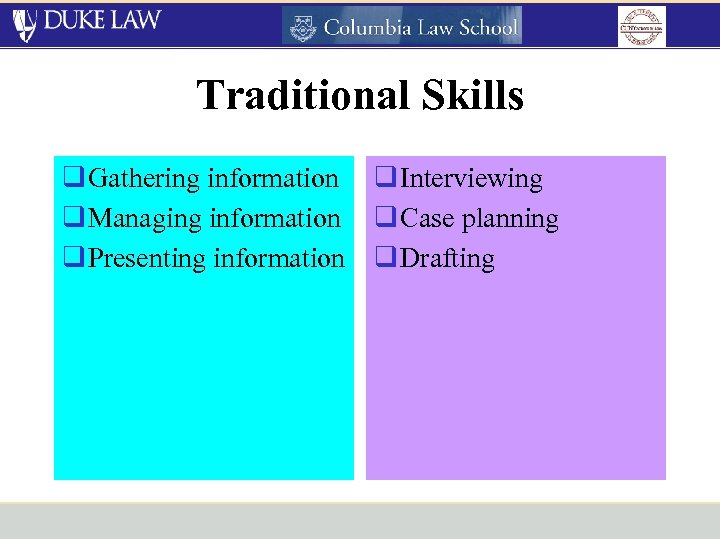 Traditional Skills q Gathering information q Interviewing q Managing information q Case planning q Presenting information q Drafting
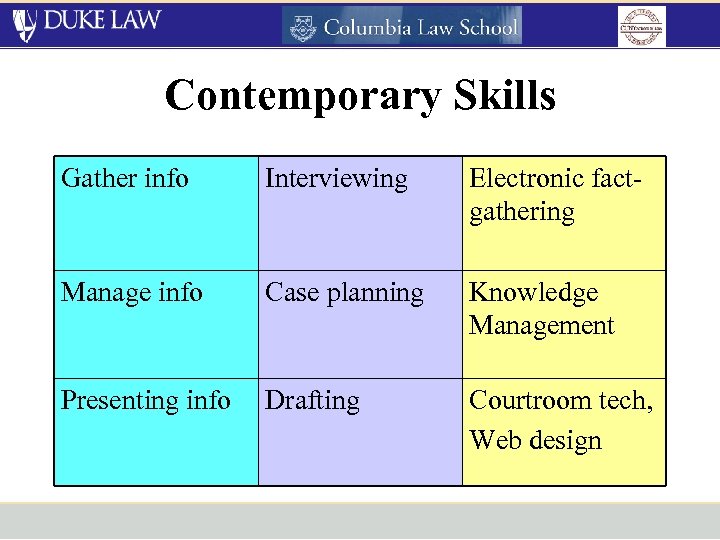 Contemporary Skills Gather info Interviewing Electronic factgathering Manage info Case planning Knowledge Management Presenting info Drafting Courtroom tech, Web design
 Student Fieldwork q Work one on one with Atty’s in legal aid legal services – Harlem Legal Aid, Community Law Offices, SRO project, MFY Legal Services q Software/web content development – NYC Housing Court (automated answer) – Probono. net (several projects including 9/11) – Supreme Court (public web site) q Public interest support – Center for Social Justice (redistricting project) – Assoc. Bar City of New York (hotline)
 What Should Students Know About Technology and Learning the Law? Bob Seibel Professor of Law CUNY School of Law 718 -340 -4206 seibel@mail. law. cuny. edu