 Скачать презентацию Is Global Software Development A Silver Bullet Or
540ff3e936d166a21130ecda83a50bf1.ppt
- Количество слайдов: 62



Is Global Software Development A Silver Bullet Or Just For Cowboys? Valentine Casey Bournemouth University 25 th of November 2009 vcasey@bournemouth. ac. uk
Overview • Introduction • Who I am • Overview of Global Software Development (GSD) • • Place GSD in context Outsourcing verses Offshoring Virtual teams An overview of my research • The Benefits of GSD • • • Geographical and temporal distance Communication Culture Motivation and fear Cooperation and trust • Conclusion • Questions vcasey@bournemouth. ac. uk 2
Introduction • Name: Valentine Casey – (What’s in a name? ) • Ph. D (Computer Science) from the University of Limerick (UL) Ireland • MSc. in Software Re-Engineering (UL) • BSc. in Economics and Management from University of London • SEI Trained CMMI Assessor • 20+ years experience in business & IT Industry vcasey@bournemouth. ac. uk 3
Introduction • Software Engineer, Team Leader, Project Manager Software Quality Manager / Consultant • Managed virtual teams in a GSD environment • Carried out research in this area for the last 10 years • University of Limerick & Lero the Irish Software Engineering Research Centre • Software Systems Research Centre Bournemouth University vcasey@bournemouth. ac. uk 4

What is Global Software Development? vcasey@bournemouth. ac. uk
Global Software Development Formal Definition: • The term Global Software Development (GSD) implies teams of knowledge workers located in various parts of the globe developing commercially viable software • GSD is characterised by moving centralised software development from “home” to dispersed teams or / and external organisations in remote locations vcasey@bournemouth. ac. uk 6
Outsourcing and Offshoring Outsourcing Software Development Outsourcing today this term has come to mean an organisation engaging or partnering with another company to partially or fully develop software on their behalf Offshoring Software Development Offshoring has come to mean when an organisation establishes a division in a remote location and wholly or partially distributes software development to that location vcasey@bournemouth. ac. uk 7
Outsourcing and Offshoring Why Explain This? Ten years ago these terms were not clearly defined and this was reflected in the literature vcasey@bournemouth. ac. uk 8
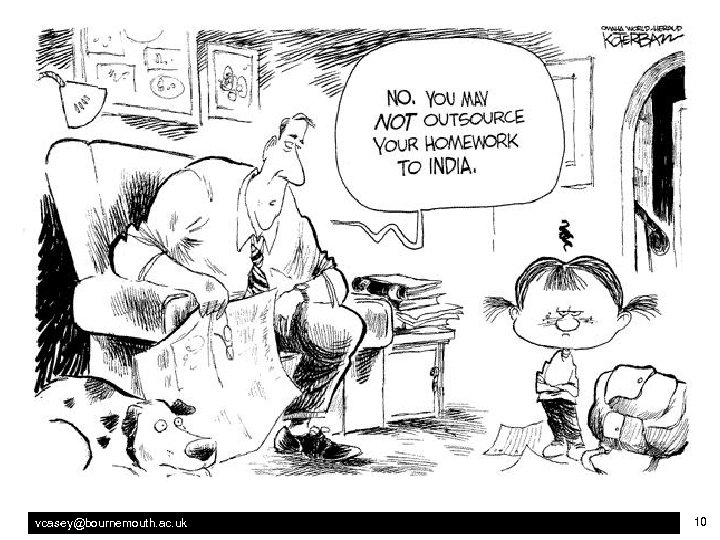
Global Software Development (GSD) is an expanding trend in the Software Industry today 9 vcasey@bournemouth. ac. uk
vcasey@bournemouth. ac. uk 10
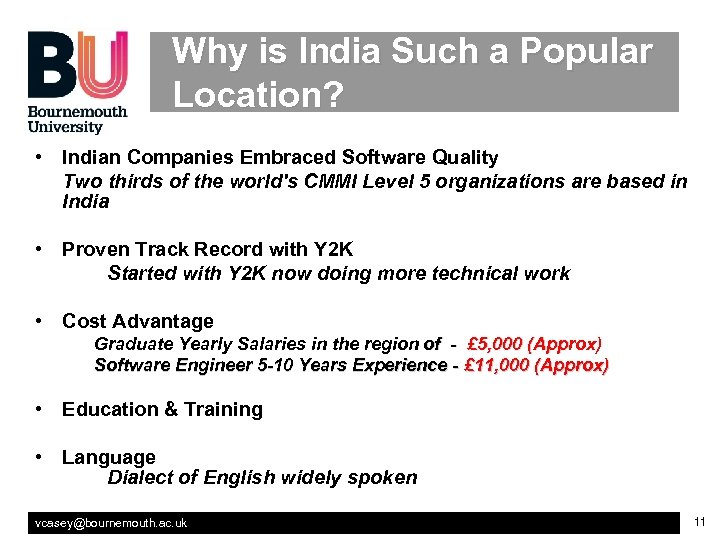
Why is India Such a Popular Location? • Indian Companies Embraced Software Quality Two thirds of the world's CMMI Level 5 organizations are based in India • Proven Track Record with Y 2 K Started with Y 2 K now doing more technical work • Cost Advantage Graduate Yearly Salaries in the region of - £ 5, 000 (Approx) Software Engineer 5 -10 Years Experience - £ 11, 000 (Approx) • Education & Training • Language Dialect of English widely spoken vcasey@bournemouth. ac. uk 11
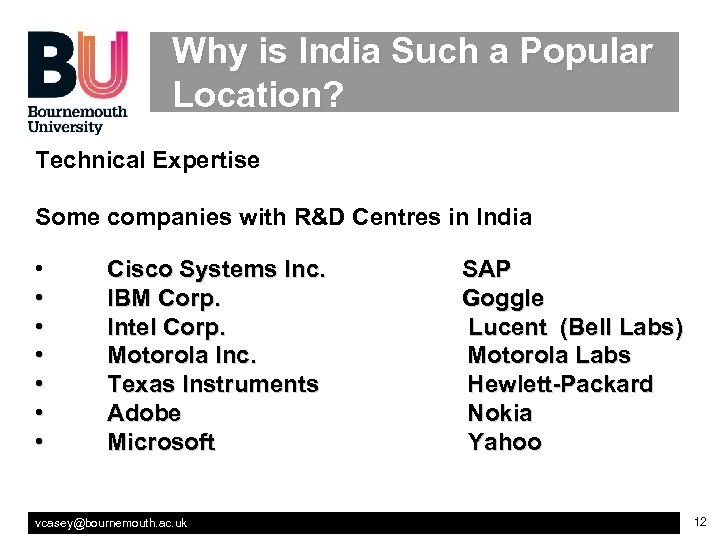
Why is India Such a Popular Location? Technical Expertise Some companies with R&D Centres in India • • Cisco Systems Inc. IBM Corp. Intel Corp. Motorola Inc. Texas Instruments Adobe Microsoft SAP Goggle Lucent (Bell Labs) Motorola Labs Hewlett-Packard Nokia Yahoo vcasey@bournemouth. ac. uk 12
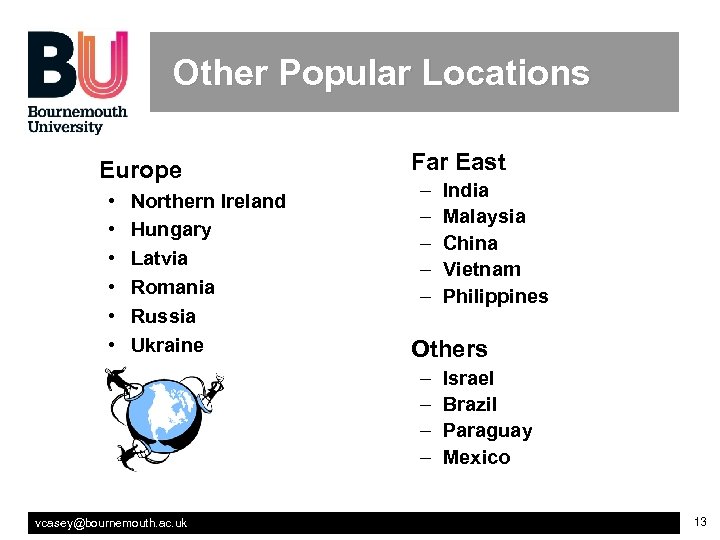
Other Popular Locations Europe • • • Northern Ireland Hungary Latvia Romania Russia Ukraine Far East – – – Others – – vcasey@bournemouth. ac. uk India Malaysia China Vietnam Philippines Israel Brazil Paraguay Mexico 13
What European country which was a very popular location for outsourcing and offshoring software development is missing off that list? vcasey@bournemouth. ac. uk 14

The Republic of Ireland 15 vcasey@bournemouth. ac. uk
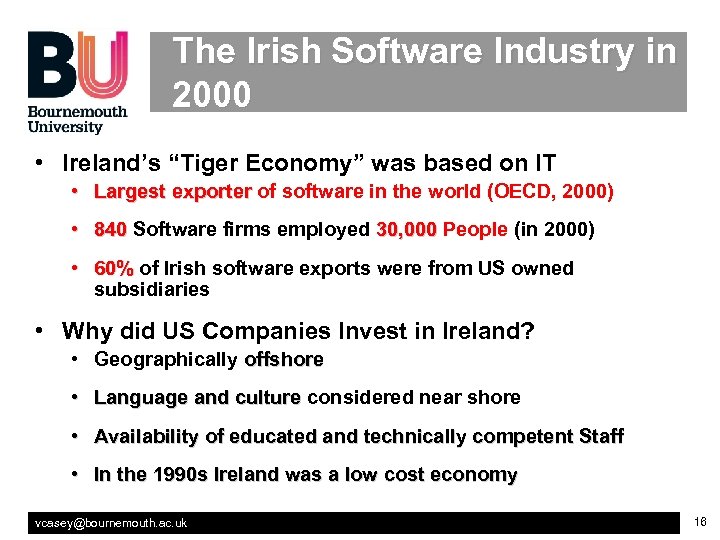
The Irish Software Industry in 2000 • Ireland’s “Tiger Economy” was based on IT • Largest exporter of software in the world (OECD, 2000) Largest exporter • 840 Software firms employed 30, 000 People (in 2000) 30, 000 • 60% of Irish software exports were from US owned 60% subsidiaries • Why did US Companies Invest in Ireland? • Geographically offshore • Language and culture considered near shore Language and culture • Availability of educated and technically competent Staff • In the 1990 s Ireland was a low cost economy vcasey@bournemouth. ac. uk 16
What has happened since • Costs in Ireland have increased since 2000 • Ireland has seen the dot com bubble burst and experienced its repercussions • It is no longer a low cost location • Even after the recent banking crisis • Ireland is now the most expensive in EU (or tied with Finland for that “honour”) vcasey@bournemouth. ac. uk 17
Irish Software Industry In Recent Years • The reality is today Irish based multinationals and indigenous software companies are now outsourcing and offshoring software development internationally • In many cases the same people who were recipients of this type of work are now responsible for offshoring or outsourcing their work • As a result of these developments the Irish Software Industry’s long term focus is now knowledge based, niche centric and value adding • This provides a unique research perspective as the recipients have become the exporters • A considerable part of my research has focused on leveraging the opportunities which carrying out research with Irish based organisations has provided vcasey@bournemouth. ac. uk 18
My Research Philosophy • My Research Philosophy: • • My work should be practical Industry based Employ effective research methods Deal with real people, factors, issues and problems • My Goal is that my results will be of value • People will be able and want to read what I publish • What I produce should help to make a difference vcasey@bournemouth. ac. uk 19
Industry Based Research • Four Independent industry based studies Undertaken over a ten year period • • Distributed software development within the one country US organisation partnered with Irish based division of US multinational Large Irish based division of US multinational offshored to Malaysia Three Indian software development organisations who had project outsourced and offshored from US and UK to them • Research Methodologies • • Action Research Yin based case study Grounded theory Tools employed • • • Interviews and focus groups Questionnaires Direct observation and artefact review vcasey@bournemouth. ac. uk 20
Virtual Teams • Traditional team (Powell et al. , 2004) • Social group of individuals collocated and interdependent in tasks • Undertake activities to achieve common goals • Virtual team (Lipnack & Stamp, 1997) • Same goals and objectives as traditional team • Operate across time, geographical locations and sometimes organisational boundaries • Linked by communication technologies vcasey@bournemouth. ac. uk 21
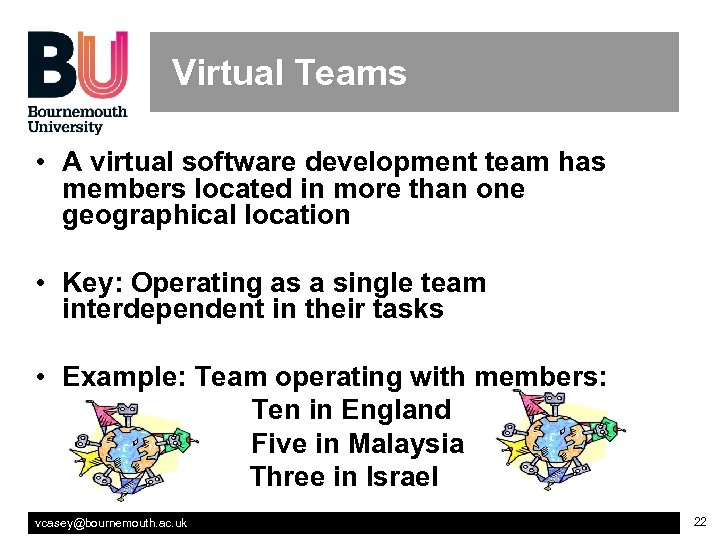
Virtual Teams • A virtual software development team has members located in more than one geographical location • Key: Operating as a single team interdependent in their tasks • Example: Team operating with members: Ten in England Five in Malaysia Three in Israel vcasey@bournemouth. ac. uk 22
Focus Of My Research • The focus of my research has been the effective operation of virtual teams • Why virtual teams? • Virtual teams are exposed to the full impact of GSD • All distributed projects are impacted in a similar manner to virtual teams to the same or to a lesser extent • Therefore it is a very relevant area to focus on when researching Globally Software Development vcasey@bournemouth. ac. uk 23
What are the expected benefits to be gained by utilising a GSD strategy? 24 vcasey@bournemouth. ac. uk
The Perceived Benefits of GSD • Economic • Reduced labour costs and therefore development costs • Labour market • Access to large labour market • Global access to technical skills • Leverage skills of developers at different locations • Temporal • ‘Follow the sun’ 24 hour development • Full tools utilisation • “Faster Development” / “First to Market” • Product • Opportunity to be close to customers and developing markets vcasey@bournemouth. ac. uk 25
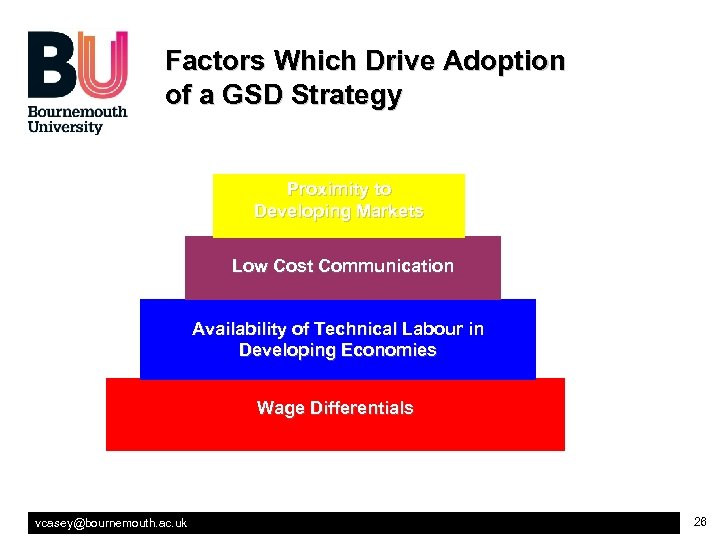
Factors Which Drive Adoption of a GSD Strategy Proximity to Developing Markets Low Cost Communication Availability of Technical Labour in Developing Economies Wage Differentials vcasey@bournemouth. ac. uk 26
The Objective of Implementing a GSD strategy Goal: Gain / Maintain Competitive Advantage Achieved by: • Reduction in development costs • Cheaper to Produce Software in Low Cost Centres • More Competitive Price = More Market Share • Increased Profit • Ability to be first to market • “Follow The Sun Development” • 24 / 7 Development • Example: UK - US – India – UK(again) • Ability to respond quickly to dynamic markets vcasey@bournemouth. ac. uk 27
Rationale For Implementing A GSD Strategy • Economic / Labour market / Temporal / Product benefits • Software Quality e. g. CMMI accreditation • Availability of educated remote software engineers • Communication Infrastructure available and cheap • Popularity and knowledge of English as a business language • Our competitors are doing it! vcasey@bournemouth. ac. uk 28

Does all this Mean GSD is a Silver Bullet? Or is it just for Cowboys? vcasey@bournemouth. ac. uk 29
The Reality - GSD Is A Difficult Task • GSD is a complex and difficult endeavour • Never mind the hype there are lots of problems and failures • Not the same as collocated development • Costs are not just Salary there are other important not just Salary costs - Training, Travel, Coordination, Delayed Delivery, Product Quality, Human! • Need for individuals at different and remote locations to operate as unified teams • All the negative factors associated with distance come into play vcasey@bournemouth. ac. uk 30
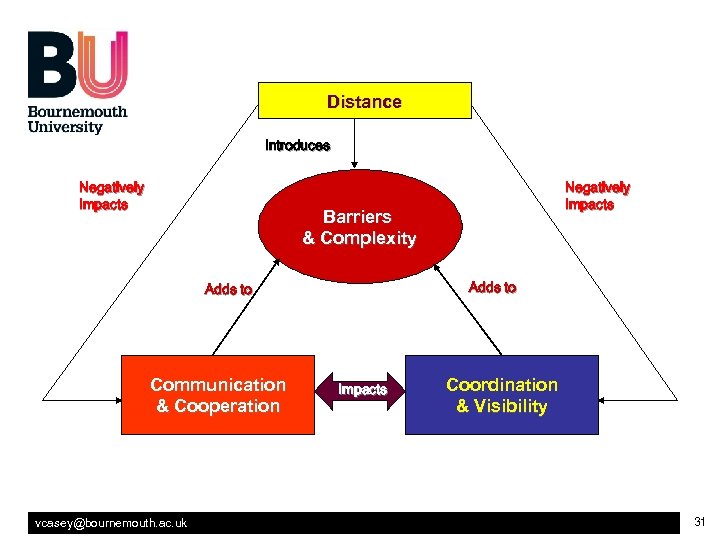
Distance Introduces Negatively Impacts Barriers & Complexity Adds to Communication & Cooperation vcasey@bournemouth. ac. uk Impacts Coordination & Visibility 31
Factors Negatively impacting GSD • Each factor is complex and impacts other factors and variables and is presented here only in summary form • The high level model presented • Communication • Cooperation • Coordination • Visibility • These factors are fundamental for any successful collocated or GSD project • All these factors are negatively impacted by GSD distance vcasey@bournemouth. ac. uk 32
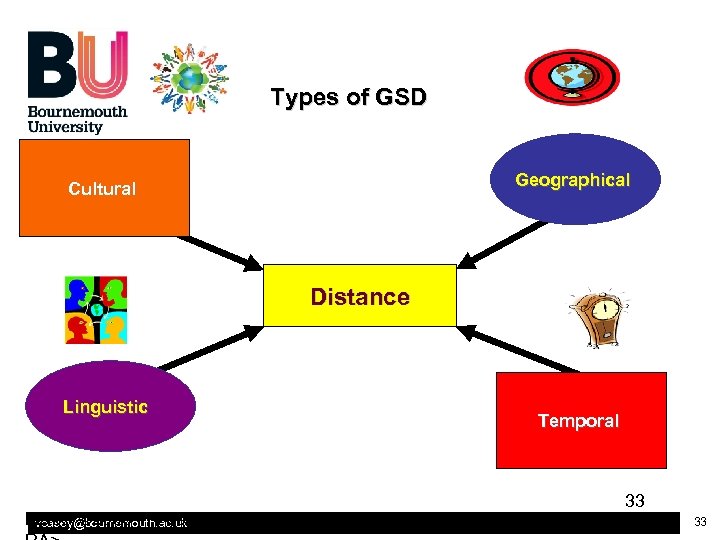
Types of GSD Geographical Cultural Distance Linguistic LERO © 2008 | <Area Name> | <Name of vcasey@bournemouth. ac. uk Temporal 33 33
Geographical Distance • Physical separation negatively impacts on the operation of teams • The opportunity for developing working relationships is reduced due to the lack of physical proximity • Issues which can be normally discussed and clarified in an informal way in the collocated situation have to be formally articulated and remotely addressed • Knowledge transfer is inhibited and is costly due to distance • It is difficult to build a relationship and work closely with someone you have never met vcasey@bournemouth. ac. uk 34
Temporal Distance • Team members normally work in different time zones • The opportunity for synchronous contact may be very limited or nonexistent - i. e. 30 minutes a day • When issues arise they can delay a project as they have to be raised utilising asynchronous tools in many cases a response is required before work on an important issue can continue • A big problem which I identified was that issues can take much longer to resolve when dealing with remote colleagues • If a “Follow the Sun” approach is implemented considerable overhead has to be invested in documenting what and how things have been done • On handing over work between sites time has to be spent reading and understanding this documentation at the other location vcasey@bournemouth. ac. uk 35
Good Communication is the life blood of every project How is it impacted by GSD ? 36 vcasey@bournemouth. ac. uk
Communication • Communication is negatively impacted due to operating in a GSD environment • The ability to communicate • Knowledge of English • How is your Hindi or Chinese? • Use of a different dialect of English • The full stop saga • Accent particularly on the telephone or conference calls • It works both ways! • Tools to communicate with • Selection and provision of appropriate communication Tools • Ensure adequate to do the job vcasey@bournemouth. ac. uk 37
Communication • Communication Tools: Telephone Email Conference Calls Groupware Process Documents Team Pages Voice Mail Instant Messenger Video Conferencing Intranet FAQ Wiki • The provision of adequate communication tools does not mean they will be used ! vcasey@bournemouth. ac. uk 38
Communication Motivation • Staff need to be motivated to communicate • This was a problem I encountered when carrying out my research • Reasons for not phoning remote colleagues in the Far East: “I can’t phone them I don’t know if it is a man or a women ” “I can’t tell from the name” “I don’t know what to call them, their names are backwards” “Is it Poo Ling or Ling Poo ” “He signs his e-mails Joe so what do I call him” “I can’t telephone them !!!” vcasey@bournemouth. ac. uk 39
Communication My Solution: • On the team’s Intranet page Intranet • Have a photograph of each team member • Under the photograph have each individuals name • Val Casey, Avanindra Sing or Ping Loo • Then a little bit about the person starting with their first name “Val has been with the company since June 2004” “Loo has been with the company since May 2005… Loo’s friendly name is Joe so if you contact him you can call him Joe” • The reaction from the Irish team members to this suggestion was “I am not having my photograph on a web site!!” • Even if it was only on the Intranet What was going on? vcasey@bournemouth. ac. uk 40
Communication • Communication problems do not only arise with those responsible for outsourcing or offshoring their work • In another situation researched the team members based in the Far East never used the telephone to contact or respond to their colleagues in Ireland • It emerged after further investigation that the Management in the Far East saw their divisional advantage lay in their low cost base • Their objective was therefore to limit their costs and transfer as much of the project costs to the offshoring location as possible vcasey@bournemouth. ac. uk 41
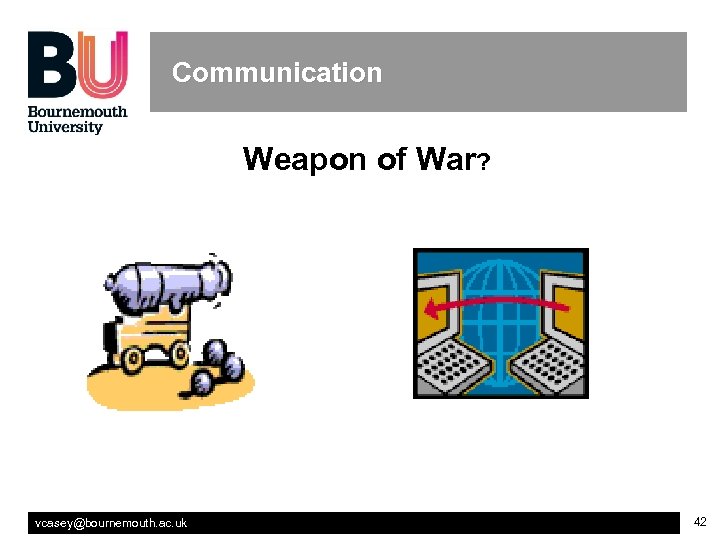
Communication Weapon of War? vcasey@bournemouth. ac. uk 42
Communication • Communication can be used as a weapon of war • In one case study researched a US based organisation had partnered with the Irish division of a US multinational • Email was used to attack team members from the other organisation • The tactic employed by both sides was to copy any minor problems to Senior Management in both organisations • This resulted in virtual teams and management which were divided on organisational lines who ended up attacking and obstructing each other • This very nearly led to the collapse of the whole project vcasey@bournemouth. ac. uk 43
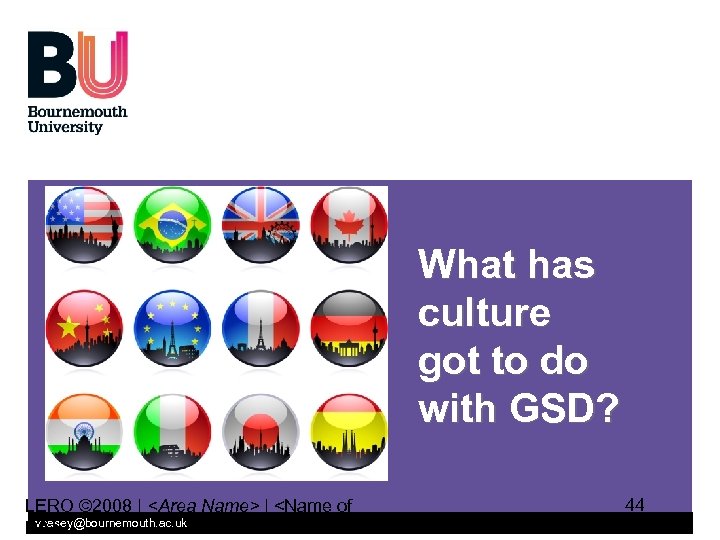
What has culture got to do with GSD? LERO © 2008 | <Area Name> | <Name of vcasey@bournemouth. ac. uk RA> 44
Culture What is Culture? • Invisible to us • Tells us that ours is the correct way of doing things • Based on our shared knowledge, experience, beliefs and values • Allows us to understand our environment and others • It provides rules and guidelines that allow us to predict, categorise and interpret others and the world around us • Allows us to give and receive signals • We know what is and is not acceptable • It moulds the way we act and think • We ignore its importance within GSD at our peril vcasey@bournemouth. ac. uk 45
Culture • In the business context there are two types of culture • • Organisational Culture National Culture • Organisational or corporate culture has been defined as “Shared values and beliefs, which are seen to characterise particular organisations” (Dawson, 1992) • Corporate norms, beliefs, values and objectives are imparted though training, management style, communication methods, rewards and organisational structure • The successful transmission of organisational culture depends on the differences between its values and norms and the national culture of those who it is being imparted to • While there may be outward compliance, national culture is hard to change and this can only effectively take place over an extended time period vcasey@bournemouth. ac. uk 46
Culture • National culture has been described in terms of shared values, beliefs and philosophies that affect the way society is organised • These values, norms and beliefs are shaped by common history, religion, tradition, climate and prosperity • It makes us who we are as individuals, a nation, a society • It is the glue that binds us together and makes us different from others • It is inclusive to those who share our background and beliefs • It can be a barrier and lead to misunderstandings with those who come from a different culture • Its impact should not be underestimated • Example: “Are you checking up on me? ” vcasey@bournemouth. ac. uk 47
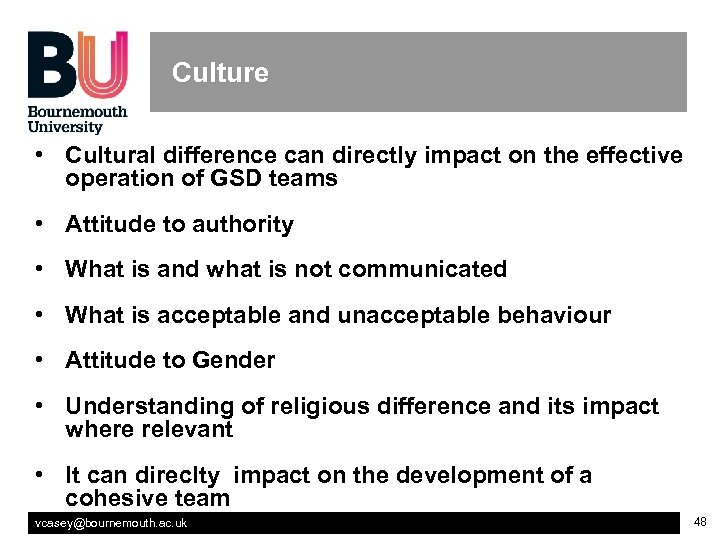
Culture • Cultural difference can directly impact on the effective operation of GSD teams • Attitude to authority • What is and what is not communicated • What is acceptable and unacceptable behaviour • Attitude to Gender • Understanding of religious difference and its impact where relevant • It can direclty impact on the development of a cohesive team vcasey@bournemouth. ac. uk 48
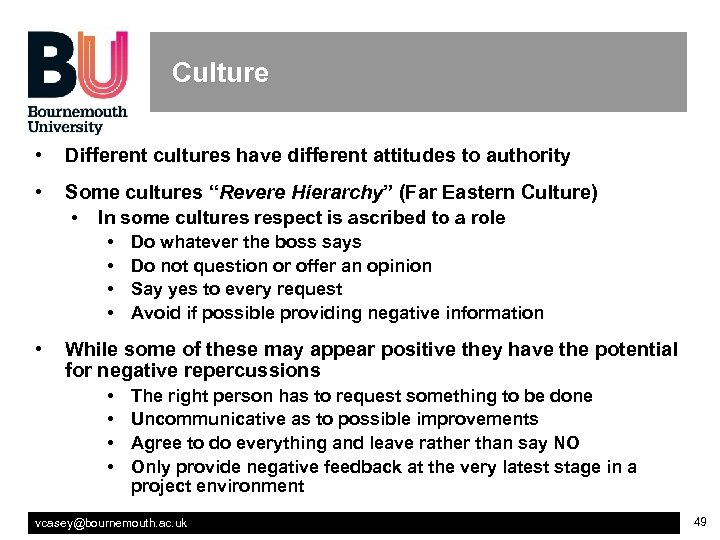
Culture • Different cultures have different attitudes to authority • Some cultures “Revere Hierarchy” (Far Eastern Culture) • In some cultures respect is ascribed to a role • • • Do whatever the boss says Do not question or offer an opinion Say yes to every request Avoid if possible providing negative information While some of these may appear positive they have the potential for negative repercussions • • The right person has to request something to be done Uncommunicative as to possible improvements Agree to do everything and leave rather than say NO Only provide negative feedback at the very latest stage in a project environment vcasey@bournemouth. ac. uk 49
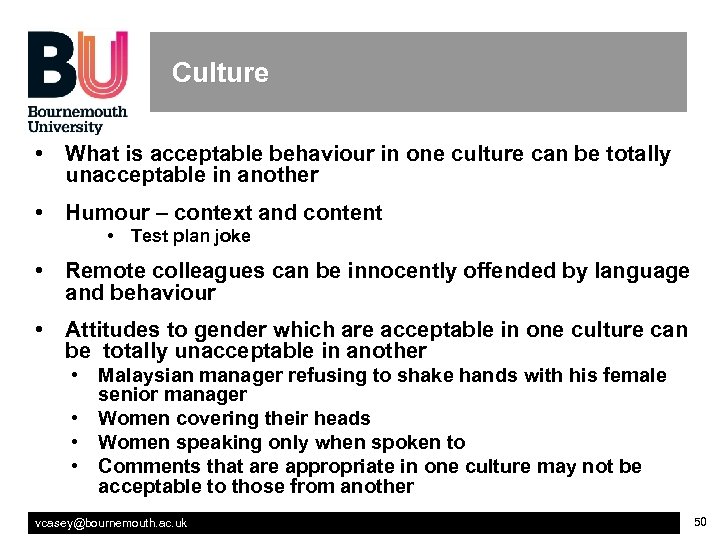
Culture • What is acceptable behaviour in one culture can be totally unacceptable in another • Humour – context and content • Test plan joke • Remote colleagues can be innocently offended by language and behaviour • Attitudes to gender which are acceptable in one culture can be totally unacceptable in another • Malaysian manager refusing to shake hands with his female senior manager • Women covering their heads • Women speaking only when spoken to • Comments that are appropriate in one culture may not be acceptable to those from another vcasey@bournemouth. ac. uk 50
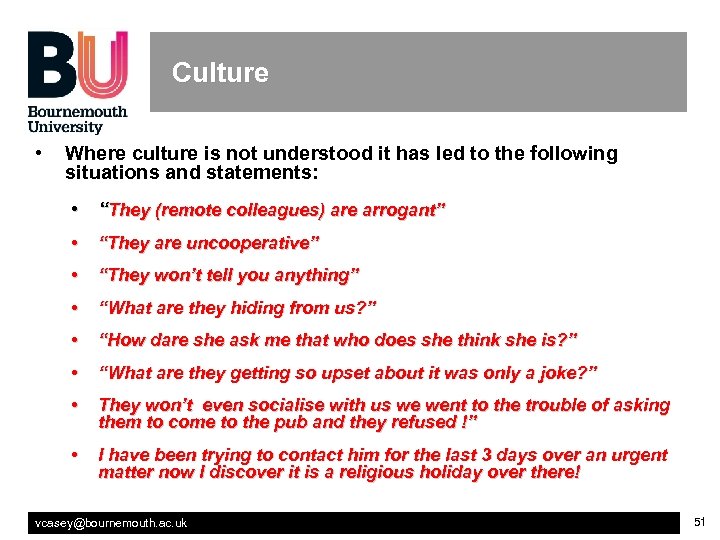
Culture • Where culture is not understood it has led to the following situations and statements: • “They (remote colleagues) are arrogant” • “They are uncooperative” • “They won’t tell you anything” • “What are they hiding from us? ” • “How dare she ask me that who does she think she is? ” • “What are they getting so upset about it was only a joke? ” • They won’t even socialise with us we went to the trouble of asking them to come to the pub and they refused !” • I have been trying to contact him for the last 3 days over an urgent matter now I discover it is a religious holiday over there! vcasey@bournemouth. ac. uk 51
Motivation And Fear • Motivation is a key element for the successful operation of software development teams • Well motivated employees will work well with their remote colleagues • Fear in the GSD context is a serious problem particularly for those work is offshored or outsourced • Fear negatively impacts on motivation • GSD can result in the loss of jobs, power and knowledge for those at the outsourcing / offshoring location • This type and level of fear does not go away and is often reinforced vcasey@bournemouth. ac. uk 52
Motivation And Fear Would you be motivated and disposed to cooperate with your remote colleagues if I told you: “I can get someone to do your job at half the price in the Far East” “You better be more value adding and productive to justify the extra we are paying you” “We have been here for 20 years but it is a cost issue if we can get the work done cheaper elsewhere it is something we will have to look at” “By the way you have to train your remote colleagues and ensure they know everything about the project vcasey@bournemouth. ac. uk 53
Cooperation And Trust • It is difficult to develop trust and cooperate with remote colleagues in these circumstances • Communication, openness, provision of relevant information all help • Trust is built on honesty • If the long term future is secured by GSD that needs to be reinforced • If the objective is to transfer knowledge and close the outsourcing /offshoring staff located there are going to realise that • Cooperation is as important in the GSD setting as for collocated teams • Teamness needs to be developed • A single team approach needs to be implemented • Common goals and rewards are important • Management need to understand potential problems and play a proactive role in mitigating the risks which FEAR brings to GSD teams vcasey@bournemouth. ac. uk 54
GSD Project Management 55 vcasey@bournemouth. ac. uk
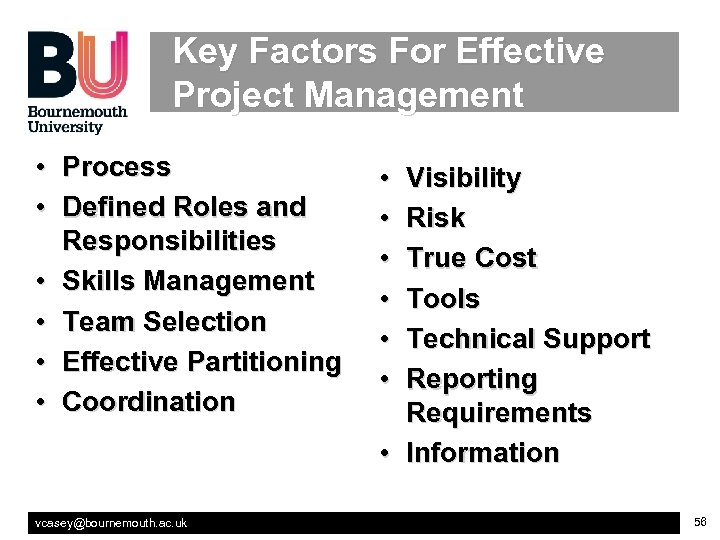
Key Factors For Effective Project Management • Process • Defined Roles and Responsibilities • Skills Management • Team Selection • Effective Partitioning • Coordination vcasey@bournemouth. ac. uk • • • Visibility Risk True Cost Tools Technical Support Reporting Requirements • Information 56
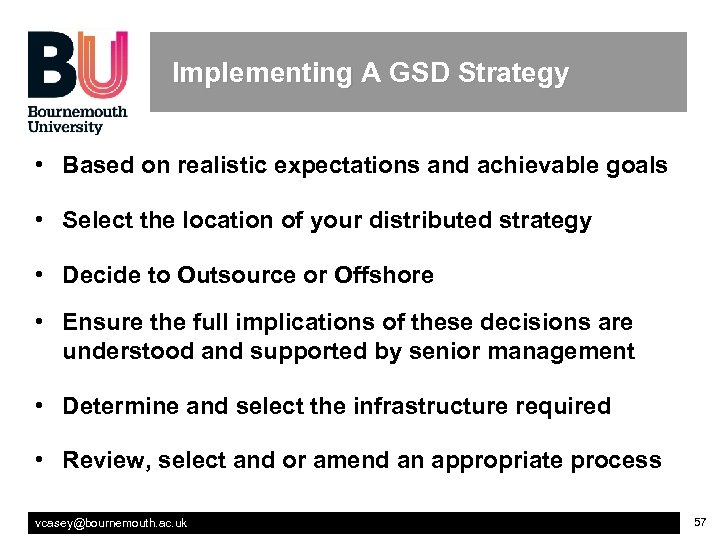
Implementing A GSD Strategy • Based on realistic expectations and achievable goals • Select the location of your distributed strategy • Decide to Outsource or Offshore • Ensure the full implications of these decisions are understood and supported by senior management • Determine and select the infrastructure required • Review, select and or amend an appropriate process vcasey@bournemouth. ac. uk 57
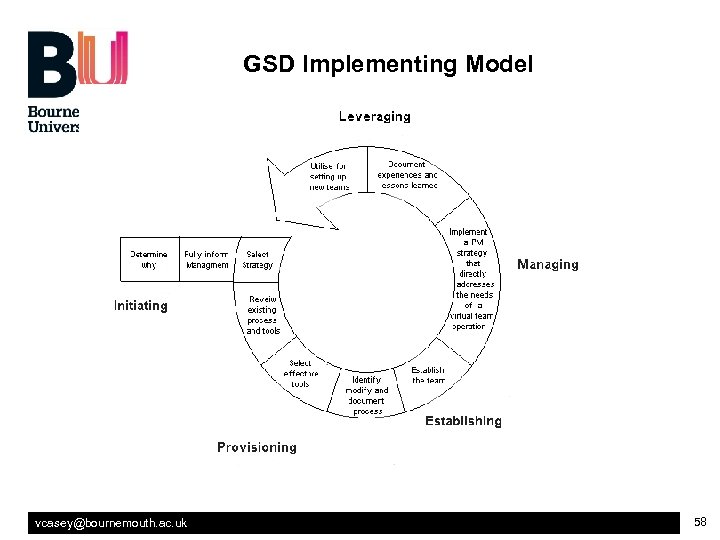
GSD Implementing Model vcasey@bournemouth. ac. uk 58
So is GSD just for Cowboys? No it can work but it requires a realistic apporach and expectations vcasey@bournemouth. ac. uk 59

vcasey@bournemouth. ac. uk 60

My Book Is Available From The Publisher Cambridge Scholars: http: //www. c-s-p. org/Flyers/Software-Testing-and-Global. Industry--Future-Paradigms 1 -4438 -0109 -7. htm Amazon. com: http: //www. amazon. co. uk/Software-Testing-Global. Industry-Paradigms/dp/1443801097 Waterstones: http: //www. waterstones. com/waterstonesweb/simple. Sear ch. do? simple. Search. String=Valentine+Casey&search. T ype=2 vcasey@bournemouth. ac. uk 61
Questions? Contact Details Val Casey Bournemouth University vcasey@bournemouth. ac. uk Thank You 62 vcasey@bournemouth. ac. uk
Скачать презентацию Is Global Software Development A Silver Bullet Or
540ff3e936d166a21130ecda83a50bf1.ppt