


 Скачать презентацию Is Disparity in Asthma among Californians Due to
0bd31254fa6056274b813b33baa8ef4b.ppt
- Количество слайдов: 38
 Is Disparity in Asthma among Californians Due to Higher Pollutant Exposures, Greater Susceptibility, or Both? Funded by California Air Resources Board June 12, 2008 1
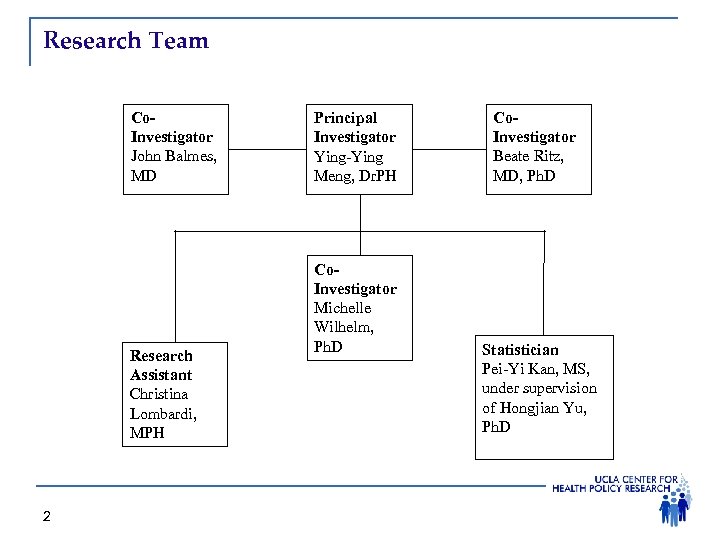 Research Team Co. Investigator John Balmes, MD Research Assistant Christina Lombardi, MPH 2 Principal Investigator Ying-Ying Meng, Dr. PH Co. Investigator Michelle Wilhelm, Ph. D Co. Investigator Beate Ritz, MD, Ph. D Statistician Pei-Yi Kan, MS, under supervision of Hongjian Yu, Ph. D
 Background • Asthma is one of the most common chronic conditions in the United States. • In 2005, 32. 6 million Americans (11. 2% of the population) were diagnosed with asthma. • Information is needed on the effects of long-term air pollution exposure on chronic severe asthma and asthma-like symptoms in vulnerable populations. 3
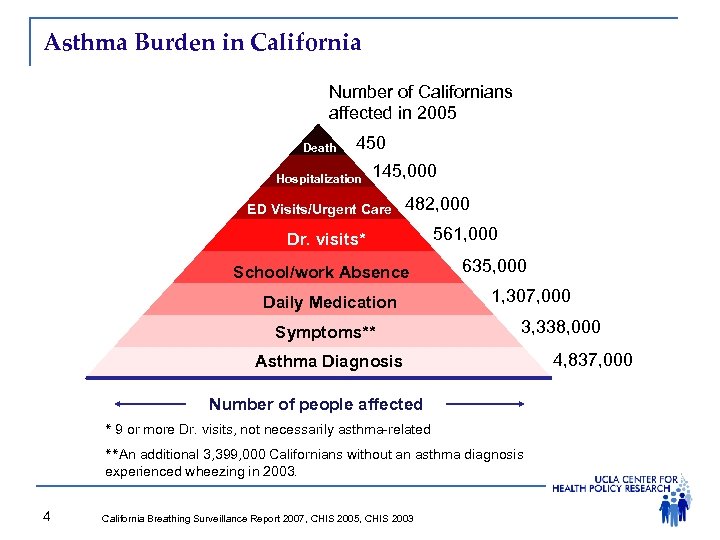 Asthma Burden in California Number of Californians affected in 2005 Death 450 Hospitalization 145, 000 ED Visits/Urgent Care 482, 000 Dr. visits* School/work Absence Daily Medication Symptoms** 561, 000 635, 000 1, 307, 000 3, 338, 000 Asthma Diagnosis Number of people affected * 9 or more Dr. visits, not necessarily asthma-related **An additional 3, 399, 000 Californians without an asthma diagnosis experienced wheezing in 2003. 4 California Breathing Surveillance Report 2007, CHIS 2005, CHIS 2003 4, 837, 000
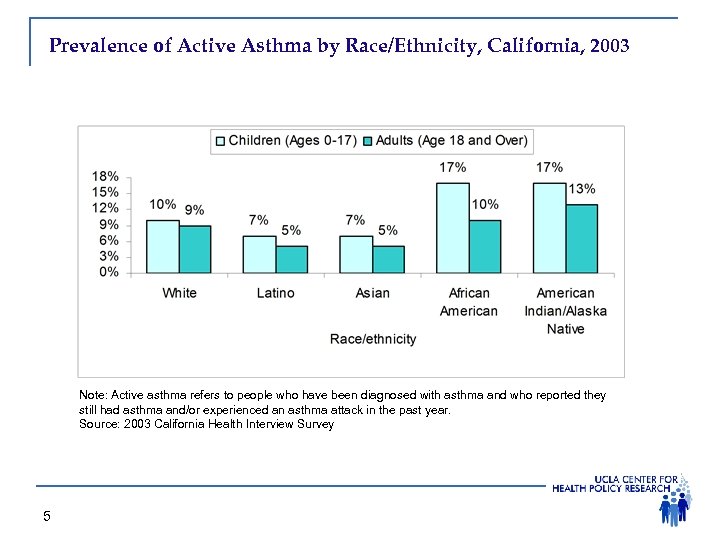 Prevalence of Active Asthma by Race/Ethnicity, California, 2003 Note: Active asthma refers to people who have been diagnosed with asthma and who reported they still had asthma and/or experienced an asthma attack in the past year. Source: 2003 California Health Interview Survey 5
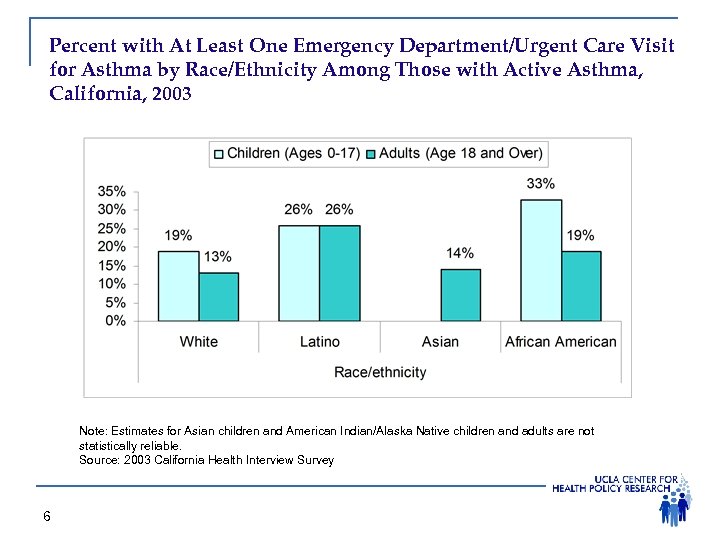 Percent with At Least One Emergency Department/Urgent Care Visit for Asthma by Race/Ethnicity Among Those with Active Asthma, California, 2003 Note: Estimates for Asian children and American Indian/Alaska Native children and adults are not statistically reliable. Source: 2003 California Health Interview Survey 6
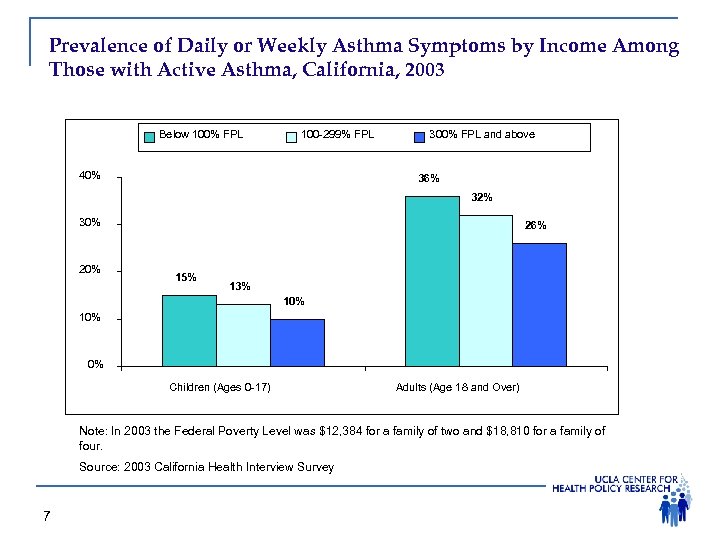 Prevalence of Daily or Weekly Asthma Symptoms by Income Among Those with Active Asthma, California, 2003 Below 100% FPL 100 -299% FPL 40% 300% FPL and above 36% 32% 30% 26% 15% 13% 10% 0% Children (Ages 0 -17) Adults (Age 18 and Over) Note: In 2003 the Federal Poverty Level was $12, 384 for a family of two and $18, 810 for a family of four. Source: 2003 California Health Interview Survey 7
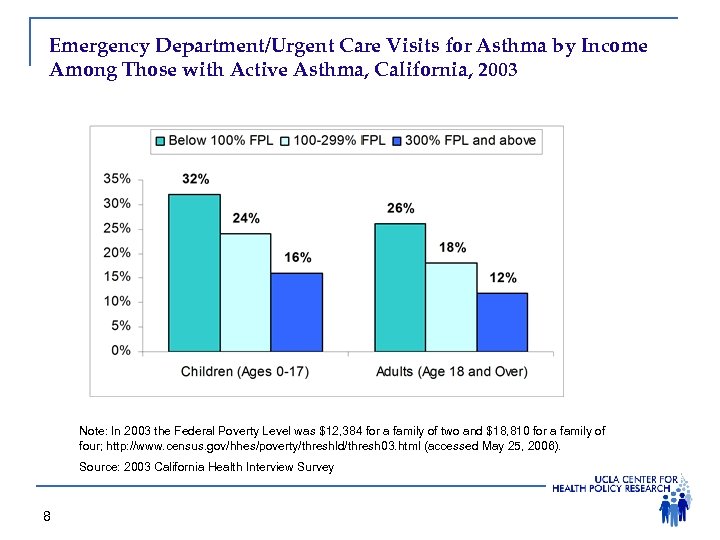 Emergency Department/Urgent Care Visits for Asthma by Income Among Those with Active Asthma, California, 2003 Note: In 2003 the Federal Poverty Level was $12, 384 for a family of two and $18, 810 for a family of four; http: //www. census. gov/hhes/poverty/threshld/thresh 03. html (accessed May 25, 2006). Source: 2003 California Health Interview Survey 8
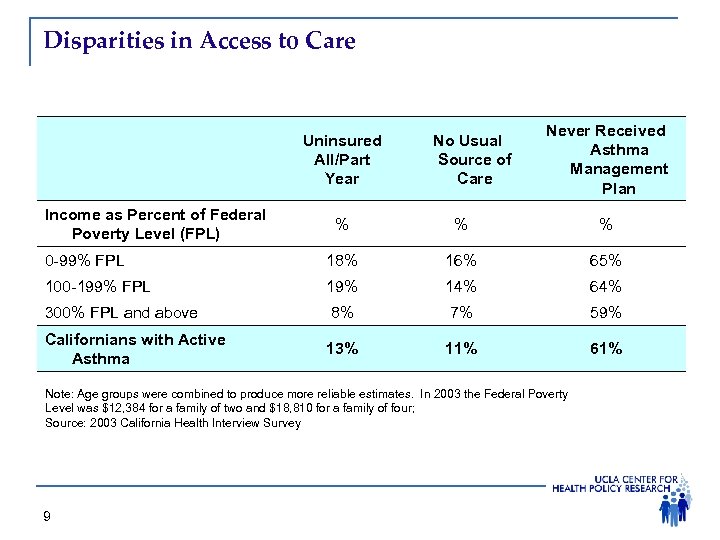 Disparities in Access to Care Uninsured All/Part Year Income as Percent of Federal Poverty Level (FPL) No Usual Source of Care Never Received Asthma Management Plan % % % 0 -99% FPL 18% 16% 65% 100 -199% FPL 19% 14% 64% 300% FPL and above 8% 7% 59% Californians with Active Asthma 13% 11% 61% Note: Age groups were combined to produce more reliable estimates. In 2003 the Federal Poverty Level was $12, 384 for a family of two and $18, 810 for a family of four; Source: 2003 California Health Interview Survey 9
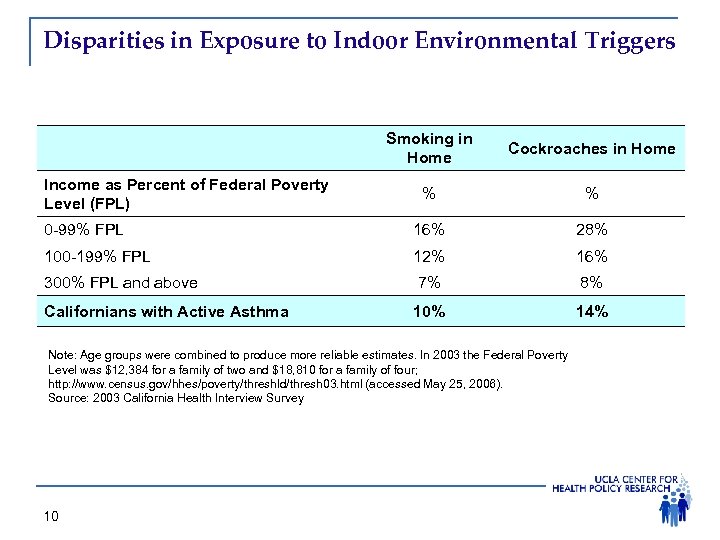 Disparities in Exposure to Indoor Environmental Triggers Smoking in Home Cockroaches in Home % % 0 -99% FPL 16% 28% 100 -199% FPL 12% 16% 300% FPL and above 7% 8% Californians with Active Asthma 10% 14% Income as Percent of Federal Poverty Level (FPL) Note: Age groups were combined to produce more reliable estimates. In 2003 the Federal Poverty Level was $12, 384 for a family of two and $18, 810 for a family of four; http: //www. census. gov/hhes/poverty/threshld/thresh 03. html (accessed May 25, 2006). Source: 2003 California Health Interview Survey 10
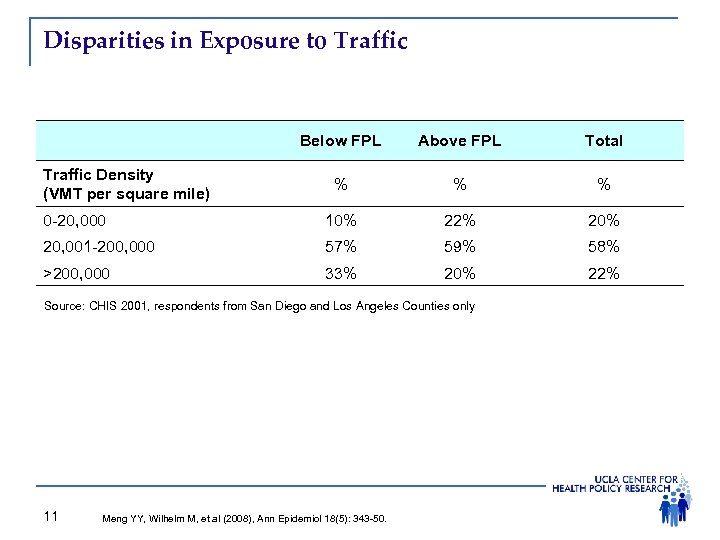 Disparities in Exposure to Traffic Below FPL Above FPL Total % % % 0 -20, 000 10% 22% 20, 001 -200, 000 57% 59% 58% >200, 000 33% 20% 22% Traffic Density (VMT per square mile) Source: CHIS 2001, respondents from San Diego and Los Angeles Counties only 11 Meng YY, Wilhelm M, et al (2008), Ann Epidemiol 18(5): 343 -50.
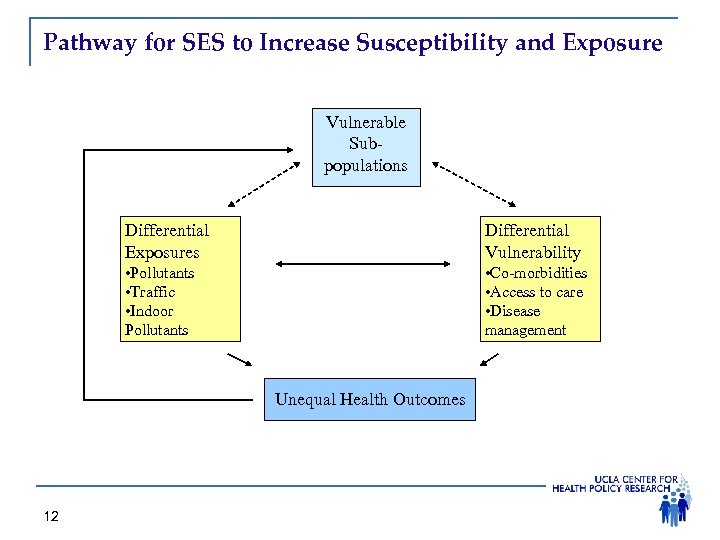 Pathway for SES to Increase Susceptibility and Exposure Vulnerable Subpopulations Differential Exposures Differential Vulnerability • Pollutants • Traffic • Indoor Pollutants • Co-morbidities • Access to care • Disease management Unequal Health Outcomes 12
 Project Objectives 1. 2. Develop residential traffic exposures using data from Caltrans for each 2003 respondent. 3. 13 Assess air pollution exposures for CHIS 2003 respondents by linking residence locations to appropriate air monitoring stations. Identify sub-populations that have higher exposures to a single pollutant or pollutant mixes, and/or potentially greater vulnerability to these exposures.
 Project Objectives—continued 4. Determine whether the disproportionate burden of asthma or asthma-like symptoms among low SES individuals is associated with greater pollutant exposures, greater vulnerabilities, or both. • 5. 14 If possible, this study will also identify factors that contribute to or modify the susceptibility to air pollution among these sub-populations. Develop a report and disseminate the results to policy makers, public health and environmental agencies, community-based organizations, and the public.
 Data Sources • California Health Interview Survey (CHIS) • Ambient Air Monitoring Data from CARB • Traffic Data from Caltrans 15
 California Health Interview Survey (CHIS) • • Largest state health survey, conducted in five languages: English, Spanish, Chinese (Mandarin and Cantonese dialects), Vietnamese, and Korean • Collects information for all age groups on health status, health conditions, health-related behaviors, health insurance coverage, access to care, and other health and development issues • 16 Biannual population-based random-digit dial telephone survey, first conducted in 2001 Collaborative project of UCLA Center for Health Policy Research, the California Department of Health Services, and the Public Health Institute
 California Health Interview Survey (CHIS)—continued Sampling • CHIS sample is representative of California’s noninstitutionalized population living in households. • • State was divided into 41 geographic sampling strata (33 single-county strata and 8 groups that include the other 25 counties with small population sizes). Within each stratum, households were selected through random-digit dialing (RDD). Within each household: – – – • Interviews for children and adolescents • • 17 One adult is randomly selected. One child (under 12) and one adolescent are sampled where applicable. Up to three interviews are completed per household. Parent or guardian most knowledgeable about the health and care of the sampled child is interviewed. After parental permission is granted the adolescent responds for him or herself.
 California Health Interview Survey (CHIS)—continued • Sampling for racial/ethnic groups • • • Urban counties were oversampled. Areas with high concentrations of Korean and Vietnamese populations were sampled at higher rates and this sample was supplemented with phone numbers for group-specific surnames from telephone listings. Designed to provide estimates for: • • 18 large- and medium-sized population counties Groups of the smallest population counties California’s overall population California’s major racial/ethnic groups as well as several Asian ethnic groups
 CHIS 2003 • • About 15% of children and 12% of adults reported an asthma diagnosis in their lifetime (7, 509 respondents). • An additional 10% of Californians reported suffering from asthmalike breathing problems (5, 522 respondents). • Collected geocodable residential address information from >90% of respondent households and zip code information for the others. • 19 Surveyed 54, 400 non-institutionalized Californians, including 12, 500 children from Aug 2003 to Feb 2004. Collected information on duration of residence in the same neighborhood.
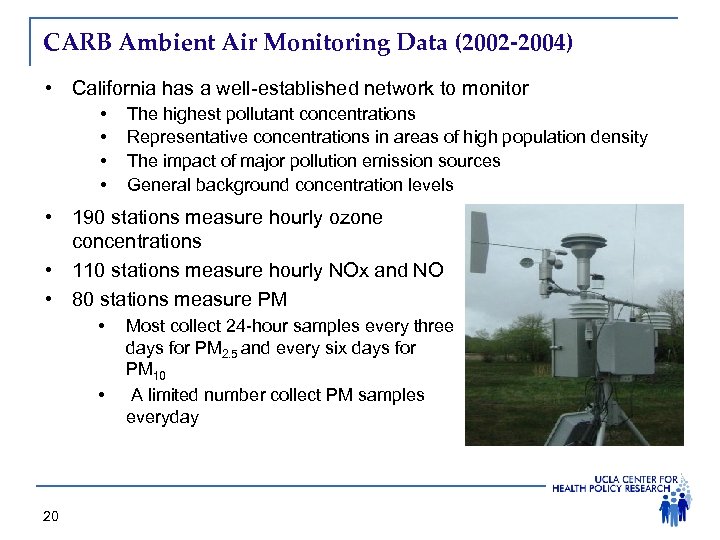 CARB Ambient Air Monitoring Data (2002 -2004) • California has a well-established network to monitor • • The highest pollutant concentrations Representative concentrations in areas of high population density The impact of major pollution emission sources General background concentration levels • 190 stations measure hourly ozone concentrations • 110 stations measure hourly NOx and NO • 80 stations measure PM • • 20 Most collect 24 -hour samples every three days for PM 2. 5 and every six days for PM 10 A limited number collect PM samples everyday
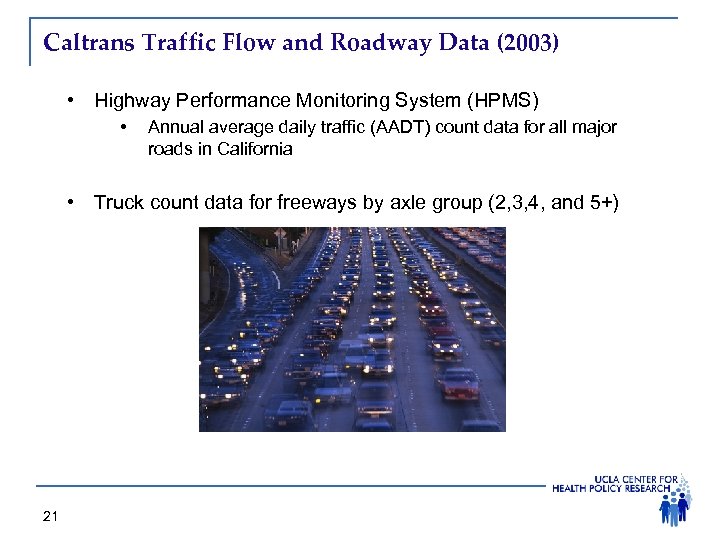 Caltrans Traffic Flow and Roadway Data (2003) • Highway Performance Monitoring System (HPMS) • Annual average daily traffic (AADT) count data for all major roads in California • Truck count data for freeways by axle group (2, 3, 4, and 5+) 21
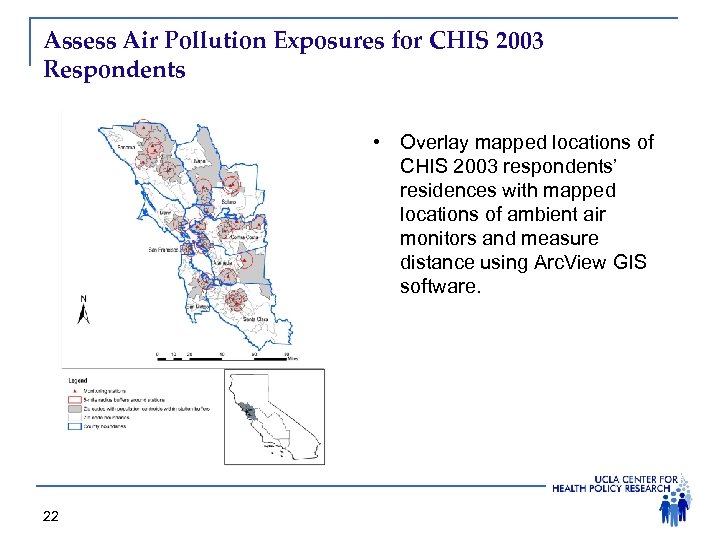 Assess Air Pollution Exposures for CHIS 2003 Respondents • Overlay mapped locations of CHIS 2003 respondents’ residences with mapped locations of ambient air monitors and measure distance using Arc. View GIS software. 22
 Air Pollution Exposure Measures • Annual average concentrations • • • Calculated for the year prior to the CHIS interview date Based on hourly measurements for NO 2 and Ozone Based on 24 -hour average measurements for PM 10 and PM 2. 5 • Interpolated pollutant concentrations • • • For respondents in areas with a less dense monitoring network Spatially interpolated relying on inverse distance weighting Based on a maximum of three monitoring stations • Exceedance frequencies • 23 Number of days or hours above air quality standards
 Develop Residential Traffic Exposures for CHIS 2003 Respondents with Traffic Data from Caltrans • Monitoring data may not be sufficient to capture exposure to traffic related pollution. • Traffic exposure measures will be created for each respondent based on their mapped residential location: • Traffic density • Distance to major roadways/freeways 24
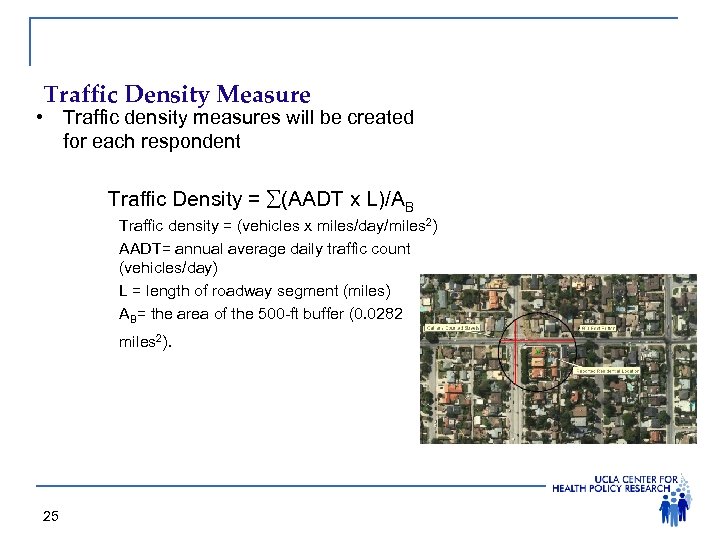 Traffic Density Measure • Traffic density measures will be created for each respondent Traffic Density = (AADT x L)/AB Traffic density = (vehicles x miles/day/miles 2) AADT= annual average daily traffic count (vehicles/day) L = length of roadway segment (miles) AB= the area of the 500 -ft buffer (0. 0282 miles 2). 25
 Identify Sub-populations with High Exposures and High Vulnerability • Examine traffic and pollutant distributions by: • Age: children, elderly • Gender • Geography: Air district, county, city, and zip code • Length of Residency: non-movers • Residency: rural, urban • Income level • Racial and ethnic groups 26 Gunier RB, Hertz A, et al (2003) J of Exp Anal and Environ Epi 13(3): 240 -6, Meng YY, Wilhelm M, et al (2007) Ann Allergy Asthma Immunol 98(5): 455 -63.
 Identify Sub-populations with High Exposures and High Vulnerability—continued • Vulnerability variables to be examined: • • • 27 Access to health care: having health insurance currently, having experienced delays in getting care, having a usual source of care, type of usual source of care, e. g. HMO; Overall health status: co-morbidity such as diabetes and heart disease; Disease management: year of asthma diagnosis, receiving asthma management plan, taking daily medication to control asthma (new for CHIS 2003); Health behaviors: overweight/obesity, smoking, and walking for transportation or leisure; Housing conditions: type of housing such as single family dwelling or apartment and crowding, and; Indoor triggers: smoking at home, dog/cat in the home, cockroaches in the home (new for CHIS 2003).
 Health Effect Measures CHIS Asthma Questions • Asthma diagnosis • Has a doctor ever told you that you have asthma? • How old were you when you or your parents were first told by a doctor that you had asthma? • Do you still have asthma? • Asthma symptoms • During the past 12 months, how often have you had asthma symptoms such as coughing, wheezing, shortness of breath, chest tightness or phlegm? Would you say …(not at all, less than every month, every week, or every day)? 28
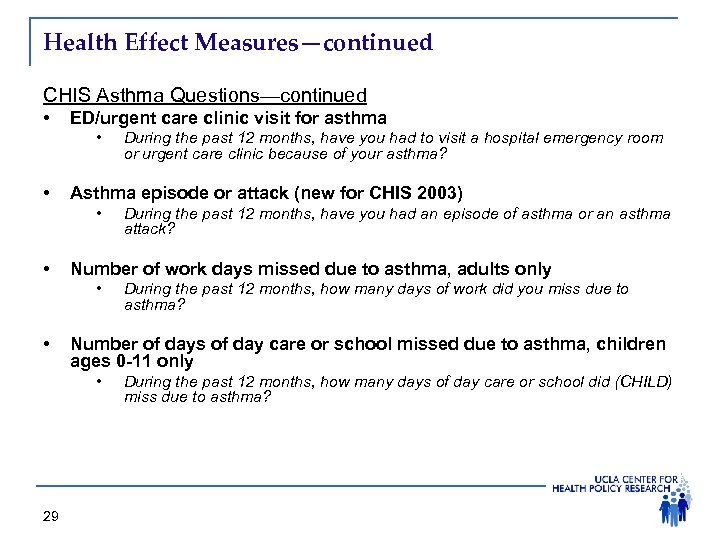 Health Effect Measures—continued CHIS Asthma Questions—continued • ED/urgent care clinic visit for asthma • • Asthma episode or attack (new for CHIS 2003) • • During the past 12 months, how many days of work did you miss due to asthma? Number of days of day care or school missed due to asthma, children ages 0 -11 only • 29 During the past 12 months, have you had an episode of asthma or an asthma attack? Number of work days missed due to asthma, adults only • • During the past 12 months, have you had to visit a hospital emergency room or urgent care clinic because of your asthma? During the past 12 months, how many days of day care or school did (CHILD) miss due to asthma?
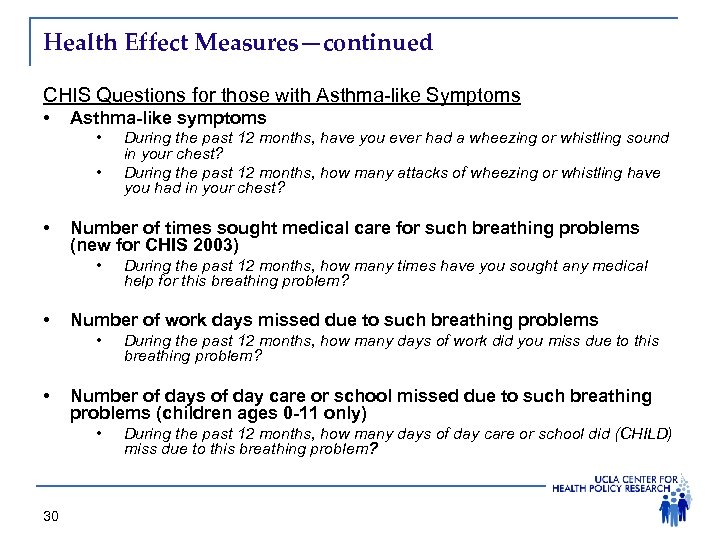 Health Effect Measures—continued CHIS Questions for those with Asthma-like Symptoms • Asthma-like symptoms • • • Number of times sought medical care for such breathing problems (new for CHIS 2003) • • During the past 12 months, how many days of work did you miss due to this breathing problem? Number of days of day care or school missed due to such breathing problems (children ages 0 -11 only) • 30 During the past 12 months, how many times have you sought any medical help for this breathing problem? Number of work days missed due to such breathing problems • • During the past 12 months, have you ever had a wheezing or whistling sound in your chest? During the past 12 months, how many attacks of wheezing or whistling have you had in your chest? During the past 12 months, how many days of day care or school did (CHILD) miss due to this breathing problem?
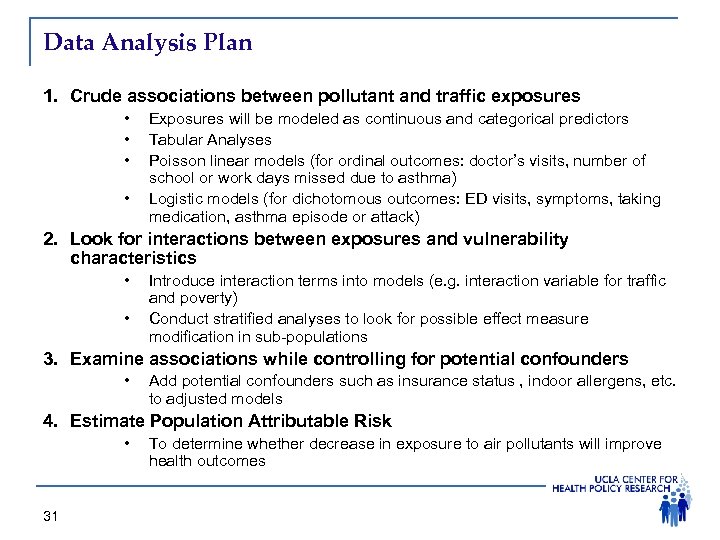 Data Analysis Plan 1. Crude associations between pollutant and traffic exposures • • Exposures will be modeled as continuous and categorical predictors Tabular Analyses Poisson linear models (for ordinal outcomes: doctor’s visits, number of school or work days missed due to asthma) Logistic models (for dichotomous outcomes: ED visits, symptoms, taking medication, asthma episode or attack) 2. Look for interactions between exposures and vulnerability characteristics • • Introduce interaction terms into models (e. g. interaction variable for traffic and poverty) Conduct stratified analyses to look for possible effect measure modification in sub-populations 3. Examine associations while controlling for potential confounders • Add potential confounders such as insurance status , indoor allergens, etc. to adjusted models 4. Estimate Population Attributable Risk • 31 To determine whether decrease in exposure to air pollutants will improve health outcomes
 Strengths • Data is population-based with large sample-size. • Exposures assessed using residential address instead of zip code. • Adds to understanding of air pollution’s effects on vulnerable subpopulations. • Looks at several asthma-related health outcome measures, and breathing problems in non-asthmatics to get a more comprehensive understanding of disease burden. • Accounts for important potential confounders such as socioeconomic status, access to care, behavior-related risk factors, and some indoor exposures. 32
 Limitations • Temporal ambiguity exists between exposure and outcomes since data is cross-sectional, though we are restricting study population to those respondents who resided in the same house the year prior to the interview. • Participants’ recall may, for example, be better for ED visits than work days missed due to asthma. • We don’t have information on commute time, occupational exposures, or time spent outdoors. • Information on indoor sources is limited, i. e. we don’t have air conditioning use, gas stove use, etc. 33
 Implications • Provides information on whether current federal or state air quality standards sufficiently protect vulnerable sub-populations. • Directly addresses CARB’s Environmental Justice Policy “…to better characterize the variety of air pollution exposures in communities and to better assess health impacts, especially non-cancer effects, cumulative effects, and effects from long-term low-level exposures. ” 34
 Publication and Dissemination Publications • Final Report • Peer-reviewed journal articles Distribution • Distributed via listserv and email newsletter announcement • Posted on Center website (www. healthpolicy. ucla. edu) 35
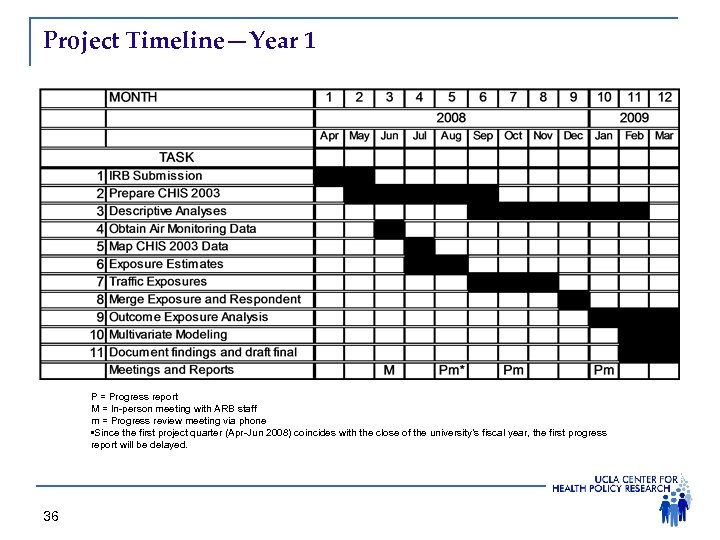 Project Timeline—Year 1 P = Progress report M = In-person meeting with ARB staff m = Progress review meeting via phone • Since the first project quarter (Apr-Jun 2008) coincides with the close of the university’s fiscal year, the first progress report will be delayed. 36
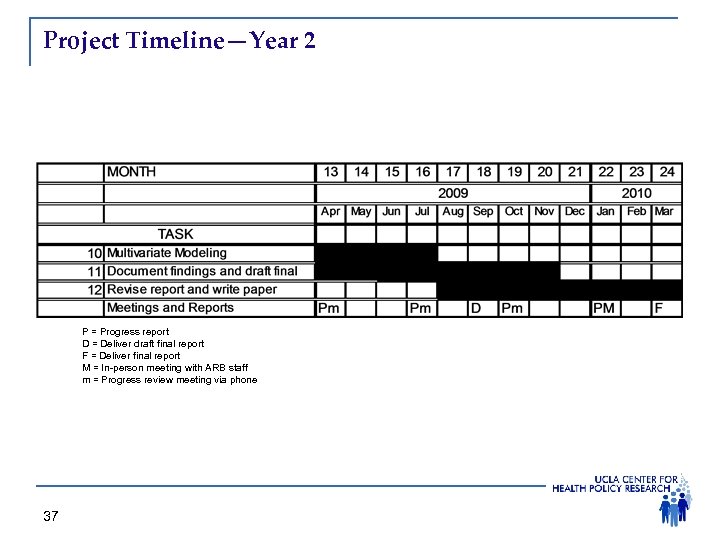 Project Timeline—Year 2 P = Progress report D = Deliver draft final report F = Deliver final report M = In-person meeting with ARB staff m = Progress review meeting via phone 37
 Thanks ! Ying-Ying Meng, Dr. PH UCLA Center for Health Policy Research 10960 Wilshire Blvd, Suite 1550 Los Angeles, California 90024 (310) 794 -2931 yymeng@ucla. edu 38