 Скачать презентацию Is Britain Pulling Apart Evidence from the analysis
30f8619144e30b4e84e6c05a1239da70.ppt
- Количество слайдов: 57



Is Britain Pulling Apart? Evidence from the analysis of Social Distance Paul S. Lambert (Univ. Stirling) Dave Griffiths (Univ. Stirling) Erik Bihagen (Univ. Stockholm) Richard Zijdeman (Intl. Inst. Social History, Amsterdam) Presentation to the Radical Statistics conference, Manchester, 8 March 2014 Sponsored by the ERSC Secondary Data Analysis Initiative Phase 1 project ‘Is Britain pulling apart? Analysis of generational change in social distances’ http: //www. camsis. stir. ac. uk/pullingapart http: //www. twitter. com/pullingapart http: //pullingapartproject. wordpress. com/ 1
Studying patterns in Social Distance 1) Introduction: trends in social inequality and social distance 2) Social distance patterns in Britain for markers of lifestyle 3) Social distance patterns in Britain in socio-economic inequalities http: //www. camsis. stir. ac. uk/pullingapart 2
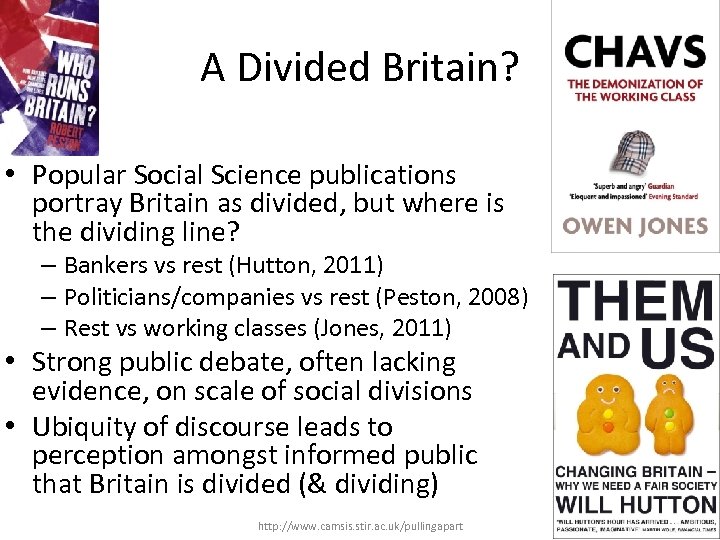
A Divided Britain? • Popular Social Science publications portray Britain as divided, but where is the dividing line? – Bankers vs rest (Hutton, 2011) – Politicians/companies vs rest (Peston, 2008) – Rest vs working classes (Jones, 2011) • Strong public debate, often lacking evidence, on scale of social divisions • Ubiquity of discourse leads to perception amongst informed public that Britain is divided (& dividing) http: //www. camsis. stir. ac. uk/pullingapart 3
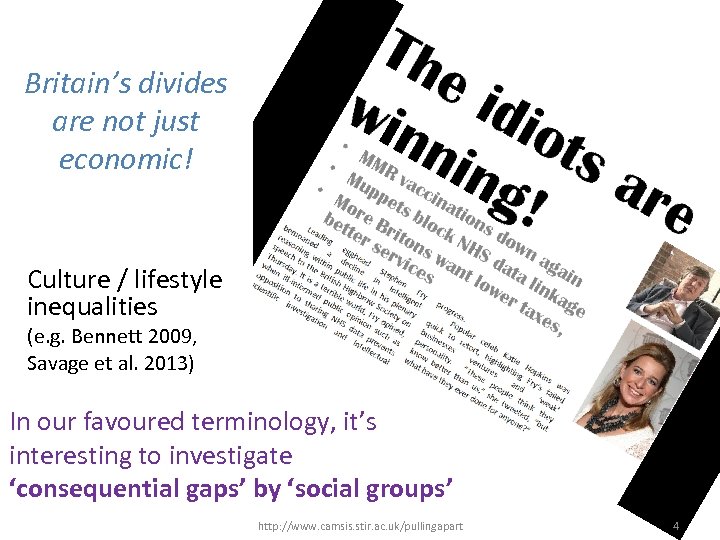
Britain’s divides are not just economic! Culture / lifestyle inequalities (e. g. Bennett 2009, Savage et al. 2013) In our favoured terminology, it’s interesting to investigate ‘consequential gaps’ by ‘social groups’ http: //www. camsis. stir. ac. uk/pullingapart 4
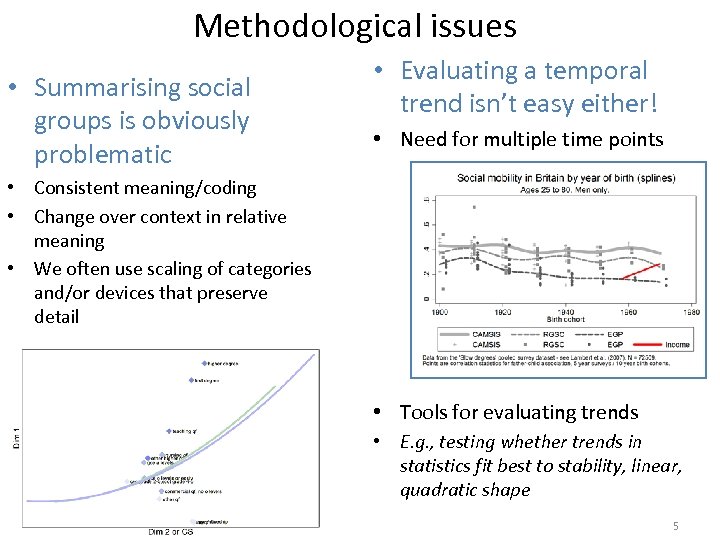
Methodological issues • Summarising social groups is obviously problematic • Evaluating a temporal trend isn’t easy either! • Need for multiple time points • Consistent meaning/coding • Change over context in relative meaning • We often use scaling of categories and/or devices that preserve detail • Tools for evaluating trends • E. g. , testing whether trends in statistics fit best to stability, linear, quadratic shape 5
Are we really interested in inequalities, or in trends in inequalities? • It’s important to study inequality regardless of temporal trends! • Most things, in Britain, are pretty stable, but some things do change – Work, leisure, housing, family – Education, the internet, family formation, health, pollution • Many studies highlight social change in the distribution of income, deprivation, education, health, etc – Not all evidence points the same way, but common view that polarisation has risen slightly since 2000, & will rise further (e. g. ETUI 2012; Dorling 2011; Gibbons et al. 2005) – Stories about social inequalities between some social groups are more varied (cf. Finney and Simpson 2009; Evans &Tilley, 2011; Jivrav 2012) • Plenty of interesting theories of social change or stability – …E. g. Bourdieu 1977; Marks 2014; Erikson and Goldthorpe 2010 – …French pessimism; American optimism; English diffidence… 6
Studying ‘consequential gaps’ between ‘social groups’ • Where the groups sit in the social structure may often be shaped by correlated demographic/unimportant differences – e. g. age, region and ethnicity – changes in position over time might be conflated with cohort related specificities (though that could be ok) • One alternative is to study instead the social position as realised through the enduring social organisation reflected in social interactions – Social support and connections central to our lives, and people use social contacts to reproduce their circumstances and society itself (…e. g. Lauman 1973, Christakis and Fowler 2012…) Ø Leads to focusing on ‘social distance’ http: //www. camsis. stir. ac. uk/pullingapart 7
‘Social distance’ • Generically, social distance = how far away A is from B, on the basis of {likely} levels of social contact • Contact levels assessed through measurable social interactions (friendship, marriage, family) • A and B are usually social units; we typically see several empirical dimensions that characterise the pattern of social contacts • Previous research on social distance between occupational categories (e. g. www. camsis. stir. ac. uk ; Lauman & Guttman 1966; Chan 2010) Social distance = social structure that is revealed through analysing ties 8
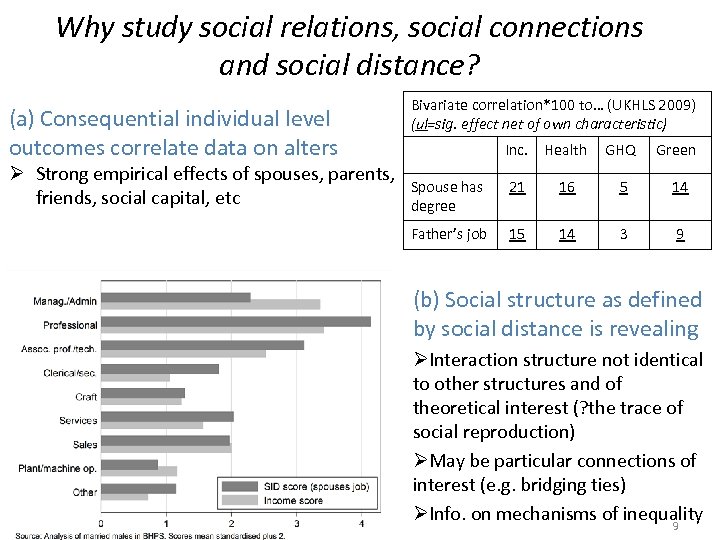
Why study social relations, social connections and social distance? (a) Consequential individual level outcomes correlate data on alters Ø Strong empirical effects of spouses, parents, friends, social capital, etc Bivariate correlation*100 to… (UKHLS 2009) (ul=sig. effect net of own characteristic) Inc. Health GHQ Green Spouse has degree 21 16 5 14 Father’s job 15 14 3 9 (b) Social structure as defined by social distance is revealing ØInteraction structure not identical to other structures and of theoretical interest (? the trace of social reproduction) ØMay be particular connections of interest (e. g. bridging ties) ØInfo. on mechanisms of inequality 9
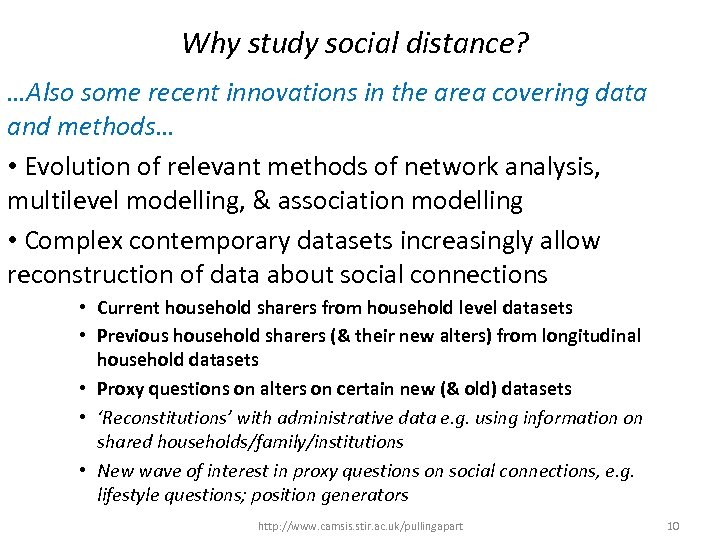
Why study social distance? …Also some recent innovations in the area covering data and methods… • Evolution of relevant methods of network analysis, multilevel modelling, & association modelling • Complex contemporary datasets increasingly allow reconstruction of data about social connections • Current household sharers from household level datasets • Previous household sharers (& their new alters) from longitudinal household datasets • Proxy questions on alters on certain new (& old) datasets • ‘Reconstitutions’ with administrative data e. g. using information on shared households/family/institutions • New wave of interest in proxy questions on social connections, e. g. lifestyle questions; position generators http: //www. camsis. stir. ac. uk/pullingapart 10
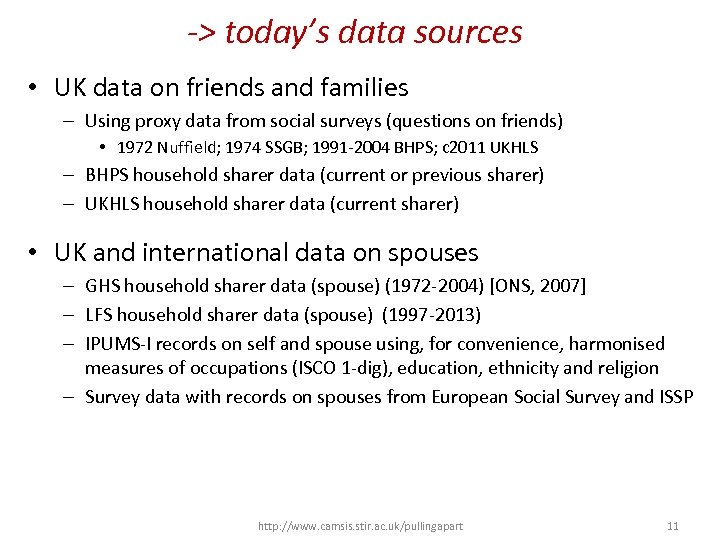
-> today’s data sources • UK data on friends and families – Using proxy data from social surveys (questions on friends) • 1972 Nuffield; 1974 SSGB; 1991 -2004 BHPS; c 2011 UKHLS – BHPS household sharer data (current or previous sharer) – UKHLS household sharer data (current sharer) • UK and international data on spouses – GHS household sharer data (spouse) (1972 -2004) [ONS, 2007] – LFS household sharer data (spouse) (1997 -2013) – IPUMS-I records on self and spouse using, for convenience, harmonised measures of occupations (ISCO 1 -dig), education, ethnicity and religion – Survey data with records on spouses from European Social Survey and ISSP http: //www. camsis. stir. ac. uk/pullingapart 11
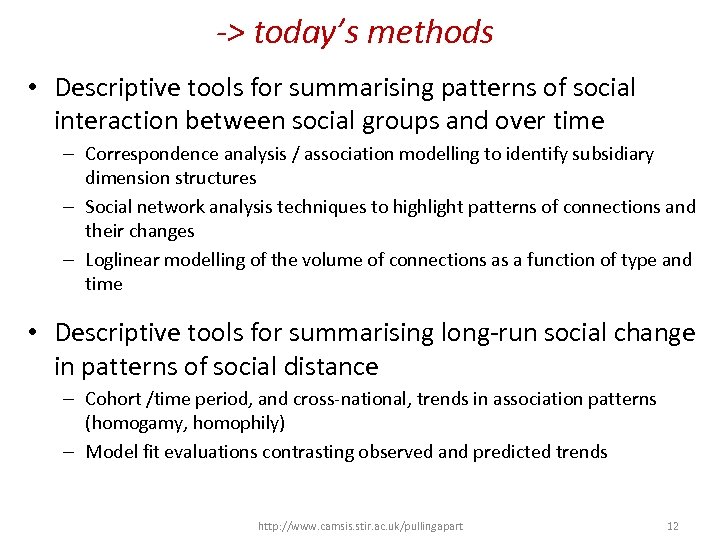
-> today’s methods • Descriptive tools for summarising patterns of social interaction between social groups and over time – Correspondence analysis / association modelling to identify subsidiary dimension structures – Social network analysis techniques to highlight patterns of connections and their changes – Loglinear modelling of the volume of connections as a function of type and time • Descriptive tools for summarising long-run social change in patterns of social distance – Cohort /time period, and cross-national, trends in association patterns (homogamy, homophily) – Model fit evaluations contrasting observed and predicted trends http: //www. camsis. stir. ac. uk/pullingapart 12
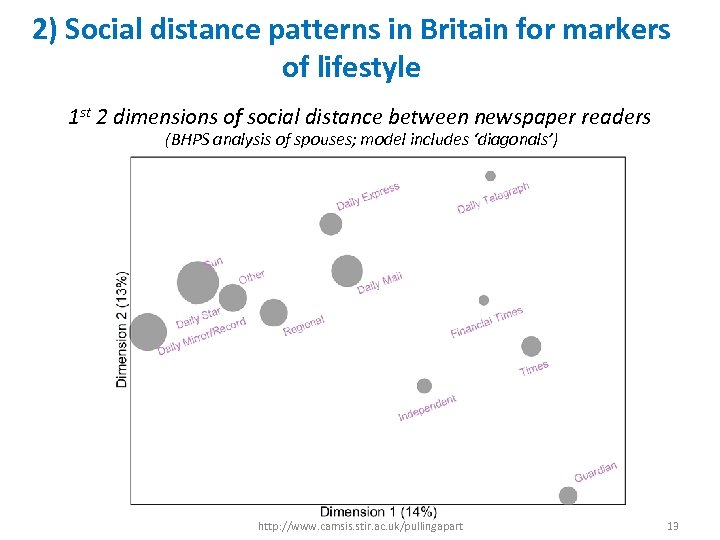
2) Social distance patterns in Britain for markers of lifestyle 1 st 2 dimensions of social distance between newspaper readers (BHPS analysis of spouses; model includes ‘diagonals’) http: //www. camsis. stir. ac. uk/pullingapart 13
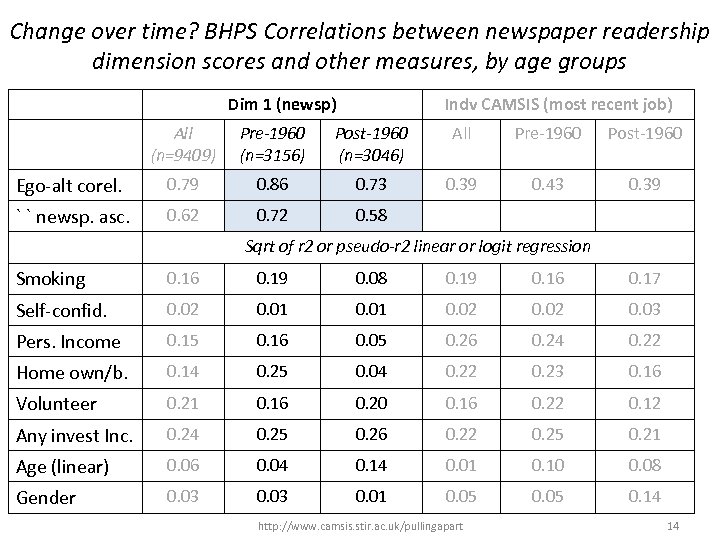
Change over time? BHPS Correlations between newspaper readership dimension scores and other measures, by age groups Dim 1 (newsp) Indv CAMSIS (most recent job) All (n=9409) Pre-1960 (n=3156) Post-1960 (n=3046) All Pre-1960 Post-1960 Ego-alt corel. 0. 79 0. 86 0. 73 0. 39 0. 43 0. 39 ` ` newsp. asc. 0. 62 0. 72 0. 58 Sqrt of r 2 or pseudo-r 2 linear or logit regression Smoking 0. 16 0. 19 0. 08 0. 19 0. 16 0. 17 Self-confid. 0. 02 0. 01 0. 02 0. 03 Pers. Income 0. 15 0. 16 0. 05 0. 26 0. 24 0. 22 Home own/b. 0. 14 0. 25 0. 04 0. 22 0. 23 0. 16 Volunteer 0. 21 0. 16 0. 20 0. 16 0. 22 0. 12 Any invest Inc. 0. 24 0. 25 0. 26 0. 22 0. 25 0. 21 Age (linear) 0. 06 0. 04 0. 14 0. 01 0. 10 0. 08 Gender 0. 03 0. 01 0. 05 0. 14 http: //www. camsis. stir. ac. uk/pullingapart 14
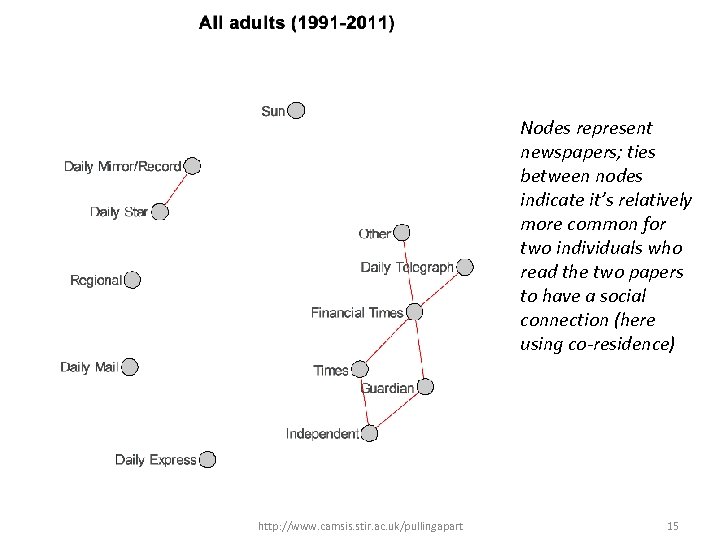
Nodes represent newspapers; ties between nodes indicate it’s relatively more common for two individuals who read the two papers to have a social connection (here using co-residence) http: //www. camsis. stir. ac. uk/pullingapart 15
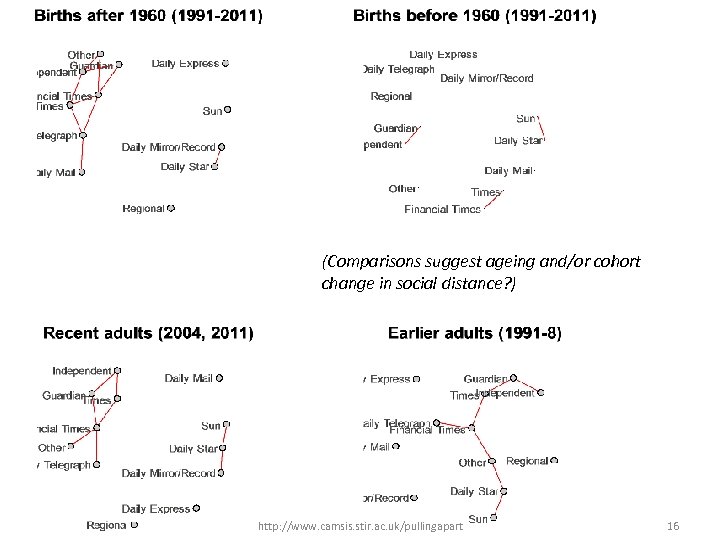
(Comparisons suggest ageing and/or cohort change in social distance? ) http: //www. camsis. stir. ac. uk/pullingapart 16
‘Catnets’ in leisure and consumption? • Categories of social networks (White, 1992) – E. g. a student might have networks amongst others from the same course, same halls, same sports teams (and combinations of more than one) • Concept can be applied to homophily: – Do my friends vote the same way as me? Read the same papers as me? Have similar levels of education? • Both vote like me and read the same paper? • {Homophily itself likely to result from several different processes - propinquity, attraction, assimilation} http: //www. camsis. stir. ac. uk/pullingapart 17
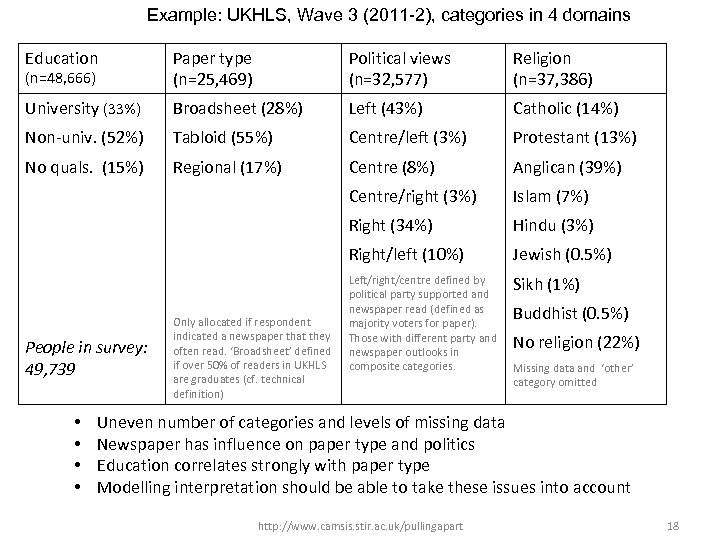
Example: UKHLS, Wave 3 (2011 -2), categories in 4 domains Education (n=48, 666) Paper type (n=25, 469) Political views (n=32, 577) Religion (n=37, 386) University (33%) Broadsheet (28%) Left (43%) Catholic (14%) Non-univ. (52%) Tabloid (55%) Centre/left (3%) Protestant (13%) No quals. (15%) Regional (17%) Centre (8%) Anglican (39%) Centre/right (3%) Islam (7%) Right (34%) Hindu (3%) Right/left (10%) Jewish (0. 5%) Left/right/centre defined by political party supported and newspaper read (defined as majority voters for paper). Those with different party and newspaper outlooks in composite categories. Sikh (1%) People in survey: 49, 739 • • Only allocated if respondent indicated a newspaper that they often read. ‘Broadsheet’ defined if over 50% of readers in UKHLS are graduates (cf. technical definition) Buddhist (0. 5%) No religion (22%) Missing data and ‘other’ category omitted Uneven number of categories and levels of missing data Newspaper has influence on paper type and politics Education correlates strongly with paper type Modelling interpretation should be able to take these issues into account http: //www. camsis. stir. ac. uk/pullingapart 18
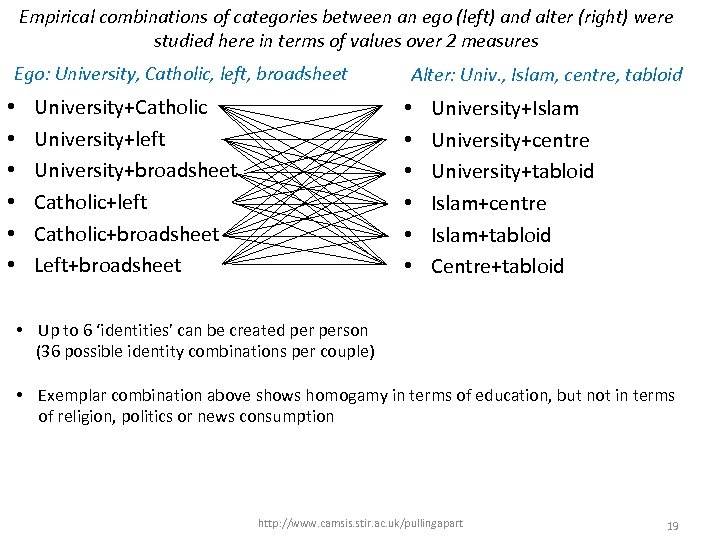
Empirical combinations Husband studiedof categories between an ego 2(left) and alter (right) were Wife here in terms of values over measures Ego: University, Catholic, left, broadsheet • • • University+Catholic University+left University+broadsheet Catholic+left Catholic+broadsheet Left+broadsheet Alter: Univ. , Islam, centre, tabloid • • • University+Islam University+centre University+tabloid Islam+centre Islam+tabloid Centre+tabloid • Up to 6 ‘identities’ can be created person (36 possible identity combinations per couple) • Exemplar combination above shows homogamy in terms of education, but not in terms of religion, politics or news consumption http: //www. camsis. stir. ac. uk/pullingapart 19
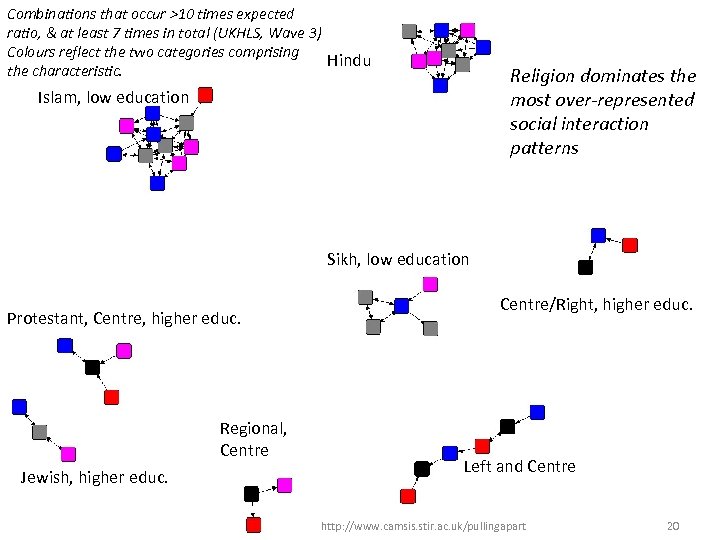
Combinations that occur >10 times expected ratio, & at least 7 times in total (UKHLS, Wave 3) Colours reflect the two categories comprising Hindu the characteristic. Religion dominates the most over-represented social interaction patterns Islam, low education Sikh, low education Protestant, Centre, higher educ. Regional, Centre Jewish, higher educ. Centre/Right, higher educ. Left and Centre http: //www. camsis. stir. ac. uk/pullingapart 20
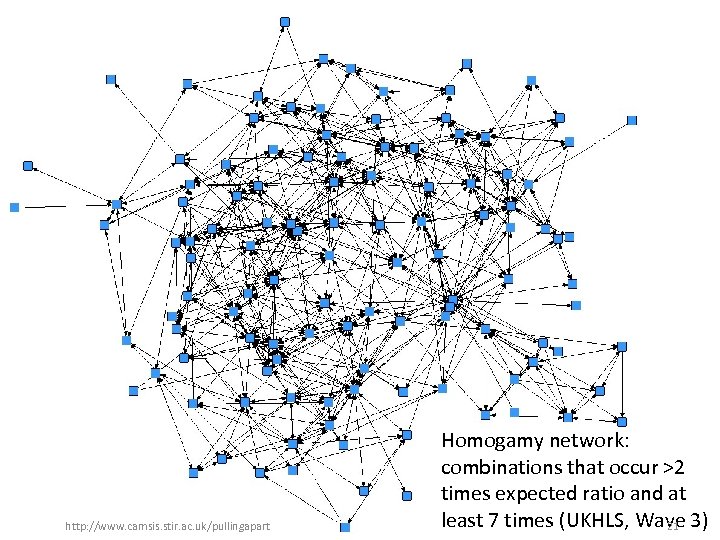
http: //www. camsis. stir. ac. uk/pullingapart Homogamy network: combinations that occur >2 times expected ratio and at least 7 times (UKHLS, Wave 3) 21
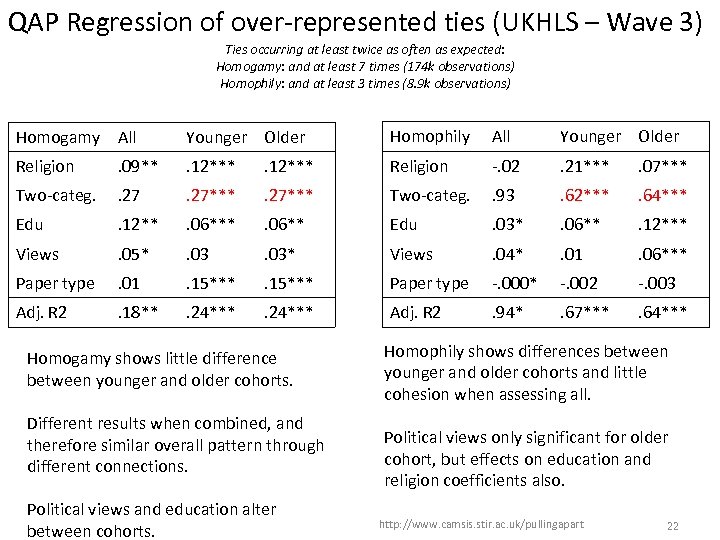
QAP Regression of over-represented ties (UKHLS – Wave 3) Ties occurring at least twice as often as expected: Homogamy: and at least 7 times (174 k observations) Homophily: and at least 3 times (8. 9 k observations) Homogamy All Younger Older Homophily All Younger Older Religion . 09** . 12*** Religion -. 02 . 21*** . 07*** Two-categ. . 27*** Two-categ. . 93 . 62*** . 64*** Edu . 12** . 06** Edu . 03* . 06** . 12*** Views . 05* . 03* Views . 04* . 01 . 06*** Paper type . 01 . 15*** Paper type -. 000* -. 002 -. 003 Adj. R 2 . 18** . 24*** Adj. R 2 . 94* . 67*** . 64*** Homogamy shows little difference between younger and older cohorts. Different results when combined, and therefore similar overall pattern through different connections. Political views and education alter between cohorts. Homophily shows differences between younger and older cohorts and little cohesion when assessing all. Political views only significant for older cohort, but effects on education and religion coefficients also. http: //www. camsis. stir. ac. uk/pullingapart 22
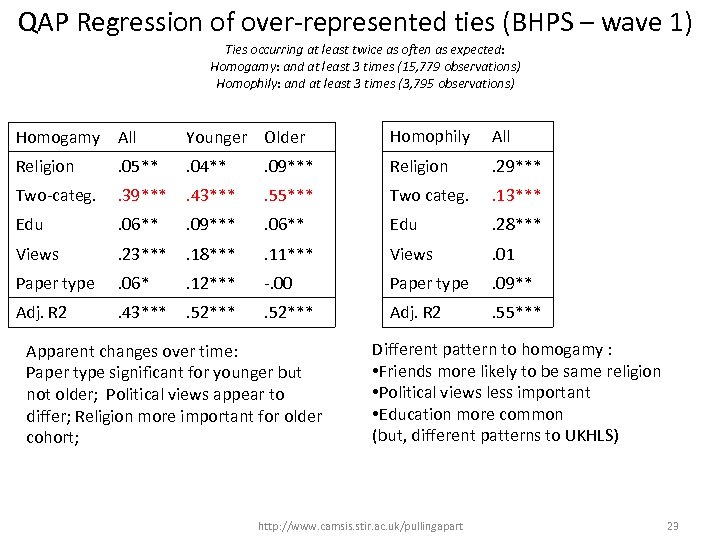
QAP Regression of over-represented ties (BHPS – wave 1) Ties occurring at least twice as often as expected: Homogamy: and at least 3 times (15, 779 observations) Homophily: and at least 3 times (3, 795 observations) Homogamy All Younger Older Homophily All Religion . 05** . 04** . 09*** Religion . 29*** Two-categ. . 39*** . 43*** . 55*** Two categ. . 13*** Edu . 06** . 09*** . 06** Edu . 28*** Views . 23*** . 18*** . 11*** Views . 01 Paper type . 06* . 12*** -. 00 Paper type . 09** Adj. R 2 . 43*** . 52*** Adj. R 2 . 55*** Apparent changes over time: Paper type significant for younger but not older; Political views appear to differ; Religion more important for older cohort; Different pattern to homogamy : • Friends more likely to be same religion • Political views less important • Education more common (but, different patterns to UKHLS) http: //www. camsis. stir. ac. uk/pullingapart 23
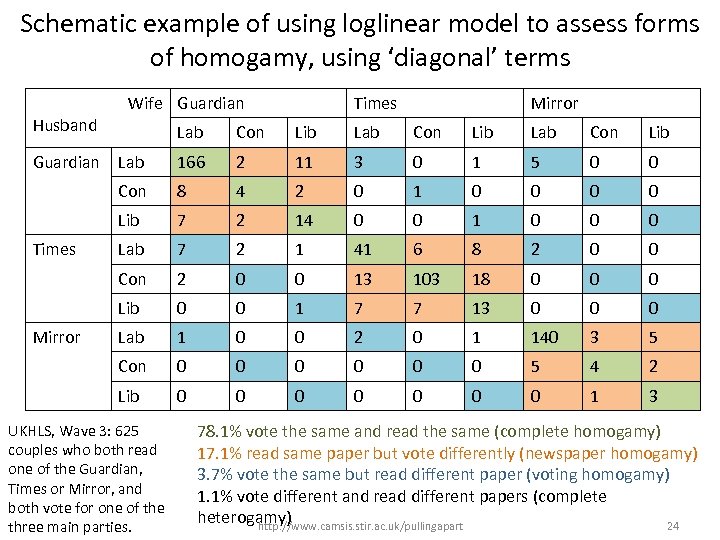
Schematic example of using loglinear model to assess forms of homogamy, using ‘diagonal’ terms Husband Wife Guardian Times Mirror Lab Con Lib Lab 166 2 11 3 0 1 5 0 0 8 4 2 0 1 0 0 7 2 14 0 0 1 0 0 0 Lab 7 2 1 41 6 8 2 0 0 Con 2 0 0 13 103 18 0 0 0 Lib 0 0 1 7 7 13 0 0 0 Lab 1 0 0 2 0 1 140 3 5 Con 0 0 0 5 4 2 Lib Mirror Lib Times Con Guardian Lab 0 0 0 0 1 3 UKHLS, Wave 3: 625 couples who both read one of the Guardian, Times or Mirror, and both vote for one of the three main parties. 78. 1% vote the same and read the same (complete homogamy) 17. 1% read same paper but vote differently (newspaper homogamy) 3. 7% vote the same but read different paper (voting homogamy) 1. 1% vote different and read different papers (complete heterogamy) http: //www. camsis. stir. ac. uk/pullingapart 24
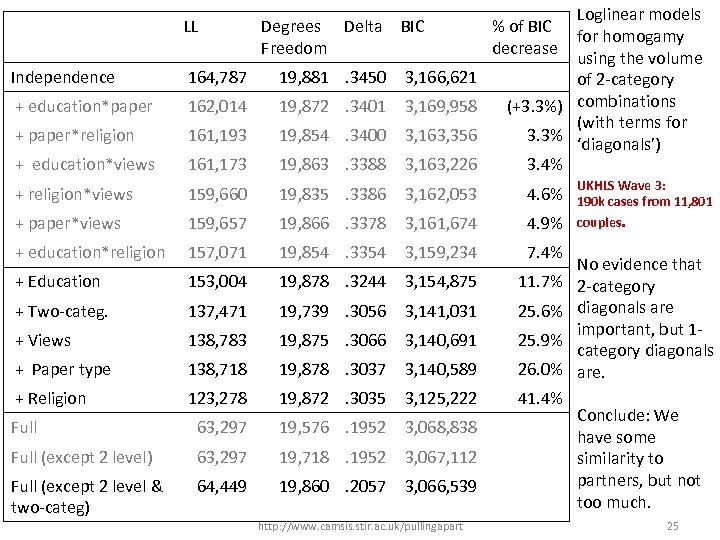
LL Degrees Delta BIC Freedom Loglinear models for homogamy using the volume of 2 -category (+3. 3%) combinations (with terms for 3. 3% ‘diagonals’) 3. 4% % of BIC decrease Independence 164, 787 19, 881. 3450 3, 166, 621 + education*paper 162, 014 19, 872. 3401 3, 169, 958 + paper*religion 161, 193 19, 854. 3400 3, 163, 356 + education*views 161, 173 19, 863. 3388 3, 163, 226 + religion*views 159, 660 19, 835. 3386 3, 162, 053 4. 6% + paper*views 159, 657 19, 866. 3378 3, 161, 674 4. 9% + education*religion 157, 071 19, 854. 3354 3, 159, 234 7. 4% + Education 153, 004 19, 878. 3244 3, 154, 875 11. 7% + Two-categ. 137, 471 19, 739. 3056 3, 141, 031 25. 6% + Views 138, 783 19, 875. 3066 3, 140, 691 25. 9% + Paper type 138, 718 19, 878. 3037 3, 140, 589 26. 0% + Religion 123, 278 19, 872. 3035 3, 125, 222 41. 4% Full 63, 297 19, 576. 1952 3, 068, 838 Full (except 2 level) 63, 297 19, 718. 1952 3, 067, 112 Full (except 2 level & two-categ) 64, 449 19, 860. 2057 3, 066, 539 http: //www. camsis. stir. ac. uk/pullingapart UKHLS Wave 3: 190 k cases from 11, 801 couples. No evidence that 2 -category diagonals are important, but 1 category diagonals are. Conclude: We have some similarity to partners, but not too much. 25
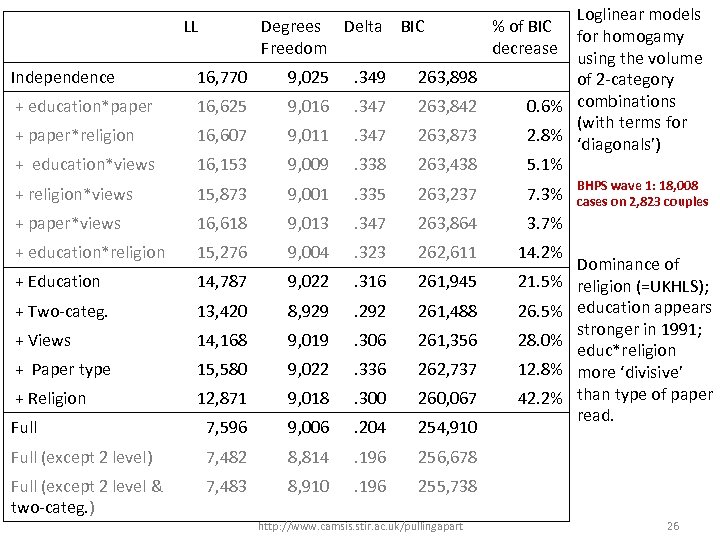
Independence 16, 770 9, 025 . 349 263, 898 + education*paper 16, 625 9, 016 . 347 263, 842 + paper*religion 16, 607 9, 011 . 347 263, 873 + education*views 16, 153 9, 009 . 338 263, 438 Loglinear models for homogamy using the volume of 2 -category 0. 6% combinations (with terms for 2. 8% ‘diagonals’) 5. 1% + religion*views 15, 873 9, 001 . 335 263, 237 7. 3% + paper*views 16, 618 9, 013 . 347 263, 864 3. 7% + education*religion 15, 276 9, 004 . 323 262, 611 14. 2% + Education 14, 787 9, 022 . 316 261, 945 21. 5% + Two-categ. 13, 420 8, 929 . 292 261, 488 26. 5% + Views 14, 168 9, 019 . 306 261, 356 28. 0% + Paper type 15, 580 9, 022 . 336 262, 737 12. 8% + Religion 12, 871 9, 018 . 300 260, 067 42. 2% Full 7, 596 9, 006 . 204 254, 910 Full (except 2 level) 7, 482 8, 814 . 196 256, 678 Full (except 2 level & two-categ. ) 7, 483 8, 910 . 196 255, 738 LL Degrees Delta BIC Freedom http: //www. camsis. stir. ac. uk/pullingapart % of BIC decrease BHPS wave 1: 18, 008 cases on 2, 823 couples Dominance of religion (=UKHLS); education appears stronger in 1991; educ*religion more ‘divisive’ than type of paper read. 26
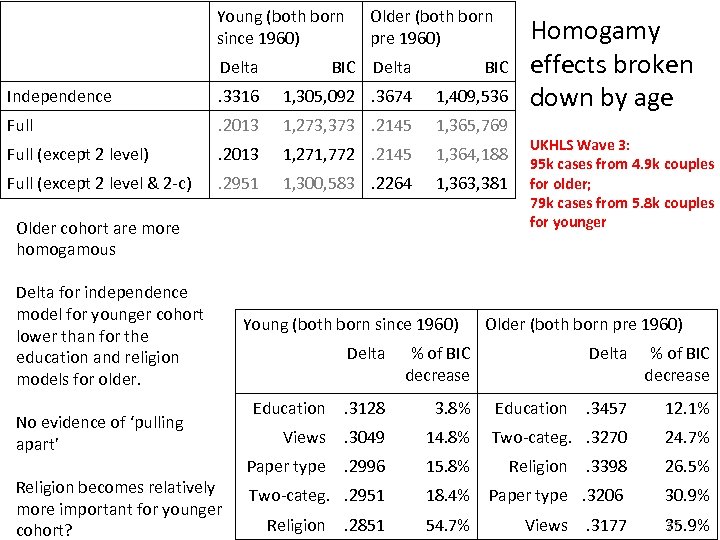
Young (both born since 1960) Older (both born pre 1960) Delta BIC Independence . 3316 1, 305, 092. 3674 1, 409, 536 Full . 2013 1, 273, 373. 2145 1, 365, 769 Full (except 2 level) . 2013 1, 271, 772. 2145 1, 364, 188 Full (except 2 level & 2 -c) . 2951 1, 300, 583. 2264 1, 363, 381 Older cohort are more homogamous Delta for independence model for younger cohort lower than for the education and religion models for older. No evidence of ‘pulling apart’ Religion becomes relatively more important for younger cohort? Young (both born since 1960) Delta. 3128 3. 8% Views . 3049 14. 8% Paper type . 2996 15. 8% Two-categ. . 2951 18. 4% UKHLS Wave 3: 95 k cases from 4. 9 k couples for older; 79 k cases from 5. 8 k couples for younger Older (both born pre 1960) % of BIC decrease Education Homogamy effects broken down by age Religion . 2851 54. 7% Delta % of BIC decrease . 3457 12. 1% Two-categ. . 3270 24. 7% Education Religion . 3398 26. 5% Paper type. 3206 30. 9% Views . 3177 27 35. 9%
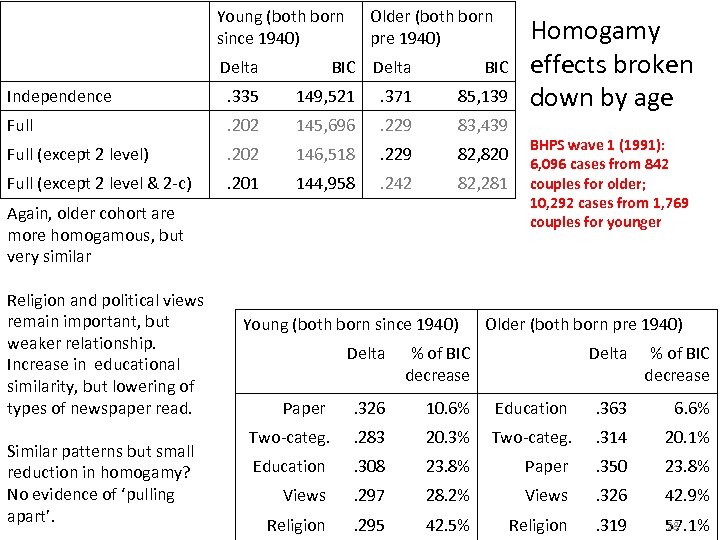
Young (both born since 1940) Delta Older (both born pre 1940) BIC Delta BIC Independence . 335 149, 521 . 371 85, 139 Full . 202 145, 696 . 229 83, 439 Full (except 2 level) . 202 146, 518 . 229 82, 820 Full (except 2 level & 2 -c) . 201 144, 958 . 242 82, 281 Again, older cohort are more homogamous, but very similar Religion and political views remain important, but weaker relationship. Increase in educational similarity, but lowering of types of newspaper read. Similar patterns but small reduction in homogamy? No evidence of ‘pulling apart’. Young (both born since 1940) Delta. 326 10. 6% Two-categ. . 283 Education BHPS wave 1 (1991): 6, 096 cases from 842 couples for older; 10, 292 cases from 1, 769 couples for younger Older (both born pre 1940) % of BIC decrease Paper Homogamy effects broken down by age Delta % of BIC decrease Education . 363 6. 6% 20. 3% Two-categ. . 314 20. 1% . 308 23. 8% Paper . 350 23. 8% Views . 297 28. 2% Views . 326 42. 9% Religion . 295 42. 5% Religion . 319 28 57. 1%
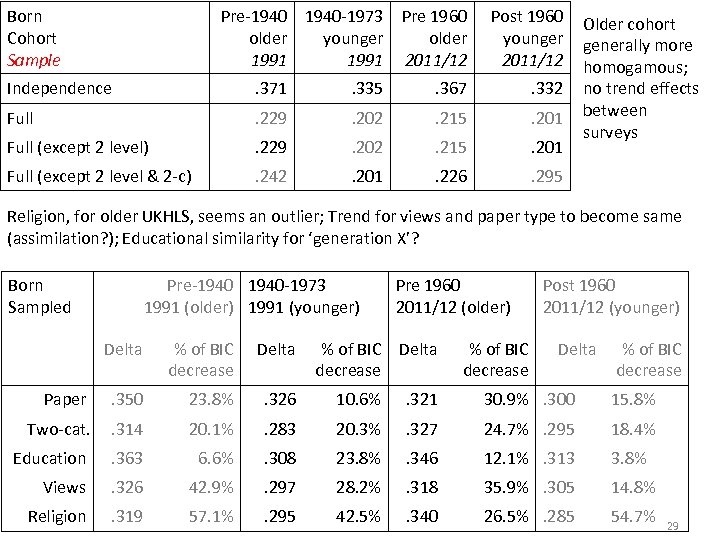
Born Cohort Sample Pre-1940 older 1991 1940 -1973 younger 1991 Pre 1960 older 2011/12 Post 1960 younger 2011/12 Independence . 371 . 335 . 367 . 332 Full . 229 . 202 . 215 . 201 Full (except 2 level) . 229 . 202 . 215 . 201 Full (except 2 level & 2 -c) . 242 . 201 . 226 . 295 Older cohort generally more homogamous; no trend effects between surveys Religion, for older UKHLS, seems an outlier; Trend for views and paper type to become same (assimilation? ); Educational similarity for ‘generation X’? Born Sampled Pre-1940 -1973 1991 (older) 1991 (younger) Pre 1960 2011/12 (older) % of BIC Delta decrease % of BIC decrease Post 1960 2011/12 (younger) Delta % of BIC decrease Paper . 350 23. 8% . 326 10. 6% . 321 30. 9%. 300 15. 8% Two-cat. . 314 20. 1% . 283 20. 3% . 327 24. 7%. 295 18. 4% Education . 363 6. 6% . 308 23. 8% . 346 12. 1%. 313 3. 8% Views . 326 42. 9% . 297 28. 2% . 318 35. 9%. 305 14. 8% Religion . 319 57. 1% . 295 42. 5% . 340 26. 5%. 285 54. 7% 29
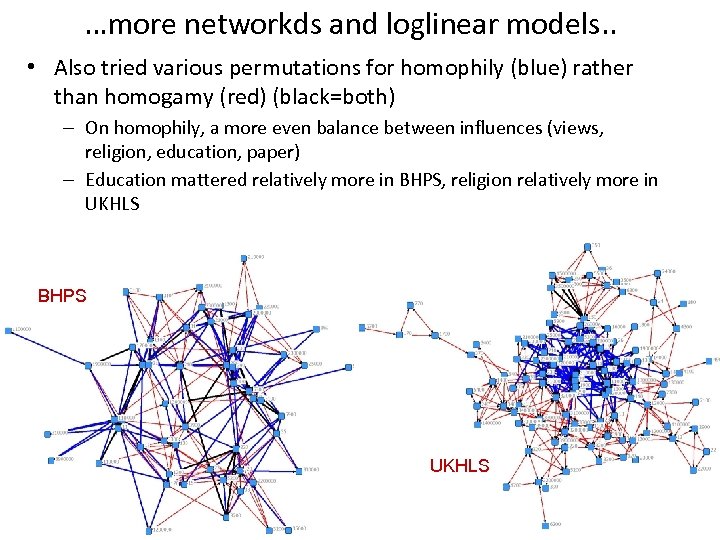
…more networkds and loglinear models. . • Also tried various permutations for homophily (blue) rather than homogamy (red) (black=both) – On homophily, a more even balance between influences (views, religion, education, paper) – Education mattered relatively more in BHPS, religion relatively more in UKHLS BHPS UKHLS http: //www. camsis. stir. ac. uk/pullingapart 30
Summary on lifestyle patterns • Strong influence of social structure of inequality in other domains of behaviour (dimensions of interaction are shaped by social stratification) • Mixed / inconclusive evidence of trend through time – Also true for other items that we’ve measured (e. g. sports participation) – Difficulty of distinguishing cohort from ageing effects • Combinations of identities or ‘Catnets’ are not especially critical (it’s positions themselves that matter most) http: //www. camsis. stir. ac. uk/pullingapart 31
(3) Social distance patterns in Britain in socio-economic measures What characterises the main dimensions of social association patterns according to categories of occupations, educational levels, ethnicity and religion, and does this change through time? • Use social interaction distance analysis to characterise the ownalter relationship between categories (here use correspondence analysis & SNA) and its change through time – Overall strength of the ego-alter relationship (‘inertia’ / Cramer’s V / gap between selected units) – Evidence of trends in that structure through time or between countries http: //www. camsis. stir. ac. uk/pullingapart 32
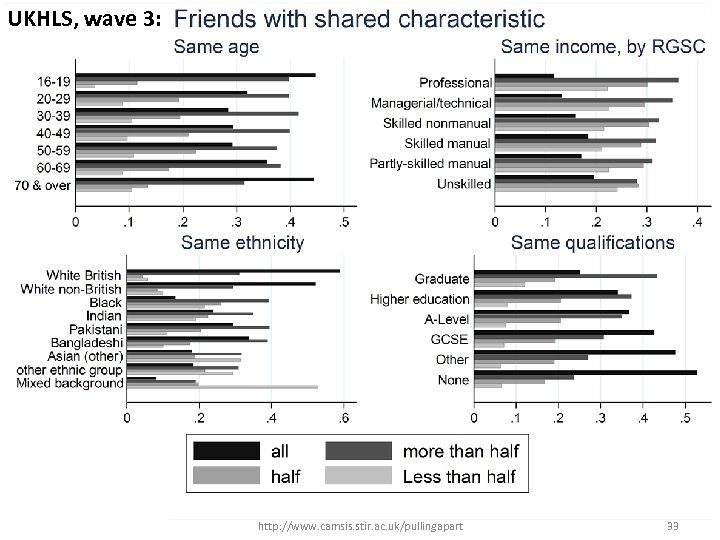
UKHLS, wave 3: http: //www. camsis. stir. ac. uk/pullingapart 33
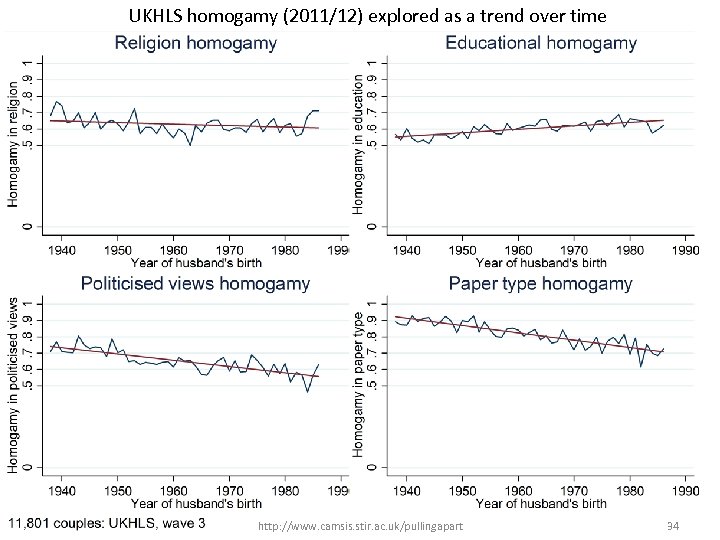
UKHLS homogamy (2011/12) explored as a trend over time http: //www. camsis. stir. ac. uk/pullingapart 34
Consequential gaps between social groups? • Social groups: Occupations; Education; Ethnicity; Religion • Consequential gaps: Evidence of changes in social distance between groups • Previous social distance research shows: – No major peturbations (so far) in the underlying order defined by social distance (e. g. Prandy and Lambert 2003) – Levels of homogamy/homophily generally stable or, for education, marginally increasing (e. g. Brynin et al. 2008) http: //www. camsis. stir. ac. uk/pullingapart 35
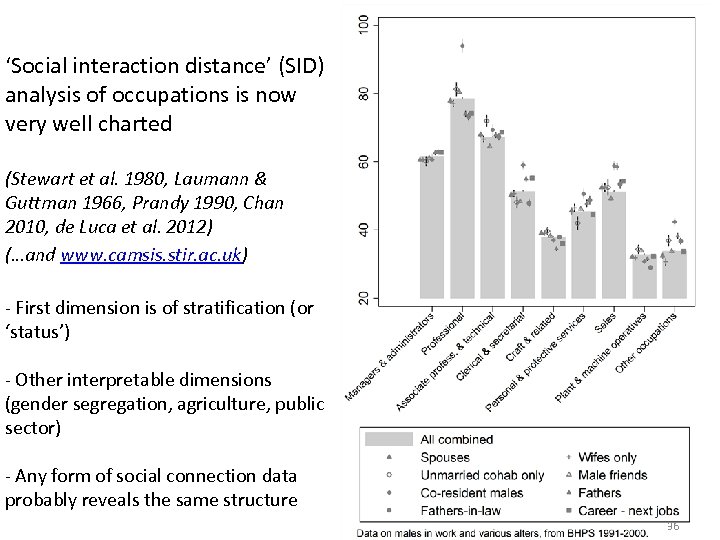
‘Social interaction distance’ (SID) analysis of occupations is now very well charted (Stewart et al. 1980, Laumann & Guttman 1966, Prandy 1990, Chan 2010, de Luca et al. 2012) (…and www. camsis. stir. ac. uk) - First dimension is of stratification (or ‘status’) - Other interpretable dimensions (gender segregation, agriculture, public sector) - Any form of social connection data probably reveals the same structure 36
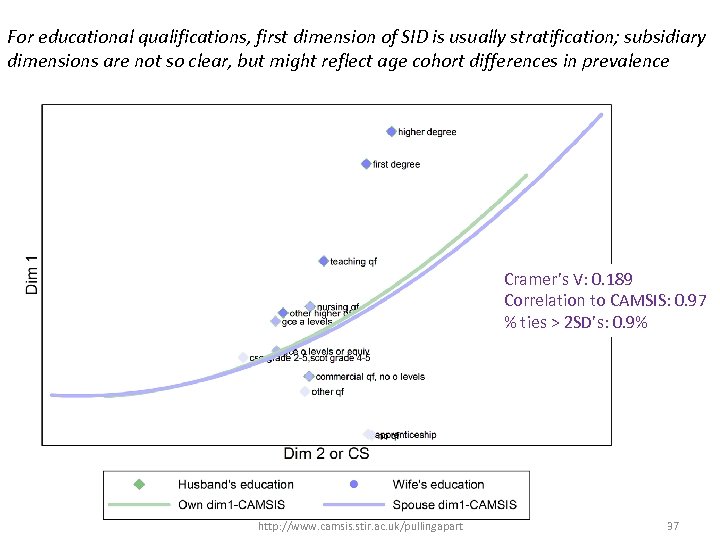
For educational qualifications, first dimension of SID is usually stratification; subsidiary dimensions are not so clear, but might reflect age cohort differences in prevalence Cramer’s V: 0. 189 Correlation to CAMSIS: 0. 97 % ties > 2 SD’s: 0. 9% http: //www. camsis. stir. ac. uk/pullingapart 37
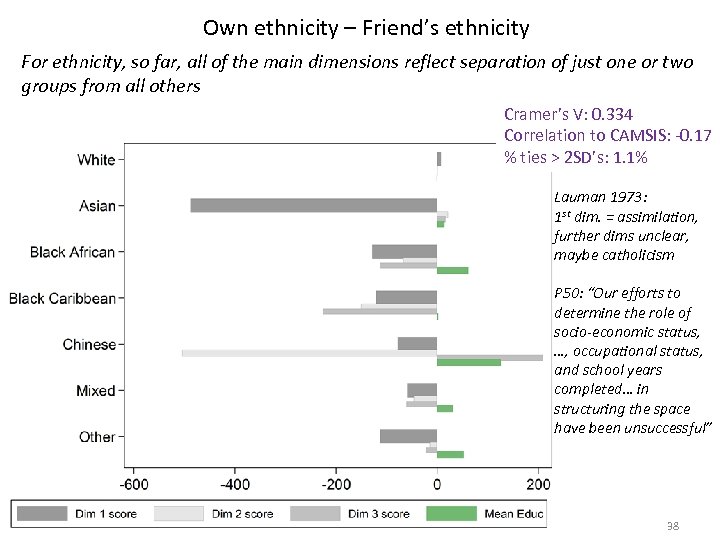
Own ethnicity – Friend’s ethnicity For ethnicity, so far, all of the main dimensions reflect separation of just one or two groups from all others Cramer’s V: 0. 334 Correlation to CAMSIS: -0. 17 % ties > 2 SD’s: 1. 1% Lauman 1973: 1 st dim. = assimilation, further dims unclear, maybe catholicism P 50: “Our efforts to determine the role of socio-economic status, …, occupational status, and school years completed… in structuring the space have been unsuccessful” 38
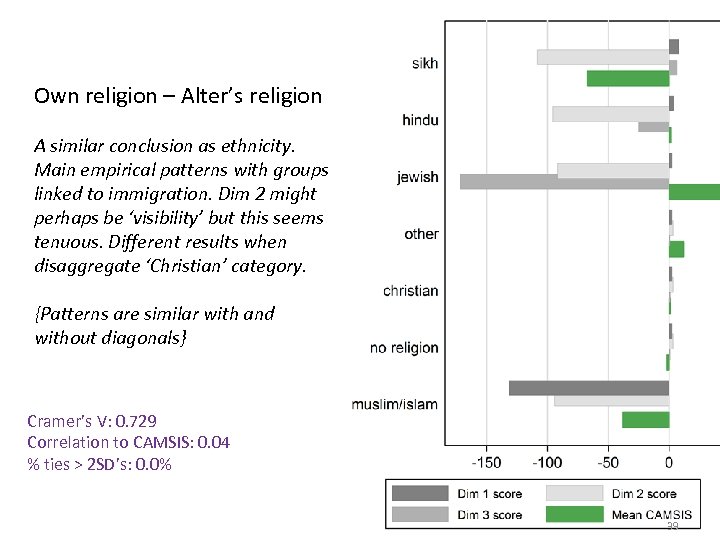
Own religion – Alter’s religion A similar conclusion as ethnicity. Main empirical patterns with groups linked to immigration. Dim 2 might perhaps be ‘visibility’ but this seems tenuous. Different results when disaggregate ‘Christian’ category. {Patterns are similar with and without diagonals} Cramer’s V: 0. 729 Correlation to CAMSIS: 0. 04 % ties > 2 SD’s: 0. 0% 39
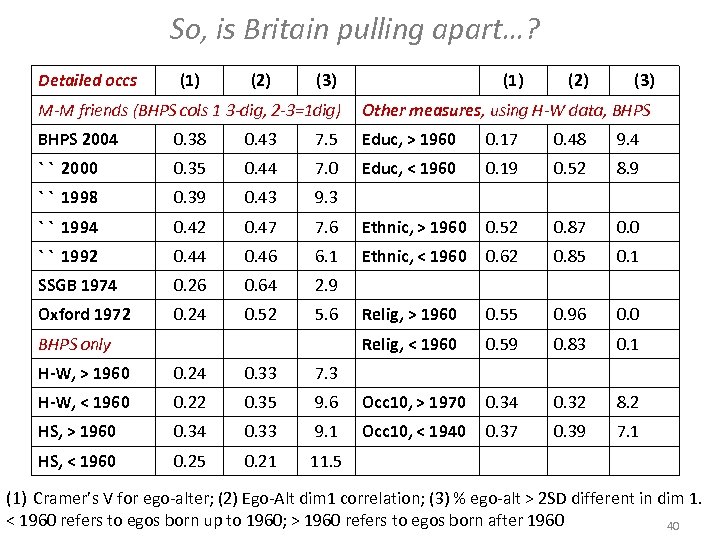
So, is Britain pulling apart…? Detailed occs (1) (2) (3) M-M friends (BHPS cols 1 3 -dig, 2 -3=1 dig) Other measures, using H-W data, BHPS 2004 0. 38 0. 43 7. 5 Educ, > 1960 0. 17 0. 48 9. 4 ` ` 2000 0. 35 0. 44 7. 0 Educ, < 1960 0. 19 0. 52 8. 9 ` ` 1998 0. 39 0. 43 9. 3 ` ` 1994 0. 42 0. 47 7. 6 Ethnic, > 1960 0. 52 0. 87 0. 0 ` ` 1992 0. 44 0. 46 6. 1 Ethnic, < 1960 0. 62 0. 85 0. 1 SSGB 1974 0. 26 0. 64 2. 9 Oxford 1972 0. 24 0. 52 5. 6 Relig, > 1960 0. 55 0. 96 0. 0 Relig, < 1960 0. 59 0. 83 0. 1 BHPS only H-W, > 1960 0. 24 0. 33 7. 3 H-W, < 1960 0. 22 0. 35 9. 6 Occ 10, > 1970 0. 34 0. 32 8. 2 HS, > 1960 0. 34 0. 33 9. 1 Occ 10, < 1940 0. 37 0. 39 7. 1 HS, < 1960 0. 25 0. 21 11. 5 (1) Cramer’s V for ego-alter; (2) Ego-Alt dim 1 correlation; (3) % ego-alt > 2 SD different in dim 1. < 1960 refers to egos born up to 1960; > 1960 refers to egos born after 1960 40
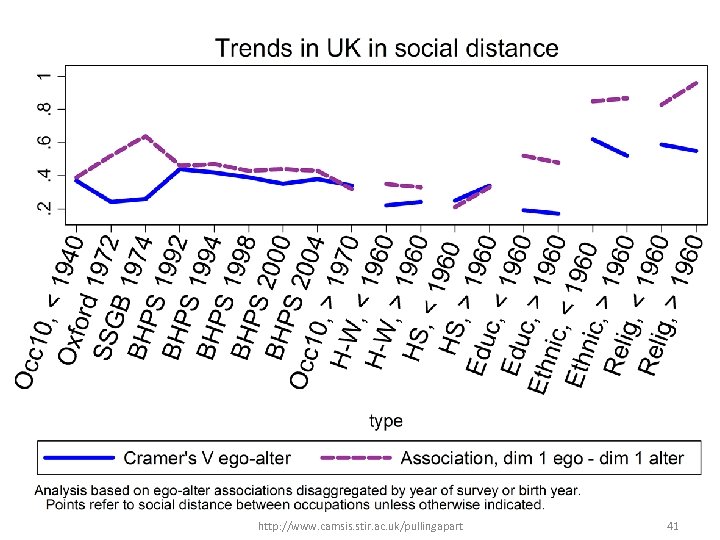
http: //www. camsis. stir. ac. uk/pullingapart 41
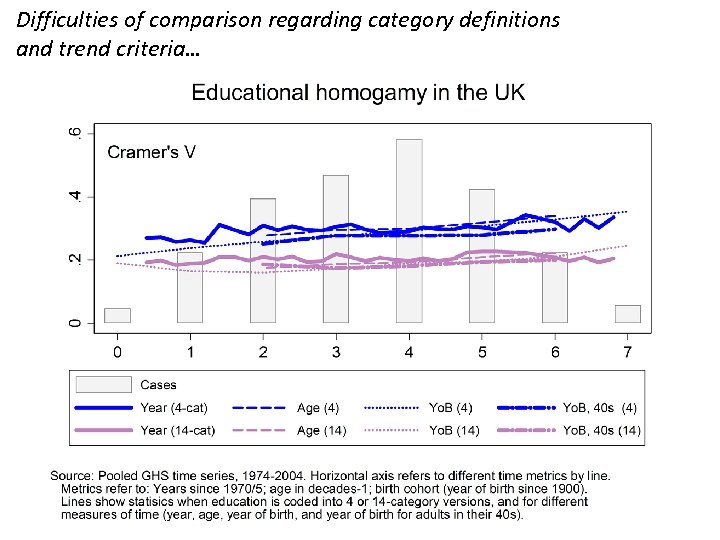
Difficulties of comparison regarding category definitions and trend criteria… http: //www. camsis. stir. ac. uk/pullingapart 42
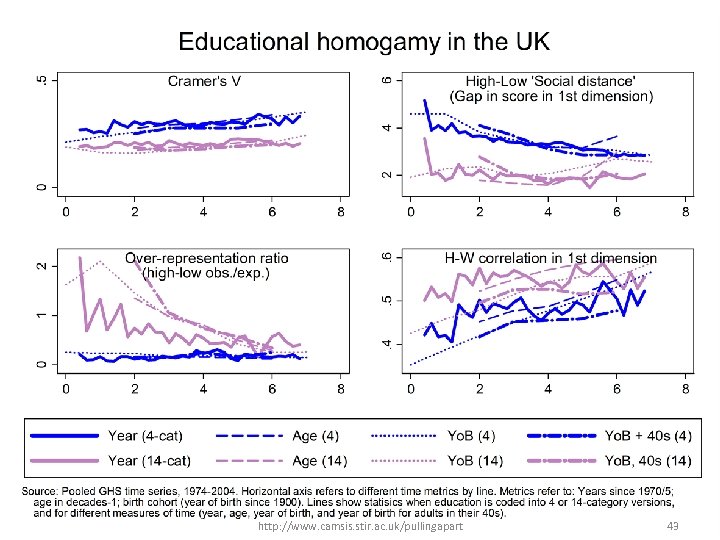
http: //www. camsis. stir. ac. uk/pullingapart 43

http: //www. camsis. stir. ac. uk/pullingapart 44
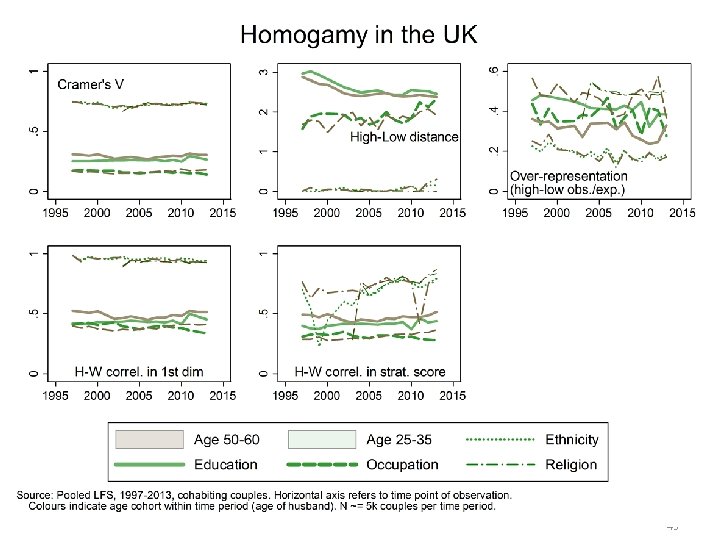
LFS images 45
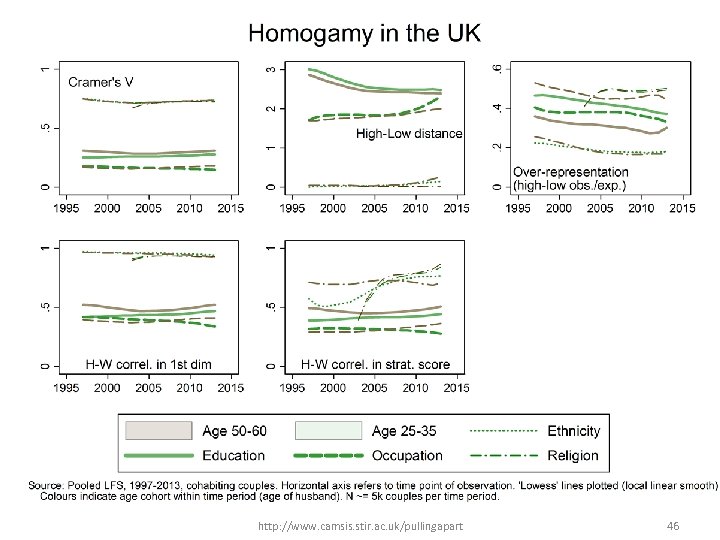
http: //www. camsis. stir. ac. uk/pullingapart 46
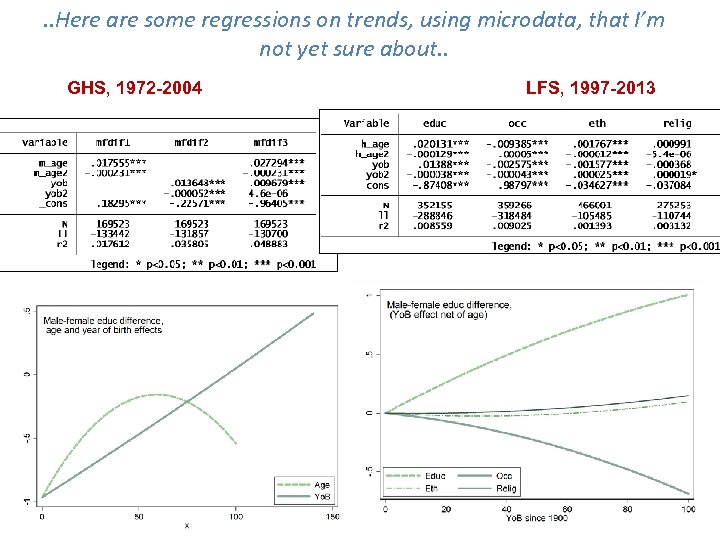
. . Here are some regressions on trends, using microdata, that I’m not yet sure about. . GHS, 1972 -2004 LFS, 1997 -2013 47
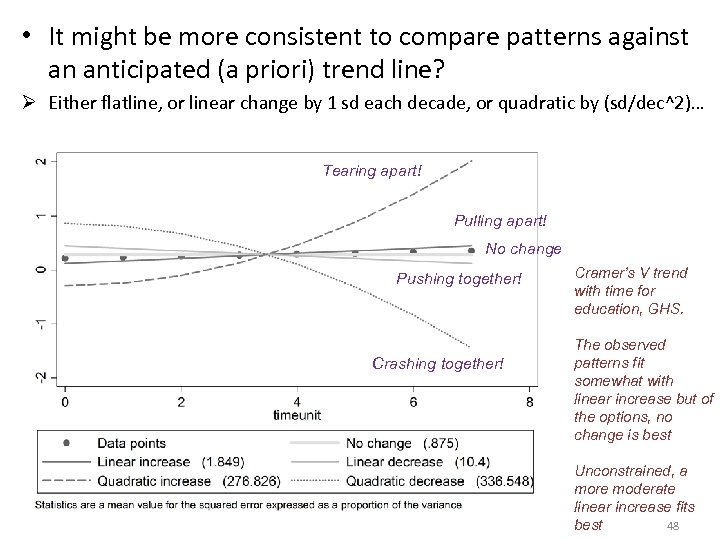
• It might be more consistent to compare patterns against an anticipated (a priori) trend line? Ø Either flatline, or linear change by 1 sd each decade, or quadratic by (sd/dec^2)… Tearing apart! Pulling apart! No change Pushing together! Cramer’s V trend with time for education, GHS. The observed patterns fit somewhat with linear increase but of the options, no change is best Unconstrained, a more moderate linear increase fits 48 best
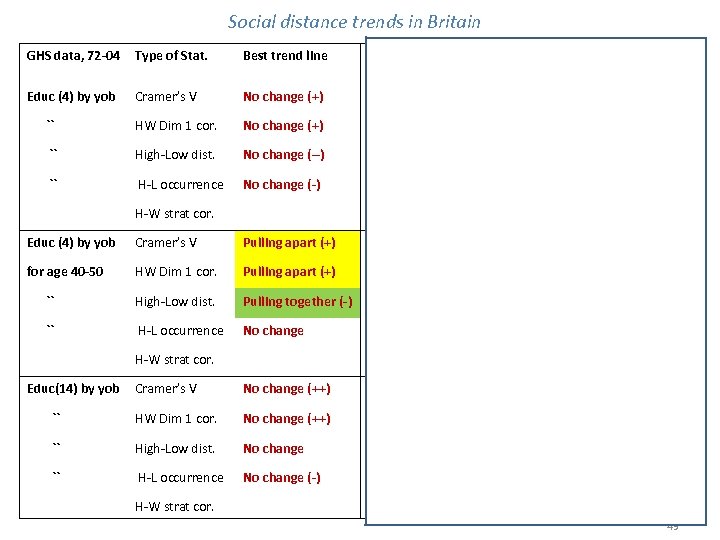
Social distance trends in Britain GHS data, 72 -04 Type of Stat. Best trend line LFS data, 1997 -2013 Best trend line (age 50 -60) Best trend line (age 25 -35) Educ (4) by yob Cramer’s V No change (+) Educ. Pulling apart (+) No change (+) `` HW Dim 1 cor. No change (+) `` Pulling apart (+) No change (+) `` High-Low dist. No change (--) `` Pulling together (-) `` H-L occurrence No change (-) `` Pulling apart (+) No change (+) H-W strat cor. Educ (4) by yob Cramer’s V Pulling apart (+) Occ (9) Pulling together (-) Pulling apart (+) for age 40 -50 HW Dim 1 cor. Pulling apart (+) `` Pulling together (-) Pulling apart (+) `` High-Low dist. Pulling together (-) `` Pulling apart (+) `` H-L occurrence No change `` No change Pulling apart (+) `` Pulling together (-) Pulling apart (++) H-W strat cor. Educ(14) by yob Cramer’s V No change (++) Ethnic (11) No change (++) `` HW Dim 1 cor. No change (++) `` Pulling together (-) `` High-Low dist. No change `` Pulling apart (+) Pulling apart (++) `` H-L occurrence No change (-) `` Pulling apart (+) No change H-W strat cor. 49
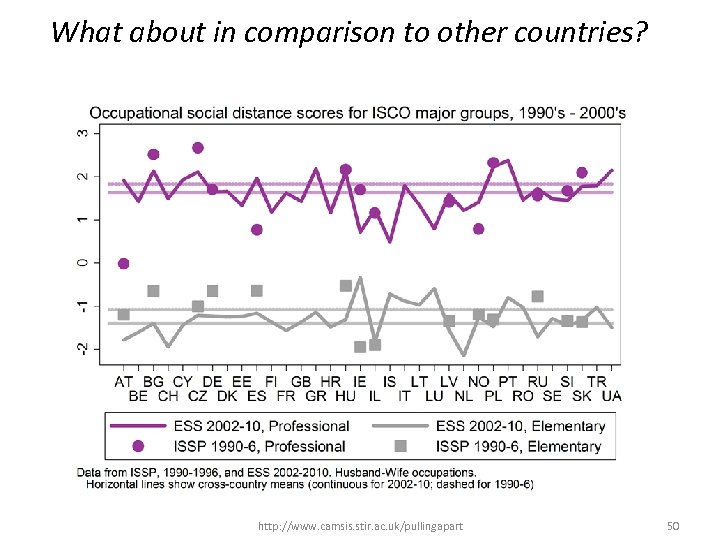
What about in comparison to other countries? http: //www. camsis. stir. ac. uk/pullingapart 50
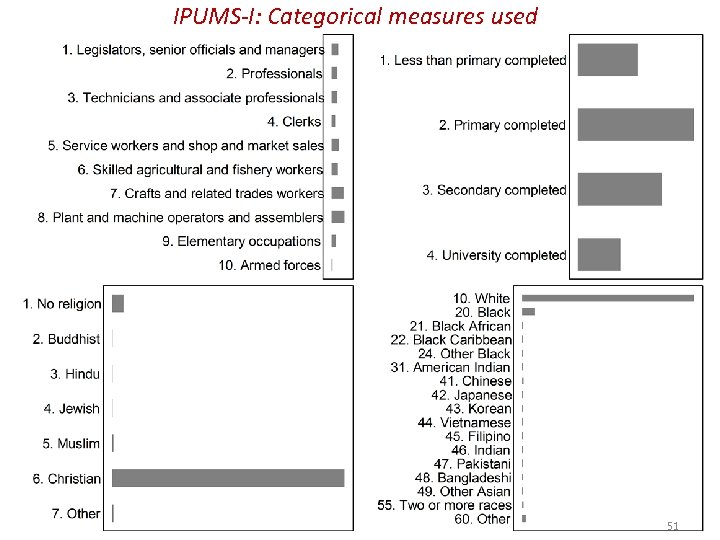
IPUMS-I: Categorical measures used 51
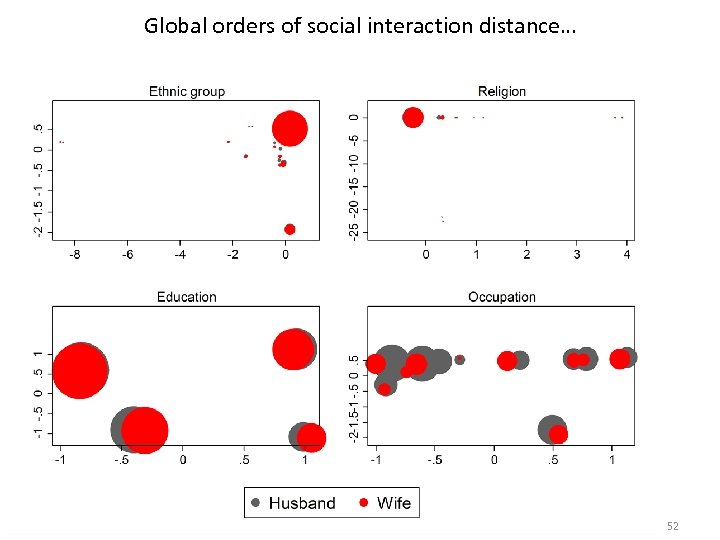
Global orders of social interaction distance… 52
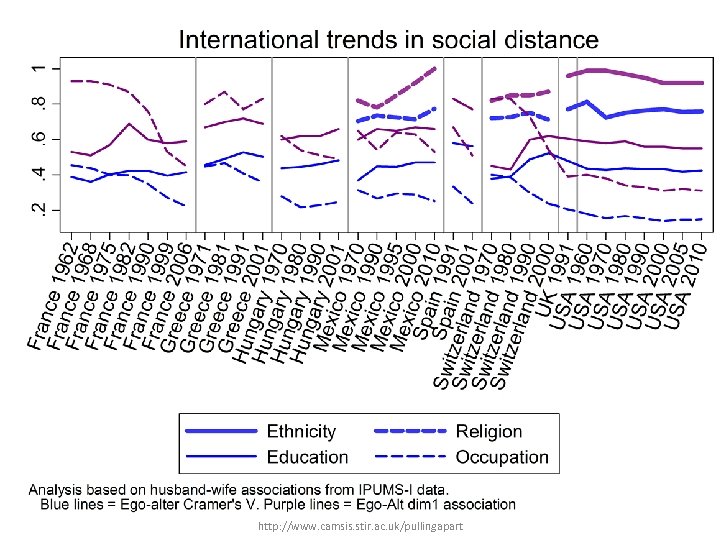
http: //www. camsis. stir. ac. uk/pullingapart 53
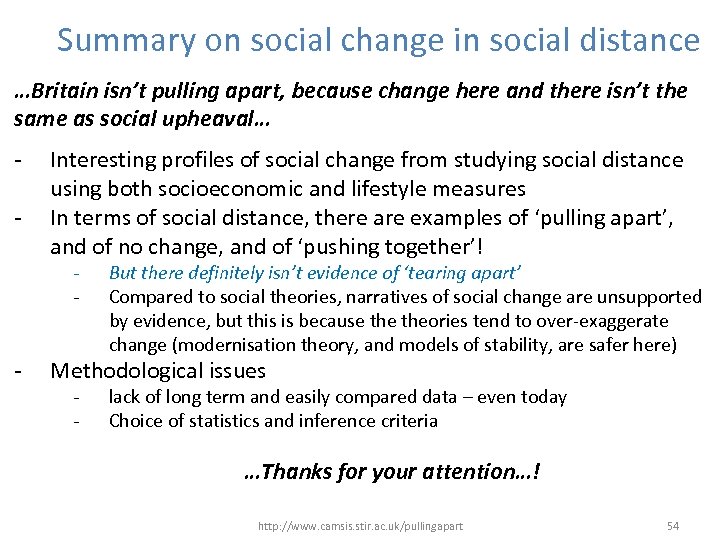
Summary on social change in social distance …Britain isn’t pulling apart, because change here and there isn’t the same as social upheaval… - Interesting profiles of social change from studying social distance using both socioeconomic and lifestyle measures In terms of social distance, there are examples of ‘pulling apart’, and of no change, and of ‘pushing together’! - - But there definitely isn’t evidence of ‘tearing apart’ Compared to social theories, narratives of social change are unsupported by evidence, but this is because theories tend to over-exaggerate change (modernisation theory, and models of stability, are safer here) Methodological issues - lack of long term and easily compared data – even today Choice of statistics and inference criteria …Thanks for your attention…! http: //www. camsis. stir. ac. uk/pullingapart 54
References cited • • • • • • Bourdieu, P. (1977) ‘Cultural Reproduction and Social Reproduction’ in J. Karabel and A. H. Halsey(eds) Power and Ideology in Education. New York: Oxford University Press. Chan, T. W. (Ed. ). (2010). Social Status and Cultural Consumption. Cambridge: Cambridge University Press. Chan, T. W. , & Goldthorpe, J. H. (2007). Social Status and Newspaper Readership. American Journal of Sociology, 112(4), 1095 -1134. Christakis, N. , & Fowler, J. (2010). Connected: The amazing power of social networks and how they shape our lives. London: Harper Press. Dorling, D. (2011) Injustice: Why Social Inequality Persists. Bristol: Polity Press. Erikson, R. , & Goldthorpe, J. H. (2010). Has social mobility in Britain decreased? Reconciling divergent findings on income and class mobility. British Journal of Sociology, 61(2), 211 -230. ETUI. (2012). Benchmarking Working Europe 2012. Brussels: European Trade Union Institute. Evans, G. , & Tilley, J. (2011) ‘How Parties Shape Class Politics: Explaining the Decline of the Class Basis of Party Support’, British Journal of Political Science, 42(1), 137 -161. Finney, N. , and Simpson, L. (2009) Sleepwalking to Segregation? Challenging Myths About Race and Migration. Bristol: Polity Press. Hutton, W. (2011) Them and Us. London: Abacus Jivraj, S. (2012), How has ethnic diversity grown 1991– 2001– 2011? , Dynamics of Diversity: Evidence from the 2011 Census, Manchester: Centre on Dynamics of Ethnicity, University of Manchester. Jones, O. (2011) Chavs. London: Verso. Lambert, P. S. , Prandy, K. , and Botero, W. (2007) ‘By Slow Degrees: Two Centuries of Socail Reproduction in Britain’, Sociological Research Online, 12(1). Laumann, E. O. (1973). Bonds of Pluralism: The form and substance of urban social networks. New York: Wiley. Laumann, E. O. , & Guttman, L. (1966). The relative associational contiguity of occupations in an urban setting. American Sociological Review, 31, 169 -178. Marks, G. N. (2014). Education, Social Background and Cognitive Ability. London: Routledge. Peston, R. (2008) Who Runs Britain? How Britain’s New Elite are Changing our Lives. London: Hodder & Stroughton. Prandy, K. (1990). The Revised Cambridge Scale of Occupations. Sociology, 24(4), 629 -655. Prandy, K. , & Lambert, P. S. (2003). Marriage, Social Distance and the Social Space: An alternative derivation and validation of the Cambridge Scale. Sociology, 37(3), 397 -411. Stewart, A. , Prandy, K. , & Blackburn, R. M. (1980). Social Stratification and Occupations. London: Mac. Millan. Swift, A. (2004). Would Perfect Mobility be Perfect? European Sociological Review, 20(1), 1 -11. White, H. (1992) Identity and Control: A Structural Theory of Social Action. Princeton, NJ: Princeton University Press. http: //www. camsis. stir. ac. uk/pullingapart 55
• British Household Panel Study – • ISSP Research Group, International Social Survey Programme (ISSP) (2013) Role of Government II, 1990. Distributor: GESIS Cologne Germany ZA 1950; ISSP Research Group, International Social Survey Programme (ISSP) (2013) Religion I, 1991. Distributor: GESIS Cologne Germany ZA 2150; ISSP Research Group, International Social Survey Programme (ISSP) (2013) Social Inequality II, 1992. Distributor: GESIS Cologne Germany ZA 2310; ISSP Research Group, International Social Survey Programme (ISSP) (2013) Environment I, 1993. Distributor: GESIS Cologne Germany ZA 2450; ISSP Research Group, International Social Survey Programme (ISSP) (2013) Family and Changing Gender Roles II, 1994. Distributor: GESIS Cologne Germany ZA 2620; ISSP Research Group, International Social Survey Programme (ISSP) (2013) National Identity I, 1995. Distributor: GESIS Cologne Germany ZA 2880; ISSP Research Group, International Social Survey Programme (ISSP) (2013) Role of Government III, 1996. Distributor: GESIS Cologne Germany ZA 2900. Social Status in Great Britain (1974) – • Minnesota Population Center. (2011). Integrated Public Use Microdata Series, International: Version 6. 1 [Machine readable database]. Minneapolis: University of Minnesota, and https: //international. ipums. org/ (accessed 1 July 2011). ISSP – • ESS Round 5: European Social Survey Round 5 Data (2010). Data file edition 3. 0. Norwegian Social Science Data Services, Norway – Data Archive and distributor of ESS data; ESS Round 4: European Social Survey Round 4 Data (2008). Data file edition 4. 1. Norwegian Social Science Data Services, Norway – Data Archive and distributor of ESS data; ESS Round 3: European Social Survey Round 3 Data (2006). Data file edition 3. 4. Norwegian Social Science Data Services, Norway – Data Archive and distributor of ESS data; ESS Round 2: European Social Survey Round 2 Data (2004). Data file edition 3. 3. Norwegian Social Science Data Services, Norway – Data Archive and distributor of ESS data; ESS Round 1: European Social Survey Round 1 Data (2002). Data file edition 6. 3. Norwegian Social Science Data Services, Norway – Data Archive and distributor of ESS data. IPUMS-International: – • Office for National Statistics. Social Survey Division and Northern Ireland Statistics and Research Agency. Central Survey Unit, Quarterly Labour Force Survey, January - March, 2013 [computer file]. Colchester, Essex: UK Data Archive [distributor], May 2013. SN: 7277 , http: //dx. doi. org/10. 5255/UKDA-SN-7277 -1 [and citations at UK Data Service] European Social Survey: – • Office for National Statistics. Social and Vital Statistics Division, General Household Survey: Time Series Dataset, 1972 -2004 [computer file]. Colchester, Essex: UK Data Archive [distributor], July 2007. SN: 5664. Labour Force Survey – • University of Essex. Institute for Social and Economic Research and Nat. Cen Social Research, Understanding Society: Waves 1 -3, 2009 -2012 [computer file]. 5 th Edition. Colchester, Essex: UK Data Archive [distributor], November 2013. SN: 6614 , http: //dx. doi. org/10. 5255/UKDA-SN-6614 -5 General Household Survey – • University of Essex, & Institute for Social and Economic Research. (2011). British Household Panel Survey: Waves 1 -18, 1991 -2008 [computer file], 5 th Edition. Colchester, Essex: UK Data Archive [distributor], SN 5151. United Kingdom Household Longitudinal Study (‘Understanding society’) – • Data sources Blackburn, R. M. , Stewart, A. , & Prandy, K. (1980). Social Status in Great Britain, 1974 [computer file]. Colchester, Essex: UK Data Archive [distributor], SN: 1369. Oxford Mobility Study (1972) – University of Oxford, & Oxford Social Mobility Group (1978). Social Mobility Inquiry, 1972 [computer file]. Colchester, Essex: UK Data Archive [distributor], SN: 1097. http: //www. camsis. stir. ac. uk/pullingapart 56
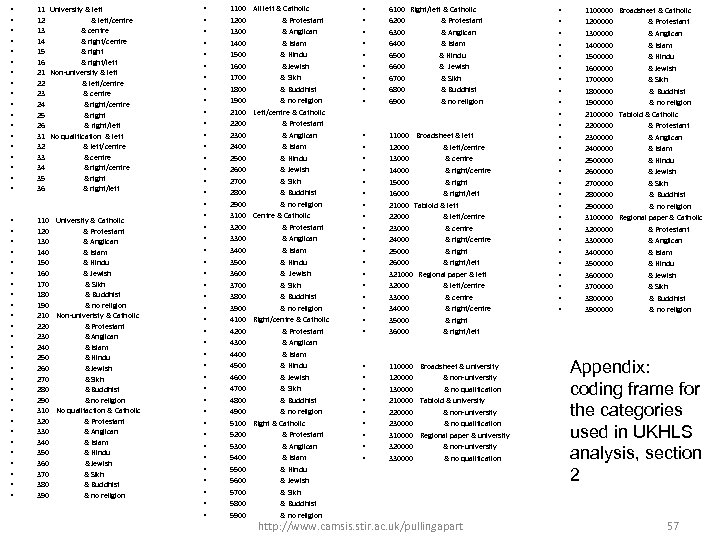
• • • • • 11 University & left 12 & left/centre 13 & centre 14 & right/centre 15 & right 16 & right/left 21 Non-university & left 22 & left/centre 23 & centre 24 & right/centre 25 & right 26 & right/left 31 No qualification & left 32 & left/centre 33 & centre 34 & right/centre 35 & right 36 & right/left • • • • • • • 110 University & Catholic 120 & Protestant 130 & Anglican 140 & Islam 150 & Hindu 160 & Jewish 170 & Sikh 180 & Buddhist 190 & no religion 210 Non-univeristy & Catholic 220 & Protestant 230 & Anglican 240 & Islam 250 & Hindu 260 & Jewish 270 & Sikh 280 & Buddhist 290 & no religion 310 No qualifaction & Catholic 320 & Protestant 330 & Anglican 340 & Islam 350 & Hindu 360 & Jewish 370 & Sikh 380 & Buddhist 390 & no religion • • • • • • • • • • • • 1100 1200 1300 1400 1500 1600 1700 1800 1900 2100 2200 2300 2400 2500 2600 2700 2800 2900 3100 3200 3300 3400 3500 3600 3700 3800 3900 4100 4200 4300 4400 4500 4600 4700 4800 4900 5100 5200 5300 5400 5500 5600 5700 5800 5900 All left & Catholic & Protestant & Anglican & Islam & Hindu &Jewish & Sikh & Buddhist & no religion Left/centre & Catholic & Protestant & Anglican & Islam & Hindu & Jewish & Sikh & Buddhist & no religion Centre & Catholic & Protestant & Anglican & Islam & Hindu & Jewish & Sikh & Buddhist & no religion Right/centre & Catholic & Protestant & Anglican & Islam & Hindu & Jewish & Sikh & Buddhist & no religion Right & Catholic & Protestant & Anglican & Islam & Hindu & Jewish & Sikh & Buddhist & no religion • • • 6100 Right/left & Catholic 6200 & Protestant 6300 & Anglican 6400 & Islam 6500 & Hindu 6600 & Jewish 6700 & Sikh 6800 & Buddhist 6900 & no religion • • • • • 11000 Broadsheet & left 12000 & left/centre 13000 & centre 14000 & right/centre 15000 & right 16000 & right/left 21000 Tabloid & left 22000 & left/centre 23000 & centre 24000 & right/centre 25000 & right 26000 & right/left 321000 Regional paper & left 32000 & left/centre 33000 & centre 34000 & right/centre 35000 & right 36000 & right/left • • • 110000 Broadsheet & university 120000 & non-university 130000 & no qualification 210000 Tabloid & university 220000 & non-university 230000 & no qualification 310000 Regional paper & university 320000 & non-university 330000 & no qualification http: //www. camsis. stir. ac. uk/pullingapart • • • • • • • 1100000 Broadsheet & Catholic 1200000 & Protestant 1300000 & Anglican 1400000 & Islam 1500000 & Hindu 1600000 & Jewish 1700000 & Sikh 1800000 & Buddhist 1900000 & no religion 2100000 Tabloid & Catholic 2200000 & Protestant 2300000 & Anglican 2400000 & Islam 2500000 & Hindu 2600000 & Jewish 2700000 & Sikh 2800000 & Buddhist 2900000 & no religion 3100000 Regional paper & Catholic 3200000 & Protestant 3300000 & Anglican 3400000 & Islam 3500000 & Hindu 3600000 & Jewish 3700000 & Sikh 3800000 & Buddhist 3900000 & no religion Appendix: coding frame for the categories used in UKHLS analysis, section 2 57
Скачать презентацию Is Britain Pulling Apart Evidence from the analysis
30f8619144e30b4e84e6c05a1239da70.ppt