 Скачать презентацию IS ARMS CONTROL THE ANSWER http www youtube
679c360c1a7425d0462350c74682257a.ppt
- Количество слайдов: 5



IS ARMS CONTROL THE ANSWER? http: //www. youtube. com/watch? v=v. Uy. Qu 5 q. SGDM • • What makes WMDs different? Chem, bio, & nuke vs. conventional weapons They seem so 20 th Century, so why do (some) countries want WMDs? How much is enough? Deterrence and mutually assured destruction (aka “massive retaliation's”; arguments for proliferation The security dilemma. We don’t want them, but… Why isn’t extended deterrence enough? The stability-instability paradox: Once you have them, what else can you do? (Israel, Pakistan, and the US as examples? ) Legitimacy issues & claims to hegemony (domestic, regional, intl. )
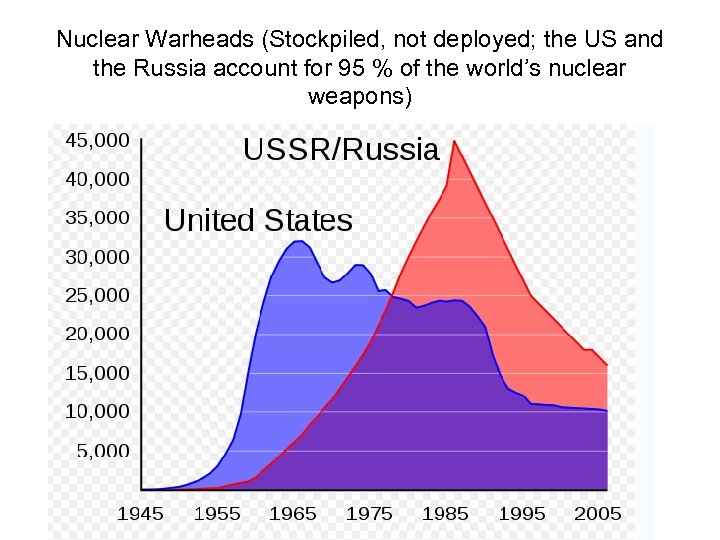
Nuclear Warheads (Stockpiled, not deployed; the US and the Russia account for 95 % of the world’s nuclear weapons)
THE WMD’STIMELINE • WWI: Extensive use of chemical weapons by all sides • 1945 first nuclear weapon used; plutonium based (roughly equal to 15 K tons of dynamite, killing 120 K people) • 1949 USSR tests, 1952 UK tests • 1950 s development of hydrogen bombs (a 20 megaton bomb = 20 million tons of dynamite) • 1957 Soviets test first ICBMs (the space race) • 1957 Atoms for Peace effort; Intl. Atomic Energy Agency • 1958 France tests • 1961 Cuban Missile Crisis • 1964 China tests, today a few 100 • Since then: Israel, Pakistan, India, South Africa & N. Korea • Other important developments: silo hardening, missile technology, MIRVs, tactical nukes, SLBMs (subs), ABMs, SDI (1987) grows up in the 2000 s to be a “shield”
WHY HAVE WE SOUGHT TO IMPOSE ARMS LIMITATIONS? • International norms and tipping points…Must stop early or the cat will get out of the bag and everyone will have • How valuable are nukes today to the most powerful states? : Not very valuable (Korea, Vietnam, and Afghanistan show that most powerful states will lose before using nukes) • Conventional vs. WMD capability gaps: What’s easiest and cheapest weapon for rising states to develop? • The credibility problem for major powers’ WMDs, especially with extended deterrence: USSR in Afghanistan, US in Vietnam • The morality issue (domestic and foreign) – How can we have them and say we believe in human rights? • Are nukes offensive or defensive? Hard to tell… This is a huge problem in relying on them. Nuclear subs are esp. problematic. • The rogue regime & terrorism problem: Even if they don’t use nukes, they can be more aggressive with them. • The number of actors and uncertainty
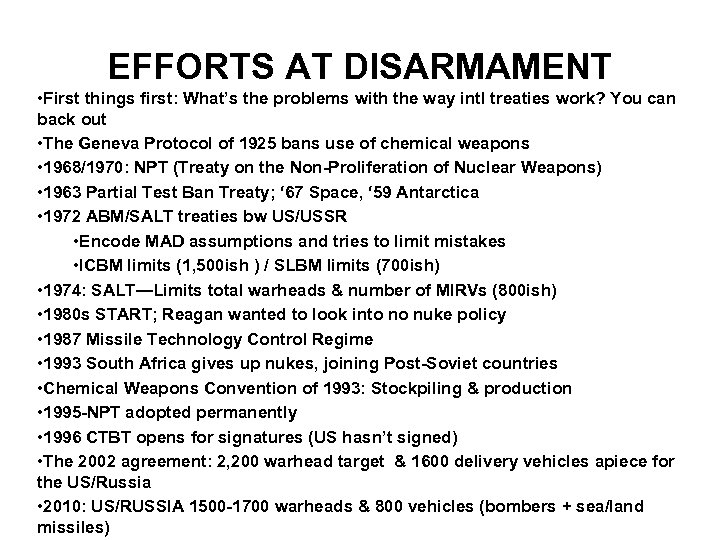
EFFORTS AT DISARMAMENT • First things first: What’s the problems with the way intl treaties work? You can back out • The Geneva Protocol of 1925 bans use of chemical weapons • 1968/1970: NPT (Treaty on the Non-Proliferation of Nuclear Weapons) • 1963 Partial Test Ban Treaty; ‘ 67 Space, ‘ 59 Antarctica • 1972 ABM/SALT treaties bw US/USSR • Encode MAD assumptions and tries to limit mistakes • ICBM limits (1, 500 ish ) / SLBM limits (700 ish) • 1974: SALT—Limits total warheads & number of MIRVs (800 ish) • 1980 s START; Reagan wanted to look into no nuke policy • 1987 Missile Technology Control Regime • 1993 South Africa gives up nukes, joining Post-Soviet countries • Chemical Weapons Convention of 1993: Stockpiling & production • 1995 -NPT adopted permanently • 1996 CTBT opens for signatures (US hasn’t signed) • The 2002 agreement: 2, 200 warhead target & 1600 delivery vehicles apiece for the US/Russia • 2010: US/RUSSIA 1500 -1700 warheads & 800 vehicles (bombers + sea/land missiles)
Скачать презентацию IS ARMS CONTROL THE ANSWER http www youtube
679c360c1a7425d0462350c74682257a.ppt