


 Скачать презентацию Is Advertising Immoral PHIL 106 2009 Dan
357b2f3f7345a1ce3878ce1bd5ae3a1f.ppt
- Количество слайдов: 79
 Is Advertising Immoral? PHIL 106 – 2009 Dan Turton
 Recap Justify your ethical claims! l By providing at least one good reason to believe your ethical claim l And (even better) l By also providing at least one good reason not to believe your opponents ethical claim l
 Does Advertising Manipulate Us? Reekie’s Defense of Advertising PHIL 106 – 2009 Dan Turton
 Topic Summary l Does advertising manipulate us? l Reekie’s l Does advertising manipulate us? l Crisp’s l limited critique of advertising Does advertising make us unhappy? l Belch l defense of advertising vs. Hamilton Does advertising make us unhappy? l Hamilton again and wrap up
 Today l Start addressing the question: l Is advertising immoral? l An explanation of advertising l A defense of advertising l Setting up some of the moral issues
 Advertising is… Communication from a specific source that intends to inform and influence the audience so that they believe something and/or behave in a certain way l It is usually: l l Persuading people to purchase a brand/product l Paid for l Using mass media l But some marketers are much sneakier…
 Advertising might also be… l Rosser Reeves l Manager of a successful advertising company While holding up two coins: l “[Making] you think that this quarter is more valuable than that one” l
 The Role of Advertising l Advertising supports marketing and business function. l A modern business model: l l l Perform consumer research Develop new product based on research Advertise product Sell product Importantly, both the business and the consumers are thought to benefit from this
 The Benefits of Advertising l Advertising helps consumers decide what to buy l l Informs about the existence of new products Informs about new uses for existing products Informs about differences between products – laundry powder & razors Advertising provides incentives to: l l Make differentiated products, and Innovative products l Who doesn’t like PS 3 s, wi-fi, iphones?
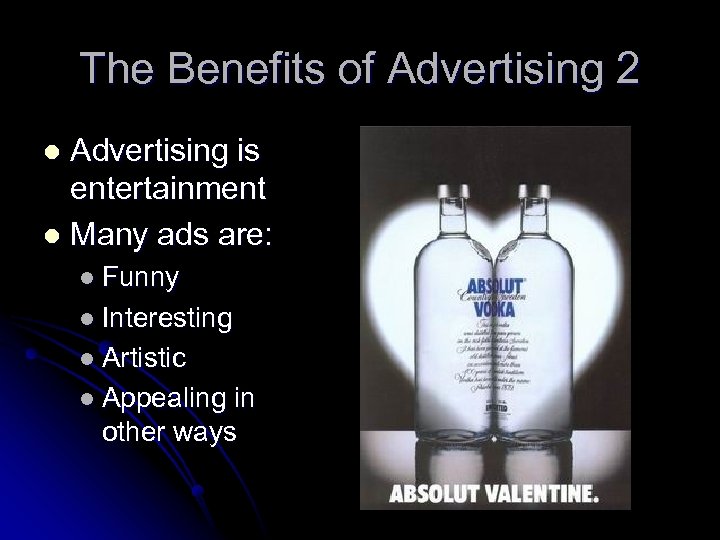 The Benefits of Advertising 2 Advertising is entertainment l Many ads are: l l Funny l Interesting l Artistic l Appealing in other ways
 The Benefits of Advertising 3 l Advertising is good for the economy l It is a huge industry l It employs a lot of people l It stimulates economic growth by connecting more of consumers needs and wants with solutions l Economic growth is good l Means you can get more things you want
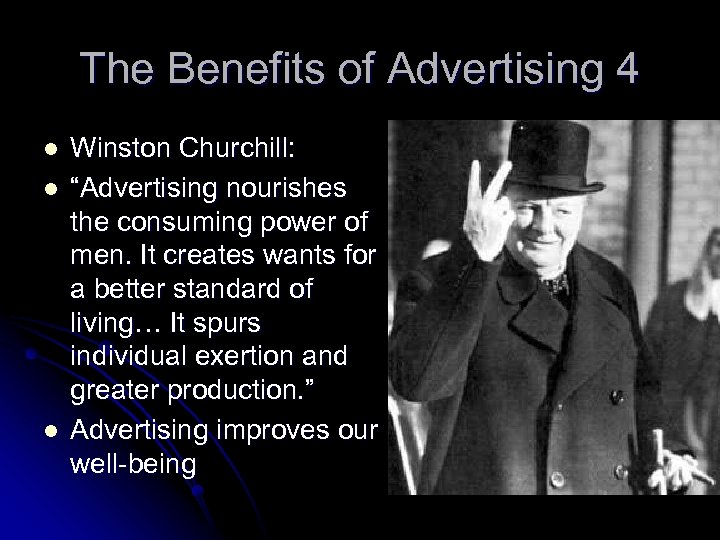 The Benefits of Advertising 4 l l l Winston Churchill: “Advertising nourishes the consuming power of men. It creates wants for a better standard of living… It spurs individual exertion and greater production. ” Advertising improves our well-being
 So, What’s Wrong with Advertising? l Apparently, advertising deceives people into buying things that they don’t really need l Apparently, advertising lies, deceives and misleads l Apparently, advertising makes people think they need things that they shouldn’t even want l Some people even think it makes us unhappy!
 Advertising Doesn’t Lie l Reasons why advertisers don’t lie l Misleading ads are reported and removed from circulation l ASA: “Truthful Presentation - Advertisements should not contain any statement … which … is likely to deceive or mislead the consumer … or exploits his/her lack of experience or knowledge. ” l ASA: “(Obvious hyperbole, identifiable as such, is not considered to be misleading). ”
 Advertising Doesn’t Lie l Reasons why advertisers don’t lie l Misleading ads are reported and removed from circulation l Lies about product quality are soon discovered, making the lying company go out of business l Really important product categories have extra regulations to prevent lying l Advertisers don’t want to tarnish the reputation of advertising generally
 Advertising Doesn’t Make Us Buy Things We Don’t Need Advertising never forces anyone to do anything l Advertising does influence our purchase decisions (at least it intends to) l l But what is wrong with that? l Advertising can’t encourage you to want something you really don’t need l Advertising can only help you fulfill wants and needs you already have
 Should Advertising be Allowed to Help Us Fulfill Our Wants? Should we stop people from helping others to fulfill their wants? l Depends on the wants… l l Some things we want are bad for others l Slaves, l over-sized cars, blow-off valves Some things we want are bad for ourselves l Cigarettes, valves highly processed foods, blow-off
 Should Advertising Help Us Fulfill Our Wants? l Advertising obviously shouldn’t encourage or help people to harm others but… l l l What is better, freedom or having the government protect us from our own wants? Why shouldn’t I be able to do whatever I want with my money (without hurting others)? l l Who should decide what we should and shouldn’t want (for our own good)? Consumer Sovereignty: Surely I have that right! Where do we draw the line?
 Summary l Advertising is good because: l l l It helps consumers decide what to buy It provides incentives for innovation At least some of it is entertaining Its good for the economy It allows us to improve our lives (as we see fit) by helping us to satisfy our wants and needs Busting the myths about advertising: l l Advertising does not lie or deceive Advertising cannot make people buy things they don’t want
 Next Time l Read: l Roger Crisp’s ‘Persuasive Advertising, Autonomy, and the Creation of Desire l Get ready to discuss: l Why advertising actually is immoral – it creates desires in us that we cannot even attempt to reject
 Does Advertising Manipulate Us? Crisp’s Limited Critique of Advertising PHIL 106 – 2009 Dan Turton
 Last Time l Advertising is good because: l l l It helps consumers decide what to buy It provides incentives for innovation At least some of it is entertaining Its good for the economy It allows us to improve our lives (as we see fit) by helping us to satisfy our wants and needs Busting the myths about advertising: l l Advertising does not lie or deceive Advertising cannot make people buy things they don’t want
 Today Looking at an argument that a certain type of advertising is immoral l Roger Crisp thinks: l Persuasive advertising is immoral because it overrides our autonomy l
 Informative Adverts Crisp: informative advertising is usually OK because it facilitates (not overrides) the desiremaking process l E. g. Jacket on sale l l He already wanted that kind of jacket, now he knows where to get it (for cheap)
 Persuasive Adverts Crisp: persuasive advertising is immoral because it overrides our autonomy (our ability to make purchase decisions for ourselves) l E. g. subliminal ads? l l The desire for the product itself is created
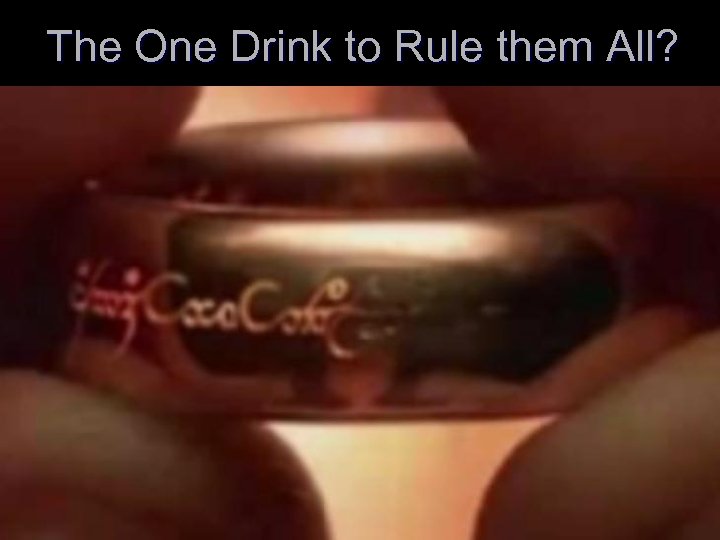
 How Subliminal Ads ‘Work’ l Unconscious emotional manipulation by l Suggestion, or l Association l If you are aware of seeing/hearing it, then it’s not subliminal advertising l (or it’s a failed attempt at subliminal advertising)
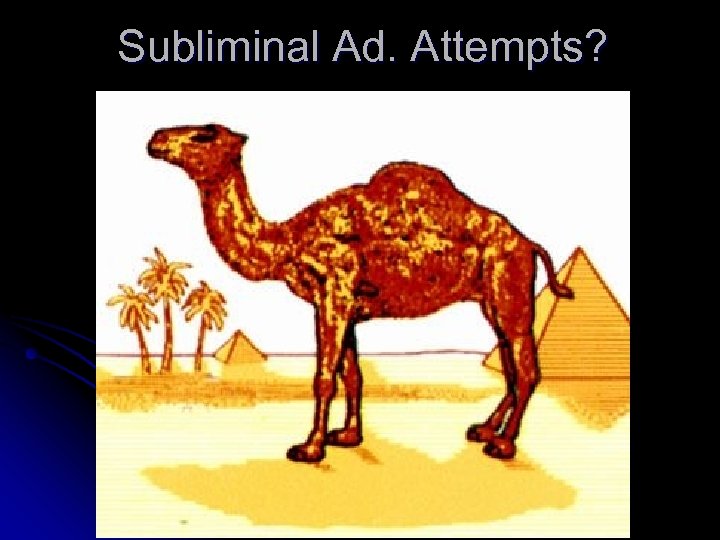 Subliminal Ad. Attempts?
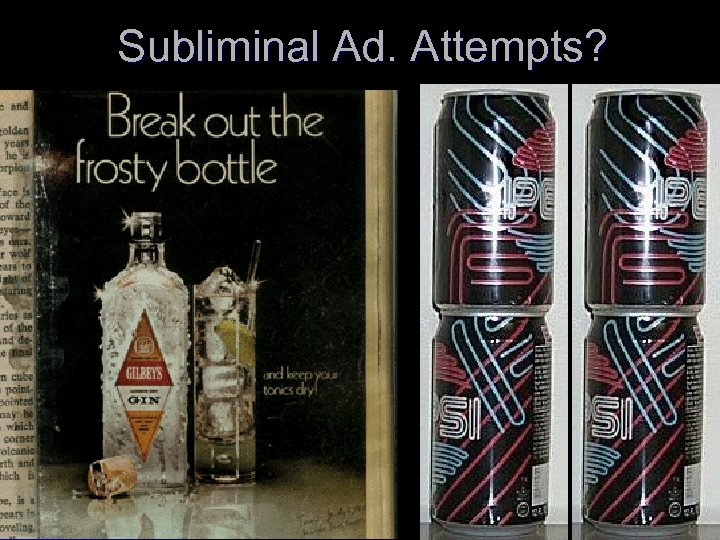 Subliminal Ad. Attempts?
 The One Drink to Rule them All?
 The Truth about Subliminal Ads Subliminal ads alone can’t make you buy something that you didn’t want l Purchasing a product is too complex a behaviour for subliminal ads to control l Unconscious priming works sometimes l Some priming is rejected l
 Arrington: Autonomous Desires are autonomous if we accept them l E. g. Arrington sees an ad for hair dye l l He desires hair dye because he desires to look younger l And, he is perfectly happy to have both of those desires l Therefore, (according to him) his desire for hair dye is autonomous
 Crisp: Autonomous Desire Is Arrington’s desire autonomous? l What if the ad showed a man (with 100% not-grey hair) in a position of authority and surrounded by beautiful women? l Perhaps Arrington's real desires were for power and sex l
 Crisp: How Adverts Persuade They appeal to our unconscious desires l Crisp: they might appeal to our “unconscious desires for power and sex” l
 Subtle Sex Appeal
 Unconscious Desires? l The unconscious desire for sex l Makes l us laugh at jokes that aren’t funny The unconscious desire for power l $$ is the best indicator of power these days l Makes us angry/disappointed if we don’t get that promotion/job we were after l Also makes us laugh at jokes that aren’t funny
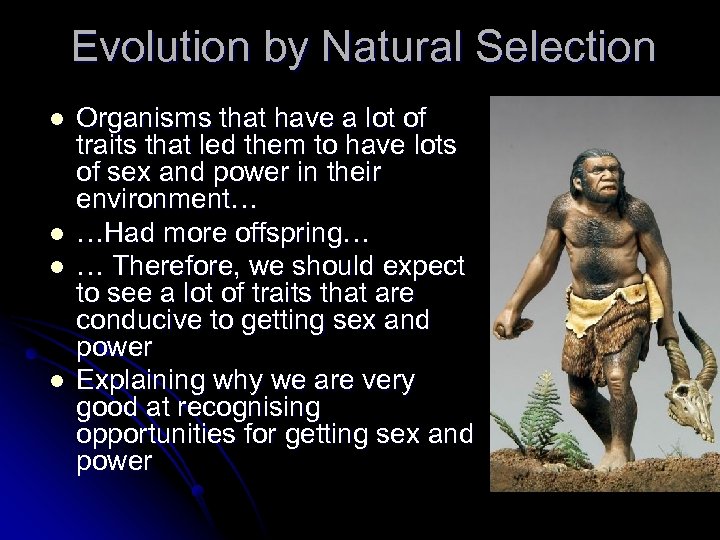 Evolution by Natural Selection l l Organisms that have a lot of traits that led them to have lots of sex and power in their environment… …Had more offspring… … Therefore, we should expect to see a lot of traits that are conducive to getting sex and power Explaining why we are very good at recognising opportunities for getting sex and power
 Unconscious Desires Advertisers don’t always target sex and power though l Most ads for FMCGs are targeted at women or women and children l l Remember that Persil makes your clothes whiter? l Well, that’s not all it does: l http: //www. youtube. com/watch? v=xu. Tspd 9 l. FFE&f eature=related
 Crisp: Rational Desire Persuasive advertising creates irrational desires l If our main desire for a product is subconscious, then rationality doesn’t even come into it - we cannot possibly accept it or even consider it! l l Remember that an autonomous desire is one that we accept l Imagine Crisp subconsciously desires hair dye… that certainly seems irrational…
 Crisp: Free Choice l Being able to provide any old reason for why you bought something isn’t necessarily helpful l “I l like Meow Mix”, “I like Grecian Formula 16” We need to weigh up the relevant reasons in order to make a free choice l Persuasive advertising uses reasons that we are not aware of and so cannot evaluate
 Crisp: Control or Manipulation l You control someone if you make them do something for reasons that they would not consider… reasonable. l Making Crisp do a jig (by tying ropes to his limbs) just because I feel like it would be controlling him l Adverts can do this
 Crisp’s General Argument 1) 2) 3) 4) Persuasive advertising creates the desire for a product by associating it with sex, power or some other thing that is commonly and subconsciously craved Therefore, the real reason for the desire is hidden from us Therefore, the desire is not autonomous Therefore, persuasive advertising overrides our autonomy (which is immoral)
 Summary Persuasive advertising uses subconscious associations to try to make us desire products l Crisp thinks it works and that is immoral because it overrides our autonomy l It must work to some extent, or persuasive advertising probably wouldn’t be so widespread l Is it manipulative enough to be immoral, though? l
 Next Time l Read: l Belch l & Belch ‘Economic Effects of Advertising’ Get ready to discuss: l Does advertising make us happy… or unhappy?
 Does Advertising Makes Us Unhappy? Belch vs. Hamilton PHIL 106 – 2009 Dan Turton
 Recap of Crisp Persuasive advertising uses subconscious associations to try to make us desire products l Crisp thinks it works and that is immoral because it overrides our autonomy l It must work to some extent, or persuasive advertising probably wouldn’t be so widespread l Is it manipulative enough to be immoral, though? l
 Today The advertisers argument for how advertising makes us happier l Hamilton’s criticism of that argument l
 Problem: Margin of Discontent l l l Margin of discontent = Gap between what we have and what we want Happiness = satisfaction with how your life is going (no discontent) Examples of things that might discontent people: l l l You have a Corolla, but you want an Evo You work at Mc. Ds, but you want a job at Logan Brown You have a 14” TV, but you want a 21”
 Hamilton’s Solutions to the Margin of Discontent Hamilton mentions two possible solutions, l l but he thinks that the first solution doesn’t seem to work: Economic growth solution: 1) • “People satisfy their wants by increasing their possessions, thus becoming happier” ‘Sages’ solution: 2) • “Give up wanting”
 ‘Neo-Liberal’ (Advertisers) Argument (Roughly According to Hamilton) Reducing the margin of discontent makes people happier 2) Economic growth helps consumers to reduce their margin of discontent 3) Advertising encourages economic growth 4) Advertising helps consumers to make better decisions about how to reduce the margin of discontent c) Therefore, advertising helps make people happier 1)
 Hamilton’s Refutation of the ‘Neo. Liberal’ (Advertisers) Argument l More $$ (economic growth) does not make us happier l l Therefore, P 2 is false Advertising does not help consumers to make better decisions about how to reduce the margin of discontent l Therefore, P 4 is false
 Does $$ Make Us Happy? 1) 2) l l Reducing the margin of discontent makes people happier Economic growth helps consumers to reduce their margin of discontent If 1. and 2. are both true, then why have we gotten richer… but not happier? Evidence?
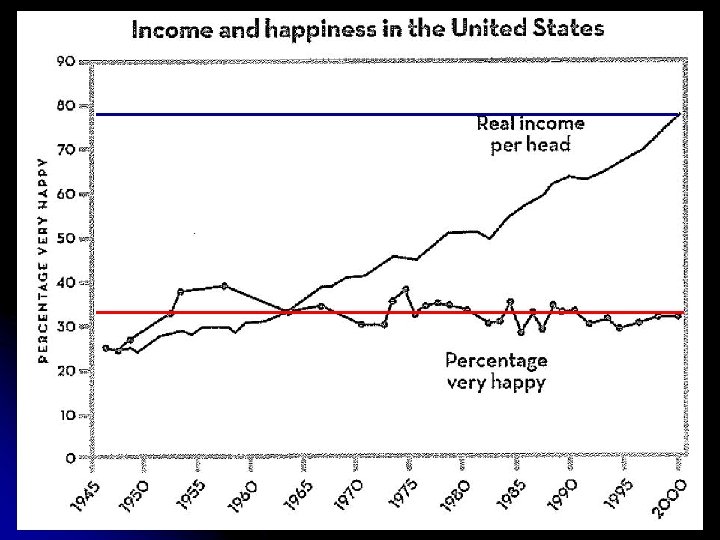
 Materialism Doesn’t Pay Very High
 Adaptation l l Lottery winners return to pretty much the same level of happiness after 1 year The more we have: l l l The more we want and The more we think we need Evidence?
 So, Does $$ Make Us Happy? l So, unless you are materialistic, more $$ makes very little difference to our happiness – much less than: l l l A rewarding job A loving relationship Volunteering l But materialistic people seem to have a pretty strange idea of happiness l Having said all this… who would not want to win lotto?
 Possible Neo-Liberal Response (Consumer Sovereignty) l Remember Consumer Sovereignty? l l l Regardless of happiness, we have a right to do what we want with our money Economic growth gives people more freedom to choose whatever they wish to do with their lives and their money Without advertising consumers would find it very difficult to exercise this freedom
 Hamilton Fights Back l Advertisers claim to be helping consumers to freely choose how to best satisfy their needs and wants – but this is false! l l l Consumers do not freely choose between products because advertising manipulates our preferences – (Consumer Sovereignty is a myth) More choice doesn’t help us satisfy our needs and wants Therefore, P 4 is false
 Consumer Sovereignty is a Myth! l l Consumers do not freely choose between products because advertising manipulates our preferences Our preferences are formed inside, not outside, of the marketplace Indeed, consumers values, goals and personal identities are all formed inside the marketplace! Evidence?
 The Abundance of Real Choice is a Myth l l l The abundance of choices advertising provides are limited to meaningless choices between variations of things that we didn’t need in the first place “Most advertising, unfortunately, is devoted to an attempt to build up… irrational preferences for certain brands… to persuade consumers [to] buy Bumpo rather than Bango” – Prof. Boulding Evidence?
 How Well Did Hamilton Fight Back? l l Advertisers claim to be helping consumers to freely choose how to best satisfy their needs and wants Hamilton claims that: l l Advertising coerces consumers into satisfying the greedy financial wants of businesses, not their own wants or needs Advertising doesn’t provide more real choice, so it doesn’t help consumers choose what they really want
 Summary – You Decide l Does advertising make us happier by making us richer? l Or do we adapt to and waste our extra income on things that don’t make us happy? l Does advertising help us decide how best to satisfy our needs & wants? l Or does it make it harder to decide between a bunch of irrelevantly differentiated options?
 Next Time l Read: l Clive l Hamilton: ‘Identity’ Get ready to discuss: l Hamilton’s idea that the whole point of advertising is to make us dissatisfied l Get ready to discuss: l Test tips!
 Does Advertising Makes Us Unhappy? Hamilton Again & Wrap Up PHIL 106 – 2009 Dan Turton
 Today l l A quick recap, then Clive Hamilton's argument that advertising makes us unhappy and is therefore immoral, then A summary of the whole morality of advertising section Tips for the test
 Last Time: Margin of Discontent l Gap between what we have and what we want l l You have a Corolla, but you want an Evo You have a 14” TV, but you want a 21” You generally have old slow small smelly stuff but you want newer faster bigger better cooler stuff All kinds of things, not just things you can buy from shops
 Last Time: How Advertising Makes Us Happy Advertising helps solve the problem of the margin of discontent in two ways Economic growth solution: l 1) • It gives everyone more $$ to buy the things they want Better choices solution: 2) • It helps consumers make better wantsatisfying choices
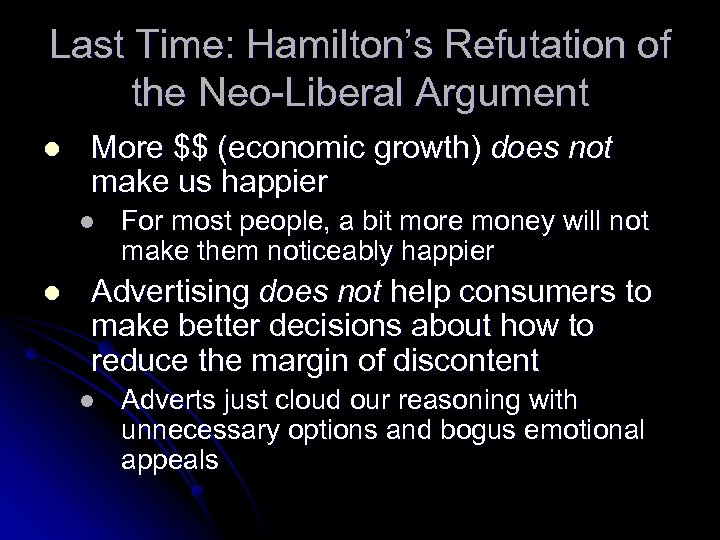 Last Time: Hamilton’s Refutation of the Neo-Liberal Argument l More $$ (economic growth) does not make us happier l l For most people, a bit more money will not make them noticeably happier Advertising does not help consumers to make better decisions about how to reduce the margin of discontent l Adverts just cloud our reasoning with unnecessary options and bogus emotional appeals
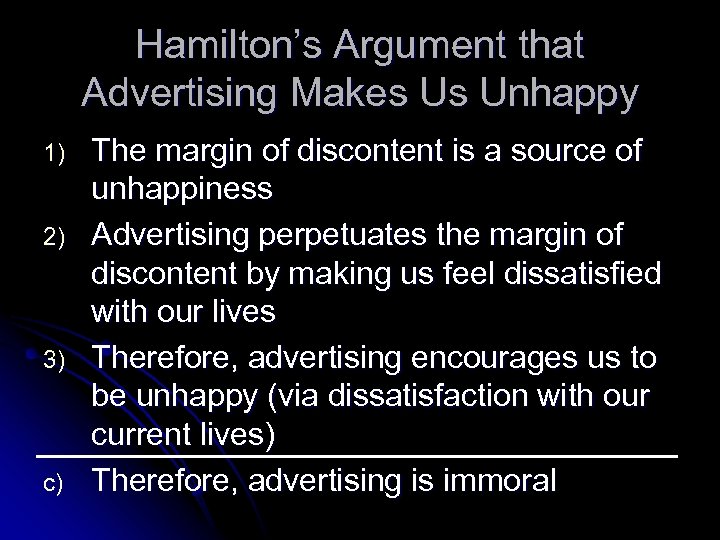 Hamilton’s Argument that Advertising Makes Us Unhappy 1) 2) 3) c) The margin of discontent is a source of unhappiness Advertising perpetuates the margin of discontent by making us feel dissatisfied with our lives Therefore, advertising encourages us to be unhappy (via dissatisfaction with our current lives) Therefore, advertising is immoral
 Does Advertising Make Us Dissatisfied 1? l Advertisers and their critics both agree that advertising influences consumers… l l But, to what extent does it do it? And, How does it do it?
 How Much Does Advertising Influence Us? l Advertising companies are in the funny position of: l l l Having to tell their clients that they can influence consumers very strongly. While, Having to tell consumer rights groups that they have very little influence on consumers Anyone who thinks that advertising doesn’t affect them at all is wrong
 Does Advertising Make Us Dissatisfied 2? l Remember Winston Churchill’s quote… l l He thought advertising was good because it made people strive for a higher standard of living… but how did it do that? Maybe by making everyone feel dissatisfied with what they have at the moment by showing them something ‘better’
 Does Advertising Make Us Dissatisfied 3? l Beautiful (photo-shopped) women are in adverts everywhere we look
 Does Advertising Make Us Dissatisfied 4? l Never more so than with our prime biological motivators (for getting a good mate/s)… l l l Status for men (or more directly; just getting women). Beauty (sexiness) for women. Real beauty for women.
 Brand vs. Company Integrity Crazy that some companies/brands advertise in a much more moral manner than others…. right? l Wrong (In this case anyway) ! l Remember that companies are there to make money l l (Charities place) are there to make the world a better
 Does Advertising Really Make Us Dissatisfied? l l l Advertising either helps us solve our existing dissatisfactions, or Advertising constantly provides reasons to be dissatisfied and then helps us momentarily ‘solve’ them… and then tries to make us dissatisfied again! …Or A woosy in between position (only some ads are bad) l Could ads that make us feel satisfied work?
 Summary – Hamilton on Ads l Advertisers would say they help everyone by: Helping us close the margin of discontent l Raising the standard of living l Helping us to exercise our consumer sovereignty and our personal choices about how to live l l Hamilton says that advertising is immoral because: It doesn’t make us happier like they claim it does, and l It coerces us into a constant state of dissatisfaction l
 Section Summary: Is Advertising Immoral? l Advertisers help everyone by: Helping us close the margin of discontent l Growing the economy & raising our standard of living l Helping us to exercise our consumer sovereignty and our personal choices about how to live l l Hamilton: advertising is immoral because: l l It coerces us into a constant state of dissatisfaction Crisp: persuasive advertising is immoral: Because it overrides our autonomy and… l It makes us desire products without us realising! l
 Find Out More l The perils of consumerism and what to do about it: l http: //www. storyofstuff. com/ l See what the anti-advertising community is up to (and trying to sell to you): l http: //www. adbusters. org/home/ l Don’t worry though! Find out how advertising is self-regulated in New Zealand l http: //www. asa. co. nz/
 Do More Let the government know what you think about how advertising is regulated: l Hon Dr Jonathan Coleman – minister of broadcasting l l jonathan. coleman@national. org. nz l TEL l (04) 817 6818 (Parliament) Hon Simon Power – minister of commerce l simon. power@national. org. nz l TEL (04) 817 6803 (Parliament)