 Скачать презентацию IS 554 Public Library Management Services Technology
1289cba44a08c35c243c35cb35515199.ppt
- Количество слайдов: 69



IS 554: Public Library Management & Services Technology Applications and Implementation 28 February, 2006 Spring 2006 Bharat Mehra School of Information Sciences
Agenda for the Day “Lesson Plans” Discussion http: //www. sis. utk. edu/~bmehra/IS 554/PM Ptemplate. html • Start developing your assignments into the SIS Template
Agenda for the Day • Technological glitches from Indian side • Back-up plans: Collecting data for your community/culture questions – “Lesson plan” interaction from students during class time – Get feedback from a PL staff and/or online case-analysis of US or non-US PL • Improvements to your “lesson plan” questions • Content related to your “lesson plan”
Questions for Pre-Project Survey • Share your thoughts and feelings about the class so far? Do you think that you are benefiting from the lectures, readings, and assignments? What is working for you and what is not working for you? • What would you like to change about the class? How can it be improved? • What are your thoughts about gathering information using the questions identified in your “lesson plan” from the Indian students for our PMP Manual? • What kind of culture-related information do you think you will gather? • Do you think it is a good idea to gather information from another culture about PLs in another part of the world? How is it relevant to this class? • If we are not able to collaborate with the Indian students, how will you feel about gathering information from/about an American public library (via interviews, Internet study), or a non-U. S. library via the Internet? Any other ways that you would prefer to gather feedback using your “lesson plans”? • Additional comments? Send an e-mail to CINDY LANCASTER (lancast@utk. edu) with the subject line “IS 554 Survey” by 7 MARCH and she will compile your feedback and send me a summary of your responses in a way that your identities remain anonymous.
Agenda for the Day • Student Presentations – Topics Covered: Library Governance, Library Identity, Marketplace Dynamics/Advertising, Personnel Management, Finances, Policy Development, Collection Development, Library Products/Customer Services, Intellectual Property Rights and Copyright – Today’s presentations • Personnel Management: Martha Hendricks • Technological Infrastructure: Greg Miller • Technical Services and Cataloging + Classification: Jennifer Anielski and Christina Tracy Readings for this class (Technology Applications and Implementation) plus last class readings (Digital PLs)
Public Libraries and Digitization Personnel Management Martha Hendricks
State-wide digital libraries and digitization of public library materials n Paper done in Prof. Allard’s Digital Libraries class Spring 2005 n Came about accidentally when original project fell through n Looked at five states approaches to digitizing public library special collections n Chose a public library in each state that had digitized material
Why do Georgia and Kentucky already have state-wide digital libraries…? n …that include public library material while states like New York, Oregon and Washington do not? n One possible answer: A history of state support and cooperation that promotes centralization of resources.
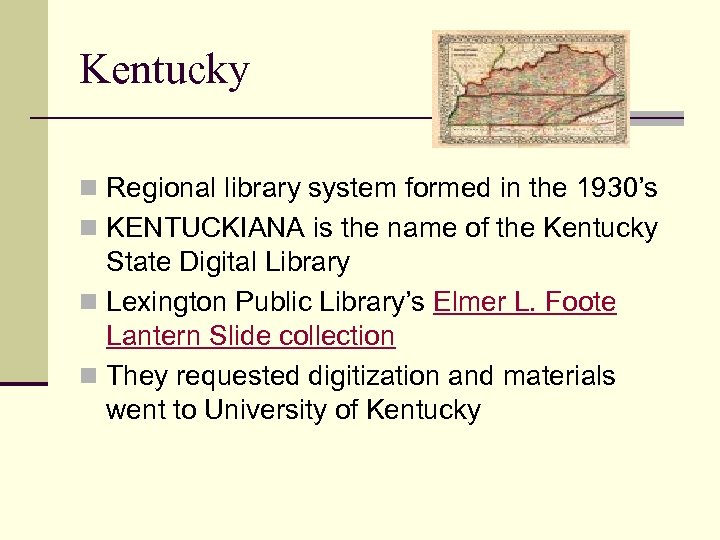
Kentucky n Regional library system formed in the 1930’s n KENTUCKIANA is the name of the Kentucky State Digital Library n Lexington Public Library’s Elmer L. Foote Lantern Slide collection n They requested digitization and materials went to University of Kentucky
Georgia n Regional library system formed in 1940 n GALILEO – Digital Library of Georgia n Georgia HOMEplace is the link to public library digitization n Lumpkin County Public Library’s Thar’s Gold in Them Thar Hills…
Washington State n Washington has no State regional library system, though they have regional libraries n Public libraries receive no state funds at all n Washington State Best Digital Practices n Ellensburg PL’s pilot project – Through Open Eyes
Personnel Management and Ellensburg Public Library’s digitization efforts n Returned to Ellensburg to look at Personnel Management aspect of digitization n Five staff positions took on digitization projects n Some workloads were rearranged n Bottlenecks were created by initial inexperience in how the process worked
Outcomes in Ellensburg n Library director very motivated n Her ability to fulfill management functions flawed in many respects n The project was completed despite problems n New project also initiated n New position of researcher/archivist/ digital collections manager envisioned to protect existing collections and develop new ones
Technological Infrastructure By: Greg Miller
Project Topic ► Technological requirements for Digitization and automation of cultural material § In house digitization of collection materials § Technological requirements for information package delivery ► Can be divided into two main categories § Software ►Library support Automation packages, databases, OPAC § Hardware ►Ether/Intranet, Scanners, Wepages, Domains, Routers, Switches, etc.
Project Scope ► Will examine fundamental infrastructure required to do “in house” processing and delivery of cultural material ► Will examine policies and procedures associated with the processing of information requests and delivery ► Will examine both software and hardware requirements to carry out project along with bugetary and staff considerations
Project Goals ► Understand how the digitization of cultural material differs from that of India’s small public libraries ► Examine delivery methods of information packages both internal to the United States as well as Intercontinental Delivery. ► Develop a resource that compiles information for professional librarians to reference in regards to both software and hardware needed to house, maintain, expand make available digital collections to all members of the world community
Project Justification ► Universal Cultural Understanding ► One-stop resource that can be updated with newer technology ► Sharing of technologies and ideas crossculture ► Small libraries – Big Help, avoidance of consultation fees
Got Infrastructure? ► Without Infrastructure digitization would be impossible ► Information packages would never be delivered ► Collections would not be accessible by people outside the community…. the seas would boil…the dead would rise from their graves…etc…. seriously though none of the processes would be possible
Technical Services & Cataloging and Classification Jennifer Anielski and Christina Tracy IS 554 Public Library Management
Choose and define topic: Our topic is Technical Services, specifically the acquisition, cataloging and classification of materials.
Culturally inclusive classification and cataloging: • Helps library users be more self sufficient in searching for materials to meet their needs • Allows users to find materials more efficiently • Must meet the needs of all library patrons, not just the vocal audience
Library automation: • Falls under the umbrella of technical services • Maintain the library’s catalog • Investing and implementing enhancements to better serve the community and its needs
Describe the topic: • Items are selected for purchase • Upon arrival, items are entered into the catalog • Subject heading assignments • Classification decisions • Location • Foreign language title translations • Records are uploaded to World. Cat
Outline the scope of the topic: • Purchase materials that will benefit the diverse cultures served by the library • Assign subject headings that are understandable to the end user • Assign location codes • Are there areas in the library designated for culturally specific books (i. e an ESL area)
Outline the scope of the topic: • Include information on books that are in a foreign language • 041, 241 and 500 note fields in MARC • Investigate the need for multiple records for one item that targets a specific group • i. e. multiple records in the catalog for one Spanish book, one in English, one in Spanish
Identify goals of the project: To explain the process of preparing cultural-specific materials for circulation in a small public library. This includes ordering, classifying and cataloging these materials in a way that they can be found in the library by a culturally diverse patron group.
Technical services and small library settings aspects: • Outsourced cataloging (OCLC, Booklist, LC)- saves time and increases access • Lack of an online catalog system / funding to update system • Funding for acquisitions may be skewed based on demands • Selective cataloging • Staff trained to catalog and classify books
Technical services and cultural aspects in another culture: • Cataloging foreign language materials • Creating/using subject headings that are culturally appropriate • Books, videos and audio recordings are costly when purchasing the same materials in multiple languages (DVDs can fix part of this problem) • Standardization of physical processing of nonwestern materials • Evaluating materials to ensure they meet the library’s policies for cultural sensitive circulation
Technical services and digitization: • Creating the metadata so that the information is accessible to patrons • Funding to digitize • Priority of cataloging/classifying material vs. digitizing it • Preservation issues • The debate of whether to fully catalog materials that may not be apart of the library’s permanent collection
American case study www. chesapeake. lib. va. us
Chesapeake Public Library System • Serves city of Chesapeake, VA • 353 square miles in southeastern Virginia • 207, 199 citizens • Consists of a central library , 5 branches and a bookmobile • Wallace Room • Public Law Library • Gates Lab
Library Services: • Computer training • Literacy training • Tutoring • Select federal and state government repository • Programming for children and adults • Multicultural reading lists
Technical Services @ CPL • Ensures accurate input into catalog • Works to decrease time between when books arrive and when they are available to the public • Coordinates with IT dept. to maintain catalog and databases • Quickly and accurately catalogs popular reading materials to maximize availability to patrons
Strategic Action Plan • Goals • To improve service to a culturally diverse local population • Increase speed at which locally relevant materials are processed • Materials for learning labs are processed quickly and accurately • Displays for cultural events relevant to local population • Library as a learning center
Links: http: //www. librarysupportstaff. com/jobhelp 8. html#techstaff 1 "The Cyberlibrary" hosts this annotated bibliography of links for librarians involved with cataloging, Interlibrary Loan, and Serials. http: //www. ala. org/ala/lamapublications/smalllibspubs/vide oothernonprint. htm The ALA provides this resource for handling non print resources in small public libraries. http: //www. ala. org/ala/lamapublications/smalllibspubs/refer enceservice. htm Reference services are simplified for small public libraries in this digital resources by the ALA.
Technology and PLs • “Take a book, remove the cover, remove the title page, remove the table of contents, remove the index, cut the binding from the spine, fling the loose pages that remain so that they scatter about the room. Now, find the information you needed from that book. This is the Internet. ” – Michael Gorman • Why is the computer and the Internet “two-edged” sword with positive and negative impacts? Identify some of the positive and negative impacts? What aspects does the above quote reveal about the Internet?
Survey of Library Automation CEOs on Trends in Information Technology INDUSTRY • Consolidation: merger of companies; content providers are buying automation firms • Globalization: non-US firms are entering the US market; • Application service providers (ASPs): outsourcing What impact do these have on PL management? Have these had an impact in your own PL settings?
Survey of Library Automation CEOs on Trends in Information Technology • E-books: Not yet time because of lack of standards and user-friendliness • Monitors: More glitzy equipment • Wireless Any other innovations or impacts of technology in PLs?
Survey of Library Automation CEOs on Trends in Information Technology Functionality • Unicode: Vendors with more powerful codes will increase their viability (especially in the context of other languages) • Content enhancements: add book covers to OPACs • Digital libraries: What software to use? • Metadata: MARC records for all sorts of media • Portals and content management: most portals aggregate, not select or filter What other issues do you face in your PL?
Survey of Library Automation CEOs on Trends in Information Technology Seven Ps of the Information Age (Shaffer) • Privacy • Property (intellectual or tangible) • Personalization • Preservation • Protection (security) • “Pretty good” validity • Propriety (pornography and mores) How do these matter in PL management and technology implementation?
Survey of Library Automation CEOs on Trends in Information Technology • Consolidation of information • Cost of information • Control and hearing from different viewpoints • Development into marketing and sales How do these play a role on PL management and technology use?
Survey of Library Automation CEOs on Trends in Information Technology Focus on individual and usability “Your job is not envision the future but to enable. ” Do you agree? Impacts on Technology and Vice-Versa • Patrons • Libraries as collections • Staff • Caring about knowledge and information
Security vs. Accessibility Can we restrict or monitor access without complicating accessibility or infringing on people’s rights? Fundamental Principles • Security and accessibility are not antithetical, but are necessarily antagonistic. You cant do both at the same time: Know what the limits are in your setting • Decide what risks you can live with and making technology perform towards those expectations • Information and awareness are our only defense—the right information, and only the right information, to the right people at the right time.
Security vs. Accessibility • Ledbetter’s three principles of accessibility – Obviousness: Information is not accessible unless it is obvious how to find it: “Intuitively obvious” Know your users to know what is obvious to them – Simplicity: Information is not available unless its easy to get at – Veracity: Information is not useful… unless its true and we know that its true: Authenticity, Accuracy, and Authority
Tips for a Better PL Website • What is the purpose of the website supposed to be? • Decide what you want to include (KISS principle: keep it short and simple)
Tips for a Better PL Website • Good things to have on a website – Brief description of your PL, its products, and philosophy – Library hours and location – Major library services (statement of subjects covered): link to collection development policy – Short circulation/use policy – Charges for services – Tricks – Notes for special software or add-ins – Copyright regulations – Attractive design How many of these are applicable to your PL’s website?
Essential Elements of a PL Website • URL Persistence • URL Simplicity • Contacting the Library • Don’t Overlook the Basic Facts – Official name of the PL; Complete street and mailing address; Phone numbers; Email address; Hours of service; Link to OPAC; Description of facilities/collections
“All the Better” Elements of a PL Website • Findings aids or electronic gateways • Directory of library staff • Site index of all pages within the website • Search box for finding information within the site Does your PL website fulfill these expectations? Avoid unnecessary frills: Flash animations; Sound backgrounds; Special effects transitions
Advantages and Disadvantages of Weblogs Advantages • Web becomes a two-way medium (reading and writing) • Staff weblogs become insights into organizational culture • Relationships can be nurtured between service providers and patrons • Collective weblogs as rich resource for peer learning • Voice to marginalized groups
Advantages and Disadvantages of Weblogs Disadvantages • Difficult to impose control • Requirement for regular updating • Tendency towards vanity publishing
Libraries Today and Tomorrow: Local Automation can provide library operations (circulation, cataloging) achieve real efficiencies Acquiring MARC records is at the heart of the automation process Determining the best way to acquire MARC records through various retro conversion options is the most critical decision when planning for automation
Libraries Today and Tomorrow • Broader and far-reaching concerns when PLs incorporate access to national electronic databases • Digital reference services: what type? Question: Whether your library is automated or not, if you had to make a decision about buying an automated system, what features would you look for?
Cataloging and Organization Cataloging accomplishes provision of systematic access to the PL’s collections Cataloging materials in all formats and then logically organizing materials on the shelves, providing access to documents via author, title, and subject How will this impact small libraries, digitization, and culture-specific materials?
Cataloging and Organization: Questions • Describe your library’s procedures for cataloging in terms of: amount of original cataloging done; whether AACR 2 and Sears are used and to what extent? • Approximately how much does it cost the library in staff time and dollars to create an original cataloging record? If you purchased most of your catalog records instead of creating your own, how would you use the extra time?
Cataloging and Organization: Questions • What difficulties do your customers have in using the catalog? • What do you do to teach people how to use the catalog? • What library materials should circulate? What should remain inhouse? • Should any library materials be labeled or restricted in any way?
A Poem Lovely as a Tree? Virtual Reference Questions in Norwegian Public Libraries • Empirical study conducted of the main Norwegian Virtual Reference Desk: Ask the Library (ATL) hosted by Oslo PL • Based on representative sample of typical queries • Finding was that response to literary questions were more factually authoritative than answers to science questions • Implication: PLs in Norway should seek closer collaboration with scientific communities and their portals By Tord Hoivik
Background Research • Do you agree with the 55% rule for traditional reference services? • Are digital reference services an effective use of the electronic possibility? What are the aspects that require attention by PLs considering to expand their virtual reference services? • What are the advantages and disadvantages of digital reference serves in PLs?
Evaluation of Digital Reference Services • Service not dependent on physical location • Storage of questions and answers so as to build on past experience • Save on time • Traditional reference is opaque; digital reference is transparent
The Queries: What Do People Ask? • 80% within the five “large” Dewey groups – 24% Qs about literature – 18% Qs about history and geography – 15% about social sciences – 13% about technology – 12% about arts and recreation Do these numbers related to your reference experiences in the United States? (Based on 6000 reference transactions in SBI database by fall 2001)
The Queries: What Do People Ask? • The five “small” Dewey groups contain 5% or less – 5% about computers, information, and general reference – 4. 6% about science – 4. 5% about language – 3. 2% about religion – 2. 6% about philosophy and psychology
Research Methods & Findings – 100 reference Qs selected based on Dewey group stratification – Classifying RQs • Topical Qs: Users request information about a subject, theme, or topic • Factual Qs: Users request factual answers to concrete and specific questions • Document Qs: Users require factual information about specific documents, usually in order to retrieve the documents Are these patterns the same for face-to-face reference?
Nature of Virtual Reference Desk • Friendly, chatty and relatively informal • Entry barriers are low. How low? • Analysis of RQs reveals needs and expectations, interests and problems, trends and topics popular in the culturespecific population
Topical Qs • Reflect strong local roots: local searches • Libraries promote enlightenment, education, and other cultural activities: literary searches • Broad queries address topics that are elementary and widely known: communism, witches, calligraphy, the late sixties • Narrow topics that are of interest to a few: medical use of saffron, the programming language SIMULA, color theories of Wittgenstein
Factual Qs • Service not geared towards advanced Qs of technical nature • 4 main areas: words and expressions, scientific and technical, medical, society and public affairs, history • Users problem comes from diversity of sources as compared to difficulty of Qs • Issues of physical access and intellectual access in web searching
Document Qs • Advanced Qs in the bibliographic field • Factual Qs that concern the formal or external properties of documents rather than their actual content • Document retrieval still dominated by singlemedia systems • Users want an integrated approach • 75% of document searches concern printed media
Who Are the Customers? • Work, Learning and Leisure – Qs that emerge from working life private or public) » Hope of solving practical problems, related to paid work – Qs from situations of formal learning or study (schools, colleges, universities) » Unpaid produce and deliver – Qs from informal sphere (family, leisure, voluntary activities) » Varied and unpredictable How much of this culture-specific? Is there a variation in the American context?
What do the Customers Ask? • School Qs: What do pupils ask? Imposed query (Gross) • Leisure Qs: What do adults ask? • Between literature and science – Familiar and foreign topics Science education in crises: The PLs are shaped by a literary rather than a scientific culture. Do you agree?
Reference as Market • There are many competing suppliers of information. How can PLs keep up with the stiff competition? How does your PL compete with competing service providers?
Скачать презентацию IS 554 Public Library Management Services Technology
1289cba44a08c35c243c35cb35515199.ppt