


 Скачать презентацию IS 2150 TEL 2810 CC Evaluation Risk
1024b6a1ea1675d806a2e703494a5a43.ppt
- Количество слайдов: 66
 IS 2150 / TEL 2810 CC Evaluation, Risk Management, Legal Issues, Physical Security November 2, 2006
 Common Criteria (CC) Evaluation
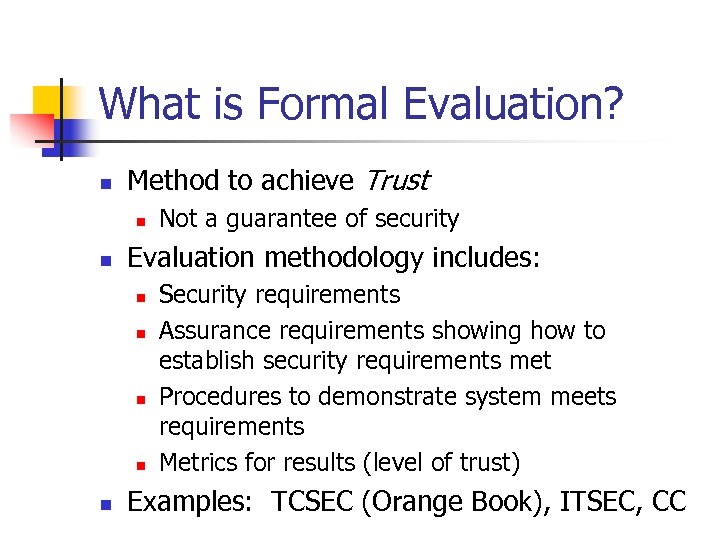 What is Formal Evaluation? n Method to achieve Trust n n Evaluation methodology includes: n n n Not a guarantee of security Security requirements Assurance requirements showing how to establish security requirements met Procedures to demonstrate system meets requirements Metrics for results (level of trust) Examples: TCSEC (Orange Book), ITSEC, CC
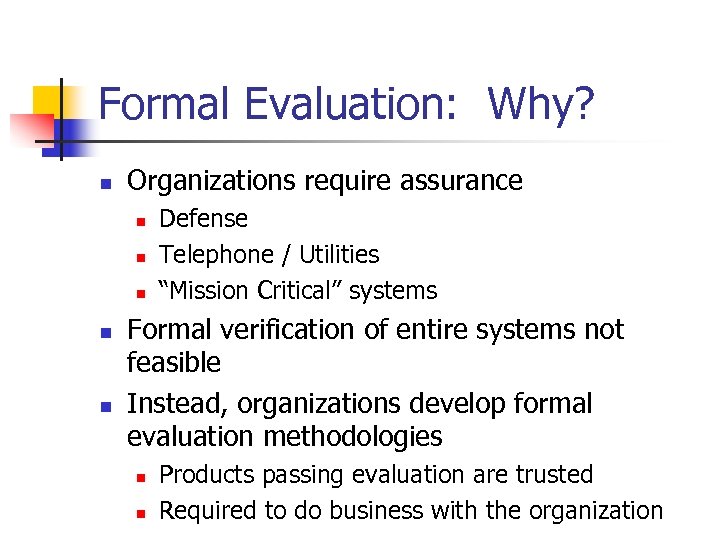 Formal Evaluation: Why? n Organizations require assurance n n n Defense Telephone / Utilities “Mission Critical” systems Formal verification of entire systems not feasible Instead, organizations develop formal evaluation methodologies n n Products passing evaluation are trusted Required to do business with the organization
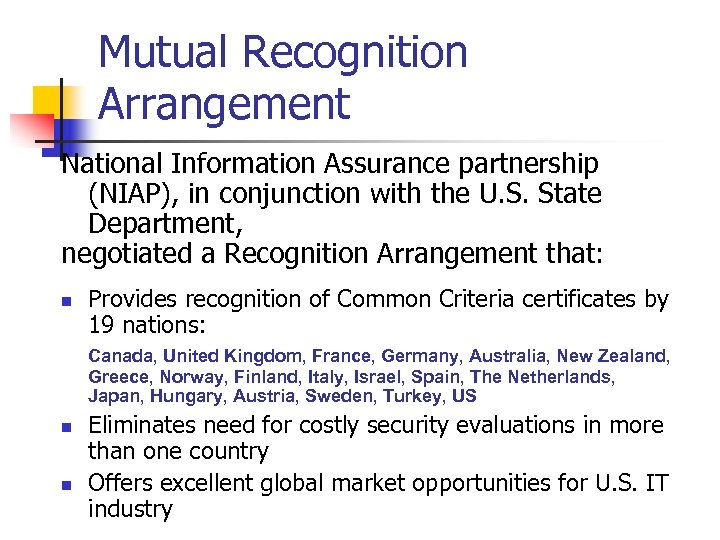 Mutual Recognition Arrangement National Information Assurance partnership (NIAP), in conjunction with the U. S. State Department, negotiated a Recognition Arrangement that: n Provides recognition of Common Criteria certificates by 19 nations: Canada, United Kingdom, France, Germany, Australia, New Zealand, Greece, Norway, Finland, Italy, Israel, Spain, The Netherlands, Japan, Hungary, Austria, Sweden, Turkey, US n n Eliminates need for costly security evaluations in more than one country Offers excellent global market opportunities for U. S. IT industry
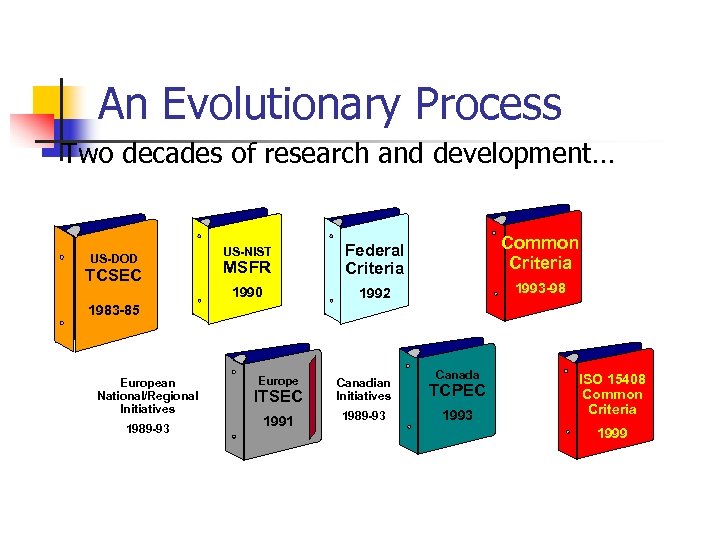 An Evolutionary Process Two decades of research and development… TCSEC US-NIST MSFR Federal Criteria Common Criteria 1990 US-DOD 1992 1993 -98 1983 -85 European National/Regional Initiatives 1989 -93 Canada Europe Canadian Initiatives TCPEC 1991 1989 -93 1993 ITSEC ISO 15408 Common Criteria 1999
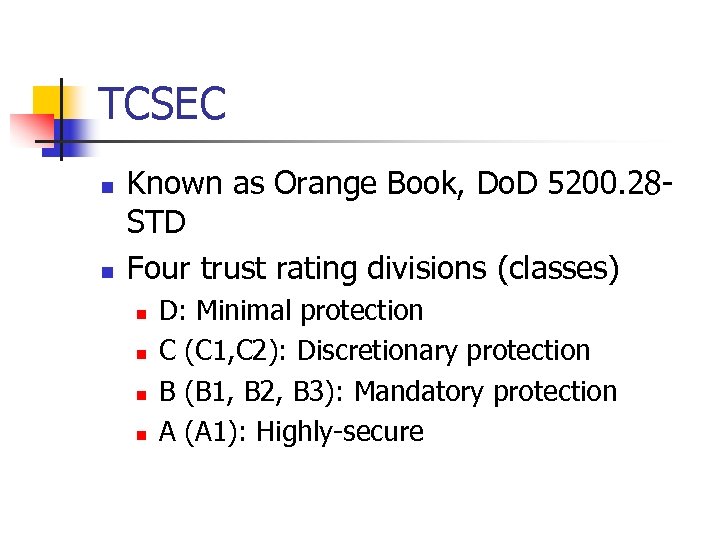 TCSEC n n Known as Orange Book, Do. D 5200. 28 STD Four trust rating divisions (classes) n n D: Minimal protection C (C 1, C 2): Discretionary protection B (B 1, B 2, B 3): Mandatory protection A (A 1): Highly-secure
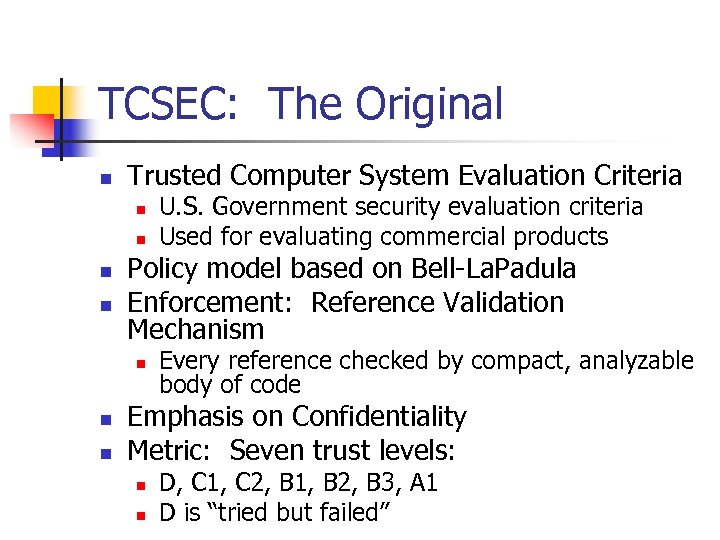 TCSEC: The Original n Trusted Computer System Evaluation Criteria n n Policy model based on Bell-La. Padula Enforcement: Reference Validation Mechanism n n n U. S. Government security evaluation criteria Used for evaluating commercial products Every reference checked by compact, analyzable body of code Emphasis on Confidentiality Metric: Seven trust levels: n n D, C 1, C 2, B 1, B 2, B 3, A 1 D is “tried but failed”
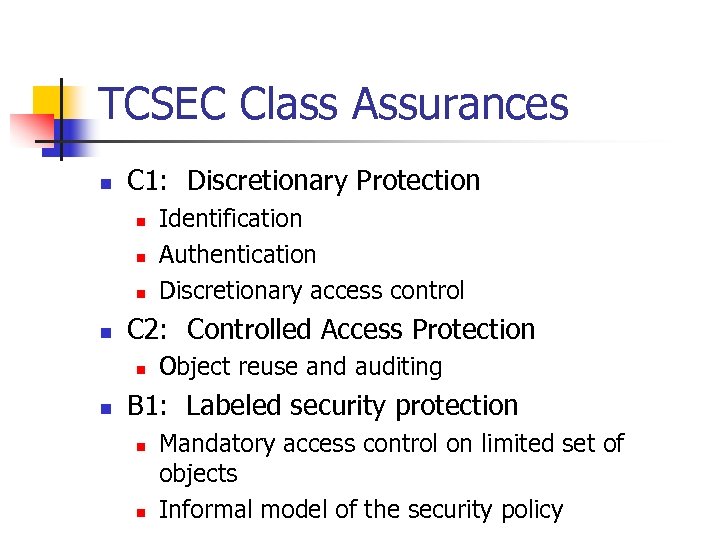 TCSEC Class Assurances n C 1: Discretionary Protection n n C 2: Controlled Access Protection n n Identification Authentication Discretionary access control Object reuse and auditing B 1: Labeled security protection n n Mandatory access control on limited set of objects Informal model of the security policy
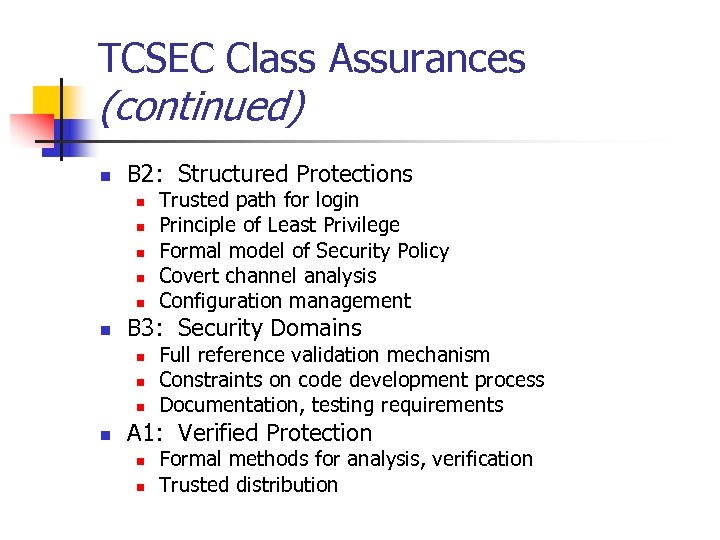 TCSEC Class Assurances (continued) n B 2: Structured Protections n n n B 3: Security Domains n n Trusted path for login Principle of Least Privilege Formal model of Security Policy Covert channel analysis Configuration management Full reference validation mechanism Constraints on code development process Documentation, testing requirements A 1: Verified Protection n n Formal methods for analysis, verification Trusted distribution
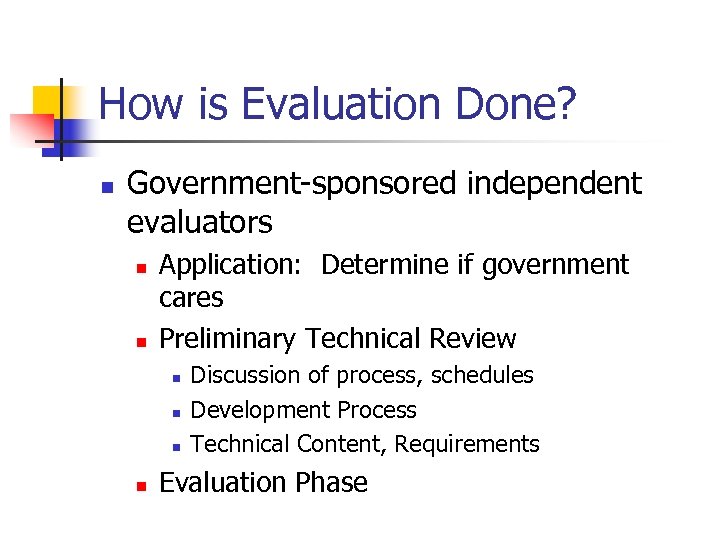 How is Evaluation Done? n Government-sponsored independent evaluators n n Application: Determine if government cares Preliminary Technical Review n n Discussion of process, schedules Development Process Technical Content, Requirements Evaluation Phase
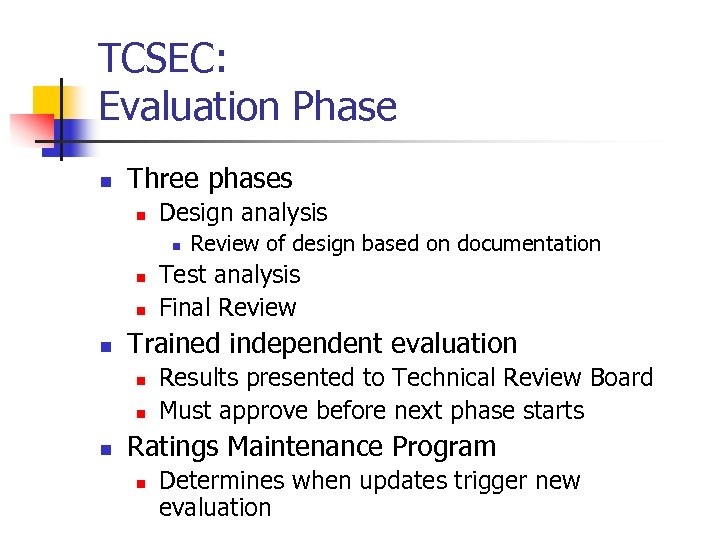 TCSEC: Evaluation Phase n Three phases n Design analysis n n Test analysis Final Review Trained independent evaluation n Review of design based on documentation Results presented to Technical Review Board Must approve before next phase starts Ratings Maintenance Program n Determines when updates trigger new evaluation
 TCSEC: Problems n Based heavily on confidentiality n n n Did not address integrity, availability Tied security and functionality Base TCSEC geared to operating systems n n TNI: Trusted Network Interpretation TDI: Trusted Database management System Interpretation
 Later Standards n n CTCPEC – Canada ITSEC – European Standard n n n n n Did not define criteria Levels correspond to strength of evaluation Includes code evaluation, development methodology requirements Known vulnerability analysis CISR: Commercial outgrowth of TCSEC FC: Modernization of TCSEC FIPS 140: Cryptographic module validation Common Criteria: International Standard SSE-CMM: Evaluates developer, not product
 ITSEC: Levels n E 1: Security target defined, tested n n E 2: Informal description of design n n Structured approach to design Design level vulnerability analysis E 5: Correspondence between design and code n n Configuration control, distribution control E 3: Correspondence between code and security target E 4: Formal model of security policy n n Must have informal architecture description Source code vulnerability analysis E 6: Formal methods for architecture n n Formal mapping of design to security policy Mapping of executable to source code
 ITSEC Problems: n No validation that security requirements made sense n n n Product meets goals But does this meet user expectations? Inconsistency in evaluations n Not as formally defined as TCSEC
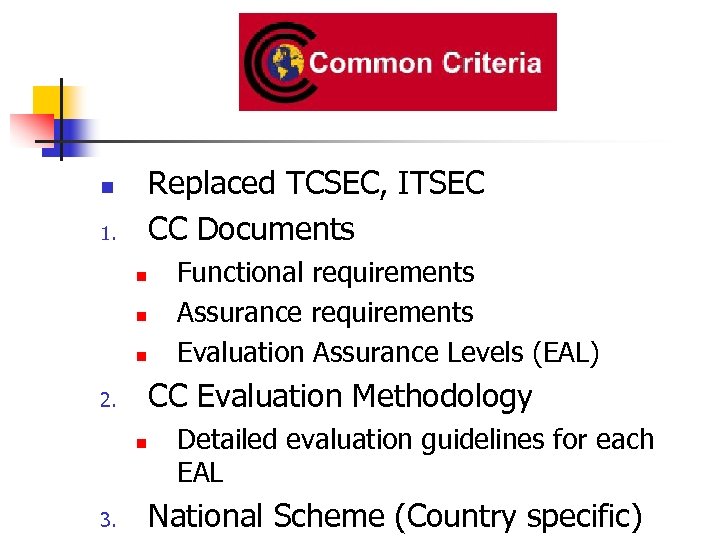 Replaced TCSEC, ITSEC CC Documents n 1. n n n CC Evaluation Methodology 2. n 3. Functional requirements Assurance requirements Evaluation Assurance Levels (EAL) Detailed evaluation guidelines for each EAL National Scheme (Country specific)
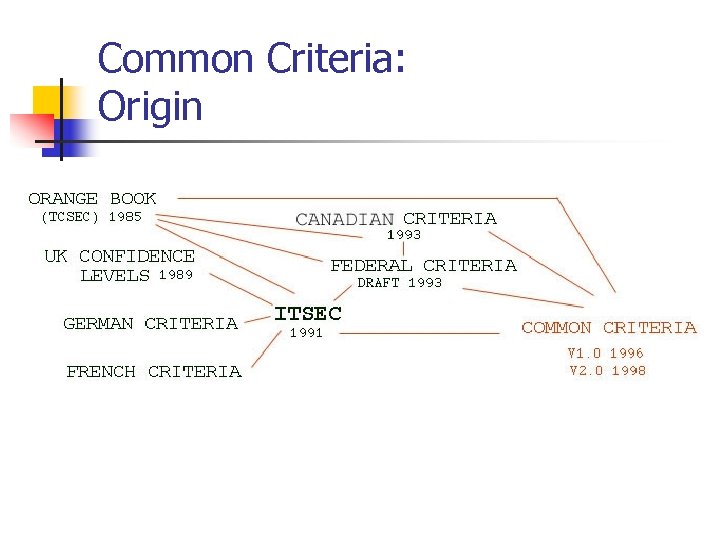 Common Criteria: Origin
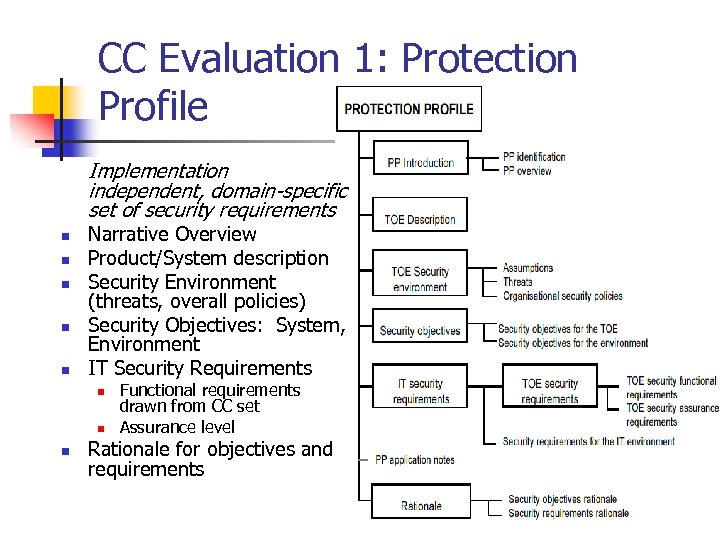 CC Evaluation 1: Protection Profile Implementation independent, domain-specific set of security requirements n n n Narrative Overview Product/System description Security Environment (threats, overall policies) Security Objectives: System, Environment IT Security Requirements n n n Functional requirements drawn from CC set Assurance level Rationale for objectives and requirements
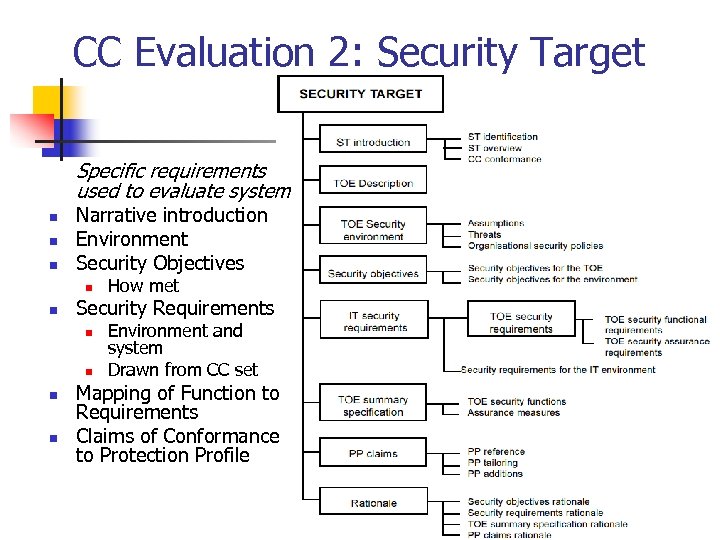 CC Evaluation 2: Security Target Specific requirements used to evaluate system n n n Narrative introduction Environment Security Objectives n n Security Requirements n n How met Environment and system Drawn from CC set Mapping of Function to Requirements Claims of Conformance to Protection Profile
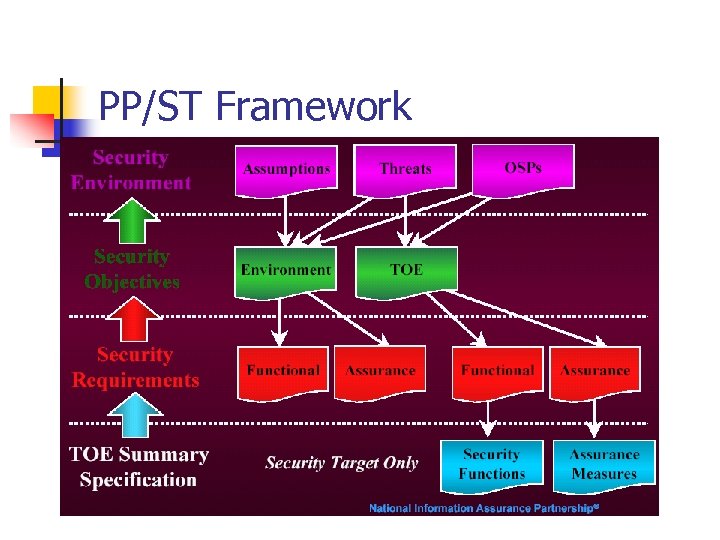 PP/ST Framework
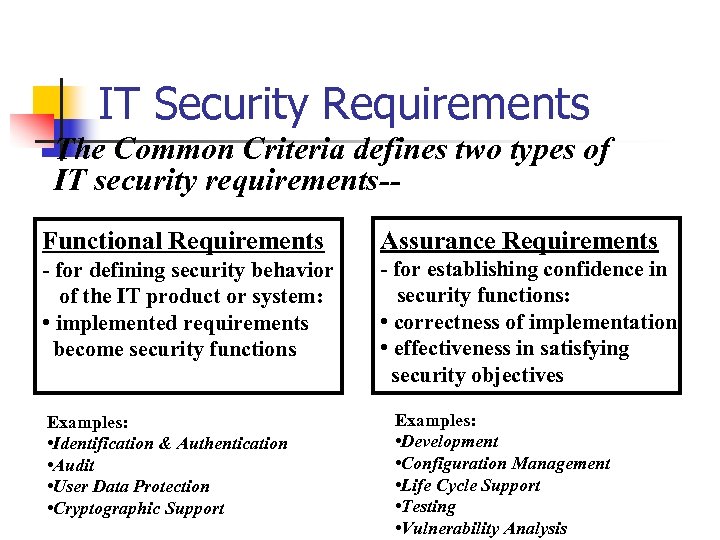 IT Security Requirements The Common Criteria defines two types of IT security requirements-Functional Requirements Assurance Requirements - for defining security behavior of the IT product or system: • implemented requirements become security functions - for establishing confidence in security functions: • correctness of implementation • effectiveness in satisfying security objectives Examples: • Identification & Authentication • Audit • User Data Protection • Cryptographic Support Examples: • Development • Configuration Management • Life Cycle Support • Testing • Vulnerability Analysis
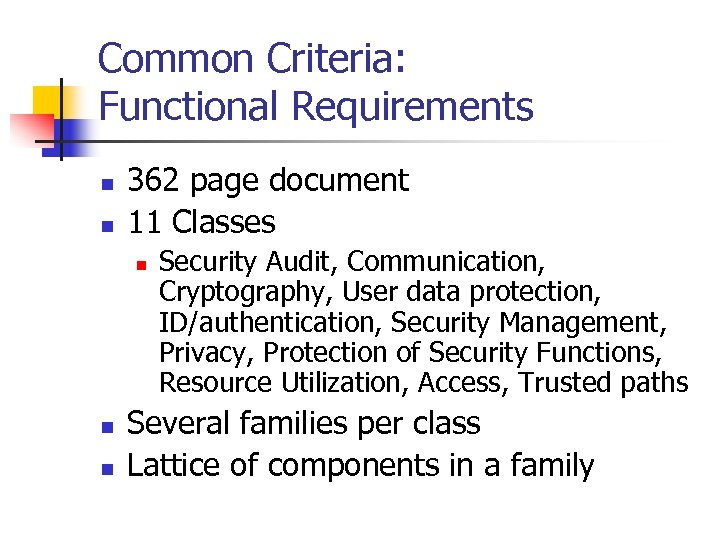 Common Criteria: Functional Requirements n n 362 page document 11 Classes n n n Security Audit, Communication, Cryptography, User data protection, ID/authentication, Security Management, Privacy, Protection of Security Functions, Resource Utilization, Access, Trusted paths Several families per class Lattice of components in a family
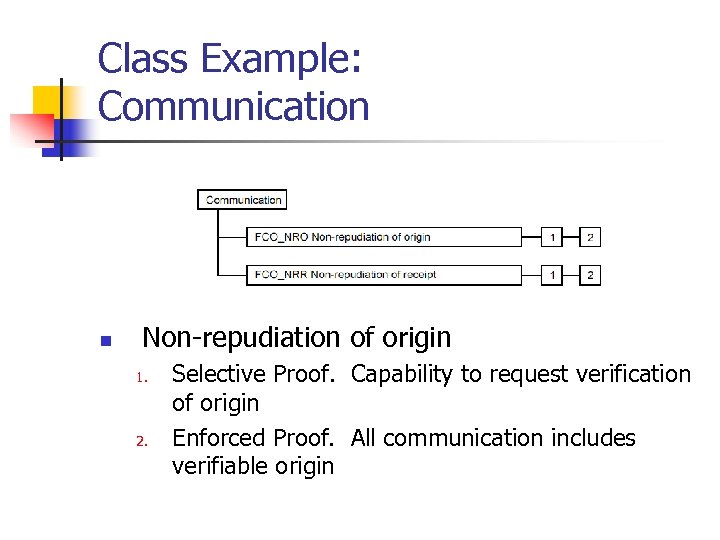 Class Example: Communication n Non-repudiation of origin 1. 2. Selective Proof. Capability to request verification of origin Enforced Proof. All communication includes verifiable origin
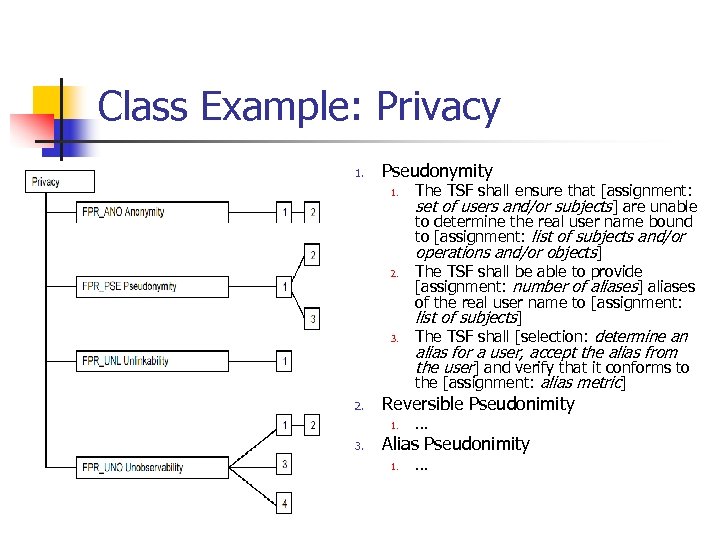 Class Example: Privacy 1. Pseudonymity 1. 2. 3. 2. alias for a user, accept the alias from the user] and verify that it conforms to the [assignment: alias metric] Reversible Pseudonimity 1. 3. The TSF shall ensure that [assignment: set of users and/or subjects] are unable to determine the real user name bound to [assignment: list of subjects and/or operations and/or objects] The TSF shall be able to provide [assignment: number of aliases] aliases of the real user name to [assignment: list of subjects] The TSF shall [selection: determine an … Alias Pseudonimity 1. …
 Common Criteria: Assurance Requirements n n 216 page document 10 Classes n n n Protection Profile Evaluation, Security Target Evaluation, Configuration management, Delivery and operation, Development, Guidance, Life cycle, Tests, Vulnerability assessment, Maintenance Several families per class Lattice of components in family
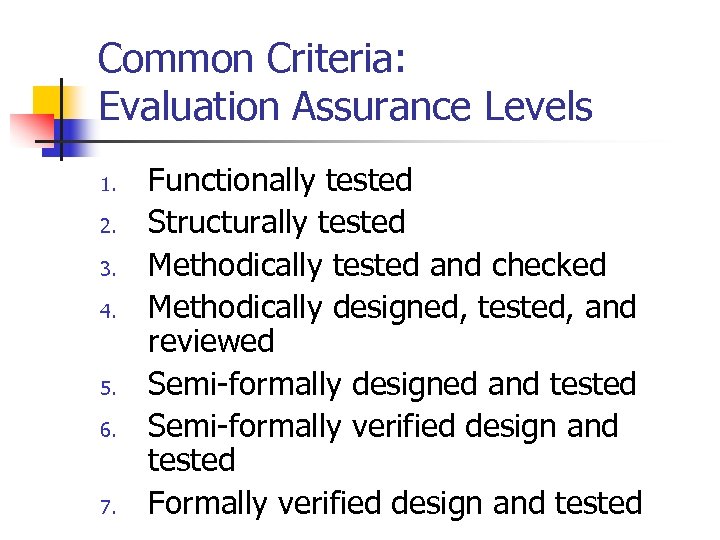 Common Criteria: Evaluation Assurance Levels 1. 2. 3. 4. 5. 6. 7. Functionally tested Structurally tested Methodically tested and checked Methodically designed, tested, and reviewed Semi-formally designed and tested Semi-formally verified design and tested Formally verified design and tested
 Common Criteria: Evaluation Process n National Authority authorizes evaluators n n n U. S. : NIST accredits commercial organizations Fee charged for evaluation Team of four to six evaluators n n n Develop work plan and clear with NIST Evaluate Protection Profile first If successful, can evaluate Security Target
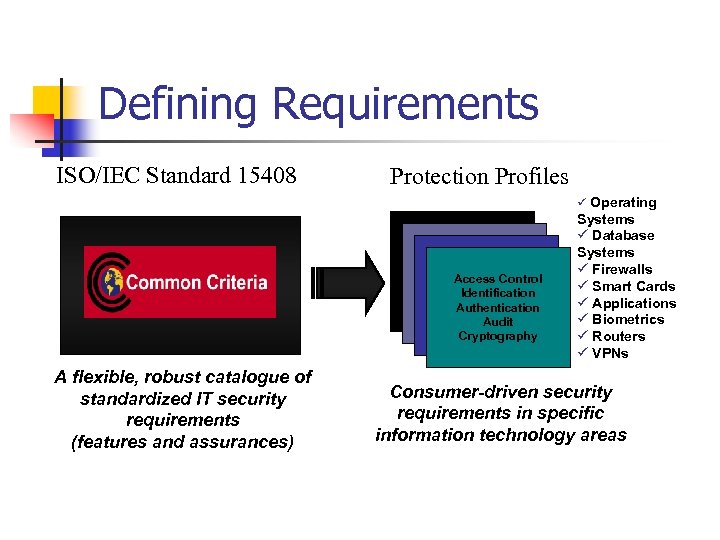 Defining Requirements ISO/IEC Standard 15408 Protection Profiles ü Operating Access Control Identification Authentication Audit Cryptography A flexible, robust catalogue of standardized IT security requirements (features and assurances) Systems ü Database Systems ü Firewalls ü Smart Cards ü Applications ü Biometrics ü Routers ü VPNs Consumer-driven security requirements in specific information technology areas
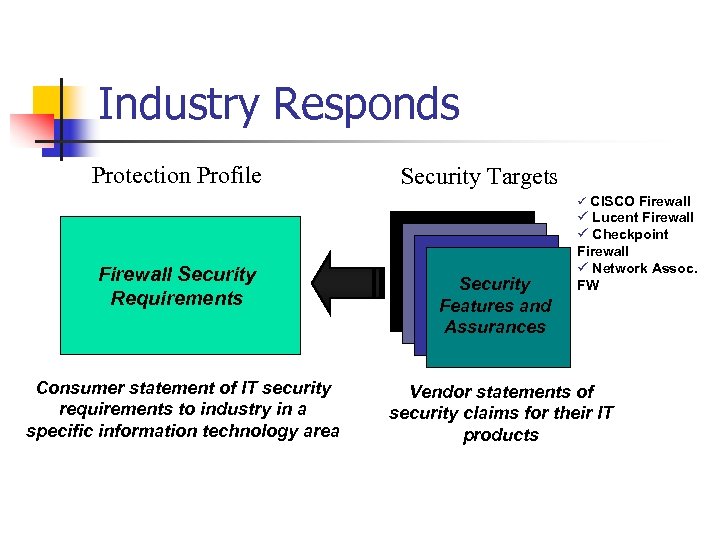 Industry Responds Protection Profile Security Targets ü CISCO Firewall Security Requirements Consumer statement of IT security requirements to industry in a specific information technology area Security Features and Assurances ü Lucent Firewall ü Checkpoint Firewall ü Network Assoc. FW Vendor statements of security claims for their IT products
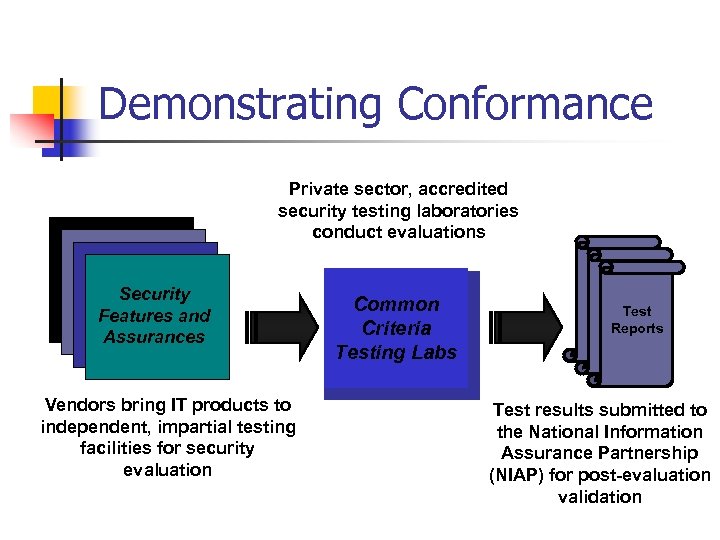 Demonstrating Conformance Private sector, accredited security testing laboratories conduct evaluations IT Products Security Features and Assurances Vendors bring IT products to independent, impartial testing facilities for security evaluation Common Criteria Testing Labs Test Reports Test results submitted to the National Information Assurance Partnership (NIAP) for post-evaluation validation
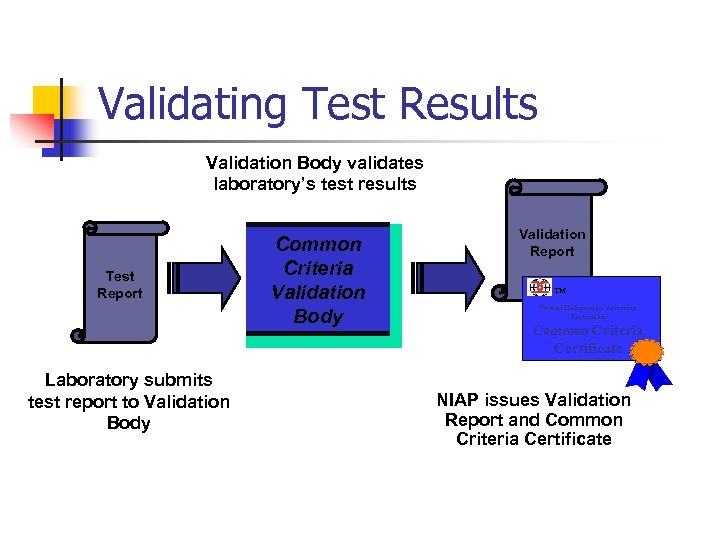 Validating Test Results Validation Body validates laboratory’s test results Test Report Common Criteria Validation Body Validation Report TM National Information Assurance Partnership Common Criteria Certificate Laboratory submits test report to Validation Body NIAP issues Validation Report and Common Criteria Certificate
 Common Criteria: Status n About 80 registered products n n Only one at level 5 (Java Smart Card) Several OS at 4 Likely many more not registered New versions appearing on regular basis
 Risk Management
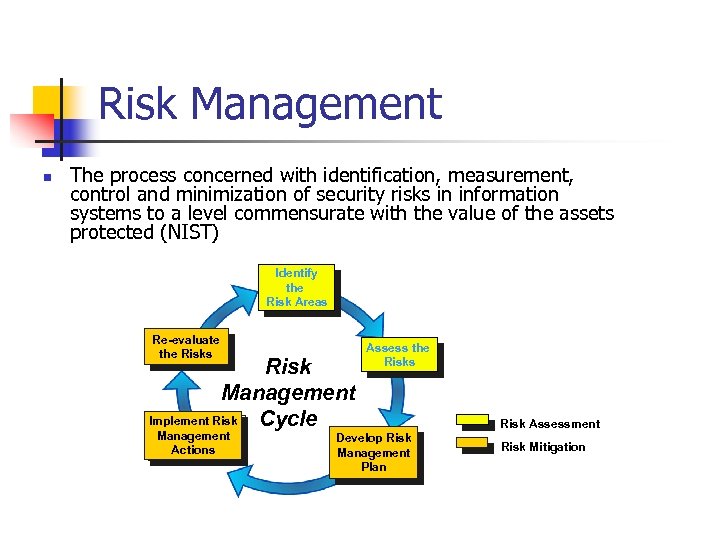 Risk Management n The process concerned with identification, measurement, control and minimization of security risks in information systems to a level commensurate with the value of the assets protected (NIST) Identify the Risk Areas Re-evaluate the Risks Risk Management Implement Risk Cycle Management Actions Assess the Risks Develop Risk Management Plan Risk Assessment Risk Mitigation
 Risk n The likelihood that a particular threat using a specific attack, will exploit a particular vulnerability of a system that results in an undesirable consequence (NIST) n likelihood of the threat occurring is the estimation of the probability that a threat will succeed in achieving an undesirable event
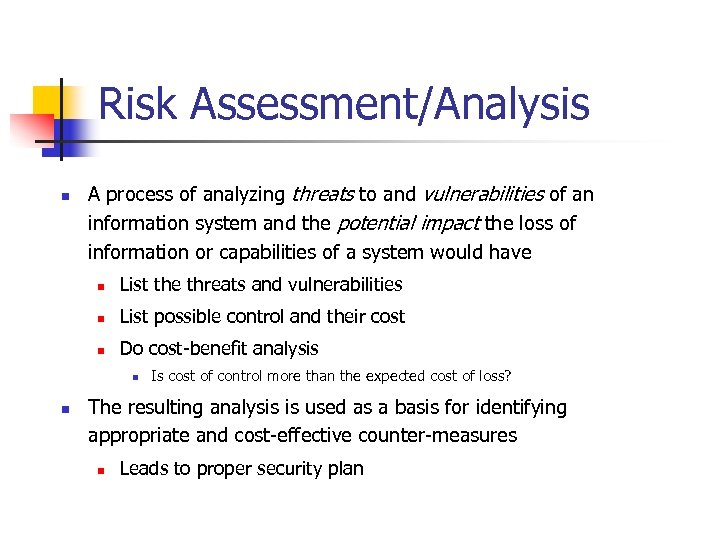 Risk Assessment/Analysis n A process of analyzing threats to and vulnerabilities of an information system and the potential impact the loss of information or capabilities of a system would have n List the threats and vulnerabilities n List possible control and their cost n Do cost-benefit analysis n n Is cost of control more than the expected cost of loss? The resulting analysis is used as a basis for identifying appropriate and cost-effective counter-measures n Leads to proper security plan
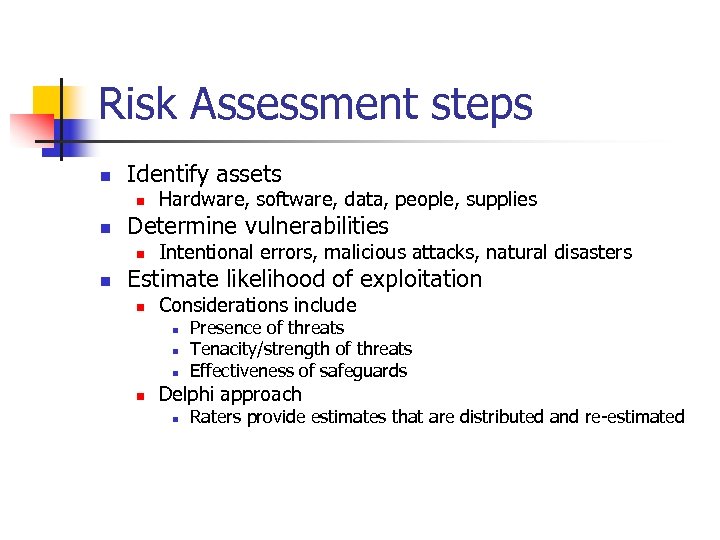 Risk Assessment steps n Identify assets n n Determine vulnerabilities n n Hardware, software, data, people, supplies Intentional errors, malicious attacks, natural disasters Estimate likelihood of exploitation n Considerations include n n Presence of threats Tenacity/strength of threats Effectiveness of safeguards Delphi approach n Raters provide estimates that are distributed and re-estimated
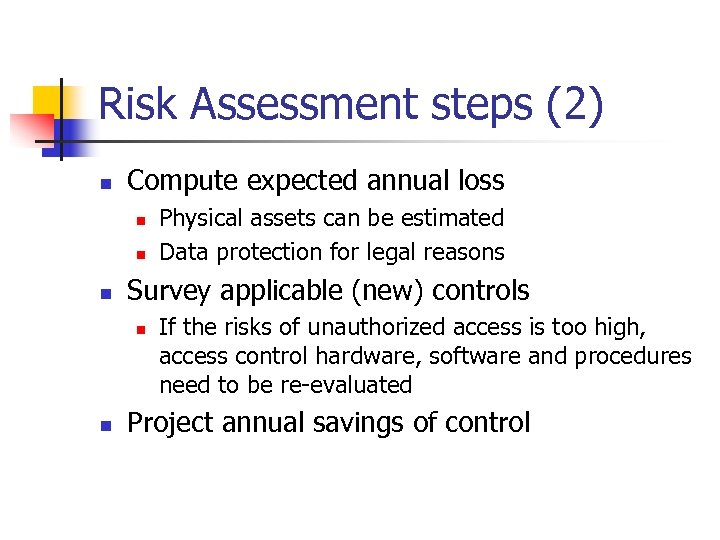 Risk Assessment steps (2) n Compute expected annual loss n n n Survey applicable (new) controls n n Physical assets can be estimated Data protection for legal reasons If the risks of unauthorized access is too high, access control hardware, software and procedures need to be re-evaluated Project annual savings of control
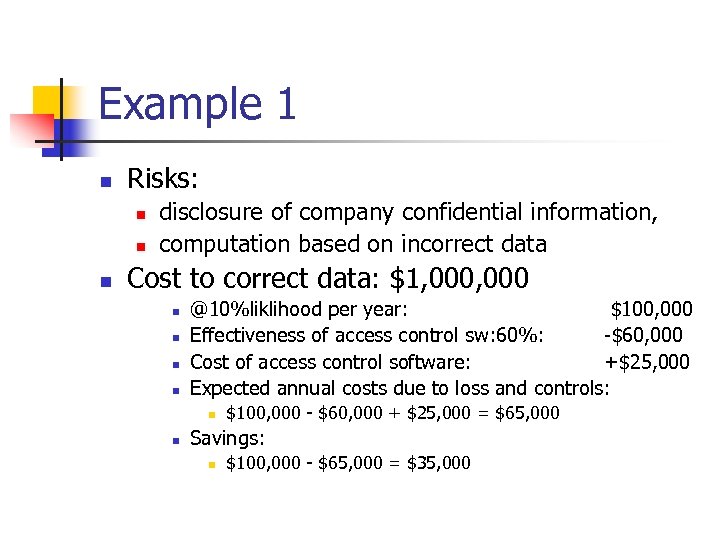 Example 1 n Risks: n n n disclosure of company confidential information, computation based on incorrect data Cost to correct data: $1, 000 n n @10%liklihood per year: $100, 000 Effectiveness of access control sw: 60%: -$60, 000 Cost of access control software: +$25, 000 Expected annual costs due to loss and controls: n n $100, 000 - $60, 000 + $25, 000 = $65, 000 Savings: n $100, 000 - $65, 000 = $35, 000
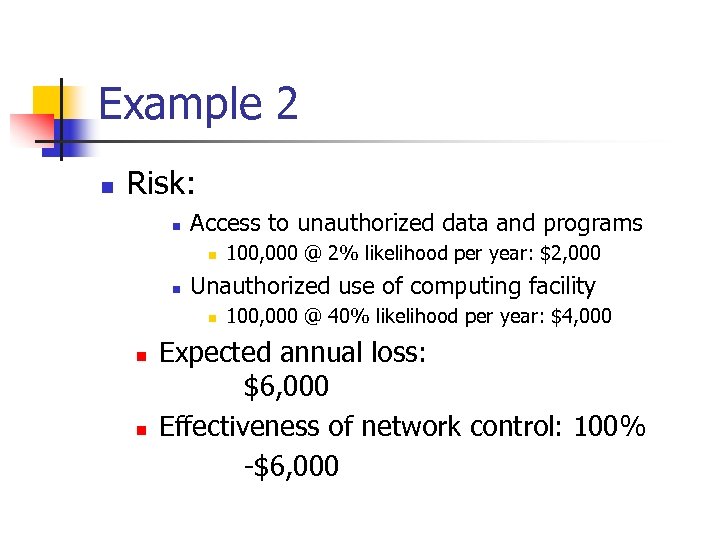 Example 2 n Risk: n Access to unauthorized data and programs n n Unauthorized use of computing facility n n n 100, 000 @ 2% likelihood per year: $2, 000 100, 000 @ 40% likelihood per year: $4, 000 Expected annual loss: $6, 000 Effectiveness of network control: 100% -$6, 000
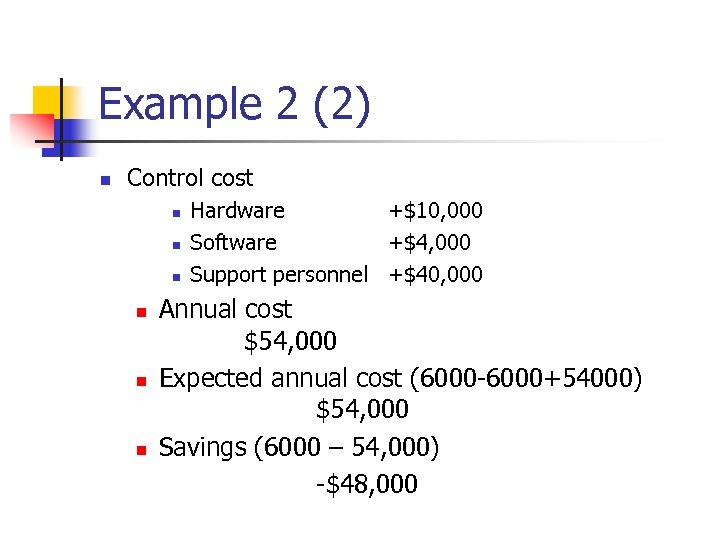 Example 2 (2) n Control cost n n n Hardware +$10, 000 Software +$4, 000 Support personnel +$40, 000 Annual cost $54, 000 Expected annual cost (6000 -6000+54000) $54, 000 Savings (6000 – 54, 000) -$48, 000
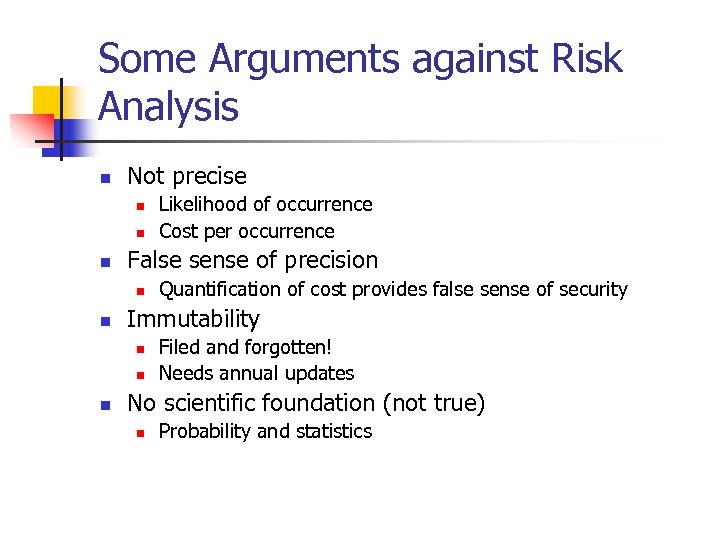 Some Arguments against Risk Analysis n Not precise n n n False sense of precision n n Quantification of cost provides false sense of security Immutability n n n Likelihood of occurrence Cost per occurrence Filed and forgotten! Needs annual updates No scientific foundation (not true) n Probability and statistics
 Legal and Ethical Issues
 Laws and Security n Federal and state laws affect privacy and secrecy n n Laws regulate the use, development and ownership of data and programs n n Rights of individuals to keep information private Patent laws, trade secrets Laws affect actions that can be taken to protect secrecy, integrity and availability
 Copyrights n n n Intellectual property (copyright law of 1978) n n n Copyright must apply to an original work It must be done in a tangible medium of expression Originality of work n n Designed to protect expression of ideas Gives an author exclusive rights to make copies of the expression and sell them to public Ideas may be public domain Copyrighted object is subjected to fair use
 Copyright infringement n n Involves copying Not independent work n n Two people can have copyright for identically the same thing Copyrights for computer programs n n n Copyright law was amended in 1980 to include explicit definition of software Program code is protected not the algorithm Controls rights to copy and distribute
 Patent n Protects innovations n n Applies to results of science, technology and engineering Protects new innovations n n Device or process to carry out an idea, not idea itself Excludes newly discovered laws of nature n 2+2 = 4
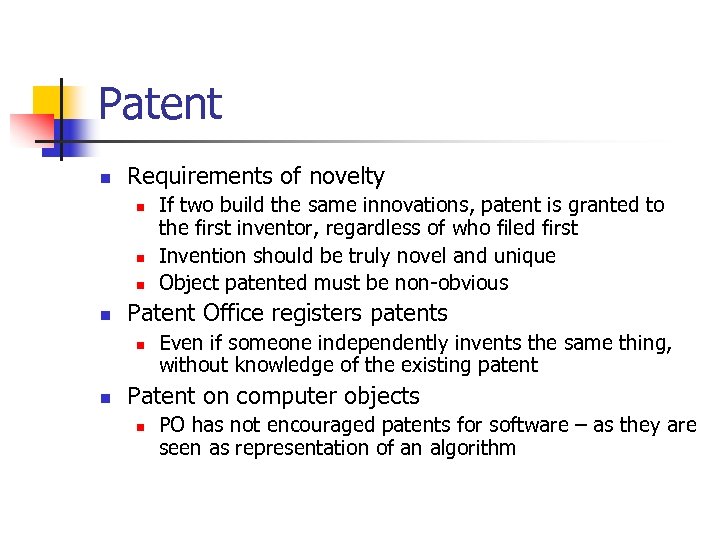 Patent n Requirements of novelty n n Patent Office registers patents n n If two build the same innovations, patent is granted to the first inventor, regardless of who filed first Invention should be truly novel and unique Object patented must be non-obvious Even if someone independently invents the same thing, without knowledge of the existing patent Patent on computer objects n PO has not encouraged patents for software – as they are seen as representation of an algorithm
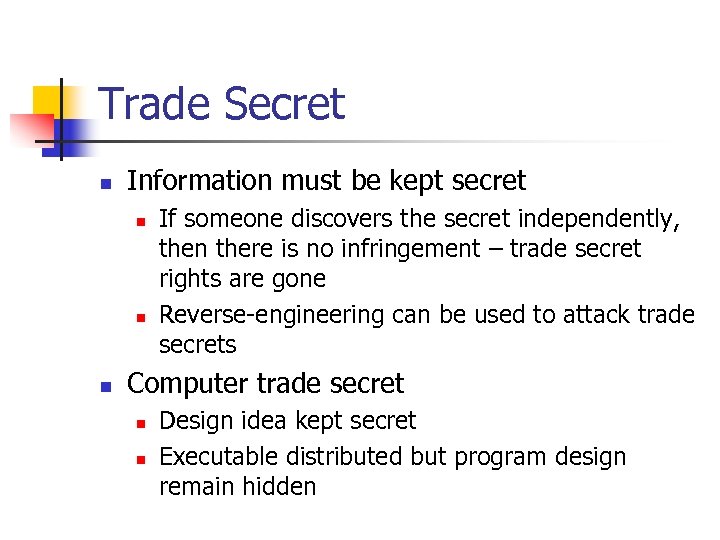 Trade Secret n Information must be kept secret n n n If someone discovers the secret independently, then there is no infringement – trade secret rights are gone Reverse-engineering can be used to attack trade secrets Computer trade secret n n Design idea kept secret Executable distributed but program design remain hidden
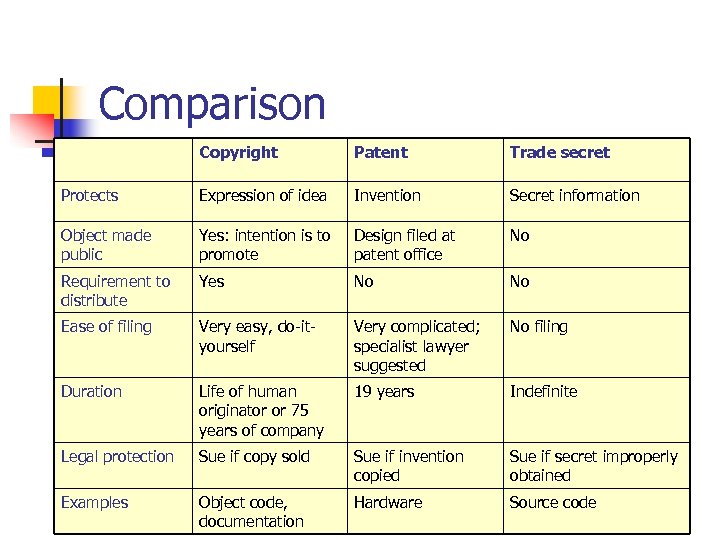 Comparison Copyright Patent Trade secret Protects Expression of idea Invention Secret information Object made public Yes: intention is to promote Design filed at patent office No Requirement to distribute Yes No No Ease of filing Very easy, do-ityourself Very complicated; specialist lawyer suggested No filing Duration Life of human originator or 75 years of company 19 years Indefinite Legal protection Sue if copy sold Sue if invention copied Sue if secret improperly obtained Examples Object code, documentation Hardware Source code
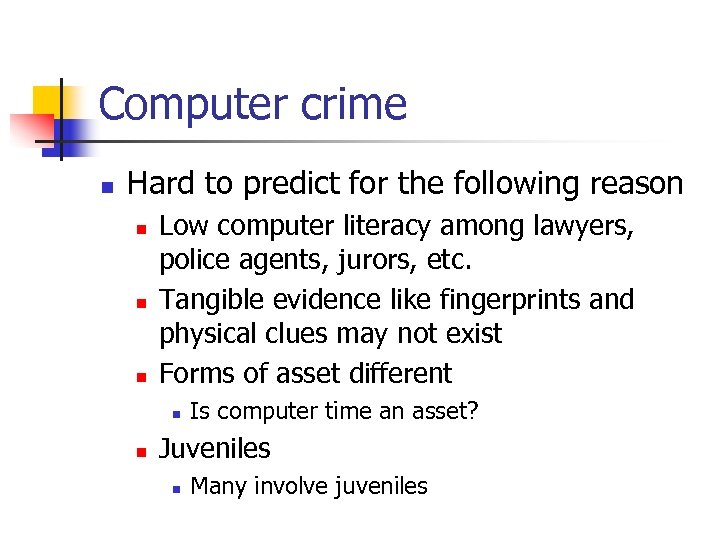 Computer crime n Hard to predict for the following reason n Low computer literacy among lawyers, police agents, jurors, etc. Tangible evidence like fingerprints and physical clues may not exist Forms of asset different n n Is computer time an asset? Juveniles n Many involve juveniles
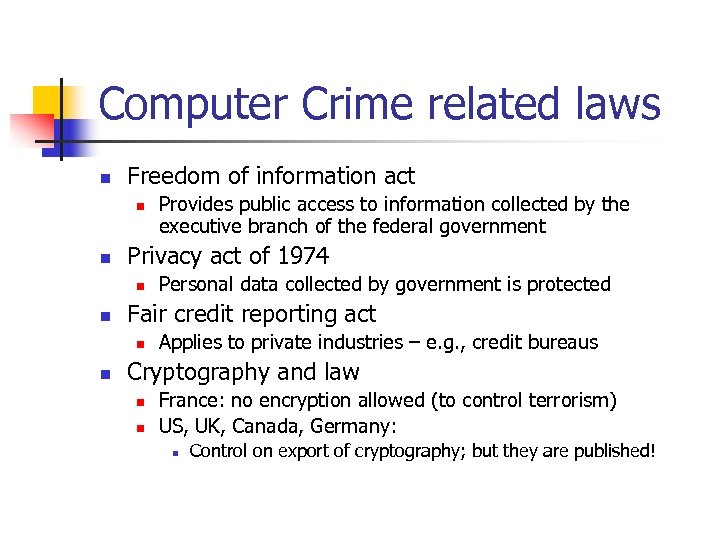 Computer Crime related laws n Freedom of information act n n Privacy act of 1974 n n Personal data collected by government is protected Fair credit reporting act n n Provides public access to information collected by the executive branch of the federal government Applies to private industries – e. g. , credit bureaus Cryptography and law n n France: no encryption allowed (to control terrorism) US, UK, Canada, Germany: n Control on export of cryptography; but they are published!
 Ethics n n An objectively defined standard of right and wrong Often idealistic principles In a given situation several ethical issues may be present Different from law
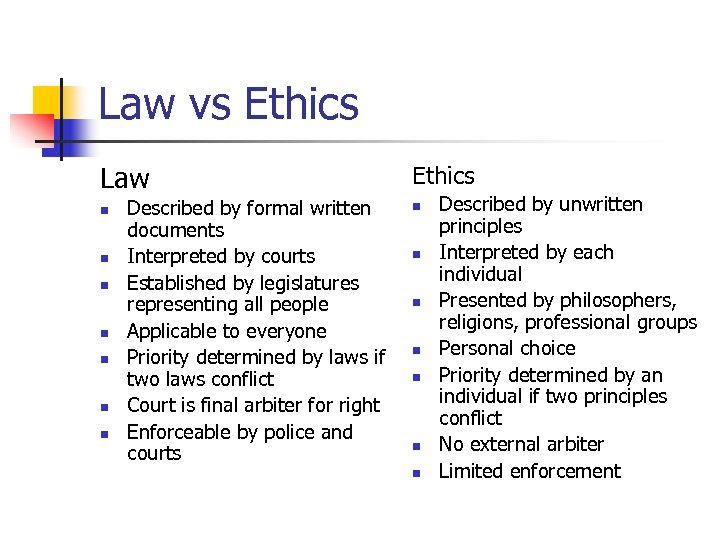 Law vs Ethics Law n n n n Described by formal written documents Interpreted by courts Established by legislatures representing all people Applicable to everyone Priority determined by laws if two laws conflict Court is final arbiter for right Enforceable by police and courts Ethics n n n n Described by unwritten principles Interpreted by each individual Presented by philosophers, religions, professional groups Personal choice Priority determined by an individual if two principles conflict No external arbiter Limited enforcement
 Ethics Example n Privacy of electronic data n n “gentlemen do not read others’ mail” - but not everyone is a gentleman! Ethical question: when is it justifiable to access data not belonging to you n n n One approach: Protection is user’s responsibility Another: supervisors have access to those supervised Another: justifiably compelling situation
 Codes of ethics n IEEE professional codes of ethic n n n To avoid real or perceived conflict of interest whenever possible, and to disclose them to affected parties when they do exist To be honest and realistic in stating claims or estimates based on available data ACM professional codes of ethics n n Be honest and trustworthy Give proper credit for intellectual property
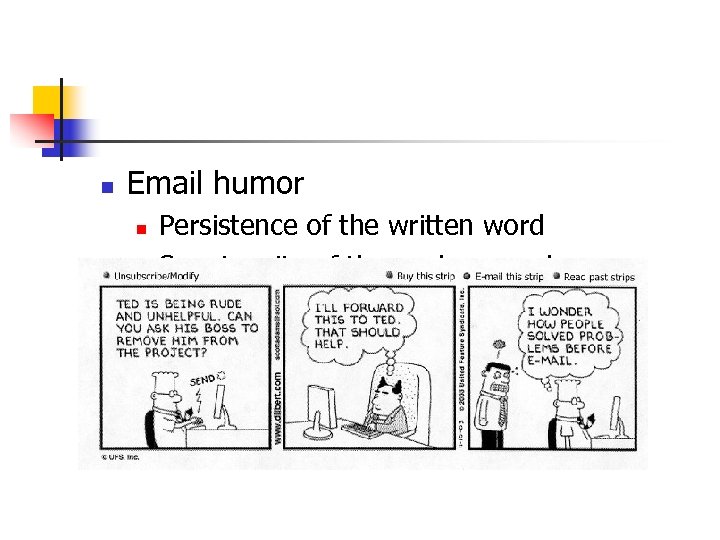 n Email humor n n Persistence of the written word Spontaneity of the spoken word
 Physical Security
 Physical Security n Often ignored or considered as of little or no concern n If someone working late steals a laptop – the fancy firewall defenses won’t help! A NY investment bank spent tens of thousands of dollars on comsec to prevent break-in during the day, only to find that its cleaning staff opened the doors at night! A company in SFO had more than $100, 000 worth of computers stolen over a holiday; an employee had used his electronic key card to unlock the building and disarm the alarm system
 Physical security in security plan n Organizational security plan should include n n n Description of physical assets to be protected Description of physical areas where the assets are located Description of security perimeter Threats (attacks, accidents, natural disasters) Physical security defense and cost-analysis against the value of information asset being protected
 Physical security plan n Should answer (at least) the following n n n Can anybody other than designated personnel physically access the computer resources? What if someone has an outburst and wants to smash the system resources? What if an employee from your competitor were to come to the building unnoticed? What are the consequences in case of fire? How to react in case of some disaster?
 Disaster Recovery n Natural disasters n n Flood/Falling water Fire Earthquake Other environmental conditions n n Power loss n n n Dust, explosion (terrorist act), heat/humidity, electrical noise, lighting Uninterruptible power supply Surge protectors Accidents: food & drink
 Contingency planning n n “key to successful recovery is adequate planning” Backup/off-site backup Cold-site/hot-site n n n Cold site: facility with power/cooling where computing system can be installed to begin immediate operation Hot-site: facility with installed and ready to use computing system. Theft prevention n Prevent access: guards; locks; cards prevent portability: locks, lockable cabinets detect exit: like in library
 Disposal of Sensitive Media n Shredders n n Sanitizing media before disposal n n Mainly for paper; also used for diskettes, paper ribbons and some tapes Completely erase data ERASE and DELETE may not be enough Overwrite data several times Degaussers n n Destroys magnetic fields Fast way to neutralize a disk or tape
 TEMPEST: Emanations protections n n n All electronic and electromechanical info. processing equipment can produce unintentional data-related or intelligence-bearing emanations which, if intercepted analyzed, disclose the info. transmitted, received, handled or otherwise processed (NSTISSAM 1 -00) PASSIVE attack !! TEMPEST program certifies an equipment as not emitting detectable signals n Enclosure n Completely cover a tempest device n n n Shielded cable Copper shielding a computer? Emanation modification n Similar to generating noise