


 Скачать презентацию IRU Academy Driver Competence Seminar COMPARATIVE OVERVIEW of
0fe28da79e0ba9b480a6610aef8b70bb.ppt
- Количество слайдов: 24
 IRU Academy Driver Competence Seminar COMPARATIVE OVERVIEW of the implementation of the Directive 2003/59/EC Brussels, 28 January 2010 Daniel Vandenberghe CIECA Business Manager 2010 Driver Competence Seminar, Brussels, Belgium Page 1 © International Road Transport Union (IRU)
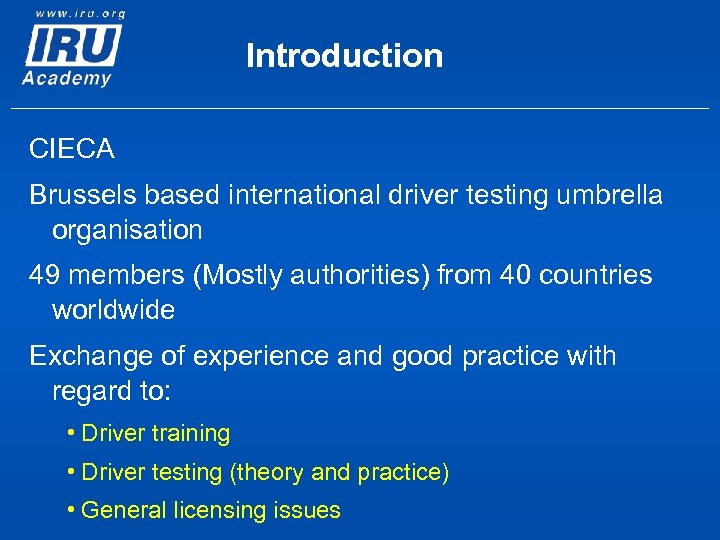 Introduction CIECA Brussels based international driver testing umbrella organisation 49 members (Mostly authorities) from 40 countries worldwide Exchange of experience and good practice with regard to: • Driver training • Driver testing (theory and practice) • General licensing issues
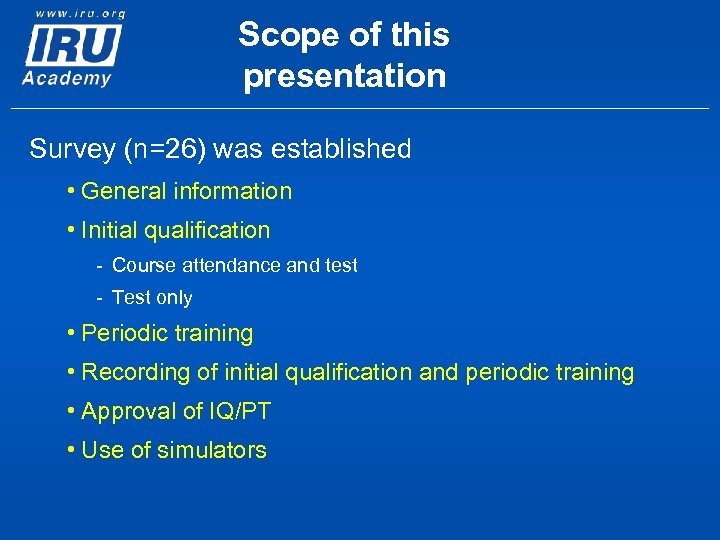 Scope of this presentation Survey (n=26) was established • General information • Initial qualification - Course attendance and test - Test only • Periodic training • Recording of initial qualification and periodic training • Approval of IQ/PT • Use of simulators
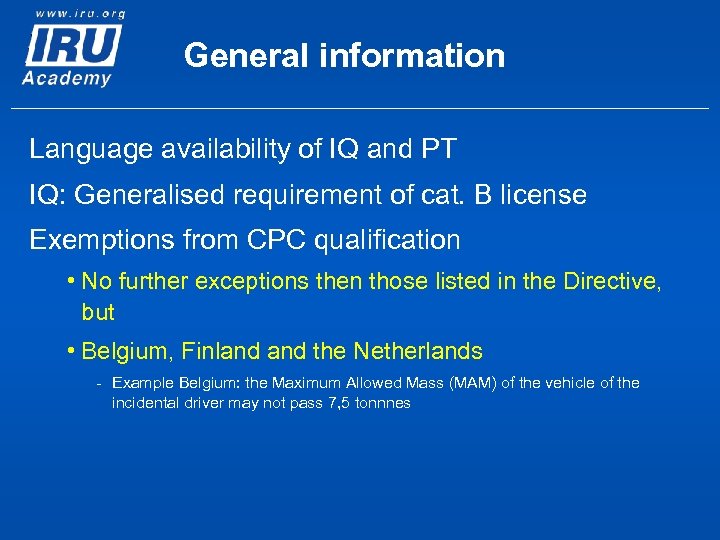 General information Language availability of IQ and PT IQ: Generalised requirement of cat. B license Exemptions from CPC qualification • No further exceptions then those listed in the Directive, but • Belgium, Finland the Netherlands - Example Belgium: the Maximum Allowed Mass (MAM) of the vehicle of the incidental driver may not pass 7, 5 tonnnes
 Initial qualification process Initial CPC though course attendance and test • have a minimum period of training hours of 280 hours • accelerated training option with a minimum period of 140 hours (dependant upon the age of the driver and size of the vehicle ) • written or oral test covering all of the relevant objectives Initial CPC through system of tests only (Annex 1, Section 2 of the Directive) • focuses on assessment of competence • It involves tests totalling 6 hours min. Specific emphasis on road safety and rationalisation of fuel consumption Harmonisation with ages in Driving License Directive
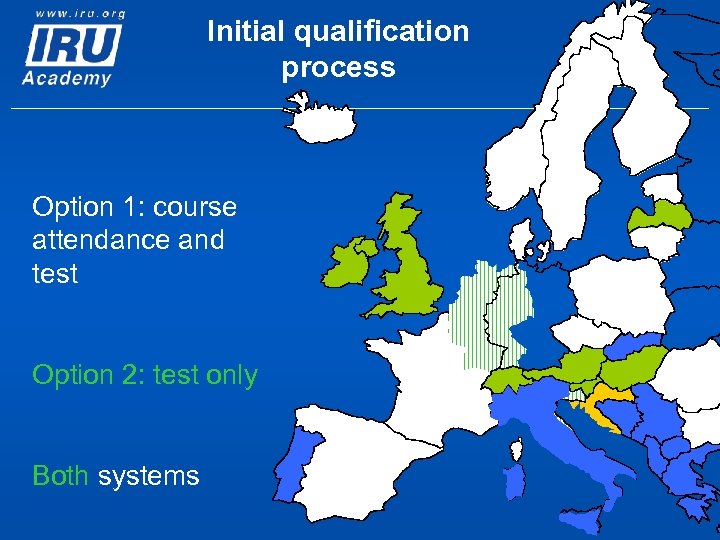 Initial qualification process Option 1: course attendance and test Option 2: test only Both systems
 Option 1: course attendance and test (280/140 hrs + written or oral test) Type of test at the end of training The overall pass rate • Example France (80% pass rate for the 280 h training – 97% for accelerated training) • Sweden 46 % Goods Transport / 54 Passenger Transport Is accelerated initial qualification accepted • All option 1 countries allow this
 Option 2: course attendance and test Integrating the driving license with the CPC or is a tendency among countries who chose option 2 Example Northern Ireland We further asked • Number of theory questions • Duration theory test • Overall pass rate theory tests • Duration practical tests • Overall pass rate practical tests • 100 multiple choice questions • 19 hazard perception clip • 50 case study questions • • 4 hours Approx. 80 % 1. 5 hour on-road driving 0. 5 hour vehicle safety/documentation check • Approx 50%
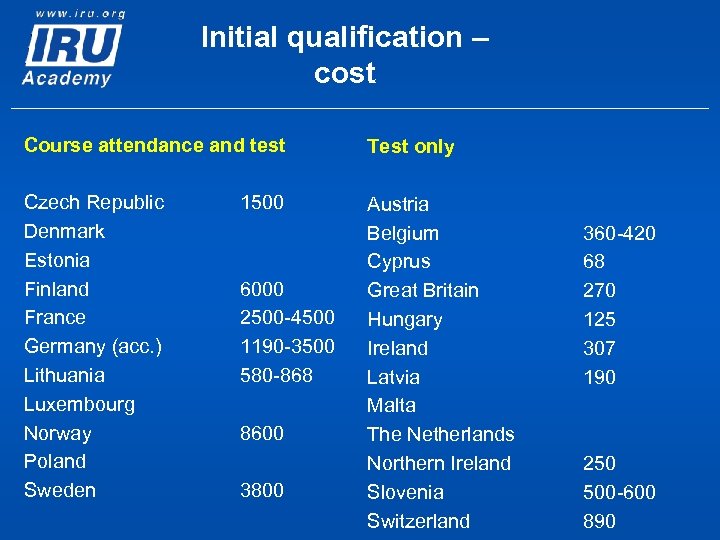 Initial qualification – cost Course attendance and test Test only Czech Republic Denmark Estonia Finland France Germany (acc. ) Lithuania Luxembourg Norway Poland Sweden Austria Belgium Cyprus Great Britain Hungary Ireland Latvia Malta The Netherlands Northern Ireland Slovenia Switzerland 1500 6000 2500 -4500 1190 -3500 580 -868 8600 3800 360 -420 68 270 125 307 190 250 500 -600 890
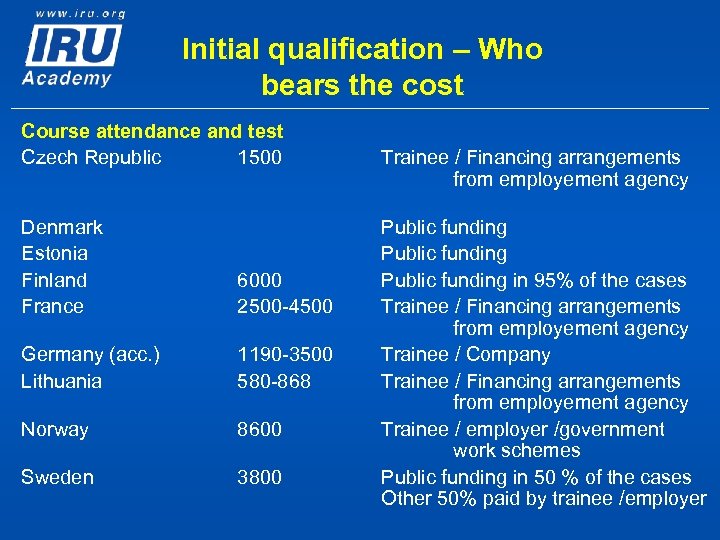 Initial qualification – Who bears the cost Course attendance and test Czech Republic 1500 Denmark Estonia Finland France 6000 2500 -4500 Germany (acc. ) Lithuania 1190 -3500 580 -868 Norway 8600 Sweden 3800 Trainee / Financing arrangements from employement agency Public funding in 95% of the cases Trainee / Financing arrangements from employement agency Trainee / Company Trainee / Financing arrangements from employement agency Trainee / employer /government work schemes Public funding in 50 % of the cases Other 50% paid by trainee /employer
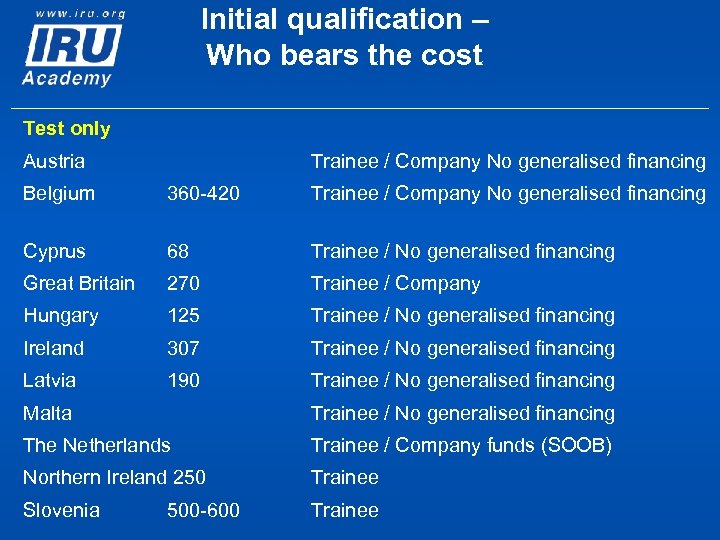 Initial qualification – Who bears the cost Test only Austria Trainee / Company No generalised financing Belgium 360 -420 Trainee / Company No generalised financing Cyprus 68 Trainee / No generalised financing Great Britain 270 Trainee / Company Hungary 125 Trainee / No generalised financing Ireland 307 Trainee / No generalised financing Latvia 190 Trainee / No generalised financing Malta Trainee / No generalised financing The Netherlands Trainee / Company funds (SOOB) Northern Ireland 250 Trainee Slovenia Trainee 500 -600
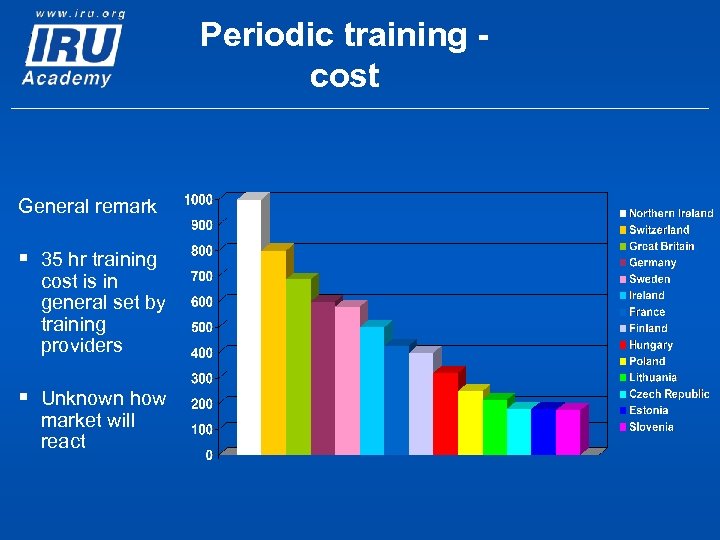 Periodic training cost General remark § 35 hr training cost is in general set by training providers § Unknown how market will react
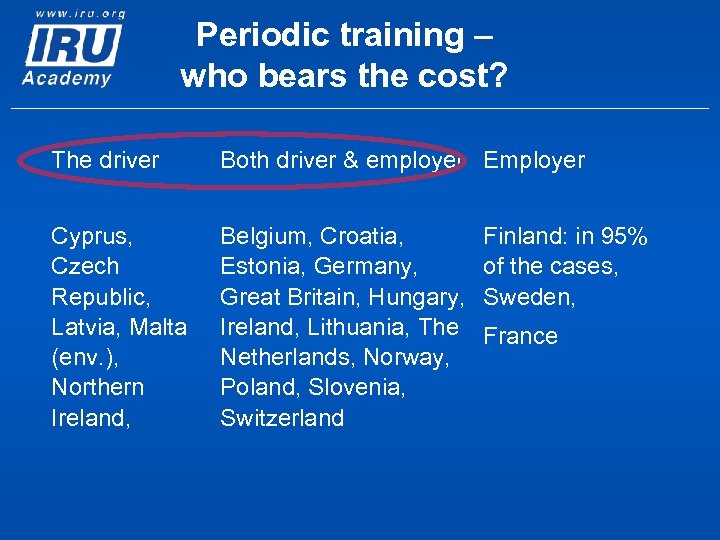 Periodic training – who bears the cost? The driver Both driver & employer Employer Cyprus, Czech Republic, Latvia, Malta (env. ), Northern Ireland, Belgium, Croatia, Estonia, Germany, Great Britain, Hungary, Ireland, Lithuania, The Netherlands, Norway, Poland, Slovenia, Switzerland Finland: in 95% of the cases, Sweden, France
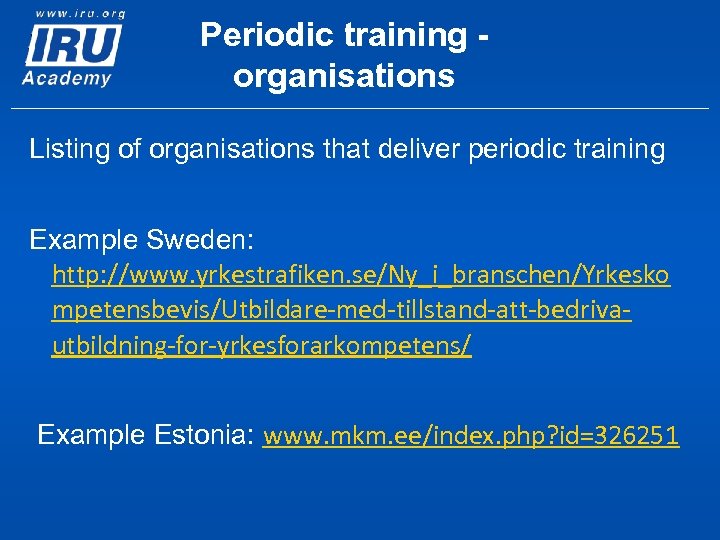 Periodic training organisations Listing of organisations that deliver periodic training Example Sweden: http: //www. yrkestrafiken. se/Ny_i_branschen/Yrkesko mpetensbevis/Utbildare-med-tillstand-att-bedrivautbildning-for-yrkesforarkompetens/ Example Estonia: www. mkm. ee/index. php? id=326251
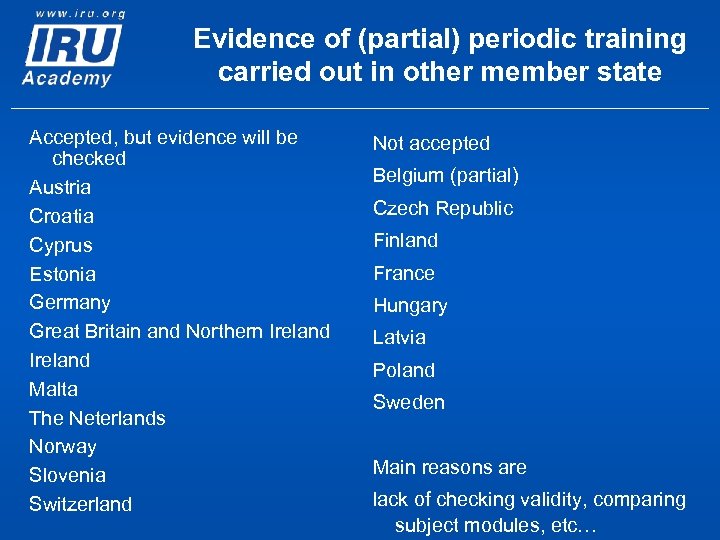 Evidence of (partial) periodic training carried out in other member state Accepted, but evidence will be checked Austria Croatia Cyprus Estonia Germany Great Britain and Northern Ireland Malta The Neterlands Norway Slovenia Switzerland Not accepted Belgium (partial) Czech Republic Finland France Hungary Latvia Poland Sweden Main reasons are lack of checking validity, comparing subject modules, etc…
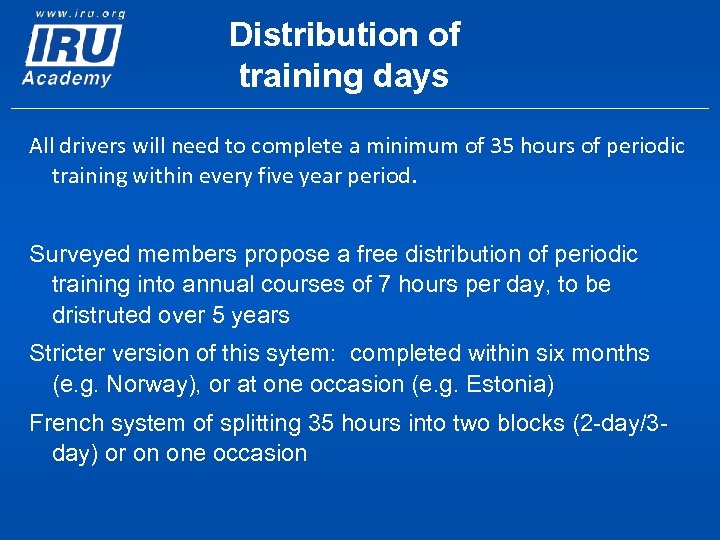 Distribution of training days All drivers will need to complete a minimum of 35 hours of periodic training within every five year period. Surveyed members propose a free distribution of periodic training into annual courses of 7 hours per day, to be dristruted over 5 years Stricter version of this sytem: completed within six months (e. g. Norway), or at one occasion (e. g. Estonia) French system of splitting 35 hours into two blocks (2 -day/3 day) or on one occasion
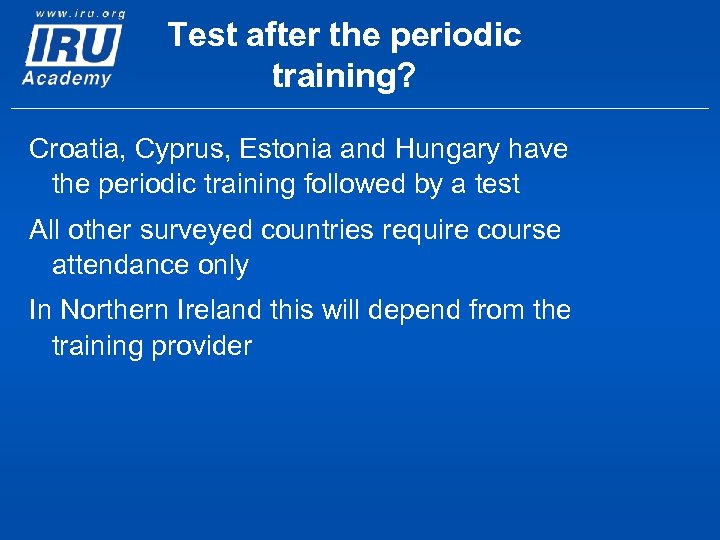 Test after the periodic training? Croatia, Cyprus, Estonia and Hungary have the periodic training followed by a test All other surveyed countries require course attendance only In Northern Ireland this will depend from the training provider
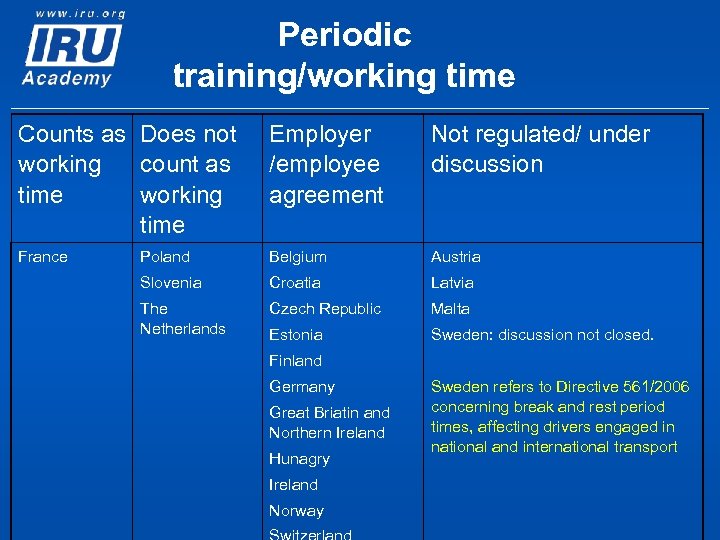 Periodic training/working time Counts as Does not working count as time working time Employer /employee agreement Not regulated/ under discussion France Poland Belgium Austria Slovenia Croatia Latvia The Netherlands Czech Republic Malta Estonia Sweden: discussion not closed. Finland Germany Great Briatin and Northern Ireland Hunagry Ireland Norway Sweden refers to Directive 561/2006 concerning break and rest period times, affecting drivers engaged in national and international transport
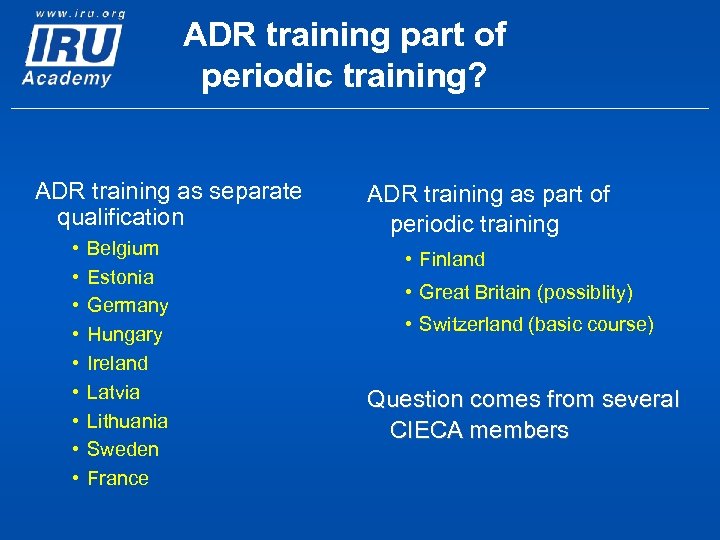 ADR training part of periodic training? ADR training as separate qualification • • • Belgium Estonia Germany Hungary Ireland Latvia Lithuania Sweden France ADR training as part of periodic training • Finland • Great Britain (possiblity) • Switzerland (basic course) Question comes from several CIECA members
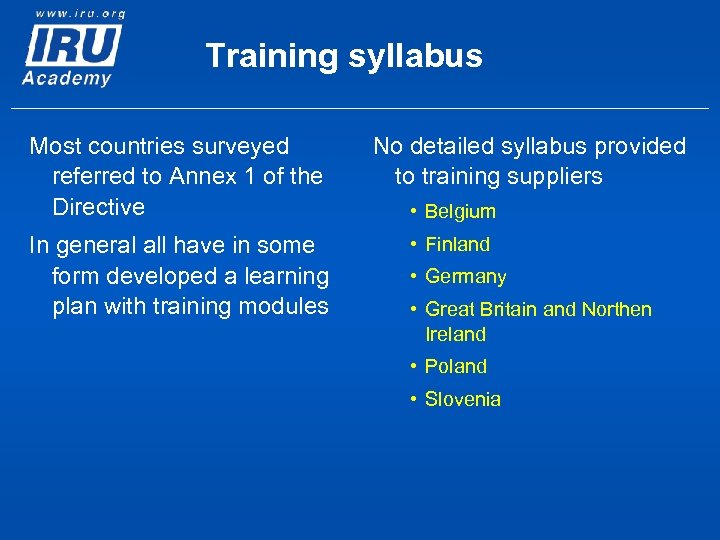 Training syllabus Most countries surveyed referred to Annex 1 of the Directive In general all have in some form developed a learning plan with training modules No detailed syllabus provided to training suppliers • Belgium • Finland • Germany • Great Britain and Northen Ireland • Poland • Slovenia
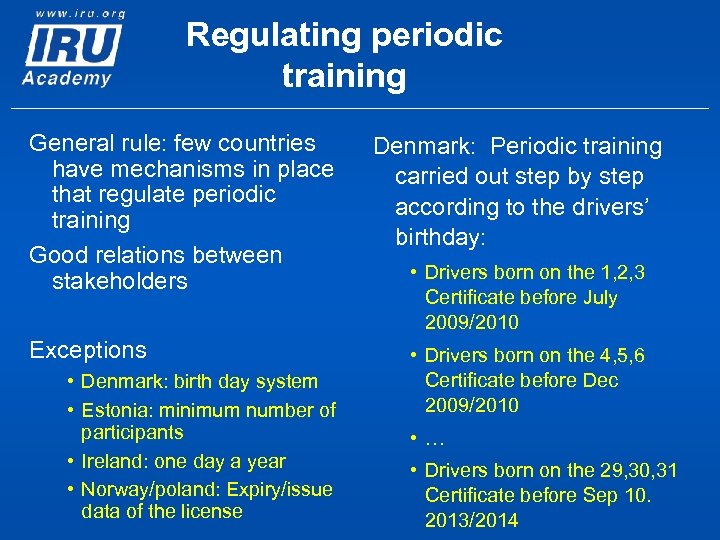 Regulating periodic training General rule: few countries have mechanisms in place that regulate periodic training Good relations between stakeholders Exceptions • Denmark: birth day system • Estonia: minimum number of participants • Ireland: one day a year • Norway/poland: Expiry/issue data of the license Denmark: Periodic training carried out step by step according to the drivers’ birthday: • Drivers born on the 1, 2, 3 Certificate before July 2009/2010 • Drivers born on the 4, 5, 6 Certificate before Dec 2009/2010 • … • Drivers born on the 29, 30, 31 Certificate before Sep 10. 2013/2014
 Simulators – periodic training Almost all surveyed countries allow simulators during periodic training Austria and Lithuania do not allow simulators during periodic training Use of simulator for periodic training is not wide spread yet 2010 Driver Competence Seminar, Brussels, Belgium Page 22 © International Road Transport Union (IRU)
 Closing Survey Report will be made available on www. cieca. be Thank you for your attention
 THANK YOU! 2010 Driver Competence Seminar, Brussels, Belgium Page 24 2010 Driver Competence Seminar, Brussels, Belgium