 Скачать презентацию Irreversible Inhibition Kinetics Automation and Simulation Petr Kuzmič
a2fa40faed982f1569a22f32661eb67c.ppt
- Количество слайдов: 25



Irreversible Inhibition Kinetics Automation and Simulation Petr Kuzmič, Ph. D. Bio. Kin, Ltd. 1. Automate the determination of biochemical parameters 2. PK/PD simulations with multiple injections Irreversible Inhibition Kinetics
Irreversible Inhibition Kinetics Automation and Simulation Petr Kuzmič, Ph. D. Bio. Kin, Ltd. 1. Automate the determination of biochemical parameters 2. PK/PD simulations with multiple injections Irreversible Inhibition Kinetics
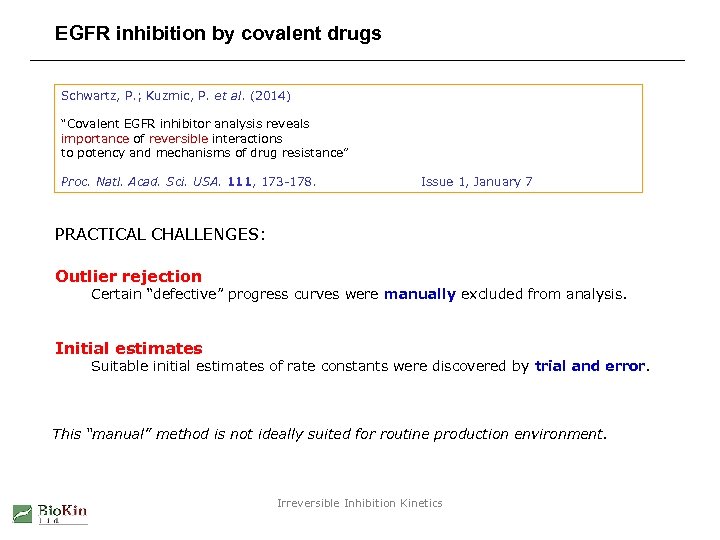
EGFR inhibition by covalent drugs Schwartz, P. ; Kuzmic, P. et al. (2014) “Covalent EGFR inhibitor analysis reveals importance of reversible interactions to potency and mechanisms of drug resistance” Proc. Natl. Acad. Sci. USA. 111, 173 -178. Issue 1, January 7 PRACTICAL CHALLENGES: Outlier rejection Certain “defective” progress curves were manually excluded from analysis. Initial estimates Suitable initial estimates of rate constants were discovered by trial and error. This “manual” method is not ideally suited for routine production environment. Irreversible Inhibition Kinetics
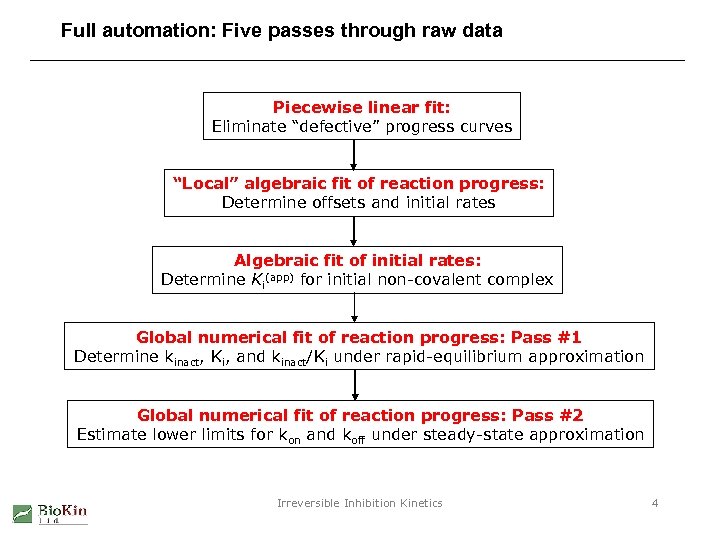
Full automation: Five passes through raw data Piecewise linear fit: Eliminate “defective” progress curves “Local” algebraic fit of reaction progress: Determine offsets and initial rates Algebraic fit of initial rates: Determine Ki(app) for initial non-covalent complex Global numerical fit of reaction progress: Pass #1 Determine kinact, Ki, and kinact/Ki under rapid-equilibrium approximation Global numerical fit of reaction progress: Pass #2 Estimate lower limits for kon and koff under steady-state approximation Irreversible Inhibition Kinetics 4
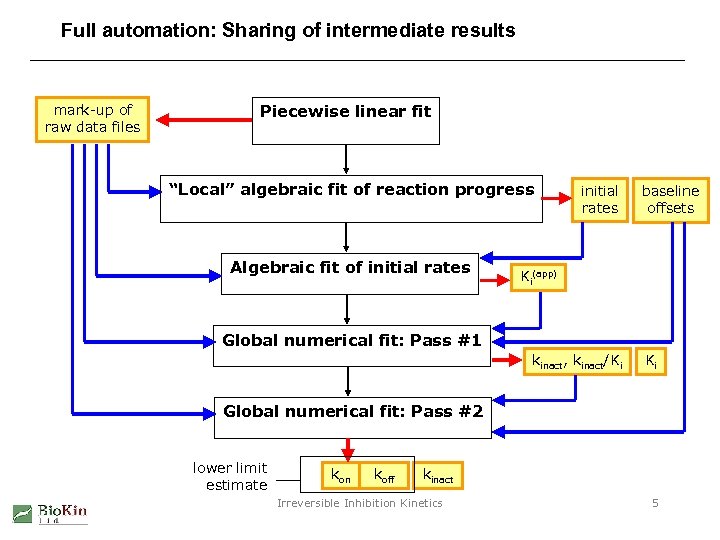
Full automation: Sharing of intermediate results mark-up of raw data files Piecewise linear fit “Local” algebraic fit of reaction progress Algebraic fit of initial rates baseline offsets Ki(app) Global numerical fit: Pass #1 kinact, kinact/Ki Ki Global numerical fit: Pass #2 lower limit estimate kon koff kinact Irreversible Inhibition Kinetics 5
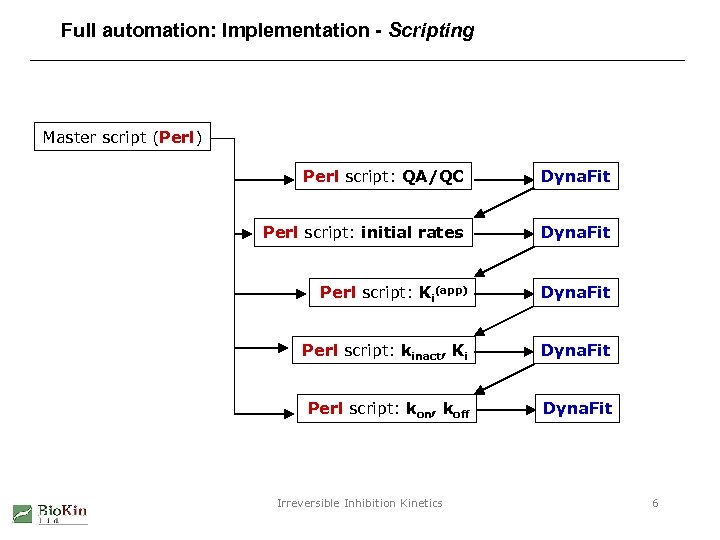
Full automation: Implementation - Scripting Master script (Perl) Perl script: QA/QC Dyna. Fit Perl script: initial rates Dyna. Fit Perl script: Ki(app) Dyna. Fit Perl script: kinact, Ki Dyna. Fit Perl script: kon, koff Dyna. Fit Irreversible Inhibition Kinetics 6
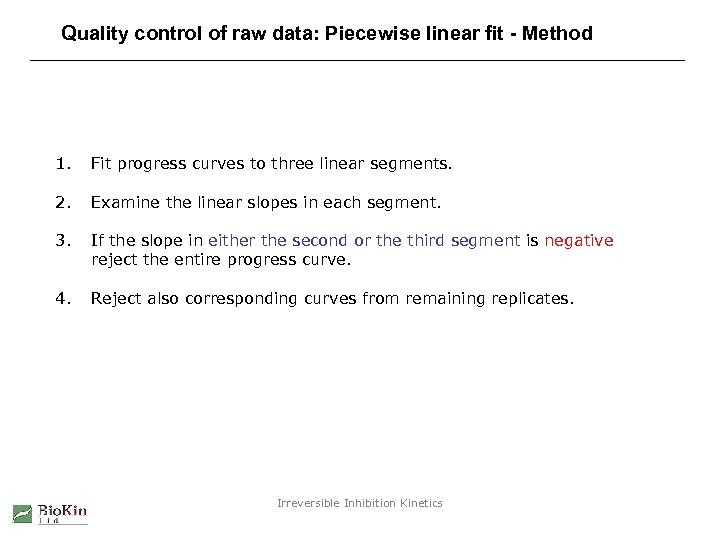
Quality control of raw data: Piecewise linear fit - Method 1. Fit progress curves to three linear segments. 2. Examine the linear slopes in each segment. 3. If the slope in either the second or the third segment is negative reject the entire progress curve. 4. Reject also corresponding curves from remaining replicates. Irreversible Inhibition Kinetics
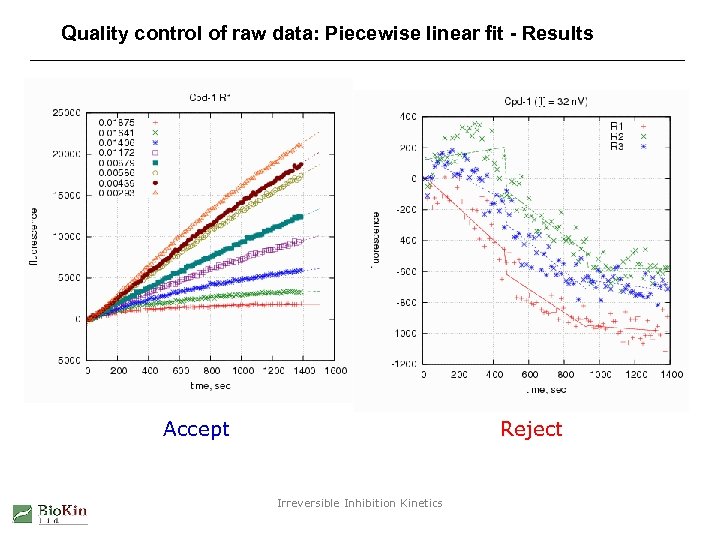
Quality control of raw data: Piecewise linear fit - Results Accept Reject Irreversible Inhibition Kinetics
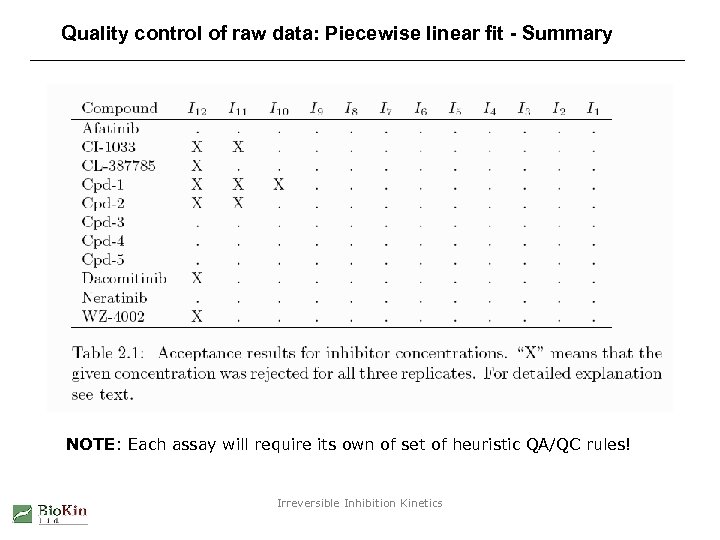
Quality control of raw data: Piecewise linear fit - Summary NOTE: Each assay will require its own of set of heuristic QA/QC rules! Irreversible Inhibition Kinetics
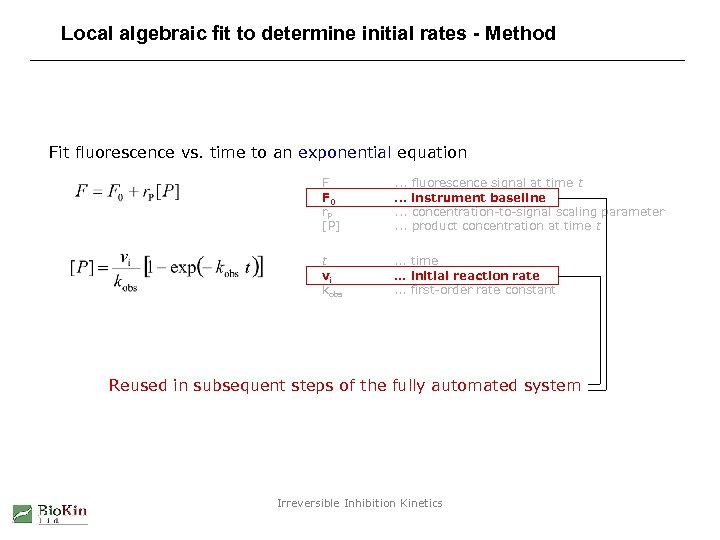
Local algebraic fit to determine initial rates - Method Fit fluorescence vs. time to an exponential equation F F 0 r. P [P] . . . fluorescence signal at time t instrument baseline concentration-to-signal scaling parameter product concentration at time t t vi kobs . . . time. . . initial reaction rate. . . first-order rate constant Reused in subsequent steps of the fully automated system Irreversible Inhibition Kinetics
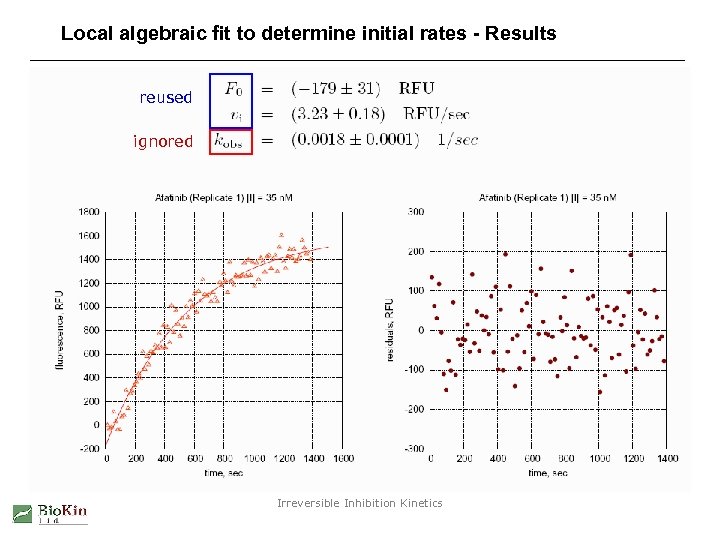
Local algebraic fit to determine initial rates - Results reused ignored Irreversible Inhibition Kinetics
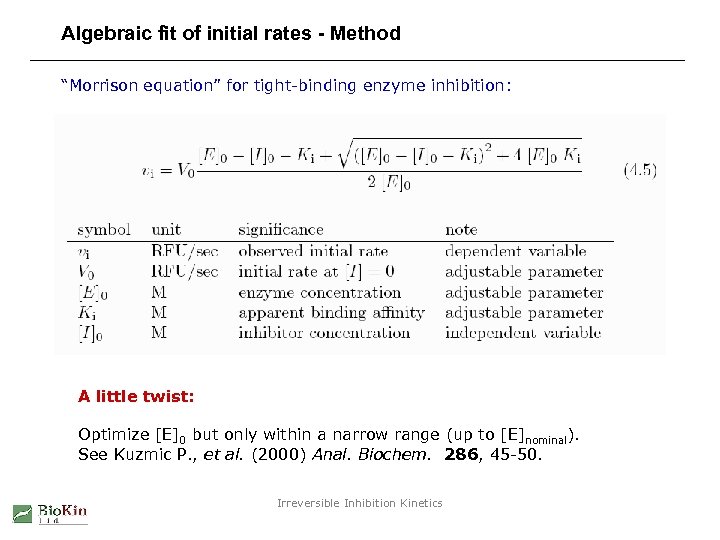
Algebraic fit of initial rates - Method “Morrison equation” for tight-binding enzyme inhibition: A little twist: Optimize [E]0 but only within a narrow range (up to [E]nominal). See Kuzmic P. , et al. (2000) Anal. Biochem. 286, 45 -50. Irreversible Inhibition Kinetics
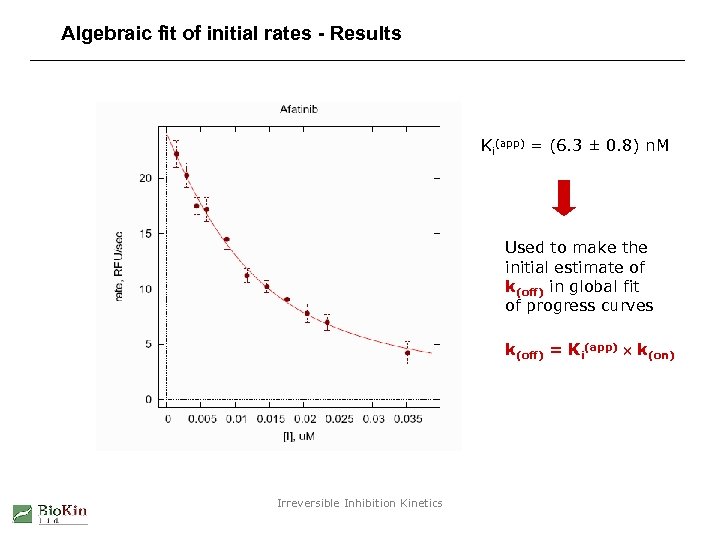
Algebraic fit of initial rates - Results Ki(app) = (6. 3 ± 0. 8) n. M Used to make the initial estimate of k(off) in global fit of progress curves k(off) = Ki(app) k(on) Irreversible Inhibition Kinetics
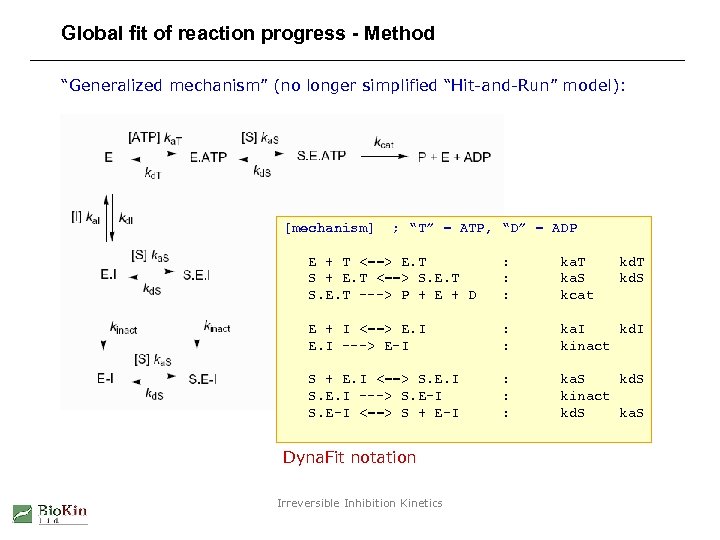
Global fit of reaction progress - Method “Generalized mechanism” (no longer simplified “Hit-and-Run” model): [mechanism] ; “T” = ATP, “D” = ADP E + T <==> E. T S + E. T <==> S. E. T ---> P + E + D : : : ka. T ka. S kcat E + I <==> E. I ---> E-I : : ka. I kd. I kinact S + E. I <==> S. E. I ---> S. E-I <==> S + E-I : : : ka. S kd. S kinact kd. S ka. S Dyna. Fit notation Irreversible Inhibition Kinetics kd. T kd. S
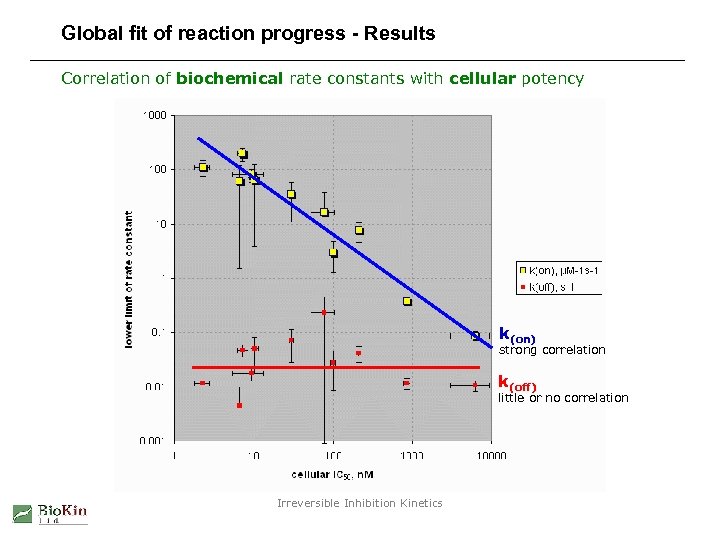
Global fit of reaction progress - Results Correlation of biochemical rate constants with cellular potency k(on) strong correlation k(off) little or no correlation Irreversible Inhibition Kinetics
Irreversible Inhibition Kinetics Automation and Simulation Petr Kuzmič, Ph. D. Bio. Kin, Ltd. 1. Automate the determination of biochemical parameters 2. PK/PD simulations with multiple injections Irreversible Inhibition Kinetics
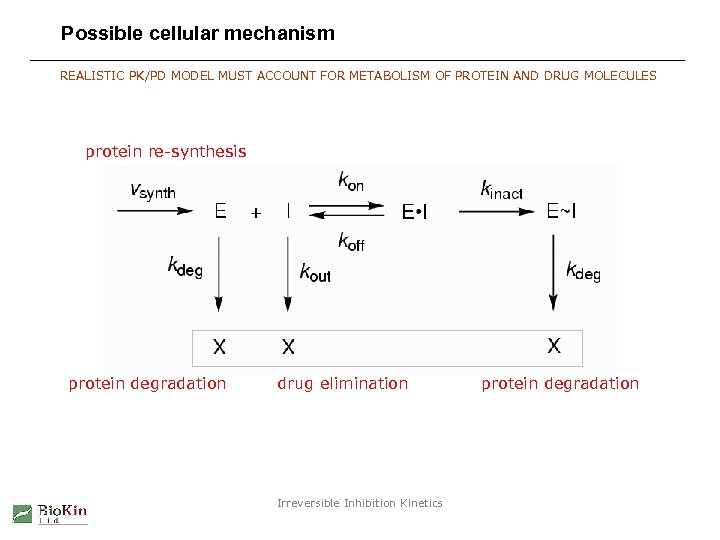
Possible cellular mechanism REALISTIC PK/PD MODEL MUST ACCOUNT FOR METABOLISM OF PROTEIN AND DRUG MOLECULES protein re-synthesis protein degradation drug elimination Irreversible Inhibition Kinetics protein degradation
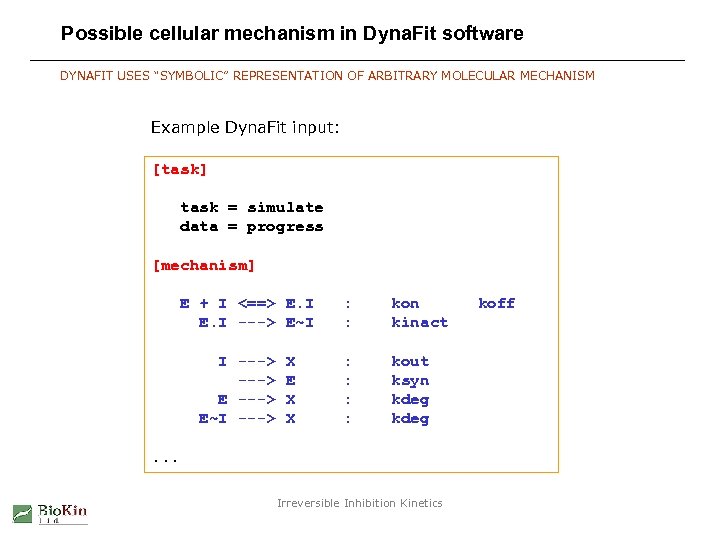
Possible cellular mechanism in Dyna. Fit software DYNAFIT USES “SYMBOLIC” REPRESENTATION OF ARBITRARY MOLECULAR MECHANISM Example Dyna. Fit input: [task] task = simulate data = progress [mechanism] E + I <==> E. I ---> E~I I ---> E~I ---> X E X X : : kon kinact : : kout ksyn kdeg . . . Irreversible Inhibition Kinetics koff
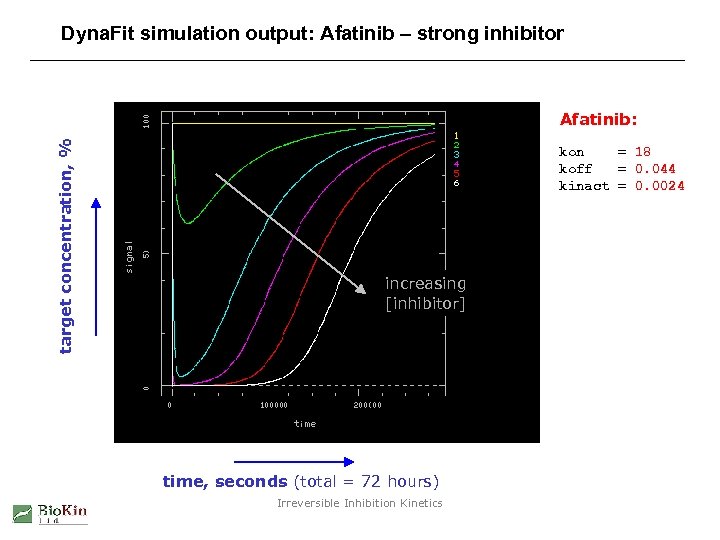
Dyna. Fit simulation output: Afatinib – strong inhibitor target concentration, % Afatinib: kon = 18 koff = 0. 044 kinact = 0. 0024 increasing [inhibitor] time, seconds (total = 72 hours) Irreversible Inhibition Kinetics
![Simulate multiple injections - Method 1. Set initial concentrations of [Enzyme] and [Inhibitor] 2.](https://present5.com/presentation/a2fa40faed982f1569a22f32661eb67c/image-20.jpg "Simulate multiple injections - Method 1. Set initial concentrations of [Enzyme] and [Inhibitor] 2.")
Simulate multiple injections - Method 1. Set initial concentrations of [Enzyme] and [Inhibitor] 2. Run a Dyna. Fit simulation for one injection 3. Record concentrations at the end of the run 4. Increase [Inhibitor] concentration by next injection amount 5. Set initial concentrations to the final values (after adjusting [I]) 6. Go to step #2 above Irreversible Inhibition Kinetics
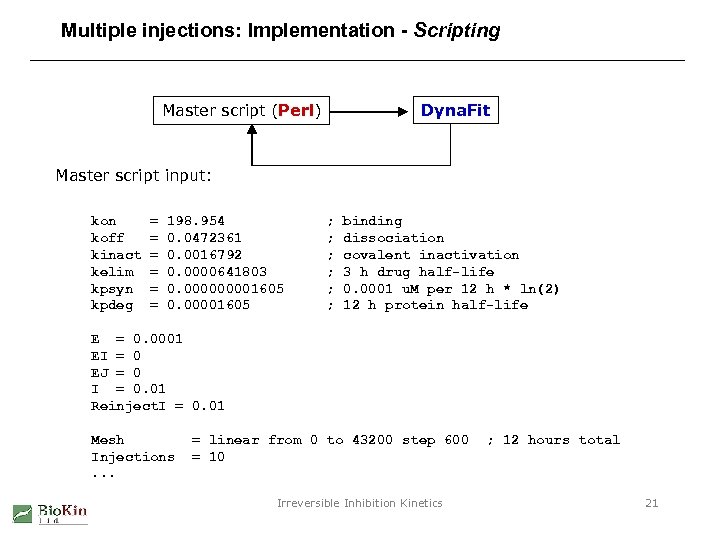
Multiple injections: Implementation - Scripting Dyna. Fit Master script (Perl) Master script input: kon koff kinact kelim kpsyn kpdeg = = = 198. 954 0. 0472361 0. 0016792 0. 0000641803 0. 00001605 ; ; ; binding dissociation covalent inactivation 3 h drug half-life 0. 0001 u. M per 12 h * ln(2) 12 h protein half-life E = 0. 0001 EI = 0 EJ = 0 I = 0. 01 Reinject. I = 0. 01 Mesh Injections. . . = linear from 0 to 43200 step 600 = 10 Irreversible Inhibition Kinetics ; 12 hours total 21
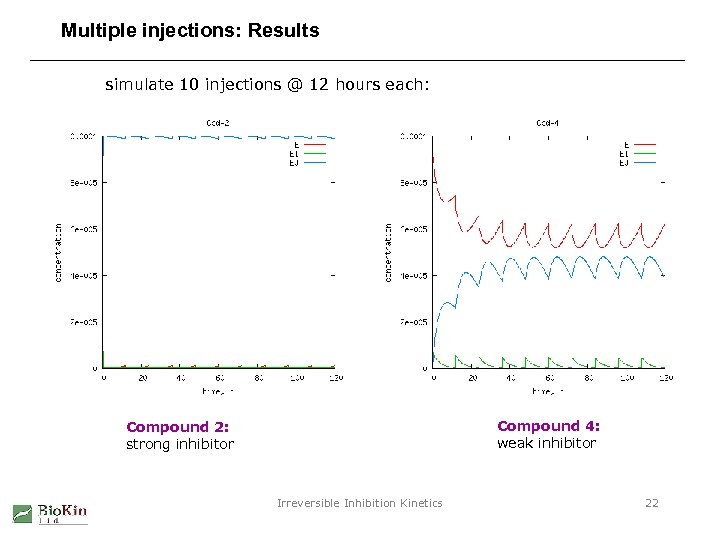
Multiple injections: Results simulate 10 injections @ 12 hours each: Compound 4: weak inhibitor Compound 2: strong inhibitor Irreversible Inhibition Kinetics 22
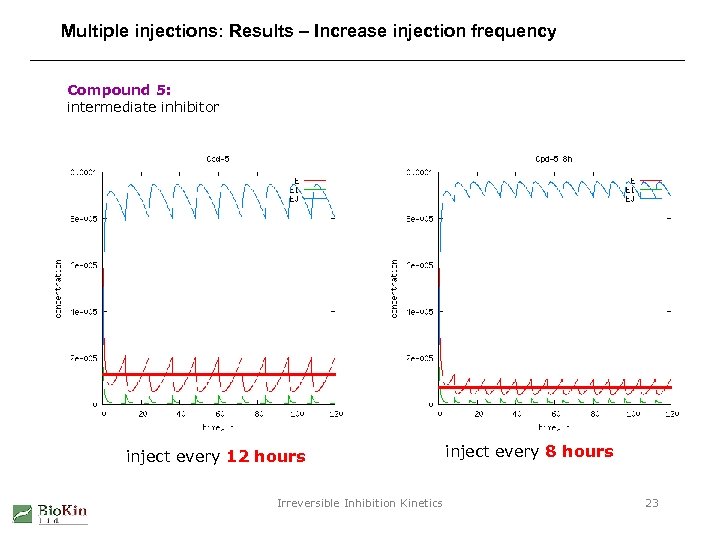
Multiple injections: Results – Increase injection frequency Compound 5: intermediate inhibitor inject every 12 hours Irreversible Inhibition Kinetics inject every 8 hours 23
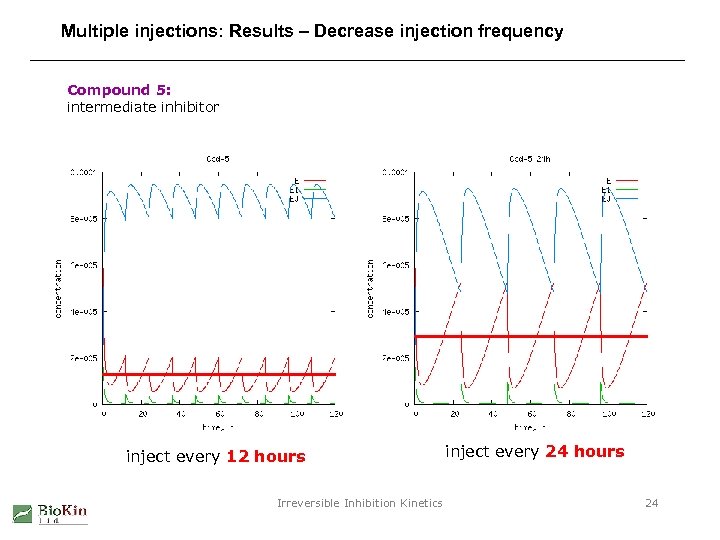
Multiple injections: Results – Decrease injection frequency Compound 5: intermediate inhibitor inject every 12 hours Irreversible Inhibition Kinetics inject every 24 hours 24
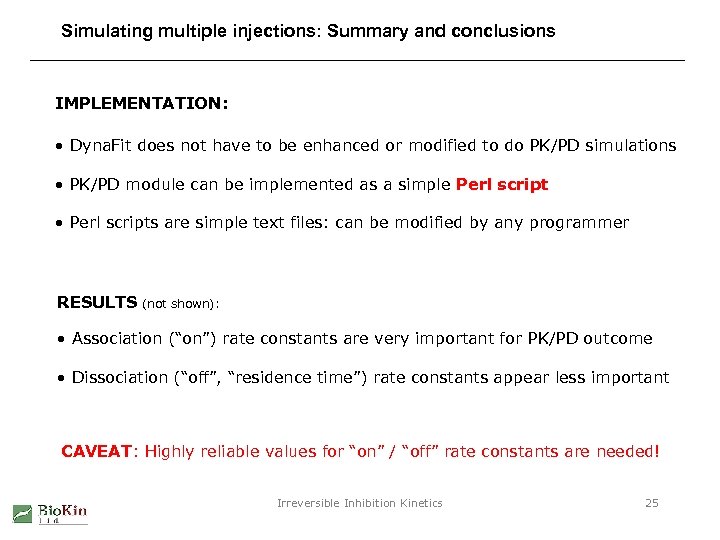
Simulating multiple injections: Summary and conclusions IMPLEMENTATION: • Dyna. Fit does not have to be enhanced or modified to do PK/PD simulations • PK/PD module can be implemented as a simple Perl script • Perl scripts are simple text files: can be modified by any programmer RESULTS (not shown): • Association (“on”) rate constants are very important for PK/PD outcome • Dissociation (“off”, “residence time”) rate constants appear less important CAVEAT: Highly reliable values for “on” / “off” rate constants are needed! Irreversible Inhibition Kinetics 25
Скачать презентацию Irreversible Inhibition Kinetics Automation and Simulation Petr Kuzmič
a2fa40faed982f1569a22f32661eb67c.ppt