


 Скачать презентацию Irradiation and annealing study of 3 D p-type
2539ba4049e36181d65cc35f6315644a.ppt
- Количество слайдов: 18
 Irradiation and annealing study of 3 D p-type strip detectors • CNM double-sided 3 D • Measurements pre-irradiation – Bulk capacitance – Leakage current – Interstrip capacitance – Interstrip resistance • Post-irradiation and annealing • Future work Celeste Fleta, Manuel Lozano, Giulio Pellegrini (IMB-CNM, Barcelona)
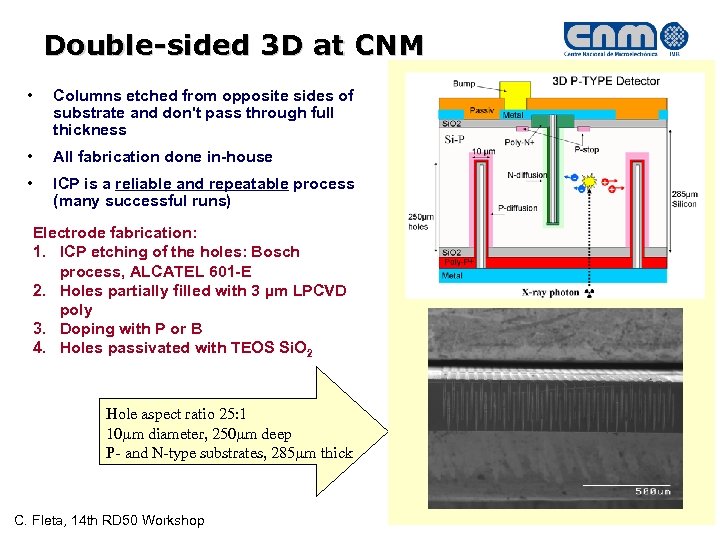 Double-sided 3 D at CNM • Columns etched from opposite sides of substrate and don't pass through full thickness • All fabrication done in-house • ICP is a reliable and repeatable process (many successful runs) Electrode fabrication: 1. ICP etching of the holes: Bosch process, ALCATEL 601 -E 2. Holes partially filled with 3 µm LPCVD poly 3. Doping with P or B 4. Holes passivated with TEOS Si. O 2 Hole aspect ratio 25: 1 10µm diameter, 250µm deep P- and N-type substrates, 285µm thick C. Fleta, 14 th RD 50 Workshop
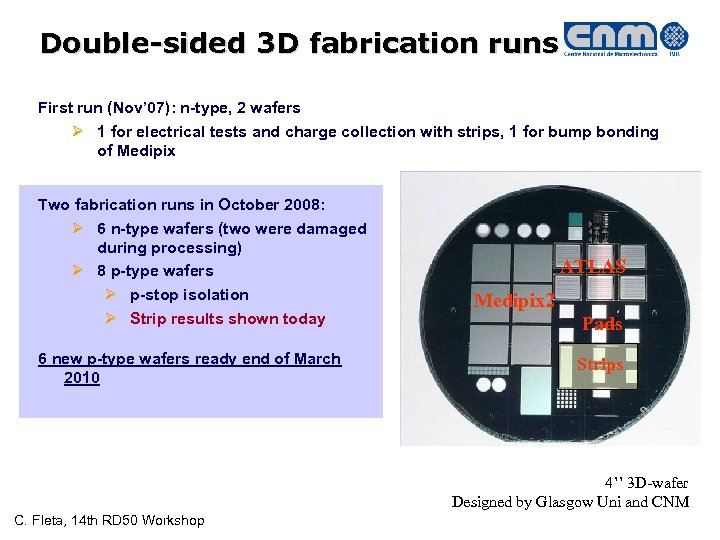 Double-sided 3 D fabrication runs First run (Nov’ 07): n-type, 2 wafers 1 for electrical tests and charge collection with strips, 1 for bump bonding of Medipix Two fabrication runs in October 2008: 6 n-type wafers (two were damaged during processing) 8 p-type wafers p-stop isolation Strip results shown today 6 new p-type wafers ready end of March 2010 ATLAS Medipix 2 Pads Strips 4’’ 3 D-wafer Designed by Glasgow Uni and CNM C. Fleta, 14 th RD 50 Workshop
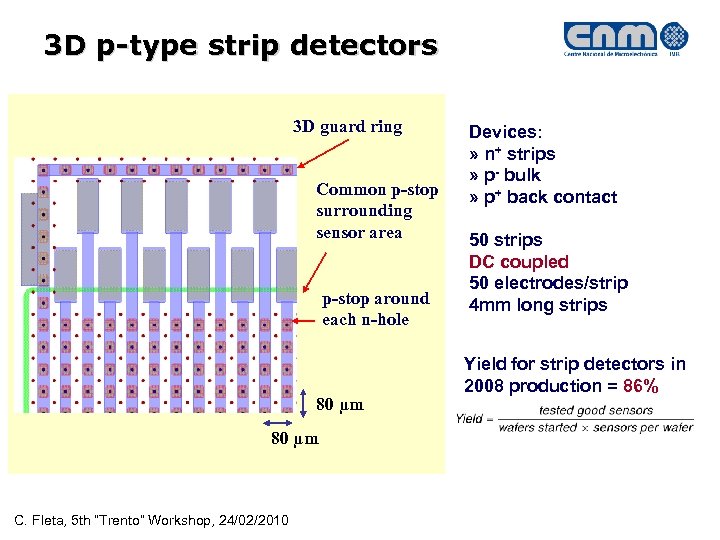 3 D p-type strip detectors 3 D guard ring Common p-stop surrounding sensor area p-stop around each n-hole 80 µm C. Fleta, 5 th “Trento” Workshop, 24/02/2010 Devices: » n+ strips » p- bulk » p+ back contact 50 strips DC coupled 50 electrodes/strip 4 mm long strips Yield for strip detectors in 2008 production = 86%
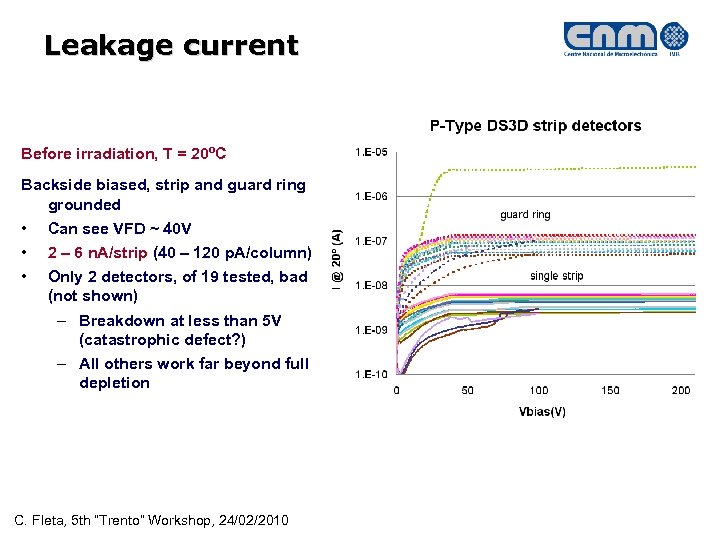 Leakage current Before irradiation, T = 20ºC Backside biased, strip and guard ring grounded • • • Can see VFD ~ 40 V 2 – 6 n. A/strip (40 – 120 p. A/column) Only 2 detectors, of 19 tested, bad (not shown) – Breakdown at less than 5 V (catastrophic defect? ) – All others work far beyond full depletion C. Fleta, 5 th “Trento” Workshop, 24/02/2010
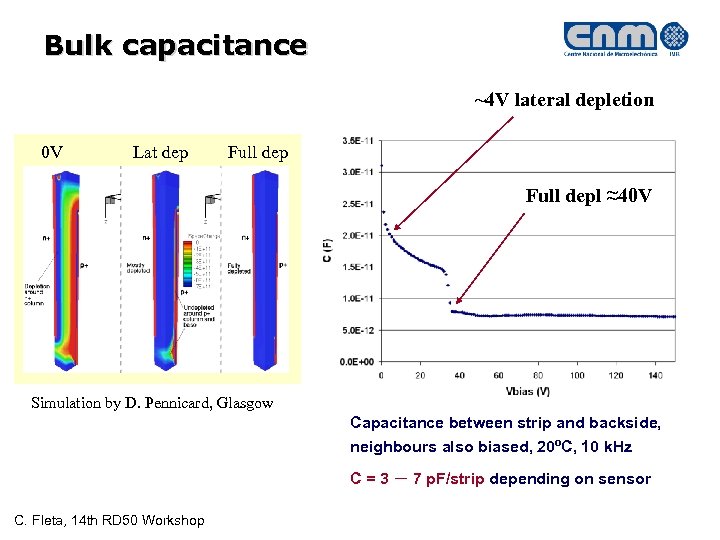 Bulk capacitance ~4 V lateral depletion 0 V Lat dep Full depl ≈40 V Simulation by D. Pennicard, Glasgow Capacitance between strip and backside, neighbours also biased, 20ºC, 10 k. Hz C=3 C. Fleta, 14 th RD 50 Workshop – 7 p. F/strip depending on sensor
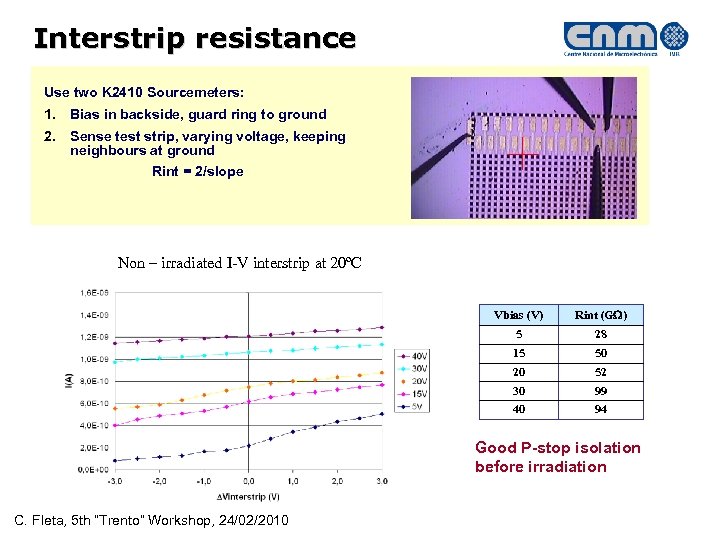 Interstrip resistance Use two K 2410 Sourcemeters: 1. Bias in backside, guard ring to ground 2. Sense test strip, varying voltage, keeping neighbours at ground Rint = 2/slope Non – irradiated I-V interstrip at 20ºC Vbias (V) Rint (GW) 5 28 15 50 20 52 30 99 40 94 Good P-stop isolation before irradiation C. Fleta, 5 th “Trento” Workshop, 24/02/2010
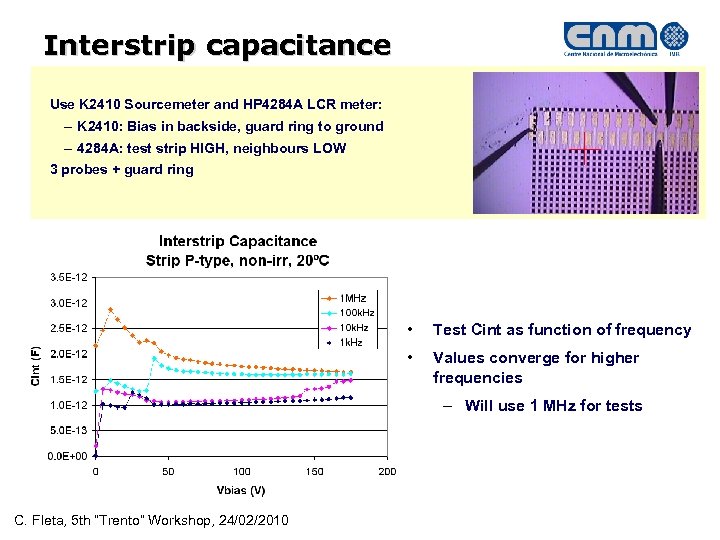 Interstrip capacitance Use K 2410 Sourcemeter and HP 4284 A LCR meter: – K 2410: Bias in backside, guard ring to ground – 4284 A: test strip HIGH, neighbours LOW 3 probes + guard ring • Test Cint as function of frequency • Values converge for higher frequencies – Will use 1 MHz for tests C. Fleta, 5 th “Trento” Workshop, 24/02/2010
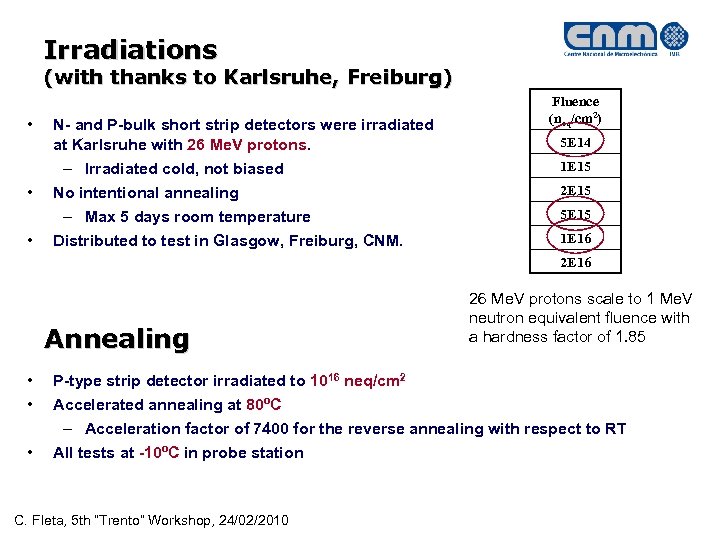 Irradiations (with thanks to Karlsruhe, Freiburg) • • • N- and P-bulk short strip detectors were irradiated at Karlsruhe with 26 Me. V protons. – Irradiated cold, not biased No intentional annealing – Max 5 days room temperature Distributed to test in Glasgow, Freiburg, CNM. Fluence (neq/cm 2) 5 E 14 1 E 15 2 E 15 5 E 15 1 E 16 2 E 16 Annealing • • • 26 Me. V protons scale to 1 Me. V neutron equivalent fluence with a hardness factor of 1. 85 P-type strip detector irradiated to 1016 neq/cm 2 Accelerated annealing at 80ºC – Acceleration factor of 7400 for the reverse annealing with respect to RT All tests at -10ºC in probe station C. Fleta, 5 th “Trento” Workshop, 24/02/2010
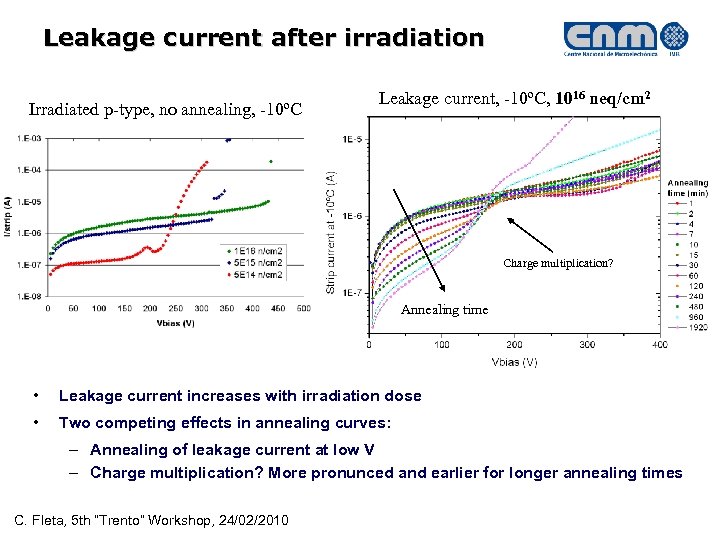 Leakage current after irradiation Irradiated p-type, no annealing, -10ºC Leakage current, -10ºC, 1016 neq/cm 2 Charge multiplication? Annealing time • Leakage current increases with irradiation dose • Two competing effects in annealing curves: – Annealing of leakage current at low V – Charge multiplication? More pronunced and earlier for longer annealing times C. Fleta, 5 th “Trento” Workshop, 24/02/2010
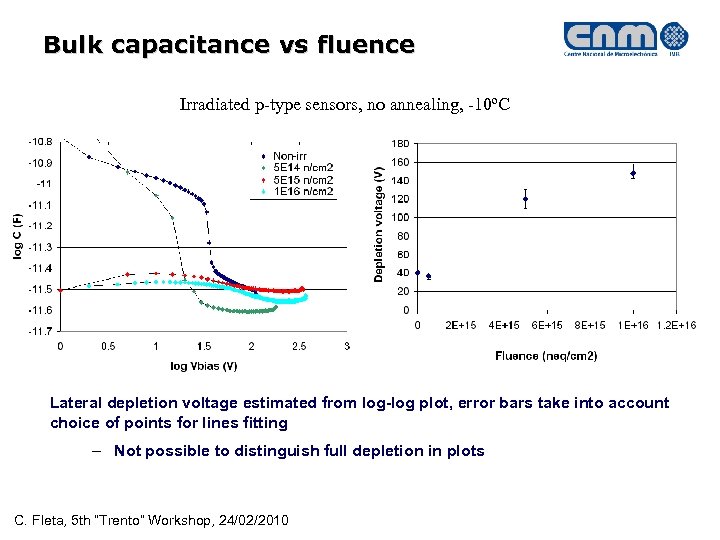 Bulk capacitance vs fluence Irradiated p-type sensors, no annealing, -10ºC Lateral depletion voltage estimated from log-log plot, error bars take into account choice of points for lines fitting – Not possible to distinguish full depletion in plots C. Fleta, 5 th “Trento” Workshop, 24/02/2010
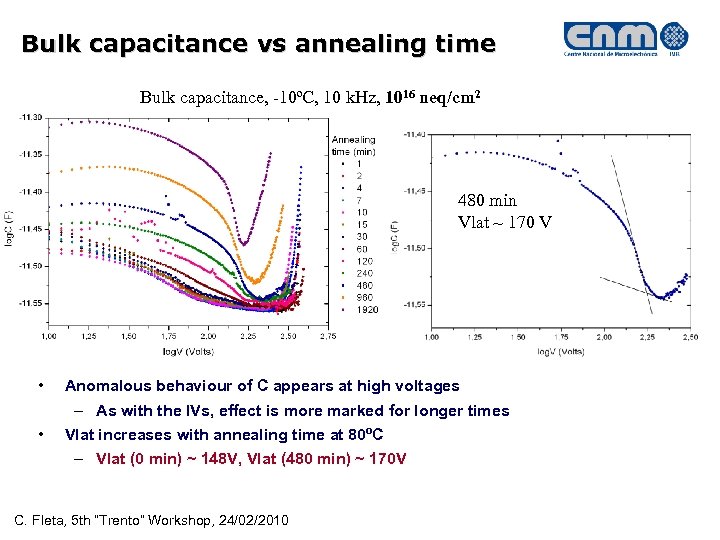 Bulk capacitance vs annealing time Bulk capacitance, -10ºC, 10 k. Hz, 1016 neq/cm 2 480 min Vlat ~ 170 V • Anomalous behaviour of C appears at high voltages • – As with the IVs, effect is more marked for longer times Vlat increases with annealing time at 80ºC – Vlat (0 min) ~ 148 V, Vlat (480 min) ~ 170 V C. Fleta, 5 th “Trento” Workshop, 24/02/2010
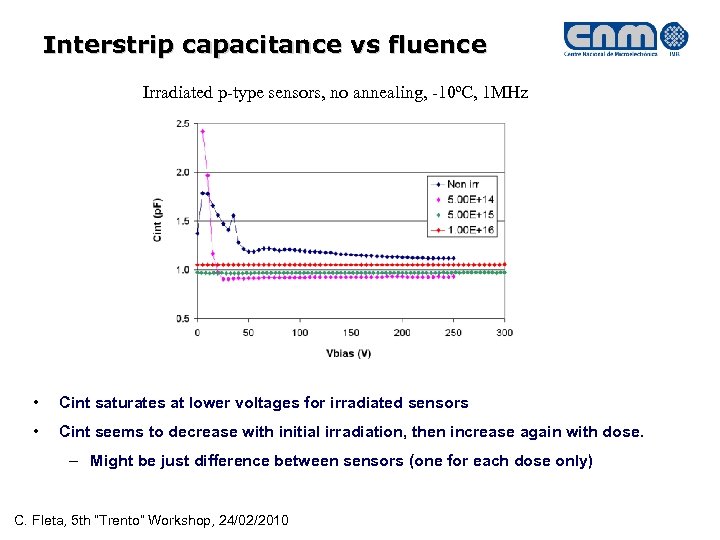 Interstrip capacitance vs fluence Irradiated p-type sensors, no annealing, -10ºC, 1 MHz • Cint saturates at lower voltages for irradiated sensors • Cint seems to decrease with initial irradiation, then increase again with dose. – Might be just difference between sensors (one for each dose only) C. Fleta, 5 th “Trento” Workshop, 24/02/2010
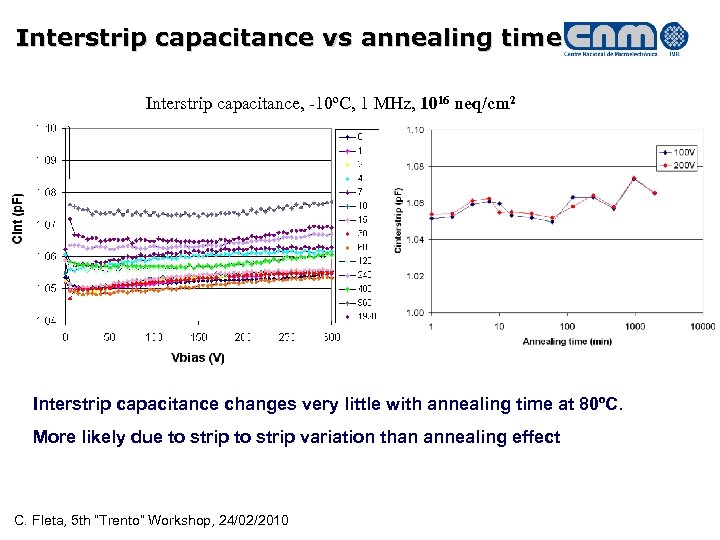 Interstrip capacitance vs annealing time Interstrip capacitance, -10ºC, 1 MHz, 1016 neq/cm 2 Interstrip capacitance changes very little with annealing time at 80ºC. More likely due to strip variation than annealing effect C. Fleta, 5 th “Trento” Workshop, 24/02/2010
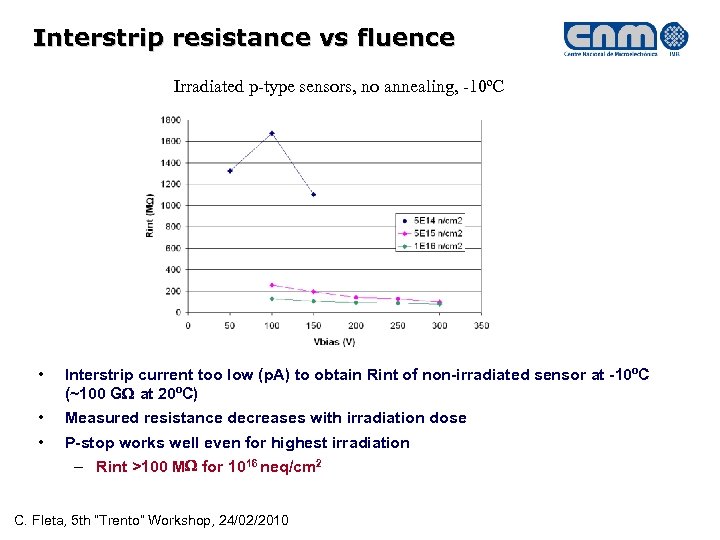 Interstrip resistance vs fluence Irradiated p-type sensors, no annealing, -10ºC • Interstrip current too low (p. A) to obtain Rint of non-irradiated sensor at -10ºC (~100 GW at 20ºC) • • Measured resistance decreases with irradiation dose P-stop works well even for highest irradiation – Rint >100 MW for 1016 neq/cm 2 C. Fleta, 5 th “Trento” Workshop, 24/02/2010
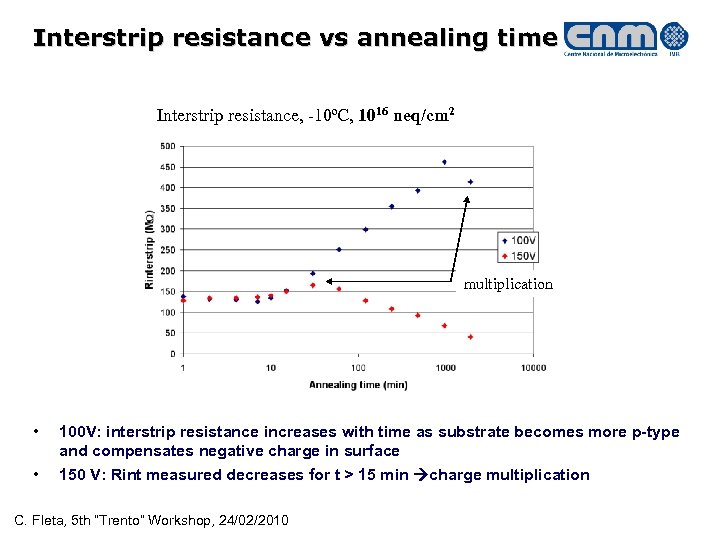 Interstrip resistance vs annealing time Interstrip resistance, -10ºC, 1016 neq/cm 2 multiplication • 100 V: interstrip resistance increases with time as substrate becomes more p-type and compensates negative charge in surface • 150 V: Rint measured decreases for t > 15 min charge multiplication C. Fleta, 5 th “Trento” Workshop, 24/02/2010
 Conclusions • I have presented an irradiation and annealing study of 3 D P-type strip sensors from CNM irradiated with 26 Me. V protons up to 1 E 16 neq/cm 2 • Depletion voltage increases with irradiation dose and annealing time. V(lat depl) lower than 150 V for 1 E 16 without annealing • Leakage current increases with dose, shows typical annealing behaviour for low voltages. Charge multiplication appears at higher voltages, earlier for longer annealing times • Strip isolation decreases with dose, p-stop works well even for higher irradiation • Multiplication effect also seen in annealing curves of interstrip resistance • Interstrip capacitance doesn’t change much with irradiation or annealing • Annealing study of n-type sensor irradiated to 1 E 16 neq/cm 2 started C. Fleta, 5 th “Trento” Workshop, 24/02/2010
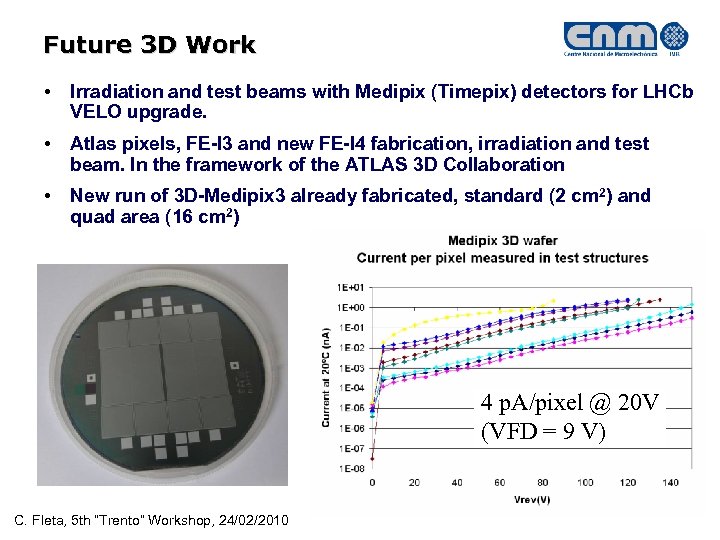 Future 3 D Work • Irradiation and test beams with Medipix (Timepix) detectors for LHCb VELO upgrade. • Atlas pixels, FE-I 3 and new FE-I 4 fabrication, irradiation and test beam. In the framework of the ATLAS 3 D Collaboration • New run of 3 D-Medipix 3 already fabricated, standard (2 cm 2) and quad area (16 cm 2) 4 p. A/pixel @ 20 V (VFD = 9 V) C. Fleta, 5 th “Trento” Workshop, 24/02/2010