 Скачать презентацию Irish Junior Certificate Science Revised Syllabus Current
0ecb5bbc37be10642c4ef5ceff619b8b.ppt
- Количество слайдов: 17



Irish Junior Certificate Science Revised Syllabus
Current Syllabus 1 1989 two syllabii (A and E) combined to incorporate aspects of both and examine at Higher and Ordinary Levels Major change – Applied Science Options e. g. electronics, horticulture in addition to biology, physics and chemistry Some students could do a project - Local Studies
Current Syllabus 2 Problems apparent with current science syllabus: (i) There was an obvious under representation of chemistry in the applied science section (ii) Students taking the syllabus at Ordinary level were omitting the chemistry section in favour of the applied science section •
Current Syllabus 3 (iii) The number of students taking physics and chemistry at senior level was falling (iv) The course was too long for all students to have hands-on experience of all the prescribed practical activities (v) No assessment of practical work
Revised Syllabus 1 1998 National Council for Curriculum and Assessment (NCCA) reconvened course committee A new syllabus was drawn up and introduced in 2003 First examination in 2006 Much of the content of the previous syllabus has been retained but there have been changes in both format and emphasis
Revised Syllabus 2 Chemistry 2 A Classification of substances 2 B Air, oxygen, carbon dioxide and water 2 C Atomic structure, reactions and compounds Physics 3 A Mechanics, force and energy 3 B Heat, light and sound 3 C Magnetism, electricity and electronics
Revised Syllabus 3 Biology 1 A Human biology – food, digestion and associated body systems 1 B Human biology – the skeletal/muscular system, the senses and human reproduction 1 C Animals, plants and micro-organisms
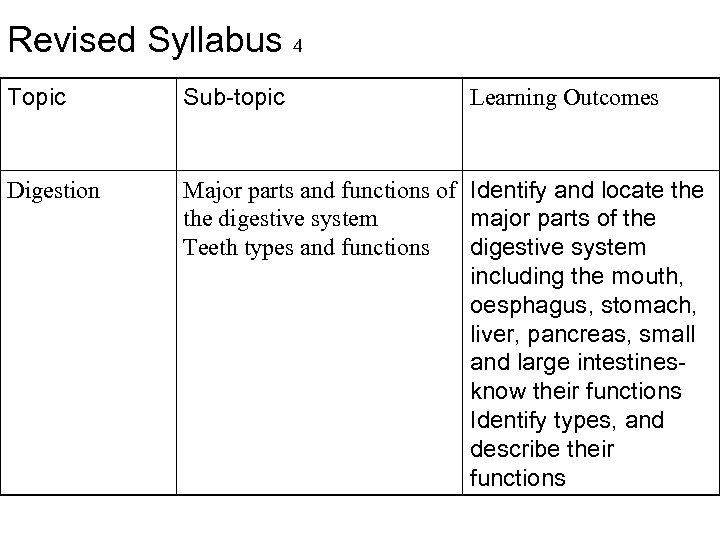
Revised Syllabus 4 Topic Sub-topic Digestion Major parts and functions of Identify and locate the digestive system major parts of the Teeth types and functions digestive system including the mouth, oesphagus, stomach, liver, pancreas, small and large intestinesknow their functions Identify types, and describe their functions Learning Outcomes
Revised Syllabus 6 The most obvious change is the removal of the applied science section however, selected content from this section has been incorporated into the appropriate section - physics, chemistry or biology e. g electronics into physics Some content had to be omitted to shorten the syllabus to allow for active student engagement in learning experiences that will enable the development of science process skills All students will do a project
Revised Syllabus 7 The most important change is in the way the students will be assessed. Students will now be examined on the practical work they carried out during the three year cycle Course work A 10 % - Practical Workbook Course work B 25% - Project work Course work C 65% - Terminal exam paper
Revised Syllabus 8 Aim: Better understanding of the underlying science concepts, as well as the development of higher order skills associated with problem solving and the application of knowledge in new situations or contexts The revised syllabus places increased emphasis on scientific investigation and on the application of science process skills through student activities
Revised Syllabus 9 The aims of the syllabus are in keeping with international developments in science education, reflecting a move towards greater emphasis on the development of ‘scientific literacy’.
Teacher Professional Development Syllabus document contains prescriptive material – only this can be examined Teacher guidelines available on web Teacher Inservice – Now entering year three 2 days per year plus support from regional development officer Government grant for equipment and /or laboratories based on individual needs of the school
Teacher Response • Change welcomed • Attendance at inservice very high (approx 80%) • Teachers are apprehensive re assessment • Teachers are concerned about time factors • Time for Coursework B • Time taken for organisation of labs • Time for new methodologies
Conclusion The principle underlying any teaching and learning strategy is that it should enable the aims and objectives of the syllabus to be achieved The entire thrust of curriculum reform, enhanced infrastructural investment, teacher professional development is to create an environment in which science teaching and learning is an enjoyable experience. The new syllabus is designed to extend students educational experience
develop the students confidence, prepare the students for further study of the sciences, and prepare the young person for the responsibilities of citizenship in the national, European and global communities.
THE END
Скачать презентацию Irish Junior Certificate Science Revised Syllabus Current
0ecb5bbc37be10642c4ef5ceff619b8b.ppt