 Скачать презентацию Iranian Ballistic Missile Capabilities Michael Elleman Senior Fellow
c13733e7b8e1b276c63978fa7e782a3c.ppt
- Количество слайдов: 17



Iranian Ballistic Missile Capabilities Michael Elleman Senior Fellow for Missile Defence International Institute for Strategic Studies 22 November 2010
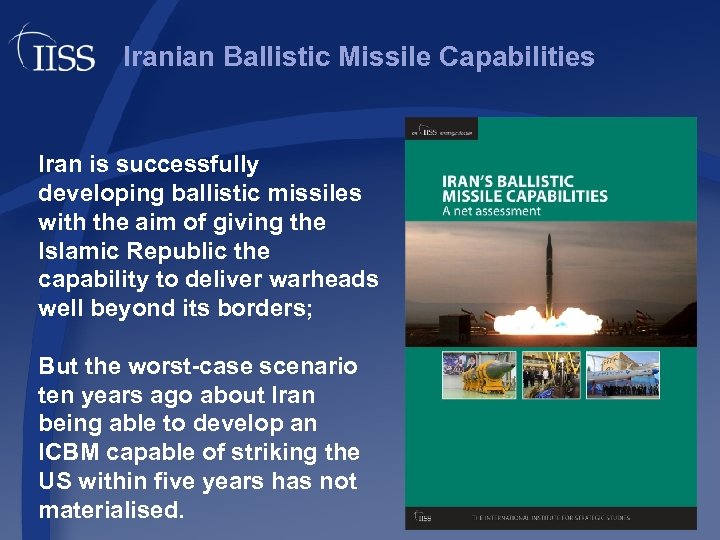
Iranian Ballistic Missile Capabilities Iran is successfully developing ballistic missiles with the aim of giving the Islamic Republic the capability to deliver warheads well beyond its borders; But the worst-case scenario ten years ago about Iran being able to develop an ICBM capable of striking the US within five years has not materialised.
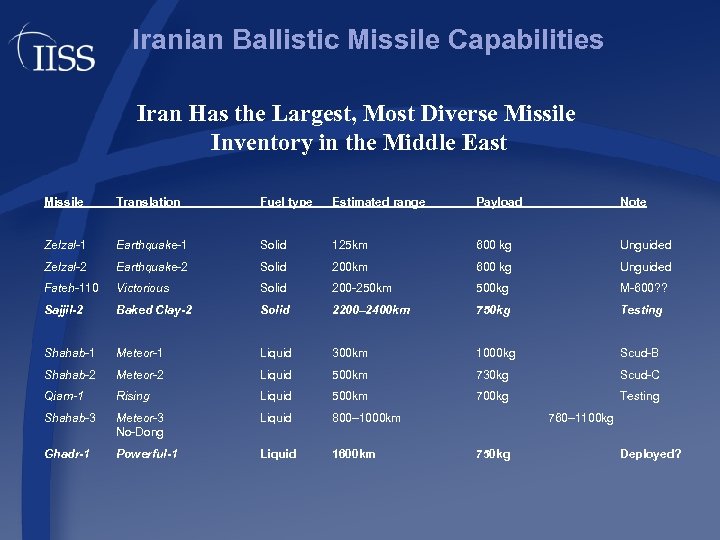
Iranian Ballistic Missile Capabilities Iran Has the Largest, Most Diverse Missile Inventory in the Middle East Missile Translation Fuel type Estimated range Payload Note Zelzal-1 Earthquake-1 Solid 125 km 600 kg Unguided Zelzal-2 Earthquake-2 Solid 200 km 600 kg Unguided Fateh-110 Victorious Solid 200 -250 km 500 kg M-600? ? Sajjil-2 Baked Clay-2 Solid 2200– 2400 km 750 kg Testing Shahab-1 Meteor-1 Liquid 300 km 1000 kg Scud-B Shahab-2 Meteor-2 Liquid 500 km 730 kg Scud-C Qiam-1 Rising Liquid 500 km 700 kg Testing Shahab-3 Meteor-3 No-Dong Liquid 800– 1000 km Ghadr-1 Powerful-1 Liquid 1600 km 760– 1100 kg 750 kg Deployed?
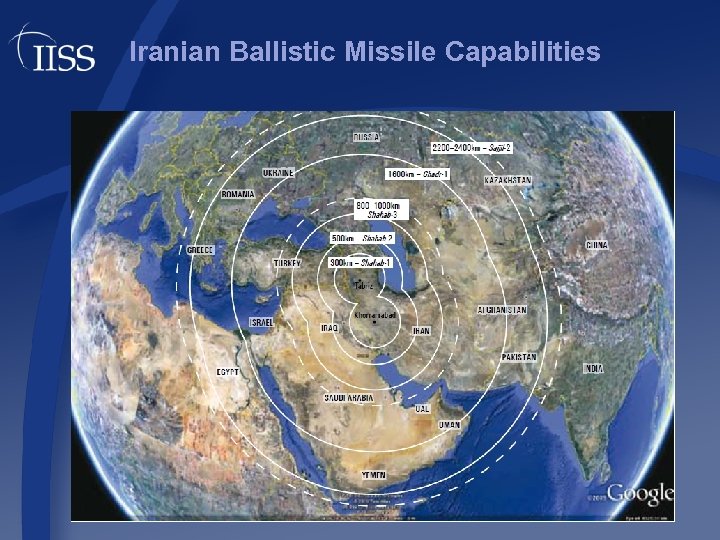
Iranian Ballistic Missile Capabilities
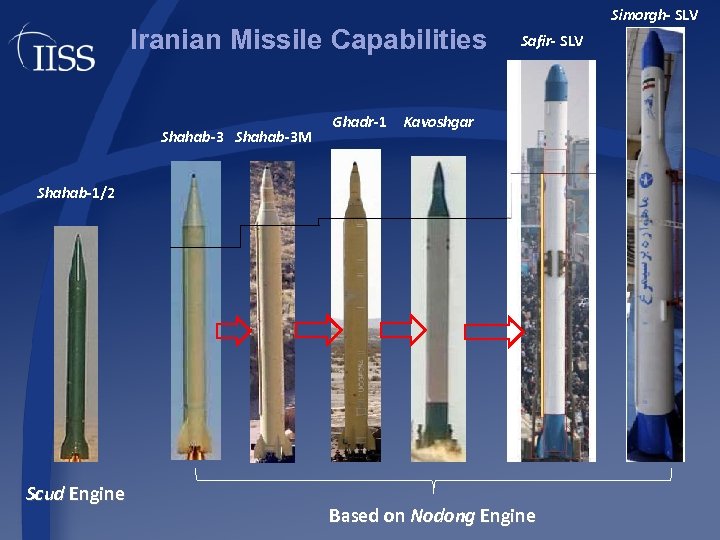
Iranian Missile Capabilities Shahab-3 M Ghadr-1 Simorgh- SLV Safir- SLV Kavoshgar Shahab-1/2 Scud Engine Based on Nodong Engine
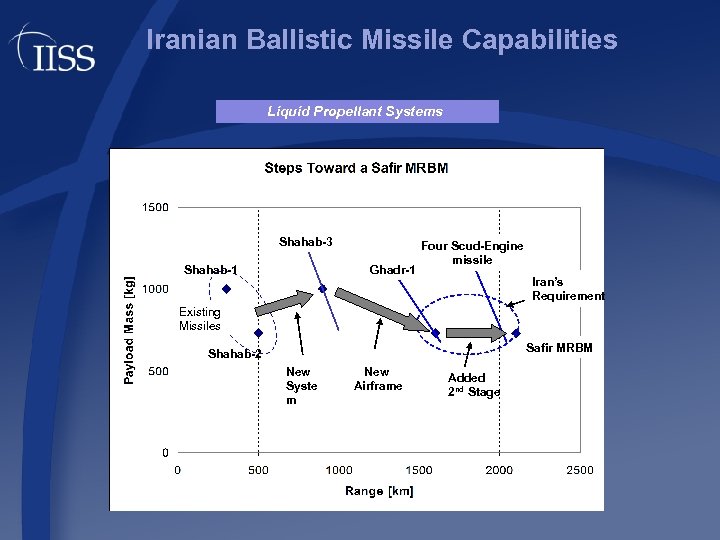
Iranian Ballistic Missile Capabilities Liquid Propellant Systems Shahab-3 Shahab-1 Ghadr-1 Four Scud-Engine missile Iran’s Requirement Existing Missiles Safir MRBM Shahab-2 New Syste m New Airframe Added 2 nd Stage
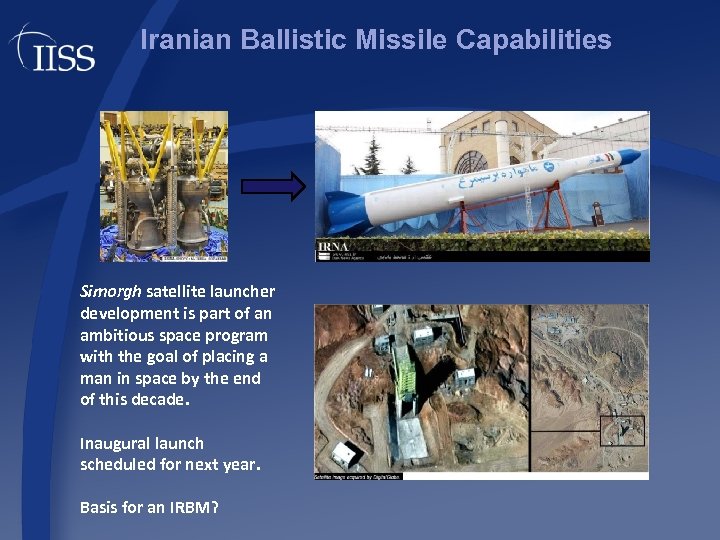
Iranian Ballistic Missile Capabilities Simorgh satellite launcher development is part of an ambitious space program with the goal of placing a man in space by the end of this decade. Inaugural launch scheduled for next year. Basis for an IRBM?
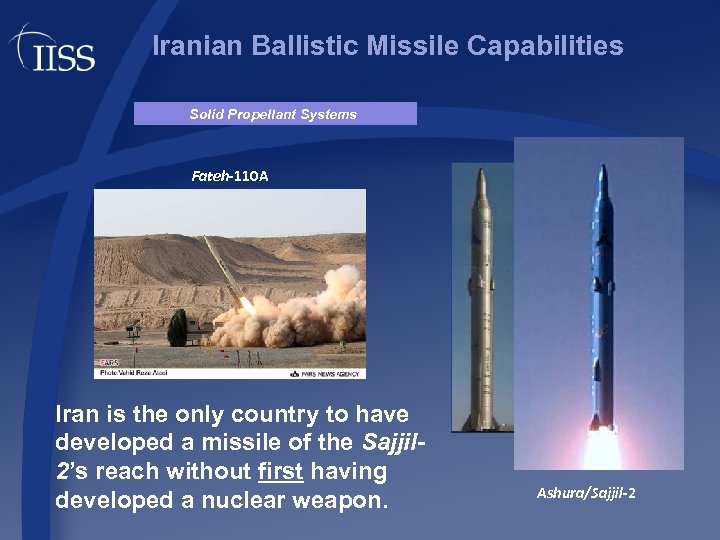
Iranian Ballistic Missile Capabilities Solid Propellant Systems Fateh-110 A Iran is the only country to have developed a missile of the Sajjil 2’s reach without first having developed a nuclear weapon. Ashura/Sajjil-2
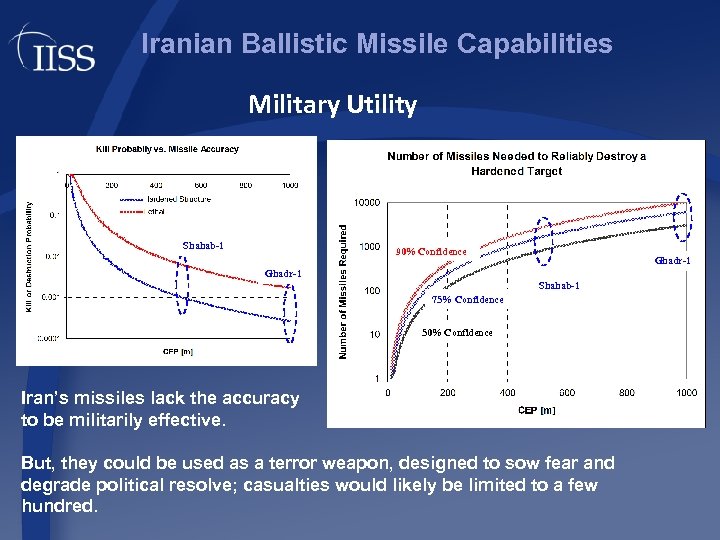
Iranian Ballistic Missile Capabilities Military Utility Shahab-1 90% Confidence Ghadr-1 Shahab-1 75% Confidence 50% Confidence Iran’s missiles lack the accuracy to be militarily effective. But, they could be used as a terror weapon, designed to sow fear and degrade political resolve; casualties would likely be limited to a few hundred.
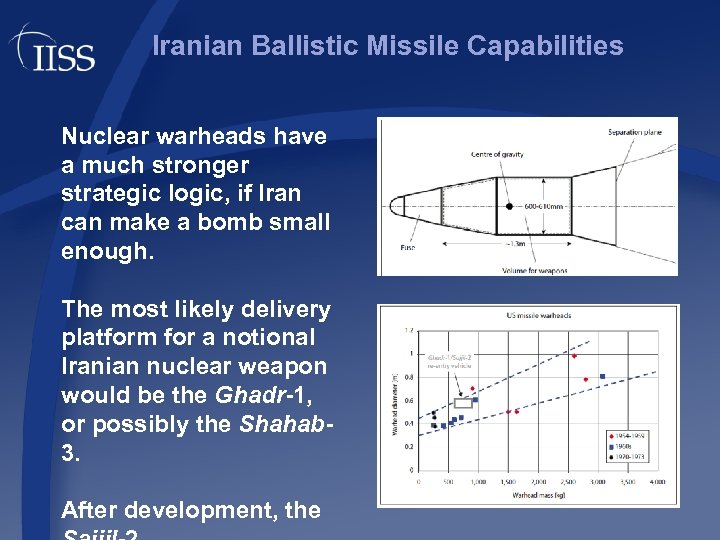
Iranian Ballistic Missile Capabilities Nuclear warheads have a much stronger strategic logic, if Iran can make a bomb small enough. The most likely delivery platform for a notional Iranian nuclear weapon would be the Ghadr-1, or possibly the Shahab 3. After development, the
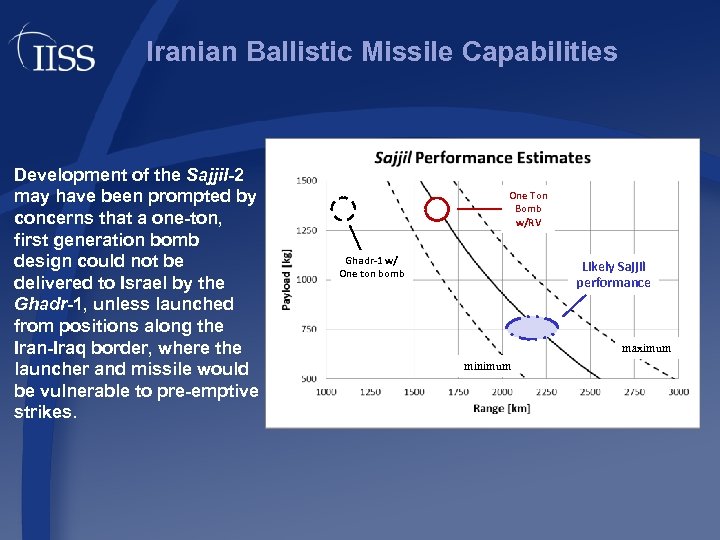
Iranian Ballistic Missile Capabilities Development of the Sajjil-2 may have been prompted by concerns that a one-ton, first generation bomb design could not be delivered to Israel by the Ghadr-1, unless launched from positions along the Iran-Iraq border, where the launcher and missile would be vulnerable to pre-emptive strikes. One Ton Bomb w/RV Ghadr-1 w/ One ton bomb Likely Sajjil performance maximum minimum
Iranian Ballistic Missile Capabilities Status of Iran’s Missile Industries Iran has invested heavily to establish an indigenous production capacity – Considerable success to date; but still dependent on foreign sources for key components, materials and manufacturing equipment – Solid-propellant industries more capable than Liquid-fueled counterparts • Cannot develop new liquid-fueled engine indigenously • Could produce larger solid-propellant motors with minimal foreign assistance Established disciplined, robust engineering management processes which enables future developments – Capable of introducing moderately sophisticated countermeasures Missiles will remain inaccurate
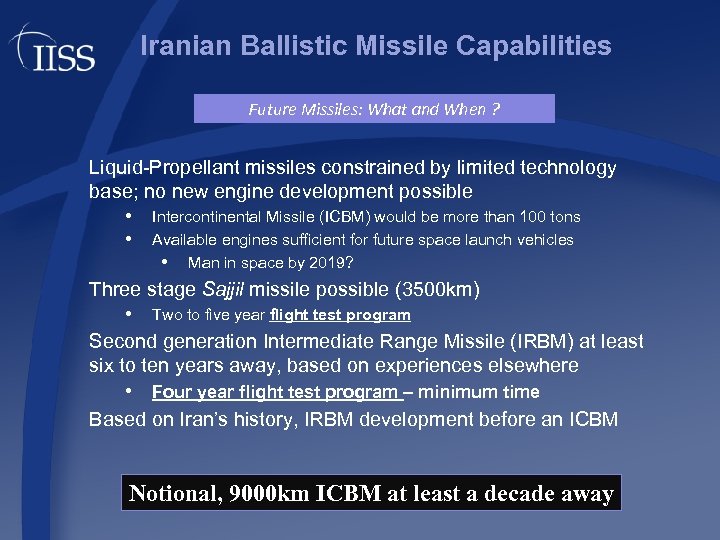
Iranian Ballistic Missile Capabilities Future Missiles: What and When ? Liquid-Propellant missiles constrained by limited technology base; no new engine development possible • Intercontinental Missile (ICBM) would be more than 100 tons • Available engines sufficient for future space launch vehicles • Man in space by 2019? Three stage Sajjil missile possible (3500 km) • Two to five year flight test program Second generation Intermediate Range Missile (IRBM) at least six to ten years away, based on experiences elsewhere • Four year flight test program – minimum time Based on Iran’s history, IRBM development before an ICBM Notional, 9000 km ICBM at least a decade away
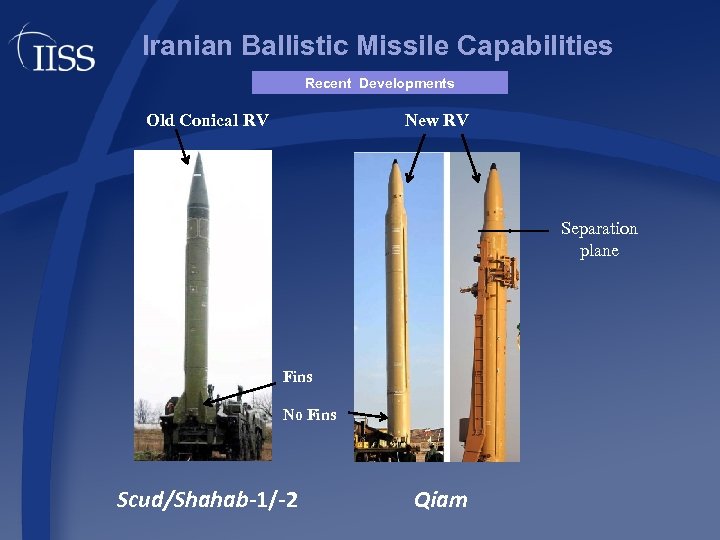
Iranian Ballistic Missile Capabilities Recent Developments Old Conical RV New RV Separation plane Fins No Fins Scud/Shahab-1/-2 Qiam
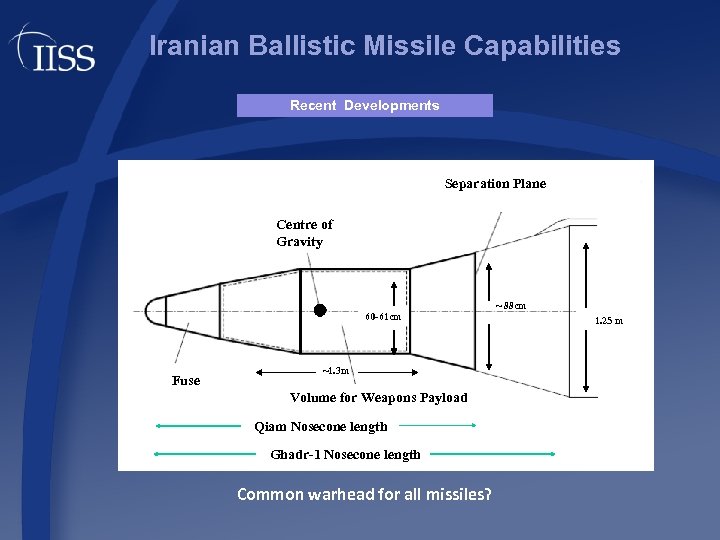
Iranian Ballistic Missile Capabilities Recent Developments Separation Plane Centre of Gravity 60 -61 cm Fuse ~1. 3 m Volume for Weapons Payload Qiam Nosecone length Ghadr-1 Nosecone length Common warhead for all missiles? ~ 88 cm 1. 25 m
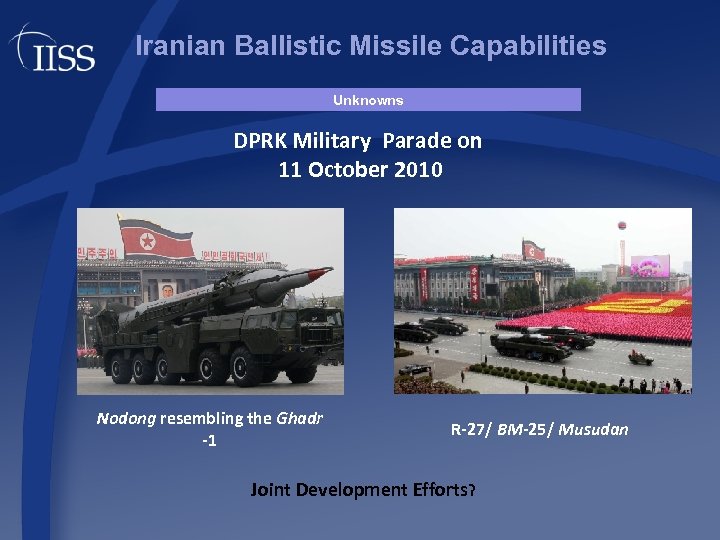
Iranian Ballistic Missile Capabilities Unknowns DPRK Military Parade on 11 October 2010 Nodong resembling the Ghadr -1 R-27/ BM-25/ Musudan Joint Development Efforts?
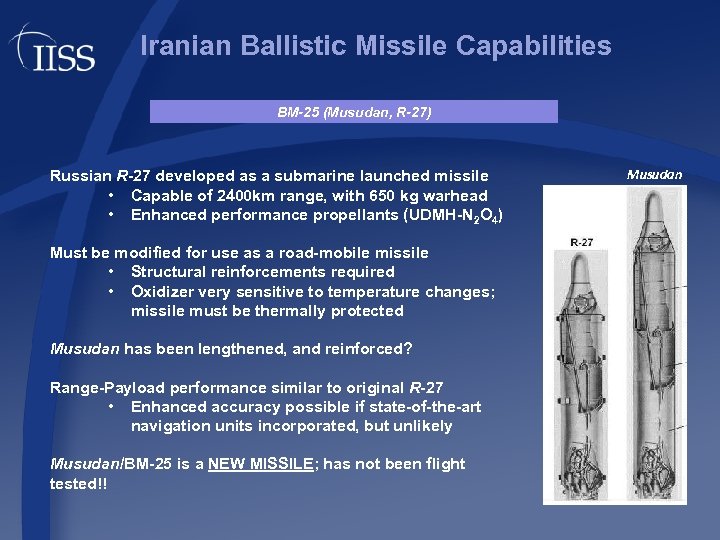
Iranian Ballistic Missile Capabilities BM-25 (Musudan, R-27) Russian R-27 developed as a submarine launched missile • Capable of 2400 km range, with 650 kg warhead • Enhanced performance propellants (UDMH-N 2 O 4) Must be modified for use as a road-mobile missile • Structural reinforcements required • Oxidizer very sensitive to temperature changes; missile must be thermally protected Musudan has been lengthened, and reinforced? Range-Payload performance similar to original R-27 • Enhanced accuracy possible if state-of-the-art navigation units incorporated, but unlikely Musudan/BM-25 is a NEW MISSILE; has not been flight tested!! Musudan
Скачать презентацию Iranian Ballistic Missile Capabilities Michael Elleman Senior Fellow
c13733e7b8e1b276c63978fa7e782a3c.ppt