


 Скачать презентацию Iran Yesterday Tomorrow David Antoš Josef Stráský Karel
9cb358b725941aefd63e8956b5d9154a.ppt
- Количество слайдов: 27
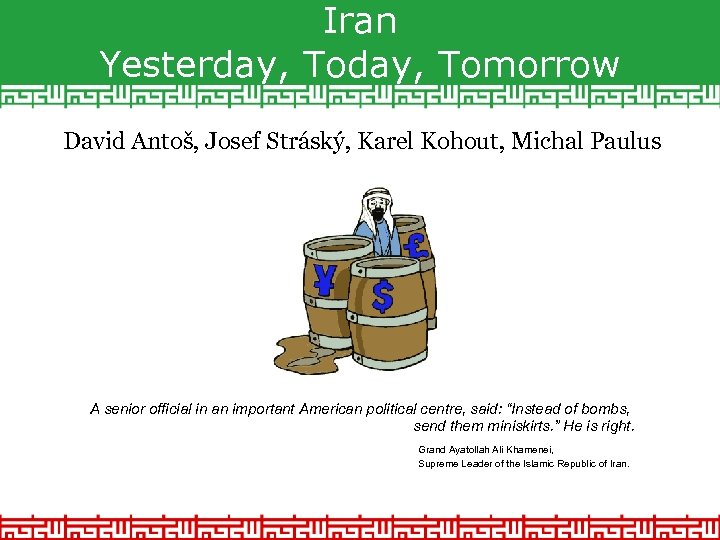 Iran Yesterday, Tomorrow David Antoš, Josef Stráský, Karel Kohout, Michal Paulus A senior official in an important American political centre, said: “Instead of bombs, send them miniskirts. ” He is right. Grand Ayatollah Ali Khamenei, Supreme Leader of the Islamic Republic of Iran.
 Overview Religion situation Recent history Current issues with the „Western world“ reaction Summary
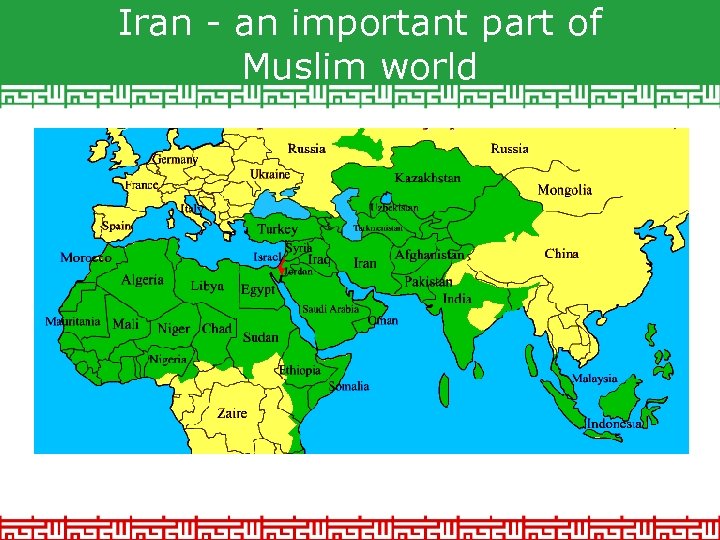 Iran - an important part of Muslim world
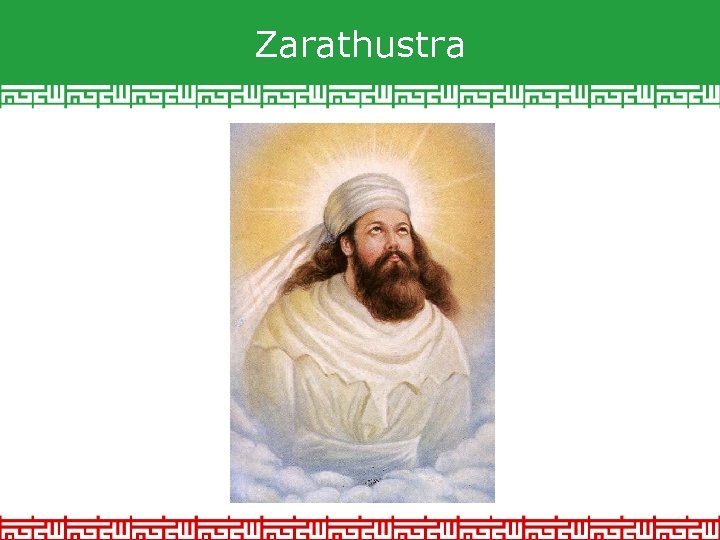 Zarathustra
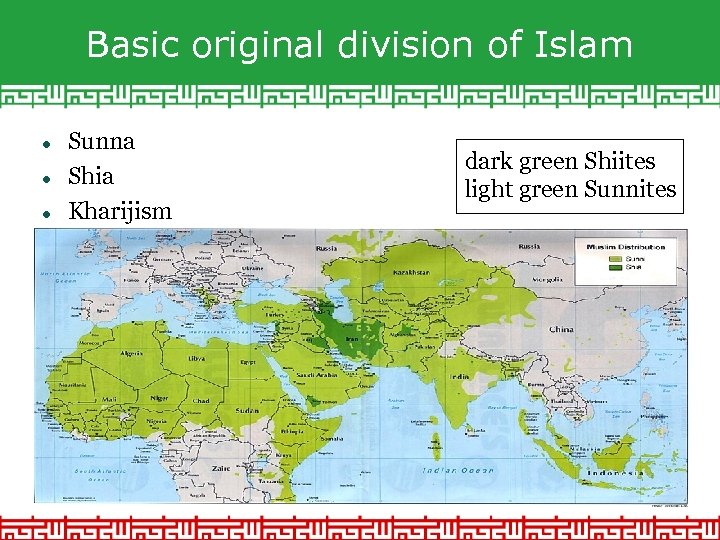 Basic original division of Islam Sunna Shia Kharijism dark green Shiites light green Sunnites
 Potential leaders of Muslim world I Turkey Egypt Saudi Arabia Iran To some extent – Pakistan – Indonesia
 Potential leaders of Muslim world II • Turkey – Westernization • Egypt – economic situation • Saudi Arabia – small population • Iran – different religion and ethnicity • Pakistan – distance • Indonesia – distance
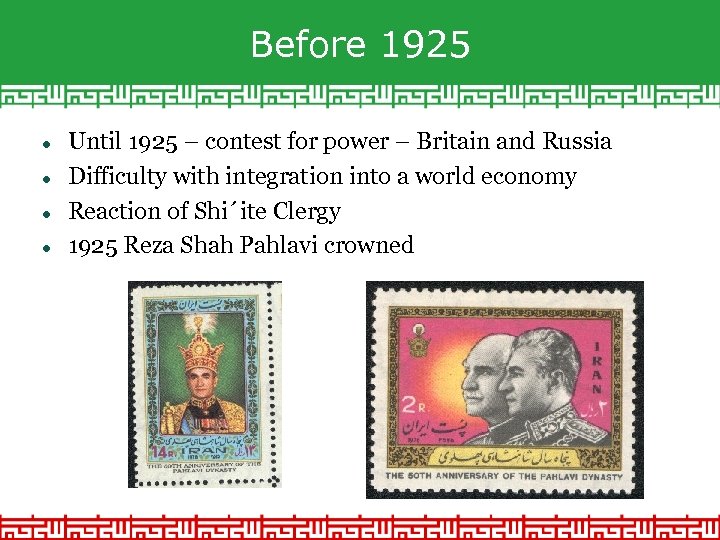 Before 1925 Until 1925 – contest for power – Britain and Russia Difficulty with integration into a world economy Reaction of Shi´ite Clergy 1925 Reza Shah Pahlavi crowned
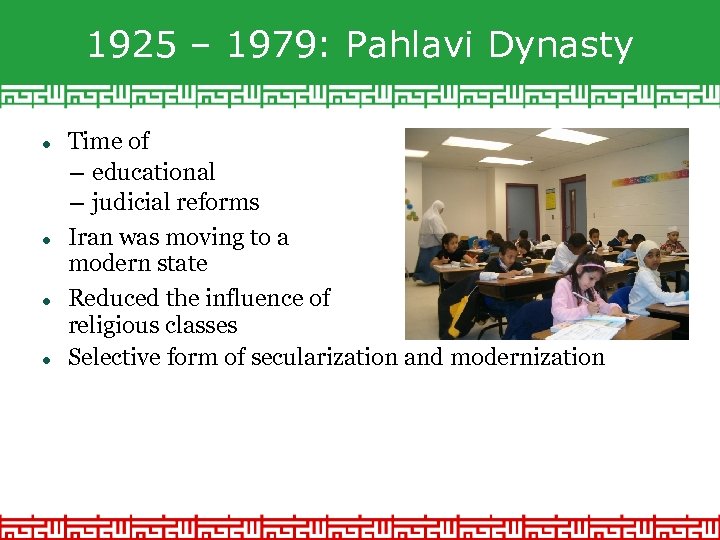 1925 – 1979: Pahlavi Dynasty Time of – educational – judicial reforms Iran was moving to a modern state Reduced the influence of religious classes Selective form of secularization and modernization
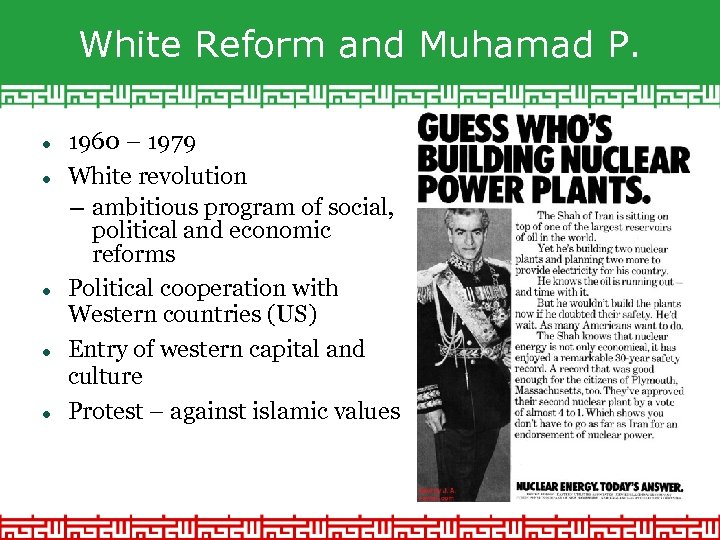 White Reform and Muhamad P. 1960 – 1979 White revolution – ambitious program of social, political and economic reforms Political cooperation with Western countries (US) Entry of western capital and culture Protest – against islamic values
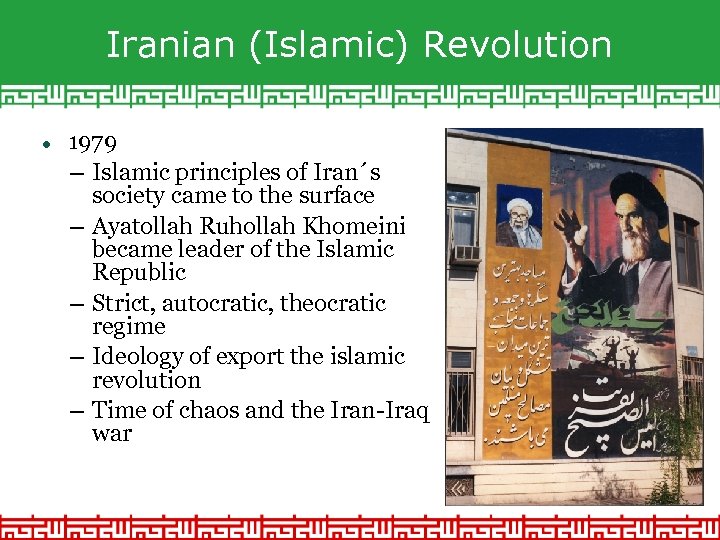 Iranian (Islamic) Revolution 1979 – Islamic principles of Iran´s society came to the surface – Ayatollah Ruhollah Khomeini became leader of the Islamic Republic – Strict, autocratic, theocratic regime – Ideology of export the islamic revolution – Time of chaos and the Iran-Iraq war
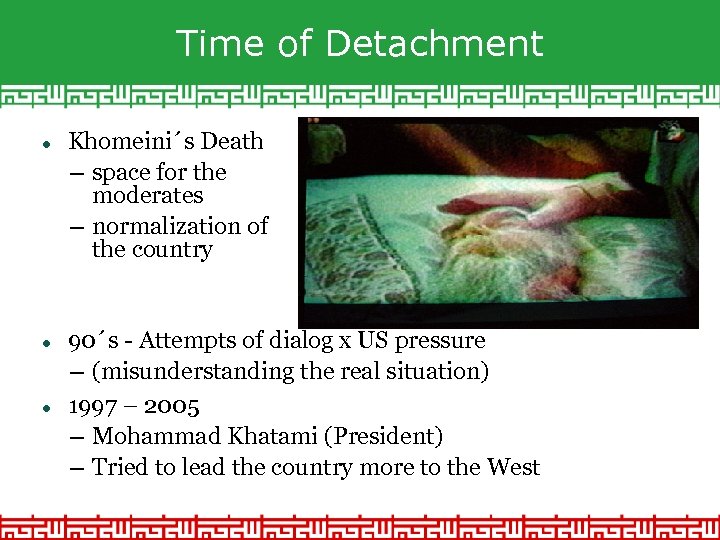 Time of Detachment Khomeini´s Death – space for the moderates – normalization of the country 90´s - Attempts of dialog x US pressure – (misunderstanding the real situation) 1997 – 2005 – Mohammad Khatami (President) – Tried to lead the country more to the West
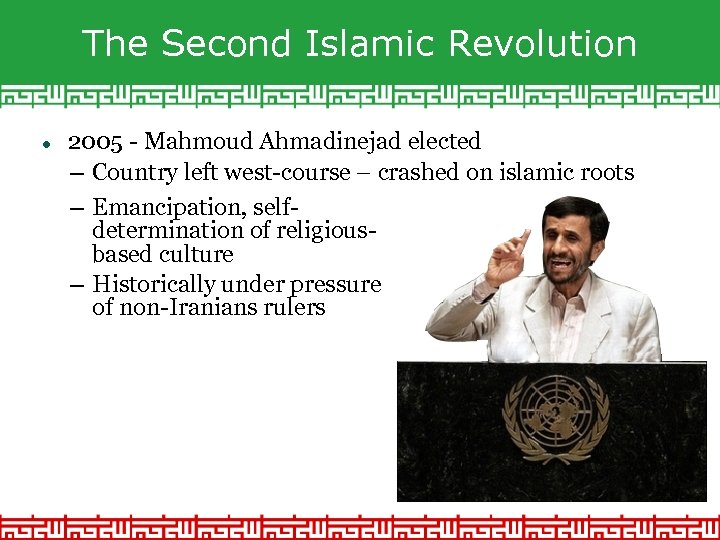 The Second Islamic Revolution 2005 - Mahmoud Ahmadinejad elected – Country left west-course – crashed on islamic roots – Emancipation, selfdetermination of religiousbased culture – Historically under pressure of non-Iranians rulers
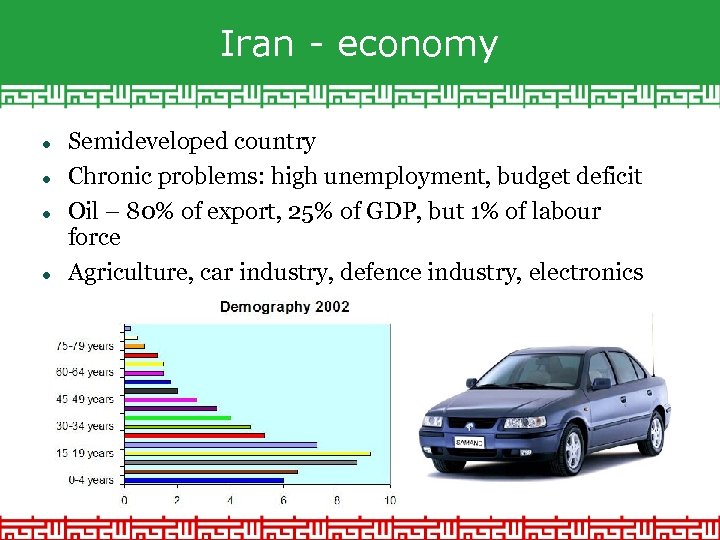 Iran - economy Semideveloped country Chronic problems: high unemployment, budget deficit Oil – 80% of export, 25% of GDP, but 1% of labour force Agriculture, car industry, defence industry, electronics
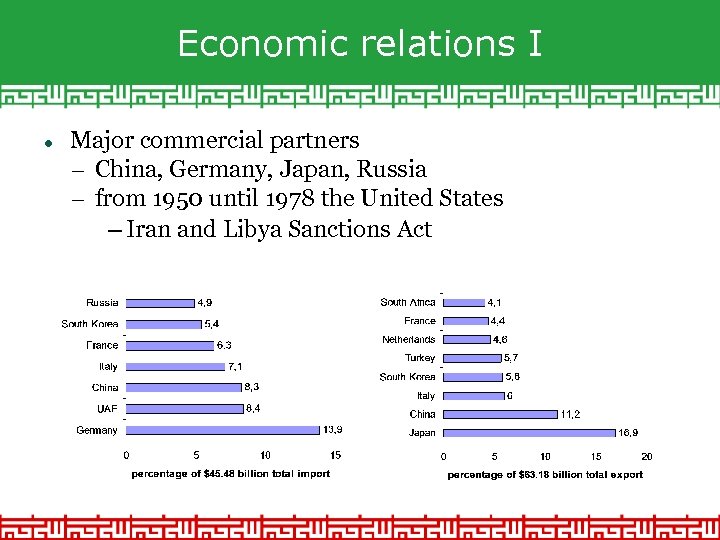 Economic relations I Major commercial partners – China, Germany, Japan, Russia – from 1950 until 1978 the United States – Iran and Libya Sanctions Act
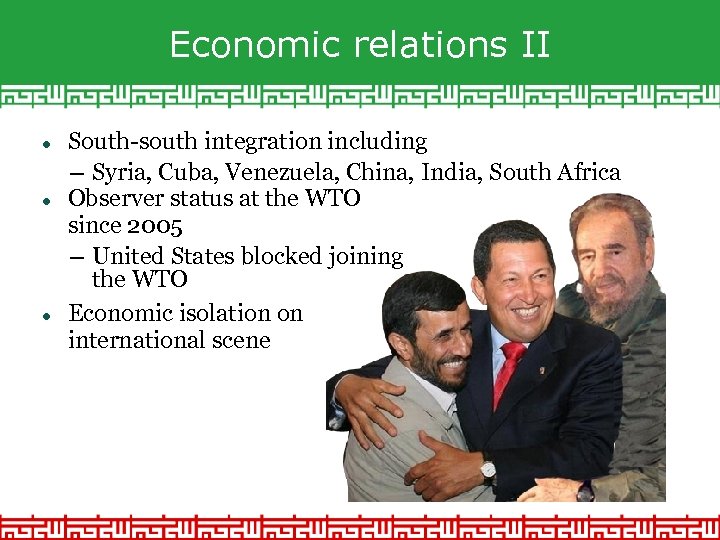 Economic relations II South-south integration including – Syria, Cuba, Venezuela, China, India, South Africa Observer status at the WTO since 2005 – United States blocked joining the WTO Economic isolation on international scene
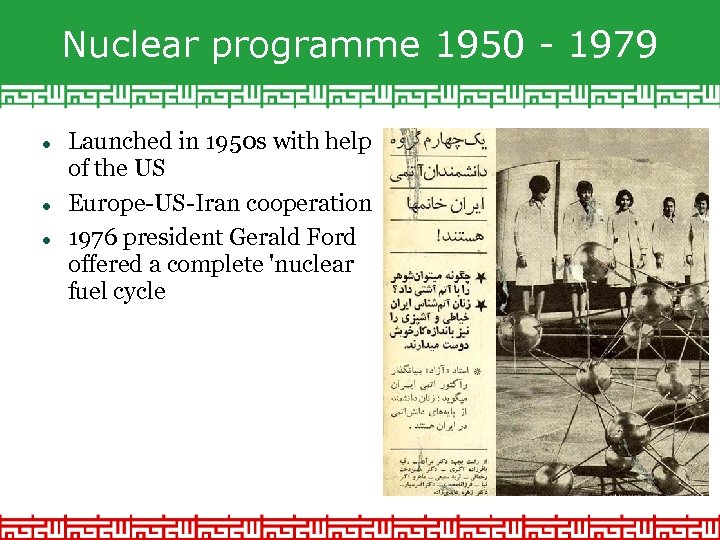 Nuclear programme 1950 - 1979 Launched in 1950 s with help of the US Europe-US-Iran cooperation 1976 president Gerald Ford offered a complete 'nuclear fuel cycle
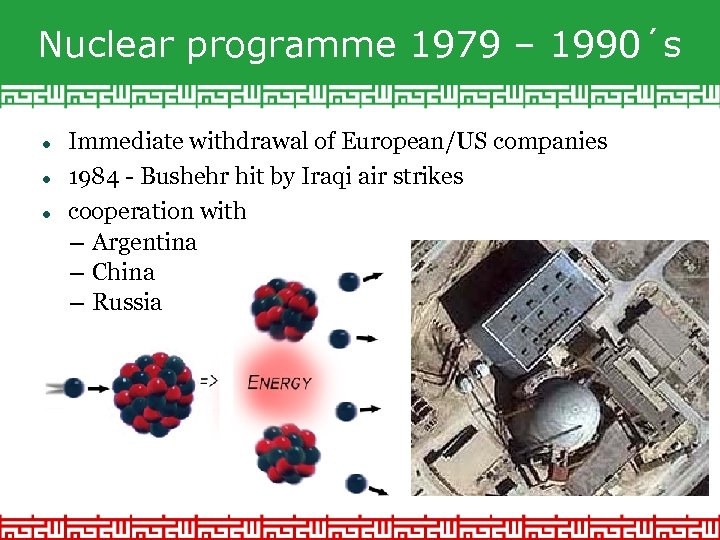 Nuclear programme 1979 – 1990´s Immediate withdrawal of European/US companies 1984 - Bushehr hit by Iraqi air strikes cooperation with – Argentina – China – Russia
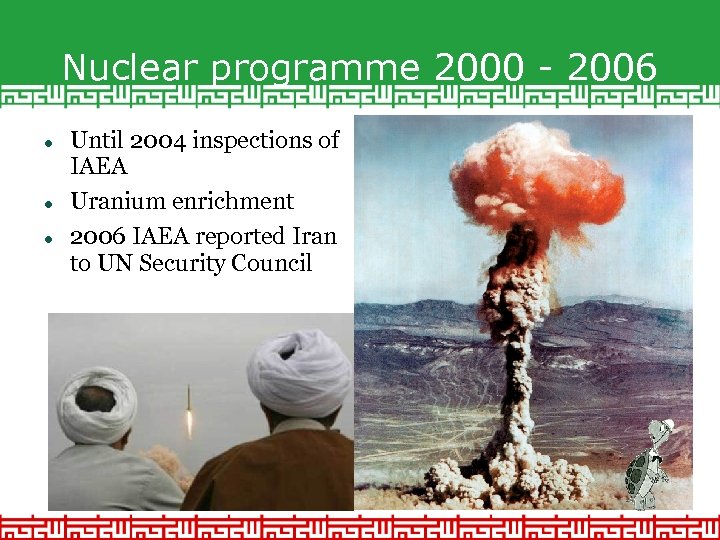 Nuclear programme 2000 - 2006 Until 2004 inspections of IAEA Uranium enrichment 2006 IAEA reported Iran to UN Security Council
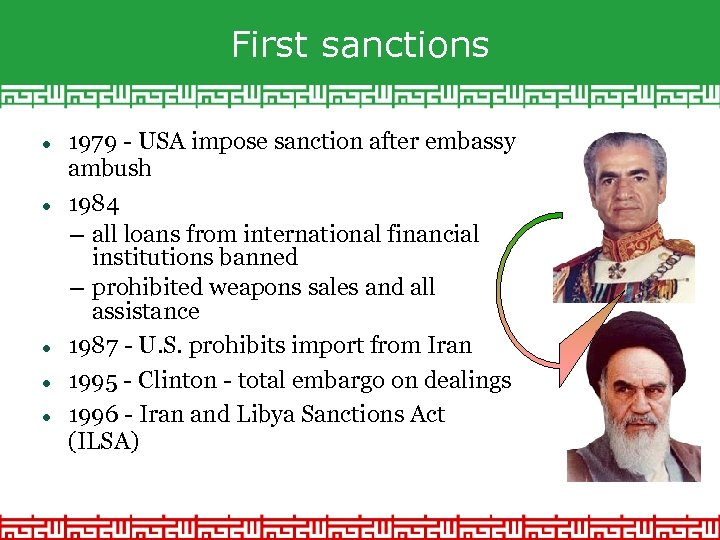 First sanctions 1979 - USA impose sanction after embassy ambush 1984 – all loans from international financial institutions banned – prohibited weapons sales and all assistance 1987 - U. S. prohibits import from Iran 1995 - Clinton - total embargo on dealings 1996 - Iran and Libya Sanctions Act (ILSA)
 Sanctions (continued) Iran and Libya Sanctions Act of 1996 (ILSA) denial of Export-Import Bank assistance loans over 10 mil. USD prohibited denial of export licenses to the violating company, ban on imports of the violating company 2004 scientific isolation 2006 Iranian bank is barred from dealing with financial institutions . . . ?
 UN sanctions Recent event 2006 -12 -23 UN Security Council Resolution 1737 Imposed because of uranium enrichment program Freezing assets of companies involved in nuclear and ballistic missile programmes Cannot be enforced militarily 2007 -4 -24 UN Security Council Resolution 1747 Tightens the sanctions Bans arms sales Steps up the freeze on assets
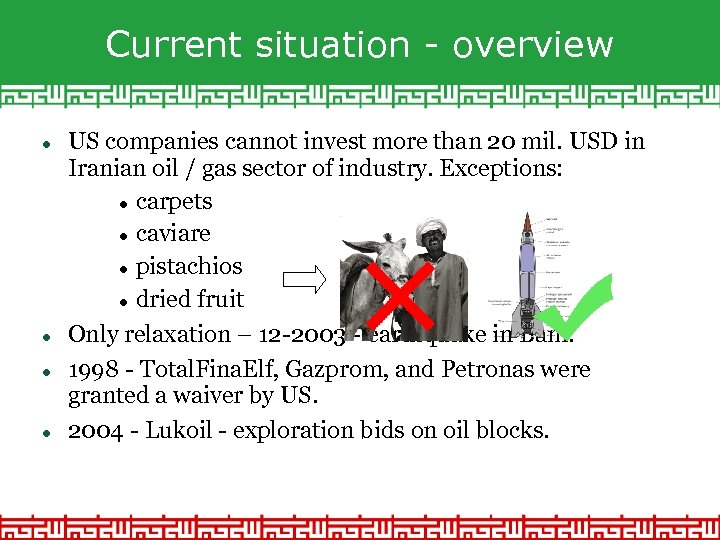 Current situation - overview US companies cannot invest more than 20 mil. USD in Iranian oil / gas sector of industry. Exceptions: carpets caviare pistachios dried fruit Only relaxation – 12 -2003 - earthquake in Bam. 1998 - Total. Fina. Elf, Gazprom, and Petronas were granted a waiver by US. 2004 - Lukoil - exploration bids on oil blocks.
 Effects of sanctions Iran is relatively unharmed (supplies of oil) Industry - similar to that during socialism in Eastern Europe R&D dependant sectors – e. g pharmaceutics – 95% Iranian-only production Possible second oil market – with Euros instead of USD
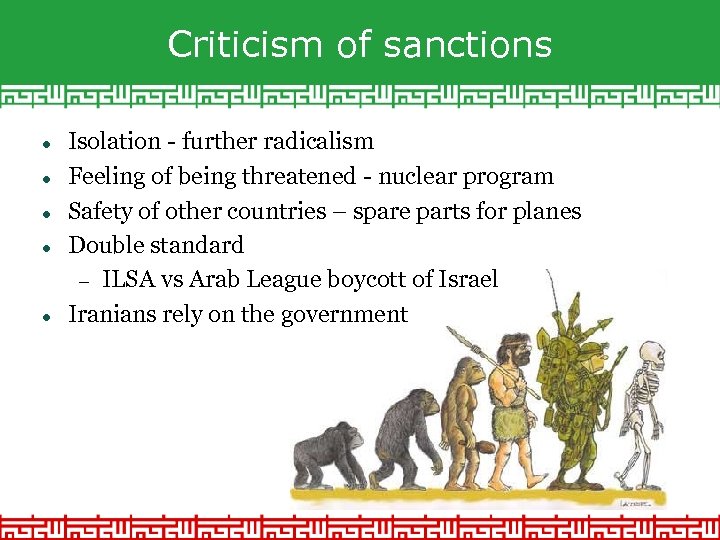 Criticism of sanctions Isolation - further radicalism Feeling of being threatened - nuclear program Safety of other countries – spare parts for planes Double standard ILSA vs Arab League boycott of Israel Iranians rely on the government
 Further information Interesting blog: – ahmadinejad. ir “Kateřina xxx Dear Mr. Ahmadinejad. Your blog is wonderful!! I want to tell you, that you are good president. Dont believe, that people in Europe are against Iran and you. Most people are with you, but our government are against, cos they are bus-boys of USA. I support you, you ideas are good. I with you. Good luck. ”
 Verdana 36 Georgia 24 – Georgia 24 • Georgia 24 Zelený rám nahoře přesahuje snímek, záměrně, blok nadpisu je roztažený od horního okraje stránky po začátek zelených ornamentů Červený rám je viditelný pouze po konec ornamentů Rám s textem je 1, 52 cm vodorovně od levého horního okraje, 4, 5 cm svisle od levého horního