


 Скачать презентацию Iran Islamic Fundamentalism The Khomeini Revolution
7d9a500e7d1ee948967a7b47da1b0870.ppt
- Количество слайдов: 104
 Iran Islamic Fundamentalism
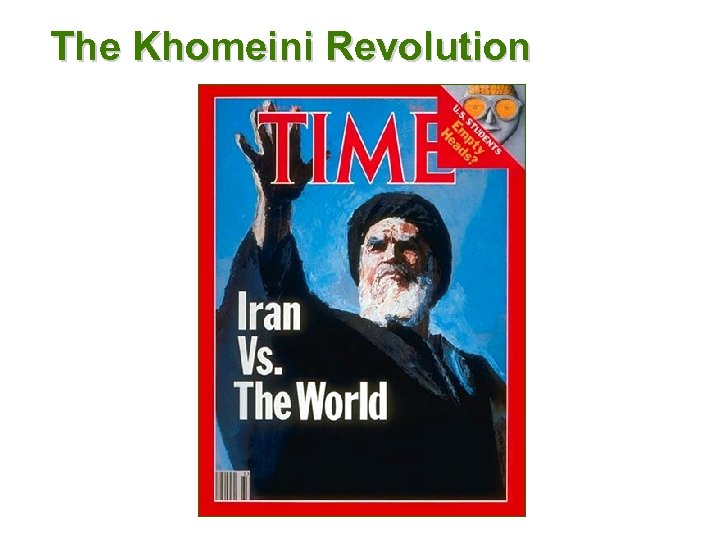 The Khomeini Revolution
 Current Policy Challenges § Iran is the first country in which Islamists have had to deliver on the promises of a society characterized by social justice and moral propriety. § During the first decade of the Islamic Republic § Some redistribution of wealth § New leadership came mostly from humble or middle-class backgrounds and adopted populist policies that somewhat bettered the lot of the poorest. § § Rural development Health Women’s education Roads § Poverty, inequality, and underemployment continue to be major public grievances.
 Current Policy Challenges § Job creation has been very inadequate. § Need to increase economic output. § Population grows by one million a year. § Discontent spurred out migration from the country § One in four Iranians with higher education live abroad § Subsequently, Iranians often have family abroad in the U. S. , Canada, and Europe § Corruption § Dissatisfaction with the status quo among some of Iran’s ethnic minorities
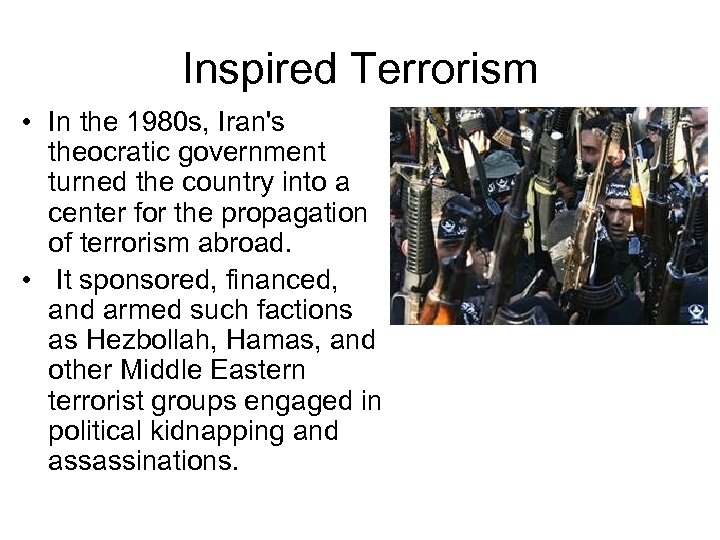 Inspired Terrorism • In the 1980 s, Iran's theocratic government turned the country into a center for the propagation of terrorism abroad. • It sponsored, financed, and armed such factions as Hezbollah, Hamas, and other Middle Eastern terrorist groups engaged in political kidnapping and assassinations.
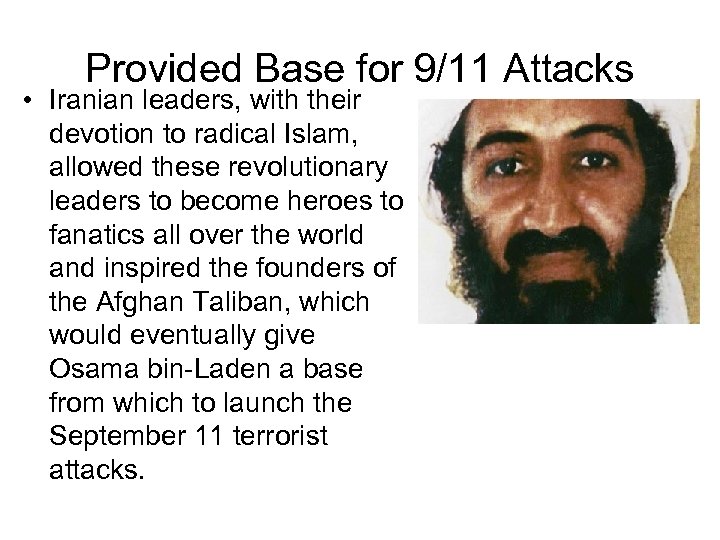 Provided Base for 9/11 Attacks • Iranian leaders, with their devotion to radical Islam, allowed these revolutionary leaders to become heroes to fanatics all over the world and inspired the founders of the Afghan Taliban, which would eventually give Osama bin-Laden a base from which to launch the September 11 terrorist attacks.
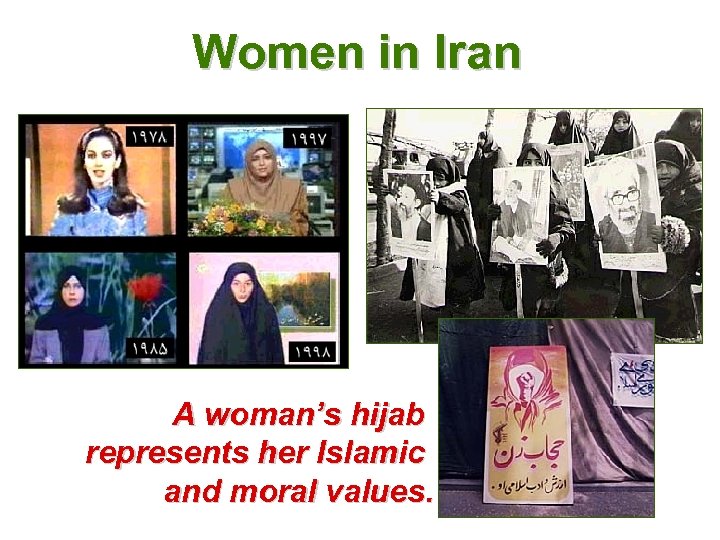 Women in Iran A woman’s hijab represents her Islamic and moral values.
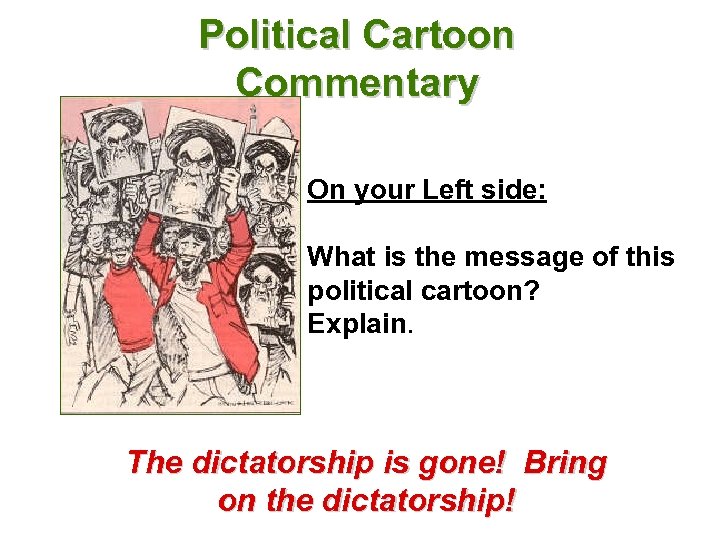 Political Cartoon Commentary On your Left side: What is the message of this political cartoon? Explain. The dictatorship is gone! Bring on the dictatorship!
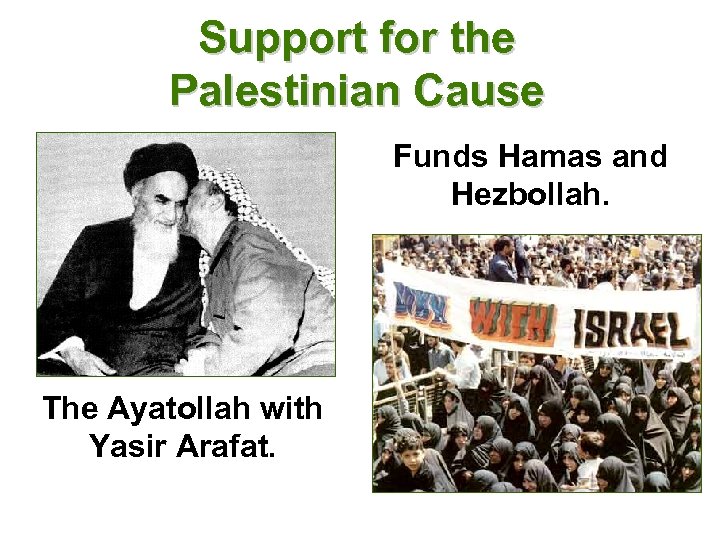 Support for the Palestinian Cause Funds Hamas and Hezbollah. The Ayatollah with Yasir Arafat.
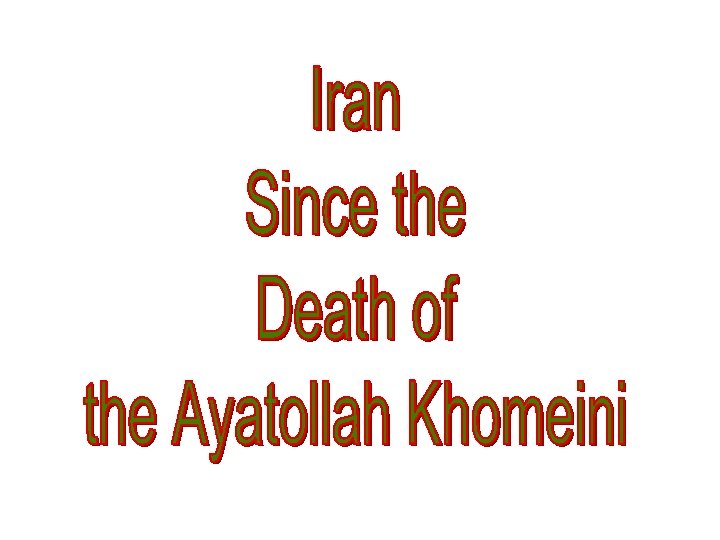
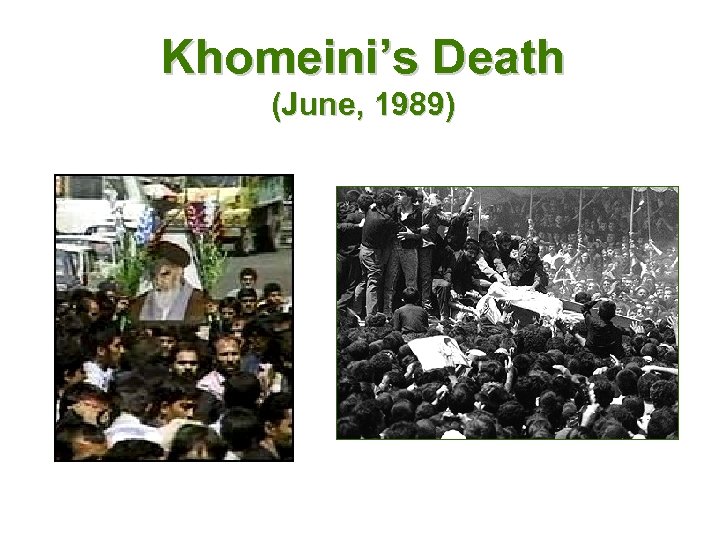 Khomeini’s Death (June, 1989)
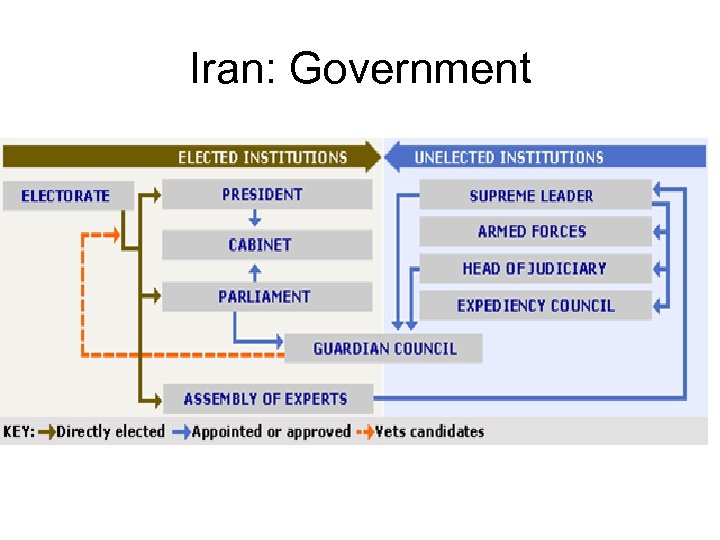 Iran: Government
 Institutions of the Islamic Republic § Multiple power centers § Leader § Highest authority in the Islamic Republic § Combines religious and temporal authority § Assembly of Experts § Choose the Leader § President § Elected by universal suffrage every four years § Must be a Twelver Shiite and a male; does not have to be a cleric
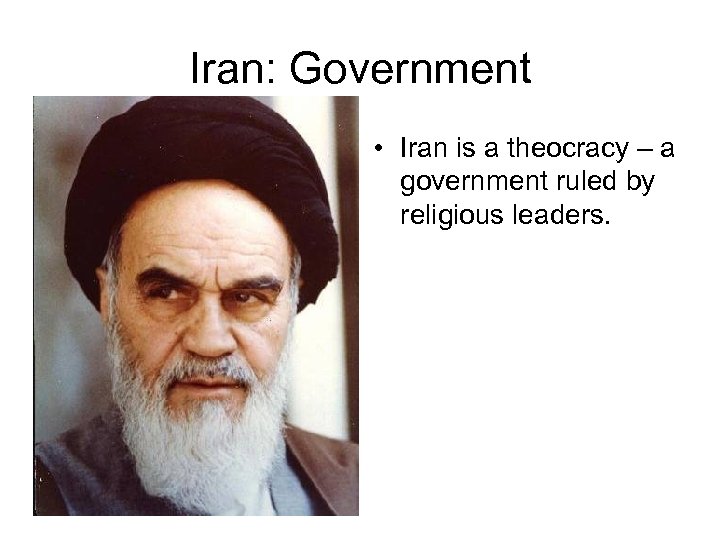 Iran: Government • Iran is a theocracy – a government ruled by religious leaders.
 Background: Islamic Republic of Iran § World’s only theocracy § A form of government in which ideally all laws are grounded in religion and express the will of God, and the clergy exercises supreme power
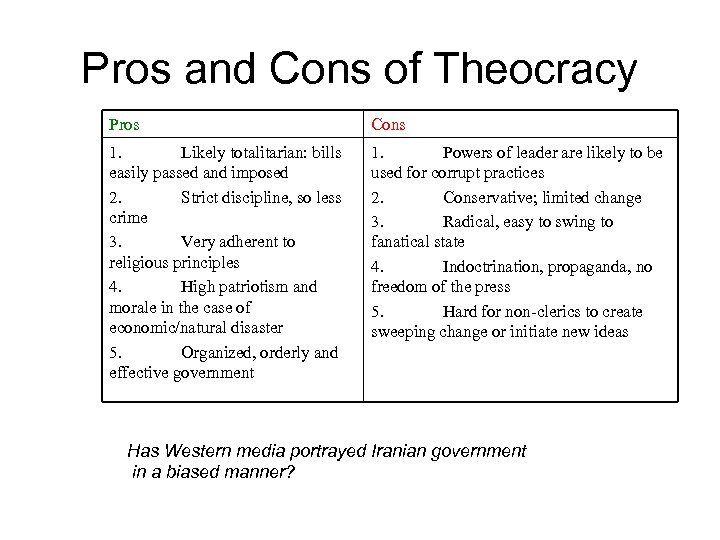 Pros and Cons of Theocracy Pros Cons 1. Likely totalitarian: bills easily passed and imposed 2. Strict discipline, so less crime 3. Very adherent to religious principles 4. High patriotism and morale in the case of economic/natural disaster 5. Organized, orderly and effective government 1. Powers of leader are likely to be used for corrupt practices 2. Conservative; limited change 3. Radical, easy to swing to fanatical state 4. Indoctrination, propaganda, no freedom of the press 5. Hard for non-clerics to create sweeping change or initiate new ideas Has Western media portrayed Iranian government in a biased manner?
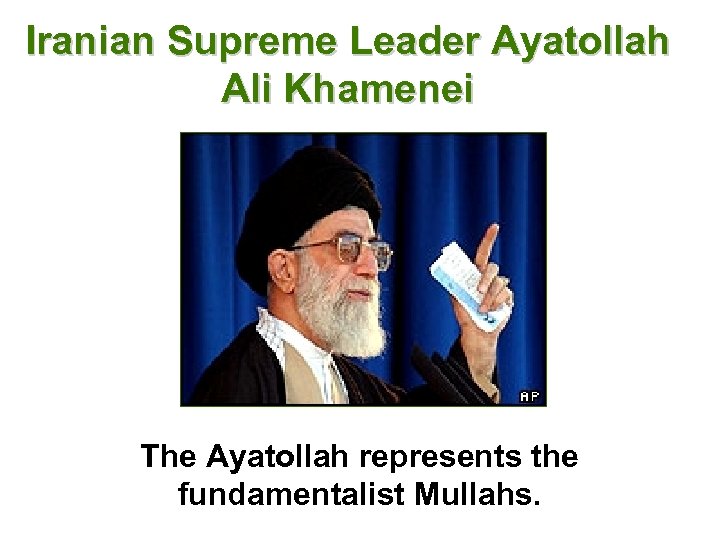 Iranian Supreme Leader Ayatollah Ali Khamenei The Ayatollah represents the fundamentalist Mullahs.
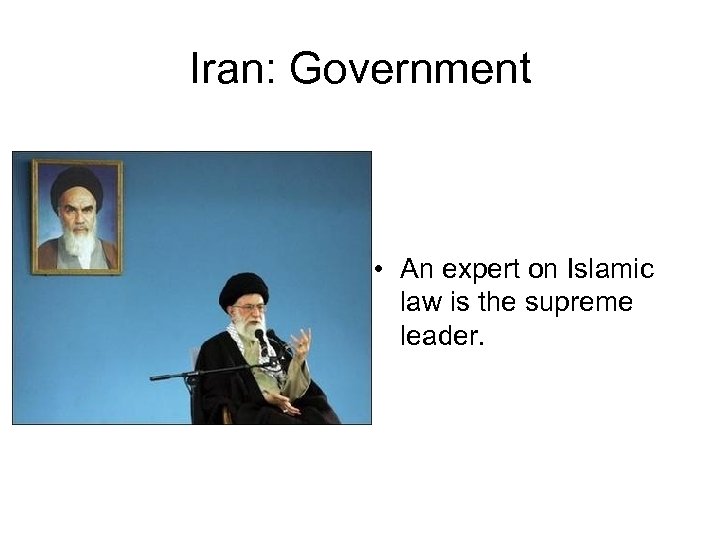 Iran: Government • An expert on Islamic law is the supreme leader.
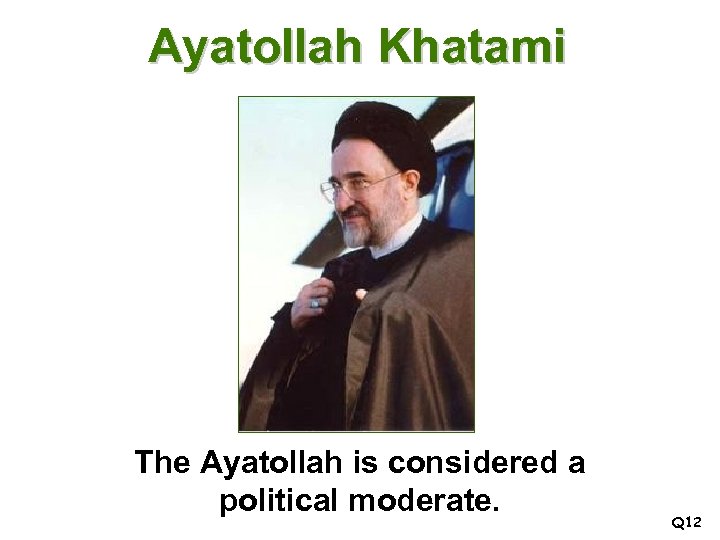 Ayatollah Khatami The Ayatollah is considered a political moderate. Q 12
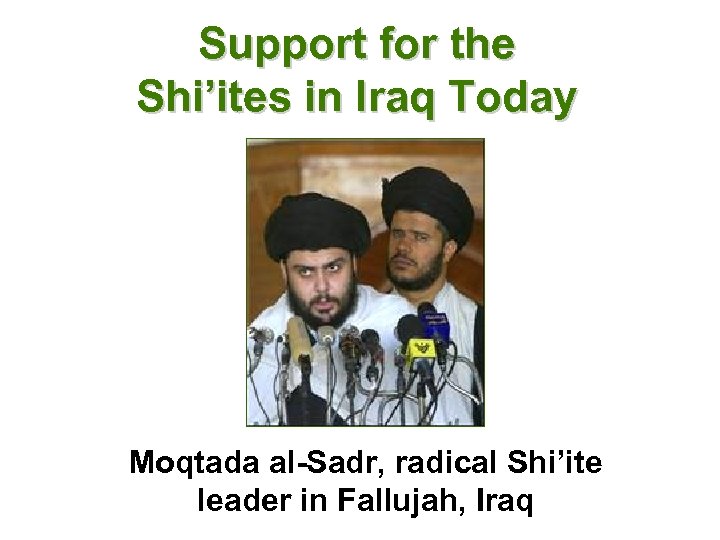 Support for the Shi’ites in Iraq Today Moqtada al-Sadr, radical Shi’ite leader in Fallujah, Iraq
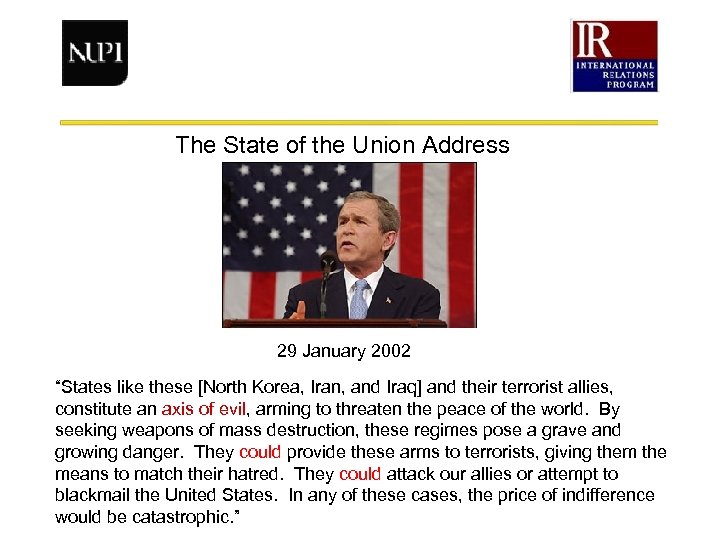 The State of the Union Address 29 January 2002 “States like these [North Korea, Iran, and Iraq] and their terrorist allies, constitute an axis of evil, arming to threaten the peace of the world. By seeking weapons of mass destruction, these regimes pose a grave and growing danger. They could provide these arms to terrorists, giving them the means to match their hatred. They could attack our allies or attempt to blackmail the United States. In any of these cases, the price of indifference would be catastrophic. ”
 Iranian Relations with Western Nations • Today there are no formal diplomatic relations between Iran and The US • Do not exchange ambassadors -Iran maintains an interests section at the Pakistani embassy in Washington D. C -US maintains an interests section at the Swiss embassy in Tehran
 Hostility • Hostility begins after the 1979 Iranian Revolution • US fears that Iran is developing nuclear weapons shortly after the Revolution • 1995 -the United States starts an embargo on trade with Iran • US District court judge says that the Iran was responsible for the 1983 attack on US Embassy • US Fed court finds Khobar Towers bombing was authorized by Ali Khomeini -Ayatollah of Iran • United States attack of 1988 -United States launched Operation Praying Mantis against Iran -Largest American naval combat operation since World War II
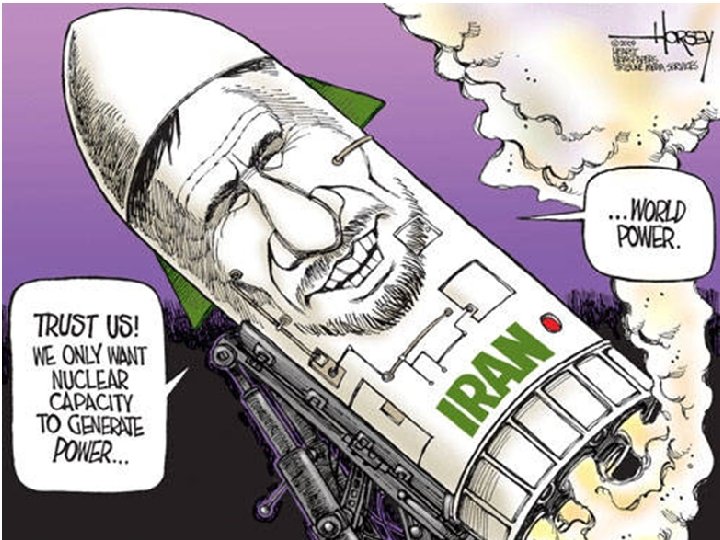
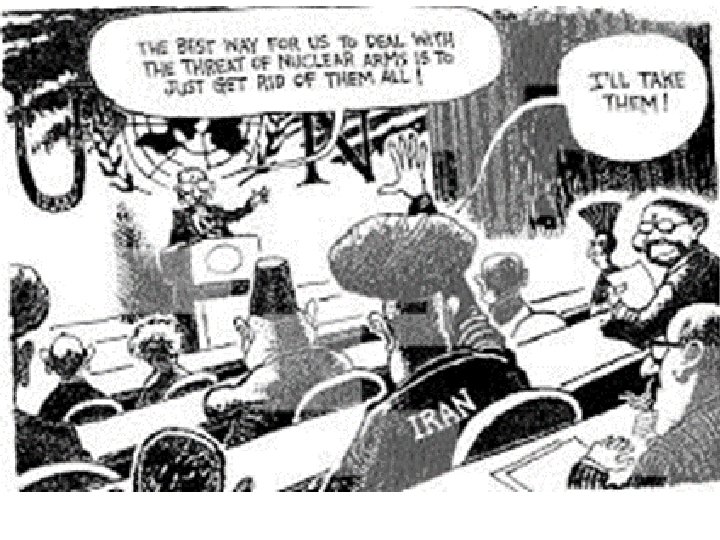
 Iranian Nuclear Program • Since 2003 the US has alleged that Iran has a program to develop nuclear weapons • Iran says that its nuclear program is only to generate electricity • Both US and Iran are members of NPT -US and other countries in violation for not disarming -Iran in violation for not reporting nuclear material to IAEA • March 8 2006 -US and European countries call on Security Council of UN to act against Iran
 Brief Iran Nuclear Program History • Atoms for Peace program • Iranian Revolution – Iraq war • Iran Program 2000 – present – In 2003 President Mohammad Khatami announcement of building sophisticated facilities at Natanz and other places – EU-3 • Pushing Iran to sign the Additional Protocols • Paris Agreement – In 2006 Iran reduces inspection rights of IAEA – Sanctions
 Political Culture • Authoritarianism (not totalitarianism) – leaders claim to be all powerful, but do not interfere with every aspect of the citizens lives • Union of political & religious authority • Shi’ism & Sharia – key components of everyday life • Geographic Limitations – limited arable land forced expansion through military conquest, population of Iran unevenly distributed in cities and northwestern part of country • Influence of Ancient Persia and colonial past
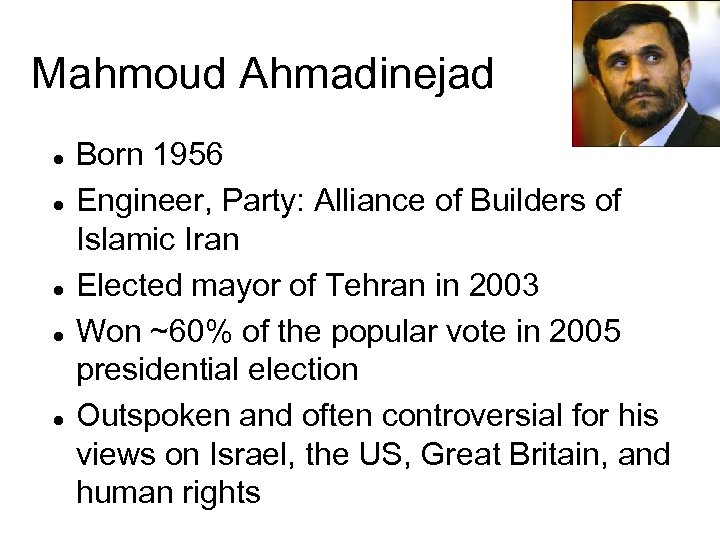 Mahmoud Ahmadinejad Born 1956 Engineer, Party: Alliance of Builders of Islamic Iran Elected mayor of Tehran in 2003 Won ~60% of the popular vote in 2005 presidential election Outspoken and often controversial for his views on Israel, the US, Great Britain, and human rights
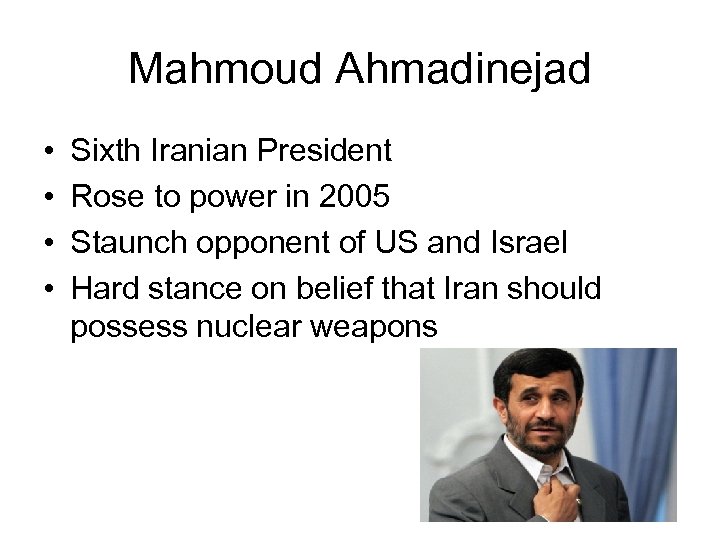 Mahmoud Ahmadinejad • • Sixth Iranian President Rose to power in 2005 Staunch opponent of US and Israel Hard stance on belief that Iran should possess nuclear weapons
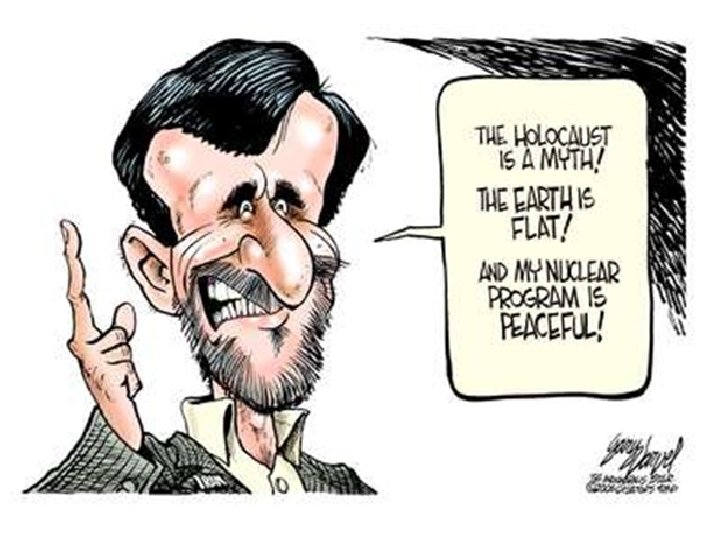
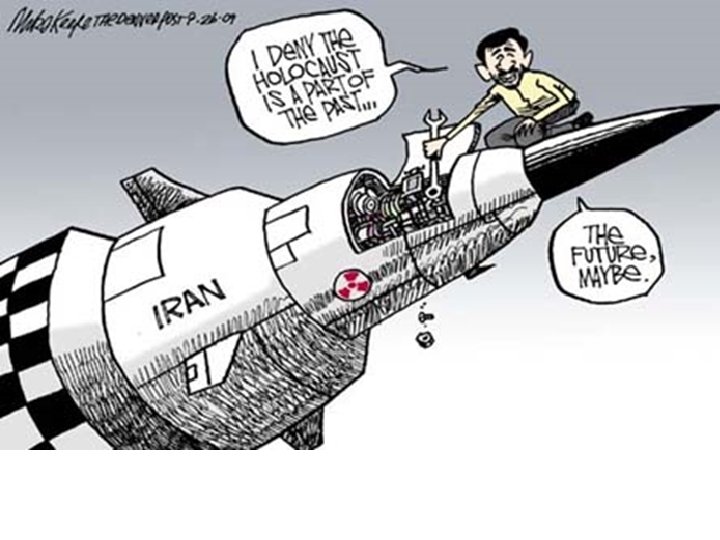
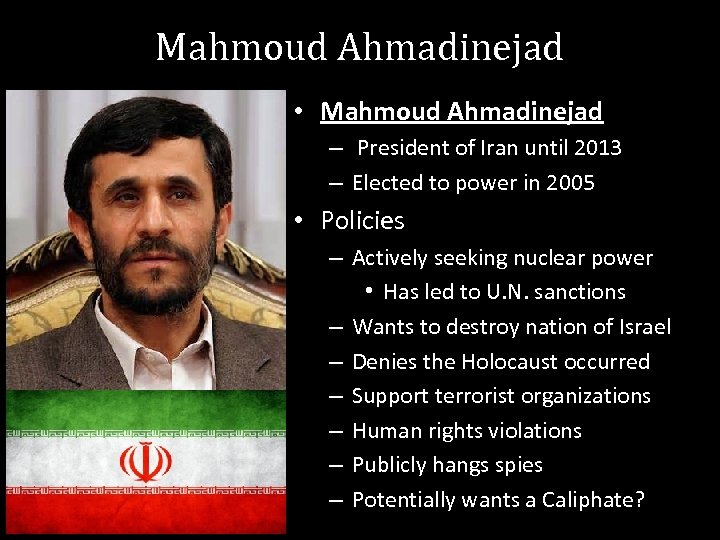 Mahmoud Ahmadinejad • Mahmoud Ahmadinejad – President of Iran until 2013 – Elected to power in 2005 • Policies – Actively seeking nuclear power • Has led to U. N. sanctions – Wants to destroy nation of Israel – Denies the Holocaust occurred – Support terrorist organizations – Human rights violations – Publicly hangs spies – Potentially wants a Caliphate?
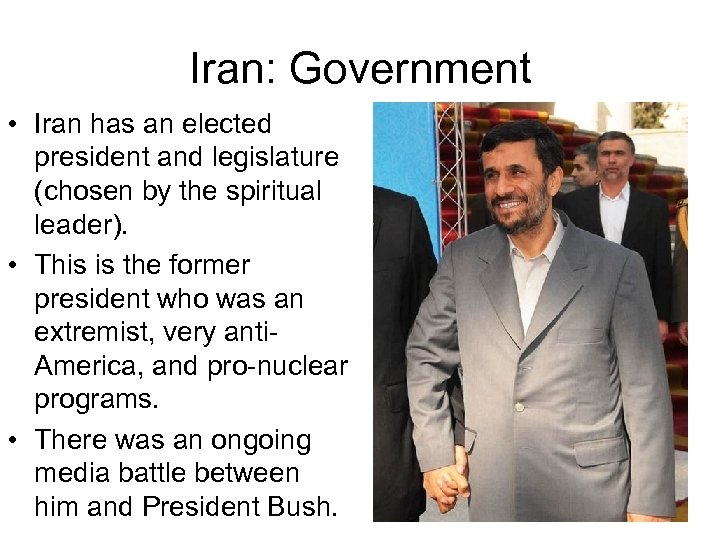 Iran: Government • Iran has an elected president and legislature (chosen by the spiritual leader). • This is the former president who was an extremist, very anti. America, and pro-nuclear programs. • There was an ongoing media battle between him and President Bush.
 Iran vs. Israel Today
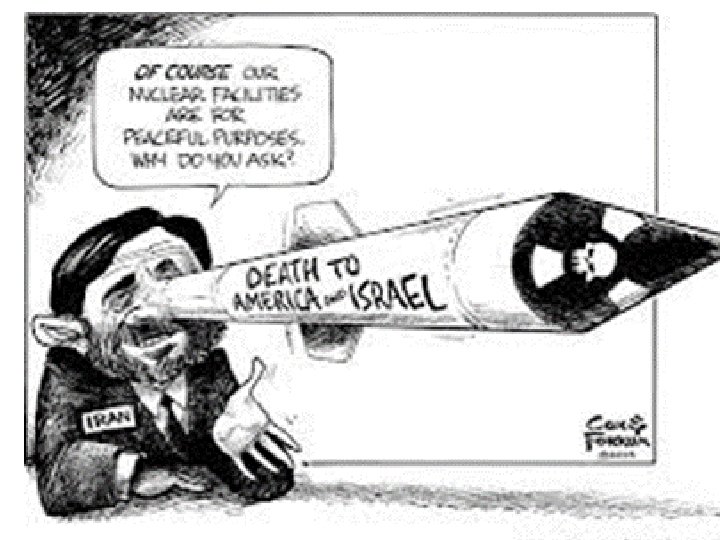
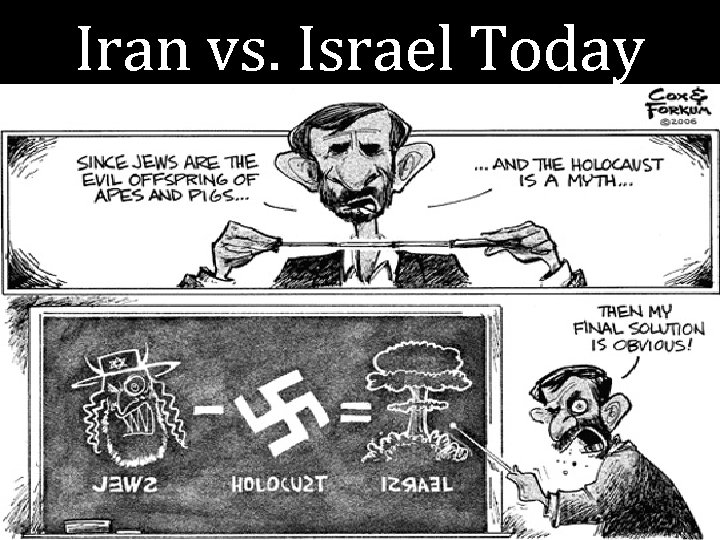
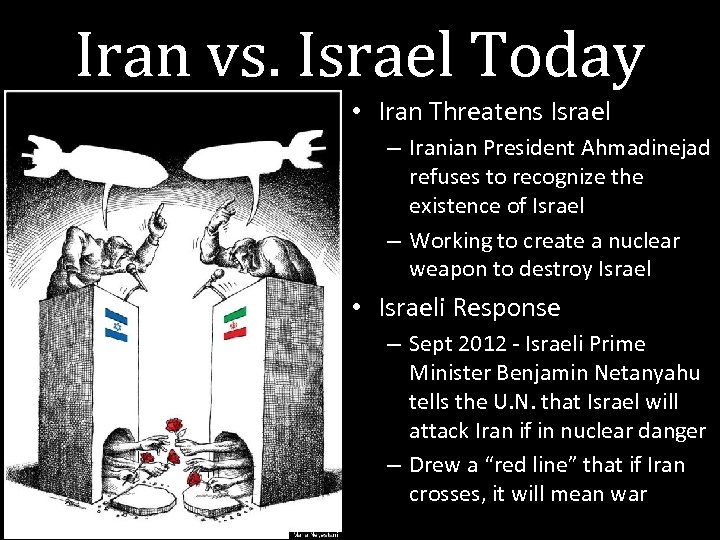 Iran vs. Israel Today • Iran Threatens Israel – Iranian President Ahmadinejad refuses to recognize the existence of Israel – Working to create a nuclear weapon to destroy Israel • Israeli Response – Sept 2012 - Israeli Prime Minister Benjamin Netanyahu tells the U. N. that Israel will attack Iran if in nuclear danger – Drew a “red line” that if Iran crosses, it will mean war
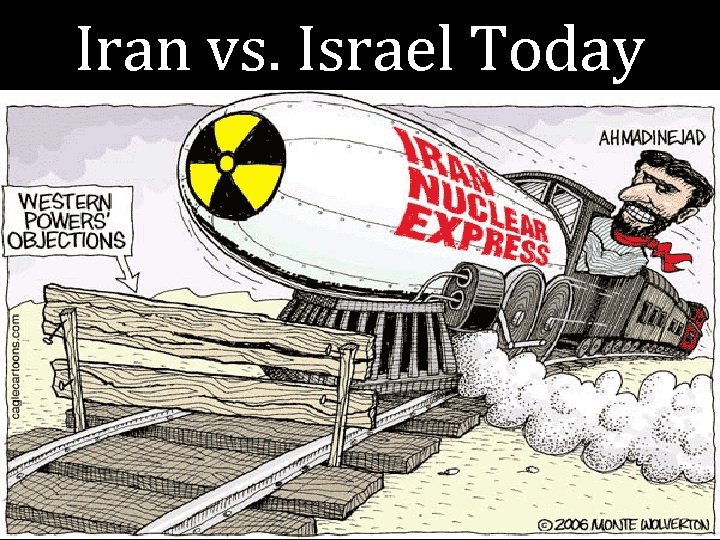 Iran vs. Israel Today
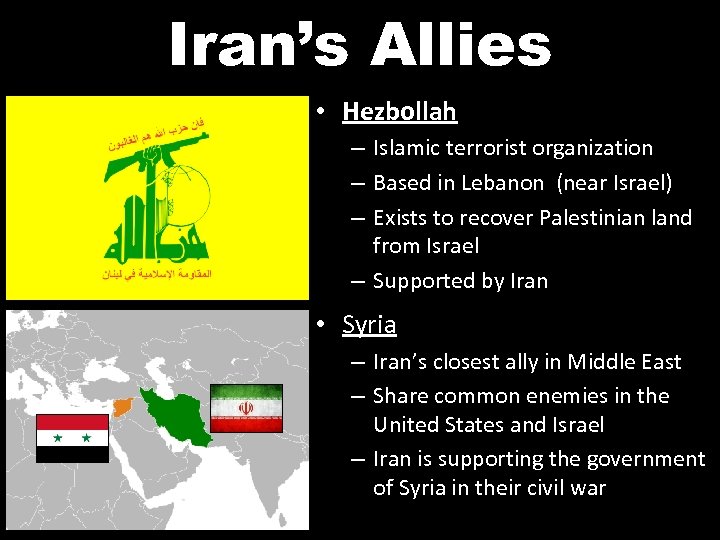 Iran’s Allies • Hezbollah – Islamic terrorist organization – Based in Lebanon (near Israel) – Exists to recover Palestinian land from Israel – Supported by Iran • Syria – Iran’s closest ally in Middle East – Share common enemies in the United States and Israel – Iran is supporting the government of Syria in their civil war
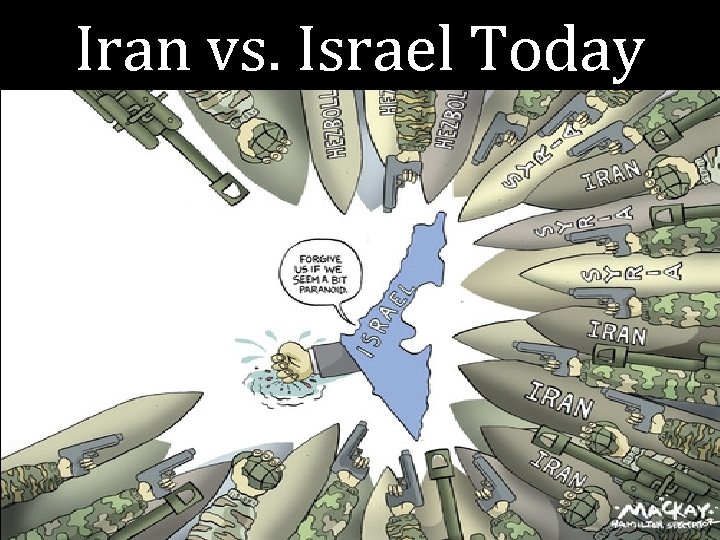 Iran vs. Israel Today
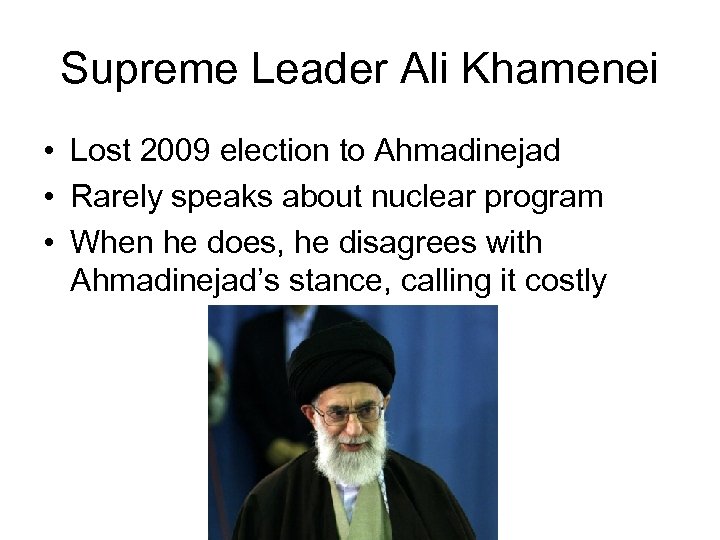 Supreme Leader Ali Khamenei • Lost 2009 election to Ahmadinejad • Rarely speaks about nuclear program • When he does, he disagrees with Ahmadinejad’s stance, calling it costly
 2009 Election Protests • The 2009 Iranian Presidential Election sparked peaceful and violent protests over disputed election results. • The incumbent president, Mahmoud Ahmadinejad, won the election in a landslide, 64. 22% to 33. 86% for challenger Mir-Hossein Mousavi. • Mousavi and his supporters claimed widespread election fraud, maintaining that Mousavi should have won.
 2009 Election Protests • The violence escalated, and some protest marches turned into riots. • Government security forces cracked down on both peaceful and violent protests. • Government supported paramilitary Basij militiamen attacked marchers, sometimes with gunfire, supported by regular police forces. Videos of protests: http: //news. bbc. co. uk/2/hi/middle_east/8263467. stm Pictures of protests: http: //www. boston. com/bigpicture/2009/06/irans_disputed_election. html
 2009 Election Protests • Many protests were organized through Twitter and text messaging, while the world quickly got word of the protests through the internet. • The death of one protester, Neda Agha-Soltan, was captured on video, and she quickly became a rallying point for the protesters. • Most of the protests had stopped by mid-August, but smaller protests occurred into 2010. After the wave of revolutions in the Arab world, more protests started, but were quickly put down. • Between 36 and 72 people were killed, and many more injured in the violence.
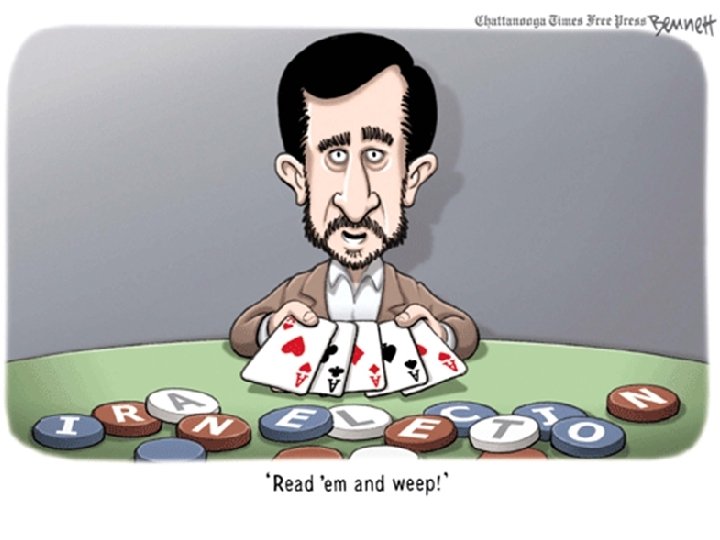
 The Summer 2009 Elections (June 12) Candidates Ahmadinejad and Mir-Hussein Mousavi receive 62% and 34% of the popular vote, respectively Public outcry came against wide-spread accusations of voting irregularities Video Commentary – This link is one of a HUGE amount of material on this election available online. The elections were Tweeted, Facebooked, 24 hour news networked, commented, Wikied, Huffington Posted, and more! – A little online digging goes a long way.
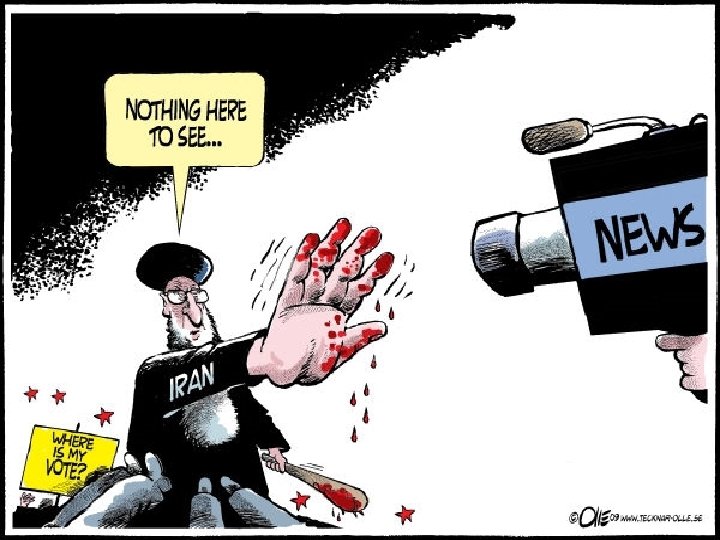
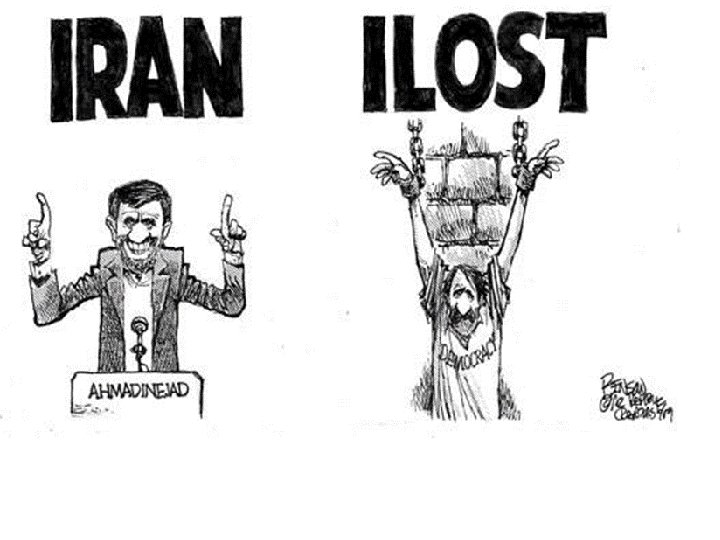
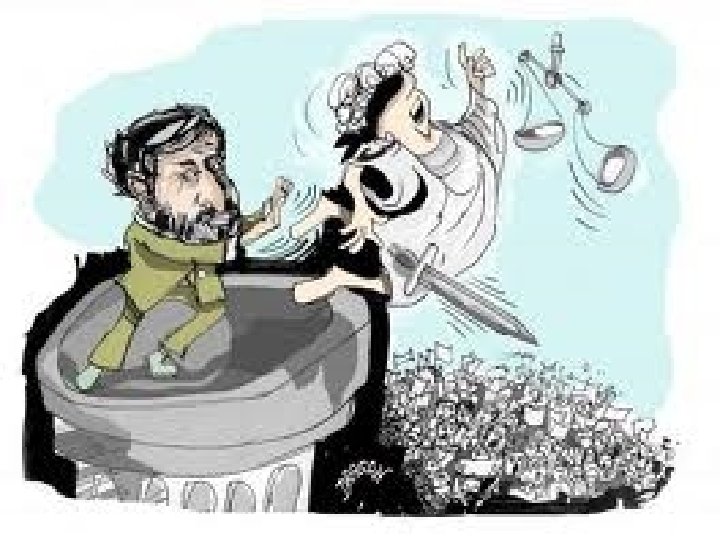
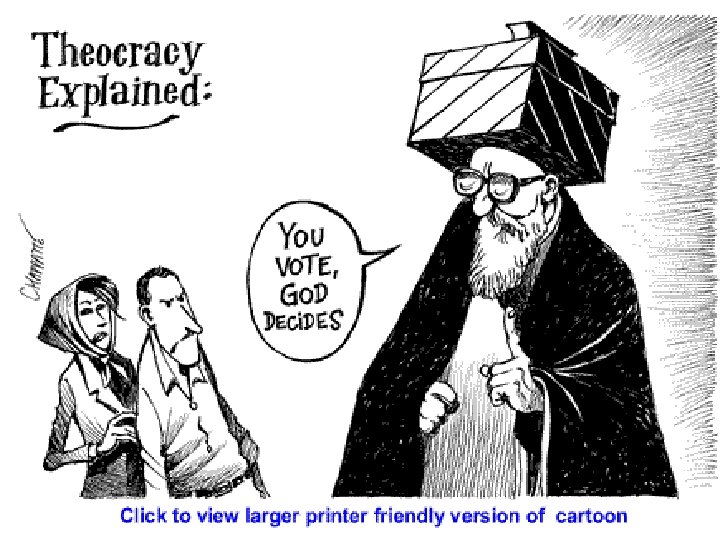
 On your Left Side, answer: CARTOON 1: Is this cartoon in support of Ahmadinejad or Mousavi? What does the cartoon suggest about the government in Iran?
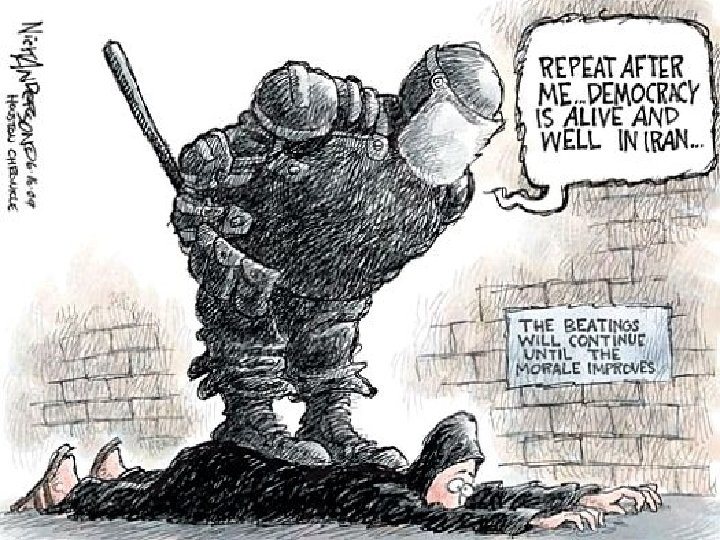
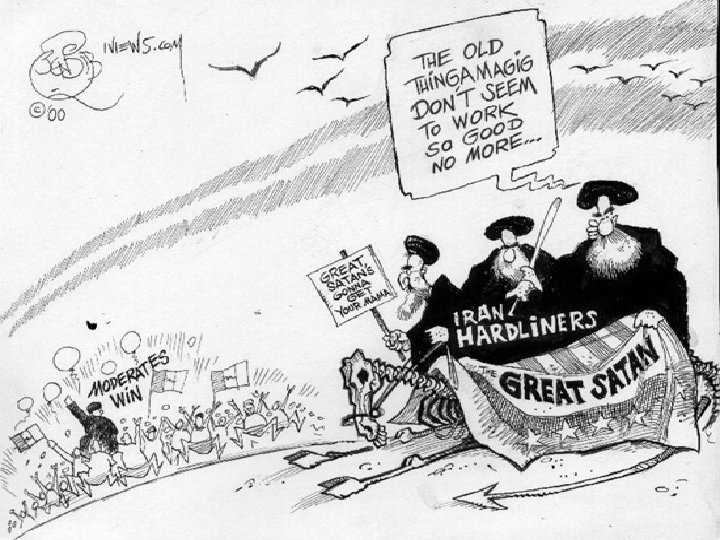
 On your Left Side, answer: Is this cartoon in support of Ahmadinejad or Mousavi? Who are the bearded men in black meant to symbolize? What is the skeletal remains of the horse meant to represent? What does the artist imply about the reform movement’s opinion of the United States?
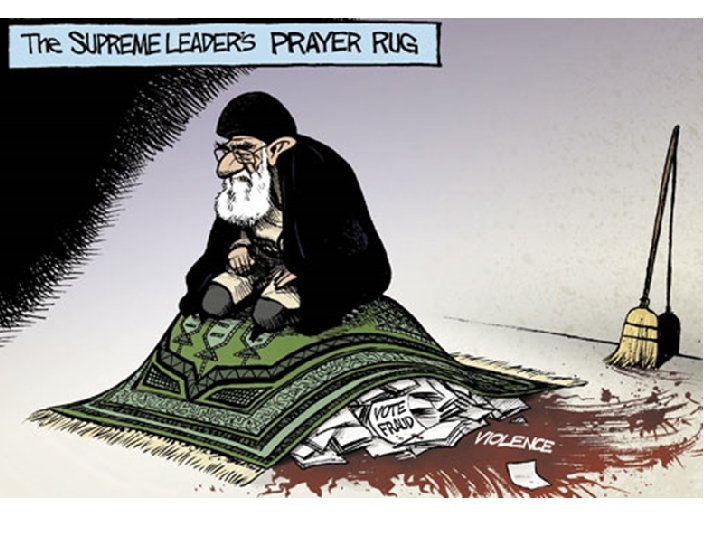
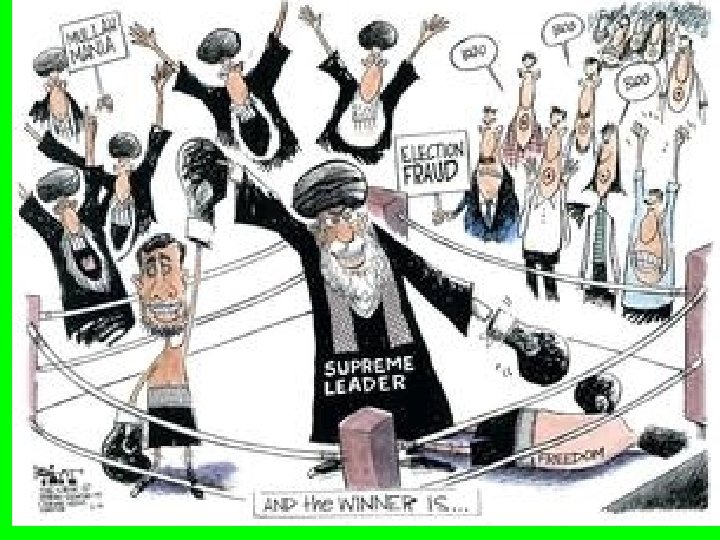
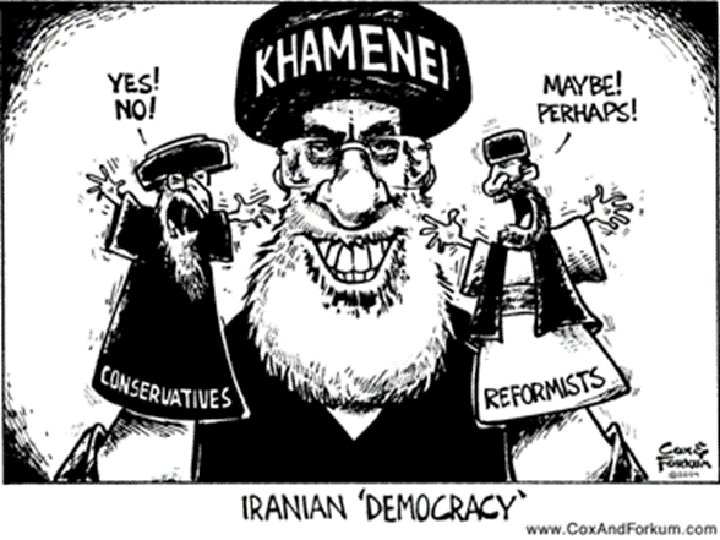
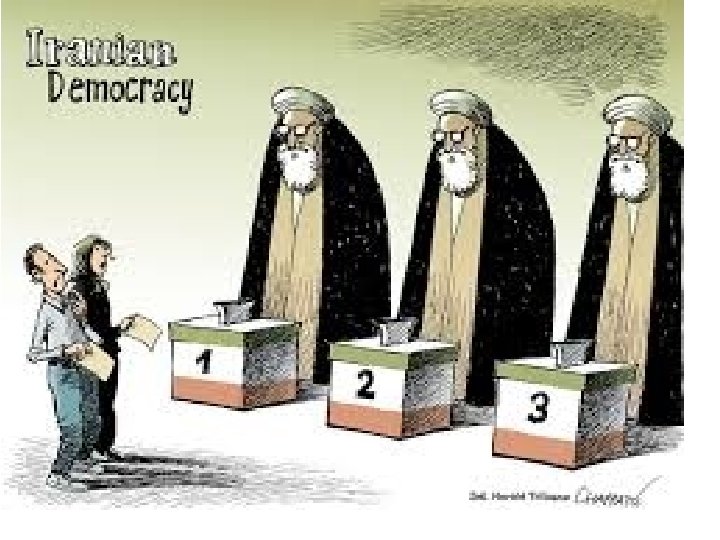
 On your Left Side, answer: Is this cartoon in support of Ahmadinejad or Mousavi? What does the cartoon suggest about the role of the Supreme Leader in the election? Who or what is the “loser” according to the cartoon? What does this cartoon imply about democracy in Iran?
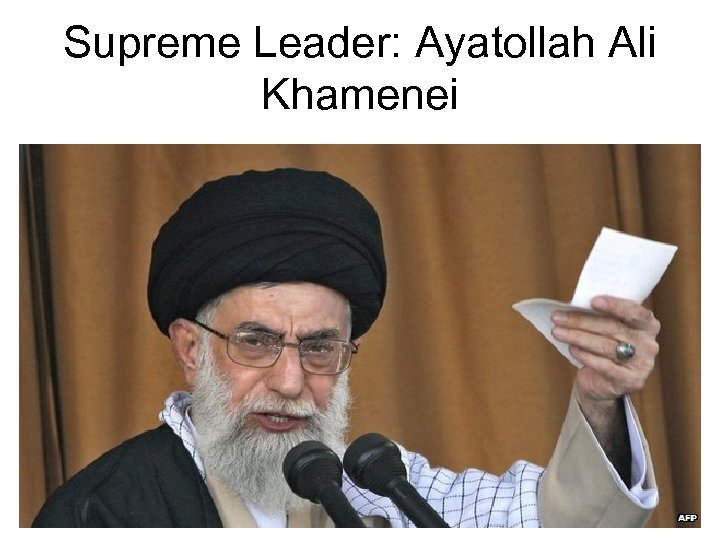 Supreme Leader: Ayatollah Ali Khamenei
 Ayatollah Ali Khamenei • The Supreme Leader - the highest power in the land - appoints the head of the judiciary, military leaders, the head of radio and TV and Friday prayer leaders. • He also confirms the election of Iran's president. • Moreover, the Supreme Leader selects six members of the 12 -member Guardian Council, an influential body which has to pass all legislation and which can veto would-be election candidates. • The Leader is chosen by the clerics who make up the Assembly of Experts. • Ayatollah Ali Khamenei was appointed for life in June 1989, succeeding Ayatollah Khomeini, the founder of the Islamic republic. • He previously served two consecutive terms as president in the 1980 s. • He has intervened on behalf of conservatives, coming into conflict with former president Mohammad Khatami and other reformists.
 Who will be Iran's next Supreme Leader? (Oct 21, 2014) • The head of the Assembly of Experts, the body that elects the Supreme Leader of Iran, has died after almost five months in a coma. • Mohammad Reza Mahdavi Kani was considered to be a unifying figure in Iranian politics and his death opens up a period of uncertainty at a crucial time. • It comes just a month after the country's 75 -year-old Supreme Leader Ayatollah Ali Khamenei had prostate surgery, with official photographs showing him pale and fragile in his hospital bed. • The events raise the question of who will eventually take over as leader, and how that choice will be made.
 Importance of Supreme Leader • The Supreme Leader is by far the most powerful man in Iran. • He is commander-in-chief of the armed forces and appoints the heads of the judiciary and the state broadcaster, as well as half of the members of the Guardian Council - the powerful body which vets candidates for presidential and parliamentary elections. • In a few cases, the Supreme Leader has ordered parliament to stop passing legislation. • He has also ordered the house arrest of dissidents and opposition leaders. • Key ministers are selected with the Supreme Leader's agreement and he has the ultimate say on Iran's foreign policy and nuclear programme. • No substantial political change can happen in Iran unless it gets a green light from the Supreme Leader. • This can create difficulty for whomever holds the elected role of president.
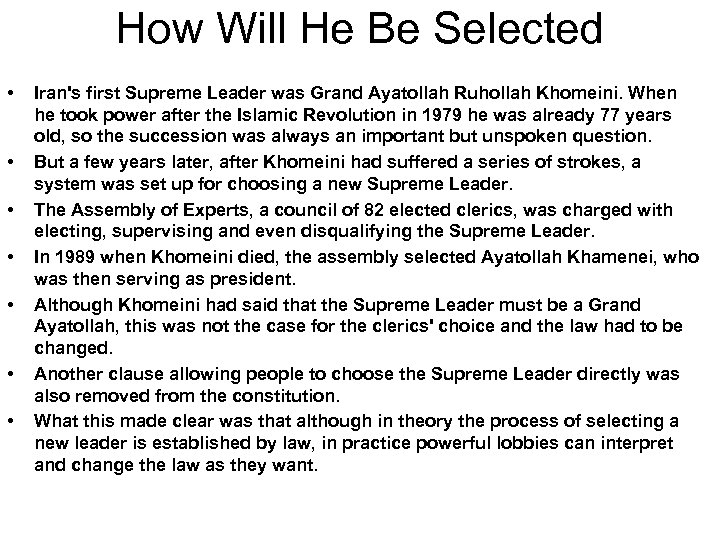 How Will He Be Selected • • Iran's first Supreme Leader was Grand Ayatollah Ruhollah Khomeini. When he took power after the Islamic Revolution in 1979 he was already 77 years old, so the succession was always an important but unspoken question. But a few years later, after Khomeini had suffered a series of strokes, a system was set up for choosing a new Supreme Leader. The Assembly of Experts, a council of 82 elected clerics, was charged with electing, supervising and even disqualifying the Supreme Leader. In 1989 when Khomeini died, the assembly selected Ayatollah Khamenei, who was then serving as president. Although Khomeini had said that the Supreme Leader must be a Grand Ayatollah, this was not the case for the clerics' choice and the law had to be changed. Another clause allowing people to choose the Supreme Leader directly was also removed from the constitution. What this made clear was that although in theory the process of selecting a new leader is established by law, in practice powerful lobbies can interpret and change the law as they want.
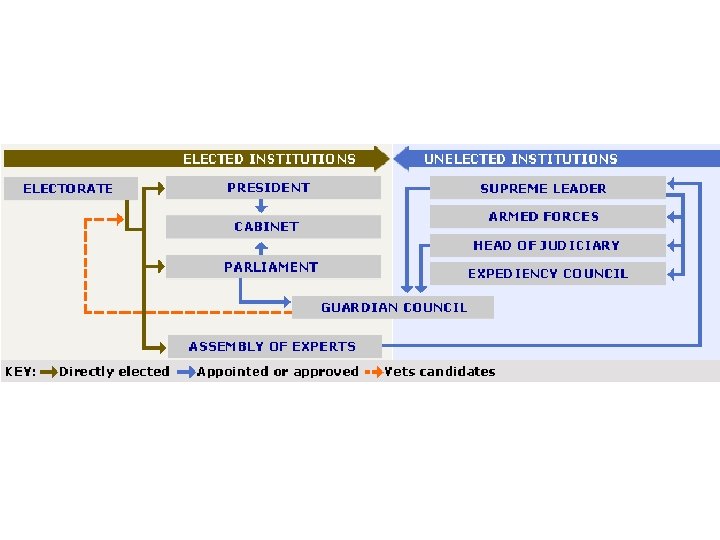
 Role of Supreme Leader with Conflicting Groups • Iran could have a very different future depending on which faction in the Assembly of Experts gains the upper hand in choosing the next leader. • There are two groups - conservatives and moderates. • The conservatives, who dominate the assembly, support Ayatollah Khamenei. They believe the leader of the Islamic regime is the representative of God on Earth and must be obeyed. • The moderates believe in the divine role of the Supreme Leader but hold that he takes his legitimacy from the people and should be responsible to them. • Some moderate members have called for changes to the current leadership model, suggesting the Ayatollah Khamenei's successor should serve for a fixed term rather than for life, and that a council of leaders should be set up to work with him. • But Ayatollah Khamenei has dismissed all talk of reform as long as he is Supreme Leader.
 Possible Contenders • Fifteen members of the Assembly of Experts are charged with drawing up a list of potential candidates for the role of Supreme Leader. • The list is not made public but is likely to contain a number of well-known names. • The first of these is former president Ali Akbar Hashemi Rafsanjani. • A moderate who also used to head the Assembly of Experts, he and Ayatollah Khamenei were once close friends. • Mr Rafsanjani played a significant role in helping him become Supreme Leader, but their friendship soured, especially after Mr Rafsanjani backed the mass opposition protests that erupted after the disputed presidential election in 2009.
 Possible Contenders • The main candidates from the conservative faction are former heads of the judiciary, Grand Ayatollah Mahmoud Hashemi Shahroudi and Mohammad Yazdi, and current judiciary chief Sadeq Larijani. Judiciary heads are appointed by the Supreme Leader and thus are close allies. • Two hardline clerics, Mohammad Taqi Mesbah-Yazdi and Ayatollah Abbas Vaez Tabasi, are usually mentioned because of their religious authority. • But their lack of experience in government is generally considered to rule them out as serious contenders.
 Who has the upper hand - moderates or conservatives? • Over past decade conservatives have gained more seats in the Assembly of Experts because all candidates are vetted by the Guardian Council, whose most influential members are chosen directly and indirectly by the Supreme Leader. • The next election to the Assembly of Experts will be held in February 2016 and it is expected that members who supported the 2009 opposition protest will be disqualified from standing again. • The death of the Assembly head, Mohammad Reza Mahdavi Kani, is likely to change the current balance of power. • He was close to both conservative and moderate candidates, and a battle is now likely between the two camps for control of the Assembly.
 Who Else Has A Say? • Although the Assembly of Experts has the formal role of selecting the new leader, there will be intense behind the scenes lobbying to influence their decision. • Key players are likely to be the powerful Revolutionary Guards, and the office of the current Supreme Leader. • Another important group will be the supporters of whoever holds the presidency when a new leader is chosen. • The incumbent, President, Hassan Rouhani, is a moderate member of the Assembly of Experts, and this has for now helped to boost the position of the moderates. • Which leads to one more intriguing possibility. • If President Rouhani can maintain good ties with Ayatollah Khamenei until the end of his term of office, then his name too could be added to the list of potential candidates to succeed him.
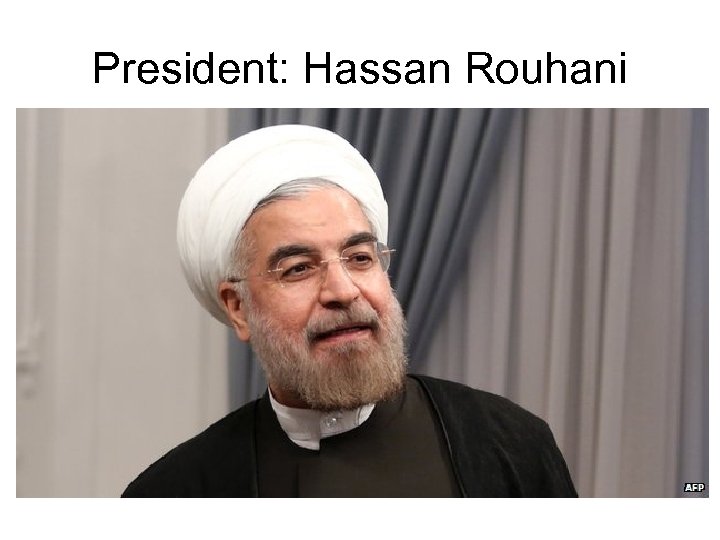 President: Hassan Rouhani
 President Hassan Rouhani • Hassan Rouhani was elected as Iran's president in June 2013, winning just over 50% of the vote. • The cleric, regarded as a religious moderate, was backed by the reformists, led by former President Mohammad Khatami. • He was endorsed by former President Akbar Hashemi Rafsanjani, who was barred from running for office. • Mr Rouhani says he wants to steer Iran towards "moderation". One of his main election pledges was to try to ease international sanctions imposed on Iran over its nuclear programme, which he partially achieved in November with an agreement with the P 5+1 group - US, Britain, Russia, China, France and Germany - in Geneva. • The agreement sees Iran agree to curb uranium enrichment above five per cent and give UN inspectors better access in return for about $7 bn in sanctions relief.
 Rouhani versus Ahmadienjad • Mr Rouhani was an Islamic activist in the run-up to Iran's 1979 revolution, and was later an influential figure during the Iran-Iraq war. • He served as Iran's chief nuclear negotiator from 2003 to 2005, when he was removed by his ultra-conservative predecessor as president, Mahmoud Ahmadinejad. • Mr Ahmadinejad was re-elected in June 2009 amid a bitterly contested poll that led to serious internal unrest. • In the 2005 presidential election, Mr Ahmadinejad won a run-off vote to become Iran's first non-clerical president for 24 years. • His harsh rhetoric - most notably over Israel and the Jews - often caused outrage abroad. • He likened Israel to a "cancer" and demanded its replacement with a Palestinian state, while describing the Holocaust as a "myth". • He faced criticism at home over his handling of the economy, with hardship on the rise as a result of falling oil prices and the impact of sanctions.
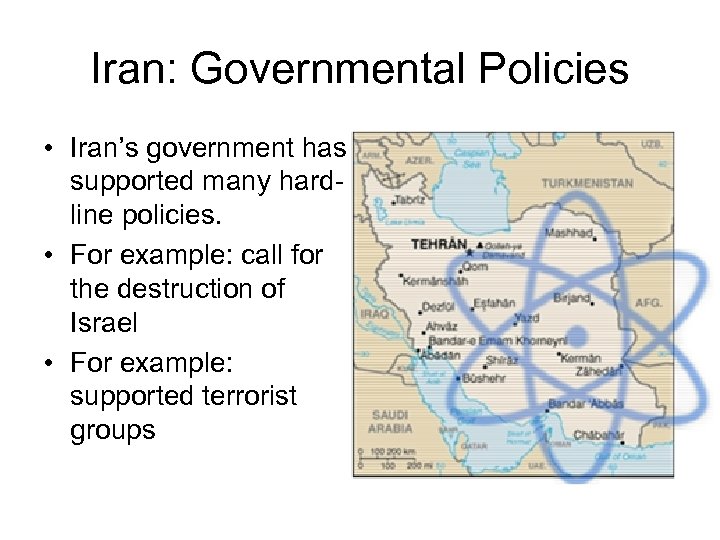 Iran: Governmental Policies • Iran’s government has supported many hardline policies. • For example: call for the destruction of Israel • For example: supported terrorist groups
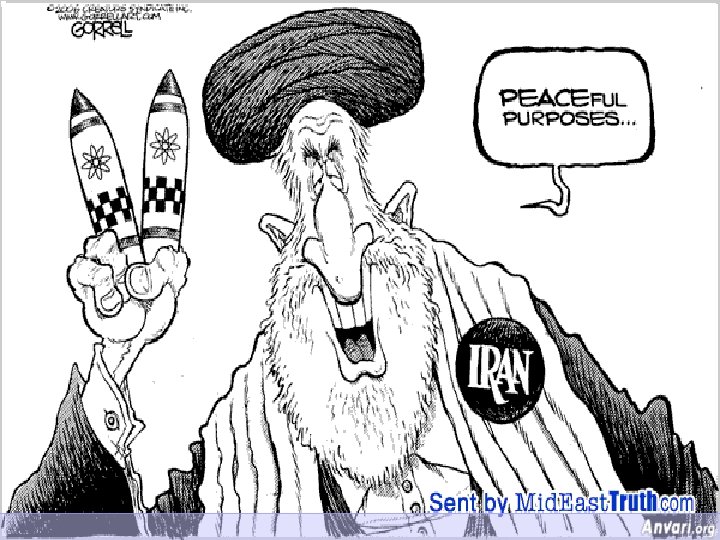
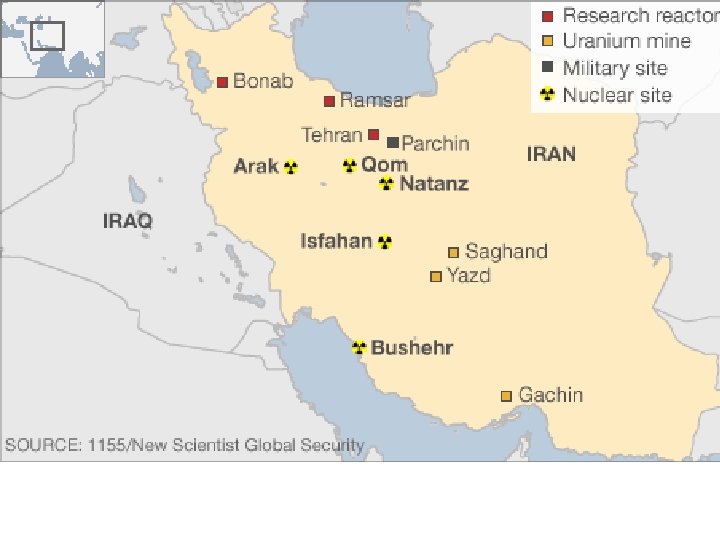
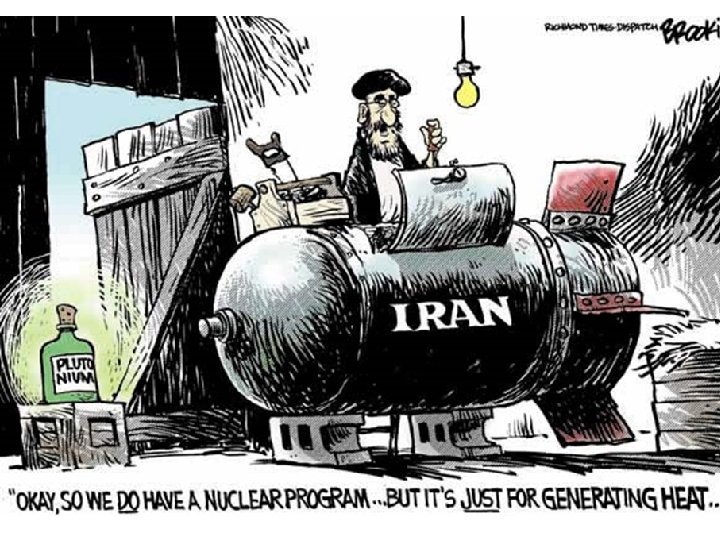
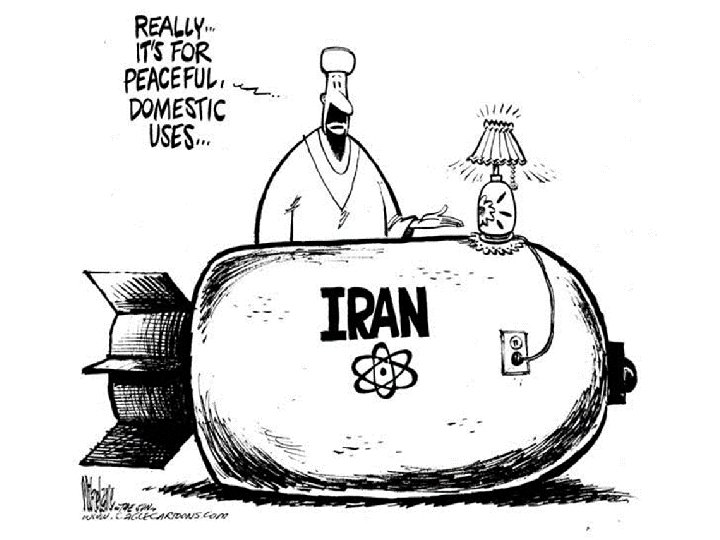
 Iran’s Nuclear Program • Iran says it has the right to nuclear energy - and stresses that its nuclear programme is for peaceful purposes only. • Former Iranian President Mahmoud Ahmadinejad visits the Natanz uranium enrichment facility in 2008 Iran's former president, Mahmoud Ahmadinejad, rejected curbs on its nuclear programme • Iran's nuclear programme became public in 2002, when an opposition group revealed secret activity including construction of a uranium enrichment plant at Natanz and a heavy-water reactor at Arak. Enriched uranium can be used to make nuclear weapons, and spent fuel from a heavy-water reactor contains plutonium suitable for a bomb.
 Arak Heavy Water Plant • The existence of a heavy water facility near the town of Arak first emerged with the publication of satellite images by the US-based Institute for Science and International Security in December 2002. • Heavy water is used to moderate the nuclear fission chain reaction either in a certain type of reactor - albeit not the type that Iran is currently building - or produce plutonium for use in a nuclear bomb. • In August 2010, the IAEA visited the IR-40 heavy water reactor site at Arak. • It said the facility was still being built but some major equipment had been installed. • Iran told the IAEA the operation of the reactor was planned to start by the end of 2013. • The IAEA said that based on satellite imagery, the heavy water production plant appeared to be in operation, but had not had access to it to confirm such reports.
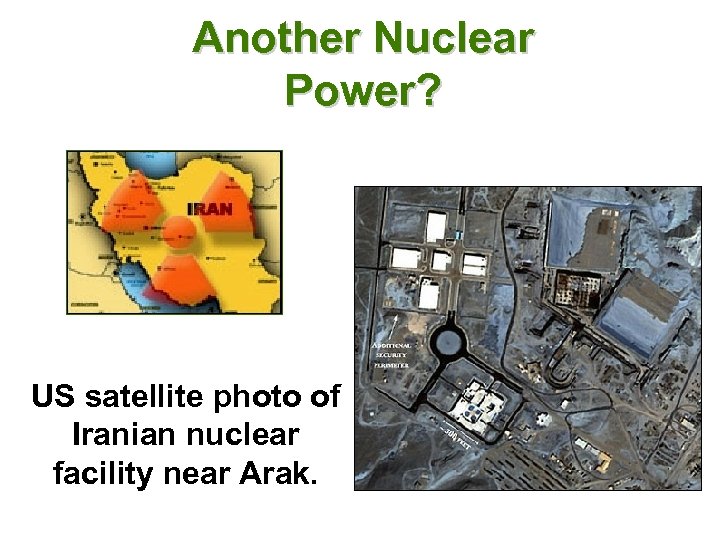 Another Nuclear Power? US satellite photo of Iranian nuclear facility near Arak.
 Bushehr - Nuclear Power Station • Iran's nuclear programme began in 1974 with plans to build a nuclear power station at Bushehr with German assistance. • The project was abandoned because of the Islamic revolution five years later, but revived in the 1990 s when Tehran signed an agreement with Russia to resume work at the site. • Moscow delayed completion on the project while the UN Security Council debated and then passed resolutions aimed at stopping uranium enrichment in Iran. • In December 2007, Moscow started delivering the canisters of enriched uranium the plant needs.
 Bushehr • Earlier in the same month, a US intelligence report said Iran was not currently running a military nuclear programme. • There are two pressurised water reactors at the site. • Satellite images from March 2010 show the first completed reactor building on a site that occupies 2. 5 square kilometres (one square mile), about 17 km (11 miles) south of the city of Bushehr. • Iranian state media said the plant was connected to the national grid in September 2010. • When it was inspected by the IAEA in October 2011, the agency noted that the reactor was in operation.
 Gachin - Uranium Mine • In December 2010, Iran said it had delivered its first domestically produced uranium ore concentrate, or yellowcake, to a plant that can make it ready for enrichment. • Iran's nuclear chief Ali Akbar Salehi said the first batch of yellowcake had been sent from Gachin mine sent to a conversion facility at Isfahan. • Mining operations started at the Gachin in 2004. • Iran was believed to be running low on its stock of yellowcake, originally imported from South Africa in the 1970 s.
 Isfahan - Uranium Conversion Plant • Iran is building a plant at a nuclear research facility to convert yellowcake into three forms: • Hexafluoride gas - used in gas centrifuges • Uranium oxide - used to fuel reactors, albeit not the type Iran is constructing • Metal - often used in the cores of nuclear bombs. The IAEA is concerned about the metal's use, as Iran's reactors do not require it as fuel.
 Natanz Uranium Enrichment Plant • Iran resumed uranium enrichment work at Natanz in July 2004, after a halt during negotiations with lead. It announced in September 2007 that it had installed 3, 000 centrifuges, the machines that do the enrichment. • In 2010, Iran told the IAEA Natanz would be the venue for new enrichment facilities - construction of which would start around March 2011. • This is the facility at the heart of Iran's dispute with the United Nations Security Council. • The Council is concerned because the technology used for producing fuel for nuclear power can be used to enrich the uranium to a much higher level to produce a nuclear explosion.
 Parchin • One area at Parchin has been identified as a suspected nuclear weapons development facility. • The overall complex is one of Iran's leading munitions centres - for the research, development and production of ammunition, rockets and high explosives. • A limited inspection carried out by the IAEA in 2005 found no proof of any nuclear weapons activity at Parchin. • But according to information from an IAEA report in November 2011, it is believed the site has also been used for testing high explosives that could be used in nuclear weapons.
 Qom - Uranium Enrichment Plant • In January 2012, Iran said it had begun uranium enrichment at the heavily fortified site of Fordo near the holy city of Qom. • It had revealed the existence of the facility, about 30 km (20 miles) north of the city, in September 2009. • Iran initially informed the IAEA that it was constructing the plant to produce uranium enriched up to 5% - commonly used in nuclear power production. • In June 2011, Iran told the IAEA that it was planning to produce uranium enriched up to 20% at Fordo - and would subsequently stop 20% fuel production at Natanz. • In January 2012, the IAEA confirmed Iran had started the production of uranium enriched up to 20%. • Iran says the Highly Enriched Uranium (HEU) is for use as a fuel in research reactors. Uranium - with a concentration of 20% or more - is needed to build nuclear weapons. • The IAEA says environmental samples taken from the site at Fordo in April 2011 did not indicate the presence of enriched uranium.
 Iran’s Nuclear Program • The Iranian government subsequently agreed to inspections by the global nuclear watchdog, the International Atomic Energy Agency (IAEA). • But the IAEA was unable to confirm Iran's assertions that its nuclear programme was exclusively for peaceful purposes and that it had not sought to develop nuclear weapons. • This led the US and its European allies to press Iran to stop enriching uranium, which can be used for civilian purposes but also - if the concentration of the active uranium-235 isotope is 90% or above - to build nuclear bombs.
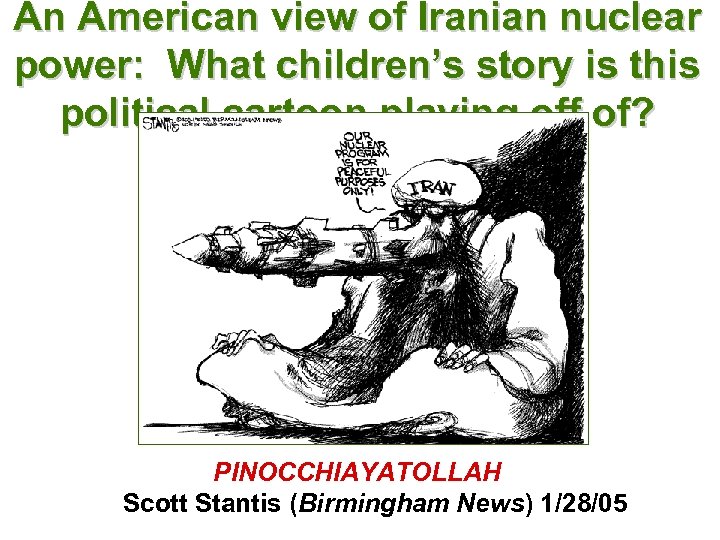 An American view of Iranian nuclear power: What children’s story is this political cartoon playing off of? PINOCCHIAYATOLLAH Scott Stantis (Birmingham News) 1/28/05
 Iran’s Nuclear Program • However, the election of President Mahmoud Ahmadinejad in 2005 halted any progress in talks, and the IAEA referred Iran to the UN Security Council for failing to comply with its Nuclear Non-Proliferation Treaty (NPT) Safeguards Agreement. • Since then, the Security Council has adopted six resolutions requiring Iran to stop enriching uranium, some imposing sanctions. • In 2012, the US and EU began imposing additional sanctions on Iranian oil exports and banks, crippling Iran's economy. • Despite that, Iran continued to enrich uranium. • In 2009, it disclosed the existence of a new underground facility at Fordo.
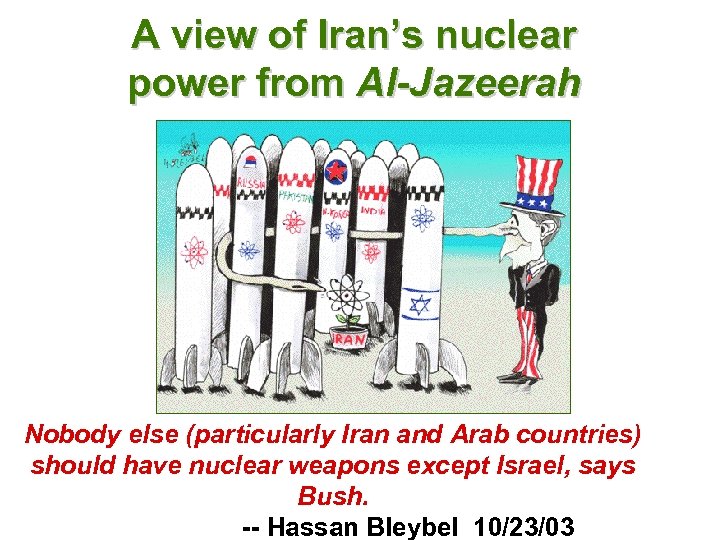 A view of Iran’s nuclear power from Al-Jazeerah Nobody else (particularly Iran and Arab countries) should have nuclear weapons except Israel, says Bush. -- Hassan Bleybel 10/23/03
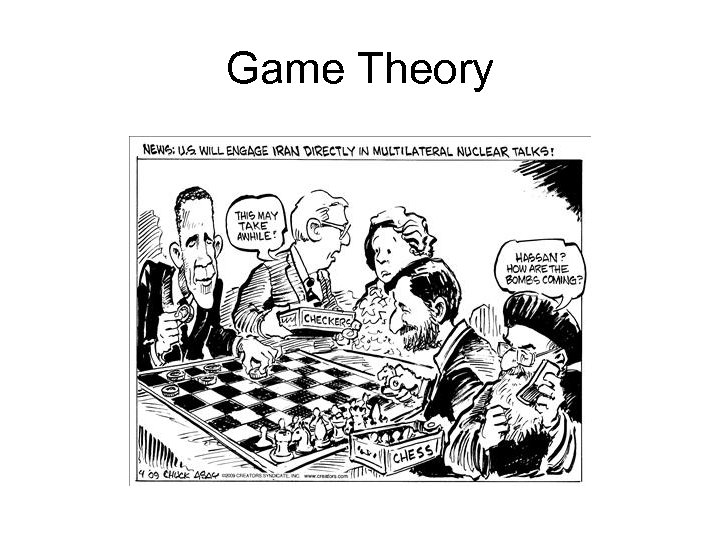 Game Theory
 Iran’s Nuclear Program • There have been multiple rounds of negotiations between Iran and the so-called P 5+1, which comprises the five permanent members of the UN Security Council - the US, UK, France, China, Russia - and Germany. • For years they failed to make headway. • But the mood changed after the election of Hassan Rouhani as president in June 2013. • Five months later, following secret bilateral talks between the US and Iran, negotiators agreed an interim deal.
 Recent Nuclear Treaty with Iran • Representatives of Iran, the EU and P 5+1 in Geneva (24 November 2013) In July both sides agreed to extend the deadline for a permanent agreement • Under the Joint Plan of Action (JPOA), which came into force in January 2014, Iran effectively agreed to freeze its production of enriched uranium above 5% purity and committed to dilute or convert into oxide form its stockpile of near-20% enriched uranium. • Iran said it would not install any new uranium centrifuges or build new enrichment facilities. • Iran also agreed not to commission or fuel the reactor at Arak, and not to construct a fuel reprocessing facility there.
 Summary of Treaty • What Iran will do: • Halt enrichment of uranium above 5% purity • "Neutralise" its stockpile of near-20%enriched uranium • Not install any more centrifuges (the machines used to enrich uranium) • What world powers will do: • Not impose further nuclear-related sanctions • Suspend certain sanctions on trade • Transfer $4. 2 bn (£ 2. 6 bn) to Iran in installments from sales of its oil
 Summary of Treaty • From 20 January 2014, Iran will start diluting its stockpile of 20%-enriched uranium • All 20%-enriched uranium will be gone within six months • Daily access will be provided to the Fordo uranium enrichment site near the holy city of Qom • Monthly inspections will be allowed at the Arak heavy water reactor
 Complications with Treaty • • Diplomats warned from the start of the negotiations on a comprehensive nuclear accord that they would be complex and that significant gaps remained between Iran and the P 5+1. Both sides said the six rounds of talks between January and July 2014 had produced significant progress, including redesigning the Arak reactor to substantially reduce the amount of plutonium it will produce. But they also accused each other of making some unrealistic demands, primarily on the issue of uranium enrichment. Iranian Foreign Minister Mohammad Javad Zarif and US Secretary of State John Kerry meet in Vienna in July 2014 The two negotiating teams have accused each other of making unrealistic demands Iran is reportedly offering to freeze the current number of operating centrifuges for three to seven years. After that, it argues, there must be sufficient enrichment capacity to produce fuel for the Bushehr power plant when the reactor's fuel supply agreement with Russia expires in 2021. That would require Iran to expand its current capacity 10 -fold or more, which experts say would reduce the amount of time required to produce weapons-grade uranium to a few weeks. In return for higher enrichment capacity and being permitted to continue research and development, Iran says it would accept more intrusive inspections by the IAEA. Bushehr nuclear power plant (2009) Iran says it needs the enrichment capacity to produce fuel for the Bushehr power plant from 2021 onwards
 Complications with Treaty • The P 5+1 wants a sharp reduction of Iran's current enrichment capacity. • It says Iran has no compelling need to produce large amounts of fuel because Russia is prepared to supply Bushehr's reactor for its lifetime. • The P 5+1 also wants to limit Iran's R&D activities, which could enhance centrifuge efficiency. • It believes the restrictions should remain in place for at least two decades and be backed-up by extensive monitoring. • Domestic political constraints are said to be limiting the chance of compromise on enrichment. • Analysts say the Iranian negotiators would struggle to defend an agreement that does not preserve their country's current capacity. • Western negotiators would likewise have difficulty selling a deal that left Iran the ability to rapidly produce weapons-grade uranium.
 Complications with Treaty • Iran hid an enrichment programme for 18 years, so the Security Council says that until Iran's peaceful intentions can be fully established, it should stop enrichment and other nuclear activities. • Iran has said it is simply doing what it is allowed to do under the Nuclear Non-Proliferation Treaty, which allows signatory states to enrich uranium to be used as fuel for power generation. • Such states have to remain under inspection by the IAEA. • Iran is under inspection, though not under the strictest rules allowed because it will not agree to them.
 Complications with Treaty • There are mixed views on this. • US Secretary of State John Kerry told a Senate hearing in April 2014 that Iran had the ability to produce weapons-grade uranium for a nuclear bomb within two months, if it decided to do so. • However, Mr Kerry said such a "break-out" window did not mean Iran yet had a warhead or suitable delivery system. • That was also before the IAEA confirmed in July that Iran had converted all of its 20%-enriched uranium into forms that were less of a proliferation risk. • Experts at the Washington-based Institute for Science and International Security cautioned in a September 2013 report that any bomb-making process would be done in secret, so estimating timelines was extremely difficult. • In fact, experts have been predicting for decades that Iran was on the verge of building a nuclear bomb. • While the IAEA can monitor the amount of uranium, the relative skills of its scientists involved in nuclear and weapons research are harder to assess.
 SUMMARIZE Discuss Why is Iran a nation that we need to be aware of in the modern world?