 Скачать презентацию IR and Optical Observations of GRB from Campo
3208aba834767f05185c694a08ac6ffd.ppt
- Количество слайдов: 10



IR and Optical Observations of GRB from Campo Imperatore R. Speziali, F. D'Alessio, L. A. Antonelli, A. Di Paola, L. Burderi, F. Fiore, G. L. Israel, D. Lorenzetti, F. Pedichini, L. Stella & F. Vitali Osservatorio Astronomico di Roma
Abstract In this poster we present the Infrared and Optical observations of GRB afterglows from the Campo Imperatore Station where two complementary instruments are available: the AZT-24 (1. 1 m Ritchey Cretien) equipped with the NIR camera SWIRCAM that is one of the few IR telescope working in the northern emisphere, and the Schmidt telescope (60/90/180) now renewed and equipped with a 2 Kx 2 K back illuminated CCD. A description of the Station facilities, suitable for very fast reaction to GRB triggers, and the IR detection of the GRB 000926 are reported.
Introduction Comprehendingthe nature of the Gamma-Ray Bursts (GRBs) has been a long-standingproblem of modern astrophysicssince their discoveryin the late of sixties (Klebesadelet al. , 1973, Ap. JL, 182, L 85). The Beppo. SAX satellitemade importantsteps forward thanks to its capabilityto locatethe bursts with an unprecedentedaccuracy of 1 -3 arcmin within few hours from the event. This led to the discoveryof the X-rays, optical, IR and radio afterglowsof GRBs. Optical spectroscopy yieldedthe first redshift measurementsthereforeproving the cosmologicalnature of the GRB phenomenon (Costa et al. , 1997, Nat. , 387, 783; Van Paradijs et al. , 1997, Nat. , 386, 686). Much progress in the study of GRBs has been achieved over the last three years from detailed multi-wavelength observations the afterglows. of Yet the origin and the physics of GRB phenomenon is still activelydebated The most widely. discussed theoreticalmodels for GRBs consider vastly differentscenarios both in terms of the progenitors and environment. For example, if the GRBs originate from neutron star-neutron star or neutron star-black hole mergers (Meszaros & Rees, 1997, Ap. J, 482, L 29) then the explosion should be located very far from the place where the progenitor binary system was formed and most probably in a lowdensity interstellarmedium. On the contrary if GRBs originate in hypernova (Paczynski 1998, Ap. J, 494, L 95) or supranova (Vietri & Stella, 1998, Ap. J, 507, L 45) events, being the immediate progenitor a very high mass rotating star, the explosion should take place in a high density medium, probably a star-forming region. So a positivedetectionof an optical and IR afterglowand its study can help us to constrain and better understand the physics underlaying these phenomena through their spectral energy distribution endevolution (Galama et al. , 1998, Ap. J, 500, L 97).
Introduction In particular near-infraredobservationsare very importantto ascertainwhether the burst goes off in a dense medium of a star-formingregion or even in the ejecta of the pre-supernova star. An important contributionin the infrared band might also be due to the deceleration the expandingblastwave in a of high densityabsorbing medium. The presence of an infrared afterglowand the lack of an opticalone, as in the case of GRB 990705 (Masettiet al. , 2000, A&A, 354, 473), may suggest the existenceof a high density circumburst medium. Another indicationof the presence of a dense sorrounding medium can be seen in the earlyer steepeningof the decay law as envisagedby Dai & Lu (1999) and as observed in the case of GRB 990705 (Masetti et al. , 2000), in the case of GRB 990123 (Castro-Tirado et al. , 1999, Sci. , 283, 2069), GRB 990510 (Stanek et al. , 1999, Ap. JL, 522, 39) and, GRB 000315 c (Jensen et al. , 2000, astro-ph/0005609). The NIR band vs the optical one are fundamental importancein the study the GRB phenomenon to address the physics of GRBs and the environment in which they go off. The prompt triggersfrom Beppo. SAX (1 -3 hours) and the Wide Field Cameras error-circles(~ 3') provide at the moment the best opportunityfor successful follow-up observations. Usually the positions are refined within few hours at 1 -1. 5 arcmin level by the Beppo. SAX Narrow Field Instrumentsfollow-up observations. In the near future (October 2000) the quality of the triggerwill be significantly improved with the launch of HETE 2. This satellitewill detectto GRBs performingfast detection(few seconds) to an accuracy of 3 arcmin. More refined GRB positions (10''-2'' error-circleradius depending on the Burst intensity) will be obtained shortly after few minutes. HETE 2 will provide the astronomical communitywith the GRBs coordinatesthrough an automaticdistributionsystem, so faster and more accurate follow-up observationswill be possible with ground-based telescopesallowing to investigate the GRB afterglows.
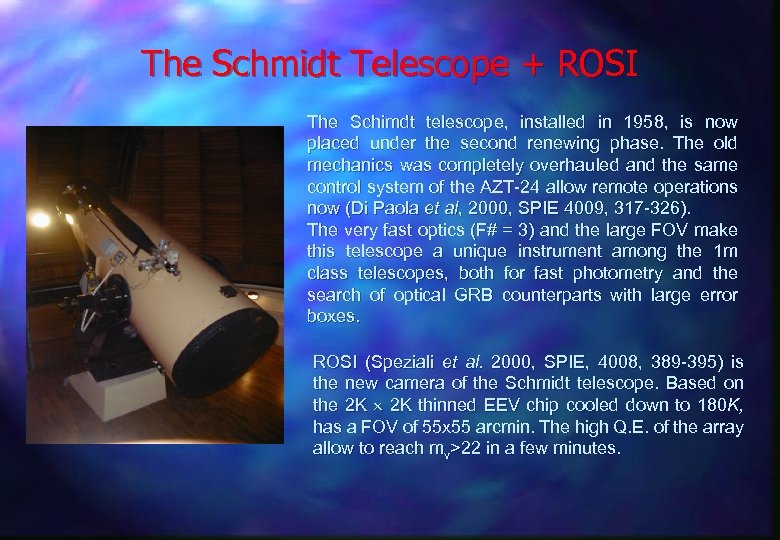
The Schmidt Telescope + ROSI The Schimdt telescope, installed in 1958, is now placed under the second renewing phase. The old mechanics was completely overhauled and the same control system of the AZT-24 allow remote operations now (Di Paola et al, 2000, SPIE 4009, 317 -326). The very fast optics (F# = 3) and the large FOV make this telescope a unique instrument among the 1 m class telescopes, both for fast photometry and the search of optical GRB counterparts with large error boxes. ROSI (Speziali et al. 2000, SPIE, 4008, 389 -395) is the new camera of the Schmidt telescope. Based on the 2 K thinned EEV chip cooled down to 180 K, has a FOV of 55 x 55 arcmin. The high Q. E. of the array allow to reach mv>22 in a few minutes.
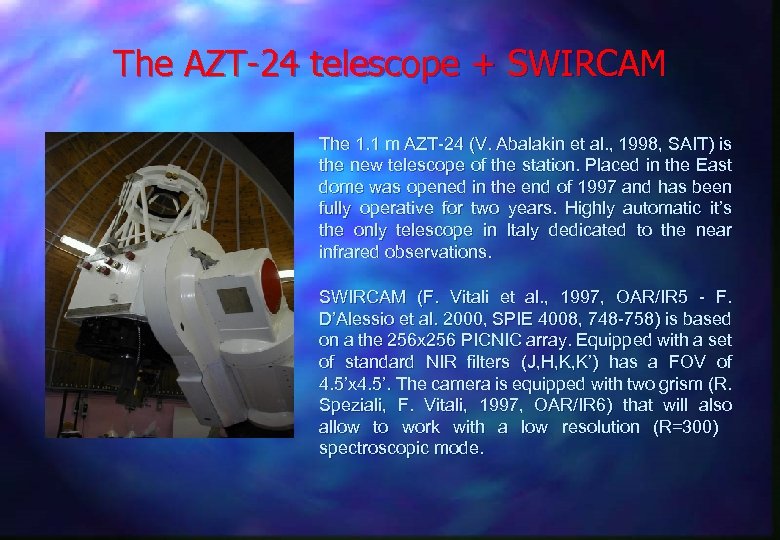
The AZT-24 telescope + SWIRCAM The 1. 1 m AZT-24 (V. Abalakin et al. , 1998, SAIT) is the new telescope of the station. Placed in the East dome was opened in the end of 1997 and has been fully operative for two years. Highly automatic it’s the only telescope in Italy dedicated to the near infrared observations. SWIRCAM (F. Vitali et al. , 1997, OAR/IR 5 - F. D’Alessio et al. 2000, SPIE 4008, 748 -758) is based on a the 256 x 256 PICNIC array. Equipped with a set of standard NIR filters (J, H, K, K’) has a FOV of 4. 5’x 4. 5’. The camera is equipped with two grism (R. Speziali, F. Vitali, 1997, OAR/IR 6) that will also allow to work with a low resolution (R=300) spectroscopic mode.
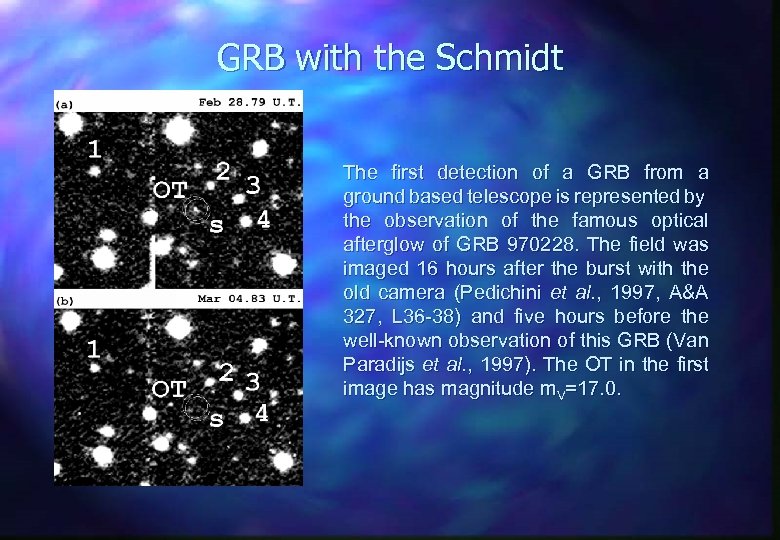
GRB with the Schmidt The first detection of a GRB from a ground based telescope is represented by the observation of the famous optical afterglow of GRB 970228. The field was imaged 16 hours after the burst with the old camera (Pedichini et al. , 1997, A&A 327, L 36 -38) and five hours before the well-known observation of this GRB (Van Paradijs et al. , 1997). The OT in the first image has magnitude m. V=17. 0.
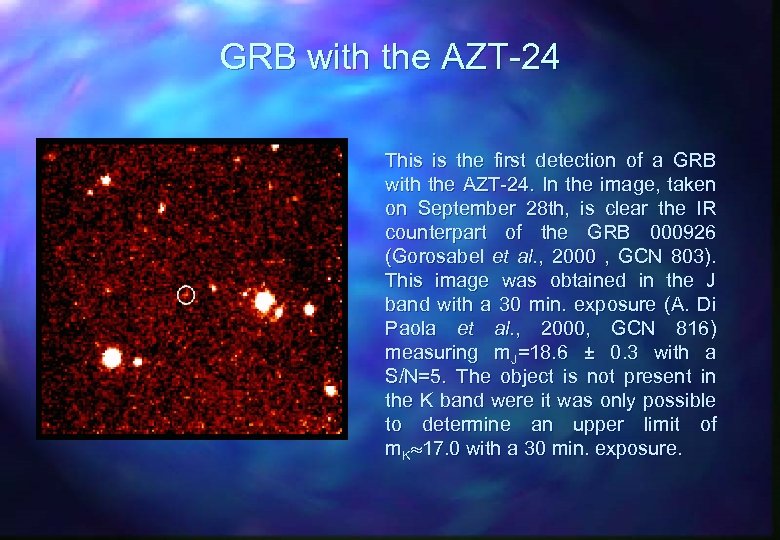
GRB with the AZT-24 This is the first detection of a GRB with the AZT-24. In the image, taken on September 28 th, is clear the IR counterpart of the GRB 000926 (Gorosabel et al. , 2000 , GCN 803). This image was obtained in the J band with a 30 min. exposure (A. Di Paola et al. , 2000, GCN 816) measuring m. J=18. 6 ± 0. 3 with a S/N=5. The object is not present in the K band were it was only possible to determine an upper limit of m. K 17. 0 with a 30 min. exposure.
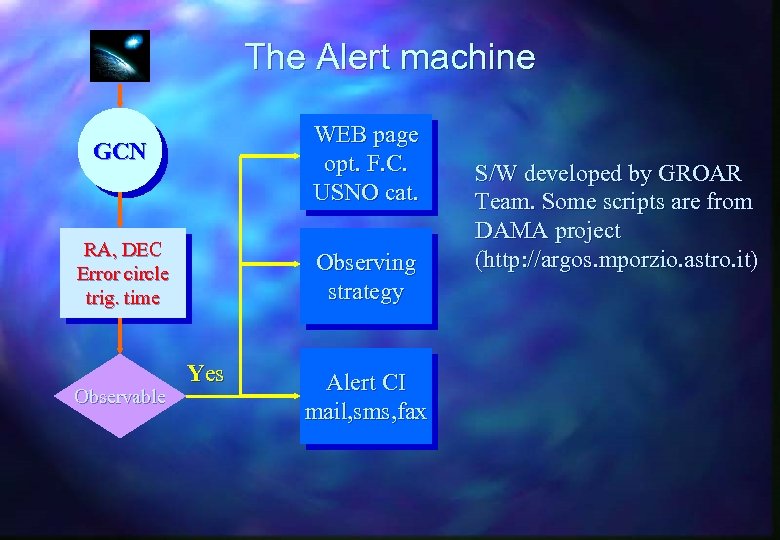
The Alert machine WEB page opt. F. C. USNO cat. GCN RA, DEC Error circle trig. time Observable Observing strategy Yes Alert CI mail, sms, fax S/W developed by GROAR Team. Some scripts are from DAMA project (http: //argos. mporzio. astro. it)
Future perspectives n n HETE 2 will observe about 35 bursts per year improving the possibility to observe both optical and NIR afterglow of GRBs with the telescopes of Campo Imperatore. SWIFT (2003) will cover a wide band ranging from optical up to 300 ke. V. It will observe about 300 bursts per year so NIR observations with AZT-24 will be very important to have a wider band coverage.
Скачать презентацию IR and Optical Observations of GRB from Campo
3208aba834767f05185c694a08ac6ffd.ppt