


 Скачать презентацию IPv 6 Technical overview Policies Procedures
08b093a7652d7daf1106bc0bc777dc86.ppt
- Количество слайдов: 54
 IPv 6 Technical overview Policies & Procedures
 Overview • • Rationale IPv 6 Addressing Features of IPv 6 Transition Techniques Current status IPv 6 Policies & Procedures Statistics
 Rationale • Address depletion concerns – Squeeze on available addresses space • Probably will never run out, but will be harder to obtain – End to end connectivity no longer visible • Widespread use of NAT IPv 6 provides much larger IP address space than IPv 4
 Rationale (Cont. ) • Increase of backbone routing table size – Current backbone routing table size > 100 K • CIDR does not guarantee an efficient and scalable hierarchy • The lack of uniformity of the current hierarchical system • Routing aggregation is still a concern in IPv 6 address architecture is more hierarchical than IPv 4
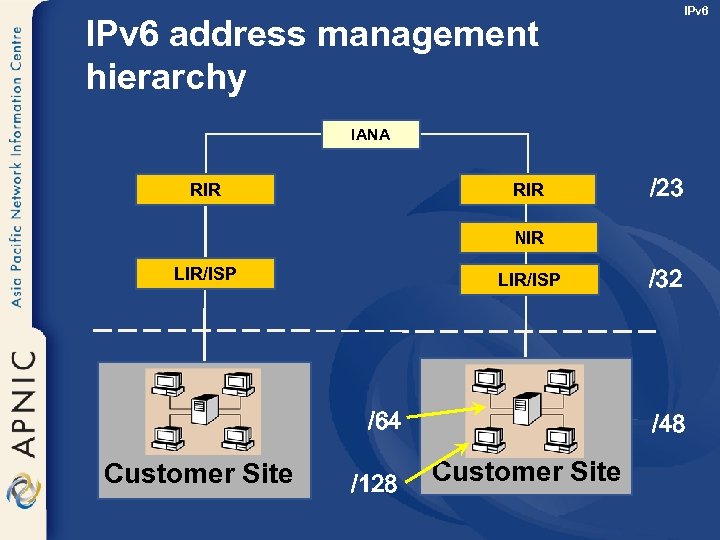 IPv 6 address management hierarchy IANA RIR /23 NIR LIR/ISP /64 Customer Site /128 /32 /48 Customer Site
 Rationale (Cont. ) • Needs to improve the Internet environment – Encryption, authentication, and data integrity safeguards needed • Necessity of IP level security – Plug and Play function needed • Reduce network administrators work load • Reduce errors caused by individual users More recent technologies (security, Plug and Play, multicast, etc. ) available by default in IPv 6 • Useful reading: – “The case for IPv 6”: http: //www. 6 bone. net/misc/case-for-ipv 6. html
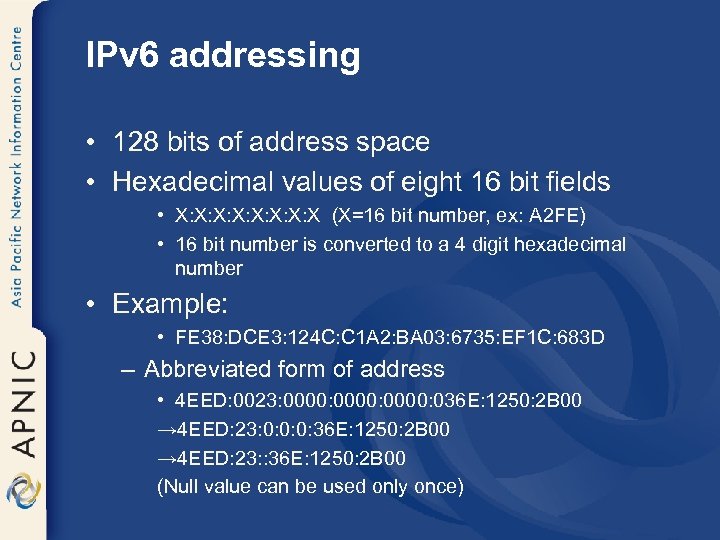 IPv 6 addressing • 128 bits of address space • Hexadecimal values of eight 16 bit fields • X: X: X (X=16 bit number, ex: A 2 FE) • 16 bit number is converted to a 4 digit hexadecimal number • Example: • FE 38: DCE 3: 124 C: C 1 A 2: BA 03: 6735: EF 1 C: 683 D – Abbreviated form of address • 4 EED: 0023: 0000: 036 E: 1250: 2 B 00 → 4 EED: 23: 0: 0: 0: 36 E: 1250: 2 B 00 → 4 EED: 23: : 36 E: 1250: 2 B 00 (Null value can be used only once)
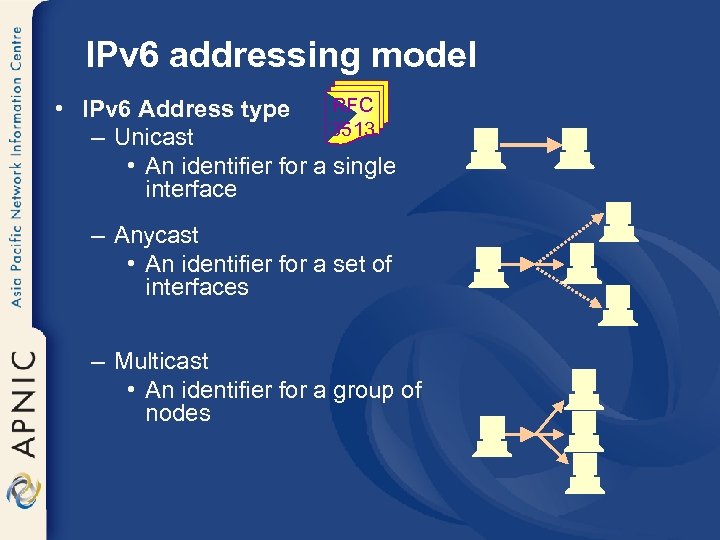 IPv 6 addressing model RFC • IPv 6 Address type 3513 – Unicast • An identifier for a single interface – Anycast • An identifier for a set of interfaces – Multicast • An identifier for a group of nodes
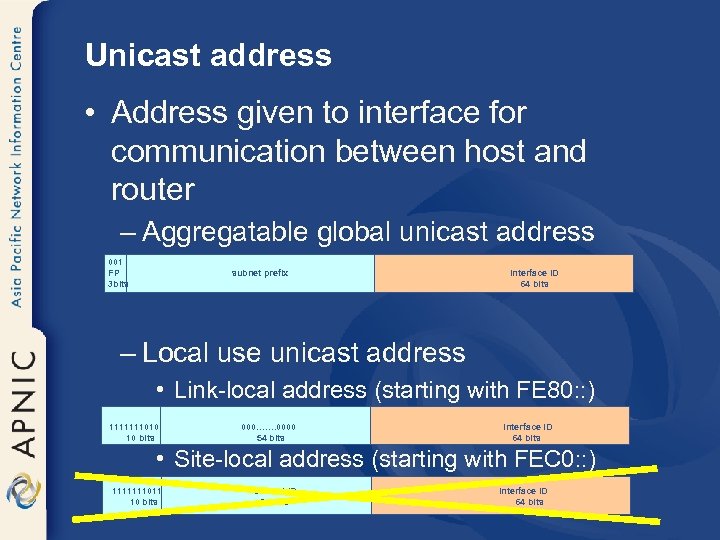 Unicast address • Address given to interface for communication between host and router – Aggregatable global unicast address 001 FP 3 bits subnet prefix Interface ID 64 bits – Local use unicast address • Link-local address (starting with FE 80: : ) 1111111010 10 bits 000……. 0000 54 bits Interface ID 64 bits • Site-local address (starting with FEC 0: : ) 1111111011 10 bits Subnet-ID 54 bits Interface ID 64 bits
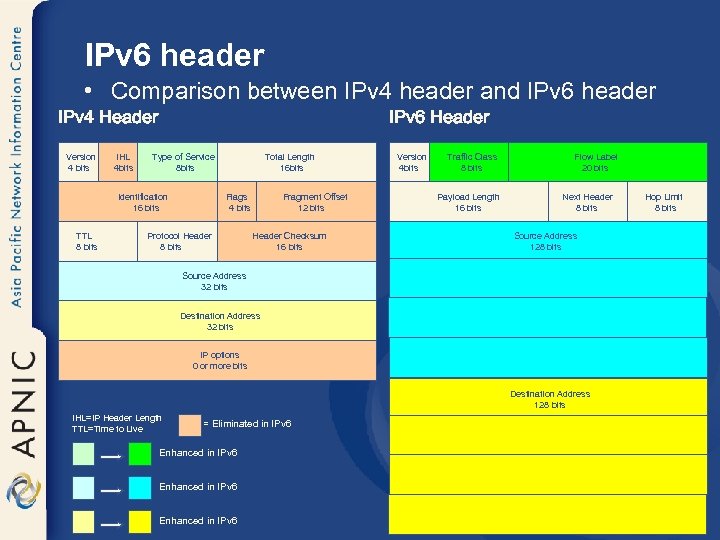 IPv 6 header • Comparison between IPv 4 header and IPv 6 header IPv 4 Header Version 4 bits IHL 4 bits IPv 6 Header Type of Service 8 bits Identification 16 bits TTL 8 bits Total Length 16 bits Flags 4 bits Protocol Header 8 bits Fragment Offset 12 bits Header Checksum 16 bits Version 4 bits Traffic Class 8 bits Payload Length 16 bits Flow Label 20 bits Next Header 8 bits Source Address 128 bits Source Address 32 bits IHL Destination Address 32 bits IP options 0 or more bits Destination Address 128 bits IHL=IP Header Length TTL=Time to Live = Eliminated in IPv 6 Enhanced in IPv 6 Hop Limit 8 bits
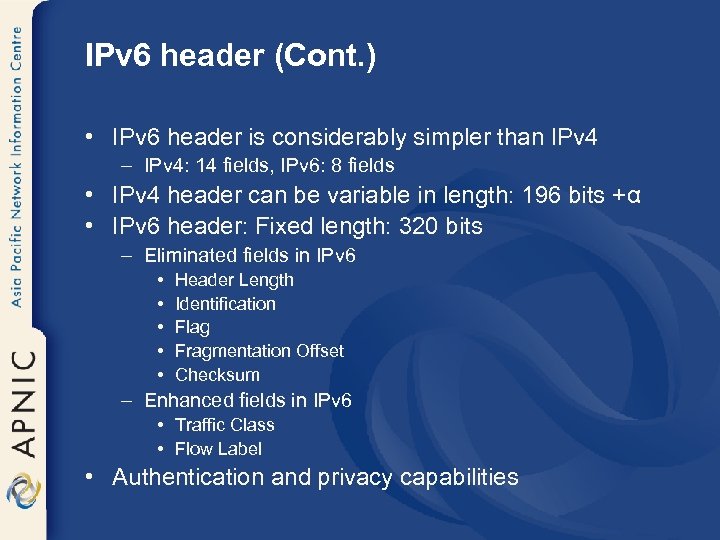 IPv 6 header (Cont. ) • IPv 6 header is considerably simpler than IPv 4 – IPv 4: 14 fields, IPv 6: 8 fields • IPv 4 header can be variable in length: 196 bits +α • IPv 6 header: Fixed length: 320 bits – Eliminated fields in IPv 6 • • • Header Length Identification Flag Fragmentation Offset Checksum – Enhanced fields in IPv 6 • Traffic Class • Flow Label • Authentication and privacy capabilities
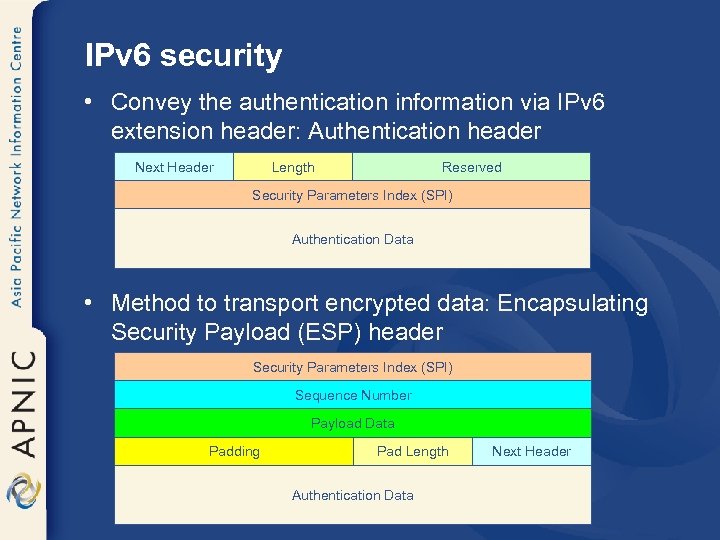 IPv 6 security • Convey the authentication information via IPv 6 extension header: Authentication header Next Header Length Reserved Security Parameters Index (SPI) Authentication Data • Method to transport encrypted data: Encapsulating Security Payload (ESP) header Security Parameters Index (SPI) Sequence Number Payload Data Padding Pad Length Authentication Data Next Header
 IPv 6 features – autoconfiguration • Stateless mechanism – For a site not concerned with the exact addresses – No manual configuration required – Minimal configuration of routers – No additional servers • Stateful mechanism – For a site requires tighter control over exact address assignments – Need DHCP server – DHCPv 6 • Enable “Plug and play” RFC 2462
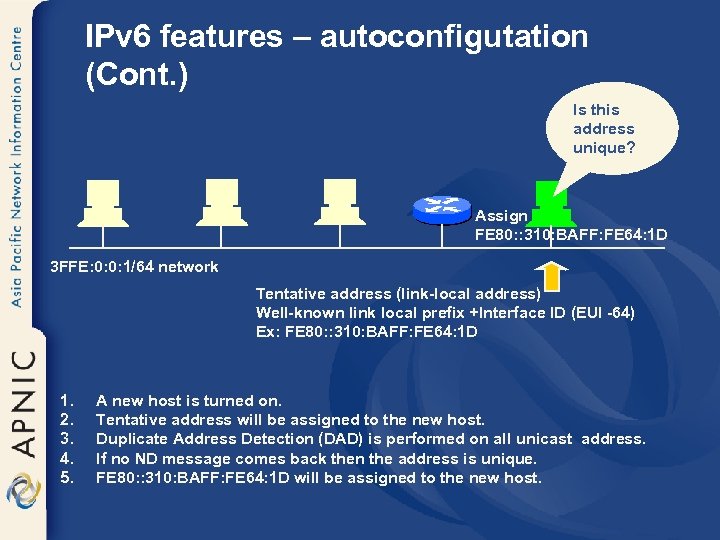 IPv 6 features – autoconfigutation (Cont. ) Is this address unique? Assign FE 80: : 310: BAFF: FE 64: 1 D 3 FFE: 0: 0: 1/64 network Tentative address (link-local address) Well-known link local prefix +Interface ID (EUI -64) Ex: FE 80: : 310: BAFF: FE 64: 1 D 1. 2. 3. 4. 5. A new host is turned on. Tentative address will be assigned to the new host. Duplicate Address Detection (DAD) is performed on all unicast address. If no ND message comes back then the address is unique. FE 80: : 310: BAFF: FE 64: 1 D will be assigned to the new host.
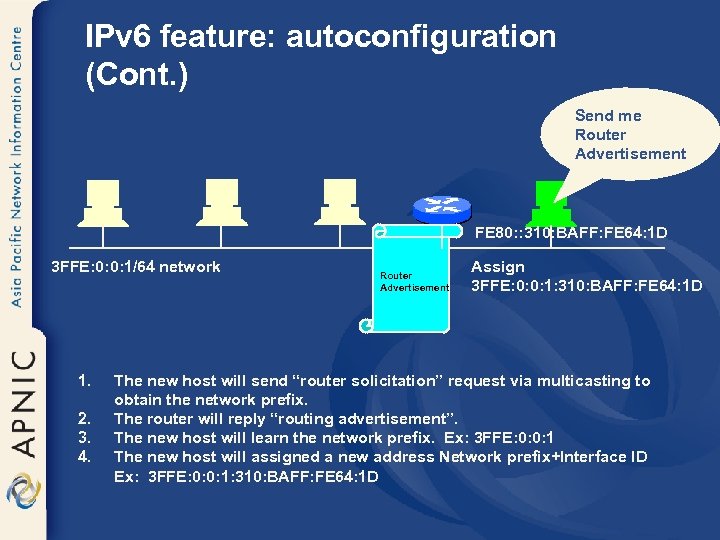 IPv 6 feature: autoconfiguration (Cont. ) Send me Router Advertisement FE 80: : 310: BAFF: FE 64: 1 D 3 FFE: 0: 0: 1/64 network 1. 2. 3. 4. Router Advertisement Assign 3 FFE: 0: 0: 1: 310: BAFF: FE 64: 1 D The new host will send “router solicitation” request via multicasting to obtain the network prefix. The router will reply “routing advertisement”. The new host will learn the network prefix. Ex: 3 FFE: 0: 0: 1 The new host will assigned a new address Network prefix+Interface ID Ex: 3 FFE: 0: 0: 1: 310: BAFF: FE 64: 1 D
 IPv 6 features – autoconfiguration (cont. ) • Keeps end user costs down – No need for manual configuration – In conjunction with the possibility of low cost network interface • Helpful when residential networks emerge as an important market
 IPv 4 to IPv 6 transition • Implementation rather than transition • The key to successful IPv 6 transition – Maintaining compatibility with IPv 4 hosts and routers while deploying IPv 6 • Millions of IPv 4 nodes already exist • Upgrading every IPv 4 nodes to IPv 6 is not feasible • Transition process will be gradual • Commonly utilised transition techniques – Dual Stack Transition – Tunneling
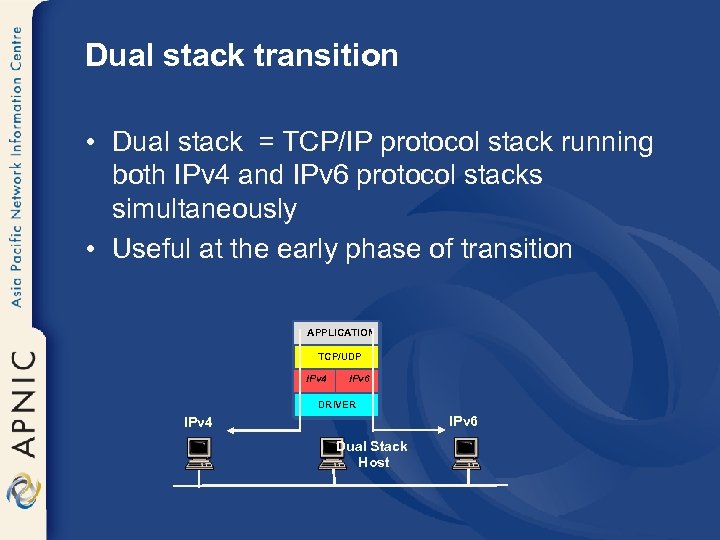 Dual stack transition • Dual stack = TCP/IP protocol stack running both IPv 4 and IPv 6 protocol stacks simultaneously • Useful at the early phase of transition APPLICATION TCP/UDP IPv 4 IPv 6 DRIVER IPv 6 IPv 4 Dual Stack Host
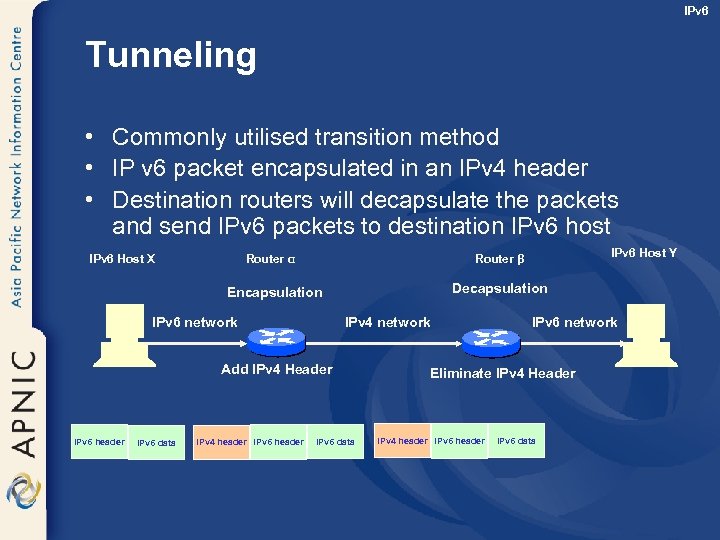 IPv 6 Tunneling • Commonly utilised transition method • IP v 6 packet encapsulated in an IPv 4 header • Destination routers will decapsulate the packets and send IPv 6 packets to destination IPv 6 host IPv 6 Host X Router α Decapsulation Encapsulation IPv 4 network IPv 6 network Add IPv 4 Header IPv 6 header IPv 6 data IPv 4 header IPv 6 Host Y Router β IPv 6 data IPv 6 network Eliminate IPv 4 Header IPv 4 header IPv 6 data
 IPv 6 address policy goals • Efficient address usage • Avoid wasteful practices • Aggregation • Hierarchical distribution • Aggregation of routing information • Limiting number of routing entries advertised • Minimise overhead • Associated with obtaining address space • Registration, Uniqueness, Fairness & consistency • Same as IPv 4
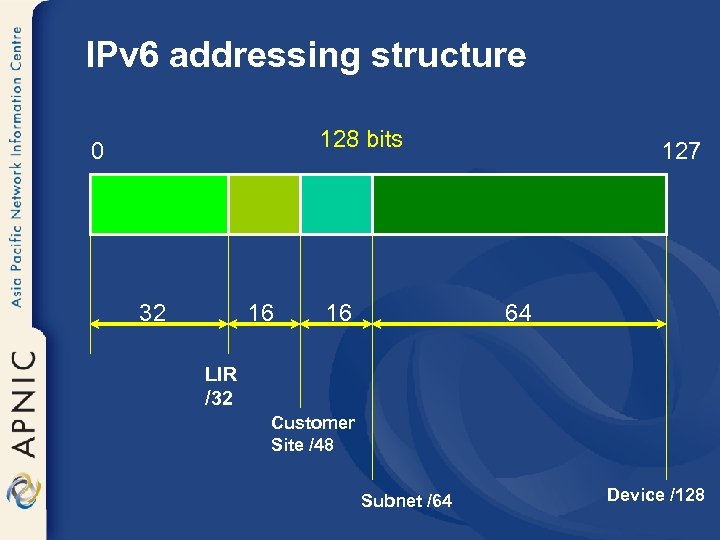 IPv 6 addressing structure 128 bits 0 32 16 16 127 64 LIR /32 Customer Site /48 Subnet /64 Device /128
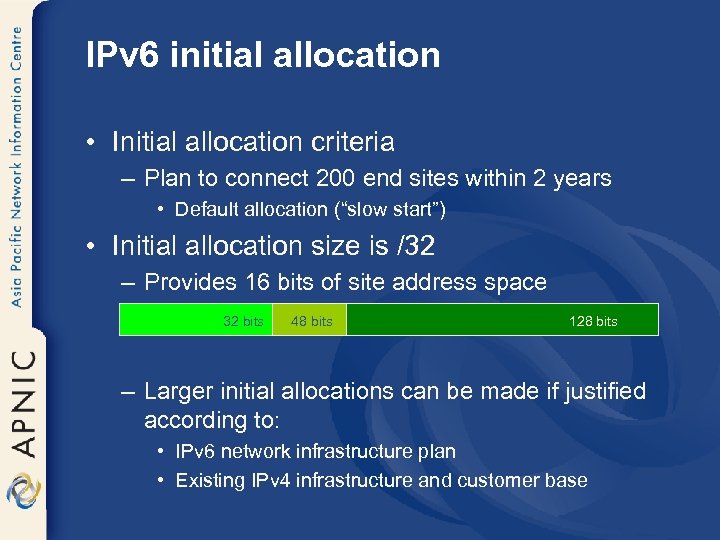 IPv 6 initial allocation • Initial allocation criteria – Plan to connect 200 end sites within 2 years • Default allocation (“slow start”) • Initial allocation size is /32 – Provides 16 bits of site address space 32 bits 48 bits 128 bits – Larger initial allocations can be made if justified according to: • IPv 6 network infrastructure plan • Existing IPv 4 infrastructure and customer base
 IPv 6 sub-allocation policy • LIR to ISP allocation – Policy determined by LIR • DB registration – All /48 and shorter prefix allocations and assignments must be registered
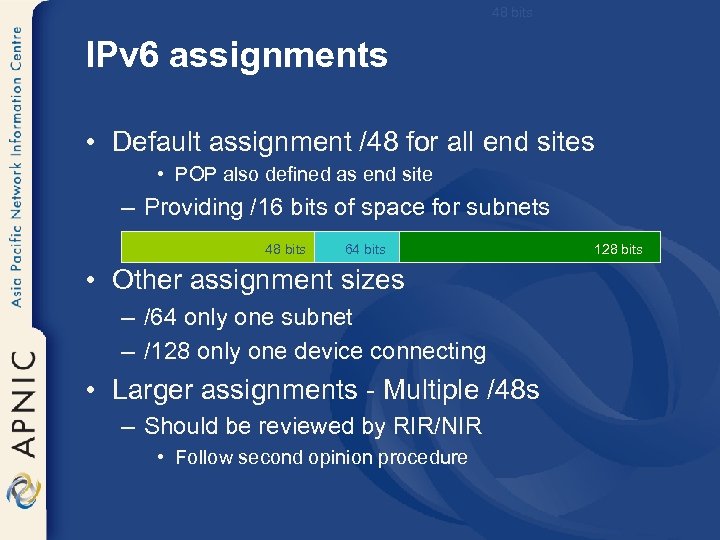 48 bits IPv 6 assignments • Default assignment /48 for all end sites • POP also defined as end site – Providing /16 bits of space for subnets 48 bits 64 bits • Other assignment sizes – /64 only one subnet – /128 only one device connecting • Larger assignments - Multiple /48 s – Should be reviewed by RIR/NIR • Follow second opinion procedure 128 bits
 What is an end site? • End Site defined as an end user of an ISP where the ISP: – Assigns address space to the end user – Provides Internet transit service to the end user – Advertises an aggregate prefix route that contains the end user's assignment
 IPv 6 utilisation • Utilisation determined from end site assignments – LIR responsible for registration of all /48 assignments – Intermediate allocation hierarchy not considered • Utilisation of IPv 6 address space is measured differently from IPv 4
 IPv 6 utilisation (Cont. ) • Subsequent allocation may be requested when IPv 6 utilisation requirement is met
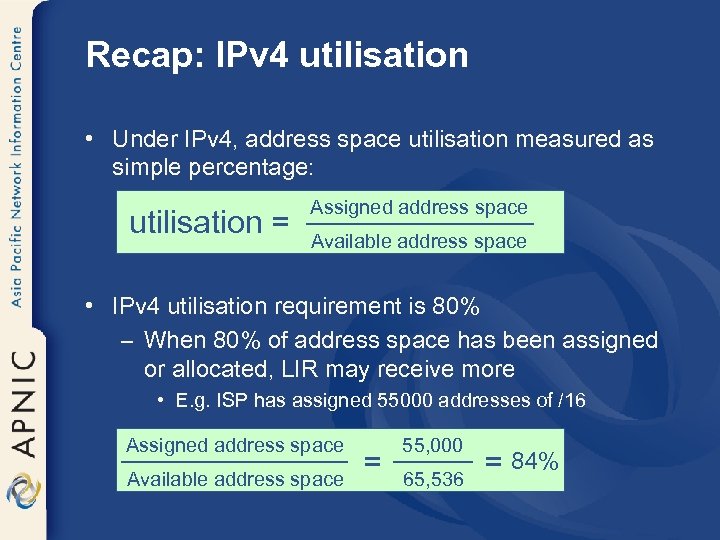 Recap: IPv 4 utilisation • Under IPv 4, address space utilisation measured as simple percentage: utilisation = Assigned address space Available address space • IPv 4 utilisation requirement is 80% – When 80% of address space has been assigned or allocated, LIR may receive more • E. g. ISP has assigned 55000 addresses of /16 Assigned address space Available address space = 55, 000 65, 536 = 84%
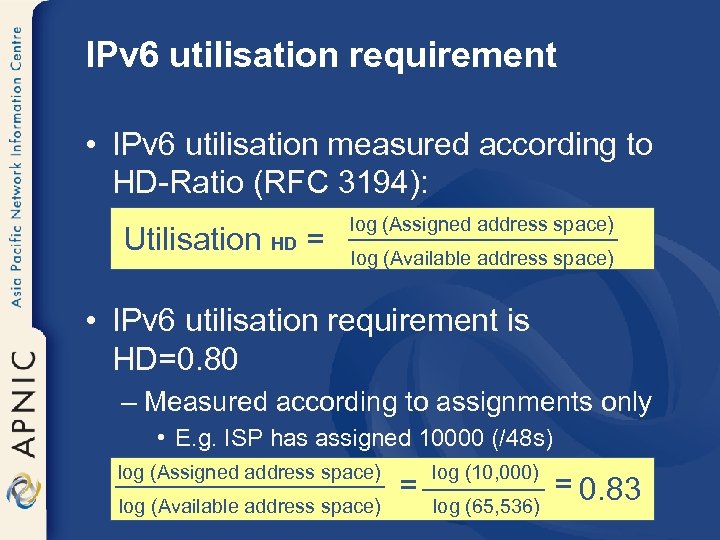 IPv 6 utilisation requirement • IPv 6 utilisation measured according to HD-Ratio (RFC 3194): Utilisation HD = log (Assigned address space) log (Available address space) • IPv 6 utilisation requirement is HD=0. 80 – Measured according to assignments only • E. g. ISP has assigned 10000 (/48 s) addresses of space) log (Assigned address /32 log (10, 000) log (Available address space) = log (65, 536) = 0. 83
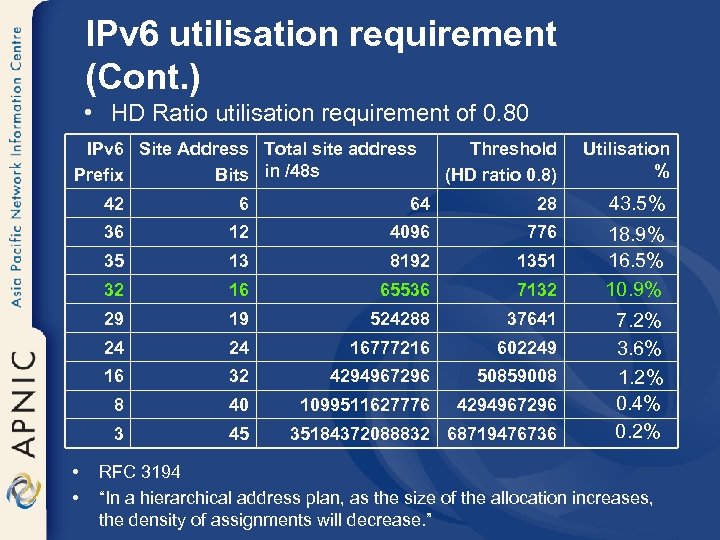 IPv 6 utilisation requirement (Cont. ) • HD Ratio utilisation requirement of 0. 80 IPv 6 Site Address Total site address Prefix Bits in /48 s Threshold (HD ratio 0. 8) Utilisation % 42 64 28 43. 5% 36 12 4096 776 35 13 8192 1351 32 16 65536 7132 18. 9% 16. 5% 10. 9% 29 19 524288 37641 24 24 16777216 602249 16 32 4294967296 50859008 8 40 1099511627776 4294967296 3 • • 6 45 35184372088832 68719476736 7. 2% 3. 6% 1. 2% 0. 4% 0. 2% RFC 3194 “In a hierarchical address plan, as the size of the allocation increases, the density of assignments will decrease. ”
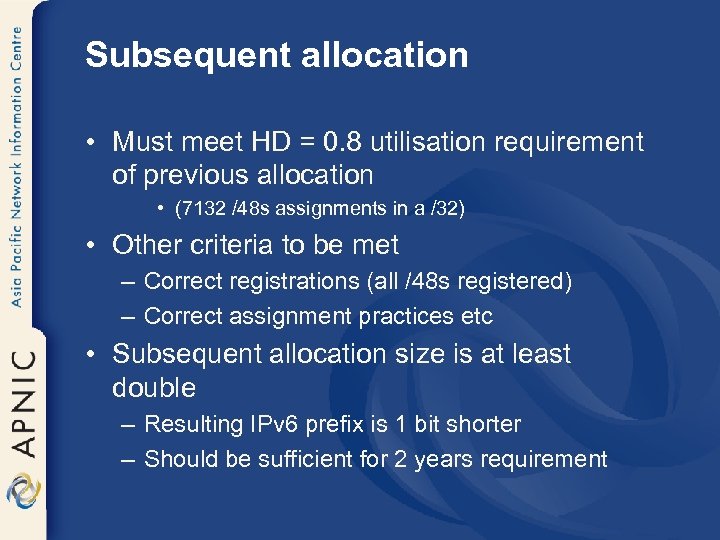 Subsequent allocation • Must meet HD = 0. 8 utilisation requirement of previous allocation • (7132 /48 s assignments in a /32) • Other criteria to be met – Correct registrations (all /48 s registered) – Correct assignment practices etc • Subsequent allocation size is at least double – Resulting IPv 6 prefix is 1 bit shorter – Should be sufficient for 2 years requirement
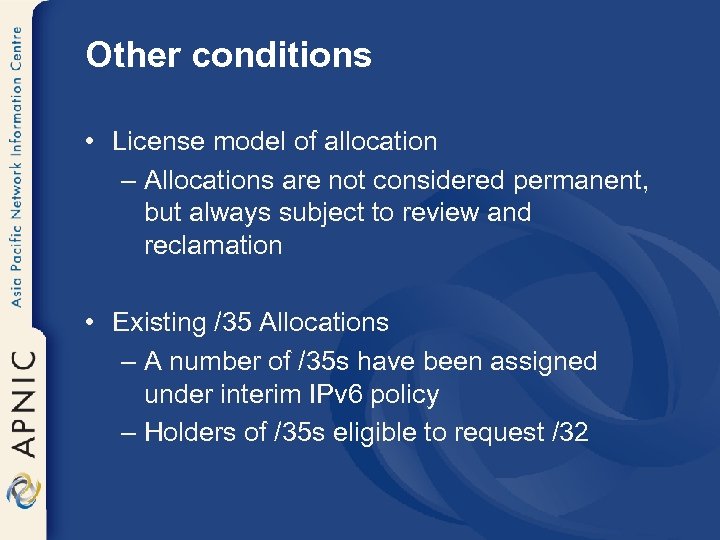 Other conditions • License model of allocation – Allocations are not considered permanent, but always subject to review and reclamation • Existing /35 Allocations – A number of /35 s have been assigned under interim IPv 6 policy – Holders of /35 s eligible to request /32
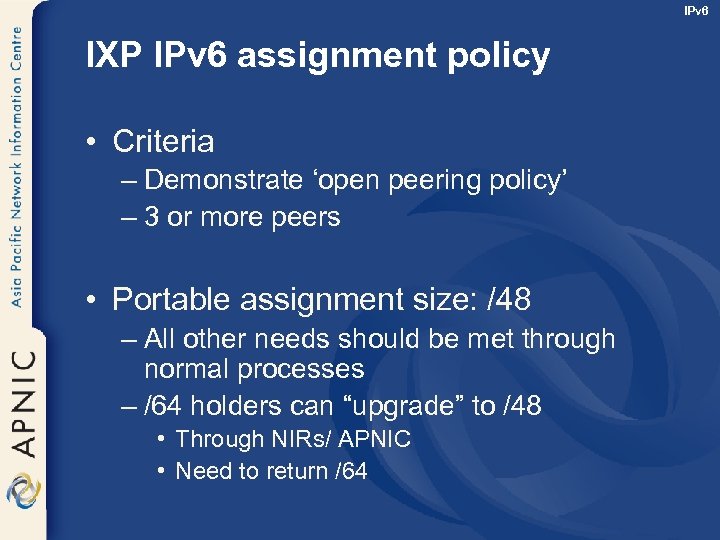 IPv 6 IXP IPv 6 assignment policy • Criteria – Demonstrate ‘open peering policy’ – 3 or more peers • Portable assignment size: /48 – All other needs should be met through normal processes – /64 holders can “upgrade” to /48 • Through NIRs/ APNIC • Need to return /64
 IPv 6 Current Status - Implementations • Most vendors are shipping supported products today • eg. 3 Com, Apple, Bay Networks, BSDI, Bull, Cisco, Dassault, Digital, Epilogue, Ericsson/Telebit, Free. BSD, IBM, Hitachi, HP, KAME, Linux, Mentat, Microsoft, Nokia, Novell, Nortel, Open. BSD, SCO, Siemens Nixdorf, Silicon Graphics, Sun, Trumpet
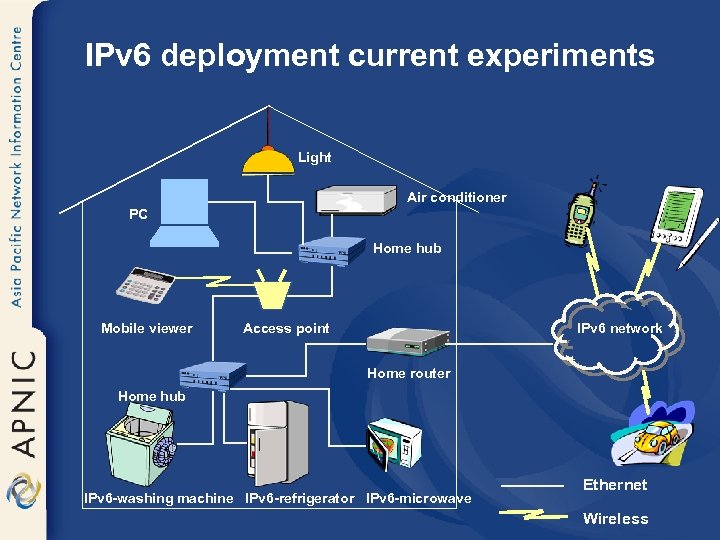 IPv 6 deployment current experiments Light Air conditioner PC Home hub Mobile viewer Access point IPv 6 network Home router Home hub IPv 6 -washing machine IPv 6 -refrigerator IPv 6 -microwave Ethernet Wireless
 Current issues: DNS • Need for a root name server, TLDs name server accessible via IPv 6 • Human error easily made in IPv 6 reverse DNS record – Dynamic update may provide a solution – Security system while update required • Ex: DNSSEC
 IPv 6 Address Allocation Procedures • IPv 6 Allocations to RIRs from IANA – APNIC – ARIN – LACNIC – RIPE NCC 2001: 0200: : /23 2001: 0 C 00: : /23 2001: 0 E 00: : /23 2001: 0400: : /23 2001: 1800: : /23 2001: 1200: : /23 2001: 0600: : /23 2001: 0800: : /23 2001: 0 A 00: : /23 2001: 1400: : /23 2001: 1600: : /23 2001: 1 A 00: : /23 • IPv 6 Address Request form • IPv 6 FAQ http: //ftp. apnic. net/apnic/docs/ipv 6 -alloc-request http: //www. apnic. net/faq/IPv 6 -FAQ. html
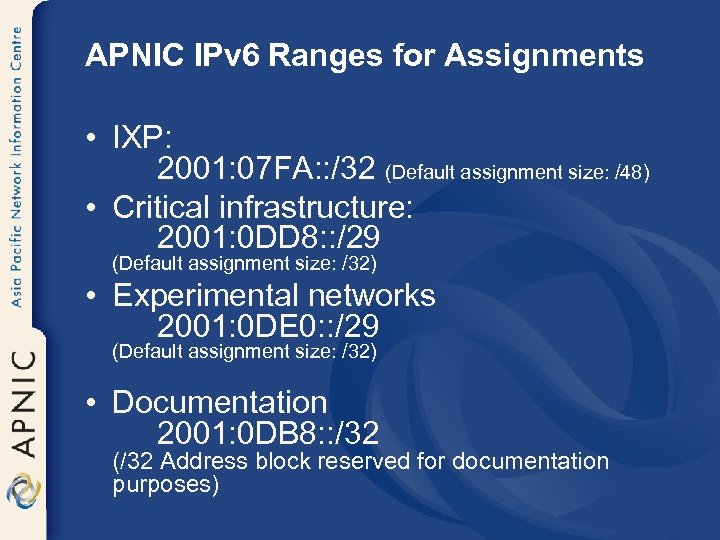 APNIC IPv 6 Ranges for Assignments • IXP: 2001: 07 FA: : /32 (Default assignment size: /48) • Critical infrastructure: 2001: 0 DD 8: : /29 (Default assignment size: /32) • Experimental networks 2001: 0 DE 0: : /29 (Default assignment size: /32) • Documentation 2001: 0 DB 8: : /32 (/32 Address block reserved for documentation purposes)
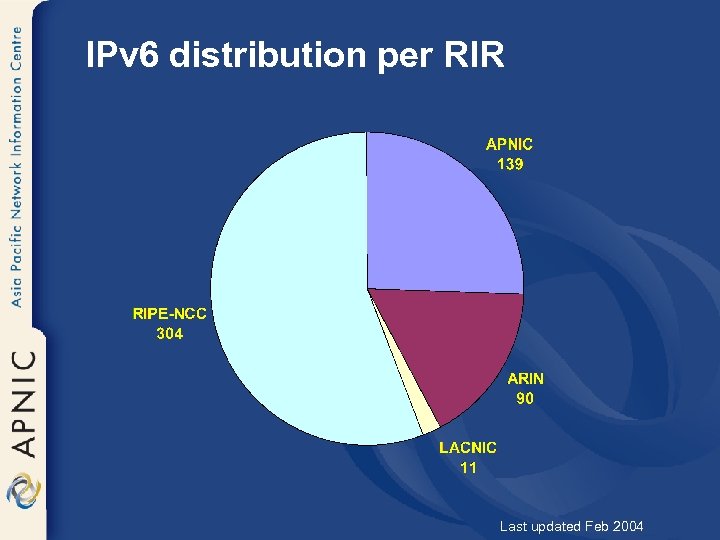 IPv 6 distribution per RIR Last updated Feb 2004
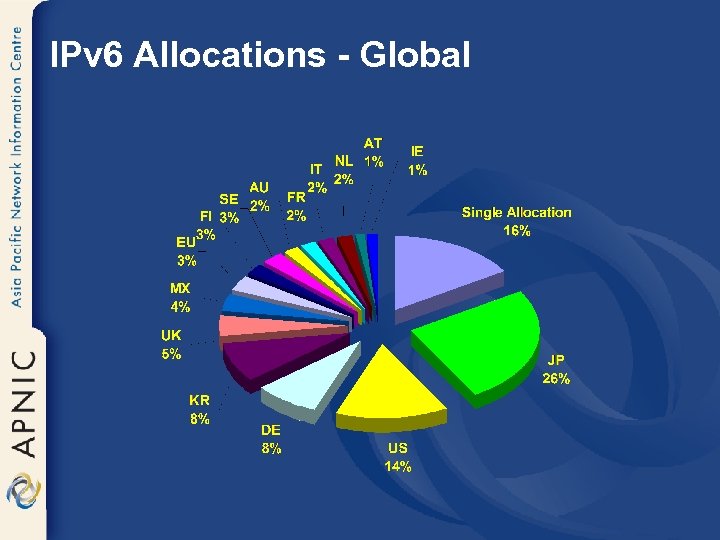 IPv 6 Allocations - Global
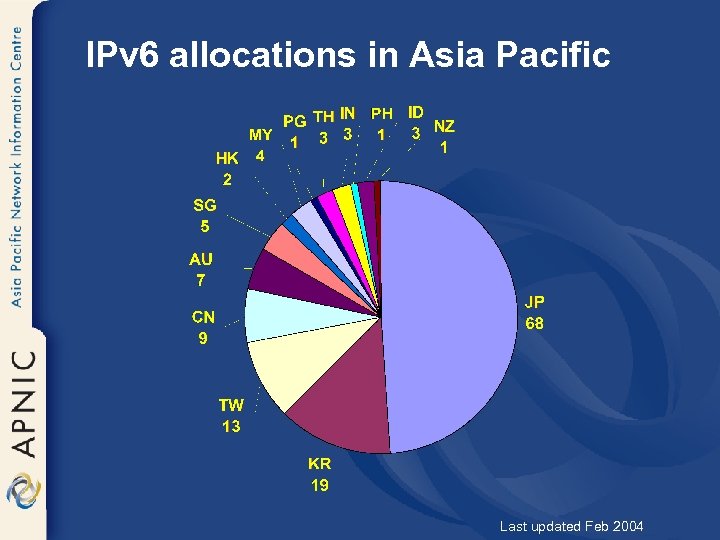 IPv 6 allocations in Asia Pacific Last updated Feb 2004
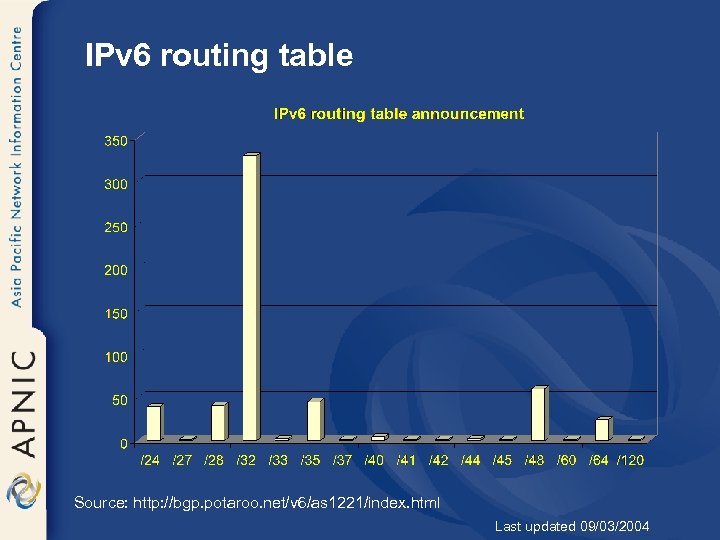 IPv 6 routing table Source: http: //bgp. potaroo. net/v 6/as 1221/index. html Last updated 09/03/2004
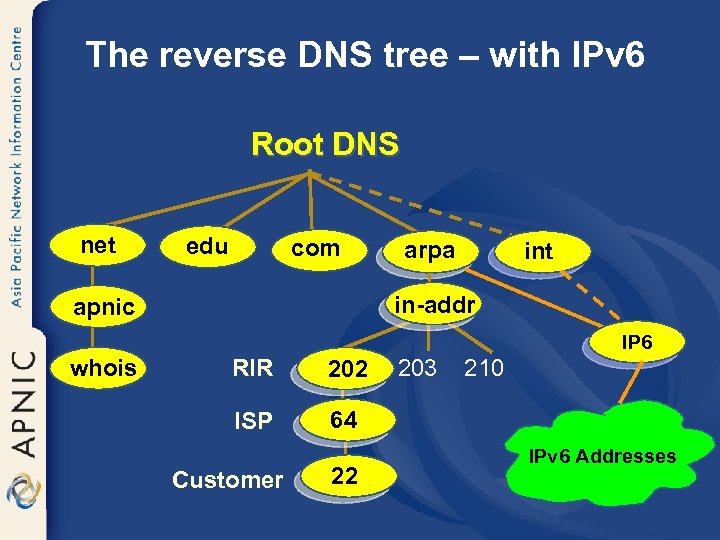 The reverse DNS tree – with IPv 6 Root DNS net edu com int in-addr apnic whois arpa IP 6 RIR 202 ISP 64 64 Customer 22 22 203 210 IPv 6 Addresses
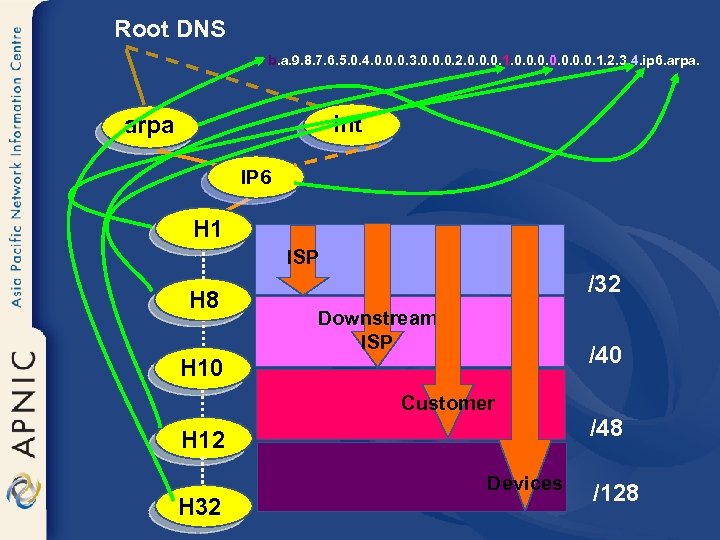 Root DNS b. a. 9. 8. 7. 6. 5. 0. 4. 0. 0. 0. 3. 0. 0. 0. 2. 0. 0. 0. 1. 2. 3. 4. ip 6. arpa. int arpa IP 6 H 1 64 ISP H 8 /32 Downstream ISP /40 H 10 Customer /48 H 12 H 32 Devices /128
 IPv 6 forward lookups • Multiple addresses possible for any given name – Ex: in a multi-homed situation • Can assign A records and AAAA records to a given name/domain • Can also assign separate domains for IPv 6 and IPv 4
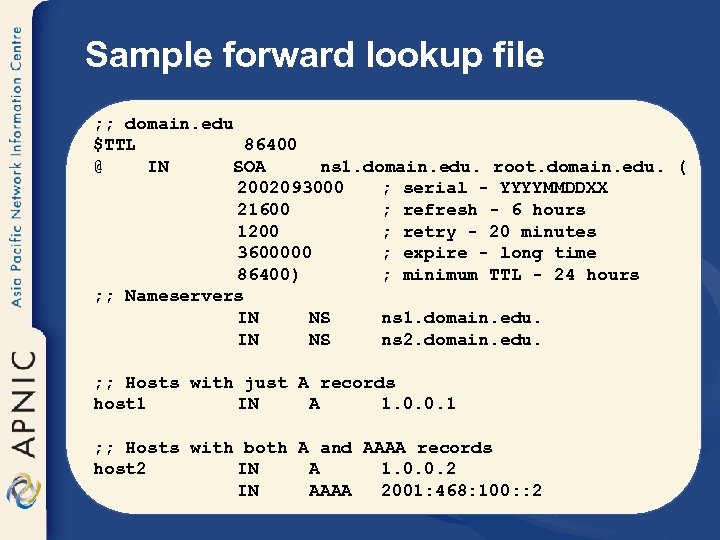 Sample forward lookup file ; ; domain. edu $TTL 86400 @ IN SOA ns 1. domain. edu. root. domain. edu. ( 2002093000 ; serial - YYYYMMDDXX 21600 ; refresh - 6 hours 1200 ; retry - 20 minutes 3600000 ; expire - long time 86400) ; minimum TTL - 24 hours ; ; Nameservers IN NS ns 1. domain. edu. IN NS ns 2. domain. edu. ; ; Hosts with just A records host 1 IN A 1. 0. 0. 1 ; ; Hosts with both A and AAAA records host 2 IN A 1. 0. 0. 2 IN AAAA 2001: 468: 100: : 2
 IPv 6 reverse lookups • IETF decided to restandardize IPv 6 PTR RRs – They will be found in the IP 6. ARPA namespace rather than under the IP 6. INT namespace • The ip 6. int domains has been deprecated, but some hosts still use them – Supported for backwards compatiblity • Now using ip 6. arpa for reverse
 IPv 6 reverse lookups - AAAA and ip 6. arpa • Address record four times longer than A – Quad A ( AAAA ) • AAAA record is a parallel to the IPv 4 A record • It specifies the entire address in a single record
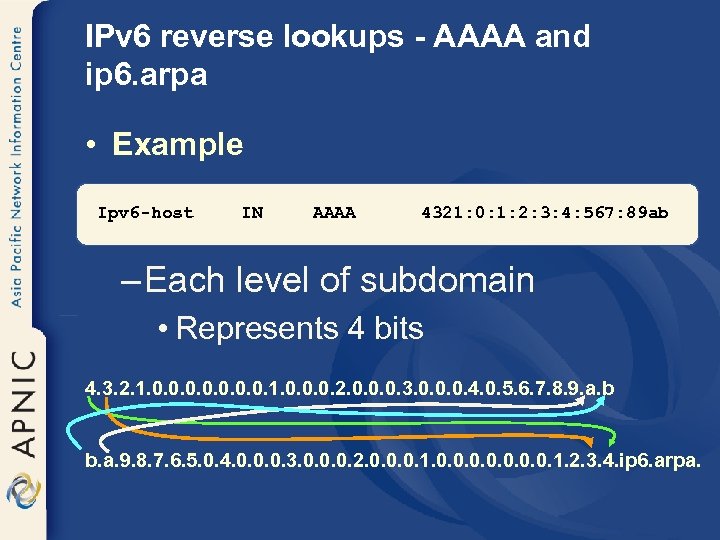 IPv 6 reverse lookups - AAAA and ip 6. arpa • Example Ipv 6 -host IN AAAA 4321: 0: 1: 2: 3: 4: 567: 89 ab – Each level of subdomain • Represents 4 bits 4. 3. 2. 1. 0. 0. 0. 2. 0. 0. 0. 3. 0. 0. 0. 4. 0. 5. 6. 7. 8. 9. a. b b. a. 9. 8. 7. 6. 5. 0. 4. 0. 0. 0. 3. 0. 0. 0. 2. 0. 0. 0. 1. 2. 3. 4. ip 6. arpa.
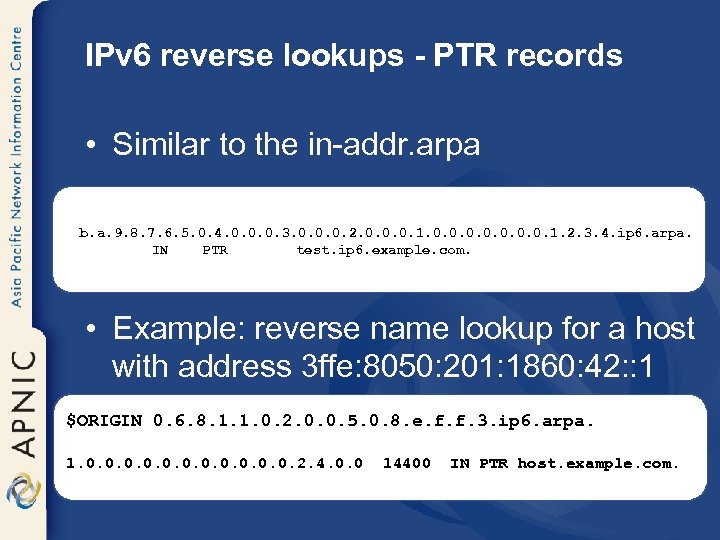 IPv 6 reverse lookups - PTR records • Similar to the in-addr. arpa b. a. 9. 8. 7. 6. 5. 0. 4. 0. 0. 0. 3. 0. 0. 0. 2. 0. 0. 0. 1. 2. 3. 4. ip 6. arpa. IN PTR test. ip 6. example. com. • Example: reverse name lookup for a host with address 3 ffe: 8050: 201: 1860: 42: : 1 $ORIGIN 0. 6. 8. 1. 1. 0. 2. 0. 0. 5. 0. 8. e. f. f. 3. ip 6. arpa. 1. 0. 0. 0. 2. 4. 0. 0 14400 IN PTR host. example. com.
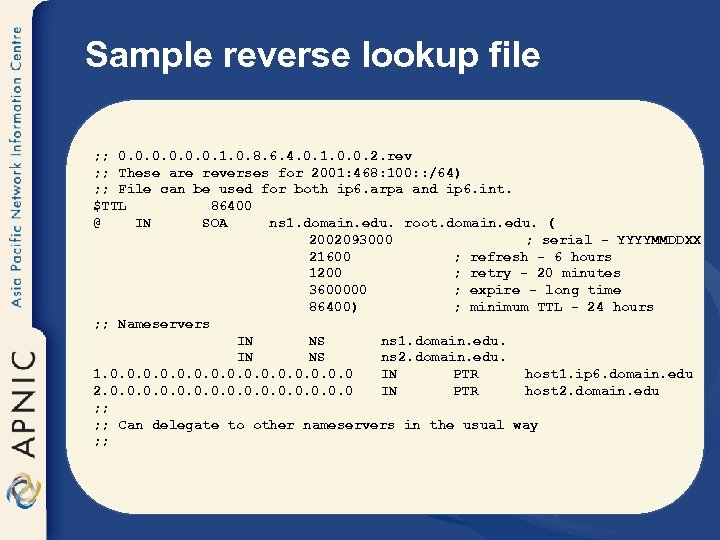 Sample reverse lookup file ; ; 0. 0. 0. 1. 0. 8. 6. 4. 0. 1. 0. 0. 2. rev ; ; These are reverses for 2001: 468: 100: : /64) ; ; File can be used for both ip 6. arpa and ip 6. int. $TTL 86400 @ IN SOA ns 1. domain. edu. root. domain. edu. ( 2002093000 ; serial - YYYYMMDDXX 21600 ; refresh - 6 hours 1200 ; retry - 20 minutes 3600000 ; expire - long time 86400) ; minimum TTL - 24 hours ; ; Nameservers IN NS ns 1. domain. edu. IN NS ns 2. domain. edu. 1. 0. 0 IN PTR host 1. ip 6. domain. edu 2. 0. 0 IN PTR host 2. domain. edu ; ; Can delegate to other nameservers in the usual way ; ;
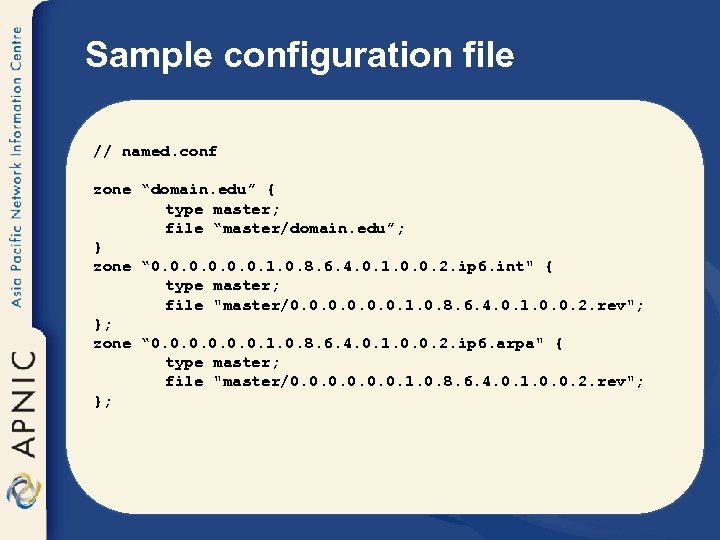 Sample configuration file // named. conf zone “domain. edu” { type master; file “master/domain. edu”; } zone “ 0. 0. 0. 1. 0. 8. 6. 4. 0. 1. 0. 0. 2. ip 6. int" { type master; file "master/0. 0. 0. 1. 0. 8. 6. 4. 0. 1. 0. 0. 2. rev"; }; zone “ 0. 0. 0. 1. 0. 8. 6. 4. 0. 1. 0. 0. 2. ip 6. arpa" { type master; file "master/0. 0. 0. 1. 0. 8. 6. 4. 0. 1. 0. 0. 2. rev"; };
 Current Status – IPv 6 in DNS • A 6 and Bit label specifications has been made experimental – RFC 3363 • IETF standardized 2 different formats – AAAA and A 6 – Confusions on which format to deploy – More than one choice will lead to delays in the deployment of IPv 6
 Questions ?