Скачать презентацию IPv 6 Security Issues IPSec does solve
37a6c95a3447fe6dc5addcb26bfe20cb.ppt
- Количество слайдов: 48
 IPv 6 – Security Issues (IPSec does solve everything) Tomáš Podermański, tpoder@cis. vutbr. cz

 IPv 6 security • IPv 6 provides better security than IPv 4 for applications and networks • How does IPv 6 provide a solution? In IPv 6, IPSec is a major protocol requirement and is one of the factors in ensuring that IPv 6 provides better security than IPv 4. The large address space also prevents networks against address scanning. Source: http: //www. ipv 6. com/
 Scanning • The huge address space prevents scanning – Brute force scanning on a network with prefix /64 would take 28 years until the first active address found. That means 1 mln tests per second and traffic 400 Mb/s. – RFC 5157 IPv 6 - Implications for Network Scanning – Privacy extension for Stateless Address Autoconf. (RFC 4941) • New ways to find active IPv 6 addresses – DNS, whois, logs, Flow, NI Query (RFC 4620), well known MAC address, existing IPv 4 address, transition mechanisms – van. Hauser – Ministry of Truth (http: //www. youtube. com/watch? v=c 7 hq 2 q 4 j. QYw) – 2000 active addresses were found in 20 seconds !! • Scanning on the local network – Ping FF 02: : 1 – Information obtained from neighbor cache (or sniffing on FF 02: : 1)
 ICMPv 6 (RFC 2463) • Completely differed comparing to IPv 4 • IPv 6 can not work without ICMPv 6 – – – Neighbor Discovery (NDP) Stateless Autoconfiguration (RS, RA) Working with multicast groups (MLD) Diagnostics (PING) Signalization • • –… Destination Unreachable Time exceeded Packet to Big Redirection
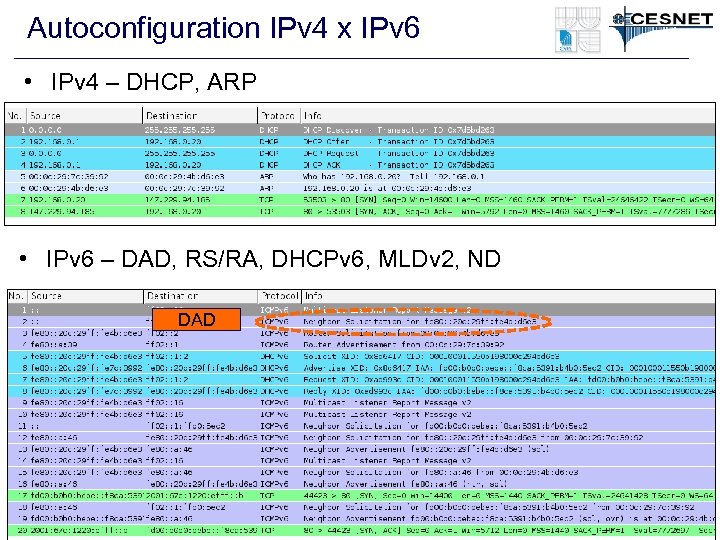
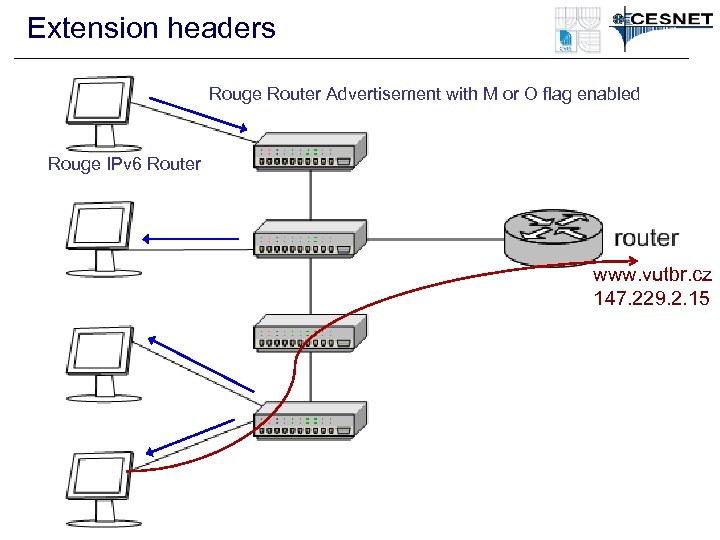
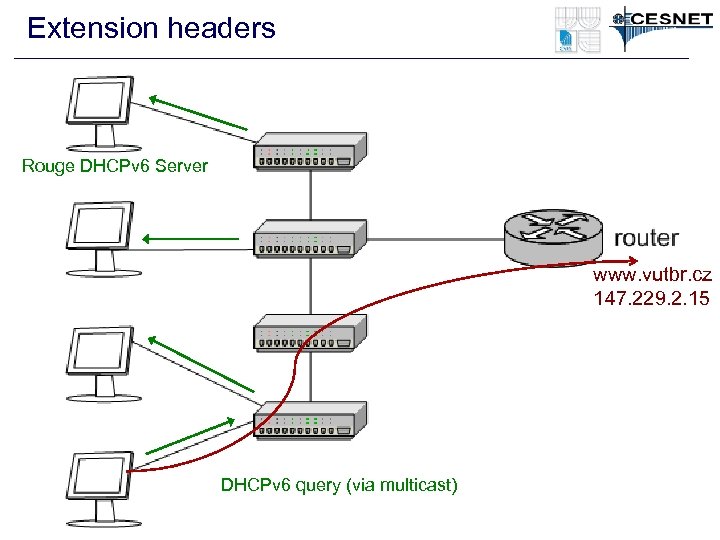
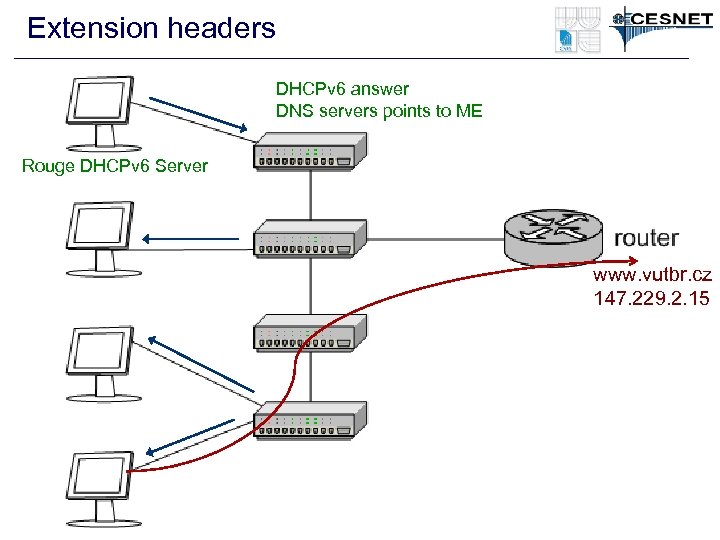
 ICMPv 6 - Neighbor Discovery • Neighbor cache spoofing – Very similar to ARP spoofing – The spoofed address can be kept in the NC longer • Do. S - Duplicate Address Detection (DAD) – Nodes usually create own address (EUI 64, Privacy Extensions) – (Optimistic) DAD – “sorry, the address is mine, choose another” • Neighbor Cache Table Overload – Big address space (64 bits – 1. 8 e+19 address) – Many records in the NC for non existing clients • Rouge Router Advertisement – I am a router for this network – use me as a default router – The real router is not a valid anymore – zero lifetime • Rouge DHCPv 6 Server – I am a DHCPv 6 sever for this network. Use my options (DNS)
 IPv 6 Attack Tools • Scanners – Nmap, halfscan 6, Scan 6, CHScanner • Packet forgery – Scapy 6, Send. IP, Packit, Spak 6 • Do. S Tools – 6 tunneldos, 4 to 6 ddos, Imps 6 -tools • THC IPv 6 Attack Toolkit – parasite 6, alive 6, fake_router 6, redir 6, toobig 6, detect-new-ip 6, dosnew-ip 6, fake_mld 6, fake_mipv 6, fake_advertiser 6, smurf 6, rsmurf 6 http: //freeworld. thc. org/
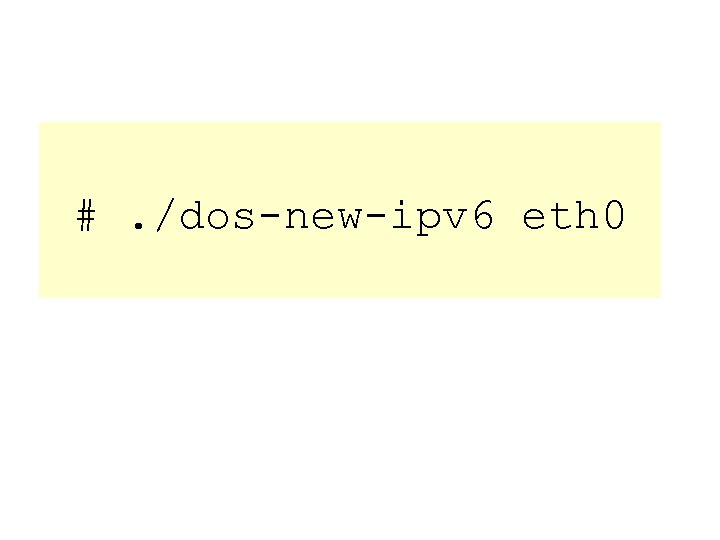 #. /dos-new-ipv 6 eth 0
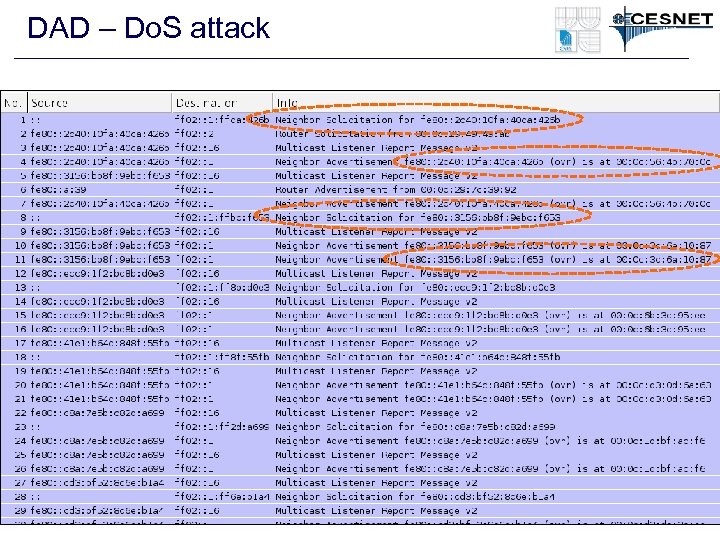 DAD – Do. S attack
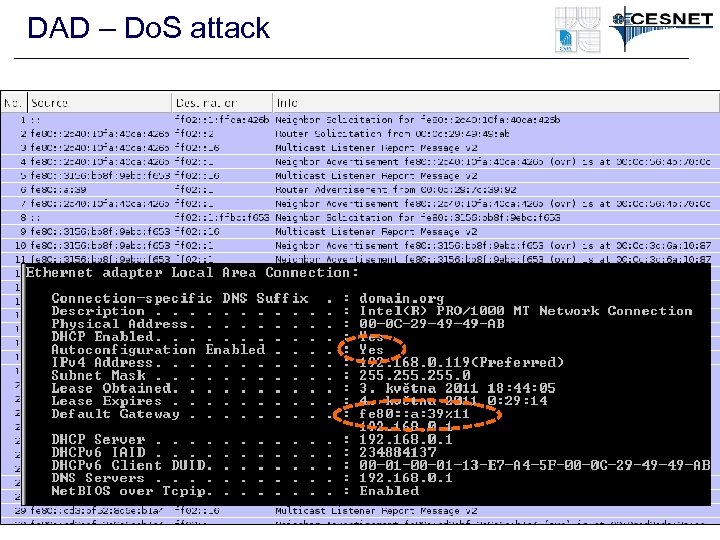 DAD – Do. S attack
 It is not a problem There are not enough services available on IPv 6. We have plenty of time to solve it and implement a proper solution. Really ? Do we ?
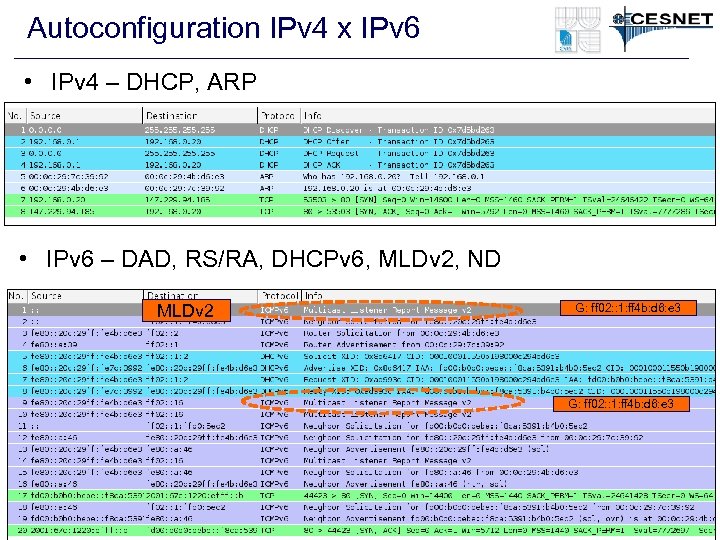
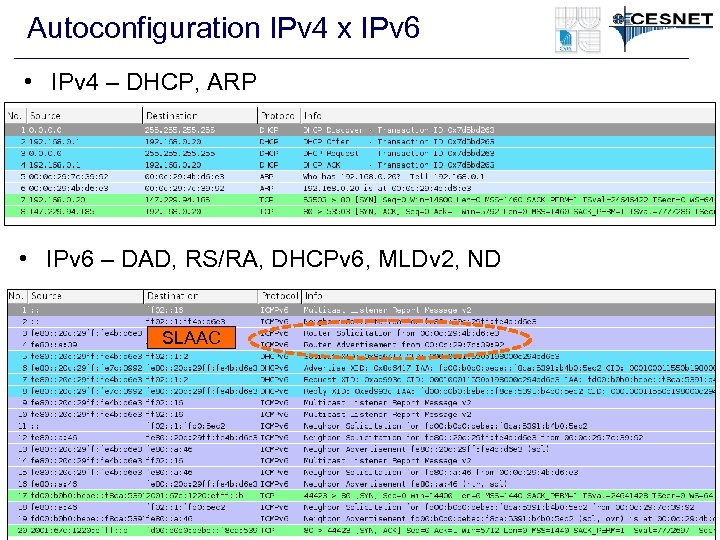
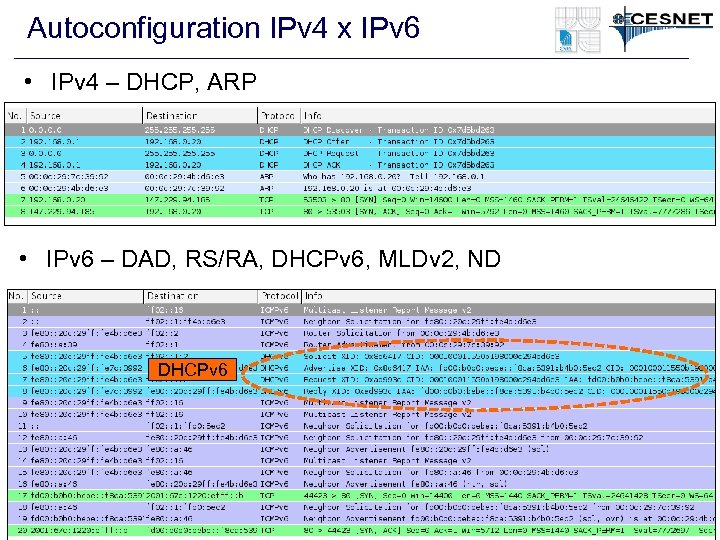
 Autoconfiguration – SLAAC, DHCPv 6 • SLAAC does not contain addresses of DNS servers – Obtain via another protocol (DHCPv 4, DHCPv 6) – Anycast address for recursive DNS servers – New option in RA (RFC 6106) – lack of implementation • DHCP was not planned for IPv 6 – The first RFC 3315 (2003) – Coexistence with SLAAC (flags M, O) – Does not contain the address of a default router • We have to use both mechanisms in IPv 6 -only networks • Different platforms support different techniques – Windows Vista/7 – SLAAC + DHCPv 6 – MAC OS, i. OS - SLAAC only – Linux, BSD, … – depends on distribution
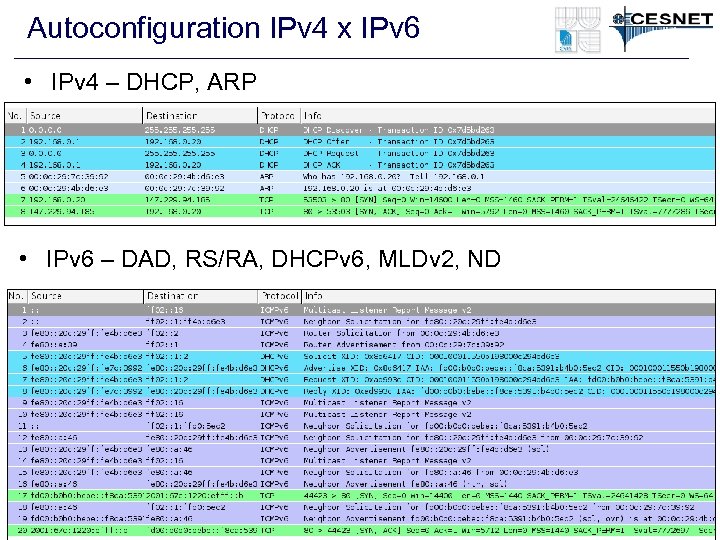 Autoconfiguration IPv 4 x IPv 6 • IPv 4 – DHCP, ARP • IPv 6 – DAD, RS/RA, DHCPv 6, MLDv 2, ND
 Autoconfiguration IPv 4 x IPv 6 • IPv 4 – DHCP, ARP • IPv 6 – DAD, RS/RA, DHCPv 6, MLDv 2, ND MLDv 2 G: ff 02: : 1: ff 4 b: d 6: e 3
 Autoconfiguration IPv 4 x IPv 6 • IPv 4 – DHCP, ARP • IPv 6 – DAD, RS/RA, DHCPv 6, MLDv 2, ND DAD
 Autoconfiguration IPv 4 x IPv 6 • IPv 4 – DHCP, ARP • IPv 6 – DAD, RS/RA, DHCPv 6, MLDv 2, ND SLAAC
 Autoconfiguration IPv 4 x IPv 6 • IPv 4 – DHCP, ARP • IPv 6 – DAD, RS/RA, DHCPv 6, MLDv 2, ND DHCPv 6
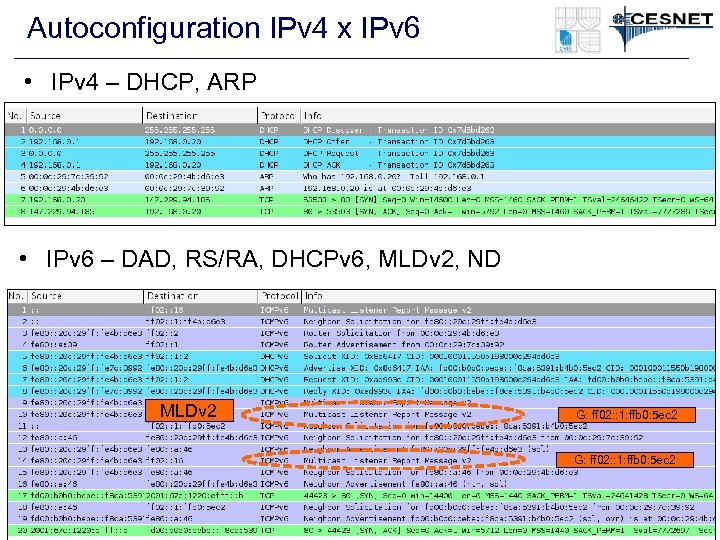 Autoconfiguration IPv 4 x IPv 6 • IPv 4 – DHCP, ARP • IPv 6 – DAD, RS/RA, DHCPv 6, MLDv 2, ND MLDv 2 G: ff 02: : 1: ffb 0: 5 ec 2
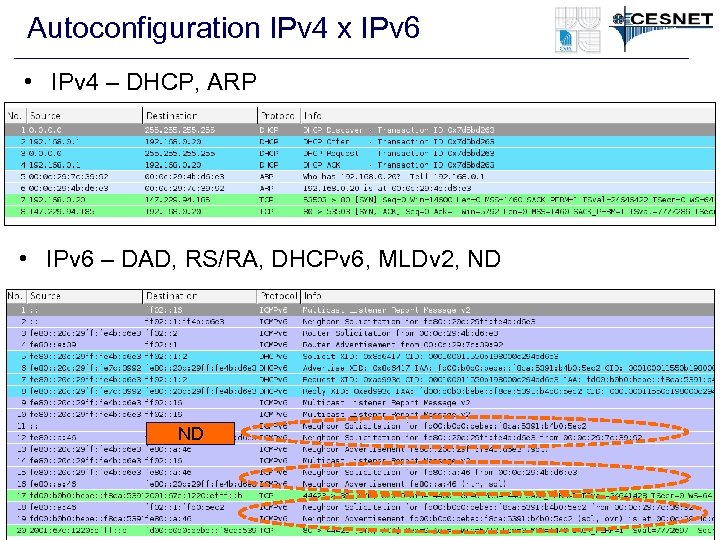 Autoconfiguration IPv 4 x IPv 6 • IPv 4 – DHCP, ARP • IPv 6 – DAD, RS/RA, DHCPv 6, MLDv 2, ND ND
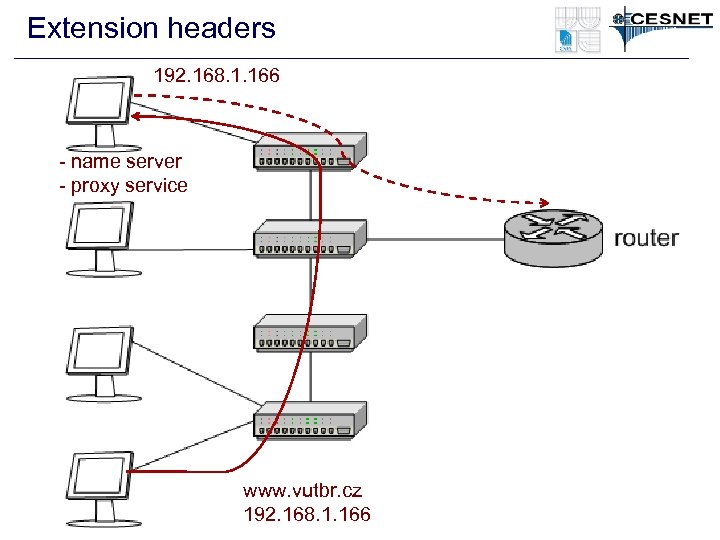
 IPv 4 and IPv 6 in a network • More than 50% of PC supports dualstack – Most of them use autoconfiguration (SLAAC) to get IP address (MS Vista/7, Linux, Mac OS, i. OS, BSD*) – IPv 6 is preferred protocol by default • Steps to make an attack: – Setup attacker’s IP to act as a RA sender – Prepare a DHCPv 6 server on the attacker's PC; as DNS servers provide attacker’s addresses – Modify the behavior of DNS server to return A or AAAA records for www. google. com, www. yahoo. com, etc. to your attacker’s address – Transparent proxy service allows attacker to modify content of webpages
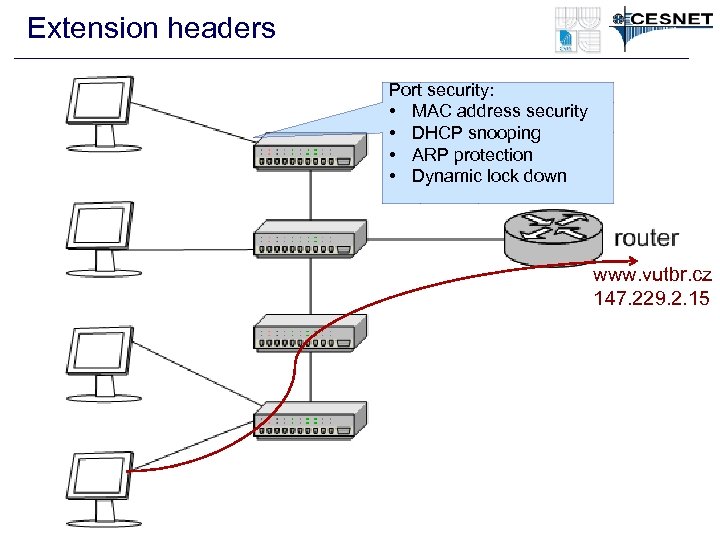 Extension headers Port security: • MAC address security • DHCP snooping • ARP protection • Dynamic lock down www. vutbr. cz 147. 229. 2. 15
 Extension headers Rouge Router Advertisement with M or O flag enabled Rouge IPv 6 Router www. vutbr. cz 147. 229. 2. 15
 Extension headers Rouge DHCPv 6 Server www. vutbr. cz 147. 229. 2. 15 DHCPv 6 query (via multicast)
 Extension headers DHCPv 6 answer DNS servers points to ME Rouge DHCPv 6 Server www. vutbr. cz 147. 229. 2. 15
 Extension headers 192. 168. 1. 166 - name server - proxy service www. vutbr. cz 192. 168. 1. 166
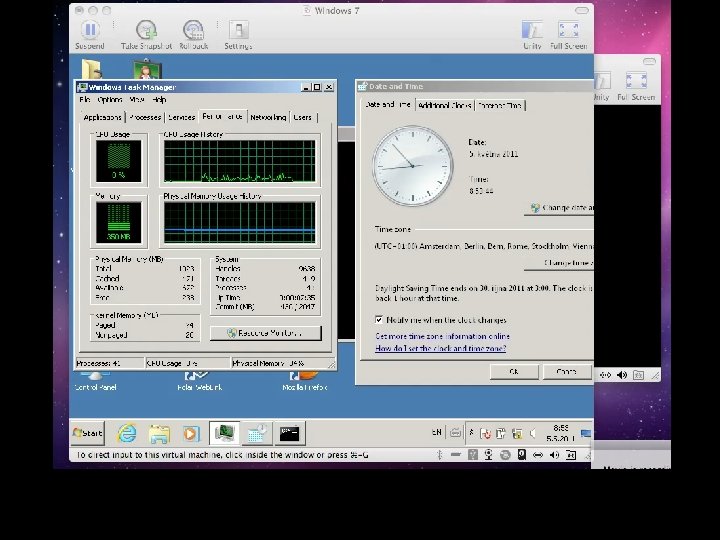
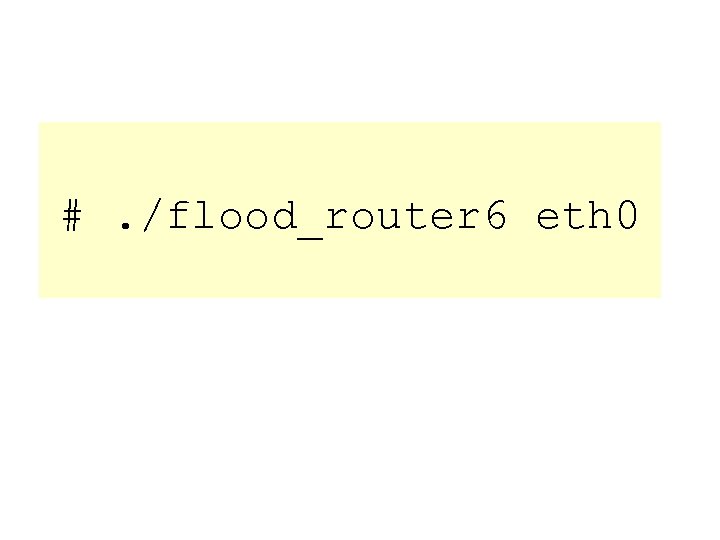 #. /flood_router 6 eth 0
 It is not a problem! IPv 4 has very similar issues related to autoconfiguration. There is no difference between IPv 6 and IPv 4. Really ? Isn’t there ?
 Autoconfiguration – IPv 4 • IPv 4 autoconfiguration = DHCP • Protection mechanisms on L 2 devices – DHCP snooping • Blocking DHCP responses on access ports • Prevents against fake DHCP servers – Dynamic ARP protection • MAC-IP address databased on DHCP leases • Checking content of ARP packets on client access port • Prevents against ARP spoofing – Dynamic lock down • The MAC-IP database is used for inspection of client source MAC and IP address. • Prevents against source address spoofing
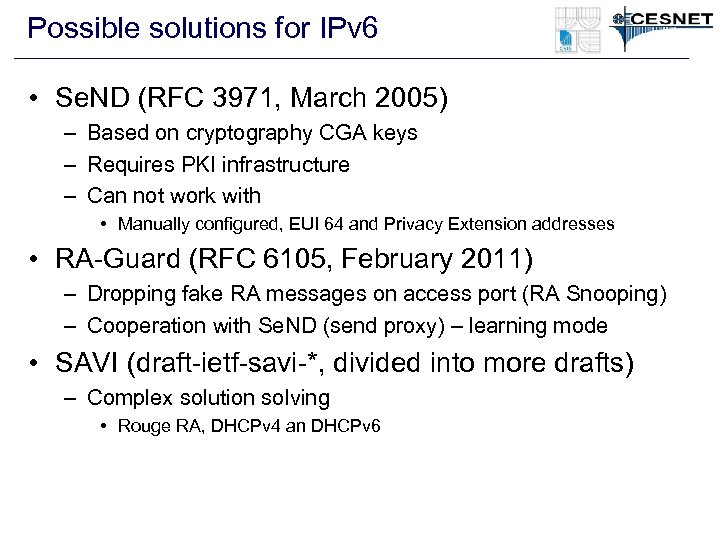 Possible solutions for IPv 6 • Se. ND (RFC 3971, March 2005) – Based on cryptography CGA keys – Requires PKI infrastructure – Can not work with • Manually configured, EUI 64 and Privacy Extension addresses • RA-Guard (RFC 6105, February 2011) – Dropping fake RA messages on access port (RA Snooping) – Cooperation with Se. ND (send proxy) – learning mode • SAVI (draft-ietf-savi-*, divided into more drafts) – Complex solution solving • Rouge RA, DHCPv 4 an DHCPv 6
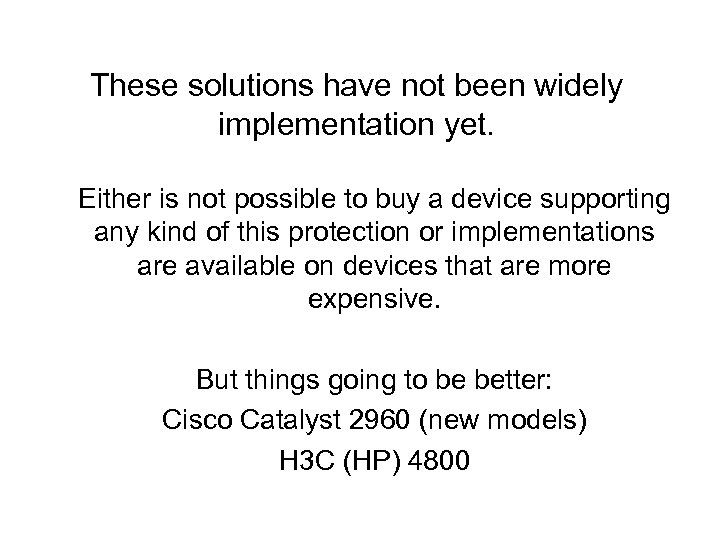 These solutions have not been widely implementation yet. Either is not possible to buy a device supporting any kind of this protection or implementations are available on devices that are more expensive. But things going to be better: Cisco Catalyst 2960 (new models) H 3 C (HP) 4800
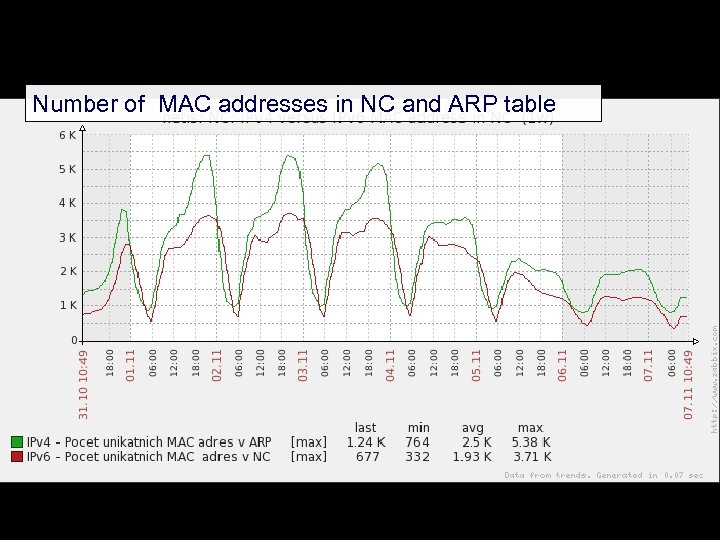 Number of MAC addresses in NC and ARP table
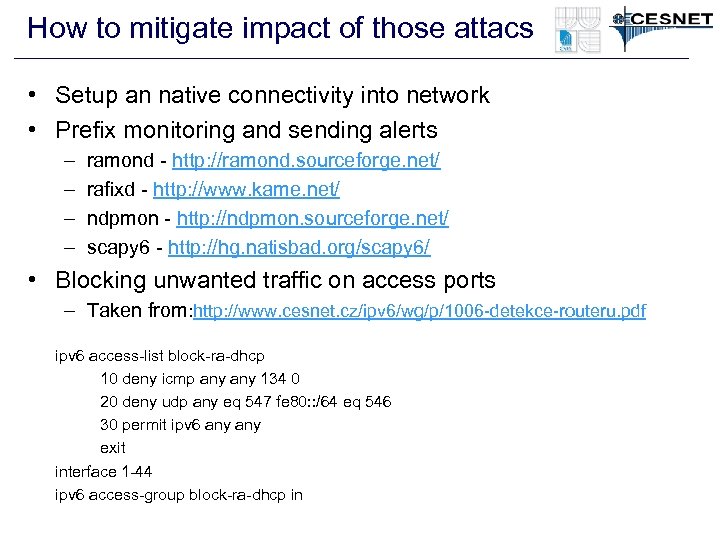 How to mitigate impact of those attacs • Setup an native connectivity into network • Prefix monitoring and sending alerts – – ramond - http: //ramond. sourceforge. net/ rafixd - http: //www. kame. net/ ndpmon - http: //ndpmon. sourceforge. net/ scapy 6 - http: //hg. natisbad. org/scapy 6/ • Blocking unwanted traffic on access ports – Taken from: http: //www. cesnet. cz/ipv 6/wg/p/1006 -detekce-routeru. pdf ipv 6 access-list block-ra-dhcp 10 deny icmp any 134 0 20 deny udp any eq 547 fe 80: : /64 eq 546 30 permit ipv 6 any exit interface 1 -44 ipv 6 access-group block-ra-dhcp in
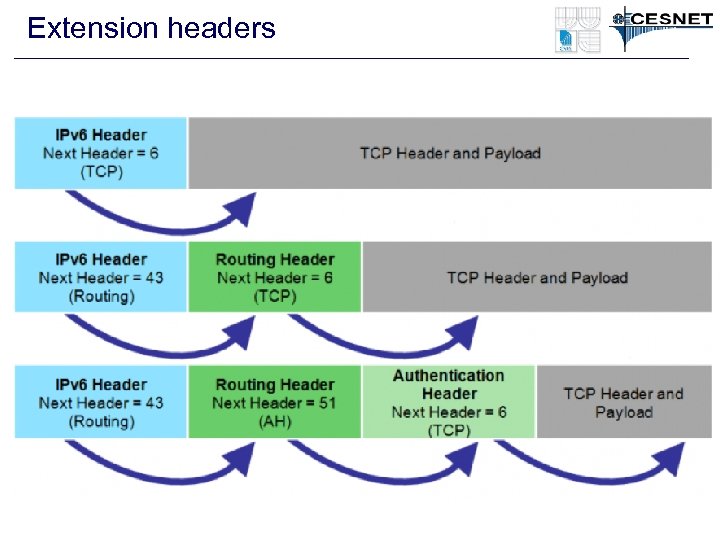 Extension headers
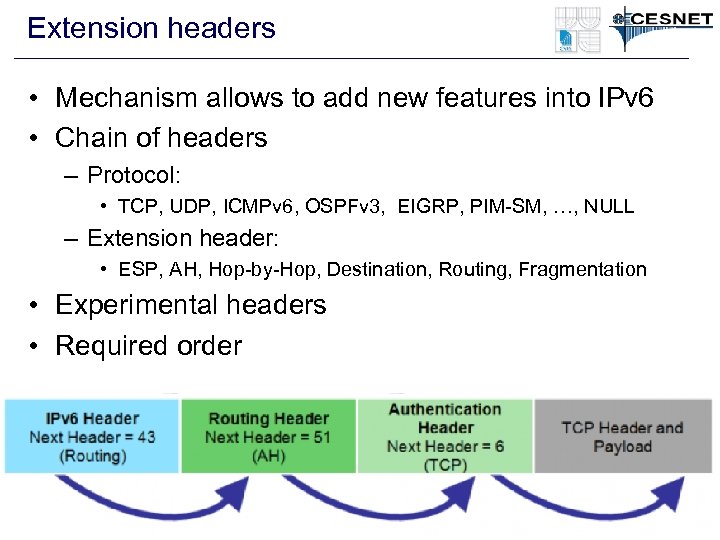 Extension headers • Mechanism allows to add new features into IPv 6 • Chain of headers – Protocol: • TCP, UDP, ICMPv 6, OSPFv 3, EIGRP, PIM-SM, …, NULL – Extension header: • ESP, AH, Hop-by-Hop, Destination, Routing, Fragmentation • Experimental headers • Required order
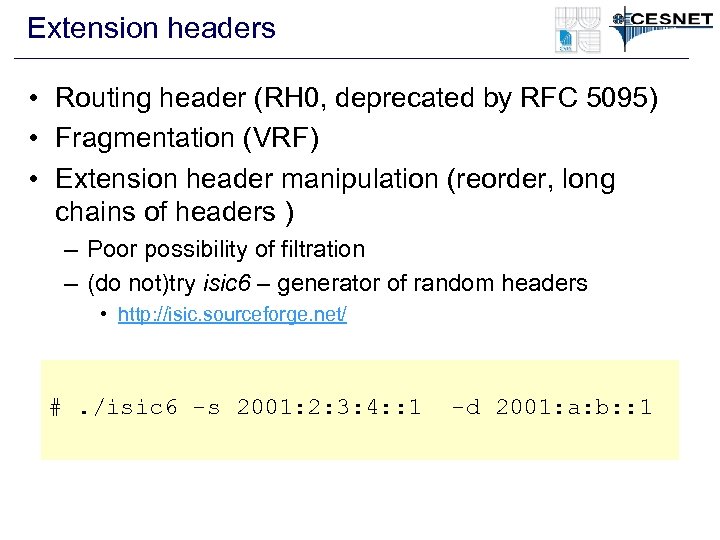 Extension headers • Routing header (RH 0, deprecated by RFC 5095) • Fragmentation (VRF) • Extension header manipulation (reorder, long chains of headers ) – Poor possibility of filtration – (do not)try isic 6 – generator of random headers • http: //isic. sourceforge. net/ #. /isic 6 -s 2001: 2: 3: 4: : 1 -d 2001: a: b: : 1
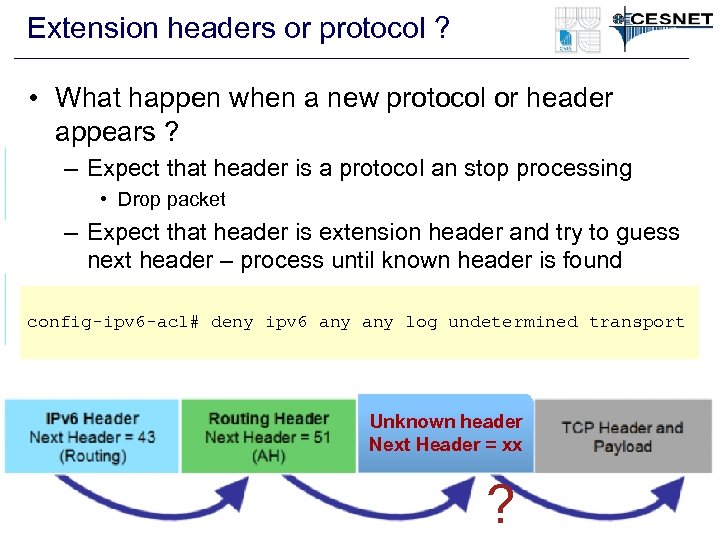 Extension headers or protocol ? • What happen when a new protocol or header appears ? – Expect that header is a protocol an stop processing • Drop packet – Expect that header is extension header and try to guess next header – process until known header is found config-ipv 6 -acl# deny ipv 6 any log undetermined transport Unknown header Next Header = xx ?
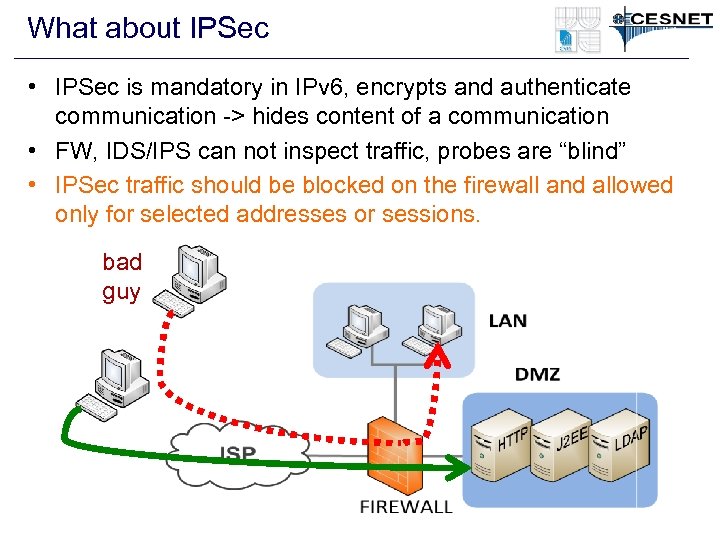 What about IPSec • IPSec is mandatory in IPv 6, encrypts and authenticate communication -> hides content of a communication • FW, IDS/IPS can not inspect traffic, probes are “blind” • IPSec traffic should be blocked on the firewall and allowed only for selected addresses or sessions. bad guy
 Implementation Vulnerabilities in IPv 6 so far • IPv 6 was meant to be easy to process and easy to implement. • Programmers have learned their lessons with IPv 4. Hey, then what can probably go wrong? Taken from: http: //freeworld. thc. org/papers. php
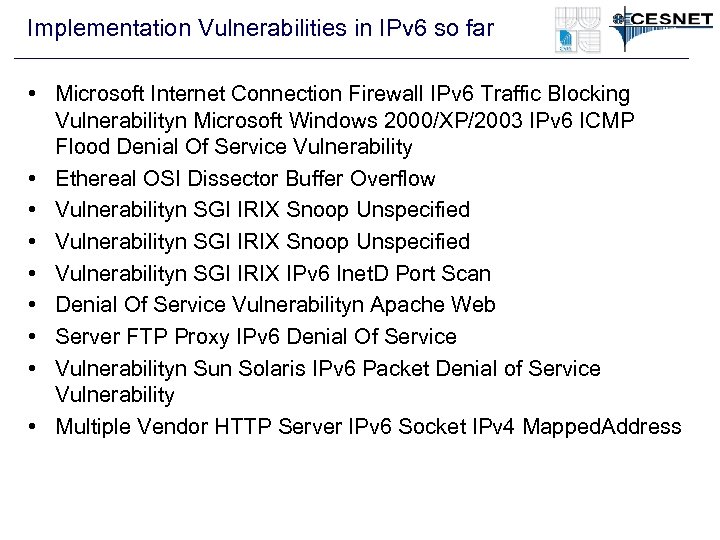 Implementation Vulnerabilities in IPv 6 so far • Microsoft Internet Connection Firewall IPv 6 Traffic Blocking Vulnerabilityn Microsoft Windows 2000/XP/2003 IPv 6 ICMP Flood Denial Of Service Vulnerability • Ethereal OSI Dissector Buffer Overflow • Vulnerabilityn SGI IRIX Snoop Unspecified • Vulnerabilityn SGI IRIX IPv 6 Inet. D Port Scan • Denial Of Service Vulnerabilityn Apache Web • Server FTP Proxy IPv 6 Denial Of Service • Vulnerabilityn Sun Solaris IPv 6 Packet Denial of Service Vulnerability • Multiple Vendor HTTP Server IPv 6 Socket IPv 4 Mapped. Address
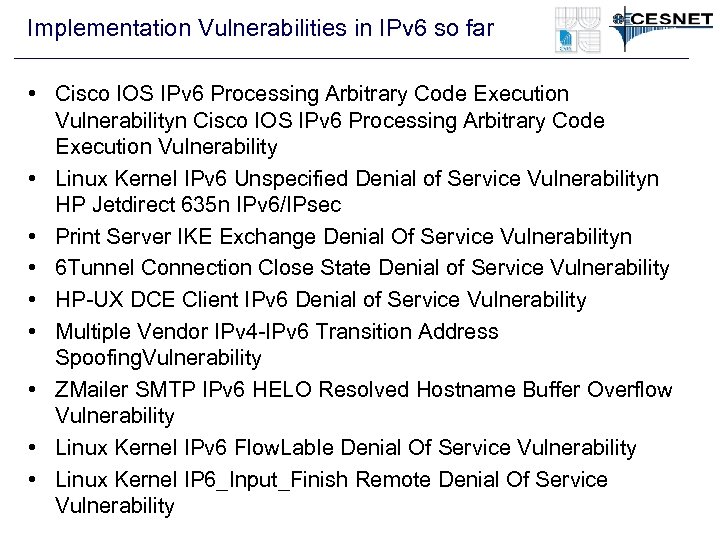 Implementation Vulnerabilities in IPv 6 so far • Cisco IOS IPv 6 Processing Arbitrary Code Execution Vulnerabilityn Cisco IOS IPv 6 Processing Arbitrary Code Execution Vulnerability • Linux Kernel IPv 6 Unspecified Denial of Service Vulnerabilityn HP Jetdirect 635 n IPv 6/IPsec • Print Server IKE Exchange Denial Of Service Vulnerabilityn • 6 Tunnel Connection Close State Denial of Service Vulnerability • HP-UX DCE Client IPv 6 Denial of Service Vulnerability • Multiple Vendor IPv 4 -IPv 6 Transition Address Spoofing. Vulnerability • ZMailer SMTP IPv 6 HELO Resolved Hostname Buffer Overflow Vulnerability • Linux Kernel IPv 6 Flow. Lable Denial Of Service Vulnerability • Linux Kernel IP 6_Input_Finish Remote Denial Of Service Vulnerability
 Implementation Vulnerabilities in IPv 6 so far • Linux Kernel IP 6_Input_Finish Remote Denial Of Service Vulnerability • Sun Solaris 10 Malformed IPv 6 Packets Denial of Service Vulnerability • Sun Solaris Malformed IPv 6 Packets Remote Denial of Service Vulnerability • Windows Vista Torredo Filter Bypass • Linux Kernel IPv 6 Seqfile Handling Local Denial of Service Vulnerability • Linux Kernel Multiple IPv 6 Packet Filtering Bypass Vulnerabilities • Cisco IOS IPv 6 Source Routing Remote Memory Corruption Vulnerability
 Implementation Vulnerabilities in IPv 6 so far • Linux Kernel IPv 6_Sock. Glue. c NULL Pointer Dereference Vulnerability • Multiple: IPv 6 Protocol Type 0 Route Header Denial of Service Vulnerability • Linux Kernel Netfilter nf_conntrack IPv 6 Packet Reassembly Rule Bypass Vulnerability • Sun Solaris Remote IPv 6 IPSec Packet Denial of Service Vulnerability • Linux Kernel IPv 6 Hop-By-Hop Header Remote Denial of Service Vulnerability • KAME Project IPv 6 IPComp Header Denial Of Service Vulnerability • Open. BSD IPv 6 Routing Headers Remote Denial of Service Vulnerability
 Implementation Vulnerabilities in IPv 6 so far • Linux Kernel IPv 6_Getsockopt_Sticky Memory Leak Information Disclosure Vulnerability • Linux Kernel IPv 6 TCP Sockets Local Denial of Service Vulnerability • Juniper Networks JUNOS IPv 6 Packet Processing Remote Denial of Service Vulnerability. Cisco IOS Dual-stack Router IPv 6 Denial Of Service Vulnerability • Multiple Platform IPv 6 Address Publication Denial of Service Vulnerabilities • Microsoft IPv 6 TCPIP Loopback LAND Denial of Service Vulnerability • Handling Vulnerabilityn BSD ICMPV 6 Handling • Routines Remote Denial Of Service Vulnerability
 Implementation Vulnerabilities in IPv 6 so far Vulnerability data from June 2008 47 bugs some multi operating systems many silently fixed Taken from: http: //freeworld. thc. org/papers. php
 Conclusion • IPv 6 have all security issues that IPv 4, also have – DDo. S, Address spoofing, (RH 0), Fragmentation, … • Some attacks are more difficult to perform – Scanning – Better network filtration • Some are easier to perform – – RA, DHCPv 6 spoofing, … ICMPv 6 – more complex, needs more attention to secure Header reorder, overflow, … Lack of knowledge how to secure the network • Transition techniques are a new way to perform attacks – Avoiding firewalls, probes, IDS, IPS – Address behind NAT can be accessible from anywhere • IPSec is NOT complex solution to solve security issues
 What we can do about it ? • Start using IPv 6 immediately – We have been waiting for perfect IPv 6 more than 15 years - it does not work – Until IPv 6 is used we will not discover any problem • Prefer native IPv 6 connectivity (anywhere you can) – It is a final solution for future (IPv 4 will be switched off later) – Native IPv 6 is more secure than unattended tunneled traffic ! • Ask vendors and creators of standards to fix problems – More requests escalate troubles on the vendor side – Standardization of IPv 6 is not enclosed process. Anyone can contribute or comment the standards • Stop pretending that IPv 6 do not have any troubles – IPv 6 have got many problems – Problems can not be solved by covering them – Unreliable information led to broken trust amongst users. The naked truth is always better than the best dressed lie