


 Скачать презентацию IPv 6 in Africa How Africa is preparing
eb1f5b8560d38c96e2589cf0dff8c5ca.ppt
- Количество слайдов: 17
 IPv 6 in Africa How Africa is preparing for IPv 6 © Afri. NIC – 2005 -2008 Adiel A. Akplogan CEO, Afri. NIC i. Week, Johannesburg, 18 September 2008
 Content Challenges Initiatives to overcome some of the challenges Achievement Way forward Conclusion
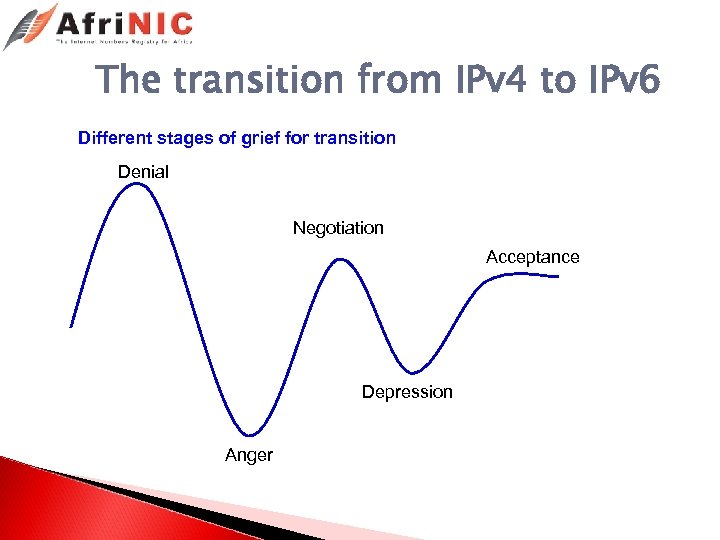 The transition from IPv 4 to IPv 6 Different stages of grief for transition Denial Negotiation Acceptance Depression Anger
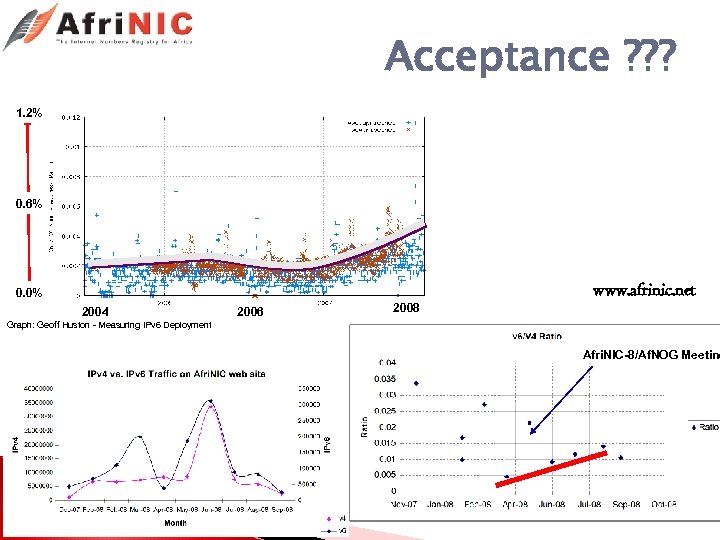 Acceptance ? ? ? 1. 2% 0. 6% www. afrinic. net 0. 0% 2004 2006 2008 Graph: Geoff Huston - Measuring IPv 6 Deployment Afri. NIC-8/Af. NOG Meeting
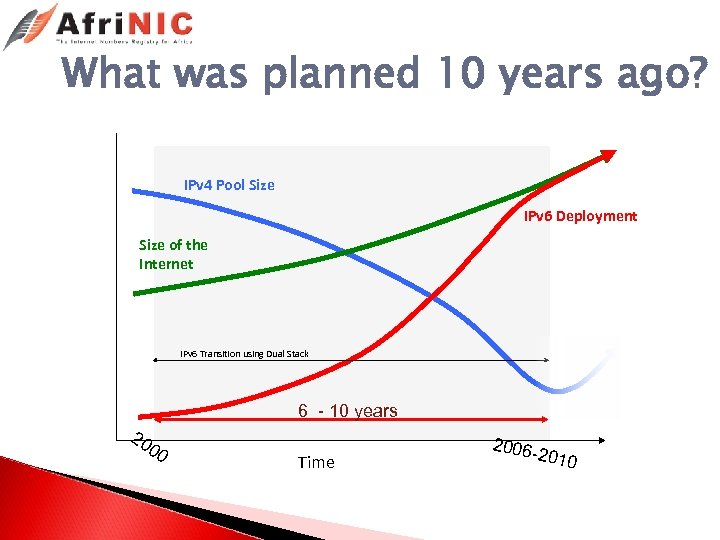 What was planned 10 years ago? IPv 4 Pool Size IPv 6 Deployment Size of the Internet IPv 6 Transition using Dual Stack 6 - 10 years 20 00 Time 2006 -2 010
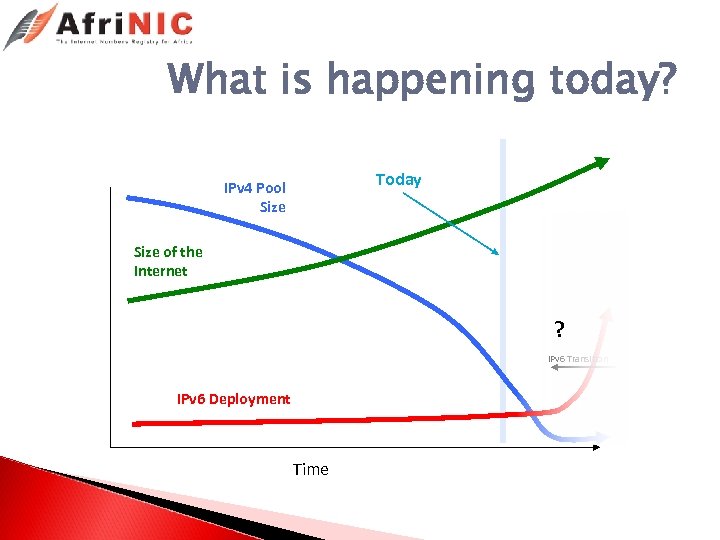 What is happening today? Today IPv 4 Pool Size of the Internet ? IPv 6 Transition IPv 6 Deployment Time
 Few challenges for IPv 6 in Africa IPv 6 adoption is an important challenge worldwide but more importantly in our region: ◦ Perception of lack of demand from the users ◦ ◦ ◦ “Lack of end-users applications” Perception of huge costs related to transitioning Lack of awareness on real IPv 6 development cases Lack of transparent compatibility with IPv 4 Passiveness regarding IP issues in our community People are still straggling to properly deploy IPv 4 Networks: Too extensive usage of NAT in the region
 Killer application? IPv 6 is NOT a feature! While everyone wants a source of additional revenue, “fundamental transport is difficult to monetize” (Tony Hain – Cisco System)). ◦ Carriers use IPv 6 deployment cost as a defensive play but the reality is that they will still have to absorb the costs of an IPv 4 routing system (that will be growing unconstrained once the central pool is gone and addresses may started to be traded) … and this until they can get their customers to leave IPv 4 behind. ◦ Revenue generating applications are most likely to be peer-to-peer, because client-server can be hacked in using nat.
 Or Killer constraint? Google Maps opens ~ 70 parallel connections i. Tunes store has been shown to open as many as 300 parallel connections New apps that have not emerged yet ? ? ? ◦ IPv 4/nat multiplexes multiple users through the port range, so 64 k divided by 300 parallel connections results in ~200 customers per ISP based nat address (assuming each customer is only allowed to run one simultaneous instance of i. Tunes or similar apps).
 Cost of deployment The largest cost for most network managers will be training. ◦ It is packet based (IP), but other than that it is a different protocol. Another major cost will be retooling custom apps and scripts. ◦ Frequent shortcuts assuming an address will always be 32 bits. Is IPv 6 deployment could be seen as an opportunity to integrate other engineering changes that have not been large enough to justify by themselves? ◦ What costs will be attributed to IPv 6 vs. general evolution?
 Africa & IPv 6 As requested by the community during Afri. NIC-2 meeting (Maputo), the project aims to create an environment which favors smooth transition to IPv 6 in Africa through: ◦ Creation of an environment which allows exchange within IPv 6 initiatives throughout the Continent. (afripv 6 -discuss@afrinic. net) ◦ Creation of an IPv 6 Forum for Africa. (3 rd during Afri. NIC-9) ◦ Conducting IPv 6 Training across the Continent. ◦ Providing Lab and Internships to Engineers to play live with IPv 6 ◦ Supporting research based on IPv 6 and Mobile Infrastructure ◦ Creation of an IPv 6 ready platform to offer v 6 support to the community (IPV 6 ready at IXP to offer tunnels). ◦ Bringing major African connectivity/content providers to the game by encouraging them to provide v 6 ready services. ◦ Developing a case study documentation for the use of African operators (based on local experiences).
 Africa & IPv 6 (con’t) We have identified in 2005 that training is one of the key factors that will support IPv 6 deployment. ◦ More than 35 trainings conducted in different 30 countries throughout Africa (1 -3 day events) Policy proposal to ease IPv 6 allocation in our region has been proposed and adopted by the community in 2006. ◦ No need to justify 200 end-users allocation to get IPv 6 addresses. ◦ Waived any additional fee for IPv 6 allocations. ◦ Integrate ‘IPv 6’ into Afri. NIC training program. End User assignment Policy proposed and adopted in 2007
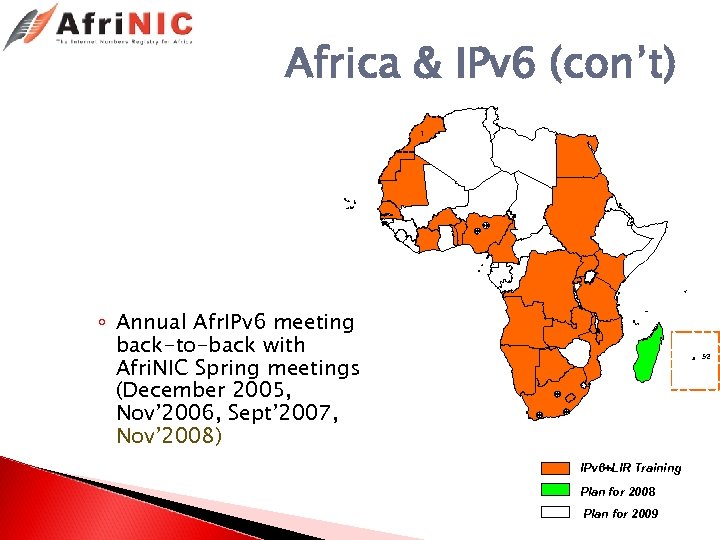 Africa & IPv 6 (con’t) 1 ◦ Annual Afr. IPv 6 meeting back-to-back with Afri. NIC Spring meetings (December 2005, Nov’ 2006, Sept’ 2007, Nov’ 2008) 52 IPv 6+LIR Training Plan for 2008 Plan for 2009
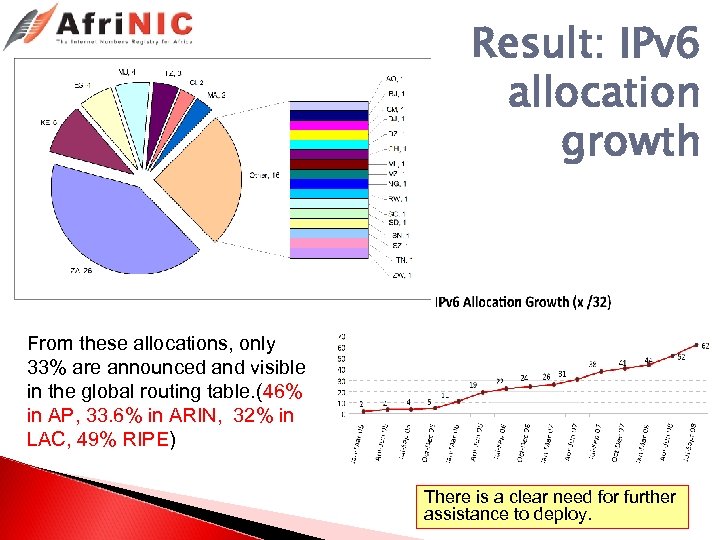 Result: IPv 6 allocation growth From these allocations, only 33% are announced and visible in the global routing table. (46% in AP, 33. 6% in ARIN, 32% in LAC, 49% RIPE) There is a clear need for further assistance to deploy.
 So how Africa is preparing for IPv 6? ◦ Very slowly ◦ Following the trend of the rest of the world ◦ Trying to understand what is on stake We need to ◦ Push for more action from Operators (Train, Plan and implement Dualstack, allow user to access v 6 network) ◦ Be innovative and explore the opportunity of developing application that can directly benefit from IPv 6 and its “features”. ◦ Involve Research and Education community into the game. Governments need to lead by making sure: their own internet‐based services are IPv 6‐ready (early adopters) The public is aware and educated on the transition Appropriate policies are developed to foster national transition to IPv 6 …. Education seems to be the critical part of this long journey
 Conclusion IPv 6 is an opportunity for Africa (innovation and sustainable growth) With our initiatives we hope to make Operators in Africa not be the one who are always catching up with other. We would like to bring this campaign to another level and create an environment for an exchange of information, training, and for sharing best practices. Having our own Regional Internet Number Registry, we have the opportunity to define policies and plans that will help IPv 6 adoption and support a sustainable Internet growth in Africa
 Thank you